MIT Video Tool Amplifies Micro-Motions to Track Vitals in Real Time
Miki Rubinstein
Applying spatial decomposition and temporal bandpass filtering to standard video amplifies imperceptible color and physical shifts, enabling non-contact vital sign extraction that matches clinical monitors.
AI-assisted summary of Eulerian Video Magnification — original source. Check the original for full context.
Source published:
Key ideas
- Researchers present Eulerian Video Magnification, a computational framework that combines spatial Laplacian decomposition and temporal bandpass filtering to amplify imperceptible video variations in real time without explicit feature tracking. (0:00)
- By isolating frequencies corresponding to human heart rates, the system amplifies subtle facial chromatic shifts to non-invasively measure pulse, demonstrating clinical accuracy against standard hospital equipment on a newborn. (1:24)
- Using a first-order Taylor series approximation, the method scales temporal signal derivatives to amplify physical spatial displacements while strictly maintaining the original temporal frequency of the motion. (2:08)
- The framework enables diverse cross-disciplinary applications, including non-contact infant respiration monitoring, acoustic analysis of individual guitar strings, and mechanical diagnostics of DSLR mirror recoil. (2:08)
Detailed notes
## Background Published on YouTube by Miki Rubinstein on May 23, 2012, this video serves as the visual accompaniment to the SIGGRAPH 2012 paper 'Eulerian Video Magnification for Revealing Subtle Changes in the World.' The project description directs viewers to the research team's MIT CSAIL project page for deeper technical details.
## TL;DR Eulerian Video Magnification introduces a computational technique that reveals imperceptible temporal changes in standard video by combining spatial Laplacian pyramid decomposition with temporal bandpass filtering. Operating in real time as a temporal microscope, the system allows users to interactively tune frequency bands and magnification sliders to visualize minute variations. The approach effectively amplifies subtle color fluctuations to extract vital signs, such as pulse rate and infant respiration, with clinical accuracy across various skin tones. Furthermore, by linking temporal filtering to a first-order spatial Taylor series approximation, the method amplifies physical motions to expose unseen mechanical vibrations in guitar strings and camera bodies.
## Atmosphere & style The presentation carries the poised, measured tone of a high-level academic research paper, prioritizing clarity and scientific precision over flashiness. Watching the footage evokes quiet awe as standard consumer recordings are peeled back to reveal invisible biological pulses, infant breathing, and hidden mechanical tremors. The narrator delivers deliberate, clinical explanations that ground each demonstration, creating the experience of looking through an optical microscope that uncovers a hidden layer of physical reality.
## Bulletin - [00:00](https://www.youtube.com/watch?v=ONZcjs1Pjmk&t=0s) Researchers present Eulerian Video Magnification, a computational framework that combines spatial Laplacian decomposition and temporal bandpass filtering to amplify imperceptible video variations in real time without explicit feature tracking. - [01:24](https://www.youtube.com/watch?v=ONZcjs1Pjmk&t=84s) By isolating frequencies corresponding to human heart rates, the system amplifies subtle facial chromatic shifts to non-invasively measure pulse, demonstrating clinical accuracy against standard hospital equipment on a newborn. - [02:08](https://www.youtube.com/watch?v=ONZcjs1Pjmk&t=128s) Using a first-order Taylor series approximation, the method scales temporal signal derivatives to amplify physical spatial displacements while strictly maintaining the original temporal frequency of the motion. - [02:08](https://www.youtube.com/watch?v=ONZcjs1Pjmk&t=128s) The framework enables diverse cross-disciplinary applications, including non-contact infant respiration monitoring, acoustic analysis of individual guitar strings, and mechanical diagnostics of DSLR mirror recoil.
## Key takeaways - [00:00](https://www.youtube.com/watch?v=ONZcjs1Pjmk&t=0s) Eulerian Video Magnification amplifies invisible temporal variations in standard video sequences without tracking physical features explicitly. - [00:00](https://www.youtube.com/watch?v=ONZcjs1Pjmk&t=0s) The spatial pipeline decomposes video frames into separate frequency bands using a multiscale Laplacian pyramid. - [00:00](https://www.youtube.com/watch?v=ONZcjs1Pjmk&t=0s) Temporal bandpass filtering isolates specific frequency bands across the temporal sequence of pixel values. - [00:00](https://www.youtube.com/watch?v=ONZcjs1Pjmk&t=0s) Magnified temporal signals are added back to the original frames and collapsed across pyramid levels to reconstruct the final video. - [00:00](https://www.youtube.com/watch?v=ONZcjs1Pjmk&t=0s) The system operates in real time as an interactive temporal microscope, allowing users to tune cutoff frequencies and amplification factors dynamically. - [00:00](https://www.youtube.com/watch?v=ONZcjs1Pjmk&t=0s) Higher amplification factors boost the visibility of minute changes, but excessive magnification introduces noticeable visual artifacts. - [01:24](https://www.youtube.com/watch?v=ONZcjs1Pjmk&t=84s) Targeting standard heart rate frequencies amplifies subtle facial redness changes caused by the circulation of oxygenated blood. - [01:24](https://www.youtube.com/watch?v=ONZcjs1Pjmk&t=84s) The physiological visualization technique remains robust across different skin tones and small involuntary subject movements. - [01:24](https://www.youtube.com/watch?v=ONZcjs1Pjmk&t=84s) Non-contact pulse extraction from standard video of a newborn infant was validated against synchronized hospital diagnostic monitors. - [02:08](https://www.youtube.com/watch?v=ONZcjs1Pjmk&t=128s) Temporal filtering acts as a first-order Taylor series approximation of spatial wave translation, extending the technique to physical motion magnification. - [02:08](https://www.youtube.com/watch?v=ONZcjs1Pjmk&t=128s) Synthetic benchmarks confirm that spatial motion can be exaggerated while strictly preserving the temporal frequency of the underlying movement. - [02:08](https://www.youtube.com/watch?v=ONZcjs1Pjmk&t=128s) Medical uses include non-contact monitoring of infant respiration for SIDS detection and visualizing subcutaneous arterial pulsation. - [02:08](https://www.youtube.com/watch?v=ONZcjs1Pjmk&t=128s) In acoustic analysis, frequency-selective filtering isolates and magnifies the fundamental vibration of individual plucked guitar strings. - [02:08](https://www.youtube.com/watch?v=ONZcjs1Pjmk&t=128s) Mechanical diagnostic applications reveal internal camera vibrations caused by the rapid flipping of a DSLR mirror during continuous shooting.
## Detailed walkthrough ### [00:00](https://www.youtube.com/watch?v=ONZcjs1Pjmk&t=0s) Eulerian Video Magnification Pipeline and Real-Time Control
Eulerian Video Magnification is presented as a method designed to amplify and reveal subtle temporal variations in standard video sequences that are invisible to the naked human eye. Rather than tracking features explicitly, the technique combines spatial and temporal processing to accentuate fine changes across time. The pipeline begins by taking a standard video as input and decomposing each frame into various spatial frequency bands using a Laplacian pyramid. Across the sequence of pixel values over time, a temporal bandpass filter is applied to isolate the specific frequency band of interest. Once extracted, this temporal signal is magnified by a user-defined amplification factor, added back onto the original frame representations, and finally collapsed across the pyramid levels to reconstruct the output video.
```mermaid flowchart LR accTitle: Eulerian Video Magnification Pipeline accDescr: Video frames undergo Laplacian pyramid decomposition, temporal bandpass filtering, amplification, and reconstruction. subgraph SpatialDecomp["Spatial Processing"] A["Input Video Frames"] --> B["Laplacian Pyramid Decomposition"] end subgraph TemporalProc["Temporal Processing"] B --> C["Temporal Bandpass Filter"] C --> D["Signal Amplification"] end subgraph Reconstruction["Reconstruction"] D --> E["Add Back to Original Frames"] E --> F["Collapse Pyramid to Output Video"] end ```
The system is efficient enough to run in real time, functioning interactively as what the narrator characterizes as a temporal microscope: “Our technique can be run in real time, essentially serving as a microscope for temporal variations.” A user interface enables interactive exploration by letting users adjust the high and low cutoff frequencies of the temporal bandpass filter, alongside a slider to scale the amplification factor. Increasing the amplification factor boosts the visibility of minute fluctuations in the scene; however, the narrator cautions that this creates an operational tradeoff: “Changing these parameters can make variations in the scene more apparent, but large amplification can add artifacts to the result as discussed in the paper.”
- **Spatial decomposition**: Multiscale Laplacian pyramid separates spatial frequency bands. - **Temporal filtering**: Bandpass filter targets specific oscillation frequencies across time. - **Interactivity**: User-adjustable high/low cutoff frequencies and magnification slider operate in real time.
---
[01:24](https://www.youtube.com/watch?v=ONZcjs1Pjmk&t=84s) Visualizing Physiological Signals: Heart Rate and Newborn Monitoring
The framework is applied to reveal imperceptible biological phenomena, most notably the human pulse. By configuring the temporal filter to isolate a narrow band around the standard human heart rate, the algorithm amplifies subtle chromatic shifts across the face, exposing the rhythmic flush of redness as oxygenated blood circulates through facial tissue with each heartbeat. The narrator notes that “this approach is robust to different skin tones and small motions,” making it an effective non-contact tool for physiological measurement.
Beyond qualitative visualization, the method supports automated extraction of vital signs directly from standard consumer video recordings. In a clinical demonstration, Eulerian magnification is used to extract heart rate readings from video footage of a newborn infant. The extracted pulse measurements are validated against simultaneous, synchronized readouts from standard hospital monitoring equipment, demonstrating high diagnostic accuracy without requiring physical sensors attached to fragile skin.
- **Pulse detection**: Amplifies cyclic color changes corresponding to blood perfusion. - **Clinical validation**: Non-contact vital sign extraction tested on a newborn matches hospital vitals monitors in real time. - **Robustness**: Tolerates subject movement and functions reliably across diverse skin pigmentation.
---
[02:08](https://www.youtube.com/watch?v=ONZcjs1Pjmk&t=128s) From Color Changes to Motion Amplification and Everyday Applications
Temporal color filtering can be extended to amplify spatial motion. Using a 1D wave translation model, the narrator explains that for smooth images undergoing small displacements, temporal filtering provides a first-order Taylor series approximation of a translated spatial wave. Scaling this temporal derivative signal approximates a larger spatial shift, effectively converting subtle physical movements into exaggerated motions. A synthetic benchmark of oscillating blobs demonstrates that applying a temporal bandpass filter isolates and magnifies specific motion frequencies while strictly preserving the temporal frequency of the original movement: “Notice that the same temporal filter is applied to all pixels and while the spatial motion is amplified, the temporal frequency is maintained.”
```mermaid flowchart TD accTitle: Motion Amplification Concept accDescr: Relationship between spatial motion, temporal filtering, and selective frequency amplification. A["Subtle Spatial Motion"] --> B["Temporal Bandpass Filtering"] B --> C["Amplified Temporal Signal"] C --> D["Approximated Larger Translation"] D --> E["Motion-Amplified Video (Preserved Frequency)"] ```
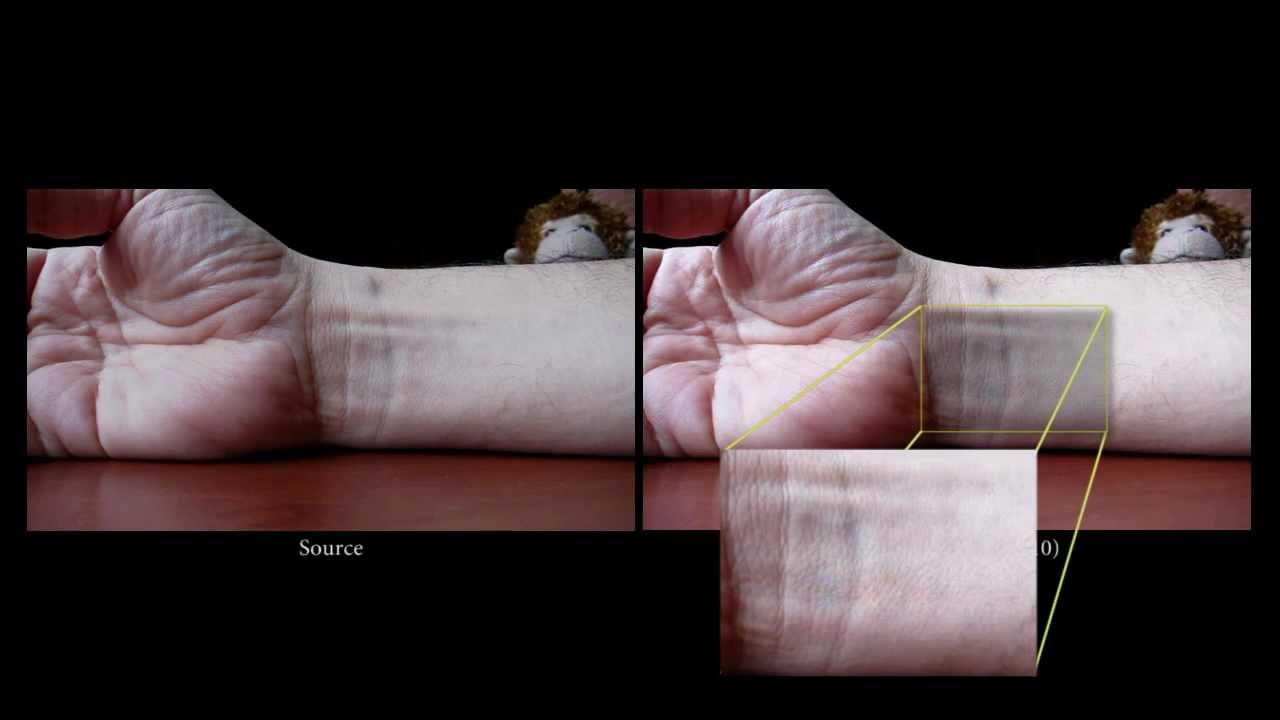
This capability translates into a broad range of scientific, medical, and mechanical use cases: - **Medical diagnostics**: Visualizing the pulsation of subcutaneous arteries and non-contact monitoring of infant respiration for potential Sudden Infant Death Syndrome (SIDS) detection. - **Acoustic analysis**: Tuning the filter to the fundamental frequencies of individual acoustic guitar strings to selectively isolate and amplify the vibration of specific plucked strings. - **Transient scene changes**: Visualizing subtle movements in static environments, such as blending two still photographs taken 15 seconds apart to detect minute shifts. - **Mechanical diagnostics**: Amplifying the internal mechanical vibrations and physical kick of a DSLR camera body caused by the rapid flipping of its internal mirror during a continuous high-speed photo burst.
## Notable quotes > [00:00](https://www.youtube.com/watch?v=ONZcjs1Pjmk&t=0s) Our technique can be run in real time, essentially serving as a microscope for temporal variations.
## Mentioned Eulerian Video Magnification, SIGGRAPH 2012, Miki Rubinstein, Sudden Infant Death Syndrome (SIDS), Laplacian pyramid, Taylor series
## Video description The video accompanying our SIGGRAPH 2012 paper "Eulerian Video Magnification for Revealing Subtle Changes in the World". Read more about it here: http://people.csail.mit.edu/mrub/vidmag/
[Source](https://www.youtube.com/watch?v=ONZcjs1Pjmk)