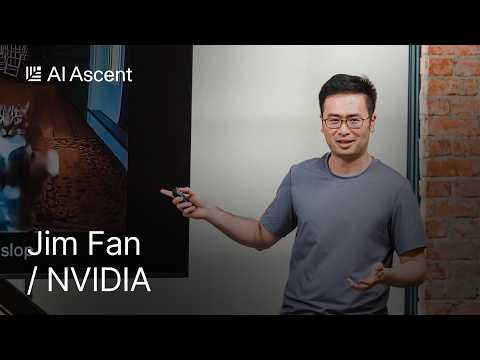
Nvidia Prepares 'World Action Models' to Skip Robot Teleoperation
Sequoia Capital
Nvidia predicts humanity will reach the absolute end of the robotics technology tree by 2040 by treating video and action as first-class citizens to copy the exponential scaling laws of large language models.
## Background
Published by Sequoia Capital on YouTube on April 30, 2026, this video features Nvidia's Jim Fan arguing that robotics is entering its end game by following an LLM-like playbook. The page description outlines 'the great parallel' where world models, egocentric video, and world action models are replacing older paradigms to achieve a physical Turing test within 2–3 years.
## TL;DR
In this presentation, Jim Fan outlines Nvidia's strategic roadmap for solving robotics by mimicking the evolutionary stages of Large Language Models. He introduces the transition from Vision-Language-Action models to World Action Models like 'Dreamer,' which learn physics directly through video predictive scaling. To overcome data bottlenecks, Nvidia leverages human wearables like Dex-UMI and neural simulators like 'Dream Dojo' to feed a log-linear scaling law for dexterity. Ultimately, Fan maps out a civilizational technology tree that predicts achieving a physical Turing test, software-configured robot fleets, and automated self-improving hardware by the year 2040.
## Atmosphere & style
The presentation is nostalgic yet high-energy and forward-looking, blending a sense of historic awe with playful tech-industry humor. Fan speaks with an infectious, youthful enthusiasm, joking about 'AI video slop' and expensive teleoperation hours while remaining deeply earnest about the exponential trajectory of AI. The narrative creates an inspiring, visionary arc that makes the audience feel as though they are standing on the precipice of a sci-fi future, culminating in a philosophical rally that they were born at the exact right moment in human history to witness and solve the robotics endgame.
## Key takeaways
- [00:02](https://www.youtube.com/watch?v=3Y8aq_ofEVs&t=2s) The "great parallel" proposes that robotics can achieve its end game by directly adapting the successful LLM progression from pre-training and alignment to reinforcement learning and autonomous research.
- [00:02](https://www.youtube.com/watch?v=3Y8aq_ofEVs&t=2s) The LLM community's rapid progress through step functions like GPT-3, InstructGPT, and o1 serves as a foundational blueprint for accelerating autonomous physical intelligence.
- [00:31](https://www.youtube.com/watch?v=3Y8aq_ofEVs&t=31s) Vision-Language-Action (VLA) models act more like "LVAs" because their parameters heavily prioritize language semantics over the physical verbs and complex mechanics needed for robotics.
- [00:31](https://www.youtube.com/watch?v=3Y8aq_ofEVs&t=31s) World Action Models (WAMs) utilize video generative pre-training at scale, enabling physical properties like gravity, reflections, and lighting to emerge naturally through next-state pixel prediction.
- [00:31](https://www.youtube.com/watch?v=3Y8aq_ofEVs&t=31s) Nvidia's "Dreamer" WAM performs action fine-tuning by jointly decoding next world states and high-dimensional motor actions, allowing zero-shot physical execution based on visual planning.
- [07:43](https://www.youtube.com/watch?v=3Y8aq_ofEVs&t=463s) Traditional teleoperation data collection is severely limited by a physical bottleneck of human labor and robot hardware downtime.
- [07:43](https://www.youtube.com/watch?v=3Y8aq_ofEVs&t=463s) Data wearables like the Universal Manipulation Interface (UMI) and Dex-UMI exoskeleton bypass the robot body, allowing humans to collect high-quality, natural manipulation data rapidly.
- [07:43](https://www.youtube.com/watch?v=3Y8aq_ofEVs&t=463s) Nvidia's Ego Scale framework leverages 21,000 hours of egocentric human video to achieve highly dexterous tasks, requiring less than 0.1% high-precision robot data in the overall training mix.
- [07:43](https://www.youtube.com/watch?v=3Y8aq_ofEVs&t=463s) A clean log-linear mathematical neural scaling law exists for dexterity, directly linking pre-training hours of egocentric video to optimal validation loss.
- [13:59](https://www.youtube.com/watch?v=3Y8aq_ofEVs&t=839s) Scaling environments for reinforcement learning requires a "real-to-sim-to-real" pipeline that converts standard 3D scans of physical objects into digital cousins inside physics simulators.
- [13:59](https://www.youtube.com/watch?v=3Y8aq_ofEVs&t=839s) Nvidia's "Dream Dojo" operates as a purely data-driven neural simulator, bypassing classical physics engines by translating action signals directly into real-time RGB frames and sensor states.
- [13:59](https://www.youtube.com/watch?v=3Y8aq_ofEVs&t=839s) In post-training for robotics, compute directly equals environments, which directly equals data generation.
- [16:59](https://www.youtube.com/watch?v=3Y8aq_ofEVs&t=1019s) The "physical Turing test" is estimated to be only 2 to 3 years away, marking the milestone where a robot's physical dexterity becomes indistinguishable from a human's.
- [16:59](https://www.youtube.com/watch?v=3Y8aq_ofEVs&t=1019s) The creation of a physical API will enable software-configured robot fleets to operate fully autonomous lights-out factories and automated wet labs.
- [16:59](https://www.youtube.com/watch?v=3Y8aq_ofEVs&t=1019s) The final stage of the robotics technology tree is physical auto research, where closed-loop systems autonomously design and build the next generation of robots.
- [18:51](https://www.youtube.com/watch?v=3Y8aq_ofEVs&t=1131s) Driven by exponential technological advancement, the trajectory from AlexNet in 2012 to current agentic research in 2026 suggests humanity will reach the end of the robotics technology tree by 2040.
## Detailed walkthrough
### [00:02](https://www.youtube.com/watch?v=3Y8aq_ofEVs&t=2s) The Great Parallel: Copying the LLM Success
Jim Fan, leader of the embodied autonomous research group (Nvidia Robotics), begins his presentation with a nostalgic trip down memory lane. He recalls a summer day in 2016, right in the very office where the event is hosted, when a man in a shiny leather jacket with "big biceps" hurled a large metal tray onto a table. That man was Jensen Huang, and the metal tray was the world's first DGX-1, bearing a handwritten inscription: "To Elon and the OpenAI team, to the future of computing and humanity..." As a young intern, Fan rushed to sign his name on it, right alongside Andrej Karpathy. Reflecting on how far the field has come, Fan quotes Ilya Sutskever's famous maxim: "If you believe in deep learning, deep learning will believe in you."
Over the last six years, large language models (LLMs) have progressed through distinct step functions: GPT-3 pre-training, InstructGPT supervised fine-tuning, o1 reasoning via reinforcement learning, and finally, autonomous research. Fan notes with playful jealousy that the LLM community is already "speed running AGI" and having the party of their lives. To bring robotics into this "end game," Fan proposes "the great parallel"—directly copying the LLM homework. Instead of simulating strings of text, robotics must simulate the next physical world state, align it through action fine-tuning, and let reinforcement learning carry it the last mile.
- **Key Milestones in LLM Progress:**
- **GPT-3 (2020):** Pre-training to learn the rules of grammar and simulate how thoughts, code, and strings unfold.
- **InstructGPT (2022):** Supervised fine-tuning to align the simulation to do useful work.
- **o1:** Reinforcement learning to surpass imitation learning.
- **Auto Research:** Accelerating the entire loop beyond human capability.
---
[00:31](https://www.youtube.com/watch?v=3Y8aq_ofEVs&t=31s) From VLAs to World Action Models (WAMs)
To play the robotics end game, researchers must tackle two core pillars: model strategy and data strategy. For the past three years, the model landscape has been dominated by Vision-Language-Action (VLA) models like PaLM-E and RT-2. However, Fan argues these are actually "LVAs" because the vast majority of their parameters are dedicated to language, making language a first-class citizen while vision and action are secondary. While VLAs excel at encoding nouns and semantic knowledge—such as generalizing to move a Coke can to a picture of Taylor Swift—they are "head-heavy in the wrong places" and struggle with physics and verbs.
The second pre-training paradigm shifts the focus to video generative models, which Fan jokingly refers to as "AI video slop" (like internet clips of cats playing banjos). Despite the humor, models like Sora and VEO3 are internally learning to simulate the next world state. By predicting pixels at scale, physical properties like gravity, buoyancy, lighting, reflection, and refraction emerge naturally without being explicitly coded. To make these world models useful for robotics, Nvidia introduces "Dreamer," a World Action Model (WAM) that performs action fine-tuning. Dreamer jointly decodes the next world states and high-dimensional continuous motor actions, allowing it to "dream" a few seconds into the future and execute zero-shot physical tasks.
- **VLA vs. WAM:**
- **VLAs (Vision-Language-Action):** Great at semantic knowledge and nouns, but weak on physics and verbs.
- **WAMs (World Action Models):** Treat vision and action as first-class citizens; physics and visual planning emerge from predicting next-state pixels.
- **Dreamer:** A WAM that visualizes its own future actions. If the video prediction is accurate, the action succeeds; if it hallucinates, the action fails.
---
[07:43](https://www.youtube.com/watch?v=3Y8aq_ofEVs&t=463s) Breaking the Teleoperation Bottleneck with Sensorized Human Data
Moving to data strategy, Fan displays a clip of Nvidia's Chief Scientist, Bill Dally, performing teleoperation in the lab. "Given his salary," Fan jokes, "I think this is by far the most expensive teleop trajectory ever collected." While teleoperation rigs and VR headsets have defined the last three years, they are fundamentally bottlenecked by a physical limit of 24 hours per robot per day—and realistically, only about 3 hours of actual collection due to robots "throwing tantrums."
To scale data collection, researchers developed the Universal Manipulation Interface (UMI), where a human simply wears a robot gripper on their hand to collect data directly, bypassing the rest of the robot body. Nvidia took this further with "Dex-UMI," an exoskeleton with a one-to-one mapping to five-finger dexterous robot hands. Comparing the methods, a skilled PhD student using traditional teleoperation is slow and has a low success rate, whereas a human wearing the Dex-UMI exoskeleton collects high-quality data rapidly. This data is used to train autonomous policies with zero teleoperation data in the loop.
- **Data Collection Methods Compared:**
- **Teleoperation:** Highly precise but extremely slow, expensive, and physically limited.
- **Data Wearables (UMI / Dex-UMI):** Bypasses the robot body, allowing humans to collect natural manipulation data rapidly.
- **Ego Scale:** Nvidia's framework pre-trained on 21,000 hours of in-the-wild egocentric human video (Ego-Exo) with zero robot data.
- **Ego Scale Training Mix:** Requires only 50 hours of high-precision motion-capture glove data and 4 hours of teleoperation (less than 0.1% of the total training mix) to achieve highly dexterous autonomous tasks like sorting cards, manipulating syringes, and folding shirts.
- **Neural Scaling Law for Dexterity:** A clean log-linear mathematical relationship discovered between pre-training hours of egocentric video and optimal validation loss.
---
[13:59](https://www.youtube.com/watch?v=3Y8aq_ofEVs&t=839s) Scaling Environments: Real-to-Sim-to-Real and Dream Dojo
The outer ring of the data strategy focuses on scaling environments for reinforcement learning. While frontier LLM labs spend massive budgets acquiring coding environments for RL, robotics must scale up physical and virtual environments. Running RL directly on real robots can push specific tasks to a 100% success rate—such as robots autonomously assembling GPUs—but scaling to millions of environments is impossible with physical hardware alone.
To solve this, Nvidia utilizes a "real-to-sim-to-real" pipeline. A user can take an iPhone photo of a room, pass it through a 3D world scan pipeline to extract interactive objects, and automatically synthesize them inside a classical physics simulator. These objects can then be infinitely varied to create "digital cousins." To move beyond classical graphics engines entirely, Nvidia developed "Dream Dojo," a neural simulator. Dream Dojo takes continuous action signals as input and outputs real-time RGB frames and sensor states. Operating purely on data without physics equations or graphics engines, it allows massively parallel RL to run across a mix of real robot stations, graphics cores, and heavy inference compute. As Jensen Huang famously says, "The more you buy, the more you save."
- **Dream Dojo:** A neural simulator that learns robot mechanics through a purely data-driven approach, generating synthetic sensor states and video frames for RL training.
- **The Post-Training Formula:** Compute = Environments = Data.
---
[16:59](https://www.youtube.com/watch?v=3Y8aq_ofEVs&t=1019s) Unlocking the Robotics Technology Tree
Using the video game *Civilization* as an analogy, Fan views his research as unlocking achievements on a "civilizational technology tree." He outlines the final three achievements required to complete the robotics end game, after which he jokes he can finally retire.
The first achievement is passing the "physical Turing test," where a spectator cannot distinguish between a human and a robot performing a physical task. Fan estimates this milestone is only 2 to 3 years away. The second is the "physical API," which allows fleets of robots to be configured via software APIs and command lines, enabling fully autonomous "lights-out factories" (printers of atoms that turn markdown files into physical products) and automated wet labs for scientific discovery. The final achievement is "physical auto research," where robots autonomously design, improve, and build the next generation of themselves.
- **The Civilizational Technology Tree for Robotics:**
- **Physical Turing Test:** Achieving human-level dexterity and efficiency (unit energy in, unit labor out).
- **Physical API:** Software-configurable robot fleets enabling lights-out manufacturing and automated chemistry/biology labs.
- **Physical Auto Research:** Closed-loop robotic self-improvement beyond human capability.
[18:51](https://www.youtube.com/watch?v=3Y8aq_ofEVs&t=1131s) The Exponential Path to the End of the Technology Tree
Reflecting on the staggering pace of artificial intelligence, the speaker traces the journey from the very first forward pass of AlexNet in 2012—a model that could barely distinguish a cat from a dog—to the present day in 2026, where the industry routinely discusses agentic autonomous research. By projecting this trajectory forward another 14 years to the year 2040, the speaker highlights that 2026 sits precisely in the middle of this timeline. Crucially, because technology advances exponentially rather than linearly, the progress over the next decade and a half will be even more radical.
With a lighthearted snort, the speaker declares with "95% certainty" that humanity will reach the absolute end of the technology tree by 2040, a milestone that many in the audience will live to see while still being relatively young. Closing on an inspiring, philosophical note, the speaker rallies the audience around their unique place in history, asserting that while their generation may have been born too late to explore the Earth and too early to explore the stars, they were "born just in time to solve robotics."
- **AlexNet (2012):** A foundational model that could barely recognize a cat versus a dog.
- **AI Ascent (2026):** The current state of technology, characterized by discussions around agentic autonomous research.
- **The End Game (2040):** The projected year for reaching the end of the technology tree, driven by exponential technological advancement.
- **Core Philosophy:** "If you believe in robotics, robotics will believe in you."
## Notable quotes
> [00:02](https://www.youtube.com/watch?v=3Y8aq_ofEVs&t=2s) To Elon and the OpenAI team, to the future of computing and humanity... — Jensen Huang
> [00:02](https://www.youtube.com/watch?v=3Y8aq_ofEVs&t=2s) If you believe in deep learning, deep learning will believe in you. — Ilya Sutskever
> [00:02](https://www.youtube.com/watch?v=3Y8aq_ofEVs&t=2s) speed running AGI — Jim Fan
> [00:02](https://www.youtube.com/watch?v=3Y8aq_ofEVs&t=2s) the great parallel — Jim Fan
> [00:31](https://www.youtube.com/watch?v=3Y8aq_ofEVs&t=31s) AI video slop — Jim Fan
> [00:31](https://www.youtube.com/watch?v=3Y8aq_ofEVs&t=31s) head-heavy in the wrong places — Jim Fan
> [07:43](https://www.youtube.com/watch?v=3Y8aq_ofEVs&t=463s) Given his salary, I think this is by far the most expensive teleop trajectory ever collected. — Jim Fan
> [07:43](https://www.youtube.com/watch?v=3Y8aq_ofEVs&t=463s) throwing tantrums — Jim Fan
> [13:59](https://www.youtube.com/watch?v=3Y8aq_ofEVs&t=839s) The more you buy, the more you save. — Jensen Huang
> [13:59](https://www.youtube.com/watch?v=3Y8aq_ofEVs&t=839s) Compute = Environments = Data. — Jim Fan
> [16:59](https://www.youtube.com/watch?v=3Y8aq_ofEVs&t=1019s) civilizational technology tree — Jim Fan
> [16:59](https://www.youtube.com/watch?v=3Y8aq_ofEVs&t=1019s) lights-out factories — Jim Fan
> [16:59](https://www.youtube.com/watch?v=3Y8aq_ofEVs&t=1019s) printers of atoms that turn markdown files into physical products — Jim Fan
> [18:51](https://www.youtube.com/watch?v=3Y8aq_ofEVs&t=1131s) born just in time to solve robotics — Jim Fan
> [18:51](https://www.youtube.com/watch?v=3Y8aq_ofEVs&t=1131s) If you believe in robotics, robotics will believe in you. — Jim Fan
## Mentioned
Nvidia, Jim Fan, Sequoia Capital, AI Ascent, Jensen Huang, Elon, OpenAI, DGX-1, Andrej Karpathy, Ilya Sutskever, GPT-3, InstructGPT, o1, PaLM-E, RT-2, Taylor Swift, Sora, VEO3, Dreamer, Bill Dally, Universal Manipulation Interface, Dex-UMI, Ego Scale, Ego-Exo, iPhone, Dream Dojo, Civilization, AlexNet
英伟达筹备“世界动作模型”以跳过机器人遥操作
英伟达预测,通过将视频和动作视为一等公民来复刻大语言模型的指数级扩展定律,人类将在2040年前达到机器人技术树的绝对终点。
在本次演讲中,Jim Fan概述了英伟达通过模仿大语言模型的演进阶段来攻克机器人技术的战略路线图。他介绍了从视觉-语言-动作模型向“Dreamer”等世界动作模型的转变,后者通过视频预测扩展直接学习物理规律。为了突破数据瓶颈,英伟达利用Dex-UMI等人类可穿戴设备以及“Dream Dojo”等神经模拟器,来满足灵巧操作的对数线性扩展定律。最终,Fan描绘了一副文明级别的技术树,预测到2040年将实现物理图灵测试、软件配置的机器人机队以及自动自我改进的硬件。
英伟达 Jim Fan 提出机器人学的“大平行”(The Great Parallel)路线,主张直接复刻 LLM 从预训练、对齐到强化学习与自主研究的发展路径,以世界模型替代语言模型加速具身智能演进。 (0:02)
针对传统 VLA 模型过度偏向语言语义而缺乏物理理解的短板,英伟达推出世界动作模型(WAM)Dreamer,通过视频生成预训练模拟物理世界,并结合动作微调实现端到端的物理任务执行。 (0:31)
为突破人类遥操作的数据采集瓶颈,英伟达采用 Dex-UMI 外骨骼及 EgoScale 框架,基于 2.1 万小时第一人称人类视频预训练,仅需不足 0.1% 的机器人本体数据即可掌握高难度灵巧操作。 (7:43)
Fan 预计机器人将在 2 至 3 年内通过物理图灵测试,并有 95% 的把握在 2040 年前彻底点满包含物理 API 与自主迭代研发在内的机器人科技树。 (16:59)
Reading summary
Jim Fan, leader of Nvidia's embodied autonomous research group, argues that robotics can match the rapid ascent of large language models by adapting their developmental playbook—replacing text tokens with world-state predictions, scaling human demonstration data via wearables, and generating reinforcement learning environments through neural simulation.
Shift from Language Models to World Action Models (0:31)
Fan contends that prevailing Vision-Language-Action (VLA) models such as RT-2 and PaLM-E dedicate disproportionate parameter capacity to language processing, making them proficient at semantic nouns but fundamentally weak at physical verbs and dynamics. In contrast, large-scale video generative models like Sora and VEO3 implicitly learn foundational physical rules—such as gravity, buoyancy, reflection, and lighting—simply by predicting subsequent pixels across massive visual datasets.
To bridge generative video and physical control, Nvidia developed "Dreamer," categorized as a World Action Model (WAM). Dreamer jointly decodes prospective visual world states alongside high-dimensional, continuous motor actions. By visually projecting its actions several seconds into the future, the model executes zero-shot manipulation tasks, succeeding when its internal video simulation accurately predicts the physical interaction.
Scaling Demonstration Data via Wearable Human Interfaces (7:43)
Traditional robotic teleoperation faces a severe throughput ceiling, bounded by hardware downtime and human labor limits to roughly three usable recording hours per robot each day. To scale data capture without physical robots, researchers use data wearables such as the Universal Manipulation Interface (UMI) and Nvidia's Dex-UMI exoskeleton, which maps human finger motion directly to five-finger dexterous robot hands to gather manipulation data at lower cost and higher speed.
Nvidia deployed this wearable data strategy in its "Ego Scale" framework, which was pre-trained on 21,000 hours of egocentric human video with zero robotic demonstrations. Fine-tuning required only 50 hours of motion-capture glove data and 4 hours of teleoperation—less than 0.1 percent of the total dataset—to execute delicate tasks like sorting cards, handling syringes, and folding shirts. Fan notes that this setup demonstrates a clean log-linear scaling law between egocentric video pre-training hours and validation loss.
Generating Parallel Environments with Neural Simulation (13:59)
While physical reinforcement learning can push specialized tasks—such as automated GPU assembly—to a 100 percent success rate, scaling hardware across millions of diverse training environments is impractical. Nvidia addresses this through a "real-to-sim-to-real" pipeline, converting smartphone 3D room scans into physics engine assets and procedurally generating synthetic variations termed "digital cousins."
To bypass the limits of standard physics engines entirely, Nvidia introduced "Dream Dojo," a data-driven neural simulator. Rather than executing mathematical physics equations, Dream Dojo accepts continuous action signals and outputs real-time RGB video and sensor states directly from data. This architecture allows reinforcement learning to run concurrently across real hardware stations and massive inference compute, operationalizing the principle that compute directly substitutes for physical training environments.
The Robotics Technology Tree and Projected Milestones (16:59)
Fan outlines the trajectory of robotics as a three-stage civilizational technology tree. The first milestone is a "physical Turing test," where a robot's dexterity and energy efficiency are indistinguishable from a human's, which Fan estimates is two to three years away. The second milestone is a "physical API" allowing software commands to orchestrate robot fleets in fully autonomous, lights-out manufacturing plants and automated wet laboratories. The final milestone is "physical auto research," wherein robots autonomously design and assemble future generations of hardware.
Comparing the field's trajectory from AlexNet in 2012 to agentic systems in 2026, Fan highlights the compounding effect of exponential growth over linear projections. Based on this historical curve, Fan forecasts with a stated 95 percent certainty that the robotics technology tree will be fully achieved by 2040.
Fan's framework hinges on the premise that physical dynamics can be largely solved through video pre-training and neural simulation. However, his aggressive timeline—including achieving a physical Turing test within two to three years and reaching the end of the robotics technology tree by 2040—represents an optimistic forecast that assumes hardware scaling and neural simulators can reliably overcome real-world physical edge cases without severe physical bottlenecks.
[0:02] Jensen Huang: To Elon and the OpenAI team, to the future of computing and humanity...
[0:02] Ilya Sutskever: If you believe in deep learning, deep learning will believe in you.
[0:02] Jim Fan: speed running AGI
[0:02] Jim Fan: the great parallel
[0:31] Jim Fan: AI video slop
[0:31] Jim Fan: head-heavy in the wrong places
[7:43] Jim Fan: Given his salary, I think this is by far the most expensive teleop trajectory ever collected.
[7:43] Jim Fan: throwing tantrums
[13:59] Jensen Huang: The more you buy, the more you save.
[13:59] Jim Fan: Compute = Environments = Data.
[16:59] Jim Fan: civilizational technology tree
[16:59] Jim Fan: lights-out factories
[16:59] Jim Fan: printers of atoms that turn markdown files into physical products
[18:51] Jim Fan: born just in time to solve robotics
[18:51] Jim Fan: If you believe in robotics, robotics will believe in you.
Original transcript
[0:02] And up first, I'm delighted to introduce
[0:04] my friend Jim Fan.
[0:06] Uh Jim leads the embodied autonomous
[0:08] research uh group at Nvidia, otherwise
[0:10] known as Nvidia robotics.
[0:12] Um
[0:13] I think that robot robots are just one
[0:15] of the most thrilling things that's
[0:16] going to happen. Uh a car basically is a
[0:18] big robot, but I'm excited for robots
[0:19] can go beep boop and lift things for us.
[0:22] And so, Jim was Jim was a standout at
[0:24] last year's AI Ascent, and we're
[0:26] delighted to have you back.
[0:28] Thanks, [applause] everyone. Thanks.
[0:30] So, it was a summer day in 2016.
[0:32] Actually, right in this office that
[0:35] we're sitting in.
[0:36] >> [snorts]
[0:37] >> There's a guy in shiny leather jacket,
[0:39] you know, big biceps, hurling this large
[0:42] metal tray.
[0:43] And on this
[0:45] large piece of metal, he wrote, "To Elon
[0:48] and the OpenAI team, to the future of
[0:50] computing and humanity, I present you
[0:52] the world's first DGX-1."
[0:55] So, that was the first time I met
[0:56] Jensen.
[0:57] And as any good intern would do, I
[1:00] rushed to getting line to sign my name
[1:02] on it.
[1:03] So, can you spot it, my name?
[1:05] It's here. And can you spot another?
[1:08] That's Andre, right there.
[1:09] So, Andre, we're going to the Computer
[1:11] History Museum.
[1:13] I feel like a dinosaur.
[1:16] You know, back then, I had no clue what
[1:19] I was signing up for.
[1:21] And then, no one can describe what
[1:23] happened next better than Ilya himself.
[1:26] If you believe in deep learning, deep
[1:28] learning
[1:29] will believe in you.
[1:31] And oh boy, did deep learning believe in
[1:33] all of us big time.
[1:36] Three step functions, six years.
[1:39] That's how all it took to bring us here
[1:41] today.
[1:42] The first tick, GPT-3,
[1:44] pre-training.
[1:46] Next token prediction is really about
[1:48] learning the rules of grammar, the shape
[1:50] of language. It's about simulating how
[1:53] thoughts and code and strings in general
[1:56] should unfold.
[1:57] 2022 Instruct GPT
[2:00] supervised fine-tuning aligned the
[2:02] simulation to do useful work.
[2:05] 01 reasoning
[2:07] using reinforcement learning to surpass
[2:09] imitation learning and finally auto
[2:11] research accelerating the whole loop
[2:14] beyond what's humanly possible.
[2:17] So, as Andre said
[2:18] all the labs are getting to the final
[2:20] boss fight.
[2:22] So, for LLMs
[2:24] they're in the thick of the end game.
[2:27] And honestly, I'm very jealous.
[2:29] Look at how happy Andre was, big smile
[2:31] on his on his face.
[2:33] The LLM folks
[2:35] are having the party of their lifetime.
[2:37] They're speed running AGI on mystical
[2:40] creatures literally called mythos.
[2:43] So, why can't robotics get a piece of
[2:45] fun?
[2:47] So, as any self-respecting scientist
[2:49] would do
[2:50] I copy homework and I give it a new
[2:52] name.
[2:53] I call it the great parallel.
[2:56] So, instead of simulating strings
[2:58] can we simulate next physical world
[3:00] state?
[3:02] And then we can align through action
[3:03] fine-tuning
[3:04] onto a thin slice of that simulation
[3:06] that matters for real robots.
[3:09] And we let reinforcement learning carry
[3:12] the last mile.
[3:14] And that's it.
[3:16] The great parallel copying the LLM
[3:17] success.
[3:18] If you can't beat them, join them.
[3:20] So, please join me in a new episode
[3:23] robotics the end game.
[3:26] I'm sorry, I just couldn't resist. Nano
[3:27] bananas too good. Thanks, Demis.
[3:31] So, how do we play the end game? It
[3:33] boils down to two things, model strategy
[3:35] and data strategy.
[3:37] Let's look at the model first.
[3:39] The last 3 years
[3:41] were dominated by VLAs or visual
[3:44] language action models and models like
[3:46] PaLM and Goot fall in this category.
[3:49] So, we assume that the pre-training is
[3:51] done by a VLA
[3:52] and we simply graph an action head on
[3:54] top of it.
[3:56] But really, if you think about these
[3:57] models, they're LVAs because the most
[4:00] amount of parameters are dedicated to
[4:02] language. So, language is first-class
[4:05] citizen followed by vision and action.
[4:08] And by design, VOAs are great at
[4:10] encoding knowledge and nouns, but not so
[4:13] much at physics and verbs. It's kind of
[4:16] head-heavy in the wrong places.
[4:18] This is my favorite example from the
[4:20] original VOA paper.
[4:22] Move the Coke can to a picture of Taylor
[4:24] Swift. Yes, it has not seen Taylor Swift
[4:26] before. Yes, it's able to generalize.
[4:29] But this is not quite the pre-training
[4:30] ability that we're looking for.
[4:32] So, what's the second pre-training
[4:34] paradigm?
[4:35] And I always thought that it would be
[4:37] something glorious.
[4:39] Unfortunate, it turns out
[4:42] that this is AI video slop that we call.
[4:45] You know, I can watch these cats playing
[4:47] banjo on security cam all day. It's peak
[4:49] internet.
[4:51] But really,
[4:53] look at this. No one can take this
[4:54] seriously
[4:56] >> [laughter]
[4:56] >> until we realize that these video models
[4:59] are learning to simulate next world
[5:01] state internally.
[5:03] So, these are some rollouts from VEO3.
[5:06] You can see that the models, they pick
[5:07] up gravity, buoyancy, lighting,
[5:10] reflection, refraction all by
[5:12] themselves. None of this is coded in.
[5:15] Physics emerge by predicting the next
[5:18] blob of pixels at scale.
[5:21] And even visual planning emerges.
[5:23] Look at how VEO solves these mazes.
[5:27] It solves them by running simulation
[5:29] forward in pixel space.
[5:32] And draw attention to the lower right
[5:34] corner here. This is my favorite
[5:35] example. Let's watch. And you blink if
[5:37] you miss how VEO3 solves this one.
[5:41] >> [laughter]
[5:43] >> It's super smart. You know, VEO3 figures
[5:45] out that if you're not looking, geometry
[5:47] is optional.
[5:49] I call this physics law.
[5:53] So, how do we make these world models
[5:55] useful?
[5:56] Well,
[5:57] we do action fine-tuning.
[5:59] We align the superposition of all
[6:02] possible future states and [snorts]
[6:04] collapse that onto a thin slice that
[6:07] matters for real robots.
[6:09] Introducing Dreamer.
[6:12] It's a new type of policy model
[6:14] that dreams a couple seconds into the
[6:16] future and acts accordingly.
[6:19] And you know that motor actions, they're
[6:21] high-dimensional continuous signals.
[6:24] So, that looks just like pixels.
[6:26] We can render it at the same time as we
[6:28] render the videos. So, Dreamer jointly
[6:32] decodes the next world states and next
[6:34] actions.
[6:35] And as a result, it's able to zero-shot
[6:38] solve tasks
[6:39] and verbs that it has never seen in
[6:41] training.
[6:44] And as a robot executes, we can
[6:45] visualize what it's dreaming about.
[6:47] And the correlation is very tight.
[6:49] If the video prediction works, the
[6:51] action works.
[6:52] If the video hallucinates, the action
[6:54] fails.
[6:55] So, once again, vision and action are
[6:57] now first-class citizens.
[7:00] And we have a lot of fun with Dreamer.
[7:02] So, we just roll the robot around in our
[7:04] lab and then type random things into the
[7:06] prompt box.
[7:08] And of course, Dreamer is not going to
[7:10] get all of these tasks 100% robust, but
[7:13] it's kind of like GPT-2.
[7:15] It's trying to get the shape of the
[7:16] motion correct in every case.
[7:19] So, Dreamer is our first step towards
[7:22] open-ended, open-vocabulary prompting
[7:25] for robotics.
[7:27] And we [snorts] call this new type of
[7:28] model world action models or WAM.
[7:32] So, let's all take a moment of silence
[7:35] for our dear friend VOS.
[7:37] They served us well. Rest in peace.
[7:40] Long live world action models.
[7:43] >> [clears throat]
[7:43] >> And next, data strategy.
[7:46] This is Nvidia's chief scientist, Bill
[7:49] Dally, operating teleoperation inside
[7:51] our lab.
[7:53] And given his salary, I think this is by
[7:55] far the most expensive teleop trajectory
[7:57] ever collected in our data set.
[8:01] The past 3 years have been dominated by
[8:04] teleoperation. It's the golden era.
[8:07] All right, VR headsets,
[8:09] extremely optimized
[8:11] latency for streaming, and these complex
[8:14] rigs that look like medieval torture
[8:15] devices.
[8:17] You know, so much investment in
[8:18] industry, so much pain and suffering.
[8:21] And yet, for teleop, it's upper bounded
[8:24] by 24 hours per robot per day, the
[8:27] fundamental physical limit.
[8:28] And actually, who am I kidding? It's
[8:30] more like 3 hours per robot per day, and
[8:32] only when the robot god is merciful,
[8:34] because they throw tantrums all the
[8:36] time.
[8:37] So, how can we do better?
[8:39] Well, how about this?
[8:41] You just wear the robot hand on your own
[8:44] hand.
[8:45] So, this is called UMI, or universal
[8:47] manipulation interface, and it's a
[8:49] deceptively simple idea.
[8:51] You wear the robot actuator on your hand
[8:54] and directly collect the data as humans,
[8:56] while getting the rest of the robot body
[8:59] out of the loop.
[9:01] Yet, I will say UMI is perhaps one of
[9:03] the greatest papers ever written in
[9:04] robotics data,
[9:06] and it spawned two unicorn startups.
[9:09] On the left hand side is Joles improving
[9:11] this design, so you can wear the gripper
[9:12] here, and on the right hand side, Sunday
[9:15] made these three-finger data gloves.
[9:18] So, last year, we took a one step
[9:20] further.
[9:21] We designed this exoskeleton that has a
[9:23] one-to-one mapping with five-finger
[9:25] dexterous robot hands, and we call it
[9:27] Dex-UMI.
[9:28] Let's look at it in action.
[9:31] On the left,
[9:32] the human directly collecting the data
[9:34] always the fastest.
[9:35] On the right, look at how difficult
[9:37] teleop is.
[9:38] Right? The human operator, here one of
[9:40] our most skilled PhDs, he has to align
[9:43] very carefully, right? And then it's
[9:45] super slow. Also, the success rate is
[9:48] very low as well.
[9:49] And in the middle, you just wear this
[9:51] exoskeleton and you collect data
[9:53] directly.
[9:55] And we train a robot policy on this
[9:57] data.
[9:58] So, here what you see is a fully
[9:59] autonomous
[10:01] rollout of a policy that's trained on
[10:03] zero teleoperation data.
[10:06] So, we're able to break the curse of 24
[10:09] hours per robot per day and see how
[10:11] happy these robots are because they no
[10:13] longer need to be in the loop for data
[10:15] collection.
[10:16] So, is this the answer? Have we solved
[10:18] scaling for robotics?
[10:21] Anyone driving Tesla or Waymo here?
[10:23] Anyone?
[10:24] Right?
[10:26] You know, when you're driving,
[10:27] you're actually contributing to the
[10:30] biggest physical data flywheel.
[10:33] And the beauty is you don't even feel it
[10:35] during FSD because the data upload is an
[10:38] ambient process.
[10:40] Yet, wearing these old me or data
[10:41] wearables, it's still cumbersome, right?
[10:43] It's intrusive. It's not as seamless as
[10:46] just driving to work.
[10:48] So, we need
[10:50] an FSD equivalent.
[10:53] The data collection needs to get out of
[10:55] the way, fade into the background so we
[10:57] can capture the full glory of human
[10:59] dexterity across all walks of lives,
[11:02] across all labors of economic value.
[11:06] So, we're going all in on human
[11:08] egocentric videos that come with these
[11:10] detailed annotations like hand position
[11:13] tracking and dense language annotations.
[11:17] Introducing Ego Scale.
[11:20] Where 99.9%
[11:21] of the training that goes into this is
[11:23] based on human egocentric videos.
[11:26] And the result is an end-to-end policy
[11:29] that maps directly from the camera
[11:30] pixels here to 22 degrees of freedom
[11:33] high dexterity robot hands.
[11:35] What you see here is fully autonomous.
[11:39] We pre-train Ego-Exo on 21K hours of
[11:43] in-the-wild egocentric human data
[11:46] with zero robot data whatsoever.
[11:49] And during pre-training, we predict
[11:50] these hand joints and wrist poses.
[11:54] Then action fine-tuning, we collect only
[11:56] 50 hours of high precision mocap data
[11:59] gloves and 4 hours of teleop.
[12:02] That's 4 hours of teleop.
[12:04] Less than 0.1%
[12:06] of our training mix.
[12:09] And with this, Ego-Exo is able to
[12:11] generalize to these very dexterous tasks
[12:13] like sorting card
[12:15] or manipulating syringe,
[12:17] right? Over transferring the liquid, you
[12:20] know, someday we might have robot nurses
[12:22] at home. Might as well try this.
[12:25] And for these tasks, it takes only one
[12:27] shot demonstration at test time to learn
[12:29] different shirt folding strategies.
[12:33] And perhaps the most fascinating finding
[12:35] from the paper
[12:36] is that we discovered this neural
[12:39] scaling law
[12:40] for dexterity.
[12:42] It's a very clean relationship between
[12:44] the amount of hours we put into
[12:46] pre-training and the optimal validation
[12:48] loss. In fact, it's a clean log-linear
[12:52] mathematical equation.
[12:53] 6 years after the original neural
[12:55] scaling law for language models.
[12:59] So, if we put all of these data
[13:00] strategies on this chart, X axis is
[13:03] alignment to the robot hardware, Y axis
[13:05] is scalability, this is what it looks
[13:07] like. Teleop, the least scalable. Data
[13:10] wearables, you can go up to hundreds of
[13:12] thousands of hours.
[13:14] And egocentric video, if we're able to
[13:16] spin the FSD flywheel, easily 10 million
[13:19] hours in the next year or so.
[13:22] And if we draw a line here, everything
[13:24] to the left of this line is the
[13:26] paradigm, sensorized human data.
[13:29] So, let me make a few predictions.
[13:31] In the next year or two, we'll see
[13:33] Teleop dropping and dropping to almost
[13:35] negligible amount.
[13:37] And then, there will be an ensemble of
[13:40] data wearables custom-designed for
[13:42] different hardware and use cases.
[13:44] And finally, the main diet for robotics
[13:46] will be egocentric videos.
[13:49] So, a moment of silence for our dear
[13:52] friend Teleop. You have served us well.
[13:54] Rest in peace. Long live sensorized
[13:56] human data.
[13:59] Are we done with the data strategy yet?
[14:01] Did you notice I put two rings on data
[14:02] strategy?
[14:04] What's the outer ring here?
[14:06] All the old and frontier labs
[14:09] have spent significant budget now on
[14:11] acquiring millions of coding
[14:13] environments to do reinforcement
[14:14] learning.
[14:15] So, robotics is the same. We're in
[14:17] urgent need to scale up environments.
[14:20] And of course, you can always
[14:23] do reinforcement learning directly on
[14:24] the real robot.
[14:25] So, in our lab, we use RL to push
[14:27] certain tasks to almost 100% success
[14:30] rate, so you can do these continuous
[14:32] execution for hours on end.
[14:35] You know, it's kind of therapeutic to
[14:36] see these robots assembling GPUs just by
[14:38] themselves. Or as a wise man would say,
[14:40] "Good boy, this task has been approved
[14:42] by my boss."
[14:45] Yet, we can't get [snorts] to 1 million
[14:48] environments because that would require
[14:50] 1 million robots if you do it the
[14:51] previous way.
[14:53] So, we need a better way.
[14:55] Here, let's say you take an iPhone
[14:57] picture
[14:58] and you can pass it through this 3D
[15:01] world scan pipeline to extract all the
[15:03] objects and then automatically
[15:06] synthesize them again inside a classical
[15:08] physics simulator. So, all these objects
[15:11] are actually interactive after the scan.
[15:14] And then, you can augment this
[15:15] infinitely in simulation with variations
[15:18] that we call digital cousins.
[15:21] So now, iPhone basically become
[15:24] a pocket world scanner.
[15:26] In this process that we call real to sim
[15:28] to real, and in this way, we have a
[15:31] scalable way to port the physical world
[15:33] into the digital world.
[15:35] But still this method relies on a
[15:37] classical
[15:38] graphics engine. Can we do better?
[15:41] Introducing
[15:42] Dream Dojo.
[15:44] So, it's our spin on video world model
[15:46] and turning them into full-fledged
[15:49] neural simulators.
[15:51] Dream Dojo takes us input these
[15:53] continuous action signals and outputs
[15:56] the next RGB frames as well as sensor
[15:58] states in real time.
[16:00] Not a single pixel you see here is real.
[16:03] And Dream Dojo is able to capture and
[16:05] learn the mechanics of different robots
[16:07] through a purely data-driven approach.
[16:10] There's no physics equation, no graphics
[16:12] engine involved in this process.
[16:16] So, the new post-training paradigm for
[16:18] robotics is a massively parallel RL
[16:21] system
[16:22] that runs on a few real robot stations,
[16:25] a bunch of graphics cores running world
[16:27] scans, and heavy inference compute
[16:29] running world models.
[16:32] Or, as this equation goes, compute now
[16:35] equals environment now equals data. Or,
[16:39] as a wise man would say,
[16:40] the more you buy, the more you save.
[16:43] And this message has been approved by my
[16:44] boss.
[16:47] So, that's it. Putting it together,
[16:49] the great parallel that robotics will
[16:51] follow. And it's happening as we speak.
[16:54] And we're looking at the beginning of
[16:56] the end game.
[16:59] You guys play the video game
[17:01] Civilization?
[17:03] Still my favorite.
[17:05] I like to think of my research as
[17:07] unlocking game achievements on the
[17:09] civilizational technology tree.
[17:12] >> [clears throat]
[17:13] >> And there are three more achievements to
[17:15] unlock for robotics, and then we're
[17:16] done.
[17:17] I can retire, and I can't wait for that.
[17:20] The first
[17:22] is passing the physical Turing test.
[17:25] Across a wide range of activities, you
[17:28] cannot tell the difference between a
[17:31] human doing a task or a robot doing it.
[17:33] Maybe not drunk humans, but
[17:36] you know.
[17:37] Physical Turing test is about unit
[17:39] energy in and unit labor out.
[17:43] And just by judging at the sexy pose of
[17:45] this robot, I think the work is cut out
[17:46] for us.
[17:47] So, maybe it's 2 to 3 years away.
[17:51] And next, physical API.
[17:53] You have a whole fleet of robots,
[17:55] and they can be configured just like any
[17:57] other software using APIs and command
[17:59] lines, orchestrated someday by Opus 9.0.
[18:04] And if we have this physical API, we'll
[18:06] be able to realize lights-out factories.
[18:09] Those are essentially printers of atoms.
[18:11] They take us input design in markdown
[18:14] files, and then output fully assembled
[18:16] products, completely autonomous.
[18:19] Or these wet labs
[18:21] that automate scientific discoveries in
[18:24] chemistry,
[18:25] biology, and medicine.
[18:28] And the final stop, physical auto
[18:30] research. When the robots start to
[18:33] design, improve, and build the next
[18:35] iteration of themselves, far beyond
[18:38] what's humanly possible.
[18:40] So, you might ask, is this too science
[18:42] fiction? Like, are we going to see this
[18:44] in our lifetime?
[18:46] Well,
[18:48] it took the AI community
[18:50] 14 years
[18:51] to go from the first forward pass of
[18:53] AlexNet in 2012,
[18:55] a model that barely recognized cat
[18:57] versus dog,
[18:58] to AI ascent today, 2026, where we talk
[19:01] about agentic auto research.
[19:04] And let's just add another 14 years. How
[19:06] about that?
[19:08] 2026 is right in the middle of 2012 and
[19:12] 2040.
[19:14] And technology does not advance
[19:15] linearly. It advances exponentially.
[19:19] So, [snorts] I can say with 95%
[19:22] certainty that we'll get to the end of
[19:24] the end game,
[19:25] the end of the technology tree,
[19:28] by 2040.
[19:30] And we'll still be all We'll still be
[19:32] young.
[19:34] If you believe in robotics, robotics
[19:36] will believe in you.
[19:38] And to all of us here,
[19:40] sitting here,
[19:41] I think our generation
[19:43] was born too late to explore the Earth
[19:46] and too early to explore the stars, but
[19:48] we are born just in time to solve
[19:51] robotics.
[19:53] Thank you.
[19:54] >> [applause]
[19:58] [applause]