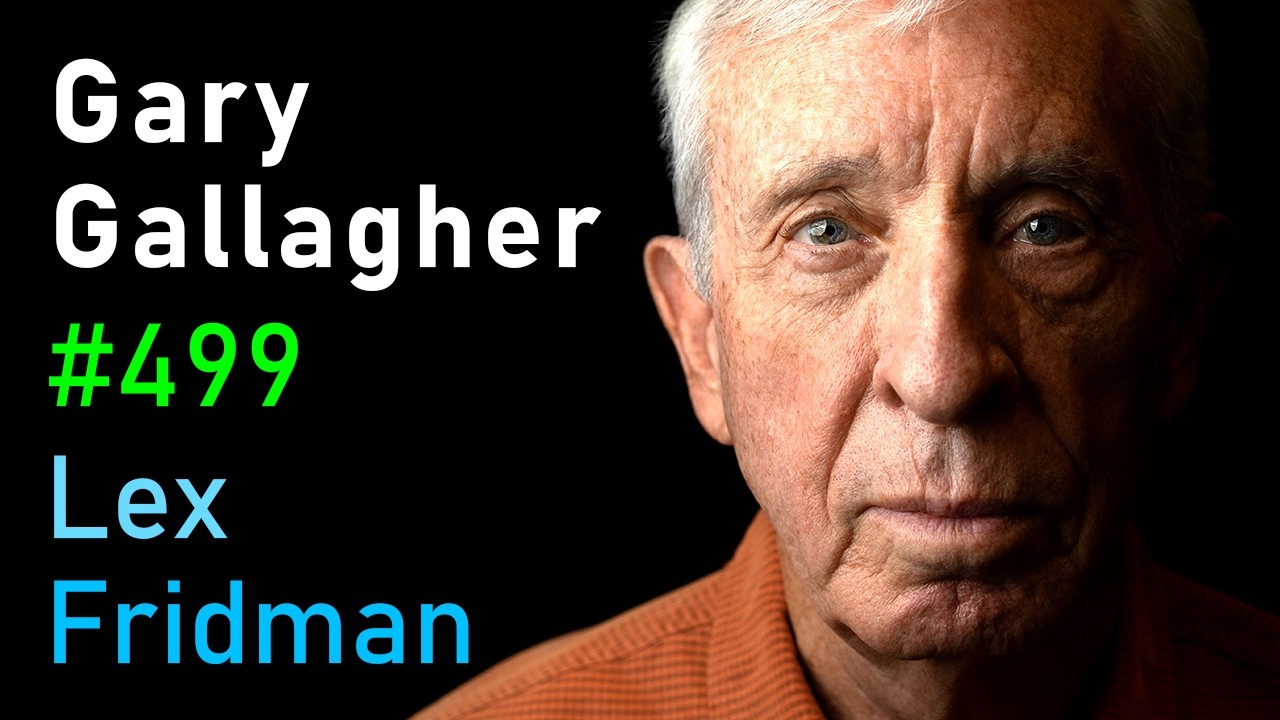
Historian Gary Gallagher Refutes Inevitability of Union Civil War Victory
Lex Fridman
The Confederacy's central driver was preserving slavery, yet its military collapse depended on contingent battlefield victories rather than an inevitable Northern industrial dominance.
## Background
This episode was published by Lex Fridman on YouTube on July 28, 2026. According to the page description, it features an in-depth conversation with Civil War historian Gary Gallagher exploring the conflict's causes, military strategies, key political figures, and enduring legacy.
## TL;DR
Historian Gary Gallagher joins Lex Fridman for an expansive, analytical exploration of the American Civil War, examining how slavery directly fueled the conflict and shaped military decision-making. Gallagher dismantles persistent historical myths, including the 'Lost Cause' narrative and the inevitability of Union victory, while providing deep character studies of Abraham Lincoln, Ulysses S. Grant, and Robert E. Lee. The discussion traces pivotal turning points from Shiloh and Gettysburg to the Overland Campaign, assessing how Northern political will and total war strategy ultimately secured victory. Finally, the dialogue addresses post-war memory, monument controversies, and how the political divisions of the 1850s compare to modern American society.
## Atmosphere & style
The conversation is scholarly, grounded, and deeply reflective, striking a thoughtful balance between rigorous historical analysis and engaging storytelling. Gary Gallagher delivers authoritative, sharp historical insights with a conversational warmth, while Lex Fridman acts as a curious, introspective interviewer who frequently nudges the dialogue toward broader human and philosophical questions. The emotional arc transitions smoothly from the intense, sobering military reality and human tragedy of battle to nuanced discussions on presidential leadership, historical memory, and ultimate optimism for the American republic.
## Key takeaways
- [00:00](https://www.youtube.com/watch?v=XyXBwO5jYpw&t=0s) Slavery was the singular foundational cause of the Civil War; without it, the political fractures and eventual military conflict between the North and South would not have occurred.
- [01:29](https://www.youtube.com/watch?v=XyXBwO5jYpw&t=89s) The primary political dispute in 1860 focused on the expansion of slavery into newly acquired federal territories rather than its immediate abolition in existing Southern states.
- [11:50](https://www.youtube.com/watch?v=XyXBwO5jYpw&t=710s) The vast economic value of enslaved human beings—approximately $3 billion in 1860—surpassed the combined capital value of all U.S. manufacturing and railroads.
- [16:50](https://www.youtube.com/watch?v=XyXBwO5jYpw&t=1010s) Abraham Lincoln issued the Emancipation Proclamation primarily as a military necessity under his authority as Commander-in-Chief to strike at the Confederate war effort.
- [21:12](https://www.youtube.com/watch?v=XyXBwO5jYpw&t=1272s) While slavery caused the war, most Union soldiers initially volunteered to preserve the Union as a unique democratic experiment rather than to abolish slavery.
- [33:51](https://www.youtube.com/watch?v=XyXBwO5jYpw&t=2031s) The Confederacy aggressively centralized power, enacting the first national draft in American history, an income tax, and direct seizure of agricultural yields.
- [39:07](https://www.youtube.com/watch?v=XyXBwO5jYpw&t=2347s) Lincoln demonstrated extraordinary intellect and political agility by assembling a 'Cabinet of Rivals' and guiding a war effort that killed over 700,000 soldiers.
- [55:22](https://www.youtube.com/watch?v=XyXBwO5jYpw&t=3322s) Ulysses S. Grant's success lay in his steady, offensive mindset and focus on destroying enemy armies rather than worrying about what Robert E. Lee would do.
- [58:20](https://www.youtube.com/watch?v=XyXBwO5jYpw&t=3500s) Robert E. Lee's choice to fight for the Confederacy was driven by an interconnected bundle of loyalties to his state, family heritage, and the Southern social order.
- [01:29:48](https://www.youtube.com/watch?v=XyXBwO5jYpw&t=5388s) Material and demographic superiority did not render Union victory inevitable; the Confederacy needed only a stalemate to secure independence.
- [01:42:35](https://www.youtube.com/watch?v=XyXBwO5jYpw&t=6155s) Approximately 200,000 Black men served in the U.S. military, establishing a critical foundation for post-war claims to citizenship and civil rights.
- [02:11:17](https://www.youtube.com/watch?v=XyXBwO5jYpw&t=7877s) Lincoln's views on race evolved throughout his presidency, shifting from considering voluntary colonization to advocating voting rights for Black veterans.
- [02:40:53](https://www.youtube.com/watch?v=XyXBwO5jYpw&t=9653s) Lee's aggressive operational strategy aimed to inflict heavy casualties and break Northern civilian morale before Southern resources were depleted.
- [04:54:42](https://www.youtube.com/watch?v=XyXBwO5jYpw&t=17682s) Vicksburg was a more strategically decisive victory than Gettysburg because it yielded control of the Mississippi River and captured an entire Confederate army.
- [05:02:25](https://www.youtube.com/watch?v=XyXBwO5jYpw&t=18145s) The capture of Atlanta by Sherman and victories in the Shenandoah Valley restored Northern morale, securing Lincoln's reelection in November 1864.
- [05:23:44](https://www.youtube.com/watch?v=XyXBwO5jYpw&t=19424s) The 'Lost Cause' narrative falsely reframed the war around states' rights rather than slavery, portraying Confederate defeat as an inevitable mathematical impossibility.
- [03:36:54](https://www.youtube.com/watch?v=XyXBwO5jYpw&t=13014s) Modern political polarization in the United States, while sharp, lacks the formal institutional steps toward armed conflict and state-level secession seen in the 1850s.
## Detailed walkthrough
### [00:00](https://www.youtube.com/watch?v=XyXBwO5jYpw&t=0s) Escalation of the War and Military Strategy
The vast, unpredictable scale of the Civil War became brutally apparent early on in the conflict. In just two days at Shiloh, the United States military suffered more battle casualties than in every previous American war combined. Shortly thereafter, during the Seven Days Battles outside Richmond, George B. McClellan’s army clashed with Robert E. Lee’s forces, resulting in another 36,000 casualties. These back-to-back engagements made it undeniably clear that the conflict had escalated into a war of total destruction. Generals like Philip Sheridan in the Shenandoah Valley and William Tecumseh Sherman in Georgia executed strategy pushed by Ulysses S. Grant: lay waste to agriculturally rich land, burn mills, slaughter livestock, and erase the logistics supporting the Confederacy.
Beyond logistical destruction, Sherman explicitly weaponized psychological warfare. His goal was to demonstrate to the Southern populace that Northern armies could march wherever they pleased without Jefferson Davis being able to stop them. Countering historical theories that downplay individual agency in favor of sweeping structural forces, individual leadership proved pivotal. Figures such as Abraham Lincoln and Grant were indispensable to the Union effort, while Lee’s tactical brilliance single-handedly prolonged the Confederacy’s survival far beyond what would have otherwise been possible. Nevertheless, on the question of fundamental cause, removing slavery from the equation leaves no Civil War at all.
[01:29](https://www.youtube.com/watch?v=XyXBwO5jYpw&t=89s) Causes of the Civil War: Federal Territories and Political Fractures
The foundational triggers of the American Civil War were rooted entirely in the institution of slavery and its cascading political dynamics across both slave and free states. By the winter of 1860–1861, conditions for war were fully established. Crucially, the mainstream political struggle among white Americans was not immediately about abolishing slavery where it already existed, but rather whether it would be permitted to expand into newly acquired federal territories.
By 1860, the slaveholding South recognized its dwindling power, having long lost the population race to the free states. Decades prior, Southern states dominated national politics; Virginia produced four of the first five U.S. presidents, all of whom were prominent slaveholders. As the 1850s progressed, Southern political elites felt increasingly encircled and threatened. If slavery were restricted solely to existing states, the free states would solidify a permanent congressional majority, ultimately gaining the power to tamper with the institution in the South.
While radical abolitionists called for immediate emancipation, they remained a despised, tiny minority in the North during the 1840s and 1850s, often viewed as reckless agitators who threatened the stability of the Union.
- **Liberty Party Performance:** In 1840, the anti-slavery Liberty Party managed only a few thousand votes; at its peak in 1844, it captured roughly 2.5% of the popular vote.
- **Demographics in 1860:** The U.S. population stood at roughly 31 million, including nearly 4 million African Americans (3.5 million of whom were enslaved in the South).
- **Racial Demographics in Free States:** Free states were over 98% white, meaning Northern opposition to slavery was overwhelmingly tied to economic self-interest—reserving Western territories for white labor—rather than racial egalitarianism.
[05:00](https://www.youtube.com/watch?v=XyXBwO5jYpw&t=300s) The Election of 1860 and Secession
The collapse of the American political party system directly paved the way for secession. The Whig Party fractured and dissolved over the issue of slavery in the early 1850s, running its final major presidential candidate in 1852. Out of its ashes rose the Republican Party, whose primary unifying platform was strict opposition to the expansion of slavery into federal territories.
During the presidential election of 1860, the Democratic Party—the last remaining national institution spanning both North and South—split apart. Northern Democrats nominated Stephen A. Douglas, while Southern Democrats ran John C. Breckinridge. Coupled with a Constitutional Union candidate, this splintering allowed Republican nominee Abraham Lincoln to win the presidency.
Southern leaders viewed Lincoln's victory as an existential threat. Although the official 1860 Republican platform pledged not to interfere with slavery where it already existed, Lincoln's famous 1858 "House Divided" speech—alongside William H. Seward's "Irrepressible Conflict" speech—convinced white Southerners that Republicans ultimately intended to extinguish the institution entirely. Between December 20, 1860 (led by South Carolina) and late February 1861, seven Deep South states seceded from the Union.
[08:06](https://www.youtube.com/watch?v=XyXBwO5jYpw&t=486s) Southern Social Structure and Race Attitudes
White Northern society in 1860 was deeply prejudiced by modern standards; opposition to the expansion of slavery rarely translated into support for civil equality. Approximately 45% of Northern voters were Democrats who harbored little to no moral objection to slavery. However, in the South, defense of the institution was virtually unanimous across all economic classes.
Even though a large majority of Southern families did not own slaves, non-slaveowning whites maintained a profound stake in the system. Beyond its economic function, slavery served as a rigid system of racial and social control. Southern whites lived in constant psychological fear of slave rebellions, haunted by the specter of the Haitian Revolution. In plantation districts where enslaved populations outnumbered whites by up to nine to one, slavery was viewed as an essential safeguard for white physical safety. Furthermore, economic ties bound non-slaveowners to wealthy planters through mutual reciprocity, such as borrowing cotton gins in exchange for participating in local slave patrols.
[11:50](https://www.youtube.com/watch?v=XyXBwO5jYpw&t=710s) Comparative History of Slavery and Economic Stakes
Examining the transatlantic slave trade highlights the unique trajectory of slavery in North America. Out of the millions of enslaved Africans brought across the Atlantic, only about 4% were brought directly to North America. The vast majority were taken to Brazil (over 4.9 million) and the Caribbean (over 4 million). Yet, while other Western nations abolished slavery through legislative decrees or financial buyouts—such as Great Britain freeing 800,000 enslaved people in 1833 by purchasing their freedom, or Russia emancipating 23 million serfs in 1861—the U.S. engaged in a catastrophic war resulting in over 700,000 military fatalities.
Unlike Great Britain, where enslaved populations resided in distant colonies, American slaveholders lived alongside millions of enslaved human beings, vastly heightening their perceived existential and racial stakes. Furthermore, slavery in the United States was far from an expiring institution; it was economically thriving and expanding from agricultural cash crops (cotton, rice, sugar) into industrial enterprises.
- **Value of Enslaved Property:** According to the 1860 census, capital invested in enslaved human beings equaled roughly $3 billion—exceeding the combined total value of all U.S. manufacturing industries and railroads ($2.5 billion).
- **Proportion of Casualties:** Revised historical estimates place Civil War military deaths at over 700,000 (up from the traditional 618,000), making it by far the bloodiest conflict in U.S. history relative to total population.
[16:50](https://www.youtube.com/watch?v=XyXBwO5jYpw&t=1010s) The Emancipation Proclamation as Military Necessity
The Civil War did not begin as a crusade to end slavery; its initial, explicit goal was strictly to suppress rebellion and preserve the Union. However, as the conflict dragged into the summer of 1862 and grew exponentially costlier, Union leadership recognized that the Confederacy could not be defeated without destroying its underlying economic foundation.
Enslaved labor formed the bedrock of the Confederate war effort, maintaining agricultural output and enabling the South to mobilize an extraordinary 85% to 90% of its white, military-aged male population. Recognizing this, Abraham Lincoln issued the Emancipation Proclamation strictly as a military necessity under his constitutional powers as Commander-in-Chief. Stripped of poetic rhetoric, the document functioned like a legal "bill of lading," specifically designed to withstand judicial scrutiny while crippling the Confederacy's capacity to wage war.
[18:29](https://www.youtube.com/watch?v=XyXBwO5jYpw&t=1109s) The Emancipation Proclamation and Political Pragmatism
Lincoln’s strategy behind issuing the Emancipation Proclamation was deeply tied to military necessity and political pragmatism. He recognized that the war effort could not rely solely on Republicans; keeping Northern Democrats committed to the cause was critical. Most Democrats firmly opposed emancipation as a primary goal, expressing a willingness to shed blood only to preserve the Union of the founders—not to free enslaved Black people. By basing the proclamation strictly on his executive war powers, Lincoln aimed to make it palatable across the loyal states, framing the abolition of slavery as a direct blow against the rebel war machine and a punishment for those who instigated the conflict.
Despite Lincoln’s careful framing, the proclamation remained intensely controversial and deeply alienated many Democrats. Furthermore, its legal mechanics were inherently paradoxical. Lincoln asserted that as Commander-in-Chief, he only possessed the authority to strike at slavery in areas actively in rebellion against the United States. Consequently, any region where the U.S. Army held control, or slaveholding areas that had remained loyal to the Union, were exempt. On the exact day he signed it—January 1, 1863—it effectively freed no one immediately, as it applied exclusively to places outside federal control. Freedom followed strictly in the wake of the advancing U.S. military.
- The Emancipation Proclamation expanded upon the **Second Confiscation Act** (passed by Congress in July 1862), which freed enslaved people belonging to rebels but exempted Southern slaveholders who could prove Union loyalty. Lincoln's proclamation drew no such distinction for loyalists in rebel territories.
- The U.S. Army served as the physical line of liberation: wherever federal troops advanced after January 1, 1863, enslaved people were officially freed under the proclamation.
---
[21:12](https://www.youtube.com/watch?v=XyXBwO5jYpw&t=1272s) Causation vs. Motivation: Why Union Soldiers Fought
Understanding the Civil War requires separating its ultimate cause from the individual motivations of the men who fought it. In terms of causation, the answer is absolute: without slavery, there would have been no Civil War. However, most white Northern men who put on blue uniforms were not motivated by a desire to eradicate slavery. Instead, they volunteered to preserve the Union, which they viewed as a sacred gift bequeathed to them by the revolutionary generation through immense sacrifice and bloodshed.
To 19th-century Northerners, the Union represented two extraordinary, interconnected ideas: political self-governance and economic opportunity. Though voting rights were restricted by modern standards, the United States possessed by far the broadest democratic franchise in the Western world at the time. Furthermore, the Union offered the promise that an individual could rise economically rather than remaining bound to their father's station. Northerners viewed the Southern Confederacy as a slave-holding oligarchy controlled by aristocrats who rejected democratic principles. Looking at Europe—where the revolutions of 1848 had failed and monarchies were reasserting control—they believed America was "the last best hope of Earth," a phrase Lincoln famously popularized. Citizens in this republic felt a duty to act as "citizen soldiers" to protect this democratic experiment from dismantling itself over a lost election.
- Approximately **3 million total soldiers** served in the Civil War: **2.2 million** for the United States (Union) and between **800,000 and 900,000** for the Confederacy.
- The vast majority of combatants on both sides were volunteers rather than draftees.
- On military maps, U.S. units are represented by **blue blocks** (the North), while Confederate units are shown as **red blocks** (the South).
- Northern volunteers viewed secession after the Election of 1860 as an unacceptable precedent: if a minority could leave simply because they disliked an election outcome, the entire republican form of government was a farce.
---
[25:03](https://www.youtube.com/watch?v=XyXBwO5jYpw&t=1503s) A War Between Two Republics
Rather than framing the conflict merely as "North versus South," the war is best understood as a clash between two mid-19th-century republics—one established, and one short-lived republic forged entirely within the cauldron of war. In 1860, there were 15 slaveholding states, but only 11 actually seceded to join the Confederacy. Four slaveholding states—Kentucky, Missouri, Maryland, and Delaware—remained in the United States, illustrating that the division was not strictly geographical.
| Republic | Key Characteristics | View of the Constitution & Founders |
|:--- |:--- |:--- |
| **United States** *(Union)* | Established republic defending constitutional democracy, election legitimacy, and national sovereignty. | Claimed to be the true heirs of the Revolution, viewing the Union as perpetual and sacred. |
| **Confederate States** | Newly created republic with a President, Congress, Senate, Army, Navy, and executive departments. | Claimed they were upholding the original principles of the Founders, modifying the U.S. Constitution primarily to protect slavery and prevent protective tariffs. |
Both sides vehemently claimed to be the rightful heirs of the revolutionary generation, invoking figures like George Washington and Thomas Jefferson. The Confederates argued that the U.S. Constitution explicitly protected property in slaves and that Northern states interfering with that right were the ones violating the original constitutional compact. This clash of deeply held, competing visions of American destiny fueled the intense passions on both sides.
- The Confederate government drafted its constitution quickly by copying the U.S. Constitution and inserting specific protections for slavery and restrictions on federal tariffs.
- The **4 border slave states** that never seceded and remained in the Union were **Kentucky, Missouri, Maryland, and Delaware**.
---
[33:51](https://www.youtube.com/watch?v=XyXBwO5jYpw&t=2031s) States' Rights, Hypocrisy, and Confederate Centralization
The concept of "states' rights" has often been misconstrued as an exclusively Southern ideology, but throughout American history, it has simply been a political tool used by whichever faction opposes federal authority at a given moment. Prior to the Civil War, New England states invoked states' rights during the War of 1812 at the Hartford Convention. Leading up to the Civil War, Northern states enacted "personal liberty laws" to interpose state authority against federal enforcement of the Fugitive Slave Act. For the white South, their appeal to states' rights centered on a single core objective: asserting the right of a state to protect the institution of slavery from potential federal interference.
> "I always love to ask people who say that, 'What are all the state rights? Give me the top three... No, really, just give me the top two.' There's only one. The state right that they're worried about is the right of their state to interpose its power between a federal government that might try to interfere with slavery..."
```
┌──────────────────────────────────────┐
│ STATES' RIGHTS AS A POLITICAL TOOL │
└──────────────────┬───────────────────┘
│
┌────────────────────────────┴────────────────────────────┐
▼ ▼
┌──────────────────────────────┐ ┌──────────────────────────────┐
│ NORTHERN USAGE │ │ SOUTHERN USAGE │
├──────────────────────────────┤ ├──────────────────────────────┤
│ • War of 1812 opposition │ │ • Defense of slavery against │
│ • Personal Liberty Laws to │ │ federal interference │
│ block Fugitive Slave Act │ │ • Justification for state │
└──────────────────────────────┘ │ secession │
└──────────────────────────────┘
```
In an ironic historical twist, the Confederacy created the most intrusive central government in American history up to that point. To sustain its war effort against a vastly superior opponent, the Confederate government was forced to abandon its anti-centralization rhetoric and implement sweeping federal controls. It instituted the first national conscription law in American history in the spring of 1862, overriding state authorities to draft men directly into service. When its paper currency collapsed under runaway inflation, the Confederate congress enacted a national graduated income tax followed by a "tax-in-kind," empowering government agents to directly seize a percentage of farmers' crops and livestock.
- The Confederate government passed the **first national draft in U.S. history** in the **spring of 1862**, months before the U.S. federal government instituted its own conscription.
- To feed its armies amid hyperinflation, the Confederate central government imposed a mandatory **tax-in-kind**, taking a direct percentage of agricultural yields from its citizens.
[36:21](https://www.youtube.com/watch?v=XyXBwO5jYpw&t=2181s) Confederate Centralization and Conscription Encroachments
The Confederacy faced a profound internal ideological tension between its stated foundation of states' rights and the harsh necessities of fighting a total war. To sustain its military efforts, the Confederate government in Richmond was forced to implement drastic centralizing measures: impressment of horses, mules, and enslaved labor to construct military fortifications. These sweeping federal intrusions outraged strict states' rights dogmatists within the Confederacy. Unlike the North, the Confederacy deliberately eschewed formal political parties—arguing that the Founding Fathers had opposed party factionalism—which left political friction to play out between two main camps: a nationalist wing championed by President Jefferson Davis and General Robert E. Lee (who believed the central government must do whatever it takes to win), and an uncompromising states' rights wing led by Vice President Alexander H. Stephens.
```
┌────────────────────────────────────────────────────────┐
│ Confederate Ideological Rift │
└───────────────────────────┬────────────────────────────┘
│
┌─────────────────────────┴─────────────────────────┐
▼ ▼
┌─────────────────────────────────┐ ┌─────────────────────────────────┐
│ Nationalist Wing │ │ States' Rights Wing │
│ • Jefferson Davis, Robert E. Lee│ │ • Alexander H. Stephens (VP) │
│ • Central government power │ │ • State autonomy over Richmond │
│ • Imposed conscription & draft │ │ • Opposed federal mandates │
│ • Impressed labor & property │ │ • Suspended habeas corpus bad │
└─────────────────────────────────┘ └─────────────────────────────────┘
```
The paradox of the Confederate war effort was that it lasted as long as it did only because the central government took extreme actions no one thought possible prior to 1861, including the selective suspension of habeas corpus by Davis, paralleling Abraham Lincoln's actions in the Union. Conscription became a flashpoint of resentment. In the spring of 1861, expecting a swift conflict, initial Confederate volunteers signed up for a single year. When those enlistments expired in 1862, Congress instituted the first national draft in American history to retain experienced soldiers.
* Early Confederate volunteers signed one-year enlistments expecting a quick victory in 1861.
* In spring 1862, the Confederate Congress passed conscription laws making all men liable for three years of service and trapping original volunteers for two additional years.
* Later in the war, Congress altered the rules again to hold soldiers "for the duration" of the war.
* Critics condemned national conscription as a fundamental abridgment of individual liberties, maintaining that a citizen should only volunteer.
* The United States government waited until spring 1863 to enact its own conscription, though unlike the Confederacy, it respected original enlistment terms and never forced soldiers to serve for the duration without renewal.
---
[39:07](https://www.youtube.com/watch?v=XyXBwO5jYpw&t=2347s) The Intellect, Focus, and Leadership of Abraham Lincoln
When evaluating the primary figures of the Civil War, Abraham Lincoln stands out as an extraordinary historical anomaly. Born in the backwoods of Kentucky with virtually no formal schooling—far less than a single cumulative year—Lincoln possessed an intellect and rhetorical capacity that surpassed every polished contemporary. His genius lay in his ability to distill the most complex moral and political concepts into brief, crystalline prose that resonated across a deeply divided nation.
```
┌──────────────────────────────────────────────────────────────┐
│ Lincoln's Leadership Arsenal │
└──────────────────────────────┬───────────────────────────────┘
│
┌──────────────────────────────┼──────────────────────────────┐
▼ ▼ ▼
┌─────────────────────────┐ ┌─────────────────────────┐ ┌─────────────────────────┐
│ Ego Suppression │ │ Laser Focus │ │ Cabinet of Rivals │
│ Put personal pride │ │ Relentlessly focused on │ │ Surrounded himself with │
│ aside; endured insult │ │ saving the Union and │ │ better-educated political│
│ (e.g., from McClellan) │ │ destroying slavery. │ │ rivals (Seward, Chase). │
└─────────────────────────┘ └─────────────────────────┘ └─────────────────────────┘
```
Lincoln possessed a significant ego, yet his rare strength was his ability to completely set it aside to maintain an unyielding focus on his primary objectives: suppressing the rebellion, preserving the Union, and destroying the institution of slavery he deeply hated. He willingly surrounded himself with formidable political rivals in his Cabinet—such as William H. Seward and Salmon P. Chase—men who were better educated, possessed broader administrative experience, and held superior social standing. While his rivals initially looked down on his humble origins and accent, Lincoln’s quiet brilliance and emotional maturity earned their deep respect over time.
* **Scale of the Conflict:** The 31 million people in the U.S. produced over 3 million men under arms (equivalent to 35–40 million soldiers today, or 55 million in the Confederacy proportionally).
* **Projected Casualties:** Civil War deaths reached between 600,000 and 750,000—equivalent to 6 to 7.5 million deaths today.
* **Comparative Scope:** The casualties from a few hours of fighting at Antietam equaled the total U.S. military fatalities pictured in *The New York Times* across the entirety of the modern Gulf Wars.
* **Army Size Expansion:** Winfield Scott captured Mexico City with under 15,000 men; by 1864, Ulysses S. Grant commanded field armies exceeding 120,000 soldiers.
* Lincoln endured severe bouts of clinical depression ("black moods") throughout his life, yet maintained the psychological stamina to lead during the nation's darkest hours.
* Contrast in preparation: Jefferson Davis was a West Point graduate, decorated Mexican-American War commander, former Secretary of War, and chairman of the Senate Military Affairs Committee; Lincoln had only one two-year term in the U.S. House of Representatives and brief service as a junior officer in the Black Hawk War.
> "Almost nobody continues to go up in my estimation as I get older and older, but Lincoln is one of the people who does." — Gary Gallagher
---
[48:08](https://www.youtube.com/watch?v=XyXBwO5jYpw&t=2888s) Lincoln's Character and Rhetorical Legacy
Lincoln's strength of character was highlighted by his patience with difficult military subordinates, most notably General George B. McClellan. In late 1861, Lincoln and Secretary of State Seward personally walked to McClellan's house to consult with him. Upon returning home, McClellan snubbed the Commander-in-Chief by going straight upstairs to bed, instructing a staff member to tell the President he would see him another time. Rather than throwing a fit, Lincoln simply left, quietly placing the insult aside because he believed McClellan was the man who could win the war.
```
┌──────────────────────────────────────┐
│ Lincoln's Greatest Rhetorical Gems │
└──────────────────┬───────────────────┘
│
┌──────────────────────────┴──────────────────────────┐
▼ ▼
┌──────────────────────────────────────┐┌──────────────────────────────────────┐
│ Gettysburg Address ││ Second Inaugural Address │
│ • November 18, 1863 (~2 minutes) ││ • March 4, 1865 (~8-9 minutes) │
│ • Reframed the war as a test of ││ • Declared slavery the cause of war │
│ human equality and self-governance.││ • Called for national humility and │
│ • "Government of the people, by the ││ reconstruction "with malice toward │
│ people, for the people..." ││ none; with charity for all..." │
└──────────────────────────────────────┘└──────────────────────────────────────┘
```
Lincoln used words to explain to the American public why the enormous sacrifices of the war were necessary. At his Second Inaugural Address in March 1865, as the public demanded vengeance against the defeated South, Lincoln delivered an 8-minute masterclass in moral leadership. He insisted that slavery was the root cause of the war, reminded the crowd that the entire nation was complicit in its existence, and urged reconciliation rather than retribution.
* The Second Inaugural Address is widely considered by historians as the greatest speech in American history, explicitly addressing collective guilt and calling for binding up the nation's wounds.
* Delivered on November 19, 1863, the Gettysburg Address spanned fewer than 272 words and took roughly two minutes to deliver—so brief that many in the audience barely realized he had begun speaking before he finished.
* The Gettysburg Address reframed the conflict not merely as a war to restore territory, but as a crucial test of whether a nation "conceived in liberty, and dedicated to the proposition that all men are created equal" could endure.
* In his closing line at Gettysburg—"government of the people, by the people, for the people"—Lincoln emphasized "the people" as the foundation of republican self-governance, a concept he previously dubbed a "people's contest."
> "With malice toward none, with charity for all, with firmness in the right as God gives us to see the right, let us strive on to finish the work we are in, to bind up the nation's wounds..." — Abraham Lincoln (Second Inaugural Address)
---
[54:19](https://www.youtube.com/watch?v=XyXBwO5jYpw&t=3259s) Ulysses S. Grant: Resilience and Strategic Mindset
Ulysses S. Grant stood in stark contrast to traditional military figures. Prior to the Civil War, Grant had experienced repeated failures in civilian life—failing at farming, real estate, and business ventures, as well as leaving the peacetime army under a cloud of hardship. Yet when the national crisis erupted, these personal setbacks proved invaluable: they forged a leader who was resilient, adaptable, and unbothered by temporary failures.
```
┌─────────────────────────────────┐
│ Grant's Command Philosophy │
└────────────────┬────────────────┘
│
┌─────────────────────────────┼─────────────────────────────┐
▼ ▼ ▼
┌─────────────────┐ ┌─────────────────┐ ┌─────────────────┐
│ Moral Courage │ │ Strategic Adapt │ │ Focus Forward │
│ Took complete │ │ Willing to break│ │ Ignored enemy's │
│ responsibility │ │ standard rules │ │ actions; drove │
│ for decisions. │ │ and doctrine. │ │ his own plans. │
└─────────────────┘ └─────────────────┘ └─────────────────┘
```
Grant’s strength came from a stable family life anchored by his relationship with his wife, Julia, alongside a distinct mindset on the battlefield. He possessed the moral courage to take full responsibility for decisions, broke outdated tactical rules, and refused to panic when things went wrong. If a maneuver failed, Grant simply adapted and tried the next option. When he assumed command of all Union armies in 1864, he brought a clear, offensive focus that transformed the Northern war effort.
* Grant struggled through multiple financial and professional failures before the war, giving him a rare resilience that served him well in high-stakes command.
* His leadership style relied on clear decision-making, direct communication, and an refusal to be paralyzed by fear of what the enemy might do.
* Unlike previous commanders of the Army of the Potomac, who often retreated after setbacks, Grant maintained forward momentum against Robert E. Lee's forces in Virginia.
[55:22](https://www.youtube.com/watch?v=XyXBwO5jYpw&t=3322s) Ulysses S. Grant, Robert E. Lee, and the "Butcher" Myth
Gary Gallagher highlights the stark contrast in command style between Ulysses S. Grant and his cautious predecessors. When subordinates fretted over potential enemy movements, Grant famously shot back, "Why don't we start worrying—let's not worrying about what General Lee is gonna do and let General Lee worry about what we're going to do?" Gallagher emphasizes that Grant possessed an unflappable temperament under extreme stress, making him Abraham Lincoln's indispensable military counterpart to lead the Union armies.
Despite his battlefield success, Grant earned the enduring reputation of "Grant the Butcher," a label heavily promoted by former Confederates and Northern Peace Democrats. Gallagher dismantles this myth with striking casualty statistics. Prior to their bloody 1864 Overland Campaign in Virginia, Grant’s total casualties across all his major Western victories totaled 37,000 men. In that exact same timeframe, Robert E. Lee’s army suffered over 98,000 casualties. Citing a rigorous demographic study of Lee’s Army of Northern Virginia by historian Joseph Glatthaar, Gallagher notes that an individual soldier in Lee’s army faced a staggering 73% probability of becoming a casualty, making Lee by far the bloodiest general in American history. Grant’s casualty numbers spiked only when he directly encountered Lee, just as every other Union commander's had.
Gallagher also addresses Grant’s historical reputation as a heavy drinker. While historians debate whether Grant simply could not handle alcohol well or required the stabilizing presence of his wife, Julia, and key staff officers like John A. Rawlins, Gallagher points out the ultimate truth: alcohol never impeded Grant’s performance or decision-making during the war. Recognizing his unmatched ability to deliver victories, Congress resurrected the prestigious rank of lieutenant general (three-star general) in March 1864 specifically for Grant—a rank previously held only by George Washington (and by Winfield Scott via brevet). Grant would later become the first four-star general in United States Army history.
- **Grant's Pre-1864 Casualties:** 37,000 total casualties across all major battles prior to facing Lee.
- **Lee's Pre-1864 Casualties:** Over 98,000 total casualties during the same timeframe.
- **Individual Risk in Lee's Army:** According to scholar Joseph Glatthaar, a soldier in Lee's Army of Northern Virginia had a **73% chance** of becoming a casualty.
- **Historic Military Rank:** In March 1864, Grant was elevated to lieutenant general, receiving the active rank first established for George Washington.
[58:20](https://www.youtube.com/watch?v=XyXBwO5jYpw&t=3500s) Who Was Robert E. Lee?
When evaluating Robert E. Lee, Gallagher frames him as the cultural and social antithesis of the middle-class Ulysses S. Grant. Lee was born into the apex of Virginia's plantation aristocracy; his family tree included two signers of the Declaration of Independence and his father, "Light-Horse Harry" Lee, a celebrated Revolutionary War commander who penned the iconic eulogy describing George Washington as "first in war, first in peace, and first in the hearts of his countrymen." Lee idolized Washington above all figures in American history, patterning his life after him even as his later actions came close to tearing apart the republic Washington helped build.
When offered field command of the Union Army in April 1861, Lee declined, resigned his commission in the U.S. Army, and cast his lot with Virginia. Gallagher clarifies that Lee did not initially leave to join the Confederacy, as Virginia had not yet seceded; rather, he resigned to command Virginia's state forces, transitioning into Confederate service once Virginia joined the new republic. Gallagher explains that Lee's decision was rooted in an interconnected bundle of loyalties: devotion to his home state, family heritage, and the slaveholding Southern social order. Prior to the war, Lee had been a dedicated U.S. nationalist and a brilliant military officer whom General Winfield Scott—the 350-pound hero of the Mexican-American War—considered the finest soldier in the army.
- **Family Heritage:** Son of Revolutionary War hero Henry "Light-Horse Harry" Lee; grand-uncles signed the Declaration of Independence.
- **Initial Choice:** Resigned U.S. Army commission in April 1861 to take command of Virginia state forces before Virginia joined the Confederacy.
- **Confederate Rank:** Became the third-ranking officer in the Confederate States Army.
[01:01:30](https://www.youtube.com/watch?v=XyXBwO5jYpw&t=3690s) Radical Politics: Thaddeus Stevens and the "Slime Line"
The discussion turns briefly to the ideological extremes of the era, focusing on Congressman Thaddeus Stevens of Pennsylvania, one of the most fiery Radical Republicans. An unyielding abolitionist who championed racial equality and women's rights, Stevens was notorious for his devastating wit on the House floor.
Gallagher shares two classic anecdotes demonstrating Stevens' sharp tongue and humor:
1. While delivering a speech in the House of Representatives, Stevens paused to observe a political opponent walking across the chamber, declaring: "I'm gonna pause while my colleague... slinks across the floor of this House and adheres to his seat by his own slime."
2. Being completely bald and wearing a full wig, Stevens was once approached on the steps of the U.S. Capitol by a female admirer asking for a lock of his hair. Stevens promptly removed his entire wig, handed it to her, and said, "Madam, have them all."
Gallagher notes that Stevens' extreme radical reputation made him the direct historical template for the villainous character "Stoneman" in D.W. Griffith's pro-Lost Cause propaganda film, *The Birth of a Nation*.
[01:03:14](https://www.youtube.com/watch?v=XyXBwO5jYpw&t=3794s) Secession, Fort Sumter, and the Upper South's Turning Point
Gallagher maps out the political domino effect that triggered the war, beginning in the Deep South. Ground zero for radical secessionism was South Carolina, which hosted the disastrous 1860 Democratic National Convention in Charleston—"the worst place in the world they could've had it if they wanted a quiet, rational discussion." South Carolina was the first state to secede following Lincoln's election, quickly followed by six other Deep South states: Alabama, Mississippi, Florida, Georgia, Louisiana, and Texas. Delegates assembled in Montgomery, Alabama, to establish a provisional Confederate government.
However, eight slaveholding states initially refused to secede, including the most populous and economically vital state, Virginia. The stalemate broke over Fort Sumter in Charleston Harbor. Federal military installations had been seized across the South, but Lincoln resolved to hold Fort Sumter by sending non-military supplies. Confederate President Jefferson Davis, refusing to tolerate a foreign federal fort inside Confederate territorial waters, ordered its bombardment. The Confederates fired the first shots on April 12, 1861.
The true catalyst for wider war was not Sumter itself, but Lincoln's subsequent call for 75,000 volunteers to suppress the rebellion. Forced to choose between supplying troops to coerce sister Southern states or seceding, four Upper South states left the Union: Virginia, Arkansas, Tennessee, and North Carolina. Secession conventions had previously rejected leaving the Union; Virginia's convention voted against secession twice before reversing course after Lincoln's troop call. Meanwhile, West Virginia split off from Virginia to remain loyal to the Union, while critical border slave states—Maryland, Kentucky, and Missouri—were successfully retained by the Union.
- **Initial Deep South Secession (7 States):** South Carolina, Mississippi, Florida, Alabama, Georgia, Louisiana, Texas.
- **Second Wave Secession (4 States):** Virginia, Arkansas, Tennessee, North Carolina (triggered by Lincoln's call for volunteers after Fort Sumter).
- **Loyal Border Slave States:** Maryland, Kentucky, Missouri, and Delaware.
- **Enslaved Population Statistics (1860 Census):**
- **Virginia:** 490,000 enslaved people (highest total number).
- **Georgia, Mississippi, Alabama, South Carolina:** Each had over 400,000 enslaved people.
- **Wealth Distribution:** South Carolina and Mississippi had the highest proportion of enslaved people and were the two wealthiest states per capita among white citizens in 1860.
- **Troop Contributions:** Virginia, Tennessee, North Carolina, and Georgia contributed the most soldiers to the Confederate Army—three of which only joined in the second wave of secession.
[01:09:52](https://www.youtube.com/watch?v=XyXBwO5jYpw&t=4192s) Was the Civil War Inevitable?
Gallagher challenges the common historical assumption that the Civil War was an unavoidable conflict. He emphasizes that events unfolded in a fragile, contingent sequence rather than an inevitable march to war: Lincoln’s election led to Deep South secession, which led to the standoff at Fort Sumter, which led to Lincoln’s call for troops, which ultimately forced the Upper South to secede.
The entry of Virginia was the absolute game-changer. Richmond alone accounted for 40% of the entire Confederacy's industrial capacity, and the state provided key military commanders like Robert E. Lee, Stonewall Jackson, and J.E.B. Stuart, along with deep symbolic ties to the Founding Fathers (Washington, Jefferson, Madison). Had Lincoln handled Fort Sumter differently—or had Virginia's Unionist majority prevailed—the Confederacy would have lacked the manpower, industry, and leadership to sustain a four-year large-scale war. Gallagher warns against reading history backward, concluding that while all the combustible conditions for war were present, specific political decisions directly dictated whether those conditions escalated into open military conflict.
<ElicitationsGroup message="To explore these topics further:">
<Elicitation label="Analyze Grant's military strategy during the Overland Campaign" query="Break down Ulysses S. Grant's strategy during the 1864 Overland Campaign against Robert E. Lee and why it resulted in such high casualties."/>
<Elicitation label="Examine how the Border States were kept in the Union" query="How did Lincoln successfully keep Maryland, Kentucky, and Missouri from seceding during the Civil War?"/>
</ElicitationsGroup>
[01:12:39](https://www.youtube.com/watch?v=XyXBwO5jYpw&t=4359s) The Human Cost and the "Appomattox Syndrome"
Lex Fridman asks Gary Gallagher how to make sense of the war's staggering human toll—over 700,000 dead—and how Americans could reach a point where they literally killed their own brothers. Gallagher pushes back against a 1980s–1990s scholarly thesis claiming that the Confederacy was never a genuine nation because it supposedly "didn't try hard enough." The demographic numbers tell a vastly different story: the Confederacy lost between 4.5% and 5.5% of its entire population. This proportion of loss was higher than that of Great Britain, France, Germany, or Russia in World War I. More than 30% of all white, military-aged Confederate males died—a figure equivalent to roughly 18 million Americans dying in a modern conflict. Meanwhile, the Union lost about 1.8% of its population (compared to just 0.3% for the U.S. in World War II). If sacrifice is a metric of dedication, white Southerners were profoundly committed to their cause.
```
CIVIL WAR POPULATION LOSS (PERCENTAGE OF TOTAL POPULATION)
Confederacy [████████████████████████████████████████] ~4.5% - 5.5%
Union [████████████] ~1.8%
U.S. (WWII) [██] ~0.3%
```
Gallagher dispels the cozy myth that soldiers on both sides viewed each other purely as friendly brothers who merely traded coffee and tobacco across picket lines. While occasional fraternization occurred, bitter hatred escalated as the conflict became an all-encompassing war that directly impacted the civilian home front. War weariness was widespread, and desertion was significant—about 15% for Confederate troops and 12% for Union forces. Yet, the fighting persisted because if forced to choose late in the war between continuing under Jefferson Davis or rejoining the United States under Abraham Lincoln without slavery, most white Southerners preferred to keep fighting.
- **Confederate Male Mortality:** Over 30% of all military-aged white males in the South were killed.
- **Desertion Rates:** ~15% for the Confederacy versus ~12% for the Union.
- **The "Appomattox Syndrome":** The flawed historical tendency to read history backward, assuming Union victory, the destruction of slavery, and Northern dominance were pre-ordained outcomes from the start.
[01:16:02](https://www.youtube.com/watch?v=XyXBwO5jYpw&t=4562s) Reunion, Reconciliation, and Post-War Forgiveness
When the war drew to a close, Abraham Lincoln directed Ulysses S. Grant and William Tecumseh Sherman during their final strategy sessions to offer generous surrender terms at Appomattox. Rather than treating Confederates as traitors to be tried or executed, Lincoln sought to stitch the nation back together. Confederate officers and soldiers were required to sign a parole, accept the end of slavery, and agree to live under U.S. authority, after which they were permitted to return home without fear of prosecution. However, Gallagher cautions against confusing "reunion" with "reconciliation." Reunion—the political and structural re-assembly of the nation—was achieved quickly, but true reconciliation took generations, hindered by deep-seated bitterness that was only intensified by Lincoln’s assassination.
- **Lincoln's Terms:** Required former Confederates to sign a parole, accept the abolition of slavery, and acknowledge federal authority to return to civilian life.
- **Reunion vs. Reconciliation:** *Reunion* (rebuilding the physical U.S. state) occurred immediately in 1865, whereas *reconciliation* (healing emotional and social divides) remained unresolved for decades.
[01:18:27](https://www.youtube.com/watch?v=XyXBwO5jYpw&t=4707s) Antebellum Reality and Modern Resiliency
Turning back to the standard of living on the eve of the war in 1859, Gallagher emphasizes that ordinary citizens in Iowa or South Carolina were not obsessing daily over the impending conflict; they were consumed by normal, everyday concerns—such as the Colorado Gold Rush, which initially drew more migrants than the California Gold Rush. Rapid technological shifts, including the expansion of telegraph lines and railroads, created a dizzying sense of acceleration. While high-profile national flashpoints occasionally snapped public attention back to the slavery debate, most Americans had no concept that they were living through an "antebellum" era.
```
KEY 1850s FLASHPOINTS THAT INTENSIFIED REGIONAL TENSION
┌──────────────────────┬──────────────────────────────────────────┐
│ Event │ Cultural & Political Impact │
├──────────────────────┼──────────────────────────────────────────┤
│ Uncle Tom's Cabin │ Re-framed moral debates on slavery │
│ Kansas-Nebraska Act │ Sparked violent "Bleeding Kansas" │
│ Caning of Sumner │ Brought physical violence to Senate floor│
│ Dred Scott Decision │ Stripped Black legal rights nationally │
└──────────────────────┴──────────────────────────────────────────┘
```
Looking at contemporary geopolitical tensions in 2026, Fridman and Gallagher discuss how the Civil War demonstrates the resilience of the American republic. The war unleashed unimaginable central power and unprecedented financial expansion: the federal budget mushroomed from $63 million in 1860 to over $1.2 billion by 1865 (and over $2 billion when including Confederate expenditures). That meant the entire pre-war annual budget would have lasted barely 11 days by the end of the conflict. Despite the chaos, the destruction of slavery, and the loss of a third of military-age Southern men, the constitutional framework produced the 13th, 14th, and 15th Amendments. As Gallagher notes, history is rarely simple; it involves messy, complicated human beings rather than 30-second soundbites, requiring real humility—the kind displayed by Ulysses S. Grant rather than George B. McClellan, whose daily thought was, *"Who is gonna not appreciate how wonderful I am today?"*
- **Federal Expenditure Boom:** Jumped from $63 million in 1860 to $1.2 billion in 1865 (a nearly twenty-fold increase).
- **Constitutional Amendments:** The war transformed the nation’s legal architecture, producing the 13th (Abolition), 14th (Citizenship & Due Process), and 15th (Voting Rights) Amendments.
- **McClellan vs. Grant:** Gallagher contrasts Grant's genuine humility with George B. McClellan's inflated sense of self-importance.
[01:29:48](https://www.youtube.com/watch?v=XyXBwO5jYpw&t=5388s) Military Advantages and the Myth of Inevitability
Gallagher tackles one of the greatest misconceptions held by the general public: that a Northern victory was mathematically inevitable due to overwhelming structural advantages. While the United States possessed 22 million people compared to the Confederacy’s 9 million (which included 3.5 million enslaved individuals and 5.5 million white citizens), industrial capacity and population numbers alone do not guarantee military victory. He notes that if sheer material superiority dictated outcomes, the United States would not have lost the American Revolution against Great Britain or failed in subsequent modern conflicts.
<ElicitationsGroup message="Explore related aspects of this conversation:">
<Elicitation label="Analyze the military strategies of Grant vs. Lee" query="Based on Lex Fridman Episode 499 with Gary Gallagher, analyze the military strategies and leadership styles of Ulysses S. Grant and Robert E. Lee."/>
<Elicitation label="Examine how the Lost Cause myth shaped Civil War history" query="How does historian Gary Gallagher explain the origin and impact of the Lost Cause myth following the American Civil War?"/>
</ElicitationsGroup>
[01:30:32](https://www.youtube.com/watch?v=XyXBwO5jYpw&t=5432s) Strategic Balances and the Path to Confederate Victory
Many commentators simplify the Civil War as an inevitable Union victory due to Northern industrial power, a standing army, and a functional navy. However, Gary Gallagher points out that the Confederacy possessed significant compensating advantages. Crucially, the South had a much lower bar for victory: it did not need to invade New England or capture Washington, D.C. It only needed to make the war costly enough that a majority of the Northern civilian population would lose the motivation to continue fighting. Because both sides were democratic republics, civilian political will ultimately dictated the outcome. Gallagher compares this dynamic directly to the Vietnam War, where military performance was rendered irrelevant once public support collapsed.
Furthermore, the vast size of the Confederacy—spanning a territory comparable to Western Europe with poor transportation infrastructure—created immense logistical challenges for the Union, echoing the hurdles faced by the British during the American Revolution. The Confederates were also fighting on their own soil to defend their homes, a powerful psychological factor. While the U.S. possessed a standing military in 1860, it consisted of only 15,000 men and fewer than 50 naval vessels, leaving just three ships to blockade a 3,600-mile Confederate coastline at the war's outset.
- **Conditions for Victory:** The Confederacy only required a stalemate ("a tie is as good as a win") to secure independence, coming remarkably close to this threshold in the summer of 1864.
- **Naval Deficits:** The initial Union blockade was severely hampered by having only three available vessels for thousands of miles of coastline.
- **Top Leadership Disparity:** While both sides drew from the same professional officer corps, Gallagher argues the Union eventually found four top-tier army commanders—Ulysses S. Grant, William Tecumseh Sherman, Philip Sheridan, and George H. Thomas—whereas the Confederacy only ever found one in Robert E. Lee.
[01:34:02](https://www.youtube.com/watch?v=XyXBwO5jYpw&t=5642s) Military Parity and the Reality of Civil War Combat
Militarily, both sides entered the conflict on equal footing. West Point—established under Thomas Jefferson as the premier engineering institution in the United States—had trained virtually every major army and corps commander on both sides. Generals like Lee, Grant, and Sherman had read the same textbooks, studied under the same professors, and served as junior officers under Winfield Scott or Zachary Taylor during the Mexican-American War. They shared an identical body of doctrine, weapon technology, and tactical training. Both sides made extensive use of the telegraph and railroads, while the core combat loadout was virtually identical: muzzle-loading rifle-muskets and standard artillery.
The actual experience of combat was defined by linear, shoulder-to-shoulder formations designed to maintain unit cohesion, leading to extreme casualty rates. By 1864, field entrenchments became standard practice whenever an army halted, shifting the balance heavily in favor of defenders and requiring roughly a three-to-one numerical advantage for a successful assault. Beyond battlefield wounds, disease was the primary killer, accounting for two-thirds of all military deaths. While Union troops were generally better supplied with consistent rations and standardized uniforms, Confederate forces never lost a major battle specifically due to a lack of gunpowder or shoes.
- **Primary Weaponry:** Single-shot, muzzle-loading rifle-muskets inflicted 85% to 90% of all battlefield casualties.
- **Casualty Statistics:** Total casualties—including killed, wounded, and prisoners of war—reached approximately 1.5 million.
- **Disease Impact:** Disease killed two out of every three soldiers overall, though high-intensity combat units like the Union's Irish Brigade inverted this ratio, losing two men to battle wounds for every one lost to disease.
[01:39:53](https://www.youtube.com/watch?v=XyXBwO5jYpw&t=5993s) Demographic Demands and Religious Prejudices
The soldierly demographics reflected the broader composition of the 1860 population, accompanied by deep-seated social prejudices. In the loyal states, roughly one-third of the military-age white population was foreign-born, supplying about a quarter of the Union Army. German immigrants made up the largest foreign-born contingent in the North, followed by the Irish. Ethnic prejudice was rife, with Irish immigrants facing anti-Catholic nativism, political caricatures that depicted them with simian features, and accusations of election fraud, while German regiments were derogatorily dubbed "Dutch" units.
> "The cartoons were brutal on depicting African American characters, but they also depicted the Irish as sort of simian characters, often with a jug of whiskey in one hand... There's profound prejudice."
Despite these divides, both sides were overwhelmingly Protestant Christians and drew heavily on religious ideology to frame the war. Chaplains served in the field, and religious language saturated the official correspondence of Confederate commanders like Lee, Stonewall Jackson, and Jeb Stuart to a far greater extent than that of Union generals like Grant or Sherman. Scripture was weaponized by both sides to justify battlefield violence and to interpret military setbacks as divine trials meant to test their resolve.
- **Northern Demographics:** German immigrants formed the largest foreign-born group in the Union Army, followed by Irish immigrants.
- **Southern Demographics:** Foreign-born soldiers were far less common in the Confederacy, though they were slightly overrepresented relative to the South's small overall immigrant population.
[01:42:35](https://www.youtube.com/watch?v=XyXBwO5jYpw&t=6155s) African American Soldiers and the Fight for Citizenship
Approximately 200,000 Black men served in the United States military during the war, organized primarily into the United States Colored Troops (USCT) within the Army, as well as serving aboard integrated vessels in the Navy. Gallagher forcefully dismantles the historical myth that large numbers of Black men fought as armed soldiers for the Confederacy, calling claims of up to 100,000 armed Black Confederates "preposterous nonsense" unsupported by credible evidence. Enslaved Black men were forced into non-combat labor roles behind Southern lines to free up white men for frontline duty, but they were not armed soldiers.
```
┌─────────────────────────────────┐
│ 200,000 Black Service │
│ Members │
└────────────────┬────────────────┘
│
┌─────────────┴─────────────┐
▼ ▼
┌────────────────────┐ ┌────────────────────┐
│ U.S. Navy │ │ U.S. Army │
│ (Integrated Crews) │ │ (USCT Segregated) │
└────────────────────┘ └────────────────────┘
```
For Black soldiers, taking up arms was a direct strike against a slavery-based society and a calculated effort to establish an "unimpeachable claim to citizenship." The logic was straightforward: risking one's life as a citizen-soldier created a moral and political mandate for voting rights and civil equality after the war. However, this development enraged Confederates, who viewed the arming of Black men as an attempt to incite a bloody slave insurrection.
While leaders like Frederick Douglass recognized emancipation as merely the initial step toward full civil equality, this radical vision was not shared by the broader Northern white public. Most white Northerners viewed the war's objectives strictly as preserving the Union and ending slavery; once those two goals were accomplished, there was little political appetite or military willingness to enforce racial equality in the South during Reconstruction.
- **USCT Composition:** USCT units were overwhelmingly commanded by white officers, though a small number of Black officers served.
- **Naval Integration:** Unlike the Army's segregated USCT regiments, the U.S. Navy maintained integrated crews throughout the conflict.
- **Post-War Expectations:** The broader Northern electorate and returning Union soldiers generally lacked the political desire to maintain a long-term military presence in the South to enforce full equal rights for Black Americans.
<ElicitationsGroup message="Explore more historical contexts from this interview:">
<Elicitation label="Examine the debate around Ulysses S. Grant vs. Robert E. Lee" query="Summarize Gary Gallagher's analysis of Ulysses S. Grant vs. Robert E. Lee from the Lex Fridman Podcast."/>
<Elicitation label="Analyze the main factors that caused the American Civil War" query="What does historian Gary Gallagher identify as the primary causes of the Civil War in his interview with Lex Fridman?"/>
<ElicitationsGroup/>
[01:47:35](https://www.youtube.com/watch?v=XyXBwO5jYpw&t=6455s) Reconstruction, Divisions, and the Northern vs. Southern Mindset
When Union soldiers enlisted in 1861 to save the Union, few anticipated that victory would mean forcing an entire socio-political transformation upon the South. Had someone told them at the outset that they would be required to enforce Black equality post-war, most would have said, "What are you talking about? I signed on to do this. We did it. Send us home right now." Abolishing slavery was not the end of a journey; it was merely the beginning. Achieving true equal rights historically takes at least a century, extending far beyond legal frameworks into the complex realm of societal perceptions. While the Civil Rights Act, Voting Rights Act, and Fair Housing Act ultimately addressed legal equality, changing the underlying attitudes in people's minds remains a far slower, more frustrating process. Human society possesses a dormant, latent impulse to "otherize" opposing groups because having an enemy serves a psychological function, and opportunistic figures routinely exploit these dormant divisions.
Long before hostilities broke out in 1861, Northern and Southern citizens harbored deeply entrenched, skewed perceptions of one another:
* **Northern Perceptions of Southerners:** Free-state residents viewed white Southerners as inherently lazy, violent, and unwilling to talk out problems. They pointed to incidents like Preston Brooks beating Senator Charles Sumner over the head with a cane as typical behavior, reasoning that a society reliant on brutalizing enslaved Black people naturally relied on brute force in all matters.
* **Southern Perceptions of Northerners:** White Southerners viewed Yankees as money-obsessed materialists lacking any genuine sense of family, kinship, or honor.
While both sides shared a common language, Protestant religion, history, and foundational documents that exerted a pull toward unity, these visceral perceptions mattered more to contemporaries than reality. These growing divides eventually fractured national institutions, including major Protestant churches, setting the stage for armed conflict.
---
[01:50:23](https://www.youtube.com/watch?v=XyXBwO5jYpw&t=6623s) The Three Theaters of War and the Myth of the East
The Civil War was divided into three primary geographical theaters, each playing a distinct role in the conflict's strategic landscape:
* **The Eastern Theater:** The most famous, mythologized, and glorified theater, encompassing Virginia, Maryland, and parts of Pennsylvania. It centered on the struggle between the Union's Army of the Potomac and the Confederacy's Army of Northern Virginia as they fought over the rival capitals of Washington, D.C., and Richmond. Its fame stems primarily from the high-profile clashes between Robert E. Lee and U.S. Grant.
* **The Western Theater:** A vast geographical region stretching from the Appalachian Mountains west to the Mississippi River, and from the Gulf of Mexico north to the Ohio River. Spanning key states like Tennessee, it was the critical proving ground for the Union commanders who ultimately won the war, including Ulysses S. Grant, William Tecumseh Sherman, Philip Sheridan, and George Thomas.
* **The Trans-Mississippi Theater:** Covering regions west of the Mississippi River—including parts of Louisiana, Arkansas, Texas, and Missouri—this theater was by far the least important in terms of resource commitment and its ultimate effect on the war's outcome, despite the frustration this fact causes some regional historians.
---
[01:52:07](https://www.youtube.com/watch?v=XyXBwO5jYpw&t=6727s) Naïveté at Manassas and the Reality of Escalation
The war's opening major conflict at First Manassas (First Bull Run) in July 1861 highlighted the complete naïveté of the American public and its leaders. Spectators from Washington drove out in carriages with picnic baskets, setting up on a ridge to watch the action below, utterly clueless about the brutal reality of military combat. President Abraham Lincoln initially believed the rebellion could be suppressed with a single battle, issuing a call for 90-day volunteers following the fall of Fort Sumter. General William Tecumseh Sherman famously scoffed at this short-term enlistment, remarking that trying to extinguish such a massive national fire with a 90-day draft was like trying to put out a forest fire with a "squirt gun."
The illusion of a quick war shattered as casualties mounted, leading to a naming convention split between the opposing sides and a swift escalation in force:
* **Naming Conventions:** Battles often carried two distinct names. The Union typically named battles after local terrain features (e.g., Bull Run Creek, Antietam Creek), whereas the Confederacy named them after the nearest town or rail junction (e.g., Manassas, Sharpsburg).
* **Initial Realization:** The defeat at First Bull Run forced the Union to confront the reality that suppressing the rebellion would require hundreds of thousands of men and vast supply networks. Aside from smaller engagements like the Battle of Wilson's Creek in Missouri, the rest of 1861 remained relatively quiet as both sides mobilized.
* **The Awakening of Spring 1862:** The true scale of the war hit home in early April 1862 at the Battle of Shiloh in the Western Theater. Over two days, U.S. Grant's forces and Albert Sidney Johnston's Confederate army suffered upwards of 25,000 casualties—more battle casualties than the United States had suffered in every previous American war combined. Just two and a half months later, George B. McClellan's Seven Days Battles against Robert E. Lee outside Richmond produced another 36,000 casualties, proving the conflict would demand unprecedented sacrifice.
---
[01:55:30](https://www.youtube.com/watch?v=XyXBwO5jYpw&t=6930s) Guerrilla Warfare vs. Conventional Nation-State Conflict
In regions like Missouri and Kentucky, the war descended into vicious guerrilla warfare, locally referred to as "bushwhacking." Operating in small bands ranging from a few dozen to several hundred men, guerrillas ambushed troops, terrorized civilians, slaughtered livestock, and executed prisoners. In one prominent raid, Confederate guerrilla William Quantrill led a raid on Lawrence, Kansas, burning parts of the town and executing more than 150 civilian men. Guerrilla violence directly correlated with elevation—flourishing in hilly and mountainous regions like East Tennessee, western North Carolina, southwestern Virginia, Texas, and most acutely in Missouri and Kentucky. Although involving only about 50,000 of the 3 million men who served in the war, its lawless brutality prompted Union General Henry Halleck to push for the formal codification of the rules of war to distinguish combatants from civilians.
Outside of these guerrilla enclaves, the Civil War was primarily fought between two mid-19th-century nation-states using formal armies led by West Point-trained professional officers. While the war expanded in scope to target economic infrastructure—especially once Grant became general-in-chief—it largely stopped short of the deliberate, indiscriminate slaughter of civilians. For individual farmers whose livestock was confiscated and crops were destroyed by passing armies, the experience felt like "total war," but it remained bounded by military conventions.
---
[01:58:55](https://www.youtube.com/watch?v=XyXBwO5jYpw&t=7135s) Soldier Testimony: Letters, Diaries, and the Hardening of Veterans
By 1862, armies swelled to unprecedented sizes, with the Army of the Potomac topping 100,000 men. Historians possess a massive trove of firsthand testimony from these soldiers because the vast majority of troops on both sides were literate. Millions of letters crossed between the front lines and the home front, alongside detailed personal diaries that record the real-time hardening of young volunteers.
* **Common Written Themes:** Soldiers wrote extensively about mundane daily struggles: bad food, inadequate clothing, harsh weather, and incompetent or disliked officers.
* **The Unspoken Reality of Battle:** Veterans rarely attempted to explain the actual combat experience to loved ones back home. Recognizing that civilians could not fathom the horror of the battlefield, soldiers frequently wrote short phrases like "It was awful" or "Words just can't convey what it was," deliberately keeping a psychological boundary between military life and the civilian world.
---
[02:00:56](https://www.youtube.com/watch?v=XyXBwO5jYpw&t=7256s) The 1862 Maryland Campaign: Antietam and McClellan's Firing
In the spring of 1862, Major General George B. McClellan advanced the Army of the Potomac to within five miles of Richmond. He was opposed by Confederate General Joseph E. Johnston, whose default operational instinct was always to retreat. When Johnston was wounded by a shell fragment at the Battle of Seven Pines, Robert E. Lee took command of the army. McClellan foolishly dismissed Lee, writing that Lee was far too timid to be an effective battlefield commander. Lee promptly proved him wrong by driving McClellan away from Richmond in the Seven Days Battles, followed by a decisive victory over Union forces at the Second Battle of Bull Run (Second Manassas) in late August 1862.
Capitalizing on his momentum, Lee launched his first invasion of the North in September 1862, crossing into Maryland with roughly 50,000 men. However, severe straggling and desertion reduced his force to 35,000 by the time he made a stand at Sharpsburg along Antietam Creek. Even after Union soldiers discovered a lost copy of Lee's detailed operational plan (Special Orders No. 191) wrapped around cigars at an abandoned campsite, McClellan moved cautiously.
```
1862 Eastern Theater Sequence:
Seven Days Battles (Richmond saved) ➔ Second Bull Run (War shifted North) ➔ Antietam (Invasion halted)
```
The resulting Battle of Antietam on September 17, 1862, became the single bloodiest day in American military history, resulting in 23,000 casualties in a single day. Lee narrowly held his lines, remained on the field for an extra day of extreme risk, and then safely retreated across the Potomac River. While Confederates viewed the campaign as a three-act victory—saving Richmond, shifting the war to Northern Virginia, and invading the North—Lincoln was deeply frustrated by McClellan's failure to destroy Lee's army. Demonstrating his political skill, Lincoln waited until the day after the November 1862 elections to fire the popular Democratic general, replacing McClellan with Major General Ambrose Burnside. McClellan excelled at organizing and building the Army of the Potomac, earning the deep affection of his men, but when the critical moment arrived on the battlefield, his profound risk-aversion prevented him from seizing victory.
Here is a detailed, faithful walkthrough of the transcript section.
---
[02:04:55](https://www.youtube.com/watch?v=XyXBwO5jYpw&t=7495s) McClellan’s Failure at Antietam and the Shift to Emancipation
The discussion opens with George B. McClellan's failure to capitalize on his advantage against Robert E. Lee at the Battle of Antietam. Gary Gallagher emphasizes how rare it was to have an opportunity to destroy an opposing army during the Civil War, yet McClellan pulled back and left 20,000 Union troops completely unused, having never fired a musket. This passivity deeply frustrated Abraham Lincoln and eventually led to McClellan's firing. Gallagher notes that McClellan lacked what 19th-century contemporaries termed "moral courage"—the willingness to risk everything, a trait that both Ulysses S. Grant and Lee possessed.
This hesitation dramatically altered the trajectory of the war between the Seven Days Battles and Antietam. McClellan’s defeat during the Seven Days Battles in late June and early July 1862 convinced both Lincoln and Congress that the war could no longer be fought conservatively with slavery intact. Consequently, Congress passed the Second Confiscation Act in late July 1862. Lincoln subsequently informed his cabinet that he intended to issue a proclamation of emancipation, but Secretary of State William H. Seward persuaded him to wait for a battlefield victory so it wouldn't look like an act of desperation. After a defeat at Second Bull Run, the victory at Antietam—secured when Lee retreated—gave Lincoln the occasion he needed to issue the Preliminary Emancipation Proclamation on September 22, 1862.
- **Key Battles & Acts:** Seven Days Battles (late June/early July 1862), Second Confiscation Act (late July 1862), Second Bull Run, Battle of Antietam (September 17, 1862).
- **Key Date:** Preliminary Emancipation Proclamation issued on September 22, 1862 (five days after Antietam).
- **Troop Details:** 20,000 Union soldiers in McClellan's army never fired a shot at Antietam.
---
[02:07:08](https://www.youtube.com/watch?v=XyXBwO5jYpw&t=7628s) Slavery as a Military Target and the Small Abolitionist Minority
By late May 1862, the war had seemed nearly over due to catastrophic Confederate losses in the Western Theater. The Confederacy had lost New Orleans—its largest city, home to 160,000 people, and the economic gateway to the Mississippi River Valley—as well as Nashville and Memphis. Virtually all of Tennessee (except mountainous East Tennessee) was out of Confederate hands, and a Union army of 100,000 men was stationed in northern Mississippi. When McClellan allowed Lee to save Richmond, northern citizens and European powers (namely France and England) realized the war would be long and grueling. To cripple the Confederacy's ability to maintain its vast armies, the Union turned to emancipation as a direct war measure targeting Southern economic infrastructure.
Gallagher points out that while abolitionists like Frederick Douglass and Senator Charles Sumner recognized early on (even after First Bull Run) that a prolonged war would force slavery onto the table, true abolitionists made up a tiny fraction of the Northern population—estimated at roughly 3%. Most Northerners were not fighting primarily to end slavery out of moral crusade, but to preserve the Union. Lincoln himself hated slavery personally, but as president, he had to navigate strict constitutional constraints protecting slavery in border states like Kentucky, Missouri, Maryland, and Delaware, while keeping Northern War Democrats unified. By late June 1862, Congress had abolished slavery only where it held direct federal authority: the federal territories (without compensation) and the District of Columbia (with compensation).
- **Confederate Strategic Losses (Spring 1862):** New Orleans (160,000 residents; four times larger than any other Confederate city), Nashville, Memphis, and most of Tennessee.
- **Union Forces:** 100,000 troops in northern Mississippi by late May 1862.
- **Abolitionist Demographics:** Roughly 3% of the Northern population were strict abolitionists seeking immediate, uncompensated emancipation everywhere.
---
[02:11:17](https://www.youtube.com/watch?v=XyXBwO5jYpw&t=7877s) Lincoln, Colonization, and Political Malleability
Lex Fridman brings up Lincoln's meeting in the summer of 1862 with Black leaders, where Lincoln advocated for colonization—the movement to relocate freed Black Americans outside the United States to places like Liberia. Gallagher acknowledges this as "probably the least attractive element" of Lincoln's worldview. Lincoln explicitly voiced his belief that white Americans would never treat Black Americans as full political or social equals. Having grown up in Kentucky, Southern Indiana, and Southern Illinois, Lincoln was steeped in intense racial prejudice and had likely never seen white communities willing to accept racial equality.
However, both Fridman and Gallagher highlight Lincoln's capacity for growth and political adaptability over the course of the war. Unlike his successor Andrew Johnson, Lincoln possessed the intellect and flexibility to evolve his positions when presented with shifting realities and wise counsel.
> "He genuinely didn't believe that white people would ever accept Black people as equals. He told the leaders that when he met with them, and he said, 'You wouldn't want it that way. I wouldn't want it. It's the way it is. It's a reality.'"
---
[02:13:22](https://www.youtube.com/watch?v=XyXBwO5jYpw&t=8002s) The Worst Presidents: Andrew Johnson and James Buchanan
When discussing poor presidential leadership, Gallagher ranks Andrew Johnson as the second-worst president in U.S. history, trailing only James Buchanan. Johnson was driven by deep personal prejudices and grievances stemming from his background as a poor white man in a slaveholding society; he was inflexible, vengeful, and completely unyielding in his lifelong biases during Reconstruction.
Buchanan, however, occupies what Gallagher calls the "sub-basement" of American presidency, sitting "in a little corner of the sub-basement all by himself with one candle." Described as the ultimate political hack who rose through party loyalty, Buchanan completely froze during the secession crisis of 1860–1861, essentially hiding under his desk and hoping the nation would not collapse before his term ended. Fridman notes that great presidential leadership requires a balance of strong moral backbone and pragmatic flexibility, sharing an apocryphal story where Lincoln outvoted his entire unanimous cabinet by declaring, "Six nos and one yes. Mine, the ayes have it."
---
[02:16:24](https://www.youtube.com/watch?v=XyXBwO5jYpw&t=8184s) The Greatest Presidents: Washington, Lincoln, and Republican Virtue
Gallagher views George Washington and Abraham Lincoln as neck-and-neck for the title of greatest U.S. president, placing Washington slightly ahead because "without him, the rest doesn't happen." Washington established vital precedents for the young republic, most notably surrendering his military commission after the Revolutionary War and voluntarily stepping down after two presidential terms when he could have easily ruled for life. European observers were astounded by this refusal to become a dictator or military monarch.
Washington embodied the classical "small-R republican virtue" of the citizen-soldier, modeled after Cincinnatus, who leaves his plow to serve during a crisis and returns to his farm once duty is fulfilled. Gallagher highlights the fascinating dynamic where brilliant minds like James Madison, Alexander Hamilton, Thomas Jefferson, and Benjamin Franklin all deferred to Washington's moral authority despite being more academically educated. Gallagher compares this to General William Tecumseh Sherman’s deference to Ulysses S. Grant:
> "Sherman said, 'I know more about strategy than Grant. I know more about tactics. I know more about supply. I know more about everything than U.S. Grant does. But where he beats me and where he beats the world is he don't give a damn what the enemy is doing out of his sight, and that scares me like hell.'"
---
[02:20:25](https://www.youtube.com/watch?v=XyXBwO5jYpw&t=8425s) Personal Anecdotes and Note-Taking Technology
The conversation briefly shifts during a pause in the discussion. Fridman thanks Gallagher for his Great Courses series on the Civil War and Robert E. Lee, sharing that he has spent over 50 hours listening to them while running. Fridman demonstrates a pocket AI note-taking device called Plaud, explaining how he uses it to capture thoughts, transcribe conversations automatically, and organize summaries. Gallagher expresses mild technological wonder ("God, technology. Geez.") and reminisces about his own running days while working at the LBJ Library in Austin, Texas, where he and a small group would run six miles around Town Lake (now Lady Bird Johnson Lake) in 38 minutes at noon.
- **Gallagher's Running Pace:** 6 miles in 38 minutes (~6:20 per mile pace) during his time working at the LBJ Library.
[02:22:15](https://www.youtube.com/watch?v=XyXBwO5jYpw&t=8535s) Historical Craft, Short Books, and the True Meaning of "Union"
Gallagher shares his daily routine of walking six or seven miles while listening to Audible, balancing history audiobooks with fiction, mysteries, and classic literature like *Moby-Dick*. Reflecting on book length, both speakers agree that many long texts could be far tighter. Gallagher explains that his process for writing history stems from either solving an unanswered question or pushing back against flawed literature. His book *The Union War* was written to rescue the original 19th-century understanding of "Union"—a concept that today feels alien or reduced to labor unions, but back then represented a profound democratic ideal.
In the 1860s, while citizens held deep regional and state ties, they viewed the central Union as an indispensable bulwark for "small-d democracy." Watching Europe falter after the 1840s revolutions under monarchies and oligarchies, Americans believed their nation was the last best hope for ordinary individuals to rise. Abraham Lincoln did not invent this sentiment; rather, he distilled and articulated what the public already felt in eloquent, memorable language.
- Gallagher walks 6 to 7 miles daily while listening to Audible, enjoying a mix of history, fiction, classics like *Moby-Dick*, and mysteries.
- He notes that many long books would make better short books, and many short books would make better essays.
- Robert E. Lee managed complex, overlapping loyalties to his state (Virginia), his country, and the slaveholding South.
- Lincoln's rhetoric resonated because it captured pre-existing public sentiment regarding free labor and democratic mobility.
---
[02:27:23](https://www.youtube.com/watch?v=XyXBwO5jYpw&t=8843s) The Carnage at Fredericksburg and the "Mud March"
Shifting back to the military timeline following Antietam and the Preliminary Emancipation Proclamation, the narrative moves to the December 1862 Battle of Fredericksburg. Union General Ambrose Everett Burnside—an affable man famous for his distinct side-whiskers that spawned the term "sideburns"—launched disastrous, piecemeal frontal attacks against Robert E. Lee's heavily fortified positions atop Marye's Heights across the Rappahannock River.
The resulting slaughter was an appalling Union defeat. Watching his infantry and artillery devastate incoming Union waves, Lee famously remarked to James Longstreet, *"It is well that war is so terrible, or we should grow too fond of it."* Burnside’s follow-up attempt in January 1863 to flank Lee dissolved into rain and muck, derisively labeled the "Mud March," prompting Lincoln to relieve him. This constant turnover in Union leadership drastically contrasted with the stable, unified command structure of Lee's Army of Northern Virginia.
- **Casualties at Fredericksburg:** ~12,500 U.S. casualties versus ~5,500 Confederate casualties.
- **Etymology:** Burnside's facial hair pattern was originally called "burnsides" before being transposed into "sideburns."
- Burnside later entered politics, a career path Gallagher quips was fitting for someone "not very bright in some ways."
- Lincoln fell into deep despair over the ongoing failures in the Eastern Theater despite progress in the West.
---
[02:30:43](https://www.youtube.com/watch?v=XyXBwO5jYpw&t=9043s) The Tactical Masterclass and Nerve Breakdown at Chancellorsville
In late April and early May 1863, newly appointed Union commander Joseph Hooker—who had boasted about the need for a dictator to secure victory, prompting a famously sharp letter from Lincoln—launched the Chancellorsville campaign. Hooker re-energized and reorganized the 135,000-man Army of the Potomac, maneuvering 70,000 men behind Lee's left flank near a dense wilderness crossroads west of Fredericksburg. Caught in a tactical vise, Lee made the audacious decision to split his 64,000-man army, leaving a skeleton force at Fredericksburg while marching to confront Hooker head-on on May 1.
When fighting broke out near Zoan Church, Hooker inexplicably lost his nerve, surrendered the initiative, and pulled his massive force back into defensive entrenchments inside the thick brush. The following day, May 2, Lee divided his army once more, sending Stonewall Jackson on a famous circuitous march around the exposed Union right flank held by Oliver Otis Howard's 11th Corps. Jackson crushed the 11th Corps, though he was accidentally shot by his own men at dusk during a reconnaissance errand and died days later.
On May 3, after Hooker suffered a severe concussion when an artillery shell struck a pillar he was leaning against, Lee unified his forces in the Chancellorsville clearing. Despite facing 2-to-1 odds, Lee forced a full Union retreat in a battle he had no structural right to win.
- **Army Sizes:** Union Army of the Potomac (~135,000 men) vs. Confederate Army of Northern Virginia (~64,000 men).
- **Key Commanders:** Joseph Hooker vs. Robert E. Lee and Thomas "Stonewall" Jackson; Oliver Otis Howard commanded the routed Union 11th Corps.
- Ethnic prejudice was directed toward the 11th Corps following the route due to its high concentration of German-American soldiers.
- Lincoln was shattered by the defeat, as Northern newspapers widely publicized Hooker's overwhelming numerical advantage.
---
[02:38:31](https://www.youtube.com/watch?v=XyXBwO5jYpw&t=9511s) Memory, Myth, and the Creation of the Lee Legend
The outcome at Chancellorsville solidified Robert E. Lee's status as a near-mythic figure in both North and South. For Confederates, Lee and his army became the ultimate embodiment of the nation, mirroring George Washington and the Continental Army during the Revolution—as long as Lee remained in the field, independence was alive. In the North, Lee emerged as a terrifying "bugaboo," fueling an intense public craving for a Union general who could finally defeat him and take Richmond.
The two sides processed the memory of Chancellorsville in radically opposing ways. Northern public memory largely "airbrushed" the humiliating disaster out of popular consciousness, preferring to focus on triumphs like Gettysburg. Conversely, Lost Cause ideology elevated Chancellorsville as the absolute high-water mark of the Confederacy. B.J. Julio's iconic painting *The Last Meeting of Lee and Jackson*, depicting the two commanders on the eve of battle, was mass-produced as a lithograph that hung in countless Southern homes, courtrooms, and offices for generations.
- Julio's painting *The Last Meeting of Lee and Jackson* became an iconic piece of Lost Cause visual culture across the South.
- Gallagher highlights Chancellorsville as a supreme example of one military personality asserting total psychological dominance over another.
```
_ _
( \ /)
) X (
(_/ \_)
```
<FollowUp label="Would you like to explore how Gettysburg immediately shifted this dynamic two months later?" query="How did the outcome at Gettysburg two months later reshape the legends of Robert E. Lee and the Army of the Potomac?"/>
Here is the detailed walkthrough of this portion of the transcript:
[02:40:00](https://www.youtube.com/watch?v=XyXBwO5jYpw&t=9600s) The Death of Stonewall Jackson and Its Real Impact
Following his wounding after Chancellorsville, Stonewall Jackson was carried to the rear to recover, but he died eight days later on May 10th. His death triggered an immense wave of public mourning across the Confederacy, cementing his status as a legendary figure. Interestingly, even some Northern commentators offered positive remarks about Jackson, acknowledging his intense personal piety and conviction—viewing him as a deeply misguided man, but a devout one nonetheless. Quietly, however, the northern reaction was one of profound relief: the United States understood his death was great news for their war effort and devastating news for the Confederacy.
When evaluating whether Jackson’s death had a true practical impact on the outcome of the war beyond the myth, Gary Gallagher remains skeptical. Jackson was undeniably an exceptional soldier at the operational level, and Robert E. Lee utilized him masterfully in a highly effective partnership. However, Jackson’s presence alone would not have altered the larger strategic contours or the fundamental trajectory of the Civil War. While Jackson enthusiasts often dispute this view, Lee’s systemic advantages and disadvantages remained largely the same regardless of Jackson’s survival.
[02:41:09](https://www.youtube.com/watch?v=XyXBwO5jYpw&t=9669s) Robert E. Lee's Military Genius, Culture, and Aggression
The Chancellorsville campaign serves as a masterclass for understanding both Robert E. Lee’s military genius and the inherent risks that accompanied it. At his core, Lee was fiercely aggressive, operating on the principle that because the Confederacy was vastly outnumbered, sitting back defensively meant handing every advantage to the enemy. To disrupt Union plans and create openings, Lee repeatedly demonstrated incredible audacity; during the campaign, he divided his army three distinct times in the face of a vastly superior force.
This aggressiveness fostered an army culture that was the polar opposite of George B. McClellan’s Army of the Potomac. McClellan created a culture of extreme caution—waiting for every variable to align perfectly before acting, which in reality meant never acting at all. In contrast, Lee built a culture of relentless risk-taking aimed at inflicting maximum damage on the opponent. Because Lee's Army of Northern Virginia won battle after battle, his men developed a willingness to absorb staggering casualties, believing these sacrifices directly paved the way to ultimate victory.
This dynamic reached a dramatic peak on May 3rd at Chancellorsville when Lee rode into the midst of his triumphant soldiers. In that moment, the men concluded that Lee was unbeatable, while Lee looked at his infantry and believed they could accomplish literally anything he asked of them. This mutual, absolute confidence is essential for understanding subsequent events like Pickett's Charge at Gettysburg, where Lee's conviction in his men's invincibility ultimately pushed them past the limit of human endurance.
- Lee's tactical philosophy relied on seizing the initiative to offset Northern numerical superiority.
- Soldiers in the Army of Northern Virginia wrote letters home reflecting an absolute refusal to contemplate losing to the Army of the Potomac.
- The closest the two armies ever came to numerical parity was during the Seven Days Battles; afterward, Lee always fought at a severe numerical disadvantage.
[02:43:53](https://www.youtube.com/watch?v=XyXBwO5jYpw&t=9833s) Bleeding the South Dry vs. Northern Civilian Morale
Lee’s relentless aggressiveness carried a severe cost: staggering casualties. At Chancellorsville, Lee lost roughly 13,000 men compared to Joseph Hooker’s 17,500—a far higher proportional loss for the smaller Confederate army. On paper, Chancellorsville should have been a crushing defeat for Lee, as Hooker possessed all the advantages required to destroy him. This highlights the central debate among historians: was Lee’s audacity the South’s only realistic hope of winning, or was he simply bleeding the Confederacy dry of precious manpower?
Gallagher argues that Lee possessed a far superior understanding of the connection between military strategy and political reality than most of his contemporary peers or modern critics. Lee recognized that the war was ultimately a race between Confederate manpower and Northern political morale. If Confederate victories could sufficiently depress Northern public opinion, the Peace Democrats would gain traction, potentially taking office and recognizing Southern independence. Lee knew he had to break Northern morale before he ran out of soldiers. Ultimately, the Confederacy ran out of men before the Union ran out of political will, but Lee's strategic focus on the Northern home front was remarkably perceptive.
- Spring 1863 marked a crisis point for Northern civilian morale due to resistance over the Emancipation Proclamation and the passage of the Conscription Act in March 1863.
- Anti-war Democrats denounced Abraham Lincoln as a tyrant forcing citizens to fight an unwanted war.
- Desertion rates in the Army of the Potomac spiked following the Emancipation Proclamation, laying the groundwork for the New York City Draft Riots that broke out in July 1863.
[02:46:43](https://www.youtube.com/watch?v=XyXBwO5jYpw&t=10003s) The Vicksburg Campaign: Ulysses S. Grant in the West
While Northern morale was reeling in the Eastern Theater in late spring 1863, Ulysses S. Grant was executing a brilliant operation in the Western Theater against Vicksburg, Mississippi. Vicksburg and Port Hudson were the final Confederate strongholds preventing total Union control of the Mississippi River. Having operated against Vicksburg since the winter of 1862, Grant suffered multiple setbacks before formulating a daring plan: he severed his own supply lines, had the Union Navy run past the city's powerful artillery batteries, crossed to the east bank of the Mississippi, and encircled the city from the rear.
Neither William Tecumseh Sherman nor Abraham Lincoln initially understood Grant’s high-risk strategy, but it proved to be one of the most impressive campaigns in U.S. military history. Grant invested the city in May 1863, laying a siege that culminated in the total surrender of John C. Pemberton’s Confederate army on July 4, 1863—the exact same day Robert E. Lee began his retreat from Gettysburg. To a deeply religious 19th-century American public, the simultaneous major Union victories on Independence Day felt like direct divine intervention.
[02:48:45](https://www.youtube.com/watch?v=XyXBwO5jYpw&t=10125s) The Gettysburg Campaign Begins
Following his victory at Chancellorsville, Lee felt frustrated that he had not completely destroyed Hooker's army. Rebuilding his force to its absolute apex of 75,000 confident, well-supplied soldiers, Lee initiated his second invasion of the North in mid-June 1863. Contrary to popular depictions—such as in the movie *Gettysburg*—Lee had no intentions of capturing Washington, D.C., knowing its fortifications were far too strong. Instead, his objectives were twofold: relieve Virginia's depleted agricultural sector by foraging off the rich Cumberland Valley in Pennsylvania, and maneuver in Northern territory to intensify political pressure on Lincoln.
However, the campaign was compromised early on by J.E.B. Stuart's cavalry. After nearly suffering a humiliating defeat at the Battle of Brandy Station on June 9—the largest cavalry battle of the war—Stuart felt compelled to embark on a headline-grabbing ride completely around the Army of the Potomac to restore his vanity. When the Union army moved north sooner than expected, Stuart became separated and unable to communicate with Lee. Starved of intelligence, Lee scattered his army across southern Pennsylvania until a civilian spy named Harrison informed him that the Union army was dangerously close. Lee ordered a concentration near Gettysburg, explicitly instructing his commanders not to bring on a general battle.
[02:51:36](https://www.youtube.com/watch?v=XyXBwO5jYpw&t=10296s) Three Days at Gettysburg and Pickett's Charge
Despite Lee's intentions, the opposing forces stumbled into a meeting engagement west of Gettysburg on July 1, 1863, which rapidly escalated into the largest battle of the American Civil War. Over three grueling days, Lee took the tactical offensive with his 75,000 men against approximately 85,000 to 88,000 Union troops. After a massive Confederate victory on the first day and near-breakthroughs on the second across iconic landmarks like Little Round Top, Devil's Den, and the Peach Orchard, a frustrated Lee made the fateful decision on July 3rd to launch a direct frontal assault.
This assault, known historically as Pickett's Charge, involved 12,500 Confederate infantrymen crossing open fields under devastating artillery and rifle fire. The attack failed completely, forcing Lee to retreat back to Virginia the following day. Afterwards, Lee took full personal responsibility, writing candidly to his wife and President Jefferson Davis that he had asked too much of his infantry. Much like Grant—and unlike McClellan, whose reflex was always to blame others—Lee accepted total accountability for expecting his men to perform the impossible.
- Strategic commentator and artillerist Edward Porter Alexander argued after the war that Lee should have assumed a defensive posture after his Day 1 victory and forced the Union army to attack him.
- Lee lost approximately 25,000 men—at least a third of his army—during the Gettysburg campaign.
- Out of 52 Confederate generals who crossed the Potomac with Lee, 17 became casualties (killed, wounded, or captured).
[02:54:42](https://www.youtube.com/watch?v=XyXBwO5jYpw&t=10482s) Why Gettysburg Was Not the War's Turning Point
Although commonly cited as the definitive turning point of the Civil War, Gettysburg did not hold that status for contemporary leaders like Abraham Lincoln. After Hooker was replaced by George Meade, Meade won at Gettysburg but repeated McClellan's post-Antietam mistake by failing to aggressively pursue Lee's retreating, battered army across the Potomac. A bitterly disappointed Lincoln drafted a harsh letter to Meade stating that letting Lee escape meant the war would continue indefinitely. Though Lincoln withheld the letter, he communicated his frustration through General-in-Chief Henry Halleck, clearly demonstrating that he did not view Gettysburg as the decisive climax of the war.
Lee himself recognized that while both sides had suffered heavy casualties, his army remained intact. He accurately predicted that the Army of the Potomac would be "as quiet as a sucking dove" for months; in fact, ten months passed before the next major battle took place in the Eastern Theater. In contrast, Grant’s victory at Vicksburg was far more decisive, as it resulted in the total surrender of an entire Confederate army and yielded complete Union control over the Mississippi River. Following another major Western triumph at the Battle of Chattanooga in late 1863, Lincoln promoted Grant in March 1864 to General-in-Chief of all Union armies, elevating him to the rank of Lieutenant General—wearing three stars on his shoulders as he prepared to face Lee directly.
[02:57:07](https://www.youtube.com/watch?v=XyXBwO5jYpw&t=10627s) The Overland Campaign: Continuous Warfare and Mass Casualties
The narrative turns to 1864 and the brutal mechanics of the Overland Campaign, alongside Sherman's operations toward Atlanta. Grant stepped into the role of general-in-chief with a grand strategic vision encompassing five distinct components. Crucially, his primary objective was not the territorial capture of Richmond, but rather locking onto Robert E. Lee’s Army of Northern Virginia, inflicting maximum damage, preventing Lee from reinforcing other sectors, and forcing the eventual collapse of the Confederacy. This shifted Union focus directly onto Lee's army—a priority Abraham Lincoln had urged his generals to adopt since the start of the war.
Grant's operational plan was deceptively simple: engage Lee directly and relentlessly. Beginning along the Rappahannock River frontier near Fredericksburg, the two commanders clashed in a grueling six-week period of continuous combat, inaugurating a style of warfare the nation had never experienced. Historically, Civil War engagements followed a pattern where a major battle was fought, one side retreated, and weeks or months passed before the next collision. Grant shattered that paradigm starting with the Battle of the Wilderness on May 5–6, 1864, which yielded 18,000 Union and 12,000 Confederate casualties. Instead of retreating or halting, Union forces marched for a single day and immediately initiated the Battle of Spotsylvania Court House, adding another 18,000 Union and 12,000 Confederate casualties.
By early June, the continuous meatgrinder reached Cold Harbor near Richmond. Grant launched direct frontal assaults that proved disastrously costly, leading many of his men to be "butchered" without gaining ground. The six-week campaign exacted a staggering toll: 65,000 Union casualties—a figure equivalent to the total size of Lee's entire army—and 35,000 Confederate casualties. While both sides suffered roughly proportional losses relative to their total numbers, the relentless pace eviscerated the officer corps, shattered ranks, and pushed soldiers into severe mental breakdowns that modern observers would recognize as PTSD.
* **Casualty Breakdown (Wilderness):** 18,000 Union / 12,000 Confederate (~30,000 total).
* **Casualty Breakdown (Spotsylvania):** 18,000 Union / 12,000 Confederate (~30,000 total).
* **Six-Week Overland Campaign Total:** 65,000 Union casualties; 35,000 Confederate casualties.
* **Strategic Outcome:** Continuous pressure pushed Lee into a defensive siege at Petersburg, Virginia, south of Richmond, locking down Confederate supply lines and placing Lee in his most feared tactical scenario.
[02:59:23](https://www.youtube.com/watch?v=XyXBwO5jYpw&t=10763s) Union Morale at Crisis Point and the Election of 1864
Grant's grinding tactics earned him the enduring moniker "Grant the Butcher." While his strategy successfully bled the Confederate army and backed Lee into a corner at Petersburg, the civilian population behind Northern lines saw only an unending stream of casualties with no clear sign of victory. Morale in the United States plummeted to its absolute lowest point of the war during July and August 1864. William Tecumseh Sherman was slowly maneuvering toward Atlanta, avoiding massive set-piece battles but failing to capture the city quickly. With both Richmond and Atlanta holding out as summer dragged on, Northern public sentiment turned sharply against the war effort.
The crisis reached such an intensity that Lincoln grew convinced he would lose the upcoming presidential election to the Democratic candidate, General George B. McClellan. In late August 1864, Lincoln took the extraordinary step of drafting what became known as the "Blind Memorandum." He called his cabinet together and had them sign the folded paper without reading it. The document bound the administration to a grim pledge: accepting that they would likely lose the election, they were obligated to exert every effort to win the war before inauguration day, as the Democratic platform would surely abandon the war effort.
The Democratic platform advocated for an immediate armistice followed by peace negotiations, an outcome many believed would permanently end hostilities and confirm Confederate independence. Furthermore, a Democratic victory meant the death of emancipation. Although the Senate had passed what would become the 13th Amendment abolishing slavery in April 1864, the House of Representatives had voted it down, leaving its ultimate fate tied directly to the political survival of Lincoln's party.
* **Northern Civilian Perception:** Citizens dismissed past victories like Gettysburg (fought a year prior) as irrelevant in the face of ongoing 1864 slaughter.
* **McClellan's Stance:** Though running on a peace platform, McClellan personally broke with his party's soft stance by arguing the war must be won military before negotiating, though his election still meant the end of emancipation efforts.
* **The Blind Memorandum:** Signed August 1864, committing Lincoln's administration to resolve the war before handing power to the Democrats.
[03:02:25](https://www.youtube.com/watch?v=XyXBwO5jYpw&t=10945s) The Turning Point: Atlanta, the Shenandoah, and Total War
The political and military stalemate broke dramatically in early September 1864 when Sherman captured Atlanta. The fall of the deep-South hub fundamentally altered the trajectory of the election and restored Northern faith in ultimate victory. Following this breakthrough, Philip Sheridan executed a series of crushing victories against Confederate forces in the Shenandoah Valley, culminating in a decisive triumph just weeks before citizens went to the polls. The combined impact of Sherman and Sheridan's victories reelected Lincoln in November 1864 and swept massive Republican majorities into both the House and the Senate.
With political backing secured, Union armies applied severe logistical and psychological pressure designed to break the Confederacy's internal capacity to wage war. Sherman launched his famous March to the Sea, leading 60,000 men directly across Georgia to Savannah, destroying infrastructure, crops, and supply networks along the way. Sherman famously declared, "I'm gonna go across and make Georgia howl." This strategy incorporated an explicit psychological objective alongside physical destruction: showing Southern civilians that Northern armies could move anywhere at will without Jefferson Davis's government being able to stop them.
> "I'm gonna show them that my army can go wherever it wants to go, whenever it wants to go, and there's nothing Jefferson Davis can do about it. When they decide that, they'll give up." — William Tecumseh Sherman
* **Sheridan's Valley Campaign:** Laid waste to the agricultural output of the Shenandoah Valley, burning mills, killing livestock, and destroying crops to cut off supply lines to Lee's army.
* **Sherman's Campaign Path:** Marched across Georgia to Savannah, then turned north through South Carolina and into North Carolina.
* **Siege of Petersburg:** Lasted nine continuous months until Grant finally broke Lee's lines on April 1, 1865, forcing Lee into a frantic retreat that ended a week later at Appomattox Court House.
[03:04:44](https://www.youtube.com/watch?v=XyXBwO5jYpw&t=11084s) Grant vs. Lee: Personalities, Military Genius, and Endgames
The personal dynamic between Grant and Lee presents a striking contrast. Despite both serving in the Mexican-American War, they operated in distinct spheres and did not personally know each other well. When they met at Appomattox to negotiate terms, they engaged in somewhat awkward small talk; one recalled seeing the other in Mexico, while the other had no recollection of the encounter. Intriguingly, both commanders maintained a public affectation of downplaying each other's talents. Grant routinely pretended Lee was not his toughest opponent, and Lee similarly minimized Grant's capability—a posturing that was "ludicrous" given the intensity of their campaign.
This tactical stubbornness and willingness to defy conventional wisdom defined Grant's military genius. A prominent example was the Vicksburg campaign, where Grant insisted on having the Union Navy run gunboats past heavy Confederate batteries to land his army on the enemy-controlled side of the Mississippi River. Despite unanimous opposition from the Navy and senior subordinates like Sherman, Grant held firm and executed the plan successfully. By contrast, Lee famously praised George B. McClellan as the most "intellectual" general he ever faced—a backhanded compliment highlighting McClellan's habit of overthinking operations without ever taking decisive action.
* **Lee's Disintegrating Army:** Began the retreat from Petersburg with roughly 60,000 men, but continuous pressure reduced his force to under 30,000 within a single week.
* **Appomattox Surrender Numbers:** Lee surrendered exactly 28,000 men at Appomattox Court House.
* **Grant's Magnanimity:** Granted 25,000 rations immediately to feed Lee's starving troops, allowed soldiers to sign parole promises, and permitted them to return home without facing imprisonment.
[03:08:07](https://www.youtube.com/watch?v=XyXBwO5jYpw&t=11287s) Appomattox and Generous Terms of Surrender
Lee’s surrender on April 9, 1865, marked the de facto end of the American Civil War. Although tens of thousands of Confederate troops remained under arms across other theaters, Lee and the Army of Northern Virginia held such symbolic weight that both sides recognized the conflict was effectively over. Official surrenders followed swiftly across remaining sectors over the subsequent weeks, wrapping up fully by June 1865. Confederate President Jefferson Davis remained one of the few figures attempting to urge continued resistance, but his efforts found no support.
Grant's handling of the surrender terms closely mirrored Abraham Lincoln's overarching mandate to reconcile the broken nation rather than humiliate a defeated enemy. Grant refrained from demanding Lee’s sword and made a crucial allowance regarding horses: upon learning that Confederate cavalrymen and artillerymen provided their own animals rather than receiving government-issued mounts, Grant permitted the men to keep their horses for spring farm planting. Surrendering soldiers turned over their arms, artillery, and battle flags, signed parole pledges, and walked away free men rather than being marched off to prisoner-of-war camps.
* **Protection of Paroled Officers:** When President Andrew Johnson later sought to try Robert E. Lee for treason following Lincoln's assassination, Grant threatened to resign his position as head of the army, insisting the terms of the Appomattox parole must be honored.
* **Northern Radical Backlash:** Radical Republicans like Thaddeus Stevens vehemently opposed these lenient terms, demanding that rebel leaders be executed, lands confiscated, and Southern society explicitly punished beyond the emancipation of enslaved people.
[03:12:32](https://www.youtube.com/watch?v=XyXBwO5jYpw&t=11552s) The Assassination of Abraham Lincoln
Just five days after Lee’s soldiers laid down their arms, the fragile momentum toward peaceful national reconciliation suffered a catastrophic blow when Abraham Lincoln was assassinated. The assassin was John Wilkes Booth, a famous 26-year-old actor from one of the nation's premier theatrical families—the son of Junius Brutus Booth and brother of Edwin Booth. Though Booth had been an ardent pro-Confederate, he had avoided military service in the Southern army, choosing instead to harbor deep hatred for the Union war effort from within Northern territory.
Booth's motive crystallized shortly before the attack. After hearing Lincoln deliver a public speech floating the possibility of extending voting rights to newly freed Black soldiers—specifically those who had served in the Union military—Booth declared that the president had gone too far and marked him as a "tyrant" who needed to be killed. On April 14, 1865, Booth shot Lincoln at Ford's Theatre in Washington, D.C., cutting down the president at the very moment he was preparing to guide the country through the immense political and social challenges of Reconstruction.
Here is a detailed, faithful walkthrough of this section of the interview, preserving its concrete facts, nuance, and tone.
---
[03:13:52](https://www.youtube.com/watch?v=XyXBwO5jYpw&t=11632s) Lincoln's Assassination and the Conspirators' Fate
Gary Gallagher details the mechanics and scope of the plot against Abraham Lincoln's administration. John Wilkes Booth had previously plotted to kidnap Lincoln and hold him for ransom, but when that failed, he assembled a group of misfits and "real losers" to carry out a coordinated decapitation strike on the U.S. government. The goal was to simultaneously execute President Lincoln, Vice President Andrew Johnson, and Secretary of State William H. Seward. On the night of the attack, the co-conspirator assigned to assassinate Andrew Johnson chickened out. Meanwhile, Lewis Powell attacked Seward, who was recovering from a carriage accident and wearing a bulky neck brace. Powell slashed Seward across the face, leaving severe, disfiguring scars and wounding Seward's son, but the neck brace saved the Secretary's life.
Booth succeeded in shooting Lincoln at Ford's Theatre, sparking a massive manhunt. Instead of being captured to stand trial, Booth was cornered and shot dead in a barn in Virginia. Four other conspirators were tried by a military commission and executed by hanging at the Old Capitol Prison, including Mary Surratt, who owned the boarding house where the conspirators met. The federal government also tried and hanged Captain Henry Wirz, the commandant of the notorious Andersonville prison camp in Georgia. Gallagher notes that these high-profile executions served a psychological purpose for the country: they satisfied the Northern desire for retribution and helped cool down national political temperatures following the trauma of Lincoln's murder.
* **Key Conspirators & Targets:**
* **John Wilkes Booth:** Orchestrated the plot; killed Lincoln at Ford's Theatre; shot and killed in a barn during the manhunt.
* **Lewis Powell:** Attacked Secretary of State William H. Seward; wounded Seward's son; failed to kill Seward due to a protective neck brace.
* **George Atzerodt:** Assigned to assassinate Vice President Andrew Johnson; chickened out.
* **Mary Surratt:** Boarding house owner; first woman executed by the U.S. federal government.
* **Henry Wirz:** Commandant of Andersonville Prison; hanged alongside the conspirators.
---
[03:15:37](https://www.youtube.com/watch?v=XyXBwO5jYpw&t=11737s) Conspiracy Theories Around Lincoln's Death
Lex Fridman and Gallagher discuss the human tendency to spin elaborate conspiracy theories around presidential assassinations. Gallagher explains that a long line of conspiratorial literature exists regarding Lincoln, famously kickstarted decades ago by chemist Otto Eisenschiml. These theories alleged that Secretary of War Edwin Stanton and radical Republicans arranged Lincoln's death because they opposed his lenient vision for Reconstruction and believed they could manipulate Andrew Johnson. Conspiracy theorists pointed to anomalous details to build their case: Why was Lincoln left unguarded? Why was the Navy Yard Bridge over the Potomac left open for Booth's escape? Why did General Ulysses S. Grant decline his invitation to Ford's Theatre that night?
Gallagher systematically dismantles these claims, pointing out that mundane explanations account for all of them—for instance, General Grant and his wife Julia skipped the play simply because Julia Grant did not like Mary Todd Lincoln. Furthermore, modern police protection did not exist; Lincoln's sole guard simply walked across the street to get a drink. Booth was a prominent actor who knew Ford's Theatre intimately and had prepped his escape path earlier in the day. Fridman reflects on why these theories endure, noting that it feels emotionally unsatisfying and heartbreaking for people to accept that catastrophic historical events—where over 700,000 soldiers died—can hinge on a random, "stupid actor" jumping onto a stage, breaking his leg, and slipping away.
> "It's not satisfying. You want a more satisfying... big conspiracy is better... as opposed to the tides of history can turn on a stupid actor shooting one of the greatest, if not the greatest president in history."
---
[03:18:36](https://www.youtube.com/watch?v=XyXBwO5jYpw&t=11916s) Lincoln's Absence at the Grand Review and the Reality of Reconstruction
Gallagher highlights a poignant moment immediately following the war's end: the Grand Review of the Armies in Washington, D.C., where General William T. Sherman's and the Army of the Potomac's troops marched in a massive two-day parade. The dominant sentiment among citizens and returning soldiers alike was profound sorrow that Lincoln was not in the presidential box to witness the triumph. Fridman and Gallagher reflect on how different and likely smoother Reconstruction would have been had Lincoln survived to guide the nation with his evolving leadership and singular rhetorical ability.
Turning to Reconstruction itself, Gallagher dispels the enduring Southern myth that the former Confederacy was subjected to a crushing Northern military occupation under "the boot heel." He emphasizes that the U.S. Army never maintained enough troops to occupy a region spanning 750,000 square miles. At its peak, the military presence in the South was only 30,000 soldiers, dropping to just 10,000 by 1870. The Northern public lacked the political will or financial desire to fund a long-term army of occupation to force white Southerners to grant full equality to formerly enslaved Black Americans.
Despite these limitations and President Andrew Johnson's obstructionism in 1865, Northern Republicans managed to pass the 14th and 15th Amendments. Gallagher calls it "miraculous" that Black men gained the constitutional right to vote given the pervasive racial attitudes of the era. Defeated Confederates recognized they could no longer secure their dream of an independent slaveholding republic, so they scaled back their goals to establishing white supremacy through local control—ultimately resulting in the Jim Crow era.
* **Reconstruction Military Footprint:** Peak of ~30,000 U.S. troops across 750,000 square miles; dropped to ~10,000 by 1870.
* **Constitutional Milestones:** 14th Amendment (citizenship/equal protection) and 15th Amendment (voting rights for Black men).
* **Southern Pivot:** Transitioned from seeking an independent slave republic to instituting white supremacy via Jim Crow laws.
---
[03:21:47](https://www.youtube.com/watch?v=XyXBwO5jYpw&t=12107s) Battlefield Preservation and the Ghosts of Gettysburg
Gallagher explains why physical historic sites offer an educational value that cannot be replicated in a classroom or through textbooks. Standing on an actual battlefield makes the spatial realities of terrain, sightlines, and troop movements instantly clear. More importantly, it provides a canvas for historians to engage visitors on broader questions: the motivations of ordinary soldiers, the political stakes of a specific campaign, and how generations have commemorated the conflict through memorial landscapes.
Sharing a personal memory, Gallagher describes giving an address at the Soldiers' National Cemetery at Gettysburg on November 19th—the anniversary of Lincoln's Gettysburg Address. Standing before a crowd of a thousand people in the freezing, biting wind, he felt a rare, tangible connection to history, describing it as "feeling the ghosts of the past."
> "You cannot replicate in a classroom what you can do at a historic site... The opportunities for a teacher on one of these sites are just almost unlimited."
---
[03:23:44](https://www.youtube.com/watch?v=XyXBwO5jYpw&t=12224s) The Four Memory Streams of the Civil War and the Lost Cause
Gallagher breaks down the four distinct ways the generation that lived through the Civil War remembered and framed the conflict:
1. **The Union Cause:** Held by the majority of white Northerners. Viewed the preservation of the American Union as the supreme victory, with the abolition of slavery as a welcome secondary outcome.
2. **The Emancipation Cause:** Held predominantly by African Americans and abolitionists. Framed the destruction of slavery and the fulfillment of the nation's founding promises as the central, most vital accomplishment of the war.
3. **The Lost Cause:** Invented by former Confederates to make sense of their catastrophic defeat. To soften the blow of losing 1/3 of their military-aged white male population and their enslaved property, they constructed a narrative claiming:
* The war was fought over high constitutional principles (states' rights) rather than slavery.
* Southern defeat was inevitable due to overwhelming Northern resources and numbers, meaning there was no loss of honor in losing a hopeless fight.
* Robert E. Lee and Stonewall Jackson were elevated as heroic, flawless figures, while unpopular leaders like Confederate President Jefferson Davis were sidelined.
4. **The Reconciliation Cause:** A later movement in which white Northerners and white Southerners agreed to set aside contentious debates over slavery and emancipation to celebrate shared soldierly courage and national unity.
Responding to historians who argue for a "long Civil War," Gallagher asserts that the war explicitly ended in the spring and summer of 1865 with the total military surrender and collapse of the Confederate government. Reconstruction and subsequent memory battles were merely a 12-year coda and an ongoing cultural aftermath.
---
[03:26:52](https://www.youtube.com/watch?v=XyXBwO5jYpw&t=12412s) The Confederate Flag, Charlottesville, and the Monument Debate
Gallagher addresses modern controversies surrounding Civil War iconography, starting with the Confederate flag. He points out the historical ignorance of many who fly it: the ubiquitous rectangular flag featuring a St. Andrew's cross is actually a modified version of the square Confederate battle flag, not the official national flag of the Confederacy (which featured large bars and a star field resembling the U.S. flag). Regardless of modern claims that it represents general anti-authority rebellion, Gallagher stresses that in America, the symbol cannot be divorced from its history of use by groups like the Ku Klux Klan to enforce white supremacy.
Recalling the events in Charlottesville in August 2017, Gallagher notes that he was interviewed on the UVA campus by journalist Katie Couric just a day before the violent white supremacist rally at the downtown Robert E. Lee statue. Sharing his nuanced perspective on Confederate monuments, Gallagher argues against treating all statues identically:
* **Courthouse & Early Monuments:** Often erected by war veterans and surviving women to honor the common soldiers—a lost generation of local young men.
* **Ideological Monuments:** Statues like UNC's "Silent Sam" or New Orleans' "Battle of Liberty Place" monument were explicitly tied to white supremacist dedication speeches and political movements.
Gallagher advocates for local communities deciding the fate of their own public art through structured, democratic processes. He notes that in Charlottesville, a blue-ribbon commission originally recommended keeping the Confederate statues in place while re-contextualizing them with corrective signage and adding monuments to previously ignored historical figures. However, the city council ultimately chose to override the commission's recommendation and remove the statues entirely.
<ElicitationsGroup message="To explore more topics from this podcast episode with Gary Gallagher:">
<Elicitation label="Examine Robert E. Lee's military strategy" query="Summarize Gary Gallagher's analysis of Robert E. Lee's military strategy and generalship from this Lex Fridman podcast."/>
<Elicitation label="Explore Ulysses S. Grant vs. Robert E. Lee" query="How does Gary Gallagher compare Ulysses S. Grant and Robert E. Lee in terms of strategy, leadership, and historical reputation?"/>
</ElicitationsGroup>
[03:31:15](https://www.youtube.com/watch?v=XyXBwO5jYpw&t=12675s) Confederate Monuments and the Memory of the Civil War
Gary Gallagher outlines the distinct historical waves during which Confederate monuments were erected across the United States. Following the initial wave right after the war, a second wave came during the 1920s and 1930s. A third wave emerged in the 1950s and early 1960s as a direct backlash against the civil rights movement, while a fourth wave appeared much later following the release of the film *Gettysburg* and Ken Burns's landmark documentary series. While acknowledging the perspective of those who view these monuments purely as symbols of hate that should be completely removed, Gallagher explains that he historically approached them as complex pedagogical tools.
During his time teaching in Charlottesville, Gallagher frequently used the local monuments—including five distinct sites—to instruct students and educators on competing strains of historical memory. These included two statues erected by veterans, later statues of Robert E. Lee and Stonewall Jackson, and two bronze plaques at the University of Virginia Rotunda listing approximately 500 UVA graduates who died in Confederate service. The Charlottesville Lee statue, for instance, originally embodied a "reconciliationist" narrative focused on reuniting the nation post-Appomattox rather than explicitly promoting Jim Crow, even though its creators held white supremacist views. Gallagher emphasizes that white supremacy in the Jim Crow South was maintained through state law, local police, and state troopers rather than bronze statues. While he values keeping monuments as interpretative evidence of the historical record, he firmly believes that deciding whether to keep or remove them should remain a local decision for communities to resolve.
* **Waves of Monument Construction:**
* Post-war / early veterans' era
* 1920s–1930s
* 1950s–early 1960s (Civil Rights movement backlash)
* Post-*Gettysburg* movie and Ken Burns documentary era
* **Charlottesville Confederate Memorials:**
* 2 statues erected directly by veterans
* 2 later statues (Robert E. Lee and Stonewall Jackson)
* 2 bronze Rotunda plaques at UVA listing ~500 fallen alumni
---
[03:33:09](https://www.youtube.com/watch?v=XyXBwO5jYpw&t=12789s) Confronting the "Hard Edges" of History and Uncomfortable Texts
Lex Fridman and Gallagher pivot to the danger of historical censorship and erasing uncomfortable aspects of the past. Fridman asserts that ignoring history dooms societies to repeat it, advocating for reading primary texts like *Mein Kampf* or books capturing destructive historical moments to understand them fully. Gallagher notes that history contains many "hard edges" alongside comfortable narratives, and serious historical study requires directly confronting those edges. He recalls teaching a graduate seminar on foundational 19th-century American texts where several students refused to read Mark Twain's *Adventures of Huckleberry Finn* because they were unwilling to encounter its racially offensive language.
Fridman adds that studying painful realities like American slavery is intrinsically difficult, yet humans must build the capacity to engage with dark historical truths. He warns that human nature remains capable of great evil, particularly because people easily convince themselves that their destructive actions serve a noble end. "Yeah, because if you're doing good, you can do anything," Gallagher agrees, noting that when ends are perceived as absolute good, moral restraints disappear. Both stress that history ought to bother and unsettle the reader; if studying human history feels pleasant, one is not grasping the full spectrum of human capability. Returning to monuments, Gallagher points out that historical figures themselves debated public memory: Union veterans frequently opposed Confederate monuments, and Frederick Douglass famously critiqued the depiction of the freed slave on the Emancipation Memorial in Washington, D.C.
> "There are a lot of hard edges in the past. There are a lot of nice edges too that make you feel good, but there are a lot of really hard edges in the past, and if you're gonna be serious about coming to terms with history, you need to accept that and deal with them and talk about them and not just try to erase them, I think."
---
[03:36:54](https://www.youtube.com/watch?v=XyXBwO5jYpw&t=13014s) Extreme Political Division: Modern America vs. the 1850s
Addressing popular contemporary commentary regarding a potential modern "civil war" in the United States, Gallagher strongly rejects the notion that current political turmoil is on the verge of armed conflict comparable to the 18th or 19th century. However, he acknowledges striking rhetoric and structural similarities between modern political polarization and the 1850s. Today, as in the decade preceding the Civil War, political factions immediately attribute the worst possible motives to their opponents, refuse to recognize any good on the opposing side, and employ inflammatory rhetoric designed to maximize controversy and grievance.
Despite these similarities in tone, Gallagher argues the country is nowhere near the breaking point of 1861. Modern political conflict lacks the systemic, physical breakdowns seen in the 1850s—such as physical assaults between members of Congress on the floor of the Capitol—or formal state action toward disunion. While modern politicians and states occasionally throw around threats of secession (such as Texas during the Obama administration or California during the Trump administration), neither state convened formal constitutional conventions or sent elected delegates to vote on leaving the Union, as Southern states did immediately following Abraham Lincoln's election in 1860. Fridman adds that despite pervasive bickering, there remains a deep, quiet resilience in the Union, comparing public political arguing to a heated family Thanksgiving dinner where underlying bonds persist.
* **Parallels to the 1850s:**
* First impulse is to attribute the absolute worst intentions to political opponents.
* Hyper-inflammatory rhetoric driven by hyper-partisanship.
* **Key Differences from the 1860 Crisis:**
* Absence of physical violence between lawmakers in Congress.
* Absence of formal state constitutional conventions or official legislative votes on secession.
---
[03:39:59](https://www.youtube.com/watch?v=XyXBwO5jYpw&t=13199s) What Defines the American Union?
Reflecting on over half a century of studying the Civil War, Gallagher considers what fundamentally defines the American nation. He views the United States as retaining its core 19th-century identity as a global magnet for diverse populations seeking opportunity. While mid-19th-century immigration was heavily characterized by European groups like Germans and Irish, modern America welcomes people from every corner of the globe into a dynamic, evolving social mosaic. Although the country possesses significant flaws and fails to offer an easy path for everyone, Gallagher sees its ability to continuously absorb new groups into the national fabric as historically unique.
Fridman highlights the symbolic power of American progress, remarking on how profound it would be if Abraham Lincoln could witness Barack Obama—an African American—delivering speeches as President of the United States. Gallagher responds that Lincoln's defining attribute was his profound, grounded humanity and his appreciation for individuals rising above steep odds without early advantages. Given Lincoln's capacity for personal growth and deep empathy, Gallagher believes Lincoln would have processed the sight of an African American president remarkably well—far better than most of his mid-19th-century contemporaries—while humorously noting that Lincoln "would've still been really tall" even by modern standards.
---
[03:43:07](https://www.youtube.com/watch?v=XyXBwO5jYpw&t=13387s) Hope for the Nation's Trajectory and Closing Reflections
As the United States approaches its 250th anniversary, Gallagher confesses that while he is generally a "grouchy, not optimistic person," he retains genuine, deep optimism regarding the structural resilience of the American republic. Having spent his career analyzing the nation's greatest internal crisis, he believes the long-term historical trajectory of the country continues in the right direction—a sentiment echoic of Barack Obama's historical observations. While acknowledging many ongoing shortcomings, Gallagher argues that history demonstrates the country's capacity to endure severe trials and emerge stronger.
Fridman pushes back against narratives proclaiming the inevitable decline of America, expressing firm belief that the nation remains a vital beacon of hope, freedom, and human diversity. He embraces the noise, passionate debates, and apparent chaos of American democracy as the very engine that drives historical progress. Expressing hope for the next 250 years, Fridman thanks Gallagher for his life's work in preserving Civil War history. He closes the episode by reflecting on the true cost of armed conflict with a famous quote from Union General William Tecumseh Sherman:
> "I am tired and sick of war. Its glory is all moonshine. It is only those who have neither fired a shot nor heard the shrieks and groans of the wounded who cry aloud for blood, for vengeance, for desolation. War is hell."
## Notable quotes
> [33:51](https://www.youtube.com/watch?v=XyXBwO5jYpw&t=2031s) I always love to ask people who say that, 'What are all the state rights? Give me the top three... No, really, just give me the top two.' There's only one. The state right that they're worried about is the right of their state to interpose its power between a federal government that might try to interfere with slavery... — Gary Gallagher
> [39:07](https://www.youtube.com/watch?v=XyXBwO5jYpw&t=2347s) Almost nobody continues to go up in my estimation as I get older and older, but Lincoln is one of the people who does. — Gary Gallagher
> [48:08](https://www.youtube.com/watch?v=XyXBwO5jYpw&t=2888s) With malice toward none, with charity for all, with firmness in the right as God gives us to see the right, let us strive on to finish the work we are in, to bind up the nation's wounds... — Abraham Lincoln
> [55:22](https://www.youtube.com/watch?v=XyXBwO5jYpw&t=3322s) Why don't we start worrying—let's not worrying about what General Lee is gonna do and let General Lee worry about what we're going to do? — Ulysses S. Grant
> [01:01:30](https://www.youtube.com/watch?v=XyXBwO5jYpw&t=3690s) I'm gonna pause while my colleague... slinks across the floor of this House and adheres to his seat by his own slime. — Thaddeus Stevens
> [01:39:53](https://www.youtube.com/watch?v=XyXBwO5jYpw&t=5993s) The cartoons were brutal on depicting African American characters, but they also depicted the Irish as sort of simian characters, often with a jug of whiskey in one hand... There's profound prejudice. — Gary Gallagher
> [02:11:17](https://www.youtube.com/watch?v=XyXBwO5jYpw&t=7877s) He genuinely didn't believe that white people would ever accept Black people as equals. He told the leaders that when he met with them, and he said, 'You wouldn't want it that way. I wouldn't want it. It's the way it is. It's a reality.' — Gary Gallagher
> [02:16:24](https://www.youtube.com/watch?v=XyXBwO5jYpw&t=8184s) Sherman said, 'I know more about strategy than Grant. I know more about tactics. I know more about supply. I know more about everything than U.S. Grant does. But where he beats me and where he beats the world is he don't give a damn what the enemy is doing out of his sight, and that scares me like hell.' — Gary Gallagher
> [02:27:23](https://www.youtube.com/watch?v=XyXBwO5jYpw&t=8843s) It is well that war is so terrible, or we should grow too fond of it. — Robert E. Lee
> [05:02:25](https://www.youtube.com/watch?v=XyXBwO5jYpw&t=18145s) I'm gonna show them that my army can go wherever it wants to go, whenever it wants to go, and there's nothing Jefferson Davis can do about it. When they decide that, they'll give up. — William Tecumseh Sherman
> [05:15:37](https://www.youtube.com/watch?v=XyXBwO5jYpw&t=18937s) It's not satisfying. You want a more satisfying... big conspiracy is better... as opposed to the tides of history can turn on a stupid actor shooting one of the greatest, if not the greatest president in history. — Lex Fridman
> [05:21:47](https://www.youtube.com/watch?v=XyXBwO5jYpw&t=19307s) You cannot replicate in a classroom what you can do at a historic site... The opportunities for a teacher on one of these sites are just almost unlimited. — Gary Gallagher
> [03:33:09](https://www.youtube.com/watch?v=XyXBwO5jYpw&t=12789s) There are a lot of hard edges in the past. There are a lot of nice edges too that make you feel good, but there are a lot of really hard edges in the past, and if you're gonna be serious about coming to terms with history, you need to accept that and deal with them and talk about them and not just try to erase them, I think. — Gary Gallagher
> [03:43:07](https://www.youtube.com/watch?v=XyXBwO5jYpw&t=13387s) I am tired and sick of war. Its glory is all moonshine. It is only those who have neither fired a shot nor heard the shrieks and groans of the wounded who cry aloud for blood, for vengeance, for desolation. War is hell. — William Tecumseh Sherman
## Mentioned
Gary Gallagher, Lex Fridman, Ulysses S. Grant, Robert E. Lee, Abraham Lincoln, George B. McClellan, Philip Sheridan, William Tecumseh Sherman, Jefferson Davis, Stephen A. Douglas, John C. Breckinridge, William H. Seward, Salmon P. Chase, Alexander H. Stephens, Winfield Scott, Liberty Party, Whig Party, Republican Party, Democratic Party, Constitutional Union Party, Army of the Potomac, Second Confiscation Act, Emancipation Proclamation, Gettysburg Address, Second Inaugural Address, Fugitive Slave Act, Hartford Convention, Joseph Glatthaar, Julia Grant, John A. Rawlins, George Washington, Henry 'Light-Horse Harry' Lee, Thaddeus Stevens, D.W. Griffith, George H. Thomas, Frederick Douglass, Preston Brooks, Charles Sumner, Stonewall Jackson, J.E.B. Stuart, Andrew Johnson, James Buchanan, Ambrose Burnside, Joseph Hooker, Oliver Otis Howard, John C. Pemberton, Plaud, The Union War, Great Courses, LBJ Library, Harrison, Edward Porter Alexander, George Meade, Henry Halleck, John Wilkes Booth, Junius Brutus Booth, Edwin Booth, Lewis Powell, George Atzerodt, Mary Surratt, Henry Wirz, Andersonville, Old Capitol Prison, Otto Eisenschiml, Edwin Stanton, Mary Todd Lincoln, Grand Review of the Armies, Katie Couric, University of Virginia, Silent Sam, Battle of Liberty Place, Charlottesville, Ken Burns, Mark Twain, Barack Obama, Adventures of Huckleberry Finn, Mein Kampf, Emancipation Memorial
历史学家加里·加拉格尔驳斥联邦内战胜利必然论
维护奴隶制是邦联的核心驱动力,但其军事崩溃取决于战场的偶然胜负,而非北方工业优势带来的必然结果。
历史学家 Gary Gallagher 与 Lex Fridman 展开深入而具分析性的对话,探讨美国南北战争,剖析奴隶制如何直接激化冲突并影响军事决策。Gallagher 破除了包括“失落的事业”叙事和联邦必胜论在内的长期历史迷思,同时对 Abraham Lincoln、Ulysses S. Grant 和 Robert E. Lee 进行了深刻的人物剖析。对话梳理了从夏洛、葛底斯堡到陆路战役的关键转折点,评估了北方的政治意志与全面战争策略如何最终锁定胜局。最后,双方还探讨了战后历史记忆、纪念碑争议,以及 1850 年代的政治分裂与现代美国社会的对比。
奴隶制是南北战争唯一的根本起因;若没有奴隶制,南北双方就不会爆发政治分裂及随后的军事冲突。 (0:00)
1860年的核心政治争议在于奴隶制是否向新获得的联邦领地扩张,而非立即废除南方现有各州的奴隶制。 (1:29)
被奴役人口拥有巨大的经济价值——1860年约达30亿美元——超过了全美制造业与铁路资本价值的总和。 (11:50)
Abraham Lincoln 颁布《解放黑人奴隶宣言》,主要是凭借其最高统帅职权、出于军事必要性,以打击邦联的战争潜能。 (16:50)
尽管奴隶制引发了战争,但绝大多数联邦士兵最初志愿参战是为了维护联邦这一独特的民主实验,而非废除奴隶制。 (21:12)
Reading summary
Historian Gary Gallagher argues that the American Civil War was a contingent, devastating clash between two mid-19th-century republics caused entirely by slavery, yet fought by most Union soldiers to preserve constitutional democracy rather than achieve abolition. Far from a mathematically inevitable Northern triumph, the war's outcome hinged on pivotal political and military leadership—most notably Abraham Lincoln, Ulysses S. Grant, and Robert E. Lee.
Causation Versus Motivation and the Meaning of Union (21:12)
Gallagher draws a sharp distinction between the war's ultimate cause and why individual soldiers fought. In terms of causation, slavery was absolute: following the collapse of the Whig Party and the 1860 split of the Democratic Party, Deep South states seceded because they viewed Abraham Lincoln's election as an existential threat to slavery. Even non-slaveowning Southern whites fiercely defended the institution as an essential system of racial control and physical safety, haunted by fears of slave rebellions in districts where enslaved people outnumbered whites by up to nine to one.
However, most white Northern volunteers were not motivated by abolitionism; true abolitionists comprised roughly 3% of the Northern population, and about 45% of Northern voters were Democrats with little moral objection to slavery. Instead, Northerners fought to preserve the "Union," which they regarded as a sacred heritage and the Western world's primary bulwark of democratic self-governance and economic mobility. Lincoln himself approached abolition pragmatically, issuing the Emancipation Proclamation in 1862 strictly as a constitutional military necessity to destroy the enslaved labor foundation that enabled the Confederacy to mobilize 85% to 90% of its military-aged white male population.
Contingency, Leadership, and the Grant "Butcher" Myth (55:22)
Gallagher rejects the popular misconception that the Union's structural advantages—22 million people against the Confederacy's 9 million (including 3.5 million enslaved people)—made Northern victory inevitable. Both armies entered the conflict on equal military footing, sharing identical rifle-musket weaponry, West Point engineering and tactical doctrine, and commanders trained in the Mexican-American War. Because material superiority alone does not dictate military outcomes, individual agency proved decisive.
While George B. McClellan instilled a paralyzing culture of caution in the Army of the Potomac, Robert E. Lee cultivated fierce audacity in the Army of Northern Virginia. At Chancellorsville in May 1863, Lee divided his outnumbered army three times to defeat Joseph Hooker, cementing a mythic status that single-handedly prolonged the Confederacy's survival. Yet Gallagher uses demographic data to dismantle the Lost Cause narrative of "Grant the Butcher." Prior to their 1864 Virginia campaign, Ulysses S. Grant's casualties across all major Western victories totaled 37,000 men, whereas Lee's army suffered over 98,000 casualties in the same timeframe. Soldiers in Lee's army faced a 73% probability of becoming a casualty, making Lee—not Grant—the bloodiest general in American history.
Decisive Turning Points and Total Warfare (174:42)
Although Gettysburg is widely remembered as the war's turning point, Gallagher notes that contemporary leaders like Lincoln were bitterly disappointed when George Meade allowed Lee's battered army to retreat intact across the Potomac. By contrast, Grant's simultaneous victory at Vicksburg on July 4, 1863, was far more decisive, eliminating an entire Confederate army and securing complete Union control of the Mississippi River. Even after Grant became general-in-chief in 1864, grinding stalemates outside Richmond and Atlanta drove Northern morale to its lowest point in July and August 1864, prompting Lincoln to draft a "Blind Memorandum" preparing his cabinet for probable defeat in the upcoming presidential election.
The stalemate broke in September and October 1864 when William Tecumseh Sherman captured Atlanta and Philip Sheridan crushed Confederate forces in the Shenandoah Valley, securing Lincoln's reelection. Union strategy escalated into total logistical and psychological warfare. Leading 60,000 troops on his March to the Sea across Georgia, Sherman systematically destroyed crops, mills, livestock, and rail networks while proving to Southern civilians that Northern armies could march anywhere without Confederate President Jefferson Davis being able to protect them.
Demographic Toll, Reunion, and Reconstruction Realities (72:39)
The conflict functioned as a war between two mobilized republics—11 seceded slave states against a Union that retained four border slave states—forcing the ostensibly states'-rights Confederacy to adopt sweeping centralizing measures like conscription and impressment. Countering scholarship suggesting the Confederacy lacked national commitment, Gallagher highlights its staggering human toll: out of more than 700,000 total war dead, the Confederacy lost 4.5% to 5.5% of its entire population and over 30% of its military-aged white men, a higher proportional loss than any major European combatant suffered in World War I, compared to a 1.8% population loss for the Union.
At Appomattox in April 1865, Grant implemented Lincoln's mandate for generous surrender terms, paroling Confederate soldiers and allowing cavalrymen to keep their horses for spring planting. While this achieved rapid political reunion, emotional reconciliation and racial equality remained unresolved, especially after John Wilkes Booth assassinated Lincoln and Andrew Johnson—whom Gallagher ranks as the second-worst U.S. president after James Buchanan—obstructed Reconstruction. Although Northern Republicans passed the 14th and 15th Amendments, Gallagher dispels the Southern myth of a brutal post-war military occupation, noting that U.S. troop levels across the 750,000-square-mile South peaked at just 30,000 and fell to 10,000 by 1870.
While Gallagher and Lex Fridman acknowledge that modern American political polarization echoes the 1850s in its inflammatory rhetoric and refusal to grant opponents good faith, Gallagher firmly rejects claims that the United States is approaching another civil war. Unlike the decade preceding 1861, contemporary divisions lack systemic physical violence on the floor of Congress or formal state constitutional conventions voting on secession, leaving both speakers optimistic about the long-term institutional resilience of the American republic.
[33:51] Gary Gallagher: I always love to ask people who say that, 'What are all the state rights? Give me the top three... No, really, just give me the top two.' There's only one. The state right that they're worried about is the right of their state to interpose its power between a federal government that might try to interfere with slavery...
[39:07] Gary Gallagher: Almost nobody continues to go up in my estimation as I get older and older, but Lincoln is one of the people who does.
[48:08] Abraham Lincoln: With malice toward none, with charity for all, with firmness in the right as God gives us to see the right, let us strive on to finish the work we are in, to bind up the nation's wounds...
[55:22] Ulysses S. Grant: Why don't we start worrying—let's not worrying about what General Lee is gonna do and let General Lee worry about what we're going to do?
[61:30] Thaddeus Stevens: I'm gonna pause while my colleague... slinks across the floor of this House and adheres to his seat by his own slime.
[99:53] Gary Gallagher: The cartoons were brutal on depicting African American characters, but they also depicted the Irish as sort of simian characters, often with a jug of whiskey in one hand... There's profound prejudice.
[131:17] Gary Gallagher: He genuinely didn't believe that white people would ever accept Black people as equals. He told the leaders that when he met with them, and he said, 'You wouldn't want it that way. I wouldn't want it. It's the way it is. It's a reality.'
[136:24] Gary Gallagher: Sherman said, 'I know more about strategy than Grant. I know more about tactics. I know more about supply. I know more about everything than U.S. Grant does. But where he beats me and where he beats the world is he don't give a damn what the enemy is doing out of his sight, and that scares me like hell.'
[147:23] Robert E. Lee: It is well that war is so terrible, or we should grow too fond of it.
[302:25] William Tecumseh Sherman: I'm gonna show them that my army can go wherever it wants to go, whenever it wants to go, and there's nothing Jefferson Davis can do about it. When they decide that, they'll give up.
[315:37] Lex Fridman: It's not satisfying. You want a more satisfying... big conspiracy is better... as opposed to the tides of history can turn on a stupid actor shooting one of the greatest, if not the greatest president in history.
[321:47] Gary Gallagher: You cannot replicate in a classroom what you can do at a historic site... The opportunities for a teacher on one of these sites are just almost unlimited.
[213:09] Gary Gallagher: There are a lot of hard edges in the past. There are a lot of nice edges too that make you feel good, but there are a lot of really hard edges in the past, and if you're gonna be serious about coming to terms with history, you need to accept that and deal with them and talk about them and not just try to erase them, I think.
[223:07] William Tecumseh Sherman: I am tired and sick of war. Its glory is all moonshine. It is only those who have neither fired a shot nor heard the shrieks and groans of the wounded who cry aloud for blood, for vengeance, for desolation. War is hell.
Original transcript
[0:00] - You cannot control what
a great military event
[0:04] can set loose. More battle
casualties than US forces had
[0:08] suffered in every war combined
down to that point happened in two
[0:11] days. Two and a half months after
that, George B. McClellan's army
[0:16] engaged with Lee's army in what came to be
called the Seven Days Battles at Richmond,
[0:20] 36,000 casualties. So
those two together just
[0:24] showed that this was gonna
be on a totally different
[0:27] scale. He added a
psychological twist. What,
[0:31] what Grant envisioned his doing, and
Sheridan actually did it in the Shenandoah
[0:35] Valley before Sherman did it
in Georgia, is go into an
[0:39] agriculturally productive area,
burn the mills, kill the livestock,
[0:43] destroy the crops, lay waste to it so that
it can't be a logistical support of the
[0:48] Confederacy anymore. Sheridan did it in
the Shenandoah Valley, and then Sherman
[0:52] did it in Georgia. But Sherman said,
"But I'm also going to break them
[0:56] psychologically. I'm gonna show them that
my army can go wherever it wants to go
[1:00] whenever it wants to go, and there's nothing
Jefferson Davis can do about it." The great
[1:04] forces are all that matters and individuals
don't really matter notion of history I
[1:08] think is ridiculous. Individuals
really matter. For the
[1:12] United States, Lincoln and Grant
matter beyond calculation-
[1:16] ... in this war. And on the Confederate side,
if you take Lee out of the picture, the
[1:20] war doesn't last nearly as long as it
does. In terms of causation, if you take
[1:24] slavery out of the picture,
there is no Civil War, period.
[1:29] - The following is a conversation
with Gary Gallagher, a
[1:33] historian of the American Civil War.
[1:36] This is the Lex Fridman Podcast. To
support it, please check out our sponsors
[1:40] in the description where you can
also find links to contact me,
[1:44] ask questions, give feedback,
and so on. And now, dear
[1:48] friends, here's Gary Gallagher. The
American Civil War broke out in 1861.
[1:57] What were the causes of the
Civil War? Could it have been
[2:01] avoided, or was it inevitable?
[2:04] - I don't know if anything is inevitable in
history, but it's certainly safe to say
[2:08] that the conditions were in
place to make it possible-
[2:11] ... by the winter of 1860, '61, and
the conditions that made it possible
[2:15] were all related to the
institution of slavery and
[2:19] its effects both in the states where
slavery was allowed and the states
[2:23] where it was not allowed. And there
had been a series of tensions
[2:27] that grew in the decade
preceding the 1850s.
[2:31] It's not that one side wants to get
rid of slavery and the other side
[2:35] wants to protect slavery. I'm talking about
the white people in the United States now
[2:39] who would be making the
political decisions.
[2:43] It's a question of whether slavery was
going to be able to expand into federal
[2:47] territories. That is what really created
[2:51] the starkest difference between
the two sections in the
[2:55] 1850s, even in the late 1840s.
The issues that came to most, uh,
[3:02] perilous a point in the view of many people
then had to do with whether slavery would
[3:06] be allowed only where it already
existed, or would it be allowed to
[3:09] expand. If it could expand,
then it seemed that it might
[3:13] be conceivable at some point even
that the slaveholding states
[3:17] could end up with a majority.
They were in a minority by 1860,
[3:21] '61 and feeling beleaguered, feeling
threatened. They'd long since lost
[3:25] the population race to the free states.
[3:28] Early in the nation, the most powerful states
were slaveholding states. Virginia was by
[3:32] far the most important state.
Four of the first five
[3:36] presidents were from Virginia,
all slaveholders, all prominent
[3:40] members of the slaveholding class. Those
days were long gone by the late 1850s.
[3:45] - So that's an important thing to
say. It wasn't before the Civil
[3:49] War a discussion about abolishing
slavery. It's about whether
[3:52] slavery, the institution of
slavery should be expanded.
[3:56] - Allowed to expand into federal
territories. There, there is a portion
[4:01] of the white population that
is adamantly in favor of
[4:04] getting rid of slavery immediately. The abolitionists,
they... There was even a political party
[4:08] called the Liberty Party, that ran a
candidate in 1840 and they got a handful of
[4:14] thousand votes. They reached their
high point in 1844. They got about
[4:18] two and a half percent of the vote.
[4:20] The abolitionists are a tiny minority
among the— even in the North, tiny
[4:24] minority among the white people
of the United States. The African
[4:28] American population, nearly four
million of them by 1860, of
[4:32] course, would have embraced it
instantly and yearned for it. But in
[4:36] the white population, the abolitionists are
a tiny minority. They are much despised
[4:41] even across much of the North
because they were seen as agitators
[4:45] who roiled the Union and
deepened rifts that might
[4:49] bring a significant political break.
[4:52] - So how did this escalate
to a civil war, this
[4:55] almost policy discussion about the
institution of slavery? How did it
[4:59] actually escalate?
[5:00] - It escalated into a civil war because
in the presidential election of
[5:04] 1860... There'd been two party systems
in the United States. The first
[5:08] party system, the Republicans, the Jeffersonian
Republicans versus the Federalists.
[5:14] After that, there was, the two parties
were the Whig Party against the
[5:18] Democratic Party. The Democratic Party grew
out of the Jeffersonian Republican Party.
[5:22] It's the same party.
[5:23] The Whig Party foundered to a significant
degree on the issue of slavery.
[5:29] How do you maintain a national party
that has a wing in the Southern
[5:33] states and has a wing
[5:35] in the Northern free states that
can handle the issue of slavery?
[5:39] The Democrats managed to do that. The
Whigs could not do it, and so the Whig
[5:43] Party ran their last candidate
in 1852, presidential candidate,
[5:46] significant candidate. And the
Republican Party emerged in the
[5:50] mid-1850s, took most of the
old Whigs into the Republican
[5:54] ranks and one of the Republican,
the key Republican platform plank
[5:58] was no expansion of slavery
into the territories.
[6:02] Not abolish slavery, no
expansion. That was the key in
[6:05] 1856 when they ran their first
candidate. In 1860, that
[6:09] is again the key plank in the Republican
platform. The Republican platform in
[6:12] 1860 says where slavery exists it will
continue, but it cannot expand into the
[6:19] territories. When white Southerners
saw that, that meant that
[6:23] they were doomed to become an increasingly
[6:27] minority section in the nation,
and you would have a federal
[6:31] government increasingly dominated by the
free states that could then do the one
[6:34] thing that the white South could
not countenance, and that is
[6:38] tamper with the institution
of slavery in the South.
[6:43] The presidential election of 1860
brought the destruction of the
[6:47] last national party, which was
the Democrats. They couldn't even
[6:51] settle on a candidate, so you end up with
a Northern Democratic candidate running,
[6:55] Stephen A. Douglas, and a
Southern candidate running. The
[6:58] convention fractured and John C.
Breckinridge ran on the, on the Southern
[7:02] Democrat platform. You had a
Unionist candidate running who just
[7:06] didn't wanna talk about slavery, let's
talk about the Union, and you had Lincoln
[7:10] running as a Republican. When Lincoln
won, the white South looked at Lincoln
[7:14] winning. Here's a guy who
has said that he doesn't
[7:17] think slavery would expand, but
he'd said more than that. He
[7:21] scared the white South more because
in 1858, both Lincoln and William
[7:25] Henry Seward, these are two
prominent, prominent Republicans,
[7:29] had said basically in separate
speeches, the House Divided Speech
[7:33] on Lincoln's part, the Irrepressible
Conflict Speech on Seward's part,
[7:37] that the nation could not continue in
the long term half slave and half free.
[7:42] And everybody in the South knew
which way they wanted it to be. They
[7:45] would want it to be no slavery.
And so Lincoln's election
[7:51] scared the white South enough
so that seven of the 15
[7:54] slave-holding states seceded in
response to Lincoln's election.
[7:58] They seceded between December 20th,
when South Carolina went out,
[8:02] and the end of February. You
had the deep South went out.
[8:06] - What was the general view amongst
the populace towards slavery? Let's
[8:10] kind of lay it out. Let's you know,
for the audience looking back,
[8:16] let's put ourselves in the
mind space of how people
[8:20] saw the world, how people saw slavery,
how people saw African Americans.
[8:24] - Well, the baseline among the
white Americans, there were about
[8:28] 31, shade more than 31 million Americans
in 1860 for the census of 1860.
[8:35] About four million of them
were African Americans,
[8:39] three and a half million of those
enslaved in the South. Anyway,
[8:44] among the white population,
[8:47] the average attitude toward Black
people is what we would call
[8:50] profoundly prejudiced. Doesn't matter whether
you... A lot of people think this is a
[8:54] Southern white thing. They're the only ones
who were prejudiced. By our standards, the
[8:58] overwhelming majority of
people in the free states
[9:02] were also deeply prejudiced.
It's important to
[9:06] keep in mind that attitudes towards
slavery and attitudes toward race
[9:10] do not, they're not necessarily the
same. I mean, you could be against
[9:14] slavery and still be prejudiced against
Black people. By our standards, many
[9:17] abolitionists were prejudiced
against Black people. They...
[9:21] But the overwhelming
majority of the white North,
[9:25] in the North, often had a hard time getting
my students to understand the demographics
[9:29] in 1860. The free states in
1860 were more than 98% white.
[9:35] 98% white. African Americans are a tiny
[9:39] minority in the free states. Black
people lived in the 15 slaveholding
[9:43] states in 1860. Most of
the white North, by our
[9:47] standards, was very prejudiced.
They were against the expansion of
[9:51] slavery into the territories because
they thought that would circumscribe
[9:54] white opportunities to make an economic
life in these federal territories,
[10:01] and they didn't want that to happen.
About 45% of the people who lived
[10:05] in the free states were Democrats.
Most Democrats had no problem with
[10:08] slavery. I mean, absolutely no
problem with the institution of
[10:12] slavery. There would be more
problems among Republicans,
[10:16] especially with extension of slavery,
although many Democrats, white
[10:20] Democrats in the North
were against that as well.
[10:23] The white South was overwhelmingly
in favor of slavery. You
[10:27] often read the argument, the kind
of neo-Confederate argument that
[10:31] they'll talk about how most Confederate
soldiers didn't own slaves. That's true.
[10:35] The a large majority of families in
the South did not own a single slave.
[10:39] But all white Southerners had a stake
in slavery. They had a stake in
[10:43] it as a form of labor control,
[10:46] but more important than that, they had
a stake in it as a means of social
[10:49] control. They knew, no matter what
they said later in the Jim Crow era of
[10:56] how happy Black people were in the institution
of slavery, they knew that Black people,
[11:00] of course, did not want to be enslaved, and
they were afraid of what would happen if
[11:04] they weren't enslaved anymore. They had in
the backs of their minds Haiti. Is that
[11:08] what's gonna... If you live in one of the
coastal districts of South Carolina where
[11:11] 90% of the residents are enslaved
and you're a white person, you
[11:15] probably don't sleep all that soundly
at night if you think there's any
[11:19] chance that the Black people are not
gonna remain under the control of the
[11:23] white people. So all white people in
the South had a stake in slavery,
[11:27] not just some. All of them did, and
there were all kinds of ways that
[11:31] it would go back and forth.
If you were a modest
[11:35] farmer and grew a little bit of cotton, you
didn't have your own cotton gin, you...
[11:39] but your more wealthy neighbor had a
gin, could gin your cotton there, and
[11:43] then you would take your turn on the slave
patrol, the slave patrols. So there's a
[11:47] reciprocity in that regard.
[11:50] - This is perhaps a bit outside the
scope of what we'll talk about today,
[11:54] but just to lay out the context
on slavery in general in human
[11:58] history, we should say that slavery was
[12:01] ubiquitous. It existed
in virtually every major
[12:05] civilization in the history of humans.
[12:08] Mesopotamia, Egypt, Greece,
Rome, China, the Islamic
[12:12] world, Africa, the Americas,
North and South America.
[12:16] We should also say something
that, as I was looking into this,
[12:20] another big topic, which is the Atlantic
slave trade. And it was surprising to me,
[12:26] the stat I wasn't aware of, I would venture
to say most Americans probably don't know,
[12:30] that only 4% of African slaves were brought
to North America, to the United States.
[12:37] - Brazil is the main destination.
[12:39] - Brazil, the Caribbean was
over 90%, 4.9 million in
[12:43] Brazil, 4 million in the Caribbean,
[12:46] and it was also the last of the
Americas to abolish the slave trade. So
[12:50] only 4% of the Atlantic slave trade
went to the United States. So there's--
[12:56] the story of human slavery
is one that reaches deep
[13:02] into our history and
geographically is much
[13:05] larger than we often study in the
context of the United States.
[13:09] - One thing the war, the Civil War, which
I'll just call the war for the rest of
[13:13] our discussion, I mean, one
thing it did was end slavery
[13:18] in four years in the United States.
[13:22] Whereas in the absence of that war, it
might have gone on for decades. I think the
[13:26] United States would have had the
ignominious distinction of being the last
[13:30] place to get rid of slavery, would have been
after Brazil, would have been after Spanish
[13:34] Cuba, because it was thriving in
the United States in 1860. It was
[13:38] making the transition from
cash crop agriculture-
[13:42] ... to other, to industrial
applications and other applications
[13:46] growing of non-- not growing, growing
just cotton and rice and sugar. It was--
[13:54] There was a time in the literature
when people argued that the war
[13:58] was needless, the Civil War was needless because
slavery was on its way out. That's absolutely
[14:02] wrong. It was not on its way out. It was
thriving. Lincoln said at one point he
[14:06] thought it might have lasted another
fifty years, and I don't know how many
[14:10] years it would have lasted, but I think it would
have lasted longer than it did in either Cuba or
[14:14] Brazil if it hadn't, if the
war hadn't taken place.
[14:17] - So slavery was flourishing
in the United States from-
[14:20] - Flourishing.
[14:21] - ... from an economics
perspective- ... especially.
[14:24] - The wealthiest part...
The 1860 census is our
[14:28] friend, and it tells us that
the people who controlled the
[14:31] most wealth in the United States were
slaveholders, and their property in
[14:36] slaves alone, not their other
holdings, not their land holdings,
[14:39] just property in slaves were valued at
about three billion dollars. The value
[14:45] of all industries, all railroads,
all of that put together,
[14:50] fewer than two point five billion dollars.
So the people who controlled the most
[14:54] wealth, by far, were
the slaveholding class.
[14:58] - So it was the most valuable
industry in the United States,
[15:02] and perhaps it is the reason,
[15:05] Again, a bit out of scope, but
maybe it helps lay out the land.
[15:10] Let's look at the nineteenth century. So
[15:14] most slave-owning societies of the
era were able to abolish slavery
[15:18] without people dying at the mass
scale that we'll discuss. So
[15:21] Britain freed eight hundred
thousand slaves in 1833-
[15:26] ... By buying their freedom. Russia freed
twenty-three million serfs in 1861 with
[15:33] a decree, so legally. Brazil, which
[15:36] imported more than ten times as many
enslaved Africans as the United
[15:40] States, abolished slavery in 1888
through basic ordinary legislation.
[15:46] No violence. Why did
the US have a civil war
[15:50] with an estimated seven hundred
and fifty thousand people dead in
[15:54] order to abolish slavery?
[15:55] - Yes. That's-- Let's talk just for a second
about the seven hundred and fifty thousand
[16:00] dead soldiers we're talking about.
The number for years was six
[16:04] hundred and eighteen thousand,
and that's been revised lately.
[16:09] I think we're probably certainly more than seven
hundred thousand. By far the bloodiest war in,
[16:13] in our history as a percentage of
the population off the charts,
[16:17] by far the bloodiest. I think there's
a big difference between Great
[16:21] Britain doing it and the United States
doing it, is Great Britain did it in other
[16:25] places. There weren't millions of enslaved
people in Great Britain at the time.
[16:31] It's-- I think, for them, it might
have been a little bit easier to free
[16:35] enslaved people who don't live among
you than it... In the United States,
[16:39] the ante is up for the Confederacy because they,
the enslaved people lived here, and I think they
[16:43] were, a lot of them were afraid of them
and what would happen if they weren't
[16:47] enslaved anymore. The war goes
from... It doesn't begin as a
[16:51] war to end slavery. There's
a major shift in the war,
[16:54] begins in the summer of
1862, where you add to the
[16:58] war. The war aim for the United
States initially is to suppress the
[17:02] rebellion, which is what they
called this. They didn't call
[17:06] it the Civil War for the most part during
the war. It's the War of the Rebellion.
[17:10] That's the goal initially. As the
war goes on and becomes costlier
[17:14] and more all-encompassing, they decide
that they're not gonna be able to suppress
[17:18] the rebellion unless they also
strike at slavery, because
[17:21] slavery underpins the
Confederate war-making capacity.
[17:26] You have enslaved labor that keeps the
economy going and allows the Confederacy
[17:30] to mobilize between eighty-five and
ninety percent of all their white
[17:34] military-aged males. It's an
astonishing mobilization. It's only
[17:37] possible because enslaved labor keeps
the economy going. If you take that
[17:41] enslaved labor away, it deals a significant
blow to the Confederate economy and,
[17:47] and by extension, to its ability
to wage a nineteenth century war.
[17:51] - So the Emancipation Proclamation
was in part a military strategy.
[17:57] - Abraham Lincoln based it entirely
[18:00] on his war-making power as
commander-in-chief in a time of open
[18:04] rebellion. His inclination, there's
no-- He's often been criticized
[18:08] for not including the soaring
language he was capable of in the
[18:11] Emancipation Proclamation. One
historian likened it to a bill of
[18:15] lading. It had all the soaring
language of a bill of lading. He
[18:19] did that on purpose. He did it because he,
[18:23] he doesn't have the power to strike at
slavery in the absence of a war. The
[18:27] president doesn't. And
[18:29] he did it because he knows that
he can't win the war with only
[18:33] Republicans in the army. He needs to keep
Democrats on board with the war as well.
[18:36] They're not in favor of emancipation.
The one way that they might accept it
[18:41] is as a tool to help achieve union, and
[18:45] to do that we've got to strike at
the rebels this way, strike at
[18:49] slavery. That will hurt their war effort, and it
will also punish the people who brought on the war,
[18:53] and that would make... So
Lincoln hoped that by basing it
[18:56] strictly on his war power, it
might be more widely accepted
[19:01] across all parts of the
loyal states and not as
[19:05] controversial as it was. It was still
intensely controversial. It alienated
[19:09] many Democrats when he issued it,
who said, "You're changing what this
[19:13] war is about. We're willing to shed
our blood and maybe risk our lives to
[19:17] restore the union of the founders.
I'm not gonna risk my life to
[19:21] free a Black person." That's a very,
very common attitude among Democrats.
[19:25] - So what did the Emancipation
Proclamation actually do? It
[19:30] emphasized the freeing
of slaves in the South.
[19:35] - It's even more complicated than that.
The only place that Lincoln said he had
[19:39] the power as the war leader to
strike at slavery is where the
[19:45] rebels were actually still in
rebellion and in control. So
[19:49] any place where the US Army was in
control, any place-- He said that
[19:53] it is in essence United States
territory now. I can't free them there
[19:57] because I don't have the power. I can
only free them where we don't have the
[20:00] power. So he exempted parts of
states and areas in the South
[20:04] that it didn't apply to as of the
moment he signed it. Going forward,
[20:10] any place that the United States Army
went where it hadn't been on January 1st,
[20:14] 1863, the Emancipation Proclamation
applied and enslaved people would be
[20:20] freed by it. At the, literally at the
time he signed it, he didn't free
[20:24] anybody because he's only saying, "I can free
them where we're not in control. We have to be
[20:28] in control for this to have effect
and for this to have power."
[20:31] - So in part, this is why the army was the
boundary which the freeing was happening.
[20:39] - It's, it's, it's absolutely the boundary,
and Congress had already passed what was
[20:43] called the Second Confiscation Act.
It passed this in July of 1862
[20:48] that announced that all
enslaved people belonging
[20:52] to rebels were free. It didn't apply
[20:56] to people who could prove they were
unionists living in the South and owned
[20:59] slaves. Lincoln didn't make that distinction
in the Emancipation Proclamation.
[21:03] His proclamation is broader than
the Second Confiscation Act was.
[21:08] - Okay. There's so many tangents we can
take, but let's zoom out once again.
[21:12] There's a difference between cause, as
you've talked about, cause and motivation.
[21:16] - Absolutely.
[21:17] - Quite a large number of
people volunteered to fight.
[21:21] - In fact, a majority of all the
soldiers who fought on both
[21:25] sides were volunteers during
the Civil War. About 3 million
[21:29] served, 2.2 million in the United
States, 800, 900,000 in the Confederacy.
[21:36] It's, again, I talk about things that are hard to
get students to understand. This is one of them.
[21:39] They have to separate... The
causation and motivation are
[21:43] often conflated, and not just by students
but also by lots of talking heads on
[21:48] newscasts in the United States who
don't know anything about United States
[21:51] history- ... but know what they
know. In terms of causation, if
[21:55] you take slavery out of the picture,
there is no Civil War, period.
[21:59] That's not a long conversation you need.
You ask the question. That's the answer.
[22:03] Let's go to the next question.
[22:04] The next question is, okay,
so were most white people
[22:08] motivated to put on blue uniforms
because they wanted to kill
[22:12] slavery? The answer to that is no,
they were not. They were motivated
[22:16] to put on blue uniforms
to salvage the Union,
[22:19] which they saw as a unique gift that the
[22:23] founding generation, based on the
bloodshed in the American Revolution,
[22:27] had bequeathed the successive generations.
And the two key parts of what the
[22:31] Union meant for them was, number one,
[22:35] you had a voice in your own government,
and someone will always say now to me,
[22:39] "Well, but women couldn't
vote." That's right.
[22:42] The people who could vote by our
standards were limited in the 19th
[22:46] century, but within the context
of the Western world in
[22:50] 1860, the United States had by
far the broadest franchise, by
[22:53] far. And so they argued that's one
thing the Union gives us, and it
[22:57] also gives us the chance to rise
economically. Doesn't guarantee that you can
[23:01] succeed, but it means you're not
doomed to be what your father was.
[23:06] And those are worth fighting for. And
so I will put on a uniform so the
[23:10] slave-holding aristocrats and
oligarchs, which is what they called
[23:13] them, of the South, they said they're not...
They don't really believe in democracy.
[23:17] It's an oligarchy- ... in the South.
It's a slavery-based oligarchy,
[23:21] and we know which way Europe's going,
they said. The revolutions of the
[23:25] 1840s failed in Europe. Europe's going
the wrong way. They're going toward
[23:29] more aristocracy, more oligarchy, more...
[23:33] And we are the last hope.
When Lincoln spoke of
[23:37] the last best hope of Earth,
which he did in one of his most
[23:40] memorable phrases, he's meaning
[23:43] that the United States is a
beacon of small D democracy in a
[23:47] Western world that seems to be turning
the other way. And those soldiers,
[23:52] it meant, it meant it was that important
to them. They are citizens in a republic
[23:57] that people shed blood to
establish, and we can't let it
[24:01] go. Part of the compact is
I'm a citizen. I derive these
[24:05] benefits from this
republic, from the Union.
[24:08] I can have a voice in government. I can
rise economically or have the chance to.
[24:12] I owe my service to that republic.
That's what most of them would've
[24:16] said if you'd pressed them on why they're doing it.
Doesn't mean everybody was on fire with ideology
[24:20] that way. Some guys would say, "Well, you
know what? I'm broke, and I'm gonna get
[24:24] fed and clothed in the army." But this
sense of exceptionalism, exceptionalism's
[24:30] unpopular now in the United
States, but Americans had a
[24:34] sense of themselves as a truly
exceptionalist society within the
[24:38] context of the Western world.
[24:40] - And as a small aside terminology-wise,
[24:44] blue is the Union or what we
think of as the United States,
[24:48] and red is the Confederacy.
[24:49] - Yes. On the maps, the Confederate
units are red blocks. And the United
[24:53] States units are blue
blocks. That's right.
[24:56] - And, uh
[24:57] - That is correct.
[24:58] - And the North and the South is another
way we'll refer to it just to clarify.
[25:03] - And let me have a very brief
rant on North and South.
[25:06] I prefer to see this as a war between
two mid-19th-century republics,
[25:12] One of which didn't last very long
and spent its whole life in the midst
[25:16] of a great war. There were 15
slaveholding states in 1860.
[25:20] Only 11 of them seceded
from the United States.
[25:23] - Even though there's 13 stars.
We'll talk about that.
[25:25] - We'll talk about that demented notion
of things in just a minute, but only 11
[25:29] leave. So there are four slaveholding
states in the United States: Kentucky, and
[25:33] Missouri, and Maryland, and Delaware
remain in the United States. So
[25:37] it's not just North versus South.
Those states are all part of the
[25:41] South. It's the United States
versus the Confederacy.
[25:44] - But see how you referred to it
as the United States. So the
[25:47] Union is also referred
to as the United States
[25:50] - That's correct. Yes, yes
[25:52] - But the Confederacy was, as
you write about, a set of
[25:56] people who also had a sense
of nationalism, pride
[25:59] - Well, and took their founding document.
I mean, it took the whole summer of
[26:03] 1787 in Philadelphia, that
hot, steamy, humid summer of
[26:07] 1787 to come up with the
Constitution. The Confederates did it
[26:11] quickly 'cause they basically had the
US Constitution here, a blank piece of
[26:15] paper over here
[26:16] ... copied most of the Constitution over
here, just changed the parts that they needed
[26:20] to make sure slavery was protected,
and you didn't have the wrong
[26:24] kind of tariffs and so forth. That's one
reason they could do it so quickly. It's
[26:27] absolutely based on
[26:30] the government they've been thriving under,
which is under the United States Constitution.
[26:34] Both sides claimed they were the true
inheritors of the revolutionary generation.
[26:38] That was one of their... They
all... Jefferson Davis loved the
[26:42] Declaration of Independence. The
Declaration is Abraham Lincoln's favorite
[26:46] document. They just liked
different parts of it
[26:48] - So we should think of
this as two republics
[26:52] - I argue that. That makes
many people very angry
[26:55] - I will make many people angry today
[26:57] - They say that I am conferring
legitimacy on the Confederacy that they
[27:01] don't deserve,
[27:03] and my response to that is they have
a national government. They have a
[27:06] Senate. They have a Congress. They have
an army. They have a navy. They have
[27:10] departments. They... It's...
It walks like a duck. It
[27:14] quacks like a duck. In the end, it's a
slaughtered duck faster than it would've been
[27:18] because the United States
military forces crushed it
[27:21] - We should say that you are respected,
admired, loved by most people on both sides
[27:29] in, from a perspective sense. You're
[27:33] deeply respected by historians of
Civil War and just historians of
[27:37] American history. But of
course, when you do your job
[27:40] well on a controversial topic in a
controversial period of human history-
[27:45] ... you're going to get, hopefully
an equal amount of critics on both
[27:51] sides. And that's when you do your
job well. So sometimes when we
[27:56] speak today, some of the
controversial, quote-unquote,
[28:00] controversial things that you express
are controversial from that small
[28:04] minority of folks on both
sides for different reasons
[28:07] - Yes. I won't be... One of my favorite
pieces of hate mail I got was an
[28:11] email where this guy, I had... He
was upset that I referred to the
[28:14] Confederacy as a slave-holding republic
that was... And he said that he
[28:18] hoped I would develop virulent pancreatic
cancer and die a horrible death. Not
[28:25] just regular pancreatic cancer. He
wanted virulent pancreatic cancer
[28:28] And then he signed his name and said he'd
be happy to talk to me anytime I wanted
[28:32] to
[28:33] - Yeah. I'm sure that would
be a wonderful conversation
[28:36] But there's also really
strong senses throughout,
[28:40] throughout the United States,
the United States, of the,
[28:46] this diversity of opinion of
what is the United States
[28:51] - Of course. Yes
[28:52] - And that's where the
passion is really rooted
[28:56] - Both sides claim... In
the election of 1860,
[29:00] Douglas talked about how much he loved the
Union. Lincoln talked about how much he
[29:04] loved the Union. Breckinridge talked
about how much he loved the Union.
[29:08] They're all... And John Bell, who's the
Unionist, the Constitutional Union-
[29:12] That's all he talked about. They just had
different versions of what the Union was
[29:18] - And that's why I love this country. I think
it's the greatest country on Earth, and it
[29:21] has a bunch of people that very
strongly disagree with each other.
[29:26] Of course, hopefully never again
[29:29] escalating to the degree that it
did during this period of time.
[29:33] So we talked about the blue people on
the map and the red people on the map.
[29:38] It may be a silly thing to ask,
but sticking with the motivation,
[29:45] why would, let's say, a farm boy in
Ohio- ... want to die for the Union?
[29:53] - That is the most important, and I didn't
even ask you to ask that question. That's
[29:57] the, that's the hardest thing-
[29:58] - Let's be honest. You paid me a lot
of money to ask that question, yeah.
[30:00] - I didn't think it was so much.
[30:03] - Okay. I'm sorry. Go
ahead. I won't distract.
[30:04] - No. The, I tell my students at the beginning
of my Civil War class that if they couldn't
[30:07] explain, I didn't use Ohio. I said, "If you
can't explain why a farmer from Vermont-
[30:13] ... would put on a blue uniform and
pick up a musket to make South Carolina
[30:17] come back in, why didn't he just say, 'Great.
South Carolina's gone. I never liked them
[30:21] anyway. This is a better union.'
If you can't explain that,
[30:25] then you can't understand the Civil War." And
the key to that, I'll come back to it, is
[30:29] union because he would've said,
"If we allow South Carolina to go
[30:33] That means that other places
could go and you could dismantle.
[30:37] And the only reason they're going is because
they didn't like who was elected president.
[30:41] They didn't say that Lincoln was corrupt. They
didn't say Republicans bought the election.
[30:45] They just didn't like who won the
election. And so if the republic is
[30:49] so fragile that it can't have
an election without having the
[30:52] people who didn't like who won
leave, then the founders had wasted
[30:56] their time, the revolution was for
nothing, all that bloodshed meant
[31:00] nothing. You had to step up and save this
precious republic that had put in place
[31:08] by the revolutionary generation
and gave its citizens the benefits
[31:12] that I've already talked about. That's why
they would put on a uniform and risk their
[31:16] life, because they believed a
citizen... These are citizen soldiers.
[31:22] We don't know what that means so much now.
[31:25] because we have a professional
military establishment now. Not--
[31:29] I mean, even when I was younger, there was
still a draft, and but that's gone now.
[31:35] And so we don't understand what the
concept of citizen soldier was, that you
[31:39] owe something back to the republic
that has conveyed these things
[31:43] to you, and that's why the guy from
Vermont or New Hampshire or Ohio
[31:48] would put on a uniform and
go into military service.
[31:52] - Is it possible for us to understand
that level of love of nation
[31:56] and believe in nation? Is this, is this
very distant from what America is today?
[32:02] - I actually think many people probably still
feel that way, but they're not the ones
[32:06] who are on television-
[32:07] ... most of the time. Republicans
in the midst of the war commented
[32:11] about the fact that even with
this gigantic conflict going
[32:15] on, immigration continued
at a high level. People
[32:19] coming into a nation that
was in the middle of a great
[32:23] war. And they said, "This is
a testament to the promise
[32:27] of the United States."
And I think that promise
[32:31] continues. I mean, we've argued about...
As with so many things, Americans have
[32:35] no sense of history. They believe we've
never argued about immigration before.
[32:38] We've always argued about immigration, with
some people always saying, "Shut the door.
[32:42] They're ruining us. The Italians are ruining
us. The Irish are Catholics. They're ruining
[32:46] us. God, the Southern Europeans are
even worse than, than the Irish were."
[32:52] It's-- The people change, the
arguments stay very much the
[32:56] same, and I think it's really telling
that in the midst of the war, people
[33:00] would say, "Look at our republic.
It is-- It offers so much to people
[33:04] that even in the midst of this
great war, they're still coming-
[33:07] ... to the United States."
[33:09] - And like you said, both
sides, both these republics
[33:13] claimed, for example, George Washington.
[33:16] - Yes. They both claim... I'll leave it at
that. They both claim George Washington.
[33:19] They wanted to be right
[33:21] with the man, which is what George
Washington was. He's the indispensable
[33:25] man, no question. Both sides
wanted him on their side. They
[33:29] both quoted Thomas Jefferson,
although Confederates were a
[33:33] little more leery of Jefferson
'cause he's too complicated for them
[33:36] sometimes. But no, they wanted to be
right with the founders and claimed to
[33:40] be right with the founders. The Confederates
would say, "The Constitution allowed
[33:44] slavery. What are you talking about we're out
of step with the Constitution? We're in step
[33:48] with the Con- You're the ones who are
out of step with the Constitution."
[33:51] - What about the topic of states'
rights? At the very least-
[33:54] - I love state rights. State rights...
I mean, I love the way people use
[33:58] it with the Civil War. They associate
it solely with Southern states-
[34:02] ... of course. State rights is always
available in United States history for
[34:06] somebody who's not happy with what
the federal government is doing.
[34:10] During the War of 1812, it was New
England that most often talked-
[34:14] ... about resorting to state rights. They had
a convention where they sort of wandered over
[34:17] towards secession territory
in the Hartford Convention.
[34:21] We think of it as state rights
because as you lead up to the Civil
[34:25] War, you hear con- white Southerners
talking about it all the
[34:29] time. "We need our state
rights." I always love to ask
[34:33] people who say that, "What are all the state
rights? Give me-- List the state rights that
[34:37] the white South is concerned."
[34:38] You know, "Give me the top three. No, really,
just give me the top two." There's only one.
[34:43] The state right that they're worried
about is the right of their state to
[34:46] interpose its power between a federal
government that might try to interfere with
[34:50] slavery and a state government that wants
to maintain it. That's the state right that
[34:54] matters then. Northern states also
resorted to state rights during this, the
[35:00] ramp-up to the Civil War, with what
were called personal liberty laws. They
[35:04] tried to interpose their state power in
between a federal government that would
[35:08] use its power to to force escaped,
enslaved people back into slavery.
[35:14] It's whoever's unhappy with the federal
government, the concept of state rights is
[35:18] available, and both sides used it.
[35:21] - And of course, the beautiful, dark,
[35:25] ironic hypocrisy was illustrated by the
Confederacy when they were the first to
[35:31] pass a national draft in American history.
[35:34] - Like, irony is wonderful- ... in history.
Another thing that I love to teach
[35:42] is that the most intrusive
central government in American
[35:46] history, by far, until deep
into the 20th century, was the
[35:50] Confederate central government, because
it had to do things to keep the war
[35:54] going that it couldn't have done unless
the central government stepped in,
[35:57] such as passing the first national
conscription law in American history. The
[36:02] government, the US government never forced
people into uniform before the Civil War.
[36:05] The Confederates did it first. They did
it in the spring of 1862. They passed a
[36:09] national graduated income tax.
And when taxing didn't work,
[36:13] when their money became so devalued, they
then passed what they called the tax in
[36:17] kind. They would take a percentage of
your crop. They allowed the government to
[36:21] impress horses and mules
and enslaved labor to work
[36:25] on All of these were intrusions
from the central government that
[36:29] drove true state rights people
crazy in the Confederacy.
[36:33] Confederates didn't have political parties
because they said the founders didn't want them,
[36:37] so we won't have them. But what
they did have was a sort of
[36:41] nationalist, "We're gonna let the central government
do whatever it needs to do." That's Jefferson
[36:45] Davis' wing, and Robert E. Lee's over
there, too. And the people like the
[36:49] vice president, Alexander Stephens,
who said, "You can't do all this stuff
[36:52] because the states
should have more power."
[36:55] The only reason the war lasted as long as it did
is because the central government did things
[36:59] no one ever would have believed they
would do. He also got rid of habeas
[37:03] corpus just like Abraham Lincoln
did in selected situations.
[37:07] - And of course, we should really emphasize
that on both sides, those volunteers,
[37:12] the on the Confederacy, there's
a very large number of people
[37:16] percentage-wise that volunteered
to fight. And then I
[37:20] believe the volunteer
period was one year, and
[37:24] then there's all kind of funky stuff that
the that the government started doing to
[37:28] trap those people into then serving and-
[37:30] - Here's what the Confederacy did.
[37:34] They... Nobody thinks the
war's gonna last a long time-
[37:36] ... in the spring of 1861.
So if you enlist for a year-
[37:39] ... that's probably plenty of time to
finish this war. Well, a year goes by and a
[37:43] significant percentage of the Confederate
men under arms are due to get out. So what
[37:47] the Confederate Congress
did was pass conscription.
[37:50] We're gonna put every- make everybody
liable to three-year service.
[37:54] And in the midst of doing that,
all you guys who volunteered for
[37:58] one year are now in for two more years.
[38:01] Well, that outraged... I mean, "That's,
you're breaking faith with us," they said.
[38:04] They didn't stop there.
[38:07] Later they revised it when the war kept
going on and then the three years guys were
[38:10] gonna get out, then the Congress stepped in and
said, "You're in for the duration." The bottom
[38:14] line is, the Confederacy ever
gets you in uniform, you don't
[38:18] get out because they keep changing
the rules on you. And that
[38:22] was considered, national conscription
was considered a fundamental
[38:26] abridgment of individual rights by many people.
That's something the government should never
[38:30] force a citizen into uniform. A citizen
should volunteer their service.
[38:35] The US government waited a year, then
it did it in the spring of 1863,
[38:39] although it always respected
original terms of enlistment.
[38:44] Never made it the war for the
duration the way the Confederacy did.
[38:48] - Quick pause for a bathroom
break if it's okay.
[38:51] Quick 10-second shout-out to our sponsors.
Check them out in the description.
[38:55] It really is the best way to
support this podcast. Go to
[38:58] lexfridman.com/sponsors.
And now, dear friends,
[39:03] back to my conversation
with Gary Gallagher.
[39:07] All right, we're back. There's so many
different directions we can go, but
[39:11] I am somebody who believes that individuals
can steer the direction of history.
[39:14] So one angle to look at here is,
[39:18] some of the legendary historical
figures from this time.
[39:24] Let's talk about some of the key figures
of the Civil War. We have Abraham Lincoln,
[39:28] of course, the President of the United States
who held the Union together and turned the war
[39:32] into a fight for a new birth of
freedom. Jefferson Davis, who you
[39:36] mentioned, President of the
Confederacy. Ulysses S.
[39:40] Grant, somebody we'll talk
about quite a bit, General in
[39:43] Chief of the Union
armies. Robert E. Lee on
[39:47] the other side, the commander of
the Army of Northern Virginia,
[39:52] somebody who you have studied for
decades now. We'll talk a lot
[39:55] about him. There's Sherman, there's Stonewall
Jackson, there's Frederick Douglass,
[40:02] there is McClellan, there is John
Brown, a militant abolitionist.
[40:08] Many more figures, but let's look at three
[40:12] at first. Let's look at Lincoln,
Grant, and Lee. Lincoln first. So
[40:20] Abraham Lincoln, we have
this backwoods lawyer with a
[40:24] single year of schooling
who somehow outgrew every
[40:27] polished man around him and became one
of the most consequential leaders in
[40:31] human history. So what do we
need to understand? What can we
[40:35] possibly understand at
a 10,000-foot level,
[40:39] About Lincoln that made it
all possible? What was it
[40:43] about Lincoln's mind that
made this man do what he did?
[40:48] - Almost nobody continues to go up in
my estimation as I get older and
[40:52] older, but Lincoln is one of the people
who does. And Lincoln is quite frankly
[40:57] a mystery to me. I don't see how you
get Abraham Lincoln out of someone who
[41:01] came from his very poor background. You
[41:05] said he had a year of schooling. You're being very
generous to him there. He didn't even really have a
[41:09] year of formal schooling.
And you end up with a person
[41:14] who is the most eloquent president
we've ever had by a very wide margin
[41:18] and I think even more
eloquent than Jefferson,
[41:21] and who is able to distill
into the fewest possible
[41:25] words the most complex ideas and
topics imaginable and just have them
[41:33] ring in a way that almost no one
is able to do. He is someone...
[41:37] He had an ego, but I think one of
his real gifts was the ability to
[41:41] put his ego aside and keep his eye on
the goal. He was able to really focus,
[41:48] and he focused relentlessly
on, number one,
[41:53] suppressing the rebellion
and restoring the Union,
[41:56] but also getting... He hated the
institution of slavery. He's not an
[42:00] abolitionist, but he hated the institution
of slavery and he was very happy to
[42:04] see that slavery was added to
the roster of what the United
[42:07] States would insist on
at the end of the war.
[42:12] He's able to let all the other
things go. He can pay attention to
[42:16] many things, but he never loses his...
his principal focus was, "How do I
[42:20] maintain this great war?"
And it's an all en- it's
[42:24] really hard to get people
to understand the scope
[42:28] of the Civil War. There are 31
million people in the United States
[42:31] then. About a shade more than 3
million put on uniforms. It would
[42:35] be as if we had 35 to 40 million
[42:39] people under arms now. For the Confederates,
it would be like having more like
[42:42] 55 million people- ... under arms
as a percentage of the population.
[42:47] The dead would be between 6
million and 7.5 million, depending
[42:51] on how you count it. The scope
is just... During the Gulf Wars,
[42:55] The New York Times put a picture of every
United States service person who was
[42:59] killed, put a picture in the paper
[43:02] over the scope of those wars,
and that is about as many people
[43:06] as were shot in a few hours at
Antietam. It's just very different to
[43:10] get students now to understand the
different scale, and that's what
[43:14] Lincoln's dealing with. How
do I keep the focus on a war
[43:19] that is becoming far more
costly than anyone imagined,
[43:25] and eating up our young manpower at a
rate that no one... There's never been
[43:29] anything in our history to prepare
the United States for this. The
[43:32] Winfield Scott captured Mexico City
with an army of fewer than 15,000
[43:36] during the war with Mexico.
[43:40] U.S. Grant has 120,000. I mean, the whole
scale is just so different that it's
[43:44] hard to come to terms with it.
[43:45] And that's what Lincoln was
dealing with. I think the fact
[43:49] that he was willing to surround
himself with really able
[43:53] counselors is important. Who does
he put in his cabinet? He puts his
[43:56] main rivals in the cabinet. He
put William Henry Seward in his
[44:00] cabinet, who's the most famous Republican
in the country. He puts Salmon P. Chase,
[44:04] who's a very smart and effective and
ambitious person from Ohio, in his
[44:10] cabinet. He surrounds himself with
people who are capable and energetic
[44:17] and have their own ambitions, he's not afraid
to do that, all of whom had far better
[44:21] educations than he had and didn't have
a rural backwoods accent like he did.
[44:25] It's also a measure of how confident he was. He
didn't pretend to talk a way he, uh, to talk
[44:29] in a fashion that he- ...
didn't actually talk.
[44:31] He would've pronounced words in ways that
anybody who went to Harvard would just
[44:35] sneer at. He didn't, and he knew
they sneered, and he didn't care.
[44:39] Because eventually, all of them,
except the ones with only a 20-watt
[44:43] bulb, figured out that
Lincoln was actually probably
[44:47] smarter than they were and had a better
grasp of things than they did and
[44:51] brought them around. He really brought
Seward around, which is very impressive.
[44:56] - Yeah, there's so many fascinating
things about Lincoln. So backwoods of
[44:59] Kentucky, and Kentucky is a very
important state in this story. And
[45:06] the right words, the right speeches,
[45:09] the right debates at this moment in
history. It really does make me wonder,
[45:15] you know, if Lincoln didn't exist, if
certain humans in history didn't exist,
[45:24] that everything could have
turned out very differently.
[45:27] - The great forces are all that matters and
individuals don't really matter notion of
[45:31] history I think is ridiculous.
Individuals really matter.
[45:35] For the United States, Lincoln and
Grant matter beyond calculation--
[45:40] ... in this, in this war. And on the Confederate
side, if you take Lee out of the picture, the
[45:44] war doesn't last nearly as long as
it does. In fact, we'll talk about
[45:47] this later probably, I think it could
have ended early in the summer of 1862
[45:52] with slavery still intact.
I mean, in a perverse way,
[45:56] Lee furthers the cause of
emancipation because he--
[46:00] extends the war long enough that the
United States says, "We have to do this.
[46:04] We've gotta get rid of slavery
to defeat the rebels."
[46:08] - So, and also on the psychological
side, Lincoln is a,
[46:12] this is a fascinating study because he,
he carried deep depression all his life.
[46:16] - He had black, black moods
in his life, yes, he did.
[46:20] - And so for somebody that has to go
through an all-encompassing war,
[46:26] to be able to sort of survive
through that, to think through that,
[46:31] without an education,
without any acquired skill
[46:37] that enables him to be a
commander-in-chief during a time of war.
[46:43] He's got nothing in the
toolbox, and yet he steps up.
[46:46] - If you looked at his resume
and Jefferson Davis's--
[46:51] ... in 1860 and said, "Okay, here are the
two guys who are gonna be your respective
[46:54] commanders-in-chief. Who
do you want on your team?"
[46:57] Lincoln had no administrative
experience beyond running a little
[47:01] law office. He had one
two-year term in the House of
[47:05] Representatives in terms of
national government. He had no
[47:09] military service to speak of, a
little while in the Black Hawk
[47:12] War as a junior officer
in the Black Hawk War.
[47:17] Didn't check any of the education boxes, as
you said. Jefferson Davis was a graduate of
[47:21] West Point. He'd commanded more
men in the war with Mexico than
[47:24] most of the men who commanded armies
during the Civil War. He'd chaired the
[47:28] Senate Committee on Military
Affairs. He'd been Secretary of
[47:32] War, a lot of administrative experience. He
checked every box. Lincoln checked none of the
[47:36] boxes, and yet you got Lincoln as a
[47:40] commander-in-chief. It's really quite
remarkable. He could listen to people
[47:43] that he thought knew more about
something than he did. That's a
[47:47] quality that all of our presidents,
to put it mildly, have not
[47:51] had. Lincoln did have that. He could
listen. He could admit when he was wrong
[47:56] and change his mind about
things, and he could put up
[48:00] with obnoxious behavior on
the part of people that
[48:04] he thought might deliver the goods.
And a perfect example of this
[48:08] is George Brinton McClellan, whom we'll
talk about later, his young... who was
[48:12] general-in-chief for a while,
commanded the Army of the Potomac.
[48:15] In 1861, Lincoln and his
Secretary of State, William Henry
[48:19] Seward, went to McClellan's house to
talk to McClellan. Went to McClellan's
[48:23] house. The commander-in-chief goes to
McClellan's house. McClellan wasn't there.
[48:27] The butler or somebody put them in a
side room. McClellan came home, was
[48:31] told Lincoln was there.
He went upstairs and then
[48:34] told the person who worked for him to go tell
the president that he'd be happy to talk to
[48:38] him some other time. And so
Lincoln just left. He never went
[48:42] back to see McClellan again,
didn't pitch a fit, filed
[48:46] that away. Okay, McClellan's an ass, but
I think he might win the war. I mean, he
[48:50] had that ability to do that,
to put aside that kind of
[48:55] behavior on the part of someone
if he thought they would deliver.
[48:59] He just has a number of qualities,
I think, that are very unusual to
[49:03] find in someone. And as you say, he
did have depressive moments, and
[49:07] he-- we talk about how, what
bad days presidents have. Now,
[49:11] Lincoln would have said, I'll take
that president's worst day every
[49:15] day rather than the days that I get,
for the most part. I mean, he--
[49:19] it's hard to imagine the
burdens that he carried.
[49:22] - And at the right time was
just a handful of words
[49:27] expressed something that no
military could possibly do.
[49:30] - Explain what the war was about,
[49:33] why it was worth fighting, what it
meant, his second inaugural address.
[49:37] I mean, people went-- when people went
to hear the president give his second
[49:41] inaugural address on that cold day in
[49:44] 1865, what they wanted to hear,
they finally beat the rebel
[49:48] scum from their point of view. Let's have some
retribution here. What are we going to do to them?
[49:52] How are we going to make these
people who brought this great war
[49:56] pay for this? And what does
Lincoln tell them? He tells them
[49:59] slavery caused it. Everybody knows that
somehow that's the truth, and we're
[50:03] all implicated in it. I mean, he
didn't tell them anything that
[50:07] they wanted to hear that
day. And it was-- and it
[50:11] took great courage, I think, to do
that at that moment, to tell an
[50:15] audience what they didn't want to hear.
And he did it in the most eloquent
[50:18] language that any president's-- that's the
greatest speech in American history, the second
[50:22] inaugural, in my view.
[50:25] - With malice toward none, with
charity for all, with firmness
[50:29] in the right as God gives
us to see the right, let us
[50:33] strive on to finish the
work we are in, to bind
[50:37] up the nation's wounds,
to care for him who shall
[50:40] have borne the battle and for his widow and
his orphan, to do all which may achieve
[50:48] and cherish a just and lasting peace
among ourselves and with all nations.
[50:54] - And we're all complicit
in this because we all
[50:58] countenanced slavery. I mean, that's all
in that one speech. And it's a short
[51:02] speech. The whole speech probably only
lasted eight or nine minutes. And he
[51:07] also pays tribute to the citizen soldiers at
the beginning of it because he says that the
[51:11] war is going well and we all know that
everything depends on what our soldiers do.
[51:16] And by that he meant saving
the union, killing slavery, it
[51:20] all depends on them. And then he comes back
and finishes with his tribute to the soldiers
[51:24] at the end.
[51:25] - And I have to say the Gettysburg Address.
[51:27] - Oh, no, it's you can't.
[51:30] - If I may, it's only maybe 200 words. Four
score and seven years ago, our fathers
[51:39] brought forth on this
continent a new nation,
[51:43] conceived in liberty and dedicated
to the proposition that all men
[51:47] are created equal. Now we are engaged in a
[51:51] great civil war, testing
whether that nation or
[51:55] any nation so conceived and so dedicated
can long endure. We are met on a great
[52:02] battlefield of that war. We have come
to dedicate a portion of that field as
[52:09] a final resting place for
those who here gave their
[52:12] lives that that nation might live.
[52:15] It is altogether fitting and
proper that we should do this.
[52:20] But in a larger sense, we cannot
dedicate, we cannot consecrate, we
[52:24] cannot hallow this ground. The brave men
[52:28] living and dead who struggled
here have consecrated it
[52:32] far above our poor power
to add or detract.
[52:36] The world will little note
nor long remember what
[52:39] we say here, but it can
never forget what they did
[52:43] here. It is for us the living,
rather, to be dedicated
[52:47] here to the unfinished work
which they who fought here have
[52:51] thus far so nobly advanced.
It is rather for us to be
[52:55] here dedicated to the great
task remaining before us, that
[52:59] from these honored dead we take increased
[53:02] devotion to that cause for
which they here gave the
[53:06] last full measure of
devotion, that we here highly
[53:10] resolve that these dead
shall not have died in vain,
[53:14] that this nation, under God, shall
have a new birth of freedom,
[53:19] and that government of the people,
by the people, for the people shall
[53:23] not perish from the earth.
[53:27] That's a big statement about what this
country is about. It's about freedom.
[53:31] - And he comes back to, when most people
read that, the very last part of it, they
[53:37] emphasize the prepositions of the
people, by the people, for the people.
[53:47] Lincoln, it's not about the
prepositions. It's about the people. He
[53:51] earlier in the war referred to
this as a people's contest.
[53:55] It's the people that are the key, the
people who make up the republic, the
[53:59] people who will derive the freedoms and
[54:02] liberties that the-- I mean,
it's an amazing-- and it
[54:06] probably took you two minutes to read
that. He was finished before most people
[54:10] knew he had started at Gettysburg. Almost
nobody heard him say that. The one
[54:14] thing wrong about it is when he said no one
would remember very long what he said there.
[54:17] It's been remembered pretty well.
[54:19] - And let's talk about the two other figures
which we'll return to time and time again.
[54:24] Ulysses S. Grant and Robert
E. Lee. So who was Grant?
[54:29] So this is a man who failed at
farming. Failed at business,
[54:34] failed at his role in the peacetime army.
Then when the war came, the war revealed a
[54:42] genius.
[54:43] - So he'd known a lot of failure,
he'd known a lot of setbacks, and
[54:47] his wartime record shows that he'd learned
to deal with those things. He had a great,
[54:51] tremendous relationship with his wife,
a very strong family life, a family he
[54:55] loved. I think that was the rock for him.
But during the war, what he exhibited
[54:59] was an absolute willingness
to break rules,
[55:04] to take risks, to take responsibility
for what he was doing,
[55:08] whether it was a success or a
failure, and not to be cast
[55:11] down by things that didn't work. If something
didn't work, he'd say, "Okay, that didn't work.
[55:16] Now let's do this." He very
famously, when he got to
[55:19] Virginia in 1864 and took
over the Army of the Potomac,
[55:22] he had all these subordinates who were
saying, "Well, what if General Lee does this?
[55:26] What if General Lee does that?" He finally
said, "Why don't we start worrying-- let's--
[55:30] not worrying about what General Lee is gonna
do and let General Lee worry about what
[55:34] we're going to do?" I mean, he
just had... He was unflappable
[55:39] under stress. He was the
perfect person to end up
[55:43] heading the Union armies, and he and
Lincoln-- And Lincoln realized that,
[55:47] and he proved indispensable. But he has
[55:51] this reputation as a butcher, Grant the Butcher.
That's something that former Confederates
[55:55] and some Democrats in the
North fastened on him. His
[55:59] preferred way of fighting wasn't just
kind of slug it out. It's really
[56:03] interesting to compare
his record in the war
[56:06] and Lee's record in the war before
they wound up opposing each other
[56:10] in Virginia in a really bloody
overland campaign. Grant's total
[56:14] casualties in all his great battles
before they met were 37,000.
[56:18] Lee's were over 98,000--
[56:20] ... in the same period. The bloodiest
general in US history by far in terms of
[56:24] how many of his men get
shot is Robert E. Lee.
[56:27] The most careful demographic
study of any Civil War army is
[56:31] one done of Lee's army by a scholar
named Joe Glatthaar, and Joe figured out
[56:36] that if you were a soldier in
Robert E. Lee's army, you had a 73%
[56:40] chance of becoming a casualty. 73%.
Grant's casualties get high when he
[56:46] runs into Robert E. Lee, just like
everybody else. So the butcher tag is
[56:50] completely unfair about Grant.
He's also known as a drunk,
[56:54] and people have gone back and forth
on that, whether he just had a
[56:57] weakness, couldn't hold
his alcohol very well or
[57:03] was okay as long as his wife was around and
he had a key staff officer to help him.
[57:07] The point is, alcohol never got in the
way of anything Grant did during the
[57:11] war, and he had
[57:15] a superlative record of delivering victories
when the United States needed them,
[57:18] and Lincoln figured that
out. And the absolute
[57:22] proof of his stature because
of this is that in the March
[57:26] of 1864, Congress decided to dust
[57:30] off the rank of three-star general,
lieutenant general, and give it to
[57:34] Grant. The only person who'd ever
had that rank was George Washington,
[57:38] the man, Jorge. I mean, he
is the man. And so they
[57:42] are saying, "Okay, Grant, you get
the rank the man had," and that
[57:46] shows there's never been anyone else who
got it. You're the first. And then he would
[57:50] also be the first to get a four-star
rank in the United States Army. That...
[57:54] There couldn't be a
better indication of his
[57:58] stature than that he got Washington's
rank. Winfield Scott had had it by brevet.
[58:04] Grant got the actual rank.
[58:06] - So in part, the Grant the Butcher
[58:09] label was from the Overland
Campaign that we'll talk about-
[58:11] - It is from the Overland Campaign
[58:12] - ... as the military decisions made there.
[58:14] - Yep.
[58:15] - Uh, many would argue that those are
critically important for the success
[58:19] of the war.
[58:20] - Yes. He and Lee are often compared,
[58:24] but for the last year of the war,
they're operating on it's not
[58:28] apples to apples because Grant is
general in chief and is managing
[58:32] the entire war effort. He's managing what
Sherman's doing and what Sheridan's doing
[58:36] and what Nathaniel Bank...
Lee is an army commander.
[58:39] He can recommend things to Jefferson Davis,
but he never commands more than an army,
[58:43] and so he never operates at the level
that Grant did. Very late in the war, he
[58:47] was made general in chief when it
was so late that it didn't matter.
[58:51] - So who was Robert E. Lee? In April 1861,
Lee was offered command of the Union Army-
[58:58] - He was
[58:59] - ... and chose Virginia instead.
[59:01] - He did.
[59:02] - What was he actually choosing in that
decision? Was he choosing home? Was he
[59:06] choosing honor? Was he choosing
slavery? And maybe just
[59:10] zooming out, what do we need to understand
in the early steps about Robert
[59:14] E. Lee? Who was the man?
[59:16] - Well, Lee is sort of the antithesis
of Grant in some ways. Lee is from an
[59:19] aristocratic family. Grant was from
a solidly middle-class family. Lee's
[59:23] from an aristocratic
family at the very top
[59:26] of the Virginia aristocracy. The
Lees are all... He has uncles who
[59:30] were prominent, two signed the
Declaration of Independence. His
[59:34] father was a famous commander under George
Washington. His father's the one who
[59:38] said that Washington was first in war, first in
peace, first in the hearts of his countrymen.
[59:42] That's Lee's father, who was later
a prominent Virginia politician.
[59:46] Lee's idol is George
Washington. He patterns
[59:50] himself on Washington. He differs
from him in some ways, but
[59:54] he patterns himself on Washington.
He considered Washington the
[59:58] most admirable person in United States
history. And then, of course, he almost
[60:02] undoes the work that George Washington
put in place during the American
[60:05] Revolution. He chose
[60:08] Virginia. He didn't leave... He didn't resign
his commission in the United States Army
[60:12] to go with the Confederacy. He resigned his
commission in the United States Army to,
[60:16] to go to Virginia, which wasn't in the
Confederacy yet, become the head of state
[60:20] forces in Virginia. But then
when Virginia went into the
[60:24] Confederacy, he took his Confederate
commission and ended up as the
[60:30] third-ranking officer in Confederate
service, and he makes an easy transition to
[60:36] A Confederate loyalty. I think
it's his loyalty to Virginia
[60:40] and what that means. That means his
family, and of course that means slavery.
[60:43] That's part of what that loyalty is.
He's devoted to the slave-holding
[60:47] South as well as to Virginia.
Virginia's a subset of that. All of
[60:51] that is in one bundle
with Lee. It's all... But
[60:55] th- he also had been an
ardent US nationalist
[60:59] earlier in his career, and a very
successful military officer.
[61:02] Winfield Scott thought he was the greatest soldier
in the army, and Scott, he probably really
[61:06] thought, "Except for me." But Scott
is a great soldier that people don't
[61:10] remember that way because he became a kinda
Jabba the Hutt figure by the time of the
[61:14] Civil War. He's enormous, weighs 350
pounds, has to be winched onto his horse.
[61:19] But he was a very smart guy
and he thought very highly
[61:23] of Lee. Lee was a superb soldier,
as he would show during the war,
[61:28] but he's on the wrong side.
[61:30] - Maybe just to throw in a few
more characters, I do think
[61:34] the folks on both sides that are the,
[61:37] of the more radical persuasion are quite
interesting. Somebody you spoke about,
[61:41] I'm not sure where, think it might've been
in your lecture series about Thaddeus
[61:44] Stevens.
[61:47] - Yes, the Thaddeus Stevens.
[61:48] Thaddeus Stevens was one of the most
radical of the radical Republicans.
[61:51] He's a congressman from Pennsylvania
[61:54] who... People think people say harsh
things now in Congress. Thaddeus Stevens
[61:58] just eviscerated people. And he was
way out... I mean, he was an ardent
[62:04] abolitionist and for equal rights
for women in many ways and,
[62:08] and he picked up a number of
causes and championed them.
[62:11] - I think in your lecture you mentioned this
thing which I just love, the slime line.
[62:17] - He had a-- This is his kind of
line. He's sitting in the House of
[62:21] Representatives and one of his opponents-
[62:24] ... and he's speaking, and one of his opponents
starts to come down to the floor and he
[62:28] says, and this is a paraphrase, "I'm
gonna pause while my colleague,"
[62:31] from wherever he was from, "slinks
across the floor of this House and
[62:35] adheres to his seat by his own slime."
[62:38] - Yeah. Beautiful.
[62:39] - That's a great line. Impromptu.
[62:41] He had a... Women used to ask
for locks of hair as, from
[62:45] famous people, and he was completely
bald and wore a full wig. He had
[62:49] a woman stop him on the steps to the
Capitol and ask for a lock of his
[62:53] hair, took his whole wig off and
said, "Madam, have them all." And c-
[62:57] - Which is brilliant
[62:57] - no, it's very good.
[62:59] - But of the radical persuasion.
[63:01] - Oh, absolutely. Yes, he defined it. He
is the character in Birth of a Nation
[63:06] Stoneman, the character of Stoneman,
the evil radical Republican
[63:10] named Stoneman, is patterned
on Thaddeus Stevens.
[63:14] - All right. If we can, let's talk
about the buildup to the war.
[63:18] - All right.
[63:19] - What were the key states on
both sides that were debating?
[63:23] What are the ones that
were certainly going to be
[63:27] firmly on one side or the other?
And maybe what are the ones that
[63:31] were critical at the, at the borderline?
[63:33] - The states that were in the forefront of the
secession movement were the Deep South states, and
[63:37] South Carolina was kind of ground
central for what was going
[63:41] on there. It just so happened that
the Democrats had their national
[63:45] convention in Charleston in 1860,
which is the worst place in the
[63:49] world they could've had it if they wanted
a quiet, rational discussion of anything.
[63:56] South Carolina is the first state to secede,
and then is quickly followed. You can
[64:00] just go the tier across Alabama,
Mississippi, Florida, Georgia,
[64:04] Texas. That's the... It's seven
states. The Deep South states go
[64:08] out in that initial... But
there's a long period then,
[64:12] and they gather in Montgomery, Alabama,
to establish a new government with
[64:15] Montgomery as the capital
of the Confederacy.
[64:18] Delegates from those states do. And
they set up a provisional government
[64:22] that's gonna last a year and call
for the first national elections in
[64:25] 1861. There are only seven states
there, and really only six for a
[64:29] lot of it 'cause Texas got there late.
It was the last of the first seven to
[64:33] secede. But the states that haven't
seceded yet are the ones with
[64:37] the most people. Virginia, which
is the most populous, North
[64:40] Carolina, Tennessee,
Kentucky, Missouri. Eight
[64:44] states have not gone out. Eight slaveholding
states have not gone out. The most
[64:48] important one is Virginia
among those that-
[64:51] ... that have not gone
out. The question is,
[64:55] can they find some resolution to
all of this, or is it gonna get
[64:59] more serious, and are those states gonna
go? And it came to focus, once again, on
[65:03] Charleston, South Carolina,
[65:05] and a federal installation in
Charleston Harbor, Fort Sumter.
[65:09] Much United States property and illic- and
[65:13] installations had been just
given over to the Confederates.
[65:17] And the question is, can we do it
with this one as well? This is a very
[65:21] difficult decision to make, and
it comes down to what's gonna
[65:25] happen in Charleston Harbor. And in the
end, I mean, Jefferson Davis believed
[65:29] that he couldn't allow it to remain a
federal installation 'cause it's actually
[65:33] in the Confederacy from their point
of view. And Lincoln, who's not
[65:37] conceding the right of states to secede.
They're, they're temporarily out
[65:41] of our power, but we have to maintain...
He decided in the end to maintain
[65:45] power there, not to reinforce it,
but to resupply it, needed supplies.
[65:51] And that's what triggers it. Then, then
the ball's in Jefferson Davis' court.
[65:55] "Okay, they're gonna resupply it. What
do we do?" And they decided we need to
[65:59] insist that it surrender, and if it won't
surrender, we need to fire on it. And
[66:03] the Confederates fired the first shots. They
would've said, "We were forced to fire the
[66:07] first shots by what Lincoln did." Nobody
wanted to be the ones who fired the first
[66:11] shots. But in the end, it's the
Confederates who fired the first shots.
[66:15] And once that is fired,
the key thing, the key
[66:19] thing is not the firing
on Sumter in the end,
[66:22] but that sets up the key
thing, which is Lincoln's call
[66:26] for volunteers to suppress the
rebellion, and he is gonna ask each
[66:30] state to supply people.
[66:32] And the Upper South states, most of them
have said, "We're not gonna secede, but
[66:36] you can't... But, but the states that
are gone had the right to secede-
[66:40] ... and you can't do anything to make
them come back." Lincoln is seeming to
[66:44] make them do things to come back.
And so four more states went out.
[66:49] Virginia went out. Arkansas
went out. Tennessee went out.
[66:53] Then North Carolina went out. And
now you have an 11-state Confederacy
[66:57] rather than seven. But more
than that, you have Virginia.
[67:02] The city of Richmond has 40% of all
the industrial capacity in the entire
[67:05] Confederacy, what became the Confederacy.
Virginia is the most populous state, has
[67:09] the largest slave population,
the largest white population.
[67:13] It supplies the most important
military leaders. And the
[67:17] capital ends up in Richmond. They
move from Montgomery to Richmond
[67:22] in acknowledgment of how important
Richmond is, that this is the key
[67:25] state. The key states that didn't
go out were Maryland, Kentucky,
[67:30] and Missouri. Delaware didn't either, but who
cares? The other three didn't go out, and that
[67:34] really mattered because they were
more populous. But 11 are gone.
[67:38] Four remain in the Union.
[67:40] - And to lay out some more context,
going to Perplexity here,
[67:44] by total enslaved population
on the eve of the Civil War,
[67:49] we have looking at the top
five states, Virginia,
[67:53] as you said, with the most
number of slaves, 490,000.
[67:57] Then Georgia, Mississippi, Alabama, South
Carolina, all with over 400,000 slaves.
[68:04] - Yes. And Mississippi and South Carolina
have the highest proportion of
[68:07] enslaved people of any of
the states. And this is an
[68:11] interesting little fact from the 1860 census.
When you're talking about white people in the
[68:15] United States, those are the two wealthiest
states per capita in the United States,
[68:19] are South Carolina and
Mississippi in 1860.
[68:23] - Boy, the complicated history
of this great nation of ours.
[68:27] - It's hard to overstate the resources.
The states that sent the most men
[68:31] into the Confederate Army are Virginia,
[68:34] Tennessee, North Carolina,
and Georgia. Three of those
[68:38] come in this second wave of secessions.
Three of them, three of the four. Only
[68:41] Georgia among the original ones was in those
top four states. And so you would have had a
[68:46] much, much smaller pool
of manpower for that
[68:50] earlier version of the Confederacy. It's
inconceivable to me that you would have
[68:54] had the war we had with just that version.
[68:56] - So it does feel, just to linger on it,
[68:59] like there was a lot on the
balance here. Like there was a
[69:03] lot of different decisions
that could have been made,
[69:08] even on the political side, that
could have turned the tides.
[69:12] - For example, there's a secession
convention in Virginia.
[69:16] It goes in... It votes
twice against secession.
[69:20] Twice. It's only after Sumter that
they come back for another vote.
[69:24] I mean, it's a Unionist vote in
that convention in Virginia.
[69:29] And it's only after Fort Sumter.
[69:32] - Wow.
[69:32] - And then it's still so divided
that a big chunk of Virginia
[69:36] decide that's how you get West
Virginia. West Virginia essentially
[69:39] secedes from Virginia- ... in
the course of the Civil War.
[69:42] - And given the industrial capacity of Virginia, that
was a critical state. So it could have been...
[69:47] Virginia could have changed. We could
have avoided the Civil War with
[69:51] Virginia alone.
[69:52] - It would have really changed. I mean,
Virginia is the key. Virginia is the key
[69:56] because of the manpower, the industrial
capacity, the food production,
[70:00] and Virginia gives you Lee, Jackson, Jeb
[70:04] Stuart. I mean, it, and the most
soldiers of any state in the
[70:07] Confederacy. It's just, it's a real game
[70:11] changer to get Virginia.
Plus, it also gives you these
[70:15] unbelievable ties to the revolutionary
generation. Hey, it's George's
[70:19] home state. It is now in the
Confederacy with his big statue
[70:23] on the Capitol grounds of George Washington.
I mean, gives you, you get Washington, the
[70:27] ties to Jefferson, the ties to Madison.
All of this comes in with Virginia.
[70:32] - So I think a lot of historians have
said that the Civil War was inevitable.
[70:37] It... You're really painting a picture
here where it perhaps was not inevitable.
[70:41] - I don't think it's inevitable. Things
happen in a sequence. I was at a
[70:45] conf- academic conference once when they were
trying to decide what important dates were,
[70:49] and one... And they concluded
that no dates are, dates are an
[70:53] artificial construction. No date
is more important than any other.
[70:57] That is so obviously
preposterous. I mean, things
[71:01] happen in a sequence. They don't just
sort of happen. Lincoln's elected,
[71:04] then South Carolina secedes, then other
states secede, then... I mean, things
[71:08] happen as a consequence of what happened
before, and you have these various
[71:12] things that have to happen
before the next thing does. And
[71:16] then we end up with a war
that seems to be inevitable,
[71:19] but it's not... It's just the way things
played out. All of these factors are in
[71:23] motion, and you end up with the sequence that gets
you to where people start shooting each other.
[71:28] - Yeah. When you read history and look back,
it seems inevitable. But if we were to
[71:31] place ourselves in that moment of time, do
you think there's decisions that could have
[71:35] been made?
[71:36] - The decision to not let Fort
Sumter, I mean, that's a
[71:40] big decision to make. If they had just, if Lincoln
had just said, "Go ahead and take Fort Sumter,"
[71:45] okay, then maybe... Then what
would it have taken to trigger
[71:49] the departure of those upper South states?
That would have changed that whole equation.
[71:54] But Lincoln decided you
just can't keep giving them
[71:57] everything that they want if you don't concede
that they have the right to do what they did.
[72:01] - Yeah, there would be a
continued heated political
[72:06] debates, intense political debates
about the expansion of slavery, but it
[72:10] would not cause rebellion to then
escalate into a full-on hot war.
[72:16] - I think that's conceivable. I don't
think the war was inevitable. I think it
[72:20] But I think the conditions were
present for it to happen, obviously.
[72:24] I mean, that's stating... 'Cause
it did happen. But I think it's
[72:28] very tricky to just say that
it was inevitable. That's kind
[72:32] of starting at the end of the story and just saying,
"Let's look at the factors that got us here.
[72:36] We know it was gonna happen, and these are
the things that pointed this direction."
[72:39] - Can we just actually linger on this, on the
nature of war? Over 700,000 people dead.
[72:45] How do we make sense of our capacity
as, in that context, Americans?
[72:52] To kill sometimes literally our brothers
[72:55] - Yes, sometimes literally our brothers
[72:57] - How is that even possible?
[72:58] - Well, one thing, it tells me things are pretty
important to people on both sides if you're
[73:02] gonna continue for a war that long.
I mean, there was a period in the
[73:06] literature, in the scholarly literature
[73:09] in the 1980s and into the 1990s where
they argued that the Confederacy
[73:13] wasn't a nation, and the proof was that they didn't
try very hard, that they... If they'd really
[73:16] thought of themselves as a nation, they
would have tried harder and fought longer.
[73:20] Well, they lost between four and a half
and five and a half percent of their
[73:24] entire population, which is more
than Great Britain, France, Germany,
[73:31] or Russia during World War I. They
had a higher percentage loss than any
[73:35] of the powers in World War I. The US lost
about 1.8% of its population from the war.
[73:40] US, in World War II, three-tenths of
1% of its population... That seems...
[73:44] They lost more than 30% of
their entire white military-age
[73:48] males in the war. It'd be the equivalent
of about 18 million Americans being killed
[73:52] now in a war. That seems to me that they're
pretty serious about something there.
[73:58] - It means that's one of the
largest percentages of loss.
[74:02] That's... If that's a
measure of dedication-
[74:05] - If that's your measure of dedication,
yes, and it seems to me that it should be
[74:09] one of the metrics that you bring to
play that, that it's... They just keep
[74:12] at it. They didn't give up easily.
[74:15] - What can we say about the motivation?
On the psychological side, did the
[74:21] members of the Confederacy
hate the members of the Union?
[74:25] - Well, that escalated on both sides during
the war. As more and more loss came,
[74:29] you... They did. There was more hatred
directed toward the enemy more and more.
[74:33] This notion that it's they're all brothers
and not really mad at each other and...
[74:37] That just doesn't hold up. There are
[74:39] places where the soldiers fraternized
with one another and traded tobacco for
[74:43] coffee and that kind of
stuff, but no, the bitterness
[74:46] as the war went on, and there was greater
loss on the home front, and as the
[74:50] war became more all-encompassing
and really went after the entire,
[74:55] The civilian side of the Confederacy
was not shielded from it, the
[74:59] bitterness increased and increased
and increased. And there's a
[75:03] lot of unhappiness with the war
behind the lines in the Confederacy,
[75:06] absolutely, unhappiness with the
government. There's desertion.
[75:12] About 15% of Confederate
soldiers deserted.
[75:16] About 12% of United States
soldiers deserted. So there's
[75:19] desertion on both sides.
There's war-weariness,
[75:23] but the war goes on because I think if
you had been able to poll most white
[75:27] Southerners even late in the war and
say, "Okay, here are your choices.
[75:32] You either have Jefferson Davis in the government
and the war goes on, or you're going back
[75:36] into the United States and the Lincoln
government will be in charge and you won't have
[75:40] slavery. Which one do you pick?" They're
gonna pick the first one, and that's why
[75:44] the war went on as long as it did.
[75:46] - But at the same time, to fast-forward,
[75:50] and that maybe teaches you something about
the nature of war, but after the war,
[75:56] maybe some of the decisions that
Grant made, people were able to
[76:00] rediscover the brotherhood.
[76:02] - You mean at Appomattox
you're talking about-
[76:03] - Appomattox
[76:04] - ... the terms at Appomattox.
[76:05] - Yes.
[76:05] - Yes, the... And those
were... And he didn't just
[76:08] reach up in the air and say, "I've got some
terms." The... Lincoln very specifically...
[76:12] He met with Lincoln shortly before
Appomattox. Sherman was there.
[76:16] One top naval officer was there, Grant
and Lincoln, and Lincoln said, "This is
[76:20] what I want. This is the
kind of peace I want."
[76:22] "The whole point of this war is to put
the nation back together, and a good
[76:26] start on that is..."
[76:28] I mean, if it's just a rebellion, what
do you do with traitors and rebels?
[76:32] You hang them.
[76:33] You don't bring them back. You don't treat them
as prisoners of war, which the United States
[76:37] did during this. You, he... But the goal is
to put the nation back together, and Lincoln
[76:41] said, "This is a good start. Make
them sign a parole. Make them accept
[76:47] the end of slavery and the fact that they're back
in the Union. If they do that, they get to go
[76:51] home and resume their lives." Hadn't
been decided yet whether they'll get to
[76:54] vote, but let them go home. Don't
imprison them. Don't execute
[76:58] them. Don't execute their
leaders. That's the decision.
[77:02] - From the perspective of the Union, what do
you think about that kind of forgiveness?
[77:05] - Well, I think that it was sort
of a nod toward the direction of
[77:09] forgiveness, but I don't think the real...
I don't think real forgiveness was there.
[77:13] It was still extremely hard feelings
on both sides, and Lincoln's
[77:17] assassination upped the ante on
that, especially for a while,
[77:21] in the United States.
The, the forgiveness...
[77:27] Two things in terms of the aftermath of
the war, two words that often come into
[77:31] play are reunion and reconciliation.
[77:35] Those are two other things that are
often conflated. Reunion is literally
[77:39] putting the nation back together.
That happened. Reconcile, true
[77:43] reconciliation, that's much, much,
much tougher, and that didn't
[77:47] come anytime soon on the part of millions
of people on both sides, I think.
[77:51] - And we'll probably maybe talk about
in multiple ways how maybe that is
[77:58] something that's still going on.
[77:59] - Oh, there are echoes of the Civil War all
over the place. It's not still being fought,
[78:04] but you can see resonances of the
Civil War because it's such a
[78:07] profoundly disruptive
event that gets right
[78:11] at the heart of what the republic means.
I mean, and so it's... There's nothing
[78:15] else like it in US history, and
it's a great moment of truth,
[78:20] the residual aftermath and
effects of which lingered for
[78:24] decades and are still present
in some ways, I think.
[78:27] - So in 1859, most Americans
were just living their life.
[78:34] Did they have a sense
what was on the horizon?
[78:39] - It's what I like to call the Appomattox
Syndrome, which starts at the end of the story
[78:44] And says, "Of course there was gonna be a war
because the war was inevitable, and of course the
[78:48] United States was gonna win and slavery was
gonna be destroyed," because they were.
[78:52] So let's find out how we got right here.
[78:54] But no, most people didn't
wake up in Iowa in 1857
[78:58] and their first thought was,
"Boy, I hate the South."
[79:00] "Those slaveholders, they're really..."
No. People got on with their
[79:03] quotidian lives and they got to the
farm or they went to their business and
[79:07] they did... They weren't... Nobody
knew that they were living in the
[79:11] antebellum era, and that those great
antebellum years were about to come to an end.
[79:17] They... That is something that
it's hard to get people not...
[79:21] To just put it out of your mind that that's all
anybody is thinking about. They're thinking,
[79:25] "There's a lot of other stuff going on."
[79:28] There's a big gold rush in Colorado.
More people go to Colorado than went to
[79:32] California for a while.
There is... And you have
[79:36] these tremendous changes coming about,
[79:40] technological changes of the 1850s
where you have the real expansion of
[79:44] railroads, the real expansion of the
telegraph. There's a shrinking of time and
[79:48] space that's remarkable for people
at the time. It seemed dizzying
[79:52] to them at the time. There are a lot of things
to think about other than how much I hate
[79:56] Yankees if I'm in South Carolina, or I hate
slaveholders if I live in New Hampshire.
[80:02] But periodically, there are
these events that pop up that
[80:05] refocus on the differences
between the sections.
[80:09] And you have the Kansas-Nebraska
Act. You have Dred
[80:13] Scott. You have the caning of Charles
Sumner on the floor of the Senate.
[80:18] You have Uncle Tom's Cabin earlier
in the decade in 18-- and what...
[80:22] And the impact that that had on attitudes
towards slavery. Doesn't create a bunch of
[80:26] abolitionists, but it creates a
bunch of people who rethink their
[80:30] thoughts about slavery.
[80:32] - Sorry to ask the big
question about history. But,
[80:38] you know, we're living today, 2026,
[80:43] and there's the sense that
every day you wake up,
[80:47] the possibilities before us are endless,
[80:51] for the good, for the bad, for
the truly destructive. There's a
[80:55] an eerie sense that the possibility of
a world war in different kinds of ways,
[81:00] whether it's sparked in the Middle East or
sparked in China and Taiwan, or sparked
[81:08] in Ukraine-Russia,
[81:10] or elsewhere totally surprising in
the world, may be related to nuclear
[81:13] weapons or not. There's a sense
that everything is possible.
[81:17] And of course, when history is
written about the 21st century,
[81:21] it will all be obvious.
[81:23] - It's always obvious in
retrospect. That's right.
[81:25] - What can we learn about... from the
Civil War about how history unfolds
[81:33] itself, I suppose, for the modern day?
[81:35] - Well, I think that the
potential threats now
[81:38] are different from the potential threats in
the mid-19th century. The nuclear dimension,
[81:42] some kind of really brutal use of
[81:46] pathogens. I mean, there are lots of
things that could happen now that couldn't
[81:50] happen then, at least not because humans
were making them happen. But I mean, to,
[81:58] to me, one of the things to take away from
the Civil War is really the resiliency
[82:03] of this republic, which I
still think it's a resilient
[82:08] republic. We're living
in a sort of wacky time.
[82:10] Uh, but I believe that
the... I think that...
[82:14] I have a great faith in the
resiliency of the nation, I really
[82:18] do, of the United States. I think it's been
through much tougher times than we're in now,
[82:23] and I think that we will weather
this, although everybody
[82:27] will have some scar tissue.
There might even come a
[82:31] time when our leadership class
actually leads, and which would be
[82:34] interesting. And I'm saying, you
know, I'm talking about both
[82:38] sides of the fence here.
But it is... That, to me,
[82:43] this is, this is the supreme test
of a republic that had been put in
[82:47] place in the late 18th century. Can
that late 18th century republic
[82:50] adjust, including adjusting
to deal with the profoundly
[82:54] disruptive issue of slavery,
in a way that allows it
[82:58] to go forward? And the answer
is yes. In a war that brings
[83:02] slaughter on an unimaginable scale and
brings social disruption in the former
[83:06] slave-holding states on an unimaginable...
It just couldn't be more profoundly
[83:10] disruptive if you're a
Confederate. There's not slavery
[83:14] anymore, and we lost the war, and a third
of our military-age white men are dead.
[83:18] Wow, that's a bad four years
for our team. What's gonna
[83:22] happen here? The Republic emerged from
that and worked it out, and I think it
[83:25] is... It goes back to, to me,
[83:29] the intelligence of the founding generation
that put in place documents that
[83:33] actually allowed the Republic to
deal with something like this.
[83:36] And it's sort of a miracle to me
[83:40] that from a nation that was
as prejudiced, racially
[83:43] prejudiced as the United
States was, you get the 13th,
[83:47] 14th, and 15th Amendments out
of this. It's just kind of
[83:53] mind-boggling that that happens.
[83:56] - Yeah, I think resilience and
[84:01] adaptive innovation often looks
like chaos in the moment.
[84:05] - It absolutely does. It absolutely
does. But then when you really get
[84:09] to the end of that story, you look, and
there you are, and oh, it's okay, the
[84:13] nation is still intact. And the 13th
Amendment is in place. Wow, we didn't think-
[84:20] ... that was gonna happen in 1861-
[84:22] ... when secession started. I mean, it
really... One, another lesson is that you
[84:26] cannot control what a great
military event can set loose.
[84:32] I mean, no, things that nobody imagined
would happen, including expansion of
[84:37] central power
[84:38] in ways that no one would have imagined. You don't
get to ratchet that back and say, "Well, that'll
[84:42] never happen again." No, you know what? It happened,
and maybe it will happen again because we've
[84:46] seen it happen. Nobody imagined
that. The federal budget in
[84:50] 1860 was $63 million. That was
the entire federal budget.
[84:55] The federal budget in 1865
was $1.2 billion, and
[84:59] if you throw in the Confederate side of that,
it gets you over $2 billion, which means
[85:03] federal expenditures in 1860 would've
lasted about 11 days in 1865. Nobody
[85:10] foresaw that. Absolutely
nobody foresaw that. And
[85:16] education legislation that would create
the great land grant colleges and
[85:19] universities and no- it's...
The war brought a lot
[85:26] - And I think most of the things that have
happened through the hard periods of our
[85:31] country's history, nobody
could have really f-
[85:34] foreseen, and then we somehow figure it
out, and that gives me a lot of hope.
[85:39] - We-
[85:39] - That this kinda like extreme
division, the arguments, the people
[85:45] basically speaking in the harshest
of ways against each other,
[85:50] that is like the engine of,
[85:54] brainstorming and figuring problems out
that in the long arc of history create
[86:02] progress. But in the short term,
it feels like a dumpster fire.
[86:06] - It does. And to me, the arc of US history
[86:13] has been, and Lincoln talked about this
too, it's an expansion of freedoms and
[86:17] liberties. That's the,
that's the long arc,
[86:20] with very problematical
places along the way. But
[86:25] again, the documents allow for
that, and the process allows
[86:29] for that, and I think that's one
of the remarkable things about
[86:33] Philadelphia in the summer of 1787. I mean,
those guys, a lot of whom own slaves,
[86:41] put together something that's proved to be
resilient and adaptable and changeable,
[86:45] and it has evolved in a way that is in
the right direction, although there are
[86:49] always problems.
[86:52] - I love this country. I
will never stop saying how
[86:56] much I love this country. It's
an incredible experiment.
[86:59] I'm... we're this year celebrating its
250th birthday. I can't wait for the next
[87:07] 250 years. This is such a fascinating
study of human civilization.
[87:12] - And it is complicated. What we want now
is a sort of cartoon version of what we
[87:20] Americans, as you watch
popular culture, we want a
[87:23] 30-second view of whatever. Well, who should I
like? Who are the good guys? Who are the bad
[87:27] guys? I want a 30-second version
of the Civil War. What do I...
[87:31] History is not that way.
I've spent my whole life
[87:35] studying history, and the maybe the main
thing I've learned is however complicated
[87:39] I thought something was when I really started
to explore it, it's more complicated than
[87:43] I thought it was. People aren't simple.
They're complicated. And you have to
[87:50] at least
[87:52] appreciate, you don't have to embrace the
complexity. I guess you can't make people do that,
[87:56] but you have to at least concede that
things are... they're just... There's not a
[88:00] 20-second version of anything in
the past. The past is complicated,
[88:04] because humanoids are involved
in it. They're complicated.
[88:07] - Yeah, the... when you look at the system
as a whole. But as individual humans, we
[88:10] like to do the black
and white thing where-
[88:13] - Of course.
[88:14] - ... we just see the good, everything
as good and evil, and then we bicker.
[88:16] - 'Cause it's easier.
[88:17] - And then we get together at Thanksgiving dinner,
and we yell at each other, and then people lose
[88:21] their shit, and they stop talking to
each other for a year, and then they,
[88:25] they make up and all this 'cause this is
just how humans interact with each other.
[88:28] And, but as a system, especially
with the increasing levels of
[88:32] freedom, with the freedoms of
speech and be able to speak out
[88:36] about your feelings, even when they're
intense feelings, that somehow works as a
[88:40] system.
[88:40] - And it's very messy.
[88:42] - Yeah, yeah.
[88:42] - The more freedom, the messier it
is. Really, the messier it is.
[88:46] - And your job as a historian
[88:49] is a difficult job, and as you
said, because the more you learn,
[88:53] the more you come to understand, the
more complicated the picture appears.
[88:56] - Yep, and the more you learn, the more you
learn that you don't know as much as you
[89:00] thought you did.
[89:02] - So some humility will take you a long way.
[89:06] - Yes, you want more of Grant,
[89:08] than McClellan in that, on that
humility score. Grant would
[89:12] score high on humility. McClellan,
[89:15] every day, every day the first
thought was, "What about me?"
[89:19] "Who is gonna not appreciate how wonderful
I am today?" thought George B. McClellan.
[89:23] That's the thought that nagged at him.
"Somebody might not know how great I am."
[89:28] That's an aside.
[89:29] - Reminds me of somebody. But anyway.
[89:32] Quick ten-second shout-out to our sponsors.
Check them out in the description.
[89:36] It really is the best way to
support this podcast. Go to
[89:39] lexfridman.com/sponsors. And now, dear
[89:43] friends, back to my conversation
with Gary Gallagher.
[89:48] Okay, let's at the start, first shots
fired at Fort Sumter, as you mentioned,
[89:55] and this thing starts brewing and
escalating towards a full-on war.
[90:01] What are the different advantages of
each side from a military perspective?
[90:07] - Here is one of the great misconceptions about
the Civil War. Among the people who know
[90:11] anything about it, which in the
US is a very small percentage,
[90:14] but if they know anything, they know
United States' victory was inevitable.
[90:19] Because the United States
had 22 million people.
[90:22] The Confederacy had five and
a half million white people-
[90:25] ... and three and a half million
enslaved people. The United States'
[90:28] economy was infinitely
more powerful than the
[90:32] Confederate economy. The United States
had the United States Army. The United
[90:36] States had the United States Navy.
[90:39] Really, who's gonna win this war?
The US, it's inevitable, next
[90:42] question. It's not true at all. The
US did have those advantages, but the
[90:46] Confederacy had compensating
advantages. And
[90:50] one of those advantages was
it had a much lower bar to
[90:54] cross for success. It didn't have
to invade the United States,
[90:58] didn't have to capture Washington. It
didn't have to project its military
[91:02] power into New England. All it
had to do was convince a majority
[91:06] of the civilian population
of the loyal states that it
[91:10] wasn't worth the cost to make
these rebel states come back into
[91:14] the Union. These are two democratic
republics at war, and in
[91:18] the end, the civilian sector
decides. Somebody my age
[91:22] can... We have the perfect example,
Vietnam. The United States was
[91:26] not defeated militarily in
Vietnam, and it didn't matter.
[91:29] 'Cause when the people said, "We're not gonna
support this war anymore," the war's gonna come to
[91:33] an end. The smart people in the
Confederacy understood this. They
[91:37] understood it at the time. Lee understood
it. Jefferson Davis understood it.
[91:41] You had key people at the time
saying, "There's no way that a
[91:45] nation as large as ours and a population
[91:49] as large as ours has ever been
subjected in a war like this.
[91:53] A tie is as good as a win for the
Confederacy." And they came very close to
[91:57] that in the summer of 1864. The
other thing is the sheer size
[92:01] of the Confederacy is a huge
advantage to them. It's huge, with
[92:05] a very poor transportation and
[92:08] communication infrastructure in
many ways. And to move a large army
[92:12] deep into the Confederacy is
a huge logistical problem.
[92:16] The same thing had happened to the British both
during the American Revolution and the War of
[92:19] 1812. They confront this... The Confederacy's
as big as all of Western Europe.
[92:27] That's a problem. It's also a problem
that the Confederates are fighting,
[92:30] literally fighting to defend their
homes. That's always, almost
[92:34] always a stronger factor
than trying to impose your
[92:38] will on somebody else. All of these
factors help the Confederacy.
[92:42] The US did have an army. The
army had 15,000 men in it in
[92:46] 1860, 15,000. The Navy had
fewer than 50 vessels,
[92:52] most of them on overseas
stations. There were exactly
[92:55] three vessels available to blockade
the Confederacy at the beginning
[92:59] of the war. The Confederate coastline's
3,600 miles long. Probably not gonna be
[93:03] able to shut down a lot there.
So the point is that there are
[93:09] factors that help both sides. To me, the
[93:13] conditions for victory are the most important
factor that favors the Confederacy.
[93:17] We just have to make it painful
enough to the United States
[93:22] that they're gonna say, "Let them go. We
never liked South Carolina anyway. Just
[93:26] let them go. We're not... It's not worth it. It's
killing too many of our boys. It's costing too
[93:30] much money, and we don't have to worry about
slavery in the territories if they're gone,
[93:34] 'cause they'll be gone. And our
territories will be free of slavery."
[93:38] - So again, the Union is the invading force.
[93:41] - Yes.
[93:42] - Geography comes into
play, as you mentioned.
[93:44] - Immediately, yes.
[93:45] - Vast land. And so in some
sense, it's a miracle
[93:48] that the war lasted as long as it did,
and then there was as much motivation-
[93:54] - Yes, that they stuck to it
[93:55] - ... because again, victory for
the Confederacy was stop the war.
[93:59] - Stop the war. Neither side has
an advantage in terms of its
[94:02] leadership. The generals
all come... You often
[94:06] used to read frequently Confederates had
better generals than the... And, but
[94:11] this is the first war where West-- where
West Pointers are in charge. They were
[94:15] subalterns in Mexico. The West Point is the
United States Military Academy where the
[94:20] professional officer corps gets its training.
It was established under Jefferson.
[94:24] It's the premier engineering school in
the United States. And I mean, West
[94:28] Point-trained engineers are very, very
prominent when they get out of the
[94:32] army and even when they're in the
army. But by the time of the Civil
[94:36] War, it is West Pointers
who were lieutenants and
[94:39] captains in the war with Mexico
are now gonna be the people in
[94:43] charge. Almost every army commander,
almost every corps commander, which
[94:47] is the next level,
[94:49] are West Point graduates. They took
the same classes from the same
[94:53] professors, read the same textbooks,
served under either Winfield
[94:57] Scott or Zachary Taylor in Mexico.
They bring the same background
[95:01] and body of doctrine and
training to the table.
[95:05] It would've been weird if one
side or the other had an inherent
[95:09] advantage in leadership. The one
place where the US ends up with an
[95:13] advantage is that over the course
of the war, it found, in my
[95:16] view, four men who could command
armies effectively: Grant,
[95:20] Sherman, Philip Henry Sheridan, and
George H. Thomas. The Confederacy
[95:24] only ever found one, and that's
Lee. And they had more than one
[95:28] army, so that's a problem. If you have more
than one army but only one really good army
[95:32] commander, that puts
you at a disadvantage.
[95:35] - In what ways were the two
sides balanced militarily,
[95:40] Equal militarily? So the, the
passion, like we mentioned,
[95:44] of the fighting force, the soldiers,
the dedication to the fighting.
[95:49] - Both brought the same notions of how to
fight a war to the table because the
[95:53] officer corps had been, on both
sides, had been trained in the
[95:57] same way. Neither side has
a real advantage in terms
[96:01] of technology. Both sides
use the railroad. Both
[96:05] sides use the telegraph. The United States
could have used repeating weapons but
[96:08] decided not to. The Confederacy didn't
have the industrial capacity to
[96:12] produce. So the war is fought by
infantrymen, for the most part,
[96:16] carrying muzzle-loading single-shot
muskets, rifle muskets.
[96:20] That's the weapon that inflicts
85 to 90% of the casualties-
[96:25] ... in the Civil War, and they both
have exactly the same thing. And they
[96:28] have the same kinds of artillery
pieces. The United States
[96:32] Navy's much bigger, but it's...
And the Navy is important,
[96:37] but armies really decide the war,
and the armies are... They're
[96:40] organized exactly the same way.
[96:43] They are-- They get officers the
same way. They're very similar.
[96:47] - So what was the actual fighting like?
Like you mentioned, most of it was with
[96:51] muskets. What was the
experience of it like?
[96:54] - It's linear formations,
shoulder-to-shoulder kinds of formations
[96:58] that would allow you to
maintain unit integrity on a
[97:02] battlefield, which is one reason
casualties were high. They'd line up and
[97:06] fight each other.
[97:07] As the war went on, they resorted more
and more. One of the developments
[97:11] was the field entrenchments
became very common by
[97:14] 1864. And both armies, if they would
stop for the night, they would entrench.
[97:18] They'd throw up field works--
[97:20] ... which gave the defenders a
much greater power vis-a-vis
[97:24] the attacking force. They came to
decide that you needed about a
[97:27] three-to-one advantage in numbers to
have a successful attack once field
[97:31] entrenchments were in place. But
it is... It's an infantryman's war
[97:37] overwhelmingly, and the infantryman's
experience on both sides. The United States
[97:43] side was a little better supplied.
Union soldiers ate a little
[97:47] better for the most part.
They got regular issues
[97:50] of clothing a little more regularly than the
Confederates did. Their uniforms all kind of looked
[97:54] the same. The Confederates would
have had a more motley look.
[97:58] But the Confederates didn't lose any
battles because they didn't have enough
[98:02] shoes, and they didn't lose any battles 'cause
they didn't have enough powder. They never had
[98:06] a problem with that. So it's
a war where each side looks
[98:10] like the other side in terms of what the
armies actually... If we had wandered
[98:14] through the armies and, or watched
them in battle, they would have looked
[98:18] the same to us.
[98:19] - But it wasn't just about bullets.
There was also dysentery and disease.
[98:23] - Two out of every three soldiers
who died, died of disease.
[98:27] It depends on what unit you're in. If you're
in the Irish Brigade, ah, God love them.
[98:32] You know, just point us towards
something and let us indulge in
[98:36] self-immolation, for God's
sake. The Irish Brigade had the
[98:39] reverse. They had two men who died
from battle wounds for every man who
[98:43] died from disease. But overall, it's
one man died from battle wounds
[98:49] and two died from disease. Overall
casualties, killed, wounded,
[98:55] prisoners of war, about a million and a
half-- ... casualties in the Civil War.
[98:59] - There-- You know, there's this idea that
a big part of the American spirit is the
[99:03] Scots-Irish spirit, the fighting spirit.
You think there's some truth to that?
[99:08] - Well, the songs are Irish songs that
both sides sing with different words,
[99:12] and I mean, there are a lot of
Irish soldiers in the Union Army.
[99:17] But in the entire military-age
white population of
[99:21] the loyal states in
1860, just about a third
[99:25] were born somewhere other
than the United States.
[99:27] And they made up about a quarter of
all the soldiers. So they're actually
[99:31] underrepresented in the United States
Army. Far lower percentage of foreign-born
[99:35] soldiers in the Confederate Army, but there
they're a little bit overrepresented.
[99:40] So there are lots of foreign-born
soldiers in the army. The
[99:44] largest group are not Irish. They're the second
largest group. The largest group are Germans,
[99:48] On the US side. The Irish are second,
and then you'd go way down the
[99:52] line for yet others.
[99:53] - So we talked pretty thoroughly about
slavery. Can we talk about immigration?
[99:57] What was the view at
the time of immigrants?
[100:03] - Well,
[100:04] I think you know the answer to that. We
need to have all that stuff done, but we
[100:08] don't especially like the people doing
it. That's basically the... Well,
[100:14] I mean, the--
[100:14] - Oh, America
[100:15] - ...the anti-Irish, and a lot of
it is bound up with anti-Catholic
[100:19] sentiment. The-- 'Cause the Irish are
changing the nature of the country.
[100:23] The country's a Protestant,
[100:25] British country, and here come all
these Irishmen. And especially in
[100:29] the '40s and '50s, the-- My
Gallaghers came in the late '50s.
[100:33] They are changing the nature, and they
take over. Look at them. They don't know
[100:37] their place. They're--
[100:38] ... pretty soon they're taking over cities, and
they all cheat when they vote. We know that.
[100:42] You can buy an Irish vote for one drink.
[100:44] - This all sounds familiar, right?
[100:47] - The cartoons were brutal on depicting
African American characters, but they also
[100:51] depicted the Irish as sort of simian
characters, often with a jug of
[100:54] whiskey in one hand. I mean, it's
very... There's profound prejudice. And
[100:58] prejudice against the Germans, whom
they called the Dutch. That was what
[101:02] the soldiers would call the German
regiments, Dutch regiments. And
[101:07] yeah, there's a lot of ethnic prejudice.
[101:09] - So to mention, you mentioned
Protestants, so both sides were
[101:13] primarily Protestant Christians.
[101:16] - Overwhelmingly.
[101:17] - At that time, it was a
very religious country.
[101:20] - Yes, yes.
[101:20] - So the religious sentiment
was pretty strong.
[101:23] - Units had chaplains, and there
were Catholic priests with
[101:26] Catholic units. Yes, a very big presence.
[101:29] - Was Christianity used to justify--
[101:31] - Of course it was. Both sides used it, yes.
[101:34] I don't mean to jump on your
question, but yes, they did.
[101:36] - I mean, how was it used to
justify fighting for a nation?
[101:42] - Yeah, there's a lot of fighting in the Bible,
a lot of people killing other people in
[101:46] the Bible-- As long as you're
doing it for the right reasons--
[101:48] - Right.
[101:48] - ...you can... And you could use it
different ways. I mean, you can deal with
[101:52] setbacks by saying, "Well, God tests
us. We're being tested." What do you
[101:56] do when God tests you? You don't give up when God
tests you. You try harder when God tests you.
[102:01] The very top leaders... This is
interesting. The top leaders
[102:05] on the Confederate side, the most famous
ones, Lee, Stonewall Jackson, Jeb Stuart,
[102:12] they were much more overtly
religious than people like
[102:16] Grant, Sherman, Philip Sheridan.
I mean, much, much more. Lee,
[102:22] was an Episcopalian. Jackson was a
Presbyterian. But they talked-- I mean, their
[102:28] official reports, their correspondence,
it's filled with allusions to
[102:32] religion much more than
Grant's or Sherman's.
[102:35] - What about African Americans in the army?
[102:38] - African Americans made up... There
were about 200,000 Black men
[102:42] served in what were called United
States Colored Troops units, USCT.
[102:46] - It was on the Union side.
[102:48] - On the U- Yes. Okay, let's
just dispense with the
[102:51] hallucination that there were a lot
of Black men in the Confederate Army.
[102:55] That is such total- Ridiculous nonsense-
[103:00] ... utterly unsupported by any evidence
that anyone would consider credible.
[103:06] This whole notion of... I mean,
it's just, it's preposterous.
[103:10] It's ridic- and I'm really
managing my language right here.
[103:16] I'm not saying what I really
think it is. So, so just... I've
[103:20] seen estimates of as high as 100,000
Black men in the Confederate Army.
[103:24] - Not true.
[103:25] - Really, really, no.
[103:26] No. Were there Black men with the
Confederate armies? Yes. There are enslaved
[103:30] Black men who are doing all kinds
of non-military things in the army
[103:34] to free more white men to shoulder
muskets and shoot at Yankees.
[103:38] That's what's going on in the Confederate
Army. There are a lot of Black men around
[103:42] Union armies before they became soldiers
as well. But there are these...
[103:48] 200,000 Black men join the military service
during the war. They're in the Navy and in the
[103:52] Army. They'd always been in the
Navy. The US Navy... And they're
[103:56] not segregated in the Navy in the, in the way
that they can be in the Army. They're just in
[104:00] Bl- you have integrated crews-
[104:02] ... on naval vessels, although they're separated
in some ways, but there've always been
[104:06] Black sailors in the Navy.
The Army, no. That was
[104:10] a big, it's a big thing to
put Black men in uniform. And
[104:14] for a Confederate, it's bad enough if
you announce emancipation, but you, then
[104:17] you start arming Black men.
That, to Confederates,
[104:21] is urging a widespread
slave rebellion, basically.
[104:27] - Black regiments on the Union side
was enraging the Confederate side.
[104:32] - Yes. And they have white officers
overwhelmingly. There are a few
[104:36] Black officers, but overwhelmingly the USCT
units have white officers leading them.
[104:43] - But symbolically, that is a
really powerful thing, right?
[104:45] - Oh, it's hard for modern
Americans to understand just how
[104:50] jarring that would be to a Confederate,
that not only would you have enslaved
[104:54] people no longer enslaved, but you would
have the men in uniforms carrying muskets.
[105:01] - So you as a historian, you've looked at
every layer of this, including diaries and-
[105:06] - What, what was motivating?
What was going through the
[105:11] minds of African Americans who
were fighting for the Union side?
[105:15] I think what you would expect is going... I mean, they
would talk about Union occasionally, but what that
[105:19] means to them, it's a union without
slavery. They have the most... Of
[105:23] all the people who can have a direct
[105:27] impact on what's going on versus slavery,
there's nothing more direct than picking up a
[105:31] musket and firing at the people
who are defending a slavery-based
[105:35] society. It doesn't get... And at the
same time, you are not only doing that,
[105:39] you are also establishing an
unimpeachable claim to citizenship. The
[105:43] whole point of a citizen soldier
is that you do your bit for the
[105:47] nation that's helping you, and the
nation does these things for you.
[105:51] Well, okay, if I'm picking up and risking my life
with a musket in my hand, are you gonna tell
[105:55] me I can't vote after I do? I thought
that's the whole point of this, when I'm
[105:59] protecting the right to vote by doing
my citizen's role as a soldier.
[106:03] And that was a big debate in Congress.
[106:05] That really changed the equation of that
debate as well. How are you gonna treat
[106:09] people after they've served
in United States units?
[106:13] Can you tell them they can't vote?
You're not gonna give the vote to them?
[106:16] - How many people in the Black regiments,
but also, you know, folks like Frederick
[106:20] Douglass, saw that Black Americans and
white Americans should have equal rights?
[106:25] - Well, Douglass saw that, of course. But
even within their context, their notion
[106:29] of equal rights is that that doesn't mean that
Black women are gonna vote, just like for white
[106:33] people, it didn't mean white women would
vote. But in terms of the context of the
[106:37] time, yes,
[106:38] equal rights should come out of this.
Abolishing slavery is the first step of this.
[106:42] It's not the end game. The end game
is equal rights for everybody.
[106:46] - Did many people see that?
[106:47] - No. A tiny percentage of people
saw that. There's a notion
[106:51] that's very common that somehow
the white North turned its back
[106:55] on Black people after the war, and it
should've tried harder during Reconstruction
[106:59] to force the white South to convey
full equal rights to Black people.
[107:03] The assumption there is simply
flawed. Most white people in the
[107:07] North didn't believe that... They believed
[107:11] first save the Union, and yes, we'll need
to kill slavery as well. Those are the two
[107:15] things on the list. Check, check, we've done
those. Full equal rights for Black people is
[107:19] not on their list. That... And they were not
willing to do the things that it would've taken to
[107:23] do that, including the white
soldiers in uniforms who
[107:27] wanted out of the army after the Confederates
surrendered and said, "Well, now we
[107:31] need the army to make the white South do
the right thing vis-à-vis Black people."
[107:35] They would've said, "What
are you talking about?"
[107:37] "I signed on to do this. We did
it. Send us home right now."
[107:41] - I think that's one of the lessons you learn
from human history across the different
[107:45] places where slavery was abolished,
[107:48] is abolishing slavery is not the end of a
journey. It's the beginning of a journey.
[107:52] - It's the beginning.
[107:53] - And it sometimes takes, quite
often takes at least 100 years
[107:57] to go from that to something you
would identify as equal rights.
[108:02] And then maybe even beyond that,
there's a complicated story about
[108:06] even outside of rights, just how
society sees the different people.
[108:09] - There's a difference between passing...
I mean, the Great Society passed most of
[108:13] the... I mean, you got the Civil Rights Act,
the Voting Rights Act, the Fair Housing Act.
[108:16] You got all of this legislation that does
a lot of the legal stuff, but it's what's
[108:20] in people's heads- ... that takes longer
and is a, is a more frustrating process.
[108:27] - Remains, as has appeared in
human history, potential fuel
[108:34] for the division to rise up again.
[108:36] - Of course. And then people can exploit
that. It's, it's waiting to be
[108:40] exploited, and people exploit it.
[108:43] - This is something we do as humans.
We like to otherize certain groups.
[108:46] - Good to have an enemy.
[108:47] - And the Civil War for our country
is a story of this. It's...
[108:51] So understanding the Civil War
is in part extremely important
[108:55] for understanding the, the division,
maybe the dormant division that's there.
[109:03] - Yes. And there, and even
before the war, there were-
[109:07] There were notions about the
other side that sort-- for,
[109:11] for a lot of people in the free states
looking South, they said white Southerners
[109:15] are because of they're lazy, they're
[109:19] violent, they, they don't wanna
talk out a problem. They'll do
[109:23] what Preston Brooks did to Charles Sumner.
They'll beat him over the head with a
[109:26] cane, and they're used to this because
they have slavery, and they're used to
[109:30] brutalizing Black people. That's just
how they approach things. And the white
[109:34] South would look North and say they don't care
anything about family. They're all just lusting
[109:38] after money. All they care about is
material things. They don't have any
[109:42] sense of kinship or family.
They're... That's what Yankees
[109:45] are. It doesn't even matter whether
any of that is true, of course.
[109:49] There was a sense perceptions are more
important than reality with human
[109:53] beings, and the perceptions on the eve
of the Civil War were that the other
[109:57] side was different in a lot of
ways. They also had profoundly
[110:00] profound commonalities. They
had a common language, a common
[110:04] religion, a common history,
these founding documents. All of
[110:08] that would pull things,
pull people together.
[110:11] But they found ways to see
differences and divided
[110:15] some of the churches. I mean, Protestant
churches divided over slavery.
[110:19] - And many of these themes
continue to today. Let's
[110:23] talk about the different theaters of the war,
the Eastern Theater and the Western Theater.
[110:27] You mentioned the navies, the geography. How
does geography come into play? What are the
[110:31] different parts here?
[110:32] - There's three main theaters of the war.
The Eastern Theater is the theater
[110:36] that features Washington and Richmond.
[110:39] Plays out in Virginia, a little bit of
Maryland, and a little bit of Pennsylvania.
[110:43] That's-- it's where the Army of Northern Virginia
and the Army of the Potomac fight for the most
[110:47] part. That's the Eastern Theater.
[110:49] - And that's the theater that maybe
is most glorified and mythologized.
[110:54] - It's by far the most
famous of the theaters.
[110:56] There are famous battles in the other theaters,
but that's the one, and it's mainly because of the
[111:00] presence of Lee and then of Grant.
[111:03] The Western Theater is a much larger one.
It goes from the Appalachian Mountains
[111:06] to the Mississippi River,
east to west, and would go
[111:10] from the Gulf to the Ohio River, so it's
huge and involves Tennessee and, and then
[111:18] beyond the Mississippi River
is the descriptively named
[111:22] Trans-Mississippi River, part of Louisiana,
Arkansas, Texas, and so forth. In terms
[111:29] of commitment of resources and
effect on the outcome of the war,
[111:33] it's by far the least important. Some
people get very upset when I say that,
[111:37] say that, that the Trans-- you know, it's basically
who cares about what's going on out there.
[111:41] But that's the third theater, the
Trans-Mississippi, the Western Theater,
[111:46] and the Eastern Theater.
[111:47] - But I think you've argued that the Western
Theater is really important for the war.
[111:51] - Very important, and it's
where we get Grant. The
[111:55] soldiers who won the war
for the United States
[111:58] all come out of the Western
Theater. Grant, he brings
[112:02] Sherman, Philip Sheridan, George Thomas.
Those are all in the Western Theater.
[112:07] - So at the very beginning, the first real
battle, at the First Manassas in July
[112:14] 1861, I think one
interesting aspect of that,
[112:18] as you've talked about, is that
people gathered for a picnic.
[112:21] - They came out to watch from Washington.
They brought the carriages out,
[112:25] set up on a little ridge that let
them look down over the battle.
[112:29] - So that kind of gives you a sense
[112:31] that people of the time, first of all,
didn't think this would-- this is going
[112:35] to scale to the size that it
did or last as long as it did,
[112:39] but also not understand the
seriousness of the situation.
[112:44] - They're clueless about what's actually
going on. To even think that you should go
[112:47] observe a battle like that
is ridiculous, but they did.
[112:51] And there was a strong belief,
and Lincoln was part of
[112:55] this at the beginning, that there's probably
gonna be one battle. It's not gonna last.
[112:58] He asked for 90-day volunteers to suppress
the rebellion right after Fort Sumter.
[113:05] William Tecumseh Sherman reacted to that
by saying that you might as well try to
[113:09] put out a fire with a squirt gun. I mean,
it's ridiculous. They're not thinking
[113:13] about what this war could easily
be. Take years, take hundreds of
[113:19] thousands of men maybe, not one battle.
[113:22] - When did it, the dark cloud, the
reality of the war, come in?
[113:28] - Well, First Bull Run and
Star or Manassas, th- each
[113:31] side, many battles have two names, one
that the United States soldiers used
[113:35] and one... And usually the Confederates
would pick the nearest town,
[113:40] and the United States often picked
terrain features, so you get Bull
[113:44] Run, which is a creek or stream. That's
what the Union soldiers called it.
[113:48] Manassas is what the Confederates
called it. Antietam,
[113:52] a creek in Maryland, is what the Union.
Sharpsburg is what Confederates called
[113:56] it. Anyway, there are several of those.
[113:59] That brought a little sense
of reality to people in the
[114:03] United States especially. They'd expected it to
be over, and it didn't go the way they thought
[114:07] it would go, and so it's gonna
take more men. The summer of
[114:10] '61 was spent, hundreds of thousands of
men went into uniform in the summer of
[114:14] '61. The whole supply situation
became more evidently imperative,
[114:20] but not much happened
[114:23] in the, for the rest of the war. There's a pretty
big battle called the Battle of Wilson's Creek
[114:27] that takes place in Missouri, but
the rest of 1861 doesn't have... The
[114:31] real fighting begins in the spring of '62,
[114:34] and what really brought home
in a way that no one had
[114:37] imagined what could be in store was one
battle in the East and one battle in the
[114:41] West. The one in the West is Shiloh,
which happened in early April.
[114:45] U.S. Grant on the, on the United
States side and a General Albert
[114:49] Sidney Johnston on the Confederate
side. But at Shiloh in two days,
[114:54] there were upwards of 25,000
casualties, and that's more,
[114:58] more battle casualties than U.S.
forces had suffered in every
[115:02] war combined down to that
point happened in two days.
[115:07] Two and a half months after
that—George B. McClellan's army
[115:11] engaged with Lee's army in what came to be
called the Seven Days Battles at Richmond,
[115:15] 36,000 casualties. So
those two together just
[115:19] showed that this was gonna be
on a totally different scale,
[115:23] and it was gonna involve
sacrifices and allocation of
[115:27] resources that no one had imagined before.
[115:30] - Since you mentioned Missouri, you've talked
about how that was the most brutal guerrilla
[115:34] warfare of the conflict.
[115:35] And maybe can you speak to what do you mean
by guerrilla warfare? What kind of war
[115:40] was that? And then contrast
with the structure,
[115:44] the dynamics of battles
elsewhere in the war.
[115:48] - Yes. Guerrilla war is more of what
I think most Americans can sort of
[115:52] imagine what guerrilla war is.
It involves much, much smaller
[115:55] numbers of actors, obviously, on
[115:59] both sides. Guerrilla bands might have
a few dozen members. They might have
[116:03] a few hundred at different times.
There are no real battles,
[116:07] battles between guerrillas.
There is a lot of
[116:11] bushwhacking, which is what they called it,
ambushing people, terrorizing civilians,
[116:18] killing livestock, killing some
civilians, killing prisoners after you've
[116:23] captured them, hanging some
people. There are a few semi-large
[116:27] scale ones. There's a Confederate
guerrilla named Quantrill led a raid
[116:31] against Lawrence, Kansas, where
they burned parts of the town,
[116:35] executed more than 150 men in the
town, and terrorized the place.
[116:39] That is going on in the... There's a
[116:44] relationship in many places between
elevation and guerrilla activity. The
[116:48] more mountainous or hilly, the more likely
there'll be guerrillas operating. They operate
[116:52] in the mountains, East Tennessee, western
North Carolina, southwestern Virginia,
[116:58] Central... There's even some activity
in parts of Texas, but Missouri and
[117:02] Kentucky have the worst guerrilla warfare.
It's present through the whole war,
[117:06] probably involves maybe
50,000 men out of the
[117:10] 3 million who were in
action during the war,
[117:13] and was very nasty, no rules. One
reason that rules of war were codified
[117:21] was because Henry Halleck, who was a
Union general in Missouri, was dealing
[117:25] with this guerrilla activity and he said, "We need
to get some rules about who's a civilian, who's
[117:29] not a civilian. How do you deal with
this kind of situation and that
[117:33] kind of situation?"
[117:34] - What should we take away from the
fact that most of the fighting
[117:38] had the rules of war behind it? So
it was more structured, it was-
[117:42] - I think what we take away from that
[117:44] supports my argument that
this is a war between two
[117:48] mid-19th century nation states that
have a sense of how you fight a
[117:52] war. You fight a war with
national armies who are led by
[117:56] professional soldiers and who understand
that there are limits to what you
[117:59] do in a war, and all the war, the
war's limits expand as it goes on,
[118:04] but it doesn't reach the point where you
have indiscriminate killing of civilians and
[118:08] so forth. You just don't... I mean, there's an
argument about whether it's a total war or not.
[118:12] It all depends on how
you define total war.
[118:14] - As you've mentioned, in terms of
how encompassing it was, as total a
[118:18] war as it gets because the, the entirety
of the society was involved in it.
[118:23] - When there's wide-scale targeting
of the economic infrastructure
[118:27] of your opponent that can be used to support
the war effort, which is what you get
[118:31] increasingly as the war goes on and
officially when Grant is in charge as
[118:34] general-in-chief, then certainly that's
a total... If you're the farmer who
[118:41] experiences an army coming
by and they, they take
[118:45] all, take or kill all your livestock
and destroy your crops, and that's,
[118:49] that's pretty much like a total
war, even if they don't kill you.
[118:53] - So the war escalates.
[118:55] - Yes, the war does escalate.
'62, it takes a quantum leap.
[118:59] In the spring and early summer of 1862,
[119:03] the signals are clear this is something
that we had not counted on before.
[119:07] And the armies are much, they're gonna be much
bigger. The Army of the Potomac's more than
[119:10] 100,000 men. There's never been an army
like that in US history, nothing like that.
[119:15] - What do we understand from the
diaries of soldiers coming,
[119:21] For the first time face to face with
this scale of war? We're talking
[119:25] about a year. They've been volunteering
for a year, like you mentioned,
[119:29] you know, in the summer, in the
spring and the summer of '62.
[119:32] - There's so many themes in soldier
letters, and it's an incredible gift
[119:37] to people such as myself who
study this, is that almost, that
[119:41] a very large majority of the men
on both sides were literate.
[119:45] And so we have this mass of testimony.
And they, and they, they sent
[119:50] millions of letters from the armies
home and, and back to the armies, the,
[119:54] the on both sides. So we have this,
[119:58] this trove of first-hand
evidence and diaries too, many,
[120:02] many, many, many, many diaries.
But so you can see in real
[120:06] time how attitudes are changing,
hardening. You can see the
[120:10] hardening process in soldiers who they don't
have any idea what being a soldier is,
[120:14] then they do, and they don't like lots of things
about it. They don't... They talk a lot about food,
[120:18] talk a lot about clothing, talk
a lot about officers they don't
[120:21] like. They don't talk, what
one thing, it's really
[120:25] fascinating, the thing they
don't try to do is explain to
[120:29] people behind the lines exactly what
it's like to be in a battle because they
[120:33] understand the people back home won't
understand what they're talking about. And so
[120:37] they'll say things like, "It was awful,"
and, "Words just can't convey what
[120:40] it was," and then maybe tell
more about their individual
[120:44] experience. But there's a real sense
[120:47] that what a veteran knows about
being in the military and what the
[120:51] people back home will understand are two different
things, and you just can't explain it to them.
[120:56] - And so that takes us into the
fall of the Battle of Antietam.
[121:01] Can you walk me through what happened
at the battle and why it mattered?
[121:05] - George B. McClellan, whom I've already
referred to dismissively a couple of times-
[121:11] He was-
[121:12] ... he was in charge of the Army of the
Potomac by this point. He'd been general
[121:16] in chief for a brief time and
commanding the Army of the Potomac.
[121:20] And he finally approached Richmond.
He got within, literally within
[121:24] five miles of Richmond. He was opposing
an officer named Joseph E. Johnston,
[121:28] who just, his first thought every day was,
"What a great day to retreat. Where could I go?
[121:32] I could go that way, or I could go that way."
He and McClellan were a match made in heaven.
[121:36] McClellan didn't wanna go anywhere,
and Johnston only wanted to
[121:39] retreat. Anyway, they finally
ended up at Richmond.
[121:44] Johnston got wounded, got hit
by a shell fragment outside
[121:48] Richmond in the Battle of Seven Pines,
and he's replaced by Robert E. Lee.
[121:52] And McClellan, in his usual perceptive
way, observed that this was great because
[121:56] he knew that Lee was too timid to ever be
an effective presence on the battlefield.
[122:00] So he read him just exactly the way-
[122:02] ... that McClellan would. He
ends up fighting Lee, and he,
[122:07] in the Seven Days' Battles, McClellan is
pushed away from Richmond. He shouldn't have
[122:11] been, but he was. That was
considered a great victory.
[122:15] Lee's reputation goes
up after that. Then Lee
[122:19] follows that up with the campaign
of Second Bull Run, which
[122:23] reorients the war from
Richmond to Manassas,
[122:27] the old First Manassas battlefield in
northern Virginia. Stonewall Jackson plays
[122:31] a key role in it. He wins the Battle
of Second Bull Run in late August
[122:35] 1862, and then invades the loyal
[122:38] states for the first time. He crosses
into Maryland in early September
[122:43] with an army that is broken
down in terms of supply.
[122:47] He has tremendous straggling problems
and desertion problems, Lee did,
[122:51] in ... He moved across the army
with about 50,000 men. When they
[122:55] finally came to battle at
Antietam, which is in western
[122:59] Maryland, he only had about 35,000
soldiers on the field. McClellan had
[123:03] about 80,000 on the other side.
[123:05] And McClellan had captured a copy
of Lee's entire orders for the
[123:09] whole campaign, Special Orders
Number 191. They had gone
[123:13] through an old Confederate camp- ...
and found a copy of Lee's orders.
[123:18] And still McClellan didn't move quickly.
I won't bash McClellan. They fight.
[123:22] The bloodiest single day in US
history is Antietam, the battle of
[123:26] 23,000 casualties in one
day there. Very close
[123:30] thing. Lee hangs on by
just the narrowest margin,
[123:34] sits on the battlefield for another whole day,
which he shouldn't have done. He was being way too
[123:38] bold there, and then retreated,
got back across the Potomac River.
[123:42] Confederates looked at this whole thing
[123:44] as a drama in three acts:
save Richmond, reorient the
[123:48] war to northern Virginia, cross into
the United States, and they saw it as
[123:52] a success. Richmond's
no longer threatened.
[123:55] Lee's reputation has gone way up. McClellan
has frustrated Lincoln immeasurably,
[124:02] and as a result, Lincoln removes
McClellan from command. He waits
[124:06] till the day after the elections in
November 'cause McClellan's popular among
[124:09] Democrats, and Lincoln is an adept
politician. He fires him the day
[124:13] after the elections and replaces him
with a guy named Ambrose Burnside.
[124:18] - So what can you say about what makes a great
general and what makes a poor general in
[124:22] all of this?
[124:23] - Well, McClellan is a very smart guy,
[124:27] and he was on Winfield
Scott's staff in Mexico, as
[124:30] was Lee, which is a sign that
you're a pretty bright officer.
[124:35] He built the Army of the Potomac. He did
a brilliant job building the Army of the
[124:38] Potomac. The troops loved him. There
was never a bond with any other
[124:42] commander the way they had with
McClellan. But what he couldn't
[124:45] do when the moment came.
When the moment came, he
[124:49] couldn't risk things. He was risk-averse.
He had a chance to capture Richmond
[124:55] against Lee. He should have, and
he didn't. He withdrew. He had a
[124:59] chance ... You almost never had a chance
to destroy another army in the Civil War.
[125:03] He had a chance to destroy Lee's
army at Antietam, and he didn't. He
[125:07] pulled back. He didn't even
use 20,000 of his men. They
[125:11] never fired their muskets at Antietam.
If you're in Lee's army, you're gonna
[125:15] fire your musket. If you're in McClellan's
army, maybe, maybe not. He didn't
[125:19] at Antietam. He let Lee get away.
It frustrated Lincoln immensely,
[125:23] and Lincoln finally fired him
because of that. It was a flaw. He
[125:27] lacked what they would've called in
the mid-19th century the moral courage
[125:31] to risk everything. Grant had it. Lee
had it. McClellan didn't have it.
[125:38] - One of the components of a great general
is the willingness to risk it all,
[125:42] Obviously with, with good
advice, with intelligence, but--
[125:47] - Which he had.
[125:47] - ... risk failure.
[125:49] - The whole war changed in this arc
between the Seven Days and Antietam,
[125:53] and it changed in this
way. McClellan's defeat at
[125:57] the Seven Days. This is
in late June and the, and
[126:01] early July '62, convinced both Congress
[126:05] and Lincoln that slavery was gonna
have to be put on the table. The
[126:09] war's gonna be moral and con-- McClellan
could've won the war with slavery intact.
[126:14] He didn't, so Congress passed the
Second Confiscation Act in late
[126:18] July, which I mentioned earlier,
which strikes at slavery.
[126:22] And then Lincoln decided, he
told his cabinet toward the end
[126:26] of July that he was gonna issue
a proclamation of emancipation,
[126:29] and he was persuaded that he couldn't just do
it then in the wake of a defeat. He should
[126:33] wait until he had a victory. He got
another defeat at Second Bull Run.
[126:37] He finally got a victory at Antietam
because Lee retreated, and then that's
[126:41] when he announced the preliminary
proclamation. The key battle here isn't
[126:45] Antietam. The key battle is the Seven
Days and McClellan's defeat that
[126:49] persuades Lincoln to do this.
Antietam gives him the occasion to do
[126:53] it, and he issued his
preliminary proclamation
[126:56] five days after the battle
on September 22nd, 1862.
[126:59] - Can you elaborate why it became
obvious that the slavery has to be
[127:03] on the table as, as the motivation,
as the driving motivation-
[127:07] ... for the war at that time?
[127:08] - Because people believed the...
And they were right. The war was
[127:12] almost over at the end of
May 1862. It had been a
[127:16] catastrophe for the Confederacy
in the Western Theater.
[127:20] They had lost New Orleans. New Orleans
was surrender- the biggest city in the
[127:24] Confederacy by far, 160,000
people, four times bigger than the
[127:28] next biggest con- the most
important port. The key to the
[127:31] Mississippi River Valley as a, as
an economic artery. If you don't
[127:35] control New Orleans, the
Mississippi isn't an economic river
[127:39] for you. New Orleans was gone in April.
[127:42] Nashville was gone, the key
city and capital of Tennessee.
[127:45] Memphis was gone in June. The
whole state of Tennessee, except
[127:49] the mountainous East Tennessee, was
basically not a Confederate state anymore by
[127:53] May 1862.
[127:56] There was a Union army of 100,000 in
northern Mississippi by the end of May.
[128:03] Catastrophic. And George B.
McClellan's army was in five miles of
[128:09] the national capital in Richmond.
[128:11] I don't think the Confederacy could
have absorbed the loss of Richmond at
[128:15] that point. I think it would've
been over, and emancipation
[128:20] was not on the table yet in an official
way. The fact that Richmond didn't fall
[128:25] convinced people in the North that
the war was gonna have to last a lot
[128:29] longer. The Confederates were gonna be
harder to beat, convinced Europe of the same
[128:33] thing. By Europe, I mean France
and England. That's what
[128:36] mattered. And so they decided that
they were gonna have to take more
[128:40] extreme measures, and then the key,
more extreme measure is strike at
[128:44] slavery. Strike at it as
a war measure directly.
[128:47] - And as a war measure, it
what? Attacks at the economic
[128:51] infrastructure of the Confederacy.
[128:54] - It attacks the, the economic infrastructure
that enables the Confederacy
[128:58] to maintain the largest
possible army in the war.
[129:01] - So this is not about the, the ethics,
the morality of slavery. It's the-
[129:06] - It is for the abolitionists who see it, and
Frederick Douglass realized that this is
[129:09] good. The abolitionists
realized early on, even in
[129:13] 1861, some of them, Charles
Sumner, for example, saw
[129:17] the Union defeat at First Bull
Run. "Yes, it's bad that we
[129:21] lost, but the longer the war
goes, the more likely that
[129:25] we can get slavery on the table, get
emancipation on the table." Frederick Douglass
[129:29] believed the same thing.
[129:31] A longer war made that more
likely, and McClellan handed them
[129:35] that gift by not being as aggressive as
he should've been at Richmond in 1862.
[129:40] - But we should say, and correct me if
I'm wrong, that only a tiny minority
[129:46] of Americans were
abolitionists at that time.
[129:49] - We'll never know exactly. I would
say if you... I think if you guessed
[129:52] 3% were- I mean, really
abolitionists, destroy
[129:56] it now, destroy it completely,
no compensation for rebel owners
[130:00] or any owners, kill it in Kentucky,
kill it in Missouri, kill it in
[130:03] Maryland. Yes, I think 3%
would be about the ballpark.
[130:08] - So of course, now we
venerate those folks, and
[130:12] we mythologize them, and so
they become bigger in our
[130:16] minds. But we should remember
that they're a tiny percentage.
[130:21] - They're a tiny percentage, and there are
other factors that are pushing forward the
[130:25] process that leads to the 13th Amendment.
[130:27] It's not just people who hate slavery so
much that they'll do anything to kill it.
[130:31] The... in fact, most of them
aren't. That's not what they are.
[130:35] We wish they were, but they're not.
And Lincoln is in a tough position.
[130:39] Lincoln hates slavery personally, but
he's president trying to win a war,
[130:43] and he can't win the war with just Republicans.
He has to try to keep Democrats on
[130:47] board, so he has to... I mean, and
the Constitution protects slavery.
[130:52] In Kentucky and Missouri and Maryland
and Delaware. They're still in the
[130:56] nation. The Constitution still
applies. Congress, by the time, by
[131:00] the end of June, had already gotten rid of
slavery in the only two places where it
[131:03] could. And that is in the federal
territories and the District of Columbia.
[131:08] No compensation in the territories, but
there were hardly any enslaved people there,
[131:12] and there was some compensation
in the District of Columbia.
[131:17] - You said that Lincoln hates slavery.
Can we just take that tangent and
[131:24] from a perspective of some,
there's a hypocrisy there
[131:28] in pushing for a policy of colonization.
[131:32] - Colonization. Yes,
colonization. In the summer of
[131:35] 1862, Lincoln met with a group of
Black leaders and tried to convince
[131:39] them to support colonization,
which colonization
[131:43] meant if you freed enslaved people, then
they would go somewhere else. They'd
[131:47] go out of the United States. It's
why Liberia exists. And Lincoln,
[131:52] that is probably the least
attractive element of his total
[131:56] thinking on... He genuinely didn't
believe that white people would
[132:00] ever accept Black people as equals. He told
the leaders that when he met with them, and he
[132:04] said, "You wouldn't want it that way. I
wouldn't either. It's the way it is. It's
[132:08] a reality."
[132:08] - Do we know he believed that, or
is this a pragmatic politician
[132:13] understanding the lay of the land?
[132:14] - I think for someone who was
born in Kentucky and reared in
[132:18] Southern Indiana and Southern
Illinois, he was never around
[132:21] anything but a level of intensity
on race that he probably
[132:26] didn't ever see, wasn't ever around
white people who he could see
[132:30] accepting Black people as fully
equal. That's- ... I do believe that.
[132:35] - And still, it is a country
that where the words
[132:39] "All men are created
equal" is on the page.
[132:40] - They're right there on the page,
waiting for that to be made good
[132:45] on. Yes, that's correct. Well, it's true.
[132:49] And Lincoln-- I mean, Lincoln
also was capable of growth.
[132:54] - Well, he seemed to have evolved
quite a lot in the years of the war.
[133:01] - He did. No, he did. He did.
[133:03] - And it's very, very possible were he not
[133:06] assassinated, he would've arrived
at a very different worldview.
[133:10] - We'll never know, but we
do know that he was a lot
[133:13] smarter and a lot more adaptable
and a lot more politically
[133:17] adept than Andrew Johnson, and
so it certainly would've looked
[133:20] different. Well, it's true.
[133:22] - No, I just-
[133:23] - Yes, it is true.
[133:23] - ... I think I vaguely remember
you saying somewhere that Andrew
[133:26] Johnson is the second worst
president in America's history.
[133:32] - Yeah, he's right. He has... the
glory of being above James Buchanan.
[133:36] I said that a few years ago, yes.
[133:37] - I think you said something about Buchanan.
[133:41] is... There's like a basement, there's
like a basement below basement. I think-
[133:44] - Sub-basement. He's in the sub-basement.
[133:45] - ... He's in the sub-basement. And this I
put that in the category of the slime, uh-
[133:50] ... poetic commentary. Uh-
[133:51] - He's in a little corner of the sub-basement
all by himself with one candle.
[133:55] - So can we take that tiny tangent of
why they were terrible pr- uh, tangent
[133:59] on a tangent, why was Andrew Johnson such a
terrible president, and Buchanan as well?
[134:03] - I think he was a terrible
president because he was,
[134:07] he was extremely prejudiced.
He had all kinds of grievances
[134:11] stacked up. He had the poor white
man's grievance from being in a
[134:15] slavehold. He hates... His slaveholders were
part of his enemies when he was growing up,
[134:20] then he embraced them after the war.
[134:22] He was... He couldn't get beyond his most
profound lifelong prejudices. He was not
[134:30] malleable in any way. He thought what he
thought, and that's what he was always
[134:34] gonna think. And he just was not the
right be- person to be in place.
[134:38] - Well, why is Buchanan the worst
president- ... in America's history?
[134:41] - If you had a dictionary that had the word
hack in it, it should have a picture of
[134:45] James Buchanan by it. He was
an absolute political hack-
[134:50] ... who made his way up by staying alive
and doing everything that you should
[134:54] do as a party hack as you went
along. And then, oh, I ended up as
[134:57] president in 1856 because there's
a... The person I'm running
[135:01] against is from a party, this is the first
time they're running a candidate. His
[135:05] way of dealing with the secession crisis
was basically hiding under his desk and
[135:09] hoping the roof didn't fall in before he
got out of Washington. He's just, he's just
[135:13] horrible.
[135:14] - I think from that I get a sense that what
you admire in a leader and a president
[135:18] is a, is a kind of backbone, uh-
[135:21] ... to be able to, again, take
risks and to stand behind
[135:25] political savvy, yes, but also
a backbone behind that savvy.
[135:29] - Yes, and to actually change a
position if you're persuaded-
[135:33] ... by both events and good counsel that
you had the wrong position before. Go
[135:37] ahead and do that.
[135:38] - So some kind of balance of, of a
backbone behind principles and
[135:43] malleability based on the information,
knowledge, and wisdom that you gain-
[135:48] ... versus for convenience or out of fear.
[135:51] - There's an apocryphal story about Lincoln
that I think gets at his willingness to
[135:55] row against the tide if he needed to. He's... They're
discussing something in a cabinet meeting, and he
[135:59] says, "Well, let's, let's vote. Let me get
your sense." And they went around the table,
[136:03] and every cabinet member
voted no. And, and
[136:07] Lincoln said, "Well, that's
six nos and one yes. Mine,
[136:11] the ayes have it." I mean, he's...
So he listened to them, and in that
[136:15] case, he's willing to do something
that's unpopular and knows that he's
[136:19] gonna get... But he'll do it because... And
that's, that's a quality not everybody has
[136:23] either.
[136:24] - Who's the greatest president
in the history of the United-
[136:26] - In my view?
[136:27] In my view, it's neck and neck with Washington
and Lincoln. Without Washington, there's no
[136:31] United States, so it's sort
of hard to go against him.
[136:36] He set all kinds of precedents
that were really important.
[136:39] - Just giving away power.
[136:40] - Twice. He did it twice. The Europeans
couldn't wrap their minds around that. He
[136:44] gave it away after the revolution.
In other words, his message
[136:48] is, "I'm not Caesar. I'm
not Cromwell. I'm not
[136:52] Napoleon." There hadn't been a Napoleon
yet, but anyway, he wasn't one.
[136:56] "I had power, and I gave it back." And then he
stepped down. He would've been president for
[136:59] life if he wanted to be. He did two terms.
That's enough. Let somebody else do it.
[137:07] Who does that? But he embodies the notion
of what... This is what a citizen soldier
[137:14] does. He comes forward at
a time of crisis, he does
[137:18] his duty, and when the crisis
is over, he is Cincinnatus.
[137:22] He goes back to his farm when
this is over with, because the
[137:26] point is, he'd done what
republic... small R republican
[137:30] virtue dictated, and then he went back.
[137:34] And, and that image was
invoked over and over and
[137:38] over again. The small R repub- This has
nothing to do with the Republican Party.
[137:42] Small R republican virtue
of disinterested service
[137:46] to your republic. It's... And
Washington embodied that.
[137:50] He's crucial. What's always been
fascinating to me, Lex, is you have
[137:54] this guy, he's surrounded
by this freakishly
[137:57] talented group of people in
this little nation. You have
[138:01] Madison and Hamilton and Jefferson
and Franklin, all these people
[138:05] who are probably smarter than Washington.
They've certainly read more Greek and
[138:08] Latin than Washington, and yet nobody's
concerned about who the man is.
[138:14] It's Washington. He's
the guy. We're smarter.
[138:18] It's like what Sherman
said about Grant one time.
[138:23] Sherman's smarter than Grant, probably.
Sherman said, "I know more about strategy than
[138:26] Grant. I know more about tactics. I know
more about supply. I know more about
[138:30] everything than U.S. Grant does.
But where he beats me and where
[138:34] he beats the world is he don't give
a damn what the enemy is doing
[138:38] out of his sight, and that scares me like
hell." In other words, Grant could just
[138:45] let the background noise go
away, focus on his thing, and
[138:49] do what he was gonna do, and
Sherman couldn't do that. Grant
[138:52] liberated Sherman to become a great
general because he had Grant over him
[138:56] taking responsibility.
[138:58] It's really fascinating. And Washington,
whatever faults he had, he could take
[139:03] responsibility, and was
aware that he was setting
[139:07] precedents as the first president
of this new republic almost
[139:11] every time he did something. It's a
precedent. What did Washington do?
[139:15] Well, he gave up his uniform, and
then he gave up the presidency
[139:19] - Yeah, just from studying history,
understanding how difficult it
[139:23] is to give away power in the way that
Washington did, I have to put him as the number
[139:27] one.
[139:27] - Yeah, because without him,
the rest doesn't happen.
[139:29] I mean, that's my bottom line on it, and I really
do believe that. Without him, the rest doesn't
[139:33] happen. I don't know what... If they hadn't
had Washington to persuade people that
[139:37] a stronger central government might be
possible because Washington's gonna
[139:41] be president, who else would they
agree could be trusted? There's
[139:45] Washington, and then
there's everybody else.
[139:47] - And I think America's a truly
positive force in human history.
[139:51] So the fact that whatever ideas that
were created at that time, and that
[139:55] Washington was the foundation of
that, is a great gift to humanity.
[140:02] - Lucky to have him, lucky to have Lincoln.
We've been lucky in our leaders, Indy.
[140:06] We're lucky to have FDR in World War
II. I mean, we've been lucky to have-
[140:09] ... people at moments of real crisis.
[140:12] - But we need the basement, too. We
need, we need the full variety.
[140:17] - Well, we've got them.
[140:19] And you never know when we might need
a new sub-basement. So it's just
[140:23] complicated and an ongoing story.
[140:25] - Man, it is a beautiful theater,
a beautiful drama, and
[140:30] I, like you, have faith in the
resilience of the people to
[140:34] deal with the full mess of it.
Quick bathroom break if it's okay.
[140:37] - Yeah.
[140:38] - I wanted to mention to you just as
a plug, but also as a big thank you
[140:44] that I don't know how many
hours, it must be maybe over 50
[140:48] hours I've enjoyed listening to your Great
Courses. So you have two on the American
[140:55] Civil War and on Robert E. Lee.
[140:58] - Right.
[140:58] - And so I just wanted to mention this
thing that I've been using. It's called
[141:02] Plaud. So what I do is
I run along the river,
[141:06] and then I'll use this Plaud thing
where you just press the button,
[141:10] and then you leave a note, like what
I'm saying now is being recorded.
[141:13] - Right.
[141:14] - And then it's transcribed. Those
notes are then transferred.
[141:17] - God, technology. Geez.
[141:19] - Yeah, this thing is great. So it's great for just...
It's been running this whole time, too, so it's
[141:23] transcribing automatically.
It's using AI to transcribe-
[141:25] - Oh, so it's doing every word,
everything that we say?
[141:27] - Yeah. You know, transcribing it into text.
[141:29] - Right. Right.
[141:30] - And then it can summarize it for you,
and then I organize and study the notes
[141:34] afterwards. This thing is great. Highly
recommend it. It's called Plaud.
[141:38] - Plaud.
[141:39] - Plaud. It's a clip.
[141:41] - I used to run around Town Lake or what
was, I guess it's Lady Bird Johnson
[141:45] Lake now. Is that what they call it?
We used to run six miles a day at noon
[141:51] for years when I worked at the LBJ Library.
We had a little group of us who went.
[141:55] - Just run?
[141:56] - Just ran. We'd do it in... We
would do six miles in 38 minutes.
[142:02] - It's actually a really hard problem
to solve, of how to not take memory.
[142:08] I'm just really happy this exists. Okay.
'Cause my smartphone was being a pain
[142:15] in the ass, like writing it down. It's been,
it's been a hard problem for me to solve.
[142:20] You listen to audiobooks
or no? Or you just read?
[142:22] - All the time on my w-
[142:23] I walk... I don't run anymore, but I
walk six or seven miles a day, and
[142:27] I listen to Audible all the time.
That's what I do. I love Audible.
[142:34] - Well, just out of curiosity,
just take that tangent.
[142:37] Do you listen to, like, history books?
Like what... Or do you wanna escape?
[142:41] - I listen to a mixture. I
listen to some history books,
[142:46] but I also listen to
some mysteries and some-
[142:49] - So fiction is also-
[142:50] - Oh, fiction, oh yeah. Yeah, and
some books that I think I should
[142:54] listen to and haven't ever gotten around
to reading. I did Moby Dick that way.
[142:58] - Mm-hmm. So the classics also?
[143:00] - Oh, yeah. But I've never
read War and Peace, and I
[143:04] don't think I ever will. I think... I
would've done it by now if I was going to.
[143:08] - We're making a statement today. I like a
[143:12] person who's not, not always,
but I like short books.
[143:15] - I do too. I write short
books. A lot of long books
[143:19] would make good short books, and a lot of
short books would make good essays, I think.
[143:23] - Yeah, can you... Ugh, I'm sorry to be taking
so many tangents 'cause you've written so many
[143:27] excellent books. How much of it is editing?
Like how-- or what does it take to
[143:31] write a good history
book? What's the process?
[143:34] - Well, for me, it's having
[143:36] either a question that you wanna
answer or having some strain in the
[143:40] literature that you think is wrong,
and you need to... For me, the
[143:44] Union War was trying to rescue something
that I thought people just don't understand
[143:48] anymore, is what union meant to
that generation. It makes more
[143:52] sense... A war fought to
end slavery makes sense to
[143:56] us now. That's, of course, it's a
monstrous institution, fight a war...
[143:59] but that's not what it was about
for most of the people. And to
[144:03] get at what it was about is a harder
pull, and explaining what union then
[144:10] meant to an era where it doesn't
mean anything. I mean, union as they
[144:16] understood it does-- it's not in
our vocabulary anymore. It has
[144:20] to do with labor relations now. But to say,
"What is-- but what does the concept of
[144:23] union mean?" Get crickets.
[144:27] - Is it basically a strong sense of nation?
So, like, what... Can we just kinda
[144:34] pull that apart? So there's
different states, and
[144:39] uh, Americans have always had a sense
of, like, "I'm from this state" pride--
[144:44] - Absolutely.
[144:45] - ... being from the state.
[144:45] - You have different loyalties.
You have a state pride and
[144:49] and a and maybe even a regional
pride. I think... I wrote
[144:53] a little book where I talked about Robert
E. Lee in that regard as part of it, where
[144:57] he has a sense of loyalty to
the nation, to the state, to
[145:01] the slaveholding South,
and so forth. But union,
[145:05] I mean, it's composed of individual
states which engender loyalties
[145:09] among the people who live in them,
but the parts make a greater whole,
[145:12] and that's what the union is,
and you have to have the whole--
[145:18] To get all the benefits.
[145:19] Because... And that is what people
thought then, and they tied it to the
[145:23] revolution, of course, and tied it to
earlier sacrifice, and tie- They had an eye
[145:27] on what's going on in Europe. I
mean, the Western world is, was
[145:31] their world. They didn't care that much about the
rest of the world. But the Western world, what's
[145:35] going on there, and I think they believed
things were going the wrong way in much of
[145:41] Europe, that the revolu-- the all the
[145:44] revolutionary fervor of the 1840s
had seemed to run into a cliff of o-
[145:51] oligarchy and aristocracy
and monarchy, and,
[145:56] and they saw the US as a bulwark
against that for small D democracy.
[146:01] - I think having a faith in nation
[146:05] is a beautiful thing. It's a
narrative that unites a people.
[146:09] And I think that in itself has power.
It's not ... You can make an economic
[146:13] argument, you can make a freedom
argument, all these arguments you can
[146:17] make, but I think what makes
a nation is a bunch of
[146:21] people believing in a narrative. It's
like what makes a great company. There's
[146:25] a mission. The power of humans
when you together believe in a
[146:29] thing is, is remarkable. And so that
belief in itself is really powerful.
[146:33] - That clearly was there,
[146:35] Among many, many, many, many. Not everybody,
of course, but it was widespread.
[146:40] And Lincoln articulated it- ...
perfectly, and he did it again and again,
[146:45] talking about give, give the ...
You wanna give a person a chance to
[146:49] rise, a person... And talking
about the last best hope of
[146:53] Earth, and talking... I mean, he
got it, and he distilled it, and he
[146:57] conveyed it. And
[146:59] it's not as if he's telling people
things they don't already know, but he's
[147:02] reaffirming things in ways that
are eloquent and memorable.
[147:08] - Quick ten-second thank you to our sponsors.
Check them out in the description. It
[147:12] really is the best way to
support this podcast. Go to
[147:15] lexfridman.com/sponsors. And now, dear
friends, back to the conversation.
[147:23] All right. So we were talking about, uh-
[147:25] - Where are we?
[147:26] - ... Antietam.
[147:26] - Okay.
[147:27] - And how that was, uh, the
moment when The Union realized-
[147:32] - Preliminary Proclamation
[147:34] - ... Preliminary Proclamation, where it's
like, okay, slavery has to be a thing
[147:38] as a central part- ... of the Civil War.
And so where does that take us? Also
[147:43] very bloody battle. The generals, McClellan,
the end of the McClellan chapter,
[147:49] and that takes us to Fredericksburg.
So what happened at Fredericksburg?
[147:53] - Fredericksburg was a
[147:55] ... It's another victory for Lee. It's an
easy victory for Lee. He has a very strong
[147:59] position on high ground across the
Rappahannock River from the Union
[148:03] forces, who are opposite Fredericksburg.
His opponent is a guy named Ambrose
[148:07] Everett Burnside, who's a very
affable guy, kind of a nice guy, who
[148:11] gave us the word sideburns. He
wore his whiskers that came
[148:15] down and came up and made, and-
[148:17] - Nice
[148:17] - ... it wasn't a beard, and they
were called burnsides at the time.
[148:21] The burnside cut, which was
transposed into sideburns.
[148:25] Everybody liked him. He just wasn't
[148:28] very bright in some ways. He's a
politician after the war, so he
[148:32] went into the right field, but His idea at
Fredericksburg- ... was to, in the end,
[148:39] it wasn't his original plan, but he ended up
launching frontal assaults one brigade at a
[148:43] time against very strongly entrenched
Confederates, and it was a butchery
[148:47] for ... And another horrible defeat
for the Army of the Potomac.
[148:51] Lincoln was really cast
down by it, and it just
[148:55] seemed that in this Eastern theater, he
[148:59] could not get any good news. He's getting
good news from the West. He's not
[149:03] getting any good news here, and he has
this revolving door of commanders.
[149:07] Burnside tried another
march in late January
[149:10] 1863. He was gonna get around Lee's
flank, but he had horrible weather.
[149:15] His army literally got stuck
in the mud. Then it was
[149:18] lampooned as the Mud March,
and he removed him from
[149:22] command. So now he has another commander
in the Army of the Potomac. So you've had
[149:26] McClellan and Burnside, and
now a guy named Joseph Hooker.
[149:31] You have no continuity at the top in that
army. You have complete continuity at
[149:35] the top in the Army of Northern Virginia, which
is a huge advantage to the Army of Northern
[149:39] Virginia.
[149:40] - So this is where the, the famous
words of Robert E. Lee were...
[149:44] He was watching the slaughter.
[149:46] He said that "It is well that war is so
terrible, or we should grow too fond of it."
[149:51] What did he mean by that?
[149:53] - He was getting... I mean, he was
watching his soldiers butcher
[149:59] Union soldiers and, I guess,
kind of enjoying it. Uh,
[150:04] he's in a really strong position with
really guard artillery supporting his
[150:08] infantry, and the Union troops are
just attacking them and not having
[150:13] any success. And so there he is. He's up
there with James Longstreet and other
[150:20] people and watching it. And he, unlike
McClellan, was willing to risk,
[150:28] obviously, piling up casualties in every battle.
Didn't have that many at Fredericksburg.
[150:32] There were about 12 and a half thousand
US casualties at Fredericksburg and about
[150:36] 5,500 Confederate casualties
because they were so
[150:40] well-protected in their defensive lines.
[150:43] - So you are working on a
manuscript on Chancellorsville.
[150:50] It's a legendary battle for many reasons.
Can you break down some of the military,
[150:58] details of what made up that
battle to give us a sense of,
[151:02] in general, what battles were like?
[151:04] - This is often described
as Lee's most successful
[151:08] battle. It's him against Joseph
Hooker. It's the last battle
[151:12] that Lee and Jackson fought as a team,
Lee and Stonewall Jackson, with Stonewall
[151:16] Jackson as his principal subordinate.
Hooker had replaced Burnside.
[151:20] Hooker had maneuvered to get
rid of Burnside. He wanted
[151:24] to be in command of the army. He, he had
made a statement that he said what the
[151:28] nation needed was a dictator to make
sure it won. And Lincoln, one of
[151:32] the best letters a president
ever wrote to a military
[151:36] commander, Lincoln wrote to
Hooker, and he said basically,
[151:40] "I know everything you're saying. You're
talking about all the things you're gonna
[151:43] do." And he said that, "The only
way you get to be a dictator is if
[151:47] you have victories, and I'm willing to
risk a dictatorship to get victories. And
[151:51] so I know I've got you figured out,
Joe," he's saying, and he did.
[151:55] Hooker made a lot of blustery talk.
He got a... He had a great start.
[151:59] He built the army into what he called
the greatest army on the planet, about
[152:03] 135,000 men, beautifully supplied,
reorganized the medical service in it.
[152:11] He, he did everything that you
should do to get an army in shape,
[152:18] and then he started a campaign.
His plan, Lee was still at
[152:21] Fredericksburg. He was gonna get around
Lee's left flank, come in behind
[152:25] him, force Lee to either retreat to Richmond
or fight him on unfavorable ground.
[152:29] Everything went well with
Hooker. He got going in late
[152:32] April until the moment of truth came.
The moment of truth came on May
[152:36] 1st, 1863, when Lee,
instead of retreating,
[152:40] left part of his army to watch one part
of Hooker's and turned around to meet
[152:44] Hooker head-on near a crossroads
called Chancellorsville
[152:49] a few miles west of Fredericksburg.
And as soon as the fighting
[152:53] started, McClellan lost his nerve-
[152:55] ... pulled into a defensive
position. And the upshot was
[152:59] after Lee and Jackson carried off
a very successful flank attack,
[153:04] although it left Hooker still in a very
strong position, Hooker in the end
[153:07] retreated, and it was another victory for
[153:11] Lee in a battle he never, ever should
have won. He was outnumbered two to one,
[153:15] 135,000 to about 64,000.
[153:19] And when the moment of truth came, Joseph
Hooker just lost his nerve. I mean, I
[153:23] really do believe that. I had fun
working on this book. I wrote a
[153:27] ... A lot of books on campaigns are very long
and detailed. I wanted a short book that would
[153:31] introduce interested readers who didn't
really know that much perhaps to ...
[153:37] There's one of the maps.
[153:38] - So there are different, there's different
positions, the different troops' positions.
[153:42] There's Hooker.
[153:43] - Yes. That is the ... The battle
played out on May 1st, 2nd, and
[153:47] 3rd. There's the opening
of the campaign. See the
[153:51] Rappahannock River, Fredericksburg.
[153:53] The armies are facing each other
there. Hooker's plan was to leave
[153:57] part of his army to hold Lee's attention
and move the rest up the river,
[154:01] up the Rappahannock, cross the
Rappahannock and then the Rapidan, and get
[154:05] behind Lee so that Lee
would be caught in a vise.
[154:08] He'd have Hooker in his rear and
the anvil of other Union troops at
[154:12] Fredericksburg, and he thought that that would
force Lee to retreat toward Richmond and that he
[154:16] could then harass him. They get around,
they get behind Lee. They do exactly what
[154:21] Hooker wanted to do. He got to
Chancellorsville. He had more than
[154:28] 70,000 men at Chancellorsville,
and Lee doesn't find out till the
[154:32] very end of April what's going on, and
then he decides to divide his army,
[154:36] leave 10,000 men to watch 40,000
Federals at Fredericksburg, and he
[154:40] and Stonewall Jackson head back
toward Chancellorsville to
[154:44] meet Hooker. And they
meet on May the 1st. The
[154:48] fighting starts on May the 1st.
Everybody's upbeat in the Army of the
[154:52] Potomac. They've gotten around Lee's flank. They
know they're behind him. Everything seems to
[154:55] go very well. Hooker said,
"This is it. We've done
[154:59] it. We've done exactly what I wanted to do." And
then the fighting starts the next day on May
[155:03] 1st.
[155:04] They march toward that place called Zoan Church.
You can see there, it's just a little bit
[155:08] east of Chancellorsville. And
the fighting, they collide about
[155:12] 11:00 in the morning. 2:00 that
afternoon, Hooker orders a retreat.
[155:17] Everybody retreats back into this wilderness.
It's a kind of cut-over, woodsy area,
[155:23] that it has very few roads, and
he just hunkers down around
[155:27] Chancellorsville, hands
the initiative to Lee.
[155:31] The next day, Jackson
and Lee decide to send
[155:35] Jackson all the way around the
right flank, and you see the
[155:39] flank march there. They come,
they strike a Union corps
[155:43] that's exposed, commanded by a man named
Oliver Otis Howard. Howard University
[155:47] is named after him. He headed the
Freedmen's Bureau later in the war.
[155:52] They strike, they crush the 11th
Corps, which has a very high
[155:56] German element in it, and there's a lot of ethnic
prejudice that comes into play there by the
[156:00] other soldiers. But it ends up, the
day ends up with Lee actually in worse
[156:06] shape than he was before. He's got two
divisions over here under Anderson and
[156:10] McLaws on the lower right.
He's not even in touch with
[156:13] Jackson's corps. Jackson was
wounded that night by his own men,
[156:17] carried from the field.
He'd die a few days later.
[156:21] And Hooker still, although Hooker is in
between these two parts of Lee's army, he's
[156:25] in an ideal position. He's still just
thinking about the defense even. Where on
[156:29] the morning of May 3rd,
[156:31] the two parts of Lee's army fight their
way together around the Chancellorsville-
[156:35] ... clearing, and Hooker then retreats
toward the north. You have this
[156:39] amazing moment on May the 3rd
where Hooker, who's been stunned
[156:43] by an artillery round that hit a pillar he
was leaning against at Chancellorsville-
[156:48] ... he had a concussion. He was
vomiting. He retreated to the rear.
[156:53] And as the Union troops retreated from
that clearing near Chancellorsville,
[156:57] Lee's army
[156:59] had fought itself together, and Lee rode
into the middle of his troops. And there was
[157:03] this amazing moment when this spontaneous
[157:07] outpouring of emotion on the
part of the Confederates, that's
[157:10] the moment when Lee and his men finished
this period of bonding this year that
[157:14] was unmatched in the Civil War. See, there's
no way Lee should've won this battle.
[157:19] There's one more day of action a
little farther to the east. But in the
[157:23] end, Hooker retreats. He never should've
retreated. He was in an impregnable
[157:26] position, but he did retreat.
[157:29] And Lincoln was absolutely
beside himself after this. He
[157:33] just couldn't ... Everybody knew what the numbers
were. The newspapers had talked about it-
[157:37] ... that Lee had only half as
many men as Hooker, and once
[157:40] again, the Army of the Potomac, the
largest and most important army of
[157:44] the Republic, has been defeated
by this smaller army. It,
[157:50] Lee's sort of legend in the
North grew and in the South.
[157:54] He became, by this point, he and his
army were the most important national
[157:57] institution in the Confederacy. People
looked to them to see whether indep- It's
[158:01] like Washington and the Continental Army
during the Revolution. If they're still in the
[158:05] field, there's still a
chance for victory. This
[158:09] cemented that position
for Lee, this victory at
[158:12] Chancellorsville did, in the minds of
Confederates, and made him a kind of
[158:16] bugaboo to people in the
North. They were just
[158:19] thirsty for someone to defeat
Lee and capture Richmond.
[158:22] - So this, in some sense, created
the legend of Robert E. Lee.
[158:25] - It certainly helped solidi-
Yes, it did. It went a long way
[158:29] toward doing it. A long way.
[158:31] - So you write about, you know, the
difference between sort of reality and
[158:35] memory. How does the North remember
this battle, and how does the South
[158:41] remember this battle?
[158:43] - It's really fascinating. The North
remembers this battle by not remembering it
[158:47] very much.
[158:47] - Yeah, ignoring it.
[158:47] - They sort of airbrush it out of their
memory of the war. The Confederates,
[158:53] in the iconography of the
Lost Cause, this ... Lee and
[158:57] Jackson had their last meeting ever here
just before the fighting on May 2nd got
[159:01] going, and there was a famous painting
of that done by an artist named
[159:05] Julio that was then reprinted as a
lithograph that hung in innumerable homes
[159:13] and offices and courthouses in
the South. It's Lee and Jackson
[159:17] at high tide, kind of. Gettysburg
hasn't happened, never mind
[159:21] Appomattox. These are the two greatest
Confederate soldiers at their greatest moment
[159:25] of success. It became hugely
important in the Lost Cause
[159:29] telling of the war. On the
Union side, they didn't
[159:33] wanna talk about Joseph Hooker that much. They
had... They'd rather talk about other things.
[159:38] - Yeah, it's probably one of the most humiliating
battles of the war from the Union side.
[159:41] - It, I think it's, it's really,
[159:45] it's just a, it's amazing that Hooker lost this.
It's just amazing. And it shows the complete
[159:49] dominance of one personality over
another personality, in my view.
[159:54] - So Stonewall Jackson was shot, killed.
[159:56] - Shot by his own men, out trying to
reconnoiter and keep the battle going
[160:00] and exploit his successes,
carried back to the rear, and he
[160:04] died on May 10th, died eight days later.
[160:08] - So what impact did that have
of Stonewall Jackson's death?
[160:13] - Well, that had a hu-- That,
there was unbelievable mourning
[160:17] across the Confederacy about that,
[160:20] and even since, really interesting, even
some positive comments in the North
[160:24] about how he'd been a sor-- He was misguided,
but a very religious guy and all of this
[160:28] stuff, but they're quietly very, "That's
really good news for the United States that
[160:32] Stonewall Jackson is dead, and really
bad news for the Confederacy."
[160:37] - Outside the myth, did it actually have
a practical impact on, on the war?
[160:43] - I don't think so, and the people who love Stonewall
Jackson would disagree with me, but I don't see
[160:47] where he would've ... He was a very
good soldier at what he did, and Lee
[160:51] used him very well, and they were
a good partnership, but I don't
[160:55] see how he would've changed the
larger contours of the war. I don't.
[160:59] - If we zoom out and look at Robert E. Lee,
somebody you've written about quite a bit,
[161:03] studied a lot,
[161:05] do you think we can use this battle to
try to understand the military genius of
[161:09] the man and, in general, who he was?
[161:12] - I do, and it shows both
why he was successful and
[161:15] why some of the reasons he was
successful opened the way for
[161:19] what should've been big defeats but
didn't. I mean, Lee's personality
[161:23] was, at heart, aggressive. His first
impulse was always to take the
[161:29] war to the opponent. He said, "They
outnumber us. If we just sit and wait
[161:33] for them to come to us, they're gonna have
all the advantages. We need to try to
[161:36] disrupt them and look for openings."
[161:39] What this campaign showed was
his audacity. He divided his
[161:42] army three times in the
course of this campaign in
[161:46] the face of a much more powerful
opponent, which showed his audacity.
[161:51] It also highlighted the overall
[161:54] culture that he created in his
army, which was a culture of
[161:57] risk-taking, of seeking to inflict
the greatest possible harm on your
[162:01] opponent. It's the antithesis of the
culture that McClellan created in the
[162:05] Army of the Potomac, which is a culture
of caution, of not taking risks,
[162:09] of not doing anything until
everything is just right.
[162:13] Any adult knows everything is never just right,
so if you're waiting for that, you'll never
[162:17] do anything. It's the, two
cultures are absolutely
[162:21] antithetical to one another,
and in the end, it shows
[162:24] Lee and how what he had
accomplished, he had created an army
[162:30] that was willing to absorb casualties
because it won all the time.
[162:35] And they realized that that was,
they believed, making it more
[162:39] likely that their whole war effort would
be successful. There are only a few
[162:43] times during the war where you get a scene
like you got on May 3rd, where this whole army
[162:47] sees the old man ride into their midst,
basically, and just has this ... I
[162:50] think they decided at
that point, the soldiers,
[162:54] that he was always gonna win, and Lee
looked at them and thought, "They can do
[162:58] whatever I ask them to do." I think if you
wanna understand Gettysburg, if you wanna
[163:02] understand Pickett's Charge,
[163:04] you need to look back to May 3rd at
Chancellorsville, when Lee just decided that his
[163:08] infantry could do anything
he wanted them to do.
[163:11] - But also from the infantry
perspective, they believed in the-
[163:14] - You asked me earlier about what did the
soldiers' letters say. The letters from
[163:18] Lee's army, they absolutely didn't even
[163:21] contemplate losing to the Army of the
Potomac. I mean, they just didn't think-
[163:26] They didn't think they would lose to it
[163:27] - What do you attribute that to? Is
that, does it, Robert E. Lee, to him?
[163:31] - It's to Lee and the fact that they won these
victories under Lee, and that they took
[163:35] these chances, and everybody tried. And they
always knew that they were outnumbered, and yet
[163:39] they were still winning. The closest
the numbers had ever been at the seven
[163:42] days when the armies were about the same
size, but after that, Lee is always at
[163:46] a significant disadvantage in numbers,
and yet he seems to be victorious.
[163:53] - So Lee's aggressiveness, like you've mentioned,
produced also staggering casualties.
[164:00] - Staggering casualties. He lost
13,000 men here, and Hooker about
[164:04] 17,500. A much higher proportion
[164:08] of Lee's army than Hooker lost in
his army. But this should've been
[164:12] a disaster for Lee. Hooker
should have crushed Lee here.
[164:16] Absolutely should have
crushed Lee, but he didn't.
[164:18] - So there's two cases:
Lee's audacity being the
[164:22] South's best hope of
winning the war, but the
[164:26] other case is he was actually
bleeding the South dry.
[164:29] - Yes, and historians have criticized
him for not just being on the
[164:33] defensive all the time. I think Lee understood
better than many of his critics now
[164:38] understand that the key was
Northern civilian opinion.
[164:42] He said it more than once, "If we win
victories, it will depress their morale.
[164:46] If their morale is depressed, the Democrats
will do better. If the Democrats get into
[164:50] office, it's good for the Confederacy."
[164:53] And he also knew that he was ... It's a
race between, "Am I gonna run out of men
[164:57] before they run out of morale
[164:59] ... in the United States?" I think
he understood that, and I think
[165:03] that was the best chance for the
Confederacy to win. And in the end, I'm
[165:07] very happy to report, the
Confederacy ran out of men
[165:11] before the Union ran out of
morale. And so the war went
[165:15] the way it did. But I think Lee was
very perceptive in that regard. He
[165:18] understood how important politically
what happened militarily was.
[165:25] Much better understanding of that than a
lot of people had at the time, and better
[165:29] understanding, I think, than a lot of
historians have now. And this is a horrible
[165:33] time for the US because
[165:36] behind the lines, people are in
ra- Democrats are unhappy with
[165:40] the Emancipation Proclamation.
[165:43] Just two months before this, Congress
passed the Conscription Act.
[165:47] Democrats are very unhappy about that.
They're saying that Lincoln is a tyrant.
[165:51] He's forcing people into a war that's
not the war they wanted to fight anyway.
[165:55] Union morale is very fragile.
[165:58] Morale, civilian morale at this
point, and this makes it much, much
[166:02] worse. The draft riots in New York City,
[166:06] the first draft numbers were pulled in
New York City in July. The draft riots
[166:10] come right after Gettysburg,
but that is symptomatic of what
[166:13] morale ... Desertions went up in the Army
of the Potomac after the Emancipation
[166:17] Proclamation.
[166:18] - So at this point, the Confederacy is
arguably very close to winning the war.
[166:23] - I think this is one of the
more optimistic points
[166:27] for the Confederacy, is in the late spring
and early summer of 1863. Yes, I do.
[166:33] - If Robert E. Lee is correct, in that it's
all about morale, which seems like a,
[166:37] a valid argument, then this feels, like,
very close to breaking the morale of the
[166:42] Union.
[166:43] - In the Eastern Theater, I think it is,
but in the Western Theater we have our
[166:47] boy Grant ... who's operating against
Vicksburg at this point. So there are two big
[166:52] campaigns kind of going on at this
time, and Vicksburg is the other one.
[166:56] - Can you speak to Vicksburg? This is '63.
[166:59] - Yeah, this is '63, and
Vicksburg is the last major
[167:03] Confederate citadel on the Mississippi
River. They've already lost New
[167:07] Orleans. They've lost ... So they've lost the
river. It's not a Confederate river anymore.
[167:11] But they still have a strong point at Vicksburg,
and another one at Port Hudson in Northern
[167:14] Louisiana. Grant has been operating
against Vicksburg since the winter of
[167:19] '62, and he's finally, through a
series of trial and errors and
[167:23] failures, he's finally found a way
that he thinks he can get to the
[167:26] city. He takes great risks.
He crosses the Mississippi
[167:30] River after having the Union
Navy run past all the batteries,
[167:34] the artillery batteries there at Vicksburg,
and he invests the city from the
[167:38] east. He's laying siege
to Vicksburg while he's
[167:42] just getting his campaign to do that
started when Hooker is at Chancellorsville.
[167:48] In May, he invests the city
and begins a siege that
[167:52] will end just as the Battle of
Gettysburg ends, and it's, it's one
[167:56] of the most impressive campaigns in
US military history, Grant's campaign
[168:00] against Vicksburg. Cuts loose from
his supply lines. Nobody understands
[168:04] what he's doing. Sherman doesn't get what he's
doing. Lincoln doesn't get what he's doing.
[168:08] And in the end they go, "Oh, that's
what you were doing." And it worked.
[168:12] And in the end, he captures Vicksburg,
which surrenders on July 4th, 1863.
[168:19] And if you don't think that a
kind of religious people didn't
[168:23] read divine intervention into
catching, having that happen on
[168:27] July 4th, 1863, you would be incorrect.
[168:32] That's the same day that Lee
retreated from Gettysburg. What?
[168:35] Really? God's not putting a thumb on
the scales here? Huge victories in
[168:39] the West, huge victory in the
East on the anniversary of the
[168:43] Declaration of Independence.
[168:45] - Well, that takes us to Gettysburg.
[168:47] - Here we are at Gettysburg.
[168:48] - Here we go.
[168:48] - Which everybody knows, Lex, is the
turning point of the Civil War.
[168:53] - Or is it? Okay.
[168:54] - No.
[168:55] - All right.
[168:55] - Short answer.
[168:56] - Well, that's first ...
Before we before we analyze
[169:00] the, its role as a turning point or not-
[169:03] - Yes, yes.
[169:03] - ... what is Gettysburg? July 1863.
[169:05] - Okay.
[169:06] - Walk me through the three
days of Gettysburg.
[169:08] - So Joe Hooker retreats across the
Rappahannock. Lee is frustrated because he
[169:12] hasn't dealt more damage to
Hooker, and this is what he
[169:16] decides to do. He decides to move
north for a second time. His
[169:19] army is strengthened. He builds
it up to 75,000. This is
[169:23] his army at its absolute apogee
as he gets ready to go north.
[169:27] It's confident. It's
well-supplied, well-led. And so
[169:31] they head north second week in June,
and here's what his goal is. He has two
[169:35] main goals. He wants to take the
war out of Virginia so that the
[169:39] agricultural sector isn't subject
to the presence of the army, so to
[169:43] let agriculture recover a little, and
he wants to provision his army off
[169:47] the rich Cumberland Valley in
Pennsylvania, siphon fodder and
[169:51] food and animals while he's
north of the Potomac, and he
[169:55] wants to stay up there for a long time to keep
the war out of Virginia. He doesn't wanna-- He
[169:59] has no... The movie Gettysburg, he
says he wants to capture Washington.
[170:03] No, he doesn't wanna capture Washington.
He knows it's too strong. He
[170:06] has no idea of doing that, but he knows he'll
pull the Union Army after him and simply
[170:10] reorient the war, and he knows it'll
be bad politically for Lincoln-
[170:15] ... if he's actually operating in the
United States. So off he goes to the north.
[170:19] He gets north of the river. His
cavalry under Jeb Stuart is not
[170:23] doing its job because poor Jeb,
[170:25] who is a very good cavalryman but
has a sort of adolescent streak
[170:29] where he has to be praised all the
time, he fights a, the biggest
[170:33] cavalry battle of the war near
Culpeper, Virginia, Battle of Brandy
[170:37] Station on June the 9th,
and he almost loses,
[170:41] and it hurts his little feelings. And so
he decides that he needs to do something
[170:45] dramatic so the newspapers
will love him again.
[170:47] And he decides to ride all the way around
the Army of the Potomac, which he did when
[170:51] McClellan was in command. It's easier to do it
when McClellan's in command 'cause he's never
[170:55] moving. He decides he'll do it again here.
[171:00] And just as he gets east of
the Army of the Potomac, the
[171:04] Army of the Potomac starts to move
north, and so Stuart is trapped
[171:07] with... and he can't communicate with Lee. So
Lee doesn't know what's going on 'cause his
[171:11] cavalry isn't doing its job. He
spreads his army across southern
[171:15] Pennsylvania and then finds out
from a sort of civilian spy,
[171:20] guy named Harrison, that the Army of
the Potomac is actually following him
[171:24] and is much closer, and Lee at the
end of June orders his army to
[171:28] concentrate near Gettysburg and not to bring
on a battle, and they concentrate. Most
[171:35] of them come together.
[171:36] There's a little clash on June the
30th, but on July the 1st, the
[171:40] armies make contact to
the west of Gettysburg in
[171:44] a meeting engagement and more troops
coming on each side. It builds into what
[171:48] turns into the three-day biggest
battle of the Civil War. It's not
[171:52] something Lee had planned,
[171:54] And it wouldn't have happened if his cavalry
had been doing its job, but they weren't,
[171:59] and so here they come and there's
a battle that goes for three days.
[172:03] Lee has the-- He takes the
tactical aggressive every day. He
[172:06] does the attacking. The Federals
do the defending. Lee's army's
[172:11] 75,000. The other army's
about 85,000, 88,000.
[172:16] And famous terrain, Little Round
Top, Round Top, Devil's Den, the
[172:20] Peach Orchard, all these famous places,
and it ends on the third day. Lee
[172:24] comes close on the second day, a huge
victory for the Confederates on the first
[172:27] day. Third day, Lee's frustrated
[172:32] and he just decides to let his infantry
take care of it for him and the
[172:36] result is what most people
call Pickett's Charge. Pickett
[172:40] was just a part of the charge.
[172:42] 12 and a half thousand infantry
in a direct assault and it fails
[172:46] completely and he retreats
the next day. I think you
[172:50] can draw a straight line between
[172:52] May the 3rd at Chancellorsville
when his infantry fought
[172:56] their way together and July the 3rd
at Gettysburg. He admits it too as he
[173:00] writes letters to both his wife and Jefferson
Davis saying, "I asked too much of my infantry.
[173:05] No fault is on them. All
the fault is on me."
[173:09] And he was right. All the fault was on
him. He and Grant are alike that way.
[173:12] They accept responsibility, not like
McClellan. His first reaction is, "It's not my
[173:16] fault,"
[173:17] to pick a general at random who did this.
"It's not my fault. It must be somebody else's
[173:21] fault." Lee took responsibility.
[173:24] He expected too much from his infantry.
His subordinates had not been
[173:28] doing that good a job and they lost
the biggest battle of the war.
[173:33] - What was the military mistake there?
What could Robert E. Lee have done
[173:36] differently?
[173:37] - I think what he could have done, the most
perceptive Confederate soldier who wrote about
[173:41] the war was a guy named Edward Porter
Alexander who was the most gifted artillerist.
[173:45] He's in Lee's army. He
wrote after the war,
[173:49] Lee won a great victory on July
1st at Gettysburg, smashed two
[173:53] Union infantry corps, had a very
strong position. He should've just
[173:56] hunkered down and said, "Okay,
attack me. See what you can do."
[174:01] He didn't do that. He almost certainly
would've won the battle if he had done
[174:05] that, but he, his, this is where
his aggressiveness gets him in
[174:09] trouble. He was pushing for
a more aggressive, more
[174:12] decisive outcome right then and
he ended up costing... He lost
[174:19] probably 25,000 men at Gettysburg,
at least a third of his army.
[174:24] More than that, he went across the
river, went across the Potomac with
[174:27] 52 generals in his army.
[174:31] 17 of them became casualties.
He lost a third of his entire
[174:34] corps of generals killed, wounded, or
captured in the Gettysburg Campaign. It's a
[174:38] really bloody, costly campaign
for him and he ends up retreating
[174:42] back into Virginia. It comes to it, and
Lincoln is at first very happy about it.
[174:49] There's another, yet another general in
command on the Union side. Hooker's gone.
[174:53] A guy named George Meade
is in and Meade does what
[174:57] McClellan did after Antietam. He
lets Lee get away, doesn't really
[175:01] harass him, and Lincoln is beside
himself with disappointment. He
[175:05] writes a letter to Meade, thanks him for
[175:09] his great victory and then says,
"You've let him get away. The war is
[175:12] gonna continue indefinitely,"
says Lincoln. Then he doesn't
[175:16] send the letter to... He writes
it but doesn't send it to
[175:20] Meade, but he gets another guy to
tell Meade what's in it, so he-
[175:24] ... a guy named Halleck who's the
general in chief at that point.
[175:28] Lincoln certainly did not think Gettysburg
was the great turning point of the war.
[175:31] He, he probably thought it should've been,
[175:34] but it wasn't because Lee got away with
his army intact. And after the battle, Lee
[175:41] said, "Well, you'll see." He said, "They
lost a lot too, and they're gonna be...
[175:46] There's not gonna be another big battle."
[175:47] He said, "They'll be as quiet as a
sucking dove- ... for six months."
[175:52] And in fact, it's 10 months before
there's another big battle in-
[175:55] ... the Eastern Theater,
till Grant gets there.
[175:58] - Yeah, so how does Grant come from the, to
change the theater from the Western Theater
[176:02] into the Eastern?
[176:03] - So Gettysburg's a really important
victory for the United States.
[176:06] - Yeah, but it's not the turning point.
[176:07] - No, and it's not as important as Vicksburg,
because Lee gets away. Grant captured an
[176:11] entire rebel army at Vicksburg.
Pemberton's whole army surrendered,
[176:16] and that's the second time Grant had forced
an army to surrender. He forced one at
[176:20] Fort Donelson back in February of 1862.
[176:24] His victory is ... There
are no equivocations about
[176:28] it. It's a victory. The Mississippi
is now all controlled by the United
[176:32] States Navy, but Lee got away,
so that puts a little cloud
[176:36] over Gettysburg at the time.
[176:38] Grant wins one more victory in the
West after this. He wins the Battle of
[176:42] Chattanooga in late 1863. And that then
puts him in position for Lincoln to
[176:50] decide that he not only should be in charge
of everything in the West, he should be
[176:54] general-in-chief, and that's what
brings Grant to the fore. And in March
[176:58] '64, he's now general-in-chief
with the new rank of
[177:02] lieutenant general on his ... He's
got three stars on his shoulders
[177:06] now instead of two.
[177:07] - And then that where does that
take us? That takes us to
[177:11] '64 with the Overland Campaign. That
story plus Atlanta, Sherman's March.
[177:16] - That sets up ... Grant is now planning
for how the whole war is gonna go.
[177:20] And he envisions five components.
The two most important are he's
[177:24] gonna move against Lee, and his
plan is lock up with Lee, inflict
[177:28] the greatest possible damage on
Lee, prevent Lee from sending
[177:32] reinforcements anywhere else, and if all goes
well, Richmond would fall. But he's not mainly
[177:36] interested in Richmond. He's
interested in Lee's army,
[177:39] which is what Lincoln has been trying
to get his generals to be interested in
[177:43] the whole time. Destroy Lee's army,
and of course Richmond falls.
[177:47] - So how is he thinking about the
clash with Lee? Grant versus Lee.
[177:50] - Grant versus Lee is just confront him.
[177:54] And they're still near Fredericksburg, where
they, on the Rappahannock River frontier,
[177:58] engaged with him and
what they ended up with
[178:02] was a period of six weeks
of continuous combat that
[178:05] began with the Battle of the
Wilderness on May the 5th and
[178:08] 6th. The old pattern in the Civil
War, Lex, was you fight a battle,
[178:12] one side retreats. It might be weeks,
might be months before you fight again.
[178:16] What happened here is Lee and Grant fought
the Battle of the Wilderness. 12,000
[178:20] Confederate casualties, 18,000
Union 30,000 casualties at the
[178:24] Wilderness. They march for one day.
They start another battle, Spotsylvania
[178:28] Courthouse. 12,000 More Confederate
casualties, 18,000 more Union casualties,
[178:33] so now you've had 60,000
casualties in two battles with no
[178:37] interval. That continues through May. Cold
[178:41] Harbor, they end up near Richmond
at Cold Harbor in early June.
[178:44] Grant launches frontal assaults
there. They come to nothing. His men
[178:48] are, many of them are butchered.
The bottom line is that in the
[178:52] six-week campaign, Grant
suffers 65,000 casualties,
[178:56] which is as big as Lee's whole
army had been. Lee suffers
[178:59] 35,000, which is a higher percentage
of his army than Grant lost in, or
[179:03] about the same percentage,
actually. But it is a kind of
[179:07] continuous campaign no one had seen
before, and it shatters both armies.
[179:12] It eviscerates the officer
corps in both armies.
[179:15] armies. A lot of soldiers just break down.
[179:19] We would talk about PTSD now probably.
They just hadn't been used to something
[179:23] like this.
[179:23] - And this kind of continuous warfare,
that's ... We can attribute that to Grant.
[179:28] - Yes, this is ... And this is where
the Grant the Butcher image comes in.
[179:33] - But also probably, as hard as it is to say,
it's an act of military genius, right?
[179:40] - Well, it's ... He's doing what he wanted
to do. He's bleeding Lee's army and
[179:44] at the same time pushing it back toward
Richmond, and what it ends up in
[179:49] is the siege at Petersburg, Virginia, which
is just south of Richmond and controls
[179:53] the communications into Richmond, and
it's a siege of actually Petersburg and
[179:57] Richmond, and that is the thing that
[180:01] Lee feared the most, and Grant had
put him in exactly that position.
[180:05] But the perception behind the lines in
the United States is endless casualties.
[180:11] Who's winning? We can't even tell who's
winning. We have these casualties,
[180:15] and so Union morale drops
[180:18] to its lowest point of the entire
war in July and August 1864. Because
[180:22] while this is going on,
Sherman is moving against
[180:25] Atlanta, and he is taking
his time, not fighting these
[180:29] big battles, but he's not capturing Atlanta
either. The whole summer goes by. Atlanta
[180:32] hasn't fallen. Richmond hasn't fallen.
There's an election coming up in the fall in
[180:36] the United States, and Lincoln
decides ... The morale
[180:40] gets so bad he calls his
cabinet together in late August
[180:45] and makes them sign what's been called
the Blind Memorandum, and what the
[180:49] memorandum said is, "We're
not gonna be reelected,
[180:54] and we're gonna have to win the war before the Democrats
come in, because we know they won't win the war."
[180:57] Lincoln did not think they would win.
That's in August. And so I think
[181:01] that United States civilian morale,
the lowest point of the war for the
[181:05] United States is in July
and August 1864. And
[181:09] if we'd been able to stick our microphones
in people's faces and said, "Well, but what
[181:13] about Gettysburg? That was the turning point
of the war," they would've said, "What are you
[181:17] talking about?" "That was a year ago.
This is now, and we're not winning, and
[181:22] it's not worth it, and we're
just about ready." McClellan,
[181:26] incidentally, was the Democratic nominee for
president that year, so he's running against
[181:30] Lincoln.
[181:30] - So first of all, if Lincoln
didn't win, do you think-
[181:34] - Well, we know it would've been good for the
Confederates if Lincoln didn't win, but just, uh ...
[181:37] McClellan still ... It's interesting.
McClellan was running kind of
[181:41] against the Democratic platform. What
the Democratic platform called for
[181:45] was basically negotiations,
an armistice and then
[181:48] negotiations. And many people
believed if they ever stop fighting,
[181:52] they're not gonna start fighting again.
And so some negotiated end to the war
[181:56] that might even yield a confederacy.
[181:59] McClellan, to his credit, and I hate to
give him credit, at least said that he
[182:03] wasn't up for that. He said, "We need to win
the war, and then we'll have negotiations."
[182:08] But what's clear is... And it would've been,
would've been the end of emancipation.
[182:11] The, 'cause emancipation, what became the
13th Amendment had passed through the
[182:18] Senate in April of '64, but
the House voted against it.
[182:21] That doesn't, isn't gonna
happen till early '65.
[182:25] - How close was it that Lincoln won/lost?
[182:31] - Well, Lincoln won. Grant didn't
reelect Lincoln, 'cause he,
[182:35] Grant against Lee would not reelect Lincoln.
But other Grants, other things that
[182:39] Grant, part of his overall plan as
general-in-chief, Sherman captured Atlanta-
[182:45] ... in early September. And
that just changed everything.
[182:48] - That was the real turning point.
[182:50] - That was a huge military turning point,
and then on the heels of that, Philip
[182:54] Sheridan won a series of crushing
victories in the Shenandoah Valley,
[182:58] the last of which came just before the
election, and it was Sherman, and to a
[183:02] lesser degree Sheridan, that
reelected Lincoln, and not just
[183:06] Lincoln, but huge Republican majorities-
[183:08] ... in both the House
and the Senate in 1864.
[183:11] - And then the thing that broke the
back of Confederacies, Sherman's
[183:15] March, 60,000 men across Georgia to
the sea, burning the infrastructure.
[183:20] - Yes, as he said, "I'm gonna go across and
make Georgia howl," is how he put it.
[183:25] He added a psychological twist. What Grant
[183:29] envisioned his doing, and Sheridan actually
did it in the Shenandoah Valley before
[183:33] Sherman did it in Georgia,
is go into an agriculturally
[183:37] productive area, burn the mills, kill
the livestock, destroy the crops,
[183:42] lay waste to it so that it can't
be a logistical support of the
[183:46] Confederacy anymore. Sheridan did it in
the Shenandoah Valley, and then Sherman
[183:50] did it in Georgia. But Sherman said,
"But I'm also going to break them
[183:53] psychologically." That's what he said,
that, "I'm gonna show them that my
[183:57] army can go wherever it wants to go,
whenever it wants to go, and there's nothing
[184:01] Jefferson Davis can do about it." He said,
"When they decide that, they'll give up."
[184:05] Didn't exactly work that way, but
that's what he-- so he marched first to
[184:09] Savannah, and then the final campaign for
[184:13] Sherman was up through the Carolinas. He
went up through South Carolina and into
[184:17] North Carolina. And Grant laid siege to
[184:22] Lee, and the siege lasted nine months,
the Siege of Petersburg in Richmond,
[184:27] and finally Grant broke Lee's lines on
April 1st, 1865. Lee started a retreat.
[184:35] Grant just gave him no
pause, and he ran him to
[184:39] ground at Appomattox after about
a week, and Lee surrendered.
[184:44] - What do we know about the
relationship between the two men?
[184:47] - Grant and Lee?
[184:48] - Yeah.
[184:49] - Well, it's really interesting. I mean, they
basically operated in totally different
[184:53] worlds. They were both
in the war with Mexico,
[184:56] but they weren't with
each other in Mexico, and
[185:00] they had some awkward kinda small talk
at Appomattox before they got down
[185:04] to business. One said he remembered the other one,
the other one said he didn't remember him at all, and
[185:08] it's so ... And
[185:10] it... But Grant was very generous. He
gave 25,000 rations to Lee's army,
[185:17] and to survive. Lee began the
retreat with about 60,000
[185:20] men, only fewer than 30,000. His army
disintegrated in a week. He only
[185:24] surrendered 28,000 at Appomattox. They
were allowed to sign a parole and go home.
[185:31] - But at the peak of their,
you know Grant versus Lee,
[185:36] surely they were thinking
about each other.
[185:38] - They were, and I've always found this
interesting. They tended to be very
[185:41] generous toward other opponents.
[185:44] But Grant pretended that Lee wasn't
the best opponent he ever faced.
[185:50] And Lee pretended that Grant
wasn't the best opponent he
[185:54] ever faced, and it's ludicrous that
they would've actually thought that.
[185:57] They clearly found out
that that wasn't true.
[185:59] - It's interesting when people,
when people do that. I sometimes,
[186:03] like, wonder, how is it possible,
[186:07] um... There's just a million
examples of this. For example,
[186:10] Hitler just completely dismissed
America as a military force.
[186:15] - Oh, it's noth- they're a bunch of... Yes,
they're soft. They'll never do anything.
[186:18] - I have to say, it's probably
some silly psychological
[186:22] things. You s- you make up your
mind for some stupid reason.
[186:26] - And then you stick to it.
[186:27] - And you stick to it, and you almost,
like, against... I mean, with a lot
[186:30] of great generals and leaders, you have
to be stubborn in the face of facts
[186:36] sometimes-
[186:38] - You do, yeah
[186:38] - ... because, like, all the rational people
will tell you, you get this with Napoleon,
[186:43] like, "What are you doing?" Like, the
generals, the wise, smart people around
[186:47] you will say, "Don't do this."
[186:48] - Grant's a perfect example of that,
Lex, at Vicksburg, where he,
[186:52] he, his problem was to get his army on the same
side of the river as the Confederates, where he
[186:56] could come against Vicksburg, and the
only way to do it was have the Union
[187:00] Navy run p- and he said to do it. "No, don't
do it," said the Navy. "No, don't. No.
[187:04] Sherman, no. Don't..." Everybody said no,
and Grant said, "Do it." And it worked.
[187:10] - I mean, it has to do with the, with
I guess you've criticized once or
[187:14] twice M- this guy named McClellan.
[187:16] - I did, once or twice.
[187:18] - That you know, you do have to take
risk. You have to take risk in order-
[187:22] ... to win battles.
[187:23] - And I'll finish w- I can't resist
getting one more shot. Lee is often
[187:27] quoted as saying that McClellan was the
most talented general he ever faced.
[187:31] - Really? Hmm.
[187:32] - Yeah, but that's, but what he actually
said, and the quote started with his
[187:35] nephew, Fitzhugh Lee, who wrote it
in a book after the war. Lee called
[187:39] McClellan the most intellectual
General he ever faced.
[187:43] And I think that is not a compliment.
I think Lee is saying, "Yeah, he's
[187:47] an intellectual. He thinks about this, he
thinks about ... He never does anything."
[187:51] "He thinks about things." So I think it's
actually a slight, not a compliment to
[187:55] McL- I really do.
[187:57] Because he couldn't have possibly thought
he was the most talented one that he,
[188:01] that he faced.
[188:02] - I think it's a polite wink
and nod to criticize.
[188:05] - It's a wink and nod.
[188:07] - Uh, all right. How does the
war end? So clearly there's
[188:11] the turning point with
Atlanta and Sherman's March.
[188:14] - And the election of '64 is the that
drives the dagger into ... I mean,
[188:18] there's no question
[188:19] but that the war will be pushed to the end
because Lincoln and Grant are in charge
[188:23] and they are not gonna
take their foot off the-
[188:25] ... the pedal. They're gonna push it.
So it's a question of time. It drags
[188:29] on, still drags on another six months.
[188:33] Lee surrenders on April 9th. They
lay down their arms on April 12th.
[188:38] There are still tens of thousands
of Confederate soldiers under arms
[188:42] in different places, but it's a
measure of how important Lee and his
[188:46] army were that for everybody, virtually
on both sides, that's the end of the war.
[188:50] Lee surrendered. There's no reason to push
this any farther, and other surrenders came
[188:54] pretty quickly. Jefferson Davis was one
of the few people who didn't figure
[188:58] that out. He thought something was still possible,
but it wasn't. That was the end of the war.
[189:02] The final surrenders are over in June,
and that's it, and everybody gets
[189:06] the same terms that Grant offered to
Lee. His friend Sherman tried to do
[189:10] more, and they had to reign Sherman
in and say, "You can't ... No.
[189:14] You're a general, not a
politician. You can't do this."
[189:17] - So can we talk about April 9th? I mean,
this is a really important moment of
[189:21] what Grant did in terms of how
he treated the opposing army.
[189:27] - As I said earlier, he treated him
the way that he knew that Lincoln
[189:31] wanted them treated and, and it may be
that Grant thought exactly the same
[189:35] thing. But I think this is a
measure of how Grant was a
[189:39] very ... He's a soldier who
knew his place. He has civilian
[189:43] superiors. Other generals
didn't act that way. I know I'm
[189:47] beating up on McClellan. He's one. Joseph
Johnston on the Confederate side is one.
[189:51] They didn't really defer to their
civilian superiors. US Grant did,
[189:55] and he ... And this is one of those
cases. He sent the rations. He,
[189:59] he didn't know that Confederates
supplied their own horses. If you're a
[190:03] Confederate cavalryman, the government
didn't buy a horse for you. You had to
[190:06] supply your horse, and if a horse got
killed, you had to buy another one
[190:11] or they'd make you an infantryman.
When Grant found that out, he let them
[190:15] take their horses home with them. He said
they'll need them for the planting and so
[190:19] forth. He did everything
[190:21] in a generous way that you could
reasonably think might happen in a
[190:25] situation like ... It's still an unconditional
surrender. You are surrendering.
[190:29] You're going home. You're
not an army anymore. But
[190:32] nobody's going to prisoner of war camps.
[190:35] Nobody's doing those things. You lay your arms
down, you lay your flags down, and you lay your
[190:39] ammunition down, but that's it.
[190:41] - Yeah, but there's certain symbolic actions
like this that can lay the groundwork
[190:45] for long-term peace.
[190:47] - Yes. He didn't demand that Lee give
him his sword. He didn't do that, none
[190:51] of those kinds of things
that you could have done.
[190:54] - Sorry to linger on it, but there's
certain elements of humiliation that
[190:58] prevent long-term peace. I
have to go back to Hitler
[191:02] and what Germany experienced
at the end of World War I.
[191:05] - You mean Versailles, the terms from
Versailles. No question about it.
[191:08] - And some of it is economic, some of
it is geopolitics, but some of it
[191:12] is just on a basic human
level humiliation.
[191:16] And people are just not good
with humiliation. They remember.
[191:19] - No, and they can turn that around
into something you don't want it to
[191:23] be to get back national
pride. But Lincoln's
[191:27] bottom line was the point is to
put the nation back together
[191:31] and you ... The good way to start that is
not by imprisoning tens of thousands of
[191:34] Confederate soldiers. That's not the way to
do it. Send them home. Make them accept the
[191:38] terms, but then send them home
and leave them alone. The
[191:42] president wanted to go after Lincoln's
death. Andrew Johnson wanted to go
[191:46] after Lee, and Grant said, "I'll
resign if you do..." 'Cause I
[191:50] ... His term ... We extended the
terms. He's abiding by the terms.
[191:54] You can't change the rules here.
[191:55] - But by the way, like it should be said, is
that that's not easy to do. You have just
[191:59] fought an extremely bloody
battle. There's hatred.
[192:02] - There were lots of people who wanted
Davis to swing and Lee to swing. "Kill
[192:06] them. Execute the rebels. They're rebels
and traitors who almost destroyed the
[192:10] nation. Why are you
being so easy on them?"
[192:13] Thaddeus Stevens was on board that
train. Lots of radical Republicans
[192:17] were. "You need to punish them for what ... You haven't
punished them enough. You're not punished them.
[192:21] Yes, you took
[192:23] slavery away from them, but that's not enough.
They should be punished more for what they
[192:27] did." "Confiscate their lands.
Take their wealth away from them."
[192:32] - So what happened next in
terms of reconciliation?
[192:36] - Well, Lincoln got assassinated
just a few days after-
[192:39] ... Lee's troops laid down their arms.
[192:41] - Can you talk to the assassination? He was
shot five days after the surrender, right?
[192:46] - Yes, he was.
[192:47] - So who was Booth? Who
was John Wilkes Booth?
[192:51] Why did he assassinate Lincoln,
and what impact did that have?
[192:54] - Well, he was the youngest
[192:57] of the most famous acting family in
the United States. Junius Brutus
[193:01] Booth and Edwin Booth, his father
and older brother, were very famous
[193:05] actors, and he was a very successful actor,
too, John Wilkes Booth was. He was good at
[193:09] jumping around the stage,
and he was very athletic.
[193:12] Um, and an ardent pro-Confederate.
[193:17] - That's the more important- ... aspect
[193:18] - Not ardent, not ardent enough to put on a
[193:21] uniform for the Confederacy,
but ardent enough to, you know-
[193:26] ... argue for the Confederacy. He
claims ... I mean, not claims. He,
[193:30] he heard Lincoln make a statement about
maybe Black soldiers getting the vote,
[193:34] and he said that was it for him, he ...
that somebody needed to kill the tyrant.
[193:39] This is very ... This is
after Lee had surrendered.
[193:41] - So he was on the Union side.
[193:44] - Oh, yeah. Oh, yes, he-
[193:45] - But Lincoln was a tyrant in his eyes.
[193:48] - Lincoln was a tyrant because of his sta-
because of his treatment of the white
[193:52] South. And he had plotted earlier
to kidnap Lincoln and hold him for
[193:57] ransom, and that didn't work out.
So then he got this little group of
[194:01] losers around him to help. I
mean, real misfits. Their,
[194:05] their plan was to kill Seward,
Andrew Johnson. They were gonna
[194:10] cut off the top leadership
of the United States.
[194:12] - Yep.
[194:13] - Kill the vice, kill the president, kill the
vice president, kill the secretary of state.
[194:16] That's what they wanted to do.
[194:18] - On the Johnson side, they chickened out.
[194:20] - That guy chickened out. A guy named Lewis
Powell was sent to kill Seward. Seward had
[194:24] been in an accident and had
his neck in a big brace,
[194:28] and he slashed at Seward, huge
scars on the side of his face,
[194:32] but the knife hit the brace and didn't
kill Seward. So Seward was disfigured. His
[194:36] son was wounded.
[194:38] The guy who was supposed to kill Johnson
chickened out, and Booth killed Lincoln.
[194:42] And there was a manhunt for Lincoln,
or for Booth. It took a while, and he
[194:46] was shot in a barn rather than
captured and put on trial.
[194:51] But four of the conspirators were
put on trial, including one woman, a
[194:54] woman named Mary Surratt, who ran a boarding house
where some of them stayed, and they were all
[194:58] hanged at Old Capitol Prison.
And the combination of th-
[195:04] that hanging, they were tried
by a military commission and
[195:08] hanged, but they also put on trial
and hanged the commandant of
[195:12] Andersonville Prison, which was the most
infamous of the Confederate prison of war
[195:16] camps. They hanged him as
well. And it seemed that
[195:20] those hangings sort of took
the edge, the sort of we
[195:24] need some retribution edge off
attitudes in the North. I think
[195:28] those things helped offset Lincoln's
assassination in a sort of odd way
[195:33] because the temperature
went down after that.
[195:37] - You talk about, as maybe
a bit of an aside,
[195:42] But that we Americans like to spin up
conspiracy theories about assassinations-
[195:47] - We do
[195:48] - ... of our presidents. So that's certainly
very true, maybe truer than most about
[195:53] Lincoln's assassination.
[195:55] - There was a long literature actually.
It began with a chemist named
[195:59] Otto Eisenschiml many, many decades ago
that implicated Secretary of War Stanton-
[196:05] ... and blamed the radicals were
unhappy with Lincoln for not being
[196:09] harsher on the former Confederates,
and what they wanted to do was
[196:13] get him out of the way. They thought they
could manipulate Andrew Johnson if they got
[196:16] Andrew Johnson in charge. So they,
[196:21] then they would pose these questions. How
come no one was guarding Lincoln that night?
[196:24] How come the only bridge over the Potomac
that wasn't guarded is the one that Booth
[196:28] escaped across? All of these.
[196:31] How come Grant didn't go to the play
with Lincoln? The Lincolns asked them.
[196:35] Well, they didn't 'cause Mrs. Lincoln didn't like...
I mean, the, Mrs. Grant didn't like Mrs. Lincoln.
[196:39] I mean, you, there are answers to all the
questions. But they put all these together,
[196:43] added two and two and got
five, and said that it was,
[196:47] it was a plot on the part of the radical
wing of the Republican Party to get rid of
[196:51] Lincoln 'cause Lincoln didn't wanna
be harsh enough on the South.
[196:55] - Yeah, it's difficult to
believe that dramatic,
[196:59] sometimes catastrophic things happen for
[197:02] seemingly... That, that like
the random, as you said, loser
[197:07] - It's not satisfying. You want a more
satisfying, and that is a big conspiracy
[197:11] is better. There are all these forces at
work to get rid of Lincoln, not just that
[197:15] the one guy assigned to guard
Lincoln, there's no Secret Service
[197:19] then, went across the
street to get a drink.
[197:22] And Booth had played in that theater many
times. He knew exactly the layout. He'd
[197:26] come in earlier. He'd arrange... I mean,
it, it just, that's the way it worked out.
[197:30] - And I have to say, it, it's kinda interesting.
I have to be honest with my own mind
[197:36] that, like, I love a good
conspiracy. My brain does.
[197:39] - Every, almost everybody does.
[197:40] - I think it's, what is it?
It, it's maybe depressing or
[197:44] heartbreaking to know that so much
destruction can be caused by random events.
[197:52] You want there to be a larger
[197:58] system at play that it makes
you feel like there's a meaning
[198:05] to this whole thing as opposed to the tides
of history can turn on a stupid actor
[198:12] shooting one of the greatest, if not
the greatest president in the history
[198:16] - That's correct. Killing
him, jumping out of
[198:19] the presidential box, breaking
his leg when he hit the stage,
[198:23] limping off, and getting away. Yep.
[198:26] - Over 700,000 people dead, these epic
[198:30] battles, all of that. Lincoln
survives all of it, and then there's
[198:36] - When they had the grand review in Washington,
when Sherman's armies and the Army of
[198:40] the Potomac marched over
two days, this amazing
[198:43] display of the troops that had won the war,
and troops who had run the war, one of the
[198:47] most common comments was, "Lincoln's
not here. Of all people who
[198:51] should've been here, Lincoln should've been
here, and he doesn't get to watch this.
[198:54] He's not in the presidential
box watching this."
[198:58] And the soldiers talked about it too.
[199:00] - It's heartbreaking, really, especially
I would've loved to see his evolution
[199:05] as a leader, as a human being, and the
words he may have, he may have found
[199:14] to direct us as a country, you know,
in the, in the Reconstruction.
[199:18] - Yep. Would've been different.
We can't tell how different.
[199:22] But it would've been different, and I
think it would've worked more smoothly.
[199:27] - What was Reconstruction? How rocky was it?
[199:32] - The white South liked to talk about the
occupation of the South and how they were
[199:36] under the boot heel. There was
never an occupation of the former
[199:39] Confederacy 'cause there never were
enough troops available to do it. The
[199:43] most that were ever in
the former Confederacy
[199:46] Which is three quarters of a
million square miles in size, was
[199:50] 30,000 men, and that was
for a very short period. By
[199:53] 1870, there were only about
10,000 men left. And the reason
[199:57] there wasn't an occupation is because
the Northern population wasn't
[200:01] willing to either pay for it
or keep men in uniform long
[200:05] enough to make the White South do something
that they didn't really care about, which was
[200:09] give full equal rights
[200:12] to formerly enslaved Black people. The
White North just wasn't, they weren't
[200:16] willing to do that. They were willing,
[200:20] largely because of Andrew
Johnson's intransigence
[200:23] in the summer of 1865 when he started to
act like the South hadn't even quite lost,
[200:29] they were willing to push far enough
to get the 14th Amendment and the
[200:32] 15th Amendment, and that to me is sort
of miraculous considering what the
[200:36] attitudes among white people were in the
United States. You got the vote given to
[200:40] African American men, and you
got the 14th Amendment. So it's,
[200:44] that's kind of amazing. And
those don't go away. They're
[200:48] still there on the books to be
interpreted correctly down the line
[200:52] somewhere, even though Jim
Crow is a long and ugly
[200:55] episode of what comes. I mean the
Confederates just, they weren't
[200:59] confused about being defeated.
They were crushed, and
[201:03] so they vastly scaled back what
they wanted. They had wanted a
[201:06] slave-holding republic. They
scaled back for just having white
[201:10] supremacy and the North, and
that's what happened. You
[201:14] ended up with white supremacy
and Jim Crow intact--
[201:18] ... which is a lot different
than keeping slavery intact.
[201:22] - And that set off the whole process of the
Civil Rights Movement that lasted decades.
[201:29] - I mean, Jim Crow is the clearest
expression of the White South's
[201:34] reaction to defeat at
Appomattox. "Okay, what can
[201:38] we get out of this? We
can't get what we wanted.
[201:42] This is the next best thing, and that's
what we'll get. We'll get Jim Crow."
[201:47] - You know, when you walk the ground of
some of these battles, Gettysburg,
[201:51] is there something you can only
experience when you're there?
[201:54] - In my experience, you cannot replicate
in a classroom what you can do at a
[201:58] historic site, I mean a
really historic site.
[202:01] You can... You get people to a
place like that, I've given untold
[202:05] tours on battlefields and
other historic places.
[202:09] You can talk about so much more than just
what you can s- First of all, you can
[202:13] you can understand what happened on the battlefield
better than reading about it or looking at
[202:17] maps 'cause the terrain
makes it much clearer.
[202:19] But you can also talk about, okay, what
are the men like in the armies who
[202:23] are here? Why are they in the ser- A lot of the
things we've talked about today, what's the
[202:27] status of the war now? What are the
political situations behind the lines? What
[202:31] difference will this battle
make? What will happen if the
[202:35] Federals prevail or if the
Confederates prevail? Or you can
[202:39] use, at a place like Gettysburg,
the memorial landscape as a
[202:42] wonderful way to talk about memory from
the war. Look at the inscriptions on the
[202:46] monuments. What was important when they put
these up? And the later monuments, it's ...
[202:51] The opportunities for a teacher on one of
these sites are just almost unlimited.
[202:58] - And I don't want to be too woo-woo,
but I also believe from some of the
[203:02] experience I've had that the land has a
kind of memory. I don't know what it is.
[203:06] - They have a speech in the
cemetery at Gettysburg on the
[203:10] anniversary of Lincoln's Gettysburg
Address every year, and I was asked to do
[203:14] that a few years ago, and it
was just... It was amazing
[203:18] to me. I mean, there have been
very few things in my career
[203:21] that are like that, and we
want... We talked, we stopped in
[203:25] different parts of the cem- There were a
thousand people there. It was an extremely
[203:29] cold, windy November 19th, and it was
just... Talk about feeling the ghosts
[203:36] of the past. It was really something
that I've only felt a few times
[203:40] in my life. It was really
interesting, really interesting.
[203:44] - You've mentioned the Lost Cause a few
times. What was the Lost Cause? Who
[203:48] created it, and what did it claim?
[203:49] - The Lost Cause is the
Confederate memory stream of
[203:53] the war, and let me just say very, very
briefly, I think there are four main
[203:57] ways the generation that experienced
the war remembered it. The one
[204:01] remembered by the most people would be
the majority of white Northerners is what
[204:05] I call the Union Cause and that the greatest
outcome of the war was putting the nation back
[204:09] together. It's also good that slavery
was killed. That's important, but
[204:13] the most important thing was putting the
nation back together. The Emancipation
[204:17] Cause memory of the war is, yes, it's a good
thing that the Union was saved, but the
[204:21] most important thing is you killed
slavery. You got rid of this monstrous
[204:25] institution that had mocked
that language in the founding
[204:27] documents. So those are both the
winners' versions of the war.
[204:32] The Confederate version, the Confederates are
in a tough spot. How do we make something
[204:37] palatable out of this catastrophic
decision we made in 1861?
[204:43] We'll do this to save slavery, and four years
later, slavery's dead, and a third of all
[204:47] our white military-age boys are
dead. So here's what we're gonna do.
[204:53] First of all, it wasn't about slavery. Let's
pretend it wasn't about slavery. It was about high
[204:57] constitutional principles.
It was about states' rights-
[204:59] - States' rights
[204:59] - ... as opposed to central
authority oppressing people.
[205:02] - Right, right, right.
[205:03] - And second, we never could have
won. It was a hopeless fight
[205:07] against long odds, and so
it was a gallant effort in,
[205:11] in pursuit of constitutional
rights. Okay, that gets us off the
[205:15] hook there. And who are we gonna look to?
Should we talk about Jefferson Davis?
[205:19] No, we didn't even like him during the war. I know
who we'll talk about. Let's talk about Robert E.
[205:23] Lee. He won victories against
the odds. So these are kind
[205:27] of the main tenets of the Lost Cause. It
wasn't about slavery. We never could have
[205:31] won. There's no loss of honor in losing a
battle you never could have won, but that
[205:35] you waged for high constitutional principle.
And let's talk about Lee 'cause we don't
[205:39] wanna talk about Jefferson Davis, and there's
almost no one else to talk about except maybe
[205:43] Stonewall Jackson. Those will be our
two boys that we talk about the most.
[205:47] And that is basically
[205:49] The short form of the Lost Cause. The fourth
way that people remembered, and this came
[205:53] a little bit later, was the
reconciliation cause where you...
[205:57] This is kind of white Northerners and white
Southerners agreeing not to talk about slavery.
[206:00] Don't talk about emancipation. Let's
talk about shared American virtues of
[206:04] courage and so forth.
[206:07] - So some of that still persists
with us today. We look at the
[206:11] Confederate flag. So some historians argue
for the long, quote, "long Civil War."
[206:16] - Sure, and it's really long. It's the
Civil War that never ends kind of,
[206:20] and I certainly think that there
are ramifications from the Civil
[206:24] War that have never ended. But I think the Civil
War ended, and I think it ended in the early
[206:28] summer of 1865 with the destruction
of the Confederate government,
[206:33] the absolute dissolution of all
the Confederate military forces.
[206:37] I think that is the end of the Civil War.
People at the time thought it was, too. What
[206:41] comes afterward, the long coda,
Reconstruction is a 12-year
[206:45] coda to a four-year war that works
out some of the difficulties of
[206:49] how you put the nation back together.
[206:52] And then beyond that, you have these
different memory streams that have
[206:56] been contending with one another
that still... Some of which still
[206:59] reverberate today, and including
what are you gonna do with the
[207:03] Confederate flag, which most of... There are
a lot of nitwits around. They don't even
[207:07] know what the Confederate
flag was. They fly a
[207:10] rectangular version of
the St. Andrew's cross.
[207:14] That is not the Confederate flag.
They call it the Confederate flag.
[207:18] The Confederate flag that had a St.
Andrew's cross wasn't a rectangle, it was a
[207:21] square, and the actual
Confederate flag had three big
[207:25] bars and then stars up in... It looks
kind of like the United States flag.
[207:30] They don't even know that, and they go
around flying it everywhere. It's a
[207:34] symbol and pretend that it
represents all kinds of things. The
[207:38] Confederate flag cannot be divorced
from all the times, that version of it,
[207:42] the St. Andrew's cross version.
Every Ku Klux Klan group flew it.
[207:45] Every... It's... You just
can't sanitize it. And
[207:49] I mean, I saw Confederate flags in Britain
[207:52] and Ireland. I mean, it's become a sort of
up yours symbol I think in some places-
[207:58] ... of just sort of rebellion, not
necessarily- ... tethered specifically-
[208:01] - Rebellion against inst- institutions
[208:03] - ... against authority and institutions-
[208:05] ... and the ruling class and the... But
that's... But here it has a very specific
[208:09] meaning, and you just can't separate
it. It's... People should quit trying.
[208:13] - So you taught at UVA and lived
through Charlottesville in 2017.
[208:20] Can you tell me what Charlottesville
was? What did it mean?
[208:25] - It's really interesting because the
day just before that, I did a long
[208:31] interview with Katie Couric,
who was working on a s-
[208:35] on a documentary about
Confederate monuments.
[208:38] And she and I spent two hours
talking, walking around the
[208:42] UVA campus, talking about the Confederate
monuments were there. She was a
[208:46] student at UVA.
[208:47] She said, "I didn't even know these were here." I
said, "Well, most people don't know they're here.
[208:51] They're not aware of this, of this
part of the landscape." We had
[208:55] no idea. Her film crew went out
the next day and filmed what was
[208:59] going on when they actually
had the violence and the
[209:02] crowd at the Lee statue, which was downtown.
I didn't go down to watch any of that.
[209:08] - What's your view on Confederate monuments?
You know, the monuments that capture
[209:17] these periods, these complicated
periods of our history.
[209:20] - Well, I have complicated views,
but my main vi- But my, my
[209:24] first reaction to that is they're not all the
same. They've all... They're treated as if they're
[209:28] all exactly the same, and
they're not. There's some...
[209:32] There are the Silent Sam
mo- which was on the
[209:36] campus at UNC for years. It
had... Some of the rhetoric
[209:40] when they dedicated that is
really horrific. It's horrible
[209:44] rhetoric, and I can understand why that needed to
go. There's the... what was called the Battle of
[209:48] Liberty Place monument in New
Orleans that was a white supremacist
[209:53] monument very definitely that.
[209:57] I think that local places should
decide these. Wherever the
[210:01] monument is, I think that's who should decide,
if the local... And I think there should be a
[210:04] process how they decide
it. Let people have a
[210:08] public hearing. But they did that in
Charlottesville actually, had a public hearing.
[210:12] I went and talked at it. Lots of other
scholars and local people talked at it,
[210:16] and then they had a commission that
they had set up, and the commission
[210:20] voted to keep the monuments in place
but re-examine them with text that put
[210:27] them in context and then put
up monuments, new monuments to
[210:31] previously ignored groups.
[210:35] The city council then came in and overrode
that and decided they took them all down
[210:39] in Charlottesville. They also took down the
Lewis & Clark monument, and there's a Geo-
[210:43] They took down all the monuments
that had been put up. I think
[210:47] many of the Confederate monuments, the kind
of ones on courthouse lawns and so forth
[210:53] that were put up by the Confederate
generation, that is the veterans
[210:57] themselves and the women who were
alive during the war, tend to be
[211:01] monuments to the common soldiers,
that just kind of lost generation
[211:05] of young men. The later
wave of monuments that came
[211:11] are... were put up by other groups that were
not... They're not really Confederate monuments.
[211:15] They're put up by... The ones that were put up
in the '20s and '30s. A third wave were put
[211:19] up in reaction to the civil rights
activities in the '50s and early
[211:23] '60s, and then a fourth wave
went up after the movie
[211:27] Gettysburg and Ken Burns' series. But
they're complicated, and I see them
[211:30] as historical...
[211:33] And I understand the arguments on both sides. I
understand people who just say they're hateful.
[211:36] They bring up hateful remembrances. We should
get rid of all of them, every one of them.
[211:41] I used them as teaching tools in
Charlottesville for years with groups of
[211:44] teachers and students. There were
five monuments in Charlottesville,
[211:49] Two that were put up by
veterans—two that were put up by
[211:52] groups later, the Lee and Jackson statues
were those, and then there were two
[211:58] bronze plates on the side of
the rotunda that just listed
[212:01] UVA graduates who died in Confederate
service. Had about 500 names on them.
[212:05] Those were all of the Confederate
statues there, and it— I used
[212:09] them to talk about different
strains of memory and used
[212:13] recon- They're— The Lee, the main
tenor of the Lee statue when it
[212:17] went up was this
reconciliationist Lee. He, Lee
[212:21] wanted the nation back together. Lee at Appomattox,
that kind of stuff. Didn't have anything
[212:25] to do with Jim Crow or white supremacy, although
all the people who put them up probably would've--
[212:29] Clearly, we would consider them racist.
They were in favor of white supremacy.
[212:34] But you don't need statues
in the post-war South
[212:38] and the Jim Crow South. You have
the police force, state law,
[212:42] local law, state troopers. That's
what enforces white supremacy,
[212:46] not statues. The historian in me
[212:50] likes to use them as part
of the historical record,
[212:54] interpret them, use them to explain
different parts of U.S. history.
[212:59] That's how I used them. Having
said all that, I did, I do,
[213:03] did, and still do believe that it should be a
local issue. If a locality decides they don't want
[213:07] them up anymore, then don't
have them up anymore.
[213:09] - I think if we ignore history, we're
gonna be doomed to repeat it. I think
[213:13] that's... We should never
censor books. We should
[213:17] read books. We should read
Mein Kampf. We should read,
[213:21] Books that capture a certain moment
in history, even if it's a hateful
[213:25] moment in history, even if it's a
destructive moment in history. We need to
[213:28] understand-
[213:29] - Or have them read texts written at
the time that have language that we
[213:35] wouldn't use now. It helps you
understand the ti- It's, it's-
[213:39] There are a lot of hard edges in
the past. There are a lot of nice
[213:43] edges too that make you feel good, but there are a
lot of really hard edges in the past, and if you're
[213:47] gonna be serious about coming to terms
with history, you need to accept
[213:51] that and deal with them and talk
about them and not just try
[213:55] to erase them, I think. There are
a lot of books that people won't
[213:59] read now. I taught a graduate
seminar at one point
[214:02] on foundational 19th century
texts, and one of the texts
[214:07] I was gonna— that I assigned in
the class was Huckleberry Finn.
[214:12] And a lot of the students said they wouldn't
read Huckleberry Finn because they knew it had
[214:16] language in it that they... And
they didn't wanna see those words.
[214:18] - Even just reading about slavery,
American and otherwise, is hard.
[214:24] It's really difficult. But,
like, we're capable of that. We
[214:28] humans are capable of that.
And this doesn't somehow go
[214:32] away because we agree for it to
[214:36] go away. We can always return back
to that, maybe in other forms,
[214:40] in other ways. We can do evil
things unto each other. And I,
[214:44] I personally believe all of us are
capable of doing evil things unto each
[214:48] other. And the dark
reality of that is we too
[214:54] readily convince ourselves
that we're doing good.
[214:58] - Yeah, because if you're doing
good, you can do anything-
[215:00] ... and it's justified if it's,
if it's good. If the end is good-
[215:05] ... all bets are off. You can
do anything that you wanna do.
[215:08] - And reading history to realize that,
uh, we need to think deeper and more
[215:14] critically about our actions and,
[215:18] and also that history is complicated,
and there's a bunch of different forces,
[215:24] Is really important. And
also to realize that
[215:29] individuals can, can turn the
tides of history, can like,
[215:36] can lead to progress, can
stop evil doing when it's
[215:40] happening. All of those things. Like,
the power of the individual is immense.
[215:44] - Yes. I mean, coming back to the
monuments for a minute, it, it's also
[215:48] worth talking about that even at the time
there were people who... A lot of Union
[215:51] veterans were against putting up Confederate
monuments. Frederick Douglass had
[215:55] a problem with the Emancipation
Monument that was in Emancipation Park
[215:59] on Capitol Hill and talked about the reasons
why he had a pro- "Why is this the image
[216:03] that you chose for that monument?"
Union veterans, they had a
[216:07] hard time with Confederate monuments, and
[216:11] I just think that it is... Almost
everything can be a teaching tool,
[216:14] un- but it bothers me that certain books
would be proscribed because they have some
[216:22] language that might bother somebody.
And, and, and it... You need to...
[216:28] I mean, the language
should bother you. So-
[216:31] - I think, I think history
truly should bother you.
[216:38] It, it, the, it should be difficult.
[216:41] It should be a painful process
to study human history
[216:44] because if it's not painful,
you're not really understanding
[216:48] the full range of what we're
capable of. But anyway,
[216:54] you know, people in the modern day,
I have to ask you about this, kinda
[216:58] casually talk about the
new Civil War in America.
[217:03] As somebody who studied the Civil
War, do you think our country
[217:06] today is divided to a
degree that's on the verge
[217:10] of something like the Civil
War of the 19th century?
[217:14] - No, I really don't. And I'm not pr-
And I don't mean to play down the
[217:18] degree to which... that we are divided.
We are divided. We, we do resemble the
[217:23] 1850s now in that I think
the first impulse on
[217:27] the part of people on either side
of the political spectrum is to
[217:31] attribute the worst to the
other side and to, and to not
[217:35] acknowledge any, any good on the
other side, to attribute the worst
[217:38] possible characteristics
to the other side,
[217:42] and to have inflammatory
rhetoric coming from
[217:46] various directions that, that
really seeks to sort of stir
[217:50] up as much unhappiness and controversy
as possible. I think we're like the
[217:53] 1850s in that way. But I-- But in terms of
[217:57] whether we're really at the point
where the kind of actions that I've
[218:01] dealt with in my study of the Civil War
[218:05] I, I don't think we're anywhere near
that. And I mean, I really don't. If
[218:09] we get there, that will be heartbreaking,
but I just don't, I just don't see it.
[218:14] I don't see physical assaults
against members of Congress on the
[218:17] floor of the Congress. I don't see...
It's, States talk about seceding if things
[218:25] don't go... Texas talked about seceding
when Obama was elected. California
[218:29] talked about seceding when Trump was elected.
But you know what? Neither one of them called a
[218:32] secession convention and had
delegates go to it. When Lincoln was
[218:36] elected, they called conventions, they
voted to secede, and they left the
[218:40] they left the nation. So that's
different to me than talking
[218:44] about it and threatening it and
posing different scenarios.
[218:49] - Are there genuine structural
parallels between that time and now,
[218:53] if you can linger on that?
[218:55] - Well, I mean, the states
structurally, a state can call a
[218:59] convention if it wants to,
[219:01] and to talk about whatever it
wants to talk about. So I suppose
[219:05] that structure is still in place,
[219:09] but I haven't seen any serious movement
toward doing something like that.
[219:15] - Yeah. And I think there's a real
cohesion and resilience to the Union,
[219:21] as we've talked about. I think people are,
[219:25] despite the discourse and the
bickering, there's a real
[219:32] love of nation that maybe is not
often expressed- ... explicitly. But
[219:40] there is a sense that we're
all in this kinda together,
[219:44] and that we're yelling at each other. Kinda
like you have a family Thanksgiving dinner
[219:48] where there's very passionate
[219:52] yelling and arguing, but there's a kinda
assumption that we're still a family.
[219:57] At least that's the hope.
[219:59] You know, one of the questions that the
Civil War asked is, What is America?
[220:07] So I have to ask you from over 50 years of
[220:11] studying the Civil War- ... like what,
what do you think? What is this country?
[220:17] What is this union? What is the
core that makes us who we are?
[220:24] - Well, I think in a lot of ways
it's much of what it was in the
[220:28] mid-19th century. I still think it's
a magnet for... I mean, we're in an--
[220:32] we're far more diverse now as a people
than we were during the Civil War
[220:37] because we continue to
act in the same way as
[220:40] it did in the Civil War, only they're not
Germans and people come from everywhere here
[220:44] now. I mean, they literally
come from everywhere here now.
[220:48] And everybody doesn't find a nice
easy road here by any means,
[220:52] and there are lots of things wrong
[220:54] with the United States. But I still
think the United States acts... Has a
[221:01] role in the world that's unlike, I
won't say any other place, but I can't
[221:05] think of a place that's quite like it, that
has so many people coming from so many places,
[221:10] who somehow manage to fit into
this mosaic. And then I think
[221:14] most people do have a way to fit into
the mosaic, and then they become part of
[221:18] the old mosaic when the next
group of people who are not like
[221:21] them come in, and those are the ones
who are the new ones fitting in.
[221:25] - Yeah, sometimes I think about,
I'm sorry to romanticize it,
[221:29] but because I do think that Barack Obama
was one of the great speech makers
[221:35] of my lifetime. And I sometimes imagine
what Lincoln would have thought
[221:42] if he could attend an Obama speech.
If he saw that Obama became
[221:48] president, that an African American
became President of the United States of
[221:52] America. It's, it seems like
such a trivial thing to say,
[221:58] But I think it's not trivial at
[222:02] all. It's one of the great
accomplishments of our country.
[222:04] - I think one of Lincoln's great attributes
was his humanity comes through
[222:12] so many things that he wrote.
His real appreciation for
[222:16] people who faced long odds,
worked against the odds, didn't
[222:20] begin with advantages in
their favor, and so forth.
[222:23] I think he and his ability to grow, I
think he would have handled that actually
[222:27] pretty well. Much better than
many other people I can think of
[222:31] from the mid-19th century. I think
he had genuine humanity. I think,
[222:37] I don't think you can read all the
things he wrote and not come to
[222:41] that conclusion. He also... But,
so does, does he check all our
[222:45] boxes now? Of course he doesn't. Was he
prejudiced by our standards in some ways?
[222:49] Of course he was. But I think that he,
I think he would have handled that
[222:52] pretty well, and he would have been,
[222:55] still been really tall. Even in our time-
... he'd be way taller than most people.
[223:01] - Yeah. What you know, 250th birthday,
[223:07] What gives you hope about
the future of America?
[223:10] - What gives me hope? I'm, and I'm,
and I'm a grouchy, not optimistic
[223:15] person in a lot of ways.
[223:16] - Are you?
[223:16] - Yeah, I am. I am.
[223:18] - You had some moments of optimism today.
[223:20] - I was just gonna say, but for, I do have
moments of optimism, and one of them
[223:24] I have is in the resiliency of this republic.
I really do have... And it's genuine
[223:32] optimism. I'm not just... And I know a lot of
people will think that it's naive, but I really...
[223:36] Because I'm, see what it's been
through, and it's emerged-
[223:39] ... and it's gone forward. And the
trajectory, and this is something O-
[223:43] that Obama has commented on, and as have
many others, the trajectory is in the
[223:46] right direction.
[223:49] With lots of things you wish were different,
but the overall trajectory is in the right
[223:53] direction. I really do
believe that, and that's why
[223:57] I tend to be, in that regard, optimistic.
[224:01] - I think there's a few folks
[224:03] on the interwebs that talk about
the decline of the American empire,
[224:07] even using the word
empire. I'm one of the f-
[224:12] One of the folks who thinks that
America's flourishing. It's, it
[224:16] is a beacon of hope and
freedom in the world,
[224:19] and there's a lot to
criticize, the militarism,
[224:22] And a lot of different aspects
that are hypocritical,
[224:28] and is not always living up
to the great ideals that it
[224:34] supposedly represents, but at
least is striving towards that.
[224:38] And it is still a home
for the great diversity
[224:42] of humans, as you've mentioned.
That, I think, is one of the great,
[224:46] beautiful aspects about this country.
And the full mess of it, the drama,
[224:50] the arguments, the heated passion, the
[224:54] chaos, the thing that feels
like chaos but I think
[224:58] ultimately will lead to progress.
I love all of it. I think it
[225:01] is the greatest nation
on Earth. So on this
[225:05] 250th birthday, I hope
there's 250 years more, and
[225:10] I'm truly grateful that
there's somebody like you
[225:14] studying our great history, and I'm grateful
for this wonderful conversation today.
[225:18] - I appreciate the
invitation. It's been fun.
[225:21] - Thank you, Gary.
[225:22] Thank you for listening to this conversation
with Gary Gallagher. To support this
[225:26] podcast, please check out our sponsors
in the description, where you can
[225:30] also find links to contact me, ask
questions, give feedback, and so
[225:34] on. And now, let me leave you with
some words from William Tecumseh
[225:37] Sherman, a United States
Army general in the Union
[225:41] Army during the Civil War.
"I am tired and sick of war.
[225:46] Its glory is all moonshine.
It is only those who have
[225:50] neither fired a shot nor heard the
shrieks and groans of the wounded
[225:54] who cry aloud for blood, for
vengeance, for desolation.
[225:59] War is hell." Thank you for listening,
and hope to see you next time.