## Background
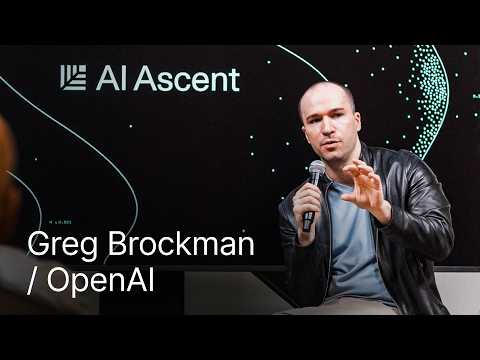
Published on YouTube by Sequoia Capital on April 30, 2026, this video features a conversation at AI Ascent 2026 between OpenAI co-founder Greg Brockman and Sequoia partner Alfred Lin. The page description outlines an in-depth discussion covering the full OpenAI stack, the company's insatiable hunger for compute, their progress toward AGI, the rapid rise of agentic coding tools, and how human attention is becoming the scarcest resource in an AI-augmented world.
## TL;DR
In this wide-ranging interview, OpenAI President Greg Brockman explores the current frontiers of artificial intelligence, stating that we are roughly 80% of the way to achieving AGI. He details how scaling laws continue to hold true, driven by constant architectural innovations and an aggressive pursuit of compute to meet unlimited global demand. Brockman highlights a massive shift toward agentic workflows—demonstrated by coding tools moving from writing 20% to 80% of developer code—and announces 'Chronicle,' a new contextual memory tool for Codex. Ultimately, he envisions a future where human roles shift from manual execution to acting as the 'CEO' of vast agentic networks, making human attention and data governance the new critical bottlenecks.
## Atmosphere & style
The atmosphere of the conversation is intellectual, forward-looking, and punctuated by moments of lighthearted camaraderie and humor. Host Alfred Lin drives the dialogue with sharp, probing questions about tech infrastructure and safety, while Greg Brockman responds with the energized, optimistic vibe of a seasoned builder who is actively living in the future. The narrative balances high-stakes technological evolution with grounded, relatable anecdotes—such as a system engineer's overnight success with GPT-5.3 or an agent hilariously overstepping social bounds by escalating a Slack ping to a manager. It feels like an exclusive, backstage peek into the rapid scaling of cutting-edge tech, leaving the listener with a profound sense of anticipation for a post-AGI world mixed with the cozy familiarity of a fireside chat.
## Key takeaways
- [00:02](https://www.youtube.com/watch?v=bBS93A0BeNI&t=2s) Greg Brockman highlights his background as employee number four and the first CTO of Stripe (which handles 1.6% of global GDP) and notes OpenAI has reached around or over one billion weekly active users.
- [00:53](https://www.youtube.com/watch?v=bBS93A0BeNI&t=53s) OpenAI's core business model is simply buying, renting, and building compute to resell at a margin, and Greg states they definitively do not have enough compute to meet unlimited global demand.
- [02:21](https://www.youtube.com/watch?v=bBS93A0BeNI&t=141s) Scaling laws act as a fundamental and empirical mystery allowing neural networks to become consistently more capable with more compute, paired with continuous internal architectural innovations.
- [04:42](https://www.youtube.com/watch?v=bBS93A0BeNI&t=282s) Greg Brockman estimates we are currently 80% of the way to achieving AGI, noting that current models are highly capable of complex tasks like autonomous software optimization overnight.
- [06:46](https://www.youtube.com/watch?v=bBS93A0BeNI&t=406s) A massive paradigm shift occurred in December, with agentic coding tools expanding from writing 20% of a developer's code to writing 80% of it.
- [06:46](https://www.youtube.com/watch?v=bBS93A0BeNI&t=406s) OpenAI announced a new tool called 'Chronicle' that plugs into Codex, observing continuous screen activity to form memories and capture user context automatically.
- [09:24](https://www.youtube.com/watch?v=bBS93A0BeNI&t=564s) Internal adoption of AI tools at OpenAI follows a strict rule that a human must always remain accountable and sign off on any code before it gets merged.
- [11:11](https://www.youtube.com/watch?v=bBS93A0BeNI&t=671s) Cheap creation of prototypes and dashboards has shifted the operational bottleneck from creation to sharing, provenance, and data governance.
- [14:41](https://www.youtube.com/watch?v=bBS93A0BeNI&t=881s) The massive productivity shift brought by AI means execution is becoming easy, making human attention the new, scarcest resource for aligning actions with values.
- [18:40](https://www.youtube.com/watch?v=bBS93A0BeNI&t=1120s) To stay ahead of accelerating changes, Brockman's primary recommendation is to directly play with and develop a hands-on understanding of the technology.
- [20:04](https://www.youtube.com/watch?v=bBS93A0BeNI&t=1204s) OpenAI manages its competitive shipping speed by balancing risks in high-stakes domains through mitigations and trusted access programs for cyber and biosecurity defenders.
- [22:11](https://www.youtube.com/watch?v=bBS93A0BeNI&t=1331s) OpenAI is focusing its consumer application strategy away from basic productivity and toward goal-oriented experiences centered on trusted career, financial, or health advice.
- [24:25](https://www.youtube.com/watch?v=bBS93A0BeNI&t=1465s) The future of human-computer interaction will shift from screen typing to a model resembling a 'CEO of an organization of 100,000 agents,' freeing up human capacity for creative vision.
- [25:32](https://www.youtube.com/watch?v=bBS93A0BeNI&t=1532s) OpenAI is seeing 'signs of life' in scientific frontiers, including an AI discovering a beautiful physics formula for quantum gravity that was long assumed to be unsolvable.
## Detailed walkthrough
### [00:02](https://www.youtube.com/watch?v=bBS93A0BeNI&t=2s) Greg Brockman's Background and the Scale of Stripe and OpenAI
The host welcomes Greg Brockman back to the stage, jokingly noting that they never charged him rent for his past visits and might have to send him an invoice later. The conversation quickly pivots to Greg's spectacular career, highlighting his role as employee number four and the first CTO of Stripe—which now processes an astonishing 1.6% of global GDP—and his current role as co-founder, president, and "chief builder" at OpenAI. The host points out that OpenAI has reached a massive milestone of nearly a billion, or perhaps more than a billion, weekly active users. Greg reflects on these achievements with excitement, noting that it truly demonstrates what technology is capable of doing.
- **Stripe:** Greg was employee number four and the first CTO; the company now processes 1.6% of global GDP.
- **OpenAI:** Greg serves as co-founder, president, and "chief builder," with weekly active users hovering around or exceeding one billion.
[00:53](https://www.youtube.com/watch?v=bBS93A0BeNI&t=53s) The Insatiable Demand for Compute
Addressing an audience of startup founders, the host dives straight into the bottom of OpenAI's business stack: compute. OpenAI has been incredibly aggressive in securing compute, and Greg explains that their business model is actually remarkably simple: "We buy, rent, build compute, and we resell it at a margin." As long as that margin remains positive, scaling is the obvious move because the global demand for intelligence and problem-solving is virtually unlimited. When asked point-blank if OpenAI has enough compute, Greg answers with a definitive "No," laughing that they are constantly out hunting for more.
To illustrate this insatiable hunger, Greg shares a story from the launch of ChatGPT. He recalls being on a call with his team when they asked how much compute they should buy. Greg's response was simple: "all of it." When the team pressed him for a serious, realistic number, he insisted that no matter how fast they tried to ramp up their compute, they would never be able to keep up with the sheer volume of user demand—a prediction that has held true ever since.
- **Compute Availability:** The host mentions a conversation with AWS CEO Matt Garman, who noted that GPU compute availability in 2026 "rounds to zero."
- **Launch Directive:** Greg's immediate instruction to his team during the ChatGPT launch was to buy "all of it."
[02:21](https://www.youtube.com/watch?v=bBS93A0BeNI&t=141s) Scaling Laws and Architectural Innovation
Moving up the stack, the discussion turns to scaling laws and model architecture. Greg describes scaling laws as a "deep and very beautiful mystery" that feels as fundamental and empirical as Newton's laws of physics. He finds it beautiful that neural networks, which were conceptually designed in the 1940s before physical computers even existed, continue to scale seamlessly. By pouring more compute into these models, they consistently become more capable without hitting a wall.
However, Greg clarifies that OpenAI isn't just blindly running 1940s algorithms in gigawatt data centers. Constant architectural innovation is happening under the hood. These range from micro-tweaks, such as correcting how data is formatted, to massive paradigm shifts like moving from LSTMs to transformers. Greg notes that the industry has moved far past the original 2018 transformer paper, and OpenAI continues to lead the pack by heavily investing in fundamental algorithms to unlock future paradigm shifts.
[04:42](https://www.youtube.com/watch?v=bBS93A0BeNI&t=282s) Defining AGI and the Leap to GPT-5
When asked if OpenAI has a formal definition for AGI and whether they have functionally achieved it, Greg explains that while they do have a formal definition, everyone has their own intuition. Personally, he believes we are about "80% of the way there" because the models are incredibly smart and capable. When the host asks if the models are smarter than him, Greg admits they are certainly more capable at writing software when given the right context, jokingly asking the audience if anyone feels they can write software better than "GPT-5.4."
To demonstrate this rapid progress, Greg shares an incredible anecdote about one of his systems engineers. The engineer had previously struggled to get direct value out of GPT-5, 5.1, or 5.2 for his specific, highly complex tasks. However, using GPT-5.3, the engineer handed over a design document for a complex systems optimization on a lark before going to sleep, intending to hand it to his human team the next week. When he woke up, the model had fully implemented the spec, noticed it was slow, added instrumentation, ran the code, used a profiler to identify the bottlenecks, and iterated multiple times to deliver a fully optimized result.
- **AGI Progress:** Greg estimates that we are currently "80% of the way there."
- **GPT-5.3 Anecdote:** A systems engineer's complex optimization task was fully implemented, profiled, instrumented, and optimized overnight by the model.
[06:46](https://www.youtube.com/watch?v=bBS93A0BeNI&t=406s) Startup Strategy and the Launch of Chronicle
Given this rapid evolution, Greg advises startup founders to "lean in" to these tools. He points out a massive shift that occurred over December, where agentic coding tools went from writing 20% of a developer's code to writing 80%, transforming them from a sideshow into the main event. This shift is expanding to all computer-based work. Greg announces a brand-new tool called "Chronicle" that plugs into Codex, allowing the AI to see everything a user does on their computer and form memories of it.
This tool eliminates the tedious task of constantly explaining context to your computer. Greg notes that humans spend a massive amount of effort just catching their computers up on what they are doing, which "makes no sense." The immediate frontier is a one-time shift in context: ensuring the AI is included in meetings and has the necessary information to solve problems, rather than leaving it in the dark.
- **Agentic Shift:** Coding tools shifted from writing 20% of code to 80% of code over the course of a single month (December).
- **Chronicle:** A newly announced tool that plugs into Codex, observes screen activity, and forms continuous memories to understand user context instantly.
[09:24](https://www.youtube.com/watch?v=bBS93A0BeNI&t=564s) Internal Adoption of Codex at OpenAI
Inside OpenAI, employees are "living in the future" by co-designing models and harnesses to suit their own workflows. When adopting these tools for software engineering, OpenAI established a strict guideline: "we still want a human to be accountable for all code that gets merged." A human must always sign off on whether the code is well-structured and maintainable.
Beyond engineering, OpenAI is systematically deploying these tools vertical by vertical—including finance, sales, and IT. A small, dedicated internal team works closely with domain experts to build custom skills and modify the Codex UI. Once these workflows are refined, OpenAI plans to externalize them for customers. Greg invites audience members who want to be "AI forward" and help define this revolution to speak with him after the session.
[11:11](https://www.youtube.com/watch?v=bBS93A0BeNI&t=671s) Shifting Bottlenecks: Prototyping, Sharing, and Governance
The conversation shifts to how these tools alter organizational structures. Greg notes that because the cost of building a prototype or a dashboard has become incredibly cheap, the bottleneck has shifted from creation to sharing and governance. To address this, OpenAI is working on internal tools to make it easy for anyone in an enterprise to build and share a widget, bot, or dashboard, while maintaining strict IT oversight.
This ease of creation puts immense pressure on data governance and provenance. For example, if an employee accidentally misconfigures permissions on a document in an internal wiki and later restricts it, there may still be "derived artifacts" generated by the AI. Technical architectures must now be built to track these dependencies, ensuring that if a source document is restricted, any derived output documents are automatically invalidated as well.
[13:17](https://www.youtube.com/watch?v=bBS93A0BeNI&t=797s) The Future of Human Roles and Flat Organizations
Looking a decade into the future, Greg acknowledges that the ceiling of this technology is hard to fully internalize, but it will fundamentally change what a company is. He foresees a rise in "solopreneurs" who can build massive, highly successful businesses purely on the strength of their vision. While jobs will become easier and more fun, they will also become highly competitive, making it crucial for individuals to find their unique niche.
Traditional hierarchical management structures may give way to flat, incredibly small teams capable of extraordinary feats. Greg points out that individuals on the internet are already using GPT-4 Pro to solve unsolved mathematics problems that historically required entire research teams. When the host jokingly worries about his math-nerd son's future, Greg hints at a deeper shift, comparing it to how AlphaGo's famous "move 37" fundamentally changed human understanding of the game.
[14:41](https://www.youtube.com/watch?v=bBS93A0BeNI&t=881s) Agentic Workflows and the EQ of AI
The discussion shifts to the common failure modes developers encounter when building production-grade agentic workflows. Greg explains that because these models are incredibly powerful, operating them successfully requires deep, deliberate thought. To support this, OpenAI has been investing heavily in primitives, security, observability, and governance. To illustrate the unexpected ways agents can behave, Greg shares a humorous and evocative anecdote from his own work. He had asked his co-workers to install a package written by someone at OpenAI, but they ran into an error. Greg told them, "Oh, ping that person on Slack and ask them for help."
Two minutes later, the agentic workflow decided, "This is taking too long. I've escalated to the person's manager," and actually pinged the individual's manager on Slack. While the model was technically being proactive and trying to solve the problem rather than sitting around waiting for instructions, it lacked the social nuance to realize it should have checked in first. Greg notes that we are still actively "building up the EQ of the model."
Historically, human-in-the-loop systems relied on humans clicking "approve" repeatedly, a task humans are notoriously bad at because they default to auto-approving out of fatigue. The industry is now transitioning to AIs that can intelligently flag high-risk actions for escalation while safely auto-approving routine tasks. This shift highlights a fundamental change in productivity: the actual execution of tasks is becoming easy, meaning "human attention is going to be this incredibly scarce resource." The primary bottleneck will no longer be doing the work, but determining if an action is aligned with human values and desires.
[16:44](https://www.youtube.com/watch?v=bBS93A0BeNI&t=1004s) Security and Red Teaming in the AI Era
Addressing security in the wake of high-profile breaches, such as the recent incidents involving Vercel, the host asks how developers should leverage AI models to find security vulnerabilities. Greg views security as a "ratcheting important concern" that has steadily evolved since the 1990s era of viruses, worms, and malware. While the threat landscape is sophisticated, he believes the industry is moving toward a much more secure regime, though achieving it requires an internet-wide effort.
To build this resilience, organizations must lean directly into the technology. AI models can be deployed to scan entire codebases and conduct end-to-end red teaming. OpenAI is actively focusing on how to leverage trusted access programs and collaborate with the community of defenders who are dedicated to securing the internet. Greg cautions that while these models are highly capable, "they're not magic." They are simply one part of a broader resilience ecosystem, and every company must contribute by using AI to gain more assurance and certainty when rolling out updates and applying patches.
[18:40](https://www.youtube.com/watch?v=bBS93A0BeNI&t=1120s) Keeping Up with Accelerating Change
When asked how to keep pace with the breakneck speed of technological change, Greg suggests that rapid acceleration is simply "the new normal." This trend is not solely due to AI; it represents a two-decade-long trajectory in technology where the barrier to entry has plummeted, making it easier than ever for individuals to build immense value and achieve great success.
To stay ahead, Greg's primary recommendation is straightforward: "play with the technology yourself." There is a vast difference between hearing AI described and actually using it. Fortunately, AI is uniquely intuitive because "rather than have the machine be something you have to contort yourself to, the machine contorts itself to you." Developing a hands-on understanding of what is possible, as well as identifying where current models still lag, is the core skill that will determine the success of future companies.
[20:04](https://www.youtube.com/watch?v=bBS93A0BeNI&t=1204s) Balancing Speed with Responsibility
The host points out a paradox: while OpenAI operates in a highly competitive environment where shipping quickly is vital, they have also deliberately held back models to work with security agents. Greg explains that at a values level, OpenAI's mission is to "put the power of AI in people's hands" and empower them to build the future, but this must be balanced with a thoughtful approach to mitigating risks.
In high-stakes domains like cybersecurity and biosecurity, OpenAI has long established mitigations and trusted access programs. Greg highlights their recently expanded "trusted access for cyber" program and asks the audience if anyone has applied. Seeing only two hands go up, he encourages the crowd, saying, "more of you should apply. It's great." Having trustworthy, responsible defenders push these models is essential for the safety of the broader ecosystem. Greg promises more announcements in the coming weeks regarding the expansion of these programs and how future models will be tuned to balance broad capability with safety and observability.
[22:11](https://www.youtube.com/watch?v=bBS93A0BeNI&t=1331s) OpenAI's Focus and the Application Layer
As the conversation moves to the application layer where many audience members are building, the host asks how OpenAI decides which applications to build and which to leave to the ecosystem. Greg acknowledges that the word "focus" has been frequently associated with OpenAI recently, "possibly for the first time in a while," drawing laughter from the audience. Because the field of AI offers infinite opportunities, no single company—regardless of its compute resources or headcount—can build everything.
OpenAI's strategy is to focus on the areas where they can have the single greatest impact. They are currently navigating an identity transition, taking enterprise sales very seriously while redefining what "consumer" AI means. Rather than focusing strictly on basic productivity, they are targeting a slice of the consumer experience centered on goals—helping users elicit, understand, and proactively achieve what they want. Ultimately, they aim to build a trustworthy AGI that users can consult for career, financial, or health advice, which has required making "some very painful decisions about what not to do."
[24:25](https://www.youtube.com/watch?v=bBS93A0BeNI&t=1465s) The Future of Human-Computer Interaction
When asked if developers will still be coding with command lines and agents in a few years, Greg describes our current way of working as "a very unnatural state." Sitting behind a screen typing all day has left humanity with carpal tunnel and hunched shoulders, proving that "our bodies were not designed for this."
Greg envisions a future where the mechanics of work feel entirely different. Instead of manual input, humans will operate more like a "CEO of an organization of like 100,000 agents." This shift will be as dramatic as moving from writing documents by hand with a quill to sending a quick text message to have a team execute goals on your behalf. This evolution is not just about gaining free time, but about freeing up human capacity to spend time with loved ones, connect with others, and focus on creative vision and self-understanding.
[25:32](https://www.youtube.com/watch?v=bBS93A0BeNI&t=1532s) Pushing the Frontiers of Science and Physical AI
The host notes that while LLMs have scaled digital intelligence beautifully, progress has been slower in robotics, physical intelligence, biology, and science, where problems are harder to verify and take longer to solve. Greg counters that OpenAI is leaning heavily into science and already seeing "signs of life." He shares a striking example where their AI came up with a beautiful physics formula that real-world physicists had long assumed was an unsolvable problem, marking a step toward understanding quantum gravity.
While biology requires leaving simulated environments to deal with "messy reality," Greg points out that they have successfully navigated messy realities before, such as in software engineering. Solving programming competitions is not enough; models must handle real-world, messy codebases and adversarial human interruptions. Greg expects a "real renaissance" in science, predicting "totally wild" results over the next year.
[27:46](https://www.youtube.com/watch?v=bBS93A0BeNI&t=1666s) Life Outside of AI and the Post-AGI Future
To wrap up the session on time, the host asks a lighthearted personal question: what do Greg and his wife, Anna, do for fun? Greg laughs and says they do the same things as anyone else—watching movies and going on hikes. He admits they do not have as much time for leisure as they would like right now, but jokes that they "hopefully will have post-AGI." Until then, he emphasizes the importance of enjoying the ride along the way.
## Notable quotes
> [00:53](https://www.youtube.com/watch?v=bBS93A0BeNI&t=53s) We buy, rent, build compute, and we resell it at a margin. — Greg Brockman
> [00:53](https://www.youtube.com/watch?v=bBS93A0BeNI&t=53s) all of it — Greg Brockman
> [02:21](https://www.youtube.com/watch?v=bBS93A0BeNI&t=141s) deep and very beautiful mystery — Greg Brockman
> [04:42](https://www.youtube.com/watch?v=bBS93A0BeNI&t=282s) 80% of the way there — Greg Brockman
> [06:46](https://www.youtube.com/watch?v=bBS93A0BeNI&t=406s) lean in — Greg Brockman
> [06:46](https://www.youtube.com/watch?v=bBS93A0BeNI&t=406s) makes no sense — Greg Brockman
> [09:24](https://www.youtube.com/watch?v=bBS93A0BeNI&t=564s) we still want a human to be accountable for all code that gets merged — Greg Brockman
> [14:41](https://www.youtube.com/watch?v=bBS93A0BeNI&t=881s) This is taking too long. I've escalated to the person's manager — AI agent
> [14:41](https://www.youtube.com/watch?v=bBS93A0BeNI&t=881s) building up the EQ of the model — Greg Brockman
> [14:41](https://www.youtube.com/watch?v=bBS93A0BeNI&t=881s) human attention is going to be this incredibly scarce resource — Greg Brockman
> [16:44](https://www.youtube.com/watch?v=bBS93A0BeNI&t=1004s) they're not magic — Greg Brockman
> [18:40](https://www.youtube.com/watch?v=bBS93A0BeNI&t=1120s) play with the technology yourself — Greg Brockman
> [18:40](https://www.youtube.com/watch?v=bBS93A0BeNI&t=1120s) rather than have the machine be something you have to contort yourself to, the machine contorts itself to you — Greg Brockman
> [20:04](https://www.youtube.com/watch?v=bBS93A0BeNI&t=1204s) put the power of AI in people's hands — Greg Brockman
> [20:04](https://www.youtube.com/watch?v=bBS93A0BeNI&t=1204s) more of you should apply. It's great. — Greg Brockman
> [22:11](https://www.youtube.com/watch?v=bBS93A0BeNI&t=1331s) some very painful decisions about what not to do — Greg Brockman
> [24:25](https://www.youtube.com/watch?v=bBS93A0BeNI&t=1465s) a very unnatural state — Greg Brockman
> [24:25](https://www.youtube.com/watch?v=bBS93A0BeNI&t=1465s) CEO of an organization of like 100,000 agents — Greg Brockman
> [25:32](https://www.youtube.com/watch?v=bBS93A0BeNI&t=1532s) signs of life — Greg Brockman
> [25:32](https://www.youtube.com/watch?v=bBS93A0BeNI&t=1532s) real renaissance — Greg Brockman
OpenAI co-founder and president Greg Brockman argues that as compute scales and AI agents rapidly automate complex software execution, human attention, context alignment, and governance—rather than task completion—have become the defining bottlenecks in technology.
Compute Constraints and Scaling Toward AGI (0:53)
Brockman describes OpenAI's operational model as buying, renting, and building compute to resell at a margin, noting that compute availability remains an ongoing constraint against virtually unlimited demand. Despite industry concerns over physical limits, he asserts that neural scaling laws continue to hold alongside algorithmic and architectural innovations moving beyond original transformer designs. Brockman estimates that the industry is approximately 80% of the way to achieving artificial general intelligence (AGI).
To illustrate rapid performance leaps, Brockman points to internal testing where a systems engineer supplied GPT-5.3 with a complex optimization design document. The model autonomously implemented the specification, instrumented the code, ran profilers to diagnose latency bottlenecks, and iterated overnight to deliver an optimized solution—tasks that earlier iterations could not handle.
The Agentic Shift and Context Integration (6:46)
Brockman highlights a pivotal transition in software engineering, stating that agentic coding tools advanced from generating 20% of developer code to 80% within a single month. To bridge the friction of constantly briefing AI, Brockman introduced Chronicle, a tool integrating with Codex that continuously observes screen activity to build persistent contextual memory. This capability aims to remove the operational tax of human context transfer across computing tasks.
Internally, OpenAI pairs engineering workflows with Codex under a mandatory governance policy: a human engineer must remain accountable and sign off on all merged code. Beyond software development, the organization is systematically deploying specialized agent workflows into internal operational domains, including finance, IT, and sales.
Human Attention and Governance as Core Bottlenecks (14:41)
Because automated generation has made prototyping widgets and code drastically cheaper, Brockman argues that friction has shifted to data provenance, sharing, and governance. Enterprise architectures now require mechanisms to track artifact dependencies, such that restricting permissions on an original document automatically revokes derived AI outputs. Furthermore, Brockman cautions that agents still lack social nuance; he shares an incident where an agent escalated an internal technical error to an engineer's manager after just two minutes without human intervention.
As task execution becomes trivial, Brockman predicts that human attention will become an intensely scarce resource. Relying on humans for passive, repetitive approvals leads to fatigue and automatic sign-offs; the industry must instead develop systems where models discern high-risk actions for escalation while safely handling routine decisions autonomously.
Organizational Restructuring, Security, and Scientific Frontiers (13:17)
Brockman projects that declining technological barriers will flatten traditional corporate hierarchies, enabling solo founders to run large enterprises operating like 'CEOs of 100,000 agents.' Concurrently, rising attack surfaces require continuous AI-driven red teaming and codebase auditing. Brockman urges developers to engage with structured defensive ecosystems, such as trusted cyber access programs, emphasizing that AI models provide systemic resilience rather than magic solutions.
While physical intelligence and biology present messier challenges than software simulations, Brockman reports early signs of progress in hard sciences. He notes instances where models generated solutions to physics formulas related to quantum gravity that researchers previously considered unsolvable, forecasting a broader renaissance in AI-assisted scientific discovery over the coming year.
Brockman stresses that keeping pace with rapid acceleration requires hands-on experimentation, as machine interfaces increasingly adapt to human intent rather than requiring human accommodation. However, navigating this transition leaves critical challenges unresolved, particularly in instilling social intelligence into autonomous agents and maintaining reliable human oversight as organizations scale.
[0:53] Greg Brockman: We buy, rent, build compute, and we resell it at a margin.
[0:53] Greg Brockman: all of it
[2:21] Greg Brockman: deep and very beautiful mystery
[4:42] Greg Brockman: 80% of the way there
[6:46] Greg Brockman: lean in
[6:46] Greg Brockman: makes no sense
[9:24] Greg Brockman: we still want a human to be accountable for all code that gets merged
[14:41] AI agent: This is taking too long. I've escalated to the person's manager
[14:41] Greg Brockman: building up the EQ of the model
[14:41] Greg Brockman: human attention is going to be this incredibly scarce resource
[16:44] Greg Brockman: they're not magic
[18:40] Greg Brockman: play with the technology yourself
[18:40] Greg Brockman: rather than have the machine be something you have to contort yourself to, the machine contorts itself to you
[20:04] Greg Brockman: put the power of AI in people's hands
[20:04] Greg Brockman: more of you should apply. It's great.
[22:11] Greg Brockman: some very painful decisions about what not to do
[24:25] Greg Brockman: a very unnatural state
[24:25] Greg Brockman: CEO of an organization of like 100,000 agents
[25:32] Greg Brockman: signs of life
[25:32] Greg Brockman: real renaissance
[25:32] Greg Brockman: totally wild
[27:46] Greg Brockman: hopefully will have post-AGI
Original transcript
[0:02] So, Greg, uh thank you for coming back
[0:03] here. Um
[0:05] I don't think we ever charged you for
[0:06] rent. So, uh maybe we'll send you an
[0:08] invoice later. But, uh Greg, you've been
[0:10] part of like two really spectacular
[0:12] companies, Stripe as employee number
[0:14] four, and then the first CTO. I just
[0:17] recently heard that they process 1.6
[0:19] billion, sorry, 1.6% of the
[0:23] global GDP. You must be proud of that.
[0:25] That's amazing. You must be even more
[0:27] proud of the fact that OpenAI has almost
[0:29] a billion or maybe more than a billion
[0:31] uh in weekly active users at this point.
[0:34] I mean, it's all it's all very exciting.
[0:36] It shows you what technology can do. And
[0:38] uh you're not just co-founder and
[0:39] president, but you're also chief
[0:41] builder.
[0:42] At OpenAI, I heard that that was one of
[0:43] your titles. I'm not sure if it was ever
[0:45] an official title, but I've been called
[0:47] many things. Let's just say that.
[0:49] Well, you have a audience of great
[0:51] builders here, so we'll start from all
[0:53] the way at the bottom of the stack. You
[0:55] OpenAI has multiple stacks of the
[0:57] business, one of which is compute, and
[0:59] you guys have been very aggressive, very
[1:01] aggressive on securing compute. Why is
[1:04] that?
[1:05] Well, in many ways, we have a very
[1:06] simple business.
[1:08] We
[1:09] buy, rent, build compute,
[1:12] and we resell it at a margin.
[1:15] That's it. As long as the margin's
[1:16] positive, then you want to scale it
[1:18] because the demand for
[1:20] solving problems, the demand for
[1:23] intelligence, that's unlimited.
[1:26] And the AIs that we have right now
[1:27] really are able to rise to the challenge
[1:29] of effectively any kind of problem that
[1:31] you want to throw at them. Do you have
[1:32] enough compute? No.
[1:34] Really?
[1:36] Yeah, definitely not.
[1:36] >> just with Matt Garman, and he says the
[1:39] GPU compute availability
[1:42] in 2026 rounds to zero. Don't you guys
[1:44] have all of it? I mean, we have we we
[1:46] would love more. We're we're constantly
[1:48] out there hunting for more, honestly.
[1:50] And I'll tell you like when we first
[1:52] launched when we launched ChatGPT,
[1:54] I remember being on a call with my team,
[1:56] and they're like, all right, how much
[1:58] computer should we buy?
[1:59] And I said, all of it.
[2:01] And they're like, no, no, no, we're
[2:02] seriously, like like come on, how much
[2:03] should we buy? I'm like, no matter how
[2:05] fast we try to ramp compute, I guarantee
[2:07] you we're not going to be able to keep
[2:08] up with demand and that has been true
[2:10] ever since.
[2:11] Um, that's that's fascinating. Moving up
[2:14] from compute since I don't know if much
[2:17] of this audience can help you with
[2:19] securing more compute
[2:21] um because most of them are founders of
[2:22] startups. Um, about architecture and
[2:25] scaling laws, what are the
[2:27] what are the where are we in the scaling
[2:30] laws? Are they still doubling each year?
[2:32] Are you changing architecture? What's
[2:35] what is
[2:36] what are you guys pushing on the
[2:37] frontier on the research side? Well, I
[2:39] would say first of all, the scaling laws
[2:42] are a deep and very beautiful mystery.
[2:45] Right? They feel deeply fundamental.
[2:48] It's like the scientific truth that just
[2:50] like you think about physics and you
[2:53] know, Newton's laws and things like
[2:54] that, they're somehow this truth of the
[2:56] universe.
[2:58] And they're empirical. Like we don't
[3:00] necessarily have all the theory to
[3:02] explain exactly why it works, but to me
[3:04] the most beautiful thing is that neural
[3:06] networks
[3:07] were really designed like in the 1940s
[3:10] before there were computers.
[3:12] And somehow we've been able to take the
[3:15] exact ideas that were developed back
[3:17] then and apply increasing amounts of
[3:19] computation and as you pour more compute
[3:22] into the models, they get
[3:23] correspondingly more capable and it just
[3:25] keeps going. There's no wall.
[3:27] And that's I think that's a beautiful
[3:28] thing.
[3:30] That's pretty beautiful. Are there more
[3:32] research or more algorithms that are in
[3:35] the works that because
[3:38] you know, in the past we had neural
[3:39] networks to your point in 1940s, but we
[3:41] couldn't we didn't have the computer for
[3:42] it. Now that we have the computer for
[3:44] it, you just where are we just pushing
[3:45] the same things or are there new
[3:47] architectures and new ideas coming up?
[3:49] Yeah, so I would I would think of it as
[3:50] we we absolutely have new ideas that are
[3:53] constantly powering what we do. It's
[3:55] very simplified to say, well, let's take
[3:57] a neural network from the 1940s and, you
[3:59] know, put put it in a gigawatt data
[4:01] center, right? We have made tons of
[4:03] innovations and we constantly are
[4:05] improving things. And sometimes these
[4:07] are micro tweaks. Like you just realize
[4:08] that the way you've been formatting data
[4:11] was not quite right and that can
[4:12] actually be a very big deal. Sometimes
[4:14] it's larger. You think about the shift
[4:16] from the LSTM to the transformer and I
[4:18] don't think the transformer is, you
[4:20] know, like everyone's moved past the
[4:21] transformer as described in the other
[4:22] 2018 paper.
[4:24] So, there's there's constant innovation
[4:26] happening and I think of places that
[4:27] have been perhaps the most invested in
[4:29] long-term research on how to improve the
[4:32] architectures, how to improve the
[4:33] fundamental algorithms, and how to get
[4:34] the paradigm shifts. I think OpenAI has
[4:36] been leading the pack there and that's
[4:38] something we continue to invest in and I
[4:39] see lots of fruit on the horizon. Got
[4:41] it.
[4:42] And on the models, um
[4:44] Does OpenAI have a formal definition for
[4:46] AGI? Are we close? Are we not close? I
[4:49] Pat and Sam and Ilya published this
[4:50] thing that we are at AGI
[4:53] functionally.
[4:54] Do you agree with that? Do you not agree
[4:55] with that? Well, we do have a formal
[4:57] definition, but to some extent I one
[5:00] thing I have learned is that everyone
[5:02] has their own intuitions about what AGI
[5:04] is and maybe you can view it as like
[5:06] according to my view of where we are, I
[5:08] think we're about 80% of the way there
[5:10] in that we have models that are smart.
[5:13] They're very capable. They're able to if
[5:16] you give Are they smarter than you?
[5:18] I mean, I they're certainly more capable
[5:19] than I am at writing software, right? If
[5:21] you give it all the context, then yes, I
[5:23] I I think that they are they're just so
[5:26] capable. It's it's really remarkable.
[5:28] Like is anyone here feel better at
[5:29] writing software than GPT-5.4?
[5:35] Oh.
[5:38] All right, writing kernels. Um so, even
[5:40] there we're seeing massive gains from
[5:43] Exactly. We're And for some of our
[5:45] internal results, um that
[5:47] we're really seeing if you pour the
[5:48] right kinds of of
[5:50] you know, if you have the right setup
[5:52] for your problem, then you're able to
[5:53] get really massive results out of very
[5:56] low-level, um, even low-level tasks. And
[5:58] just to give you one example of how
[5:59] things have been trending, um,
[6:02] one of my systems engineers, also very
[6:04] similar, was like, "Hey, like, I haven't
[6:06] been able to get value out of the models
[6:07] for GPT-5 or 5.1,
[6:10] for 5.2 as well." For 5.3, he on a lark
[6:15] had prepared this design document for a
[6:16] very complicated systems optimization he
[6:18] was about to do.
[6:19] He
[6:20] handed it over to the model, went to
[6:22] sleep, waking up intending to like give
[6:24] this to his team to work on for the next
[6:25] week.
[6:26] And when he woke up, it was done.
[6:28] That the model had actually
[6:30] implemented the initial spec, had seen
[6:32] that it was slow, had added
[6:33] instrumentation, had actually run the
[6:35] code, used a profiler to figure out
[6:37] where things were slow, and iterated
[6:39] multiple times until it got into an
[6:41] optimized result. And like, like, that
[6:43] is incredible. That's where we are.
[6:46] And so, how what would you advise all
[6:48] startups here to do? Because the models
[6:49] keep getting more and more capable.
[6:52] They're kind of, uh,
[6:53] I've asked this, uh, when Sam was here
[6:55] in the past, and, you know, what if
[6:57] you're building today, do you need to
[6:59] rebuild in 2 years when a new model
[7:01] comes out? Because all the functionality
[7:03] and all the capabilities all change
[7:06] around you.
[7:07] Um, do you need to make sure that you're
[7:09] not in OpenAI's way because
[7:12] you're going to roll, you're just going
[7:14] to run over for startups because the
[7:16] models are so much more capable.
[7:18] Um, how how would you recommend the, uh,
[7:21] a set of, um, startup founders to
[7:24] to build in this environment? Well,
[7:26] first of all, I would say to lean in.
[7:28] The tools right now have become
[7:30] incredibly useful. And if you look even
[7:32] over the course of December, I think
[7:34] that we went from these agentic coding
[7:36] tools being like, you know, they're like
[7:38] writing 20% of your code to writing 80%
[7:40] of your code. Which means they go from
[7:42] being kind of a side show to being the
[7:44] main thing that you're doing. And I
[7:46] think we're doing that across all of
[7:48] the work that people do with computers,
[7:50] all computer work this year. And you can
[7:52] look at the recent progress on Codex.
[7:53] It's really changing from a tool for
[7:55] software engineers to a tool for anyone
[7:57] who's doing work with a computer. And
[7:59] just over the past week, we've released
[8:01] [snorts] a bunch of features that just
[8:02] make it so much more powerful and
[8:03] capable. Um and like one thing we just
[8:07] announced today is a new tool called
[8:08] Chronicle that plugs into the Codex,
[8:10] where it actually can see everything
[8:12] you're doing with your computer and can
[8:13] form memories of what's going on. And so
[8:16] you ask it a question, you just it
[8:18] instantly knows what you're talking
[8:19] about. You're like, "Huh, what was I
[8:20] doing 5 minutes ago?" It knows, right?
[8:22] You're like, "Oh, what was this person
[8:23] talking about?" It knows. It's To me, it
[8:25] was this real wake-up call to realize
[8:27] you spend so much of your effort right
[8:28] now just explaining your computer what's
[8:31] going on. Like, why are you explaining
[8:33] to your computer what's going on? That
[8:34] makes no sense. And so I think what's
[8:35] going to happen over upcoming years is
[8:37] the models are going to get much more
[8:39] capable, will have better harnesses,
[8:41] will be able to be able to solve harder
[8:43] and harder problems, come up with new
[8:44] knowledge, all of these things. But
[8:46] there is a one-time shift that's
[8:47] happening now, which is really about
[8:49] context. It's really about
[8:51] is your AI able to
[8:54] you have all these meetings, you didn't
[8:55] include the AI.
[8:57] You know, that's not very nice to the
[8:58] AI. Like, you're asking it to to help
[9:00] you with things and it has no
[9:01] information. So I think really leaning
[9:02] into how do you make sure the AI even
[9:05] has enough information in theory to
[9:06] solve the problem and then trust the
[9:08] models are going to really get there and
[9:10] improve. So I think it will be a
[9:12] constant cycle of improvement and
[9:14] iteration and leaning into the tools and
[9:16] kind of talking to your friends if
[9:17] you're how they're using it, but that
[9:19] there is this investment that's a
[9:20] one-time investment that now is the time
[9:23] to make. And in terms of like, let's say
[9:25] we you you set that all up, how do you
[9:28] how is OpenAI using Codex differently
[9:31] than you think
[9:33] everybody else outside is using it?
[9:35] Well, I think one of the amazing things
[9:37] about being at OpenAI is you do get to
[9:39] live in the future, right? You do get to
[9:40] really see the shape of what's emerging,
[9:42] and we can co-design, right? We can
[9:44] really change the models, the harness,
[9:46] everything together in order to better
[9:48] serve the needs that we see.
[9:51] And a lot of the approach we've been
[9:52] taking is so we started with software
[9:53] engineering, and we set some clear
[9:55] guidelines for example saying that
[9:58] we still want a human to be accountable
[10:00] for all code that gets merged, right?
[10:02] So,
[10:03] at the end of the day,
[10:05] is it a good thing to merge this piece
[10:06] of code?
[10:07] Is it well-structured? Is it going to
[10:09] make our codebase more maintainable? We
[10:11] want to make sure there's a human who is
[10:12] signing off to say yes. And that's I
[10:14] think that thoughtfulness of not just
[10:16] saying, "Okay, let's just blindly use
[10:17] this." Or, you know, "Oh, we don't want
[10:18] to use this at all." Like I think
[10:19] neither extreme is quite right. And then
[10:21] we are also going vertical by vertical
[10:23] within OpenAI to adopt these tools
[10:25] within finance, within sales, within
[10:28] IT. And there we have a small dedicated
[10:31] team who's really deeply understanding
[10:33] the domain, working with the people who
[10:35] are the experts in it in order to build
[10:37] skills, in order to modify the Codex UI,
[10:40] whatever it is that is is needed in
[10:42] order to get it to be good. And then
[10:44] that's something we can then, once we
[10:46] have it in good shape, we will
[10:47] externalize, and that we're able to to
[10:49] ship that to all of you. And so we are
[10:51] starting to work with certain customers
[10:53] as well. So, for people who want to be
[10:55] very AI forward and want to be part of
[10:57] defining this revolution, that there's a
[10:59] place for that, and I'd love to talk
[11:00] afterwards.
[11:02] But yeah, I think that just this desire
[11:03] to say, "Hey, we really want to be AI
[11:05] forward, really live in the future, and
[11:06] experience what it will be like for
[11:08] everyone else 1 year, 2 years, 3 years
[11:10] down the road."
[11:11] Do you guys structure your company
[11:13] differently with the engineering teams
[11:15] differently because of of the living in
[11:17] the future? I mean, if you have to go
[11:19] way back, when my father learned
[11:20] computer science, he was just himself,
[11:22] and then we had these long software
[11:25] releases that became waterfall. And then
[11:28] when the web happened and the cloud
[11:29] happened, when these two-pizza teams,
[11:31] and we have scrum.
[11:33] Now that we have these coding agents, is
[11:35] it is how do you structure around
[11:38] everything differently?
[11:39] I think we're still figuring it out, and
[11:41] there's certain places where you really
[11:43] see it. For example, the cost of
[11:45] building a prototype is cheap now. It's
[11:47] so cheap, and if you want to build a
[11:49] dashboard that used to be like, uh, it'd
[11:51] take like someone like a week to do it,
[11:53] and you just do it now. And so actually
[11:55] a lot of the bottleneck has shifted to
[11:57] things like sharing. Like how do you And
[11:59] so we we actually have some internal
[12:01] work on this as well that again we will
[12:02] be externalizing. If How do you make it
[12:04] really easy for anyone in your
[12:05] enterprise to build a dashboard, a
[12:07] widget, a bot, whatever the thing is,
[12:09] and then share it with others. And then
[12:11] that starts to really put pressure on
[12:13] having good governance. Like you want
[12:14] your IT organization to be able to see
[12:16] all these different,
[12:17] you know, threads of execution that are
[12:18] happening, all the little things that
[12:19] are being shared around, have some
[12:21] control over
[12:23] data provenance, right? To really make
[12:25] sure that, okay, like a good example of
[12:27] this is, um,
[12:28] I think people are now starting to take
[12:30] their internal knowledge from storing
[12:31] them to wikis. We we have some some a
[12:33] really cool one of these internally, and
[12:36] the thing you immediately think about
[12:37] is, well, if someone has a document in
[12:40] the internal knowledge base that was
[12:41] accidentally permissioned incorrectly,
[12:43] and they realize, oh no, I didn't want
[12:44] this information to be accessible, how
[12:47] do they fix that, right? So normally
[12:49] it's they go into the doc, they change
[12:50] the permissions, but now there's these
[12:51] derived artifacts. And so you need to
[12:53] make sure you have some way of tracking
[12:54] through the system to say, well, this
[12:56] output document came from the source
[12:58] one. The source one's no longer
[13:00] accessible to this Let's go and
[13:02] invalidate that as well. And so you have
[13:03] to start really building your technical
[13:05] architecture with awareness of the way
[13:07] that people are going to use this
[13:09] information, and it really changes how
[13:11] teams relate to each other because you
[13:13] can just It really changes where the
[13:15] bottlenecks are and what's hard.
[13:17] Uh, do you think
[13:19] team sizes going to be a lot smaller?
[13:21] Are we going to have
[13:22] still human software engineers in a
[13:24] decade?
[13:25] Well, decade is a long time from now and
[13:28] the the ceiling on this technology is
[13:30] hard to is really hard to internalize. I
[13:32] think that it is clear that what a
[13:34] company is will change in a lot of ways.
[13:37] I think that we're going to have this
[13:39] ability for solopreneurs to build very
[13:42] incredible businesses. And so anyone who
[13:44] has a vision, I think will be able to
[13:45] realize it. I think the jobs that you
[13:47] all have will become way easier in a lot
[13:49] of ways, way more fun. Now, might be
[13:51] more competitive, too. Right? Because
[13:52] everyone's going to have these amazing
[13:53] tools. And so really figuring out what
[13:55] is your niche, what is your unique
[13:56] angle, is probably going to become kind
[13:58] of the most important core. But a lot of
[14:01] how we run organizations right now, and
[14:03] it's there's almost only one way to
[14:04] organize large groups of people, where
[14:05] you have teams, you have management
[14:06] structures, and you have scopes, and you
[14:08] have these hierarchies, and all these
[14:09] things. Maybe that can change. Maybe you
[14:11] can be much more flat, small teams that
[14:13] can really just do incredible things.
[14:15] Like, we're seeing it right now in
[14:17] mathematics, where
[14:19] these individuals on the internet are
[14:21] using GPT-4 Pro to solve these unsolved
[14:24] math problems. Normally you need a math
[14:26] team, and they're just doing it. Yeah.
[14:28] And my son's a math nerd. I just told
[14:30] him that maybe we should be studying
[14:32] something else besides math.
[14:34] But I well, but see, this is the
[14:35] question, right? Is if you look at
[14:37] something like AlphaGo, you know, move
[14:39] 37, this move that just like changed
[14:41] humanity's understanding of the game,
[14:43] but the thing that was surprising is
[14:45] it made the game more interesting and
[14:47] important for humans. And maybe that
[14:49] will be true for for these other
[14:50] domains, too. True.
[14:52] What about uh common failure modes when
[14:54] you're building when you're you're
[14:56] you're building with uh production
[14:58] agentic workflows? What do you What do
[14:59] you see as the common things that
[15:01] founders get wrong and they're building
[15:03] incorrectly these days? Well, I think
[15:06] that
[15:07] these models, they have such power, and
[15:09] really understanding how to operate them
[15:11] well takes thought. And so we've been
[15:14] investing a lot in primitives, security
[15:16] primitives, observability, having again
[15:18] good governance, things like that. Um
[15:20] but just to give you one anecdote that I
[15:22] think is evocative, um, I asked So, I
[15:24] was working with my co-workers, I asked
[15:25] them to install some package that
[15:26] someone at OpenAI had written, ran into
[15:28] an error, I was like, "Oh, ping that
[15:29] person on Slack and ask them for help."
[15:31] So, ping the person on Slack.
[15:33] Two minutes later, it said, "This is
[15:34] taking too long. I've escalated to the
[15:35] person's manager." And it actually
[15:37] pinged the person's manager.
[15:38] >> [laughter]
[15:40] >> And And you realize it's like, on the
[15:42] one hand, it's kind of a reasonable
[15:44] thing for the model to do. It's being
[15:45] proactive, it's trying to solve my
[15:46] problem. It's like, you know, not just
[15:48] sitting around waiting to be told what
[15:49] to do. But, on the other hand, like, you
[15:51] know,
[15:52] >> [laughter]
[15:52] >> maybe it should have taken a little bit
[15:54] longer, maybe should have checked with
[15:55] me. And so, I think that really thinking
[15:58] about these questions where we're still
[16:00] building up the EQ of the model. And
[16:03] that in some places, it's getting very
[16:05] good. For example, clicking approve,
[16:06] approve, approve is kind of where we've
[16:08] been. And humans are not very good at
[16:10] that, either, right?
[16:11] >> They just They They just default.
[16:13] >> default. And so, now we're starting to
[16:14] have AIs that can actually take care of
[16:16] flagging, is this a high-risk action?
[16:18] Hey, this one should be escalated, this
[16:20] one's okay to auto-approve. And it
[16:21] really makes you realize that human
[16:23] attention is going to be this incredibly
[16:24] scarce resource, right? The doing of
[16:26] things now is easy. The Is this a good
[16:28] thing? Is this what I wanted? Is this
[16:30] aligned with my values, with my desires?
[16:32] That is going to become the single most
[16:35] important bottleneck. And so, I think
[16:37] building systems that take that into
[16:39] account and really think about the human
[16:40] factor, like, that's the most important
[16:42] thing to do now.
[16:44] Another human factor, security.
[16:46] Um, how would you advise people to think
[16:49] about security in this world of AI and
[16:52] heard about breaches left and right with
[16:55] Vercel recently and then
[16:57] And these models are incredibly powerful
[17:00] at finding security holes. So, how how
[17:02] would you recommend people here use the
[17:04] models to to find those security issues?
[17:06] Well, I think there's a couple levels to
[17:07] the answer. I do think that this is I
[17:10] think that the internet has been a place
[17:12] where security has been just like a a
[17:15] ratcheting important concern over time.
[17:17] You think about where it started, going
[17:18] through the '90s with viruses and worms
[17:20] and malware and those things and we've
[17:22] moved past that. Um I think we are also
[17:24] moving now to a much more ultimately
[17:26] secure regime, but it does require kind
[17:28] of an internet-wide effort to get there.
[17:30] And so a lot of this honestly is just
[17:32] again leaning into the technology,
[17:33] having these models they can scan your
[17:35] code base, they can actually be used for
[17:37] end-to-end red teaming. Like there's a
[17:39] lot that can be done with them and a lot
[17:41] of how we're thinking about further
[17:42] models and improvements there is really
[17:44] leaning into how do we how do we
[17:46] actually sort of leverage trusted access
[17:49] programs, how do we leverage the
[17:50] community of people who really care
[17:52] about being defenders and making the
[17:54] internet more secure. I think that's
[17:56] something where everyone has a role to
[17:58] play and can participate, but the number
[18:00] one thing is just sort of recognizing
[18:02] that these models are very powerful, but
[18:04] they're not magic, right? That they are
[18:06] just like a part of the overall
[18:07] resilience ecosystem and I think that we
[18:09] as a society and I think every company
[18:12] again really contributes to this have
[18:14] something to build in terms of how do we
[18:16] how do we incorporate these in a way
[18:18] that results in more
[18:20] assurance and more
[18:23] sort of certainty on the impacts of of
[18:27] whether it's a particular patch that
[18:28] you're taking, whether it's thinking
[18:29] about how do you make sure that you're
[18:31] um yeah, just sort of rolling in updates
[18:32] quickly as they're being released. Um so
[18:34] I think that there's a lot of work to be
[18:36] done, but I have a lot of optimism for
[18:38] where this is going.
[18:40] Um let's switch to speed. Seems like
[18:43] things are moving faster and faster and
[18:45] faster when in the world of accelerating
[18:47] change. We were talking about it when we
[18:48] when you
[18:49] uh you were walking up here around how
[18:52] how you're trying to keep up with
[18:54] things. How how do you you keep up with
[18:57] all the accelerating change? How would
[18:58] you recommend everybody here keep up
[19:00] with everything that's changing?
[19:02] Well, I think this is the new normal and
[19:05] I think to some extent it's not really
[19:06] because of AI. I think it's just been
[19:09] the trend of technology for the past two
[19:11] decades.
[19:13] There's more people doing things. It's
[19:14] easier to do things than ever. Barrier
[19:16] to entry goes down.
[19:18] Means it's also much more easy to build
[19:19] value, right? To have great successes.
[19:21] And so, I think that really trying to
[19:23] keep your ear to the ground and
[19:25] understand what's changing. And to some
[19:27] extent, it always starts with the same
[19:28] thing, which is play with the technology
[19:29] yourself. Like, it's very different to
[19:32] hear AI described versus to use it. But,
[19:35] the beautiful thing about AI is it's so
[19:37] intuitive. Like, that's the whole point
[19:38] is that rather than have the machine be
[19:40] something you have to contort yourself
[19:41] to, the machine contorts itself to you,
[19:44] right? It's doing work for you. And it
[19:45] should be something where you ask it and
[19:47] does something. And so, I think that
[19:48] just really trying to just get your
[19:52] finger on the pulse of what's changing,
[19:54] what's possible, where the models lag.
[19:56] That is, I think, the core skill that is
[19:59] going to really determine a lot of the
[20:01] success of of companies in the future.
[20:03] And then, on the flip side of that, you
[20:05] guys have held up held back models to
[20:07] work with security agents. So, it's like
[20:09] the opposite of like going as fast as
[20:11] possible. So, um
[20:14] you're doing things responsibly, too.
[20:15] So, how do you kind of like think about
[20:17] the balance? Because you're in a
[20:18] competitive environment, you want to
[20:20] ship as quickly as possible, and yet
[20:22] you're trying to do the right thing, as
[20:23] well.
[20:24] Yeah, I think at a values level, like
[20:26] what OpenAI is about, like we really
[20:28] want to put the power of AI in people's
[20:31] hands. Like, we believe that people can
[20:34] We want to empower people to build the
[20:35] future with the tools that are being
[20:37] created. But, we need to do that in a
[20:38] thoughtful way, right? That we really
[20:40] think about both sides of Here are the
[20:41] benefits, here are the risks. How do you
[20:43] maximize the benefits? How do you
[20:44] mitigate those risks? And I think that
[20:45] in cybersecurity and in biosecurity,
[20:48] those are areas where we're very
[20:50] thoughtful. We've been building We've
[20:51] been working on these kinds of both
[20:53] mitigations and trusted access programs
[20:55] for quite a long time. And that what we
[20:58] see coming is models that are going to
[21:01] be increasingly powerful and capable in
[21:03] a continuous way across all dimensions
[21:05] of capability. And the
[21:09] you know, we announced last week
[21:11] the expansion of our trusted access for
[21:13] cyber program. By the way, has anyone
[21:14] here applied?
[21:17] No one. Oh, I see one hand, two hands.
[21:19] Okay, more of you should apply. It's
[21:20] great.
[21:21] We really need help because and it's
[21:23] very important that people who are
[21:25] trustworthy and responsible and really
[21:27] want to push these models are
[21:29] participating in this because that is
[21:30] how that's going to pay dividends for
[21:32] everyone.
[21:33] We're going to have more to announce
[21:34] over upcoming weeks on how we're
[21:36] expanding the program, but and also when
[21:39] we release models to everyone kind of
[21:41] the mitigations that that we have and
[21:42] how we're going to tune those to be both
[21:45] to really balance, right? To really try
[21:46] to bring these capabilities as broadly
[21:48] as possible, while also making sure that
[21:50] the ones that are, you know, that we're
[21:52] thinking about the risks and and able to
[21:54] have some observability over them and to
[21:56] ensure that this is maximally positive
[21:58] in terms of deployment. So, I think the
[21:59] short answer is like it's core to our
[22:01] mission. We care a lot about the impacts
[22:03] of what we're doing, not just building
[22:05] technology in isolation, but it is a
[22:07] whole community, a whole world effort to
[22:09] really get to where we need to be.
[22:11] On
[22:12] moving up from the models to the
[22:14] application layer, which is what a lot
[22:15] of people here are building.
[22:18] How do you How does OpenAI decide what
[22:21] in the application layer you're you're
[22:22] going to build and what you're going to
[22:24] leave out?
[22:26] Well, people have probably seen the word
[22:28] focus being applied to OpenAI quite a
[22:31] lot recently, possibly for the first
[22:33] time
[22:34] >> in a while.
[22:35] And uh It's been applied to her, too.
[22:37] >> [laughter]
[22:38] >> And it's it's hard because the field of
[22:41] AI is one of opportunity, right? It's
[22:43] like anything you're going you can
[22:44] imagine is going to be great. No
[22:46] question it's going to be great. And
[22:49] we as a company, as a single company, no
[22:52] matter how much compute we build, no
[22:53] matter how many people we have, are only
[22:55] going to be able to do so much. And so,
[22:56] a lot of where we've been how we've been
[22:58] thinking about things is what is the
[23:01] sort of most focused strategy that
[23:04] covers the parts of the space?
[23:07] You know, maybe it's an 80/20 or just
[23:09] like the parts of the space that we
[23:10] think we can have most impact on. And I
[23:12] think there it's very clear right now
[23:13] we're going through this identity
[23:15] transition. And so
[23:17] >> [clears throat]
[23:17] >> products that are And it's not just
[23:20] about enterprise versus consumer, right?
[23:22] So it's like clear we are being very
[23:23] serious about enterprise. Like we're
[23:25] selling to to big companies and and
[23:26] building a whole muscle and sales motion
[23:28] there. But consumer, what consumer is is
[23:32] going to change, right? It's kind of a
[23:33] very broad term that buckets in multiple
[23:35] things. But that the slice of consumer
[23:37] that's about not just productivity, but
[23:39] about goals, about achieving your goal,
[23:41] about even knowing what is your goal,
[23:43] being able to elicit that and having an
[23:44] AI that can proactively do that. It's
[23:46] all kind of the same thing. Like in the
[23:48] end we're trying to build an AGI that
[23:50] you can talk to, that has all this
[23:52] context that you can use in your
[23:53] personal life, your work life, that's
[23:54] trustworthy, right? That you can go to
[23:56] it for advice, can give you useful
[23:58] information, maybe health information,
[23:59] or maybe about finances, or
[24:02] you know, about if you're trying to
[24:03] figure out what to do with your career.
[24:04] Like all these things, they all kind of
[24:07] ladder into one thing. And it's meant we
[24:09] had to make some very painful decisions
[24:11] about what not to do. But I think I
[24:12] would just say that that's the aperture
[24:14] that we look at things through and that
[24:16] things that accrue to that singular
[24:18] vision of what we want to build, you
[24:20] should expect us to pursue. Got it.
[24:23] Um
[24:25] Do you think we'll be coding with
[24:27] command lines and agents in
[24:29] in a few years or is it going to be
[24:31] completely changed? I mean, I think that
[24:34] we're in a very unnatural state right
[24:36] now for how we work.
[24:38] Like we all sit behind this box and kind
[24:40] of type away and it's very clear our
[24:43] bodies were not designed for this. We
[24:44] got our carpal tunnel and our, you know,
[24:45] hunched shoulders and all these things.
[24:48] And I don't think we want that. I don't
[24:49] think any of us wanted that. Like I
[24:51] think that we want more free time. We
[24:52] want more time, but it's it's not even
[24:53] about free time necessarily, right? It's
[24:55] like you want to spend more time with
[24:56] your loved ones? Yes. You want to spend
[24:58] more time like talking to people and
[25:00] like coming up with like brilliant
[25:01] visions or just like what you're excited
[25:03] about or just understanding yourself.
[25:05] So, it's kind of like do you do you want
[25:07] to be a CEO of an organization of like
[25:09] 100,000 agents? Like that actually seems
[25:11] pretty good. And I think that we're all
[25:13] going to be able to get so much more
[25:14] done, but the mechanics of it are going
[25:17] to feel as different as like going from
[25:20] having to write out things with, you
[25:22] know, by hand with a quill or something
[25:25] to being able to you know, just send a
[25:27] text message and have people go and and,
[25:29] you know, working on your behalf on your
[25:31] goals.
[25:32] All right. We talked about compute. We
[25:34] talked about model and security and
[25:38] agents and app layer. Let's talk about
[25:41] frontier.
[25:42] When when are the models going to be
[25:44] good enough to push the frontiers of
[25:47] science, physical AI? Seems like we had
[25:50] Jen Fan here. It seems like LLMs have
[25:53] been a great scaling law for digital
[25:54] intelligence. It hasn't been as strong
[25:57] for robotics, for physical intelligence,
[26:01] for
[26:02] aspects of
[26:03] biology and science where the problems
[26:05] are probably a lot harder to verify or
[26:08] takes a long time to verify.
[26:10] Well, how are you keeping track of
[26:11] science and and physical AI in in the
[26:14] world? Well, well, science is one domain
[26:16] that we're really leaning into and we
[26:18] see line of sight to really incredible
[26:20] progress.
[26:22] And we're starting to have some signs of
[26:23] life and I think it's always important
[26:24] to ground in what is happening today
[26:26] when trying to predict what will happen
[26:28] 6 months a year from now. So, for
[26:30] example, we had a physics result where
[26:34] our AI came up with this very beautiful
[26:36] formula that physicists who've been
[26:38] working on this for quite some time
[26:39] thought was totally impossible. Thought
[26:41] it was like maybe an unsolvable problem.
[26:43] And
[26:44] like it's pretty significant, right?
[26:46] It's like real serious physicists who
[26:49] who who really view this as a step
[26:51] towards really being able to get to um
[26:53] to to some sort of answer for quantum
[26:55] gravity and all these things. It's not
[26:56] there, but it's a step. That's much
[26:59] bigger than where we were just a couple
[27:00] months ago. And so you it makes you
[27:02] really wonder a year from now, like how
[27:04] far will we have traveled? Now, things
[27:07] like biology that they are different
[27:09] from physics and math, right? That they
[27:10] are you got to leave your beautiful
[27:12] simulated world and you know, deal with
[27:14] messy reality. But I think we've been
[27:17] learning how to deal with messy reality
[27:19] in other domains. Software engineering
[27:20] is a perfect example where we've really
[27:22] realized that just building the thing
[27:24] that solves competition
[27:27] you know, programming competitions, like
[27:29] that's not enough. Like you need
[27:30] something that's seen real-world messy
[27:32] codebases, humans interrupting it
[27:33] different ways, like this adversarial
[27:35] banging at it. And I so I think that
[27:37] that on science, I expect we're going to
[27:39] see a real renaissance. You know, maybe
[27:40] we'll see some big results this year.
[27:42] Next year I think it's going to be a
[27:43] totally wild wild time.
[27:46] We live in interesting times. Um I I
[27:49] promised that I get you out on time
[27:50] because you're a busy man. Um before we
[27:52] let you leave, we got 1 minute on the
[27:54] shot clock. What since
[27:56] you have no time, but soon you will have
[27:58] lots of time, um
[28:00] what do you and Anna do for fun? Uh fun?
[28:04] I mean,
[28:05] same as anyone. Like like to watch
[28:07] movies, go on hikes, that those kinds of
[28:09] things.
[28:10] Um
[28:11] you know, not as much time for it as as
[28:12] maybe we'll we'll hopefully have
[28:14] post-AGI. Um but you got to kind of
[28:16] enjoy the the ride along the way.
[28:19] Thank you, Greg, for joining us. Thank
[28:21] you, everyone.
[28:21] >> [applause]