Automakers Skip Recalls When Lawsuit Payouts Undercut Repair Costs
Montag Beeblebrox
Automobile manufacturers refuse to recall fatally defective vehicles whenever projected out-of-court settlement payouts are lower than the cost of a fleet-wide fix.
AI-assisted summary of Fight Club - The Recall Coordinator's Formula — original source. Check the original for full context.
Source published:
Key ideas
- The Narrator operates as an automobile recall coordinator, deciding vehicle safety actions purely through an actuarial cost-benefit calculation rather than safety concerns. (0:00)
- Automotive recalls are governed by the equation A × B × C = X, comparing total potential out-of-court settlement payouts against the aggregate cost of issuing a recall. (0:00)
- Corporate policy dictates that if the total estimated lawsuit settlement cost (X) is less than the financial cost of repairing defective vehicles, no recall is initiated. (0:00)
- Suffering from severe detachment and exhaustion, the Narrator openly hopes for a fatal plane crash on business trips, incentivized by corporate life insurance paying triple. (0:00)
Detailed notes
## Background Published on YouTube by Montag Beeblebrox on December 29, 2009, this video is a clip from the film Fight Club. The page description highlights the famous quote that 'survival rate for everyone drops to zero' on a long timeline and transcribes the Narrator's explanation of the cold mathematical formula used to determine automobile recalls.
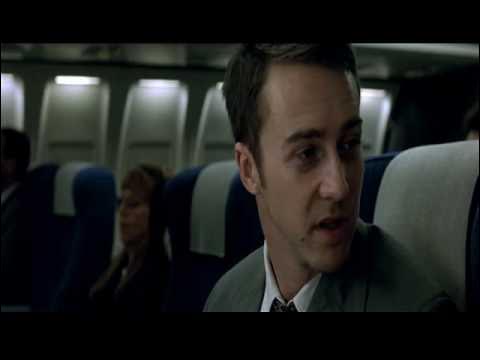
## TL;DR The Narrator details his job as a recall coordinator for a major car manufacturer, where vehicle safety decisions are driven solely by financial liability rather than human lives. He outlines the corporate formula multiplying field vehicles, failure probability, and settlement amounts to determine whether settling lawsuits is cheaper than issuing a recall. Reflecting on gruesome accident scenes with detached, dark humor, he explains the equation to an alarmed fellow airline passenger. Numbed by his work and corporate life, he reveals that he routinely prays for fatal plane crashes during flight turbulence, comforted by the triple payout of his business travel life insurance.
## Atmosphere & style The scene carries a chillingly detached, cynical, and nihilistic tone, juxtaposing horrific crash-scene imagery with dry corporate arithmetic. The Narrator's calm, deadpan delivery and dark quips contrast sharply with the bewildered horror of his seatmate. Watching the clip feels unsettling and darkly satirical, evoking a pervasive sense of modern alienation and exhausted indifference toward mortality.
## Bulletin - [00:00](https://www.youtube.com/watch?v=SiB8GVMNJkE&t=0s) The Narrator operates as an automobile recall coordinator, deciding vehicle safety actions purely through an actuarial cost-benefit calculation rather than safety concerns. - [00:00](https://www.youtube.com/watch?v=SiB8GVMNJkE&t=0s) Automotive recalls are governed by the equation A × B × C = X, comparing total potential out-of-court settlement payouts against the aggregate cost of issuing a recall. - [00:00](https://www.youtube.com/watch?v=SiB8GVMNJkE&t=0s) Corporate policy dictates that if the total estimated lawsuit settlement cost (X) is less than the financial cost of repairing defective vehicles, no recall is initiated. - [00:00](https://www.youtube.com/watch?v=SiB8GVMNJkE&t=0s) Suffering from severe detachment and exhaustion, the Narrator openly hopes for a fatal plane crash on business trips, incentivized by corporate life insurance paying triple.
## Key takeaways - [00:00](https://www.youtube.com/watch?v=SiB8GVMNJkE&t=0s) Mortality is viewed with absolute fatalism, summarized by the premise that everyone's survival rate inevitably drops to zero on a long enough timeline. - [00:00](https://www.youtube.com/watch?v=SiB8GVMNJkE&t=0s) The Narrator's role as a recall coordinator requires investigating fatal car accidents with clinical, morbid detachment. - [00:00](https://www.youtube.com/watch?v=SiB8GVMNJkE&t=0s) Horrific crash site evidence—such as melted body fat or braces stuck in an ashtray—is dehumanized into dark humor or detached observations. - [00:00](https://www.youtube.com/watch?v=SiB8GVMNJkE&t=0s) A hypothetical scenario involving a locked rear differential at 60 mph illustrates how catastrophic defects trap and burn passengers. - [00:00](https://www.youtube.com/watch?v=SiB8GVMNJkE&t=0s) Variable A in the corporate formula represents the total volume of affected vehicles currently in the field. - [00:00](https://www.youtube.com/watch?v=SiB8GVMNJkE&t=0s) Variable B represents the statistical likelihood or probable rate of mechanical failure. - [00:00](https://www.youtube.com/watch?v=SiB8GVMNJkE&t=0s) Variable C reflects the average financial cost of settling wrongful death or injury claims out of court. - [00:00](https://www.youtube.com/watch?v=SiB8GVMNJkE&t=0s) Product X (A × B × C) represents the total expected financial liability facing the automaker. - [00:00](https://www.youtube.com/watch?v=SiB8GVMNJkE&t=0s) The company withholds vehicle recalls whenever projected settlement liability remains cheaper than repairing the defect. - [00:00](https://www.youtube.com/watch?v=SiB8GVMNJkE&t=0s) The Narrator confirms to a passenger that fatal failures occur with shocking frequency while withholding his employer's exact identity. - [00:00](https://www.youtube.com/watch?v=SiB8GVMNJkE&t=0s) Deep professional numbness drives the Narrator to actively pray for mid-air collisions during turbulent flights. - [00:00](https://www.youtube.com/watch?v=SiB8GVMNJkE&t=0s) Corporate life insurance provides a triple payout in the event of an employee dying during official business travel.
## Detailed walkthrough ### [00:00](https://www.youtube.com/watch?v=SiB8GVMNJkE&t=0s) The Recall Coordinator's Formula and Morbid Calculations
Reflecting on mortality with clinical detachment, the Narrator observes the inevitability of death: “On a long enough timeline, the survival rate for everyone drops to zero.” Working as a recall coordinator for a major automobile manufacturer, his primary responsibility is not vehicle safety, but the cold application of corporate risk calculation. He investigates catastrophic crash scenes with an unsettling, cynical gaze, observing horrific physical details as mere data points or dark ironies. Examining burned wreckage, he takes note of an infant thrown through a windshield, a teenager whose dental braces were left wrapped around the backseat ashtray—quipping that it “might make a good anti-smoking ad”—and the silhouette of a massive father whose melted body fat scorched an imprint into the polyester seat, remarking dismissively that it resembles “very modern art.”
To explain whether his employer fixes defective models, he lays out a hypothetical failure where a newly manufactured car travels at 60 miles per hour, suffers a locked rear differential, crashes, and burns with the passengers trapped inside. Determining corporate action comes down strictly to an arithmetic cost-benefit equation: take the total count of cars on the road ($A$), multiply by the statistical likelihood of mechanical failure ($B$), and multiply that product by the projected financial cost of settling the resulting lawsuits out of court ($C$). As the Narrator explains the bottom line to his seatmate on an airplane: “If X is less than the cost of a recall, we don't do one.” When the horrified woman asks if these types of lethal accidents happen frequently, he replies, “You wouldn't believe,” and evades identifying his employer directly by stating only that he works for “a major one.” His exhaustion and numbness extend to his own life, confessing that whenever his flight hits turbulence on takeoff or landing, he actively wishes for disaster: “Every time the plane banged too sharply on takeoff or landing, I prayed for a crash or a mid-air collision.” He finds grim solace in the corporate perks of his demise, noting that “life insurance pays off triple if you die on a business trip.”
```mermaid flowchart TD accTitle: Automobile Recall Formula accDescr: Flowchart illustrating the corporate calculation used to decide whether to issue a vehicle safety recall based on potential liability versus recall costs.
subgraph Calculation ["Liability Cost Formula"] A["A: Number of vehicles in the field"] B["B: Probable rate of failure"] C["C: Average out-of-court settlement"] A --> Mult["A × B × C"] B --> Mult C --> Mult Mult --> X["X: Total liability cost"] end
subgraph Decision ["Corporate Action"] X --> Comp{"Is X less than cost of recall?"} Comp -->|"Yes"| NoRecall["Do not initiate recall"] Comp -->|"No"| Recall["Initiate recall"] end ```
- **Variables of the Recall Formula:** - $A$: Number of vehicles currently in the field. - $B$: Probable rate of vehicle mechanical failure. - $C$: Average dollar amount of an out-of-court settlement. - $X$: Total estimated settlement payout ($A \times B \times C$). - **Corporate Policy:** If $X < \text{Cost of Recall}$, the manufacturer does not issue a recall. - **Flight Risk Benefit:** Company-provided life insurance pays triple the standard payout if an employee dies while traveling on official business.
## Notable quotes > [00:00](https://www.youtube.com/watch?v=SiB8GVMNJkE&t=0s) On a long enough timeline, the survival rate for everyone drops to zero. — The Narrator
## Mentioned Fight Club, The Narrator, Montag Beeblebrox
## Video description Clip from the movie Fight Club.
"On a long enough time line, the survival rate for everyone drops to zero.
"I was a recall coordinator. My job was to apply the formula. ... A new car built by my company leaves somewhere travelling at mph. The rear differential locks up. ... The car crashes and burns with everyone trapped inside. Now, should we initiate a recall? ... Take the number of vehicles in the field, A. Multiply it by the probable rate of failure, B. Multiply the result by the average out-of-court settlement, C. A x B x C equals X. If X is less than the cost of a recall, we don't do one."
[Source](https://www.youtube.com/watch?v=SiB8GVMNJkE)