Physicists Debunk Mpemba Effect as Sensor Shifts Skewed Cooling Data
Sciencium
Rigorous tests reveal hot water never freezes faster than cold water, proving centuries of anomalous observations stemmed from vertical temperature gradients and minor errors in thermocouple placement.
AI-assisted summary of Does Hot Water Freeze Faster Than Cold Water? — original source. Check the original for full context.
Source published:
Key ideas
- The Mpemba effect, the counterintuitive claim that hot water freezes faster than cold water, originated modernly from a 1963 ice cream observation by Erasto Mpemba and historical notes by Aristotle, Bacon, and Descartes. (0:00)
- Five traditional physical explanations—frost melting, dissolved gases, supercooling, evaporation, and convection—fail to consistently account for the phenomenon under controlled parameters. (1:41)
- A rigorous 2016 study demonstrated that the Mpemba effect does not occur under controlled conditions, identifying thermocouple placement variations of just one centimeter as the primary measurement artifact behind historical claims. (5:06)
- Disproving the effect preserves core thermodynamic laws, which would otherwise require revising physical chemistry tables to grant water molecules a 'memory' of past thermal states. (5:06)
Detailed notes
## Background Published on YouTube by the educational channel Sciencium on February 8, 2017, this video examines the millennia-old claim that warmer water can freeze faster than cold water under identical conditions. Supported by Google's Making & Science initiative, the presentation investigates the history, proposed mechanisms, and scientific validity of the phenomenon known as the Mpemba effect.
## TL;DR The video explores the Mpemba effect, a counterintuitive phenomenon documented by thinkers ranging from Aristotle and Descartes to Tanzanian student Erasto Mpemba. It evaluates five leading physical hypotheses—frost melting, dissolved gases, supercooling, evaporation, and convection currents—highlighting why each fails to universally explain the anomaly. Ultimately, the video reveals that rigorous 2016 testing debunked the effect, proving that historical claims were experimental artifacts caused by minor variations in thermocouple depth rather than genuine thermodynamic anomalies.
## Atmosphere & style The presentation carries an inquisitive, methodical, and engagingly analytical tone, balancing respect for historical inquiry with sharp scientific skepticism. It moves along an intellectual detective arc, transitioning from the wonder of an everyday paradox to a grounded deconstruction of experimental error. The experience feels clarifying and satisfyingly rational, demonstrating how precision and rigorous methodology can demystify centuries of scientific confusion.
## Bulletin - [00:00](https://www.youtube.com/watch?v=SkH2iX0rx8U&t=0s) The Mpemba effect, the counterintuitive claim that hot water freezes faster than cold water, originated modernly from a 1963 ice cream observation by Erasto Mpemba and historical notes by Aristotle, Bacon, and Descartes. - [01:41](https://www.youtube.com/watch?v=SkH2iX0rx8U&t=101s) Five traditional physical explanations—frost melting, dissolved gases, supercooling, evaporation, and convection—fail to consistently account for the phenomenon under controlled parameters. - [05:06](https://www.youtube.com/watch?v=SkH2iX0rx8U&t=306s) A rigorous 2016 study demonstrated that the Mpemba effect does not occur under controlled conditions, identifying thermocouple placement variations of just one centimeter as the primary measurement artifact behind historical claims. - [05:06](https://www.youtube.com/watch?v=SkH2iX0rx8U&t=306s) Disproving the effect preserves core thermodynamic laws, which would otherwise require revising physical chemistry tables to grant water molecules a 'memory' of past thermal states.
## Key takeaways - [00:00](https://www.youtube.com/watch?v=SkH2iX0rx8U&t=0s) Intuition suggests hot water cannot freeze faster because it must first cool down to the starting temperature of cold water. - [00:00](https://www.youtube.com/watch?v=SkH2iX0rx8U&t=0s) In 1963, Tanzanian student Erasto Mpemba observed that a hot ice cream mixture froze faster than cooled mixtures, leading to a co-authored physics paper with Dennis Osborne. - [00:00](https://www.youtube.com/watch?v=SkH2iX0rx8U&t=0s) Historical thinkers including Aristotle, Sir Francis Bacon, and René Descartes all recorded observations that pre-heated or warm water appeared to cool or freeze more quickly. - [01:41](https://www.youtube.com/watch?v=SkH2iX0rx8U&t=101s) Frost melting explains some household freezer results by creating a thermal liquid bridge to the shelf, but the effect was reported even when beaker bases were insulated. - [01:41](https://www.youtube.com/watch?v=SkH2iX0rx8U&t=101s) Dissolved gas expulsion in hot water fails as an explanation because gas re-dissolution during cooling is an exothermic reaction that releases heat. - [01:41](https://www.youtube.com/watch?v=SkH2iX0rx8U&t=101s) Supercooling can cause erratic freezing onset, but its extreme sensitivity to tiny dust specks and beaker flaws makes it impossible to reproduce reliably. - [01:41](https://www.youtube.com/watch?v=SkH2iX0rx8U&t=101s) The latent heat required to freeze 0 °C water into ice equals the energy needed to cool liquid water from 80 °C down to 0 °C, leading researchers to focus on cooling rates to 0 °C rather than complete freezing. - [01:41](https://www.youtube.com/watch?v=SkH2iX0rx8U&t=101s) Mass loss from evaporation rarely exceeds 3% and cannot overcome large temperature deficits, especially since the effect was claimed even in sealed containers. - [01:41](https://www.youtube.com/watch?v=SkH2iX0rx8U&t=101s) Convection currents create internal circulation and temperature gradients, but alone do not explain a total reversal of cooling durations. - [05:06](https://www.youtube.com/watch?v=SkH2iX0rx8U&t=306s) A 2012 Royal Society of Chemistry contest drew 22,000 explanations worldwide but failed to establish a scientific consensus. - [05:06](https://www.youtube.com/watch?v=SkH2iX0rx8U&t=306s) A meticulous 2016 study found zero evidence that hot water cools faster than cold water when experimental parameters are properly standardized. - [05:06](https://www.youtube.com/watch?v=SkH2iX0rx8U&t=306s) Decades of contradictory observations were traced to thermocouple placement: moving a sensor by as little as a single centimeter produced artificial cooling discrepancies within the temperature gradient. - [05:06](https://www.youtube.com/watch?v=SkH2iX0rx8U&t=306s) A confirmed Mpemba effect would have upended classical thermodynamics by requiring water molecules to possess a physical 'memory' of their previous thermal states.
## Detailed walkthrough ### [00:00](https://www.youtube.com/watch?v=SkH2iX0rx8U&t=0s) The Counterintuitive Phenomenon and Historical Observations
Common sense suggests an obvious answer to whether hot water freezes faster than cold water: it should not, because all else being equal, boiling or hot water must first spend time cooling down to the starting temperature of the cold water before performing the exact same steps required to reach the freezing point. Yet, a peculiar observation known as the Mpemba effect challenges this intuition. The effect takes its modern name from Erasto Mpemba, who in 1963 was a Tanzanian schoolboy working on a culinary science project making ice cream. The assignment directed students to boil a mixture of milk, cream, and sugar, allow it to cool down to room temperature, and only then place it into the freezer. Anxious that freezer space was running out and that he might lose his spot, Mpemba skipped the cooling phase and threw his piping-hot mixture straight into the freezer. Returning an hour and a half later, he discovered that his hot mixture had completely frozen solid, whereas the pre-cooled mixtures belonging to his classmates were still slushy liquid.
Intrigued rather than dismissed by this anomaly, Mpemba eventually enlisted the help of physics professor Dennis Osborne. Together, they conducted controlled trials with both ice cream mix and pure water, replicated the results, and co-authored an academic physics paper concluding that warm water could indeed freeze faster than cold. However, the observation itself is far from new. For millennia, prominent natural philosophers noted the exact same counterintuitive behavior:
- **Aristotle** recorded in the 4th century BCE: “The fact that the water has previously been warmed contributes to its freezing quickly for so it cools sooner hence many people when they want to cool hot water quickly Begin by putting it in the sun.” - **Sir Francis Bacon** observed in his writings: “Tepid water will freeze more easily than water which is altogether cold.” - **René Descartes** discussed the phenomenon in his essay on meteorology: “We can also see by experiment that water which has been kept hot for a long time freezes faster than any other sord because those of its parts which can least cease to bend evaporate while it's being heated.”
```mermaid flowchart TD accTitle: Historical Lineage of the Mpemba Effect accDescr: Historical progression from Aristotle, Bacon, and Descartes to Erasto Mpemba and Dennis Osborne. subgraph AncientAndEnlightenment["Historical Observations"] A["Aristotle (4th Century BCE)<br/>Noted pre-warmed water cools faster"] B["Sir Francis Bacon (1620)<br/>Noted tepid water freezes easier"] C["René Descartes (1637)<br/>Postulated evaporation of bending parts"] end subgraph ModernDiscovery["Modern Rediscovery"] D["Erasto Mpemba (1963)<br/>Hot ice cream mixture freezes first"] E["Dennis Osborne & Mpemba (1969)<br/>Replication paper in physics journal"] end A --> D B --> D C --> D D --> E ```
[01:41](https://www.youtube.com/watch?v=SkH2iX0rx8U&t=101s) The Five Proposed Physical Hypotheses and the Problem of Freezing
Given this long and prestigious pedigree of observations, researchers have sought a physical mechanism capable of explaining why hot water might bypass the expected thermal timeline. Over the years, physicists formulated five primary hypotheses: frost melting, dissolved gases, supercooling, evaporation, and convection currents.
```mermaid flowchart LR accTitle: Five Proposed Mechanisms of the Mpemba Effect accDescr: Flow diagram showing five proposed hypotheses for the Mpemba effect and their experimental limitations. subgraph Hypotheses["Proposed Mechanisms"] H1["1. Frost Melting"] H2["2. Dissolved Gases"] H3["3. Supercooling"] H4["4. Evaporation"] H5["5. Convection Currents"] end subgraph Flaws["Physical Contradictions / Limits"] F1["Effect persists when beaker base is insulated"] F2["Gas dissolution is exothermic (slows cooling)"] F3["Highly inconsistent; dependent on tiny dust specks"] F4["Mass loss is under 3%; persists in sealed containers"] F5["Temperature gradients alone fail to reverse net time"] end H1 --> F1 H2 --> F2 H3 --> F3 H4 --> F4 H5 --> F5 ```
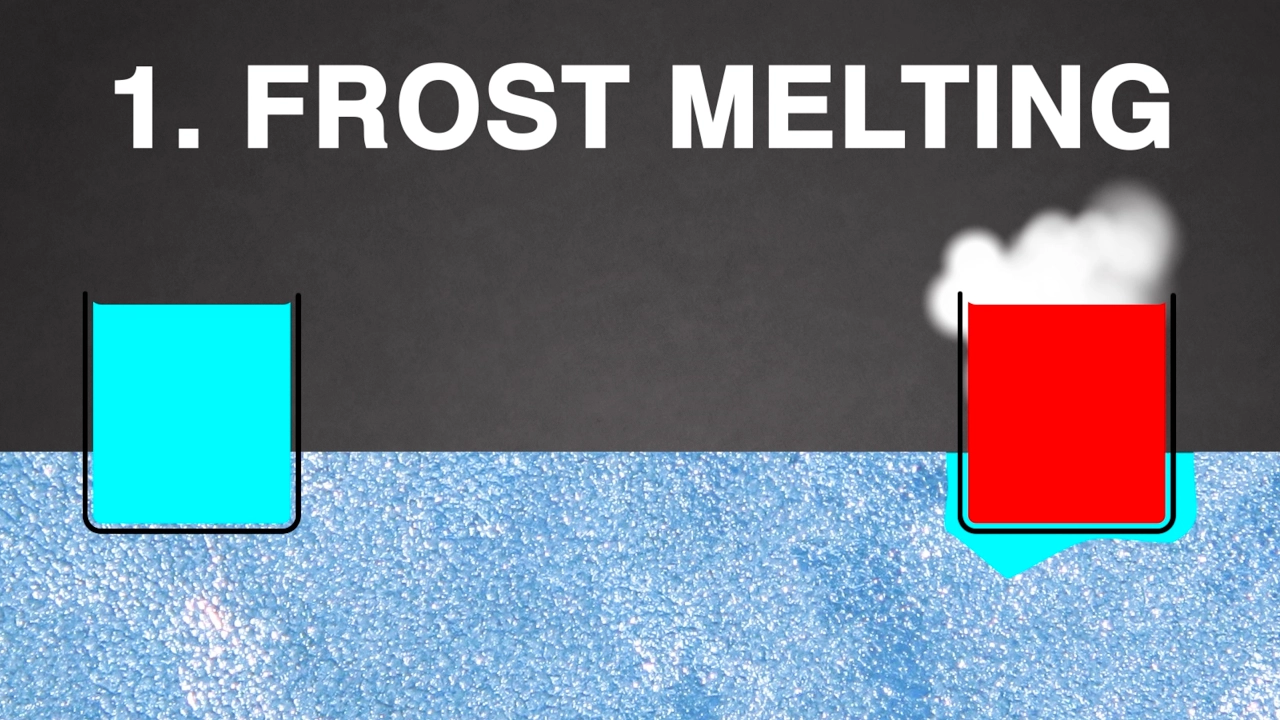
The first hypothesis involves frost melting at the base of the container. In a frosty freezer compartment, the frost layer acts as a thermal insulator. When a cold beaker is set on the shelf, the frost beneath remains frozen, leaving an insulating air gap. A hot beaker, by contrast, melts the frost beneath its base into a layer of liquid water; this water forms an efficient thermal bridge, dramatically speeding up heat conduction into the freezer shelf. While this explains casual household freezer observations, investigators who strictly insulated beaker bases from freezer surfaces still claimed to observe the effect. The second hypothesis focuses on dissolved gases: cold water holds far more dissolved gas than hot water. However, as hot water cools down and absorbs ambient gas, dissolution is an exothermic process, which actually releases heat and works against rapid cooling.
This leads to the third and most erratic factor: supercooling. Water does not automatically turn into ice at 0 °C; it frequently supercools several degrees below freezing before crystalline ice can nucleate around an impurity, microscopic air bubble, or surface scratch. Some proposed that previously heated water experiences less supercooling and begins crystallizing at a higher temperature than cold water. Yet supercooling is notoriously temperamental:
> “Now although some experiments have found that differences in super cooling cause initially warmer water to freeze faster, the results are very inconsistent and it's basically impossible to reproduce even in the same Lab at the same time which is not that surprising considering super cooling depends on something as Tiny as a speck of dust or an imperfection in the beaker.”
Furthermore, the phase change itself requires a tremendous release of latent heat. Removing enough heat to convert liquid water to solid ice at 0 °C requires the exact same energy expenditure as chilling that same water all the way from 80 °C down to 0 °C. Because the latent heat of freezing overwhelmingly dominates the cooling schedule, many modern researchers abandoned phase-change timing entirely and instead tested a simpler milestone: whether hot water can cool to 0 °C faster than cold water.
This leaves the final two fluid-dynamic candidates: - **Evaporation:** Hot water loses mass via steam and vapor, leaving less volume to cool once it hits lower temperatures. However, actual mass loss rarely exceeds 3%, which is far too little to overcome the initial temperature deficit, and the effect has been reported in hermetically sealed vessels where zero evaporation occurs. - **Convection:** Water chills primarily from the exposed top surface and outer beaker walls while the core remains warm, setting up vigorous buoyancy-driven convection cells. Proponents argue that an initially hot beaker develops much stronger internal convective circulation that persists even as the bulk temperature drops, accelerating subsequent heat transfer.
[05:06](https://www.youtube.com/watch?v=SkH2iX0rx8U&t=306s) Debunking the Myth: Thermocouple Artifacts and Thermodynamic Realities
The persistence of the mystery prompted the Royal Society of Chemistry to host a global competition in 2012 offering a monetary prize for the best explanation of the Mpemba effect. Despite receiving 22,000 submissions from scientists and enthusiasts worldwide, no definitive scientific consensus emerged. Instead, researchers began asking a more fundamental question: does the Mpemba effect actually exist under rigorous scientific scrutiny, or have centuries of observers been fooled by an experimental artifact?
In 2016, a landmark, meticulously controlled study evaluated the cooling dynamics of water while tracking every experimental variable. When conditions were strictly standardized, scientists found zero evidence of warm water cooling faster than cold water; warm water consistently took measurably longer to reach 0 °C, conforming precisely to classical thermodynamics. The researchers uncovered the true culprit behind decades of conflicting data: thermocouple placement. Because steep vertical temperature gradients develop as water cools, moving the temperature sensor up or down by as little as a single centimeter inside the beaker produced a false reading that mimicked a faster cooling rate. When the authors re-evaluated historical Mpemba studies that supplied adequate measurement data, they found that every reported instance of the effect fell neatly within the experimental margin of error caused by sub-centimeter variations in sensor depth.
The debunking of the effect is a relief to theoretical physicists. As the host underscores:
> “If the Mpemba effect really did exist it would have significant implications for thermodynamics it would mean that water molecules have a kind of memory of their earlier state or states and that would mean having to update thermodynamic tables to include not only what the temperature of the water is but also what it was before.”
Far from being a harmless quirk of nature, a genuine Mpemba effect would require rewriting the foundations of physical chemistry to account for thermal history. Ultimately, under controlled conditions, hot water simply does not freeze or cool faster than cold water. The video closes with a mention that the production was supported by Google's Making & Science initiative (#ScienceGoals), an effort encouraging people to pursue their science goals and explore discoveries that reveal the workings of the universe.
## Mentioned Aristotle, Dennis Osborne, Erasto Mpemba, Google Making & Science, Mpemba effect, René Descartes, Royal Society of Chemistry, Sir Francis Bacon
## Video description Observations over millenia and numerous experiments claim that warmer water freezes faster than cold water under identical conditions. Supported by Google Making & Science #ScienceGoals http://youtube.com/makingscience
References: Mpemba Effect: https://en.wikipedia.org/wiki/Mpemba_effect
Questioning the Mpemba Effect: http://www.nature.com/articles/srep37665
Royal Society of Chemistry competition: http://www.rsc.org/learn-chemistry/resource/res00001018/the-mpemba-effect?cmpid=CMP00007615
Edited by Trevor Carlee
[Source](https://www.youtube.com/watch?v=SkH2iX0rx8U)