NIST Calibrates All US Customary Weights to Metric Kilogram Prototype
Veritasium
American customary units possess no independent physical standards and legally function as arbitrary mathematical conversions layered over metric prototypes.
AI-assisted summary of Is America Actually Metric? — original source. Check the original for full context.
Source published:
Key ideas
- Despite cultural reliance on customary units like pounds and gallons, American measurements have been legally derived from the metric system since the US signed the 1875 Treaty of the Metre. (0:00)
- US national mass standards trace back to K20, an original 1889 platinum-iridium cylinder stored at the National Institute of Standards and Technology (NIST). (1:27)
- Calibrating stainless steel secondary standards against platinum-iridium prototypes requires precise air buoyancy corrections due to an approximate 110-milligram lift discrepancy caused by differing material densities. (3:54)
- Over a century of comparisons revealed an approximate 50-microgram relative mass divergence between the International Prototype Kilogram and its national copies, prompting the 2018 redefinition of the kilogram based on the Planck constant. (5:21)
Detailed notes
## Background Published on YouTube by Veritasium (hosted by Derek Muller) on May 10, 2017, this video explores the surprising reality of the United States' measurement system. The description explains that the US signed the 1875 Metre Convention, legally defining all customary units in terms of SI standards traceable back to the K20 national prototype kilogram housed at NIST.
## TL;DR Derek Muller visits the National Institute of Standards and Technology (NIST) to investigate the little-known fact that the United States is officially and legally on the metric system, converting metric values into customary units like pounds and inches purely by convention. Physicist Patrick Abbott displays the national prototype kilogram cylinders K20 and K92, detailing how calibration cascades down to commercial scales while metrologists account for complications like air buoyancy on stainless steel secondary standards. The discussion also recounts the analog reality of hand-carrying priceless platinum-iridium artifacts in camera bags to Paris for recalibration. Ultimately, the video reveals the underlying metrological crisis: a 50-microgram drift between the International Prototype Kilogram and its global copies, which forced the international scientific community to prepare for redefining the kilogram via Planck's constant.
## Atmosphere & style The video carries an engaging, playfully irreverent, yet deeply inquisitive atmosphere as Derek Muller uncovers the counterintuitive absurdities of American metrology. The dynamic between Muller and NIST physicist Patrick Abbott is candid, informative, and humorous, punctuated by Abbott frankly admitting that converting back and forth between SI and customary units is 'stupid.' Watching it feels like getting an exclusive behind-the-scenes pass into a high-security vault, balancing nerdy scientific intricacies like buoyancy corrections and surface roughness with high-stakes, almost comical real-world anecdotes like smuggling irreplaceable platinum cylinders through airport security in ordinary camera bags.
## Bulletin - [00:00](https://www.youtube.com/watch?v=SmSJXC6_qQ8&t=0s) Despite cultural reliance on customary units like pounds and gallons, American measurements have been legally derived from the metric system since the US signed the 1875 Treaty of the Metre. - [01:27](https://www.youtube.com/watch?v=SmSJXC6_qQ8&t=87s) US national mass standards trace back to K20, an original 1889 platinum-iridium cylinder stored at the National Institute of Standards and Technology (NIST). - [03:54](https://www.youtube.com/watch?v=SmSJXC6_qQ8&t=234s) Calibrating stainless steel secondary standards against platinum-iridium prototypes requires precise air buoyancy corrections due to an approximate 110-milligram lift discrepancy caused by differing material densities. - [05:21](https://www.youtube.com/watch?v=SmSJXC6_qQ8&t=321s) Over a century of comparisons revealed an approximate 50-microgram relative mass divergence between the International Prototype Kilogram and its national copies, prompting the 2018 redefinition of the kilogram based on the Planck constant.
## Key takeaways - [00:00](https://www.youtube.com/watch?v=SmSJXC6_qQ8&t=0s) The United States was an original signatory of the 1875 Treaty of the Metre, committing to the international metric framework. - [00:00](https://www.youtube.com/watch?v=SmSJXC6_qQ8&t=0s) Customary US units such as pounds, feet, and gallons carry no independent physical standards and are mathematically defined through SI metric equivalents. - [00:00](https://www.youtube.com/watch?v=SmSJXC6_qQ8&t=0s) In 1889, France delivered two primary prototype kilogram cylinders—designated K4 and K20—to the United States. - [01:27](https://www.youtube.com/watch?v=SmSJXC6_qQ8&t=87s) Primary mass standard K20 is constructed from 90 percent platinum and 10 percent iridium to achieve high density, hardness, and resistance to oxidation. - [01:27](https://www.youtube.com/watch?v=SmSJXC6_qQ8&t=87s) Surface roughness on mass artifacts increases surface area, significantly raising the risk of airborne contaminant adhesion that alters total mass. - [01:27](https://www.youtube.com/watch?v=SmSJXC6_qQ8&t=87s) Manufacturing a modern platinum-iridium prototype costs around $100,000, while historic primary prototypes remain irreplaceable. - [03:54](https://www.youtube.com/watch?v=SmSJXC6_qQ8&t=234s) NIST metrologists transfer mass calibrations from K20 to stainless steel working standards to avoid wear on the primary national prototype. - [03:54](https://www.youtube.com/watch?v=SmSJXC6_qQ8&t=234s) Because stainless steel is roughly one-third as dense as platinum-iridium, an equal-mass steel standard displaces more air, experiencing roughly 110 milligrams more buoyant force at atmospheric pressure. - [03:54](https://www.youtube.com/watch?v=SmSJXC6_qQ8&t=234s) Mass comparisons must occur inside sealed comparator chambers to strictly account for fluctuations in temperature, relative humidity, and barometric pressure. - [05:21](https://www.youtube.com/watch?v=SmSJXC6_qQ8&t=321s) National mass prototypes sent to Paris for recalibration are transported as hand luggage in padded camera bags rather than checked baggage or cargo. - [05:21](https://www.youtube.com/watch?v=SmSJXC6_qQ8&t=321s) Periodic international weigh-ins revealed a roughly 50-microgram divergence between the primary International Prototype Kilogram (IPK) and its worldwide sister copies. - [05:21](https://www.youtube.com/watch?v=SmSJXC6_qQ8&t=321s) Because the IPK was defined by law as exactly one kilogram, metrologists could measure relative divergence among copies but could never determine absolute drift. - [05:21](https://www.youtube.com/watch?v=SmSJXC6_qQ8&t=321s) The persistent drift and vulnerability of physical artifact standards led the international metrology community to redefine the kilogram using the Planck constant in 2018.
## Detailed walkthrough ### [00:00](https://www.youtube.com/watch?v=SmSJXC6_qQ8&t=0s) The Treaty of the Metre and America's Metric Secret
At the National Institute of Standards and Technology (NIST), host Derek Muller meets with physicist Patrick Abbott to examine the original artifacts that underpin American measurements. Abbott explains that in the 1880s, forty kilogram cylinders were manufactured alongside the International Prototype of the Kilogram (IPK) and distributed to signatories of the 1875 Treaty of the Metre. The United States signed the convention—effectively pledging to adopt the metric system—and received two official prototypes designated K4 and K20.
Despite the widespread cultural assumption that the United States operates entirely on its own customary system, American units like feet, gallons, and pounds are legally defined by SI standards. Patrick Abbott reveals the counterintuitive reality of American metrology: “So it's just a little translation that we do here but our country is actually on the metric system.” Derek points out the absurdity of basing national measurements on metric standards only to slap on an arbitrary conversion factor that workers and scientists must continually reverse. When Derek asks if that seems insane, Abbott agrees candidly: “Yes, it's stupid.”
- **Treaty of the Metre (1875):** Formed the foundation of the modern metric system; the US was an original signatory. - **US Allotment:** Received two platinum-iridium prototypes, designated **K4** and **K20**, delivered in 1889. - **Legal definition:** Customary units (pounds, inches, gallons) possess no independent physical standards and are mathematically tied to SI units.
---
[01:27](https://www.youtube.com/watch?v=SmSJXC6_qQ8&t=87s) Entering the Vault: K20 and K92
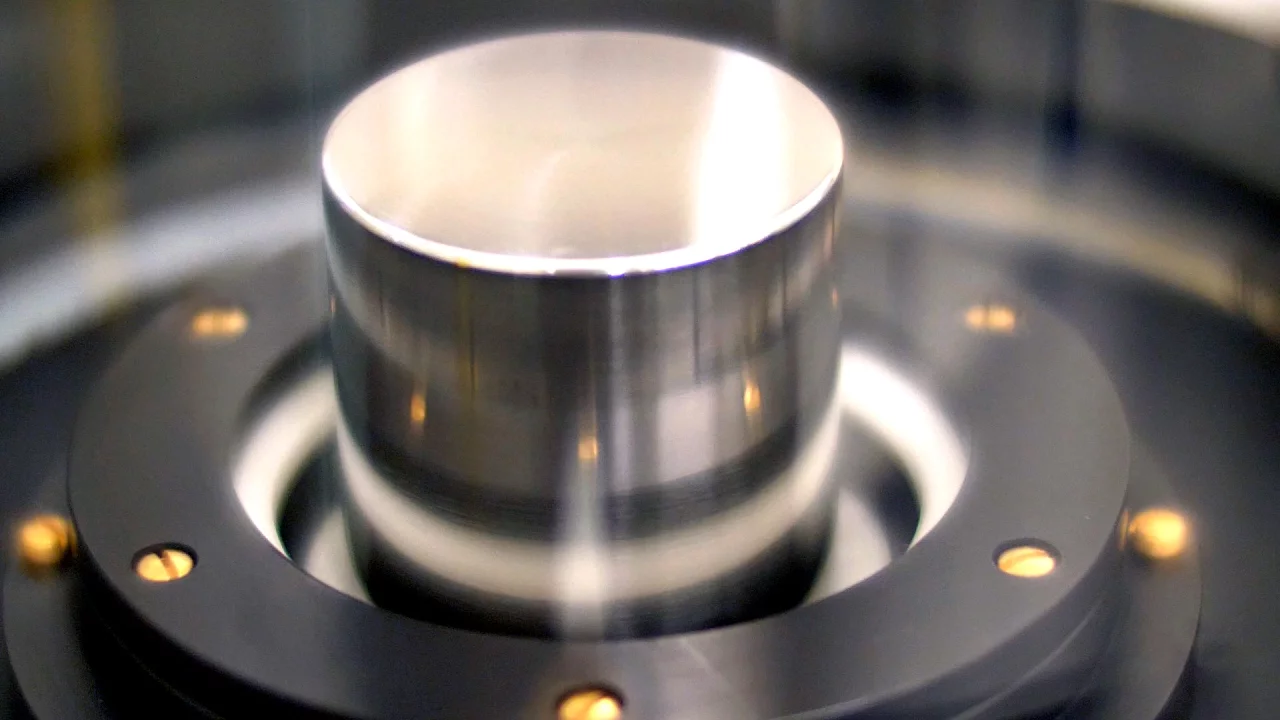
Gaining access to the mass standards requires strict contamination controls and physical security protocols. After donning protective shoe covers using a mechanical “BootieButler” dispenser and passing through keyed security layers, Abbott presents K20 alongside a modern counterpart, K92. For over 130 years, virtually every accurate mass determination made in the United States has been traceable back to K20, an unvarnished cylinder composed of 90 percent platinum and 10 percent iridium. The iridium confers essential hardness to the otherwise soft platinum, and both elements offer exceptional density along with high resistance to chemical oxidation.
```mermaid flowchart TD accTitle: Mass Standard Traceability Flow accDescr: Diagram illustrating how mass standard definitions flow from the International Prototype Kilogram in Paris down to everyday American commercial scales.
subgraph Paris ["Sèvres, France (BIPM)"] IPK["International Prototype Kilogram (IPK)"] end
subgraph NIST ["NIST Vault (Gaithersburg, MD)"] K20["Primary Standard K20<br/>(90% Pt / 10% Ir, 21.5 g/cm³)"] SS["Secondary Standards<br/>(Stainless Steel, 8 g/cm³)"] end
subgraph Field ["US Commerce & Industry"] State["State Metrology Labs"] Scales["Commercial & Scientific Scales<br/>(Pounds, Ounces, Grams)"] end
IPK -->|"Periodic international recalibration"| K20 K20 -->|"Mass comparator transfer (buoyancy corrected)"| SS SS -->|"Disseminated calibration"| State State -->|"Traceable calibration factor"| Scales ```
Looking closely at K20 reveals machining swirls and a slightly rough texture typical of late nineteenth-century fabrication, whereas the newer K92 gleams with a mirror polish. Abbott explains that a pristine finish is not purely aesthetic: “Well you want it not to be very rough because roughness increases surface area, surface area increases the probability that you will get contaminants on that will change the mass of the entire thing.” While fabricating a new platinum-iridium prototype costs roughly $100,000, historic national standards like K4 and K20 are irreplaceable cultural and scientific treasures.
- **Alloy composition:** 90% platinum, 10% iridium (selected for hardness, density, and oxidation resistance). - **Surface finish effect:** Microscopic surface roughness expands contact area, trapping ambient hydrocarbons and particulates that alter physical mass. - **Replacement cost:** A newly manufactured prototype cylinder costs roughly $100,000; the historical originals are priceless.
---
[03:54](https://www.youtube.com/watch?v=SmSJXC6_qQ8&t=234s) Secondary Standards and Buoyancy Calibration
To preserve K20 from physical wear and airborne contamination, NIST metrologists do not loan it out directly; instead, they transfer its calibrated value to secondary working standards made of stainless steel. This process introduces a significant aerodynamic complication. Stainless steel has a density of approximately 8 g/cm³, whereas platinum-iridium reaches roughly 21.5 g/cm³—making the stainless steel weights nearly three times larger in physical volume for the same mass.
Because the volumes diverge so dramatically, air buoyancy exerts an unequal upward force equal to the mass of the air displaced by each cylinder. At atmospheric pressure, a stainless steel standard experiences around 110 milligrams more buoyant lift than K20. To prevent barometric pressure swings, relative humidity, and temperature variations from distorting measurements, the comparison takes place inside a tightly isolated mass comparator chamber. Meterological fluctuations—chief among them barometric pressure—alter the local density of air and must be factored into every high-precision comparison.
- **Stainless steel density:** ~8.0 g/cm³ - **Platinum-iridium density:** ~21.5 g/cm³ (almost 3× denser than steel) - **Buoyancy offset:** Up to ~110 mg difference in upward buoyant force between equal-mass steel and platinum-iridium cylinders. - **Mass comparator environment:** Enclosed in an isolated chamber to stabilize temperature, humidity, and barometric pressure fluctuations.
---
[05:21](https://www.youtube.com/watch?v=SmSJXC6_qQ8&t=321s) Hand-Carrying Mass Standards and the Drift Crisis
Periodically, national prototype kilograms must travel back to the International Bureau of Weights and Measures (BIPM) outside Paris for calibration against the primary IPK. Transporting an irreplaceable national artifact involves surprisingly analog logistics: the cylinder is secured in its protective container, wrapped in bubble wrap, stashed in an ordinary camera bag, and hand-carried like a diplomatic pouch. Abbott notes that couriers never let the bag out of their sight or stash it in airplane overhead bins, treating it with the care of a nuclear briefcase. This manual transit once triggered an airport customs scare: when Abbott stated the artifact was made of platinum and iridium, an official mistook iridium for a radioactive threat, requiring Abbott to defuse the situation before boarding.
The far greater scientific crisis was uncovered during the periodic weigh-ins in Paris. When all 40 sister prototypes were compared against the IPK, the data indicated that the IPK appeared to have grown roughly 50 micrograms heavier than its siblings over the course of a century—or conversely, that the national prototypes were losing mass. Intriguingly, measurements gathered at the end of 2013 showed that the IPK stopped gaining mass, while the various national prototypes continued to diverge in different directions.
Abbott emphasizes the inherent vulnerability of relying on an artifact whose value is circular: “All that matters is the difference between them and the International prototype because the International prototype is the only thing you need the only thing that you really know because it's defined as one kilogram.” Because metrologists could only measure relative differences, there was no independent benchmark to prove whether the IPK was accumulating surface contaminants or whether the copies were shedding mass through wear. This fundamental instability prompted the international metrology community to prepare a complete overhaul for 2018, abandoning physical cylinders to redefine the kilogram using the Planck constant.
- **Transport security:** Hand-carried in a bubble-wrapped camera bag; never separated from the metrologist or placed in aircraft overhead storage. - **Customs incident:** An airport screener confused the non-radioactive transition metal *iridium* with a radiological hazard. - **Drift magnitude:** A relative discrepancy of approximately 50 micrograms accumulated across a century of comparisons. - **The metrological limitation:** Because the IPK was defined as exactly one kilogram by decree, artifact-based metrology could detect divergence between copies, but could never determine absolute drift. - **2018 redefinition:** The upcoming revision of the International System of Units retired physical artifact prototypes in favor of fundamental physical constants.
## Mentioned Derek Muller, Patrick Abbott, Ben Stein, National Institute of Standards and Technology (NIST), Treaty of the Metre, International Prototype of the Kilogram (IPK), K4, K20, K92, International Bureau of Weights and Measures (BIPM), Planck constant
## Video description The US signed the metre convention and bases all customary units on SI standards. As an aside, the Utah constitution from 1895 required the metric system to be taught in schools. This requirement was repealed in 1987. ¯\_(ツ)_/¯
Huge thanks to NIST, Ben Stein and Patrick Abbott. https://www.nist.gov/ https://www.nist.gov/pml/weights-and-measures/si-units-mass
Special thanks to Patreon Supporters: Tony Fadell, Donal Botkin, Jeff Straathof, Zach Mueller, Ron Neal, Nathan Hansen
Back in 1875 The US signed the Metre Convention, which basically committed the country to use the metric system. In return, French scientists sent two platinum-iridium cylinders that weigh 1kg to the US in 1889 (known by their designations K4 and K20 from a set of 40 identical objects that were produced and sent around the world). So even though everything you see and buy in the US is usually reported in pounds, all weights are traceable back to the K20 kilogram (by applying a conversion factor to get to pounds).
When I was in DC a few weeks ago, I visited the National Institute of Standards and Technology (NIST) and got up close with K20, which is still kept there and used to calibrate all mass standards in this country. I thought it was pretty cool.
Edited by Bill Connor
[Source](https://www.youtube.com/watch?v=SmSJXC6_qQ8)