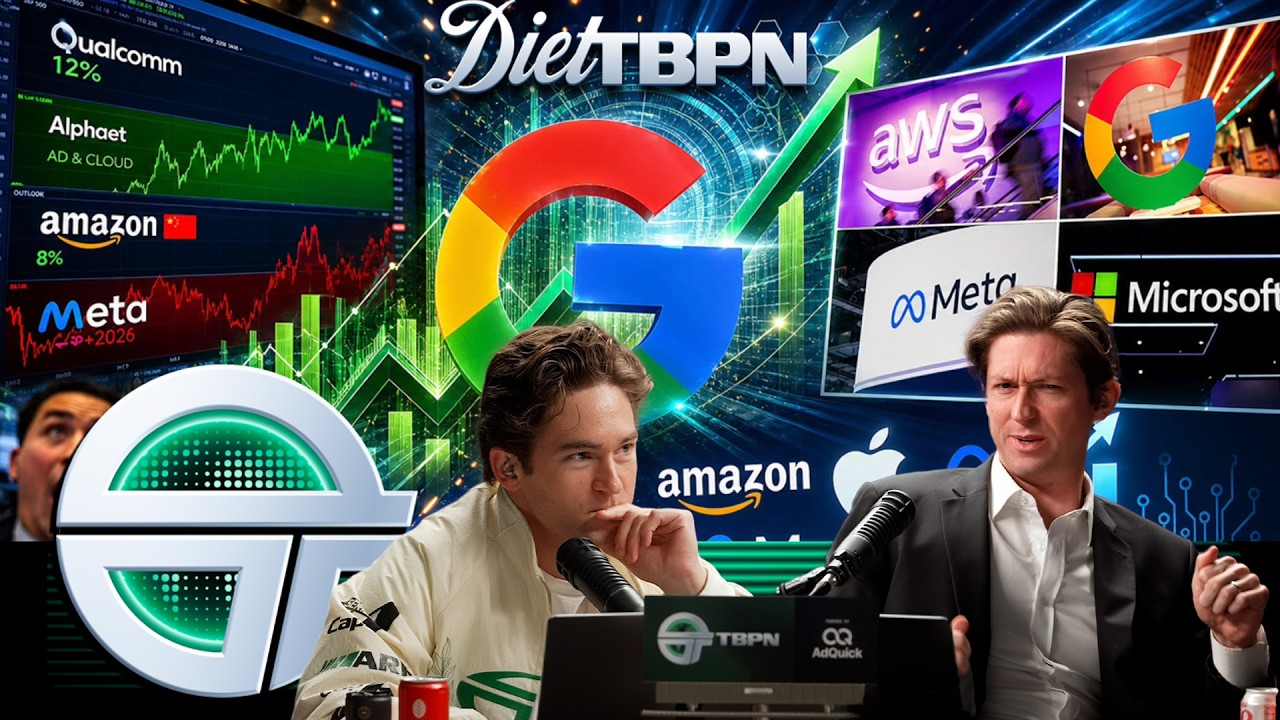
Big Tech Earnings Defy CapEx Fears as Cloud Surges
TBPN
Tech giants justify multi-billion-dollar infrastructure spending through accelerating cloud demand and robust core revenues, proving that AI monetization is actively scaling despite investor anxiety over costs.
## Background
TBPN published this video on YouTube on May 21, 2026. According to the page description, this episode of "Diet TBPN" delivers a 30-minute digest of the daily live tech talk show hosted by John Coogan and Jordi Hays, which covers major technology news and Silicon Valley topics.
## TL;DR
This episode breaks down a major tech earnings day featuring Google, Microsoft, Amazon, and Meta, analyzing how each hyperscaler is justifying massive capital expenditure through cloud growth and advertising revenue. The hosts examine market valuations, contrasting current P/E ratios with the dot-com bubble, while exploring shifting dynamics in the enterprise AI space and OpenAI's partnership landscape. The discussion also covers perspectives from tech leaders on AI job creation, courtroom reporting from an ongoing Elon Musk trial, benchmarks from Arc-AGI V3, and novel applications like automated dermatological skin exams and AI-generated e-commerce podcasts.
## Atmosphere & style
The hosts maintain a high-energy, banter-driven, and analytical tone, effortlessly mixing deep dives into corporate finance with lighthearted tech humor. The narrative style feels like an informal post-game wrap-up between sharp Silicon Valley insiders who oscillate between serious economic breakdown and comedic observations about courtroom pizza orders or data center monster truck rallies. The overall experience is energetic, fast-paced, and engaging, blending acute business commentary with playful camaraderie.
## Key takeaways
- [00:02](https://www.youtube.com/watch?v=KHoWIm9e4Ew&t=2s) Hosts John Coogan and Jordi Hays return from Stripe Sessions and reflect on the Coasean singularity theory, noting that future firm sizes could shrink as AI lowers transaction costs.
- [00:36](https://www.youtube.com/watch?v=KHoWIm9e4Ew&t=36s) Google emerged as the clear winner of a rare 'quad kill' big tech earnings day, posting $60.4 billion in Search revenue and sending its stock up 10%.
- [00:36](https://www.youtube.com/watch?v=KHoWIm9e4Ew&t=36s) Google Cloud experienced massive acceleration, reaching $20 billion in revenue (up 63% YoY) with a backlog exceeding $460 billion.
- [00:40](https://www.youtube.com/watch?v=KHoWIm9e4Ew&t=40s) Microsoft reported $82.9 billion in total revenue and added 5 million Microsoft 365 Copilot seats to hit 20 million paid users out of a 450-million seat base.
- [00:40](https://www.youtube.com/watch?v=KHoWIm9e4Ew&t=40s) Microsoft's exclusivity on OpenAI models ended as OpenAI expanded to AWS, while recent contract renegotiations removed the AGI clause in favor of revenue sharing through 2032.
- [07:42](https://www.youtube.com/watch?v=KHoWIm9e4Ew&t=462s) Amazon showed strong cloud re-acceleration with AWS growing 28% YoY to beat estimates, alongside its custom chip business reaching a $20 billion run rate.
- [08:54](https://www.youtube.com/watch?v=KHoWIm9e4Ew&t=534s) Meta's stock dropped nearly 10% despite 33% YoY revenue growth as investors reacted nervously to its full-year CapEx guidance being raised to $125B–$145B.
- [08:54](https://www.youtube.com/watch?v=KHoWIm9e4Ew&t=534s) Meta reported a rare sequential drop in Daily Active People, which management attributed to network disruptions in Iran and WhatsApp blockages in Russia.
- [14:35](https://www.youtube.com/watch?v=KHoWIm9e4Ew&t=875s) Generative AI is reinforcing existing consumer platform incumbents like Instagram, WhatsApp, and Roblox by giving creators better tools rather than spawning new social startups.
- [15:51](https://www.youtube.com/watch?v=KHoWIm9e4Ew&t=951s) Despite heavy CapEx concerns, current Big Tech P/E multiples (16x to 25x) remain grounded compared to dot-com bubble peaks, backed by massive cash flows.
- [19:15](https://www.youtube.com/watch?v=KHoWIm9e4Ew&t=1155s) George Hotz outlined a optimistic view on AI job creation, citing Jevons paradox to argue that increased AI efficiency will expand overall economic demand.
- [19:15](https://www.youtube.com/watch?v=KHoWIm9e4Ew&t=1155s) NVIDIA CEO Jensen Huang dismissed fear-mongering that AI will destroy software or radiology jobs as 'nonsensical' and harmful to young professionals.
- [25:01](https://www.youtube.com/watch?v=KHoWIm9e4Ew&t=1501s) The hosts distinguish between automating specific tasks and replacing whole jobs, noting professions like radiologists and truck drivers involve complex responsibilities beyond AI's current scope.
- [27:56](https://www.youtube.com/watch?v=KHoWIm9e4Ew&t=1676s) New robotic devices demonstrate automated dermatological skin scans for early cancer detection, aiming to increase physician throughput rather than replace dermatologists.
- [27:56](https://www.youtube.com/watch?v=KHoWIm9e4Ew&t=1676s) Frontier models struggle on reasoning benchmarks like Arc-AGI V3, where top models scored below 1% due to issues with abstraction and false world models.
- [30:48](https://www.youtube.com/watch?v=KHoWIm9e4Ew&t=1848s) Amazon is experimenting with automated AI-generated podcasts that feature synthetic hosts discussing individual products and taking simulated caller questions.
## Detailed walkthrough
### [00:02](https://www.youtube.com/watch?v=KHoWIm9e4Ew&t=2s) Stripe Sessions and the Coasean Singularity
Hosts John Coogan and Jordi Hays open the episode returning from Stripe Sessions, highlighting their interview with Patrick and John Collison. Reflecting on the conversation, they note they did not dive nearly deep enough into the "Coasean singularity"—a debate surrounding the Coase theory of the firm and the idea that future firms will shrink as transaction costs drop. Acknowledging that while economic theory can sound like "mumbo jumbo," it is becoming a central framework for understanding tech's future trajectory, and they plan to bring on expert economists to break it down further.
[00:36](https://www.youtube.com/watch?v=KHoWIm9e4Ew&t=36s) Tech Earnings Quad Kill: Google's AI Full-Stack Triumph
The hosts dive into an extraordinary "quad kill" earnings day where four big tech giants reported on the same day—a rare alignment not seen since roughly 2020. Google emerged as the undisputed winner, sending its stock surging 10% over two days. Addressing the ongoing debate over whether AI chatbots would destroy core Search revenue, Google proved those fears unfounded, posting $60.4 billion in Search and other revenue (up 19% year-over-year).
Google Cloud stood out as the main story, reaching $20 billion in revenue with a massive 63% year-over-year growth rate and $6.6 billion in operating income. Analysts were particularly struck by Google Cloud's backlog, which nearly doubled to over $460 billion, with more than half expected to be recognized within the next 24 months. The performance cemented Google's positioning as a dominant "full-stack" AI player where heavy capital expenditure is fully justified by accelerating cloud demand.
[00:40](https://www.youtube.com/watch?v=KHoWIm9e4Ew&t=40s) Microsoft's Enterprise AI and OpenAI Exclusivity Dynamics
Turning to Microsoft, the hosts evaluate a steady quarter defined by enterprise AI execution. Microsoft delivered a clean headline beat with total quarterly revenue reaching $82.9 billion (up 18% YoY), though the stock traded down slightly by 2%. Attention centered on Microsoft 365 Copilot adoption: out of 450 million total paid enterprise seats, Microsoft added 5 million Copilot seats during the quarter to reach a total of 20 million seats. While solid, investors are closely watching how quickly Copilot can penetrate the broader 450-million seat base.
The hosts analyze the shifting landscape of Microsoft's relationship with OpenAI. With Azure losing its exclusive status—allowing OpenAI models to launch on Amazon Web Services (AWS) as well—sales dynamics are changing. While losing exclusivity removes a unique pitch for Azure sales reps, it benefits Microsoft's balance sheet and equity position as OpenAI grows across platforms. Crucially, recent contract renegotiations removed the controversial "AGI clause" that previously allowed OpenAI to halt model sharing, replacing it with a clear revenue-sharing timeline extending through 2032.
- **Microsoft Total Revenue:** $82.9 billion (up 18% YoY)
- **Microsoft 365 Paid Seats:** 450 million total
- **Microsoft Copilot Paid Seats:** 20 million (5 million added in the quarter)
- **OpenAI Partnership:** Exclusivity ended (now on AWS); AGI clause removed in favor of a revenue-share agreement running through 2032
[07:42](https://www.youtube.com/watch?v=KHoWIm9e4Ew&t=462s) Amazon's AWS Re-acceleration and Chip Momentum
Amazon demonstrated why it remains the ultimate "CapEx king," topping capital spending forecasts while reassuring the market through strong cloud re-acceleration. Overall quarterly sales reached $181.5 billion (up 17% YoY), putting Amazon on a run rate toward $1 trillion in annual revenue. AWS growth re-accelerated to 28% YoY, beating analyst projections of 25%.
Unlike Google's full-stack vertical integration, AWS is succeeding as an infrastructure partner for multiple leading AI labs, including OpenAI and Anthropic. Additionally, Amazon's advertising business generated $17.2 billion in quarterly revenue, while its custom chips business crossed a $20 billion annualized run rate. The strong operational performance allowed the market to absorb Amazon's massive infrastructure spending without panic.
[08:54](https://www.youtube.com/watch?v=KHoWIm9e4Ew&t=534s) Meta's Record Margins, CapEx Debate, and Metric Anomalies
Meta faced a harsher market reaction, falling nearly 10% post-earnings despite stellar underlying ad numbers. Quarterly revenue hit $56.3 billion (up 33% YoY), driven by a 19% increase in ad impressions. However, investors balked as Meta raised its full-year CapEx guidance range by $10 billion to $125 billion–$145 billion. Debate ensued over whether this increased spend represents higher compute volume or simply rising input costs across the supply chain.
The hosts highlight Mark Zuckerberg's posture as a hyper-scalar CEO deeply "AGI-pilled," driven by recursive self-improvement and a determination not to be left behind if superintelligence is achieved. Unlike cloud providers, Meta must monetize compute entirely through its core ad business and AI products rather than selling enterprise cloud capacity. Adding to investor jitters, Meta reported its first-ever sequential drop in Daily Active People (DAP), which management attributed to internet disruptions in Iran and WhatsApp blockages in Russia rather than structural user decline.
> "Can you imagine just take 1 second and imagine that Meta's private company and their pitch is that we make AI agents for selling products. They're at a $200 billion run rate growing 33% a year. How's it priced? 20 trillion?"
- **Meta Total Revenue:** $56.3 billion (up 33% YoY)
- **Ad Impressions:** Up 19% YoY
- **Updated CapEx Guidance:** $125 billion to $145 billion (raised by $10 billion)
- **Metric Anomaly:** Sequential decline in Daily Active People (DAP) due to regional outages in Iran and Russia
[14:35](https://www.youtube.com/watch?v=KHoWIm9e4Ew&t=875s) The Fracturing AI Narrative and Platform Incumbency
Reflecting on the entire earnings cycle, the hosts observe a distinct shift in the market's evaluation of tech giants. Where the narrative over the past year was simply "spend the most on CapEx to win," each hyperscaler now presents a unique thesis: Google as the full-stack AI platform, Microsoft as enterprise adoption and distribution, Amazon as neutral infrastructure, and Meta as an ad engine financing a high-risk option on frontier AI.
Addressing the broader impact of generative AI on consumer software, the hosts reflect on how LLM technology has failed to yield new breakout consumer social platforms. Instead of unseating the market, generative tools are insulating incumbents like Instagram, WhatsApp, Facebook, and Roblox by giving existing creators better tools to produce content faster.
Here is a detailed, faithful walkthrough of this section of the transcript:
[15:51](https://www.youtube.com/watch?v=KHoWIm9e4Ew&t=951s) Tech Earnings, CapEx Justification, and Big Tech Valuations
The hosts break down the massive tech earnings reported for the quarter, pointing out that companies with solid advertising businesses also hold valuable call options on frontier AI. Wall Street has been laser-focused on short-term revenue and whether tech giants can justify their eye-watering capital expenditures. The quarterly cloud growth numbers were massive: AWS grew 28% (slightly under the 30% hoped for), Google Cloud Platform (GCP) surged 63% (shattering expectations of 40%), and Microsoft Azure grew 40%.
The show highlights a post by an analyst named Ren comparing current price-to-earnings (P/E) multiples to the dot-com bubble peak. Today's "Mad Four" trade at relatively grounded forward P/E ratios: Meta is at 16x, Google at 17x, Amazon at 24x, and Microsoft at 25x. During the dot-com crash, Microsoft was at 73x, Cisco exceeded 200x, Yahoo hit 800x, and the overall Nasdaq traded at 200x earnings. The hosts observe that even if AI were a total bubble and everyone returned to paper and pencil, these companies still generate hundreds of billions in real cash flow from digital ads and cloud SaaS. However, they acknowledge pushback from viewers citing bloated valuations among other tech names like AMD (130x), Tesla (350x), Palantir (220x), and Intel (900x), as well as unprofitability across private startups marked up to unicorn valuations over the past five years.
- AWS cloud growth reached 28%, GCP hit 63%, and Azure grew 40%.
- Current P/E multiples: Meta (16x), Google (17x), Amazon (24x), Microsoft (25x).
- Dot-com bubble historical P/E comparisons: Microsoft (73x), Cisco (200x+), Yahoo (800x), Nasdaq peak average (200x).
- High-valuation outliers noted by commenters: AMD (130x), Tesla (350x), Palantir (220x), Intel (900x).
---
[19:15](https://www.youtube.com/watch?v=KHoWIm9e4Ew&t=1155s) George Hotz and Jensen Huang on AI Job Creation
The discussion shifts to a post by George Hotz, who offered a "white pill" outlook arguing that AI will ultimately create jobs rather than destroy them. Hotz compares AI to immigration, noting that unlimited human wants drive Jevons paradox—when a resource or task becomes more efficient, consumption increases. He cites an aphorism from his time as a Facebook intern: "if you make the site 10% faster, people spend 5% more total time on it." Hotz critiques protectionism, arguing that while AI will outcompete humans at specific tasks, the overall economic pie will grow.
The hosts then transition to a clip of NVIDIA CEO Jensen Huang speaking out against fear-mongering narratives around AI. Huang criticizes prominent figures scaring students away from careers in software engineering or radiology by falsely claiming those fields will be wiped out. He calls claims that AI carries a 20% existential threat risk or will destroy 50% of entry-level college jobs "nonsensical" and "ridiculous." The hosts joke about how people love using 50/50 predictions because they offer zero accountability, while noting that real-world companies are using AI not to cut headcount, but to aggressively expand their ambition, take on more clients, and increase revenue.
- "AI and immigration are fundamentally the same... Wants are effectively unlimited. It's classic Jevons paradox." — George Hotz
- "It is hurtful if we convince all the young college graduates to not be software engineers and it turns out [the] United States need more software engineers than ever." — Jensen Huang
- Jensen Huang dismissed statements claiming AI poses a 20% existential risk or will wipe out 50% of new college graduate jobs as harmful and unfounded.
---
[20:30](https://www.youtube.com/watch?v=KHoWIm9e4Ew&t=1230s) Live Coverage of the Elon Musk Trial with Mike Isaac
While waiting to bring New York Times reporter Mike Isaac onto the stream, the hosts laugh over his live-tweeting setup covering the ongoing Elon Musk legal trial. Isaac has been maintaining a minute-by-minute log of minor personal inconveniences throughout the intense courtroom proceedings, which the production team turned into an infographic.
The hosts detail several hilariously mundane highlights from Isaac’s courtroom feed, including his lunch order of "roasted tomato and corn pizza," forgetting a pillow for his bird, and forgetting to fill his water bottle in the rush to secure a seat—leaving him dehydrated as critical testimony unfolded. He also noted a courtroom mishap when another attendee's laptop accidentally blasted a loud YouTube video about a "garden hose nozzle" right in the middle of the gallery.
---
[25:01](https://www.youtube.com/watch?v=KHoWIm9e4Ew&t=1501s) Automating Tasks vs. Jobs & Data Center "Beautification"
The conversation returns to the distinction between automating individual tasks versus replacing full jobs. The hosts emphasize that while AI models excel at specific tasks—such as scanning medical images for cancer—professions involve much wider scopes of responsibility. Radiologists perform numerous duties beyond image analysis and are currently earning more and in higher demand than ever. Similarly, truck drivers do not merely steer vehicles; a cited survey indicated 70% carry weapons because they act as security guards, perform roadside repairs, and adjust heavy cargo loads—not to mention honking for kids on highway road trips.
The hosts banter about creative ideas trending online to make data center builds acceptable to local communities. Ideas proposed by users include constructing public heated pools, water slides, half-pipes, or hosting a continuous "Nitro Circus" monster truck rally on data center roofs. Host Julie Young shared how Los Angeles disguises oil derricks as synagogues or mundane buildings, noting that LA already hides localized edge-computing data centers inside downtown buildings without windows.
---
[27:56](https://www.youtube.com/watch?v=KHoWIm9e4Ew&t=1676s) Automated Skin Exams and Arc-AGI V3 Benchmarks
The hosts review a video demo of a new robotic skin examination device automating dermatological screenings. Drawing a comparison to quick TSA airport pat-downs, the hosts point out that busy or tired human dermatologists often give patients brief glances. The automated robot performs precise, highly consistent skin scans to detect potential cancers and abnormalities, acting as an efficiency tool for doctors rather than replacing them, pending FDA medical device approval.
They then highlight the latest update from the Arc Prize benchmarking Arc-AGI V3—a series of 2D video game-like reasoning environments designed to test frontier models. While human-level reasoning remains ahead, the latest state-of-the-art benchmarks revealed modest performance scores for leading models:
* **GPT-3.5:** 0.43%
* **Opus 4.7:** 0.18%
Researchers identified three core failure modes when AI models attempt the benchmark: true local effects, false world models, and wrong levels of abstraction from training data (where a model solves a level without reinforcing the reward mechanism).
---
[30:48](https://www.youtube.com/watch?v=KHoWIm9e4Ew&t=1848s) Amazon’s AI Product Podcasts
To wrap up the segment, the hosts highlight a new feature reported by Business Insider where Amazon generates automated AI podcasts for products. The feature uses two synthetic AI hosts who discuss products in detail and accept simulated caller questions like a radio talk show. The hosts find the concept amusingly absurd, questioning whether consumers actually want to listen to a dedicated podcast episode for every everyday purchase—referencing a past joke about wanting retro 1950s-style paper towels on Amazon.
[31:36](https://www.youtube.com/watch?v=KHoWIm9e4Ew&t=1896s) Deep-Dive E-Commerce Podcasts and Weekend Sign-Off
The hosts wrap up the show with a humorous take on the future of consumer research and online shopping. Rather than relying on simple search filters or surface-level product reviews, they joke about a world where consumers can listen to an hour-long dedicated podcast episode analyzing every single SKU available before making the absolute most informed, determined purchasing decision possible.
Following the lighthearted banter about deep-dive product content, the hosts bid their audience farewell for the week. Wishing everyone a great Friday and a good weekend, they confirm their return on Monday before signing off with affectionate closing remarks and a final energetic exclamation.
* The hosts pitch the idea of listening to an entire hour-long podcast for individual SKUs to ensure maximum confidence in buying decisions.
* The show closes out with a reminder to viewers to enjoy their weekend and tune back in for the live broadcast on Monday.
## Notable quotes
> [08:54](https://www.youtube.com/watch?v=KHoWIm9e4Ew&t=534s) Can you imagine just take 1 second and imagine that Meta's private company and their pitch is that we make AI agents for selling products. They're at a $200 billion run rate growing 33% a year. How's it priced? 20 trillion?
> [19:15](https://www.youtube.com/watch?v=KHoWIm9e4Ew&t=1155s) AI and immigration are fundamentally the same... Wants are effectively unlimited. It's classic Jevons paradox. — George Hotz
> [19:15](https://www.youtube.com/watch?v=KHoWIm9e4Ew&t=1155s) if you make the site 10% faster, people spend 5% more total time on it.
> [19:15](https://www.youtube.com/watch?v=KHoWIm9e4Ew&t=1155s) It is hurtful if we convince all the young college graduates to not be software engineers and it turns out [the] United States need more software engineers than ever. — Jensen Huang
## Mentioned
Amazon, Amazon Advertising, AMD, Anthropic, Arc Prize, Arc-AGI V3, AWS, Azure, Business Insider, Cisco, Coase theory of the firm, Coasean singularity, Diet TBPN, Elon Musk, Facebook, George Hotz, Google, Google Cloud Platform, Google Cloud, Google Search, GPT-3.5, Instagram, Intel, Jensen Huang, Jevons paradox, John Collison, John Coogan, Jordi Hays, Julie Young, Mark Cuban, Mark Zuckerberg, Meta, Microsoft, Microsoft 365 Copilot, Mike Isaac, NVIDIA, OpenAI, Opus 4.7, Palantir, Patrick Collison, Ren, Roblox, Sam Altman, Satya Nadella, Stripe Sessions, TBPN, Tesla, The New York Times, TSA, WhatsApp, X, Yahoo, YouTube
云业务激增,科技巨头财报打破资本支出担忧
科技巨头凭借加速增长的云需求和强劲的核心营收,证明其数十亿美元的基础设施支出具有合理性,表明尽管投资者对成本感到担忧,但人工智能的商业化变现正在切实扩大规模。
本期节目深入剖析了涵盖 Google、Microsoft、Amazon 和 Meta 的重大科技财报日,分析了各超大规模云厂商如何通过云业务增长与广告收入来证明其巨额资本支出的合理性。主持人探讨了市场估值,将当前的市盈率与互联网泡沫时期进行了对比,同时探讨了企业级 AI 领域的动态变化以及 OpenAI 的合作格局。讨论内容还涵盖了科技领袖对 AI 创造就业机会的看法、正在进行的 Elon Musk 诉讼案庭审报道、Arc-AGI V3 基准测试,以及皮肤科自动化检查和 AI 生成电商播客等创新应用。
主持人 John Coogan 和 Jordi Hays 在参加完 Stripe Sessions 后回归,反思了科斯奇点(Coasean singularity)理论,指出随着 AI 降低交易成本,未来的企业规模可能会缩小。 (0:02)
在罕见的四大科技巨头同日公布财报中,Google 成为明确的赢家,其搜索业务营收达 604 亿美元,推动股价上涨 10%。 (0:36)
Google Cloud 业务大幅提速,营收达到 200 亿美元(同比增长 63%),积压订单金额超过 4600 亿美元。 (0:36)
Microsoft 报告总营收达 829 亿美元,新增 500 万个 Microsoft 365 Copilot 席位,使其在 4.5 亿总席位基数中的付费用户数达到 2000 万。 (0:40)
随着 OpenAI 拓展至 AWS,Microsoft 对 OpenAI 模型的独家专有权宣告结束,而近期重新谈判的合同取消了 AGI 条款,转为持续至 2032 年的营收分成机制。 (0:40)
Reading summary
TBPN hosts John Coogan and Jordi Hays argue that major tech firms are transitioning from a generic capital expenditure race into distinct monetization models anchored by resilient core cash flows. While frontier reasoning benchmarks show major technical limitations, the hosts contend that massive infrastructure spending is buffered by accelerating enterprise demand rather than speculative dot-com-style multiples.
Diverging Hyperscaler Monetization and Infrastructure Models (0:36)
A rare simultaneous earnings release highlighted diverging strategies among tech hyperscalers. Google demonstrated a vertically integrated full-stack model, dispelling fears that generative AI would erode core Search revenue ($60.4 billion, up 19% year-over-year) while Google Cloud surged 63% to $20 billion with an order backlog exceeding $460 billion. Amazon positioned AWS as neutral infrastructure for multiple foundation labs, re-accelerating cloud growth to 28% year-over-year alongside a custom chips business reaching a $20 billion run rate.
Microsoft posted $82.9 billion in total revenue and expanded Microsoft 365 Copilot to 20 million paid seats out of 450 million enterprise seats. Microsoft also adapted its commercial model with OpenAI by removing Azure exclusivity—allowing OpenAI workloads onto AWS—and replacing the controversial AGI clause with a long-term revenue-sharing structure running through 2032. Meta grew revenue 33% to $56.3 billion through ad-tech automation, though management attributed a sequential dip in Daily Active People to regional service blockages in Iran and Russia.
CapEx Scrutiny and Valuation Comparisons (15:51)
Surging capital expenditure sparked divergent market reactions, particularly for Meta, whose shares dropped 10% after raising full-year CapEx guidance to $125 billion–$145 billion. Unlike enterprise cloud vendors that resell capacity, Meta must fund its frontier AI investments directly through advertising cash flows, raising investor debate over whether increased budgets reflect higher compute volumes or rising hardware supply chain costs.
Despite mounting investor anxiety, the hosts noted that the primary hyperscalers trade at historically grounded forward price-to-earnings valuations (Meta at 16x, Google at 17x, Amazon at 24x, and Microsoft at 25x). This stands in sharp contrast to the dot-com bubble peak, where Microsoft traded at 73x, Cisco topped 200x, and Yahoo reached 800x. However, viewers highlighted that high valuation risks remain concentrated in other tech segments, citing elevated multiples for companies such as AMD (130x), Palantir (220x), Tesla (350x), and Intel (900x).
Labor Economics: Task Automation Versus Occupation Loss (19:15)
Addressing widespread labor concerns, the hosts cited technologist George Hotz and NVIDIA CEO Jensen Huang to challenge alarmist predictions regarding AI-driven unemployment. Huang dismissed forecasts that AI presents a 20% existential risk or will eliminate 50% of entry-level college positions as harmful and unfounded, arguing that efficiency encourages businesses to expand organizational scope rather than reduce headcount. Hotz framed AI progress through Jevons paradox, contending that making services cheaper and faster drives greater total consumption.
The discussion emphasized the critical structural distinction between automating isolated tasks and replacing entire occupations. For example, while AI algorithms and robotic devices can automate specific medical image evaluations, radiologists perform wider diagnostic, interventional, and administrative duties and face record demand. Similarly, commercial truck driving requires cargo handling, mechanical troubleshooting, and security responsibilities that software alone cannot address.
Reasoning Limits and Narrow Practical Deployments (27:56)
Frontier models continue to face severe technical bottlenecks in generalized logic. On the Arc-AGI V3 benchmark—which tests abstract 2D reasoning—leading models scored poorly, with GPT-3.5 recording 0.43% and Opus 4.7 scoring 0.18%. Researchers attributed these failures to three primary flaws: susceptibility to local effects, reliance on false world models, and improper levels of abstraction.
Because generalized frontier models remain constrained, commercial deployments are concentrating on narrow, structured tasks. Examples include automated robotic skin scanning systems awaiting FDA medical device clearance to supplement routine dermatological exams, as well as e-commerce experiments such as Amazon's synthetic dual-host podcasts designed to explain product SKUs to consumers.
The hosts conclude that while modern tech giants have the core cash flows to absorb massive infrastructure outlays, the return on investment remains unequal. An unresolved question for the sector is whether hyper-scaler CapEx will generate meaningful new software platforms, or simply entrench established incumbents while frontier models continue to encounter basic reasoning plateaus.
[8:54] Can you imagine just take 1 second and imagine that Meta's private company and their pitch is that we make AI agents for selling products. They're at a $200 billion run rate growing 33% a year. How's it priced? 20 trillion?
[19:15] George Hotz: AI and immigration are fundamentally the same... Wants are effectively unlimited. It's classic Jevons paradox.
[19:15] if you make the site 10% faster, people spend 5% more total time on it.
[19:15] Jensen Huang: It is hurtful if we convince all the young college graduates to not be software engineers and it turns out [the] United States need more software engineers than ever.
Original transcript
[0:02] We had to rush back from Stripe
[0:03] sessions, fantastic interview with the
[0:05] Collison brothers, many others
[0:07] yesterday. Go check it out if you
[0:08] haven't already. Fun stuff. We didn't go
[0:10] nearly deep enough on the whole Coasean
[0:12] singularity. There's a debate on the
[0:14] timeline about it. We can get into it
[0:15] later. We need to have some more
[0:16] economists on the show to break it down
[0:18] for us. But this is their big pitch.
[0:20] Firms get smaller and the future the the
[0:24] the Coase theory of the firm, anyway. If
[0:26] you studied economics, you might be
[0:27] familiar. But it's jargon and you're
[0:29] going to be hearing a lot more of it.
[0:31] >> A whole lot of mumbo jumbo.
[0:34] >> I'm not even going to try.
[0:36] I'm not even going to try, Jordan. Well,
[0:37] here's some here's some less mumbo
[0:39] jumbo. Tech earnings, quad kill recap.
[0:43] Four in one day. Last time this
[0:45] happened, I think it was 2020. Four big
[0:48] tech companies all same day. It is
[0:50] random. No one really knows why.
[0:52] It just sort of lines up. It's like a
[0:54] solar eclipse.
[0:55] >> astrology to predict the next one?
[0:57] >> Potentially. Potentially.
[0:59] >> You would have to imagine that it's some
[1:00] something around the alignment of the
[1:02] the planets that causes the whole
[1:05] >> More like the holidays because books
[1:06] close, then certain things line up. Also
[1:09] like Nvidia is never in the conference.
[1:11] They're always like two or three weeks
[1:12] later. But anyway, let's go through what
[1:15] actually happened. Google was the big
[1:16] winner. They absolutely crushed. The
[1:18] stock's up 10% in the last couple days.
[1:21] Really successful. And there's a few
[1:23] reasons. So the core business still
[1:24] growing. Google search. This was the
[1:26] question of is AI or chatbots going to
[1:29] be eating into the core Google search
[1:31] revenue, the core business that drives
[1:33] all the other investments. The answer is
[1:35] unequivocally no.
[1:37] Google search and other revenue was 60.4
[1:40] billion. Yeah. Up 19% year-over-year. I
[1:45] mean, two years ago, there was the whole
[1:46] like Google search is dead thesis. That
[1:49] has not been born out, at least this
[1:50] year. Very, very strong results there.
[1:53] Then Google Cloud is like the major
[1:54] story. So much so that Tech him when he
[1:58] uh did his earnings recap, he didn't
[2:00] even talk about top lines at Google,
[2:03] Amazon, and Microsoft. He just says
[2:05] Google Cloud revenue 63% year-over-year,
[2:08] Amazon Web Services 28% year-over-year,
[2:10] Azure 40% year-over-year, and then Meta
[2:13] overall revenue, which we'll get into,
[2:15] 33% year-over-year. So, he's not even
[2:17] looking at the at the rest of the
[2:18] business. All that matters for the three
[2:20] major public clouds um are those cloud
[2:23] businesses, not even uh anything's
[2:26] anything specific within the overall
[2:28] business. So, uh long story short,
[2:30] higher capex at Google totally justified
[2:32] in a world of cloud acceleration.
[2:35] Backlog growth is huge. Uh cloud backlog
[2:38] uh nearly doubled to more than $460
[2:41] billion.
[2:42] And importantly, this isn't like a
[2:44] 5-year, 10-year contract type thing.
[2:46] Half of that, more than half of that
[2:48] backlog is expected to be recognized in
[2:50] the next 24 months. So, really good news
[2:52] there. Uh Google Cloud hit 20 billion,
[2:55] up 63%. Now, it is smaller than Amazon,
[2:58] and that's why AWS is People are hunting
[3:00] for high 20 growth rates, maybe begins
[3:03] with a three. Uh in Google, it's
[3:05] smaller, so it can grow 63%, but that's
[3:07] still fantastic. And uh cloud operating
[3:09] income was 6.6 billion, which is very
[3:11] strong margin. So, everything is looking
[3:13] good. Search durability, demand for AI
[3:16] infrastructure, it's the full stack AI
[3:18] play right now. Uh Microsoft showed
[3:21] solid execution, but they didn't
[3:23] dramatically change any particular
[3:25] narrative. I think a lot of this goes to
[3:26] like the the the just naturally slow
[3:29] deployment of enterprise AI, but this is
[3:31] the focus for Microsoft. They are the
[3:33] enterprise AI uh play. So,
[3:36] >> one thing was notable is they weren't
[3:38] they weren't heavily teasing anything
[3:40] related to the next Gemini release.
[3:43] >> Yeah, I I they wouldn't tease that at at
[3:45] earnings.
[3:46] >> No, no, they have they have
[3:47] historically. So, uh maybe they maybe
[3:49] they want to let the model speak for
[3:51] itself.
[3:51] >> Yeah, probably announced Gemini 4, I
[3:54] would imagine. Uh
[3:56] announced it uh
[3:57] >> Or a coding specific model.
[3:59] >> Yeah. Yeah, something there. I mean,
[4:01] there's certainly demand for it. They
[4:03] have the capacity. There's lots of
[4:04] opportunity. Uh we'll probably be
[4:06] following that in 3 weeks when Google
[4:08] I/O happens. So, Microsoft. Uh investors
[4:11] wanted to see Azure growth,
[4:14] Copilot adoption, and a solid
[4:16] justification for all the CapEx. Uh the
[4:19] stock's down 2%, nothing crazy, but uh
[4:21] Microsoft beat on headline numbers.
[4:23] Revenue was 82.9 billion, up 18%
[4:27] year-over-year. Uh and from an analyst
[4:29] perspective, it was a clean beat. Um
[4:32] but, there's more nuance here. So, in
[4:34] terms of AI adoption, Microsoft added
[4:36] >> Look at this beautiful LED wall behind
[4:38] us.
[4:38] >> million. Yeah, let's give it up to the
[4:40] >> Still underrated.
[4:41] We ordered this bad boy
[4:43] maybe like 6 months ago.
[4:45] >> ago. Took a while. Took a while.
[4:46] >> But, it is fun. We we need to figure out
[4:48] >> Worth the wait.
[4:48] >> more things to do with it. On Copilot
[4:51] adoption, this is the big question. For
[4:53] Microsoft 365, like total seats, you
[4:55] know, you think about Microsoft Teams,
[4:57] Outlook, like the standard Microsoft
[5:00] enterprise seat. I think it's about $30
[5:02] per user per month. Competes with uh
[5:05] Google Apps enterprise, right? But,
[5:07] Microsoft's been doing this for much
[5:08] longer. They have 450 million paid
[5:11] seats. So, in terms of Copilot, they
[5:13] added 5 million, which is great. They're
[5:15] at 20 million now. So, that's a is solid
[5:18] adoption, but it's still small compared
[5:20] to the 450 paid seats. Ideally, like
[5:23] every seat would have a Copilot
[5:25] alongside of it. That I mean, that's the
[5:26] idea, right? Uh and so, the question is
[5:29] how quickly can they get that 20 million
[5:31] Copilot seats up to
[5:33] 200 million, 400 million, you know,
[5:35] ideally everyone has one of these add-on
[5:38] subscriptions, and that's lifting the
[5:40] overall business. Uh market reaction was
[5:42] a bit choppy as the new OpenAI
[5:44] relationship gets digested, and so
[5:46] there's two sides to the Microsoft
[5:48] OpenAI deal right now. Of course, OpenAI
[5:52] is no longer limited to selling just
[5:55] through Azure. Azure no longer has
[5:57] exclusive access to OpenAI models.
[5:59] OpenAI is now available on AWS as well.
[6:02] And it's And it cuts both ways. So, on
[6:04] one hand, Microsoft, you know, they used
[6:07] to be the exclusive provider. If you're
[6:08] a sales guy at Microsoft on Azure,
[6:10] you're probably really excited to call
[6:11] somebody up and say, "Hey, you want to
[6:13] use GPT 5.5? We're the only place in
[6:15] town. Like Like you should come over
[6:16] here. You should migrate more of your
[6:17] infrastructure. You should be using
[6:19] Azure." But, it was probably frustrating
[6:21] because a lot of people say, "No, we're
[6:22] locked into AWS. We are stuck in that
[6:25] cloud, and we'd love to, but we'll just
[6:27] use the API directly or we'll do We'll
[6:29] figure out some other workaround, but
[6:30] we're not moving
[6:31] >> Yeah, or people could be like, "Yeah,
[6:32] we're we're we're open to trying it, but
[6:34] it'll take, you know, a couple quarters,
[6:37] realistically, to get to get ramped up."
[6:39] >> Yeah. And so, from an Azure perspective,
[6:42] losing exclusivity is a negative, but
[6:45] from a business perspective,
[6:47] the more growth for OpenAI is good for
[6:49] Microsoft's equity stake in the company.
[6:52] And so, these two tensions, like the the
[6:54] capital balance sheet side of the
[6:56] business versus the Azure sales and
[6:59] acceleration side of the business, like
[7:01] >> Not to mention Copilot versus Codex.
[7:04] >> Sure. Yeah. And so, these two these two
[7:06] sides of the business are sort of
[7:08] butting up against each other, and Satya
[7:10] Nadella ultimately has to go and un- un-
[7:12] you know, renegotiate the contract, and
[7:14] they did. And it seems like they're in a
[7:16] good place because
[7:17] a lot of people were were sort of saying
[7:19] like, "Oh, well, is this going to get
[7:20] messy? Is there some going to be some
[7:21] lawsuit here?" It seems like there was a
[7:23] very clean negotiation, renegotiation,
[7:25] and they Open AI got rid of the AGI
[7:28] clause that allows them to to stop
[7:30] sharing models, but they are sharing
[7:32] revenue and
[7:33] >> Basically, the the I think 2032 end date
[7:36] >> Yeah. Is just the end of
[7:37] >> share instead of this like arbitrary
[7:40] >> Yep.
[7:40] >> AGI.
[7:42] >> Uh so, over at Amazon, Amazon still, of
[7:44] course, the CapEx king. They top the
[7:47] CapEx forecast. Uh, but the as scary as
[7:50] that would be, AWS is re-accelerating,
[7:53] and so that's very good news. So, uh,
[7:54] the stock moved slightly upwards. Uh, Q1
[7:57] 2026 sales for Amazon overall were 181.5
[8:01] billion for the quarter. For the
[8:03] quarter, they're they're like on track
[8:05] to make a trillion in revenue soon. Up
[8:07] 17% year-over-year, beating
[8:09] expectations. AWS is expected to see 25%
[8:12] growth. That was the expectation, 25%.
[8:14] That's sort of where they've been. They
[8:15] came in at 28%. So, they beat on AWS
[8:18] growth, and that's really, really
[8:19] important, especially for their scale.
[8:21] This was very good news. Uh, the ads
[8:23] business is still cooking. Uh, churned
[8:26] out 17.2 billion dollars in revenue, and
[8:29] the chips business just crossed 20
[8:31] billion run rate, which is very, very
[8:32] good. And they have big deals. AWS is in
[8:35] this interesting position, less of this
[8:37] like Google pure play, full stack, and
[8:39] more focused on, uh, working with both
[8:42] OpenAI and Anthropic at this point. And
[8:44] so, that all justifies more investments
[8:46] in training and AI infrastructure
[8:48] broadly, and the market seems to like
[8:50] it. Huge CapEx numbers, but reasonable
[8:52] response from the market and the stock.
[8:54] So, Meta Meta had a rough go. Huge drop,
[8:56] nearly 10% down following earnings. It's
[8:58] sort of jumping up and down now, but,
[9:00] uh, the core business, uh, was extremely
[9:02] strong. So, Q1 revenue was, uh, 56.3
[9:06] billion, up 33% year-over-year. So, high
[9:09] growth for the overall business. Um, ad
[9:11] impressions rose 19%, average price per
[9:13] ad rose
[9:15] They raised the CapEx outlook from, uh,
[9:18] this they they have this range, it's
[9:19] within 10 billion dollars of 125. They
[9:22] added 10 billion to both. So, instead of
[9:24] saying, "Hey, we'll be between 115 and
[9:26] 135." Now they're saying, "We're going
[9:27] to be between 125 and 145." Will they
[9:31] actually get more compute for that, or
[9:32] is that just a reflection of rising
[9:33] prices for all the inputs that go into
[9:35] compute spending? That's a big debate,
[9:37] because there's one bull case where oh,
[9:39] they're optimistic, they're going to buy
[9:40] more compute. But, it's like no, there's
[9:41] a possibility they're just spending more
[9:43] to get the same amount of compute as
[9:45] they thought. But, the big problem for
[9:47] shareholders, the big answer is it's not
[9:49] as clean of a
[9:52] >> Can you imagine just take 1 second and
[9:54] imagine that Meta's private company and
[9:57] their pitch is that we make AI agents
[9:59] for
[10:01] uh selling products. They're at a $200
[10:03] billion run rate growing 33% a year.
[10:06] How's it priced?
[10:08] 20 trillion?
[10:09] >> Probably.
[10:10] Probably.
[10:11] >> With those operating margins?
[10:12] >> Yeah.
[10:13] >> I'm joking. Uh it it truly is one of the
[10:15] most incredible businesses
[10:17] >> Yeah.
[10:17] >> of all time. But,
[10:19] >> They don't have the cloud ball.
[10:20] >> are Yeah, yeah, they don't have they
[10:22] don't have the cloud thing. He's kind of
[10:24] acting like the most AGI-pilled CEO,
[10:27] like like hyper scalar CEO, right?
[10:30] >> Yeah.
[10:30] >> He was talking about like basically
[10:32] talking about like RSI on the earnings
[10:35] call. He's like it's not just about like
[10:37] code you know, coding. Like he really
[10:39] seemingly believes and he doesn't want
[10:42] to be in a position where
[10:44] someone else has actual super
[10:46] intelligence and he does not.
[10:48] >> And so
[10:48] >> And and that's just like a little bit
[10:50] too fuzzy, because when you look in the
[10:51] rest of the market right now, it's like
[10:53] productivity tools, right?
[10:56] And so, the market just like can't
[10:57] really read into it.
[10:58] >> Yeah.
[10:59] >> And they're just kind of like not even
[11:00] giving him full credit for the business
[11:02] that he has.
[11:03] >> Yeah. And I forget if he's ever
[11:04] mentioned the idea of of selling tokens,
[11:07] selling AI infrastructure, getting in
[11:10] the cloud market, but it's way easier
[11:12] for an AWS
[11:13] >> of loosely mentioned that last year when
[11:16] he was like starting to ramp stuff up,
[11:19] like basically saying like maybe we
[11:21] could do this at some point.
[11:23] >> Yeah. Cuz it's way easier to justify the
[11:25] the CAPEX at Amazon when you say, oh,
[11:27] well, like, you know,
[11:29] if
[11:30] you know, regardless of how this market
[11:32] plays out, maybe Anthropic takes some of
[11:33] the compute, maybe OpenAI takes the
[11:35] compute, maybe there's a whole bunch of
[11:37] new
[11:38] AI labs that take compute, maybe we'll
[11:40] use it for our services, our own models.
[11:43] If models commoditize, it's still
[11:44] valuable. If they don't, it's still
[11:46] valuable. There's a whole bunch of
[11:48] different ways to to shift that CapEx
[11:51] around and justify it. Meta, it's got to
[11:53] show up in the AI figures. It's got to
[11:55] show up in the ad business, at least
[11:57] right now. And so, there's there are
[12:00] questions about how the big CapEx spend
[12:02] feeds back into cash flow when the
[12:04] company doesn't have a platform with big
[12:05] enterprise AI contracts, massive RPO
[12:08] figures. There's not an easy place to
[12:10] just like stuff compute necessarily, and
[12:12] at least get you know, a market standard
[12:15] return on investment. Of course, they
[12:18] could spin up reselling. They could
[12:20] become a neo cloud or something like
[12:21] that, but at their scale, it's a it's a
[12:23] whole new host of challenges if they go
[12:25] that direction. And I think that that's
[12:27] not the plan. I think you're dialing
[12:29] into it that they are in fact recursive
[12:32] self-improvement pill at this point. The
[12:34] other sort of
[12:35] tremor in the system was the fact that
[12:37] daily active people, which is something
[12:40] that they were it's not users anymore,
[12:41] it's DAP, daily active people,
[12:44] declined sequentially since the first
[12:46] time that Meta began reporting the
[12:47] metric. So, less people were using Meta
[12:49] platforms
[12:51] this quarter than previously.
[12:53] But, they had some good explanations for
[12:56] it. They said that there were internet
[12:57] disruptions in Iran and WhatsApp
[13:00] restrictions in Russia. And so, this was
[13:02] not representative of a real change in
[13:04] internet user behavior, and I think we
[13:06] all
[13:07] recognize that that is reality in the
[13:10] sense that there's not some
[13:12] up-and-coming social network that's
[13:14] eating Meta platforms family of apps
[13:16] lunch, right? Like, the TikTok threat
[13:19] came and sort of went. The Snapchat
[13:21] threat came and sort of went. Sora came
[13:24] and went, right? And so, there there was
[13:27] a different post I saw that social media
[13:30] use is declining especially under young
[13:32] people, but it was already so high it's
[13:35] not really showing up in the data.
[13:37] >> it will truly be insane if we get this
[13:39] new alien technology, we get LLMs which
[13:42] in digital form can
[13:44] convince you that they're a person.
[13:47] >> Yeah.
[13:47] >> And we end up getting no new big social
[13:49] platforms.
[13:50] >> But just strengthen the current ones.
[13:52] >> Well, yeah.
[13:53] No, I mean I think that's the base case
[13:54] right now, but it's still wild. I think
[13:56] you would expect I think again if you
[13:57] rewound to like 2020 and you said, "Hey,
[14:00] we're going to have this technology
[14:01] where you can effectively have a digital
[14:03] twin of yourself." You would think that
[14:05] somebody would figure out some new
[14:07] >> Yeah. Maybe.
[14:08] >> mechanism.
[14:09] >> I I I I continue to think it just
[14:10] strengthens the incumbents. Roblox,
[14:12] Instagram, WhatsApp, Facebook, like
[14:15] these platforms will just get more
[14:17] content on them that will probably be
[14:19] LLM generated, LLM enhanced. Even if
[14:22] it's not LLM written or developed, it's
[14:25] it's you know, a creator taking less
[14:28] time doing other boring things and
[14:30] spending more time on their core output.
[14:31] So,
[14:33] uh we'll keep tracking it. So, overall
[14:35] what what did we learn this earning
[14:37] season? One possible takeaway is that
[14:39] there's a little bit of a fracturing in
[14:41] the overall AI narrative. So, the AI
[14:45] narrative over the last 12 months has
[14:47] basically been like say the biggest
[14:48] number, biggest CapEx number, biggest
[14:51] deals, just grow grow grow. Now every
[14:54] hyper uh every hyperscaler reports a big
[14:57] CapEx number, but each company does have
[14:59] a different story. So, Google's the
[15:00] full-stack platform, Microsoft's focused
[15:03] on enterprise adoption and distribution,
[15:05] Amazon's most aggressive on
[15:06] infrastructure and partnerships with
[15:08] OpenAI and Anthropic. They have the the
[15:10] cleanest less uh it's a less competitive
[15:13] relationship with Anthropic and OpenAI
[15:16] because they don't have the DeepMind
[15:17] equivalent necessarily. Meta is all
[15:19] about ad optimization, and Meta's also
[15:22] this interesting like high-risk option
[15:24] on Frontier AI. Like it's possible that
[15:27] if TBD Labs MSL, if that pays off, you
[15:30] wind up getting an OpenAI-sized or
[15:32] Anthropic-sized business out of it in
[15:34] the oligopoly world where they have a
[15:36] breakthrough, they get to something
[15:37] that's 5 5 or 4 7 level, and then
[15:41] they're competing at at at an equal
[15:43] level, and they're playing in that
[15:44] oligopoly. Um and so you like the Meta
[15:47] traders are sort of or the investors are
[15:49] sort of weighing both of those sides.
[15:51] You have a very solid ads business, and
[15:52] then you have this call option on uh
[15:54] potential Frontier AI, uh which is still
[15:57] early but showing some really solid
[15:59] signs. So, uh the market likes
[16:02] short-term revenue evidence right now,
[16:04] and there's still many strategies that
[16:06] will play out over the rest of the year,
[16:07] but uh this quarter was focused on can
[16:10] you justify your CapEx this quarter? And
[16:13] so, we'll keep following it. Um let's go
[16:15] over the timeline and see what people
[16:18] were saying. The headline numbers, of
[16:20] course, were huge.
[16:23] Cloud growth, AWS 28%, GCP 63%, Azure at
[16:26] 40%, uh
[16:28] ab- absolutely massive numbers. Uh
[16:31] remember, people were hoping for GCP
[16:33] just be at 40%, and it went up 63%,
[16:36] absolutely massive. Uh AWS, people were
[16:39] hoping for 30, they got 28, not too bad.
[16:41] >> This poster Ren is comparing the
[16:44] price-to-earnings multiples today versus
[16:47] the dot-com boom. So, today's mad four
[16:50] PE ratios, the companies that reported
[16:52] earnings, uh Meta is at 16x
[16:54] price-to-earnings, Google's at 17x,
[16:56] Amazon's at 24, and Microsoft's at 25
[16:59] price-to-earnings ratio. Compare that to
[17:02] during the dot-com. Microsoft was at
[17:04] 73x, Cisco was at 200x plus, Yahoo was
[17:08] trading at 800x earnings. Uh the Nasdaq
[17:11] as a whole traded at 200 times earnings
[17:14] during the peak of of dot-com bubble. Uh
[17:16] today's bubble is trading at 16 to 25 X
[17:20] earnings on companies generating
[17:21] hundreds of billions of dollars in real
[17:22] cash flow. Now, they're drawing down on
[17:24] that cash flow, but even in some bizarre
[17:27] world where, you know, AI is a bubble
[17:29] and it's fake and we all go back to
[17:31] pencil and paper, uh we'll probably go
[17:33] back to digital advertising and
[17:36] spreadsheets in the cloud and, you know,
[17:38] SAS and uh all of these companies will
[17:40] still benefit and be in fantastic
[17:41] position.
[17:42] >> the only thing that that's in you know,
[17:44] or one thing that's imperfect with these
[17:46] comparisons is when you look at like the
[17:48] peak,
[17:49] you can say like, okay, Meta, Google,
[17:51] Amazon, and and Microsoft have
[17:53] relatively reasonable PE ratios, yeah,
[17:56] but if you look at the rest uh you look
[17:58] at all the companies that have been
[18:00] started in the last like 5 years,
[18:02] especially in the private markets that
[18:03] have been marked up from 20 to 100 to
[18:06] 500 to a billion and beyond, many of
[18:09] them have absolutely no earnings.
[18:11] >> Yeah.
[18:11] >> And so, you have to look at like maybe
[18:13] something more like a Yahoo
[18:15] >> Yeah.
[18:15] >> as like a decent comp, right? Where
[18:17] Yahoo was trading at peak at 800X. And
[18:20] so,
[18:21] >> And there is some there is some pushback
[18:22] in the in the replies here. Reasonus 4
[18:24] says AMD's at 130, Tesla's at 350,
[18:28] Palantir's at 220, and Intel is at 900
[18:31] times earnings.
[18:33] >> I know. So, it's like very very
[18:35] convenient to just
[18:36] >> Yeah.
[18:36] >> take the four four of the greatest
[18:38] companies ever in the history of the
[18:39] world and say like, there's no bubble.
[18:42] Like, they're they're reasonably priced.
[18:44] >> Yeah. I think it is it is it is useful
[18:47] to go back to the fact that like there
[18:50] there's there's a lot of hype in tech,
[18:51] but what's driving the vast majority of
[18:54] the market cap right now is still fairly
[18:57] low PE companies. Like, Intel is so much
[19:00] smaller on a market cap basis than
[19:03] Microsoft, Amazon, Google, Meta, that
[19:05] even if you're overpaying on earnings
[19:07] for that, the overall market is anchored
[19:10] to a pretty decent earnings engine
[19:13] still. And that's like the bull case
[19:15] here.
[19:15] >> George Hotz is back with a white pill.
[19:18] >> he say?
[19:19] >> May 1st, he says, "AI will create jobs."
[19:23] Says it's nice to see Jensen talk about
[19:25] this, and it's super obvious when you
[19:26] think about it. AI and immigration are
[19:28] fundamentally the same. There's new
[19:29] people showing up, and hopefully
[19:30] everyone understands how and why
[19:32] immigration creates jobs.
[19:34] Wants are effectively unlimited. It's
[19:36] classic Jevons paradox that if we make
[19:37] something more efficient, we end up
[19:38] using more of it. Or cool aphorism I
[19:41] learned at Facebook, if you make the
[19:42] site 10% faster,
[19:44] people spend 5% more total time on it.
[19:47] >> at Facebook for He was like an intern.
[19:49] >> He's part of the machine. Now, just like
[19:50] you get the wah-wah crying people about
[19:52] how immigration lowers wages for
[19:54] native-born Americans, and we got to
[19:55] keep the hard-working immigrants out
[19:57] because you have some right to be lazy
[19:59] or something, you'll get this about AI.
[20:01] AI will outcompete some humans at some
[20:03] jobs. But protectionism is for losers.
[20:05] The important thing is that the overall
[20:07] pie grows, and inequality stays somewhat
[20:09] in check, not by redistribution, but by
[20:12] design. There will be more to do than
[20:14] ever before.
[20:16] >> More to do than ever before?
[20:17] >> pull up this video of Jensen?
[20:19] >> Yeah, let's do it. And I
[20:21] >> In the production chat for you.
[20:24] >> Yo, you have it?
[20:25] >> Yeah, we can play it.
[20:25] >> Great.
[20:27] I'm excited for Eric Seufert's deep dive
[20:28] here. We'll get into that later.
[20:30] >> The Seufernator?
[20:31] >> The Seufernator.
[20:33] And reminder, we have the Isaacanator
[20:35] coming on in just 7 minutes. Mike Isaac
[20:38] has been covering the Elon Musk versus
[20:41] >> Do they do trial? Is it like a 4-day
[20:43] work week with trials?
[20:45] >> It is.
[20:45] >> Are they living in the future?
[20:46] >> It is. Wait, wait, wait. So, can can can
[20:48] we pull up this screenshot? Because did
[20:51] you read Mike Isaac's full thread on
[20:55] on his experience covering the trial?
[20:58] Did you read the whole thing? Cuz he's
[21:00] been live-tweeting it, and it's very
[21:01] funny because he will post So, we got to
[21:04] zoom in here. This is a
[21:05] >> Did you turn this into an info
[21:06] >> it into an infographic. So, this is a
[21:09] this is a minute-by-minute chronological
[21:11] log of off-topic/personal/minor
[21:15] inconvenience moments because Mike Isaac
[21:18] will talk about oh, Elon Musk just said
[21:20] this on the stage. Oh, the lawyer fired
[21:22] back with this. The jury said this. The
[21:24] judge said that, right? But then in
[21:26] between that, he has been logging very,
[21:29] very minor inconveniences that he's that
[21:32] he's uh experienced. So, he talks about
[21:34] his his lunch, the roasted tomato and
[21:37] corn pizza. He says he forgot a pillow
[21:40] for his bird to sit on.
[21:42] >> wait.
[21:43] >> He said he
[21:43] >> Corn pizza?
[21:44] >> I don't know. Uh he said he bought he
[21:46] brought
[21:46] >> Auckland thing.
[21:47] >> At at at 16:07:45,
[21:50] this is transcribed from X, so I think
[21:52] the times are
[21:53] times are in UTC or something. Uh he
[21:55] brought a water bottle, but forgot to
[21:57] fill it in the rush for a seat. Now,
[21:59] he's increasingly thirsty during an
[22:01] intense moment of testimony. Someone's
[22:04] laptop suddenly blasted a loud YouTube
[22:07] video in the gallery. This is a garden
[22:09] hose nozzle, it said. Courtroom mishap.
[22:12] So, he's going through it all. Uh it's
[22:14] very fun to to track his And we'll And
[22:16] we'll dig into his experience both in
[22:17] the court and actually with what's going
[22:19] on with the case. But let's play this
[22:20] Jensen clip. This sounds fun.
[22:21] >> There's the things that the things that
[22:23] are said are very counterproductive and
[22:26] in fact hurtful.
[22:27] I
[22:28] On the one hand, maybe
[22:30] maybe a scientist thinks that by warning
[22:32] people that AI is going to completely
[22:37] permeate and proliferate across
[22:39] radiology and therefore radiologists are
[22:42] going to get wiped out. Um on the one
[22:44] hand, that might be considered warning
[22:47] and therefore helpful, but in fact, the
[22:49] counter would have been hurtful. If we
[22:51] convinced everybody not to be
[22:52] radiologists and we now need
[22:55] radiologists, that actually is hurtful
[22:57] to society. It is hurtful if we convince
[22:59] all the young college graduates to not
[23:01] be software engineers and it turns out
[23:03] United States need more software
[23:04] engineers than ever. That's hurtful. And
[23:06] so, we have to be mindful of how we
[23:09] communicate
[23:11] the importance of this technology and
[23:12] what it's able to do
[23:14] to advocate for policy and advocate for
[23:17] guardrails on the one hand, on the other
[23:19] hand, scaring people with things like
[23:21] saying nonsensical things which are not
[23:24] going to happen, that this is an
[23:26] existential threat to humanity. There's
[23:28] 20% chance that this is existential.
[23:31] That's ridiculous.
[23:32] That it's going to wipe out 50% of
[23:37] new college grad jobs. That it's going
[23:39] to completely destroy democracy. I mean,
[23:42] these kind of comments are not helpful.
[23:45] They're not based
[23:46] They're They're made by
[23:50] >> He's subtweeting in real life. He's not
[23:52] vague posting, he's subtweeting.
[23:54] I I do think the 50% numbers are so
[23:56] funny because it's like 50/50 is like
[23:58] the most neutral you can be about some
[24:00] prediction. It feels like I mean, I get
[24:02] that it's not in that case, it's like
[24:03] 50% of jobs, but whenever you issue like
[24:06] a 50/50 proclamation, it sort of tells
[24:09] you nothing. Like we were looking at
[24:10] like the prediction markets on the trial
[24:12] and you're like, "Oh, it's 50/50. Okay,
[24:14] so that actually doesn't give me any
[24:16] information about what's going to happen
[24:17] in the future." And it's very easy to
[24:19] make a prediction that's like, "Oh, I
[24:20] predict this will happen. 50/50." And
[24:22] then if it doesn't happen, you can be
[24:23] like, "Well, yeah, 50% chance it wasn't
[24:24] going to happen." Like I had it really
[24:26] high that it wasn't going to happen. And
[24:27] then you can also say, you know, "I
[24:29] predicted it."
[24:30] >> Yeah, so it is it is truly universal
[24:33] when we talk to these companies that are
[24:35] building AI products or selling AI
[24:38] products. It seems like the ambition
[24:40] level in every single industry is just
[24:42] going up. Even even Gabe from Rogo was
[24:44] saying, "Yeah, there's an opportunity to
[24:45] cut costs or there's an opportunity to
[24:47] get aggressive and like take market
[24:49] share."
[24:50] And And he said like a lot of firms are
[24:52] saying like let's just do more work.
[24:54] Let's grow Let's grow our revenue. Let's
[24:56] take on more clients, right? It's harder
[24:58] and harder to to doom about the job
[25:01] market.
[25:01] >> Yeah.
[25:03] Do you need to doom about the task
[25:04] market?
[25:05] If you're
[25:06] >> It's over for task.
[25:07] >> Tasks are getting automated. No, it's
[25:09] serious. Like there are tasks that like
[25:12] the reading of the x-ray or whatever it
[25:15] was, the the radiologist scan. What What
[25:17] do they actually read? Is that an x-ray
[25:20] that they're looking for tumors in? You
[25:21] know what I'm talking about, right? The
[25:22] famous Hinton
[25:23] >> Yeah, I don't know if it's actually an
[25:24] x-ray.
[25:25] >> It's not, right? It's a cat scan or
[25:26] something.
[25:26] >> It's some scan where you can look at the
[25:28] >> do a scan and of course image generation
[25:30] and image models are very good at
[25:31] detecting cancers, but that is just one
[25:34] of several tasks, many tasks that a
[25:36] radiologist does throughout the day. And
[25:38] so radiologists are currently making
[25:39] more money than ever and they are in
[25:40] more demand than ever. And I was telling
[25:42] you before the show about truck drivers,
[25:45] they don't just drive the truck.
[25:47] There was a survey that said 70% of them
[25:49] carry weapons because they are
[25:51] effectively they are security guards for
[25:53] the truck
[25:54] as well as probably a bunch of other
[25:56] things that you don't think about light
[25:58] repairs on the truck, you know, stopping
[26:00] for different things, rearranging things
[26:02] in the back, making sure that the load
[26:04] is like balanced and what not.
[26:06] >> with kids in the car?
[26:07] >> just yeah.
[26:07] >> If you're driving with kids in the car
[26:09] and you drive by a big truck on a road
[26:10] trip, you can go like this
[26:12] >> Yes.
[26:12] That's another thing that the that the
[26:14] self-driving car has to do.
[26:16] >> A computer could never look out the
[26:17] window, see some kids in the car and and
[26:20] honk.
[26:20] >> But well, yeah, I mean well, we'll see.
[26:22] Data center beautification
[26:25] and he summed it up perfectly. He says
[26:27] make data centers aesthetically
[26:29] beautiful and so people have been quote
[26:32] tweeting, posting, riffing on this,
[26:34] sharing different ideas. More people
[26:36] would be pro data center if every data
[26:39] center had a beautiful open to the
[26:41] public heated pool. That's an
[26:44] interesting twist.
[26:46] Uh pool water slide. I think half pipe
[26:49] is a big idea, monster truck rally
[26:52] constantly going on. These are ways to,
[26:54] you know, win people over. Sort of a
[26:56] nitro circus going on at every data
[26:58] center.
[26:59] >> rally on the roof of a data center?
[27:01] >> Yeah. Sort of a universal basic nitro
[27:03] circus. So, you get Are you familiar
[27:05] with nitro circus? Are you not
[27:08] Is this a three fingers moment for you?
[27:10] Are you like, "Ah, I'm familiar."
[27:11] >> No, I'm just imagining they're building
[27:12] a wall.
[27:13] >> never actually been to nitro circus.
[27:15] >> imagining they're building the like dirt
[27:17] bike ramps over the data center.
[27:19] >> Exactly.
[27:19] >> Backflip thing.
[27:20] >> Exactly. Julie Young shares a trick,
[27:23] this one neat trick that Los Angeles
[27:25] uses to hide oil derricks. Uh, we have a
[27:28] few oil derricks in LA that are
[27:31] disguised as synagogues. They are
[27:33] literally just sitting in the middle of
[27:34] the city. Lol, surprisingly few people
[27:36] are aware. There's a number of data
[27:38] centers that are disguised in Los
[27:39] Angeles as well. Usually, you can tell
[27:41] because there's no windows in the
[27:42] building, but these exist in downtown.
[27:44] Usually for edge computing, for uh, like
[27:47] you need a content delivery network. You
[27:49] put store on your Netflix videos there,
[27:51] that type of stuff. Not doing training
[27:53] runs, not gigawatt clusters. We're not
[27:55] >> Just in, skin exams are getting
[27:57] automated.
[27:58] >> Oh, yes. Skin
[27:59] >> This is very cool product.
[28:00] >> Okay. Break it down for us. Let's pull
[28:02] it up.
[28:02] >> we have video here.
[28:03] >> Yes.
[28:04] >> Uh
[28:05] >> Dravens
[28:06] >> anybody that's been to a dermatologist
[28:08] >> Mhm.
[28:08] >> it's like looking for potential, um,
[28:12] you know, skin cancers, things like
[28:14] that, that abnor- abnormalities, has had
[28:16] the experience of like the, you know,
[28:18] the when you're, you know, that video or
[28:20] the meme where the the guy's like
[28:21] walking through security and the and the
[28:23] security guy's just like, you know, does
[28:25] this like really quick
[28:26] >> yeah.
[28:26] >> pat down. It's like that's basically
[28:28] what like a lot of dermatologists are
[28:30] doing where they just like take a quick
[28:31] glance and they're like, "Oh, yeah, look
[28:33] look looks good."
[28:34] >> Yeah, they might be busy. They might be
[28:35] sleepy.
[28:36] But this robot
[28:37] >> a robot that just does it like really,
[28:39] really precisely, consistently, ideally,
[28:42] uh, hopefully, hopefully a lot more
[28:44] accessibly. I can see this making a lot
[28:46] of sense. And then you actually doesn't
[28:48] even replace the job of doctor. It just
[28:51] helps them
[28:52] speed up the process.
[28:53] >> Uh
[28:54] where is this company? What stage are
[28:56] they? Do they have to go through FDA
[28:58] medical
[28:59] device approval process? That could be a
[29:00] couple years maybe, but this seems like
[29:02] once you get it through it's going to be
[29:04] massively successful.
[29:06] I wonder I wonder where they are in the
[29:09] FDA process. Hopefully they can move
[29:10] along quickly.
[29:12] Arc prize put out an update on Arc-AGI
[29:16] V3 which Tyler are you still on the
[29:19] human leaderboard for that? Or if
[29:21] >> I don't think I'm on the leaderboard
[29:22] anymore. That was still early on. Like I
[29:23] think there's actually more games now.
[29:26] >> Roasted.
[29:28] Uh
[29:28] well, Arc-AGI V3 has been very tough for
[29:33] even the most frontier AI models, but
[29:36] the good folks over at Arc prize have
[29:39] benchmarked the two latest and greatest
[29:42] AI models from OpenAI and Anthropic.
[29:44] GPT-3.5 scored 0.43%
[29:49] Opus 4.7 scored 0.18%
[29:53] >> It is It is state of the art. This is
[29:55] the weird thing about these these
[29:57] Arc-AGI tests is that they they start
[29:59] with such a low baseline 0% 1% and then
[30:02] they start they start shooting up as the
[30:04] models get more capable, but it is very
[30:07] interesting and reassuring to see these
[30:09] powerful models that you sometimes hear
[30:11] these narratives it can do everything.
[30:13] And then there's something that you know
[30:15] to to continue working for to look
[30:17] forward to in the future. Uh there's
[30:19] more applications here. And so they
[30:21] found three total failure modes. True
[30:24] local effect, false world model, wrong
[30:26] level of abstraction from training data.
[30:28] Solved the level but didn't reinforce
[30:29] the reward. And so the Arc prize account
[30:32] goes through
[30:33] a little a bit of what's going on when
[30:36] an AI model tries to play Arc-AGI V3
[30:38] which is basically a 2D video game.
[30:41] Simple enough for any human to progress
[30:44] through, but increasingly difficult for
[30:46] AI models.
[30:47] >> Okay.
[30:48] >> Yes.
[30:48] >> We got to talk about one of the most
[30:50] exciting new products created
[30:52] >> What's that?
[30:52] >> in the last 100 years.
[30:53] >> Tell me.
[30:54] >> According to Katie at Business Insider,
[30:56] Amazon will now create an AI podcast
[30:59] about their products where two AI hosts
[31:01] discuss the products and take your
[31:03] questions as if it's a calling show.
[31:05] >> Yes.
[31:06] >> Let's play.
[31:07] >> We don't need to play this one. This one
[31:08] is so rude, but you can imagine the type
[31:11] of products that people are generating
[31:14] AI podcasts for. Only the silliest
[31:17] things will be generated. I don't know
[31:19] if people want to listen to a full
[31:21] podcast about every product they buy on
[31:22] Amazon, but you have had some very
[31:24] strong opinions about
[31:26] paper towels. You wanted paper towels
[31:28] from like the 1950s or something.
[31:30] Remember this whole thing? You
[31:31] >> Well, I I just wanted a filter to be
[31:33] able to buy only shop for things on
[31:35] Amazon.
[31:36] >> instead of a filter, you can listen to
[31:37] an hour-long podcast about every
[31:39] possible skew, and then you can make the
[31:42] most determined
[31:43] decision available. Go enjoy your
[31:46] weekend. Enjoy your Friday. We will see
[31:49] you on Monday.
[31:50] >> Goodbye.
[31:52] >> We love you.
[31:52] >> Flash bang.