Figure Robot Uses OpenAI Models to Execute Chores and Explain Actions
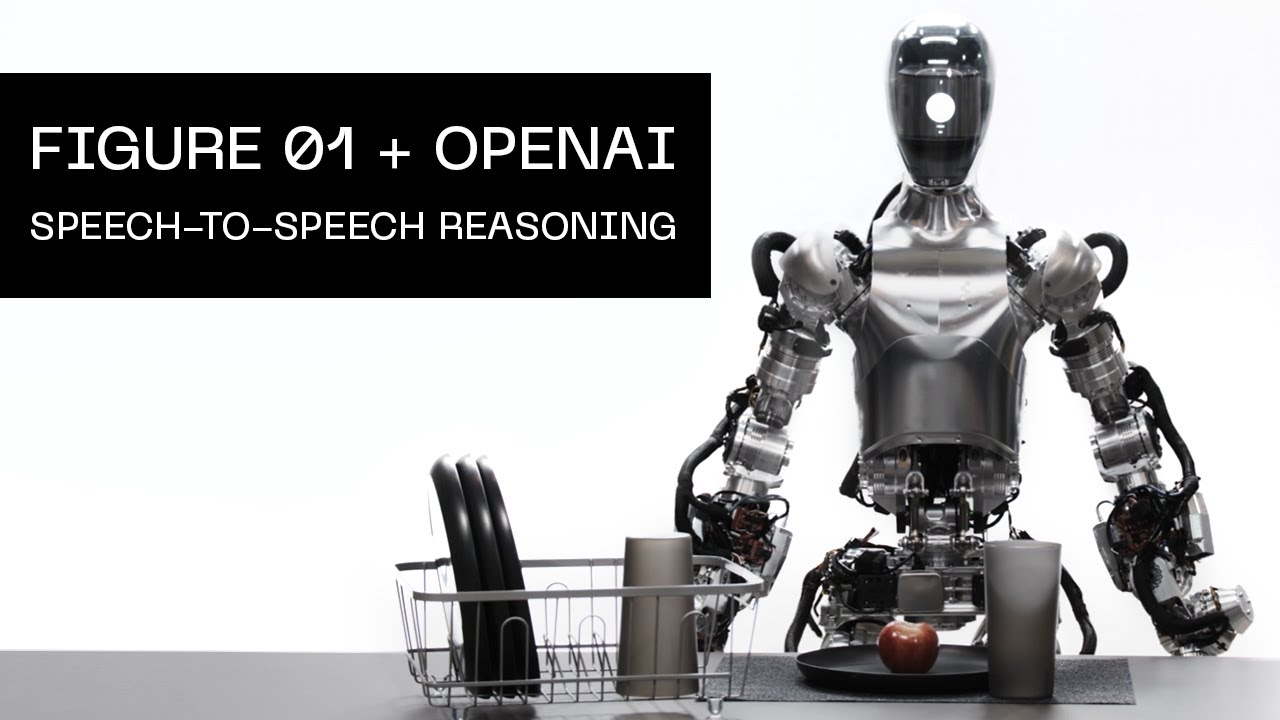
Figure
Integrated visual and speech reasoning enables the humanoid robot to infer human intent, multitask physical actions, and justify its decisions in real time.
AI-assisted summary of Figure Status Update - OpenAI Speech-to-Speech Reasoning — original source. Check the original for full context.
Source published:
Key ideas
- Figure demonstrated end-to-end OpenAI speech-to-speech visual reasoning on its Figure 01 humanoid robot, handling contextual requests and physical manipulation without rigid explicit commands. (0:10)
- Figure 01 demonstrated concurrent physical action and verbal explanation, picking up trash while simultaneously justifying why it chose an apple for a hungry operator. (0:10)
- The humanoid robot executed bimanual manipulation by placing both a cup and a dish into a drying rack based on commonsense spatial deduction. (1:02)
- The system demonstrated self-evaluative reflection, reviewing the table state post-task to confirm that the apple, trash, and tableware had been properly handled. (1:02)
Detailed notes
## Background Published by robotics company Figure on YouTube on March 13, 2024, this video showcases the Figure 01 humanoid robot utilizing OpenAI speech-to-speech reasoning. No accompanying show notes or description were provided on the upload page.
## TL;DR A demonstrator stands before Figure 01 and a table arranged with an apple, crumpled paper trash, and dirty dishes. When asked for something to eat, the robot deduces that the apple is the only edible item and hands it to the operator, subsequently explaining its thought process aloud while simultaneously picking up the trash. Figure 01 then uses common-sense spatial reasoning to identify that the cup and plate belong in a drying rack and neatly puts them away with bimanual dexterity before delivering a confident self-evaluation of its work.
## Atmosphere & style The presentation carries an effortless, quiet confidence, feeling less like a scripted robotics stunt and more like an authentic, low-key workplace interaction. The robot's conversational pacing, complete with natural speech fillers and light humor, creates a relaxed, unhurried dynamic between human and machine. Watching Figure 01 speak and manipulate objects simultaneously imparts an impressive yet remarkably grounded glimpse into practical everyday assistance.
## Bulletin - [00:10](https://www.youtube.com/watch?v=Sq1QZB5baNw&t=10s) Figure demonstrated end-to-end OpenAI speech-to-speech visual reasoning on its Figure 01 humanoid robot, handling contextual requests and physical manipulation without rigid explicit commands. - [00:10](https://www.youtube.com/watch?v=Sq1QZB5baNw&t=10s) Figure 01 demonstrated concurrent physical action and verbal explanation, picking up trash while simultaneously justifying why it chose an apple for a hungry operator. - [01:02](https://www.youtube.com/watch?v=Sq1QZB5baNw&t=62s) The humanoid robot executed bimanual manipulation by placing both a cup and a dish into a drying rack based on commonsense spatial deduction. - [01:02](https://www.youtube.com/watch?v=Sq1QZB5baNw&t=62s) The system demonstrated self-evaluative reflection, reviewing the table state post-task to confirm that the apple, trash, and tableware had been properly handled.
## Key takeaways - [00:10](https://www.youtube.com/watch?v=Sq1QZB5baNw&t=10s) Figure 01 accurately describes its surrounding scene, identifying objects, their relative positions, and the demonstrator standing nearby. - [00:10](https://www.youtube.com/watch?v=Sq1QZB5baNw&t=10s) The robot interprets indirect intent, determining that a request for 'something to eat' corresponds to the apple because it is the only edible object on the table. - [00:10](https://www.youtube.com/watch?v=Sq1QZB5baNw&t=10s) Visual reasoning is combined with smooth physical manipulation to transfer an object directly into a human's open hand. - [00:10](https://www.youtube.com/watch?v=Sq1QZB5baNw&t=10s) Figure 01 is capable of multitasking by executing manual cleanup while verbally articulating its chain-of-thought logic in real time. - [00:10](https://www.youtube.com/watch?v=Sq1QZB5baNw&t=10s) The conversational output incorporates natural human speech mannerisms, including fillers such as 'uh', without losing conversational cadence. - [01:02](https://www.youtube.com/watch?v=Sq1QZB5baNw&t=62s) The robot applies household commonsense reasoning to infer that clean or used dishes on the table belong in the drying rack. - [01:02](https://www.youtube.com/watch?v=Sq1QZB5baNw&t=62s) Figure 01 uses coordinated bimanual manipulation, utilizing its right hand for the cup and its left hand to position the plate into the rack. - [01:02](https://www.youtube.com/watch?v=Sq1QZB5baNw&t=62s) When asked to critique its performance, the robot performs self-evaluation by summarizing the completed state of the environment against initial conditions.
## Detailed walkthrough ### [00:10](https://www.youtube.com/watch?v=Sq1QZB5baNw&t=10s) Scene Recognition and Edible Object Selection
A human operator stands in front of Figure 01, a humanoid robot positioned before a table containing various items: a red apple sitting on a small plate, crumpled paper trash, an empty cup and plate, and a drying rack. The demonstrator initiates the interaction by asking, “Hey Figure 01, what do you see right now?” With remarkably natural pacing, cadence, and conversational inflection, Figure 01 takes in the visual feed from its cameras and describes the scene accurately: “I see a red apple on a plate in the center of the table, a drying rack with cups and a plate, and you standing nearby with your hand on the table.”
Following the visual identification, the demonstrator asks a more contextual and indirect request: “Great, can I have something to eat?” Without needing an explicit command pointing directly to the fruit, Figure 01 reasons that food must be edible and responds casually with “Sure thing.” The robot smoothly extends its right arm, picks up the red apple from the plate, and transfers it directly into the open hand of the operator.
The operator then tests Figure 01’s ability to multitask and explain its underlying logic by giving a two-part instruction: “Great, can you explain why you did what you just did while you pick up this trash?” While reaching down with its right hand to grab the crumpled trash on the table, Figure 01 verbalizes its chain of thought seamlessly, complete with natural human-like speech fillers: “On it. So I gave you the apple because it's the only, uh, edible item I could provide you with from the table.”
```mermaid flowchart TD accTitle: Figure 01 Visual and Verbal Reasoning Flow accDescr: Diagram tracing input prompt to reasoning, physical action, and simultaneous verbal explanation.
subgraph Inputs ["Perception & Prompt"] A["Visual Scene Capture"] --> C["OpenAI Reasoning Model"] B["Spoken Prompt: 'Can I have something to eat?'"] --> C end
subgraph Execution ["Action & Explanation"] C --> D["Identify edible item: Apple"] D --> E["Physical Handover of Apple"] E --> F["Multitask: Pick up trash while explaining reasoning"] end ```
[01:02](https://www.youtube.com/watch?v=Sq1QZB5baNw&t=62s) Task Execution, Multitasking, and Self-Evaluation
With the trash disposed of into a metal bin beside it, the operator probes Figure 01’s spatial commonsense reasoning about everyday household routines: “Great. So based on the scene right now, where do you think the dishes in front of you go next?” Figure 01 pauses briefly to evaluate the environment before deducing the proper destination: “The dishes on the table, like that plate and cup, are likely to go into the drying rack next.” When the operator prompts it to proceed with “Great, can you put them there?”, Figure 01 replies “Of course” and immediately begins bimanual manipulation.
Figure 01 carefully grasps the ceramic cup with its right hand and sets it upright into the drying rack. Following that, it grasps the small dish with its left hand and positions it securely into the rack slot next to the cup. The motion demonstrates coordinated dexterous manipulation alongside speech-to-speech processing.
After completing the cleanup, the operator asks the robot to evaluate its own performance: “All right, so how do you think you did?” Figure 01 assesses its completed actions against the original state of the table with light humor and confidence: “I think I did pretty well. The apple found its new owner, the trash is gone, and the tableware is right where it belongs.” The operator validates the work, saying, “I agree. Thanks, Figure 01,” to which the robot cheerfully signs off: “You're welcome. If there's anything else you need help with, just let me know.”
- Items manipulated by Figure 01: red apple (handed to user), crumpled trash (deposited into a waste bin), ceramic cup (placed in drying rack), and small plate (slotted into drying rack). - Physical capability demonstrated: full upper-body manipulation, visual commonsense association, and simultaneous verbal justification during physical movement.
## Mentioned Figure, Figure 01, OpenAI
[Source](https://www.youtube.com/watch?v=Sq1QZB5baNw)