Elon Musk and Y Combinator President on Thinking for the Future - FULL CONVERSATION
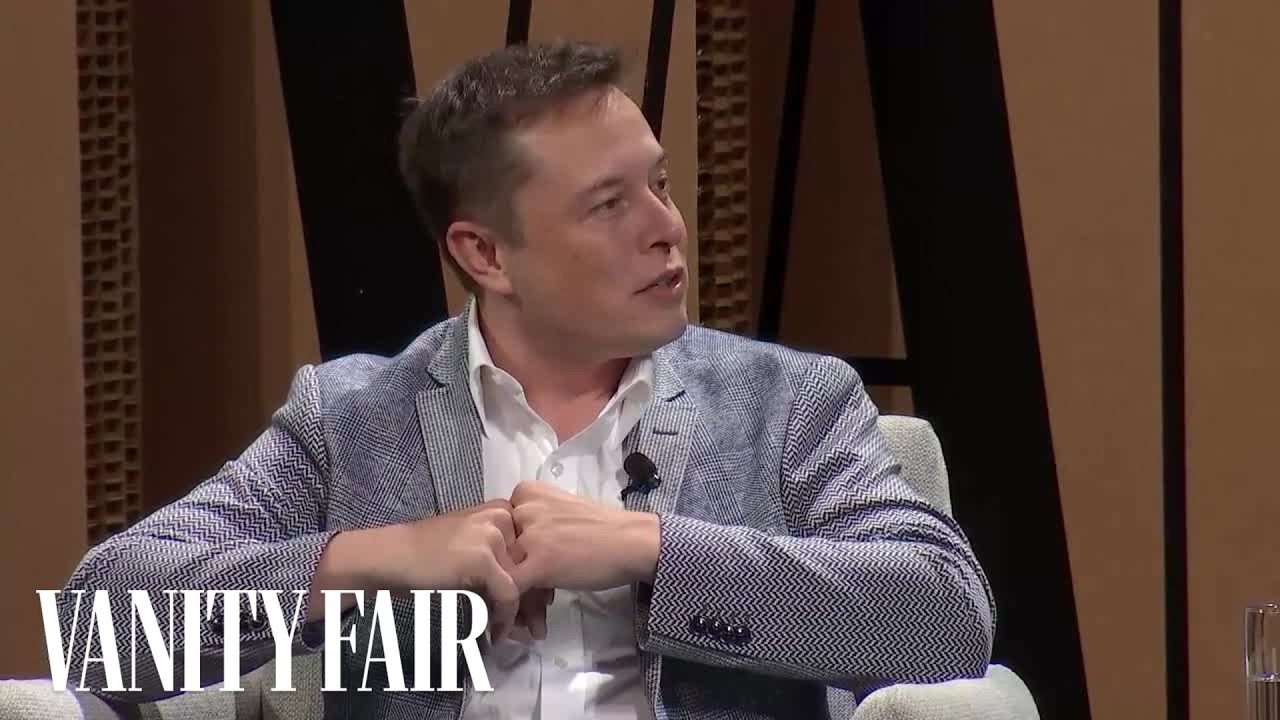
Elon Musk and Y Combinator President on Thinking for the Future - FULL CONVERSATION — Vanity Fair

Vanity Fair

AI-assisted summary of Elon Musk and Y Combinator President on Thinking for the Future - FULL CONVERSATION — original source. Check the original for full context.

Source published:

Key ideas

  • Elon Musk identifies electric aircraft, artificial intelligence, and genetic engineering as the highest-impact frontier domains outside his core commitments in sustainable transport and space exploration. (0:00)
  • Musk and Sam Altman project point-to-point autonomous vehicle driving to be technically viable within two to three years, though broad regulatory approval may trail technical capability by one to five years. (24:26)
  • Altman and Musk advocate for decentralized, symbiotic artificial intelligence that empowers individuals, warning against a single monolithic superintelligence running society. (37:05)
  • Musk recounts putting his entire personal fortune on the line during the 2008 financial crisis, noting Tesla would have filed for bankruptcy within 48 hours had its financing round not closed at 6:00 p.m. on Christmas Eve. (45:20)

Detailed notes

## Background Published by Vanity Fair on YouTube on October 8, 2015, this panel features Tesla and SpaceX CEO Elon Musk alongside then–Y Combinator president Sam Altman discussing the next major frontiers of technology. Moderated by Andrew Ross Sorkin of The New York Times and CNBC, the conversation explores multi-decade horizons across transport, artificial intelligence, clean energy, and space exploration.

## TL;DR Elon Musk and Sam Altman identify electric aviation, artificial intelligence, and genetic engineering as transformative areas for humanity alongside sustainable energy and multiplanetary survival. The discussion spans the physical feasibility of fusion energy and terraforming Mars to philosophical debates around the simulation hypothesis and the Fermi paradox. Musk addresses Tesla's pricing roadmaps, realistic timelines for fully autonomous vehicles, and the reality of government subsidies, contrasting them with oil industry tax breaks. Musk also recounts Tesla's near-death financial crisis on Christmas Eve in 2008, concluding with both speakers outlining how they intend to deploy their fortunes toward foundational technological progress, pediatric healthcare, and off-world civilization.

## Atmosphere & style The panel blends the sharp intellectual curiosity of an elite tech summit with unvarnished, deadpan pragmatism. Andrew Ross Sorkin acts as an incisive, playfully skeptical interrogator, prompting Sam Altman to provide articulate venture-scale analysis while Musk counters industry clichés with direct, first-principles physics. The atmosphere oscillates between cosmic contemplation—pondering simulated realities and the absence of extraterrestrial signals—and grounded tension as Musk candidly recounts the harrowing 2008 cash crunch that brought his companies within 48 hours of total collapse.

## Bulletin - [00:00](https://www.youtube.com/watch?v=SqEo107j-uw&t=0s) Elon Musk identifies electric aircraft, artificial intelligence, and genetic engineering as the highest-impact frontier domains outside his core commitments in sustainable transport and space exploration. - [24:26](https://www.youtube.com/watch?v=SqEo107j-uw&t=1466s) Musk and Sam Altman project point-to-point autonomous vehicle driving to be technically viable within two to three years, though broad regulatory approval may trail technical capability by one to five years. - [37:05](https://www.youtube.com/watch?v=SqEo107j-uw&t=2225s) Altman and Musk advocate for decentralized, symbiotic artificial intelligence that empowers individuals, warning against a single monolithic superintelligence running society. - [45:20](https://www.youtube.com/watch?v=SqEo107j-uw&t=2720s) Musk recounts putting his entire personal fortune on the line during the 2008 financial crisis, noting Tesla would have filed for bankruptcy within 48 hours had its financing round not closed at 6:00 p.m. on Christmas Eve.

## Key takeaways - [00:00](https://www.youtube.com/watch?v=SqEo107j-uw&t=0s) Beyond sustainable energy and space exploration, Musk considers rewriting human genetics and advancing artificial intelligence as the two sectors most capable of fundamentally altering humanity's trajectory. - [02:52](https://www.youtube.com/watch?v=SqEo107j-uw&t=172s) Musk distinguishes between increasing healthspan to treat late-life degeneration and radical longevity, noting he personally aims for around 100 functional years rather than living forever. - [05:02](https://www.youtube.com/watch?v=SqEo107j-uw&t=302s) Transitioning to sustainable energy remains the century's most critical challenge, with terrestrial power likely dominated by solar and battery storage alongside potential contributions from commercial nuclear fusion. - [07:35](https://www.youtube.com/watch?v=SqEo107j-uw&t=455s) Musk clarifies his Mars terraforming concept: deploying continuous high-altitude fusion detonations above the poles to function as artificial suns that vaporize frozen CO2 and thicken the atmosphere. - [11:04](https://www.youtube.com/watch?v=SqEo107j-uw&t=664s) Establishing a self-sustaining human outpost on Mars serves primarily as an existential insurance policy to preserve the light of consciousness against single-planet extinction events. - [13:57](https://www.youtube.com/watch?v=SqEo107j-uw&t=837s) The Fermi paradox raises the critical question of why alien civilizations remain undetectable given the universe's 14-billion-year age and the relatively short time needed to traverse the galaxy. - [15:54](https://www.youtube.com/watch?v=SqEo107j-uw&t=954s) Rapid historical improvements in computing graphics and immersive virtual reality suggest a high probability that photorealistic virtual simulations could become indistinguishable from physical reality. - [24:26](https://www.youtube.com/watch?v=SqEo107j-uw&t=1466s) Full point-to-point vehicle autonomy is technologically projected within two to three years, but widespread consumer rollout depends on regulators seeing proof that systems are significantly safer than humans. - [25:53](https://www.youtube.com/watch?v=SqEo107j-uw&t=1553s) Age is less determinative of startup success than willingness to take long-horizon risks and adapt rapidly, as demonstrated by Tesla discarding 96% of its initial Lotus chassis assumptions. - [30:27](https://www.youtube.com/watch?v=SqEo107j-uw&t=1827s) Musk allocates roughly 70% of his daily time directly to design and engineering across SpaceX and Tesla, advising against running two major companies simultaneously due to the extreme reduction in personal freedom. - [34:35](https://www.youtube.com/watch?v=SqEo107j-uw&t=2075s) Musk refutes claims of excessive government dependency, pointing out that clean-tech incentives are dwarfed by entrenched fossil-fuel tax breaks and established defense-contractor infrastructure subsidies. - [37:05](https://www.youtube.com/watch?v=SqEo107j-uw&t=2225s) Humanity is already co-evolving with distributed machine-learning systems, highlighting the need to steer AI toward a safe, decentralized model rather than a centralized, all-controlling superintelligence. - [39:32](https://www.youtube.com/watch?v=SqEo107j-uw&t=2372s) The Hyperloop was conceived as a high-speed, cost-effective alternative to California's high-priced, underperforming high-speed rail proposal, supported by SpaceX's student pod competition test track. - [43:17](https://www.youtube.com/watch?v=SqEo107j-uw&t=2597s) Altman and Musk push back against techno-pessimism, explaining that the apparent dominance of software is driven by media reporting bias rather than a lack of capital flowing to ambitious hard-tech innovation. - [45:20](https://www.youtube.com/watch?v=SqEo107j-uw&t=2720s) Capital-intensive deep-tech ventures like SpaceX and Tesla are virtually impossible to start without personal wealth or an established track record, leading Musk to commit all his liquid capital during the 2008 credit freeze. - [46:35](https://www.youtube.com/watch?v=SqEo107j-uw&t=2795s) Musk plans to deploy his accumulated wealth primarily toward building a self-sustaining Martian city, scaling sustainable transport and clean energy, and backing education and pediatric healthcare.

## Detailed walkthrough ### [00:00](https://www.youtube.com/watch?v=SqEo107j-uw&t=0s) Starting a Company from Scratch: AI, Genetics, and Electric Airplanes

Andrew Ross Sorkin opens the session by welcoming the audience and introducing his panel: Elon Musk (co-founder and leader of Tesla, SpaceX, and SolarCity) and Sam Altman (president of Y Combinator). Sorkin highlights Y Combinator’s footprint—backing roughly 250 startups annually, with an active portfolio exceeding 1,000 companies worth an aggregate $65 billion, including breakout names like Airbnb, Dropbox, Stripe, Zenefits, and Instacart.

To kick off the discussion on 10-to-20-year horizons, Sorkin issues a direct challenge to Musk: setting aside Tesla, SpaceX, and SolarCity entirely, what new venture would he launch tomorrow? Musk notes an immediate commercial frontier in aerospace: electric aircraft. Because all forms of terrestrial transport are destined to electrify over time—with the ironic exception of rockets—aviation represents an obvious opportunity. Looking at systemic impact, however, Musk points out two powerful yet volatile domains that will fundamentally alter humanity’s trajectory: artificial intelligence and genetic rewriting. While both are fraught with ethical, existential, and technical minefields, he argues that inaction might carry even greater peril than trying to steer them responsibly.

Altman concurs with Musk’s assessment. He mentions that Y Combinator is already funding ventures across that exact spectrum, including an electric airplane startup—a concept he and Musk agree is mathematically and physically viable—as well as specialized AI companies. Both founders see steering artificial intelligence in a positive direction and applying genetic engineering as the two most pivotal, non-routine fields outside their immediate daily focus.

```mermaid flowchart TD accTitle: Future Innovation Priorities accDescr: Key technological domains identified by Elon Musk and Sam Altman for future enterprise and impact.

subgraph Transport ["Next-Gen Transport"] EA["Electric Aircraft<br/>(All transport electrifies except rockets)"] end

subgraph DeepTech ["High-Impact Destiny Shifters"] AI["Artificial Intelligence<br/>(Steering toward positive outcomes)"] GE["Genetic Engineering<br/>(Rewriting human genetics & health)"] end

subgraph PlanetaryCore ["Planetary Foundations"] SE["Sustainable Energy<br/>(Solar + Battery storage)"] MP["Multi-Planetary Life<br/>(Terraforming & Mars colonization)"] end

Transport --> DeepTech DeepTech --> PlanetaryCore ```

- When evaluating the core levers of human future beyond the internet, sustainable transport, and interplanetary colonization, Elon Musk stated: “I think besides sustainable transport, the internet, and making life multiplanetary, rewriting genetics and AI, the latter two are the ones that can most change the destiny of humanity.” - On the prospect of electric flight, Sam Altman affirmed: “I think it should work; it makes sense, the math should work.”

---

[02:52](https://www.youtube.com/watch?v=SqEo107j-uw&t=172s) Longevity and the Limits of Lifespans

Sorkin turns the conversation toward longevity and biotech, noting that Elizabeth Holmes had addressed the conference earlier that day and citing Google co-founder Larry Page’s heavy capital backing of life-extension initiatives aiming to defeat aging and death. Sorkin asks Musk whether extending human lifespan is a personal focus, playfully wondering if he wants to live long enough to witness the Mars colonization program come to fruition.

Musk clarifies that radical life extension is not something he advocates. He distinguishes sharply between healthspan—remedying degenerative, debilitating conditions of late life such as dementia—and pursuing outright immortality. When pressed directly by Sorkin on how long he personally wants to live, Musk answers that around 100 good, functional years would be plenty.

- Sorkin asked: “So you don’t want to live forever so that you can actually get to Mars?” - Elon Musk bluntly replied: “I definitely don’t want to live forever.” - Clarifying his personal horizon, Elon Musk added: “100 good ones in total I think is probably fine, and maybe a bit longer.”

---

[05:02](https://www.youtube.com/watch?v=SqEo107j-uw&t=302s) Sustainable Energy, Fusion, and Global Poverty

Sorkin brings the panel back to energy fundamentals, acknowledging that disallowing SolarCity skewed Musk's immediate answers. Musk emphasizes that transitioning to sustainable energy remains the single most urgent problem humanity must resolve during this century, noting that the global scientific consensus on the perils of continuing hydrocarbon combustion is absolute. His preferred primary pillar remains solar generation paired with battery storage, taking advantage of the giant fusion reactor already present in the sky.

Altman points out the direct socioeconomic relationship between low-cost power and humanitarian progress, noting that making clean energy drastically cheaper is arguably the most impactful lever for elevating the bottom half of the global population. When Sorkin asks about nuclear options, Altman explains that the ultimate terrestrial baseload will likely settle into a mix of solar and nuclear power (roughly an 80/20 balance in either direction), expressing optimism about the viability of commercial fusion over the next two decades. Musk agrees that fusion is physically achievable, but maintains that harvesting the indirect fusion of the sun via photovoltaic panels will dominate terrestrial generation, while localized fusion reactors might serve extreme northern or southern latitudes where insolation is sparse.

- Underlining the climate imperative, Elon Musk stated: “I think sustainable energy is the most important problem that we face this century, that’s like a known difficult thing that we have to solve.” - On the global impact of energy economics, Sam Altman observed: “Every time I look into this, it’s really amazing how much the cost of energy and the quality of life correlate.”

---

[07:35](https://www.youtube.com/watch?v=SqEo107j-uw&t=455s) Physics of Fusion vs. Fission and the "Nuking Mars" Strategy

Sorkin inquires about the inherent risks of nuclear power, specifically whether fusion carries dangerous operational hazards. Musk dismisses the idea of a fusion catastrophe, detailing the fundamental physics that separate fission from fusion:

| Mechanism | Operating Principle | Major Fuels / Elements | Confinement & Runaway Risk | |:--- |:--- |:--- |:--- | | **Fission** | Heavy, unstable atomic nuclei decay or split into smaller fragments, releasing energy. | Uranium, Plutonium | Carries meltdown risk if cooling fails (though advanced reactor designs reduce this near zero); reaction can sustain itself via chain reactions. | | **Fusion** | Light hydrogen isotopes are forced together under extreme conditions to synthesize helium. | Hydrogen isotopes (forming Helium) | No meltdown risk. Self-extinguishing; extremely hard to keep the reaction burning without massive gravitational confinement (stars) or complex terrestrial electromagnetic/kinetic confinement. |

The conversation shifts to Musk’s viral remarks on *The Late Show with Stephen Colbert*, where he casually suggested “nuking Mars.” Musk explains that the 30-second television format led to misunderstandings. Rather than dropping nuclear warheads directly onto the Martian ground, his actual concept involves detonating continuous fusion devices high in the atmosphere above the Martian poles to act as two artificial pulsing suns. The radiant thermal output would warm the polar ice caps, releasing trapped carbon dioxide gas to thicken the thin atmosphere. As greenhouse warming accelerates, vaporized water and CO₂ would trigger a self-reinforcing warming cycle across the planet.

- Explaining the physical challenge of artificial fusion, Elon Musk noted: “With fusion, the great difficulty is keeping the reaction from—is keeping the fire from going out; it’s quite hard to sustain a fusion reaction unless you have something very big like the sun.” - Clarifying his Mars terraforming concept, Elon Musk explained: “What I was really talking about is creating two little suns—two pulsing suns above the North and South Pole of Mars that would warm the poles up enough so that the frozen CO₂ would gasify and densify the atmosphere.”

[11:04](https://www.youtube.com/watch?v=SqEo107j-uw&t=664s) Becoming a Multiplanetary Species as an Insurance Policy

Andrew Ross Sorkin challenges Elon Musk on why anyone would want to move to Mars given that society is struggling not to warm Earth up. Musk readily admits that going to Mars looks like a great adventure, but clarifies that the core motivation is existential preservation: extending life beyond Earth functions as an insurance policy for collective consciousness. Musk notes that there is no detectable life on the Martian surface, though some subterranean bacterial life might exist. Establishing a self-sustaining human outpost on Mars would guarantee that life as we know it is extended to another world, vastly extending the probable lifespan of human civilization.

When asked what catastrophic event he envisions happening on Earth to justify this move, Musk emphasizes that becoming multiplanetary is about choosing what kind of future humanity aspires to build. Waiting on a single planet guarantees that an eventual extinction event will wipe out humanity, whether far in the future or unexpectedly soon. In Musk’s view, humanity faces a fundamental fork in the road: “Do you want to have a future where we are forever confined to one planet or one where we are out there exploring the stars and on many planets?” He argues that the latter path is far more inspiring and exciting. Musk summarizes that making life multiplanetary rests on two pillars: a defensive measure to ensure the light of consciousness is not extinguished, and an incredible adventure that everyone can enjoy either personally or vicariously.

Sam Altman agrees that establishing multiplanetary life is vital, but raises a competing technological timeline:

> “I think the AI question is likely to become pressing and important to deal with before we can establish a full colony on Mars.”

Altman jokingly adds that even if humans do establish a base on Mars first, escaping an advanced machine intelligence might prove futile, as an AI could simply beam itself across space: “The AI can like go to Mars on a laser beam.” While moving physical matter across interplanetary distances is difficult, an AI could easily transmit itself to Mars in roughly twenty minutes at light speed.

```mermaid flowchart TD accTitle: Motivations for Colonizing Mars accDescr: Flowchart outlining Elon Musk's primary arguments for establishing a multiplanetary presence on Mars. subgraph Drivers["Core Imperatives"] Def["Defensive Insurance Policy"] Exp["Exploration & Adventure"] end

subgraph Actions["Action on Mars"] Colony["Establish Self-Sustaining Colony"] end

subgraph Outcomes["Long-Term Impact"] Preserve["Preserve Light of Consciousness"] AvoidExt["Mitigate Single-Planet Extinction Risk"] end

Def --> Colony Exp --> Colony Colony --> Preserve Colony --> AvoidExt ```

[13:57](https://www.youtube.com/watch?v=SqEo107j-uw&t=837s) The Fermi Paradox and the Drake Dilemma

Sorkin shifts the topic to whether Musk and Altman believe in alien life outside of Earth. Musk separates the question into primitive biology versus intelligent civilizations, stating that there is a high probability of microbial life existing elsewhere, but the likelihood drops sharply as life becomes more advanced and sophisticated. When asked if he believes there are aliens humanity can actually talk to, Musk laughs and mentions an article from *The Onion* proposing that NASA should only bother holding a press conference if they discover aliens with whom humans can converse.

Musk explains that for humanity to communicate with extraterrestrial intelligence, an improbable confluence of events must occur: intelligent life must not only evolve somewhere across the universe, but it must also survive long enough to overlap with human civilization's narrow window of existence. This puzzle leads Musk directly to the Fermi paradox:

> “If there are so many planets out there and the universe is almost 14 billion years old, why aren't the aliens everywhere?”

Musk points out that even at an extraordinarily slow pace—which he whimsically likens to traveling at "bicycle speed"—one could reach Alpha Centauri in a few hundred thousand years. Across a span of 100 million years, a civilization moving at such modest speeds could blanket the entire galaxy. Given that the universe is nearly 14 billion years old, the complete absence of physical evidence or alien signals remains one of the most perplexing questions in science.

[15:54](https://www.youtube.com/watch?v=SqEo107j-uw&t=954s) The Simulation Hypothesis and Virtual Reality

Sorkin brings up an idea discussed backstage that Musk has championed as a thought experiment: the possibility that humanity is collectively living inside a computer simulation. Musk outlines the probabilistic argument by examining the trajectory of computing and video games over the prior forty years. He recalls how technology progressed from the era of *Pong*—which consisted of two crude rectangular paddles bouncing a square back and forth—to modern photorealistic 3D virtual worlds shared simultaneously by millions of players. With the addition of virtual reality headsets and incoming haptic force-feedback devices, such as gloves and sticks, virtual experiences are becoming indistinguishable from physical reality.

Musk argues that even if technological progress slows by a factor of 100, photorealistic, fully interactive simulations will easily become indistinguishable from reality in 200 years rather than 20 years. When Sorkin asks if Musk truly believes an external entity is sitting somewhere holding a joystick playing humanity, Musk responds that it certainly does not feel that way, but observes that characters inside an advanced video game would not realize they are in a simulation either. Altman adds that users trying room-scale virtual reality for the first time often demonstrate how easily perception is fooled:

> “They have this experience when they do that for the first time and they take it off and then they just freeze for 10 seconds and you can—and then you talk to them and it's clear that like their belief that this is actual reality has been shaken because they were so convinced in virtual reality that that was real.”

Altman notes that the simulation hypothesis also presents an elegant resolution to the Fermi paradox: if our reality is a programmed construct, the developers simply may not have rendered any alien civilizations.

Addressing when virtual reality will become pervasive enough to replace physical conferences, Musk maintains that there will always be unique value in meeting in person that hopefully will never be lost. Nevertheless, with Oculus and Valve set to launch their consumer headsets within the coming months, Musk and Altman describe recent VR demos as breathtakingly convincing. Altman describes a physical demo where environmental immersion was amplified by practical effects—technicians blew air on the user when walking near a cliff edge and switched on a heater when standing beside an in-game fire—producing a disorienting, fully convincing reality shift.

[19:34](https://www.youtube.com/watch?v=SqEo107j-uw&t=1174s) Tesla Model X Pricing and the Deleted Model Y Tweet

Sorkin directs the conversation to Tesla, bringing up the newly launched Model X SUV and pressing Musk on its steep $132,000 price tag. Musk clarifies that the vehicles currently coming off the production line represent fully optioned, premium founder packages rather than the vehicle's standard base configuration. He explains that by the following year, Tesla plans to release a standard version priced at roughly $75,000 before electric vehicle incentives, which should bring the net price down to approximately $65,000. Looking further down the roadmap, Musk highlights the upcoming Model 3, projected for release in a couple of years with an entry price of $35,000, bringing electric mobility to a much broader market.

Sorkin then interrogates Musk about a recent Twitter incident that sparked speculation among Tesla enthusiasts. A week prior, Musk responded to a user query regarding the Model X by referencing both a "Model Y" and the Model 3, noting that one of them would feature falcon-wing doors, before quickly deleting the post. Sorkin asks why the tweet was pulled down if it was accurate. Musk demystifies the drama, stating that it was plainly obvious the crossover Model Y would inherit the falcon-wing doors rather than the compact Model 3. Musk explains that he did not delete it to hide a corporate secret, as deleting a tweet does not scrub it from the internet:

> “I just didn't like what the way my Twitter history looked. It was like too rambling.”

- **Model X Launch Edition**: Fully optioned early production model priced at approximately $132,000. - **Model X Base Model**: Planned for the following year at roughly $75,000 before incentives (approximately $65,000 net after tax credits). - **Model 3**: Planned high-volume, affordable electric vehicle with a target starting price of $35,000. - **Model Y Tease**: Confirmed by Musk as a future model positioned to feature falcon-wing doors.

[21:33](https://www.youtube.com/watch?v=SqEo107j-uw&t=1293s) Tesla as a Software Company and the Reality of Autopilot

Andrew Ross Sorkin points out that Sam Altman is an investor in both Twitter and Tesla, prompting him to pitch Tesla from an owner's standpoint. Altman explains that while he previously owned an original Tesla Roadster—which he admits "was not the best car"—the Model S stands apart as "the best car on the market." In his view, incumbents misunderstand the company's nature: “people think of this like existing car companies, but actually this is like a software company with a car attached to it.” Altman describes driving it as an intuitive "point-and-click" experience: the steering wheel points, the pedal goes down, the car moves noiselessly and reliably, and the software genuinely works. While acknowledging the vehicle remains expensive, Altman expresses confidence that a mass-market Tesla will succeed, noting that competing electric cars feel years behind.

When asked whether Tesla defines itself as a software company, Elon Musk clarifies that it is both software and hardware, though software represents an increasingly critical proportion of the engineering challenge as they approach vehicle autonomy. Sorkin brings up a prevalent theory: that Tesla is secretly installing autonomous hardware into cars with plans to "flip a switch" overnight. Musk dispels the conspiracy framing, explaining that rolling updates are completely public. Tesla is preparing Version 7 of its software to introduce highway Autosteer (capable of steering on highways or non-sharp roads and performing well in traffic). At that moment, the feature is in public beta with roughly 600 to 700 Tesla owners actively testing it.

```mermaid flowchart TD accTitle: Tesla Software and Autonomy Development Flow accDescr: Progression from current public beta to general technological readiness and eventual regulatory sign-off. subgraph Beta["Current Deployment"] A["Version 7 Highway Autosteer"] --> B["Public Beta: 600–700 Owners Testing"] end subgraph Capability["Technical Horizon (2–3 Years)"] B --> C["Point-to-Point Autonomous Capability"] C --> D["Generalized Driving Beyond Mapped Zones"] end subgraph Regulation["Regulatory Horizon (+1–5 Years)"] D --> E["Regulator Review"] E --> F["Demonstrated Significantly Safer Than Human Drivers"] end ```

[24:26](https://www.youtube.com/watch?v=SqEo107j-uw&t=1466s) The Timeline for True Autonomous Driving

Altman turns to the wider industry timeline, arguing that full self-driving will arrive far sooner than the general public assumes. While most people anticipate a 10- to 20-year horizon, Altman predicts true point-to-point autonomy will become standard within three to four years. Musk agrees with that pace on a technical level, stating: “I think that's something on the two to three year time frame is likely for it to be technologically... point-to-point virtually anywhere.”

Musk emphasizes, however, that widespread road autonomy faces a crucial distinction between engineering feasibility and bureaucratic reality: - **General Technical Capability:** Achieving autonomous driving outside tightly geofenced and pre-mapped zones (such as Mountain View or Palo Alto) is only two to three years away. - **Regulatory Lag:** Full legal sign-off will trail technical proof by roughly one to five years depending on the jurisdiction. - **Safety Standard:** Regulators will require rigorous empirical data proving that autonomous driving systems are significantly safer than human drivers before granting approval.

[25:53](https://www.youtube.com/watch?v=SqEo107j-uw&t=1553s) Founder Age, Risk Profiles, and Starting on Dumb Ideas

Turning to venture capital dogma, Sorkin cites Peter Thiel’s provocative claim that he would not back founders over age 30, jokingly asking whether Musk (then 44) was simply an exception and if older founders in the audience were finished. Altman rejects the hard cutoff: “I think it would be a crazy strategy to say I'm never going to invest in anyone over 30.” Y Combinator’s data shows the mean age of funded founders is right around 29 or 30, with several older entrepreneurs building multi-billion-dollar firms. Altman notes an intriguing split in the statistics: - **Outlier Value:** Founders of breakout, multi-billion-dollar unicorns skew significantly younger, likely because they take larger risks and pursue long time-horizon bets. - **Baseline Success Rate:** When measuring the binary outcome of whether a startup simply succeeds or fails, older founders skew higher.

Musk agrees that Thiel likely did not intend the statement literally, noting that age matters far less than raw execution: possessing a viable idea, working exceptionally hard, and hiring and inspiring a world-class team. Sorkin counters with the theory that entrepreneurs only get one great idea. Musk dismisses idea fetishization, echoing Thomas Edison’s adage that invention is 1% inspiration and 99% perspiration. In fact, Musk reveals that Tesla itself was founded on two completely flawed assumptions: 1. **The Drivetrain:** Tesla initially assumed it could license an off-the-shelf electric drivetrain from Southern California-based AC Propulsion. That technology worked for a fragile concept car, but completely failed to yield a reliable, cost-effective commercial product. 2. **The Chassis:** Tesla planned to save capital by adapting the Lotus Elise chassis. Instead, integrating the powertrain forced the team to redesign roughly 96% of the components, invalidating previous crash-test and safety data, stretching the frame, and adding 30% to the overall weight.

Musk compares the Lotus conversion to buying a house with the plan to remodel it, only to tear down every single structure except a solitary basement wall: “it would have been better to just build the house from the beginning.” The essential lesson of entrepreneurship, Musk argues, is the agility to abandon flawed premises: “start somewhere and then, you know, really be prepared to question your assumptions, fix what you did wrong, and adapt to reality.”

[30:27](https://www.youtube.com/watch?v=SqEo107j-uw&t=1827s) Running Two Companies and Approaching Politics

With Jack Dorsey preparing to simultaneously lead Twitter and Square, Sorkin asks Musk how he balances running SpaceX and Tesla. Musk does not romanticize the workload, warning: “I wouldn't recommend running two companies... it really decreases your freedom quite a lot.” Addressing misconceptions about his day-to-day schedule, Musk explains that about 70% of his time is spent directly on design and engineering. Public relations, panel discussions, and media appearances account for only 2% to 3% of his calendar, an allocation he intends to squeeze down to 1%.

As the session prepares to shift to audience questions, Sorkin introduces two final political questions: whether the United States will ever innovate past physical ballot precincts to vote directly on mobile phones, and which 2016 presidential candidates the speakers favor. Altman quips that he will answer the tech voting question so Musk can address the candidates, prompting Musk to interject with deadpan sarcasm: “Trump's amazing.”

[31:52](https://www.youtube.com/watch?v=SqEo107j-uw&t=1912s) Voting on Phones, Donald Trump, and Government Procurement

Sam Altman looks forward to an era when people will cast ballots directly from their phones. While he acknowledges resistance from entrenched interests who “don't want to see the electorate change,” Altman takes a long view: “I always try to think about things over these sort of you know 10 or 20 year time frames I think you can get so caught up in the what's happening this month or next year are we in a bubble are we buying at a low tick or a high tick but but eventually it's going to happen and I take solace in that.”

Moderator Andrew Ross Sorkin redirects the conversation toward Donald Trump's presidential campaign. Elon Musk reacts cautiously, noting he hopes Trump does not secure the Republican nomination because “that wouldn't be good.” When Sorkin mentions that media mogul Barry Diller threatened to leave the country if Trump won, Musk clarifies that he would not go that far: “At most he would get the Republican nomination, but I think that would still be a bit embarrassing.”

Musk explains that he tries to stay out of the political sphere as much as possible, entering it only when SpaceX is forced to compete against entrenched aerospace defense contractors:

> “I get involved in politics to the as little as possible yeah there sometime I have there's some amount that I have to get involved in mostly because SpaceX has to battle Boeing and Lockheed, you know for National Security and civil space launch contracts so if we don't if we don't battle them then you know then they will we'll lose.” — Elon Musk

Asked how corrupt that ecosystem is, Musk offers a nuanced view. He contends that on balance the system cannot be thoroughly corrupt, because if it were, a tiny startup like SpaceX would never have won its initial government launch contracts over giants like Boeing and Lockheed Martin. In Musk's analysis, corruption is inversely proportional to public scrutiny:

```mermaid flowchart TD accTitle: Public Visibility vs Level of Political Corruption accDescr: Diagram showing how political scrutiny levels correlate to corruption across different branches of government.

subgraph HighVis ["High Visibility / Lower Corruption"] Pres["Presidential Level"] Senate["Senate Level"] end

subgraph LowVis ["Lower Visibility / Higher Corruption"] House["House of Representatives"] State["State and Local Level"] end

Pres --> Senate Senate --> House House --> State

Metric["Public Attention Defines Corruption Risk"] -.-> HighVis Metric -.-> LowVis ```

[34:35](https://www.youtube.com/watch?v=SqEo107j-uw&t=2075s) Subsidies: Tesla, SolarCity, and SpaceX

Sorkin brings up a prominent criticism often leveled at Musk's companies: that they rely heavily on government subsidies to survive. Musk pushes back forcefully, calling an investigative piece in the *Los Angeles Times* “nonsensical.” He argues that the article bundled decades of potential future tax credits together to fabricate an inflated headline figure:

> “Because what what the LA Times article did was add up all incentives that Tesla has received and all incentives that Tesla will receive so like over a 30-year period and made it made it sound like a big number, but it's you know like if somebody's earning $50,000 a year you don't say you don't call them a millionaire because over the next 20 years they will cumulatively earn a million dollars.” — Elon Musk

Musk outlines how green incentives merely offset a fraction of the entrenched benefits enjoyed by fossil fuels:

- **Stripper Oil Wells:** The government grants a 20% tax incentive for marginal, low-production stripper wells. - **Solar Energy ITC:** The solar incentive sat at 30% but was scheduled to drop to 10% within two years, meaning solar would soon receive half the tax incentive of a stripper oil well. - **Electric Vehicle Tax Credits:** The $7,500 consumer tax credit functions as roughly a 10% discount on a vehicle purchase—a helpful catalyst, but not the make-or-break difference between viability and failure. - **SpaceX Competition:** SpaceX won national security and commercial missions despite Boeing and Lockheed Martin receiving more than a $1 billion annual government subsidy just to sustain their launch readiness infrastructure.

[37:05](https://www.youtube.com/watch?v=SqEo107j-uw&t=2225s) Symbiotic AI vs. Superintelligent Monoliths

Opening the floor to audience questions, Bruce Gman, an investor from Toronto, asks Altman and Musk to paint a positive, non-dystopian vision for artificial intelligence. Altman rejects the classic science-fiction tropes where either humanity enslaves machine intelligence or machine intelligence enslaves humanity. Instead, he highlights that a subtle, co-evolutionary symbiosis is already underway:

> “I think already humans and AI are co-evolving and no one's paid attention to this yet but I don't think there's any human left that understands all of how Google search results are ranked on that first page it really is machine learning algorithm so when we search on Google it's an AI deciding what we should see, when a dating site matches two people together there's a machine learning algorithm that no human understands how it works that is getting people together that then have babies and so in effect you know you have this like machine learning algorithm breeding humans.” — Sam Altman

Altman advocates for a decentralized model: millions of distributed AIs that empower individuals, rather than a single, monolithic superintelligence that is a million times smarter than everything else and commands humanity. Musk agrees with Altman's framing, noting that modern human society already forms a “giant cyborg” or collective symbiote. However, Musk quips that he naturally has an “affinity for the human portion of that cyborg collective,” emphasizing that developers must remain exceptionally cautious so that AI systems are developed safely and remain beneficial to humankind.

[39:32](https://www.youtube.com/watch?v=SqEo107j-uw&t=2372s) Public Enthusiasm for Science and the Origin of Hyperloop

Audience member Jessica Sing cites an episode of *The Nightly Show with Larry Wilmore* where guest Bill Nye debated whether society truly values NASA's scientific process or merely consumes shiny, finished end-products. Musk disagrees with the pessimistic view, pointing out that NASA's announcement confirming evidence of liquid water flowing on Mars generated widespread global interest. While he concedes society could always stand to care more about basic science, he believes the general public remains fundamentally curious about discovering the universe.

A subsequent question asks Musk about his motivation for proposing the Hyperloop as an alternative to California's planned High-Speed Rail project. Musk explains that any new transport system funded by California taxpayers ought to be cutting-edge, fast, and cost-effective. Instead, California's proposed rail project carried a massive price tag while offering travel times that were not clearly superior to driving or flying.

> “It's a lot of money for something which isn't obviously compelling relative to a car or a plane in terms of the time it would take to complete the journey and and it will will settle California taxpayers with a pretty significant amount of money that they got to pay so it's like if you pay if you pay a high price you should have a a great outcome like that should be the sensible thing and that doesn't seem to be what what is happening from what I can tell.” — Elon Musk

Seeking a faster way to travel between Los Angeles and San Francisco, Musk conceived an initial design concept. After realizing during an earlier speaking engagement that his first iteration was technically flawed, he collaborated and iterated with engineering colleagues until publishing the finalized Hyperloop design specifications, which independent companies have since begun building.

[42:17](https://www.youtube.com/watch?v=SqEo107j-uw&t=2537s) The SpaceX Hyperloop Student Competition

Elon Musk expresses his enthusiasm for the Hyperloop concept, hoping to see it fully realized in the real world. To help accelerate progress, he announces that SpaceX is hosting a Hyperloop student pod competition. To support the contest, SpaceX is constructing a one-mile-long test track in Hawthorne, Los Angeles County, located right next to SpaceX headquarters. The goal of the initiative is to challenge student engineering teams to design and build the most advanced sub-scale pods possible.

Musk outlines the rules and the setup of the track with a characteristic blend of high-stakes engineering and humor. The winner will simply be whoever can make their pod travel the fastest over the one-mile stretch. Because of the extreme acceleration and limited track length, Musk explains that they plan to build a massive crash barrier at the far end of the tube. If a student team's pod fails to brake in time, it will simply slam into the crash zone, making the trial both rigorous and entertaining.

[43:17](https://www.youtube.com/watch?v=SqEo107j-uw&t=2597s) Software Hype vs. Hard Tech Innovation

A Stanford computer science student named Bish approaches the microphone to ask why modern startups and media attention seem disproportionately focused on business-model innovations powered by software, rather than breakthrough "true technical innovations." He directs the first part to Sam Altman, asking why that dynamic exists, and asks Musk whether he could have ever gotten SpaceX or Tesla off the ground if they had been his very first ventures without prior personal capital.

Altman pushes back against the techno-pessimist narrative that humanity has hit an innovation plateau, rejecting the idea that "no one's working on anything interesting" or that "it's the end of progress." Instead, Altman argues that talent flows naturally to where the biggest near-term opportunities lie, and software has delivered unmatched leverage over the prior two decades. Furthermore, Altman points out a massive reporting bias in tech journalism: Y Combinator actively funds deep technological innovations on long time horizons, but the media heavily favors writing about consumer software. Musk chimes in on the second question, bluntly acknowledging that neither SpaceX nor Tesla would have worked as a first venture because capital-intensive hardware companies are virtually impossible to launch without personal wealth or an established track record.

> “The Press loves to write about the software companies and they have very little interest in writing about the other stuff and so as an outsider you would say well there's only software, but that just doesn't reflect reality.” — Sam Altman

[45:20](https://www.youtube.com/watch?v=SqEo107j-uw&t=2720s) Musk's 2008 Near-Death Experience and Going "All In"

Musk reflects on the harrowing financial crisis of 2008 and 2009, confirming that he completely exhausted his personal net worth to keep his ventures alive. After exiting PayPal, his original plan was prudent: he intended to invest only about half of his proceeds into SpaceX, Tesla, and SolarCity, leaving the remaining half as a secure safety cushion. However, when the Great Recession struck, capital markets froze, leaving Tesla and SpaceX on the brink of total collapse.

Faced with the existential crisis, Musk realized he had only two paths: watch the companies die immediately, or pour every remaining dollar into them for a fighting chance at survival. He chose to put all of his capital on the line. He vividly recalls the climax of the ordeal: Tesla's life-or-death financing round closed at 6:00 p.m. on Christmas Eve, December 24, 2008. Had that round failed to close at that very hour, Tesla would have filed for bankruptcy just two days after Christmas.

```mermaid flowchart TD accTitle: Elon Musk 2008 Capital Allocation Dilemma accDescr: Decision flowchart showing Musk choosing between keeping his safety cushion or risking total bankruptcy to save Tesla and SpaceX in 2008.

subgraph PayPalExit["PayPal Exit Strategy"] A["PayPal Proceeds"] --> B["50% Allocated: Tesla, SpaceX, SolarCity"] A --> C["50% Retained: Personal Safety Cushion"] end

subgraph Crisis2008["2008 Financial Crisis"] B --> D{"Global Credit Freeze"} C --> D D -->|"Option A: Protect Cash"| E["Companies Definitely Die"] D -->|"Option B: Invest All Capital"| F["Companies Might Survive"] end

subgraph Outcome["Outcome"] F --> G["6:00 PM Christmas Eve 2008: Round Closes"] G --> H["Tesla Avoids Bankruptcy by 48 Hours"] end ```

> “It was a choice of either invest everything or the companies would definitely die so it's like if I invest everything then they might live, and if I don't invest everything then they're definitely going to die so ended up investing any investing everything and it was real tight actually.” — Elon Musk

- Tesla's critical financing round closed at 6:00 p.m. on Christmas Eve in 2008. - Missing that deadline would have resulted in corporate bankruptcy within two days after Christmas.

[46:35](https://www.youtube.com/watch?v=SqEo107j-uw&t=2795s) Final Question: Where Will the Fortunes Go?

Andrew Ross Sorkin wraps up the session by quoting Google co-founder Larry Page, who once remarked that rather than leaving his fortune to traditional philanthropic foundations, he would rather give all his money to Elon Musk to change the world. Sorkin jokingly notes Page "might have changed his mind," and asks both Musk and Altman where—or to whom—they intend to direct all their personal wealth.

Musk states that his wealth is designated to advance civilization across specific core missions: establishing a permanent, self-sustaining human city on Mars, accelerating sustainable transport and energy on Earth, and funding education and pediatric healthcare. Altman notes that his role at Y Combinator already provides the ideal vehicle for his resources, allowing him to reinvest all his money directly back into the nascent breakthrough technologies and founders he believes in. Sorkin concludes the panel to applause, thanking Musk and Altman for their insights.

> “I want to sort of continue the path of establishing a self-sustaining City on Mars I think that's an important thing that needs to happen, and then also sustainable energy sustainable transport and then education and Pediatric Healthcare those are like the areas that I mean that's essentially where all all my money is going.” — Elon Musk

## Notable quotes > [11:04](https://www.youtube.com/watch?v=SqEo107j-uw&t=664s) I think the AI question is likely to become pressing and important to deal with before we can establish a full colony on Mars. — Sam Altman

> [05:02](https://www.youtube.com/watch?v=SqEo107j-uw&t=302s) I think sustainable energy is the most important problem that we face this century, that’s like a known difficult thing that we have to solve. — Elon Musk

> [30:27](https://www.youtube.com/watch?v=SqEo107j-uw&t=1827s) I wouldn't recommend running two companies... it really decreases your freedom quite a lot. — Elon Musk

> [05:02](https://www.youtube.com/watch?v=SqEo107j-uw&t=302s) Every time I look into this, it’s really amazing how much the cost of energy and the quality of life correlate. — Sam Altman

> [25:53](https://www.youtube.com/watch?v=SqEo107j-uw&t=1553s) I think it would be a crazy strategy to say I'm never going to invest in anyone over 30. — Sam Altman

## Mentioned AC Propulsion, Airbnb, Andrew Ross Sorkin, Barry Diller, Bill Nye, Boeing, Donald Trump, Dropbox, Elizabeth Holmes, Elon Musk, Google, Hyperloop, Instacart, Jack Dorsey, Larry Page, Lockheed Martin, Lotus Elise, NASA, Oculus, Peter Thiel, Sam Altman, SolarCity, SpaceX, Square, Stripe, Tesla Model 3, Tesla Model S, Tesla Model X, Tesla Model Y, Tesla Roadster, Tesla, The Late Show with Stephen Colbert, The Nightly Show with Larry Wilmore, The Onion, Twitter, Valve, Vanity Fair, Y Combinator, Zenefits

## Video description The C.E.O. of SpaceX and Tesla, Elon Musk, and Y Combinator president Sam Altman foresee tech’s next innovations. Moderated by Andrew Ross Sorkin, of The New York Times and CNBC.

Still haven’t subscribed to Vanity Fair on YouTube? ►► http://bit.ly/2z6Ya9M

ABOUT VANITY FAIR Arts and entertainment, business and media, politics, and world affairs—Vanity Fair’s features and exclusive videos capture the people, places, and ideas that define modern culture.

Elon Musk and Y Combinator President on Thinking for the Future - FULL CONVERSATION

[Source](https://www.youtube.com/watch?v=SqEo107j-uw)

中文简报

埃隆·马斯克与Y Combinator总裁对话:面向未来的思考——完整对话 埃隆·马斯克与萨姆·奥尔特曼认为,除可持续能源与多行星生存外,电动航空、人工智能和基因工程也是造福人类的颠覆性领域。对话内容涉及聚变能源与火星地球化的物理可行性,以及关于模拟假说和费米悖论的哲学探讨。马斯克谈到了特斯拉的定价路线图、完全自动驾驶汽车的现实时间表,以及政府补贴的现状,并将其与石油行业的税收减免进行了对比。马斯克还回顾了特斯拉在2008年平安夜濒临破产的财务危机,最后两位对谈者概述了他们计划如何将财富投入到基础技术进步、儿科医疗保健和地外文明建设中。 埃隆·马斯克认为,除在可持续交通和太空探索方面的核心投入外,电动飞机、人工智能和基因工程是影响力最大的前沿领域。 (0:00) 马斯克与萨姆·奥尔特曼预计,点对点自动驾驶汽车在技术上将在两到三年内可行,尽管全面的监管批准可能要比技术实现滞后一到五年。 (24:26) 奥尔特曼与马斯克倡导赋能个人的去中心化共生人工智能,并警惕由单一庞大的超级智能来运行社会。 (37:05) 马斯克回顾了在2008年金融危机期间押上全部个人身家,并指出如果融资轮未能在平安夜下午6:00完成,特斯拉将在48小时内申请破产。 (45:20)

Reading summary

Elon Musk and Sam Altman argue that ensuring humanity's long-term survival requires aggressively accelerating sustainable energy and transport on Earth, while simultaneously pursuing multiplanetary colonization and establishing safety safeguards around artificial intelligence. Energy Transition and Emerging Technology Horizons (0:00) Musk identifies the transition to sustainable energy as the single most critical problem humanity must solve this century, advocating for solar generation paired with battery storage as the primary terrestrial pillar. While Altman and Musk view commercial fusion as physically viable over coming decades, Musk notes that harvesting the sun's indirect fusion will dominate ground generation, relegating localized fusion reactors primarily to extreme latitudes where sunlight is scarce. Altman highlights that reducing clean energy costs correlates directly with elevating global living standards, predicting an eventual terrestrial baseload mix of solar and nuclear power. Beyond sustainable energy and transport, Musk and Altman single out artificial intelligence and genetic engineering as the two most transformative yet volatile levers shaping the future of humanity. Although Musk rejects radical longevity—stating that roughly 100 functional years would be sufficient and prioritizing healthspan over immortality—both leaders agree that electric aviation is technically and mathematically inevitable as all forms of transport outside rocketry transition to electric drivetrains. Multiplanetary Colonization and Existential Risk Mitigation (11:04) Musk frames the establishment of a self-sustaining human presence on Mars as both an inspiring civilizational venture and an existential insurance policy against single-planet extinction events. Clarifying a controversial remark about warming Mars, Musk explains that his actual terraforming concept involves detonating continuous atmospheric fusion devices above the Martian poles to function as artificial pulsing suns, thereby releasing trapped carbon dioxide to thicken the atmosphere and trigger a greenhouse effect. Altman cautions that artificial intelligence timelines may accelerate faster than Mars colonization, noting that advanced intelligence could easily beam itself across interplanetary distances via laser. Addressing the Fermi paradox, Musk observes that because a slow-moving civilization could cross the galaxy in 100 million years, the complete absence of alien signals in a 14-billion-year-old universe remains deeply puzzling. This conundrum, combined with rapid computing leaps from primitive arcade games to photorealistic virtual reality, underpins the probabilistic simulation hypothesis, which Altman notes would also explain the universe's unpopulated appearance if developers simply chose not to render extraterrestrial life. Autonomous Vehicle Timelines and Software Evolution (21:33) Discussing vehicle automation, Altman predicts that standard point-to-point autonomy will arrive within three to four years, describing Tesla fundamentally as a software company with an attached vehicle. Musk agrees that general, unmapped technical autonomy is roughly two to three years away, but distinguishes engineering feasibility from bureaucratic approval. Full regulatory sign-off, Musk warns, will lag behind technical proof by one to five years, as authorities will require extensive empirical data demonstrating that autonomous vehicles are significantly safer than human drivers. Addressing startup methodology, Musk dismisses the notion that founders are defined by a single initial stroke of inspiration, noting that Tesla began with two deeply flawed assumptions: relying on an off-the-shelf AC Propulsion drivetrain and attempting to adapt the Lotus Elise chassis. After discovering the drivetrain was unviable for production and having to redesign 96 percent of the Lotus components, the company had to rebuild its engineering foundation. Musk argues that the core prerequisite of entrepreneurship is not a flawless original premise, but the agility to discard invalid assumptions and adapt to physical reality. Capital Allocation, Subsidies, and Industrial Realities (34:35) Musk forcefully rejects criticisms that his companies depend on government subsidies to survive, calling reports that aggregate decades of hypothetical tax credits misleading. He points out that green incentives merely balance entrenched fossil fuel subsidies—such as a 20 percent tax credit for marginal stripper oil wells compared to a solar credit dropping to 10 percent—while SpaceX won national security launch contracts despite competitors Boeing and Lockheed Martin receiving over $1 billion annually simply to sustain launch infrastructure. Altman similarly challenges venture capital dogma suggesting founders over age 30 are unviable, pointing out that Y Combinator’s average founder age is approximately 30; while founders of outlier unicorns often skew younger due to taking broader risks, older founders show a higher baseline venture survival rate. Highlighting the extreme financial risk required to build hard-tech enterprises, Musk recounts how the 2008 financial crisis forced him to exhaust his entire personal net worth to rescue Tesla and SpaceX, with Tesla closing its critical funding round at 6:00 p.m. on Christmas Eve to avoid bankruptcy by just 48 hours. The discussion demonstrates a shared conviction that high-leverage innovation requires heavy capital risk and software-hardware integration. However, it leaves unresolved how society will manage the governance gap between rapidly self-evolving artificial intelligence and the far slower timelines required to establish multiplanetary redundancy and secure regulatory approval for autonomous systems.

精炼阅读摘要

在这场座谈中,Elon Musk 与 Sam Altman 探讨了重塑人类未来的关键技术路径,强调可持续能源、多行星文明、人工智能与基因重构将决定文明走向,同时澄清了技术落地过程中的物理规律、商业现实与监管挑战。 未来核心技术与能源基石 (0:00) 在探讨未来十至二十年的技术愿景时,Elon Musk 指出除互联网、可持续交通和多行星生活之外,人工智能与基因改写是对人类命运改变最深远的两个领域。虽然二者伴随着严峻的伦理和技术风险,但放弃探索带来的危险同样巨大。Sam Altman 赞同这一判断,并透露 Y Combinator 正在资助包括电动飞机和专业 AI 在内的前沿项目,两人均认为电动航空在物理和数学上具备可行性。在生命科学方面,Musk 明确区分了延长健康寿命与追求永生,他主张治疗痴呆症等退行性疾病,但反对无限制延长寿命,认为大约 100 年健康有活力的生命便已足够。 在基础能源方面,Musk 强调过渡到可持续能源是人类本世纪必须解决的最紧迫问题,科学界对化石能源燃烧的危害已形成绝对共识,他的首选方案是太阳能发电配合电池储能。Altman 指出能源成本与人类生活质量高度相关,大幅降低清洁能源成本是改善全球底层人口境况的最有力杠杆。针对核能,Altman 预计未来陆基基荷能源将由太阳能与核能(包括商业核聚变)共同构成;Musk 则认为尽管人工核聚变在物理上可行,但维持聚变反应极其困难,直接利用太阳这个天然聚变反应堆并通过光伏发电仍将是地球能源的主流方式。 多行星生存与文明存续防线 (7:35) Musk 将在火星建立自给自足的前哨基地定义为人类文明意识延续的“保险策略”,以规避单一星球不可避免的灭绝风险,同时也将其视为激励人心的探险。针对外界对其“用核武器炸火星”言论的误解,Musk 澄清该构想并非向地面投掷弹头,而是在火星两极高空引爆连续聚变装置充当人工小太阳,通过辐射热量融化极地冰盖、释放二氧化碳并增厚大气层,从而启动温室效应自我强化的升温循环。针对多行星计划与人工智能的交汇,Altman 提出警告,认为妥善应对 AI 挑战的时间节点可能早于在火星建立成熟殖民地,甚至戏称超智能实体未来能以光速通过激光束穿梭至火星,使得物理逃离变得徒劳。 关于外星生命,Musk 认为低等微生物存在的概率极高,但智慧生命罕见,且两者在时空上产生重叠的窗口极其狭窄。鉴于宇宙已有近 140 亿年历史,即使以极低速度航行也能在 1 亿年内遍布银河系,外星文明迹象的完全缺失构成了令人费解的费米悖论。针对这一谜题与计算技术的飞跃,Musk 和 Altman 讨论了模拟假说:如果现实属于计算机程序构建,开发者可能根本没有渲染外星人。Altman 观察到沉浸式虚拟现实设备已足以在短时间内动摇体验者对现实本质的认知,不过 Musk 依然坚持线下人际交流具有无法被完全取代的独特价值。 汽车工业变革与自动驾驶演进 (19:34) 围绕特斯拉的商业路线,Musk 澄清 Model X 早期下线的高价版本为全配置创始人版(约 132,000 美元),后续将推出扣除补贴后净价约 65,000 美元的标准版,并规划推出定价约 35,000 美元的大众化 Model 3;关于此前在社交媒体删除的推文,Musk 确认 Model Y 将采用鹰翼门,删帖仅为整理个人推文版面。Altman 作为早期车主与投资人,认为传统汽车制造商严重误判了特斯拉,其本质是“附带汽车实体的软件公司”。Musk 则说明特斯拉是软硬件兼备的企业,且软件在通向完全自动驾驶的工程挑战中占比日益加重,当时第七版系统正在 600 至 700 名车主中公测高速公路自动转向(Autosteer)。 对于完全自动驾驶的普及时间表,Altman 预计在三到四年内点对点全自动驾驶将成为行业标配。Musk 从工程角度表示赞同,预测在非地理围栏区域实现不受限的点对点全自动驾驶只需两到三年,但强调法律审批将滞后于技术突破一至五年。监管机构在批准商业上路前,必然要求掌握充分的实证数据,以证明自动驾驶系统的安全性显著超越人类驾驶员。 硬科技创业困局与政商博弈 (25:53) 在审视风险投资与创业规律时,Altman 指出虽然年轻创业者往往因敢于承担巨大风险而更易诞生极端成功的巨头,但年长创始人在基准成功率上表现更高。Musk 批驳了创业依赖单一灵感的观点,透露特斯拉早期的两大技术假设完全落空:最初试图授权 AC Propulsion 的现成电驱动系统,但原型在商业量产中完全无法运转;试图改装 Lotus Elise 底盘以节省资金,结果迫使团队重新设计了约 96% 的零部件并使车重增加 30%,相当于为了装修房屋却推倒了除一面地基墙外的所有结构。Musk 回顾 2008 年金融危机时,因全球资本市场冻结,特斯拉在当年平安夜下午 6 点才惊险完成生死攸关的融资轮,若错过该节点公司将在两天后破产,他强调重资产硬件创业若没有初始资本积累和破釜沉舟的决断很难启动。 面对依赖政府补贴的指责,Musk 驳斥了媒体将数十年潜在税收减免打包夸大的做法,指出化石燃料所享受的边缘油井税收激励(20%)远高于光伏激励(预计降至 10%),波音与洛克希德·马丁仅维持发射准备状态每年就获得超 10 亿美元固定补贴。Musk 坦言自身尽量远离政治,涉足游说纯粹是因为 SpaceX 必须在国防与民用发射合同上与传统巨头竞争;同时他指出,公众监督越高的层级腐败程度越低,SpaceX 能够胜出本身证明体制并未彻底腐化。关于人工智能的长期形态,Altman 倾向于构建赋能个体的分布式 AI 网络,警惕由单一中心化超级智能发号施令,Musk 亦提醒人类需对这一共生体的安全性保持极高警惕。 本场对话展示了技术理想主义与物理定律、资本周期的碰撞:无论是火星殖民、全自动驾驶还是清洁能源替代,技术逻辑的成立仅是开端,真正的分水岭在于突破工程迭代、繁复监管与利益集团阻挠的执行能力。尽管 Musk 与 Altman 承诺将个人财富悉数投入深层科技、教育及地外扩张,但超级人工智能的管控风险与前沿硬件对巨额资本的依赖,依然是未能彻底解决的深层挑战。

Source quotes

[11:04] Sam Altman: I think the AI question is likely to become pressing and important to deal with before we can establish a full colony on Mars. [5:02] Elon Musk: I think sustainable energy is the most important problem that we face this century, that’s like a known difficult thing that we have to solve. [30:27] Elon Musk: I wouldn't recommend running two companies... it really decreases your freedom quite a lot. [5:02] Sam Altman: Every time I look into this, it’s really amazing how much the cost of energy and the quality of life correlate. [25:53] Sam Altman: I think it would be a crazy strategy to say I'm never going to invest in anyone over 30.

Original transcript

[0:00] thank you all for uh sticking around [0:02] this afternoon we had some great [0:03] conversations and we're hoping to have [0:05] another great one uh I it is my pleasure [0:08] an honor or privilege really to have [0:09] this conversation about the future uh [0:12] with two gentlemen who know uh probably [0:14] more about it than most uh the fellow [0:16] all the way to my right to your left [0:18] does not need any introduction Elon Musk [0:20] uh you all know from Tesla and SpaceX of [0:22] course from Solar City um Sam Alman I [0:25] would say you don't need too much [0:27] introduction either but I'm going to [0:28] give it to you just in case you don't [0:30] uh he runs ycombinator ycombinator has [0:33] investments in over a thousand companies [0:35] at this point they're investing in about [0:36] 250 companies every single year those [0:39] companies collectively are worth about [0:41] $65 billion dollar in total that's with [0:43] a b and to give you just a a sort of a [0:46] sense of the the kind of names we're [0:48] talking about we're talking about Airbnb [0:50] Dropbox stripe zenitz instacart Etc so [0:54] both both uh folks uh with an amazing [0:57] pedigree and an amazing sense of what's [0:59] going on here's where I want to start [1:01] the conversation with both of you and I [1:02] think we're going to probably go to [1:03] outer space very quickly um but we're [1:06] going to try to keep it uh on Earth at [1:07] least for the moment when you think [1:09] about [1:10] Innovation and you think about where we [1:13] are going to be 10 15 20 years and what [1:16] to invest in and what to make I'm going [1:17] to make it hard for you Elon if you took [1:20] Tesla out of it took Solar City out of [1:22] it took SpaceX out of it and you said I [1:24] could go start a new company [1:27] tomorrow it would be what it would be in [1:30] what area where would you start thinking [1:36] about well I think I think there's some [1:39] uh [1:40] fairly like there's a fairly obvious [1:42] opportunity in electric aircraft um [1:45] because all transport will Electrify [1:48] over time with the exception of rockets [1:50] um [1:51] ironically um and um you know but but um [1:58] I there's [2:02] I mean there's I think there there's two [2:04] areas which I mean they're fraught with [2:06] issues but uh you know it's one of those [2:10] things where if you if you don't do [2:12] something maybe not doing something is [2:14] worse like on the AI front or um on uh [2:19] genetics you know so like the like the [2:23] the those are the two things I think [2:25] besides sustainable transport the [2:27] internet um and making life [2:29] multiplanetary uh rewriting genetics uh [2:33] and uh AI uh the latter two are the ones [2:37] that can most change uh Destiny of [2:40] humanity [2:41] um but but they're they're really dodgy [2:44] so I mean maybe I'd try to do something [2:46] in one of those two areas but [2:49] they're yeah fro with difficulty [2:52] Elizabeth Holmes was here earlier spoke [2:53] during uh the lunch hour do you think [2:56] about genetics and Longevity and trying [2:59] to sort of avoid your friend Larry pagee [3:02] is investing in a business hoping to end [3:05] death I I don't I mean the [3:10] the I mean I'm not actually a huge [3:13] proponent of longevity I mean I do think [3:15] that um having a good life for longer is [3:18] better like you you'd want to uh [3:22] address the you know the things that [3:24] that happen to you when when you're [3:25] older um like dementia and so forth th [3:28] those are pretty important [3:33] um but um I'm not I'm not sure it's sort [3:37] of actually you know want to do that [3:40] want to get into the genetics thing but [3:41] it is something that's going to [3:42] fundamentally change uh humanity and [3:45] um uh along with AI so you don't want to [3:48] live forever so that you can actually [3:50] get to Mars I definitely don't want to [3:52] live forever how how many years do you [3:54] want to [3:56] live [3:57] um I don't know 100 good [4:00] ones 100 good ones or 100 more good ones [4:03] you're [4:04] 44 um I mean 100 good ones in total I [4:06] think is probably fine and maybe a bit [4:09] longer [4:12] um [4:14] Sam what where where would you put your [4:16] money you're you're the investor here [4:18] well I mean we we try to invest in a [4:20] very broad range of technology so um we [4:22] funded an electric airplane or funding [4:24] electric airplane company um we've done [4:27] AI companies we've done uh how we the [4:30] electric airplane by the way I think it [4:32] should work I think it like it makes it [4:35] it makes sense the math should work um I [4:39] think I I actually I I no huge surprise [4:42] but I'll I'll agree with Elon on those [4:43] two areas I think if you could pick uh [4:46] two things that I'm not already working [4:47] really hard on um uh AI having ai go in [4:51] the positive direction which I really [4:52] think it can and I I think thinking [4:56] about sort of genetic technology genetic [4:58] technology um I I made it unfair for you [5:02] because I I said we had to take Solar [5:04] City out and we had to take the cars out [5:06] so we didn't get to really talk about [5:07] energy but I imagine how big how big how [5:11] big a thing do you think energy all in [5:14] and when you think about both your [5:15] Investments and what you're doing is [5:17] something that is one of the things that [5:19] you need to [5:20] tackle well I think sustainable energy [5:23] is the most important problem that we [5:25] face this Century um that's like a known [5:30] difficult thing that we have to solve um [5:32] like if if we if we continue to rely on [5:35] burning hydrocarbons it the future is [5:37] going to be quite bad and the vast [5:39] majority of the scientific establishment [5:41] believes that and the evidence I think [5:43] is well I [5:46] mean anyone with a scientific uh [5:49] background is um you know unequivocal so [5:53] um so so we got to solve sustainable [5:56] energy uh I'm a big fan of solar because [5:58] we got this big uh Fusion ball in the [6:01] sky um called the Sun and TOS up every [6:05] day so if we can you know use solar [6:09] energy plus batteries we can actually [6:11] have a complete solution for sustainable [6:13] energy gener generation and then we need [6:15] to use in a sustainable way which is uh [6:18] you know where where you need the [6:19] electric [6:20] transport um yeah so the thing I would [6:22] add I I think um getting the cost of [6:25] sustainable energy Down super low is [6:27] probably uh you know short of AI like [6:30] the most important thing we can do for [6:31] sort of quality of life of the poorest [6:33] half of the world I think that uh you [6:35] know every time I I look into this it's [6:37] it's really amazing how much the cost of [6:39] energy and the quality of life [6:41] correlate what about nuclear energy you [6:43] have you have some investments in [6:44] nuclear energy yeah I mean what I've [6:45] always said is I think the end state of [6:47] the world is a combination of nuclear [6:48] and solar um probably 8020 one way or [6:50] the other sort of terrestrial based [6:52] nuclear I I think Fusion is likely to [6:54] work at some point in the next couple of [6:56] decades and and that's a really big deal [6:58] uh I think that it's good to have a [7:00] backup option uh it's good to have two [7:01] sources um but you know like it's all [7:04] sort of fusion when you think about [7:05] it yeah I I I mean I'm big I mean I [7:09] think Fusion I think it's definitely [7:10] possible to make fusion work um the but [7:13] I [7:14] think the and I used to be a big fan of [7:17] of like having of that as the long-term [7:19] energy source um but I'm inclined to [7:21] think like indirect Fusion uh from the [7:23] Sun essentially is going to be the [7:25] primary source and then to some degree [7:26] there will be uh Fusion reactors for you [7:30] know maybe whatever yeah if you're [7:32] really far north or really far south or [7:34] something what about the risks of of [7:35] nuclear [7:37] energy a fusion a fusion yeah I assume [7:40] there's some risk there's no risk not [7:41] really zero I'm an idiot I don't uh no [7:44] um no mean with Fusion the difficulty is [7:47] keeping it going uh not uh you know with [7:51] with with fision uh you you have some [7:54] meltdown risk although there's you know [7:57] there's new technology on the fion front [7:58] that makes meltdown risk extremely low [8:01] um but um but with Fusion the great [8:04] difficulty is is keeping the reaction [8:06] from is keeping it the fire from going [8:08] out it it's quite hard to sustain a [8:11] fusion [8:12] reaction uh unless you have something [8:14] very big like the sun and you have the [8:16] sun has gravitational confinement of the [8:18] fusion reaction um so since you you [8:21] can't do gravitational confinement on [8:22] Earth you have to do some sort of uh [8:25] electromagnetic confinement one form or [8:28] another uh or or a kinetic confinement [8:31] by slamming things into each other um so [8:34] it's it's quite tricky to prevent a [8:37] fusion explosion from not immediately [8:40] extinguishing got it so Fusion is like [8:43] uh um I mean probably what you do is [8:46] just repeat it every second or whatever [8:48] so I mean just just a sort of you know I [8:51] Fusion is like when you when you take uh [8:54] say two hydrogen atoms or or two [8:58] hydrogen Isotopes technically and slam [9:00] them together and form [9:02] helium that's that's fusion and then [9:04] vision is like when you've got um like a [9:06] heavy atom that is decaying at a at a [9:10] you know relatively like a noticeable [9:12] rate like uranium or plutonium and [9:15] decays into smaller um atoms then uh [9:19] that that's that's Vision okay I didn't [9:21] do so well in science so we're going to [9:22] try to uh move along [9:25] but you recently said that you wanted to [9:28] Nuke [9:30] Mars um I I didn't really [9:33] understand then you guys in the back [9:35] were doing some science talk about how [9:37] nuking Mars would work uh yeah um yeah [9:42] so so nuking Mars I I I sort of was a [9:45] little flippant about that um I think [9:47] it's a really decent idea thank you [9:49] thank you um so yeah the what is really [9:53] getting at but it's hard to you know [9:55] convey that in like 30 seconds you know [9:59] on on The Late Show with s was was that [10:02] the the sun is a a nuclear explosion a [10:06] fusion explosion that's what the sun is [10:07] it's an ongoing Fusion explosion so if [10:09] you wanted to uh add energy to Mars like [10:12] warm up Mars the really the source of [10:14] almost all energy in the universe is [10:16] fusion um you know even fision is um [10:21] originally there was fusion and then [10:22] that that that then later resulted in [10:25] fishion um but what I was really talking [10:28] about is creating two little Suns uh two [10:31] pulsing Suns above the North and South [10:33] Pole of Mars that would warm the the [10:36] poles up enough so that the Frozen CO2 [10:39] would would gasify and densify the [10:41] atmosphere some of the water would also [10:44] um heat up and and you'd have sort of [10:46] water more water vapor and um CO2 in the [10:50] in the Martian atmosphere which in that [10:51] case is good because the the CO2 ends up [10:53] warming warming Mars up and so you get a [10:56] positive um sort of reaction like it's a [11:00] positive cycle of of warming on Mars [11:03] like you want to warm Mars up but you [11:04] don't want to warm Earth up you know so [11:06] why would you ever want to live on Mars [11:08] um it looks like a great adventure to [11:12] me Beyond The Adventure do you actually [11:14] both of you you you're investing in [11:16] stuff uh that hopefully one day will go [11:17] to Mars nothing for Mars but excuse me I [11:20] nothing for Mars but I but I hope El [11:21] Longos I think that would be cool but is [11:23] that just for one person tell what [11:24] what's going to happen no really I want [11:25] to yeah well I mean the the Mars thing [11:28] is is really like if you say what is [11:30] going to be really important to the [11:31] preservation of uh of civilization or [11:34] Life as we know it more than just you [11:36] know Humanity because of course we bring [11:38] Life as we know it to Mars um and that [11:41] there's no life that we can detect on [11:43] the surface of Mars there may be some [11:44] Subterranean bacterial life but there's [11:46] it's on on the surface there there isn't [11:49] anything um so this would be the [11:52] extension of life to another planet um [11:54] or Life as we know it to another planet [11:56] um and um I think would be [11:59] make a huge difference to the prob [12:02] lifespan of human civilization and um [12:06] and Life as we know it so it's sort of [12:08] like an insurance policy a life [12:10] insurance policy for Life collectively [12:12] and um you know so it's yeah probable [12:16] because you because you think global [12:18] warming what do you what do you think is [12:19] going to happen here that's I don't want [12:20] to be clear this is this is a I mean I I [12:23] think it's important that we become a [12:24] multiplet species not a single planet [12:26] species but on another planet um so this [12:29] is if if we it's like really it's like [12:32] what kind of future do you want to have [12:33] do you want to have a future Where We [12:35] Are Forever confined to one planet or [12:37] one where we are out there exploring the [12:39] stars and and on on many planets and I [12:42] think the the latter one is far more [12:44] exciting and inspiring because the [12:45] former is basically waiting around until [12:47] some some Extinction event so because [12:50] eventually there will be one um and um [12:53] it might be quite far in the future but [12:55] it also might not be far in the future [12:57] um so there's so there's the there's [13:01] really two main reasons I think to make [13:03] life multiplanetary and to establish a [13:05] self-sustaining civilization on Mars one [13:07] is the defensive reason to to ensure [13:09] that the light of Consciousness as we [13:10] know it is not extinguished uh or or [13:13] lasts much longer and the second is that [13:15] it would be an an amazing adventure that [13:19] uh that we could all enjoy uh [13:21] vicariously uh if not uh personally I [13:26] think it's really uh important to [13:27] establish multiplanetary life I agree [13:29] with with that I think my concern is [13:30] that the [13:31] uh I think the AI question is likely to [13:34] become pressing uh and important to deal [13:36] with before we can establish a full [13:38] Colony on Mars that's [13:40] true you guys and I think even if not [13:43] then the AI can like go to Mars on a [13:44] laser beam the AI goes does that mean [13:48] it's like justs itself there yeah I mean [13:50] it's very hard to send through space but [13:52] the AI is going to go like 20 minutes [13:55] you know on a laser beam it's easy do [13:57] you guys believe in uh life forms [13:59] outside of Earth you think there are I I [14:02] mean I think there's there's quite a [14:04] high chance of microbial life um that's [14:09] there's a much that then as you get more [14:11] advanced in life that there's less and [14:14] less likelihood of of um like [14:16] sophisticated life but you don't think [14:18] do you think there's sophist you think [14:18] there aliens out there that we can talk [14:20] to you mean as opposed to like bacteria [14:22] yeah yeah um there's a great onion [14:24] article recently about like you know uh [14:27] like like NASA should only hold a press [14:29] conference if they find aliens that we [14:30] can talk [14:30] [Laughter] [14:33] to um but but I I think [14:36] so [14:38] um I [14:39] mean it's it's an interesting Confluence [14:42] of events like it's not just that there [14:44] has to be life intelligent life that [14:46] evolves somewhere but that that life has [14:48] to last for a long time for us to be Co [14:50] for us to exist at the same time as that [14:54] um [14:56] so what it suggests is there's this [14:59] great questions called the like sort of [15:00] the firmy Paradox like where are the [15:03] aliens like if there are so many planets [15:05] out there um and the universe is almost [15:10] 14 billion years old why why aren't the [15:13] aliens [15:14] everywhere um and um this is a one of [15:18] the most perplexing [15:19] questions um [15:21] because um you know you could basically [15:25] bicycle to Alpa centor in a few hundred [15:28] thousand years like meaning at that's at [15:31] bicycle speed so it's sort of like you [15:34] know [15:36] uh in 100 million years like even at a [15:40] very slow speed you could completely [15:43] blanket the [15:45] Galaxy so why why not where are they [15:49] it's very hard for me to get now um well [15:54] we were we were talking in the back and [15:55] we've had this conversation before you [15:56] please weigh in on this and I think it's [15:59] a thought experiment that you have [16:01] suggested that we are all collectively [16:04] right now uh living in a [16:07] simulation what does that mean um yeah [16:10] it's it's a probabilistic thing um so [16:13] they really if you look at uh at say the [16:17] advancement of video games uh from say [16:20] 40 years ago when we started out with [16:22] pong and you had like you know [16:23] rectangles Bing a rectangle to each [16:26] other um and uh and now we've got [16:29] photorealistic 3D simulations with [16:32] millions of people playing [16:34] simultaneously or 3D games with millions [16:36] of people playing [16:37] simultaneously um that are just getting [16:38] better now we've got uh virtual reality [16:40] headsets so you can just put it on and [16:42] it feels like you're right there um [16:44] you'll have um haptic feedback meaning [16:46] force feedback uh sticks so you can [16:49] actually pick up something and feel like [16:50] you're picking up something like you [16:52] know have haptic gloves um and if if you [16:56] extrapolate that advancement [16:59] um at at any rate at all like if you say [17:02] okay let's say it's it slows down by a [17:04] factor of 100 starting right now okay so [17:07] then then then I mean the video games [17:10] will be distinguishable from reality in [17:13] let's [17:14] say you know 200 years instead of 20 [17:17] years or something like that uh but you [17:20] don't think that we're in a game right [17:22] now okay well that's this is this like [17:25] we [17:27] all somebody has a joystick somewhere [17:29] else in some other you know where I'm [17:31] going with it certainly doesn't feel [17:32] like that I mean I don't I don't I don't [17:35] think I'm being played by somebody in a [17:37] video game but then people in video [17:39] games don't generally think [17:42] that I I certainly think if you talk to [17:44] people who use the latest virtual [17:47] reality equipment in sort of a big space [17:49] where they sort of map like benches in [17:51] the space to benches in the game and the [17:52] environment you know they have this [17:54] experience when they do that for the [17:55] first time and they take it off and then [17:58] they just fre freeze for 10 seconds and [18:00] and you can and then you talk to them [18:01] and it's clear that like they their [18:04] belief that this is actual reality has [18:06] been shaken because they were so [18:07] convinced in virtual reality that that [18:10] was real and so if I can take this off [18:12] like why aren't there other layers I [18:15] also think it ties interestingly back to [18:16] to the fmy Paradox yeah um exactly you [18:19] know if if it is a simulation sort of [18:21] that would be a pretty good answer for [18:23] why there are no aliens how far are we [18:25] away from sort of virtual reality being [18:28] a thing all of us sort of live in to [18:30] some degree we would go to this [18:32] conference we would go to this [18:34] conference uh from [18:36] our VR [18:38] sets I mean I do think there there's [18:40] still something to actually really being [18:42] there in person um that that we probably [18:45] won't lose for for a long time hopefully [18:46] never uh but um I mean with with what uh [18:51] Oculus and valve are coming out with um [18:54] and I believe some of that that like the [18:56] first VR headsets are doe out um early [18:58] next year [18:59] yeah like in the next several months um [19:02] and and the demos that that I've seen [19:03] and I think Sam's probably seen too are [19:05] incredibly compelling um and there is [19:08] that strange feeling because you you you [19:10] put the headset on in like a very [19:12] nondescript Bland room and and you you [19:15] put the headset on and suddenly you're [19:17] in anywhere like you could be yeah you [19:20] know I got this demo where they would [19:21] like blow air on you when you like got [19:24] near a cliff Edge and when you walk near [19:25] a fire they would turn on a heater and [19:26] you don't see any of this cuz you're [19:27] just wearing it and then [19:29] and it's it's really quite quite [19:32] compelling um I want to talk about [19:34] something else that's compelling which [19:35] is Tesla it's really nice talk about the [19:37] X it's an SUV um it's an SUV but here's [19:40] what I was going to say [19:41] $132,000 how many people really going to [19:43] buy this thing um yeah so the the the F [19:48] the first cars that are produced are [19:49] fully the sort of fully optioned version [19:52] so it's not like a base price of you [19:54] know 132,000 it's um and we'll have a [19:58] version that's still expensive on the [20:00] expensive side but before any incentives [20:03] would be about 75k next year um and um [20:08] you know with incentives and whatnot [20:09] it's you know maybe 65 so it's it's it's [20:13] still expensive but it's not as crazy as [20:16] 132 um the and and then in in a couple [20:21] years we should have the uh model 3 um [20:25] and that'll be starting price of um [20:27] $35,000 [20:29] so it's a smaller car but it's you know [20:32] um a lot more affordable okay so for the [20:35] Tesla uh sort of real efficient AOS who [20:38] follow you on Twitter you need to you [20:39] need to answer one thing which is last [20:41] week somebody tweeted at you I think [20:43] about the X and then you put out a tweet [20:46] that mentioned uh the Y and the three [20:50] and then you deleted the Tweet yes this [20:53] and everybody wants to know why you [20:54] deleted the tweet and what the Tweet [20:56] actually said um I no I think I think it [20:58] was it just said something like the [21:00] there'll be the model 3 and the model y [21:03] um and that one of them will have like a [21:05] faling door which is like pretty [21:07] obviously the model y um so um the but I [21:12] I I deleted that and like I don't know a [21:13] dozen other tweets because I S it had [21:15] like kind of a rambling Twitter history [21:17] um but it was had no significance the [21:19] delete has no significance like I don't [21:20] think deleting a tweet like makes it go [21:22] away from the Internet or something so [21:24] why why delete the tweet I just didn't [21:27] like what the way my Twitter history [21:28] looked it was uh it was like too [21:33] rambling you've invested in Twitter I'm [21:36] I'm in Twitter in Tesla yeah you own a [21:40] Tesla yeah make the case for those who [21:44] are out there you I make it harder [21:46] because he has to do it now why what [21:49] what is this going to become in your [21:51] mind you sure you don't want him to [21:52] answer yeah we know what he's going to [21:54] say look I mean I think as most people [21:57] who own one think it's the best car like [22:00] out there uh I had a roadster before a [22:02] Tesla Roadster which was not the best [22:03] car um but the model S really is like [22:06] it's just it's the best car on the [22:07] market and I think that uh people think [22:09] of this like existing car companies uh [22:12] but actually this is like a software [22:14] company with a car attached to it and [22:17] it's you know you just [22:19] like you sort of point and click you [22:21] like point the wheel somewhere you push [22:22] the thing down and it just kind of gets [22:23] there it doesn't make noise it like it's [22:25] very reliable the software actually [22:26] works it's the only car with good [22:28] software so I think people really like [22:29] it now yeah it's like really expensive [22:31] still but uh I think uh well I'm [22:36] confident that a mass Market Tesla will [22:39] do very well and I also think the other [22:41] electric cars I've driven feel like many [22:44] years behind right uh you talked about [22:46] this being a software company do you [22:48] think of yourself as a software company [22:50] I think we're software and a hardware [22:52] company um but but the software [22:54] component does become increasingly [22:55] important um so you got to get both [22:58] right [22:59] um because it's you know it's a holistic [23:01] product experience but um uh it it [23:04] softwares increasingly the you know an [23:07] increasing proportion of the problem [23:09] particularly as you get to autonomy um [23:12] and um yeah so so there is a view I [23:14] don't know if it's a conspiracy theory [23:16] that you are [23:17] building autonomous functionality and [23:20] other driverless like functionality into [23:22] the car without advertising that it's in [23:25] there and that one day you going to flip [23:28] a switch and the car is going to start [23:30] just [23:31] driving um well uh no not quite like [23:35] that but we are going to upload new [23:37] software soon and and we this is not [23:41] actually a secret or anything um we we [23:43] have version seven of our software which [23:45] turns on um Highway autopilot so the car [23:49] will be able to steer by itself on on [23:52] highways or or any kind of um any kind [23:56] of road that doesn't have really steep [23:57] sharp curve curves on it um and um and [24:01] then also it'll steer quite well in in [24:04] traffic so those are the two scenarios [24:06] where it'll it's think going to be quite [24:08] good at steering um and and and we'll [24:11] that that's in public beta right now so [24:13] we have um I don't know 600 or 700 uh [24:17] Tesla drivers owners that are um testing [24:22] the uh aut steer software and and yeah [24:26] go ahead I think full self-driving cars [24:28] and not Tesla specifically just in [24:31] general are are likely to get here much [24:32] more quickly than people realize yeah I [24:34] absolutely you ask most people they'd [24:37] still say it's 10 to 20 years away uh [24:39] and I actually think we'll have sort of [24:40] like full point too autonomous driving [24:43] uh in a in a few years it won't be [24:44] uncomon few years like two or three [24:46] years three or four maybe know better I [24:49] agree I think that's something on the on [24:50] the two to three year time frame is [24:52] likely for for it to be technologically [24:54] I mean you you'll be able to demonstrate [24:56] it um but it you won't be able to go to [24:59] fully autonomous until you get reg [25:00] regulatory approval so there's there's a [25:03] there's a time difference between when [25:05] it is technologically possible um in a [25:10] general sense um you know so that you [25:12] know not not just like in a very tightly [25:15] mapped situation like say Mountain View [25:17] or paloalto right but in the general [25:19] sense of like you know can it can it do [25:21] point to point virtually anywhere right [25:23] um I think that's that's only you know [25:25] two to three years away um but but then [25:29] approval of from Regulators of of uh [25:32] having it be autonomous is anywhere from [25:35] I don't know one to 5 years after that [25:37] depending upon the location because The [25:40] regul Regulators have to be convinced [25:42] that it is substantial I think they'll [25:44] they'll want to see that it's [25:45] significantly [25:47] more uh sign significantly safer than [25:51] than cars that are driven by people I [25:53] want to open it up in about 5 minutes so [25:55] I just have a couple more questions uh [25:56] to get to you and so if you guys have a [25:58] question in the audience uh get your [25:59] shot on goal in just a second I want to [26:01] talk about entrepreneurship because both [26:03] of you are entrepreneurs you invest in [26:04] them you are one and you think about [26:06] this a lot uh your old pal Peter teal [26:09] likes to say that he would not invest in [26:14] somebody who's over the age of 30 years [26:18] old that that it should be the cut [26:21] off you're 44 now he's invested in you [26:24] yeah I guess make some exception but you [26:26] may be the exception to the rule [26:29] as some as somebody who invests in [26:30] companies every day do you think there's [26:32] a cut off there's a lot of people out [26:34] here who are over the age of 30 are we [26:36] done uh I mean we've said this before [26:39] but when we've looked at our data uh the [26:41] the mean age of entrepreneurs we fund is [26:44] just around 29 or 30 um so there's [26:46] obviously lots of over 30 entrepreneurs [26:48] that we fund um some of which have gone [26:50] on to create multi-billion dollar [26:52] companies so I think certainly you can't [26:54] say it's impossible for people over 30 [26:55] to create companies that's that's [26:56] ridiculous uh and we plan to continue to [26:59] invest in people of all ages um the [27:01] correlation that we've noticed is that [27:04] uh if you look at the really successful [27:05] companies we've had the multi-billion [27:06] dollar companies the the average for [27:09] those average age for those Founders [27:10] does skew significantly younger but the [27:12] success rate of founders of you know [27:15] this binary is the company a success or [27:16] not excuse older than 30 so you know [27:19] younger entrepreneurs I think tend to [27:21] take bigger risks uh maybe they're [27:23] willing to work on these very longtime [27:24] Horizon projects but that's the only [27:27] correlation we see [27:30] I think it would be a crazy strategy to [27:31] say I'm never going to invest in anyone [27:32] over [27:33] 30 yeah no I mean I think I think it's I [27:36] don't think Peter meant that either yeah [27:38] I mean you you can definitely start a [27:39] company at any age and be successful I [27:42] mean it's really just question of like [27:44] do you you know do you have a good idea [27:46] are you working really hard are you able [27:48] to attract a great team and motivate the [27:51] team um and that uh I mean that that's [27:54] sort of really what what matters but [27:55] you've had multiple ideas and there's [27:57] there's another view by the way which is [27:59] that you can only really have one great [28:00] idea right that everybody sort of has [28:02] maybe maybe one great idea it's not [28:05] really the idea you know I mean like [28:06] there's that old saying it's 1% [28:08] inspiration I I think and 99% postp [28:10] spiration I think it's generally true I [28:12] mean a lot of times like companies start [28:14] out with with with uh an idea that's [28:16] actually wrong um but they they adapt uh [28:20] quickly enough to get it to something [28:22] that that's right right um and I can say [28:24] like at the beginning of Tesla we [28:26] started out with uh we started the [28:28] company with two false premises like [28:30] that would turn out to be like really [28:32] dumb um uh one was that uh we'd be able [28:36] to uh license the drivetrain uh [28:39] technology from a company called AC [28:41] propulsion in Southern California and [28:43] that it would just work that didn't that [28:45] totally didn't work um and then we also [28:48] thought we'd be able to adapt the Lotus [28:50] Elise chassis at low cost um and be able [28:53] to essentially put the AC propulsion [28:55] drivetrain technology in a Lotus at leas [28:58] chassis and then just build that quickly [29:00] and um and sell it and that it would [29:03] that that would be okay um but but like [29:07] I said the AC propulsion technology did [29:09] not lend itself to uh any any kind of [29:14] cost-effective reliable car um it was [29:17] okay for like a small prototype but not [29:19] not for a commercial product and and the [29:22] uh and then the Lotus Elise um that that [29:27] ended up worse than if we had designed a [29:29] car from from the beginning um because [29:31] we ended up uh changing like 96% of the [29:35] components in the car um and [29:37] invalidating all of the crash results [29:39] and all the safety stuff the car ended [29:41] up being 30% heavier had to be longer um [29:45] and it ended up being like like if you [29:48] if you want if you had a house in mind [29:50] and instead of actually building that [29:51] house from scratch you got some existing [29:52] house and ended up knocking everything [29:54] except one wall in the basement out um [29:57] and and it would have been better to [29:59] just build the house from the beginning [30:00] the the house you wanted so so so [30:03] basically Tesla was started on the basis [30:06] of two dumb ideas um and um but we [30:09] managed to you know it was a tough one [30:11] to overcome those two two issues but we [30:13] we managed to get get past them that's [30:15] so that's I think the more important [30:16] thing is like start somewhere and then [30:19] you know really be prepared to question [30:21] your assumptions fix what you did wrong [30:23] and uh adapt to reality how did you run [30:27] two companies at the same time Jack [30:28] dorsy is about to take this on in a [30:30] meaningful way what is what does a day [30:32] in the life of Elon Musk actually look [30:34] like yeah I wouldn't recommend running [30:36] two companies uh this is um it really it [30:41] decreases your freedom um quite a lot [30:45] so [30:49] um and and I'll tell you what so my day [30:53] is probably a bit different than people [30:54] think it is I me most of my time is [30:57] actually spent on um engineering and [31:00] design so that's probably I don't know [31:03] like 70% of my time um like press stuff [31:07] like this is maybe two or 3% of my time [31:11] it's really really tiny um and I'm going [31:14] to reduce it even further it's probably [31:15] like 1% of my time so uh real quick and [31:19] then we'll go to the audience politics I [31:21] want to ask you two political questions [31:22] one is innovation in politics when when [31:26] do you think there'll ever be a day [31:27] where we actually vote on our phone um [31:29] we stupidly seem to still go and vote uh [31:32] you know in our local District often [31:35] times at a local school and I also [31:38] wanted to get your sense of uh who out [31:40] there you may or may not like right now [31:42] in terms of what you guys do and who who [31:45] you think might do the best all right [31:47] I'll take the first question Elon can [31:48] answer the second um Trump's amazing uh [31:52] I I think that yes we will someday vote [31:53] on our phones I think it it like and it [31:55] will have a significant impact because [31:57] it'll really change people who vote so I [31:59] think that may take a while because [32:00] there are a lot of people who don't want [32:01] to see the electorate change but uh you [32:03] know over a 20year time frame I always [32:05] try to think about things over these [32:06] sort of you know 10 or 20 year time [32:08] frames I think you can get so caught up [32:10] in the what's happening this month or [32:11] next year are we in a bubble are we [32:13] buying at a low tick or a high tick but [32:15] but eventually it's going to happen and [32:17] I take soless in that anyway Elon on [32:19] Donald Trump [32:21] yeah he asked you [32:26] um I mean and I don't really have uh [32:29] strong feelings except that I you know [32:31] hopefully Trump doesn't foret the [32:32] nomination of you know the Republican [32:35] party that's because I think that's um [32:38] yeah that wouldn't be good [32:41] um so but I mean bar Diller said he [32:44] would move out of the country what about [32:46] you really no I would move I mean I [32:48] think like at most he would get the [32:50] Republican nomination but I think that [32:51] was still be a bit embarrassing so um I [32:56] think that could happen yeah um you [32:58] think it will happen it could it won't [32:59] surprise me if it does yeah um I [33:03] honestly don't have strong feelings [33:05] about the do you get involved in [33:07] politics um I get involved in politics [33:10] to the as little as possible yeah there [33:14] sometime I have there's some amount that [33:15] I have to get involved in um mostly [33:19] because SpaceX has to battle Boeing and [33:22] locked um you know for National Security [33:25] and and civil space launch contra s so [33:28] if we don't if we don't battle them then [33:31] you know then they will we'll lose how [33:33] corrupt is that whole [33:36] thing yeah um well I mean the the I mean [33:41] actually would say that on on balance I [33:43] guess it's it's not that corrupt because [33:45] if if it was corrupt then SpaceX would [33:47] have no chance um because SpaceX um I [33:52] mean it's got it's gotten a bit bigger [33:55] these days but it was very tiny um [33:58] when when we won our first govern [33:59] contract and if if it had been like [34:02] deeply corrupt then we would not have [34:04] won anything um so you know I think you [34:09] know I think actually at [34:11] the the the greater the level of [34:14] visibility politically the the the less [34:16] corruption occurs so um I think there's [34:19] actually probably like the least [34:21] corruption at the presidential level [34:23] than at the Senate level in the house [34:24] and then that there can be a bit more [34:26] corruption at the state level U it's [34:28] like basically how much attention are [34:29] people paying that that that defines how [34:32] much corruption occurs right um yeah you [34:35] know perhaps and we'll open up to but it [34:37] got me thinking the only real big [34:39] critique of some of your businesses is [34:41] that they are subsidized to some degree [34:44] by the government could these businesses [34:46] succeed without government [34:49] help um yeah absolutely the the [34:53] the um and I should at some point I [34:55] should probably write a rebuttal because [34:57] there was like nonsensical LA Times [34:59] article from which a lot of this stems [35:01] um because what what the LA Times [35:04] article did was add up um all incentives [35:06] that Tesla has received and all inent [35:10] incentives that Tesla will receive so [35:11] like over a 30-year period and made it [35:13] made it sound like a big number um but [35:15] it's you know um like if somebody's [35:20] earning $50,000 a year you don't say you [35:23] don't call them a millionaire because [35:24] over the next 20 years they will [35:26] cumulatively earn a million do [35:28] but that's effectively what that article [35:30] uh did um the incentives I think for for [35:35] Tesla and Solar City what they really do [35:38] is balance out the um the the the actual [35:42] and de facto incentives that carbon [35:45] producing um activities have so and I [35:49] don't think they actually balance it out [35:50] so the carbon producing activities still [35:52] sort of overwhelm um the incentives that [35:55] electric cars and solar receivers I mean [35:57] for example there's a 20% um tax [36:01] incentive for stripper oil [36:03] well um like and the the incentive for [36:07] solar is currently 30% but dropping to [36:10] 10% uh in two years right so the you [36:13] know two years the incentive for solar [36:14] power will be half that of a stripper [36:16] oil well right so you know uh and and [36:20] SpaceX made it in in in spite of boing [36:24] lock receiving a billion dollar plus uh [36:27] subsidy for the launch activities so I [36:29] think in the case of SpaceX it was sort [36:31] of success in spite of incentives uh and [36:34] in the case of Solar City and Tesla it [36:37] was the incentives were you know [36:41] moderately helpful but not not the [36:42] deciding factor they they're they're [36:44] Catalyst they made things happen a [36:45] little FAS than they would otherwise [36:46] happen but um you know you look at [36:49] something like the like the there's a [36:52] $7,500 tax credit for uh EVS um Okay so [36:57] that ends up being a 10% uh discount [37:00] that the consumer receives for buying [37:02] the car it's it's not like night and day [37:03] difference okay we got a lot of people [37:05] uh who are standing and we want to get [37:06] to all the questions we're going to sort [37:07] of try to do this rapid fire so I'd ask [37:09] you to keep your question short and [37:10] these guys are going to keep their [37:11] answers short uh as well at least we're [37:13] going to Hope goad hi my name is uh [37:15] Bruce Gman I'm a private investor in [37:17] Toronto Canada and Elon if you're not [37:19] happy with the next election you're more [37:21] than welcome to come back to [37:23] Canada um question is about artificial [37:26] intelligence like any good good new [37:27] technology people always fear the change [37:30] and things that can go wrong I was [37:32] wondering if Sam and Elon could share [37:34] with us their positive vision of ai's [37:37] impact on our coming life right we [37:39] didn't even get to AI in this whole [37:41] conversation yeah I I think look there [37:43] is a really positive Vision here right I [37:45] think there are the science fiction [37:46] version is either that we enslave it or [37:48] it enslaves us but there's this uh Happy [37:50] symbiotic Vision which I don't think is [37:51] the default case but what we should work [37:53] towards I think already um humans and AI [37:57] are Co evolving and no one's paid [37:58] attention to this yet but I don't think [37:59] there's any human left that understands [38:02] all of how Google search results are [38:04] ranked on that first page it really is [38:05] machine learning algorithm so when we [38:06] search on Google it's an AI deciding [38:08] what we should see um when a dating site [38:11] matches two people together there's a [38:12] machine learning algorithm that no human [38:14] understands how it works that is getting [38:16] people together that then have babies [38:17] and so in in effect you know you have [38:19] this like machine learning algorithm [38:21] breeding humans and so really I mean you [38:23] do um and so there's this and then you [38:26] know those people like work on the [38:28] algorithms later and so I think the [38:30] happy vision of the future is sort of [38:33] humans in Ai and a symbiotic [38:35] relationship distributed AI where it [38:38] sort of empowers a lot of different [38:39] individuals not this single AI that kind [38:42] of governs everything that we all do [38:44] that's you know a million times smarter [38:46] a million times smarter than any other [38:47] entity so I think that's what we should [38:48] work [38:51] towards I agree with what Sam said um I [38:54] mean we are effectively already um a [38:57] human machine Collective symbiote um [39:01] like there's like we're like a like a [39:04] giant [39:05] cyborg um that that's actually what [39:08] Society is [39:09] today [39:11] um you know but but I'm going to sort of [39:14] obviously I mean have an affinity for [39:15] the human portion of that cyborg [39:17] Collective um and um I think I do think [39:21] we need to be careful about the [39:22] development of AI and make sure it is [39:24] ultimately beneficial to humanity that [39:26] it's uh [39:28] that that the future is [39:30] good question over here okay uh so not [39:32] too long ago oh my name is Jessica sing [39:34] by the way but not too long ago on the [39:35] nightly show with Larry Wilmore they had [39:37] Bill n the Science Guy on there [39:39] discussing the new uh Mars Discovery and [39:41] the other P panelists basically said [39:42] that our society doesn't care about the [39:45] scientific discoveries of NASA and how [39:47] does uh Innovation uh what does that [39:49] mean in a society that only values the [39:51] results like the final products like a [39:53] car or like finally going to space and [39:56] not really valuing the process proc of [39:57] getting [40:00] there well I mean I do I do think that [40:02] there is I'm not sure I agree with that [40:04] I me I think we do value Discovery and [40:06] and new things um and and learning about [40:09] the [40:10] Universe [40:12] um I mean there was quite a bit of [40:14] attention paid to the discovery of of [40:17] water flowing on Mars um I mean I'd [40:21] certainly say that it should be more but [40:23] um I think it's okay I think it's not [40:26] bad I think we're I think we're better [40:28] off than than that the show would [40:31] suggest okay yeah okay we're going to [40:33] try to get everybody up there if we can [40:34] so go ahead question for Elon I I [40:37] understand that the hyperloop was [40:38] inspired by your opinions about [40:41] California's High-Speed Rail uh and [40:43] could you share those opinions as well [40:45] as a bit about the [40:47] hyperloop um yeah just um if if if we're [40:51] to have a um some new form of Transport [40:54] in California which I think is would be [40:56] good to have then we want to we want to [40:58] Aspire to have something that is um [41:02] Cutting Edge technology um and um when [41:05] when I was reading about the highspeed [41:07] rail plan um it's it's a lot of money [41:10] for something which isn't obviously [41:12] compelling relative to a car or a plane [41:17] um in terms of the time it would take to [41:19] complete the journey um and and it will [41:22] will settle California taxpayers with a [41:25] pretty significant amount of money that [41:27] they got to pay so um so it's like if [41:30] you pay if you pay a high price you [41:32] should have a a great outcome like that [41:34] should be the sensible thing um and that [41:37] that doesn't seem to be what what is [41:39] happening from what I can tell um and so [41:42] I was trying to think well what what [41:43] would be the the fastest way you could [41:46] get from say LA to San Francisco or [41:48] cities in between um and [41:52] um [41:53] uh ended up mentioning that I had the an [41:56] idea actually had a toour not unlike [41:58] this and then and then discovered my [42:00] initial idea didn't work and then kept [42:04] iterating um with a with a bunch of [42:07] other people and uh came up with a [42:09] hyperloop so that's sort of where where [42:12] it actually it finally did work from a [42:14] technical standpoint um and now there [42:16] are some companies pursuing that which [42:17] is awesome and I hope we see some I hope [42:20] we see it come to fruition um SpaceX is [42:24] is um doing a a hyperloop student comp [42:27] ition um that um where where uh teams [42:30] will compete to see who can make the [42:33] best pod um and um and so we're doing a [42:36] sort of a mile long uh hyperloop uh [42:40] section uh in [42:42] La um just right near SpaceX really [42:44] whone technically but LA County um and [42:48] um and so I think that's going to be [42:50] pretty exciting to see what the students [42:51] can come up with and here can come up [42:52] with the most advanced pod design um and [42:56] uh [42:57] I I think we're going to set it so that [42:58] like like like the winner would be who [43:00] can get their pod to go the fastest [43:03] within a on M section and like then have [43:05] like a big crash area at the end um like [43:08] so if the pod doesn't slow down in time [43:10] can sort of get into the crash area you [43:12] know I think that'll be quite an [43:13] exciting competition we had a couple [43:15] more seconds we'll grab it thank you [43:17] hello my name is Bish I'm a computer [43:19] science student at Stanford and so far [43:22] west majority of startups we heard here [43:25] today or the ones we hear on the news [43:27] are brilliant Innovations on business [43:29] models that are supported by [43:31] technology but on the other hand the [43:34] ones that are based on true Technical [43:36] Innovations are kind of limited that we [43:38] have a few examples here I want to ask [43:40] Sam why do you think that might be the [43:42] case and as a followup to that to Elon [43:45] do you think you'll be able to [43:47] successfully build Tesla or SpaceX if [43:50] there if they were your first Ventures [43:53] and if you were looking funding for them [43:54] out there so I I I think that a lot of [43:57] people talk about how you know no one's [43:59] working on anything interesting we're [44:00] all just doing software the world is [44:02] like really shitty it's getting worse [44:03] it's the end of progress and I've never [44:05] agreed with this I think so two-part [44:07] answer one I I actually think we're on [44:09] an incredible pace of innovation what's [44:11] happening as what happens historically [44:13] is that when there's a great opportunity [44:15] sort of talent sashes around and finds [44:17] that and there's been incredible [44:19] progress in software in the last couple [44:21] of decades there will be more and so a [44:23] lot of talented people are choosing to [44:24] work on it but that doesn't mean we're [44:26] not making press it just means this one [44:28] area is like transforming the world [44:29] incredibly quickly people are doing [44:31] other things as well as you mentioned [44:33] and you know at y combinator we fund [44:35] companies doing a lot of things here's [44:37] the issue the Press loves to write about [44:39] the software companies and they have [44:40] very little interest in writing about [44:41] the other stuff and so as an outsider [44:43] you would say well there's only software [44:46] um but that just doesn't reflect reality [44:47] you know we fund companies doing all [44:49] sorts of things and I think we love [44:51] funding Tech we love funding [44:53] technological innovation on a long time [44:55] scale the Press does not love covering [44:57] it um and also I think there's nothing [44:59] wrong with working on [45:01] software um yeah I think for SpaceX and [45:05] Tesla are probably not the the ideal [45:08] companies to have as the first uh thing [45:13] um I mean generally because like um if [45:15] something is capital intensive um it's [45:17] really hard to get going um because is [45:20] it true that you totally ran out of [45:21] money supporting those two companies [45:23] yeah wow so I guess that would not have [45:25] been a good first no [45:27] um I mean the the thought I had in the [45:30] beginning was um I'm like I'm not really [45:32] an investor I just like basically invest [45:34] in the companies that I help create and [45:36] I thought you know coming out of PayPal [45:39] um I sort of I said I thought I'd invest [45:43] like half the money in SpaceX and Tesla [45:46] and Solar City and um and then I still [45:49] have the other half left over except [45:51] that doesn't really work out cuz then [45:53] the recession of 2008 and 2009 came [45:56] along and it was a choice of either [45:59] invest everything um or the companies [46:02] would definitely die so it's like if I [46:03] invest everything then they might live [46:05] um and if I don't invest everything then [46:07] they're definitely going to die so ended [46:09] up investing any investing everything [46:11] and it was real tight actually um in [46:15] fact like the the Tesla financing round [46:17] at the end of [46:18] 2008 um I remember quite well because [46:21] that we we closed that financing round [46:23] on the last hour of the last day that [46:25] was possible it was 6:00 p.m. Christmas [46:27] Eve 2008 um and we would have gone [46:29] bankrupt like 2 days after Christmas if [46:31] we hadn't closed that round um yeah that [46:35] was hard okay uh we got to wrap up final [46:37] question for both of you but I'm going [46:38] to start with Elon with this uh your pal [46:41] Larry Page once said that uh rather than [46:43] give all of his money to charity he [46:46] would prefer to give all of his money to [46:47] you he might have changed his [46:50] mind so my question for both of you is [46:53] where do you want to where who would you [46:55] give all of your money to [46:57] or what would you give all of your money [47:02] to um well I mean my expectation is uh I [47:07] mean I I want to sort of continue the [47:11] um the path of establishing a [47:13] self-sustaining City on Mars I think [47:15] that's an important thing that needs to [47:17] happen um and um and then also [47:22] sustainable energy sustainable transport [47:24] uh and then education [47:27] uh and um Pediatric Healthcare those are [47:30] like the areas that I mean that's [47:32] essentially where all all my money is [47:34] going sort of the good thing about why [47:36] combinator is I get to pour all of my [47:37] money back into the Technologies I [47:39] believe in uh so I I would keep doing [47:41] that and Larry Page will give your money [47:43] to you uh Elon Musk Sam Sam Alman thank [47:46] you guys