IIHS Pedestrian Autobrake Tests – Audi, Ford, Hyundai, Kia, Mercedes-Benz, Nissan, Subaru
The Wheel Network
AI-assisted summary of IIHS Pedestrian Autobrake Tests – Audi, Ford, Hyundai, Kia, Mercedes-Benz, Nissan, Subaru — original source. Check the original for full context.
Source published:
Key ideas
- IIHS evaluated pedestrian automatic emergency braking systems across 16 midsize cars, awarding superior ratings to six models while four nonluxury vehicles earned only basic ratings or no credit. (0:00)
- The evaluation addresses a 53 percent surge in annual pedestrian fatalities since 2009, with deaths exceeding 6,000 in 2018 and Halloween ranking among the deadliest periods of the year. (0:00)
- Performance disparities were significant: while the Audi A4, BMW 3 series, Mercedes-Benz C-Class, Nissan Maxima, Subaru Outback, and Volvo S60 earned superior ratings, the Ford Fusion, Hyundai Sonata, and Kia Optima received no credit due to repeated braking failures. (5:00)
- Higher-tier optional systems do not consistently outperform base equipment; the BMW 3 series standard system earned a superior rating, outperforming its more expensive optional system which achieved only an advanced rating. (5:00)
Detailed notes
## Background Published on YouTube by The Wheel Network on October 31, 2019, this video presents Insurance Institute for Highway Safety (IIHS) track evaluations assessing pedestrian crash prevention systems across 16 midsize cars. Timed around Halloween—historically one of the deadliest times of the year for walking traffic in the U.S.—the tests evaluate how effectively camera and radar active safety systems detect pedestrians and automatically brake across multiple daylight scenarios.
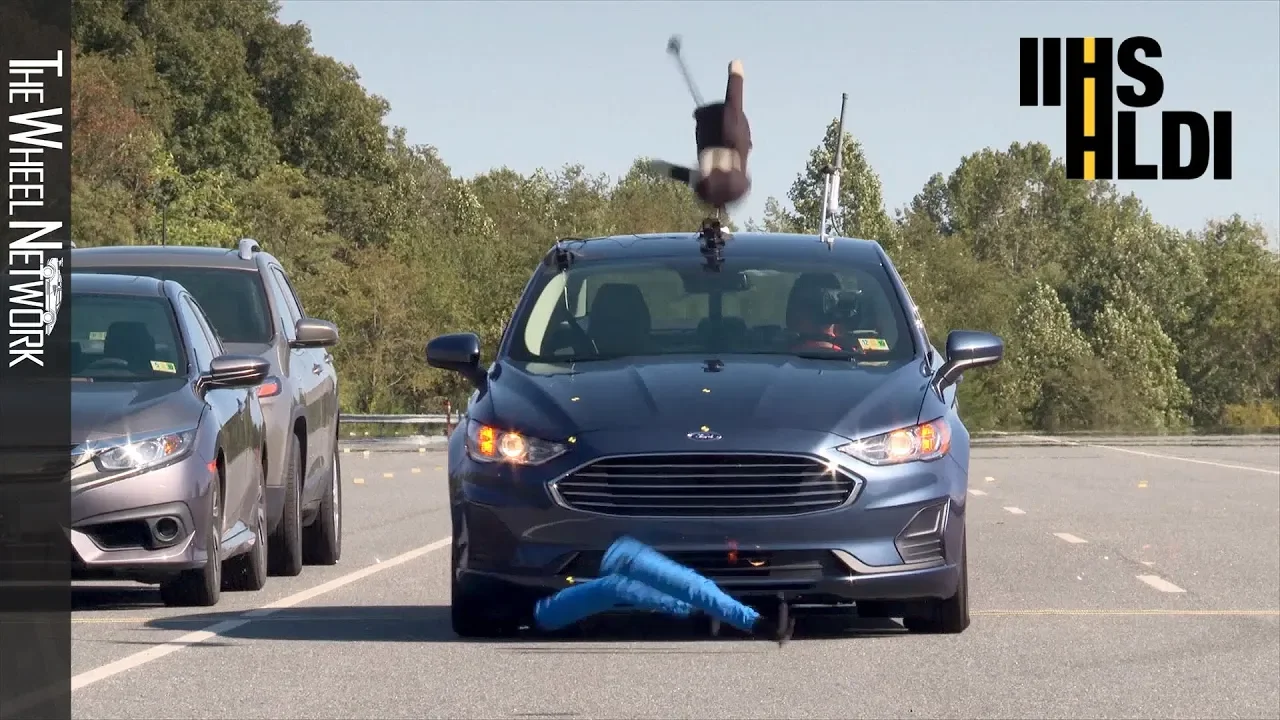
## TL;DR The IIHS evaluates 16 midsize luxury and nonluxury vehicles across three simulated pedestrian encounters: an adult crossing an open street, a child darting out between parked cars, and an adult walking along the edge of the travel lane at speeds up to 37 mph. Vehicles are given only one to two seconds to detect the dummy targets and apply emergency braking before impact. Top performers such as the Audi A4, Nissan Maxima, and Subaru Outback earned 'Superior' ratings by consistently avoiding collisions or substantially mitigating impact speeds. Conversely, the Ford Fusion, Hyundai Sonata, and Kia Optima received 'No Credit' ratings due to widespread failure to slow down in multiple scenarios.
## Atmosphere & style The presentation has a clinical, objective, and tense documentary atmosphere driven by the raw sights and sounds of the proving ground. Alternating between clean, high-tech interventions—marked by rapid interior chimes and ABS halts inches from a dummy—and violent collisions accompanied by hollow plastic impact thuds, the footage creates an unnerving demonstration of safety disparities. Sparse, functional radio exchanges from test drivers lend an authentic, behind-the-scenes engineering feel to the high-stakes trials.
## Bulletin - [00:00](https://www.youtube.com/watch?v=TJgUiZgX5rE&t=0s) IIHS evaluated pedestrian automatic emergency braking systems across 16 midsize cars, awarding superior ratings to six models while four nonluxury vehicles earned only basic ratings or no credit. - [00:00](https://www.youtube.com/watch?v=TJgUiZgX5rE&t=0s) The evaluation addresses a 53 percent surge in annual pedestrian fatalities since 2009, with deaths exceeding 6,000 in 2018 and Halloween ranking among the deadliest periods of the year. - [05:00](https://www.youtube.com/watch?v=TJgUiZgX5rE&t=300s) Performance disparities were significant: while the Audi A4, BMW 3 series, Mercedes-Benz C-Class, Nissan Maxima, Subaru Outback, and Volvo S60 earned superior ratings, the Ford Fusion, Hyundai Sonata, and Kia Optima received no credit due to repeated braking failures. - [05:00](https://www.youtube.com/watch?v=TJgUiZgX5rE&t=300s) Higher-tier optional systems do not consistently outperform base equipment; the BMW 3 series standard system earned a superior rating, outperforming its more expensive optional system which achieved only an advanced rating.
## Key takeaways - [00:00](https://www.youtube.com/watch?v=TJgUiZgX5rE&t=0s) Annual US pedestrian fatalities increased by 53 percent from their 2009 low point, exceeding 6,000 deaths in 2018. - [00:00](https://www.youtube.com/watch?v=TJgUiZgX5rE&t=0s) Data from 2013 to 2017 identified October 31 and November 1 as the two deadliest days of the year on average for pedestrians. - [00:00](https://www.youtube.com/watch?v=TJgUiZgX5rE&t=0s) Automakers committed to equipping pedestrian-capable automatic emergency braking systems ahead of a 2022 voluntary deadline. - [00:00](https://www.youtube.com/watch?v=TJgUiZgX5rE&t=0s) Pedestrian crash prevention came standard on all six luxury cars and six out of ten nonluxury cars evaluated in the 2019 test group. - [00:00](https://www.youtube.com/watch?v=TJgUiZgX5rE&t=0s) An HLDI study found Subaru's camera-based EyeSight system reduced likely pedestrian-related insurance claims by 35 percent. - [00:00](https://www.youtube.com/watch?v=TJgUiZgX5rE&t=0s) IIHS track testing relies on three daytime scenarios: an unobstructed crossing adult, a child darting between parked cars, and an adult walking parallel along the travel lane. - [00:00](https://www.youtube.com/watch?v=TJgUiZgX5rE&t=0s) Vehicles are given only one to two seconds to detect pedestrian targets and apply braking during test runs. - [00:00](https://www.youtube.com/watch?v=TJgUiZgX5rE&t=0s) Six midsize vehicles achieved top-tier superior ratings: Audi A4, BMW 3 series (standard), Mercedes-Benz C-Class (optional), Nissan Maxima, Subaru Outback, and Volvo S60. - [05:00](https://www.youtube.com/watch?v=TJgUiZgX5rE&t=300s) The Ford Fusion, Hyundai Sonata, and Kia Optima earned no credit after failing to significantly reduce speed across multiple test setups. - [05:00](https://www.youtube.com/watch?v=TJgUiZgX5rE&t=300s) Both optional configurations for the Chevrolet Malibu—camera-only and camera plus radar—managed only basic performance ratings. - [05:00](https://www.youtube.com/watch?v=TJgUiZgX5rE&t=300s) On the Mercedes-Benz C-Class, the optional pedestrian safety system earned a superior rating, whereas its base standard system received a basic rating. - [05:00](https://www.youtube.com/watch?v=TJgUiZgX5rE&t=300s) On the BMW 3 series, the standard base system unexpectedly outranked its optional package, securing a superior rating versus advanced.
## Detailed walkthrough ### [00:00](https://www.youtube.com/watch?v=TJgUiZgX5rE&t=0s) IIHS Track Testing and Active Safety Evaluations
The Insurance Institute for Highway Safety (IIHS) conducts track evaluations of pedestrian automatic emergency braking (AEB) systems across 16 midsize vehicles. These evaluations come against the backdrop of pedestrian road safety statistics showing that annual pedestrian fatalities surged by 53 percent from their low point in 2009, surpassing 6,000 pedestrian deaths in 2018. Testing was highlighted around Halloween, as data from 2013 to 2017 showed October 31 and November 1 (post-midnight) to be the deadliest days of the year for walking traffic. On the test track, vehicles are placed in three core daylight scenarios designed to replicate real-world vehicle-pedestrian encounters: an adult crossing an unobstructed roadway, a child darting out from between parked cars, and an adult walking along the edge of the travel lane parallel to traffic. In each trial, the vehicle has between one and two seconds to detect the dummy, sound collision warnings, and engage braking.
Across the opening demonstrations, vehicle alert chimes ring out as onboard forward-facing cameras and radar arrays identify stationary and moving mannequin targets. In successful runs, the active safety systems intervene rapidly to slow or completely halt the vehicle before impact. In contrasting failed runs, audible impact thuds mark collisions where systems fail to recognize the pedestrian target or apply sufficient braking force. System configurations across midsize cars vary between camera-only setups and hybrid camera-and-radar sensors mounted in the windshield and front grille. A 2017 Highway Loss Data Institute (HLDI) study underscored the real-world value of effective hardware, revealing that Subaru’s camera-based EyeSight technology reduced pedestrian-related insurance claims by 35 percent compared to non-equipped counterparts. During one of the track runs, the audio feed registers the spoken utterance, “I'm going to go.”
```mermaid flowchart TD accTitle: IIHS Pedestrian Test Evaluation Process accDescr: Flowchart outlining the sensor detection, scenario speeds, and safety rating outcomes in IIHS pedestrian crash prevention tests.
subgraph Sensors["Sensing & Decision"] A["Forward Cameras & Radar"] --> B{"Algorithm Detects Pedestrian?"} end
subgraph Scenarios["Test Scenarios & Speeds"] B -->|"Yes"| C["Perpendicular Adult (12 & 25 mph)"] B -->|"Yes"| D["Perpendicular Child Dart (12 & 25 mph)"] B -->|"Yes"| E["Parallel Adult (25 & 37 mph)"] end
subgraph Ratings["IIHS Ratings"] C & D & E --> F["Superior (Avoids / Drastic Reduction)"] C & D & E --> G["Advanced (Substantial Reduction)"] C & D & E --> H["Basic / No Credit (Minimal or No Braking)"] end ```
- **Perpendicular Adult Scenario**: Tested at 12 mph and 25 mph with an unobstructed view of a pedestrian crossing into the vehicle's path. - **Child Dart Scenario**: Tested at 12 mph and 25 mph simulating a child emerging suddenly from behind two parked vehicles. - **Parallel Adult Scenario**: Conducted at 25 mph and 37 mph with an adult walking along the roadway edge facing away from traffic. - **Equipment Standard**: Pedestrian AEB is standard equipment on all six luxury midsize cars evaluated and standard on six out of ten nonluxury cars in the 2019 test fleet. - **Top Performers**: Superior ratings are awarded to the Audi A4, BMW 3 series (standard system), Mercedes-Benz C-Class (optional system), Nissan Maxima, Subaru Outback, and Volvo S60.
[05:00](https://www.youtube.com/watch?v=TJgUiZgX5rE&t=300s) High-Speed Run-Throughs and Test Conclusions
The higher-speed test stages feature vehicles approaching dummy targets in the 25 mph and 37 mph test brackets, where sensors must calculate trajectories and trigger decelerations faster than average human reaction times. Vehicles that struggle in these higher-speed configurations fail to mitigate impact speeds significantly, resulting in forceful strikes against the mannequins accompanied by heavy impact sounds on the track. In contrast, fully optimized systems execute decisive emergency stops, keeping the vehicle bumper inches from the pedestrian target.
The overall results highlight stark performance disparities among nonluxury and luxury models alike. The Ford Fusion, Hyundai Sonata, and Kia Optima earn no credit after failing to slow significantly in multiple track scenarios, while models like the Chevrolet Malibu receive basic ratings across both its camera-only and combined camera-and-radar systems. Even within individual model lines, hardware differences yield contrasting results: the Mercedes-Benz C-Class standard system earns only a basic rating compared to the superior rating of its optional package, whereas the BMW 3 series standard system outscores its optional counterpart by securing a superior rating over the optional advanced package. As the testing concludes, the captured audio records a final sign-off, “Bye.”
| Vehicle Model | System Level | IIHS Pedestrian Rating | |:--- |:--- |:--- | | **Audi A4** | Standard | Superior | | **BMW 3 series** | Standard | Superior | | **BMW 3 series** | Optional | Advanced | | **Mercedes-Benz C-Class** | Optional | Superior | | **Mercedes-Benz C-Class** | Standard | Basic | | **Nissan Maxima** | Standard | Superior | | **Subaru Outback** | Standard (EyeSight) | Superior | | **Volvo S60** | Standard | Superior | | **Chevrolet Malibu** | Optional (Camera only / Camera+Radar) | Basic | | **Ford Fusion** | Standard / Optional | No Credit | | **Hyundai Sonata** | Standard / Optional | No Credit | | **Kia Optima** | Standard / Optional | No Credit |
## Mentioned Insurance Institute for Highway Safety (IIHS), Highway Loss Data Institute (HLDI), Subaru EyeSight, Audi A4, BMW 3 series, Mercedes-Benz C-Class, Nissan Maxima, Subaru Outback, Volvo S60, Chevrolet Malibu, Ford Fusion, Hyundai Sonata, Kia Optima
## Video description The Insurance Institute for Highway Safety rated the pedestrian crash prevention systems of 16 midsize cars in the lead-up to Halloween, a holiday that consistently ranks among the deadliest days for pedestrians in the United States.
Four luxury and two nonluxury midsize cars earn a superior rating for their pedestrian crash prevention systems, while four nonluxury cars earn only a basic rating or no credit. Another six cars earn an advanced rating.
Annual pedestrian fatalities have increased 53 percent since reaching a low point in 2009. More than 6,000 pedestrians were killed in 2018. During 2013-17, the two deadliest days of the year for pedestrians on average were Oct. 31 and Nov. 1 (or after midnight on Halloween).
Technology could be part of the solution. Many manufacturers are upgrading the automatic emergency braking systems they have agreed to install by 2022 to recognize pedestrians, in addition to other vehicles. These systems scan the path ahead and automatically apply the brakes to avoid hitting people in the roadway.
About two-thirds of the vehicles that IIHS rates included pedestrian detection in 2019, in many cases as standard equipment. Among the vehicles evaluated in this current round of testing, pedestrian crash prevention is standard on all six luxury cars and six out of 10 nonluxury cars.
When they work correctly, such systems can help avert tragedy. A 2017 Highway Loss Data Institute analysis, for instance, found that Subaru's EyeSight system with pedestrian detection cut the rate of likely pedestrian-related insurance claims by 35 percent, compared with the same vehicles without the system.
Most pedestrian crash prevention systems use one or two forward-facing cameras mounted near the rearview mirror and/or radar sensors in the front grille to scan the roadway for pedestrians poised to enter the vehicle's path. Algorithms determine if the detected objects are pedestrians. In some cases, they can recognize bicyclists or animals too. If the software calculates that a collision is imminent, it alerts the driver and applies the brakes faster than a human can react.
The performance of the systems varies widely, the latest IIHS ratings show.The Audi A4, BMW 3 series, Mercedes-Benz C-Class, Nissan Maxima, Subaru Outback and Volvo S60 have systems that earn superior ratings. They avoided collisions or slowed substantially in track tests.
At the other end of the spectrum, the Ford Fusion, Hyundai Sonata and Kia Optima earn no credit because they failed to slow significantly in multiple scenarios.
The C-Class, 3 series and Chevrolet Malibu each offer two different pedestrian crash prevention systems. On the C-Class, the optional system earns a superior rating, while the standard one earns a basic rating. On the 3 series, the standard system surprisingly earns a higher rating of superior, while the more costly optional system earns an advanced rating. Both of the Malibu's optional systems — a camera only and a camera plus radar — earn basic ratings.
About the tests IIHS launched its pedestrian ratings in February. In the first round of testing, four out of 11 small SUVs earned a superior rating, while another five earned an advanced rating.
IIHS tests performance in three scenarios: an adult pedestrian stepping into the street in the path of the oncoming vehicle with an unobstructed view, a child darting into the street from behind two parked cars, and an adult pedestrian near the side of the road in the travel lane, facing away from traffic. The two perpendicular tests are conducted at 12 and 25 miles per hour, and the test simulating a pedestrian walking in a parallel path to the vehicle is conducted at 25 and 37 mph.
In each of these tests, the system has 1 or 2 seconds to stop the car to avoid hitting the pedestrian dummy.
Each test is performed in full daylight on dry pavement. Systems might not perform as well during the nighttime hours that account for most pedestrian fatalities, though if paired with good-performing headlights, they should be able to detect pedestrians.
Pedestrian crash prevention ratings for midsize cars: SUPERIOR 2019 Audi A4 2019-20 BMW 3 series 2020 Subaru Outback 2019-20 Mercedes-Benz C-Class* 2019-20 Nissan Maxima (optional for 2019/standard for 2020) 2019 Volvo S60
ADVANCED 2019-20 BMW 3 series* 2019-20 Honda Accord 2019-20 Lexus ES 350 2019 Mazda 6 2019-20 Nissan Altima 2019-20 Tesla Model 3 2019-20 Toyota Camry
BASIC 2019-20 Chevrolet Malibu* 2019-20 Mercedes-Benz C-Class
NO CREDIT 2019-20 Ford Fusion 2019 Hyundai Sonata* 2019 Kia Optima*
* Optional safety pack
[Source](https://www.youtube.com/watch?v=TJgUiZgX5rE)