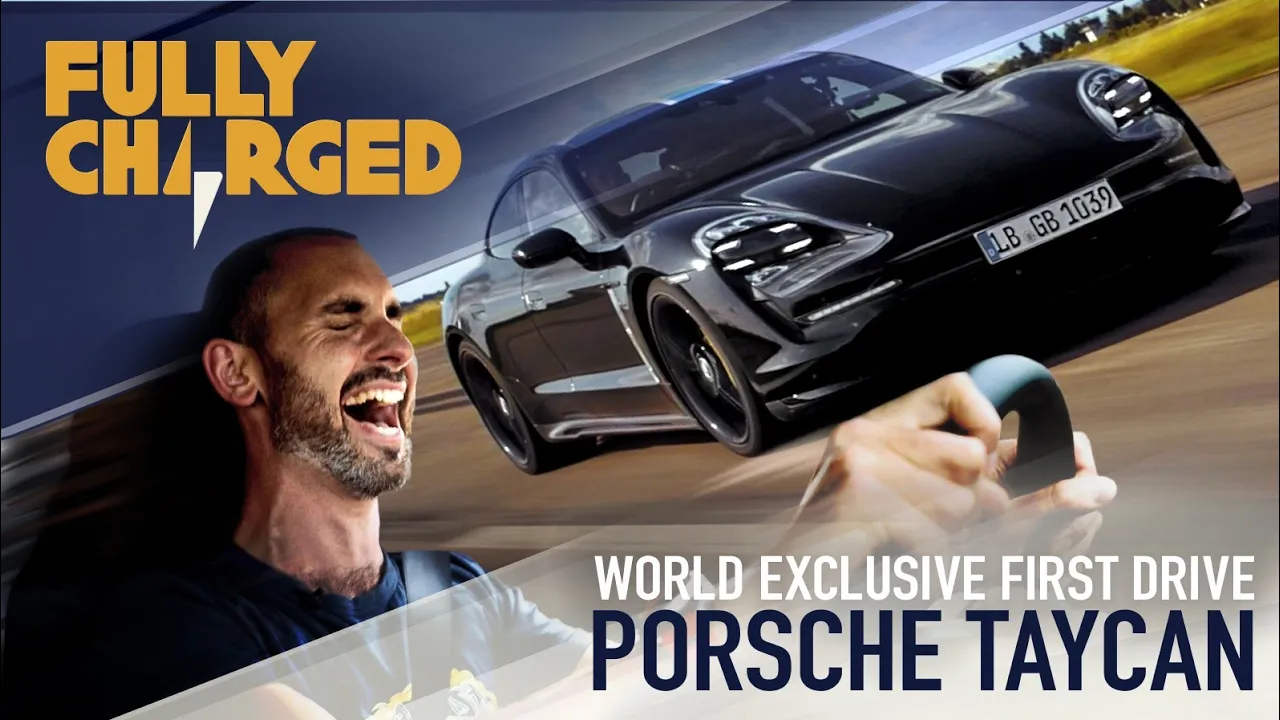
Porsche Taycan WORLD EXCLUSIVE genuine first drive & launch control testing 0-200kph | Fully Charged
Everything Electric CARS
AI-assisted summary of Porsche Taycan WORLD EXCLUSIVE genuine first drive & launch control testing 0-200kph | Fully Charged — original source. Check the original for full context.
Source published:
Key ideas
- Fully Charged secures the world-exclusive first drive of the pre-production Porsche Taycan, making Jonny Smith the first non-Porsche employee permitted behind the wheel. (0:29)
- The Taycan survived 30 consecutive full-throttle launch control runs from zero to 200 km/h (124 mph) with zero thermal derating or mechanical failure. (15:30)
- Built on a bespoke 800-volt architecture with permanent magnet synchronous motors and a rare two-speed rear gearbox, the flagship delivers over 600 hp and supports rapid charging up to 250 kW. (9:20)
- Over 20,000 customers placed €2,500 deposits ahead of the late 2019 launch, where prices for top-spec launch editions are expected between £120,000 and £130,000. (11:32)
Detailed notes
## Background Published by the Everything Electric CARS channel (Fully Charged Show) on YouTube on August 9, 2019, this video documents an exclusive first-drive review of the all-electric Porsche Taycan prototype. According to the show description, host Jonny Smith was granted unique access to test the twin-motor, 600+ hp, 800-volt 4-door sports coupe by subjecting it to dozens of full-throttle 0–124 mph (200 km/h) launch control runs at a former airfield in Germany ahead of its official debut.
## TL;DR Host Jonny Smith visits a former Canadian Air Base in Germany to conduct a world-exclusive test of the pre-production Porsche Taycan, becoming the first non-Porsche employee permitted behind the wheel. The review focuses intensely on thermal endurance and launch repeatability, subjecting the vehicle to 30 consecutive full-throttle launch control sprints up to 200 km/h (124 mph) without drivetrain distress or battery derating. Along the way, Smith examines the camouflage masking the exterior styling, explains the engineering behind the 800-volt architecture, permanent magnet synchronous motors, and rear two-speed transmission, and explores market positioning and future model variants with Porsche engineer Bernd.
## Atmosphere & style The video carries an exhilarating, high-tempo energy fueled by visceral launch G-forces and Jonny Smith's candid, contagious excitement. Shot across the open asphalt of a sprawling airfield, the presentation balances unvarnished driving thrills—complete with dislodged sunglasses and breathless reactions—with sharp, inquisitive technical journalism. The dialogue with Porsche's engineering team remains focused and grounded, creating a sense of privileged, behind-the-curtain access to a major automotive industry milestone.
## Bulletin - [00:29](https://www.youtube.com/watch?v=TP9kokeyxGU&t=29s) Fully Charged secures the world-exclusive first drive of the pre-production Porsche Taycan, making Jonny Smith the first non-Porsche employee permitted behind the wheel. - [15:30](https://www.youtube.com/watch?v=TP9kokeyxGU&t=930s) The Taycan survived 30 consecutive full-throttle launch control runs from zero to 200 km/h (124 mph) with zero thermal derating or mechanical failure. - [09:20](https://www.youtube.com/watch?v=TP9kokeyxGU&t=560s) Built on a bespoke 800-volt architecture with permanent magnet synchronous motors and a rare two-speed rear gearbox, the flagship delivers over 600 hp and supports rapid charging up to 250 kW. - [11:32](https://www.youtube.com/watch?v=TP9kokeyxGU&t=692s) Over 20,000 customers placed €2,500 deposits ahead of the late 2019 launch, where prices for top-spec launch editions are expected between £120,000 and £130,000.
## Key takeaways - [00:29](https://www.youtube.com/watch?v=TP9kokeyxGU&t=29s) The testing at a former Canadian Air Base in Germany aimed to validate repeat thermal endurance through relentless 0–200 km/h acceleration runs rather than straight-line top speed. - [02:03](https://www.youtube.com/watch?v=TP9kokeyxGU&t=123s) Taycan development traces directly from Porsche's hybrid motorsport lineage and the 918 Spyder, but utilizes a completely bespoke, ground-up EV powertrain. - [03:01](https://www.youtube.com/watch?v=TP9kokeyxGU&t=181s) Unlike Tesla's Ludicrous modes that display thermal warnings and require preconditioning, Porsche engineered the Taycan to launch repeatedly on demand without software intervention. - [03:01](https://www.youtube.com/watch?v=TP9kokeyxGU&t=181s) Activating launch control is straightforward: hold the brake, pin the throttle flat, wait for the acoustic pitch shift and cluster prompt, then release. - [04:50](https://www.youtube.com/watch?v=TP9kokeyxGU&t=290s) Exterior styling draws heavily from the Mission E concept, featuring quad-LED headlights, active aero flaps, and powered sliding charge port doors on both front fenders. - [06:40](https://www.youtube.com/watch?v=TP9kokeyxGU&t=400s) Porsche engineers prioritized sustained performance over headline-grabbing 0–100 km/h sprint times, purposefully avoiding power derating under heavy track use. - [09:20](https://www.youtube.com/watch?v=TP9kokeyxGU&t=560s) An innovative two-speed rear gearbox combined with permanent magnet synchronous motors delivers explosive off-the-line launch capability alongside high-speed efficiency. - [09:20](https://www.youtube.com/watch?v=TP9kokeyxGU&t=560s) Despite a roughly 2,000 kg curb weight across a carbon-fiber, aluminum, and steel chassis, adaptive air suspension and dynamic all-wheel drive effectively mask the car's mass. - [11:32](https://www.youtube.com/watch?v=TP9kokeyxGU&t=692s) Porsche gathered over 20,000 pre-orders with €2,500 deposits before revealing the final production vehicle to the public. - [13:52](https://www.youtube.com/watch?v=TP9kokeyxGU&t=832s) The initial flagship Turbo model commands roughly £120,000 to £130,000, with cheaper single-motor rear-wheel-drive variants expected around £65,000 within 18 months. - [14:36](https://www.youtube.com/watch?v=TP9kokeyxGU&t=876s) Engaging the vehicle's Range driving mode closes front aerodynamic cooling flaps and dials down climate control, clawing back an estimated 10 percent of range. - [15:30](https://www.youtube.com/watch?v=TP9kokeyxGU&t=930s) The Taycan demonstrated unmatched reliability by completing 30 consecutive full-throttle launches to 124 mph with no cooling cool-downs or mechanical intervention needed.
## Detailed walkthrough ### [00:29](https://www.youtube.com/watch?v=TP9kokeyxGU&t=29s) Testing Ground and Historic Milestone
At an expansive former Canadian Air Base in Germany—situated roughly an hour and a half away from Stuttgart near the Black Forest—Jonny Smith arrives for a private testing session with Porsche. Five years prior, Porsche introduced the Mission E concept to signal its intent to produce an uncompromising, purely electric battery vehicle. Having already secured victories at Le Mans and set the all-time outright Nürburgring lap record utilizing hybrid powertrains, Porsche is finally preparing its first production all-electric road car: the Taycan.
Smith points out that, discounting brand ambassador Mark Webber, he is the very first non-Porsche employee permitted behind the wheel. The vehicle features an 800-volt architecture and supports fast charging up to 250 kW. However, the explicit primary goal of the day is not top-speed touring or exploring infotainment, but assessing sheer mechanical endurance through repeated, relentless full-throttle launch control runs from zero to 200 km/h (124 mph).
- **Location**: Old Canadian Air Base airfield, approximately 1.5 hours outside Stuttgart, Germany. - **Milestone Context**: Follow-up to the Porsche Mission E concept car; lineage tracks back to Le Mans hybrid victories and the hybrid 919 Evo Nürburgring record. - **Testing Core Focus**: Verifying sustained launch control repeatability up to 200 km/h without thermal throttling. - **Embargo Constraints**: Strict secrecy remains around interior screen details, the digital binnacle, and the haptic center console.
---
[02:03](https://www.youtube.com/watch?v=TP9kokeyxGU&t=123s) Lineage from the 918 Spyder and the White-Sheet Powertrain
Speaking with Porsche engineer Bernd, Smith discusses how the company’s electrified racing and hypercar heritage transferred to the Taycan. Smith notes that the plug-in hybrid 918 Spyder was the definitive industry tipping point for high-performance electrified exotics, querying whether that engineering DNA trickled down into this platform. Bernd affirms this progression, noting that hybrid development first migrated across mainstream product lines like the Cayenne and Panamera before culminating in the clean-sheet Taycan program.
Bernd emphasizes that despite design commonalities with existing lineups, the Taycan’s powertrain shares no parts with its combustion predecessors. As Bernd states: “We started for this car with totally new powertrains and almost every part in this power train is completely new for the Taycan.”
```mermaid flowchart LR accTitle: Porsche Electrification Lineage accDescr: Diagram tracing electrified powertrain development from the 918 Spyder to the Taycan. subgraph Hypercar_Origins["Hypercar Validation"] A["918 Spyder"] -->|"PHEV Tech Trickle-Down"| B["Cayenne & Panamera E-Hybrids"] end subgraph Ground_Up_BEV["Clean-Sheet BEV"] B -->|"Ground-Up Architecture"| C["Porsche Taycan"] end ```
---
[03:01](https://www.youtube.com/watch?v=TP9kokeyxGU&t=181s) First High-Speed Launches and VBox Validation
Stepping inside the cabin for the first high-performance run, Smith contrasts the Taycan's launch control with the Ludicrous and Ludicrous Plus modes of a Tesla Model S P100D. In the Tesla, launching involves navigating multi-screen warnings cautioning drivers about thermal limits, motor wear, and reduced battery longevity. While the Tesla manages an explosive 2.6-second sprint to 60 mph, the Taycan's design philosophy targets repeatable sprints in just over 3 seconds without drivetrain distress.
Initiating launch control requires pressing the brake pedal while depressing the throttle flat to the floor. The artificial low-speed pedestrian hum alters pitch, and the cluster displays "launch control activated." Releasing the foot brake instantly hurls the vehicle forward, dislodging Smith's sunglasses as the digital readout streaks past 160, 190, 200, and finally peaks at 220 km/h before he rolls off the accelerator. An onboard VBox data logger records each run to monitor times to 200 km/h. During subsequent runs, Smith notes the aggressive, immediate lateral bite of the all-wheel-drive system: “I can feel the torque vectoring of the four-wheel drive system.”
- **Tesla P100D vs. Taycan**: Tesla hits 0–60 mph in 2.6 seconds with preconditioning and warning screens; Taycan runs consistent low-3-second 0–62 mph (0–100 km/h) sprints on demand. - **Launch Procedure**: Left foot pinned on brake, right foot pinned flat on throttle, wait for audible acoustic shift and cluster prompt, release brake. - **Recorded Speeds**: Multiple acceleration runs routinely surpass the 200 km/h target, pulling clean through to 220–225 km/h.
---
[04:50](https://www.youtube.com/watch?v=TP9kokeyxGU&t=290s) Exterior Camouflage and Body Details
Between sprint passes, Smith inspects the exterior styling hidden beneath pre-production disguise. While the Taycan looks superficially similar to a Panamera in silhouette, its proportions are noticeably lower, featuring a much shallower nose. From the driver’s seat, only the peaks of the front wheel arches are visible, deliberately evoking the cockpit view of a 911.
He points out visual trickery used to confuse spy photographers: stickers masking the aero gills in the front fascia and adhesive tape applied across the headlights. Peeling back the disguise reveals the signature quad-LED design derived from the Mission E concept, inset alongside functional air curtains. Smith also inspects the motorized charge port doors located on each front fender. Passing a hand under a sensor beneath the port causes the door to slide upward into the fender body. The car carries an AC socket on one flank and combined DC fast-charging ports on the other.
---
[06:40](https://www.youtube.com/watch?v=TP9kokeyxGU&t=400s) Thermal Repeatability and Drivetrain Architecture
Back on the runway, Smith pushes the car to 222 km/h and 225 km/h, coming within 25 km/h of the vehicle’s confirmed 250 km/h (155 mph) top speed. Returning to technical details with Bernd, Smith presses him on battery and motor configurations. Bernd confirms that the drivetrain operates on an 800-volt high-voltage architecture, but politely declines to confirm specific rumors regarding battery module layouts or supplier cell choices.
When Smith brings up the factory 0–100 km/h claim of under 3.5 seconds, he remarks that real-world tests feel significantly quicker. Bernd highlights that outright paper figures were secondary to consistent endurance under extreme thermal stress: “We set out with the goal to build the Porsche and not have the driver feel the derating of the car in any situation.”
- **Top Speed**: Electronically capped at 250 km/h (155 mph). - **Powertrain Rating**: Over 600 horsepower derived from two permanent magnet synchronous motors. - **Factory Performance Claim**: 0–100 km/h in under 3.5 seconds (estimated to achieve lower real-world figures). - **Electrical Specs**: 800-volt battery architecture designed for high current throughput and low heat buildup.
---
[09:20](https://www.youtube.com/watch?v=TP9kokeyxGU&t=560s) Motor Technology, Cooling, and Chassis Dynamics
Smith examines the mechanical decisions that enable sustained track performance. The Taycan uses a rear-mounted two-speed gearbox, a rare engineering choice for an EV, which permits aggressive low-speed launching while providing tall gearing for sustained high speeds. Unlike many electric vehicles that rely on asynchronous induction motors, Porsche collaborated at Zuffenhausen to engineer permanent magnet synchronous motors (PSM). Bernd clarifies that the advanced liquid cooling system monitoring both the battery pack and the motors is the foundational hardware enabling endless launch repeatability.
On the runway, Smith impetuously lines up against a corporate jet that has just touched down on the adjacent strip, pushing the car to 228 km/h. He observes that while the chassis is a composite mix of carbon fiber, aluminum, and high-tensile steel tipping the scales at around two tons, the vehicle disguises its mass. The chassis is equipped with adaptive air suspension and dynamic all-wheel drive, packaging an estimated 200-horsepower motor up front and a 400-horsepower unit at the rear to optimize front-end turn-in and body control.
- **Transmission**: Two-speed rear gearbox enabling strong low-end acceleration alongside sustained 200+ km/h cruising. - **Motor Architecture**: Permanent magnet synchronous motors (PSM) co-developed at Zuffenhausen. - **Thermal System**: Dedicated liquid cooling encompassing both drive units and high-voltage battery modules. - **Chassis Structure**: Hybrid build of aluminum, high-strength steel, and carbon fiber supported by adaptive air suspension. - **Weight Reference**: Around 2,000 kg (2 tonnes), coming in slightly lighter than a Tesla Model S P100D.
---
[11:32](https://www.youtube.com/watch?v=TP9kokeyxGU&t=692s) Market Positioning, Derivatives, and Pricing
Smith examines the Taycan's cabin layout and market positioning. Defined as a four-seat executive sports coupe, the launch models feature dual motors and standard all-wheel drive. When asked about potential future iterations, Bernd acknowledges that alternative drivetrain configurations are planned. Smith predicts that Porsche will expand the model range with an entry-level rear-wheel-drive version, lighter weight track-oriented models, and more drift-friendly variants.
Ahead of deliveries kicking off at the end of 2019, customer demand has proved substantial. Over 20,000 customers have placed binding deposits of €2,500 each without seeing the final production vehicle. Smith analyzes the commercial hierarchy, noting that this flagship launch car will command roughly £120,000 to £130,000, neatly occupying the pricing territory between a top-spec Cayenne and a Panamera Turbo, before cheaper derivatives roll out over the following 18 months.
- **Pre-Orders**: More than 20,000 prospective buyers deposited €2,500 each prior to the official reveal. - **Launch Availability**: Sales open at the end of 2019, followed by an expanded model portfolio within 18 months. - **Pricing Strategy**: Flagship variants estimated between £110,000 and £130,000/£140,000, aligning with the Panamera and Cayenne Turbo brackets. - **Future Derivatives**: Potential rear-wheel-drive base models, variable battery capacities, and lightweight performance specifications.
[13:52](https://www.youtube.com/watch?v=TP9kokeyxGU&t=832s) Speculation on Entry Models, Boot Operation, and Further Launch Sprints
Jonny Smith reflects on the future lineup for the Taycan, speculating that over time the car's entry price will drop significantly. He anticipates a base variant starting around £65,000, which he expects will feature a single-motor, rear-wheel-drive setup delivering over 300 horsepower. He is careful to emphasize that this is educated speculation rather than official confirmation from Porsche.
Transitioning back to the runway, Jonny engages launch control once again. Pinning the throttle with his right foot, he braces against the brutal G-forces, exclaiming, “I'm fighting it with my neck, fighting it with my neck!” as the speedometer rapidly ticks past 150, 160, 175, 182, and directly up to 200 km/h (124 mph). Stepping outside to inspect the exterior, Jonny points out the discreet boot release button at the rear; pressing it causes the decklid to power upward automatically, though interior viewing remains strictly off-limits due to the embargo. Unwilling to resist the performance, he immediately jumps back in for another full-bore sprint, laughing with pure excitement at the relentless acceleration.
- Speculated entry-level pricing: approximately £65,000. - Speculated base configuration: single rear-mounted electric motor producing over 300 hp in rear-wheel drive. - High-speed testing mark: repeated runs directly up to 200 km/h (124 mph). - Exterior equipment: power-operated boot release button at the tail.
---
[14:36](https://www.youtube.com/watch?v=TP9kokeyxGU&t=876s) Active Aerodynamics, Efficiency Modes, and Rebutting EV Skeptics
Moving around the bodywork, Jonny highlights the active aerodynamics integrated into the front fascia. Selecting the dedicated Range driving mode alters these surfaces dynamically, closing active cooling flaps to minimize aerodynamic drag, while dialing back the climate control and dulling throttle response. According to Porsche, this mode claws back roughly 10 percent of overall range. With these efficiency measures, the car achieves a claimed 320-mile total range and supports rapid DC charging from 0 to 80 percent in approximately 40 minutes at 150 kilowatts.
Jonny uses the Taycan's capabilities to directly challenge long-standing criticisms leveled by internal-combustion enthusiasts against electric mobility. Skeptics routinely argue that electric vehicles lack emotion, cannot cover meaningful distances, take far too long to charge, and look uninspiring. Pointing back at the low-slung, high-performance prototype, Jonny playfully suggests that those tired complaints no longer hold water: “People don't buy electric cars because they say they look rubbish.. I might have found a solution.”
- Active aerodynamic flaps: shut down in Range mode to optimize airflow and boost range by approximately 10%. - Additional Range mode adjustments: softened throttle mapping and reduced air conditioning output. - Quoted specifications: up to 320 miles of range; rapid charging capable of 0–80% replenishment in roughly 40 minutes at 150 kW.
---
[15:30](https://www.youtube.com/watch?v=TP9kokeyxGU&t=930s) Porsche DNA, Unprecedented Abuse Testing, and Final Reflections
Summing up the Taycan's place in the automotive landscape, Jonny describes how the machine bridges the heritage of the marque—blending unmistakable styling cues and packaging elements from both the 911 and the Panamera—while retaining its own distinct character. What impresses him most is the mechanical endurance demonstrated during the test session. Porsche did not coddle the prototype; rather, the engineering team actively encouraged extreme punishment. Jonny executed 30 consecutive full-throttle launches from zero to 124 mph without thermal throttling, brake failure, or powertrain degradation, leaving the vehicle fully capable of driving home straight off the runway.
Highlighting the importance of driving charisma and vault-like build quality, Jonny asserts that the Taycan will serve as a foundational asset for both Porsche and the wider Volkswagen Group. Before wrapping up, he notices a diesel support van approaching to clear the runway, prompting a swift sign-off. He expresses gratitude to the show's Patreon community and to Porsche for granting *Fully Charged* this world-first access: “Thank you to Porsche who have let us have this world exclusive I'm the first non-Porsche employee to drive this car I am feeling very smug, I have to say.”
- Total abusive launch cycles: 30 consecutive 0–124 mph (0–200 km/h) runs without mechanical complaint or battery derating. - Lineage cues: blends design and mechanical DNA from the 911 and Panamera into a dedicated, ground-up platform. - Milestone achievement: marks Jonny Smith as the first person outside of Porsche employment permitted to drive the Taycan.
## Notable quotes > [06:40](https://www.youtube.com/watch?v=TP9kokeyxGU&t=400s) We set out with the goal to build the Porsche and not have the driver feel the derating of the car in any situation. — Bernd
> [14:36](https://www.youtube.com/watch?v=TP9kokeyxGU&t=876s) People don't buy electric cars because they say they look rubbish.. I might have found a solution. — Jonny Smith
## Mentioned Porsche Taycan, Porsche, Jonny Smith, Mark Webber, Bernd, Tesla Model S P100D, Tesla, Porsche 918 Spyder, Porsche 911, Porsche Panamera, Porsche Cayenne, Mission E concept, Porsche 919 Evo, Volkswagen Group, Fully Charged, VBox
## Video description The Fully Charged Show is given exclusive access to get Jonny Smith behind the wheel of the new first Porsche all electric car - the Taycan - and drive it full throttle from 0-124 mph (200 km/h) dozens of times. The Taycan is a twin motor 600+hp, 96kWh, 800-volt 4-door 4-seater coupe with a supposed range of 320 miles (≈ 515 km) . It can reach 0-62 mph (0 -100 km/h) in just over 3 seconds repeatedly, and can rapid charge at over 250kW. With a charging time ≈ 0 - 80% in about 40 minutes. Prices for this 'Turbo' launch model Porsche battery electric vehicle will be around £130,000 ( ≈ €141k or USD $158k) with cheaper/slower versions kicking off around £65,000 within 18 months of the car's launch in late 2019. The Taycan is potentially as much of a milestone for Porsche as the aircooled flat six 911 was, taking aspects of the new 992, 911 and Panamera, but is ground-up all new. Jonny was allowed to take the genuine first drive of the car alone for some 30 full throttle launches, but the final spec and aesthetic details of the Taycan still remain under embargo. The full story is on Jonny's blog entry on our website: https://fullycharged.show/blog/porsche-taycan-a-genuine-fully-charged-exclusive/
#porsche #porschetaycan #taycan #fullycharged
Presented by Jonny Smith @carpervert Shot by Mark Taylor-Hankins @inksharkman Edited by Mark Taylor-Hankins @inksharkman Music by Martipants https://martipants.bandcamp.com
-------- We couldn't keep making the show without our supporters, thank you all! If you enjoy our videos and you'd like to help us to make more episodes of Fully Charged, please take a look at our Patreon page: https://www.patreon.com/FullyChargedShow
Alternatively, you can also support the show and help us to keep making Fully Charged by becoming a YouTube member. Take a look here for more details: https://www.youtube.com/user/fullychargedshow/join
If you like this episode, you'll love our fancy website, which includes the 'A-Z of Everything'.... https://fullycharged.show
[Source](https://www.youtube.com/watch?v=TP9kokeyxGU)