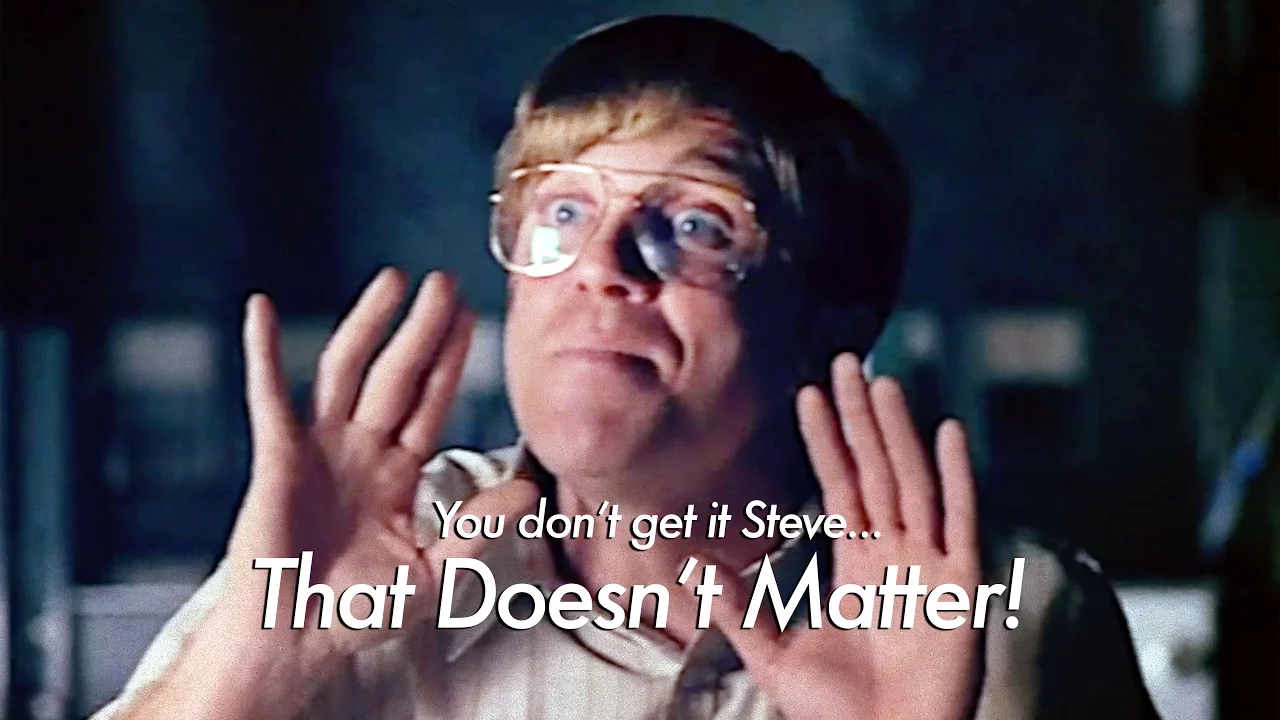
Pirates of Silicon Valley "You don't get it Steve, that doesn't matter"
Craig Bickerstaff
AI-assisted summary of Pirates of Silicon Valley "You don't get it Steve, that doesn't matter" — original source. Check the original for full context.
Source published:
Key ideas
- Steve Jobs confronts Bill Gates after Apple engineers return from Japan with an NEC computer running Microsoft software that closely mirrors Apple's graphical user interface. (0:00)
- Gates defends Microsoft's development by comparing graphical interfaces to automotive steering wheels, arguing standard interface elements are not proprietary inventions. (0:00)
- Gates dismantles Jobs's claims of ownership by characterizing both Apple and Microsoft as opportunists who took technology from Xerox PARC. (0:00)
- When Jobs asserts Apple's technical and design superiority, Gates dismisses the claim with his defining stance: 'You don't get it, Steve. That doesn't matter.' (0:00)
Detailed notes
## Background Published on YouTube by Craig Bickerstaff on May 7, 2017, this video features a climactic scene from the movie Pirates of Silicon Valley. The description explains that it captures Steve Jobs confronting Bill Gates after the Macintosh announcement about copying Apple's graphical interface to build Windows, highlighting Noah Wyle's performance as Jobs within a balanced Apple-Microsoft narrative.
## TL;DR Following the Macintosh rollout, Steve Jobs bitterly confronts Bill Gates after discovering Microsoft software running on a Japanese NEC computer that closely mirrors Apple's graphical interface. When Jobs accuses him of betrayal and theft, Gates defends his actions by likening user interfaces to common steering wheels on cars and advising Jobs to re-read their contract. Gates thoroughly undermines Jobs's indignation by pointing out that both companies lifted the concept from Xerox, framing Microsoft's success as merely reaching the prize first. The argument reaches its climax when Jobs insists Apple makes superior products, prompting Gates to dismissively counter that having better technology does not matter.
## Atmosphere & style The scene is taut, bitter, and intensely personal, framed as a dramatic clash between wounded artistic pride and ruthless corporate pragmatism. Jobs projects wounded fury and moral superiority through venomous metaphors of mafia betrayals and praying mantises, while Gates remains chillingly calm, analytical, and entirely unbothered by accusations of bad faith. Watching the exchange feels like witnessing the exact moment romantic technological idealism is crushed by cold market realism.
## Bulletin - [00:00](https://www.youtube.com/watch?v=UFcb-XF1RPQ&t=0s) Steve Jobs confronts Bill Gates after Apple engineers return from Japan with an NEC computer running Microsoft software that closely mirrors Apple's graphical user interface. - [00:00](https://www.youtube.com/watch?v=UFcb-XF1RPQ&t=0s) Gates defends Microsoft's development by comparing graphical interfaces to automotive steering wheels, arguing standard interface elements are not proprietary inventions. - [00:00](https://www.youtube.com/watch?v=UFcb-XF1RPQ&t=0s) Gates dismantles Jobs's claims of ownership by characterizing both Apple and Microsoft as opportunists who took technology from Xerox PARC. - [00:00](https://www.youtube.com/watch?v=UFcb-XF1RPQ&t=0s) When Jobs asserts Apple's technical and design superiority, Gates dismisses the claim with his defining stance: 'You don't get it, Steve. That doesn't matter.'
## Key takeaways - [00:00](https://www.youtube.com/watch?v=UFcb-XF1RPQ&t=0s) Jobs frames his relationship with Gates as a betrayal of trust akin to organized crime, remarking that turning your back gets you whacked. - [00:00](https://www.youtube.com/watch?v=UFcb-XF1RPQ&t=0s) Apple engineers discovered Microsoft's graphical interface software deployed on an NEC machine in Japan. - [00:00](https://www.youtube.com/watch?v=UFcb-XF1RPQ&t=0s) Jobs accuses Gates of blatant theft rather than coincidental visual similarity. - [00:00](https://www.youtube.com/watch?v=UFcb-XF1RPQ&t=0s) Gates uses the steering wheel analogy to argue that fundamental user interface conventions are industry standards rather than protected inventions. - [00:00](https://www.youtube.com/watch?v=UFcb-XF1RPQ&t=0s) Gates dismisses Jobs's reliance on their formal agreement, advising him that he should have read the contract more carefully. - [00:00](https://www.youtube.com/watch?v=UFcb-XF1RPQ&t=0s) Jobs compares partnering with Microsoft to being seduced and eaten alive by a praying mantis. - [00:00](https://www.youtube.com/watch?v=UFcb-XF1RPQ&t=0s) Gates reframes the conflict using the parable of Xerox as a wealthy neighbor with an open door whose television both companies tried to take. - [00:00](https://www.youtube.com/watch?v=UFcb-XF1RPQ&t=0s) Gates asserts that Microsoft merely beat Apple to capitalizing on Xerox's unguarded innovations. - [00:00](https://www.youtube.com/watch?v=UFcb-XF1RPQ&t=0s) Jobs attempts to reclaim moral and competitive high ground by insisting that Apple makes superior products. - [00:00](https://www.youtube.com/watch?v=UFcb-XF1RPQ&t=0s) Gates delivers the ultimate rebuttal to Apple's design philosophy by stating that product superiority does not determine market victory.
## Detailed walkthrough ### [00:00](https://www.youtube.com/watch?v=UFcb-XF1RPQ&t=0s) The Confrontation: Steering Wheels, Xerox, and the Nature of Competition
A deeply bitter confrontation unfolds between Steve Jobs and Bill Gates in the wake of the Macintosh rollout. Jobs opens the exchange by admitting that he made a critical misjudgment, expressing feelings of betrayal after trusting Gates like family. He frames their relationship as closer to organized crime, remarking, “Maybe a mafia family. You turn your back and you get whacked.” Jobs explains that Apple engineers recently returned from Japan carrying an NEC computer loaded with Microsoft applications that mimic Apple’s graphical user interface almost identically. When Gates dismissively replies that there might be some visual similarities, Jobs rejects the term, shooting back that it is outright theft. Gates counters with an automotive analogy, arguing that every car is built with a steering wheel, yet nobody claims that having one makes it their exclusive invention. When Jobs insists that they had a formal agreement, Gates coolly advises him that he should have examined the contract more carefully.
```mermaid flowchart TD accTitle: The Xerox Inheritance Dispute accDescr: Diagram illustrating Jobs and Gates competing over Xerox's graphical interface technology. subgraph Source["Common Origin"] X["Xerox PARC<br/>('Rich Neighbor with an Open Door')"] end subgraph Competitors["The Contenders"] A["Apple / Steve Jobs<br/>('Sneaking in to steal the TV')"] M["Microsoft / Bill Gates<br/>('Got there first / Took the loot')"] end X --> A X --> M A -.->|"Claims superior product"| M M -.->|"'That doesn't matter'"| A ```
Disgusted by Gates’s maneuvering, Jobs compares doing business with Microsoft to an encounter with a praying mantis where one gets seduced only to be devoured alive. Gates cuts through Jobs's indignation, dismantling his moral high ground by reminding him that Apple took the underlying graphical interface concept from Xerox in the first place. Gates characterizes the situation as two opportunistic thieves targeting a wealthy neighbor who left the door wide open:
> “You and I are both like guys that have this rich neighbor. Xerox. It left the door open all the time. And you go sneaking in to steal a TV set. Only when you get there, you realize But I got there first. I got the loot, Steve! And you're yelling? That's not fair! I wanted to try to steal it first. You're too late.”
Desperate to maintain superiority, Jobs asserts, “We're better than you are. We have better stuff.” Gates delivers the final, defining blow to Jobs's philosophy of technical and aesthetic perfection, answering simply: “You don't get it, Steve. That doesn't matter.”
- **The Discovery**: Apple engineers discovered Microsoft's graphical interface software on an NEC machine brought back from Japan. - **The Core Disagreement**: Jobs views Microsoft's work as stolen intellectual property, while Gates views graphical user interfaces as universal industry standards comparable to steering wheels on cars. - **The Xerox Parable**: Gates argues that neither company invented the technology, but rather both attempted to capitalize on Xerox's unguarded innovations, with Microsoft simply outmaneuvering Apple in market execution.
## Mentioned Steve Jobs, Bill Gates, Apple, Microsoft, Macintosh, Windows, NEC, Xerox, Xerox PARC, Pirates of Silicon Valley, Noah Wyle, Ashton Kutcher
## Video description I tried to upload something along the lines of this clip a few years ago but I put much more in it and the credits music ended up muting the video though copyright. Anyway it's from the end of the movie when Steve Jobs confronts Bill after the Macintosh announcement about stealing from them to make Windows. It's quite a powerful scene in the movie and shows that Noah Wiley is so much better at playing Steve Jobs then Ashton Kutcher. People seem to have gotten it into their heads that this is a Steve Jobs movie but it's really more like a 50/50 Apple/Microsoft movie.
[Source](https://www.youtube.com/watch?v=UFcb-XF1RPQ)