Mosaic browser opens Internet to public over proprietary networks
The Computer Chronicles
The decentralized, user-controlled architecture of the Internet democratizes global communication, but citizens must actively defend these open virtual communities as corporate and government interests seek to carve up the network.
AI-assisted summary of The Computer Chronicles - The Internet (1993) — original source. Check the original for full context.
Source published:
Key ideas
- NCSA's Mosaic browser is shifting Internet navigation from esoteric UNIX terminal commands to an intuitive point-and-click hypertext interface, transforming ordinary users into grassroots publishers and introducing the concept of 'net surfing.' (3:08)
- NASA Science Internet is developing packet video teleconferencing over packet-switched IP lines, cutting hourly cross-site connection costs from $50–$100 down to approximately $10 with desktop systems slated for schools within 3 to 5 years. (6:31)
- Internet Talk Radio launches as the first digital audio broadcast service, distributing asynchronous sound files via the World Wide Web that bypass traditional linear broadcast models. (16:42)
- Virtual communities such as The WELL illustrate how computer networks function as social gathering spaces, prompting calls from authors like Howard Rheingold to preserve an open civic 'social Green Belt' against corporate enclosure. (19:09)
Detailed notes
## Background This episode was published on YouTube by the official channel The Computer Chronicles on November 15, 2012, archiving an original 1993 broadcast. The show description extends special thanks to archive.org for hosting downloadable episodes of the series.
## TL;DR Host Stewart Cheifet explores the arrival of Marshall McLuhan's 'global village' through the rapidly expanding Internet, contrasting its open, user-driven architecture with closed commercial services like CompuServe. The broadcast surveys pioneering technologies including Aladdin Systems' SITcomm dialup utility, ARPA-backed NCSA Mosaic, NASA's low-cost desktop packet video, and Bellcore's library-focused MOREnet infrastructure. Author Brendan Kehoe demonstrates practical navigation using Gopher, Finger, and anonymous FTP, while Carl Malamud and author Howard Rheingold discuss the cultural impact of on-demand Internet Talk Radio and virtual communities on The WELL. The episode concludes with Rheingold urging the preservation of public civic spaces online alongside a weekly roundup of new portable hardware and software.
## Atmosphere & style The program exudes an earnest, early-1990s techno-optimism characterized by quiet awe and thoughtful journalistic curiosity toward an uncharted frontier. Anchored by Stewart Cheifet's calm, deliberate cadence, the studio demonstrations feel delightfully unvarnished as guests navigate live dialup delays, terminal screens, and modem handshakes. Watching it feels like opening a time capsule to the precise moment when cyberspace shifted from an obscure military and academic network into an accessible, human-centric cultural revolution.
## Bulletin - [03:08](https://www.youtube.com/watch?v=U_o8gerare0&t=188s) NCSA's Mosaic browser is shifting Internet navigation from esoteric UNIX terminal commands to an intuitive point-and-click hypertext interface, transforming ordinary users into grassroots publishers and introducing the concept of 'net surfing.' - [06:31](https://www.youtube.com/watch?v=U_o8gerare0&t=391s) NASA Science Internet is developing packet video teleconferencing over packet-switched IP lines, cutting hourly cross-site connection costs from $50–$100 down to approximately $10 with desktop systems slated for schools within 3 to 5 years. - [16:42](https://www.youtube.com/watch?v=U_o8gerare0&t=1002s) Internet Talk Radio launches as the first digital audio broadcast service, distributing asynchronous sound files via the World Wide Web that bypass traditional linear broadcast models. - [19:09](https://www.youtube.com/watch?v=U_o8gerare0&t=1149s) Virtual communities such as The WELL illustrate how computer networks function as social gathering spaces, prompting calls from authors like Howard Rheingold to preserve an open civic 'social Green Belt' against corporate enclosure.
## Key takeaways - [00:00](https://www.youtube.com/watch?v=U_o8gerare0&t=0s) Aladdin Systems' SITcomm software eliminates manual terminal scripting by automating connection handshakes and automatically decompressing downloaded files across multiple archive formats. - [03:08](https://www.youtube.com/watch?v=U_o8gerare0&t=188s) ARPA's post-Sputnik research into time-sharing and packet-switching established the foundational bitways and computing infrastructure that underpin the modern Internet. - [03:08](https://www.youtube.com/watch?v=U_o8gerare0&t=188s) NCSA Mosaic democratizes Internet access by treating millions of interconnected computers like local files on a desktop, eliminating the requirement for specialized computing skills. - [06:31](https://www.youtube.com/watch?v=U_o8gerare0&t=391s) Desktop packet video allows synchronized audio and video to travel over standard Internet lines, drastically undercutting the cost of dedicated broadcast teleconferencing suites. - [09:09](https://www.youtube.com/watch?v=U_o8gerare0&t=549s) Unlike proprietary, centralized networks such as CompuServe and Prodigy, the Internet has no central authority, giving any connected user the freedom to host services and publish content. - [09:41](https://www.youtube.com/watch?v=U_o8gerare0&t=581s) Menu-driven tools like Gopher enable distributed querying across nationwide servers, allowing users to browse job registries, magazine archives, and remote library indices. - [09:41](https://www.youtube.com/watch?v=U_o8gerare0&t=581s) Repurposed administrative utilities like Finger broadcast live pop culture charts, while anonymous FTP allows public downloading of primary government documents and international treaties. - [09:41](https://www.youtube.com/watch?v=U_o8gerare0&t=581s) Early network electronic commerce is restricted by unresolved security hurdles regarding credit card transmission, as well as unpredictable latency across decentralized servers. - [09:41](https://www.youtube.com/watch?v=U_o8gerare0&t=581s) Standard dialup Internet connectivity is accessible for $10 to $20 per month, supported by referral resources such as the InterNIC helpline. - [13:31](https://www.youtube.com/watch?v=U_o8gerare0&t=811s) Bellcore's MOREnet project tests the National Information Infrastructure by linking public library branches to global Internet repositories and structured electronic publishing platforms. - [16:42](https://www.youtube.com/watch?v=U_o8gerare0&t=1002s) Internet Talk Radio demonstrates on-demand, asynchronous media consumption, giving listeners total control over skipping, pausing, and archiving digital audio broadcasts. - [19:09](https://www.youtube.com/watch?v=U_o8gerare0&t=1149s) The WELL organizes conversation threads into virtual communities where geographic boundaries fall away and participants share critical emotional, parental, and technical support. - [22:15](https://www.youtube.com/watch?v=U_o8gerare0&t=1335s) Civic advocates argue for maintaining an uncommercialized digital 'social Green Belt' to preserve peer-to-peer citizen dialogue as governments and telecom giants build out the information superhighway. - [22:15](https://www.youtube.com/watch?v=U_o8gerare0&t=1335s) While computer networking connects people across vast distances, it introduces an emotional barrier, demanding caution until online relationships are verified in person.
## Detailed walkthrough ### [00:00](https://www.youtube.com/watch?v=U_o8gerare0&t=0s) Introduction to the Global Village and Aladdin Systems' SITcomm
Opening the broadcast, host Stewart Cheifet invokes media theorist Marshall McLuhan's vision of an interconnected electronic community that would shrink the globe. Stewart declares that this "global village" has officially arrived, and its main street is the Internet, where users across the planet meet to exchange ideas. With interest exploding and guidebooks hitting bookstores weekly, Cheifet introduces David Schargel from Aladdin Systems to showcase SITcomm, a telecommunications program designed to eliminate the arcane terminal commands traditionally required to dial into the Internet and transfer files.
```mermaid flowchart TD accTitle: SITcomm Connection and File Retrieval Process accDescr: Diagram illustrating how SITcomm dials an Internet provider, downloads a remote archive, and automatically decompresses it for local viewing.
subgraph Connection ["Connection Phase"] A["Address Book Profile"] -->|"Automated Scripting"| B["Dialup Provider (e.g., NETCOM)"] B -->|"Login & Password Handshake"| C["Shell / Command Prompt"] end
subgraph Transfer ["Transfer & Unpacking Phase"] C -->|"FTP Download"| D["Compressed File (.sit /.zip /.tar.Z)"] D -->|"Hang Up Modem"| E["Automatic Post-Session Decompression"] end
subgraph Local ["Local Viewing Phase"] E --> F["Native Document (e.g., Clinton Inaugural Address)"] end ```
Schargel demonstrates how SITcomm streamlines connection routines through a built-in address book. Rather than manually scripting login sequences, the user enters basic account credentials, and SITcomm handles the back-and-forth prompts automatically. Schargel initiates a connection to NETCOM, a prominent dialup Internet provider, while pointing out that SITcomm contains preconfigured settings for other popular dialup gateways like The WELL and The World, major online services like CompuServe, GEnie, MCI Mail, and Dow Jones, as well as local bulletin board systems (BBSs). Once connected, Schargel issues a command to download a file previously retrieved via FTP (File Transfer Protocol). Upon completing the modem transfer, SITcomm disconnects from the line and automatically decompresses the archive locally on the Macintosh. Schargel opens the resulting text document right inside SITcomm, revealing the complete transcript of President Bill Clinton’s inaugural address.
- SITcomm handles script automation by recognizing standard host prompts, knowing precisely when to submit usernames and passwords. - The built-in decompression engine handles Mac-native StuffIt files as well as PC archives (ZIP and ARC) and UNIX standards common to the Internet (UNIX compress `.Z`, TAR, and UUencode).
---
[03:08](https://www.youtube.com/watch?v=U_o8gerare0&t=188s) ARPA, the Enterprise Room, and the Birth of NCSA Mosaic
Stewart Cheifet traces the roots of the Internet back to its origin as a Department of Defense network created to link disparate nationwide research centers. A segment visits the Advanced Research Projects Agency (ARPA) in Arlington, Virginia. ARPA was established under President Dwight D. Eisenhower in the wake of the Soviet launch of Sputnik, charged with preventing future technological surprises. Over decades, ARPA's initiatives evolved from early time-sharing computers and computer graphics into packet-switched networking, personal computing, and scalable high-performance computing.
At ARPA headquarters, Steven Squires, Director of High Performance Communications Research, welcomes viewers to the "bridge" of the High Performance Computing and Communications (HPCC) Enterprise room—styled deliberately after the Starship *Enterprise* from *Star Trek*. Squires showcases a central status viewscreen displaying a dynamic map of the high-speed bitways piping national network traffic into the Washington, D.C. area. Beyond serving internal military needs, the Enterprise environment welcomes visiting academic and federal researchers to collaborate and develop software across agencies.
The most transformative tool emerging from this government-funded ecosystem is Mosaic, a graphical hypertext interface engineered by the National Center for Supercomputing Applications (NCSA) with ARPA support. Mosaic transforms the user experience by substituting cryptic UNIX commands with a seamless point-and-click browser that navigates remote servers as if they were local folders. Describing the software's democratization of the Internet, an NCSA spokesperson explains:
> “The thing that makes Mosaic special is that it gives everyone access without there having to be a rocket scientist, they don't have to be trained in esoteric computing, grade school kids can use it—in fact, we're installing it in schools, because it's a point-and-click interface, and that point-and-click, instead of going through information that's on your personal computer, it's as if there's a million computers on the internet inside your own personal computer.”
The report highlights how Mosaic facilitates grassroots digital publishing, turning everyday citizens into publishers who share their passions with the world. As the segment concludes, the interface is praised for turning network exploration into casual leisure: “What Mosaic does is it provides a window into this incredible cyberspace, this information space that's developing, and it allows you to simply what we call 'net surf' looking for cool stuff—that's what the kids say they're doing, that's the whole mentality of this.”
---
[06:31](https://www.youtube.com/watch?v=U_o8gerare0&t=391s) NASA Science Internet and Desktop Packet Video Conferencing
Returning to the studio, Stewart Cheifet introduces Brendan Kehoe, author of the seminal guide *Zen and the Art of the Internet*, noting that a new edition of the book is due out in January. As Kehoe begins logging into a live session, the broadcast cuts to an on-site profile of the NASA Science Internet (NSI) operations center located at Moffett Field, California. The NSI links mission scientists around the globe. While the public can retrieve general educational materials and mission data from NASA via the open Internet, accounts on the NSI backbone itself are strictly segregated and require direct NASA funding or official program affiliation.
The major breakthrough highlighted at NSI is "packet video"—a protocol suite and video compression architecture designed to route synchronized audio and video streams directly over packet-switched Internet lines rather than dedicated, expensive satellite or ISDN broadcast circuits. A NASA engineer emphasizes the dramatic cost disparity between legacy broadcast teleconferencing and desktop IP video:
> “Video conferencing facilities typically cost 10 to 20 times as much as the desktop video conferencing technology we're developing here at NASA.”
- Dedicated videoconferencing facilities cost 10 to 20 times more than desktop internet video rigs, and traditional dedicated cross-site teleconferencing links run between $50 and $100 per hour. - Routing packet video over standard wide-area Internet connections drops operational interconnectivity costs to approximately $10 per hour. - Prototype systems stream video at roughly 2 frames per second (fps); deployment of refined 10 to 12 fps desktop workstations is slated within 2 years. - Future applications under development include interactive shared whiteboards for joint document analysis, live video links to Antarctic research expeditions, remote planetary exploration rover telemetry, and wide-area virtual reality environments. - NASA projects that within 3 to 5 years, this packet video infrastructure will roll out to public schools across the country, allowing classrooms to share distance-learning lectures from master teachers and specialized researchers.
---
[09:09](https://www.youtube.com/watch?v=U_o8gerare0&t=549s) Brendan Kehoe on Why the Internet Surpasses Proprietary Networks
Back in the studio with Brendan Kehoe logged on, Stewart asks what separates the Internet from well-established commercial online services such as CompuServe or Prodigy, questioning why the computer community is generating so much buzz around it. Kehoe clarifies that commercial services operate as centralized, tightly curated walled gardens that confine users strictly to features the corporate owners decide to monetize or program. In contrast, the Internet belongs to no single entity or corporate conglomerate. Kehoe captures the open ethos of the network:
> “Where on the internet anyone can put any service on and have it do anything they want with it at any—it's completely molded by the people who use it.”
Kehoe underscores that this lack of top-down corporate control makes the Internet uniquely democratic: anyone connected to the network has the autonomy to erect new servers, publish unique resources, and invent novel applications without seeking approval from a centralized gatekeeper. Cheifet invites Kehoe to demonstrate practical examples of what ordinary users can accomplish on this sprawling network.
[09:41](https://www.youtube.com/watch?v=U_o8gerare0&t=581s) Navigating with Gopher, Finger, and Anonymous FTP
Continuing a live demonstration of Internet capabilities, the guest demonstrates how to look up employment opportunities for a friend who recently earned her teaching certificate and is seeking work in the Northeast. To conduct the search, he uses Gopher, a menu-based retrieval tool that lets a user burrow through disparate network servers and pull up resources wherever they reside. Accessing the Online Career Center hosted on a server in Michigan, he searches the keyword “teacher.” Beyond reviewing job openings—such as a substitute teacher position at the Bay View Health Care Center complete with contact details, telephone numbers, requirements, and salary information—the system also permits recruiters to search uploaded résumés.
```mermaid flowchart TD accTitle: Internet Exploration Tools Flow accDescr: Diagram showing user navigation through Gopher, Finger, and Anonymous FTP applications. subgraph GopherNav["Gopher Client"] A["Search Query: 'teacher'"] --> B["Online Career Center (Michigan)"] B --> C["Job Listing: Bay View Health Care Center"] D["Electronic Newsstand"] --> E["The New Republic: Editorial on NAFTA"] end subgraph Utilities["Network Tools"] F["Finger Protocol"] --> G["Billboard Charts / Pop Culture Data"] H["Anonymous FTP (UNC)"] --> I["Full Text NAFTA Treaties & US Budget"] end ```
The demonstration turns to the lighter, more idiosyncratic side of network culture via the Finger protocol. While originally intended to check whether specific users are currently logged into a remote system, administrators have repurposed Finger outputs to broadcast customized trivia, Billboard charts, and sports scores. Displaying the current week's Billboard top R&B singles, the guest spots Mariah Carey at number five, sparking a discussion about electronic commerce. Host Stewart Cheifet questions whether one can legitimately purchase merchandise over the network. The demonstrator acknowledges that financial transactions remain a delicate challenge: “It's a very sticky situation because one of the biggest problems is security and transfer of money and that kind of thing but many systems have actually set it up so that you can do things on the internet involving money transfering credit cards and that sort of thing.” When attempting to connect to the Compact Disc Connection to buy the album, the system lags. Remarking on the autonomous, decentralized nature of the net—where every server sets its own pace and packet delivery is guaranteed eventually, but without traffic control—they abort the purchase and switch tasks.
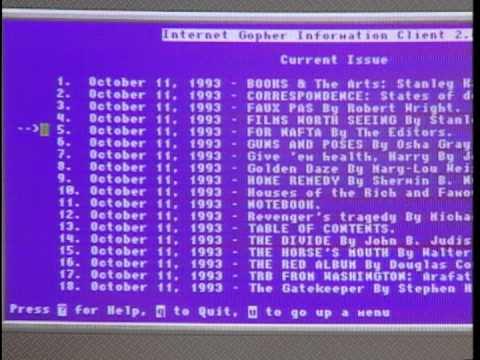
Returning to Gopher, the demonstrator navigates the Electronic Newsstand to read magazine articles. Browsing *The New Republic* alongside publications like *Internet World* and *Foreign Affairs*, he retrieves the full text of an editorial on the North American Free Trade Agreement (NAFTA). To obtain the primary document itself, he jumps to an archive at the University of North Carolina via anonymous FTP. By entering “anonymous” at the login prompt and submitting an email address as the password, users can freely browse public file repositories containing government data like the federal budget and complete treaty texts partitioned by chapter and appendix.
- **InterNIC Helpline**: Inquirers uncertain about local Internet access can contact the InterNIC helpline at 1-800-444-4345 for regional provider recommendations. - **Estimated End-User Cost**: Standard consumer access ranges between $10 and $20 per month.
---
[13:31](https://www.youtube.com/watch?v=U_o8gerare0&t=811s) Bellcore, Broadband Pipelines, and MOREnet in Public Libraries
At Bell Communications Research (Bellcore) in New Jersey—the research and engineering arm serving the seven Regional Bell Operating Companies—engineers focus on building the physical and software infrastructure required for the National Information Infrastructure (NII). Current research tackles digital transmission expansion across existing telephone lines, including early video-on-demand architectures and experimental desktop videoconferencing platforms like Cruiser. Bellcore Research Director Steve Weinstein highlights the telecom sector’s stake in underpinning these data streams: “We believe that the public network, the owners of Bellcore, can be providers as significant providers of those kinds of facilities that the future broadband internet is going to need.”
Beyond transmission speeds, Bellcore investigates public usability and community interaction with electronic data through a pilot deployment known as MOREnet in Morris County, New Jersey. Expanding on the county’s pre-existing automated inter-library catalog, MOREnet links local branch terminals directly to the global Internet. Library patrons gain public terminal access to overseas library catalogs, the CIA World Factbook, real-time weather information, and SuperBook—a proprietary Bellcore hypertext interface that enables publishers to host large databases centrally while serving clean, structured documents across devices ranging from basic ASCII terminals to sophisticated workstations. Patrons have responded with sheer awe at traversing worldwide connections in seconds, demonstrating that the future public network can successfully bridge local civic centers with international repositories.
---
[16:42](https://www.youtube.com/watch?v=U_o8gerare0&t=1002s) Virtual Communities and Asynchronous Internet Radio
Host Stewart Cheifet introduces author Howard Rheingold, author of *The Virtual Community*, to explore the cultural and human dimensions of online networks. Before diving into Rheingold’s experience with the pioneering online bulletin board The WELL, the program visits Washington, D.C., to profile Carl Malamud, the mastermind behind Internet Talk Radio—the world’s first digital audio broadcast service operating from a studio inside the National Press Club building.
```mermaid flowchart LR accTitle: Internet Talk Radio Production Flow accDescr: Diagram illustrating audio recording at the National Press Club uploaded to the Web for on-demand user consumption. A["National Press Club Studio"] --> B["Record: Geek of the Week & Luncheons"] B --> C["Audio Data Files Uploaded via WWW"] C --> D["User Retrieval: On-Demand / Asynchronous"] D --> E["User Control: Pause, Skip, or Extract Audio"] ```
Malamud describes how the venture grew organically out of his frustration with traditional print publishing economics after writing seven computer books: “It's one of those ideas that started as a hobby and kind of went nuts. I wrote books about computers, I wrote seven books and I wrote magazine articles and I was looking for a magazine about the internet and there wasn't one and I wanted to start one, but that's expensive because you have to print paper and you have to mail paper and you have to audit who gets the paper so you can get it back to your advertisers and I decided Gee let's do something on the network.” Distributing digital audio files via the World Wide Web and email (`info@radio.com`), his programming features in-depth technical interviews on *Geek of the Week* as well as recordings of National Press Club guest luncheons. Malamud emphasizes that computer-delivered audio fundamentally breaks traditional linear broadcast models in favor of asynchronous, user-controlled listening, where individuals can pause programs during phone calls or bypass segments entirely. He looks forward to an era when both established journalists like Nina Totenberg and everyday citizens publish directly to the global network.
Returning to the studio, Howard Rheingold connects the technical plumbing to human society. Describing his participation on The WELL, Rheingold contrasts mere physical data routing with social interaction, drawing an analogy: if the Internet functions as a digital superhighway, then the information and software files floating across it serve as libraries and warehouses, while online discussion forums act as the vibrant cafes, town halls, and gathering places that transform connectivity into human community.
- **Primary Program Offerings**: Internet Talk Radio’s flagship content consists of technical discussions on *Geek of the Week* alongside high-profile speeches from the National Press Club luncheon circuit. - **Asynchronous Listening Concept**: Rather than adhering to fixed broadcast clocks, listeners download the audio files as discrete data packets, giving them full autonomy to pause, skip uninteresting segments, or extract specific technical content at will.
[19:09](https://www.youtube.com/watch?v=U_o8gerare0&t=1149s) The WELL and the Architecture of Virtual Communities
Howard Rheingold demonstrates the Whole Earth Lectronic Link (The WELL), explaining that an online network is fundamentally not just a repository of data or goods, but a genuine human community accessible across the Internet. On his computer monitor, Rheingold displays a directory of conferences structured by human communication. Broad topic areas range from social responsibility and politics (encompassing debate on everything from the environment to firearms) to media, communications, business, and livelihood. In these conference sections, every thread acts as an ongoing archive of conversations among participants. Comparing the system to real life, Rheingold observes: “It's as if you walked into a cocktail party and you reeled back a conversation to the beginning so you could see what people were talking about.”
```mermaid flowchart TD accTitle: Structure of The WELL accDescr: Hierarchical organization of discussions on The WELL platform
A["The WELL System"] --> B["Topic Conferences"]
subgraph B["Topic Conferences"] C["Social Responsibility & Politics<br/>(Environment, Firearms)"] D["Business & Livelihood"] E["Media & Communications"] F["Parenting Conference"] G["Macintosh Conference"] end
F --> H["Threads / Conversations<br/>(Jealousy, Martial Arts, Photos)"] G --> I["Technical Support & Expert Debates"] ```
Rheingold highlights the Parenting conference as a discussion area close to his heart, where participants bypass technical chatter to discuss personal family life. Inside, users seek advice on finding martial arts instructors, handling jealousy in three-year-olds, raising children in the era of cyberspace, or posting baby pictures online. Rheingold explains how this provides a ready-made support system during crises: when a member shared that his son had received a leukemia diagnosis, participants rushed to assist within minutes. The support went far beyond kind words; doctors, nurses, and leukemia survivors logged on to provide guidance. Rheingold notes that the network dissolves geographical borders, pointing out that someone jumping onto an Internet on-ramp in Tokyo enters the same Parenting conference a second later: “So that's what I mean by a virtual community is the the time and space constraints of our normal communities are not there it's what we're interested in and what we talk with each other about that really defines our community here.”
- Discussion threads in each conference area run for screens and log hundreds of distinct exchanges over time. - On technical boards like the Macintosh conference, users seeking help often find knowledgeable peers actively competing to resolve technical issues when local help is unavailable.
[22:15](https://www.youtube.com/watch?v=U_o8gerare0&t=1335s) Democratic Promise and the Pitfalls of Online Interaction
Stewart Cheifet queries Rheingold on the broader social significance of these networks, asking whether online interactions represent a permanent shift in how humans relate. Rheingold affirms the political and civic weight of the technology, arguing that modern citizens have surrendered widespread direct dialogue to passive mass media consumption. While telecommunications conglomerates and federal governments maneuver to carve up the emerging digital realm, Rheingold insists on defending open communication spaces for regular citizens: “When these big deals with the big companies and the big governments carve up this new territory I feel it's very important that we keep a kind of social Green Belt that we keep the ability for citizens to talk amongst each other.”
Cheifet questions the limitations and emotional trade-offs of purely digital relationships compared to face-to-face contact. Rheingold acknowledges the emotional distance that screens can create and issues a note of caution: “I think it's important to remember that just as the computer can connect us with people it can also distance us from people and you need to know that just as you can't trust everyone you talk to on the telephone you can't trust everyone you meet in a virtual community until you meet them and get to know them offline.”
[23:41](https://www.youtube.com/watch?v=U_o8gerare0&t=1421s) Random Access: Hardware, Software, and Space Exploration
Janelle Stelson presents the weekly *Random Access* segment, reviewing the latest entries in portable hardware, contact management software, and peripheral integrations:
- **Canon Innova Book 10 / 10C Subnotebooks:** Canon introduced this family of monochrome and color 486SL subnotebooks weighing 4 pounds. Running MS-DOS 6.2 and Windows 3.1, one model incorporates Canon's smallest-ever internal Bubble Jet printer. Systems range in price from $1,600 to just over $2,000. - **Panasonic DX4 75 MHz Notebook:** Features a modular "multimedia pocket." Its pop-out floppy drive bay can be swapped for an internal CD-ROM drive, a spare battery pack, or a TV tuner card. Prices run from $5,400 to $5,900. - **Symantec ACT! 2.0 for Windows:** The contact manager update adds network multi-user support, integrated email connectivity, and improved calendar printing features, alongside an edition tailored for HP palmtop PCs. - **Alacrity Systems Office-in-a-Box:** A $500 hardware/software package including a desktop scanner, fax modem, and Alacrity software that turns standard PC and printer setups into a combined digital copier, plain-paper fax, and digital filing cabinet. - **Alpha Books' *Computers in Space: Journeys with NASA*:** Published for the 25th anniversary of the Apollo 11 Moon landing, this volume compiles rare photography and historical accounts tracing computer evolution across early spaceflights through future planetary exploration.
## Notable quotes > [22:15](https://www.youtube.com/watch?v=U_o8gerare0&t=1335s) When these big deals with the big companies and the big governments carve up this new territory I feel it's very important that we keep a kind of social Green Belt that we keep the ability for citizens to talk amongst each other. — Howard Rheingold
## Mentioned Stewart Cheifet, David Schargel, Aladdin Systems, SITcomm, Marshall McLuhan, NETCOM, The WELL, The World, CompuServe, GEnie, MCI Mail, Dow Jones, Bill Clinton, ARPA, Steven Squires, NCSA Mosaic, National Center for Supercomputing Applications (NCSA), Dwight D. Eisenhower, Brendan Kehoe, Zen and the Art of the Internet, NASA Science Internet (NSI), Prodigy, Gopher, Online Career Center, Bay View Health Care Center, Finger protocol, Billboard, Mariah Carey, Compact Disc Connection, Electronic Newsstand, The New Republic, Internet World, Foreign Affairs, North American Free Trade Agreement (NAFTA), University of North Carolina, InterNIC, Bellcore, National Information Infrastructure (NII), Cruiser, Steve Weinstein, MOREnet, CIA World Factbook, SuperBook, Howard Rheingold, The Virtual Community, Carl Malamud, Internet Talk Radio, National Press Club, Geek of the Week, Nina Totenberg, Janelle Stelson, Canon Innova Book 10 / 10C, Panasonic DX4 75 MHz Notebook, Symantec ACT! 2.0 for Windows, Alacrity Systems Office-in-a-Box, Computers in Space: Journeys with NASA, Alpha Books
## Video description Special thanks to archive.org for hosting these episodes. Downloads of all these episodes and more can be found at: http://archive.org/details/computerchronicles
[Source](https://www.youtube.com/watch?v=U_o8gerare0)