Oregon Dynamites Beached Whale, Crushing Car Under Falling Blubber
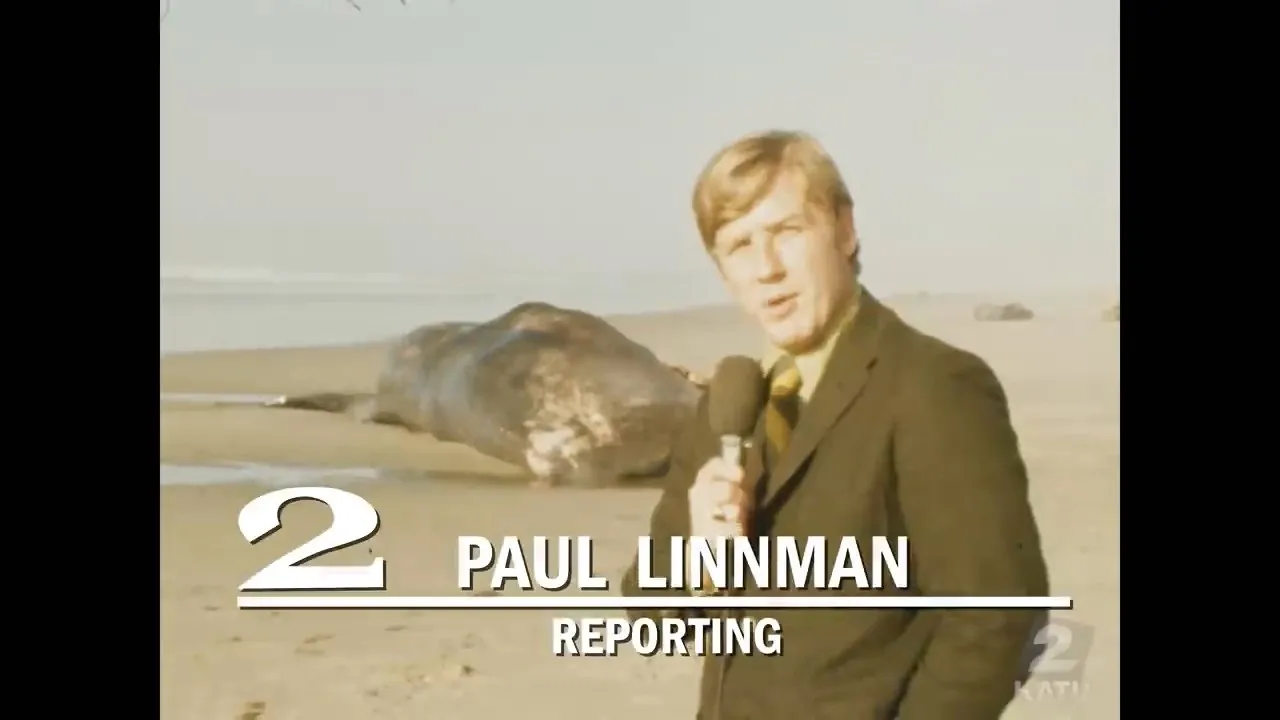
KATU News
A half-ton dynamite blast intended to disintegrate a beached carcass for scavengers backfired completely, scattering massive blubber chunks across spectators and forcing crews to bury the remains manually.
AI-assisted summary of The Exploding Whale: An infamous moment in Oregon history creates a strangely beloved icon — original source. Check the original for full context.
Source published:
Key ideas
- In November 1970, the Oregon State Highway Division attempted to dispose of a stranded 45-foot, eight-ton Pacific gray whale near Florence using a half-ton of dynamite. (0:01)
- The plan aimed to pulverize the carcass so scavengers like seagulls and crabs could consume the remains, but the blast instead hurled massive blubber fragments inland across spectator dunes a quarter-mile away. (1:21)
- A falling chunk of blubber crushed a spectator's parked car over a quarter of a mile from the blast site, while terrified onlookers were showered in foul-smelling debris. (1:21)
- The explosion scared away all scavenger birds, leaving highway crews forced to manually bury both the scattered debris and large unexploded portions of the carcass. (1:21)
Detailed notes
## Background Published on YouTube by KATU News on November 12, 2020, this video features a remastered 4K transfer of archival footage marking the 50th anniversary of the November 12, 1970 exploding whale incident in Florence, Oregon. The description details how local officials attempted to dispose of an eight-ton beached whale with dynamite, resulting in a disastrous and legendary dispersal of blubber across the beach.
## TL;DR When a 45-foot, eight-ton Pacific gray whale washed ashore near Florence, the Oregon State Highway Division opted to eliminate the rotting carcass by detonating a half-ton of dynamite. Officials hoped the blast would vaporize the whale so local scavengers like seagulls could consume the tiny remains, but the detonation instead hurled massive chunks of blubber hundreds of yards inland. Spectators and journalists pushed back a quarter-mile fled in panic as rotting flesh pelted the dunes and crushed a parked car. Ultimately, scavengers were scared off entirely, leaving highway crews to manually bury the remaining wreckage by bulldozing it into the sand.
## Atmosphere & style The piece carries the unmistakable deadpan irony and wit of vintage 1970s television news reporting, punctuated by playful alliterations like 'land blubber newsmen.' The emotional arc pivots rapidly from lighthearted, small-town spectacle and bureaucratic confidence into chaotic slapstick disaster as onlookers scream and scatter beneath a sky raining rancid blubber. Watching it feels like witnessing an unbelievable, darkly comical fable unfold in crystal-clear historical fidelity.
## Bulletin - [00:01](https://www.youtube.com/watch?v=V6CLumsir34&t=1s) In November 1970, the Oregon State Highway Division attempted to dispose of a stranded 45-foot, eight-ton Pacific gray whale near Florence using a half-ton of dynamite. - [01:21](https://www.youtube.com/watch?v=V6CLumsir34&t=81s) The plan aimed to pulverize the carcass so scavengers like seagulls and crabs could consume the remains, but the blast instead hurled massive blubber fragments inland across spectator dunes a quarter-mile away. - [01:21](https://www.youtube.com/watch?v=V6CLumsir34&t=81s) A falling chunk of blubber crushed a spectator's parked car over a quarter of a mile from the blast site, while terrified onlookers were showered in foul-smelling debris. - [01:21](https://www.youtube.com/watch?v=V6CLumsir34&t=81s) The explosion scared away all scavenger birds, leaving highway crews forced to manually bury both the scattered debris and large unexploded portions of the carcass.
## Key takeaways - [00:01](https://www.youtube.com/watch?v=V6CLumsir34&t=1s) A 45-foot, eight-ton Pacific gray whale washed ashore dead near Florence, presenting Lane County authorities with an unprecedented disposal challenge. - [00:01](https://www.youtube.com/watch?v=V6CLumsir34&t=1s) Direct burial was rejected because shifting coastal sands and ocean waves would quickly re-expose the decomposing carcass. - [00:01](https://www.youtube.com/watch?v=V6CLumsir34&t=1s) Butchering the carcass or attempting to burn it were deemed unfeasible due to the lack of willing labor and the carcass's sheer mass. - [00:01](https://www.youtube.com/watch?v=V6CLumsir34&t=1s) Officials settled on using 20 cases—roughly 1,000 pounds—of dynamite to disintegrate the whale. - [00:01](https://www.youtube.com/watch?v=V6CLumsir34&t=1s) Highway engineer George Thornton anticipated that the blast would break the whale into small fragments for local seagulls and crabs to scavenge. - [00:01](https://www.youtube.com/watch?v=V6CLumsir34&t=1s) Thornton acknowledged prior to detonation that the required explosive force was uncertain and additional cleanup or charges might be needed. - [01:21](https://www.youtube.com/watch?v=V6CLumsir34&t=81s) Workers packed the explosives on the leeward side of the carcass in an attempt to direct the blast energy toward the ocean. - [01:21](https://www.youtube.com/watch?v=V6CLumsir34&t=81s) Safety personnel pushed a crowd of roughly 75 spectators and reporters back a quarter of a mile into the coastal dunes. - [01:21](https://www.youtube.com/watch?v=V6CLumsir34&t=81s) Detonation launched massive slabs of blubber high into the air and inland directly over the spectator area, causing panic. - [01:21](https://www.youtube.com/watch?v=V6CLumsir34&t=81s) A large piece of falling blubber crushed the roof and passenger compartment of an automobile parked more than a quarter-mile away. - [01:21](https://www.youtube.com/watch?v=V6CLumsir34&t=81s) While no spectators suffered severe direct impacts, virtually everyone present was pelted and coated with decaying whale particles and an overwhelming stench. - [01:21](https://www.youtube.com/watch?v=V6CLumsir34&t=81s) The anticipated biological cleanup failed completely because the concussive force and smell drove away all local seagulls. - [01:21](https://www.youtube.com/watch?v=V6CLumsir34&t=81s) Highway crews had to bring in heavy earthmoving equipment at nightfall to bury the remaining scattered chunks and core carcass.
## Detailed walkthrough ### [00:01](https://www.youtube.com/watch?v=V6CLumsir34&t=1s) The Highway Division's "Stinking Whale of a Problem"
The Oregon State Highway Division found itself dealing with an unprecedented crisis when a 45-foot, eight-ton Pacific gray whale washed ashore dead near Florence. It had been so long since a stranded whale had appeared on a Lane County beach that local authorities had no standard operating procedure for disposing of it. Officials considered and eliminated several obvious disposal methods: the carcass could not simply be buried because wave action and shifting sands would soon uncover it; it could not be chopped into smaller segments and buried because nobody was willing to undertake the grim task of cutting it up; and burning the massive creature was deemed impossible. Consequently, the highway division settled on an explosive solution: 20 cases, or roughly a half-ton, of dynamite.
The overarching strategy assumed that the blast would practically disintegrate the long-dead mammal, scattering minute remnants that would be quickly consumed by seagulls and other natural scavengers. Flocks of gulls gathered nearby all day as crews prepared the charge. When asked for his final observations before detonation, highway engineer George Thornton conveyed cautious optimism about the outcome, while acknowledging the uncertainty surrounding the required firepower.
George Thornton explained: “Well I'm confident that it'll work, the only thing is we're not sure just exactly how much explosives it'll take to disintegrate this thing so the scavengers, seagulls and crabs and whatnot, can clean it up.” When questioned whether the operation might turn into a multi-day ordeal, Thornton admitted, “If there's any large chunks left then we may have to do some other cleanup, possibly set another charge.”
- **Subject:** 45-foot, 8-ton Pacific gray whale washed ashore near Florence, Lane County, Oregon. - **Rejected options:** Direct burial (risk of re-exposure), butchering followed by burial (no willing workers), and burning. - **Chosen method:** Detonation using 20 cases (approximately 1,000 pounds / half a ton) of dynamite. - **Intended outcome:** Carcass disintegration, with residual micro-fragments consumed by gulls and crabs.
---
[01:21](https://www.youtube.com/watch?v=V6CLumsir34&t=81s) The Blast and the Fallout
To direct the blast energy toward the ocean, highway workers packed the dynamite predominantly along the leeward side of the massive carcass. Safety personnel established a perimeter, shifting roughly 75 onlookers—mostly local residents whose initial fascination had soured due to the mounting stench—back a quarter of a mile into the coastal sand dunes. The dunes were crowded with curious onlookers and press members, whom the reporter jokingly noted were “landlubber newsmen shortly to become land blubber newsmen, for the blast blasted blubber beyond all believable bounds.”
```mermaid flowchart TD accTitle: Whale Demolition Plan vs Reality accDescr: Diagram illustrating the expected blast trajectory toward the sea versus the actual outcome scattering blubber inland across the spectators and dunes.
subgraph Plan["Intended Strategy"] D1["Half-ton of dynamite placed on leeward side"] --> B1["Blast directed toward ocean"] B1 --> C1["Disintegration into tiny pieces"] C1 --> S1["Scavengers clean up shore"] end
subgraph Reality["Actual Result"] D2["Detonation occurs"] --> B2["Debris launches high into air & inland"] B2 --> C2["Chunks rain down on dunes a quarter-mile away"] C2 --> F1["Parked car crushed"] C2 --> F2["Spectators flee falling blubber & odor"] C2 --> F3["Gulls flee blast; large chunks remain for burial"] end ```
The camera stopped rolling right after detonation as amusement transformed instantly into terror and a mad scramble for survival. Huge sections of whale blubber and flesh shot skyward, raining down over the dunes; large chunks sailed high overhead while smaller debris pelted the ground around spectators' feet. People fled the sand dunes in panic to escape both the airborne hazard and the suffocating odor. Over a quarter of a mile away from the detonation site, a falling slab of blubber scored a direct hit on a parked vehicle, crushing the passenger compartment.
While no bystander was struck with the force endured by the crushed automobile, virtually every spectator and journalist was coated in a spray of decaying whale particles. The plan's ecological cleanup mechanism also failed completely: the seagulls were either terrified by the massive concussive explosion or driven away by the repulsive smell. Even if the birds had remained, the reporter remarked that the remaining chunks were far too large for any self-respecting seagull to tackle. As night approached, highway crews had to return with heavy machinery to bury the scattered debris by hand, alongside a massive portion of the core carcass that had never left the explosion crater. Reflecting on the misadventure, the reporter observed: “It might be concluded that should a whale ever wash ashore in Lane County again, those in charge will not only remember what to do, they'll certainly remember what not to do.”
- **Spectator perimeter:** Pushed back a quarter of a mile (~1,320 feet) onto the dunes; roughly 75 bystanders and reporters present. - **Physical damage:** Heavy chunk crushed the roof and passenger compartment of a car parked over a quarter of a mile away. - **Human impact:** No severe injuries, but attendees were splattered with foul-smelling whale debris. - **Cleanup outcome:** Gulls fled entirely; remaining chunks proved far too large for scavengers, forcing highway workers to bury the remains after nightfall.
## Notable quotes > [01:21](https://www.youtube.com/watch?v=V6CLumsir34&t=81s) It might be concluded that should a whale ever wash ashore in Lane County again, those in charge will not only remember what to do, they'll certainly remember what not to do. — Reporter
## Mentioned Florence, Oregon, George Thornton, KATU News, Lane County, Oregon, Oregon Historical Society, Oregon State Highway Division, Sinclair Broadcast Group
## Video description The infamous exploding whale incident occurred Nov. 12, 1970, in Florence, Oregon. A whale washed ashore on the Oregon beach and with no other means to dispose of it, officials came up with a plan to blow the whale up. The result? Whale carcass all over the local beach.
The Oregon Historical Society, for the exploding whale's 50th anniversary, arranged a 4K transfer of the original raw film footage from their archive. KATU 2 News re-edited the video from the new high resolution material for our viewers.
Read more: https://katu.com/news/local/the-exploding-whale-50th-anniversary-of-legendary-oregon-event
This video and all Sinclair Broadcast Group content archives of local news and sports coverage are available for your use. For more information contact us at contentsales@sbgtv.com _______________ Stay up to date with our social media:
KATU on Facebook: https://www.facebook.com/katunews KATU on Twitter: https://twitter.com/KATUNews Subscribe to KATU on YouTube: https://www.youtube.com/channel/UCmDTerxNU_gvCWLkIPkqghA/?sub_confirmation=1
Daily News Playlist: https://www.youtube.com/playlist?list=PLFtHM_AbvnEUkd_YRTlZpGKkbczT5w062
For more information, visit https://katu.com/
Have a news tip? Send it directly to us:
Email us: newstips@katu.com Call the Newsroom: 503.231.4222
KATU is a OR based station and a ABC Television affiliate owned and operated by Sinclair Broadcast Group. Sinclair Broadcast Group, Inc. is one of the largest and most diversified television broadcasting companies in the country today.
#KATU #Katu2abc #Portland
[Source](https://www.youtube.com/watch?v=V6CLumsir34)