Apple CEO Tim Cook: The VICE News Tonight Interview (HBO)
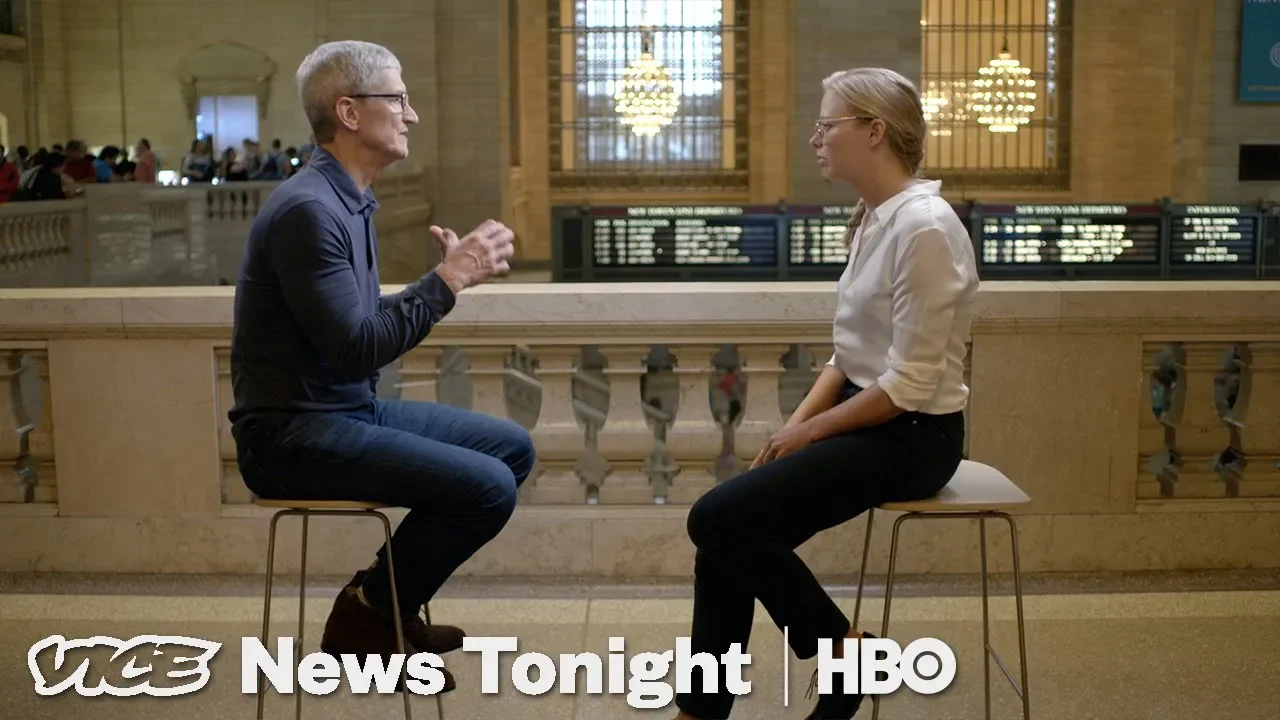
VICE News
AI-assisted summary of Apple CEO Tim Cook: The VICE News Tonight Interview (HBO) — original source. Check the original for full context.
Source published:
Key ideas
- Apple CEO Tim Cook calls for government regulation of the tech industry, arguing that market forces have failed to protect user privacy as smartphones now hold more intimate personal data than people's physical homes. (0:06)
- Cook dismisses the claim that artificial intelligence requires hoarding user data as 'bunk,' emphasizing Apple's commitment to on-device processing and data minimization over ad-targeting profiles. (2:37)
- Despite Chinese cybersecurity laws mandating domestic server hosting, Cook asserts Apple retains identical worldwide encryption standards and that physical server location does not compromise security. (4:06)
- Addressing the deplatforming of Alex Jones, Cook clarifies that Apple relies on human curation rather than pure algorithms and acted completely independently of other Silicon Valley firms. (5:32)
Detailed notes
## Background Published on YouTube by VICE News on October 3, 2018, this segment features an interview with Apple CEO Tim Cook at a New York Apple Store. The video explores Apple's distinct corporate posture regarding user privacy, contrasting its practices with data breaches and advertising models common across Silicon Valley competitors like Facebook.
## TL;DR Apple CEO Tim Cook outlines Apple's foundational stance that user privacy is a paramount human right, distinguishing its on-device computing architecture from the data-mining advertising models of its peers. Cook calls for government regulation where free markets have failed to protect personal data and rejects the notion that artificial intelligence requires hoarding user information. He also defends Apple's encryption standards in foreign markets such as China and explains the platform's independent editorial curation that led to the removal of InfoWars host Alex Jones. Ultimately, Cook asserts that this consumer privacy doctrine is deeply entrenched in Apple's institutional culture, tracing directly back to Steve Jobs.
## Atmosphere & style The piece contrasts the energetic, fan-filled spectacle of a flagship Manhattan retail store with a calm, deliberate sit-down conversation focused on ethical governance and tech accountability. Cook conveys a steady, measured authority, maintaining polite firmness when repudiating rival business models and framing privacy as a matter of basic human dignity. The interviewer maintains a probing, skeptical rhythm, pressing Cook on state surveillance in China and unchecked corporate leverage, which imbues the discussion with serious journalistic friction rather than a polished promotional tone.
## Bulletin - [00:06](https://www.youtube.com/watch?v=VD1cP8SK3Q0&t=6s) Apple CEO Tim Cook calls for government regulation of the tech industry, arguing that market forces have failed to protect user privacy as smartphones now hold more intimate personal data than people's physical homes. - [02:37](https://www.youtube.com/watch?v=VD1cP8SK3Q0&t=157s) Cook dismisses the claim that artificial intelligence requires hoarding user data as 'bunk,' emphasizing Apple's commitment to on-device processing and data minimization over ad-targeting profiles. - [04:06](https://www.youtube.com/watch?v=VD1cP8SK3Q0&t=246s) Despite Chinese cybersecurity laws mandating domestic server hosting, Cook asserts Apple retains identical worldwide encryption standards and that physical server location does not compromise security. - [05:32](https://www.youtube.com/watch?v=VD1cP8SK3Q0&t=332s) Addressing the deplatforming of Alex Jones, Cook clarifies that Apple relies on human curation rather than pure algorithms and acted completely independently of other Silicon Valley firms.
## Key takeaways - [00:06](https://www.youtube.com/watch?v=VD1cP8SK3Q0&t=6s) Tim Cook emphasizes that personal privacy is one of the defining issues of the 21st century given the volume of intimate data stored on smartphones. - [00:06](https://www.youtube.com/watch?v=VD1cP8SK3Q0&t=6s) Despite being an advocate for free markets, Cook believes government regulation of big tech has become necessary because the market failed to produce an outcome beneficial to society. - [00:06](https://www.youtube.com/watch?v=VD1cP8SK3Q0&t=6s) Educating lawmakers and staff on emerging technology is critical because technology inherently lacks moral alignment and reflects only its creators' intent. - [02:37](https://www.youtube.com/watch?v=VD1cP8SK3Q0&t=157s) Apple distinguishes its business model from Silicon Valley competitors by asserting that users are customers, not advertising products to be profiled and monetized. - [02:37](https://www.youtube.com/watch?v=VD1cP8SK3Q0&t=157s) Cook rejects the narrative that robust AI features require mass data harvesting, relying instead on on-device processing to protect user privacy. - [02:37](https://www.youtube.com/watch?v=VD1cP8SK3Q0&t=157s) Product design at Apple is systematically structured to collect the absolute minimum data required and strip identifying details. - [04:06](https://www.youtube.com/watch?v=VD1cP8SK3Q0&t=246s) Apple maintains identical end-to-end encryption standards in China as it does in the US, preventing both Apple and governments from reading private messages. - [04:06](https://www.youtube.com/watch?v=VD1cP8SK3Q0&t=246s) Data localization in China does not inherently compromise user privacy because security depends on who holds the encryption keys rather than physical server geography. - [05:32](https://www.youtube.com/watch?v=VD1cP8SK3Q0&t=332s) Apple positions its platforms as intentionally curated ecosystems employing human reviewers across the App Store, Apple Podcasts, and Apple News. - [05:32](https://www.youtube.com/watch?v=VD1cP8SK3Q0&t=332s) The decision to ban Alex Jones was made strictly independently by Apple without coordination with peer tech companies. - [05:32](https://www.youtube.com/watch?v=VD1cP8SK3Q0&t=332s) Cook insists platform curation is non-partisan, highlighting that Apple continues to host a wide spectrum of viewpoints from conservative to liberal. - [07:11](https://www.youtube.com/watch?v=VD1cP8SK3Q0&t=431s) Apple's commitment to user privacy stems from cultural roots laid down by Steve Jobs, defining privacy as clear, repeated user consent in plain English. - [07:11](https://www.youtube.com/watch?v=VD1cP8SK3Q0&t=431s) Cook dismisses concerns that a future CEO could easily overturn Apple's privacy protections, describing data protection as an ingrained, institutional value.
## Detailed walkthrough ### [00:06](https://www.youtube.com/watch?v=VD1cP8SK3Q0&t=6s) Apple's Divergence from Big Tech and the Call for Regulation
Seven years into his tenure as Apple CEO, Tim Cook meets with VICE News inside an Apple Store in New York shortly after the release of the newest iPhone. Surrounded by eager fans snapping selfies, Cook receives a warm public reception that stands in sharp contrast to the mounting hostility facing his Silicon Valley peers, who have been broadly accused of treating personal data as an advertising commodity and damaging liberal democracy. VICE sits down with Cook to examine Apple’s deliberate positioning as an outlier in the tech landscape regarding data privacy and corporate responsibility.
Cook reiterates his view that user privacy is one of the definitive issues of the 21st century. He observes that modern smartphones hold far more intimate details about a person’s life—from browsing histories, contacts, and relationships to personal photographs—than can be found within the physical walls of their homes. Although Cook describes himself as an ardent believer in free markets who is generally skeptical of government interference, he argues that the tech sector's failure to protect users requires external intervention.
Cook also reflects on his own appearances before lawmakers on Capitol Hill, calling congressional literacy on emerging technology a genuine challenge. He stresses that the industry must actively educate legislators and staff members so they can construct sensible policy, pointing out that technology in itself carries no moral alignment. In Cook's words: “Technology itself doesn't want to be good, it doesn't want to be bad, it doesn't want anything; it's up to the creator.”
- Cook states clearly on government intervention: “When the free market doesn't produce a result that's great for society, you have to ask yourself what do we need to do and and I I think some level of government regulation is important to come out of that at this time.” - He emphasizes that tech companies can no longer rely purely on self-regulation when the magnitude of collected data reaches into intimate human relationships and communications.
---
[02:37](https://www.youtube.com/watch?v=VD1cP8SK3Q0&t=157s) Privacy Over Profit and the Myth of Centralized Data
When asked for concrete examples where Apple prioritized user privacy over profit, Cook explains that such choices are embedded into the company's daily product development rather than isolated business decisions. Apple’s foundational product design philosophy requires teams to collect the minimum amount of data possible, strip identifying markers from whatever data must be gathered, and avoid analyzing user communications. Cook draws a direct line between Apple’s business model and its privacy practices: “You are not our product; we're not forming the detailed profile and then allowing other companies to buy the opportunity to target you, that is not the business that we're in.”
The interview challenges whether Apple’s refusal to harvest massive user data sets will permanently handicap its artificial intelligence, specifically questioning whether services like Siri will inevitably fall behind competitors like Amazon Alexa. Cook rejects the claim that smart consumer features require surrendering privacy, calling it an excuse manufactured by data-mining competitors: “The narrative that some companies will try to get you to believe is, 'I've got to take all of your data to make my service better'—well, don't believe that, whoever's telling you that, it's a bunch of bunk.” He explains that Apple deliberately runs processing on the user's local device, allowing the hardware itself to learn individual habits securely without transmitting personal dossiers back to centralized corporate servers.
```mermaid flowchart TD accTitle: On-Device Processing vs Cloud Ad-Profiling accDescr: Flowchart contrasting Apple's privacy-centric on-device intelligence model with competitor central cloud profiling. subgraph Apple["Apple On-Device Architecture"] A["User Inputs & Activity"] --> B["On-Device Local Processing"] B --> C["Encrypted / Anonymized Data"] C --> D["Smart Device Features"] end subgraph Competitors["Ad-Profile Cloud Architecture"] E["Messages, Browsing & Emails"] --> F["Centralized Cloud Data Mining"] F --> G["Persistent User Profiles"] G --> H["Monetization & Ad Targeting"] end ```
---
[04:06](https://www.youtube.com/watch?v=VD1cP8SK3Q0&t=246s) Human Rights, Encryption, and Operating in China
The conversation turns to international markets and whether Apple’s declaration of privacy as a fundamental human right holds up under authoritarian regimes, specifically in China. Cook insists that Apple maintains uniform encryption standards worldwide without tailoring weakened versions for foreign governments. He maintains that messages sent in China are encrypted just as they are in the United States, meaning Apple cannot unlock a customer's phone or produce decrypted message contents for authorities in either nation.
Addressing concerns over Chinese cybersecurity laws requiring domestic citizens' iCloud data to be hosted inside the country via local joint ventures, Cook dismisses the idea that physical server locations automatically expose user data to state surveillance. He clarifies that physical proximity does not compromise security when the encryption design remains sound. As Cook emphasizes: “The key question is how does the encryption process work and who owns the keys, if anyone—in most cases for us, you and the receiver own the keys.”
- Data localization mandates in China require local citizen data to be stored domestically, prompting Apple to partner with a local firm to provide iCloud infrastructure. - Cook asserts that Apple retains control over the encryption keys, leaving device unlock capabilities and message decryptions technically unavailable to both Apple and state authorities.
---
[05:32](https://www.youtube.com/watch?v=VD1cP8SK3Q0&t=332s) Platform Curation, Free Speech, and the Alex Jones Ban
The discussion transitions from privacy rights to free speech, highlighting the backlash from right-wing figures such as InfoWars host Alex Jones, who accused major tech corporations and the Democratic Party of colluding to silence populist and conservative viewpoints before the midterm elections. When asked why Apple decided to deplatform Alex Jones, Cook frames Apple's ecosystem as an explicitly curated environment. He explains that users choose Apple products specifically because human editors inspect apps, verify podcast feeds, and curate the primary headlines appearing in Apple News.
Cook firmly rejects the accusation that Apple's curation leans along partisan lines, pointing out that both the App Store and Apple Podcasts host a broad spectrum of viewpoints ranging from staunchly conservative to strongly liberal. Regarding the removal of Alex Jones, Cook argues that the host's content crossed lines that any neutral curator would recognize: “I think there's enough there that reasonable people could agree that if you're going to curate, that that should be off.” When questioned about whether Apple consulted or coordinated with rival tech companies that removed InfoWars at roughly the same time, Cook flatly denies it: “We make our decisions independently and I think that's important.”
- Apple’s ecosystem relies on human review rather than relying entirely on algorithmic distribution for podcast directories, the App Store, and Apple News top stories. - Cook reports that he never held a conversation with any peer tech executive regarding the removal of Alex Jones, and to his knowledge, no one else at Apple did either.
---
[07:11](https://www.youtube.com/watch?v=VD1cP8SK3Q0&t=431s) Executive Power and the Permanence of Apple's Privacy Culture
The interview concludes by examining corporate power, noting that leading a company valued at over one trillion dollars affords its chief executive immense societal leverage. The interviewer asks what protects consumers if Cook ever changes his mind about data ethics, or if a future successor chooses profit over user protection. Cook deflects the premise of imperial power, claiming he neither obsesses over the trillion-dollar milestone nor perceives himself as powerful in his day-to-day thinking.
Cook asserts that Apple’s commitment to privacy is not a personal whim, but an institutional philosophy codified under co-founder Steve Jobs. He recalls an archival video from roughly a decade earlier in which Jobs offered a straightforward definition: “Privacy means people know what they're signing up for, in plain English, and repeatedly.” Cook insists this definition is baked into Apple's culture, making it nearly impossible for any future leadership to casually undo: “This is our company, this is how we think—the royal 'we'—this is our culture.” He adds that the prospect of a successor reversing this foundation is unimaginable: “It's not in my imagination that somebody would just say, 'Oh, time to change.'”
## Notable quotes > [00:06](https://www.youtube.com/watch?v=VD1cP8SK3Q0&t=6s) Technology itself doesn't want to be good, it doesn't want to be bad, it doesn't want anything; it's up to the creator. — Tim Cook
> [02:37](https://www.youtube.com/watch?v=VD1cP8SK3Q0&t=157s) You are not our product; we're not forming the detailed profile and then allowing other companies to buy the opportunity to target you, that is not the business that we're in. — Tim Cook
> [02:37](https://www.youtube.com/watch?v=VD1cP8SK3Q0&t=157s) The narrative that some companies will try to get you to believe is, 'I've got to take all of your data to make my service better'—well, don't believe that, whoever's telling you that, it's a bunch of bunk. — Tim Cook
> [07:11](https://www.youtube.com/watch?v=VD1cP8SK3Q0&t=431s) Privacy means people know what they're signing up for, in plain English, and repeatedly. — Steve Jobs
> [04:06](https://www.youtube.com/watch?v=VD1cP8SK3Q0&t=246s) The key question is how does the encryption process work and who owns the keys, if anyone—in most cases for us, you and the receiver own the keys. — Tim Cook
## Mentioned Apple, Tim Cook, Steve Jobs, VICE News, Facebook, Amazon Alexa, Siri, Apple Music, Spotify, Pandora, Google Music, Alex Jones, InfoWars, iCloud, App Store, Apple Podcasts, Apple News
## Video description Seven years into his tenure as Apple CEO, Tim Cook remains a popular guy, especially in an Apple store in New York, where he recently waded through a sea of adoring Apple fans pleading for selfies before he sat down with VICE News Tonight for an interview.
This is partly because Cook’s competitors in Silicon Valley have set a low bar. Already under fire for being a tool for voter suppression and misinformation during the 2016 election, Facebook announced Friday that it had discovered the largest security breach in the company’s history, affecting 50 million users.
Cook said that kind of data breach won’t happen at Apple, because the personal data Apple collects stays locked on iPhones, and even Apple can’t access it. “We're not in the business of building the detailed profile of you,” Cook said. “The way we go into product design, we challenge ourselves to collect as little as possible. And when we have it, we challenge ourselves to encrypt it in the end.”
That has come at a cost to Apple’s business. Apple Music, for example, could build detailed profiles of users and sell that to advertisers, as competitors Spotify, Pandora, and Google Music do. But Cook considers that an affront to the basic promise of the Apple brand. “We don't read your messages,” he said. “These things, even in our heads, are offensive, right? To think about, these are private communications and intimate conversations that you are having. And so we wouldn't even think about that.”
Subscribe to VICE News here: http://bit.ly/Subscribe-to-VICE-News
Check out VICE News for more: http://vicenews.com
Follow VICE News here: Facebook: https://www.facebook.com/vicenews Twitter: https://twitter.com/vicenews Tumblr: http://vicenews.tumblr.com/ Instagram: http://instagram.com/vicenews More videos from the VICE network: https://www.fb.com/vicevideo
[Source](https://www.youtube.com/watch?v=VD1cP8SK3Q0)