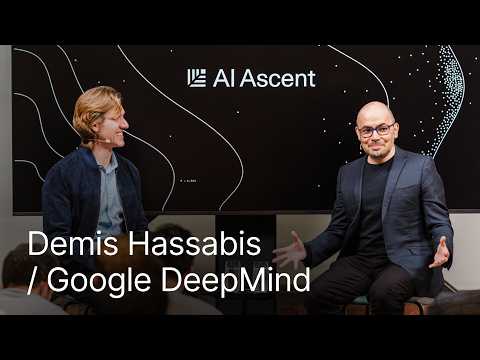
Google DeepMind's Hassabis Targets 2030 for AGI as AlphaFold Reshapes Biology
Sequoia Capital
Artificial general intelligence will arrive by the end of the decade, transforming drug discovery from a ten-year process into digital simulations that take mere days.
## Background
Published on YouTube by Sequoia Capital on April 29, 2026, this video features a wide-ranging conversation between DeepMind co-founder Demis Hassabis and Sequoia partner Konstantine Buhler at AI Ascent 2026. The page description outlines their discussion on the path to AGI by 2030, the radical acceleration of AI-driven drug discovery, and a philosophical shift toward viewing information as the fundamental substance of the universe.
## TL;DR
Demis Hassabis traces his journey from a childhood chess prodigy and game developer to founding DeepMind with a singular, 20-year mission to achieve artificial general intelligence. He highlights major breakthroughs like AlphaFold and explains how machine learning serves as the ideal description language for highly complex, emergent biological systems. Looking forward, Hassabis discusses shifting drug discovery entirely to digital simulations, redefining the universe through an information-first paradigm, and navigating the profound philosophical questions surrounding AI agency and consciousness.
## Atmosphere & style
The dialogue feels intellectually exhilarating and deeply visionary, balancing grounded technical expertise with a sense of cosmic wonder. Hassabis speaks with the calm, methodical confidence of a veteran pioneer who has spent decades executing a singular plan, injecting lighthearted humor when reflecting on early hardware limitations or gaming strategy. The interaction between the host and speaker creates an inspiring, philosophical atmosphere where cutting-edge computer science seamlessly blends with high-level physics and classical philosophy.
## Key takeaways
- [00:02](https://www.youtube.com/watch?v=AFpeWo1GTeg&t=2s) Demis Hassabis has maintained a singular, deliberate plan since his mid-teens to build artificial general intelligence (AGI), strategically choosing his work in gaming and neuroscience to serve this goal.
- [00:02](https://www.youtube.com/watch?v=AFpeWo1GTeg&t=2s) Hassabis' early background in the 1990s gaming industry provided early exposure to advanced hardware and graphics engines that evolved into today's AI-powering GPUs.
- [02:52](https://www.youtube.com/watch?v=AFpeWo1GTeg&t=172s) A key lesson Hassabis took from his first startup, Elixir Studios, is that founders should aim to be 5 years ahead of their time rather than 50, as being too far ahead of available hardware limits success.
- [04:39](https://www.youtube.com/watch?v=AFpeWo1GTeg&t=279s) In 2009, DeepMind was founded on the then-unpopular bet that combining deep learning and reinforcement learning could scale all the way to achieving AGI.
- [07:25](https://www.youtube.com/watch?v=AFpeWo1GTeg&t=445s) DeepMind operates on a strict 20-year mission laid out in 2010 to first solve intelligence (AGI) and then use it to solve everything else.
- [07:25](https://www.youtube.com/watch?v=AFpeWo1GTeg&t=445s) Beyond commercial utility, Hassabis views AI as a powerful tool for neuroscience, allowing controlled experiments to study complex cognitive phenomena like consciousness and creativity.
- [08:51](https://www.youtube.com/watch?v=AFpeWo1GTeg&t=531s) AlphaGo served as the ultimate proof-of-concept for DeepMind, demonstrating that their general algorithms could successfully transition from games to massive, real-world scientific challenges.
- [08:51](https://www.youtube.com/watch?v=AFpeWo1GTeg&t=531s) Through Isomorphic Labs and AlphaFold, the ultimate objective is to move 99% of drug discovery into digital simulations (in silico), potentially compressing a 10-year timeline down to days.
- [12:41](https://www.youtube.com/watch?v=AFpeWo1GTeg&t=761s) AI will enable highly accurate simulators for complex emergent fields like economics and social sciences, allowing rigorous scenario testing that is impossible in the real world.
- [15:12](https://www.youtube.com/watch?v=AFpeWo1GTeg&t=912s) Machine learning functions as the ideal description language for biology and complex systems, which contain weak signals and data volumes too overwhelming for traditional mathematics.
- [15:12](https://www.youtube.com/watch?v=AFpeWo1GTeg&t=912s) Hassabis envisions a future branch of science where fundamental explicit equations, similar to Maxwell's equations, can be extracted from implicit machine learning simulators.
- [17:18](https://www.youtube.com/watch?v=AFpeWo1GTeg&t=1038s) Hassabis proposes an 'information-first' paradigm of the universe, arguing that information shares an equivalence with matter and energy and that biological systems are fundamentally information processing systems.
- [17:18](https://www.youtube.com/watch?v=AFpeWo1GTeg&t=1038s) AlphaFold demonstrated that classical Turing machines, utilizing modern neural networks, can approximate optimal solutions for quantum systems like protein folding without requiring quantum hardware.
- [20:29](https://www.youtube.com/watch?v=AFpeWo1GTeg&t=1229s) Hassabis strongly advocates for a phased approach to AGI: building an incredibly precise, advanced tool first before attempting to cross the Rubicon into tackling autonomous machine agency and consciousness.
- [20:29](https://www.youtube.com/watch?v=AFpeWo1GTeg&t=1229s) Closing the experiential gap regarding machine consciousness is uniquely difficult due to a lack of 'substrate equivalence' between biological brains and artificial systems.
- [23:33](https://www.youtube.com/watch?v=AFpeWo1GTeg&t=1413s) Hassabis' worldview is heavily influenced by Immanuel Kant's philosophy that the mind creates reality and Baruch Spinoza's spiritual, deterministic view of decoding the universe through science.
- [25:04](https://www.youtube.com/watch?v=AFpeWo1GTeg&t=1504s) Hassabis maintains his definitive over/under timeline prediction that AGI will be achieved by the year 2030.
## Detailed walkthrough
### [00:02](https://www.youtube.com/watch?v=AFpeWo1GTeg&t=2s) The Common Thread: From Chess Prodigy to AI Pioneer
Demis Hassabis is introduced as one of the "OGs" of artificial intelligence—an original thinker, founder, and visionary. When asked how his seemingly disparate background as a chess prodigy, game developer, neuroscientist, and now leader of Google DeepMind connects, Hassabis explains that he has had a singular plan since he was 15 or 16 years old: to build artificial general intelligence (AGI). He deliberately chose fields of study and work that would eventually help him achieve this goal.
During the 1990s, Hassabis took a detour into the gaming industry because it was the absolute cutting edge of technology, particularly in graphics and hardware. He notes that the GPUs powering today's AI revolution were originally designed for graphics engines, and he was using the very first iterations of them in the late '90s. Every game he developed, including his work at Bullfrog Productions and his own Elixir Studios, utilized AI as a core gameplay component.
* **Theme Park (1994):** Written when Hassabis was just 17, this amusement park simulation featured an underlying economic AI model that governed the behavior of thousands of virtual visitors. It sold over 10 million copies, and seeing players' delight in interacting with the AI cemented his decision to dedicate his career to the field.
* **Neuroscience as Inspiration:** Hassabis later pursued neuroscience to gain algorithmic inspiration from how the human brain works, eventually bringing all these threads together to launch DeepMind when the timing was right.
---
[02:52](https://www.youtube.com/watch?v=AFpeWo1GTeg&t=172s) Lessons from Elixir Studios: "5 Years Ahead, Not 50"
Reflecting on his first startup, Elixir Studios, which he founded straight out of college, Hassabis shares a crucial lesson for the room of founders: "you want to be 5 years ahead of your time, not 50 years ahead." At Elixir, he was essentially funding AI research through the back door of game development. However, their ambitions sometimes outpaced the hardware of the era.
He points to their game *Republic*, which attempted to simulate an entire living, breathing country with a million simulated citizens. Trying to run complex graphics and AI for a million people on a late-1990s Pentium processor was incredibly difficult. While being ahead of the curve is necessary to avoid being late to a market, being too far ahead makes success nearly impossible. Hassabis carried this vital lesson with him when planning the launch of DeepMind.
---
[04:39](https://www.youtube.com/watch?v=AFpeWo1GTeg&t=279s) The Early Days of DeepMind and the Skepticism of 2009
In 2009, when Hassabis decided to build a company dedicated to AGI, the concept was widely dismissed as science fiction. To convince brilliant talents to join him, he relied on a few key insights that felt like a "secret" at the time. Deep learning had just been invented by Geoffrey Hinton and his colleagues, but almost no one in academia or industry realized its significance. Hassabis and his co-founders believed that combining deep learning with reinforcement learning—two fields that were highly siloed at the time—could scale all the way to AGI.
Academia was deeply skeptical, with researchers literally rolling their eyes at the mention of AGI or "strong AI." The academic establishment was still dominated by the legacy of expert systems and logic language systems from the 1990s, which Hassabis already viewed as archaic. This widespread skepticism actually increased his confidence:
> "At least if we were going to fail, we would fail in a different way than people had failed, you know, to get to AGI in the '90s... we would fail in an original way if it didn't work."
---
[07:25](https://www.youtube.com/watch?v=AFpeWo1GTeg&t=445s) The 20-Year Mission and AI as the Ultimate Scientific Tool
Hassabis states that he would have dedicated his life to AI regardless of its commercial success because he has always viewed it as the most important and interesting technology ever created. In 2010, DeepMind laid out a 20-year mission, and Hassabis believes the field is currently exactly on track to meet that timeline.
DeepMind's original two-step mission statement was simple:
1. "Step one, solve intelligence, i.e., build AGI."
2. "Step two, use it to solve everything else."
For Hassabis, AI is not just a commercial product but the ultimate tool for scientific discovery and a mirror for understanding the human mind. As a neuroscientist, he saw AI as a way to run controlled experiments to study complex phenomena like consciousness, dreaming, and creativity by comparing artificial systems against biological ones.
---
[08:51](https://www.youtube.com/watch?v=AFpeWo1GTeg&t=531s) AI for Science: From AlphaGo to AlphaFold
DeepMind's commitment to scientific breakthrough is not a recent pivot; the company has hosted a dedicated "AI for Science" division, led by Pushmeet Kohli, for nearly a decade. Hassabis recalls that this effort formally began almost the day after they returned from the historic AlphaGo match in Seoul. For Hassabis, cracking the game of Go was the proof-of-concept showing that their algorithms were powerful and general enough to tackle massive, real-world scientific challenges.
The most prominent breakthrough of this initiative is AlphaFold, which solved the 50-year-old grand challenge of protein folding. Understanding the 3D structure of proteins is fundamental to biology and drug design. To build on this, Hassabis also runs Isomorphic Labs, a spin-out focused on using AI to design chemical compounds that can precisely bind to these target proteins without causing toxic side effects.
* **In Silico Exploration:** The ultimate goal is to shift 99% of the drug discovery process—which currently takes an average of 10 years—into digital simulations (*in silico*), leaving wet labs purely for final validation.
* **The Timeline:** Hassabis believes that in the next few years, this approach could compress drug discovery timelines from years down to months, weeks, or even days, bringing personalized medicine and cures for major diseases within reach.
---
[12:41](https://www.youtube.com/watch?v=AFpeWo1GTeg&t=761s) Unlocking New Sciences and the Power of Simulation
Looking to the future, Hassabis predicts that AI will give rise to entirely new scientific disciplines. First, the analysis and engineering of AI systems themselves will become a formal science, akin to studying the human mind as these systems reach equivalent levels of complexity.
Second, Hassabis is incredibly excited about "AI for simulations." Because fields like economics and social sciences are emergent systems, they cannot easily be studied with the rigorous, repeatable controlled experiments used in physics. In the real world, policy decisions like raising interest rates cannot be tested thousands of times to observe the outcomes. However, highly accurate AI-driven simulators will allow researchers to rigorously sample and run thousands of scenarios, turning historically uncertain domains into precise, data-driven sciences.
[15:12](https://www.youtube.com/watch?v=AFpeWo1GTeg&t=912s) Machine Learning as the Language of Biology and Complex Systems
The discussion begins with the limitations of traditional, hand-coded simulators. For highly complex, dynamical, and emergent systems, we cannot simply write down a special-case simulator directly; it is not accurate enough and fails to capture all the variables. This challenge was successfully tackled in weather modeling with "Weather Next," which is the most accurate weather simulator in the world and operates far faster than the tools meteorologists traditionally use. When asked if they can control the weather yet, Demis Hassabis laughs and says, "No, we can't... and I'm not sure that would be a good idea." The first step is simply to understand it better.
This approach extends directly to biology, where Google DeepMind is working on a "virtual cell." Hassabis argues that machine learning is the perfect description language for biology in the same way that mathematics is for physics. Biology and other natural systems are defined by massive amounts of data containing weak signals, weak correlations, and complex causalities that are far too overwhelming for any human mind to analyze. Historically, mathematics has struggled to describe these highly emergent, stochastic, and messy dynamical systems because they are either too complex for top mathematicians to manage or because the expressive power of math itself is insufficient.
- **The Future of Science:** Hassabis suggests that once these implicit, intuitive machine learning simulators are learned, a new branch of science might emerge where researchers can extract explicit, fundamental equations from them by sampling the simulators an infinite number of times.
- **Maxwell's Equations of Biology:** When asked if these extracted equations could ever be as fundamental as Maxwell's equations, Hassabis muses, "Maybe. If they do exist, I don't see why we won't be able to find them with these methods."
---
[17:18](https://www.youtube.com/watch?v=AFpeWo1GTeg&t=1038s) Information as the Fundamental Building Block of the Universe
The conversation shifts to a more theoretical topic: the idea that the basic building block of everything in the universe is information. Hassabis explains that while Einstein proved the equivalence of energy and matter ($E=mc^2$), he believes information shares a similar equivalence. He views the organization of matter, structure, and especially biological systems—which actively resist entropy—as information processing systems at their core.
This perspective reverses the classical 1920s physics paradigm that treated matter and energy as primary. If the universe is understood as "information first," then the role of AI becomes even more profound. AI is not just a utility; it is a fundamental tool for organizing, understanding, and constructing information and physical objects.
- **Turing's Champions:** Hassabis refers to his team as "Turing's champions." He names Alan Turing as one of his all-time favorite scientific heroes, noting that Turing's proof—that anything computable can be computed by a relatively simple machine—is one of the most profound scientific results in history.
- **The Brain as a Turing Machine:** Hassabis states that human brains are likely "approximate Turing machines."
- **Classical vs. Quantum Modeling:** While protein folding is fundamentally a quantum system dealing with tiny particles and water bonds, AlphaFold proved that a classical Turing machine (in the guise of a modern neural network) can achieve an approximate optimal solution. This suggests many systems thought to require quantum computers to run can actually be modeled on classical hardware if approached the right way.
---
[20:29](https://www.youtube.com/watch?v=AFpeWo1GTeg&t=1229s) AI as a Tool, Agency, and the Nature of Consciousness
The interviewer notes that Hassabis has consistently described AI as a tool, comparing it to historical instruments like the telescope, microscope, or astrolabe. He asks when a machine capable of modeling almost anything stops being a tool. Hassabis strongly advocates for a two-step approach to building Artificial General Intelligence (AGI): "It would be best to build a tool first—an incredibly intelligent and useful and precise tool—and then cross the next sort of Rubicon."
While we are currently in the "agent era" where tools are becoming autonomous, the subsequent step of addressing agency and consciousness should be treated as a separate, second phase. Hassabis suggests we can actually use the highly advanced tools from the first phase to help us understand our own brains, define consciousness more precisely, and tackle these profound existential questions.
- **Defining Consciousness:** Hassabis admits he has little to add beyond thousands of years of philosophy, but notes that necessary (though perhaps not sufficient) components of consciousness include self-awareness, the concept of self versus other, and continuity over time.
- **The Substrate Barrier:** In past conversations with the late philosopher Daniel Dennett, Hassabis discussed how we attribute consciousness to other humans because they behave like us and run on the same biological substrate. Because we will never have "substrate equivalence" with an artificial system, closing the experiential gap between humans and AI will always remain a difficult challenge.
---
[23:33](https://www.youtube.com/watch?v=AFpeWo1GTeg&t=1413s) Philosophical Influences: Kant and Spinoza
When asked how he connects his admiration for Immanuel Kant (a deontological, duty-driven philosopher) and Baruch Spinoza (who held a deterministic view of the universe), Hassabis explains how both shaped his worldview. During his PhD in neuroscience, Kant’s assertion that "the mind creates reality" deeply resonated with him. To understand the nature of reality, one must first understand how the mind interprets it.
Spinoza, on the other hand, provides a spiritual dimension to scientific inquiry. For Hassabis, using science and AI to understand the universe is a way of decoding a deep, beautiful mystery. He describes his daily work as "reading the language of the universe."
The session concludes with a series of lighthearted, rapid-fire questions:
- **Over/Under on the Distribution Year of AGI:** Hassabis sticks to his consistent prediction of **2030**.
- **Must-Read Book for the Post-AGI Era:** *The Fabric of Reality* by David Deutsch. Hassabis jokes that his post-AGI work will be trying to answer the questions raised in that book.
- **Proudest Moment at DeepMind:** The breakthrough of **AlphaFold**.
- **Historical Scientist Draft Pick for a High-Stakes Strategy Game (e.g., *Civilization* or *Polytopia*):** **John von Neumann**. Hassabis explains, "You want a game theorist, I think. And I think he's the best... I feel he'd be a good teammate."
## Notable quotes
> [04:39](https://www.youtube.com/watch?v=AFpeWo1GTeg&t=279s) At least if we were going to fail, we would fail in a different way than people had failed, you know, to get to AGI in the '90s... we would fail in an original way if it didn't work. — Demis Hassabis
> [07:25](https://www.youtube.com/watch?v=AFpeWo1GTeg&t=445s) Step two, use it to solve everything else. — Demis Hassabis
> [02:52](https://www.youtube.com/watch?v=AFpeWo1GTeg&t=172s) you want to be 5 years ahead of your time, not 50 years ahead. — Demis Hassabis
> [15:12](https://www.youtube.com/watch?v=AFpeWo1GTeg&t=912s) No, we can't... and I'm not sure that would be a good idea. — Demis Hassabis
> [15:12](https://www.youtube.com/watch?v=AFpeWo1GTeg&t=912s) Maybe. If they do exist, I don't see why we won't be able to find them with these methods. — Demis Hassabis
> [23:33](https://www.youtube.com/watch?v=AFpeWo1GTeg&t=1413s) reading the language of the universe. — Demis Hassabis
> [20:29](https://www.youtube.com/watch?v=AFpeWo1GTeg&t=1229s) It would be best to build a tool first—an incredibly intelligent and useful and precise tool—and then cross the next sort of Rubicon. — Demis Hassabis
> [23:33](https://www.youtube.com/watch?v=AFpeWo1GTeg&t=1413s) the mind creates reality — Immanuel Kant
> [25:04](https://www.youtube.com/watch?v=AFpeWo1GTeg&t=1504s) You want a game theorist, I think. And I think he's the best... I feel he'd be a good teammate. — Demis Hassabis
## Mentioned
Demis Hassabis, Konstantine Buhler, Google DeepMind, Sequoia Capital, AI Ascent 2026, Bullfrog Productions, Elixir Studios, Theme Park, Republic, Geoffrey Hinton, Pushmeet Kohli, AlphaGo, AlphaFold, Isomorphic Labs, Weather Next, Albert Einstein, Alan Turing, Daniel Dennett, Immanuel Kant, Baruch Spinoza, The Fabric of Reality, David Deutsch, Civilization, Polytopia, John von Neumann
Google DeepMind co-founder Demis Hassabis argues that artificial general intelligence is progressing on a predictable multi-decade timeline toward realization around 2030, functioning primarily as the ultimate instrument for scientific discovery.
The Twenty-Year Trajectory to Solve Intelligence (4:39)
Hassabis traces his focus on artificial general intelligence (AGI) to a singular plan formed in his teens, combining game development, hardware insights, and neuroscience. His early work on titles such as Theme Park (1994), which sold over 10 million copies, deployed artificial intelligence for economic simulation. However, his startup Elixir Studios illustrated the hazard of outpacing available hardware when attempting to simulate one million citizens on late-1990s Pentium processors, yielding the operating principle to be five years ahead rather than fifty.
When founding DeepMind in 2010, Hassabis and his team established a 20-year mission structured in two steps: solve intelligence, then use it to solve everything else. DeepMind pursued the combination of deep learning and reinforcement learning at a time when the academic establishment dismissed AGI and remained focused on 1990s-era expert systems. Hassabis states that the field is currently on schedule to fulfill that 20-year roadmap.
Machine Learning as the Language of Complex Science (8:51)
DeepMind treated its 2016 AlphaGo victory as algorithmic proof that general methods could address complex real-world systems, immediately prompting the formal establishment of an AI for Science division. The initiative's primary breakthrough, AlphaFold, solved the 50-year-old protein folding problem. Through the spin-out Isomorphic Labs, Hassabis aims to shift 99% of drug discovery into digital simulations (in silico), aiming to compress development cycles from an average of 10 years down to months, weeks, or days.
Hassabis posits that machine learning represents the natural descriptive language for biology and emergent phenomena in the same manner mathematics serves physics. Because biological systems, weather patterns (such as DeepMind's Weather Next), and social dynamics contain weak signals and messy correlations that elude traditional hand-coded equations, AI simulators can model them directly. Over time, Hassabis suggests researchers may be able to extract fundamental, explicit equations from these learned models through repeated sampling.
Information Primacy, Classical Computation, and Consciousness (17:18)
Reversing classical physics paradigms, Hassabis views information as a fundamental building block of the universe equivalent to energy and matter, citing biological systems as mechanisms that actively organize information against entropy. Guided by Alan Turing's thesis that any computable process can run on a simple machine, Hassabis characterizes human brains as approximate Turing machines. He points to AlphaFold as proof that classical neural network architectures can calculate approximate solutions to quantum-scale molecular systems without requiring quantum computers.
Regarding the path forward, Hassabis advocates a two-step framework: building AI strictly as an exact, useful tool before addressing autonomous agency and consciousness. While tools are now entering the agent era, Hassabis notes that defining machine consciousness presents a fundamental barrier. Referring to discussions with philosopher Daniel Dennett, Hassabis emphasizes that because artificial systems lack biological substrate equivalence with humans, bridging the experiential and verification gap between human and machine minds remains an enduring challenge.
Hassabis maintains an estimated arrival date of 2030 for the widespread distribution of AGI. Open questions remain over whether fundamental governing equations can be extracted from biological AI simulators and how researchers will evaluate consciousness in non-biological substrates.
[4:39] Demis Hassabis: At least if we were going to fail, we would fail in a different way than people had failed, you know, to get to AGI in the '90s... we would fail in an original way if it didn't work.
[7:25] Demis Hassabis: Step one, solve intelligence, i.e., build AGI.
[7:25] Demis Hassabis: Step two, use it to solve everything else.
[2:52] Demis Hassabis: you want to be 5 years ahead of your time, not 50 years ahead.
[15:12] Demis Hassabis: No, we can't... and I'm not sure that would be a good idea.
[15:12] Demis Hassabis: Maybe. If they do exist, I don't see why we won't be able to find them with these methods.
[23:33] Demis Hassabis: reading the language of the universe.
[20:29] Demis Hassabis: It would be best to build a tool first—an incredibly intelligent and useful and precise tool—and then cross the next sort of Rubicon.
[23:33] Immanuel Kant: the mind creates reality
[25:04] Demis Hassabis: You want a game theorist, I think. And I think he's the best... I feel he'd be a good teammate.
Original transcript
[0:02] Demis, thank you so much.
[0:03] >> Exciting to be here. Um, thanks everyone
[0:05] for coming. It's great to be here.
[0:06] >> We're we're so honored to have you at
[0:08] our chocolate factory.
[0:09] >> Yes, I had just heard about that. Yeah,
[0:11] looking forward to the chocolate
[0:12] afterwards.
[0:13] >> Excellent. Well, Demis, we're going to
[0:15] jump right in. We have one of the
[0:18] OGs in every way. Uh, original thinkers,
[0:21] founders, visionaries in all things AI.
[0:24] A true believer, true scientist in in
[0:27] Demis.
[0:28] Uh, we're going to spend the beginning
[0:29] of the conversation about the early
[0:31] days.
[0:32] Then early days of DeepMind, and then
[0:34] we'll get into the science and open up
[0:35] the room for some questions. So, let's
[0:36] jump right in.
[0:38] So, Demis, you were a chess prodigy.
[0:40] Uh, you also were a founder of a gaming
[0:43] company.
[0:44] You're a neuroscientist,
[0:46] and you're the founder of DeepMind, and
[0:48] now leader of a really big consequential
[0:50] company.
[0:51] Those seem like pretty unrelated pieces,
[0:54] but you've said that there's a common
[0:55] thread.
[0:56] Can you walk us through that?
[0:58] >> There is a common thread, and um,
[1:01] maybe I made it into a common thread.
[1:02] So, it could be a post talk, you know,
[1:04] sort of shaping. But, I wanted to do AI
[1:08] for a long time. So, I kind of decided
[1:10] it was the most important thing I could
[1:11] possibly and most interesting I could do
[1:13] in my teenage years.
[1:16] And then I picked things to study or do
[1:18] that I felt would eventually would help
[1:20] me
[1:21] build a company like DeepMind. So, I I
[1:24] had that
[1:25] as a plan from about 15, 16 years old. I
[1:29] had a detour into games because actually
[1:31] that was in the '90s, this is,
[1:34] that's where all the most cutting edge
[1:35] technology was being done.
[1:37] Obviously, not just in AI, but in
[1:38] graphics especially, including hardware
[1:41] of course. The GPUs we all use today,
[1:42] they were designed for graphics engines,
[1:44] and we use the I mean, I was using the
[1:46] very first GPUs back in the day in the
[1:47] late '90s.
[1:49] So, there was a lot of really cutting
[1:51] edge technology, and then all the games
[1:53] I made, including all the games I did
[1:55] for Bullfrog, but also my own company,
[1:56] Elixir Studios, all involved AI as the
[2:00] main gameplay component. So, probably
[2:02] the most, you know, well-known game I
[2:04] made was Theme Park when I was about 17,
[2:07] and that was a simulation of an
[2:09] amusement park, and thousands of little
[2:11] people came into your theme park and
[2:13] played on your rides and decided what to
[2:15] buy from the shops. So, there was a
[2:16] whole kind of economics AI model
[2:17] underneath. And it was one of the first
[2:19] games of its type along with SimCity.
[2:22] And when I saw it sold, you know, 10
[2:24] million plus copies, and when I saw how
[2:25] delighted people were to interact with
[2:27] the AI, you know, that was one of the
[2:29] things that made me think about spending
[2:31] my whole career on it. Um and then, of
[2:33] course, neuroscience
[2:35] is to get inspiration from how the brain
[2:37] works, and
[2:39] and and different algorithmic ideas from
[2:40] that, and then just bringing all those
[2:42] different things together for the start
[2:44] of DeepMind when the timing we felt was
[2:46] right. And then, of course, we use games
[2:48] as the early proving ground for our AI
[2:50] ideas.
[2:51] >> Mhm.
[2:52] So, we've got a room full of founders
[2:54] here,
[2:55] and you can relate because you're a
[2:57] founder not just once, but twice.
[2:59] >> Mhm.
[2:59] >> Take us back to the first time. Elixir
[3:01] Studios.
[3:02] >> Mhm.
[3:02] >> What was that like? It's not the startup
[3:05] that you're most known for,
[3:06] >> Mhm.
[3:07] >> but it was one that you had incredible
[3:08] success with.
[3:09] >> Mhm.
[3:09] >> How did you lead that, and what did it
[3:10] teach you about building?
[3:12] >> Well, look, we we we start I started
[3:14] Elixir Studios straight out of college,
[3:16] um and uh I was lucky enough to work at
[3:19] Bullfrog Productions, which, those of
[3:21] you know games, it was a kind of
[3:22] legendary game studio
[3:24] uh in the early days of the game
[3:25] industry, probably the best one in the
[3:26] UK in in Europe. And uh I wanted to do
[3:30] something that combined uh pushed AI.
[3:33] So, effectively, I was funding AI back
[3:35] in those days through the back door,
[3:36] through games development.
[3:38] Um and then push the the forefront of
[3:41] that and combine it with cutting-edge
[3:42] creativity. And I think that's still
[3:44] relevant today with the way we do our
[3:46] blue sky research, but maybe the biggest
[3:48] lesson I learned was you want to be um 5
[3:51] years ahead of your time, not 50 years
[3:52] ahead. So, we tried to do a game called
[3:55] Republic at Elixir Studios which
[3:57] simulated a whole country, and then the
[3:59] idea of the game is you could sort of um
[4:02] overthrow, I think there was a dictator
[4:04] in charge of the country in any number
[4:06] of different ways. And we basically
[4:07] simulated living, breathing cities. And
[4:09] this is Bearing in mind, this is like
[4:10] the late '90s on a Pentium. So, we had
[4:13] to get all the graphics and all the AI
[4:15] for million people
[4:16] um working on uh you know, home PC at
[4:19] the time. So, it was a little bit
[4:20] ambitious. And um
[4:23] and maybe it was too ambitious. And it
[4:25] caused it caused probably some some
[4:26] issues. And I took that lesson with me
[4:28] of like, you want to be ahead of your
[4:30] time, you don't want to be obviously
[4:31] when it's obvious to everyone, it's too
[4:33] late. But um if you're 50 years ahead,
[4:36] then there's probably no way you can get
[4:38] it to be successful.
[4:39] >> All right. So, speaking of not being too
[4:41] far ahead of your time, it was 2009 and
[4:44] you decided there would be AGI.
[4:45] >> Mhm.
[4:46] Yes.
[4:47] >> [laughter]
[4:48] >> Maybe it was only you know, 10 years
[4:49] ahead of our time that time. Better than
[4:51] 50 years.
[4:52] >> So, so tell us about again, room full of
[4:54] founders here. Tell us about '09.
[4:57] How did you convince the first few
[4:59] brilliant talents? Cuz you pulled in
[5:01] really high-caliber employees, early
[5:03] team members. How did you convince them
[5:05] to believe in what seemed like total
[5:07] sci-fi at the time?
[5:09] >> Well, there was some interesting threads
[5:11] that I think we picked up on. I I think
[5:13] we thought we were 5 years ahead, but
[5:15] maybe we were more like 10. But it was,
[5:16] you know, deep learning had just been
[5:18] invented by Jeff Hinton and colleagues
[5:20] sort of in academia, but almost no one
[5:22] had really realized it was a big deal.
[5:26] Uh we knew a lot about reinforcement
[5:28] learning, and we felt there was huge
[5:30] progress to be made by combining those
[5:32] two techniques which almost had never
[5:34] been mixed together really, certainly
[5:35] not at any kind of anything other than
[5:38] toy problems. Uh in the academic
[5:40] subjects, they're quite two quite siloed
[5:42] parts of AI.
[5:44] Um then we could see the compute uh the
[5:46] GPUs at the time were going to be really
[5:48] useful. Of course, we use TPUs now, um
[5:50] but the accelerated computing industry
[5:52] was was was going to be very helpful. Uh
[5:55] and then we also felt at the end of my
[5:57] PhD and post-doc and some of the other
[5:58] people I got together were computational
[6:01] neuroscientists that we had enough ideas
[6:03] and principles um from the brain that
[6:06] could be useful, including the idea that
[6:07] reinforcement learning uh could
[6:09] eventually scale uh to AGI. So, um so we
[6:13] felt we had these ingredients and we
[6:15] almost felt like we were keepers of a
[6:16] secret because no one uh either in
[6:19] academia or industry really believed
[6:21] that any big progress was possible. In
[6:23] fact, a lot of the people in academia uh
[6:25] used to roll out that that, you know,
[6:27] literally rolled their eyes up at us
[6:29] when we were sort of suggesting we would
[6:30] work on AGI or strong AI, as it was
[6:33] sometimes called at the time, um because
[6:35] it was like, "Well, we know this doesn't
[6:36] work. So, you know, everyone tried it in
[6:38] the '90s." You know, I did my post-doc
[6:40] at MIT, which was the which was the sort
[6:42] of center uh
[6:44] uh point for expert systems. Um uh and
[6:48] first all the logic language systems. I
[6:49] mean, it seems amazing to think that
[6:51] now, but I was already feeling that that
[6:53] was archaic then, but they they, you
[6:55] know, that's still how it was done both
[6:56] in Cambridge in the UK and also in MIT,
[6:59] these big centers of traditional AI. Um
[7:02] and it felt like, but actually that
[7:03] convinced me even more that we were onto
[7:05] something because at least if we were
[7:07] going to fail, we would fail in a
[7:09] different way than people had failed,
[7:11] you know, to get to AGI in the '90s. So,
[7:14] that felt like it was worth doing uh no
[7:16] matter what, even if obviously it was
[7:17] research, we didn't know for sure it
[7:19] would be successful, but at least we
[7:20] would we would fail in a original way if
[7:23] it didn't work.
[7:25] >> Was there any common sticking point in
[7:27] that early belief? Was there something
[7:28] that you had to prove either to yourself
[7:30] or to your early followers to get them
[7:32] on board?
[7:33] >> Well, it was
[7:34] I mean, we had Put it this way. I would
[7:37] have been spent my life on AI um no
[7:39] matter what had happened. So, as it's
[7:41] turned out, it's gone
[7:43] you know, it's sort of gone on the
[7:45] absolutely amazing side of the
[7:47] optimistic side of what we thought.
[7:48] Still actually within what we were
[7:49] predicting in 2010, we thought it would
[7:51] be a 20-year mission.
[7:53] And I think we're basically exactly on
[7:55] track as a field for that, and obviously
[7:57] we played our part in that. But even if
[7:59] it hadn't transpired that way, and it
[8:01] was still now niche subject, that's all
[8:04] that's what I would still be doing
[8:06] because I felt it was the most important
[8:08] technology ever. It feels obvious to me,
[8:11] you know, our original state mission
[8:12] statement at DeepMind was step one,
[8:14] solve solve intelligence, I build AGI.
[8:16] Step two, use it to solve everything
[8:18] else. So, it was always I always thought
[8:20] it was the most important technology
[8:22] that could ever be invented, but also
[8:24] the most interesting one. So, as a tool
[8:27] for science, as an interesting artifact
[8:29] in itself, and actually as one of the
[8:31] best ways to understand our own minds,
[8:33] you know, like the nature of
[8:34] consciousness, dreaming, creativity, all
[8:36] of these questions I had as a
[8:38] neuroscientist, I felt one of the things
[8:40] that was missing was an analysis tool
[8:42] like AI, but also a comparison, a that
[8:45] you could do sort of a controlled
[8:46] experiment, study, and compare
[8:50] two different systems against each
[8:51] other.
[8:51] >> Mhm. Let's talk about AI for science.
[8:54] You've been early to that, you've been a
[8:55] believer, and you've been really a
[8:57] purist about this. This is the driving
[8:59] mission. What about the way you set up
[9:01] DeepMind and set the culture has
[9:03] positioned it to be on the constant
[9:05] forefront of AI for science?
[9:08] >> Well, that was the
[9:10] the ultimate goal, at least for me, my
[9:12] personal passion. There's one There's my
[9:13] own drive to build AI, which was to
[9:16] advance science and medicine and and our
[9:17] understanding of the world. It's my
[9:19] expression of that mission was to sort
[9:22] of do it in a meta way, right? Build the
[9:24] build the the ultimate tool, and then
[9:26] come back when that was ready and use it
[9:28] to make breakthroughs in science, things
[9:30] like AlphaFold that we've done, and I
[9:32] think many more things. So, we've always
[9:34] had that at the heart of what we've been
[9:36] trying to do at DeepMind. So, actually,
[9:37] we've had an AI for science group
[9:39] division
[9:41] led by Pushmeet Kohli that
[9:44] has existed for nearly a decade now.
[9:45] Actually, pretty much the day after we
[9:48] got back from Seoul in the AlphaGo
[9:49] match, which is sort of 10 years to the
[9:52] month now,
[9:53] is when we started formally started the
[9:55] AI for science efforts cuz I was waiting
[9:58] for the algorithms to be powerful enough
[10:00] and the ideas to be general enough
[10:02] and for me, you know, cracking Go was
[10:04] that point, that time
[10:06] that we thought, "Okay, now we're ready
[10:08] to really apply these ideas to important
[10:10] real-world problems starting with these
[10:12] big scientific challenges." So, we've
[10:15] always had that in mind as the the most
[10:18] beneficial use of of AI. Like, what
[10:20] could be better than using it to, you
[10:22] know, cure diseases and give us
[10:24] healthier lifespans and and to help with
[10:26] medicine, followed, obviously, by other
[10:28] really important areas like material
[10:30] science and the environment and energy
[10:32] and these kinds of topics, which I think
[10:34] AI is also going to be have a huge part
[10:36] to play in the next few years.
[10:37] >> And how does AI break through in
[10:40] biology? You're deeply involved with
[10:41] Isomorphic. This is an area of deep
[10:43] passion. You have been a purist on the
[10:46] potential of AI to cure diseases from
[10:48] the very beginning.
[10:50] When do we have the type of moment that
[10:52] we've had in language and coding but in
[10:55] biology?
[10:56] >> Yeah, well, I I mean, I'd argue we've
[10:57] already had one of those moments with
[10:59] AlphaFold. So,
[11:01] you know, this is a 50-year grand
[11:02] challenge, protein folding, and the 3D
[11:05] structure of proteins is incredibly
[11:07] important thing to know about if you
[11:09] want to design medicines or if you want
[11:11] to understand biology. Of course, it's
[11:13] only one part of the drug discovery
[11:15] process, an important part, but it's
[11:16] only one part. So, Isomorphic Labs,
[11:18] which is our,
[11:20] you know, later spin-out, having a lot
[11:22] of fun running that as well, and it is
[11:25] is to build adjacent technologies in
[11:27] more biochemistry and chemistry space
[11:29] that can actually design the compounds
[11:31] automatically to kind of fit and bind to
[11:34] the right part of the protein. So, we
[11:35] now know the protein that the shape of
[11:37] the protein, we know that what's on the
[11:39] on the surface of the protein and what
[11:40] we have to target.
[11:42] Um and but now we've got to build the
[11:43] right compound that of course binds
[11:46] strongly to where you want it to bind on
[11:47] the target of interest, but doesn't bind
[11:49] to anything else ideally cuz that would
[11:51] be a a toxic side effect. So, um the
[11:54] dream is to do almost all the
[11:56] exploration
[11:58] uh which is 99% of the of the work and
[12:00] the time in silico and then save the the
[12:03] the the wet lab step just for the
[12:05] validation step. Right? So, that would
[12:07] be um you know, I think if we can do
[12:09] that and and I think we can get there in
[12:11] the next few years, um I think we could
[12:14] reduce drug discovery times instead of
[12:16] that for taking like, you know, an
[12:17] average of 10 years down to months,
[12:20] maybe even weeks and perhaps even days
[12:22] one day. And um and then I think then
[12:25] all disease could be in reach and I
[12:26] think things like personalized medicine
[12:28] will become possible. Uh you know, like
[12:30] personalized variations off of base
[12:32] medicines. So, uh I think the whole of
[12:36] uh the whole medical area, drug
[12:37] discovery areas is going to be
[12:39] revolutionized in the next in next few
[12:41] years.
[12:41] >> Brilliant. You talked a lot about AI for
[12:44] science.
[12:44] >> Mhm.
[12:45] >> Do you think that at some point AI will
[12:47] create new sciences? Al uh industrial
[12:51] revolution and thermodynamics, will
[12:53] there be something new taught
[12:56] fundamentally in our education system?
[12:58] And if so, what would it be like?
[13:01] >> Well, I think there's several things
[13:03] uh
[13:04] that along those lines that I think we
[13:06] is going to happen. So, first of all, um
[13:09] the understanding and the analysis of AI
[13:12] systems themselves, I think it's going
[13:14] to become a whole science, a kind of
[13:15] engineering science. These incredible
[13:17] incredibly interesting artifacts that we
[13:20] are building and um they're incredibly
[13:23] complex as well. As complex eventually
[13:25] they'll be as complex as the human mind
[13:27] and the brain. And so, they'll need to
[13:30] be studied so we can understand fully,
[13:32] way beyond where we we are today, how
[13:34] these systems work. So, I think there's
[13:36] a whole kind of field mech and tarp is
[13:38] part of that, but there's a lot more, I
[13:40] think, that we can do to analyze uh
[13:42] these systems. So, that'll be a science.
[13:45] But, I think also um
[13:47] AI itself will maybe unlock new
[13:49] sciences, which is maybe what you're
[13:50] getting at. Um I the one I'm
[13:52] particularly excited about is AI for
[13:55] simulations. So, I I love simulations.
[13:58] All my all the games I wrote not only
[14:00] had AI, but they were simulations. And I
[14:02] think simulations is the way we can
[14:04] address some of the um what we maybe
[14:06] think of social sciences uh like
[14:08] economics um
[14:10] and and other more humanistic subjects
[14:12] because um it's very difficult to do
[14:15] control studies in that, you know, why
[14:16] aren't they just sciences like physics
[14:18] today? Because the problem is they're
[14:19] emergent systems um just like biology,
[14:22] actually. And it's very hard to do
[14:24] repeated controlled experiments. You
[14:26] know, if you raise interest rates by
[14:27] half a percent, you have to do it in the
[14:28] real world and then see what happens.
[14:30] You can have theories, but you can't run
[14:31] it thousands of times. But, if you could
[14:34] simulate things uh really accurately,
[14:36] then maybe there's sort of new sciences
[14:39] to be done where you can sort of uh
[14:41] rigorously sample uh from a very
[14:43] accurate simulator.
[14:45] Um and then I think that will turn that
[14:47] give allow us to make much better
[14:48] decisions in these today what are very
[14:51] uncertain
[14:52] uh domains.
[14:54] >> What will it take to get to those
[14:55] extremely accurate simulations? World
[14:58] models? What kind of science is
[14:59] necessary and engineering to get
[15:00] >> Yeah, well, look, I I mean, I'm thinking
[15:02] a lot about that in we do a ton of that
[15:04] work at AI like learning simulators is
[15:07] basically what it'd be. So, you know,
[15:08] these are in domains where you can't We
[15:10] don't know the mathematics of it well
[15:12] enough or it's perhaps too complex. We
[15:13] can't just write We can't just write a
[15:16] uh uh uh directly down a special case
[15:18] simulator. Um Um, it's just not accurate
[15:21] enough, doesn't capture all the
[15:22] variables. Um, we're doing that it was
[15:25] done in with weather.
[15:26] Um, we have the most accurate kind of
[15:28] weather simulator in the world, Weather
[15:30] Next. And it's far faster than what the
[15:32] meteorologists use.
[15:33] >> weather yet?
[15:34] >> No, we can't. We can't, no. And I'm not
[15:36] sure that would be a good idea. But the
[15:38] the first step is to understand it
[15:39] better.
[15:41] Um, and but then even biology, you know,
[15:42] we we're working on a kind of what I
[15:43] call a virtual cell. So, you have hugely
[15:47] um, dynamical emergent system. And I
[15:49] think biology is
[15:51] perfect uh,
[15:52] sort of machine learning is perfect
[15:54] description language for biology in the
[15:56] same way math is for physics. Because I
[15:59] think in biology and in lots of these
[16:00] natural systems you have loads of weak
[16:02] signals, weak correlations, tons of
[16:04] data, far too much than any human mind
[16:07] can analyze. But there are connections
[16:09] and correlations and interesting
[16:11] causalities within that mass of data.
[16:14] So, I think it's sort of it's always
[16:16] struck me that machine learning is the
[16:17] perfect tool
[16:19] to describe those kinds of systems.
[16:21] Where until today, you know, mathematics
[16:24] hasn't been able to do that. Either
[16:26] because we can't manage it as as top
[16:28] mathematicians cuz too complex or the
[16:31] expressive power of math is not enough
[16:33] for
[16:34] to understand these sort of highly
[16:37] emergent dynamical systems.
[16:38] >> Is it also because of the messiness and
[16:40] stochastic nature of Yeah, sure.
[16:42] >> And and I mean eventually you could by
[16:44] the way, once you learn these
[16:45] simulators, it maybe there's maybe
[16:47] there's another branch of new branch of
[16:49] science. You could maybe extract some
[16:51] equations from the once you have the
[16:54] simulator. So, you have this sort of
[16:56] implicit simulator or intuitive
[16:57] simulator and then maybe you could
[16:59] extract explicit equations from that.
[17:02] Um, because partly cuz you could also
[17:05] sample it as many times as you want.
[17:07] >> As fundamental as Maxwell's or
[17:09] >> Maybe. If if I don't know that exists
[17:11] for such emergent systems, um, but if
[17:13] they do exist, I don't see we we won't
[17:15] be able to find them in this with this
[17:17] with this methods.
[17:18] >> That would be amazing. You've talked
[17:20] about this theory that the basic
[17:22] building block of of everything in the
[17:24] universe could be information like. This
[17:26] is more theoretical. How do you think
[17:28] about it that and what does that mean
[17:29] for
[17:31] a traditional classical Turing computer?
[17:33] >> Well, look, I think you can of course
[17:35] all the famous, you know, equals mc
[17:37] squared and all the stuff Einstein did
[17:39] and energy and matter are kind of
[17:40] equivalent.
[17:41] But I actually think information has a
[17:44] kind of equivalence in the same way. So
[17:46] you can think of, you know, the
[17:47] organization of matter and structure and
[17:49] especially things like biology that are
[17:51] resisting entropy as basically
[17:54] information processing systems at their
[17:56] heart. So I think one can convert all of
[17:58] those three kind of quantities into each
[18:00] other, but I have this feeling
[18:02] information is most fundamental. So it's
[18:04] a little bit the opposite way around to
[18:06] the classic physicist thought in the
[18:08] 1920s and things where, you know, it's
[18:10] sort of energy and matter primary.
[18:13] I actually think it's a better to to
[18:14] better way to understand the world the
[18:17] universe is to think about it as
[18:18] information first. And if that's true,
[18:21] and I think there's quite a lot of
[18:22] evidence for that, then of course AI is
[18:25] even more
[18:26] sort of profound in a sense
[18:28] >> Totally.
[18:28] >> than we think and it's already pretty
[18:30] profound because it's it's also about
[18:32] organizing information and understanding
[18:34] information
[18:35] and constructing
[18:37] information or objects. So AI in my
[18:41] opinion is all about information
[18:43] processing.
[18:44] So I think there's something sort of
[18:46] very deeply connected with with these
[18:48] different areas if you think of it
[18:49] through the lens of information
[18:51] processing as the primary way to think
[18:53] about it. And do you think a classical
[18:55] Turing machine will be able to compute
[18:57] everything? Well, I sometimes think you
[19:00] know, I sometimes sort of think about
[19:02] what we're doing and refer to ourselves
[19:03] as Turing's champion because Turing
[19:06] machines, I think Alan Turing is one of
[19:08] my all time, you know, favorite
[19:09] scientific heroes.
[19:12] I think what he did obviously laid the
[19:14] foundations for the computers for
[19:16] computer science but also AI.
[19:19] And I think it's one of the most
[19:21] profound results ever is the Turing
[19:22] machine result. You know, that
[19:24] everything that is computable can be
[19:26] computed by relatively simple
[19:28] description of a machine.
[19:30] So I think our brains are
[19:32] likely to be approximate Turing
[19:34] machines.
[19:35] And I think it's interesting to think
[19:38] about the connection between Turing
[19:40] machines and quantum computers and
[19:41] quantum systems. But I think at least
[19:43] what we've shown with things like
[19:44] AlphaGo and especially AlphaFold
[19:47] is that
[19:48] classical Turing machine obviously in
[19:51] the guise of a modern neural network
[19:53] it can model what was thought to be in
[19:56] the case of protein folding is a quantum
[19:58] system. You know, in some sense it's
[20:00] very you know, it's dealing with very
[20:02] small
[20:03] particles
[20:05] and one might think you'd have to take
[20:07] into account all the quantum effects of
[20:09] the water bonds and all sorts of things.
[20:11] But it turns out you can get to an
[20:13] approximate
[20:15] optimal sort of solution on a classical
[20:18] system. So it may turn out that a lot of
[20:21] things that we think are
[20:22] would need a quantum system to model or
[20:24] run might be modelable on a classical
[20:27] system if thought about in the right
[20:28] way.
[20:29] >> So
[20:31] you've talked about AI consistently as a
[20:33] tool. Like a telescope or a microscope
[20:36] astrolabe
[20:38] through the centuries.
[20:39] When you think about a machine that can
[20:41] model almost anything
[20:43] let's say it can't even model quantum
[20:45] systems like you pointed out. When does
[20:47] it stop becoming a tool and will that
[20:49] ever happen?
[20:51] >> Well, my my my feeling strong feeling is
[20:54] we should in this sort of mission to and
[20:56] journey to build AGI
[20:59] those of us on that journey many of
[21:00] people in this room, you know, I feel
[21:02] like it would be best to build a tool
[21:04] first
[21:05] an incredibly intelligent and useful and
[21:08] precise tool and then cross the the the
[21:11] next sort of Rubicon. That's already
[21:13] profound enough and has, you know, of
[21:16] course the tool could start becoming
[21:18] more and more autonomous and agent-like
[21:19] that we're all seeing. We're in the
[21:21] midst of that the agent era now.
[21:24] But then there's a further step of like,
[21:26] you know, does it have agency? Is it
[21:27] conscious? These sorts of questions
[21:30] which are also going to be questions
[21:31] we're going to need to address, but I
[21:33] would um
[21:34] I would recommend we do that as a second
[21:36] step. Perhaps using the tool in the
[21:38] first step to help us
[21:41] with those next profound questions and
[21:44] ideally also we could understand
[21:46] our own brain and and minds better and
[21:49] define things like consciousness a lot
[21:50] more precisely than we can today.
[21:53] >> Do you have estimations of what that
[21:54] definition of consciousness might look
[21:56] like?
[21:56] >> No, I mean I haven't got much to add
[21:58] beyond that thousands of years of
[21:59] philosophy hasn't said already, but I
[22:01] mean it's very clear to me that
[22:04] it's obvious some components are going
[22:06] to be needed. Probably necessary but not
[22:08] sufficient. Like things like
[22:09] self-awareness
[22:11] and, you know, the idea of self and
[22:13] other,
[22:14] some kind of continuity over time. So
[22:17] some of these things are clearly needed
[22:20] for anything that might look like
[22:21] consciousness, but I mean obviously it's
[22:24] an open question as to as to
[22:26] what the full definition is and I've
[22:28] talked to many of the great philosophers
[22:30] about that. Daniel Dennett
[22:31] obviously sadly passed away recently,
[22:33] but we had a long conversation a few
[22:35] years back about this and I think um
[22:38] you know, one of the issues is how does
[22:40] a system behave? Does it behave like a
[22:42] conscious system? So that's
[22:45] you know, you could argue some of the AI
[22:47] systems might end up being able to do
[22:48] that as they get close to AGI.
[22:50] But then there's still the question of
[22:51] why do you you know, why do we think
[22:53] each other are conscious? One is the way
[22:55] we're behaving. We're behaving like
[22:56] conscious beings, but the other thing is
[22:58] we're we're we're running on the same
[22:59] substrate. So I think if both those
[23:01] things are true, then it's parsimonious
[23:04] to imagine you're you're experiencing
[23:05] the same thing I'm experiencing, which
[23:07] is why we don't have that debate
[23:09] about, you know, normally about as are
[23:11] each other conscious. But, I think we'll
[23:12] obviously we'll never have the substrate
[23:14] equivalence with an artificial system.
[23:17] So, there'll there'll always be a I
[23:19] think it'll be hard to to completely
[23:21] close that gap. So, you can look at it
[23:23] behaviorally, but but what about
[23:24] experientially?
[23:26] There are probably some ways to do that
[23:27] post AGI, but let me speak about out of
[23:30] scope today even for AI for science
[23:32] discussion.
[23:33] Yeah.
[23:33] >> Brilliant. So, we're going to open the
[23:35] room to questions in just a moment. Get
[23:37] your questions ready.
[23:38] But, you brought up philosophers. You've
[23:41] mentioned Kant and Spinoza as two of
[23:43] your two of your favorite philosophers.
[23:45] Kant is this
[23:46] you know, deontological, highly
[23:48] duty-driven
[23:49] philosopher. Spinoza almost has this
[23:51] deterministic view of the universe. How
[23:54] do you kind of connect those two
[23:55] beliefs? And where where is your
[23:57] thinking of how the world looks?
[23:59] >> Well, the reason I like those two they
[24:01] they stuck out for me is that
[24:04] I think Kant when when I was doing my
[24:07] PhD in neuroscience, you know, his
[24:09] his sort of statements about the mind
[24:11] creates reality, right? I think that's
[24:13] basically true. And
[24:16] and so, another reason to study the
[24:17] mind, right? How the brain works.
[24:20] And I'm interested ultimately in the
[24:21] nature of reality. So, we have to
[24:23] understand how the mind is interpreting
[24:25] that.
[24:25] >> Mhm.
[24:25] >> And so, I think that's for me what I
[24:28] took from Kant. And then Spinoza is more
[24:30] about the
[24:32] you could almost call spiritual
[24:34] dimension of like, well, if you're
[24:36] trying to understand the universe using
[24:38] science in my case as the tool, you're
[24:41] sort of understanding some deep mystery
[24:43] about how the universe works, right? In
[24:45] a in a really
[24:46] uh uh
[24:48] kind of deep way. And
[24:50] that's what I feel I'm we're doing and
[24:52] I'm doing when, you know, I do my
[24:54] science and we work on AI and we're
[24:56] building these tools is somehow we're
[24:58] kind of
[24:59] reading the language of of the universe.
[25:03] >> Beautiful.
[25:04] What a beautiful way to say what you do
[25:05] every day. Demis, scientist, orator, and
[25:08] philosopher.
[25:09] We will, before we wrap, do a couple of
[25:12] rapid-fire questions.
[25:14] >> Okay.
[25:14] >> Thank you for
[25:15] >> [laughter]
[25:15] >> finishing He's not seen these yet.
[25:18] Over under on distribution year of AGI.
[25:22] >> Oh, wow.
[25:23] Um
[25:23] >> Or reject premise of question.
[25:25] >> No, 2030. I've been pretty consistent
[25:27] about that.
[25:28] >> Okay, 2030.
[25:29] Must read book, poem, or paper
[25:33] for when we achieve AGI.
[25:34] >> Oh, wow.
[25:36] Um
[25:37] As for when we achieve once we achieve
[25:38] it,
[25:39] um
[25:41] Well, my favorite book is The Fabric of
[25:43] Reality by David Deutsch, so I think
[25:45] that still holds. I'd hope to answer the
[25:46] questions in that book with with the
[25:48] AGI. That's my post-AGI work.
[25:51] >> Brilliant.
[25:51] >> Yeah.
[25:52] >> Proudest moments so far in DeepMind.
[25:54] >> Oh, wow.
[25:56] Um we've been lucky to have a lot. I
[25:57] mean, probably AlphaFold.
[25:59] >> Okay.
[25:59] >> Yeah.
[26:00] >> Now, a couple games questions. If you
[26:02] were engaged in a high-stakes
[26:04] strategy game, turn-based strategy game.
[26:07] >> Okay.
[26:07] >> Civ,
[26:09] Polytopia, strategy games.
[26:12] And you can select one scientist from
[26:13] history. We're thinking the the
[26:15] Einsteins, the Turings, Newtons. Who
[26:18] would you select to be on your team?
[26:19] >> On my team?
[26:21] >> On your team.
[26:21] >> Oh, gosh.
[26:25] >> [laughter]
[26:26] >> Um probably von Neumann, I think. I
[26:30] mean, he's Yeah, you want a game
[26:31] theorist, I think. And I think I think I
[26:33] think I think he's the best.
[26:35] >> Makes sense.
[26:37] >> I feel he'd be a good teammate. Yeah.
[26:40] >> All right.
[26:41] >> Yeah.
[26:41] >> [snorts]
[26:41] >> Well, Demis, you do it all. Thank you so
[26:43] much for being with us. Please join me
[26:44] in thanking Demis.
[26:45] >> [applause]