Tether Withholds Debt Counterparties, Pledges Audit Within Months
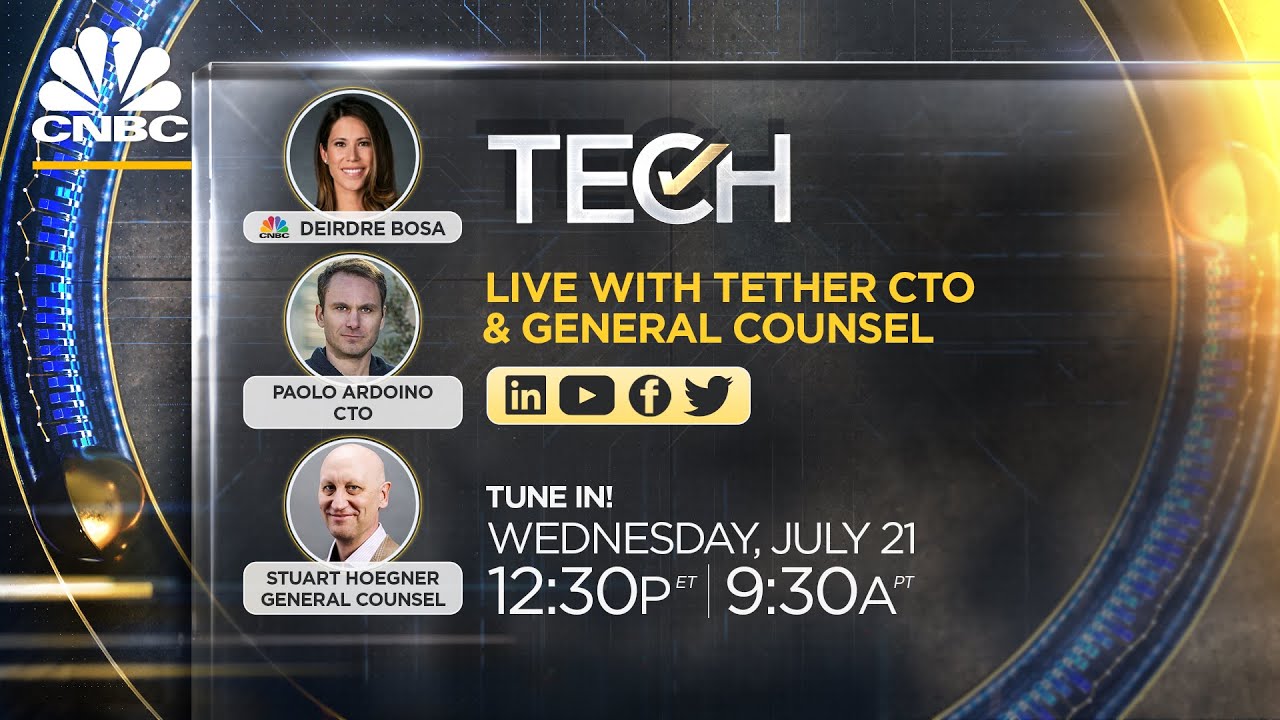
CNBC Television
Tether executives assert that sustained trading volume and unblemished redemptions prove market trust, justifying counterparty secrecy for more than half of the stablecoin's reserves while an audit remains months away.
AI-assisted summary of CNBC TechCheck+ chats with Tether's CTO and general counsel — 7/21/21 — original source. Check the original for full context.
Source published:
Key ideas
- Tether executives defended their reserve backing, noting that while less than 3% is held in cash dollars and over 50% in commercial paper, the debt is overwhelmingly rated A-2 or better by agencies like S&P and Fitch. (5:00)
- General Counsel Stuart Hoegner disclosed that Tether is undergoing a multi-year lookback financial audit, expecting completion in 'months, not years.' (24:43)
- Despite Tether ranking among the world's top ten holders of commercial paper, executives declined to identify specific issuers or geographical breakdown, citing banking confidentiality and commercial discretion. (15:42)
- Tether's market capitalization expanded by over 3,000% from roughly $2 billion in February 2019 to north of $62 billion by July 2021, with daily trading volume running between $45 billion and $50 billion. (0:00)
Detailed notes
## Background Published by CNBC Television on YouTube on July 21, 2021, this video features CNBC TechCheck host Deirdre Bosa interviewing Tether's Chief Technology Officer Paolo Ardoino and General Counsel Stuart Hoegner. According to the show description, the conversation explores Tether's role in the crypto ecosystem and examines the future of stablecoins amid heightened scrutiny.
## TL;DR In a rare mainstream media appearance, Tether executives Paolo Ardoino and Stuart Hoegner defend the stablecoin's reserve structure against sharp questioning from CNBC's Deirdre Bosa. Bosa challenges Tether on holding over 50% of its backing in undisclosed commercial paper while physical cash accounts for less than 3%, pressing for transparency regarding counterparty risks and the absence of a complete financial audit. The executives argue that market confidence is evidenced by Tether's $62 billion market cap, steady peg through major market crashes, and an unbroken track record of honoring redemptions, while pledging that an independent multi-year lookback audit is underway and expected within months.
## Atmosphere & style The interview has the tense, pointed feel of a high-stakes corporate cross-examination. Bosa takes an unyielding, skeptical stance, repeatedly pushing past executive talking points and challenging the idea that commercial popularity equates to genuine trust or security. Ardoino and Hoegner maintain a calm, guarded demeanor, defending their counterparty privacy and track record even as technical glitches, unanswerable questions about undisclosed debt issuers, and the conspicuous absence of Tether's CEO create visible friction.
## Bulletin - [05:00](https://www.youtube.com/watch?v=ZBEqyiO35cQ&t=300s) Tether executives defended their reserve backing, noting that while less than 3% is held in cash dollars and over 50% in commercial paper, the debt is overwhelmingly rated A-2 or better by agencies like S&P and Fitch. - [24:43](https://www.youtube.com/watch?v=ZBEqyiO35cQ&t=1483s) General Counsel Stuart Hoegner disclosed that Tether is undergoing a multi-year lookback financial audit, expecting completion in 'months, not years.' - [15:42](https://www.youtube.com/watch?v=ZBEqyiO35cQ&t=942s) Despite Tether ranking among the world's top ten holders of commercial paper, executives declined to identify specific issuers or geographical breakdown, citing banking confidentiality and commercial discretion. - [00:00](https://www.youtube.com/watch?v=ZBEqyiO35cQ&t=0s) Tether's market capitalization expanded by over 3,000% from roughly $2 billion in February 2019 to north of $62 billion by July 2021, with daily trading volume running between $45 billion and $50 billion.
## Key takeaways - [00:00](https://www.youtube.com/watch?v=ZBEqyiO35cQ&t=0s) CTO Paolo Ardoino describes Tether as a foundational digital dollar on public blockchains designed to boost transaction speed and efficiency across digital commerce. - [00:00](https://www.youtube.com/watch?v=ZBEqyiO35cQ&t=0s) Tether leadership points to an unblemished redemption record and massive volume growth as empirical market validation of user trust. - [05:00](https://www.youtube.com/watch?v=ZBEqyiO35cQ&t=300s) CNBC pushed back on Tether's volume-based trust metric, noting that published disclosures show cash makes up under 3% of reserves while commercial paper exceeds 50%. - [05:00](https://www.youtube.com/watch?v=ZBEqyiO35cQ&t=300s) Tether executives declined to specify whether their commercial paper holdings include Chinese debt, citing commercial discretion and counterparty privacy. - [05:00](https://www.youtube.com/watch?v=ZBEqyiO35cQ&t=300s) Management attributed the stall in new Tether minting in mid-2021 to broader cooling crypto market conditions following Bitcoin's drop from $65,000. - [10:00](https://www.youtube.com/watch?v=ZBEqyiO35cQ&t=600s) Ardoino argued that percentage growth comparisons favor smaller rivals like Circle's USDC because growing from a lower base is mathematically easier than expanding a $63 billion supply. - [10:00](https://www.youtube.com/watch?v=ZBEqyiO35cQ&t=600s) Stuart Hoegner defended Tether's reserve durability by citing its stability through historic crypto downturns, including the March 2020 crash and a subsequent 30% multi-day drop. - [10:00](https://www.youtube.com/watch?v=ZBEqyiO35cQ&t=600s) Hoegner stated that Tether holds cash reserves representing multiples of its largest single redemption and largest 24-hour redemption surge. - [12:35](https://www.youtube.com/watch?v=ZBEqyiO35cQ&t=755s) Tether defended using Cayman Islands-based Moore Cayman for assurance attestations, emphasizing the firm's digital asset expertise as part of the global Moore network. - [15:42](https://www.youtube.com/watch?v=ZBEqyiO35cQ&t=942s) Hoegner explained that Tether acquires commercial paper indirectly via partner banks and brokerages requesting quotes rather than trading in the open market under its own corporate name. - [15:42](https://www.youtube.com/watch?v=ZBEqyiO35cQ&t=942s) Deltec Bank & Trust in the Bahamas was explicitly confirmed by Hoegner as one of Tether's core banking counterparties. - [20:00](https://www.youtube.com/watch?v=ZBEqyiO35cQ&t=1200s) Addressing the New York AG settlement, Hoegner framed the findings as past disclosure errors regarding one-to-one backing that were resolved within months, noting Tether no longer operates in New York. - [20:00](https://www.youtube.com/watch?v=ZBEqyiO35cQ&t=1200s) Tether's four-step customer redemption process was outlined: onboarding with KYC/AML, token deposit, bank account designation, and fiat wire initiation. - [24:43](https://www.youtube.com/watch?v=ZBEqyiO35cQ&t=1483s) Ardoino defended the absence of CEO J.L. van der Velde and CFO Giancarlo Devasini from public media, stating they are operational leaders focused on day-to-day business rather than the limelight. - [28:38](https://www.youtube.com/watch?v=ZBEqyiO35cQ&t=1718s) Tether welcomed competing stablecoins into the market, asserting that ecosystem diversity strengthens regulatory advocacy across the entire sector.
## Detailed walkthrough ### [00:00](https://www.youtube.com/watch?v=ZBEqyiO35cQ&t=0s) Tether’s Role in Crypto and the Debate Over “Pegged” Reserves
The interview opens with CNBC host Deirdre Bosa welcoming Tether’s Chief Technology Officer Paolo Ardoino and General Counsel Stuart Hoegner to *TechCheck+*. Noting that the executives rarely—if ever—do interviews with mainstream media outlets, Bosa asks why they have chosen to appear now amid mounting public and regulatory scrutiny surrounding stablecoins. After a brief technical hiccup where he is muted, Paolo explains that their main objective is to help the public grasp Tether’s actual role in the financial ecosystem. He describes Tether as a foundational innovation meant to serve as a digital dollar on public blockchains, rendering digital commerce and crypto transactions substantially faster and more efficient. As Paolo puts it:
> “Its main role is to make the entire crypto economy but in general in the future possibly the entire digital online economy much faster, much more efficient than being basically dollar on a blockchain.”
When Bosa presses Stuart on whether their appearance is aimed at building trust and clarifying what actually backs Tether, she challenges Paolo's assertion that Tether is pegged one-to-one with the U.S. dollar, pointing out that Tether’s reserves are not made up solely of hard greenbacks. Stuart defends the peg, insisting that Tether tokens are fully reserved, backed, and verified via independent quarterly assurance attestations. While acknowledging that the backing does not consist entirely of physical U.S. dollars, Stuart emphasizes the safety of their reserve model and their operational record:
> “Most importantly we have never refused a redemption to a customer, not one time.”
When Bosa asks whether they came on CNBC to clear up misinformation and establish community trust, Stuart asserts that the market itself has already granted them full confidence. He points out that since February 2019, Tether’s issued supply surged from roughly $2 billion to over $62 billion—a growth rate exceeding 3,000%—while daily trading volume consistently outpaces all competitors combined:
> “We think the market has spoken. We believe the market has voted with its feet. The market has shown its trust and confidence in tether and its products.”
- Tether’s market capitalization surged by over 3,000% from just over $2 billion in February 2019 to north of $62 billion by July 2021. - Daily trading volume across global crypto exchanges ranges between $45 billion and $50 billion. - Tether has issued two independent accountant attestations for the year to date, with a third on the way.
[05:00](https://www.youtube.com/watch?v=ZBEqyiO35cQ&t=300s) Commercial Paper Disclosures, Counterparty Secrecy, and Plateauing Issuance
Bosa counters Stuart’s reliance on volume metrics, observing that popularity does not automatically equal trust, especially given that Tether’s own published reserve breakdown revealed that cash dollars make up less than 3% of the portfolio, while over 50% consists of commercial paper. Asked to specify who issues this commercial paper, Paolo declines, citing banking confidentiality:
> “We don't disclose our commercial partners, so that is quite important. We want to, given our portfolio composition in commercial papers, we believe that is quite important to respect the privacy of the banking partners that we work with.”
Paolo argues that true market sentiment is proven by price resilience: when people lose faith in an asset, they sell it off aggressively, yet Tether routinely holds its $1.00 peg across major venues. Bosa pushes back, asking whether this trust is precarious given warnings from prominent figures such as U.S. Treasury Secretary Janet Yellen and Boston Fed President Eric Rosengren. When asked specifically whether Tether holds commercial paper from Chinese firms—which carries a vastly different risk profile than Canadian commercial paper—Stuart also demurs. He affirms only that the paper is “international” and overwhelmingly carries ratings of A-2 or better across major agencies like S&P and Fitch:
> “As Paolo mentioned, we guard our counterparties relationships with great discretion. We have a lot of sensitive information inside our companies as retail facing entrepreneurs. And we believe we've given sufficient transparency into that.”
```mermaid flowchart TD accTitle: Tether Reserve Transparency Debate accDescr: Diagram illustrating the disagreement between CNBC and Tether executives over the composition and disclosure of reserves.
subgraph CNBC_Concerns["CNBC & Regulatory Scrutiny"] A["Reserve Composition\n(Under 3% cash, over 50% commercial paper)"] B["Regulatory Warnings\n(Janet Yellen, Eric Rosengren)"] C["Geographic & Issuer Risk\n(Chinese vs. Canadian paper)"] end
subgraph Tether_Position["Tether Executive Stance"] D["Discretion & Privacy\n(Protect banking counterparties)"] E["High Quality Debt\n(Overwhelmingly rated A-2 or better by S&P/Fitch)"] F["Market Validation\n($62B+ cap, $45B-$50B volume, steady $1.00 peg)"] end
A -.->|"demands disclosure from"| D B -.->|"raises systemic doubts against"| F C -.->|"presses for detail on"| E ```
Finally, Bosa points to industry observations that Tether’s aggressive minting schedule had slowed significantly, grinding to a near-halt since early June 2021. Paolo attributes the slowdown to cooling macroeconomic conditions across the broader crypto space, highlighting Bitcoin’s tumble from its $65,000 peak, which caused market participants to sit on the sidelines. When Bosa counters that competitor USD Coin (USDC) managed steady growth from $23 billion to $27 billion over that same stretch, Paolo urges her to compare that modest increase to the explosive velocity USDC and other rivals enjoyed during the prior three-month bull run.
- Tether holds more than 50% of its reserves in commercial paper, with less than 3% in physical U.S. currency. - Tether’s management states that its commercial paper portfolio is overwhelmingly rated A-2 or higher by ratings agencies including S&P and Fitch. - Bitcoin's retracement from its historical peak of $65,000 is cited by management as the primary driver behind the stall in new stablecoin creation. - While Tether minting stalled in June 2021, USDC continued to climb, moving from roughly $23 billion to $27 billion.
[10:00](https://www.youtube.com/watch?v=ZBEqyiO35cQ&t=600s) Market Growth Rates and Circle’s Disclosure
Deirdre Bosa presses Paolo Ardoino on what she perceives as a contradiction: earlier, he argued that broader market demand had slowed down, leading to lower issuance, but then suggested that smaller competitors can issue more because rapid growth is simply easier when starting from a lower base. Ardoino defends his logic with a simple mathematical analogy, explaining that if a stablecoin has only $10, reaching $20 is much easier than taking a massive market cap from $63 billion up to $70 billion. He emphasizes that general growth across all major stablecoins has decelerated; while Tether has flatlined, its competitors are also seeing their expansion slow due to shifting market dynamics.
```mermaid flowchart TD accTitle: Stablecoin Growth Comparison accDescr: Visualizing Ardoino's comparison of percentage growth between smaller caps and large-cap scale. subgraph SmallerCap["Smaller Competitors (e.g., Circle / USDC)"] A["Low Base ($3B to $23B)"] -->|"Easier to post large % growth"| B["Rapid Expansion Pace"] end subgraph LargeCap["Market Leader (Tether / USDT)"] C["High Base ($63B to $70B)"] -->|"Massive scale requires less new issuance"| D["Flatlining / Slower Growth"] end ```
Bosa then pivots to Circle’s newly released reserve disclosure, noting that market observers viewed it as far superior to Tether’s disclosures. When asked what Circle’s report says about the link between volume and market trust, General Counsel Stuart Hoegner welcomes the move, framing Circle as simply trailing Tether's lead. Hoegner argues that Tether has proved its durability under real-world market fire:
> “In March of 2020, the Bitcoin price was cut in half over a couple of days. A few weeks ago, the price of Bitcoin fell by 30% over just a few days. And during that time the tether peg remained solid. All redemptions were honored and the price across exchanges remained stable.”
Addressing Bosa's question about whether Circle’s higher proportion of cash and cash equivalents might lure users away, Hoegner is unfazed. He notes that Tether holds cash reserves representing multiples of its largest single redemption ever and well above its biggest 24-hour redemption window in company history, asserting that Tether's dominant market cap and 24-hour trading volume prove that the market continues to choose it.
- Paolo Ardoino contrasts a small baseline leap ($3 billion to $23 billion) with moving from $23 billion to $26.5 billion. - Circle released a detailed reserve breakdown showing higher cash and cash-equivalent holdings. - Tether points to surviving two severe crypto crashes (March 2020 and a recent 30% multi-day drop) as proof of peg resilience. - Stuart Hoegner states Tether’s cash holdings exceed its single largest redemption and its largest 24-hour redemption surge by multiple times.
[12:35](https://www.youtube.com/watch?v=ZBEqyiO35cQ&t=755s) Attestations vs. Audits and the Shift to Moore Cayman
When Bosa challenges Tether on relying on quarterly attestations rather than a full independent financial audit, Hoegner explains that both attestations and audits fall under the professional umbrella of "assurance services." He argues that Tether is actively working toward securing a complete financial audit—a milestone no stablecoin issuer has yet achieved—while pointing out that auditing services have historically been scarce across the crypto industry because mainstream firms were still learning how the space operates. Hoegner expresses eager ambition for Tether to be the first in the stablecoin sector to complete one: “We would love to be the first. We will see. We will see what happens.”
Bosa shifts the scrutiny to Tether’s choice of accounting firm, Moore Cayman, questioning why Tether uses an offshore firm in the Cayman Islands rather than a major American accounting house if its true goal is restoring trust. Hoegner pushes back on geographical bias:
> “We don't think that trust is necessarily vested in one country or another, Deirdre.”
He stresses that Moore Cayman possesses deep domain expertise in digital assets and is an integrated member of Moore Global, an international network boasting over 30,000 personnel. Bosa counters by recalling Tether’s abandoned relationship with New York firm Friedman LLP, quoting Tether's past explanation that an audit was deemed unattainable in a reasonable timeframe due to Friedman’s "excruciatingly detailed procedures" applied to Tether’s "relatively simple balance sheet." Hoegner waves this off as old history, stating that while Friedman had indeed prepared an earlier consulting report, those events occurred years ago and Tether is entirely satisfied with Moore Cayman providing the market with the transparency it needs.
[15:42](https://www.youtube.com/watch?v=ZBEqyiO35cQ&t=942s) The Commercial Paper Market and Banking Counterparties
The debate sharpens when Bosa asks who exactly Tether is listening to when it claims the market has sufficient transparency, noting that institutional players, journalists, and market participants she talks with consistently demand more. Hoegner counters that Tether's direct feedback loop comes from heavy-volume traders and major crypto market participants whose collective behavior is reflected in Tether's commanding market share. Shortly after, Paolo Ardoino drops off the stream due to technical difficulties, leaving Hoegner to field questions alone.
Bosa raises a prominent reporting mystery, mentioning her colleague Jim Cramer and institutional sources inside the commercial paper arena: despite Tether reportedly being one of the top ten commercial paper holders globally, none of CNBC’s contacts on major trading desks have ever transacted with or heard of Tether. Hoegner clarifies the mechanics of how Tether buys commercial paper, explaining that the company does not trade directly in the open market under its own name:
```mermaid flowchart LR accTitle: Tether Commercial Paper Acquisition Flow accDescr: Steps showing how Tether acquires commercial paper via partner banks, intermediaries, and secondary markets. A["Tether Accounts"] -->|"Quote Requests"| B["Partner Banks"] B -->|"Route Orders"| C["Brokers & Counterparties"] C -->|"Direct Issuers & Secondary Markets"| D["Commercial Paper (Overwhelmingly A2 or better)"] ```
> “We maintain accounts in a number of banks, financial institutions. They request quotes for commercial paper offerings from their banks who in turn request those from brokers and other counterparties, both direct from issuers and on secondary markets.”
When Bosa presses for specific names of these intermediary banks and brokerages to verify the liquidity mechanism, Hoegner acknowledges Bosa's past reporting that recognized Tether's utility for market liquidity and velocity. However, he declines to reveal a full list of counterparties, citing the company's strict policy of commercial discretion. He does confirm one primary banking partner: Deltec Bank & Trust in the Bahamas. He reiterates that Tether's commercial paper is high-grade—overwhelmingly rated A-2 or better—and managed conservatively.
As the segment draws to a close, Bosa shifts the discussion to impending regulation, highlighting comments made that very morning by SEC Chair Gary Gensler, who warned that crypto tokens priced off securities must comply with federal securities laws regardless of whether they operate on decentralized protocols, and asks how Tether is preparing for the regulatory clampdown.
- Tether is reported to be among the top 10 largest holders of commercial paper globally. - Hoegner specifies that Tether's commercial paper is overwhelmingly rated A-2 or better. - Deltec Bank & Trust, based in the Bahamas, is explicitly named as one of Tether's key banking institutions. - SEC Chair Gary Gensler issued a statement on the morning of the interview targeting tokens priced off securities on decentralized platforms.
[20:00](https://www.youtube.com/watch?v=ZBEqyiO35cQ&t=1200s) Regulation, Redemption Mechanics, and the New York AG Settlement
Deirdre Bosa asks whether Tether is prepared to reveal more about its reserves—particularly the specific commercial paper it holds—if regulators demand it, and whether heavier regulation might ultimately undermine Tether's utility, pointing to Facebook's Libra (rebranded as Diem) getting bogged down by scrutiny. General Counsel Stuart Hoegner insists Tether complies with all legal obligations and will continue doing so:
> “I think that the right kind of regulation helps everyone in the sector, stablecoin issuers and redeemers, consumers, traders, everyone in the space.”
Hoegner views increased regulation as an inevitability that Tether is actively helping shape alongside law enforcement and regulators worldwide.
```mermaid flowchart LR accTitle: Tether Fiat Redemption Process accDescr: Three-step redemption workflow from opening an account to receiving a fiat wire transfer.
subgraph Step1["1. Onboarding"] A["Open account at tether.to"] --> B["Undergo KYC & AML review"] end subgraph Step2["2. Token Deposit"] B --> C["Send USDT to deposit address"] end subgraph Step3["3. Fiat Payout"] C --> D["Submit redemption & bank details"] D --> E["Wire transfer sent to customer"] end ```
After CTO Paolo Ardoino reconnects to the stream, Bosa asks him to walk through how a customer redeems Tether for fiat currency: 1. Open an account directly on Tether's platform (`tether.to`). 2. Pass thorough Know Your Customer (KYC) and Anti-Money Laundering (AML) checks. 3. Transfer Tether tokens to the designated account deposit address. 4. Specify bank account details and submit the redemption request, after which a fiat wire transfer is initiated.
Hoegner maintains that Tether has never refused a legitimate customer redemption request. Bosa challenges this, citing past Tether statements and the New York Attorney General (NYAG) findings that Tether had not been fully backed at all times. Hoegner counters that the NYAG merely found "mistakes in our disclosures about the one-to-one backing with dollars," which Tether amended within roughly three months. He notes Tether's market capitalization has since surged from roughly $2 billion to over $62 billion, proving the market's confidence, and confirms Tether no longer conducts business in New York. Ardoino adds that during a 2017 period when Tether's website was down, redemptions continued through Bitfinex, which credited user accounts 1:1 in fiat dollars that could be wired out.
---
[24:43](https://www.youtube.com/watch?v=ZBEqyiO35cQ&t=1483s) Executive Absences, Measuring Trust, and Audit Timelines
Bosa shifts to the absence of Tether's top executive leadership, asking why CEO J.L. van der Velde remains elusive and avoids media appearances. Ardoino defends van der Velde and CFO Giancarlo Devasini as hardworking operators who handle day-to-day operations and personally assist customers:
> “JL, Jean-Louis, and our CFO, Giancarlo, are two great businessmen. They are working as hard as they can. They are super hard workers. They are really deeply involved with our businesses and they handle day-to-day operations.”
Ardoino explains that as a financial technology operation, having the Chief Technology Officer handle technology and the General Counsel manage regulatory discussions provides the appropriate public-facing representation.
Bosa presses Hoegner on whether trading volume alone is an adequate metric of trust, noting that products like fast food or cigarettes can be popular without being healthy or trustworthy. Hoegner argues that van der Velde and Devasini prioritize customer interaction over public visibility:
> “They don't need the limelight. It is really just a matter of style, Deirdre.”
Turning to the long-promised comprehensive financial audit, Hoegner discloses that Tether is currently undergoing a multi-year lookback audit. While unable to commit to an exact completion date, he clarifies the timeline expectations:
- **Audit status:** The financial audit reaching back several years is currently in progress. - **Estimated completion time:** Hoegner expects it within “months, not years.”
---
[28:38](https://www.youtube.com/watch?v=ZBEqyiO35cQ&t=1718s) Final Arguments on Reserve Transparency and Closing Remarks
In closing thoughts, Ardoino underscores Tether’s history since its founding in 2014 as the pioneer and backbone of the stablecoin industry, expanding into global commerce while never failing a redemption. He welcomes competing stablecoins, arguing that market diversity strengthens the sector's regulatory voice and pushes the entire ecosystem forward:
> “Let's do something that is really important for me, but also to everyone that works at Tether, is that Tether was formed in 2014, and actually created the entire space of stablecoins and is driving the innovation since many, many years.”
Bosa expresses lingering disappointment that neither executive disclosed details regarding Tether's commercial paper reserves—specifically whether they hold Chinese paper or other international obligations. She cautions that early leadership does not guarantee perpetual dominance as competitors issue alternative tokens. Hoegner reasserts Tether’s transparency record:
> “Tether fundamentally is more popular because it's transparent, it's trusted, it's liquid, and it's useful.”
Bosa concludes the broadcast by thanking Ardoino and Hoegner for participating, noting that the broader cryptocurrency community will scrutinize their statements, and invites them to return when the financial audit is officially completed.
## Notable quotes > [28:38](https://www.youtube.com/watch?v=ZBEqyiO35cQ&t=1718s) Tether fundamentally is more popular because it's transparent, it's trusted, it's liquid, and it's useful. — Stuart Hoegner
> [20:00](https://www.youtube.com/watch?v=ZBEqyiO35cQ&t=1200s) I think that the right kind of regulation helps everyone in the sector, stablecoin issuers and redeemers, consumers, traders, everyone in the space. — Stuart Hoegner
> [00:00](https://www.youtube.com/watch?v=ZBEqyiO35cQ&t=0s) We think the market has spoken. We believe the market has voted with its feet. The market has shown its trust and confidence in tether and its products. — Stuart Hoegner
## Mentioned Bitfinex, Circle, CNBC, Deirdre Bosa, Deltec Bank & Trust, Diem, Eric Rosengren, Fitch, Friedman LLP, Gary Gensler, Giancarlo Devasini, J.L. van der Velde, Janet Yellen, Libra, Moore Cayman, Moore Global, New York Attorney General, Paolo Ardoino, S&P, Stuart Hoegner, Tether, U.S. Securities and Exchange Commission, USD Coin
## Video description CNBC TechCheck’s Deirdre Bosa chats with Tether’s CTO Paolo Ardoino and General Counsel Stuart Hoegner about the company role in crypto and the future of stablecoins.
» Subscribe to CNBC TV: https://cnb.cx/SubscribeCNBCtelevision » Subscribe to CNBC: https://cnb.cx/SubscribeCNBC » Subscribe to CNBC Classic: https://cnb.cx/SubscribeCNBCclassic
Turn to CNBC TV for the latest stock market news and analysis. From market futures to live price updates CNBC is the leader in business news worldwide.
Connect with CNBC News Online Get the latest news: http://www.cnbc.com/ Follow CNBC on LinkedIn: https://cnb.cx/LinkedInCNBC Follow CNBC News on Facebook: https://cnb.cx/LikeCNBC Follow CNBC News on Twitter: https://cnb.cx/FollowCNBC Follow CNBC News on Instagram: https://cnb.cx/InstagramCNBC
#CNBC #CNBCTV CNBC TechCheck with Tether's CTO and general counsel — 7/21/21
[Source](https://www.youtube.com/watch?v=ZBEqyiO35cQ)