British Library Deploys Robotic Stacks to Archive All UK Publications
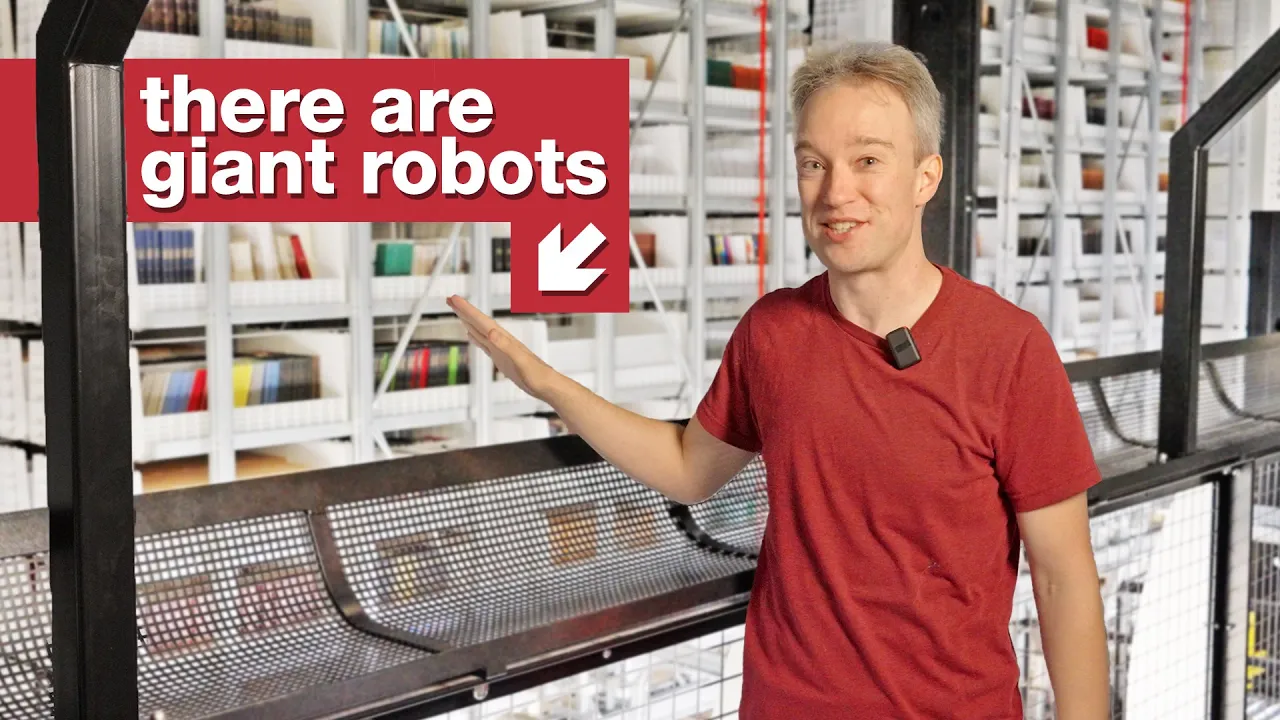
This library has every book ever published. — Tom Scott

Tom Scott

The institution collects all domestic print and digital output indiscriminately because historians cannot predict which discarded ephemera will prove vital decades later.

AI-assisted summary of This library has every book ever published. — original source. Check the original for full context.

Source published:

Key ideas

  • Under UK legal deposit legislation, the British Library systematically archives a copy of every published print item in the UK, amassing an inventory of approximately 170 million items ranging from fine art books to NHS leaflets. (0:00)
  • The bulk of physical holdings resides at an automated, low-oxygen storage facility in Boston Spa, Yorkshire, which houses over 700 kilometers of shelving and shuttles over 1,000 requested items to London daily. (1:31)
  • Digital legal deposit mandates the collection of UK web content and interactive digital literature via the UK Web Archive, which currently holds roughly 1.5 petabytes across billions of files while battling software obsolescence. (2:47)
  • The institution enforces a non-lending, non-selective intake model based on the principle that contemporary curators cannot anticipate what ephemera or obscure texts will prove historically vital decades later. (3:48)

Detailed notes

## Background Published on YouTube by Tom Scott on September 11, 2023, this video explores the British Library's role as the UK's universal legal deposit library. The video description details how the institution collects every publication without picking and choosing—a task complicated by the rise of the internet—and notes reader pass rules and storage challenges.

## TL;DR Under UK legal deposit law, the British Library collects a copy of every book, periodical, and publication produced in the country, amassing approximately 170 million items. To manage the immense spatial requirements, the majority of the physical collection is housed in automated, low-oxygen vaults in Boston Spa, Yorkshire, where high-speed robotic cranes retrieve items for transport to London reading rooms. The mandate has since expanded to digital formats, interactive media, and billions of web pages via the UK Web Archive. Operating strictly as a non-lending reference repository, the institution preserves both high literature and ephemeral everyday print to ensure an unvarnished, raw record of human history survives for future generations.

## Atmosphere & style The video carries an energetic, intellectually curious, and reverent tone typical of Tom Scott's educational journeys. Fast-paced on-location reporting contrasts the hushed, cavernous enormity of low-oxygen robotic warehouses with passionate interviews from library curators. It feels like an exclusive backstage pass into a quiet logistical marvel, culminating in a philosophically weighty defense of preserving everyday ephemera that ends on a lighthearted, serendipitous moment of robotic comic timing.

## Bulletin - [00:00](https://www.youtube.com/watch?v=ZNVuIU6UUiM&t=0s) Under UK legal deposit legislation, the British Library systematically archives a copy of every published print item in the UK, amassing an inventory of approximately 170 million items ranging from fine art books to NHS leaflets. - [01:31](https://www.youtube.com/watch?v=ZNVuIU6UUiM&t=91s) The bulk of physical holdings resides at an automated, low-oxygen storage facility in Boston Spa, Yorkshire, which houses over 700 kilometers of shelving and shuttles over 1,000 requested items to London daily. - [02:47](https://www.youtube.com/watch?v=ZNVuIU6UUiM&t=167s) Digital legal deposit mandates the collection of UK web content and interactive digital literature via the UK Web Archive, which currently holds roughly 1.5 petabytes across billions of files while battling software obsolescence. - [03:48](https://www.youtube.com/watch?v=ZNVuIU6UUiM&t=228s) The institution enforces a non-lending, non-selective intake model based on the principle that contemporary curators cannot anticipate what ephemera or obscure texts will prove historically vital decades later.

## Key takeaways - [00:00](https://www.youtube.com/watch?v=ZNVuIU6UUiM&t=0s) UK legal deposit legislation requires publishers to submit a copy of every published book, magazine, and newspaper to the British Library. - [00:00](https://www.youtube.com/watch?v=ZNVuIU6UUiM&t=0s) The library maintains a strictly exhaustive print acquisition policy, taking in items ranging from fine art volumes to supermarket magazines and government health leaflets. - [00:00](https://www.youtube.com/watch?v=ZNVuIU6UUiM&t=0s) Independent and self-published authors often do not realize they qualify as publishers, prompting library outreach to preserve small-press works. - [00:00](https://www.youtube.com/watch?v=ZNVuIU6UUiM&t=0s) Due to real estate constraints at St Pancras in London, the vast majority of physical storage is relocated to automated facilities in West Yorkshire. - [01:31](https://www.youtube.com/watch?v=ZNVuIU6UUiM&t=91s) The Boston Spa facility houses over 700 kilometers of shelving in a low-oxygen environment designed to minimize fire risk and retard paper deterioration. - [01:31](https://www.youtube.com/watch?v=ZNVuIU6UUiM&t=91s) Automated robotic cranes move at speeds up to 50 km/h along vertical tracks, dynamically reorganizing inventory to place frequently requested materials near the front. - [01:31](https://www.youtube.com/watch?v=ZNVuIU6UUiM&t=91s) Off-site items requested by readers in London require a 48-hour notice window, with more than 1,000 items transported between Yorkshire and London every working day. - [01:31](https://www.youtube.com/watch?v=ZNVuIU6UUiM&t=91s) Unselective archiving of domestic ephemera, such as early HIV/AIDS public health leaflets, preserves irreplaceable primary sources that public sentiment might otherwise discard. - [02:47](https://www.youtube.com/watch?v=ZNVuIU6UUiM&t=167s) The UK Web Archive captures domestic websites and blogs, preserving roughly 1.5 petabytes of digital data and billions of files under digital legal deposit rules. - [02:47](https://www.youtube.com/watch?v=ZNVuIU6UUiM&t=167s) Preserving digital publications poses novel archival challenges due to hardware-dependent features, responsive layouts, geolocation triggers, and software obsolescence. - [03:48](https://www.youtube.com/watch?v=ZNVuIU6UUiM&t=228s) The British Library operates strictly as a reference institution rather than a lending library, requiring all materials to remain inside secure reading rooms. - [03:48](https://www.youtube.com/watch?v=ZNVuIU6UUiM&t=228s) The foundational philosophy of universal legal deposit is that curators cannot judge today what will be important 50 years in the future, requiring the total preservation of raw historical records.

## Detailed walkthrough ### [00:00](https://www.youtube.com/watch?v=ZNVuIU6UUiM&t=0s) The Scope of Legal Deposit and London’s Storage Limits

Under UK legal deposit legislation, publishers producing a book, magazine, or newspaper within the country are legally required to submit a copy to the British Library. While many nations operate comparable legal deposit institutions under clear historical guidelines, the definition of publishing became significantly more complicated by the end of the 20th century with the advent of the World Wide Web. For physical media, the library maintains an uncompromisingly exhaustive intake policy that captures the entire spectrum of printed material. As a library representative explains: “In the print world, we collect everything.” This remit spans everything from National Health Service informational leaflets and regional periodicals to multi-thousand-pound fine art volumes, specialized academic journals, and children's supermarket magazines packaged with plastic toys.

Housing such an extensive intake presents massive spatial challenges. The British Library’s flagship site in St Pancras, London, features extensive underground basement storage, yet the capital's steep real estate costs and construction constraints make local expansion impractical. As a result, only the collection’s most frequently requested volumes remain in London, while the vast majority of items reside in high-density automated facilities located in Northern England.

```mermaid flowchart TD accTitle: British Library Physical Book Logistics accDescr: Flowchart showing how books are stored in Yorkshire, retrieved by robots, and trucked to London reading rooms upon request.

subgraph Storage["Boston Spa Facility (Yorkshire)"] A["Low-Oxygen Automated Stacks<br/>(Over 700 km of shelving)"] B["High-Speed Robots<br/>(Up to 50 km/h)"] A -->|"48-hour request trigger"| B B --> C["Automated Sorting<br/>(Frequent items kept near front)"] end

subgraph Transit["Inter-Site Transit"] C --> D["Overnight Road Freight<br/>(1,000+ items daily)"] end

subgraph London["St Pancras (London)"] D --> E["Reading Rooms<br/>(Secure desk inspection only)"] end ```

- The British Library holds approximately 170 million items, with legal deposit acquisitions accounting for the vast majority. - Mainstream commercial publishers generally understand the statutory requirements and comply routinely, but independent authors, creators who self-publish, and micro-presses often fail to realize they qualify as publishers. - The library actively conducts outreach to independent creators to ensure smaller, non-traditional publications are systematically archived rather than lost to history.

---

[01:31](https://www.youtube.com/watch?v=ZNVuIU6UUiM&t=91s) High-Density Storage at Boston Spa and the Value of Ephemera

The bulk of the British Library’s physical holdings rests in colossal, low-oxygen automated storage warehouses situated at Boston Spa in West Yorkshire. The facility houses over 700 kilometers of shelving, expanding at an average rate of roughly 8 kilometers every year. To accommodate this uninterrupted inflow, the library broke ground on an additional storage building planned to meet archival capacity demands for several decades. Inside the current structure, automated robotic cranes glide along vertical tracks at speeds reaching 50 kilometers per hour, displacing air with audible force as they negotiate the aisles. The automated system intelligently indexes and reorganizes its inventory, repositioning frequently requested items nearer to the front of the stacks for rapid retrieval.

Archival staff emphasize that preserving seemingly trivial, free ephemera is one of the collection's most essential functions. A cited example was an exhibition hosted at the National Library of Scotland detailing informational campaigns distributed at the onset of the HIV/AIDS epidemic. Library staff reflect on how public perception often undervalues such collections: “That material, if you go out to somebody on the street and you ask them, ‘Should we be collecting this?’ ‘No, of course we shouldn't.’ But we're able to learn so much from that.” Without the unselective collection of unsolicited leaflets delivered through domestic letterboxes decades earlier, historians would lack primary evidence of how public health information was communicated during the crisis.

- Boston Spa’s high-density vaults operate under reduced-oxygen atmospheres to prevent fire and retard physical degradation. - Camera crews were prohibited from mounting recording equipment onto the storage cranes because of the operational importance of the machinery. - When an authorized reader requests an off-site item in London, the system requires a 48-hour notice window. - The requested volume is automatically fetched by cranes, loaded onto scheduled freight transports heading south, and delivered to London reading rooms within two working days. - Over 1,000 items travel back and forth between Yorkshire and London every single working day.

---

[02:47](https://www.youtube.com/watch?v=ZNVuIU6UUiM&t=167s) Preserving the Web and Interactive Digital Formats

As the media landscape evolved from ink and paper to digital files, the legal deposit mandate adapted to incorporate digital publications and domestic online content. The British Library captures websites and personal blogs verified as originating within the United Kingdom. This initiative, managed through the UK Web Archive, has expanded into one of the largest sections of the entire institutional repository, holding billions of individual files and roughly 1.5 petabytes of archived data.

Digital archiving introduces structural complications that physical books never faced. Curators must often collect both print and digital versions of the same publication because the layout, editorial decisions, and user experience diverge significantly between media. Furthermore, digital texts increasingly rely on hardware and software features that complicate long-term preservation: - eBooks designed with responsive text and dynamic layouts that shift as an iPad or tablet is physically rotated. - Geolocation-dependent publications that alter their content based on where the reader is standing. - Operating system dependencies that make interactive literature vulnerable to rapid software obsolescence within only a few years.

Staff must actively engineer archiving methods today so these fluid digital formats remain accessible to researchers 50 years into the future, contending with software ecosystems that require frequent updates and render old file structures obsolete.

---

[03:48](https://www.youtube.com/watch?v=ZNVuIU6UUiM&t=228s) The Library of Last Resort and the Philosophy of Unfiltered History

Because of its preservation mandate, the British Library operates strictly as a reference institution rather than a lending library. Readers are prohibited from borrowing items or taking them outside the premises; materials must remain under observation at designated desks within the facility's specialized reading rooms and returned immediately after use. Historically, securing a reader pass required an interview to verify that the researcher could not locate their needed sources within public municipal or academic university systems, cementing its reputation as a "library of last resort."

The core philosophy underlying legal deposit is total, non-selective preservation. Library staff state this principle directly: “The importance of legal deposit not being selective, and being everything, is: we can't decide today what's going to be important in 50 years' time. We want everything, because we don't know what will be important.”

Tom Scott reflects on the irreplaceable utility of this comprehensive mandate for independent researchers. Without a universal deposit repository, out-of-print titles with no surviving commercial copies, materials bypassed by mass-digitization efforts, and obscure regional newspapers holding single, isolated historical citations would vanish entirely. He concludes that preserving every printed artifact across generations provides direct access to the unvarnished record of human activity: “This is the raw text of history, as it happened, and someone has to keep it preserved for the future.” Just as Tom finishes delivering his closing lines in the automated aisles of Boston Spa, a robotic retrieval crane glides precisely into frame behind him right on cue, prompting playful praise from the camera operator for the accidental cinematic timing.

## Notable quotes > [03:48](https://www.youtube.com/watch?v=ZNVuIU6UUiM&t=228s) The importance of legal deposit not being selective, and being everything, is: we can't decide today what's going to be important in 50 years' time. We want everything, because we don't know what will be important. — Library staff

## Mentioned British Library, Tom Scott, National Health Service, Boston Spa, St Pancras, National Library of Scotland, UK Web Archive, iPad

## Video description The British Library is one of the six legal deposit libraries for the UK — and the only one that doesn't pick and choose, or have to ask for copies. That's a lot of books to store, and the internet's only making it worse. ■ The BL: https://bl.uk ■ UK Web Archive: https://www.webarchive.org.uk/

This video has a correction: it turns out the formal interview requirement for a reader pass has been dropped. However, you'll still need to get a pass, and you're not allowed to take books out of the reading rooms! You can see all corrections on the channel here: https://www.tomscott.com/corrections/

🟥 MORE FROM TOM: https://www.tomscott.com/ (you can find contact details and social links there too) ❓ LATERAL, free weekly podcast: https://lateralcast.com/ https://youtube.com/lateralcast/ 👥 THE TECHNICAL DIFFICULTIES: https://youtube.com/techdif

[Source](https://www.youtube.com/watch?v=ZNVuIU6UUiM)

中文简报

大英图书馆启用机器人书库归档全英出版物 该机构不加甄别地收集全英所有印刷与数字出版物,因为历史学家无法预判哪些被遗弃的琐碎资料会在数十年后变得至关重要。 根据英国法定送存法规,大英图书馆收集该国出版的每一本书籍、期刊和出版物,馆藏总量已达约1.7亿件。为满足庞大的空间需求,大部分实体馆藏存放在约克郡波士顿斯帕的自动化低氧库房中,由高速机器人起重机提取藏品并运往伦敦阅览室。如今,这项法定职责已扩展至数字格式、互动媒体以及通过英国网络档案馆收录的数十亿网页。作为严格意义上的非外借参考书库,该机构同时保存经典文学与日常琐碎印刷品,以确保为后代留下真实、原始的人类历史记录。 根据英国法定送存立法,大英图书馆系统性地归档英国出版的每一样印刷品,积累了约1.7亿件藏品,涵盖从精美艺术书籍到英国国民医疗服务体系(NHS)宣传单的各类内容。 (0:00) 绝大部分实体馆藏存放于约克郡波士顿斯帕的一座自动化低氧仓储设施中,该设施拥有超过700公里的书架,每天向伦敦运送1,000多件被调阅的藏品。 (1:31) 数字法定送存规定通过英国网络档案馆收集英国网络内容和互动数字文学;面对软件淘汰的挑战,该档案馆目前已在数十亿个文件中保存了约1.5PB的数据。 (2:47) 该机构奉行不外借、无选择性的入藏模式,其依据的原则是:当代的策展人无法预知哪些琐碎资料或晦涩文献会在数十年后展现出极为关键的历史价值。 (3:48)

Reading summary

Under statutory legal deposit legislation, the British Library systematically collects every physical and digital publication produced in the United Kingdom, operating under the principle that contemporary selectors cannot predict what artifacts will prove vital to future historians. Exhaustive Legal Deposit and the Value of Ephemera (0:00) The British Library maintains a collection of roughly 170 million items, driven by a legal deposit framework that mandates publishers submit copies of all works issued in the UK. This intake is deliberately unselective, capturing high-end art volumes and academic journals alongside supermarket magazines and regional flyers. Because independent authors and micro-presses frequently do not recognize that statutory requirements apply to them, the institution actively conducts outreach to ensure non-traditional works are not omitted. Archival curators argue that preserving mundane ephemera often yields critical historical evidence. For example, during an exhibition at the National Library of Scotland, unsolicited public health leaflets distributed to domestic mailboxes provided researchers with essential documentation of early state communications regarding the HIV/AIDS epidemic. Library staff emphasize that without universal intake, materials deemed trivial by contemporary standards would vanish permanently. Automated Warehousing and Boston Spa Logistics (1:31) Due to space limits and severe real estate costs at the flagship St Pancras site in London, the vast majority of physical holdings are stored in Boston Spa, West Yorkshire. The facility features low-oxygen storage vaults—designed to prevent fire and inhibit physical decay—containing over 700 kilometers of shelving, which expands by roughly 8 kilometers each year. To handle long-term intake, construction has begun on an additional building planned to cover capacity needs for several decades. Retrieval relies on high-speed robotic cranes operating at up to 50 kilometers per hour, which dynamically reorganize bins to place frequently requested items toward the front of the stacks. When a researcher submits a request from London, the system requires 48 hours notice to fetch the volume and transport it via scheduled road freight, with over 1,000 items moving between Yorkshire and London every working day. Technical Challenges of Archiving Dynamic Digital Media (2:47) The legal deposit mandate has expanded to encompass the UK Web Archive, which contains billions of web pages and blogs amounting to approximately 1.5 petabytes of data. Digital preservation presents structural complexities absent in print, often compelling staff to collect both physical and digital editions of works whose editorial layouts diverge. Preservationists must also navigate interactive software dependencies, dynamic screen layouts on tablets, and geolocation-based content that adapts according to a user's physical location. Because underlying operating systems become obsolete within years, archival engineers must continuously develop technical workarounds to keep fluid digital works readable 50 years into the future. Preservation Rules and the Last-Resort Function (3:48) To guarantee perpetual survival of its inventory, the British Library operates strictly as a reference institution rather than a lending library. Items cannot leave the premises and must be consulted at secure desks within designated reading rooms. Historically, prospective readers had to demonstrate through an interview that their research could not be satisfied by municipal or university collections, establishing the institution as a library of last resort. Presenter Tom Scott highlights that this exhaustive mandate rescues works overlooked by mass digitization, such as out-of-print commercial volumes or local newspapers preserving unique citations. By maintaining everything without editorial curation, the institution protects the raw, unvarnished record of historical events as they unfolded. While the British Library's comprehensive collection model prevents the loss of obscure historical materials, sustaining this universal record requires continuous warehouse expansion and active technical interventions to counter rapid software obsolescence.

精炼阅读摘要

英国国家图书馆依据法定送存制度,对全英国出版的印刷品与数字内容推行全面且无选择性的采集与归档,以此留存人类活动的原始历史记录。这种“全量保存”的机制依赖于约克郡先进的自动化低氧仓储物流网络,并在数字出版时代面临着格式过时与硬件依赖等全新的长期技术挑战。 法定送存机制与全量采集的馆藏边界 (0:00) 英国的法定送存(Legal Deposit)立法强制要求,凡在英国境内出版书籍、杂志或报纸的出版商,均须向英国国家图书馆提交一份副本。与传统认知中仅收藏重要经典著作不同,图书馆对实体媒介采取了彻底穷尽的入藏政策,其馆藏已累积约1.7亿件。该范围涵盖了国家医疗服务体系(NHS)的信息宣传单、地方性期刊、价值数千英镑的精装艺术画册、专业学术期刊,乃至附带塑料玩具的超市儿童杂志。正如馆方代表所述,在纸质印刷品领域,该馆“无所不收”。 尽管主流商业出版商通常熟悉并严格履行这一法定义务,但许多独立作者、自出版创作者和微型出版社往往并未意识到自身也属于法定出版者。为此,图书馆主动向独立创作者开展普及与联络,确保非传统的边缘出版物不会在历史中被遗漏。这种包罗万象的采集机制,从根本上防止了因出版规模或商业地位所导致的历史记录断层。 约克郡自动化高密仓储与双城物流调度 (1:31) 全量收集带来了严峻的空间承载压力。伦敦圣潘克拉斯主馆虽建有庞大的地下库房,但受限于首都昂贵的地价与建设限制,仅存放调阅频率最高的核心文献。绝大部分藏品被集中安置在西约克郡波士顿斯帕(Boston Spa)的自动化高密度仓库中。该基地的书架总长已超过700公里,并以每年约8公里的速度持续增长,目前已启动新库房建设以满足未来数十年的存储需求。仓储区内部维持低氧环境以防火和减缓纸张老化,高速自动化起重机在巷道中以高达每小时50公里的速度穿行取书,并根据借阅频率智能优化货位布局。 由于馆藏实体文献严格禁止外借,伦敦读者若需查阅存放在约克郡的藏书,必须提前48小时发起预约。起重系统自动提取书籍后,由每日往返两地的专用公路货运在隔夜完成配送。每个工作日,有超过1,000件藏品在约克郡与伦敦之间调拨穿梭,并在圣潘克拉斯受严密监管的阅览室内供研究者在专用桌位查验,形成了一套精密运转的跨区域物流保障链。 动态数字出版物与网页归档的技术困境 (2:47) 随着信息传播向数字媒介迁移,法定送存范围进一步延伸至英国本土网站、个人博客及电子出版物。由其运营的英国网络档案馆(UK Web Archive)已收录数十亿个独立文件,数据规模达到约1.5 PB。然而,数字文献的长期保存面临着实体纸质书从未遇过的结构性难题:版面设计和交互体验的显著差异,迫使馆方常常需要同时收藏同一出版物的纸质版与数字版。 更为棘手的是数字形态对硬件和操作系统的深度依赖。例如,根据读者旋转平板电脑的方向而动态改变排版的响应式电子书、依据读者实时地理位置改变内容的自适应文本,以及高度绑定特定软件生态的交互式数字文学。馆方技术人员必须在当下研发归档与仿真手段,解决软件频繁更新导致的格式淘汰问题,以确保这些流动易逝的数字内容在50年之后依然能被未来学者稳定读取。 “终极参考馆”与不可预知未来的历史哲学 (3:48) 英国国家图书馆本质上是一座不可外借的纯参考型机构,历史上读者甚至需要通过审核面试,证明所查资料无法在任何公共或大学图书馆找到,才获发通行证,因而被视为“最后的图书馆”。其坚持不设筛选门槛的核心哲学在于:当代人无法预判50年后的学者会认为什么材料具有历史价值。无论是无人问津的绝版书、未被商业数字化涵盖的冷门地方报纸,还是当年挨家挨户投递在信箱中的艾滋病防疫传单,看似微不足道的即时印刷品(ephemera),数十年后往往会成为研究公共卫生传播与社会思潮不可替代的一手铁证。 正如主持人Tom Scott所总结,法定送存的终极意义在于无筛选地保留人类活动的原始记录,它呈现的是历史发生时的真实底稿。如果缺少国家层面的无差别归档机制,海量边缘文献终将随商业周期的更迭而彻底湮灭。 英国国家图书馆通过自动化仓储与全量法定送存,构建了一套将当下所有印刷与数字媒介无差别移交给未来的机制。但随着数字媒介从静态文本加速演变为依赖动态算法与特定运行环境的复合软件,如何在未来数十年内克服技术过时并持续解读这些数字遗产,仍是该馆必须持续攻克的长期课题。

Detailed notes — zh

## Background 该视频由科普创作者 Tom Scott 于 2023 年 9 月 11 日发布在 YouTube 平台上。视频简介指出,大英图书馆是英国六个法定送存图书馆之一,也是唯一一个不加筛选、无需主动索取即全量收藏每本出版物的机构;视频深入探讨了面对海量图书及互联网数字洪流,图书馆如何保存这些庞大的人类知识资产。 ## TL;DR 视频深入揭秘了大英图书馆依据“法定送存”制度全量收集英国所有出版物的运作机制。为了应对约 1.7 亿件庞大藏品带来的空间挑战,图书馆不仅在伦敦总部地下存放高频调阅书目,还在约克郡波士顿斯帕建立了拥有 700 公里书架的自动化低氧无人仓库,由穿梭机器人高速调度。与此同时,面对包含 1.5 PB 数据的 UK Web Archive 以及动态交互媒介等数字新形态,图书馆依然恪守“不作筛选、囊括一切”的原则,全力为后世守护历史发生时的原始文本记录。 ## Atmosphere & style 视频展现了 Tom Scott 一贯标志性的快节奏与严谨求知的硬核科普风格。置身于现代化、宛如科幻片般的宏伟低氧机器人书库中,镜头穿梭于高速呼啸的机械装置与浩瀚书架之间,既具有震撼的工业视觉冲击力,又充盈着浓厚的人文敬畏感。馆员专业而从容的阐释与 Tom Scott 充满感染力的即兴总结相得益彰,片尾机器人归位的幽默小插曲更添了一份灵动与亲切。 ## Bulletin - [00:00](https://www.youtube.com/watch?v=ZNVuIU6UUiM&t=0s) 大英图书馆根据英国“法定送存”法规收藏境内出版的每一类图书、报纸与杂志,目前总藏品规模已达约 1.7 亿件。 - [01:00](https://www.youtube.com/watch?v=ZNVuIU6UUiM&t=60s) 实体藏品主要存放于约克郡波士顿斯帕的低氧自动化无人仓库,内有超 700 公里书架及最高时速 50 公里的存取机器人,每年新增书架长度约 8 公里。 - [02:47](https://www.youtube.com/watch?v=ZNVuIU6UUiM&t=167s) 法定送存范围已拓展至数字领域,“英国网络档案库”现已收录数十亿文件、容量达 1.5 PB,但应对互动电子书与移动操作系统更迭的保存难度极大。 - [03:48](https://www.youtube.com/watch?v=ZNVuIU6UUiM&t=228s) 大英图书馆属于“终极求助图书馆”,馆藏严禁外借且不设筛选机制,核心逻辑在于当代人无法预测 50 年后何种材料会成为关键历史证据。 ## Key takeaways - [00:00](https://www.youtube.com/watch?v=ZNVuIU6UUiM&t=0s) 英国法律规定出版商必须向大英图书馆呈缴每一份出版物的副本,构成其法定送存制度的法理基础。 - [00:00](https://www.youtube.com/watch?v=ZNVuIU6UUiM&t=0s) 大英图书馆对印刷品的收集不设任何门槛,无论是廉价宣传单、附赠玩具的儿童刊物,还是高端学术期刊均全盘收录。 - [00:00](https://www.youtube.com/watch?v=ZNVuIU6UUiM&t=0s) 受限于伦敦昂贵的地价与有限的地下空间,伦敦总部仅存放借阅频次最高的数百万册核心藏书。 - [01:00](https://www.youtube.com/watch?v=ZNVuIU6UUiM&t=60s) 海量低频调阅藏书被转运至英格兰北部的约克郡波士顿斯帕自动化低氧仓库集中管理。 - [01:00](https://www.youtube.com/watch?v=ZNVuIU6UUiM&t=60s) 约克郡仓库的书架总长度已超过 700 公里,每年以 8 公里的速度持续扩张,目前已开工新建仓储大楼以承接未来增长。 - [01:00](https://www.youtube.com/watch?v=ZNVuIU6UUiM&t=60s) 仓库内搭载最高时速 50 公里的高速穿梭机器人,能通过算法动态优化藏品存放位置,并将高频调阅箱体移至前端。 - [01:00](https://www.youtube.com/watch?v=ZNVuIU6UUiM&t=60s) 对于存放在北方仓库的冷门藏书,伦敦读者需提前 48 小时预约,由跨区域物流车队实现每日南北往返调配。 - [01:00](https://www.youtube.com/watch?v=ZNVuIU6UUiM&t=60s) 看似微不足道的“暂留物”(如免费信箱宣传单)在数十年后往往会成为不可替代的重要历史研究证据。 - [02:47](https://www.youtube.com/watch?v=ZNVuIU6UUiM&t=167s) 网络法定送存范围覆盖英国境内的自建网站与博客,“英国网络档案库”已累积约 1.5 PB 的数据规模。 - [02:47](https://www.youtube.com/watch?v=ZNVuIU6UUiM&t=167s) 同一出版物的数字版与纸质版在版面结构与编辑意图上差异显著,因此必须同时完整归档两种形态。 - [02:47](https://www.youtube.com/watch?v=ZNVuIU6UUiM&t=167s) 依赖陀螺仪、GPS 及频繁升级的移动操作系统的互动数字媒介,给长期数字归档技术带来了巨大挑战。 - [03:48](https://www.youtube.com/watch?v=ZNVuIU6UUiM&t=228s) 大英图书馆扮演着“最后的求助图书馆”角色,藏书严禁带出阅览室,且要求读者说明在常规图书馆无法获取的理由。 - [03:48](https://www.youtube.com/watch?v=ZNVuIU6UUiM&t=228s) “全盘接纳、绝不筛选”的底层逻辑在于当下无法预判未来的价值,保存一切才能留下历史发生时的原始文本。 ## Detailed walkthrough ### [00:00](https://www.youtube.com/watch?v=ZNVuIU6UUiM&t=0s) 法定送存制度与印刷品的全量收藏 在大英图书馆(British Library),理论上收藏着英国有史以来出版的每一本书。根据英国的法律规定,任何在英国境内出版图书、杂志或报纸的人,都必须依法向大英图书馆呈缴一份副本,这种制度即为“法定送存”(legal deposit)。世界上许多国家都有类似的法律和国家级图书馆。在20世纪结束之前,这项法规的执行边界清晰明了,但随着互联网的爆发,何为“书籍”与“出版”开始变得难以界定。 大英图书馆对传统印刷品的收集标准极其宽泛,几乎不设门槛。正如馆员在采访中所生动描述的那样:“在印刷品的世界里,我们收集一切。你能想象到的任何东西,无论是国民医疗服务体系(NHS)的信息宣传单、地方杂志,还是你能想象到最昂贵的学术期刊,或是价值数千英镑的精美艺术画册,甚至是你在乐购(Tesco)货架上看到附带塑料玩具的儿童杂志——我们全都会收集。那是真正的无所不包。” 然而,海量的藏品带来了巨大的物理存储压力。虽然大英图书馆在伦敦总部的地下室开辟了极其庞大的存储空间,但面对滔滔不绝的新书依然是杯水车薪。伦敦本地地价昂贵、施工难度极高,因此伦敦馆舍地下仅存放借阅频次最高、最常被读者调阅的数百万册藏书,至于剩下的大多数藏品,则被运往了英格兰北部的自动化无人仓库。 ```mermaid flowchart TD accTitle: 英国法定送存及馆藏分流示意图 accDescr: 展示出版物进入大英图书馆后,根据借阅频次分别存放在伦敦地下室或北方仓库的流程。 subgraph S1["出版物呈缴"] P1["英国境内出版商 / 创作者"] -->|"法定送存 (Legal Deposit)"| BL["大英图书馆接收整理"] end subgraph S2["馆藏分流与仓储"] BL -->|"高频调阅藏书 (数百万册)"| LDN["伦敦总部地下书库"] BL -->|"低频或常规馆藏 (海量藏书)"| RPA["约克郡波士顿斯帕自动化低氧仓库"] end ``` ### [01:00](https://www.youtube.com/watch?v=ZNVuIU6UUiM&t=60s) 约克郡波士顿斯帕的高速机器人仓库与历史暂留物 目前大英图书馆的全部藏品总数高达约 1.7 亿件,其中绝大部分都来自于法定送存。大型出版机构通常非常熟悉这套流程并会按时送交,但真正的挑战在于微型出版商,或者那些未曾将自己视为“出版者”的独立创作者。馆方需要投入大量精力主动联系自出版作者与各类民间机构,向他们解释将其作品收录并保存下来的长远历史价值。 这些浩瀚的纸质遗产主要沉睡在英格兰约克郡波士顿斯帕(Boston Spa)的一座庞大建筑内。这里建有极其宏伟的低氧储藏库(以防止火灾及纸张老化劣化),内部的书架总长度已超过 700 公里。馆内的机器人穿梭于高耸的书架之间,其重要程度极高,以至于 Tom Scott 甚至被禁止在机器人上安装运动相机。由于大英图书馆每年消耗的书架长度约为 8 公里,一座全新的存储大楼已经破土动工,预计能支撑未来数十年的增量存储需求。 收集那些微不足道的“暂留物”(ephemera)意义深远。馆员提到苏格兰国家图书馆此前举办过的一场关于艾滋病(AIDS)流行初期的展览,展出的全是当年通过居民信箱免费分发的宣传单。馆员直言:“那种材料,如果你走到街上随便问一个人:‘我们应该收集这个吗?’对方肯定会说:‘不,当然不应该。’但我们今天能从中汲取极多认知。如果我们当初没有收集那些从大家信箱塞进来的免费材料,这场展览根本不可能办得起来。” - **穿梭机器人的性能与物流速度**:仓库内负责存取书箱的机器人最高行驶速度可达 50 km/h,穿行时掀起的强大气流甚至直接灌进了收音麦克风中。 - **动态优化存储算法**:机器人系统会自动计算调阅频率,将借阅较频繁的箱体移至靠近前端的位置。 - **调阅物流周期**:如果伦敦的读者需要查阅波士顿斯帕仓库中的冷门书籍,需要提前 48 小时提交申请;书籍由机器人取出后装上南下的卡车,每天有上千件物品在南北两地之间往返运转。 ### [02:47](https://www.youtube.com/watch?v=ZNVuIU6UUiM&t=167s) 数字洪流:UK Web Archive 与互动新媒介的保存挑战 随着时代发展,“出版”的内涵发生了剧烈变革。如今不仅涌现出大量仅以数字格式出版的电子书,更有瞬息万变的网络世界。法定送存的范畴也顺应法律调整,扩大到了万维网领域——只要能判定该网站或内容位于英国境内,无论是个人博客还是自建网站,图书馆都会设法抓取归档。 其中,“英国网络档案库”(UK Web Archive)已然膨胀为大英图书馆藏品规模最庞大的板块之一,内含数十亿个独立文件,总数据量高达约 1.5 PB。这种数字保存远非简单的复制粘贴,馆员指出,同一家机构的数字网络报纸和实体印刷报纸在版面设计、内容编排与“编辑意图”上差异极大,因此图书馆必须对两者均进行完整归档。 更令人头痛的是日新月异的技术新格式。如今的某些互动书籍能够根据读者摇晃 iPad 的动作而改变显示,或者结合用户的 GPS 地理位置动态呈现内容。面对技术飞速更迭,馆员感叹道:“我们今天该如何捕捉这些内容,好让 10 年、50 年后的研究人员依然能够调阅?你知道大家更换手机操作系统的频率有多高!要跟上这些技术的变迁步伐极其困难。” ### [03:48](https://www.youtube.com/watch?v=ZNVuIU6UUiM&t=228s) 终极求助图书馆:历史原始文本的守护者 由于承担着保存文明记录的重任,大英图书馆并不像普通的公共图书馆那样运作。这里的藏书严禁外借带走,研究人员借阅后只能在指定阅览室的阅览桌上使用,查阅完毕必须当场归还。它本质上是一所“最后的求助图书馆(library of last resort)”,读者在申请读者证时需要说明研究课题,并解释为何无法从地方图书馆或大学图书馆获取所需资源。 对于法定送存坚持“全盘接纳、绝不筛选”的底层逻辑,馆员给出了极具洞察力的解释:“法定送存不进行筛选、囊括一切的重要性在于:我们今天无法判定 50 年后什么东西会变得重要。我们要收集一切,因为我们不知道未来什么才会真正具有价值。” Tom Scott 对这种全量保存的价值深有共鸣。他表示自己曾无数次利用大英图书馆进行深入研究,无论是寻找那些从未被数字化上网的珍贵材料、翻阅世间已无其他存本的绝版孤本,还是一期不漏地检索某份偏僻的地方小报以考证某处细微的引注,这种体验的价值无论如何强调都不为过。正如他所总结的,这些藏品构成了“历史发生时的原始文本(the raw text of history, as it happened)”,必须有人将它们妥善留存给后世。在视频的末尾还发生了一个幽默的小插曲:正当 Tom Scott 激情陈词完毕时,身后书架间的机器人正好精准地滑回原位停稳,引得摄像师连连称赞,Tom 也打趣笑道:“真希望我是故意掐准这个时间点的!” ## Notable quotes > [03:48](https://www.youtube.com/watch?v=ZNVuIU6UUiM&t=228s) 法定送存不进行筛选、囊括一切的重要性在于:我们今天无法判定 50 年后什么东西会变得重要。我们要收集一切,因为我们不知道未来什么才会真正具有价值。 — 馆员 ## Mentioned Tom Scott, 大英图书馆 (British Library), 国民医疗服务体系 (NHS), 乐购 (Tesco), 苏格兰国家图书馆, 英国网络档案库 (UK Web Archive), 波士顿斯帕 (Boston Spa), iPad ## Video description The British Library is one of the six legal deposit libraries for the UK — and the only one that doesn't pick and choose, or have to ask for copies. That's a lot of books to store, and the internet's only making it worse. ■ The BL: https://bl.uk ■ UK Web Archive: https://www.webarchive.org.uk/ This video has a correction: it turns out the formal interview requirement for a reader pass has been dropped. However, you'll still need to get a pass, and you're not allowed to take books out of the reading rooms! You can see all corrections on the channel here: https://www.tomscott.com/corrections/ 🟥 MORE FROM TOM: https://www.tomscott.com/ (you can find contact details and social links there too) ❓ LATERAL, free weekly podcast: https://lateralcast.com/ https://youtube.com/lateralcast/ 👥 THE TECHNICAL DIFFICULTIES: https://youtube.com/techdif [Source](https://www.youtube.com/watch?v=ZNVuIU6UUiM)

Source quotes

[3:48] 馆员: 法定送存不进行筛选、囊括一切的重要性在于:我们今天无法判定 50 年后什么东西会变得重要。我们要收集一切,因为我们不知道未来什么才会真正具有价值。

Source quotes

[3:48] Library staff: The importance of legal deposit not being selective, and being everything, is: we can't decide today what's going to be important in 50 years' time. We want everything, because we don't know what will be important.

Original transcript

[0:00] The British Library has a copy of every book ever published in the UK. [0:04] Or at least, it should have. [0:06] If you're in the UK and you publish a book, magazine, or newspaper, then [0:09] by law you have to send a copy here. [0:11] A lot of countries around the world have similar laws and similar libraries. [0:14] The rules for what must be sent here were pretty simple to understand... [0:18] until the end of the 20th century, when the web came along, and [0:21] suddenly, books and publishing weren't quite as easy to define. [0:25] - In the print world, we collect everything. [0:28] So anything you can imagine, whether that is an NHS information leaflet, [0:33] local magazine, or the most expensive journal that you can imagine. [0:37] Or those beautiful art books that cost thousands of pounds. [0:40] Those kids' magazines that you see on the shelves in Tesco's [0:43] with the plastic toys on. We collect all of those. [0:46] It's everything. [0:47] - Down in the basement here, there's obviously a huge amount of storage. [0:51] But it's not enough. [0:52] And here in London, land is expensive and construction is difficult. [0:55] So while there are millions of books stored here, they're only the [0:59] ones that are the most requested. [1:00] The rest of them are with the robots up north. [1:03] - The library collection in total is around 170 million items. [1:07] The vast majority of that is "legal deposit". [1:10] - Often publishers know legal deposit and will send them in. [1:14] More of a challenge can be very small publishers, or people [1:18] who don't necessarily think of themselves as publishers. [1:20] So we put a lot of effort into reaching out to authors, creators who self publish, [1:25] all those kinds of organisations to say that the work [1:28] is really important to be saved and preserved. [1:31] In total, there are more than 700km of shelves, [1:34] and most of them are stacked up here, [1:36] in one of the colossal low-oxygen storage buildings [1:39] in Boston Spa in Yorkshire. [1:41] I was not allowed to attach a camera to one of these robots, [1:43] they are far too important. [1:45] The library's using up those shelves at about 8km per year, so [1:48] they've just started construction on their next storage building, [1:51] which should be good for a few decades. [1:52] - Lots of the stuff that gets sent out free tends to be ephemera, [1:56] and it will be lost over time. [1:58] A great example is a recent exhibition up in the National Library of Scotland, [2:03] all about the information that was provided at [2:06] the very beginning of the AIDS epidemic. [2:08] That material, if you go out to somebody on the street and [2:11] you ask them, "Should we be collecting this?" [2:13] "No, of course we shouldn't." [2:14] But we're able to learn so much from that. [2:17] We wouldn't have that exhibition if we hadn't collected that free material [2:20] that came through people's letterboxes. [2:22] - If someone in London wants a lesser-used book from these stacks, [2:25] they need to give 48 hours' notice. [2:26] It'll get picked out by these robots. [2:28] They go up to 50 km/h. [2:31] If you can hear wind rustling on my mic, it's because [2:33] they shove air out the way as they travel through the stacks. [2:36] And they automatically store items that are used more often close to the front. [2:40] The books are then put in a truck south, [2:42] to arrive in the reading rooms a couple of working days later. [2:44] More than a thousand items go back and forth each day. [2:47] But publication means something different now. [2:50] Not only are there books that are only being publishedas [2:53] digital files, but there's the web. [2:55] - Legal deposit has expanded to include publishing on the web, [2:59] as long as we can identify that as being within the UK. [3:02] So if someone's creating a blog, or creating their own website, [3:06] we will try to collect that. [3:08] The UK Web Archive has actually become one of the largest parts of the collection. [3:12] Billions of files, about one and a half petabytes of data! [3:16] - A digital newspaper, for example, is very different from a print newspaper. [3:20] So we have to make sure we collect both [3:22] because the editorial intent of both is very different. [3:25] And in addition to that, there are emerging formats. [3:28] You can read books which change as you move the iPad around. [3:33] You can read books that change depending on your location. [3:36] How do we capture that today, to make it available for researchers [3:40] in 10 years', 50 years' time? [3:42] You know how often you have to change the operating system on your phone! [3:45] So it's quite difficult to keep up with those changes. [3:48] - I've used the British Library for research a lot of times. [3:51] The books you request can't be borrowed and taken away. [3:53] They have to stay with the researcher, [3:55] at a desk inside one of the reading rooms, returned after they're done. [3:58] This is a library of last resort. [4:01] If you want to get a library card here, there will be a short interview [4:04] about your research and why you can't just [4:06] pull the books or material you want from your local or university library. [4:10] - The importance of legal deposit not being selective, and being everything, is: [4:15] we can't decide today what's going to be important in 50 years' time. [4:19] We want everything, because we don't know what will be important. [4:22] - I cannot overstate just how useful it is [4:26] to be able to track down things that never made it online, [4:29] or to research out of print, forgotten books [4:30] where there are no other copies available, [4:33] or to scan through every issue of an obscure local newspaper [4:36] to track down one reference. [4:37] This is the raw text of history, as it happened, [4:41] and someone has to keep it preserved for the future. [4:49] How's that for timing? [4:50] [camera op] "That was brilliant. Fantastic." [4:54] I wish I'd done that deliberately!