Lang NEXT 2014 Panel Systems Programming in 2014 and Beyond
25msr
AI-assisted summary of Lang NEXT 2014 Panel Systems Programming in 2014 and Beyond — original source. Check the original for full context.
Source published:
Key ideas
- Language designers define systems programming through varying lenses: Bjarne Stroustrup emphasizes hard resource constraints, Rob Pike identifies it with server and cloud infrastructure, and Andrei Alexandrescu proposes litmus tests like implementing one's own memory allocator and forging integers into pointers. (2:50)
- Sluggish compilation in legacy C++ stems primarily from textual header inclusions and class-per-header organization rather than templates, causing Google build metrics to show a million-fold text expansion (~4.2 million bytes parsed per byte of written source). (56:26)
- Hyperscale production constraints make dynamic hot-patching unacceptable at companies like Facebook because the required indirection layers disrupt critical first-cache-line struct performance, making process restarting and external deployment orchestration far superior. (45:40)
- Go avoids defining an internal Application Binary Interface (ABI) entirely by relying on rapid source-based compilation—building its standard library in six seconds on a laptop—while Rust preserves internal layout freedom and relies on `#[repr(C)]` strictly at FFI boundaries. (60:42)
Detailed notes
## Background This panel discussion was published on YouTube by the channel 25msr on April 14, 2018, originating from the Lang.NEXT 2014 conference. No video description was provided on the page.
## TL;DR Language designers Bjarne Stroustrup (C++), Rob Pike (Go), Andrei Alexandrescu (D), and Niko Matsakis (Rust) debate the shifting definition and engineering realities of systems programming in 2014 and beyond. The discussion explores fundamental tensions between safety, performance, and cognitive overhead, evaluating whether rigorous static type systems, garbage collection, or ownership models best serve real-world applications. They also address practical architectural pain points, including the trade-offs of runtime hot-patching versus cache-line optimization, the historical baggage causing catastrophic C++ compile-time header bloat, and divergent approaches to Application Binary Interfaces (ABIs).
## Atmosphere & style The panel carries an engaging blend of collegial warmth, intellectual honesty, and dry technical wit, underscored by decades of shared history among computing pioneers. The dynamic is candid and unpretentious; participants poke fun at their past design decisions, acknowledge competitor strengths, and bluntly dismiss dogmatic orthodoxy. Watching it feels like sitting in on an insider engineering salon where academic theory is continuously stress-tested against the brutal realities of production scale, hardware architecture, and legacy constraints.
## Bulletin - [02:50](https://www.youtube.com/watch?v=ZQR32nTVF_4&t=170s) Language designers define systems programming through varying lenses: Bjarne Stroustrup emphasizes hard resource constraints, Rob Pike identifies it with server and cloud infrastructure, and Andrei Alexandrescu proposes litmus tests like implementing one's own memory allocator and forging integers into pointers. - [56:26](https://www.youtube.com/watch?v=ZQR32nTVF_4&t=3386s) Sluggish compilation in legacy C++ stems primarily from textual header inclusions and class-per-header organization rather than templates, causing Google build metrics to show a million-fold text expansion (~4.2 million bytes parsed per byte of written source). - [45:40](https://www.youtube.com/watch?v=ZQR32nTVF_4&t=2740s) Hyperscale production constraints make dynamic hot-patching unacceptable at companies like Facebook because the required indirection layers disrupt critical first-cache-line struct performance, making process restarting and external deployment orchestration far superior. - [01:00:42](https://www.youtube.com/watch?v=ZQR32nTVF_4&t=3642s) Go avoids defining an internal Application Binary Interface (ABI) entirely by relying on rapid source-based compilation—building its standard library in six seconds on a laptop—while Rust preserves internal layout freedom and relies on `#[repr(C)]` strictly at FFI boundaries.
## Key takeaways - [02:50](https://www.youtube.com/watch?v=ZQR32nTVF_4&t=170s) Systems programming in 2014 spans a broad spectrum from client-side latency-critical software (Rust) to scalable cloud infrastructure (Go) and embedded resource constraints (C++ and D). - [07:22](https://www.youtube.com/watch?v=ZQR32nTVF_4&t=442s) Andrei Alexandrescu defines a true systems programming language by two litmus tests: the ability to write its own memory allocator internally and the ability to forge numbers into pointers. - [12:04](https://www.youtube.com/watch?v=ZQR32nTVF_4&t=724s) Bjarne Stroustrup sharply distinguishes between language-level type safety and real-world system security, noting that security involves physical and environmental vectors that type systems cannot solve alone. - [17:10](https://www.youtube.com/watch?v=ZQR32nTVF_4&t=1030s) Expanding hardware compute capacity has enabled global static verification passes—such as Gerard Holzmann's deadlock-free analysis of the Plan 9 kernel—without requiring manual formal proofs. - [21:39](https://www.youtube.com/watch?v=ZQR32nTVF_4&t=1299s) Backward compatibility and relentless user feature requests are the primary drivers of language bloat, forcing maintainers like Stroustrup to reject over 99% of feature proposals. - [24:18](https://www.youtube.com/watch?v=ZQR32nTVF_4&t=1458s) Go managed language evolution and broke backward compatibility prior to 1.0 using `go fix` and `gofmt` to perform idempotent, automated source-to-source AST refactoring across massive codebases. - [27:58](https://www.youtube.com/watch?v=ZQR32nTVF_4&t=1678s) Rust embraces upfront cognitive overhead and the borrow checker because complexity is intrinsic to systems domains; exposing resource ownership explicitly prevents subtle runtime memory defects. - [29:47](https://www.youtube.com/watch?v=ZQR32nTVF_4&t=1787s) At hyperscale data centers, a 0.5% gain in server-level CPU and memory efficiency translates into millions of dollars in power and hardware savings, justifying low-level manual resource control. - [36:55](https://www.youtube.com/watch?v=ZQR32nTVF_4&t=2215s) Rob Pike argues that garbage collection is an abstract concept whose interface simplifications cut API cognitive overhead in half compared to manual ownership management in C++. - [45:40](https://www.youtube.com/watch?v=ZQR32nTVF_4&t=2740s) Dynamic runtime hot-patching destroys CPU cache locality by introducing pointer indirection into structs, where layout of the very first cache line often dictates production performance. - [49:01](https://www.youtube.com/watch?v=ZQR32nTVF_4&t=2941s) Modern high-reliability architectures favor the Erlang paradigm of failing fast and restarting entire processes quickly rather than attempting error-prone in-memory data migrations. - [53:12](https://www.youtube.com/watch?v=ZQR32nTVF_4&t=3192s) C++ compilation latency is fundamentally rooted in Dennis Ritchie's early C batch preprocessor design and redundant textual header inclusions, a problem modularization aims to address. - [58:23](https://www.youtube.com/watch?v=ZQR32nTVF_4&t=3503s) A standard C++ ABI was never established due to ISO committee charter limits and fierce commercial competition among early compiler vendors who intentionally maintained incompatible binary formats. - [01:00:42](https://www.youtube.com/watch?v=ZQR32nTVF_4&t=3642s) Modern languages approach internal ABIs differently: Rust and Go refuse to freeze native ABIs to leave room for continuous compiler optimizations, relying on C compatibility solely at external boundaries.
## Detailed walkthrough ### [00:00](https://www.youtube.com/watch?v=ZQR32nTVF_4&t=0s) Panel Introductions and Banter
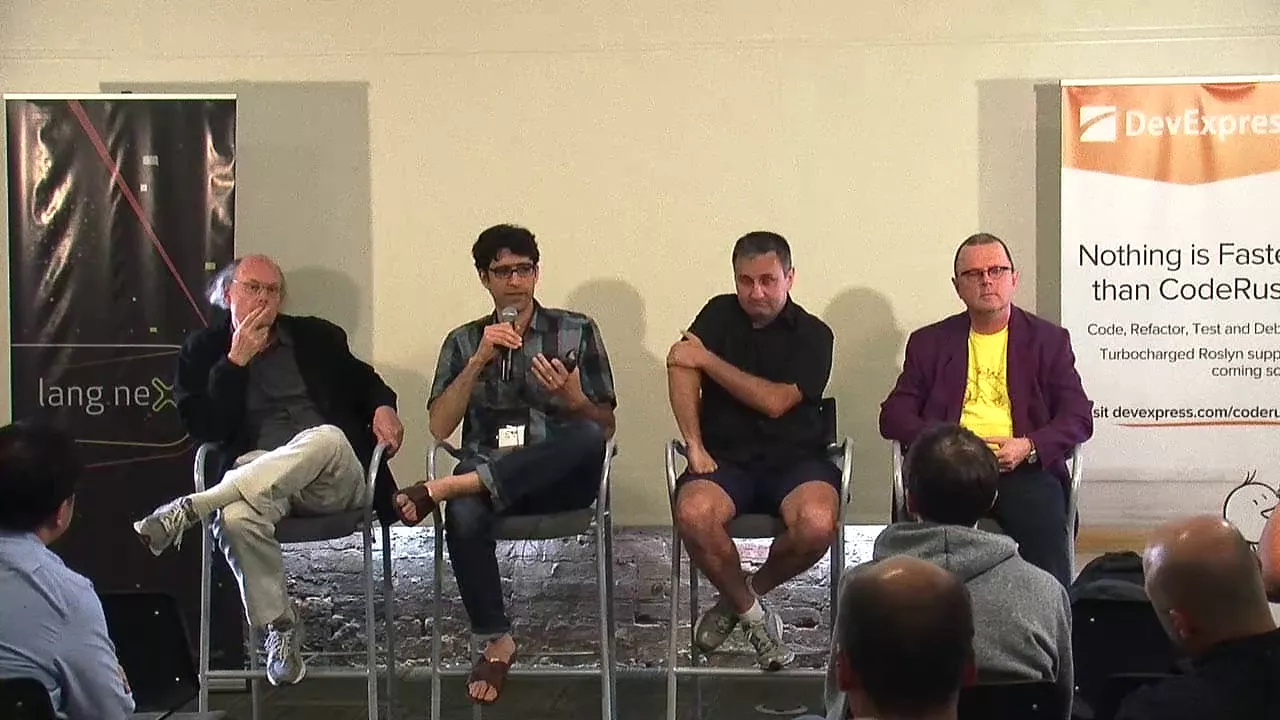
The interactive panel, titled “Systems Programming in 2014 and Beyond,” brings together language designers representing C++, Go, D, and Rust: Bjarne Stroustrup, Rob Pike, Andrei Alexandrescu, and Niko Matsakis. As the session opens, the moderator encourages audience participation, noting that attendees had been somewhat shy earlier in the day and urging them to drop their masks and ask direct questions.
Before opening the floor, the panel engages in a round of casual, good-natured introductions among themselves. Bjarne introduces Rob Pike, recalling their shared history: > “I remember when he came to Bell Labs we even shared an office for about three months and he's been doing great things at Bell Labs and then Lucent and then went to the west coast did a lot of good stuff with Google and and he was physicist I remember was it Caltech yes thanks.”
Rob returns the favor by introducing Bjarne Stroustrup as the designer and inventor of C++ at AT&T Bell Labs, joking about the sheer endurance required to serve on the standardization committee for decades. When asked how many years he had spent on the committee, Bjarne simply quips, “Too many.”
The introductions turn humorous as Andrei Alexandrescu is asked to introduce the Rust representative. Andrei confesses that he came unprepared and admits: > “Rust is the language that we're going to steal a lot from inspiration do what I say I'm gonna get a lot of inspiration from and I actually don't know much about about you so but maybe you I mean I don't know.”
Rob steps in to identify Andrei Alexandrescu as the co-designer and advocate for D, noting his work at Facebook and observing that, like every Romanian he has met recently, Andrei wears shorts all the time—prompting Andrei to joke that he will spend the rest of the evening trying to hide his legs under the table. The moderator then officially introduces Niko Matsakis, a researcher at Mozilla working on Rust, setting up the common thread across these languages: delivering high-level abstractions, type safety, and memory safety without sacrificing native performance or direct control over hardware.
[02:50](https://www.youtube.com/watch?v=ZQR32nTVF_4&t=170s) Defining Systems Programming in 2014
The moderator poses the foundational question of the session: what actually constitutes a “systems programming language” in 2014? The landscape has shifted dramatically from the days when the term applied strictly to writing operating systems or device drivers. Today, C++ powers much more than operating systems, while D, Go, and Rust occupy distinct spaces across servers, browsers, and distributed systems, leading the panelists to offer differing perspectives on what the term currently means.
```mermaid flowchart TD accTitle: Perspectives on Systems Programming in 2014 accDescr: Diagram illustrating the varied criteria and domains each panelist emphasizes when defining a modern systems programming language.
subgraph Criteria["Core Definitions & Litmus Tests"] A["Niko Matsakis (Rust)<br/>Client needs: latency, safety, resource predictability"] B["Bjarne Stroustrup (C++)<br/>Resource constraints: memory, time, hardware control"] C["Rob Pike (Go)<br/>Server & cloud infrastructure engineering"] D["Andrei Alexandrescu (D)<br/>Low-level tests: write own allocator & forge pointers"] end
subgraph Applications["Modern Target Domains"] E["Client Applications & Browsers"] F["Cloud & Scalable Distributed Backends"] G["Constrained Embedded & Hardware Systems"] end
A --> E B --> G C --> F D --> G ```
Niko Matsakis points out that terminology is used quite differently across teams. From Mozilla's perspective, the primary focus is client-side application software, such as web browsers: > “So from our point of view I mean the thing that we're most interested in certainly you know in the most selfish point of view is writing kind of client-side applications right so sort of the polar opposite of what Go was designed for for example and in these kind of applications you have high latency needs you have high security requirements you have a lot of requirements that I think don't necessarily come up on the server side...”
However, Niko concedes that the boundaries are soft: Go can be used on clients, Rust can be used for server backends, and the true distinctions only emerge at the absolute extremes of those domains.
- **Niko Matsakis's Focus**: Client applications with strict latency bounds, robust security guarantees, and fine-grained execution predictability. - **Spectrum Overlap**: The consensus that general-purpose languages can technically operate anywhere, with their trade-offs manifesting primarily at domain edges.
[05:13](https://www.youtube.com/watch?v=ZQR32nTVF_4&t=313s) Resource Constraints vs. Cloud Infrastructure
Bjarne Stroustrup frames systems programming not by the specific software being written, but by the constraints under which it operates. He explains that systems programming grew out of having to touch hardware directly and subsequently managing the runaway complexity that followed. For Bjarne, it is fundamentally a matter of operating under hard limits: > “It's a constraint that determines whether it's systems programming are you running out of memory are you running out of time are you running out of real time are you running out of file handles and then finally there's the aspect of actually touching hardware device drivers memory managers and such but it's it's like asking me to define play or game there's something obviously is there and then by analogy a lot of our listings are there don't don't expect a crisp definition.”
Rob Pike follows by reflecting on Go's naming history, admitting that labeling Go a “systems programming language” during its initial announcement created confusing expectations: > “When we first announced Go we called it a systems programming language and I slightly regret that because a lot of people assumed that meant it was an operating systems writing language and what we should have called it was a server server writing language which was what we really thought of it as...”
Rob notes that what used to be called servers has since been rebranded as cloud infrastructure. Consequently, in Rob's view, another modern and accurate definition of systems programming is simply the software stack that powers the cloud.
[07:22](https://www.youtube.com/watch?v=ZQR32nTVF_4&t=442s) Andrei's Litmus Tests and the Allocator Challenge
Andrei Alexandrescu expresses relief that Rob preempted his question regarding why Go dropped the "systems programming" label from its website. Andrei notes that while debating definitions can easily slide into endless philosophy, he relies on two pragmatic, technical litmus tests to verify whether a language is truly a systems language: > “And I think there's a there's a simple litmus test which says systems programming language must be able to allow you to write its own memory allocator in it it shouldn't escape into another language to do so and it should be able to forge a number into a pointer because that's how hardware works this is kind of two litmus tests that are relatively simple.”
He elaborates that writing a memory allocator is far more difficult than most high-level language users realize. In high-level languages, memory management is treated as a solved, invisible implementation detail. But when a language must both implement and use an allocator, the task becomes notoriously bug-prone and runs directly counter to strong type systems: at some point, typed pointers must become raw, untyped blocks of storage and then be reconstituted into entirely different types on the fly.
Rob Pike immediately responds to Andrei's criterion with a practical counterpoint: the Go team has nearly finished rewriting Go's runtime memory allocator in Go itself (having previously been implemented in C), meaning Go qualifies under Andrei's allocator benchmark.
- **Litmus Test 1**: The language must be able to implement its own runtime memory allocator internally without dropping into a secondary systems language like C. - **Litmus Test 2**: The language must support forging integers into pointers, mirroring how physical memory-mapped hardware interfaces function. - **Go's Milestones**: Rewriting the Go memory allocator in pure Go from its original C implementation.
[09:45](https://www.youtube.com/watch?v=ZQR32nTVF_4&t=585s) The Risk of External Definitions and Audience Questions on Security
Bjarne Stroustrup cautions against letting outsiders define technical domains. He points out that looking up “systems programming” on Wikipedia produces a definition so narrow—writing the lowest-level device drivers—that it renders the discipline practically obsolete: > “It is very tricky when somebody else defines your terms for you and I mentioned it with C++ with object-oriented programming we have an example here with systems programming being defined out of existence and the other example that I remember was Simula the language Simula are the introduced object-oriented programming to the world and got classes and class hierarchies in place was called Simula and I met a lot of people says no it was a special-purpose language of simulations there's nothing interesting there so let's try and define what we are doing a little bit better.”
The session then turns to the audience. An attendee brings up what they view as one of the central challenges of the era: writing secure, robust, and reliable code, which requires deep cooperation between the host platform and the programming language. The attendee asks what promising avenues of innovation the panelists see coming from the systems language space to enforce robustness.
Niko Matsakis takes the question first, answering that there are very real opportunities for innovation. He argues that before addressing broader reliability concerns, a language must establish a baseline layer of security guarantees: > “For me it sort of there's the base level of security which is kind of the properties I was talking about you know data-race freedom memory safety and so forth and you can argue about exactly which one should be in that list but there's a kind of basic set of things that you would like to get from your language most of the time at least and that gives you a good feeling...”
[12:04](https://www.youtube.com/watch?v=ZQR32nTVF_4&t=724s) Expressing Semantic Invariants Beyond Basic Safety
Niko Matsakis explains that while current type systems provide more reliable software, they merely prevent specific categories of bad behavior rather than verifying that a program actually does the intended task. As Rust evolves, he hopes to see developers leverage the type system to express deeper application-specific invariants. Beyond providing automated refactoring and seamless tooling to trace function usage, types could model domain-level constraints. As an example, a type system could enforce that untainted data received from a network interface must pass through a sanitization routine before any internal consumer can process it.
Bjarne Stroustrup immediately intervenes to draw a clear line between formal type checking and real-world system defense. “I think we have to distinguish sharply between type safety and security,” Stroustrup states, cautioning that security encompasses physical and operational environments rather than just language properties:
> “If I'm going to steal your data I will probably not try and break in your computer first I'll try and steal your computer first and then I'll head to it my own good time that's a bit hard of a server farms but still the point is that it's a system property”
Stroustrup emphasizes that while 100% type safety is an enduring ideal, missing that mark entirely does not equal failure, nor does achieving it guarantee security. He warns against superficial debates that treat type safety as a panacea for security vulnerabilities like array overflows and resource starvation.
[15:11](https://www.youtube.com/watch?v=ZQR32nTVF_4&t=911s) The Programming Language Community’s Local Optimum
Andrei Alexandrescu offers a contrarian perspective, joking that he will deliver a “Dear Leader North Korean prediction” where the luminous path lies ahead. He argues that Rust and modern languages are caught in a local optimum that constrains the entire programming languages (PL) community. Currently, properties that compilers prove effortlessly are intellectually uninteresting, while truly valuable guarantees—such as automatic array bounds check elimination—remain practically burdensome and computationally complex.
```mermaid flowchart TD accTitle: Alexandrescu's Breakthrough Cycle accDescr: Historical breakthrough cycle comparing speech recognition to type system evolution.
subgraph Hist["Historical Parallel"] SR1["Speech Recognition stuck in local minimum"] --> SR2["Breakthrough: Statistical models & Siri"] end
subgraph PL["Programming Languages"] PL1["Current PL local optimum:<br/>Trivial proofs easy, rich types onerous"] --> PL2["Ripe for breakthrough:<br/>High-assurance typing with minimal annotations"] end
Hist -.->|"Pattern convergence"| PL ```
Drawing an analogy to speech recognition research—which he abandoned just before statistical modeling led to major commercial breakthroughs like Siri—Alexandrescu suggests that type systems are approaching a similar inflection point. “Essentially the white seat we're ripe for a sort of a real breakthrough in in the area when programs are going to be typed in ways that at the same time are are interesting improve a lot of facts but don't require a lot of annotations,” he predicts. Systems programming languages, by imposing uncompromising demands for raw execution speed alongside safety, apply valuable upward pressure on academic researchers.
- Andrei Alexandrescu argues that language tools remain trapped in a rut where safe array bounds elimination is practically difficult to achieve without heavy annotation overhead. - Systems programming acts as an essential forcing function on PL theory because no level of overhead is tolerated in exchange for safety guarantees.
[17:10](https://www.youtube.com/watch?v=ZQR32nTVF_4&t=1030s) Tooling, Static Analysis, and Scale
Rob Pike counters the pessimism, arguing that the industry is already climbing out of its rut due to dramatic expansions in compute capacity. Hardware is now fast and voluminous enough to execute global program checks that were computationally impossible a generation ago. Pike recalls Gerard Holzmann’s work on the Plan 9 kernel at Bell Labs 15 years prior, where a specialized protocol analyzer parsed C source code and tracked mutex library invocations to demonstrate that the kernel was deadlock-free without requiring traditional manual proofs.
Stroustrup backs Pike's stance on mechanical inspection, arguing that static analysis scales with language sophistication. “One of the criticisms of static typing has been that they only catch trivial things,” Stroustrup observes, adding: “That's because they look at trivial type systems.”
- Gerard Holzmann built a static protocol analyzer at Bell Labs to verify locking behavior and lock-freedom across the Plan 9 operating system kernel. - Computational resources once monopolized by whole-program optimization passes can now be repurposed for deep static verification.
[19:50](https://www.youtube.com/watch?v=ZQR32nTVF_4&t=1190s) The Cognitive Burden of Systems Languages
Panel moderator Dave asks whether modern systems languages demand too much mental overhead from working programmers. Even though tools now generate better diagnostics, Dave notes that he constantly struggles with left-brain conceptual models while writing code. In Rust, one must continuously track reference lifetimes, borrow flags, and mutability; in C++, the mental landscape is similarly daunting. Dave contrasts this with Go, which intentionally trims language surface area to prevent overloading ordinary engineers, and asks the panelists if their languages force users to carry an exhausting mental model in their heads.
```mermaid flowchart LR accTitle: Language Complexity Sources accDescr: The dual pressures of legacy compatibility and user feature requests driving complexity.
subgraph Sources["Forces Expanding Complexity"] A["40-Year Heritage (C in 1972)"] --> C["Complex Mental Burden"] B["Feature Requests ('Simpler + My Feature')"] --> C end
subgraph Remedy["Proposed Path Out"] C -.-> D["Tool-Assisted Modernization & Rewriting"] end ```
[21:39](https://www.youtube.com/watch?v=ZQR32nTVF_4&t=1299s) Legacy, Language Bloat, and Mechanical Rejuvenation
Stroustrup responds directly, explaining that language complexity stems primarily from backward compatibility. Software developers perpetually request a simpler language accompanied by their own pet features, forcing him to reject upwards of 99 percent of language proposals over the decades. C++ carries four decades of legacy reaching back to Dennis Ritchie’s original 1972 design of C, containing features that should never have existed or that have long been superseded. Because existing codebases cannot be broken, obsolete mechanisms persist indefinitely.
Stroustrup calls for advanced tooling that moves beyond passive linting toward automated refactoring and language rejuvenation:
> “One thing that I hope for is not just code analysis I want code transformation and I wanted to maybe I can finally get modernization of code code rejuvenation or whatever you call it that's mechanically helped so we can get some of these things that aren't C++ just because Dennis had a bad day in the early 70s and Dennis would agree with me and actually has”
Stroustrup points out that if he were to design C++ templates today, their specification would occupy half the space. He wryly notes how new languages recurrently emerge claiming purity, referencing how early Java advocates brandished the *Annotated C++ Reference Manual* (ARM) while tearing out two-thirds of its pages to claim they had built a clean language from first principles using familiar C syntax.
- Bjarne Stroustrup estimates he has rejected more than 99% of feature proposals submitted for C++ to hold back complexity. - C++ retains design compromises inherited directly from Dennis Ritchie's original 1972 implementation of C. - Stroustrup claims that with modern design knowledge, the template mechanism in C++ could have been designed at roughly half its existing footprint.
[24:18](https://www.youtube.com/watch?v=ZQR32nTVF_4&t=1458s) Language Evolution and Automated Code Transformation with `go fix`
Bjarne Stroustrup remarks that as programming languages age, they accumulate endless “barnacles that hangs off the ship,” noting that the only languages avoiding this fate are those that fail to survive. Both C# and Java have doubled and tripled in size until their specifications rival C++. Hoping that automated code transformation might offer a way forward, he prompts Rob Pike to share how the Go team tackled language churn leading up to the release of Go 1.0. While Go did not have nearly the massive user base of C++, Pike explains that the team was determined to lock the language down without needlessly fracturing the existing community's codebase. They wanted the freedom to simplify syntax, prune experimental features, delete keywords, and overhaul standard libraries, but needed a mechanism that would prevent manual migration pain for their users.
```mermaid flowchart LR accTitle: The Go Fix Migration Pipeline accDescr: Pipeline showing legacy Go source code being parsed into an AST, transformed by modular rewrite passes, and output as clean source code via gofmt. subgraph Transformation["Automated Refactoring"] A["Legacy Go Source"] --> B["AST Parser"] B --> C["go fix Modules"] C --> D["gofmt Formatter"] end D --> E["Clean Go 1.0 Source"] ```
To achieve this, the Go team built `go fix`, a modular tool designed to parse both older and newer syntax variations into an abstract syntax tree (AST), apply idempotent rewrites, and emit clean code. This was enabled by Robert Griesemer's creation of `gofmt`, a formatting library that re-emits ASTs in canonical, human-readable source style—an addition Pike humorously observes “some people say is the best feature of the language; they may be right.” This tooling afforded the designers unprecedented freedom to experiment, reverse poorly aging ideas, and polish every edge of Go before release. Later, when Google decided to completely replace the Go Protocol Buffers API—used on virtually every third line of internal Google code—they wrote a single `go fix` module that migrated the entire monolithic repository in one step. As Pike sums up, “a lot of this is actually automatable if you're willing to have the courage to clean up, stick to your guns, and really get rid of the old stuff.”
- Go 1.0 established strict backwards compatibility; subsequent point releases focused purely on compiler performance, runtime implementation, and library additions. - The `go fix` migration modules were engineered to be idempotent so that running them repeatedly on partially converted trees caused no side effects. - The automated Protocol Buffers API rewrite at Google stood in sharp contrast to the massive, painful migrations typical of legacy C++ codebases.
---
[27:58](https://www.youtube.com/watch?v=ZQR32nTVF_4&t=1678s) Domain Complexity vs. Language Overhead: Ownership and Explicit Types
Niko Matsakis turns the discussion back to the audience's underlying concern: whether modern systems languages force programmers to keep an unreasonable amount of type machinery in their heads. Addressing the trade-off of upfront cognitive overhead versus hidden costs, Matsakis contrasts Rust’s explicit ownership and borrowing semantics with the deceptively simple pointer model of Java or C#. In managed languages, concepts like resource lifetimes, exclusive access, and mutation still exist beneath the surface, but they remain implicit and unchecked, leaving developers vulnerable to subtle design bugs.
Matsakis points out that developers migrating into systems programming often find Rust's compiler diagnostics far more forgiving than the trial-by-fire debugging required in C. Rather than spending weeks diagnosing obscure double-free panics and segmentation faults, newcomers are guided down correct structural patterns by the borrow checker. Contradicting the premise that modern systems languages are arbitrarily bloated, Matsakis argues: “I feel the most of the complexity is in the domain, and exposing it at the language level is not a mistake in that regard.”
---
[29:47](https://www.youtube.com/watch?v=ZQR32nTVF_4&t=1787s) The Full-Stack Scale of Systems Programming and Extreme Efficiency Margins
Andrei Alexandrescu begins with a personal aside to the audience member, David Ungar: “Dave, you should know, you're my academic grandfather; Craig Chambers has been my advisor through my Master's, so it's a great honor to see you.” He empathizes with Ungar's affection for the fluid, minimal cognitive friction found in dynamic prototype environments like Self and Smalltalk. However, Alexandrescu argues that systems programming carries an inescapable requirement to simultaneously manage macroscopic design and microscopic execution: “Systems languages have this extra burden on top of everything, which is, well, you got to worry about at the same time the cathedral, the bricks, and the molecules in the bricks.”
To demonstrate why dynamic or garbage-collected runtimes cannot satisfy every tier of this stack, Alexandrescu highlights recent experimentation conducted at Facebook. Benchmarking identical production payloads revealed that a garbage-collected architecture consumed roughly three times the memory of an eagerly reclaimed, manually managed counterpart—an overhead profile Facebook simply cannot afford. At hyperscale server deployments, fractional optimizations map directly to massive financial and operational outcomes:
- A mere 0.5% gain in core server-level efficiency translates to millions of dollars saved annually in electricity costs alone. - Reduced memory and physical footprint decreases server component failure rates, hardware churn, and acquisition costs. - While dynamic abstractions provide comfort to language researchers, production at scale demands that the inherent physical complexity of hardware remain exposed to the programmer.
---
[33:03](https://www.youtube.com/watch?v=ZQR32nTVF_4&t=1983s) Precision, Type Safety, and the High Stakes of Technical Correctness
Bjarne Stroustrup reinforces Alexandrescu's and Matsakis's points by forcefully rejecting the common aspiration that programming should mimic natural language. Stroustrup cautions that natural language is notoriously ambiguous, noting how frequently a statement that seems crystal clear in English is misinterpreted by everyone who hears it. In systems engineering, interfaces that enforce rigorous contracts via type systems and strict constraints are the only reliable defense against miscommunication across large organizations.
To demonstrate the real-world cost of weak or imprecise typing, Stroustrup cites the Mars Climate Orbiter disaster: the software failed not from a syntax error or a standard memory bug, but because the interface relied on bare floating-point primitives without dimensional unit verification. Because a floating-point `double` looks identical whether it represents metric Newtons or imperial pound-seconds of thrust, an undetected conversion mismatch doomed a $600 million spacecraft. Stroustrup emphasizes that for safety-critical systems—such as automotive brake software—rigorous technical specifications in the type system are non-negotiable: “For the kind of applications I think of most and care about most, like the brakes on my car and such, I would rather see it done at a technical level than an intuitive level.”
[35:02](https://www.youtube.com/watch?v=ZQR32nTVF_4&t=2102s) Cognitive Friction, Smalltalk, and the Prototyping Dilemma
An audience member follows up on an earlier point regarding testing versus language-enforced safety. He remarks that he does not know whether static type enforcement is actually sufficient to ensure the brakes work on his car compared to investing that exact same effort into comprehensive testing and fault injection. Addressing the panel, he notes that while high safety guarantees matter if code is being sent to Mars, many ideas begin as fragile concepts. In most systems languages, carrying all the low-level baggage in one's head makes it exceedingly hard to hold onto a bright new idea.
To illustrate, he quotes Randy Smith's reflection on the Alternate Reality Kit: if Smith had been forced to implement it in anything other than Smalltalk, he never would have gotten the first three lines written. The audience member expresses a desire to easily prototype an idea in a language that runs reasonably fast without being burdened upfront by manual reclamation or rigid mechanics, leaving room to add security or optimization later rather than having to rewrite the whole system from scratch.
[36:55](https://www.youtube.com/watch?v=ZQR32nTVF_4&t=2215s) Rob Pike on Garbage Collection: An Idea, Not a Performance Problem
Rob Pike steps in to clarify common misconceptions surrounding garbage collection, pointing out that not everything at Google is written in Go, nor should it be—especially where GC latency cannot be tolerated and lower-level control is strictly necessary. However, Pike argues that the systems programming community often dismisses garbage collection unnecessarily. While GC is not the solution for everything, it is the right answer for an enormous amount of software. He notes that this very realization drove the creation of Go: while C++ remains appropriate for certain core tasks at Google, it is not required for the majority of programs where developer productivity and memory ergonomics matter more.
Pike emphasizes that garbage collection itself is an abstract concept rather than an intrinsic performance bottleneck; poor performance usually stems from specific implementation strategies rather than the paradigm itself. Implementing modern allocators and collectors properly avoids bloated arenas and catastrophic slowdowns. Most crucially, removing ownership management drastically reduces interface complexity. Pike observes that Go's APIs often have half the complexity of their C++ equivalents because developers do not need to constantly negotiate memory ownership signatures.
> “The APIs in a typical Go program are half the complexity of a C++ equivalent because you don't have to talk about the memory management, and that makes the program smaller, simpler, easy to understand, and you have less to carry in your head as a result.” — Rob Pike
```mermaid flowchart TD accTitle: Go Memory Ergonomics vs C++ Complexity accDescr: Shows how removing ownership management from APIs reduces cognitive overhead in Go compared to C++.
subgraph CPP["C++ Paradigm"] direction TB C1["Explicit Ownership Semantics"] C2["Complex API Signatures"] C3["Higher Cognitive Load"] C1 --> C2 --> C3 end
subgraph GO["Go Paradigm"] direction TB G1["Automatic Garbage Collection"] G2["Streamlined API Signatures"] G3["Lower Mental Overhead"] G1 --> G2 --> G3 end ```
[39:17](https://www.youtube.com/watch?v=ZQR32nTVF_4&t=2357s) Niko Matsakis on Rust's Spectrum: From Inefficient Prototyping to High Performance
Niko Matsakis responds by citing a talk delivered earlier that morning by Bjarne Stroustrup, which busted the myth that programmers always demand maximum efficiency. Most of the time, developers do not need to inspect every generated assembly instruction; they just want to write down an idea, see it execute at a reasonable speed, and tune it later. Matsakis acknowledges that marketing a systems language like Rust creates tension because the project naturally promotes what it does best: combining absolute efficiency with rigorous memory safety.
However, Matsakis reveals that the Rust team also wants Rust to excel at writing quick, intentionally inefficient, and convenient code. In that mode, programmers should not have to fret about copying a buffer two or three times. He notes that the team has been exploring an optional garbage collection strategy as another ownership model that developers can opt into, though integrating GC alongside manual and reference-counted semantics remains technically demanding. The ultimate objective is a language where rapid prototyping is straightforward, yet the tools exist to harden and optimize the code in-place as soon as performance becomes critical.
[41:04](https://www.youtube.com/watch?v=ZQR32nTVF_4&t=2464s) Bjarne Stroustrup on Types as Thinking Tools and the Testing Epiphany
Bjarne Stroustrup offers a sharp counterpoint to the idea that type systems hinder creative prototyping. For Stroustrup, pinning down interfaces using strong, precise static types is not a bureaucratic hurdle; it is an indispensable aid to clear thinking. Relying purely on running dynamic examples only exposes design flaws after the fact, whereas putting a static type system up front flags faulty assumptions immediately.
Stroustrup views the compiler's type checker as an intellectual safety net, asserting: “I actually think of the type system as my first line of defense against my own sloppy thinking.” When an audience member jokes that this debate borders on the classic static versus dynamic typing dispute where reasonable minds disagree, Stroustrup delivers a punchline about the origins of modern testing dogma:
> “I had a bit of an epiphany last year when I realized that the reason that unit testing was being driven by the dynamic language people was that they had that instead of static typing.” — Bjarne Stroustrup
The room reacts with laughter, to which Stroustrup deadpans, “That wasn't funny, so it's a fact.”
[42:41](https://www.youtube.com/watch?v=ZQR32nTVF_4&t=2561s) Binary Versioning, Monkey-Patching, and the 5ESS Mystery
The session moves into an open Q&A. An audience member raises the financial cost of change and application binary interface (ABI) versioning, harking back to David Smith's work on adaptable systems. In production environments, breaking downstream clients across a top-to-bottom stack when modifying a shared library incurs immense economic cost. In languages like C++, memory layout is rigid, and the `this` pointer is fixed implicitly in memory, whereas more dynamic systems allow identity mutations and non-breaking post-release updates. The questioner asks why the systems language community does not place greater emphasis on explicit mechanisms designed to support large-scale program evolution and binary compatibility.
Rob Pike reflects on his time at AT&T alongside Bjarne Stroustrup, recalling the lucrative 5ESS telecommunications data switch. The 5ESS was a VAX-scale machine with massive hardware redundancy responsible for dial tones and digit switching. Every individual field installation ended up running slightly different software, as technicians applied localized binary patches—such as omitting the Spanish dialing plan in France. Pike marvels at how telecom engineers in the 1980s managed to dynamically monkey-patch live binary code over remote connections around the clock without ever dropping dial tones. Stroustrup confirms that he remembers the 5ESS era well, but clarifies that while an entire branch of the academic language community has pursued runtime adaptability and dynamic patching, his own focus has remained firmly grounded in absolute reliability: engineering the actual telephone switches and automotive braking systems so they never fail.
- The AT&T 5ESS was built with VAX-scale compute capacity and hardware redundancy to guarantee continuous dial tone and digit routing. - Real-world 5ESS deployments routinely diverged into unique configurations due to remote binary monkey-patching tailored to specific local dialing plans.
[45:40](https://www.youtube.com/watch?v=ZQR32nTVF_4&t=2740s) Hot-Patching, Cache Lines, and the Cost of Indirection
Bjarne Stroustrup opens by delineating his problem domain: keeping Mars probes and web servers reliable and efficient. Reflecting on his opening slide, where he emphasized that no single language fits every use case, he acknowledges that highly dynamic, flexible languages stemming from Lisp and Smalltalk have sustained vibrant ecosystems and never really gone out of fashion. However, that high-level dynamic space simply represents a completely different engineering concern from low-level systems programming.
Andrei Alexandrescu continues the thread, observing that having Bjarne and himself on a panel risks becoming boring because their core perspectives align so closely. He explains how Facebook handles deployments: the entire site is redeployed about twice a week across a massive, unspecified number of servers running deeply interconnected libraries. Facebook does not achieve this via dynamic hot-patching; rather, they deploy through external operational orchestration like BitTorrent-based distribution, winding down running binaries, swapping executables, and warming up services. Having spent months on Facebook's core PHP compiler team (HHVM), Alexandrescu notes that every single micro-optimization directly hits the company's financial bottom line.
Dynamic hot-patching inherently requires adding indirection—pointers, trees, and lists instead of flat structures—to swap code or data targets at runtime. Alexandrescu stresses that for production performance, indirection is completely unacceptable. At Facebook, data structures are stripped down to arrays and structs, and optimization work focuses specifically on the layout of the very first cache line:
> “The first cache line in the struct is where it's hot, that's where it happens, that's what the rubber hits the road and you come... if you come and say, ‘Oh, we need hot patching,’ and I'm like, ‘Oh, that's going to totally ruin my first line of cache right there and I'm going to die, right?’”
Swapping just two fields inside a struct can immediately cause a two-percent performance drop across a cluster, meaning hot-patching is an expensive architectural luxury low-latency infrastructure simply cannot afford.
```mermaid flowchart TD accTitle: Trade-off Between Hot-Patching Indirection and Flat Memory Cache Performance accDescr: Shows how dynamic updates require indirection that destroys CPU cache lines, contrasting with flat high-performance layouts.
subgraph Dynamic["Dynamic Hot-Patching Approach"] A["Dynamic Indirection Layers"] --> B["Lists, Trees, Indirect Pointers"] B --> C["Runtime Code/Data Swapping"] C --> D["Cache Misses & Performance Penalty"] end
subgraph Static["High-Performance Systems Approach"] E["Flat Array & Struct Layout"] --> F["Optimized First Cache Line"] F --> G["Fast CPU L1/L2 Processing"] G --> H["Restart/Reload via Process Swapping"] end ```
[49:01](https://www.youtube.com/watch?v=ZQR32nTVF_4&t=2941s) Fail Fast, Restart Quickly: Semantic Challenges of In-Memory Updates
Niko Matsakis highlights that modern system architecture tends to favor the Erlang paradigm: fail fast and restart quickly. Modern hardware can boot an entirely fresh server instance in a few milliseconds. If edge proxies and load balancers can incrementally drain traffic from a node, shut it down, and bring up the updated build without dropping user requests, trying to invent mechanisms for live in-process code modification becomes pointless added complexity.
Matsakis points out that dynamic code swapping and monkey-patching pose severe semantic challenges. While hooking in new code via virtual tables or function pointers incurs runtime cost, mutating in-memory runtime data is vastly harder. If an internal data structure changes shape or meaning—such as moving from Cartesian coordinates to polar coordinates—safely migrating live state without halting execution becomes a nightmarish problem. Establishing clean boundaries, defining what must persist versus what can be discarded, and letting the process crash or restart is far cleaner than trying to automate live in-place state migration. Stroustrup interjects with a historical note on telecommunication switches, recalling that achieving robust hot-patching required intentionally over-allocating resources:
> “The main ideas for being able to patch the data structures and switches is to deploy them with data structures that's slightly too big and with jump tables that are slightly too big so that if nothing else you can always have a thing that says switch to the new one for a while...”
Engineers could not merely ship what fit the system at that moment; they were forced to allocate memory two sizes larger than necessary just to leave room for future dynamic patches.
[51:19](https://www.youtube.com/watch?v=ZQR32nTVF_4&t=3079s) Slow C++ Compile Times and Header Bloat
An audience member working primarily in C++ raises a question about compilation pain. In their codebase, compile and link times take forever because extensive static analysis and domain logic have been pushed into the type system, creating vast numbers of template entities. He asks whether this compilation bottleneck is unique to C++, how newer languages handle it, and what the future holds for resolving the issue in C++.
Stroustrup affirms that build time is a massive industry pain point, wryly noting that Scala developers face similar struggles. However, he clarifies that template metaprogramming instances are rarely the primary culprit in most codebases. The real driver of slow compilation is textual file inclusion:
> “The instances in the in your program are not the real problem, it's the fact that we recompile the header files hundreds of times and this problem is getting unmanageable...”
Stroustrup notes that the ISO C++ Standards Committee has recognized this crisis, and he plans to dedicate significant time to modules and compilation improvements at an upcoming standards meeting three weeks later. While cautioning that standards bodies move slowly and rarely discover the most straightforward solutions on their first try, he asserts that a properly modularized C++ could achieve compilation speeds ten times faster.
[53:12](https://www.youtube.com/watch?v=ZQR32nTVF_4&t=3192s) Batch Models, Unity Builds, and the Serial Legacy of C
Niko Matsakis addresses compilation performance in Rust, mentioning that although the Rust compiler is not fast, the team had spent essentially zero time optimizing its internal throughput up to that point. Rust avoids C++’s header inclusion penalty by parsing an entire compilation unit (a crate) at once rather than repeatedly parsing individual source files. In Mozilla's C++ codebase, developers rely on unified (amalgamated) builds—concatenating multiple `.cpp` files into single large compilation units—to bypass redundant header parsing. Addressing casual community complaints about Rust's build times, Matsakis points out that running a full `make` bootstraps the compiler across three distinct stages:
- The existing compiler builds the new compiler from source. - The newly built compiler rebuilds itself using the new binaries. - The resulting binary compiles all standard libraries.
Alexandrescu argues that glacial compile times are an intrinsic design flaw inherited from C. Dennis Ritchie designed C around the memory constraints of early hardware, requiring a multistage batch compilation pipeline:
> “Does anyone know why the backslash termination line was ever introduced? Because it was run through a preprocessor that only did that because there's not enough memory for the whole thing...”
Original Unix systems lacked sufficient memory to parse files, perform macro expansion, resolve digraphs and trigraphs, and compile ASTs in a single pass, forcing a strictly serial model where every single character and token depends on everything parsed before it.
High-traffic tech giants like Google, Facebook, and Amazon grapple with this bottleneck every day. Despite marshaling massive fleets of build servers and assigning their most senior systems engineers to optimize distributed caching and build systems, C++ build latency remains fundamentally unresolved. Alexandrescu recalls that when he first joined Facebook, engineers urged him to look into the D programming language. Spending six months testing D made its lightning-fast parser and forward-referencing architecture immediately evident, leaving the C++ tooling team painfully aware of the archaic structural limits of the tools they were trying to optimize.
[56:26](https://www.youtube.com/watch?v=ZQR32nTVF_4&t=3386s) Compilation Speed and the C++ Header Blowup
The discussion continues on the decisive role compilation speed plays in developer adoption. When programmers discover a language that compiles dramatically faster, it changes their willingness to experiment: “it’s speeds of compilation that cannot be cannot be obtained at any with any money for C++; there’s no amount of money that would pay you that you could pay someone to compile code as fast as he does and that that was a winner.” For C++, the sluggish compilation times are fundamentally a design issue baked into its history, even though work on C++ modules is progressing.
Rob Pike brings up concrete data from a measurement cited in a previous SPLASH talk concerning a massive C++ build at Google. Due to transitive header inclusions, the sheer volume of text the compiler had to ingest expanded out of all proportion: “it was some like 4.2 million bytes per byte of input source to the compiler; it was a million factor blow up in the amount of source that the compiler actually looked at because of the header inclusion problem.” Pike emphasizes that this is not primarily caused by templates, but begins simply with placing a single class per header file. Bjarne Stroustrup retakes the microphone to concede the point without hesitation: “The reason I take this mic back is mostly to say that I don’t disagree with that; this this this is a major problem it’s a growing problem it needs to be dealt with.” Stroustrup notes that while he is not completely “rah-rah optimistic,” he believes the modules effort will ultimately solve the issue.
- Rob Pike cites Google build metrics showing a roughly million-fold blowup (~4.2 million bytes parsed per byte of actual written source). - The root cause is traced back to transitive `#include` directives and class-per-header patterns rather than templates alone. - Bjarne Stroustrup affirms that compilation bloat is an urgent, growing problem that modules aim to resolve.
---
[58:23](https://www.youtube.com/watch?v=ZQR32nTVF_4&t=3503s) Why C++ Never Standardized an ABI
An audience member working primarily in C++ asks Bjarne Stroustrup about the decision never to define an Application Binary Interface (ABI) as part of the language specification, whether he regrets it, and how newer language designers approach specifying binary interfaces within the limits of portability. Stroustrup replies that having a standardized binary interface would indeed have been beneficial, but the ISO C++ Standards Committee considered it completely outside its scope—just as the C committee had done earlier.
C was fortunate because each operating platform typically had a dominant, de facto owner setting the platform ABI, which C++ implementations initially rode on. However, C++ fractured rapidly because major compiler vendors each wanted to claim ownership of the platform toolchain: “the reason C++ didn't get one of those was that essentially everybody thought they could own C++ on the platform and so you had Microsoft and Borland and Symantec each defining their ABI carefully making sure you couldn't link to the enemy's code.” Whenever standardizers tried to tackle this afterwards, they hit two roadblocks: ABI was deemed outside the committee's charter, and vendors consistently chose backward compatibility with their existing customers over breaking code to achieve cross-vendor compatibility. Stroustrup notes faint hope in 64-bit standards and the Itanium ABI, but admits, “I hope people will get their act together but I'm not holding my breath.”
```mermaid flowchart TD accTitle: Obstacles to a Standard C++ ABI accDescr: Diagram illustrating the historical and technical barriers preventing a uniform C++ Application Binary Interface. subgraph Vendors["Vendor Competition"] MS["Microsoft"] BOR["Borland"] SYM["Symantec"] end
Vendors -->|"proprietary ABIs prevent linking"| Split["Fragmented Ecosystem"] Split --> Blockers{"Key Roadblocks to Reform"} Blockers --> R1["Out of ISO Standards Charter"] Blockers --> R2["Prioritizing backward compatibility over cross-vendor links"] Blockers --> Partial["Partial convergence via Itanium / 64-bit ABIs"] ```
---
[01:00:42](https://www.youtube.com/watch?v=ZQR32nTVF_4&t=3642s) Approaches to ABIs in Rust, D, and Go
The other panelists explain how their languages balance binary layout guarantees against compiler optimizations and foreign function interfaces (FFIs). Niko Matsakis explains that Rust adopted an opt-in model modeled on C: developers can annotate a representation with `#[repr(C)]` to obtain deterministic layout and write functions callable across C interfaces. However, Rust deliberately avoids locking down a global ABI for native code so the compiler retains room to innovate: “we've tried to reserve for ourselves the right to optimize representations beyond that... there's a little bit of a tension there between wanting to do the best optimizations you can given the target platform and everything else and and wanting to reserve the right to change that in the future when you think of something clever that you didn't think of when you wrote the spec.”
Andrei Alexandrescu reframes the problem around interoperability with the incumbent (C and C++) versus layout control within the language itself. D provides `extern (C)` and `extern (C++)` alongside namespace support and name mangling to talk directly to C++ code. Internally, D treats `struct` layout according to predictable C rules so programmers can organize cache performance without fear of arbitrary field reordering, whereas `class` types (accessed by reference) grant the compiler freedom to rearrange members, similar to C++ objects with virtual tables.
Rob Pike concludes with Go's starkly different design: Go only worries about ABI rules at the boundary when interacting with C or C++ via Cgo, which Pike calls “one of the hardest things to work on because every platform has its own rules.” Within pure Go, they deliberately ignore stable ABI specifications entirely. Because the compiler is so fast—building Go's entire standard library from source on a laptop in six seconds—Go mandates that all artifacts linked into a binary be compiled from source using the identical compiler version: “therefore it doesn't matter; whatever that compiler thinks is right is right.” The panel wraps up with gratitude to the audience and a humorous reminder that it is time to go drink beer.
- Rust provides `#[repr(C)]` for explicit C-FFI compatibility while keeping internal Rust ABI layouts unspecified to allow optimizations like niche packing. - D maintains C struct layout compatibility for deterministic memory layout while giving the compiler latitude to reorder fields inside reference `class` objects. - Go avoids an internal ABI altogether by relying on ultra-fast compilation from source (rebuilding the standard library in 6 seconds) and enforcing single-compiler-version builds.
## Notable quotes > [41:04](https://www.youtube.com/watch?v=ZQR32nTVF_4&t=2464s) I actually think of the type system as my first line of defense against my own sloppy thinking. — Bjarne Stroustrup
> [29:47](https://www.youtube.com/watch?v=ZQR32nTVF_4&t=1787s) Systems languages have this extra burden on top of everything, which is, well, you got to worry about at the same time the cathedral, the bricks, and the molecules in the bricks. — Andrei Alexandrescu
> [36:55](https://www.youtube.com/watch?v=ZQR32nTVF_4&t=2215s) The APIs in a typical Go program are half the complexity of a C++ equivalent because you don't have to talk about the memory management, and that makes the program smaller, simpler, easy to understand, and you have less to carry in your head as a result. — Rob Pike
> [12:04](https://www.youtube.com/watch?v=ZQR32nTVF_4&t=724s) I think we have to distinguish sharply between type safety and security — Bjarne Stroustrup
## Mentioned Lang NEXT 2014, Bjarne Stroustrup, Rob Pike, Andrei Alexandrescu, Niko Matsakis, David Ungar, Craig Chambers, Dennis Ritchie, Gerard Holzmann, Robert Griesemer, Randy Smith, Bell Labs, AT&T, Google, Mozilla, Facebook, C++, Go, Rust, D, C, C#, Java, Smalltalk, Self, Simula, Erlang, Scala, PHP, HHVM, Plan 9, 5ESS, Mars Climate Orbiter, Alternate Reality Kit, Protocol Buffers, gofmt, go fix, Cgo, ISO C++ Standards Committee, Microsoft, Borland, Symantec, Itanium
[Source](https://www.youtube.com/watch?v=ZQR32nTVF_4)