Microsoft Intentional Compiler Replaces Source Text With Tree Enzymes
dftube
Separating programming intentions from executable implementations allows transformation enzymes to modernize code and synthesize interfaces without modifying original source files.
AI-assisted summary of Intentional Programming demo (Part 2) - Compiler — original source. Check the original for full context.
Source published:
Key ideas
- Intentional Programming treats source code as a database instead of raw text, enabling programmatic transformation tools called 'enzymes' to manipulate structures like extracting procedures with minimal boilerplate. (0:08)
- To prevent compile-time collisions between independently authored enzymes, IP enforces monotonic tree growth where additions are permitted but deletions are strictly prohibited. (2:00)
- Legacy C++ ingestion recovers intent from textual preprocessor macros by converting implicit scope dependencies and loop bodies into explicit, structured intention parameters. (4:28)
- In a Java UI case study, over 50% of application code consisting of boilerplate event wiring is eliminated by annotating domain state as user-controlled and letting enzymes synthesize the interface. (7:15)
Detailed notes
## Background Published on YouTube by the channel dftube on August 25, 2006, this clip is the second part of an archival demonstration of a Microsoft research system called Intentional Programming. The uploader's description explains that the original footage was chopped into two ten-minute segments for YouTube to illustrate an unconventional way of working with code, focusing here on the compiler mechanics.
## TL;DR The video outlines the compiler architecture of Intentional Programming (IP), a paradigm that treats source code as a database of structured intentions rather than raw text. Transformations are executed by modular tools called 'enzymes,' which resolve compile-time ordering through stylized semantic queries while adhering to a strict rule allowing tree additions but forbidding deletions. The presentation also shows how IP converts implicit legacy C++ preprocessor macros into explicit, parameterized abstractions. Finally, a Java painting applet demonstrates how declarative domain intentions eliminate extensive UI boilerplate by automatically generating and upgrading interface widgets directly from underlying transformation enzymes.
## Atmosphere & style The presentation carries the methodical, cerebral atmosphere of a late-1990s corporate research lecture, complete with calm narration and measured technical exposition. The tone is deeply earnest and visionary, pairing biological metaphors like 'enzymes' and 'ecologies' with practical architectural walkthroughs and dry humor about the limits of automation. It feels like an authentic artifact from an alternate trajectory of software engineering, methodically dismantling traditional text-based programming in favor of elegant structural graphs.
## Bulletin - [00:08](https://www.youtube.com/watch?v=ZZDwB4-DPXE&t=8s) Intentional Programming treats source code as a database instead of raw text, enabling programmatic transformation tools called 'enzymes' to manipulate structures like extracting procedures with minimal boilerplate. - [02:00](https://www.youtube.com/watch?v=ZZDwB4-DPXE&t=120s) To prevent compile-time collisions between independently authored enzymes, IP enforces monotonic tree growth where additions are permitted but deletions are strictly prohibited. - [04:28](https://www.youtube.com/watch?v=ZZDwB4-DPXE&t=268s) Legacy C++ ingestion recovers intent from textual preprocessor macros by converting implicit scope dependencies and loop bodies into explicit, structured intention parameters. - [07:15](https://www.youtube.com/watch?v=ZZDwB4-DPXE&t=435s) In a Java UI case study, over 50% of application code consisting of boilerplate event wiring is eliminated by annotating domain state as user-controlled and letting enzymes synthesize the interface.
## Key takeaways - [00:08](https://www.youtube.com/watch?v=ZZDwB4-DPXE&t=8s) Programs are modeled as structured databases rather than textual source files, making code transformation tools straightforward to build. - [00:08](https://www.youtube.com/watch?v=ZZDwB4-DPXE&t=8s) Transformation tools called 'enzymes' can perform complex structural refactorings, such as lifting inline code into parameterized procedures across just a few pages of code. - [00:08](https://www.youtube.com/watch?v=ZZDwB4-DPXE&t=8s) Every intention in the tree requires distinct attributes: an identity, visual rendering specifications, editing behavior, and transformation reduction rules. - [02:00](https://www.youtube.com/watch?v=ZZDwB4-DPXE&t=120s) Intentions collaborate across the tree by emitting stylized semantic queries called 'questions' (e.g., querying types or constant values) rather than scraping intermediate raw tree nodes. - [02:00](https://www.youtube.com/watch?v=ZZDwB4-DPXE&t=120s) Higher-level constructs lower themselves by delegating generic questions to simpler primitives while intercepting construct-specific behaviors like jump targets. - [02:00](https://www.youtube.com/watch?v=ZZDwB4-DPXE&t=120s) Compile-time tree stability is maintained by a strict rule allowing node additions while strictly forbidding node deletions. - [02:00](https://www.youtube.com/watch?v=ZZDwB4-DPXE&t=120s) Dependency tracking schedules observer operations strictly after modifiers, guaranteeing deterministic lowering across independently authored transformations. - [04:28](https://www.youtube.com/watch?v=ZZDwB4-DPXE&t=268s) Generic operations decouple abstract archetype declarations from concrete implementations, allowing distributed third-party specializations without altering core definitions. - [04:28](https://www.youtube.com/watch?v=ZZDwB4-DPXE&t=268s) Legacy source ingestion runs an intention-recovery algorithm on C preprocessor macros to retain design abstractions instead of parsing flattened macro expansions. - [04:28](https://www.youtube.com/watch?v=ZZDwB4-DPXE&t=268s) Hidden scope couplings and unclosed loop bodies inside C macros are transformed into explicit, inspectable parameters upon ingestion into IP. - [07:15](https://www.youtube.com/watch?v=ZZDwB4-DPXE&t=435s) Traditional imperative UI programming incurs heavy boilerplate overhead, where over half of a Java applet's code is devoted strictly to widget plumbing and event handlers. - [07:15](https://www.youtube.com/watch?v=ZZDwB4-DPXE&t=435s) Marking domain variables and methods with declarative user-control intentions allows enzymes to synthesize UI widgets directly from underlying data types. - [07:15](https://www.youtube.com/watch?v=ZZDwB4-DPXE&t=435s) Separating domain intention from UI implementation allows developers to upgrade underlying widget controls across an entire application without modifying domain source code.
## Detailed walkthrough ### [00:08](https://www.youtube.com/watch?v=ZZDwB4-DPXE&t=8s) Enzymes and the Ecology for New Abstractions
In the Intentional Programming (IP) paradigm, source code is treated fundamentally as a database rather than raw text. Because of this structured representation, creating tools that operate on programs becomes straightforward. Adopting biological metaphors, the developers refer to these code-manipulating tools as “enzymes.” A prime example demonstrated in IP is an enzyme designed to extract a procedure out of raw, open code: a programmer selects a block of code deemed sharable, triggers the enzyme, and IP instantly generates a separate procedure along with the corresponding call site, correctly piping through both formal and actual parameters. The narrator jokes about the limits of automation, noting, “It's too bad that the system cannot come up automatically with a meaningful name so we have to supply that.” Despite the complex manipulation taking place under the hood, writing such tools is relatively compact; using IP’s application programming interfaces (APIs) and domain-specific abstractions, the “lift procedures” enzyme spans only a few pages of code.
```mermaid flowchart LR accTitle: Lift Procedure Enzyme Workflow accDescr: Diagram showing how an enzyme extracts inline code into a reusable procedure with parameters. subgraph Input["Programmer Action"] A["Select Open Code in Tree"] end subgraph Enzyme["Enzyme Transformation"] B["Lift Procedure Enzyme"] end subgraph Output["Generated Artifacts"] C["New Extracted Procedure"] D["Call Site with Actual/Formal Parameters"] end A --> B B --> C B --> D ```
This structural tree foundation establishes an “ecology for new abstractions,” enabling any arbitrary abstraction to be plugged into the environment and leveraged immediately. Within IP, the term “intention” serves interchangeably to denote an abstraction, a programming language feature, or a distinct definition node in the tree. To give an intention life, a developer assigns it an identity and specifies how it should render visually, how it edits, and how it reduces down to an implementation via transformation enzymes. Intentions interact cooperatively via parameters. For instance, an `if` statement naturally treats its conditional test and the nested branch statements as its parameters. Virtually any intention can accept parameters or become a parameter itself, leaving it up to individual intentions to decide which combinations make semantic sense.
- **Program as database**: Eliminates manual text re-parsing, allowing programmatic enzymes to restructure code directly. - **Lift procedures enzyme**: Automatically extracts code blocks, binds all actual and formal parameters, and leaves naming to the developer. - **Intention attributes**: Every intention requires an identity, rendering/display rules, editing behaviors, and implementation transformation rules.
---
[02:00](https://www.youtube.com/watch?v=ZZDwB4-DPXE&t=120s) Collaboration, Semantic Questions, and Transformation Rules
Scaling an ecosystem where independently authored transformation enzymes operate over the same source tree introduces a hard technical challenge: preventing transformations from colliding and invalidating each other's work while lowering code into executable targets. Paul steps in to explain how IP resolves compile-time ordering. Because nodes must contribute to the build pipeline without prior passes corrupting later decisions, IP strictly orchestrates the execution order. Nodes avoid querying the raw global tree indiscriminately; instead, a node can directly inspect only its own internal structure. To discover external context, it emits stylized semantic queries to neighboring nodes called “questions.”
```mermaid flowchart TD accTitle: Compile-Time Node Collaboration via Semantic Questions accDescr: Shows how an intention node queries its neighbors using semantic questions and reduces down to implementations. subgraph NodeContext["Intention Node Querying"] N["Node (e.g., While Loop)"] Q1["Question: What is your type?"] Q2["Question: Do you have a constant value?"] Q3["Question: What is your reduced tree?"] end subgraph Resolution["Target Execution"] T["Delegate to Sub-Intentions (If / Goto)"] I["Intercept Local Questions (Break / Jump Target)"] end N --> Q1 N --> Q2 N --> Q3 Q3 --> T N --> I ```
Questions inquire about semantic invariants that stay stable even as the underlying tree transforms, such as: *“What is your type?”*, *“Do you have a constant value?”*, and crucially, *“What is the lower level tree, the reduced tree that constitutes your implementation?”* When an intention lowers itself, it can delegate unhandled questions to subordinate structures. For example, a `while` loop lowering into `if` and `goto` primitives passes basic conditional handling down to the `if` node, saving the author of `while` redundant logic, while intercepting loop-specific questions like where an inner `break` statement should branch. To maintain total consistency, IP enforces an immutable transformation law:
> “A strict rule for Transformations is that additions to the tree are allowed but deletions are not.”
If nodes were deleted arbitrarily, IP could never consistently determine whether an observer should perceive a node. Consequently, observers are scheduled strictly after modifiers through comprehensive internal dependency trackers. While IP cannot magically make conflicting program semantics compatible, it guarantees early detection and error reporting whenever semantic queries clash.
- **Semantic queries over tree scraping**: Isolates nodes from unstable structural intermediate states. - **Delegation and interception**: Higher-level constructs offload common semantics to basic control primitives (e.g., `while` deferring to `if`/`goto`) while retaining construct-specific intercepts (e.g., loop exit jumps). - **Monotonic tree growth**: Nodes may only be added during transformation passes, never removed, guaranteeing stable observation windows.
---
[04:28](https://www.youtube.com/watch?v=ZZDwB4-DPXE&t=268s) Generics, Archetypes, and Legacy C++ Ingestion
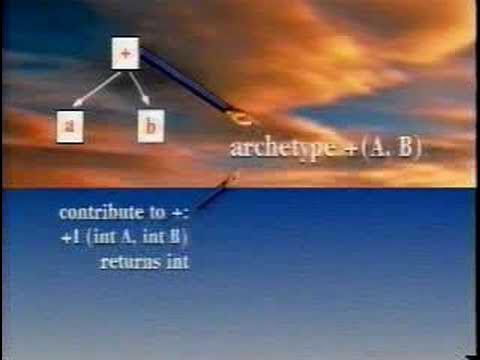
The power of intentional identity becomes particularly stark when dealing with generic operations where one conceptual operator maps to multiple concrete implementations. In conventional systems, dispatch logic is implicit. The narrator underscores that “making explicit what used to be implicit is typical to IP.” An intentional generic operator points directly to an “archetype declaration” that embodies the abstract operation and aggregates common attributes across variations. Because archetypes often reside in immutable standard libraries, IP allows specialized implementations to be contributed remotely rather than declared inline alongside the archetype. During compilation, the system gathers all distributed specializations and resolves the exact instance needed for each call site.
Beyond greenfield code, IP provides paths for legacy modernization. Front ends parse languages like C++, Java, or HTML directly into intentional trees. However, C++ preprocessor directives pose a severe hurdle: simply running the preprocessor and parsing the macro-expanded output strips critical architectural intent and abstractions. To solve this, IP uses an intention-recovery algorithm that reconstructs preprocessor directives into explicit intentional structures. In an illustrated C macro example, an unparameterized macro call hides an implicit dependence on a local variable in the calling scope, alongside an unclosed loop body. When imported into IP, the macro definition and call site are automatically rebuilt with two explicit parameters: one exposing the previously hidden local variable reference, and another explicitly wrapping the loop body. Instead of brittle textual injection, IP exposes latent coupling, turning invisible side effects into structured, safe abstractions while handling `#ifdef` directives, includes, and token concatenations cleanly.
- **Archetypes and specializations**: Decouples the abstract operator contract from implementation variants, allowing third-party libraries to provide new specializations without altering core definitions. - **Preprocessor recovery**: Extracts textual `#define` macros into clean, parameterized intentions without discarding program semantics. - **Defect surfacing**: Implicit scope intrusions in C macros are converted into visible, formal parameters that developers can review and refactor.
---
[07:15](https://www.youtube.com/watch?v=ZZDwB4-DPXE&t=435s) Declarative Domain Abstractions: Java UI Case Study
To showcase how domain-specific abstractions outshine general procedural code, the demonstration pivots to a classic graphical user interface (GUI) problem: a simple Java painting applet where users pick colors, draw with a mouse, and clear the screen. Examining the original Java source reveals a familiar defect: over half of the application text consists strictly of boilerplate UI scaffolding (highlighted in red) rather than domain graphics logic. From the domain perspective, the user interface is merely incidental plumbing to alter pen colors or trigger a canvas reset.
The demonstration shifts into the IP environment:
```mermaid flowchart LR accTitle: Declarative Domain Abstraction Transformation accDescr: Contrast between manual Java imperative UI wiring and IP declarative attribute transformation. subgraph LegacyJava["Java Imperative Model"] direction TB J1["25+ Lines of UI Wiring per Field"] J2["Manual ActionListeners & Event Loops"] J1 -.->|"High Bug Potential"| J2 end subgraph IntentionalModel["IP Declarative Model"] direction TB I1["Mark State/Method as User Controlled"] I2["Transformation Enzyme Generates UI Widgets"] I3["Enzyme Update Automatically Adds ColorPicker"] I1 --> I2 --> I3 end ```
In IP, the presenter strips out all GUI plumbing, leaving only the pure domain logic. The variable representing pen color and the procedure clearing the canvas are simply annotated with an intention marking them as under user control. An underlying UI transformation enzyme inspects these annotations and automatically synthesizes the user interface, generating a drop-down selector derived directly from the variable’s enumerated type. When a new color parameter is added to the `clear` procedure, the interface updates itself instantly. In raw Java, making that identical change requires manually authoring 25 lines of event-handling and widget-wiring code, “any one of which could have been the cause of a bug.”
Furthermore, because implementations are detached from intentions, updating the UI transformation enzyme instantly improves the application without touching the programmer's domain code. When an updated enzyme incorporating a full visual ColorPicker component is loaded, the applet adopts the advanced control automatically. Contrasting this paradigm with traditional imperative development, the presenter explains:
> “By separating the intention from the implementation, improvements in the implementations become accessible to the programmers without having to change the program source.”
- **Boilerplate elimination**: Imperative UI code comprising over 50% of the Java file is replaced by declarative intention markers directly on domain logic. - **Automated type-to-widget derivation**: Enumerated types automatically synthesize corresponding UI selectors (e.g., drop-down menus or ColorPickers). - **Maintenance velocity**: Avoids error-prone manual updates (such as the 25 lines of Java required to bind a single parameter change) by delegating code lowering to reusable enzymes.
## Notable quotes > [07:15](https://www.youtube.com/watch?v=ZZDwB4-DPXE&t=435s) By separating the intention from the implementation, improvements in the implementations become accessible to the programmers without having to change the program source.
> [02:00](https://www.youtube.com/watch?v=ZZDwB4-DPXE&t=120s) A strict rule for Transformations is that additions to the tree are allowed but deletions are not. — Paul
## Mentioned Intentional Programming, Microsoft, Paul, C++, Java, HTML, ColorPicker
## Video description An old research system from Microsoft, video off the net chopped up to fit into two 10 minute clips for youtube, interesting way to work with code.
Un vieja sistema de la investigación de los putos de Microsoft, vídeo en inglés de la Internet tajó hasta ajuste en dos partes de diez minutitos para el youtube, una manera interesante de trabajar con código.
This one doesn't make much sense but check out the other clip about the editor, which is pretty cool.
Eso video no es muy claro, pero fija el otro video, es genial, guey.
[Source](https://www.youtube.com/watch?v=ZZDwB4-DPXE)