US Navy Fires Phalanx CIWS in Automated Anti-Missile Drill
AiirSource Military
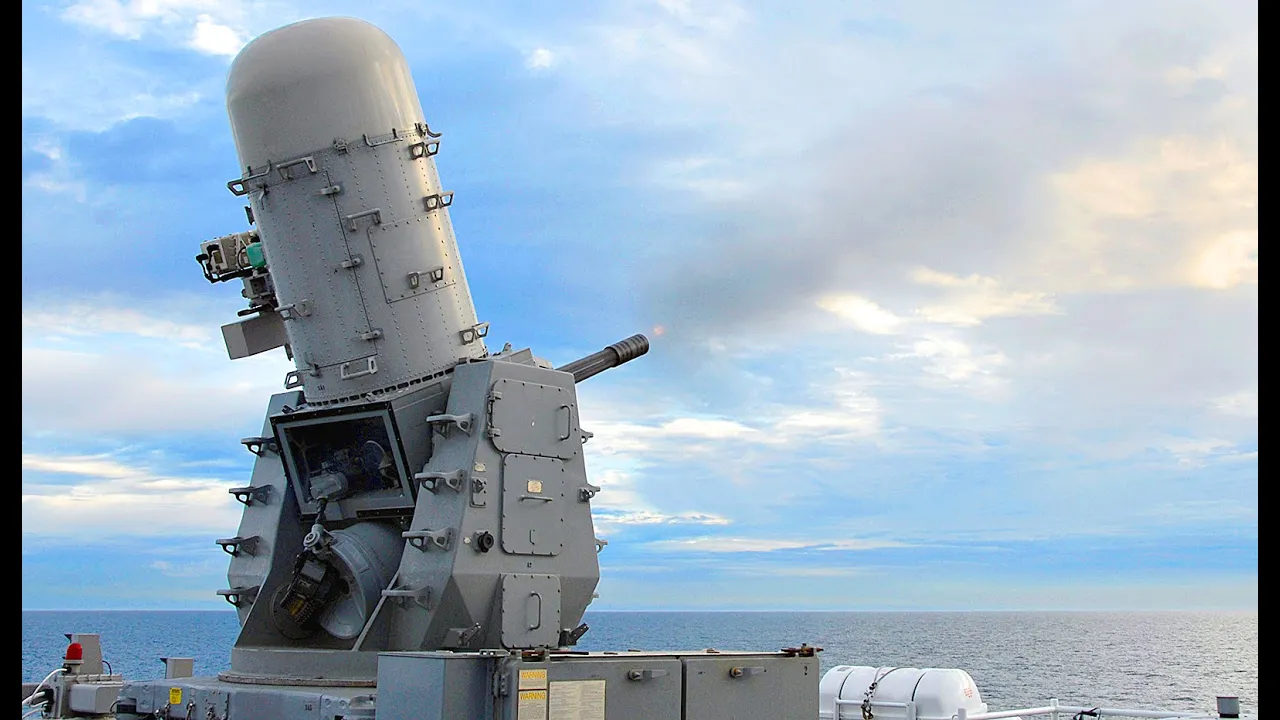
The Phalanx CIWS operates independently of host vessel systems to destroy incoming anti-ship missiles within five nautical miles even if the ship sustains heavy damage.
AI-assisted summary of Phalanx CIWS Close-in Weapon System In Action - US Navy's Deadly Autocannon — original source. Check the original for full context.
Source published:
Key ideas
- The Phalanx Close-In Weapon System (CIWS) serves as an automated terminal point defense designed to neutralize incoming anti-ship missiles and maneuvering sea-skimmers. (0:00)
- The system utilizes a radar-guided 20 mm M61 Vulcan Gatling gun autocannon mounted on a high-speed swiveling base. (0:00)
- Phalanx operates at a short effective range of 1 to 5 nautical miles (approximately 9 km) as a ship's final defensive layer.
- Because the CIWS requires minimal input from the host ship, it retains operational capability even if the vessel incurs severe damage.
Detailed notes
## Bulletin - [00:00](https://www.youtube.com/watch?v=Zsf38NYzo5Q&t=0s) The Phalanx Close-In Weapon System (CIWS) serves as an automated terminal point defense designed to neutralize incoming anti-ship missiles and maneuvering sea-skimmers. - [00:00](https://www.youtube.com/watch?v=Zsf38NYzo5Q&t=0s) The system utilizes a radar-guided 20 mm M61 Vulcan Gatling gun autocannon mounted on a high-speed swiveling base. - Phalanx operates at a short effective range of 1 to 5 nautical miles (approximately 9 km) as a ship's final defensive layer. - Because the CIWS requires minimal input from the host ship, it retains operational capability even if the vessel incurs severe damage.
## Key takeaways - [00:00](https://www.youtube.com/watch?v=Zsf38NYzo5Q&t=0s) The Phalanx CIWS provides automated last-line point defense against modern anti-ship missiles, including high-g maneuvering threats. - [00:00](https://www.youtube.com/watch?v=Zsf38NYzo5Q&t=0s) The primary armament consists of a 20 mm (0.79 in) M61 Vulcan Gatling gun autocannon. - [00:00](https://www.youtube.com/watch?v=Zsf38NYzo5Q&t=0s) Targeting and tracking are managed through an integrated radar guidance system on a fast-swiveling mount. - The effective operational engagement envelope ranges from 1 to 5 nautical miles (around 9 km). - The system's autonomous architecture requires minimal inputs from the host ship to remain fully functional during combat emergencies. - [00:00](https://www.youtube.com/watch?v=Zsf38NYzo5Q&t=0s) Live-fire exercises demonstrate rapid target acquisition followed by high-rate-of-fire bursts. - The weapon system is deployed internationally across multiple navies worldwide. - Training footage was documented by U.S. Navy personnel including PO3 Souvannason, PO1 Dunphy, SN Flewellyn, and SN Dionne.
## Detailed walkthrough ### [00:00](https://www.youtube.com/watch?v=Zsf38NYzo5Q&t=0s) Phalanx CIWS Live-Fire Engagement
The segment opens with the distinctive, high-velocity mechanical buzz of the Phalanx Close-In Weapon System (CIWS) preparing for action, accompanied by the sound of physical movement. Amidst the operational noise of the ship's deck, an operator or crew member issues a quick, somewhat garbled instruction over the comms, stating, “I'm going to go ahead and get the car out of the car.” This is immediately followed by a heavy mechanical thud and a resounding boom as the M61 Vulcan Gatling gun unleashes a burst of 20 mm rounds at its designated target.
Following the successful firing sequence, the speaker wraps up the brief engagement by saying, “So, let's go. Thank you.” This rapid-fire exercise demonstrates the automated terminal defense capabilities of the Phalanx system, which is designed to operate as a ship's final line of defense against incoming anti-ship missiles and maneuvering sea-skimmers.
- **Weapon System:** The Phalanx CIWS is built around the M61 Vulcan Gatling gun autocannon, firing 20 mm (0.79 in) ammunition from a fast-swiveling, radar-guided mount. - **Effective Range:** Designed for short-range point defense, its operational envelope spans from 1 to 5 nautical miles (approximately 9 km). - **System Independence:** The CIWS requires minimal input from the ship's main systems, ensuring it can continue to track and destroy targets even if the vessel sustains heavy damage. - **Media Credits:** The live-fire training footage was captured by Navy personnel PO3 Samuel Souvannason, PO1 Henry Dunphy, SN David Flewellyn, and SN Patrick Dionne.
## Mentioned AiirSource Military, David Flewellyn, Henry Dunphy, M61 Vulcan, Patrick Dionne, Phalanx CIWS, Samuel Souvannason, United States Navy
## Video description Footage of the Phalanx CIWS Close-in Weapon System in various target practicing exercises.
The Phalanx Close-In Weapons System (CIWS) was developed as the last line of automated weapons defense (terminal defense or point defense) against anti-ship missiles (AShMs), including high-g and maneuvering sea-skimmers. The basis of the system is the M61 Vulcan Gatling gun autocannon.
Consisting of a radar-guided 20 mm (0.79 in) Gatling gun mounted on a swiveling base, the Phalanx has been used by Navies around the world.
The CIWS is designed to be the last line of defense against anti-ship missiles. Due to its design criteria, its effective range is very short relative to the range of modern ASMs, from 1 to 5 nautical miles (9 km). The gun mount moves at a very high speed and with great precision. The system takes minimal inputs from the ship, making it capable of functioning despite potential damage to the ship. (en.wikipedia.org/wiki/Phalanx_CIWS) Credit: PO3 Samuel Souvannason, PO1 Henry Dunphy, SN David Flewellyn, SN Patrick Dionne. Additional editing: AiirSource
AiirSource℠ covers military events and missions from the Army, Navy, Marine Corps, Air Force, and Coast Guard. http://youtube.com/AiirSource
Like & share this video to show your support for the troops! Subscribe to stay updated on all the top stories: http://www.youtube.com/subscription_center?add_user=AiirSource
Stay connected with us here: Google+ http://google.com/+AiirSource Facebook http://facebook.com/AiirSource Twitter @AiirSource http://twitter.com/AiirSource
[Source](https://www.youtube.com/watch?v=Zsf38NYzo5Q)