US Strands 71,000 Tons of Nuclear Waste as Yucca Repository Stalls
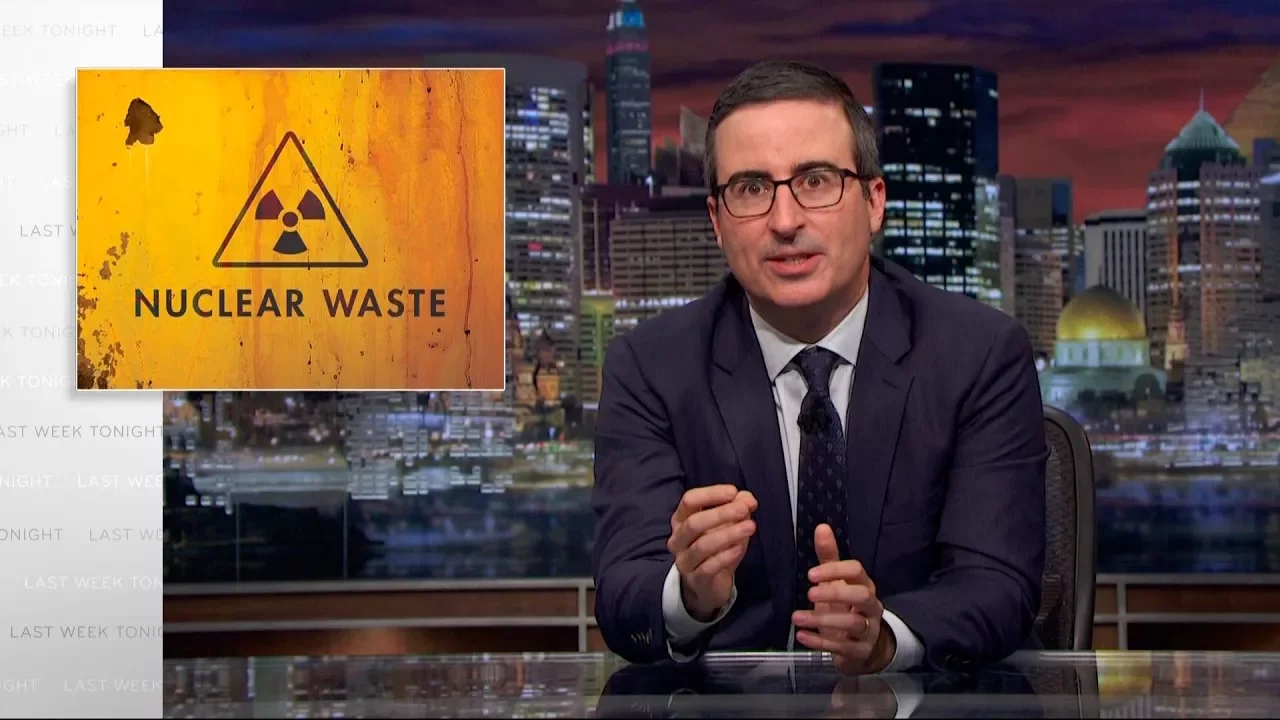
Nuclear Waste: Last Week Tonight with John Oliver (HBO) — LastWeekTonight

LastWeekTonight

Decades of political gridlock have left high-level radioactive waste dangerously marooned at aging, temporary sites nationwide, courting catastrophic contamination because leaders refuse to open a permanent geological repository.

AI-assisted summary of Nuclear Waste: Last Week Tonight with John Oliver (HBO) — original source. Check the original for full context.

Source published:

Key ideas

  • The United States has accumulated over 71,000 tons of commercial spent nuclear fuel and 100 million gallons of defense liquid waste, with one in three Americans living within 50 miles of a high-level nuclear waste site. (0:04)
  • Decades of improvised disposal, ranging from dumping barrels into the Atlantic Ocean to outdoor storage near residential waterways, have caused severe environmental contamination and documented cancer clusters. (3:24)
  • The Hanford Site in Washington holds 56 million gallons of radioactive sludge in aging tanks that have leaked over 1 million gallons into the soil, consuming $2.5 billion annually—nearly 10% of the Department of Energy's budget. (8:09)
  • Despite investing $15 billion into researching Nevada's Yucca Mountain as a deep geological repository, political opposition led by former Senator Harry Reid has left the nation without any permanent disposal solution since the 1970s. (12:22)

Detailed notes

## Background Published on YouTube by LastWeekTonight on August 21, 2017, this segment explores the severe public health threat posed by America's mounting stockpiles of nuclear waste. According to the page description, John Oliver examines why the United States urgently needs to establish a safe, permanent disposal site—serving as a metaphorical toilet for its radioactive refuse.

## TL;DR John Oliver outlines how the United States accumulated over 71,000 tons of commercial spent fuel and millions of gallons of defense-related nuclear sludge without ever constructing a permanent disposal facility. From reckless historical experiments like machine-gunning floating waste drums in the Atlantic to severe modern contamination at the Hanford Site and Missouri's Coldwater Creek, reliance on temporary storage has led to catastrophic leaks and human casualties. Oliver details how political opposition derailed the thoroughly researched $15 billion Yucca Mountain repository, leaving high-level waste stranded at active plants and seismic zones across the country. Drawing parallels to an archival 1977 news special that promised an operating repository by 1985, he demonstrates that four decades of bureaucratic paralysis have left the nation dangerously exposed to disaster.

## Atmosphere & style The presentation strikes a sharp balance between investigative urgency and satirical indignation, pairing devastating environmental reporting with rapid-fire absurdist digressions and running visual gags involving a sinister American Girl doll. Oliver's delivery shifts effortlessly between biting mockery of historical disposal schemes and genuine gravity when presenting cancer clusters and contaminated waterways. Watching the broadcast feels punchy, entertaining, and profoundly exasperating as the reality sets in that fifty years of explicit scientific warnings have been met with political evasion and neglect.

## Bulletin - [00:04](https://www.youtube.com/watch?v=ZwY2E0hjGuU&t=4s) The United States has accumulated over 71,000 tons of commercial spent nuclear fuel and 100 million gallons of defense liquid waste, with one in three Americans living within 50 miles of a high-level nuclear waste site. - [03:24](https://www.youtube.com/watch?v=ZwY2E0hjGuU&t=204s) Decades of improvised disposal, ranging from dumping barrels into the Atlantic Ocean to outdoor storage near residential waterways, have caused severe environmental contamination and documented cancer clusters. - [08:09](https://www.youtube.com/watch?v=ZwY2E0hjGuU&t=489s) The Hanford Site in Washington holds 56 million gallons of radioactive sludge in aging tanks that have leaked over 1 million gallons into the soil, consuming $2.5 billion annually—nearly 10% of the Department of Energy's budget. - [12:22](https://www.youtube.com/watch?v=ZwY2E0hjGuU&t=742s) Despite investing $15 billion into researching Nevada's Yucca Mountain as a deep geological repository, political opposition led by former Senator Harry Reid has left the nation without any permanent disposal solution since the 1970s.

## Key takeaways - [00:04](https://www.youtube.com/watch?v=ZwY2E0hjGuU&t=4s) Commercial nuclear power plants in the U.S. have stranded over 71,000 tons of spent nuclear fuel rods across 104 reactors. - [00:04](https://www.youtube.com/watch?v=ZwY2E0hjGuU&t=4s) High-level waste containing plutonium-239 requires roughly 240,000 years—ten half-lives—to decay to harmless levels, yet no permanent storage facility exists. - [03:24](https://www.youtube.com/watch?v=ZwY2E0hjGuU&t=204s) Early disposal methods relied on crude stopgaps, including dumping thousands of concrete-capped steel barrels into the Atlantic Ocean and strafing buoyant barrels with machine-gun fire to sink them. - [03:24](https://www.youtube.com/watch?v=ZwY2E0hjGuU&t=204s) Proposals to launch nuclear waste into outer space via rockets were scrapped due to the catastrophic fallout risk if a rocket exploded during launch. - [06:05](https://www.youtube.com/watch?v=ZwY2E0hjGuU&t=365s) Storage leaks at facilities like the Savannah River Site contaminated local ecosystems, producing radioactive wildlife including alligators contaminated with tritium and dioxin. - [06:05](https://www.youtube.com/watch?v=ZwY2E0hjGuU&t=365s) In North St. Louis County, Missouri, Manhattan Project radioactive residue left near Coldwater Creek exposed surrounding neighborhoods to all 21 cancers officially linked to ionizing radiation. - [08:09](https://www.youtube.com/watch?v=ZwY2E0hjGuU&t=489s) The 1957 scientific consensus from the National Academy of Sciences called for deep underground geological isolation, but permanent commercial implementation has been completely stalled. - [08:09](https://www.youtube.com/watch?v=ZwY2E0hjGuU&t=489s) The Hanford Site in Washington produced two-thirds of America's weapons-grade plutonium and now holds 56 million gallons of waste, having leaked over 1 million gallons into soil near the Columbia River. - [08:09](https://www.youtube.com/watch?v=ZwY2E0hjGuU&t=489s) Occupational radiation exposure has led the federal government to pay roughly $1.5 billion in compensation to thousands of sickened Hanford workers. - [09:58](https://www.youtube.com/watch?v=ZwY2E0hjGuU&t=598s) Remediating Hanford consumes nearly $2.5 billion per year, representing roughly ten percent of the Department of Energy's entire annual budget. - [09:58](https://www.youtube.com/watch?v=ZwY2E0hjGuU&t=598s) Spent fuel pools at nuclear plants across the country are heavily overcrowded, posing severe regional risks if a cooling failure were to occur near major metropolitan corridors like New York City. - [12:22](https://www.youtube.com/watch?v=ZwY2E0hjGuU&t=742s) Congress designated Nevada's Yucca Mountain as the sole national repository site, leading to $15 billion in research and tunneling before statewide political resistance defunded the project. - [12:22](https://www.youtube.com/watch?v=ZwY2E0hjGuU&t=742s) Leaving waste stored on-site creates extreme vulnerabilities, such as California's decommissioned San Onofre plant holding spent fuel adjacent to active fault lines and the Pacific Ocean. - [15:30](https://www.youtube.com/watch?v=ZwY2E0hjGuU&t=930s) An archival 1977 NBC documentary demonstrates that every core aspect of the nuclear waste crisis—and federal promises of a repository operating by 1985—has remained unresolved for forty years.

## Detailed walkthrough ### [00:04](https://www.youtube.com/watch?v=ZwY2E0hjGuU&t=4s) The Sheer Scale and Longevity of America's Nuclear Waste

Nuclear waste is commonly recognized as dangerous thanks to pop-culture tropes like the 1984 film *The Toxic Avenger*, in which a bullied janitor falls into a drum of toxic chemicals and emerges as a monstrous superhero. John Oliver observes that the character's gruesome face looks less terrifying than it does like a melted candle shaped like a pug. In reality, the toxic and radioactive byproducts generated by commercial nuclear power and nuclear weapons production pose an enormous, genuine public health threat, and the United States has accumulated an overwhelming volume of it. Commercial nuclear plants have generated more than 71,000 tons of spent nuclear fuel rods stranded across 104 reactors—enough to cover an entire football field over 20 feet deep—alongside more than 100 million gallons of liquid high-level waste generated from producing nuclear weapons.

```mermaid flowchart TD accTitle: US Nuclear Waste Generation and Proximity accDescr: Diagram illustrating the sources, quantities, and population proximity of US nuclear waste. subgraph Sources["Waste Sources"] A["Commercial Power<br/>(104 reactors)"] -->|"71,000+ tons spent fuel"| C["High-Level Nuclear Waste"] B["Weapons Production<br/>(Manhattan Project & Cold War)"] -->|"100+ million gallons liquid waste"| C end subgraph Impact["Public Exposure"] C --> D["1 in 3 Americans live within 50 miles"] C --> E["Plutonium-239: 24,000-year half-life<br/>(240,000 years to reach safe levels)"] end ```

Geographically, nuclear material sits much closer to everyday communities than most people realize: one out of every three Americans lives within 50 miles of high-level nuclear waste. Much of this waste contains isotopes such as plutonium-239, an element so toxic that even microscopic ingested amounts can prove lethal. Because plutonium-239 carries a radioactive half-life of roughly 24,000 years and requires approximately ten half-lives to decay into a harmless state, it must remain isolated for at least 240,000 years—a span of time Oliver describes as "one English patient" or the agonizing eternity an adult spends trying to store their partner's creepy, unblinking American Girl doll, Felicity.

Despite the obvious necessity of long-term isolation, the United States has spent decades operating nuclear facilities without any permanent storage plan. Oliver highlights an archival television report from 1990 highlighting that nearly half a century after the advent of nuclear technology, no consensus had been reached on where to dispose of the resulting materials. As Oliver notes, the situation mirrors a house constructed without plumbing: > “We have built the house,” said one critic, “and forgotten the toilets.”

- **71,000+ tons**: Weight of spent commercial reactor fuel stranded at 104 nuclear reactors. - **100+ million gallons**: Volume of hazardous liquid waste produced by defense and weapons programs. - **1 in 3 Americans**: Proportion of the national population residing within 50 miles of a high-level nuclear waste site. - **240,000 years**: Time required for plutonium-239 to undergo ten half-lives and become harmless.

---

[03:24](https://www.youtube.com/watch?v=ZwY2E0hjGuU&t=204s) Early Disposal Experiments: Ocean Dumping, Machine Guns, and Rocket Schemes

The origins of America's nuclear waste crisis stem directly from the Manhattan Project during World War II, when the federal government rushed to manufacture nuclear weapons to defeat Nazi Germany without giving any forward thought to managing radioactive byproducts. In the absence of an organized disposal policy, early authorities turned to crude and reckless stopgap measures. For years, workers simply loaded radioactive residue into 55-gallon steel drums, capped them with concrete, and dumped them by the thousands into the Atlantic Ocean right off the coast of New Jersey.

When some of those buoyant steel drums refused to sink, the military improvised an even more surreal response. In 1957, after two barrels were spotted floating off the New Jersey coastline, naval aircraft were dispatched to strafe the barrels with machine-gun fire until the rounds punctured the hulls and forced them beneath the waves. Oliver underscores the sheer absurdity and terror of firing live machine guns into barrels of nuclear waste, comparing the horror of that reality to the surreal dread of waking up in 2017 to a Donald Trump presidency.

Other historical disposal concepts proved equally ill-conceived. Planners seriously evaluated a proposal to launch America's stockpiles of high-level nuclear waste into outer space aboard rockets. That plan was abandoned because early rocketry was notoriously unreliable, and an explosion during ascent would disperse lethal fallout across the globe. As one scientist dryly explained in a documentary: > “If any one of them blew up, that would basically contaminate a large portion of the Earth with radioactive material.”

---

[06:05](https://www.youtube.com/watch?v=ZwY2E0hjGuU&t=365s) Contamination and Casualties: From Mutant Reptiles to Missouri Cancer Clusters

Decades of dumping and poorly engineered temporary storage have triggered severe leaks across the country. At South Carolina's Savannah River Site, radioactive contaminants from decaying military storage tanks seeped directly into surrounding groundwater, poisoning local wildlife and generating bizarre ecological consequences. Oliver shows footage of a local observer nonchalantly remarking on the food chain: > “It's gonna go up the food chain and... there's gonna be radioactive alligators.”

Researchers subsequently identified two specific radioactive alligators on the site, which were nicknamed "Tritagator" and "Dioxinator" after tritium and dioxin, the contaminants that tainted them.

Beyond wildlife, haphazard storage has exacted a devastating human toll. In North St. Louis County, Missouri, massive volumes of radioactive residue generated during the Manhattan Project were stored outdoors and near Coldwater Creek, an unlined waterway meandering through suburban neighborhoods and parks. Resident Jenell Wright recounted that when she logged onto Facebook to catch up with former high school classmates, she discovered an alarming epidemic of illnesses throughout their peer group: > “We've discovered that the Department of Veterans Affairs officially recognizes around 21 cancers associated with exposure to ionizing radiation, and compared that list to what we had. We had all of those cancers, every single one.”

Oliver reflects on the grim nature of discovering neighborhood cancer clusters on social media, noting that standard social media reactions are useless when confronted with communities poisoned by Cold War ordnance.

---

[08:09](https://www.youtube.com/watch?v=ZwY2E0hjGuU&t=489s) Storing Waste Where It Falls: Hanford and the Cost of Inaction

In 1957, the National Academy of Sciences recommended an enduring technical consensus: excavating a deep geologic repository inside stable rock formations to permanently isolate high-level nuclear waste. While the federal government managed to establish a repository in New Mexico for lower-level defense-related waste (the Waste Isolation Pilot Plant), it failed to construct a site for commercial spent fuel and high-level defense waste. Instead, dangerous nuclear material was left indefinitely at the facilities where it was produced—facilities never designed to survive centuries, leaving the nation effectively storing waste in fragile containers and crossing its fingers.

The most catastrophic manifestation of this failure sits at the Hanford Site in Washington State. Hanford was the primary industrial complex responsible for manufacturing two-thirds of the plutonium used in the United States nuclear weapons stockpile. Today, Hanford holds 56 million gallons of high-level radioactive and chemical sludge inside aging underground storage tanks. Decades of structural decay have caused over one million gallons of waste to leak directly into the surrounding soil, threatening the nearby Columbia River. A local news broadcast highlighted Hanford's grim milestone with unearned geographic pride: > “The most contaminated place in the entire Western Hemisphere isn't at a polluting factory or an old chemical plant. It's right here in Washington State.”

Hanford's history has been plagued by toxic chemical vapor releases, underground explosions, and relentless equipment failures. The resulting occupational health fallout has forced the federal government to pay out nearly $1.5 billion in compensation to thousands of Hanford workers who developed severe illnesses and cancers from exposure on the job.

- **1957**: The National Academy of Sciences issues its landmark report calling for deep underground geological disposal. - **Hanford Site, Washington**: Produced two-thirds of the plutonium for the U.S. nuclear arsenal. - **56 million gallons**: Radioactive liquid waste stored underground at Hanford. - **1+ million gallons**: Volume of toxic nuclear sludge confirmed to have leaked from Hanford tanks into surrounding soil. - **~$1.5 billion**: Federal compensation paid to thousands of sickened Hanford workers.

[09:58](https://www.youtube.com/watch?v=ZwY2E0hjGuU&t=598s) The Hanford Site and Vulnerable Spent Fuel Pools

Hanford’s legacy of contamination is compounded by deteriorating physical infrastructure. Following a tunnel collapse in May, local investigative reporting revealed that the facility's tunnels were constructed fifty-five to sixty years ago—far exceeding their intended lifespan—and were supported by wooden timber beams that had steadily degraded from prolonged radiation exposure. John Oliver notes the sheer absurdity of using timber in radioactive environments, remarking, “You can't build something out of wood and expect it to last forever.” Despite having produced nothing for thirty years, Hanford consumes roughly $2.5 billion annually from the Department of Energy for cleanup operations, amounting to approximately ten percent of the department's total annual budget. Oliver compares discovering this disproportionate spending to finding out that half of the Department of Agriculture's budget is being handed to a random moose named Gordon.

The crisis of waste management extends well beyond Washington State. Across the country, nuclear power plants store thousands of tons of spent fuel on site, primarily inside "spent fuel pools." These deep water pools are engineered only as temporary holding areas to cool down freshly removed fuel rods before they are transferred into sealed dry casks and ultimately shipped to a deep geological repository. Because the United States has never opened a permanent repository, spent fuel rods have simply continued to accumulate in these cooling pools year after year. Experts warn that while a catastrophic failure is statistically rare, a Fukushima-scale disaster at a facility like the Indian Point Energy Center—located right outside New York City—would bring devastating consequences across the Northeast corridor. As a news anchor somberly reported regarding the threat to major metropolitan centers, “If any one of those were to have a severe spent fuel pool accident, you're taking away a lot of big cities, a lot of farm lands, a lot of the United States, for decades, perhaps centuries.” Oliver deadpans that losing cities like Boston would be an awful shame, especially since Boston only became un-racist just yesterday.

```mermaid flowchart TD accTitle: Spent Nuclear Fuel Disposal Cycle accDescr: Diagram illustrating the intended three-stage disposal path for spent nuclear fuel versus the gridlock stalling the final repository.

subgraph Plant["Nuclear Power Plants (Nationwide)"] A["Spent Fuel Rods Extracted"] --> B["Spent Fuel Pools\n(Intended as Temporary Cooling)"] B --> C["Dry Cask Storage Containers\n(On-Site Storage)"] end

subgraph Repository["Permanent Solution (Stalled)"] D["Deep Underground Geological Repository\n(e.g., Yucca Mountain)"] end

B -.->|"Overcrowded due to lack of disposal site"| B C -.->|"Stuck on-site (e.g., San Onofre fault line)"| C C ==>|"BLOCKED by Political Opposition"| D ```

- **Hanford Cleanup Costs**: The Department of Energy spends nearly $2.5 billion each year on remediation at the Hanford site alone, representing close to 10% of the entire agency's budget. - **Aging Tunnels**: Infrastructure at Hanford collapsed after radioactive decay weakened 55- to 60-year-old wooden support beams that had long outlived their design limits. - **Regional Risk**: Plants like Indian Point place major population centers including New York, Hartford, and Boston within potential contamination zones in the event of an unmitigated pool fire or containment failure.

---

[12:22](https://www.youtube.com/watch?v=ZwY2E0hjGuU&t=742s) The Battle over Yucca Mountain

Thirty years ago, the federal government attempted to resolve the permanent disposal question by selecting Yucca Mountain in Nevada. Congress amended the Nuclear Waste Policy Act to designate Yucca Mountain as the sole candidate site for deep underground waste storage, and the federal government subsequently spent $15 billion studying and prepping the desert mountain. An official promotional video touted the location—roughly 100 miles northwest of Las Vegas—as the most thoroughly researched disposal site on Earth, emphasizing that the global scientific consensus favors burying high-level radioactive materials deep underground. In the middle of explaining that the safest place to deposit dangerous waste is a deep subterranean hole, Oliver cuts away to check on a creepy doll named Felicity, only to shriek in genuine horror when he turns around to find her sitting directly behind his anchor desk, requiring a panicked moment to regain his composure.

Despite scientific validation and the local economic backing of Nye County residents, broader political resistance across Nevada doomed the repository. Former Senate Majority Leader Harry Reid led a fierce, decades-long legislative crusade to defund and shutter the Yucca Mountain project. When asked how the nation's commercial reactors should handle their mounting waste without a central repository, Senator Reid insisted on simply leaving it in place: “If you were smart, what you would do is, uh... leave this... leave it where it is.” Oliver rejects this reasoning entirely, declaring, “The scientific consensus for decades has been that leaving it where it is is a really bad idea.” Keeping waste dispersed creates severe regional hazards; for example, the shuttered San Onofre nuclear generating station in Southern California sits directly along a seismic fault line right against the Pacific Ocean—a setup Oliver likens to the opening scene of an action film starring Dwayne "The Rock" Johnson that you would watch on an airplane. While newly appointed Energy Secretary Rick Perry expressed optimism about solving the impasse, Oliver remains skeptical, rolling footage of Perry’s clumsy routine on *Dancing with the Stars* to suggest that handling volatile forces may not be his strongest suit.

- **Yucca Mountain Investment**: The federal government sank roughly $15 billion into studying, tunneling, and engineering Yucca Mountain before political opposition brought the project to a halt. - **Local vs. Statewide Politics**: Nye County, where Yucca Mountain is situated, favored the development and its economic benefits, but fierce opposition across the rest of the state allowed Senator Harry Reid to effectively kill federal licensing. - **San Onofre Generating Station**: The decommissioned plant in Southern California holds hundreds of tons of high-level waste in coastal storage adjacent to active earthquake faults and rising sea levels.

---

[15:30](https://www.youtube.com/watch?v=ZwY2E0hjGuU&t=930s) Four Decades of Inaction: The 1977 NBC Documentary

The paralysis surrounding nuclear waste is neither new nor unexpected; it is an unresolved crisis spanning generations. While preparing their broadcast, the *Last Week Tonight* research team discovered an archival NBC News special from 1977—the year Oliver was born—titled *Danger! Radioactive Waste*. The vintage broadcast hit every single thematic beat of the modern dilemma: sailors chucking drums of radioactive sludge off ships into the ocean, structural contamination at Hanford, health consequences suffered by workers and neighboring families, and even radioactive cattle grazing on tainted pastures.

Most striking of all was an archival interview from forty years earlier wherein a reporter pressed a federal official on when the government would finally open a permanent disposal repository. The official confidently responded, “Realistic time table is scheduled to have a repository in operation by 1985, with the selection of the sites by the end of 1978 for detailed work.” Oliver highlights that nuclear waste has languished as an unsolved problem since the 1980s, producing a personal Rubik's Cube and swearing vengeance against it like Inspector Javert chasing Jean Valjean. The 1977 documentary concluded with a warning from the correspondent that remains entirely unheeded: “We are accustomed in this country to act only in times of crisis. But with nuclear waste, when the crisis comes, it will be too late.” Oliver stresses that after forty years of delays and false starts, continuing to stall without constructing a permanent repository is inexcusable: anyone arguing that the federal government can simply keep kicking the can down the road is, like a house without a toilet, entirely full of shit.

- **1977 Broadcast Parallels**: The four-decade-old NBC special covered the exact issues persisting today, including ocean dumping, Hanford's leaking infrastructure, and local environmental contamination. - **Missed Deadlines**: Federal energy officials in the late 1970s publicly promised that a fully operational national nuclear waste repository would be completed and accepting waste by 1985. - **Decades of Inaction**: Over forty years after journalists warned that waiting for an acute crisis would make remediation impossible, the United States still lacks any permanent repository for commercial nuclear fuel.

## Notable quotes > [15:30](https://www.youtube.com/watch?v=ZwY2E0hjGuU&t=930s) We are accustomed in this country to act only in times of crisis. But with nuclear waste, when the crisis comes, it will be too late.

## Mentioned The Toxic Avenger, John Oliver, Manhattan Project, Donald Trump, Savannah River Site, Jenell Wright, Department of Veterans Affairs, Coldwater Creek, National Academy of Sciences, Waste Isolation Pilot Plant, Hanford Site, Columbia River, Department of Energy, Indian Point Energy Center, Yucca Mountain, Nuclear Waste Policy Act, Harry Reid, San Onofre Nuclear Generating Station, Rick Perry, Dancing with the Stars, NBC News, Danger! Radioactive Waste

## Video description Nuclear waste poses a serious threat to public health if it's not stored in a safe place. John Oliver explains why the United States desperately needs to build a metaphorical toilet for all that waste.

Connect with Last Week Tonight online...

Subscribe to the Last Week Tonight YouTube channel for more almost news as it almost happens: www.youtube.com/user/LastWeekTonight

Find Last Week Tonight on Facebook like your mom would: http://Facebook.com/LastWeekTonight

Follow us on Twitter for news about jokes and jokes about news: http://Twitter.com/LastWeekTonight

Visit our official site for all that other stuff at once: http://www.hbo.com/lastweektonight

[Source](https://www.youtube.com/watch?v=ZwY2E0hjGuU)

中文简报

尤卡山处置库搁置致美积压7.1万吨核废料 数十年来的政治僵局使高放核废料危险地滞留于全美各地老化的临时贮存设施中,由于领导人拒绝启用永久性地质处置库,恐招致灾难性的污染风险。 约翰·奥利弗(John Oliver)概述了美国如何在未建成任何永久性处置设施的情况下,积累了超过7.1万吨商用乏燃料和数百万加仑国防核废液。从历史上在大西洋用机枪射击漂浮废料桶等鲁莽试验,到汉福德场区和密苏里州冷水溪发生的严重现代污染,对临时贮存的依赖已导致灾难性泄漏和人员伤亡。奥利弗详细阐述了政治阻力如何导致经过充分调研且耗资150亿美元的尤卡山处置库项目夭折,使高放核废料被迫滞留在全美各地的现役核电站及地震带。他类比了1977年一部承诺处置库将于1985年投入运营的存档新闻专题片,表明四十年的官僚瘫痪使该国危险地暴露在灾难风险之下。 美国已积累超过7.1万吨商用乏核燃料和1亿加仑国防核废液,三分之一的美国人生活在高放核废料地点50英里范围内。 (0:04) 从向大西洋倾倒废料桶到在居民区水道附近露天贮存,数十年来的临时处置手段造成了严重的环境污染,并导致了有记录的癌症高发区。 (3:24) 华盛顿州的汉福德场区老化储罐中存有5600万加仑放射性污泥,已有超过100万加仑泄漏至土壤中,每年耗资25亿美元,几乎占能源部预算的10%。 (8:09) 尽管已投入150亿美元对内华达州尤卡山作为深地质处置库进行研究,但以前参议员哈里·里德(Harry Reid)为首的政治反对使得美国自1970年代以来始终没有任何永久处置方案。 (12:22)

Reading summary

John Oliver argues that the United States faces an escalating public health hazard due to decades of accumulating high-level nuclear waste without opening a permanent geological repository. Despite long-standing scientific consensus, federal inaction and political resistance have left hundreds of millions of gallons and thousands of tons of radioactive material stranded in decaying, vulnerable temporary facilities nationwide. The Massive Scale and Longevity of Domestic Waste (0:04) Across the United States, commercial nuclear power facilities have accumulated more than 71,000 tons of spent fuel rods across 104 reactors, while defense and weapons programs have generated over 100 million gallons of liquid high-level waste. Geographically, this material is located near everyday population centers, with one in three Americans residing within 50 miles of a high-level nuclear waste site. Isolating this material requires unprecedented long-term planning because key isotopes such as plutonium-239 have a radioactive half-life of 24,000 years, requiring approximately 240,000 years—ten half-lives—to decay into a safe state. Despite this requirement, the United States has operated its commercial and defense nuclear apparatus for decades without completing any permanent infrastructure to isolate these materials. Ecological and Human Costs of Ad Hoc Disposal (3:24) Because the Manhattan Project focused solely on manufacturing weapons to defeat Nazi Germany, officials developed no forward-looking disposal policy. Early authorities resorted to makeshift practices, such as packing radioactive residue into 55-gallon steel drums, dumping thousands of them off the coast of New Jersey, and having military aircraft strafe floating drums with machine-gun fire to sink them. Other theoretical disposal proposals, such as launching waste into space aboard rockets, were ruled out due to the catastrophic risk of launch explosions scattering fallout globally. Improper interim storage has caused persistent ecological and public health damage. At the Savannah River Site in South Carolina, aging military tanks leaked contaminants into the groundwater and contaminated local wildlife. In North St. Louis County, Missouri, uncontained Manhattan Project waste stored outdoors near Coldwater Creek led to severe suburban contamination; local residents later discovered that neighborhood cancer clusters exhibited all 21 cancers officially recognized by the Department of Veterans Affairs as linked to ionizing radiation exposure. The Fragility of Deteriorating Interim Storage Sites (8:09) Although the National Academy of Sciences recommended deep geologic disposal in 1957, high-level waste remains indefinitely at its points of origin in facilities not designed for centuries-long storage. The Hanford Site in Washington State, which manufactured two-thirds of the nation's weapons-grade plutonium, now holds 56 million gallons of radioactive sludge in aging underground tanks. More than one million gallons have already leaked into surrounding soil near the Columbia River. Hanford's deteriorating infrastructure—exemplified by collapsed tunnels supported by 55- to 60-year-old wooden timbers—absorbs approximately $2.5 billion annually in Department of Energy cleanup funding, and the government has paid nearly $1.5 billion in compensation to sickened workers. Commercial facilities face similar vulnerabilities. Nuclear plants store thousands of tons of spent fuel inside temporary water cooling pools that were never intended for indefinite holding. A serious containment failure at facilities like Indian Point near New York City could contaminate multiple major metropolitan areas across the Northeast, while decommissioned plants like California's San Onofre store high-level waste directly adjacent to active earthquake faults and the Pacific Ocean. Political Paralysis and Missed Federal Deadlines (12:22) Congress designated Yucca Mountain in Nevada as the nation's sole permanent deep geological repository, and the federal government invested $15 billion to research and prepare the site. However, despite broad scientific endorsement and local economic backing from Nye County, statewide political opposition—led by former Senate Majority Leader Harry Reid—successfully blocked and defunded the project. Reid advocated leaving spent fuel at current reactor sites, a position Oliver notes directly contradicts decades of scientific consensus against dispersed surface storage. This policy impasse repeats a multi-decade cycle of unheeded warnings. A 1977 NBC News documentary revealed the exact same conditions—Hanford leaks, ocean dumping, and regional contamination—while federal officials on camera claimed a permanent repository would open by 1985. Forty years after those promises, the federal government has met none of its deadlines, deferring action while aging facilities and cleanup costs continue to mount. The program concludes that deferring permanent nuclear waste disposal in favor of ad hoc, deteriorating surface storage represents a severe and ongoing hazard. While deep geological repositories remain the established scientific solution, long-standing political obstruction leaves the United States without a viable path to isolate centuries of hazardous waste before an acute containment crisis occurs.

精炼阅读摘要

根据《Last Week Tonight with John Oliver》的报道,美国在发展核能和核武器数十年来,始终未能建立永久性的高放射性核废料处置库,导致数万吨致命核废料长期滞留在临时设施中,对公共安全和生态环境构成严重且持久的威胁。 庞大的核废料规模与长期安全隐患 (0:04) 美国积累了惊人数量的核废料。商业核电站已产生超过71,000吨的废弃核燃料棒,分布在104个反应堆中,其体积足以覆盖一整个足球场并深达20英尺以上;此外,国防武器制造还产生了超过1亿加仑的高放射性液体废料。大约三分之一的美国人居住在距离高放射性核废料堆放点50英里以内的区域。 这些废料中含有半衰期约为24,000年的钚-239,需要长达24万年才能衰变至无害状态。然而,美国在没有长期处置规划的情况下运行核设施数十年,批评人士形象地将此比喻为“建好了房子却忘了建厕所”。 早期粗暴的处置尝试与历史遗留污染 (3:24) 美国的核废料危机可追溯至二战时期的曼哈顿计划。由于当时急于制造武器而忽视了废料管理,早期政府采取了极其粗暴的临时措施。多年间,工作人员将核废料装入55加仑的钢桶中并倾倒入大西洋。1957年,军方甚至派遣海军飞机用机关枪扫射未沉入海底的废料桶。此外,将核废料发射到太空的方案也因火箭发射失败可能导致全球放射性污染而被放弃。 这些不当处置导致了严重的生态和健康灾难。在南卡罗来纳州的萨凡纳河区,放射性物质渗入地下水,甚至出现了体内含有氚和二恶英的“放射性鳄鱼”。在密苏里州北圣路易斯县,曼哈顿计划遗留的放射性废料被露天堆放在冷水溪附近,导致当地社区出现极高比例的癌症集群,居民发现其患癌种类与美国退伍军人事务部认定的21种电离辐射相关癌症完全吻合。 汉福德场区的危机与临时储存风险 (8:09) 位于华盛顿州的汉福德场区(Hanford Site)是美国核废料管理失败的最典型例证。该设施曾生产了美国三分之二的钚,如今地下老化储罐中储存着5600万加仑的高放射性化学泥浆。由于数十年的结构老化,已有超过100万加仑的废料泄漏到土壤中,威胁着附近的哥伦比亚河。尽管该设施已停产30年,但每年仍需消耗能源部约25亿美元(约占其总预算的10%)用于清理工作,且其支撑隧道因长期受辐射侵蚀的木梁腐朽而发生过坍塌。 除汉福德外,全美各地的核电站也堆积着数万吨废弃燃料棒。这些燃料棒本应在“乏燃料池”中临时冷却后转移至永久处置库,但由于处置库缺失,它们只能无限期积压。专家警告称,一旦像纽约市附近的印第安角能源中心(Indian Point Energy Center)这样的设施发生乏燃料池严重事故,其放射性污染将波及波士顿等大都市,导致大片土地在数十年甚至数百年内无法居住。 尤卡山项目的政治僵局与无限期搁置 (12:22) 30年前,联邦政府曾试图通过将内华达州的尤卡山(Yucca Mountain)指定为唯一的深层地下核废料永久处置库来解决这一危机。政府为此投入了约150亿美元进行科学研究和工程准备。尽管该项目得到了科学界和当地奈县(Nye County)居民的支持,但却遭到了内华达州其他地区的强烈政治抵制。 在前参议院多数党领袖哈里·里德(Harry Reid)数十年的极力阻挠下,尤卡山项目最终被切断资金并搁置。里德主张将废料“留在原地”,但科学界普遍认为长期分散存放极具危险性。例如,已退役的加州圣奥诺弗雷(San Onofre)核电站存放着数百吨高放射性废料,而该厂址正处于地震断裂带上且临近太平洋,面临着地震和海平面上升的双重威胁。 跨越四十年的拖延与警示 (15:30) 这一核废料危机已延宕数代人。节目组发现,1977年NBC播出的纪录片《危险!放射性废料》就曾报道过完全相同的议题:向海洋倾倒废料、汉福德的泄漏、工人和居民的健康受损等。当时联邦官员曾乐观预测,国家永久处置库将在1985年前投入运营。 然而,40多年后,美国依然没有建成任何商业核废料永久处置库。正如1977年纪录片结尾所警告的,美国人习惯于在危机爆发时才采取行动,但对于核废料而言,一旦危机真正来临,一切都将为时已晚。 尽管科学界早已达成建立深层地下地质处置库的共识,但由于政治阻力和联邦政府的长期拖延,美国的核废料问题至今仍处于无解状态。随着临时储存设施的不断老化,这一历史遗留问题正对美国公众的健康和安全构成日益紧迫的威胁。

Source quotes

[15:30] We are accustomed in this country to act only in times of crisis. But with nuclear waste, when the crisis comes, it will be too late.

Original transcript

[0:04] Nuclear waste. [0:05] The worst type of garbage for raccoons to get into. [0:08] Now, it's a substance that we all know is dangerous [0:11] thanks to movies like this. [0:13] NARRATOR: They tormented him until he had a horrifying [0:15] accident and fell into a bag of nuclear waste. [0:18] Melvin became The Toxic Avenger, [0:22] the first superhero born out of nuclear waste. [0:26] -His face is so terrifying... -(SCREAMS) [0:30] NARRATOR: ...we can't show it to you now. [0:32] You'll have to see the movie for yourself. [0:34] Honestly, you really don't need to see the movie, 'cause... [0:38] his face isn't really that terrifying. This is it. [0:40] I mean it's bad, but its-- it's so ugly, [0:42] it's almost cute again. [0:44] It's like-- it's like someone melted a candle shaped [0:46] -like a pug. -(AUDIENCE LAUGHS) [0:48] But-- but the point here is [0:49] nuclear waste, the radioactive and toxic byproducts [0:53] from making nuclear energy and weapons is [0:55] a serious health hazard, and America has a lot of it. [0:59] ANCHOR: There are more than 71,000 tons of nuclear waste [1:02] stranded at the nation's 104 reactors. [1:05] Put all those spent fuel rods together, [1:08] and you get a pile as big as a football field [1:10] and more than 20 feet tall. [1:13] Or you could put them in a pile as big [1:14] as two football fields and ten feet tall [1:16] or half a football field and 40 feet tall. [1:19] Or 20 football fields, one foot tall. [1:22] The point is, we have a lot of nuclear waste and it's very fun [1:25] -to play with. -(AUDIENCE LAUGHS) [1:26] And look, that is just the waste from nuclear energy. [1:29] We also have more than 100 million gallons [1:32] of hazardous liquid waste from producing weapons. [1:34] And you may live closer to nuclear waste than you think. [1:37] One out of three Americas lives within 50 miles [1:41] of high level nuclear waste. [1:42] Some of which, like plutonium, is lethally dangerous, [1:46] and will be-- will be around for an incredibly long time. [1:49] NARRATOR: Even microscopic amounts of plutonium, [1:52] if ingested, are deadly. [1:54] One of the characteristics of it is it has [1:56] an extremely long half-life. [1:58] Plutonium 239, for example, has a half life [2:00] of about 24,000 years. [2:03] It's true, 24,000 years and that just scratches the surface. [2:06] It takes ten half-lives for plutonium to become harmless [2:10] so that's 240,000 years. [2:13] A unit of time more commonly known as one English patient. [2:16] (AUDIENCE LAUGHS) [2:17] And as any adult with an American girl doll collection [2:20] eventually finds out, if you wanna keep something [2:23] around for a disturbingly long time, you have got to find [2:25] an appropriate place to put it. [2:27] "I cannot live with your murder dolls anymore. [2:31] Felicity stares at me while I sleep! [2:33] She stares at me!" [2:35] -(AUDIENCE LAUGHS, CHEERS) -"She stares unblinking!" [2:38] And look, [2:39] I'm not the first person to make this point. [2:41] Look at this news report from 1990. [2:44] NARRATOR: Almost half a century [2:45] after nuclear power was harnessed, [2:47] there still is no agreement on where to store the waste. [2:50] "We have built the house," said one critic, [2:53] "and forgotten the toilets." [2:55] -(AUDIENCE LAUGHS) -A home... [2:56] with no toilets. Or as a realtor selling a Brooklyn loft [2:59] is calling it right now, "artisanal composting." [3:02] Wait. [3:03] You're suggesting that I shit in that potted plant [3:05] while you and I both know that I will do that [3:08] 'cause this is convenient to public transport, [3:10] and has both northern and eastern exposures. [3:12] (AUDIENCE LAUGHS) [3:13] But look, it-- it has been 27 years since that clip [3:16] and our country still doesn't have a nuclear toilet. [3:19] And that is our subject tonight. [3:21] Why do we not have a nuclear toilet? [3:24] And it's actually easy to understand how we got [3:26] into this situation. Because during World War Two, [3:29] we rushed to develop nuclear weapons because we were trying [3:31] to defeat the Nazis, [3:32] who, fun fact, pretty much all Americans agreed were bad [3:35] -at the time. -(AUDIENCE LAUGHS) [3:37] Anyway, the-- the thing is, [3:39] we didn't really have a plan on what to do [3:42] with all the radioactive byproducts that we produced. [3:45] And this initially led us [3:47] to some mind-blowingly stupid solutions. [3:49] For instance, for years, we actually did this... [3:52] MAN: They loaded the, uh, [3:54] radioactive waste and it was in barrels, 55 gallon barrels, [3:58] of, uh, radioactive waste with concrete poured over it. [4:03] It's funny, the ocean don't glow out there [4:05] outside of Red Bank, New Jersey. (CHUCKLES) [4:09] Really. 'Cause we dumped a lot of barrels out there. [4:12] -(AUDIENCE GASPS) -That is true. [4:14] We didn't just dump barrels of radioactive waste [4:16] in the ocean, we did it off the coast of New Jersey. [4:19] (AUDIENCE LAUGHS) [4:20] That is so horrifying! [4:22] I'm surprised that Jersey Shore was the title of a lighthearted [4:25] MTV series, and not the name of a harrowing documentary. [4:29] An entire generation of children was born without thumbs, [4:31] a phenomenon known to locals as... [4:33] -"The Situation." -(AUDIENCE LAUGHS) [4:36] And, incidentally, [4:38] not all of those barrels sank. In fact, in 1957, [4:42] when two barrels were caught floating off the shore, [4:44] naval aircraft were summoned to strafe them [4:47] with machine-gun fire until they sank. [4:49] That's right. [4:50] They shot barrels full of nuclear waste [4:52] with machine guns! [4:54] That's got to be one of the most terrifying sentences ever said [4:57] out loud, right after, [4:58] "Donald Trump is the president now," [5:00] and, "Wait, wasn't Felicity on a different shelf [5:03] when we went to bed last night? [5:04] Oh, my God! Felicity is a waking nightmare!" [5:08] (AUDIENCE LAUGHS) [5:10] Oh! [5:11] Well, the truth is, tossing barrel-fulls of nuclear waste [5:14] into the ocean and shooting them [5:16] with machine guns is actually preferable to at least [5:18] one genuine other idea that was thankfully rejected, [5:21] and that was blasting it into space. [5:24] A concept with a pretty clear flaw. [5:27] WOMAN: Unfortunately, [5:29] we don't have a great record [5:32] with getting rockets out into the atmosphere. [5:36] If any one of them blew up, [5:39] that would basically contaminate [5:41] a large portion of the Earth with radioactive material. [5:45] (STUDIO AUDIENCE LAUGHING) [5:48] WOMAN: So that's probably not a great idea. [5:51] -(AUDIENCE LAUGHS) -Yeah. [5:52] You're right. That's probably not a great idea. [5:56] I mean, a really great idea would be also filling [5:58] the rockets up with confetti, so at least that way [6:00] if there's a horrific accident, there's also a party! [6:03] (AUDIENCE LAUGHS) [6:05] Now, over the years, we have dumped nuclear waste all over [6:08] the country and in many places, there've been frightening leaks. [6:11] Take the Savannah River Site in South Carolina, [6:13] where waste from poorly-stored material leaked [6:16] into the ground water. [6:17] And just watch this alarmingly laid back man explain [6:19] the consequences of that. [6:21] MAN: There are radioactive alligators on the site. [6:24] (STUDIO AUDIENCE LAUGHS) [6:26] MAN: Radioactive materials are in the sediments. [6:28] -(ALLIGATOR HISSING) -(CLANGING) [6:30] MAN: It's gonna go up the food chain and... [6:33] there's gonna be radioactive alligators. [6:36] -(AUDIENCE LAUGHS) -Yeah. [6:37] Radioactive alligators! [6:39] They even have names, [6:41] Tritagator and Dioxinator, [6:43] after two of the wastes that poisoned them. [6:45] And that's actually very clever, [6:46] because if I had to give them names, [6:48] I don't know, I'd probably have gone with something like, [6:50] (SCREAMS) "Holy Shit! A Fucking Radioactive Alligator!" [6:53] And, "Oh No, Fuck Me, There's Another One! [6:55] What Nightmare Hath God Wrought?" [6:59] And it's not just reptiles who've been impacted [7:01] by nuclear waste. Researchers are now studying [7:04] an area in North St. Louis County, Missouri, [7:06] where tons of waste from the Manhattan project was [7:08] improperly stored, some near a creek [7:10] that winds through residential communities, [7:12] and people who live there have noticed some alarming trends. [7:16] JENELL WRIGHT: I got on Facebook in order to reconnect [7:18] with people from high school... [7:21] And we all immediately started noticing that so many [7:24] of us were sick. We've discovered that [7:26] the Department of Veterans Affairs [7:28] officially recognizes around 21 cancers associated with exposure [7:33] to ionizing radiation, and compared that list [7:36] to what we had. [7:38] We had all of those cancers, every single one. [7:41] That is an incredibly depressing thing to discover [7:44] on Facebook and it's-- it's hard to know how to respond. [7:46] I mean, you definitely don't want to use [7:48] the "like" button, because... [7:50] then it looks like you really like the fact [7:51] they just got cancer. [7:52] Now, there is that new sad emoji, [7:55] which would really be perfect [7:56] if you hadn't already cheapened it by using it to respond [7:58] to the news that Chris Pratt and Anna Faris were separating. [8:01] I mean, it is sad. It is sad. But it is not "21-cancer" sad. [8:06] It's "nine-cancer" sad. Tops. [8:09] The point is, thankfully, 60 years ago, [8:13] our government and the scientific consensus [8:15] came up with a solution. [8:17] In 1957, the National Academy of Sciences issued a report [8:20] urging the creation of a permanent storage facility [8:23] deep underground. Basically, a nuclear toilet. [8:26] And while we did build a repository [8:28] for lower-level waste in New Mexico, [8:30] we still haven't built one [8:31] for the most dangerous, high-level waste. [8:34] And, as a result, it's essentially been left [8:36] wherever it was made. Which is not good, [8:39] because those facilities were not built [8:41] with the idea that they would be storing waste indefinitely. [8:43] So, to continue the toilet metaphor, [8:46] we've basically been shitting in bags, [8:48] leaving them all over the house, [8:49] and praying that they don't leak. [8:51] (AUDIENCE LAUGHS) [8:53] And the most frightening example of this is [8:55] the Hanford Site in Washington state, [8:57] which created two third of the plutonium [8:59] in the US arsenal and is currently storing [9:01] 56 million gallons of highly toxic [9:04] and radioactive waste underground. [9:06] And over the years, [9:07] there have been so many issues at Hanford, [9:09] that they've achieved a dubious honor, [9:11] as one local new-station reported, [9:13] with an almost prideful tone. [9:15] ANCHOR: The most contaminated place in the entire [9:18] Western Hemisphere isn't at a polluting factory [9:21] or an old chemical plant. [9:23] It's right here in Washington State. [9:25] (AUDIENCE LAUGHS) Oh! [9:26] "It's right here! We did it guys! [9:28] Washington State, home to the most contaminated place [9:32] in the Western Hemisphere, [9:34] thousands of acres of apple orchards, [9:36] and several of Ted Bundy's grizzliest murders. We did it! [9:40] Right here!" [9:42] There have been a string of problems at Hanford, [9:45] from explosions, to toxic vapor releases, [9:47] to over a million gallons of waste [9:49] leaking out of their tanks over the years. [9:51] It has been so bad, the government has had [9:53] to pay out nearly one and a half billion dollars [9:55] in compensation to thousands of workers for illnesses [9:58] stemming from exposure to radiation [10:00] and toxic chemicals there. [10:01] A local news station has done a series of reports [10:03] on Hanford, and after a tunnel collapse this May, [10:06] they found some of the infrastructure there is [10:08] almost comically badly put together. [10:12] ANCHOR: Mistakes during construction are factors [10:14] in the dangerous state of the tunnels. [10:16] They're 55 and 60 years old, [10:19] well beyond their expected life span. [10:21] In addition, wood beams holding up the tunnels are eroding, [10:25] and what corrodes timber beams? Radiation. [10:30] Yeah! [10:31] You can't build something out of wood and expect it [10:34] to last forever. You're supposed to have learned that [10:36] from the second dumbest of the Three Little Pigs. [10:38] (AUDIENCE LAUGHS) [10:40] Hanford... Hanford is a gigantic problem. [10:43] And even though it hasn't produced anything for 30 years, [10:46] the Department of Energy still spends [10:48] nearly two and a half billion dollars a year [10:50] on cleaning it up, which is close to ten percent [10:53] of its annual budget. [10:54] And it is pretty weird [10:56] to find out that a place you just heard about [10:58] is getting that much of the DOE's money. [11:01] It's like finding out that half the Department of Agriculture [11:03] budget goes to this moose named Gordon. [11:06] I mean, I don't know the right amount, [11:09] -but that seems like a lot. -(AUDIENCE LAUGHS) [11:11] And in case you're thinking, "Well I'm definitely glad that [11:14] I don't live near Hanford," [11:15] remember there are nuclear power plants storing waste [11:18] all over the country, lots of it in so-called [11:21] "spent fuel pools." [11:22] That's where nuclear fuel rods are supposed to be [11:25] temporarily placed to cool down, [11:26] and then put into dry containers, [11:29] and then moved [11:30] to permanent underground storage sites. [11:32] But remember, we don't have one of those. [11:34] And in many places those pools are just accumulating [11:37] more and more rods. [11:38] And while experts say it's highly unlikely, [11:40] if a Fukushima-like accident happens at one of those, [11:43] the results could be catastrophic. [11:46] ANCHOR: The northeast has a number of nuclear power plants, [11:48] including the Indian Point plant just outside of New York City. [11:51] If any one of those were to have [11:53] a severe spent fuel pool accident, [11:58] you're taking away a lot of big cities, [12:00] a lot of farm lands, a lot of the United States, [12:03] for decades, perhaps centuries. [12:06] That's right, lots of big cities. [12:08] New York, Hartford, Boston. [12:11] And that last one is a real shame, [12:12] 'cause as I understand it, they only just got [12:14] un-racist yesterday. [12:16] -(AUDIENCE LAUGHS) -So... [12:17] I mean, at least they could get to enjoy their new life. [12:20] -(AUDIENCE LAUGHS) -So... [12:22] So, look, it is pretty clear we need to find [12:25] a permanent facility to store our most dangerous waste. [12:28] And 30 years ago, we actually settled on a site, [12:31] Yucca Mountain in Nevada. [12:33] Congress passed a law designating it [12:34] as our sole candidate for waste storage. [12:37] Now since then, we've spent 15 billion dollars [12:39] prepping the site, [12:40] as you can see from this rather upbeat video. [12:51] NARRATOR: Located about 100 miles [12:53] northwest of Las Vegas, [12:54] Yucca mountain is the most thoroughly researched site [12:57] of its kind in the world. [12:58] Experts throughout the world agree that the most [13:01] feasible and safe method [13:02] for disposing of highly radioactive materials [13:06] is to store them deep underground. [13:09] That's right. The best place [13:10] to put nuclear waste is in a hole deep underground. [13:13] Much like Felicity. [13:15] Wait. Wait, if she's not there, where is she? [13:18] -(AUDIENCE LAUGHS) -Ah, Jesus fucking Christ! [13:21] Fuck me! [13:22] Jesus! Fucking-- Get the fuck away! [13:25] (PANTING) [13:27] (AUDIENCE APPLAUDING) [13:29] (PANTING) [13:32] -(AUDIENCE CHEERS) -It's alright. It's okay. [13:33] I'm fine. [13:35] It's fine. [13:38] The point is... [13:40] So, Yucca mountain is our permanent storage site. [13:43] So the problem is solved, right? Well, no! [13:46] Because while the site has been deemed safe, [13:48] and the people in the immediate area, [13:50] Nye County, actually support the project, [13:52] many Nevadans elsewhere in the state [13:54] really don't want it. [13:55] And their former senator, Harry Reed, lobbied hard, [13:58] eventually managing to get Yucca shot down. [14:00] Now, to be fair, he did have an alternative plan [14:03] for all the states sitting on their nuclear waste, [14:05] but to put it mildly, [14:06] it was not exactly scientifically-sound. [14:09] Leave it on site, where it is. [14:11] Leave it where it is, and dry cast storage containers. [14:14] If you were smart, what you would do is, uh... [14:16] leave this... [14:18] leave it where it is. [14:19] (AUDIENCE LAUGHS) [14:20] "If you're smart, what you would do is leave [14:23] the thing where it is" is terrible advice [14:25] for dealing with nuclear waste. [14:27] Although, it is coincidentally [14:28] the title of Britain's bestselling book on parenting. [14:31] -But... But... -(AUDIENCE LAUGHS) [14:33] Here... Here is the truth. [14:35] the scientific consensus for decades [14:37] has been that leaving it where it is is a really bad idea. [14:41] The shutted power plant at San Onofre, in California, [14:44] is storing nuclear waste, and it's on a fault line [14:46] right next to the ocean. [14:48] And that sounds like something you learn [14:50] in the first scene of a movie starring The Rock [14:52] that you watch on a plane. [14:54] -(AUDIENCE LAUGHS) -And look, [14:55] maybe Yucca is the best place [14:57] to store our growing supply of radioactive garbage. [14:59] Maybe it's not. [15:01] I am not a nuclear scientist. I just have the face of one. [15:04] -(AUDIENCE LAUGHS) -And... And our-- [15:06] Our new energy secretary, Rick Perry... [15:09] yes, Rick Perry... [15:10] has said that he is optimistic about fixing [15:12] the whole problem, which does sound great. [15:14] Although, he didn't exactly do a great job [15:16] at dealing with this disaster. [15:18] ♪ (UPBEAT MUSIC PLAYING) ♪ [15:20] (STUDIO AUDIENCE LAUGHS) [15:23] Yeah, that was him on Dancing with the Stars, [15:25] and on the basis of that, managing volatile energy [15:28] is not really his forte. [15:30] But here's the thing. We've been saying [15:32] that we are going to fix this for decades now, [15:34] and we seem to be no closer to a solution. [15:36] And let me show you something [15:37] that really drove that fact home to us, [15:39] because we've been researching this story [15:41] for a couple of weeks now, and just yesterday afternoon, [15:43] we stumbled on a TV special from 1977, [15:47] the year that I was born. [15:49] ♪ (MUSIC PLAYING) ♪ [15:55] NARRATOR: NBC News presents... [16:00] Danger! Radioactive Waste. [16:03] Yeah, this problem is so old [16:05] they reported on it back when the news was kept [16:07] in an America-shaped vault that you had to open [16:09] with a crank. [16:11] As we watched that yesterday, we gradually [16:13] and chillingly realized that by pure coincidence [16:16] it hits every beat of the story that we just told you. [16:19] It opens with footage of sailors throwing barrels [16:21] into the ocean. [16:22] It looks at the facilities at Hanford. [16:25] It talks about radiation's impact on workers [16:27] and on families who live nearby. [16:29] And while it doesn't have a radioactive alligator, [16:31] it does have radioactive cows. [16:33] Which is-- which is still good. Although, [16:35] I did prefer our alligator. [16:38] I liked it when he went... (HISSES) [16:40] -(AUDIENCE LAUGHS) -But-- [16:41] But the most chilling moment [16:43] in that documentary might be the one where they sit down [16:46] with someone in authority, and demand to know [16:48] exactly when this will be fixed. [16:50] NARRATOR: When you ask when the problem will be solved, [16:53] you get answers like this. [16:54] WOMAN: What's the realistic time table? [16:57] Realistic time table is scheduled to have [16:59] a repository in operation by 1985, [17:03] with the selection of the sites by the end of 1978 [17:06] for detailed work. [17:08] Exactly. [17:09] Nuclear waste is a problem we were supposed to have dealt [17:12] with in the 1980's and still cannot solve, [17:14] much like this Rubik's Cube that I always carry with me. [17:19] You are my Jean Valjean, cube, and, one day, [17:22] -I shall defeat you. -(AUDIENCE LAUGHS) [17:25] And at the end of that special, remember, [17:27] 40 years ago, the correspondent delivers this special message. [17:31] The waste increases every minute. [17:34] The solution of where to put it is years away. [17:37] And none of the previous solutions has worked. [17:40] We are accustomed in this country to act [17:42] only in times of crisis. [17:45] But with nuclear waste, [17:47] when the crisis comes, it will be too late. [17:50] And that was from four decades ago. [17:53] We have already waited way too long to resolve this issue. [17:56] And we are dancing with trouble here. [17:58] So if any one says the government [18:00] can just continue to wait, [18:02] they are much like a house with no toilet. [18:05] Absolutely full of shit. [18:07] (AUDIENCE LAUGHS, APPLAUDS)