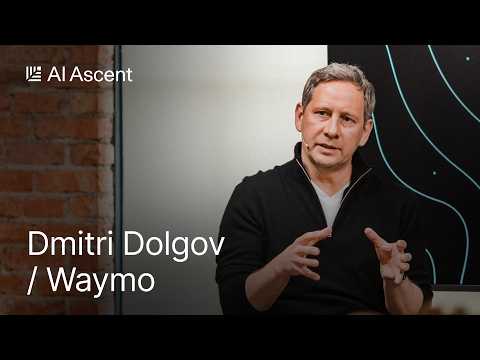
Waymo Scales Autonomous Fleet to 11 Cities as Rides Hit 20 Million
Sequoia Capital
Waymo is accelerating parallel global commercialization because its hybrid foundation model makes the driver 13 times safer than humans, preventing serious injuries every eight days.
## Background
Published on YouTube by Sequoia Capital on May 1, 2026, this video features a conversation between Waymo co-CEO Dmitri Dolgov and Sequoia partner Konstantine Buhler at AI Ascent 2026. The description outlines the 20-year evolution of Waymo from the DARPA Grand Challenge to active service in eleven cities, highlighting its safety metrics, scaling milestones, and the inner workings of the Waymo Foundation Model.
## TL;DR
Dmitri Dolgov shares Waymo's journey from its 2009 origins as Google's Project Chauffeur to its current phase of rapid, global commercialization across 11 US cities and upcoming international markets like London and Tokyo. He explains how Waymo avoided the pitfalls of industry hype cycles by keeping safety as its non-negotiable mission, allowing the company to scale exponentially to over 20 million autonomous rides. Dolgov details the technical architecture of the multimodal Waymo Foundation Model, explaining why a hybrid approach that combines end-to-end learning with structured intermediate representations is necessary to achieve superhuman driving safety.
## Atmosphere & style
The conversation carries an enthusiastic, forward-looking vibe, kicking off with lively audience participation that establishes a strong sense of community appreciation for the technology. Dolgov brings a grounded, deeply technical, and reflective narrative style, pairing nostalgic memories of intense early startup grinding with a profound, serious dedication to the global crisis of road safety. The dynamic between the host and speaker feels like a collaborative peer exchange, blending high-level AI philosophy with humorous personal anecdotes about family life and awe-inspiring stories of superhuman vehicle perception.
## Key takeaways
- [01:25](https://www.youtube.com/watch?v=I_0Kuf6Aa2c&t=85s) Dmitri Dolgov brought a strong physics and math foundation from the Moscow Institute of Physics and Technology, followed by a PhD in AI, into his 20-year autonomous vehicle career.
- [02:05](https://www.youtube.com/watch?v=I_0Kuf6Aa2c&t=125s) Dolgov's career transition to autonomous vehicles was catalyzed by his involvement in the 2005 DARPA Grand and Urban Challenges.
- [03:51](https://www.youtube.com/watch?v=I_0Kuf6Aa2c&t=231s) Project Chauffeur (the precursor to Waymo) was founded at Google in 2009, operating as an intense, small startup with around 12 people.
- [03:51](https://www.youtube.com/watch?v=I_0Kuf6Aa2c&t=231s) The early Google team spent 18 months of rigorous testing to hit its proof-of-concept goals: 100,000 fully autonomous miles and 10 intervention-free 100-mile routes across the Bay Area.
- [07:05](https://www.youtube.com/watch?v=I_0Kuf6Aa2c&t=425s) AI breakthrough hype cycles often skew development expectations by making early-stage problems look easy, while masking the immense difficulty of solving long-tail edge cases.
- [07:05](https://www.youtube.com/watch?v=I_0Kuf6Aa2c&t=425s) Waymo maintained its long-term focus through industry downturns by centering its motivation on global road safety crisis statistics, like a road death occurring every 26 seconds.
- [09:47](https://www.youtube.com/watch?v=I_0Kuf6Aa2c&t=587s) The multimodal Waymo foundation model operates as a world-action-language model that simultaneously drives the real vehicle, generates the simulation world, and evaluates performance.
- [09:47](https://www.youtube.com/watch?v=I_0Kuf6Aa2c&t=587s) Integrating Vision Language Models (VLMs) into Waymo's architecture allows the driver to leverage general world knowledge for complex social and semantic scenarios.
- [12:40](https://www.youtube.com/watch?v=I_0Kuf6Aa2c&t=760s) While end-to-end AI maps sensor inputs directly to driving decisions, Waymo firmly believes a vanilla end-to-end framework is insufficient for deployment without structural intermediate safeguards.
- [12:40](https://www.youtube.com/watch?v=I_0Kuf6Aa2c&t=760s) Waymo utilizes structured intermediate representations alongside its end-to-end framework to allow runtime safety validation, closed-loop training, and remote human support integrations.
- [15:28](https://www.youtube.com/watch?v=I_0Kuf6Aa2c&t=928s) The sixth-generation Waymo driver focuses heavily on system simplification, engineering cost reductions, and manufacturing scale readiness via the Zeekr mobility vehicle platform.
- [17:00](https://www.youtube.com/watch?v=I_0Kuf6Aa2c&t=1020s) Waymo has achieved an exponential inflection point in scaling, recording 10 million of its 20 million cumulative autonomous passenger rides within a brief seven-month span.
- [17:00](https://www.youtube.com/watch?v=I_0Kuf6Aa2c&t=1020s) The generalization capability of the Waymo driver has improved dramatically, enabling the company to launch operations across four new cities in a single day.
- [19:56](https://www.youtube.com/watch?v=I_0Kuf6Aa2c&t=1196s) Waymo rejects the classic Silicon Valley 'move fast and break things' approach, maintaining that building for the extreme safety margins requires a unique architecture and culture from day one.
- [19:56](https://www.youtube.com/watch?v=I_0Kuf6Aa2c&t=1196s) Operating at over 4 million miles per week, Waymo's data shows its driver is 13x safer than a human driver regarding injury-causing collisions, preventing a serious injury every 8 days.
- [23:17](https://www.youtube.com/watch?v=I_0Kuf6Aa2c&t=1397s) Superhuman perception capabilities were demonstrated when a Waymo model interpreted sparse LiDAR reflections bouncing under a city bus to predict the movement of a hidden pedestrian's feet.
- [25:05](https://www.youtube.com/watch?v=I_0Kuf6Aa2c&t=1505s) Waymo has shifted its operational phase from a sequential technological de-risking focus to a parallel global commercialization strategy.
- [25:05](https://www.youtube.com/watch?v=I_0Kuf6Aa2c&t=1505s) Currently operating across 11 US cities, Waymo's 5-to-10-year outlook includes major international expansions into prominent global hubs like London and Tokyo.
## Detailed walkthrough
### [00:02](https://www.youtube.com/watch?v=I_0Kuf6Aa2c&t=2s) The Journey of Dmitri Dolgov and the Early Days of Autonomy
The session begins with an enthusiastic introduction of Dmitri Dolgov, a pioneer in the autonomous vehicle (AV) space who has been building in the field for nearly 20 years—long before the AI boom of 2022. When the host asks the audience how many have ridden in a Waymo and loved the experience, a wave of hands goes up, prompting the host to declare himself a "daily active" user. Dolgov’s journey began in the Soviet Union, after which he moved to the United States, only to return to Russia to attend the prestigious and intense physics and math program at the Moscow Institute of Physics and Technology—the same school his parents attended. Dolgov explains that growing up on stories of the institute inspired him to go back, a decision that ultimately provided him with a rigorous technical foundation and taught him how to learn and explore independently.
After completing his undergraduate studies, Dolgov returned to the U.S. to earn a PhD in AI. His transition to autonomous vehicles occurred in 2005 during the DARPA Grand and Urban Challenges, which he describes as a "light switch moment." Finishing graduate school at that exact time was incredibly lucky; the technology was fascinating, the mission was powerful, and it offered a hands-on product experience that checked every box for him.
- **Key Milestones:** Dolgov has been working in autonomous vehicle technology for over 20 years, starting with the DARPA challenges in the mid-2000s.
- **Educational Background:** Moscow Institute of Physics and Technology (Physics and Math) and a PhD in Artificial Intelligence.
[03:51](https://www.youtube.com/watch?v=I_0Kuf6Aa2c&t=231s) The Birth of Project Chauffeur and the 100,000-Mile Challenge
Waymo originated in 2009 as the Google self-driving car project, internally known as Project Chauffeur. In those early, formative years, the team consisted of only about a dozen people working in a classic, high-intensity startup environment. To understand the problem space of public road autonomy, the small team set two seemingly impossible goals: drive a total of 100,000 miles in full autonomy and successfully navigate 10 distinct, highly difficult 100-mile routes across the San Francisco Bay Area from start to finish without a single human intervention.
Dolgov reminisces about this period as "probably the most fun I've ever had in my professional life." The momentum was thrilling; the team worked 24/7, building hardware and writing code during the day, and testing the vehicles on the roads at night. They had to build everything from scratch—calibrating sensors, setting up pose estimation systems, writing core driving algorithms, and designing the in-car user interfaces. It took the team 18 months of intense grinding to complete both challenges, proving to themselves and Google that a fully autonomous product was worth pursuing.
- **Early Goals (2009):** Drive 100,000 autonomous miles and complete 10 distinct 100-mile Bay Area routes with zero interventions.
- **Timeline:** It took a team of roughly 12 people 18 months to achieve these initial milestones.
[07:05](https://www.youtube.com/watch?v=I_0Kuf6Aa2c&t=425s) Navigating the Hype Cycles and Staying the Course
Reflecting on the dramatic hype cycle of 2016–2017, when the autonomous vehicle industry was flooded with capital and competitors before entering a massive slump, Dolgov shares his perspective on why these cycles occur. He notes that breakthroughs in AI—whether convolutional nets, transformers, or large language models—often make the early stages of a problem look incredibly easy to solve, leading to rapid investment. However, while these technologies reshape the beginning of the development curve, they do not eliminate the incredibly difficult "long tail" of achieving true, superhuman-level full autonomy.
When other companies folded or gave up during the industry downturn, Waymo persisted. Dolgov attributes this stamina to a deep belief in the safety mission, pointing out a sobering statistic: "today worldwide somebody loses their life to a crash on our roads every 26 seconds." By keeping the gravity of this mission in mind and refusing to look for easy wins, quick solutions, or silver bullets, the team maintained the long-term stamina required to go the distance.
- **The Hype Cycle Trap:** Rapid progress in early-stage development often masks the extreme difficulty of solving the long-tail edge cases of full autonomy.
- **The Safety Mission:** The driving force behind Waymo's persistence is the global crisis of road safety, where a life is lost to a vehicle crash every 26 seconds.
[09:47](https://www.youtube.com/watch?v=I_0Kuf6Aa2c&t=587s) The Waymo Foundation Model: Driver, Simulator, and Critic
Addressing the modern AI discourse around "world models," Dolgov explains that Waymo has been building and productionizing its own version for years. At the core of their AI ecosystem is the "Waymo foundation model," which is a multimodal world-action-language model. This model powers three distinct but deeply related pillars of their technology: the driver (the agent on the road), the simulator (which models the physical world), and the critic (which evaluates performance).
The foundation model must understand the physics and dynamics of the physical world, the behavioral aspects of other road users (such as pedestrians, cyclists, and other cars), and what constitutes "good" driving behavior. Because Waymo's vehicles are active participants in the environment rather than passive observers, the model must be highly controllable. Furthermore, by aligning the model with language, Waymo integrates the general world knowledge of Visual Language Models (VLMs), which provides a massive boost in understanding complex semantic and social driving situations.
- **Three Pillars of Waymo AI:**
1. **The Driver:** The physical agent navigating the real world.
2. **The Simulator:** The virtual environment used to test and train the driver.
3. **The Critic:** The evaluation system that judges driving behavior.
- **Multimodal Inputs:** The model processes data from cameras, lidars, and radars, combined with language semantics.
Dolgov addresses the industry debate surrounding "end-to-end" AI architectures, confirming that the Waymo foundation model is indeed an end-to-end system that maps sensor inputs directly to driving decisions. This approach is highly beneficial because it allows the system to learn rich, integrated representations between perception and planning, rather than relying on brittle, hand-engineered interfaces. However, Dolgov warns that relying *purely* on a vanilla end-to-end model is a false dichotomy and is insufficient for a safe, commercial product deployed at scale.
To achieve superhuman safety across hundreds of millions of miles, Waymo augments its learned end-to-end representations with "structured materialized intermediate representations." This hybrid approach provides critical capabilities that pure end-to-end systems lack, such as real-time validation of the vehicle's actions at runtime, closed-loop training and evaluation, and rich reward functions for reinforcement learning. It also allows the system to seamlessly integrate human feedback from remote support agents and safety drivers.
- **End-to-End Definition:** A model that processes raw sensor data to output direct driving actions.
- **Waymo's Hybrid Approach:** Augmenting end-to-end deep learning with structured intermediate representations to enable runtime safety checks and robust closed-loop testing.
[15:28](https://www.youtube.com/watch?v=I_0Kuf6Aa2c&t=928s) The Sixth-Generation Waymo Driver and the Passenger Experience
The conversation turns to hardware innovation, specifically the introduction of the sixth-generation Waymo Driver. While previous generations focused heavily on proving the core technology, the sixth generation represents a massive step forward in simplification, drastic cost reduction, and readiness for high-volume manufacturing. This new sensor and hardware suite is integrated into their latest vehicle platform, the Zeekr-built mobility vehicle.
Dolgov shares his excitement about his first ride in the fully autonomous sixth-generation vehicle, which is currently operating for employees and scheduled to roll out to public riders later in the year. He describes the vehicle as being designed entirely around the rider experience. Despite having a similar external footprint to their Jaguar I-PACE vehicles, the interior feels like a spacious "living room" with sliding doors that open automatically as you approach, massive legroom, and brand-new passenger screens.
- **Sixth-Gen Focus:** Performance optimization, system simplification, significant cost reduction, and high-volume production readiness.
- **The Zeekr Platform:** Features sliding passenger doors, a spacious "living room" interior layout, and upgraded passenger screens.
[17:00](https://www.youtube.com/watch?v=I_0Kuf6Aa2c&t=1020s) Exponential Scaling and Daily Life with Waymo
Waymo is currently undergoing a period of rapid, exponential scaling. While it took the company roughly 16 years to reach its first 100 million autonomous miles, it took only about six months to reach 200 million. Dmitri Dolgov describes this as a true "phase transition" for the company. To illustrate this acceleration, he shares that it took eight years from the start of fully autonomous operations to launch public rider services in four cities; earlier this year, Waymo launched in four new cities in a single day. Out of more than 20 million fully autonomous rides provided by Waymo, 10 million occurred in just the last seven months.
When launching in a new city, Waymo must handle operational logistics, collect environmental data, and validate the driver. However, a significant portion of the effort goes into starting conversations with local communities to earn their trust. Today, the Waymo driver generalizes incredibly well to new environments, making deployment a matter of high-fidelity, rigorous evaluation and validation.
On a personal level, Dolgov uses Waymo as his primary mode of transportation, having taken a freeway ride from Palo Alto to San Francisco for this very event. His three children have grown up with Waymo and now get annoyed on the rare occasions they have to ride in a human-driven car. Dolgov jokes that nowadays, his kids only call out two things when looking out the window: "doggies and it's Waymos," adding with a laugh that there is "probably similar amounts of cognition between those two."
- **100 million miles:** Took roughly 16 years to achieve.
- **200 million miles:** Reached just six months after the first 100 million.
- **Total autonomous rides:** Over 20 million, with 10 million occurring in the last seven months.
- **Launch speed:** Launched four cities in a single day earlier this year, compared to taking eight years to launch the first four cities.
---
[19:56](https://www.youtube.com/watch?v=I_0Kuf6Aa2c&t=1196s) A Non-Negotiable Foundation of Safety
With 1.19 million people dying in road accidents globally every year, safety is a life-or-death mission for Waymo. Challenging the status quo of human driving is what motivates the entire team. Unlike typical Silicon Valley companies that operate under a "move fast and break things" ethos, Waymo has remained incredibly patient, treating safety as a non-negotiable foundation from day one. Dolgov explains that it is tempting to focus on capability first to reach 90% quickly, but building for the "next Nines" of safety requires a completely different model architecture, training recipe, and team mindset from the very beginning.
Waymo now drives more than 4 million fully autonomous miles per week. Across more than 170 million fully autonomous miles of data, the Waymo driver has proven to be "more than 13 times safer than a human driver" regarding serious, injury-causing collisions in its operating cities. At their current scale, this 13x reduction means Waymo is preventing a serious injury every eight days.
Dolgov shares a real-world example of this superhuman safety in action: a young woman riding an electric scooter lost control and tripped directly in front of a Waymo vehicle. The vehicle demonstrated superhuman reaction times, swerving and braking so that everyone walked away safely.
- **Global road deaths:** 1.19 million people annually.
- **Weekly autonomous driving:** Over 4 million miles per week.
- **Safety performance:** 13x safer than human drivers based on over 170 million autonomous miles.
- **Injury prevention:** Waymo's safety performance prevents a serious injury every 8 days.
---
[23:17](https://www.youtube.com/watch?v=I_0Kuf6Aa2c&t=1397s) Seeing Under a Bus: Superhuman Perception
The host asks Dolgov about an incredible story where a Waymo vehicle allegedly detected a pedestrian's footsteps behind a bus. Dolgov confirms the story, calling it a moment where he was "positively surprised by the emerging capability" of the system.
The incident occurred at a San Francisco intersection. A bus crossed and stopped, partially blocking the intersection. When the traffic light turned green, the Waymo driver began to proceed but suddenly detected a pedestrian on the other side of the bus and reacted defensively. Sure enough, a pedestrian emerged from behind the bus, and the Waymo nudged safely around them.
Because lidars, radars, and cameras cannot see through solid objects, Dolgov investigated how this was possible. It turned out that the vehicle's lidar bounced its signal underneath the bus, receiving a sparse return from the movement of the pedestrian's feet. The Waymo AI was advanced enough to not only detect the pedestrian from this minimal data but also predict their future path to keep them safe.
---
[25:05](https://www.youtube.com/watch?v=I_0Kuf6Aa2c&t=1505s) The Next 5 to 10 Years of Waymo
An audience member asks about Waymo's business model and vision for the next 5 to 10 years. Dolgov explains that Waymo is currently "heads down in execution mode." The company has transitioned from a phase of sequential de-risking of the technology to "rapid parallel global commercialization."
Waymo is currently operating fully autonomous services in 11 cities across the United States. Moving forward, they plan to expand within these existing territories, add new domestic cities, and expand internationally. Dolgov highlights that Waymo has announced plans to offer services in London and Tokyo, accelerating deployment to fulfill their safety mission worldwide.
- **Current footprint:** Operating in 11 US cities.
- **International expansion:** Plans announced to launch services in London and Tokyo.
## Notable quotes
> [03:51](https://www.youtube.com/watch?v=I_0Kuf6Aa2c&t=231s) probably the most fun I've ever had in my professional life. — Dmitri Dolgov
> [07:05](https://www.youtube.com/watch?v=I_0Kuf6Aa2c&t=425s) today worldwide somebody loses their life to a crash on our roads every 26 seconds. — Dmitri Dolgov
> [12:40](https://www.youtube.com/watch?v=I_0Kuf6Aa2c&t=760s) structured materialized intermediate representations. — Dmitri Dolgov
> [17:00](https://www.youtube.com/watch?v=I_0Kuf6Aa2c&t=1020s) doggies and it's Waymos — Dmitri Dolgov's children
> [17:00](https://www.youtube.com/watch?v=I_0Kuf6Aa2c&t=1020s) probably similar amounts of cognition between those two. — Dmitri Dolgov
> [19:56](https://www.youtube.com/watch?v=I_0Kuf6Aa2c&t=1196s) more than 13 times safer than a human driver — Dmitri Dolgov
> [23:17](https://www.youtube.com/watch?v=I_0Kuf6Aa2c&t=1397s) positively surprised by the emerging capability — Dmitri Dolgov
> [25:05](https://www.youtube.com/watch?v=I_0Kuf6Aa2c&t=1505s) heads down in execution mode. — Dmitri Dolgov
> [25:05](https://www.youtube.com/watch?v=I_0Kuf6Aa2c&t=1505s) rapid parallel global commercialization. — Dmitri Dolgov
## Mentioned
Dmitri Dolgov, Konstantine Buhler, Sequoia Capital, Waymo, AI Ascent 2026, DARPA Grand Challenge, DARPA Urban Challenge, Moscow Institute of Physics and Technology, Google, Project Chauffeur, Waymo Foundation Model, Visual Language Models, Jaguar I-PACE, Zeekr, Silicon Valley, San Francisco, Palo Alto, London, Tokyo
According to Waymo co-CEO Dmitri Dolgov, the autonomous vehicle developer has shifted from long-term technical de-risking to rapid global commercialization, driven by exponential operational scaling and a multimodal foundation model. Dolgov contends that reaching superhuman safety across real-world edge cases requires a hybrid AI architecture that combines end-to-end learning with verifiable intermediate representations.
Hybrid AI Architecture and Safety Verification (9:47)
At the core of Waymo's software is a multimodal world-action-language foundation model that powers three interconnected systems: the on-road driver agent, a physical-world simulator, and an evaluative critic. The model integrates inputs from cameras, lidars, and radars alongside visual language models (VLMs) to parse complex social driving dynamics and semantic road scenes.
While the model maps raw sensory data directly to driving decisions, Dolgov rejects a purely vanilla end-to-end framework as insufficient for safe, commercial operation. Instead, Waymo augments learned representations with structured, materialized intermediate representations. This hybrid setup enables runtime safety validation, closed-loop evaluation, reinforcement learning reward modeling, and the direct integration of human feedback from remote support operators.
Sixth-Generation Hardware and Rider Experience (15:28)
Waymo's sixth-generation Driver marks a strategic transition from proving technical feasibility toward cost reduction, system simplification, and high-volume manufacturing readiness. The updated hardware suite is deployed on a custom platform manufactured by Zeekr, designed primarily around passenger utility rather than traditional vehicle ergonomics.
Dolgov reports that while the vehicle shares an exterior footprint similar to Waymo's Jaguar I-PACE fleet, the interior provides an expanded cabin featuring sliding passenger doors, extended legroom, and redesigned passenger screens. Currently operational for Waymo employees, the platform is scheduled to roll out to public riders later in the year.
Empirical Safety Record and Emergent Perception (19:56)
Dolgov frames Waymo's core mission around reducing traffic fatalities, pointing to global figures of 1.19 million annual road deaths—equivalent to one death every 26 seconds. Operating at an active rate of over 4 million autonomous miles per week, Waymo reports that data from more than 170 million autonomous miles shows its driver is more than 13 times safer than human drivers regarding serious injury collisions, preventing an injury every eight days.
Dolgov attributes this margin partly to emergent perception capabilities that exceed human sensory limits. In one documented urban incident, a vehicle proactively yielded to an unseen pedestrian behind a bus. System logs revealed the vehicle's lidar had bounced signals underneath the bus chassis, detecting the movement of the pedestrian's feet and accurately predicting their crossing path before they entered direct line of sight.
Exponential Scaling and Global Commercial Expansion (17:00)
Waymo's operations have accelerated sharply from its 2009 origins as Google's Project Chauffeur, which took 18 months for a roughly dozen-person team to complete 100,000 miles across 10 Bay Area routes. In contrast, while accumulating the company's first 100 million autonomous miles required roughly 16 years, the subsequent 100 million miles took only six months. Out of more than 20 million completed autonomous passenger trips, 10 million occurred in the last seven months alone.
Dolgov states that Waymo has advanced from sequential market rollouts to rapid parallel deployment, highlighted by launching four new municipal services in a single day compared to the eight years required for its first four cities. Waymo currently operates across 11 U.S. cities and has announced international expansion targets in London and Tokyo.
Waymo's shift to rapid commercialization rests on the claim that its proprietary model architecture and custom hardware have solved the long-tail edge cases of autonomous navigation. The company's expansion into international markets like London and Tokyo will test whether this software foundation and operational model can transfer seamlessly to complex foreign regulatory environments and street topologies.
[3:51] Dmitri Dolgov: probably the most fun I've ever had in my professional life.
[7:05] Dmitri Dolgov: today worldwide somebody loses their life to a crash on our roads every 26 seconds.
[12:40] Dmitri Dolgov: structured materialized intermediate representations.
[17:00] Dmitri Dolgov's children: doggies and it's Waymos
[17:00] Dmitri Dolgov: probably similar amounts of cognition between those two.
[19:56] Dmitri Dolgov: more than 13 times safer than a human driver
[23:17] Dmitri Dolgov: positively surprised by the emerging capability
[25:05] Dmitri Dolgov: heads down in execution mode.
[25:05] Dmitri Dolgov: rapid parallel global commercialization.
Original transcript
[0:02] We have an unbelievable treat next.
[0:06] Uh a founder who's touching a ton of
[0:07] lives and um who's been at it for a very
[0:10] long time. How many people here have
[0:12] been in a Waymo?
[0:16] Okay,
[0:16] >> [laughter]
[0:16] >> that's a relief.
[0:18] The chef eats his own food. I do. I do a
[0:20] lot of it. All right. And how many
[0:22] people love the Waymo experience?
[0:26] Rock on. I'm a daily active now. It's
[0:28] incredible. Excellent. Thank you. Um we
[0:30] have here the creator
[0:33] uh a a man who has been at this mission
[0:37] for get this founders who've been in AI
[0:39] since 2022
[0:41] almost 20 years
[0:43] building in the autonomous vehicle
[0:45] challenge. And he has not only been at
[0:48] this, he's been at it in the great
[0:49] times, at the tough times. He's been
[0:52] persistent and he has created something
[0:54] that is unlike anything else on Earth.
[0:57] Truly exceptional. Please join me in
[0:58] welcoming DMITRI DOLGOV.
[1:00] >> [applause]
[1:04] >> THANKS. GREAT TO BE HERE. ALL RIGHT,
[1:06] DMITRI. SO we've got about 25 minutes
[1:08] together. Uh the goal is to understand a
[1:10] little bit about you, what makes you
[1:11] tick, what has made you persist since
[1:14] the early days of the DARPA challenge 21
[1:16] years ago all the way through Waymo uh
[1:18] early days to today and the future. Um
[1:21] let's start on you and then we'll get
[1:23] into technology very quickly. Sound
[1:24] good?
[1:25] >> Sounds good. Okay. So Dmitri, you are
[1:28] known by your team as technically
[1:31] brilliant,
[1:32] incredibly intense, but also very kind
[1:34] and humble.
[1:35] Um you were
[1:36] born in the Soviet Union, raised in the
[1:38] States, and then chose to go back to one
[1:41] of the most prestigious and intense
[1:43] physics programs on the planet in
[1:44] Moscow. How did those first few years of
[1:47] your life shape you and how did it shape
[1:49] your character?
[1:50] So my parents went to the same school,
[1:52] so that to a large degree drove my
[1:55] decision to go back. I went to high
[1:56] school. I actually traveled around quite
[1:58] a bit. I spent a year in Japan, then
[2:00] went to uh high school in the States and
[2:02] came back to college to do math and
[2:03] physics in in Russia. Uh so that was the
[2:06] same school that my parents went to and
[2:08] I kind of really grew up uh
[2:10] hearing stories about what it is like to
[2:13] be at that place. I really wanted to go
[2:14] back. And I think you know in terms of
[2:15] how it shaped me, I think it really set
[2:17] the foundation
[2:18] uh you know technical foundation and the
[2:22] you know in those early days in college
[2:24] one of the most important thing is you
[2:26] know acquiring the ability to learn and
[2:29] independently explore, so I think that
[2:30] really helped me in my future career.
[2:33] Now, you did this very intense program
[2:36] at Moscow Institute of Physics and
[2:38] Technology, and then you decided to keep
[2:40] going on the AI path. You earned your
[2:42] PhD also in AI. And then you pretty
[2:46] quickly were attracted to autonomous
[2:47] vehicles. In in '05 you were part of the
[2:50] DARPA challenge. Can you tell us about
[2:51] those early days, what drew you to
[2:52] autonomy?
[2:55] That was kind of a light switch
[2:57] moment for me. Right? I you know in the
[3:00] early days when I went to college and
[3:01] then grad school it was more you know
[3:04] about just the learning of the
[3:06] fundamentals and I
[3:09] didn't have a at all a clear picture and
[3:13] idea of what I wanted to do after.
[3:15] Right? And then I think the timing just
[3:17] was just incredibly lucky that this was
[3:20] when I was finishing up grad school, the
[3:22] urban challenges uh the grand challenge
[3:24] and then the urban challenge the one
[3:25] that I took place in
[3:27] were happening and it clicked. It was
[3:29] just uh the the the technology is
[3:32] incredibly interesting. The mission is
[3:36] so powerful that nothing else come close
[3:38] and it's a real product there you can be
[3:40] hands-on experience it yourself. So it
[3:43] really checked all the boxes for me. And
[3:45] as you said this has been 20-some years
[3:47] ago, you know who's counting, uh and
[3:48] then I've I've never looked back and
[3:49] that's what I've been doing since.
[3:51] Amazing. So Waymo started out of a
[3:54] project at uh Stanford Automotive Lab.
[3:57] There were two sides of this building.
[3:59] There was the autonomy side and then
[4:00] there was a solar car side. Fun fact, um
[4:04] I was an idealist, I worked on the solar
[4:05] car.
[4:07] I got that bet very wrong.
[4:08] Uh you bet on autonomy. Tell us about
[4:11] the first few years of Waymo from from
[4:15] '09 to the formative years.
[4:18] So we started in 2009. That was at the
[4:20] time the Google self-driving car
[4:22] project. Um and the first couple of
[4:25] years it was all about
[4:28] learning the problem space,
[4:30] understanding you know what it means to
[4:32] try to put a autonomous vehicle on
[4:35] public roads. Uh so
[4:38] when we started in service of you know
[4:40] those goals of learning and
[4:41] understanding the problem space, we
[4:42] created a couple of goals for ourselves.
[4:44] One was to drive 100,000 miles total in
[4:47] full autonomy, which at the time was
[4:49] kind of not heard of.
[4:51] Uh and the second one was to drive 10
[4:53] routes. Each one was 100 miles long.
[4:56] They were all over the Bay Area, uh
[4:58] chosen to be you know very difficult.
[5:00] And we had to do each one from beginning
[5:02] to end in full autonomy. You know still
[5:04] with a person behind the wheel uh that
[5:06] you know could take control, but the
[5:08] challenge was to complete each one
[5:10] without an intervention. So it was a
[5:12] small team of us, it was about you know
[5:14] a dozen people. I was the early crazy
[5:17] startup days. Yeah, everybody working
[5:18] 24/7, you know writing code and building
[5:21] hardware during the day and then you
[5:23] know doing some testing at night. Uh and
[5:25] it took us about 18 months to complete
[5:28] uh both of those challenges.
[5:32] Incredible. It seemed impossible at the
[5:33] time. Now you guys are on hundreds of
[5:35] millions of miles. Absolutely. Um okay,
[5:37] so early Waymo days, extreme challenge,
[5:41] starting to achieve there. Next few
[5:43] years, you have a reputation in your
[5:45] team
[5:46] for grinding really hard. You were
[5:48] sleeping at the office. Tell us about
[5:50] Dmitri in the first few years of Waymo
[5:53] and and how you formed your leadership
[5:55] style.
[5:59] I got to say those early days was
[6:01] probably the most fun I've ever had in
[6:04] my professional life. And it is that
[6:07] that
[6:08] you know
[6:09] momentum and that pace of an you know
[6:13] early startup days. All right, when you
[6:16] are making so much progress you know
[6:18] every hour of every day. And you're
[6:20] doing everything, right? You are uh
[6:22] working on setting up the hardware in
[6:24] the cars and then you know configuring
[6:26] and calibrating the sensors and the you
[6:28] know your pose estimation system. And
[6:31] then you are writing software during the
[6:32] day and it's everything, right? It's the
[6:33] core of the you know the software, the
[6:36] algorithms that drive the car. It is all
[6:37] of the tools
[6:39] uh and UIs and the user experience in
[6:41] the car. So you're doing everything.
[6:43] You're learning at an insane rate and
[6:44] you're making progress at an insane
[6:46] rate. So [snorts] uh that's that was uh
[6:49] the those were the early days uh of
[6:51] project Chauffeur. And then you know in
[6:53] those couple of years we've convinced
[6:54] ourselves that you know yes this is
[6:57] worth pursuing, so we doubled down and
[7:00] started actually building towards the
[7:02] future of a of a fully autonomous
[7:04] product.
[7:05] Okay, so exciting first few years,
[7:07] intense, fast-paced, technically really
[7:10] difficult. Now take us to 2016-17 for a
[7:13] moment. This was a period where we
[7:15] actually had a hype cycle in AI. Turns
[7:18] out there's been a few of them. And
[7:21] AV autonomous vehicle was at the center
[7:23] of that hype cycle. I mean I remember
[7:24] just so many companies going after this.
[7:28] And then there was a massive slump.
[7:30] And when most people gave up or failed
[7:32] or fell apart, you guys persisted. And
[7:35] you were a leader in that persistence.
[7:37] For all the builders in this room, how
[7:40] did you navigate through the hard times?
[7:45] So first a comment on you know
[7:47] what these cycles kind of you know look
[7:49] like to me and you know how I've seen
[7:51] them. And you said there there's been
[7:52] many some in AV but more generally. And
[7:55] kind of the what often leads to a cycle
[7:57] like this is some
[8:00] rapid some breakthrough that leads to
[8:05] very rapid progress in the kind of the
[8:08] early parts of the problem and very
[8:10] rapid investment flow in the early part
[8:12] of the problem. And and in the AVs the
[8:14] the problem has always had this property
[8:16] that it's very easy to get started, but
[8:18] it's you know very difficult to take it
[8:20] all the way to a real product, full
[8:22] autonomy and superhuman performance. Uh
[8:25] so it's somewhat natural given those
[8:28] ingredients that whenever there's been
[8:29] you know big breakthrough in technology,
[8:31] whether it's you know convolutional nets
[8:33] or you know transformers or you know
[8:35] large language models, it's led to the
[8:37] cycle okay now the problem is going to
[8:39] be you know very And it kind of reshapes
[8:41] the early part of the curve, but it you
[8:43] know doesn't change the long tail of it.
[8:46] Uh so
[8:48] in for us
[8:50] I think it was
[8:52] understanding
[8:53] that it's
[8:56] not going to be an easy problem. And but
[8:58] it's a very important one. And having
[9:02] you know believing in the mission I
[9:03] think it's uh today
[9:07] worldwide somebody loses their life to a
[9:10] crash on our roads every 26 seconds.
[9:14] So I guess it's the combination of
[9:16] knowing that the mission is
[9:18] really really important and then
[9:20] understanding what you're up against and
[9:21] not looking for a kind of easy wins or
[9:24] quick solutions or silver bullets that
[9:26] help the team you know have the right
[9:28] stamina to go the distance.
[9:30] Brilliant. So you guys were in this
[9:33] moment where it was really easy to get
[9:35] started. A lot of people got there, but
[9:38] you guys actually persisted. And got
[9:40] through to the other side with a truly
[9:41] magical experience. Pretty much every
[9:42] hand in this room went up. Truly magical
[9:45] experience because of that persistence.
[9:47] Let's talk about technology today.
[9:49] A lot of people are talking about world
[9:50] models. You have had all the components
[9:53] of world models for many years.
[9:56] How do you think about a world model and
[9:58] what is Waymo's version of a world
[10:00] model?
[10:02] Uh yeah, there are a few things that
[10:05] a few terms that people use nowadays. Uh
[10:07] people talk about world models,
[10:09] world action models, omni models, you
[10:12] know, visual language action models. And
[10:14] at the core of each [snorts] there's an
[10:16] ingredient that is relevant uh and
[10:18] really important for Waymo and for what
[10:21] we've been building in our AI ecosystem.
[10:24] So, at the
[10:27] core of our AI ecosystem is what we call
[10:30] the Waymo foundation model and it powers
[10:33] three main pillars of our AI and our
[10:37] tech. So, the driver,
[10:39] the simulator, and the critic.
[10:42] Right? And those are
[10:44] very related but distinct tasks. Uh so,
[10:48] at the core of what our foundation model
[10:51] needs to be capable of
[10:54] uh are things like it needs to
[10:55] understand how the world works, the
[10:57] physics, the dynamics of the the
[10:59] physical world.
[11:01] Uh
[11:02] and it needs to understand, you know,
[11:04] what it is to be a good driver and you
[11:06] know, how [snorts] the effects of the
[11:08] actions of that driver or our agent on
[11:10] other agents in the world. And then we
[11:11] need to instantiate those in that
[11:13] physical agent that we're putting on the
[11:14] roads. So, in a way that foundational
[11:16] model that that we've been building over
[11:19] the years is
[11:20] uh a multimodal world action language
[11:23] model. All right, so it's multimodal in
[11:25] that it needs to be able to reason about
[11:27] not just, you know, images or video but
[11:28] also other sensors like clay lidars and
[11:31] radars.
[11:32] Uh it is a world action model in that,
[11:35] you know, it really has to have a deep
[11:37] precise understanding of the 3D spatial
[11:39] properties of the world, the dynamics,
[11:41] the physics, the um
[11:43] the
[11:43] uh behavioral aspects of other agents
[11:45] like cars, pedestrians, cyclists, and so
[11:47] forth. Uh
[11:49] and we are not just, you know, passively
[11:51] modeling those worlds, we're an active
[11:53] participant in it. Uh so, we don't not
[11:55] only have to, you know, the world model
[11:57] has to be controllable but also, you we
[11:59] need to have a deep understanding of
[12:01] what it means to be a, you know, good
[12:02] agent in that world. Uh and finally,
[12:05] it's aligned with language and that
[12:06] allows us to kind of pull in the general
[12:09] world knowledge of a VLM into our model
[12:12] that is very, very useful in giving us a
[12:14] boost in the uh
[12:17] uh in understanding the semantics and
[12:20] the deep social aspects of driving.
[12:23] Right? [snorts]
[12:24] And we've been, you know, uh working on
[12:27] productionizing that model, you know,
[12:29] for years and it really it um
[12:32] requires an extremely high degree of
[12:36] performance and accuracy and realism in
[12:38] every aspect of what we just talked
[12:39] about.
[12:40] Brilliant. So, with this driver,
[12:42] simulator, critic
[12:44] architecture,
[12:45] uh there's also been a lot of
[12:46] conversation about end-to-end
[12:47] architectures.
[12:48] Is that the
[12:50] appropriate dichotomy? How do we think
[12:52] about the approach to getting us to
[12:55] extreme performance efficiency
[12:57] autonomous vehicles that are
[12:59] totally generalizable? Yeah, so to be
[13:01] very clear, you know, the world model
[13:03] that is described, uh the Waymo
[13:04] foundation model, is an end-to-end
[13:06] model.
[13:07] Uh so, when we talk about an end-to-end
[13:08] model, typically we mean that, you know,
[13:10] it's one model that goes from sensors to
[13:13] decisions or actions.
[13:15] >> [snorts]
[13:15] >> And uh you know, there are some very
[13:17] nice properties of uh such a model.
[13:20] One of the most important ones is that
[13:22] uh
[13:23] you
[13:24] it learns the right rich representations
[13:27] between different components of the
[13:28] system like the encoder and the decoder
[13:30] or the perception and the planning part
[13:32] of your system.
[13:33] As [snorts] opposed to something where
[13:34] that interface is engineered, which is
[13:36] not sufficient for a, you know, a task
[13:38] like driving.
[13:40] Uh now, I do think there's a a false
[13:42] dichotomy there that's, you know,
[13:43] end-to-end or something else.
[13:45] Uh really, it my mind has always been
[13:48] the question of, you know, it's
[13:49] end-to-end
[13:51] and then, you know, what else? And what
[13:53] else do you need to build if you want to
[13:56] have a product that is fully autonomous,
[13:59] has superhuman level of safety, and you
[14:01] want to deploy it at scale and drive
[14:03] hundreds of millions of miles. And there
[14:05] it turns out that kind of the basic
[14:07] vanilla, you know, end-to-end system is
[14:10] insufficient, right? So, it's there's a
[14:13] massive difference between using
[14:14] end-to-end versus purely relying on it.
[14:17] So, at Waymo we've really gone beyond
[14:18] that kind of basic vanilla end-to-end
[14:20] approach and we've augmented the learned
[14:23] representation with structured
[14:25] materialized intermediate
[14:26] representation. And what that allows us
[14:29] to do
[14:30] are a few very important things that you
[14:32] might not actually need if you are, you
[14:34] know, building a different product, if
[14:35] you're building a driver assist system
[14:37] or, you know, a prototype, a demo, or a
[14:39] small scale deployment. But again, those
[14:41] things are absolutely critical if you
[14:43] want to go all the way to a fully
[14:45] autonomous safe system with superhuman
[14:48] performance. And those are things like
[14:50] having extra validation at runtime in of
[14:54] the agent that's running on the car in
[14:56] the physical world. It's things like
[14:58] richer training and evaluation recipes
[15:02] that are very difficult or impractical
[15:04] to do in a pure kind of basic end-to-end
[15:05] system where this structured
[15:07] materialized representation gives you a
[15:09] boost in things like closed loop
[15:11] evaluation, closed loop training, uh
[15:13] rich reward functions for reinforcement
[15:15] learning. So, that's been our approach.
[15:16] And all the human feedback that you get
[15:18] from support and
[15:21] drivers dropping in and all of that,
[15:23] it's essential to have this type of
[15:24] architecture.
[15:25] >> Exactly. Exactly.
[15:26] Makes perfect sense.
[15:28] So, not only have you innovated on the
[15:30] software stack but also the hardware
[15:32] stack. There's a sixth generation now of
[15:34] Waymo driver and you guys have always
[15:36] focused on being the driver.
[15:38] Tell us about the new sixth generation
[15:40] and what was it like the first time
[15:42] you've interfaced with it? It was a so,
[15:44] the sixth generation uh is our most
[15:46] advanced uh hardware suite and sensor
[15:49] suite yet. The focus there has been on
[15:52] performance but also on simplification,
[15:55] drastic cost reduction, and uh high
[15:59] scale volume production. Uh
[16:02] this is the uh
[16:04] the driver that's powering our latest
[16:06] vehicle platform, that's the O Hi.
[16:08] Uh we
[16:10] uh earlier this year started fully
[16:12] autonomous operations. Uh it's currently
[16:14] only open to employees but coming to
[16:16] our, you know, all of the riders later
[16:18] this year.
[16:19] Uh and yeah, I I had a chance to take a
[16:23] ride in one
[16:24] as soon as we started
[16:26] uh running fully autonomous operations.
[16:28] And you know, they
[16:30] I spent a lot of my life in various
[16:32] generations of our cars. Every once in a
[16:34] while there's uh kind of a new first
[16:37] moment and that was definitely it. It's
[16:39] just that they the cool car is designed
[16:41] around the rider experience. It is
[16:44] uh even though the external footprint of
[16:46] the car is about the same as the i Pace
[16:48] but inside you get in and it feels like
[16:50] it's a living room. All right, there's
[16:51] so much space in the back. We have new
[16:52] screens. We have these doors that, you
[16:54] know, slide open and will, you know,
[16:55] open automatically when you approach the
[16:56] car. So, I I I had a blast and I I can't
[17:00] wait to have this car in our fleet open
[17:02] to everyone. So, you guys are going
[17:04] through a period of incredible scaling.
[17:06] For for many years you were in the lab
[17:08] R&D, surely.
[17:10] It took 16 years-ish to get to 100
[17:13] million miles, six months-ish to get to
[17:15] 200. Things continue to scale really
[17:17] rapidly. 11 cities now, many, many more
[17:21] um
[17:22] on the horizon. Tell us what is it like
[17:24] to scale a new city and then tell us
[17:26] about your daily life with a Waymo. How
[17:28] do you use it as a creator?
[17:33] Well, there's a lot. Okay, so
[17:34] exponential scaling. First of all,
[17:35] absolutely. It's been a
[17:38] phase transition for us in how we're
[17:40] scaling. So,
[17:42] to give you a couple of additional data
[17:44] points, it took us eight years from the
[17:46] day when we started our fully autonomous
[17:48] operations
[17:50] to the day when we had our service, our
[17:54] uh our driver providing rides to the
[17:57] public in four cities. Earlier this
[17:59] year, just a few weeks ago, we launched
[18:01] four cities in one day.
[18:03] We've uh
[18:04] given
[18:06] over 20 million fully autonomous rides.
[18:10] 10 of those million happened in the last
[18:12] seven months.
[18:13] Amazing.
[18:13] >> So, that's what exponential scaling
[18:14] looks like.
[18:14] >> Amazing. Uh
[18:16] launching new cities, uh
[18:19] there's, you know, operational
[18:21] components, you know, show up. Uh you
[18:23] know, you have to uh collect the data,
[18:25] characterize the environment. Um I mean,
[18:28] validate the driver.
[18:30] Uh a significant part of it is starting
[18:32] the conversation with the local
[18:33] communities because it's a new thing,
[18:35] it's a new product. So, it's on us to
[18:36] earn the trust of the, you know, the the
[18:38] people there.
[18:39] Um and then um more often than not today
[18:42] we're seeing that the driver is
[18:43] generalizing incredibly well and it's
[18:45] just a matter of high [snorts] fidelity
[18:48] rigorous evaluate evaluation and
[18:49] validation before we deploy the fully
[18:52] autonomous product. And then uh we can,
[18:54] you know, we grow from there.
[18:56] And then the last, what was the last
[18:57] part of the question? Oh, what is my
[18:58] daily life? Yeah, it was a multi-part
[19:00] question, yeah. Uh
[19:02] Waymo I mean, Waymo is
[19:03] uh my is how I get around nowadays.
[19:06] Uh that's how I got here today. Uh it
[19:08] was, you know, a a great ride from Palo
[19:10] Alto up to San Francisco
[19:12] uh on on freeways.
[19:13] Uh
[19:14] I my family use it. I have three kids.
[19:17] They love Waymo. Uh they
[19:20] they they I think nowadays they get
[19:21] annoyed if on a rare occasion we have
[19:23] to, you know, be in a car that's driven
[19:24] by you know, myself or my wife or, you
[19:27] know, another human being. They're like,
[19:28] "Okay, what was going on there?"
[19:29] >> same way at this point. Uh
[19:31] they they love it. Uh it's been part of
[19:34] their lives, you know, for the entirety
[19:36] of their lives. There's
[19:37] uh when we are
[19:39] uh driving around, there's two things,
[19:41] there's only two things that get cool
[19:42] outs from my kids nowadays. It's doggies
[19:44] and it's Waymos.
[19:46] >> [snorts]
[19:47] >> Nice.
[19:48] Um okay.
[19:49] Uh probably similar amounts of cognition
[19:51] between those two.
[19:52] Um, okay, so let let's talk about um,
[19:56] uh, safety. You know, one of the most
[19:58] meaningful, exciting parts of partnering
[20:01] with Waymo has been the fact that
[20:03] there's 1.19 million people a year on
[20:06] Earth that die in road accidents. All
[20:09] right, it is this is life or death. You
[20:11] know, not only does it touch everyone in
[20:12] this room, but everybody has some
[20:15] connection who's been impacted by this.
[20:18] Um, you have been about safety from the
[20:20] very beginning.
[20:21] And it's actually pretty hard, you know,
[20:23] in a Silicon Valley where it's move fast
[20:25] and break things and see what happens,
[20:27] you guys have been incredibly patient
[20:30] uh, with safety. Can you tell us about a
[20:32] story that made it very real to you and
[20:35] how you keep that safety culture at
[20:37] Waymo?
[20:38] >> [snorts]
[20:40] >> So, the numbers you mentioned,
[20:43] that's
[20:44] what drives all of us at Waymo and
[20:47] that's the status quo is not okay. All
[20:48] right, we've kind of grown this over
[20:50] time,
[20:51] uh, but challenging the status quo is
[20:54] really important to everyone at our
[20:56] company. You're uh,
[20:58] absolutely right that how you go about
[21:01] building a system like this is different
[21:03] from you might do in other areas, in
[21:05] other fields, in other industries where
[21:07] safety has to be the non-negotiable
[21:10] foundation and you have to build that
[21:12] into your everything that you do from
[21:14] day one. Your model architecture, your
[21:18] training and evaluation recipe is the
[21:20] mindset of the team. It can be very
[21:22] tempting to, you know, focus
[21:23] [clears throat] on capability first and
[21:25] get to the, you know, 90%
[21:27] uh, very quickly, but how you go about
[21:31] the first 90%
[21:33] is totally different problem for, you
[21:34] know, how you go about, you know,
[21:36] getting to your next, you know, Nines.
[21:38] So, get keeping that in mind and
[21:40] focusing on safety as the non-negotiable
[21:43] fundamental layer from day one is super
[21:45] important. And then, uh, you know, today
[21:47] we're driving more than uh, 4 million
[21:50] miles in full autonomy per week.
[21:53] Uh, and you see
[21:56] a lot of
[21:58] uh, events from the field and uh, today
[22:01] we have the data
[22:03] uh, over 170 million miles fully
[22:05] autonomous miles where we see that the
[22:07] Waymo driver is more than 13 times safer
[22:11] than a human driver when it comes to
[22:13] serious injury causing collisions in the
[22:15] cities where we operate. And you see
[22:17] that
[22:18] sort of superhuman safety behavior
[22:20] manifesting itself on the roads,
[22:23] you know, daily. All right, I see
[22:24] examples of, you know, recently there
[22:26] was a little while ago there's an
[22:27] example uh, that I saw of um, uh, uh, a
[22:31] person
[22:32] uh, I think it was a young woman on
[22:34] electric scooter
[22:36] on the road and then she lost control
[22:38] and tripped and fell right in front of
[22:40] the Waymo and the Waymo
[22:42] uh, driver showed superhuman
[22:44] uh, accuracy and reaction time and was
[22:46] able to, you know, swerve and brake and
[22:48] everybody walked away. So, it's uh,
[22:51] things like this that, you know, uh,
[22:53] my my uh, I myself personally and the
[22:55] team, the whole team find very rewarding
[22:58] uh, in terms of actually having a real
[23:00] impact on the safety of our roads. And
[23:02] the scale that we're operating, that 13x
[23:04] reduction means that we are preventing a
[23:06] serious injury
[23:07] every 8 days.
[23:09] And that impact will just grow as we
[23:11] scale up. Wow.
[23:12] We're going to open the room to audience
[23:14] questions, a couple in in just a moment.
[23:17] Before we jump in, I heard a story about
[23:19] uh, the lidar detecting or the radar
[23:22] detecting the footsteps of somebody
[23:25] behind a bus. Did that happen and how
[23:28] does that work? Yeah, yeah, this was one
[23:30] of those moments where uh,
[23:32] I was
[23:34] positively surprised
[23:36] by the emerging capability of our
[23:38] system. And the situation was
[23:41] uh, this was I think in San Francisco.
[23:43] Uh, the Waymo driver was at an
[23:44] intersection. There was a bus that
[23:47] crossed uh, and we're, you know, sitting
[23:49] there waiting at a red light. Uh, so the
[23:51] bus crossed and stopped partially
[23:53] blocking the intersection. So, our light
[23:55] intersection. So, then our light turned
[23:57] green. The Waymo driver started to
[23:58] proceed and as it's proceeding,
[24:01] it detects a pedestrian on the other
[24:05] side of the bus.
[24:07] And you know, you can't see through the
[24:09] bus. It's, you know, uh, not through
[24:12] lidars, not radars, not cameras, you
[24:13] know, the the windows are reflecting the
[24:15] people inside the bus.
[24:17] Uh, and then, you know, starts to
[24:19] react defensively and sure enough, a
[24:21] pedestrian emerges from behind the bus
[24:23] and then we're able to nudge around them
[24:25] and everybody, you know, goes on their
[24:27] way. So, when I saw that, I was I have a
[24:31] blew my mind. I wasn't sure what was
[24:32] going on. Um, I guess capable as
[24:35] superhuman as the Waymo driver is, it
[24:36] doesn't see through solid objects. So,
[24:39] actually what turned out was happening
[24:40] is that our lidar
[24:43] had was bouncing the signal, you know,
[24:45] under the bus and got a little bit of a
[24:48] sparse return from the movement of the
[24:51] person's feet under the bus and that was
[24:53] enough for the Waymo AI to not only
[24:56] detect that there's a pedestrian there,
[24:57] but also make a prediction about what's
[24:59] going to happen in the future and keep
[25:01] everyone safe. Mind-blowing. Pretty uh,
[25:04] unbelievable. We've got time for one
[25:05] question from the group.
[25:07] Uh, if anybody has
[25:09] a key
[25:10] Jim, sorry, no free codes. Not at this
[25:12] one. No. Yes, Jim, please. Thank you.
[25:15] Does this work? Yes. I was just saying
[25:17] congratulations on all you've achieved.
[25:19] It's really mind-blowing. If you think
[25:21] about the next 5 to 10 years, really
[25:24] focus on the business model, what are
[25:26] the milestones, what happens in major
[25:29] cities, what's going to be different
[25:31] than where we are today? Just kind of
[25:33] walk us through through your vision of
[25:34] the future.
[25:37] So, we're heads down in execution mode.
[25:39] Uh,
[25:39] >> [snorts]
[25:39] >> we've transitioned from an intentional
[25:43] sequential de-risking of the driver and
[25:46] key parts of the business to rapid
[25:49] parallel global commercialization. Uh,
[25:52] that means uh, deploying the Waymo
[25:54] driver
[25:55] uh, in more places uh, across the United
[25:57] States. Today we're in 11 cities uh,
[26:00] operating fully autonomous and serving
[26:02] uh, our riders. That uh, we're going to
[26:04] expand in those existing places. We're
[26:06] going to add new geographies, new
[26:08] cities. We're also expanding
[26:09] internationally. Announced that this
[26:11] year we'll plan to offer a service in
[26:12] London and in Tokyo. So, uh, you will
[26:15] see us uh, just accelerating that
[26:17] deployment all in service of our
[26:18] mission.
[26:20] Good news to our team in London. Well,
[26:22] we covered a lot, Dmitri, from the very
[26:24] early days where you could get a lot of
[26:27] distance with not a lot of technology to
[26:29] then persisting through extremely hard
[26:31] times in autonomous vehicles and getting
[26:34] that extra mile. We talked about world
[26:36] models, uh, driver simulator critic
[26:38] architecture. We got into the hardware,
[26:41] the sixth generation hardware, safety
[26:44] and scaling. Uh, but most of all, I hope
[26:47] that we learned a little bit more about
[26:49] Dmitri, the man who's brought the magic
[26:51] that is Waymo to to so many of us. And
[26:54] as I've gotten to know you more and
[26:55] more, I'm constantly struck not only by
[26:56] your your brilliance and your
[26:58] persistence and performance, but also
[27:00] your humility.
[27:01] Uh, it says a lot for accomplishing this
[27:04] much. Thank you, Dmitri. Please join me
[27:05] in thanking Dmitri for all he does.
[27:07] Thank [applause] you. Thank you. Thank
[27:08] you. And the many lives saved. Thank
[27:09] you.