Germany Tests Catenary Wires to Cut Two-Thirds of Truck Emissions
Tom Scott
Outfitting one-third of highways with overhead wires could eliminate two-thirds of freight emissions, but governments must decide within five years whether to fund the massive infrastructure before diesel bans take effect.
AI-assisted summary of The highway where trucks work like electric trains — original source. Check the original for full context.
Source published:
Key ideas
- Field trials in Germany demonstrate that electrifying just one-third of the Autobahn network with overhead catenary wires could eliminate approximately two-thirds of heavy road freight greenhouse gas emissions. (0:00)
- Dynamic catenary charging delivers electricity directly via cable, bypassing the weight penalties and thermodynamic inefficiencies of hauling oversized batteries on long-haul routes. (1:28)
- Economic modeling indicates hauliers could recoup the higher capital expenditure of pantograph trucks in roughly 18 months via fuel savings, while tariffs could fund private infrastructure and replace lost fuel duty. (1:28)
- With the UK banning new diesel and petrol HGVs by 2040, governments face a tight three- to five-year window to determine whether to invest the billions required for nationwide catenary rollout. (3:20)
Detailed notes
## Background Published on YouTube by Tom Scott on October 25, 2021, this video visits an eHighway trial in Lübeck, Germany. The piece explores test installations of overhead catenary wires that allow pantograph-equipped electric trucks to draw power directly from the electrical grid while in motion.
## TL;DR To decarbonize heavy road freight without burdening long-haul trucks with enormous, heavy battery packs, trial projects in Germany are testing overhead catenary wires installed above highway lanes. Outfitting roughly one-third of the Autobahn network could eliminate approximately two-thirds of heavy freight emissions, utilizing automatic pantographs that drop down instantly during overtaking maneuvers. Hauling shipping containers along major trunk corridors directly from overhead lines offers superior thermodynamic efficiency compared to electrochemical storage and could fund its own infrastructure through fuel savings. However, with statutory bans on combustion trucks approaching within decades, governments face a pressing three-to-five-year window to decide whether to invest billions in nationwide overhead cabling.
## Atmosphere & style The presentation is crisp, curious, and grounded in pragmatic engineering, pairing Tom Scott's characteristic fast-paced explanation with quiet, steady cab-ride footage that highlights the eerie silence of an electrified truck. The tone balances forward-looking optimism about simple, time-tested railway technology with a sober appraisal of the monumental civil engineering costs ahead. It feels informative and urgent, leaving viewers with a tangible sense of the rapidly closing decision window facing policymakers.
## Bulletin - [00:00](https://www.youtube.com/watch?v=_3P_S7pL7Yg&t=0s) Field trials in Germany demonstrate that electrifying just one-third of the Autobahn network with overhead catenary wires could eliminate approximately two-thirds of heavy road freight greenhouse gas emissions. - [01:28](https://www.youtube.com/watch?v=_3P_S7pL7Yg&t=88s) Dynamic catenary charging delivers electricity directly via cable, bypassing the weight penalties and thermodynamic inefficiencies of hauling oversized batteries on long-haul routes. - [01:28](https://www.youtube.com/watch?v=_3P_S7pL7Yg&t=88s) Economic modeling indicates hauliers could recoup the higher capital expenditure of pantograph trucks in roughly 18 months via fuel savings, while tariffs could fund private infrastructure and replace lost fuel duty. - [03:20](https://www.youtube.com/watch?v=_3P_S7pL7Yg&t=200s) With the UK banning new diesel and petrol HGVs by 2040, governments face a tight three- to five-year window to determine whether to invest the billions required for nationwide catenary rollout.
## Key takeaways - [00:00](https://www.youtube.com/watch?v=_3P_S7pL7Yg&t=0s) Pure battery electrification for long-haul trucking faces a major bottleneck due to the excessive dead weight of massive battery packs and the need for stationary charging infrastructure. - [00:00](https://www.youtube.com/watch?v=_3P_S7pL7Yg&t=0s) The eHighway concept adapts century-old electric railway technology, installing overhead catenary lines over motorway slow lanes to power trucks dynamically via roof-mounted pantographs. - [00:00](https://www.youtube.com/watch?v=_3P_S7pL7Yg&t=0s) Outfitting approximately one-third of the German highway network with catenary infrastructure would address roughly two-thirds of heavy truck emissions. - [00:00](https://www.youtube.com/watch?v=_3P_S7pL7Yg&t=0s) The overhead wires operate at standard urban tram voltage levels, producing electromagnetic fields lower than typical municipal light rail and posing no unresolved safety hazards for emergency services. - [00:00](https://www.youtube.com/watch?v=_3P_S7pL7Yg&t=0s) Lane changes and overtaking are automated: switching on the turn indicator or drifting out of the catenary lane triggers the pantograph to instantly retract, switching power to onboard battery or hybrid power. - [01:28](https://www.youtube.com/watch?v=_3P_S7pL7Yg&t=88s) Commercial road freight naturally bifurcates into last-mile distribution—best served by depot-charged plug-in batteries—and hub-to-hub trunk haulage, which is ideally suited for dynamic catenary lines. - [01:28](https://www.youtube.com/watch?v=_3P_S7pL7Yg&t=88s) Directly feeding grid electrons to vehicles via cables provides the most thermodynamically efficient method for utilizing electricity in heavy freight transport. - [01:28](https://www.youtube.com/watch?v=_3P_S7pL7Yg&t=88s) Electricity tariffs can be structured to pay off truck pantograph costs within 18 months, yield commercial returns for private infrastructure investors, and generate government tax revenue to replace declining fuel duty. - [01:28](https://www.youtube.com/watch?v=_3P_S7pL7Yg&t=88s) Transitional hybrid engines can bridge operational gaps in remote or sparsely populated areas where catenary installation is commercially impractical. - [03:20](https://www.youtube.com/watch?v=_3P_S7pL7Yg&t=200s) Statutory bans on new diesel HGVs by 2040 leave an 18-year timeline that barely accommodates the planning and construction required for nationwide civil infrastructure projects. - [03:20](https://www.youtube.com/watch?v=_3P_S7pL7Yg&t=200s) Governments have an urgent three-to-five-year evaluation window to decide whether to commit billions in funding to overhead catenary networks or pursue alternative technologies.
## Detailed walkthrough ### [00:00](https://www.youtube.com/watch?v=_3P_S7pL7Yg&t=0s) The eHighway Concept and German Trials
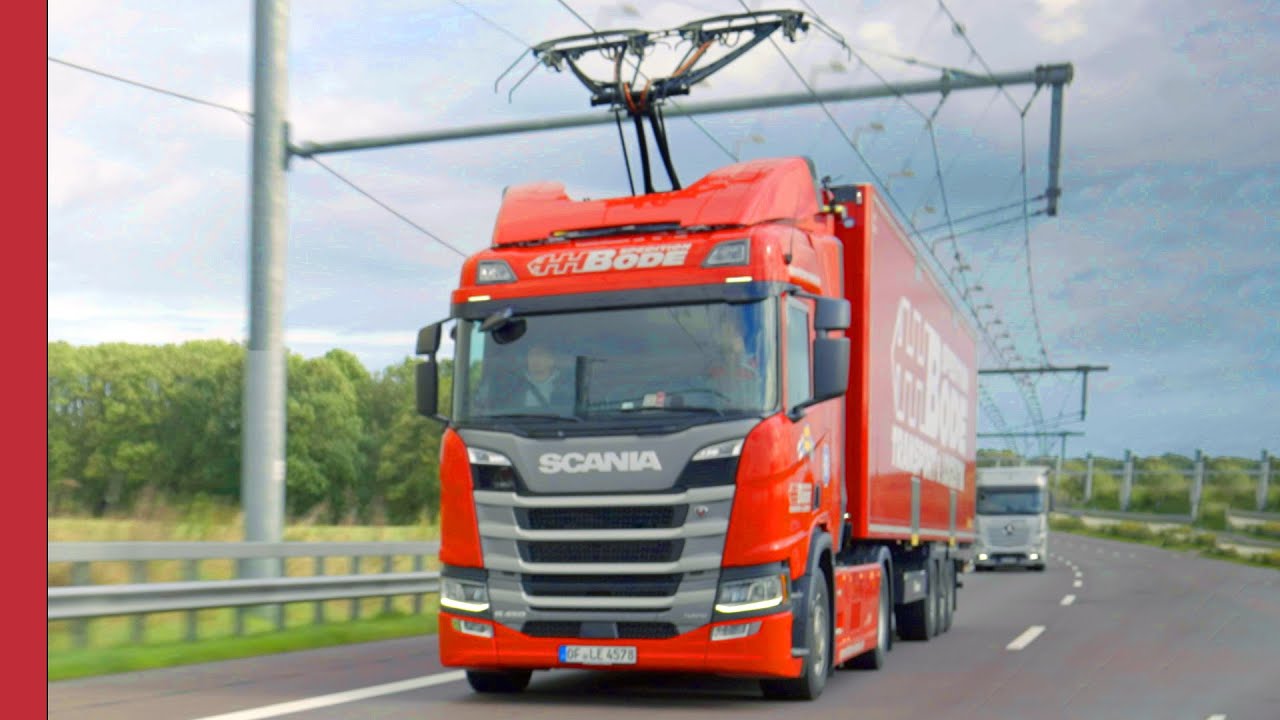
As petrol and diesel are phased out and battery technology becomes cheaper and more capable, electric heavy goods vehicles are slowly entering the market. However, electrifying long-haul trucking purely through onboard energy storage presents a major engineering bottleneck: each truck requires a massive, heavy battery pack alongside extensive stationary charging infrastructure. Rather than hauling that dead weight, an alternative is to power the vehicles dynamically while they drive. This concept borrows directly from a proven technology operating for over a century: electric railway trains drawing power from overhead catenary lines. By suspending catenary cables over the slow lane of a motorway, trucks fitted with roof-mounted pantographs can connect directly to the electrical grid while in motion.
In Germany, an operational field trial has been evaluating the real-world performance of this system over a 21-month operational period, with at least another year of testing scheduled. Project representatives calculate that outfitting just one-third of the German Autobahn network with overhead wires would be sufficient to eliminate two-thirds of all greenhouse gas emissions produced by heavy road freight. While safety concerns were initially raised by emergency responders, extensive consultations with local police and fire services resolved those apprehensions. The catenary runs at the voltage level of a standard municipal tram, and its electromagnetic field emissions are lower than those produced by typical light-rail systems. Maneuvers like lane changes and overtaking are automated: switching on the turn indicator or crossing the lane line signals the pantograph to instantly retract, allowing onboard battery reserves or a combustion engine to supply uninterrupted drive power.
```mermaid flowchart TD accTitle: eHighway Dual-Mode Power System accDescr: Flowchart showing how trucks switch power sources between highway catenary wires and off-wire driving.
subgraph Catenary["Overhead Catenary Lane"] Grid["Grid Power"] --> Wire["Overhead Wires"] Wire --> Panto["Active Pantograph"] Panto --> Motor["Electric Drivetrain"] end
subgraph OffWire["Maneuvering / Off-Highway"] Indicator["Lane Change / Indicator"] --> Drop["Pantograph Lowers Automatically"] Drop --> Onboard["Battery / Hybrid Engine"] Onboard --> Motor end ```
- A rollout covering roughly one-third of the German highway network could remove approximately two-thirds of heavy truck greenhouse gas emissions. - System voltage mirrors conventional urban trams, generating electromagnetic fields well within safe thresholds below standard tramway limits. - When passing or changing lanes, drivers encounter zero lag: “Overtaking is absolutely no problem!” explains an eHighway representative. “You just set the indicator or leave the lane and the pantograph will automatically drop down immediately and they are free to go.”
---
[01:28](https://www.youtube.com/watch?v=_3P_S7pL7Yg&t=88s) Logistics, Energy Efficiency, and Business Models
Inside the cab of a catenary-connected truck, the driving experience is characterized by a striking absence of engine roar; drawing direct grid power renders the vehicle remarkably quiet. The practical viability of overhead charging hinges on how commercial road logistics are organized. Heavy goods vehicle operations divide into two primary categories. The first is last-mile regional distribution, where trucks disperse cargo from fulfillment centers to retail storefronts. Because these routes primarily navigate local and urban roads away from the primary trunk corridors, overhead wires are impractical. However, these vehicles run shorter daily routes and park overnight, making depot-based plug-in charging ideal. The second major category involves hub-to-hub trunk haulage, moving shipping containers between seaports, distribution hubs, and major warehouses. This freight moves almost exclusively along national highway corridors, meaning the bulk of the journey can be electrified through overhead wires while modest onboard batteries handle the few miles between the junction and the warehouse gate.
From a physics and resource perspective, dynamic line feeding bypasses the primary inefficiencies of electrochemical storage. Professor David Cebon of the Centre for Sustainable Road Freight underscores this operational logic: “What you're doing is bringing the electrons to the vehicle in a cable, rather than trying to carry them in a box in a battery.” Directly powering vehicles via cable represents the most thermodynamically efficient method to utilize electricity in road freight. Moreover, economic modeling indicates the infrastructure can be self-funding: - Electricity tariffs can be set at a level that enables hauliers to recoup the higher capital expenditure of pantograph-equipped trucks in roughly 18 months through diesel fuel savings. - A portion of the electricity tariff revenue can be channeled back to private infrastructure builders, generating stable commercial returns capable of securing private finance. - Additional margin remains within the power tariffs to generate government tax revenues to replace declining fuel duty. - For remote, sparsely populated regions where catenary installation is cost-prohibitive, transitional hybrid drivetrains can bridge the gaps without stalling national decarbonization.
---
[03:20](https://www.youtube.com/watch?v=_3P_S7pL7Yg&t=200s) Deadlines, Feasibility, and the Future of Road Freight
Modern global freight infrastructure has spent well over a century optimizing around internal combustion and fossil fuels, but statutory mandates mean this paradigm must end within decades. The United Kingdom has legislated a ban on the sale of new diesel and petrol heavy goods vehicles by 2040. Although that target might seem distant, an 18-year timeline leaves virtually no room for hesitation when constructing nationwide civil infrastructure, and the European Union faces comparable timetables.
Erecting overhead catenary systems across thousands of miles of motorway could easily consume the entirety of the remaining implementation window. While the underlying electrical and mechanical engineering is thoroughly validated, technical success does not automatically guarantee financial viability. The UK and its peers face an immediate decision window: “If we want to keep to that date, then the UK has somewhere around three to five years to figure out if this is just a gimmick or whether it's worth investing the billions that it'll take to roll this out,” Tom Scott observes. While forecasting infrastructural transitions is notoriously difficult, overhead catenary gantries may well become a standard sight over major highways in the decades ahead.
## Notable quotes > [01:28](https://www.youtube.com/watch?v=_3P_S7pL7Yg&t=88s) What you're doing is bringing the electrons to the vehicle in a cable, rather than trying to carry them in a box in a battery. — David Cebon
## Mentioned Centre for Sustainable Road Freight, David Cebon, eHighway, European Union, Germany, Klein Aber, Lübeck, Maximilian Thesseling, Richard Bielau, Spedition Bode GmbH, Tom Scott, United Kingdom
## Video description In Lübeck, Germany, there's one of several eHighway test projects: overhead catenary wires, where electric trucks with pantographs can pull power directly from the grid. Thanks to everyone who gave so much time to make this video possible!
More about the eHighway: https://www.ehighway-sh.de/de/ehighway.html Prof. Cebon's work at the Centre for Sustainable Road Freight: https://www.csrf.ac.uk/author/dcebon/
Camera operator: Richard Bielau Producer: Maximilian Thesseling of Klein Aber https://kleinaber.de/
With thanks to all the team at the eHighway and at Spedition Bode GmbH
🟥 MORE FROM TOM: https://www.tomscott.com/ (you can find contact details and social links there too) ❓ LATERAL, free weekly podcast: https://lateralcast.com/ https://youtube.com/lateralcast/ 👥 THE TECHNICAL DIFFICULTIES: https://youtube.com/techdif
[Source](https://www.youtube.com/watch?v=_3P_S7pL7Yg)