Dickmanns Vision System Steers Mercedes Sedans in Live Paris Traffic
Kaspars Foigts
Real-time 25 Hz computer vision enabled fully automated highway lane changes in unscripted public traffic as early as 1994.
AI-assisted summary of Dickmann's autonomous cars, 1980s — original source. Check the original for full context.
Source published:
Key ideas
- Ernst Dickmanns' VaMoR platform demonstrated autonomous highway driving as early as 1987, reaching speeds of 96 km/h across more than 20 km on an unopened section of the German Autobahn. (0:01)
- VaMoR's real-time closed-loop architecture directly operated vehicle actuators—steering, throttle, and braking—while dynamically controlling the gaze direction of onboard vision cameras. (0:01)
- Under Phase 3 of the pan-European Eureka PROMETHEUS project (1993–1994), hardware miniaturization allowed full autonomous vision systems to fit inside Mercedes-Benz S-Class passenger sedans. (1:17)
- At a 1994 showcase near Paris, the VaMP vehicle tracked up to six surrounding vehicles at 25 Hz to autonomously execute lane-change decisions in unscripted, live three-lane freeway traffic. (1:17)
Detailed notes
## Background Published on YouTube by Kaspars Foigts on January 12, 2016, this video documents the pioneering work of Ernst Dickmanns with the VaMoR and VaMP autonomous vehicle projects. The channel's description notes that it highlights how these computer-guided vehicles managed to navigate thousands of miles autonomously on public roads starting in the 1980s.
## TL;DR The video chronicles the development of early autonomous driving technology under Ernst Dickmanns, beginning with the VaMoR platform which achieved full closed-loop computer control of steering, throttle, and braking by 1986 after eight years of simulation work. In 1987, VaMoR demonstrated sustained autonomous driving at speeds up to 96 km/h over 20 kilometers on a newly constructed German Autobahn, eventually incorporating obstacle tracking and lane-change maneuvers. The program then highlights the Eureka PROMETHEUS project in 1993–1994, where the miniaturized VaMP vision system tracked multiple surrounding vehicles at 25 Hz and executed fully autonomous lane changes in live freeway traffic near Paris.
## Atmosphere & style The presentation carries a calm, matter-of-fact archival documentary tone characteristic of classical European research overviews. The narration delivers technical milestones with clinical precision, avoiding sensationalism while letting the historic footage speak for itself. Watching early computer racks and micro-miniaturized cameras guide full-sized Mercedes sedans through live 1990s highway traffic creates an eerie, retro-futuristic atmosphere that underscores just how far ahead of its time the engineering was.
## Bulletin - [00:01](https://www.youtube.com/watch?v=_HbVWm7wdmE&t=1s) Ernst Dickmanns' VaMoR platform demonstrated autonomous highway driving as early as 1987, reaching speeds of 96 km/h across more than 20 km on an unopened section of the German Autobahn. - [00:01](https://www.youtube.com/watch?v=_HbVWm7wdmE&t=1s) VaMoR's real-time closed-loop architecture directly operated vehicle actuators—steering, throttle, and braking—while dynamically controlling the gaze direction of onboard vision cameras. - [01:17](https://www.youtube.com/watch?v=_HbVWm7wdmE&t=77s) Under Phase 3 of the pan-European Eureka PROMETHEUS project (1993–1994), hardware miniaturization allowed full autonomous vision systems to fit inside Mercedes-Benz S-Class passenger sedans. - [01:17](https://www.youtube.com/watch?v=_HbVWm7wdmE&t=77s) At a 1994 showcase near Paris, the VaMP vehicle tracked up to six surrounding vehicles at 25 Hz to autonomously execute lane-change decisions in unscripted, live three-lane freeway traffic.
## Key takeaways - [00:01](https://www.youtube.com/watch?v=_HbVWm7wdmE&t=1s) Ernst Dickmanns and his research team pioneered early autonomous driving using computer-guided road vehicles in the 1980s. - [00:01](https://www.youtube.com/watch?v=_HbVWm7wdmE&t=1s) The VaMoR vehicle entered active road testing in 1986 following eight years of foundational simulation development. - [00:01](https://www.youtube.com/watch?v=_HbVWm7wdmE&t=1s) The vehicle's computer system directly controlled vehicle actuators—steering wheel, throttle, and brakes—via real-time sensor data fusion. - [00:01](https://www.youtube.com/watch?v=_HbVWm7wdmE&t=1s) VaMoR featured an active vision platform capable of dynamically panning and altering camera gaze under computer control. - [00:01](https://www.youtube.com/watch?v=_HbVWm7wdmE&t=1s) During 1987 Autobahn trials, VaMoR drove autonomously for over 20 kilometers at speeds up to 96 km/h. - [00:01](https://www.youtube.com/watch?v=_HbVWm7wdmE&t=1s) The 96 km/h speed threshold in 1987 was limited strictly by engine gearing rather than onboard computational limits. - [00:01](https://www.youtube.com/watch?v=_HbVWm7wdmE&t=1s) Automated obstacle recognition was introduced in 1989, enabling convoy-following behind preceding vehicles. - [00:01](https://www.youtube.com/watch?v=_HbVWm7wdmE&t=1s) System capabilities matured to include fully autonomous lane changes by the early 1990s. - [01:17](https://www.youtube.com/watch?v=_HbVWm7wdmE&t=77s) Between 1993 and 1994, research joined Phase 3 of Eureka PROMETHEUS, equipping three Mercedes-Benz S-Class sedans with UBM vision architectures. - [01:17](https://www.youtube.com/watch?v=_HbVWm7wdmE&t=77s) Micro-miniaturized cameras and denser electronics made it possible to house the entire computational payload within a standard vehicle trunk. - [01:17](https://www.youtube.com/watch?v=_HbVWm7wdmE&t=77s) Engineers placed part of the hardware on the right rear seat of the VaMP test car to facilitate bench maintenance during trials. - [01:17](https://www.youtube.com/watch?v=_HbVWm7wdmE&t=77s) VaMP's upgraded vision system tracked up to six surrounding vehicles across both front and rear hemispheres at 25 Hz. - [01:17](https://www.youtube.com/watch?v=_HbVWm7wdmE&t=77s) In October 1994, VaMP demonstrated autonomous lane-change decision-making in normal, unscripted traffic on a three-lane freeway near Paris.
## Detailed walkthrough ### [00:01](https://www.youtube.com/watch?v=_HbVWm7wdmE&t=1s) Early Breakthroughs with VaMoR on the Autobahn
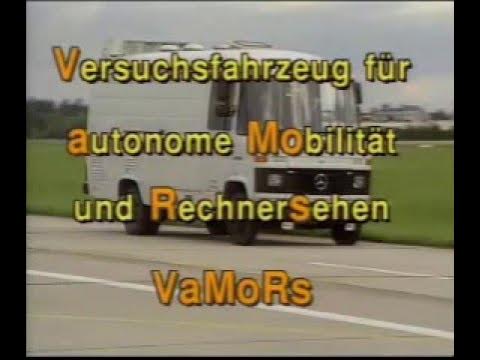
The development of automated driving achieved its earliest and most remarkable milestones through computer-guided road vehicles, led by Ernst Dickmanns and his team. The primary experimental testbed, the VaMoR vehicle, entered active field operation in 1986. This rollout was the culmination of eight years of foundational preparatory engineering centered on multiple tiers of simulation, which ultimately converged into a closed, real-time simulation loop. Operating on data fusion gathered from an array of onboard sensors, the vehicle's computer system exercised direct, automated control over the primary driving actuators: the steering wheel, the throttle, and the braking system. In addition to vehicle motion, the platform was capable of active vision, using computer control to dynamically adjust the pan and gaze direction of its onboard cameras.
```mermaid flowchart TD accTitle: VaMoR Actuation and Sensor Loop accDescr: Diagram illustrating sensor data fusion driving actuators and camera direction. subgraph SENSING["Perception & Vision"] A["Active TV Cameras"] B["Vehicle Sensors"] end subgraph PROCESSING["Onboard Computer System"] C["Real-Time Data Fusion Loop"] end subgraph ACTUATION["Vehicle Controls"] D["Steering Wheel"] E["Gas Pedal"] F["Brakes"] G["Camera Direction Control"] end A --> C B --> C C --> D C --> E C --> F C --> G G -.->|"adjusts gaze"| A ```
In 1987, VaMoR set an unprecedented benchmark for automated transit during tests on a newly completed section of the German Autobahn before it was officially opened to public transit. The vehicle navigated autonomously across a span exceeding 20 kilometers, executing maneuvers at varying speeds up to a ceiling of 96 kilometers per hour, constrained solely by the vehicle's engine gearing rather than computer processing bottlenecks. Building on this dynamic highway control, the engineering team expanded the system's scene understanding in 1989 to include automated obstacle recognition, which enabled the platform to safely transition into a convoy-following mode behind leading vehicles. By the dawn of the 1990s, the system's behavioral repertoire had matured further to perform fully autonomous lane changes.
- As the narrator highlights regarding this milestone era: “In 1987 VaMoR demonstrated worldwide top performance on a new stretch of Autobahn not yet turned over to the public.” - Preparatory engineering: 8 years of simulation work leading up to operational deployment in 1986. - 1987 test speed: Cruised at speeds reaching up to 96 km/h over stretches longer than 20 km. - Functional milestones: Automated obstacle detection introduced in 1989; autonomous lane changing realized in the early 1990s.
---
[01:17](https://www.youtube.com/watch?v=_HbVWm7wdmE&t=77s) Project PROMETHEUS and the VaMP Demonstration in Paris
Between 1993 and 1994, the research transitioned into the third phase of the pan-European Eureka PROMETHEUS project, outfitting three Mercedes-Benz S-Class passenger sedans with custom vision architectures engineered by the Universität der Bundeswehr München (UBM). Owing to the development of micro-miniaturized television cameras and denser computing hardware, the entire processing and electronic payload could now be packaged inside a standard vehicle trunk. However, inside the specific UBM test vehicle, named VaMP, engineers elected to install a portion of the hardware package across the right rear passenger seat to maximize component accessibility and speed up bench maintenance during experimental field trials.
```mermaid flowchart LR accTitle: VaMP Traffic Tracking and Decision Architecture accDescr: Flow from multi-camera tracking to autonomous lane change decision. subgraph PERCEPTION["Vision Tracking (25 Hz)"] H["Front Hemisphere Cameras"] I["Rear Hemisphere Cameras"] J["Track up to 6 Vehicles"] end subgraph REASONING["UBM Computer Science Module"] K["Surrounding Traffic State Estimation"] L["Target Neighbor Lane Assessment"] M["Autonomous Lane Change Decision"] end H --> J I --> J J --> K K --> L L --> M ```
The upgraded vision system was capable of tracking up to six external vehicles simultaneously across both the front and rear hemispheres. The relative spatial states, velocities, and trajectories of these surrounding objects with respect to the ego-vehicle were concurrently computed at an update rate of 25 Hz. This high-frequency environmental awareness culminated in a major trial held near Paris in October 1994 during the final PROMETHEUS showcase. Merging into active, unscripted traffic along a three-lane freeway, the vehicle used a specialized software module developed by UBM computer science researchers to monitor traffic across all adjacent lanes and evaluate safe opening gaps, successfully executing fully automated lane-change decisions in live highway conditions.
- As the narrator recounts regarding the milestone trial: “On this basis at the final demonstration of the Prometheus project near Paris in October of 1994 on a three-lane freeway with normal traffic the capability of making the decision for lane change fully autonomously was shown for the first time.” - Fleet integration: Three Mercedes-Benz S-Class sedans integrated with UBM vision hardware during Phase 3 of Eureka PROMETHEUS (1993–1994). - Multi-target tracking: Concurrently tracks up to 6 surrounding vehicles in front and rear hemispheres at 25 Hz. - Public road validation: October 1994 Paris demonstration evaluated automated decision-making and lane changes within live, three-lane freeway traffic.
## Mentioned Ernst Dickmanns, Eureka PROMETHEUS project, German Autobahn, Kaspars Foigts, Mercedes-Benz S-Class, Universität der Bundeswehr München, VaMoR, VaMP
## Video description Short video about Ernst Dickmanns VaMoR and VaMP projects - fully autonomous vehicles, which travelled thousands of miles autonomously on public roads in 1980s.
[Source](https://www.youtube.com/watch?v=_HbVWm7wdmE)