Semple Sells 'Pinkest Pink' to Defy Kapoor Over Vantablack Ban
Tom Scott
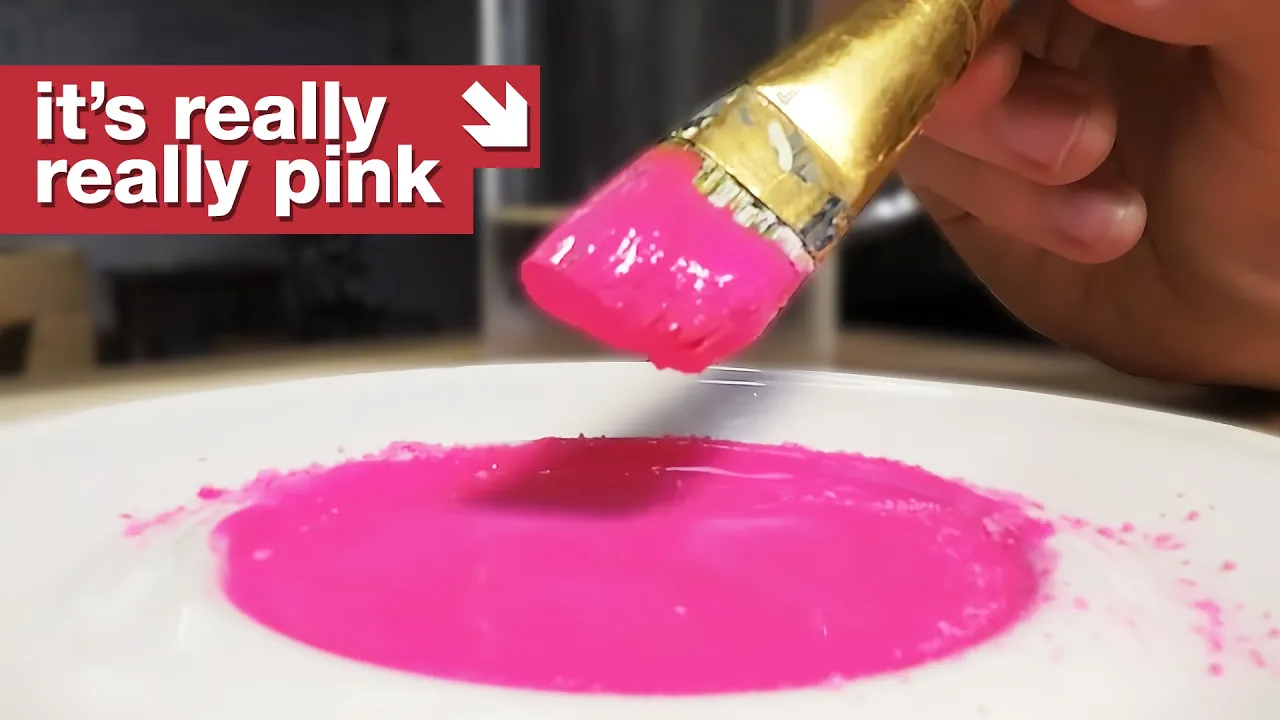
Standard 8-bit RGB consumer displays cannot render Stuart Semple's pigment because its saturation exceeds the luminescent limits of digital subpixels.
AI-assisted summary of I can't show you how pink this pink is. — original source. Check the original for full context.
Source published:
Key ideas
- Artist Stuart Semple created 'The Pinkest Pink,' an ultra-saturated pigment that standard digital cameras and RGB displays physically cannot capture or render accurately. (0:00)
- The pigment was released in protest of Surrey NanoSystems licensing exclusive artistic rights for Vantablack to sculptor Anish Kapoor, legally barring Kapoor from purchasing Semple's pigment. (0:25)
- After Kapoor bypassed the restriction and posted an Instagram image dipping his middle finger into the powder, viral global demand forced Semple's studio into four straight weeks of nonstop paint production. (1:00)
- Consumer screens are constrained by standard 8-bit RGB color channels (16.7 million colors capped between values 0 and 255), creating a hard gamut ceiling that clips hyper-saturated real-world pigments. (1:32)
Detailed notes
## Background Published on YouTube by Tom Scott on July 18, 2017, this video explores why digital video is fundamentally incapable of showing Stuart Semple's ultra-saturated pigment, "The Pinkest Pink." In the video description, Scott explains that while he can show bright and saturated shades, screens cannot truly display this particular pink, noting that viewer traffic overloaded Semple's website and that Anish Kapoor's studio did not respond to requests for comment.
## TL;DR Tom Scott visits artist Stuart Semple's studio to examine "The Pinkest Pink," an ultra-saturated pigment developed in retaliation after sculptor Anish Kapoor secured exclusive artistic rights to the ultra-dark material Vantablack. Semple made his pigment available to everyone except Kapoor—a restriction Kapoor deliberately breached online, setting off massive viral demand. Scott breaks down the technical reasons modern displays cannot reproduce the shade, explaining how standard 8-bit RGB color gamuts cap values between 0 and 255 and clip extreme real-world wavelengths. Because ordinary monitors cannot match the pigment's intensity, Scott demonstrates its vividness through relative saturation jumps and hands-on mixing in the studio.
## Atmosphere & style The video carries an energetic, playful, and intellectually curious vibe that seamlessly bridges art-world drama with display physics. Scott's classic fast-paced, expository style pairs naturally with Semple's warm, cheeky storytelling about his petty feud with Kapoor. Watching it feels delightfully paradoxical and hands-on, building from an abstract technical explanation into a tactile moment of genuine wonder as Scott watches the pigment transform before his eyes.
## Bulletin - [00:00](https://www.youtube.com/watch?v=_NzVmtbPOrM&t=0s) Artist Stuart Semple created 'The Pinkest Pink,' an ultra-saturated pigment that standard digital cameras and RGB displays physically cannot capture or render accurately. - [00:25](https://www.youtube.com/watch?v=_NzVmtbPOrM&t=25s) The pigment was released in protest of Surrey NanoSystems licensing exclusive artistic rights for Vantablack to sculptor Anish Kapoor, legally barring Kapoor from purchasing Semple's pigment. - [01:00](https://www.youtube.com/watch?v=_NzVmtbPOrM&t=60s) After Kapoor bypassed the restriction and posted an Instagram image dipping his middle finger into the powder, viral global demand forced Semple's studio into four straight weeks of nonstop paint production. - [01:32](https://www.youtube.com/watch?v=_NzVmtbPOrM&t=92s) Consumer screens are constrained by standard 8-bit RGB color channels (16.7 million colors capped between values 0 and 255), creating a hard gamut ceiling that clips hyper-saturated real-world pigments.
## Key takeaways - [00:00](https://www.youtube.com/watch?v=_NzVmtbPOrM&t=0s) Stuart Semple formulated 'The Pinkest Pink,' a pigment so intense that digital cameras cannot capture it, YouTube cannot store it, and computer monitors cannot display it. - [00:15](https://www.youtube.com/watch?v=_NzVmtbPOrM&t=15s) Alongside the pink pigment, Semple has engineered a line of extreme art materials, including the greenest green, loveliest blue, yellowest yellow, ultra-glittery natural glitter, and an ultra-matte black. - [00:25](https://www.youtube.com/watch?v=_NzVmtbPOrM&t=25s) The initiative originated as retaliation after Surrey NanoSystems granted sculptor Anish Kapoor exclusive artistic rights to Vantablack, preventing all other artists from using it. - [00:45](https://www.youtube.com/watch?v=_NzVmtbPOrM&t=45s) To order The Pinkest Pink, buyers are legally required to sign a disclaimer confirming that they are not Anish Kapoor and have no affiliation with him. - [00:55](https://www.youtube.com/watch?v=_NzVmtbPOrM&t=55s) Kapoor circumvented the terms, acquired a jar, and posted a photo on Instagram showing his middle finger dipped into the powder. - [01:05](https://www.youtube.com/watch?v=_NzVmtbPOrM&t=65s) The resulting viral attention generated thousands of orders, forcing Semple's studio to spend four continuous weeks mixing pink paint to meet demand. - [01:32](https://www.youtube.com/watch?v=_NzVmtbPOrM&t=92s) Standard digital video relies on an 8-bit RGB gamut with 256 gradations per channel (0–255), producing around 16.7 million total displayable color combinations. - [01:55](https://www.youtube.com/watch?v=_NzVmtbPOrM&t=115s) Digital displays have strict physical limits: subpixels cannot fall below 0 (no darker than off) or rise above 255 (maximum luminescence), bounding both extreme contrast and extreme color saturation. - [02:15](https://www.youtube.com/watch?v=_NzVmtbPOrM&t=135s) Extreme real-world colors lie outside the standard RGB gamut because standard monitor subpixels physically cannot illuminate with sufficient red, green, or blue intensity. - [02:30](https://www.youtube.com/watch?v=_NzVmtbPOrM&t=150s) Developing extreme art materials requires precise balancing of raw pigments and binders, building upon a historical palette spanning synthetic chemistry to materials like mummy brown. - [03:03](https://www.youtube.com/watch?v=_NzVmtbPOrM&t=183s) Because the color cannot be rendered directly, Tom Scott illustrates the jump in intensity by temporarily desaturating the video feed and snapping it back to highlight how much further the pigment goes. - [03:25](https://www.youtube.com/watch?v=_NzVmtbPOrM&t=205s) While dry pigment can initially appear like ordinary powder in a container, mixing it with an art medium unlocks an intense, luminous quality that cannot be replicated on screen.
## Detailed walkthrough ### [00:00](https://www.youtube.com/watch?v=_NzVmtbPOrM&t=0s) The Pinkest Pink and the Anish Kapoor Feud
Tom Scott visits the studio of artist Stuart Semple, holding up a pigment so intense that digital technology fails to capture it. As Tom bluntly tells the audience: “This camera can't capture it, YouTube can't store it, and your screen can't display it.” Stuart Semple explains that he has been painting since he was five years old and has encountered endless shades of pink, but after thousands of people used his creation, nobody could point to a pinker version. Beyond his "Pinkest Pink," Semple has developed a full lineup of hyper-saturated art materials: the greenest green, the loveliest blue, the yellowest yellow, the world's most glittery natural glitter, and the flattest, blackest matte art material in existence.
```mermaid flowchart TD accTitle: The Pinkest Pink Feud Flow accDescr: Diagram illustrating the origin of the Pinkest Pink feud between Surrey NanoSystems, Anish Kapoor, and Stuart Semple.
subgraph Vantablack["Vantablack Dispute"] A["Surrey NanoSystems invents Vantablack"] --> B["Exclusive artistic rights licensed to Anish Kapoor"] B --> C["Art community and Stuart Semple outraged"] end
subgraph Retaliation["Semple's Retaliation"] C --> D["Semple releases 'Pinkest Pink' to the public"] D --> E["Legal disclaimer: Buyer cannot be Anish Kapoor"] end
subgraph Escalation["The Instagram Incident"] E --> F["Kapoor acquires pigment and posts middle finger on Instagram"] F --> G["Global viral demand causes 4-week non-stop production surge"] end ```
The motivation behind releasing this pigment stemmed from deep frustration in the artistic community roughly a year and a half earlier. A company called Surrey NanoSystems had developed Vantablack—a revolutionary material that absorbed virtually all light, creating a blacker-than-black effect. However, they granted exclusive artistic usage rights to sculptor Anish Kapoor, barring every other artist on Earth from working with it. Annoyed by this gatekeeping, Semple retaliated by making his Pinkest Pink available to everyone—with one strict caveat. Anyone purchasing it had to legally sign a disclaimer certifying that they were not Anish Kapoor and had no association with him. While the joke delighted the art world and orders poured in, Kapoor ultimately managed to obtain a jar anyway. He promptly posted an image on Instagram dipping his middle finger into the powder. Reflecting on the aftermath, Stuart Semple said: “It was sort of great and sort of really frustrating when he did that, because all of a sudden we were getting thousands and thousands of orders, we ended up staying up for about four weeks making pink paint and nothing else could happen and it just took over our whole life.”
- **Surrey NanoSystems** sparked the feud by licensing artistic rights to Vantablack exclusively to sculptor **Anish Kapoor**. - Semple countered by releasing **The Pinkest Pink** alongside other extremes: greenest green, loveliest blue, yellowest yellow, natural glitter, and ultra-matte black. - The online storefront legally barred Kapoor from purchasing the pigment, a restriction Kapoor deliberately breached for an Instagram photo.
---
[01:32](https://www.youtube.com/watch?v=_NzVmtbPOrM&t=92s) The Limits of RGB, Digital Gamuts, and Mixing Pigments
The reason the pigment cannot be perceived through a video comes down to the fundamental physics of consumer screens. While computers have elaborate methods for processing color, consumer video fundamentally breaks down into RGB values: three numbers dictating the brightness of the red, green, and blue subpixels on a panel. In standard 8-bit color channels, those numbers range from 0 to 255 (representing eight binary ones). A value of 0 means the subpixel is switched off entirely, while 255 drives it to its maximum luminescence, allowing roughly 16.7 million total displayable color combinations.
Yet, 16 million colors does not cover the spectrum of human vision or real-world physics. Tom illustrates this ceiling with extreme examples: pointing a camera directly at the sun cannot blind a viewer, because the digital signal caps out at 255 (100% brightness); conversely, pointing a lens into absolute darkness cannot drop below 0 to make the display darker than when turned off. In the exact same manner, colors exist that are far too saturated for the subpixels of ordinary monitors to render—they simply cannot glow intensely enough. As Tom explains: “In the same way, there are colours that are so intense your screen can't display them, the pixels cannot go red, green or blue enough.”
```mermaid flowchart LR accTitle: Digital Color Range vs Real-World Pigment accDescr: Comparison of 8-bit digital color display bounds against real-world light and pigment intensity.
subgraph DigitalScale["Standard 8-Bit Display (0 to 255)"] direction TB Min["0 / Off: Floor cannot get darker"] Mid["~16 Million Renderable Combinations"] Max["255 / 100%: Ceiling cannot get brighter"] Min --- Mid --- Max end
subgraph RealWorld["Real-World Extremes"] direction TB Dark["True Black / Deep Shadows"] Color["The Pinkest Pink Pigment"] Sun["The Sun / Extreme Light"] end
RealWorld -.->|"Exceeds digital gamut"| DigitalScale ```
To engineer pigments that push beyond ordinary physical constraints, artists draw upon vast historical databases. Semple notes that humans have unearthed and manufactured color agents "since day dot," ranging from synthetic chemicals to macabre natural sources like "mummy brown" (historically derived from ground-up human mummies). Achieving the Pinkest Pink was not an accident; it required balancing complex relationships between raw pigments and binders, adjusting ratios until the mixture yielded maximum brilliance. Semple describes the final result as “quite a complicated little potion, actually.”
- Standard consumer screens use an **8-bit per channel RGB gamut** ($256^3 \approx 16.7\text{ million}$ colors). - A screen's brightness range is strictly bounded: it cannot drop below value 0 or exceed value 255. - Historical pigments include sources like **mummy brown**, which was produced from ground mummified remains. - Newer, high-end production displays feature wider color gamuts capable of rendering closer approximations of these wavelengths, though most current screens clip them.
---
[03:03](https://www.youtube.com/watch?v=_NzVmtbPOrM&t=183s) Simulating the Impossible Shade
Because technology cannot faithfully reproduce the color, Tom attempts to give the audience a relative impression of its vibrancy. By altering the footage, he temporarily dials down the digital saturation of the powder, showing a pale, flat pink on screen. He then snaps the saturation back up to normal video levels, asking the audience to extrapolate that jump: “Imagine that change, but more so. That's how pink this pink is. It is ridiculously pink.”
In an off-camera moment playing with the physical powder inside Semple's studio, Tom reacts with genuine amazement as the material interacts with medium and light. He admits that when looking at the dry powder in the jar, he was skeptical: “I started out, like, 'well, this isn't doing anything, this is just powder' and then it just goes!” He concludes by admiring how shockingly luminous and vivid the pigment appears in person, something no modern monitor can accurately transmit.
## Notable quotes > [01:32](https://www.youtube.com/watch?v=_NzVmtbPOrM&t=92s) there are colours that are so intense your screen can't display them, the pixels cannot go red, green or blue enough. — Tom Scott
## Mentioned Tom Scott, Stuart Semple, Anish Kapoor, Surrey NanoSystems, Vantablack, Pinkest Pink, YouTube, Instagram, Culture Hustle, Michelle Martin, mummy brown
## Video description I can show a brighter pink. I can show a more saturated pink. But I can't show you this pink. Not quite. More about Stuart Semple and his pigments: https://www.culturehustle.com/ [that's his store, we overloaded Stuart's personal web site, http://www.stuartsemple.com, within a few minutes...!]
(I reached out to Anish Kapoor's studio twice for comment; I didn't get any response.)
Edited by Michelle Martin https://www.youtube.com/@OnTheCrux
🟥 MORE FROM TOM: https://www.tomscott.com/ (you can find contact details and social links there too) ❓ LATERAL, free weekly podcast: https://lateralcast.com/ https://youtube.com/lateralcast/ ➕ TOM SCOTT PLUS: https://youtube.com/tomscottplus 👥 THE TECHNICAL DIFFICULTIES: https://youtube.com/techdif
[Source](https://www.youtube.com/watch?v=_NzVmtbPOrM)