Prison: Last Week Tonight with John Oliver (HBO)
LastWeekTonight
AI-assisted summary of Prison: Last Week Tonight with John Oliver (HBO) — original source. Check the original for full context.
Source published:
Key ideas
- The United States incarcerates over two million people—nearly one in every 100 adults—representing an eightfold increase in the prison population since 1970 driven by mandatory minimums, mental health facility closures, and drug enforcement. (0:04)
- Stark racial disparities persist in the justice system, with African-Americans sentenced for drug offenses at up to ten times the rate of white Americans despite roughly equal rates of drug use. (0:04)
- Outsourcing prison services to private contractors has resulted in severe neglect, including maggot-contaminated food served by Aramark and 50 inmate deaths in Arizona following a $30 million cut in privatized healthcare spending. (7:19)
- Private prison operators like GEO Group and CCA generate over $3 billion in combined annual revenue, creating perverse incentives where shareholder returns rely on high recidivism rates and aggressive cost-cutting. (11:01)
Detailed notes
## Background This video was published to YouTube by the channel LastWeekTonight on July 21, 2014. According to the page description, the segment explores how America's prisons are broken, featuring John Oliver and various puppets to help explain the complex subject matter.
## TL;DR John Oliver investigates the systemic failures of the American criminal justice system, highlighting how mass incarceration is driven by mandatory minimums, the War on Drugs, and the shuttering of mental health services. The segment examines the normalization of prison abuse and the dangerous consequences of privatizing food, healthcare, and entire correctional facilities for profit. By analyzing the financial incentives that reward high recidivism and understaffing, Oliver argues that the system prioritizes corporate revenue over human rehabilitation or safety.
## Atmosphere & style The tone is quintessentially satirical, blending biting investigative journalism with the surreal, disarming levity of a children's television show. Oliver maintains a rhythm of incredulous, rapid-fire humor that oscillates between righteous indignation and morbid irony, especially when utilizing puppets to dramatize horrific real-world accounts of neglect. The emotional arc is intentionally jarring, moving from sobering statistics and appalling human rights abuses to absurd, laugh-out-loud comedy, ultimately leaving the viewer with a sense of frustrated alarm regarding the state of American justice.
## Bulletin - [00:04](https://www.youtube.com/watch?v=_Pz3syET3DY&t=4s) The United States incarcerates over two million people—nearly one in every 100 adults—representing an eightfold increase in the prison population since 1970 driven by mandatory minimums, mental health facility closures, and drug enforcement. - [00:04](https://www.youtube.com/watch?v=_Pz3syET3DY&t=4s) Stark racial disparities persist in the justice system, with African-Americans sentenced for drug offenses at up to ten times the rate of white Americans despite roughly equal rates of drug use. - [07:19](https://www.youtube.com/watch?v=_Pz3syET3DY&t=439s) Outsourcing prison services to private contractors has resulted in severe neglect, including maggot-contaminated food served by Aramark and 50 inmate deaths in Arizona following a $30 million cut in privatized healthcare spending. - [11:01](https://www.youtube.com/watch?v=_Pz3syET3DY&t=661s) Private prison operators like GEO Group and CCA generate over $3 billion in combined annual revenue, creating perverse incentives where shareholder returns rely on high recidivism rates and aggressive cost-cutting.
## Key takeaways - [00:04](https://www.youtube.com/watch?v=_Pz3syET3DY&t=4s) The United States holds the largest prison population in the world, with over two million incarcerated individuals surpassing the total in China. - [00:04](https://www.youtube.com/watch?v=_Pz3syET3DY&t=4s) Mandatory minimum sentencing laws create immense pressure on defendants, leading 97 percent of federal cases to end in guilty pleas rather than trials. - [00:04](https://www.youtube.com/watch?v=_Pz3syET3DY&t=4s) Drug offenses account for half of federal inmates and a quarter of state admissions, disproportionately targeting minorities despite similar drug consumption across demographics. - [03:10](https://www.youtube.com/watch?v=_Pz3syET3DY&t=190s) Pop culture frequently trivializes prison sexual violence as an acceptable punchline, even as four percent of incarcerated people report being sexually victimized annually. - [03:10](https://www.youtube.com/watch?v=_Pz3syET3DY&t=190s) Federal oversight displays striking detachment, highlighted by Bureau of Prisons Director Charles Samuels being unable to state the dimensions of a standard solitary confinement cell in congressional testimony. - [07:19](https://www.youtube.com/watch?v=_Pz3syET3DY&t=439s) Privatizing prison food through companies like Aramark produced widespread food shortages and instances of maggot-infested meals across Michigan facilities. - [07:19](https://www.youtube.com/watch?v=_Pz3syET3DY&t=439s) Arizona's decision to privatize correctional healthcare reduced medical expenditures by $30 million but was accompanied by 50 inmate deaths in just eight months. - [07:19](https://www.youtube.com/watch?v=_Pz3syET3DY&t=439s) Shocking medical malpractice under privatized healthcare included packing granulated sugar into a female inmate's infected surgical C-section incision for three weeks. - [11:01](https://www.youtube.com/watch?v=_Pz3syET3DY&t=661s) Nearly nine percent of U.S. prisoners are held in corporate-run facilities where incarceration is pitched to Wall Street investors as a profitable growth industry. - [11:33](https://www.youtube.com/watch?v=_Pz3syET3DY&t=693s) For-profit prisons operate under a perverse business model where shareholder profits depend on high recidivism rather than successful inmate rehabilitation. - [11:33](https://www.youtube.com/watch?v=_Pz3syET3DY&t=693s) A GEO Group youth facility in Mississippi was ordered closed by a federal judge after severe understaffing—just two guards for 256 youths—fostered rampant abuse. - [12:55](https://www.youtube.com/watch?v=_Pz3syET3DY&t=775s) Florida Governor Rick Scott championed prison privatization tied to a rigid seven percent budget savings requirement while attending political fundraisers hosted by GEO Group's CEO. - [15:35](https://www.youtube.com/watch?v=_Pz3syET3DY&t=935s) A satirical children's puppet segment highlights how prisons are routinely used to manage mental illness and low-level offenses due to decades of political neglect.
## Detailed walkthrough ### [00:04](https://www.youtube.com/watch?v=_Pz3syET3DY&t=4s) Mass Incarceration and Racial Disparity
John Oliver begins by pointing out that Americans are obsessed with prison as entertainment, consuming shows like *Orange Is the New Black*, MSNBC’s weekend incarceration marathons, and the film Oliver describes as “Tim Robbins dancing shirtless in the rain.” However, this fascination is matched by a staggering real-world reality: an unprecedented number of citizens are actually locked inside them. Testifying before a House Judiciary Committee hearing, a lawmaker bluntly summarized the crisis: “Our nation now has the greatest number of prisoners of any country in the world.” More than two million Americans are currently incarcerated—meaning nearly one in every 100 American adults is behind bars, giving the United States a larger incarcerated population than China.
The country's prison population has expanded eightfold since 1970, driven by a confluence of systemic changes: the shuttering of the mental health system, harsh mandatory minimum sentencing guidelines—which pressure 97 percent of federal defendants to plead guilty rather than risk trial—and the War on Drugs. Drug offenses alone account for half of all inmates in federal prisons and roughly a quarter of all admissions to state prisons. While drug usage rates between white and African-American populations are roughly equal, enforcement is profoundly unbalanced. A cited study indicates that African-Americans are sentenced to prison for drug crimes at up to ten times the rate of white Americans. The issue has become so pervasive that *Sesame Street* introduced a storyline where Muppets comfort a young child whose father is in jail, explaining that incarceration is what happens when grown-ups break rules.
- Over 2 million Americans are currently incarcerated in prison or jail. - U.S. prison populations have grown eightfold since 1970. - Mandatory minimum sentencing leads 97% of federal defendants to plead guilty to avoid trial. - Drug offenses account for 50% of the federal prison population and 25% of state prison admissions. - African-Americans are imprisoned for drug offenses at up to 10 times the rate of white Americans despite similar drug usage rates.
---
[03:10](https://www.youtube.com/watch?v=_Pz3syET3DY&t=190s) Prison Rape as a Punchline and Ignorance of Solitary Confinement
Because prisoners are convicted lawbreakers, Oliver observes that society finds it extraordinarily easy to ignore their welfare and normalize horrific abuse through comedy. Pop culture routinely treats prison sexual assault as an acceptable punchline, popping up across family board games, cartoons, and comedies ranging from *Office Space* to *Puss in Boots*. Oliver points out that four percent of prisoners—one in every twenty-five—report having been sexually victimized in the past year, remarking that if one out of every two dozen donuts bought at a bakery had been raped, people would be deeply horrified.
This societal indifference extends to government leadership responsible for prison conditions. During a congressional hearing, the director of the Federal Bureau of Prisons, Charles Samuels, was asked by a lawmaker to give the basic physical dimensions of an average solitary confinement cell: “The size of the cell that a person is kept in.” Samuels struggled visibly, stalling and asking if the member of Congress wanted the space in feet and inches before guessing that a cell was six feet by four feet. After Oliver mocks this initial guess as barely the size of an elevator or a six-foot party sub, Samuels later corrected the official record to ten feet by seven feet—a confined space where an inmate is left entirely alone as their mental health deteriorates.
```mermaid flowchart TD accTitle: Drivers and Realities of Incarceration accDescr: Diagram illustrating the drivers of mass incarceration leading to poor prison conditions and indifference. subgraph Drivers["Systemic Drivers"] MH["Mental Health System Closures"] MM["Mandatory Minimum Sentences"] WD["War on Drugs & Disparate Enforcement"] end
subgraph Impacts["Incarceration Realities"] Pop["Over 2 Million Inmates"] Abuse["4% Subject to Sexual Victimization"] Solitary["Solitary Confinement (10x7 ft Cells)"] end
Drivers --> Pop Pop --> Abuse Pop --> Solitary ```
---
[07:19](https://www.youtube.com/watch?v=_Pz3syET3DY&t=439s) Privatization of Food and Healthcare Services
Public apathy has paved the way for states to outsource basic prison operations to private, for-profit subcontractors seeking to cut costs. The Aramark Corporation, contracted to provide meals in correctional facilities under the promise of cost savings, compiled an alarming track record. Reports revealed 65 separate incidents where Aramark ran out of food or failed to serve meals, altered recipes to utilize substandard ingredients, and served meals contaminated with maggots in Michigan facilities.
Privatized prison healthcare has produced even more dire consequences. When Arizona outsourced its correctional medical services to save money, spending dropped by $30 million, staffing collapsed, and 50 inmates died in custody during the first eight months of the year—compared to 37 deaths across the previous two full years combined. In one horrific case, a woman who had a C-section in jail was denied standard treatment and instead had packets of commercial kitchen sugar poured directly into her unhealed incision under gauze for three weeks. When confronted with this story, an Arizona lawmaker was completely dismissive: “I’m not saying that that some of them can't have a basis in fact, but you got to take them with a grain of salt or in the case of the hospital, maybe a grain of sugar.”
- Aramark had 65 logged incidents of food shortages and served maggot-infested meals in Michigan prisons. - Arizona's prison healthcare privatization slashed medical spending by $30 million. - Inmate deaths in Arizona Department of Corrections custody reached 50 in the first 8 months of privatized healthcare, up from 37 over the previous two years combined. - An incarcerated mother had kitchen sugar poured into her surgical C-section wound for three weeks as a substitute for modern medicine.
---
[11:01](https://www.youtube.com/watch?v=_Pz3syET3DY&t=661s) For-Profit Private Prisons
Beyond subcontracting food and healthcare, governments have turned over entire facilities to corporate custody. Nearly nine percent of all prisoners in the United States are housed in facilities run by private corporations such as the GEO Group and Corrections Corporation of America (CCA). Last year, these two publicly traded companies generated over $3 billion in combined revenue. While their public relations and marketing materials tout an earnest dedication to inmate rehabilitation, their corporate presentations tell a very different story to investors, pitching the incarceration of human beings as an attractive business model and growth opportunity.
[11:33](https://www.youtube.com/watch?v=_Pz3syET3DY&t=693s) The Perverse Incentives of For-Profit Incarceration
John Oliver breaks down the fundamental financial logic behind the private prison business model: high recidivism rates directly translate into guaranteed revenue. Oliver mocks the assurances such companies offer their Wall Street investors, joking that they dispel fears of reform by assuring shareholders that their business will not produce rehabilitated citizens. As Oliver quips, “Once we're done with these prisoners, they're like human boomerangs. They're broken right in the middle and they keep coming back.”
Oliver stresses that the core flaw lies in the premise itself: “The key problem with running prisons as businesses is that prisons are then run as businesses.” In an effort to maximize profit margins, staffing levels and staff pay are reduced to dangerous extremes. In one egregious example, a youth detention facility operated by GEO Group in Mississippi was left so severely understaffed that just two guards were tasked with overseeing up to 256 incarcerated youths. The facility was eventually forced to shut down after an intervention by a federal judge, who ruled that physical and sexual abuse had become rampant because the prison's managers permitted a “cesspool of unconstitutional and inhuman acts and conditions to germinate.”
- GEO Group operated a juvenile facility in Mississippi where only two guards were assigned to monitor up to 256 inmates. - A federal judge ordered the Mississippi facility closed, ruling that operators fostered rampant physical and sexual abuse. - Florida presented GEO Group with an award praising its “bold and innovative cost-saving business practices,” which Oliver calls “basically sarcastic.”
```mermaid flowchart TD accTitle: The Private Prison Business Cycle accDescr: Diagram illustrating how private prison incentives cause understaffing, abuse, and repeat incarceration. subgraph Incentives["Corporate Incentives"] A["Profit & Shareholder Demand"] --> B["Aggressive Cost-Cutting"] end subgraph FacilityImpact["On-the-Ground Conditions"] B --> C["Low Pay & Extreme Understaffing"] C --> D["Cesspool of Abuse & Neglect"] end subgraph Outcome["Systemic Loop"] D --> E["High Recidivism Rates"] E -->|"Human Boomerang Effect"| A end ```
---
[12:55](https://www.youtube.com/watch?v=_Pz3syET3DY&t=775s) Rick Scott and Florida's Privatization Bottom Line
Florida's commendation of GEO Group bore the signature of Governor Rick Scott, who spearheaded efforts to privatize state correctional facilities under a strict budgetary requirement. In archival footage, Governor Scott defends the push: “As you know, what the bill says is that we don't save at least 7%, we don't do prison privatization.”
Oliver ridicules Scott's rigid monetary standard, marveling that the governor drew the line at a specific balance sheet threshold: “Hey, listen, if you think Rick Scott is going to look the other way for a company with a history of the physical abuse of minors for savings of a mere 6%—you don't know Rick Scott, okay? Ricky needs seven. Ricky wants seven. Ricky likes seven, okay?” The cozy relationship between state politics and the private correctional industry is further underscored by Scott's upcoming calendar: Oliver reports that on the following evening, Scott was scheduled to attend a political fundraiser hosted at the private home of GEO Group’s CEO. Oliver dryly suggests the theme of that gathering ought to be “a cesspool of unconstitutional and inhumane acts.”
---
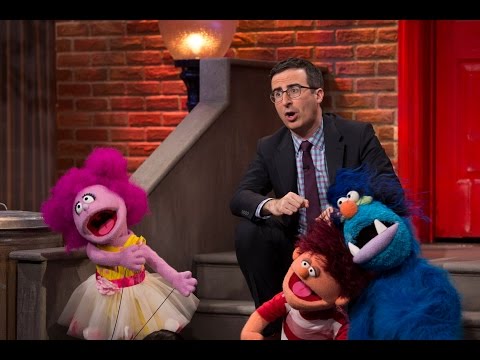
[14:02](https://www.youtube.com/watch?v=_Pz3syET3DY&t=842s) Explaining a Broken System to Puppets
Overwhelmed by the grim realities of private prisons and the broader penal system, Oliver admits, “This is all so depressing. Private prisons are bad, yes, but the whole system just seems fundamentally broken. You know what? I think, if you don't mind, I need a minute. I actually need some help understanding this.” He steps into a children's television-style workshop set populated by puppets to try and sort through the issues.
When a puppet named Timmy asks why Oliver is sad, Oliver explains that America's prisons are broken. Timmy shares that his father is serving time for a low-level drug offense—a reality Oliver points to as an emblem of the system's unfairness. Another puppet interjects that his father is locked up for murdering four people, prompting Oliver to clarify that dangerous individuals genuinely belong in prison. A third puppet complains that people pay money to view his father behind bars; Oliver quickly points out that this father is an animal in a zoo, not a human prisoner. When another puppet asks for an example of systemic failure, Oliver cites the real-life medical nightmare of prison staff pouring granulated sugar into a female inmate's infected surgical incision. The puppet confuses the medical term with the alphabet, asking if he means “the letter C,” to which an exasperated Oliver decides to simply agree.
---
[15:35](https://www.youtube.com/watch?v=_Pz3syET3DY&t=935s) The Puppet Sing-Along: "America's Prisons Are Broken"
To process the trauma of the criminal justice system, the puppets persuade Oliver to participate in an upbeat, children's-show style musical number. The song uses a lively melody to catalog the grim systemic failures of American mass incarceration:
> “It's a fact that needs to be spoken: > America's prisons are broken. > It's a hard truth about incarceration, > prisons are needed for a civilized nation. > But mandatory minimums for heroin and crack > stack the system against Hispanics and blacks. > Our prison population is bigger than Slovenia, > 'cause we put people in jail instead of treating schizophrenia.”
During the performance, a green puppet laments that his father was jailed simply because police deemed him a “monster,” prompting Oliver to validate that this constitutes racial profiling. The reptile puppet pipes up again about locking up animals, prompting Oliver to insist that the puppet's father is merely an alligator in a zoo. Offended, the puppet snaps, “I'm a crocodile!” and accuses Oliver of bigotry: “Oh, we all look alike, right?” Oliver stumbles over himself trying to defend against accusations of prejudice against reptiles while trying to keep the musical routine on track.
The segment concludes in the style of an educational television sponsor credit. The ensemble declares that America's broken prison system was brought to the public by “decades of neglect,” “a lack of political courage,” “a generous donation by the GEO Group,” and “viewers like you.”
## Notable quotes > [11:33](https://www.youtube.com/watch?v=_Pz3syET3DY&t=693s) The key problem with running prisons as businesses is that prisons are then run as businesses. — John Oliver
> [14:02](https://www.youtube.com/watch?v=_Pz3syET3DY&t=842s) Private prisons are bad, yes, but the whole system just seems fundamentally broken. — John Oliver
## Mentioned John Oliver, Tim Robbins, Charles Samuels, Rick Scott, Orange Is the New Black, MSNBC, Sesame Street, Office Space, Puss in Boots, Aramark Corporation, Arizona Department of Corrections, GEO Group, Corrections Corporation of America (CCA), Federal Bureau of Prisons, House Judiciary Committee
## Video description America's prisons are broken. Just ask John Oliver and several puppets.
Connect with Last Week Tonight online... Subscribe to the Last Week Tonight YouTube channel for more almost news as it almost happens: www.youtube.com/user/LastWeekTonight Find Last Week Tonight on Facebook like your mom would: http://Facebook.com/LastWeekTonight Follow us on Twitter for news about jokes and jokes about news: http://Twitter.com/LastWeekTonight Visit our official site for all that other stuff at once: http://www.hbo.com/lastweektonight
[Source](https://www.youtube.com/watch?v=_Pz3syET3DY)