Apple under fire for allegations of controversial business practices
CBC News: The National
AI-assisted summary of Apple under fire for allegations of controversial business practices — original source. Check the original for full context.
Source published:
Key ideas
- An undercover CBC News investigation revealed an Apple Store quoting up to $1,980 for a logic board, top case, and display replacement over liquid damage, whereas independent technician Louis Rossmann fixed the issue for free in 90 seconds by straightening a single bent backlight pin. (0:03)
- Primate Labs founder John Poole uncovered empirical Geekbench data proving Apple surreptitiously throttled processing speeds on older iPhones via operating system updates, a condition fully remediated by replacing the battery. (12:21)
- Apple faces mounting global legal scrutiny, including a statutory criminal investigation into planned obsolescence in France and multiple consumer class-action lawsuits over non-disclosed performance suppression. (14:02)
- Independent repair advocates and 17 U.S. states are advancing Right to Repair legislation, warning that a single jurisdiction mandating access to schematics and parts could reshape global consumer electronics manufacturing. (9:33)
Detailed notes
## Background This investigative report was published on October 9, 2018, by CBC News: The National on YouTube. The broadcast features an undercover investigation into Apple's controversial business practices, focusing on allegations of exorbitant repair charges, hardware restrictions, and the covert iPhone battery throttling scandal.
## TL;DR CBC News takes an undercover hidden camera into a downtown Toronto Apple Store, exposing a $1,200 repair quote for a dark MacBook screen that independent repair technician Louis Rossmann fixes in ninety seconds for free using tweezers. The investigation expands into the broader Right to Repair battle, showing how iFixit's Kyle Wiens and repair advocates fight Apple's proprietary screws, glued-in batteries, and aggressive legal threats. It also traces how Geekbench founder John Poole unmasked Apple's secret software throttling of aging iPhones, prompting international protests, criminal probes in France, class-action litigation, and tense grilling by Canadian parliamentarians.
## Atmosphere & style The piece carries the tense, skeptical, and methodical weight of classic investigative journalism. It contrasts Apple's sleek, welcoming corporate aura with hidden-camera sting footage, grounded workbenches cluttered with diagnostic tools, and combative parliamentary hearings. Watching it feels vindicating and revealing, as corporate talking points and thousand-dollar price tags are punctured by simple mechanical truths and hard bench-testing data.
## Bulletin - [00:03](https://www.youtube.com/watch?v=_XneTBhRPYk&t=3s) An undercover CBC News investigation revealed an Apple Store quoting up to $1,980 for a logic board, top case, and display replacement over liquid damage, whereas independent technician Louis Rossmann fixed the issue for free in 90 seconds by straightening a single bent backlight pin. - [12:21](https://www.youtube.com/watch?v=_XneTBhRPYk&t=741s) Primate Labs founder John Poole uncovered empirical Geekbench data proving Apple surreptitiously throttled processing speeds on older iPhones via operating system updates, a condition fully remediated by replacing the battery. - [14:02](https://www.youtube.com/watch?v=_XneTBhRPYk&t=842s) Apple faces mounting global legal scrutiny, including a statutory criminal investigation into planned obsolescence in France and multiple consumer class-action lawsuits over non-disclosed performance suppression. - [09:33](https://www.youtube.com/watch?v=_XneTBhRPYk&t=573s) Independent repair advocates and 17 U.S. states are advancing Right to Repair legislation, warning that a single jurisdiction mandating access to schematics and parts could reshape global consumer electronics manufacturing.
## Key takeaways - [00:03](https://www.youtube.com/watch?v=_XneTBhRPYk&t=3s) A CBC undercover test at a downtown Toronto Apple Store resulted in a $1,200 to $1,980 repair quote for alleged liquid damage on a dark MacBook Pro display. - [02:52](https://www.youtube.com/watch?v=_XneTBhRPYk&t=172s) Apple technicians pointed to internal liquid contact indicators that often trigger from normal atmospheric humidity rather than actual spills. - [02:52](https://www.youtube.com/watch?v=_XneTBhRPYk&t=172s) Independent repair specialist Louis Rossmann resolved the MacBook failure in 90 seconds using tweezers to bend back a display connector pin at zero charge. - [02:52](https://www.youtube.com/watch?v=_XneTBhRPYk&t=172s) Rossmann reports that his Manhattan repair shop sees between 10 and 30 customers each day who were rejected or given exorbitant quotes by Apple Stores. - [06:41](https://www.youtube.com/watch?v=_XneTBhRPYk&t=401s) iFixit CEO Kyle Wiens documents deliberate anti-repair engineering by Apple, including proprietary pentalobe screws, glued-in batteries, and software-locked modular components. - [09:33](https://www.youtube.com/watch?v=_XneTBhRPYk&t=573s) Apple aggressively suppresses unauthorized repairs by issuing copyright takedown notices threatening up to $150,000 in statutory damages and utilizing customs seizures against replacement part imports. - [09:33](https://www.youtube.com/watch?v=_XneTBhRPYk&t=573s) Right to Repair legislation introduced across 17 U.S. states seeks to legally mandate access to authentic parts, diagnostic tools, and schematics for consumers and independent shops. - [11:07](https://www.youtube.com/watch?v=_XneTBhRPYk&t=667s) Advocates argue that a single jurisdiction adopting comprehensive Right to Repair rules could trigger a domino effect across streamlined global supply chains. - [12:21](https://www.youtube.com/watch?v=_XneTBhRPYk&t=741s) Geekbench benchmark data gathered by Primate Labs provided indisputable proof that Apple deliberately throttled iPhone CPU performance via iOS updates. - [12:21](https://www.youtube.com/watch?v=_XneTBhRPYk&t=741s) Users were not informed that installing a simple, inexpensive replacement battery would immediately restore full computational performance on throttled iPhones. - [14:02](https://www.youtube.com/watch?v=_XneTBhRPYk&t=842s) French judicial authorities opened a formal investigation into Apple for planned obsolescence, which constitutes a statutory crime in France. - [14:02](https://www.youtube.com/watch?v=_XneTBhRPYk&t=842s) Consumer rights attorney Shanna Scarlett launched a major U.S. class-action lawsuit accusing Apple of surreptitiously meddling with hardware owned outright by consumers. - [15:45](https://www.youtube.com/watch?v=_XneTBhRPYk&t=945s) In testimony before a Canadian parliamentary committee, Apple Canada legal counsel admitted that the failure to disclose performance throttling was not intentional. - [17:26](https://www.youtube.com/watch?v=_XneTBhRPYk&t=1046s) Legal experts emphasize that class-action lawsuits are essential to level the power imbalance between individual consumers and trillion-dollar tech conglomerates.
## Detailed walkthrough ### [00:03](https://www.youtube.com/watch?v=_XneTBhRPYk&t=3s) Undercover at the Apple Store: The $1,200 Quote
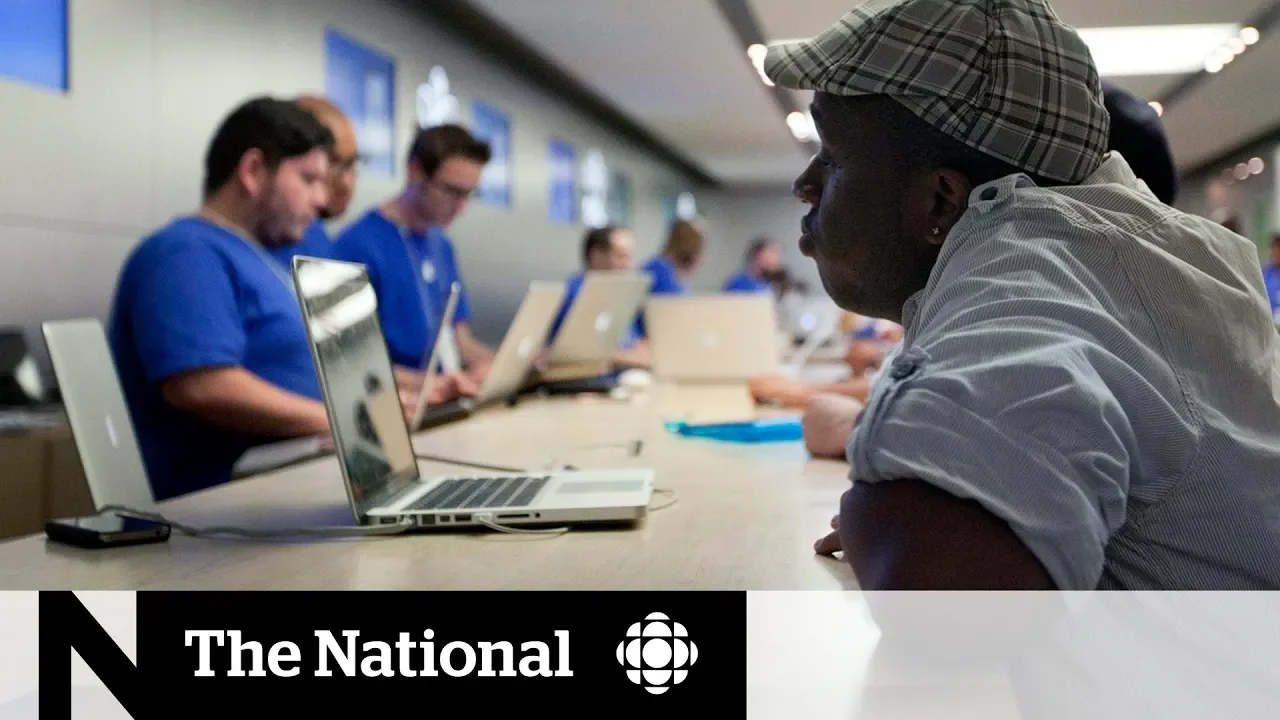
Apple cultivates an immaculate public image of energetic young Genius Bar employees serving lines of excited customers eager for the newest devices. However, that image has faced scrutiny due to persistent claims that Apple stores wildly overcharge customers for hardware repairs or push them to purchase replacements. To test whether Apple systematically misdiagnoses hardware issues that could be resolved with minor repairs, a CBC News investigative team took a malfunctioning MacBook Pro into a downtown Toronto Apple Store with a hidden camera. The laptop's screen was essentially dark, remaining extremely dim whenever the machine was powered on.
```mermaid flowchart TD accTitle: Apple Store vs Third-Party Repair Cost Comparison accDescr: Visual flowchart comparing the Apple Store repair quote exceeding $1100 to $1800 against the free two-minute pin-bend fix at Rossmann Repair Group.
subgraph Apple["Apple Store Toronto Diagnosis"] A["Liquid Contact Indicators Triggered"] --> B["Refuses Partial Repair"] B --> C["Quote: Logic Board + Top Case ($1,100) + Labor ($100)"] C --> D["Optional Display Replacement (+$780)"] D --> E["Total Quote: $1,200 to $1,980+"] end
subgraph Rossmann["Louis Rossmann Evaluation"] F["Microscope Light Reveals Working Screen"] --> G["Discovers Bent Backlight Connector Pin"] G --> H["Tweezers Used to Bend Pin Back (90 Seconds)"] H --> I["Laptop Fully Restored"] I --> J["Cost: $0.00 (Free)"] end ```
The Apple technician examined the machine and quickly attributed the failure to extensive liquid damage, pointing out internal red indicator dots that are white when pristine. The technician asserted that liquid had reached the entire computer, ruling out any cheap or partial fixes: “Well, regardless of what the cause of it is, if it isn't the liquid, we have to fix the liquid, so it's not like we can do partial repairs when it's been damaged.” He quoted more than $1,000 for mandatory replacements: roughly $600 for a logic board, $500 for a top case, and $100 for labor, bringing the base charge to $1,200. He added that if the display also needed replacement, it would cost an additional $780, bringing the total repair quote close to $2,000. When asked if any cheaper alternatives existed, the technician admitted the repair cost hovered near the price of buying a brand-new computer.
- Apple Store diagnostic: Alleged liquid damage based on internal red liquid contact indicators. - Logic board: ~$600. - Top case: ~$500. - Labor fee: $100. - Display replacement (if required): $780. - Total repair estimate: $1,200 to over $1,980.
---
[02:52](https://www.youtube.com/watch?v=_XneTBhRPYk&t=172s) Louis Rossmann’s 90-Second Free Fix
Seeking an independent second opinion, the team brought the exact same MacBook Pro to 1st Avenue in Manhattan, where technician Louis Rossmann operates Rossmann Repair Group. Rossmann, who began repairing computers in college and amasses millions of views on YouTube demonstrating component-level repairs, was told the Apple Store had declared the laptop uneconomical to repair with a $1,200 price tag. Setting the laptop on his bench, Rossmann shined an external microscope light directly through the display panel, immediately revealing a visible, moving mouse cursor and an intact desktop. He explained that the display and graphics circuitry worked fine; only the backlight was non-functional.
Rossmann opened the chassis to inspect the screen connector. He quickly spotted a single connector pin sticking out and bent outward, breaking electrical contact for the backlight circuit. Rossmann dismissed Apple's liquid damage conclusion, clarifying that liquid contact indicators near the battery frequently trip simply from atmospheric humidity in damp environments, even if liquid was never spilled. Using a simple pair of tweezers, Rossmann gently nudged the bent pin back into its groove and reconnected the cable. The laptop booted immediately with full backlight illumination. The entire repair took approximately a minute and a half.
When asked what he would charge a walk-in customer for that specific service, Rossmann stated: “If somebody wanted me to just bend the pin back, I wouldn't charge them for that; I would say, I'm going to rework your original cable, that may not last long term, but here it's free.” He noted that even if a customer requested a full cable replacement, he would only charge between $75 and $150 depending on the model, adding that bending the pin back works permanently 99% of the time. Rossmann revealed that his shop sees customers turned away or quoted exorbitant fees by the Apple Store “somewhere between 10 and 30 times a day.” CBC requested an on-camera response from Apple regarding the incident and widespread allegations of overcharging; Apple declined an interview, issuing a statement insisting that customers are best served by certified technicians using genuine parts and denying that they systematically inflate repair estimates.
- Diagnostic method: Microscope light shone through the display to confirm LCD image generation. - Root cause: Single bent pin on the display connector failing to make contact with the backlight circuit. - Repair duration: ~90 seconds using tweezers. - Rossmann's price for bending the pin: $0 (free). - Rossmann's price for a complete cable replacement: $75 to $150. - Volume of Apple Store rejections at Rossmann's shop: 10 to 30 customers per day.
---
[06:41](https://www.youtube.com/watch?v=_XneTBhRPYk&t=401s) Kyle Wiens and Apple’s Anti-Repair Engineering
In San Luis Obispo, California, Kyle Wiens heads iFixit, the largest third-party repair advocate and teardown organization in North America. Employing 125 people and generating $21 million annually, iFixit tears down new gadgets, documents recurring failure points, and sells custom repair tools and free manuals online. Wiens, a central figure in the Right to Repair movement, explains that consumers used to take for granted the ability to fix vacuums, televisions, and laptops, but modern consumer tech manufacturers have systematically stripped away that independence by withholding documentation and spare parts. Calling out Apple's philosophy, Wiens argued: “Apple's perspective is that they want complete control over the device from the moment that you buy it all the way through the end of life, and Right to Repair takes some of that control away from them and puts it in the hands of the owner, and that's where, for a manufacturer to say we're making a product and we're putting out in the world and we're going to control every aspect of what happens after the fact is complete lunacy.”
Wiens demonstrated the deliberate hardware and software roadblocks Apple designs into products to block independent repairs: 1. **Proprietary Pentalobe Screws**: Apple introduced unique five-point pentalobe screws on the exterior chassis of devices like the MacBook Pro to prevent consumers from opening hardware using standard household screwdrivers. 2. **Glued-in Batteries**: Apple shifted from easily removable batteries to adhering battery packs with strong pull-tab adhesive strips (similar to 3M Command strips) inside devices such as the iPhone 8, creating hazardous, difficult battery extractions when tabs tear. 3. **Software-Locked Modular Components**: When iPhone screens cracked, replacing the front panel often included replacing the home button. Apple reprogrammed iOS to identify third-party or non-serialized home buttons, deliberately bricking functionality. Wiens compared this to an automaker disabling a car over replacement tires: “It would be like if you're driving your car and maybe you changed out the tires and you had aftermarket tires, and then all of a sudden Tesla pushes out a software update and your car stops driving because of those aftermarket tires.”
- iFixit company footprint: 125 employees, $21 million in annual revenue. - Proprietary hardware barrier: 5-point pentalobe screw head introduced across MacBooks and iPhones. - Adhesive barriers: Gluing lithium-ion batteries into chassis rather than using mechanical brackets.
---
[09:33](https://www.youtube.com/watch?v=_XneTBhRPYk&t=573s) Legal Intimidation and the Legislative Pushback
Apple views unauthorized repair networks as adversaries and actively uses legal mechanisms to suppress the circulation of diagnostic documentation. Both Louis Rossmann and Kyle Wiens have faced aggressive intellectual property actions and copyright threats from Apple. Because Apple authors its proprietary service manuals and schematics, it exploits copyright law to issue digital takedown notices against third-party repairers who host them, threatening lawsuits seeking statutory penalties of up to $150,000 per incident. Rossmann also condemned the weaponization of Immigration and Customs Enforcement (ICE) to intercept imported replacement components at customs borders under the guise of trademark infringement, stating he wants a rollback of intellectual property and customs enforcement practices that threaten independent shop owners with prosecution or imprisonment simply for importing parts and sharing schematics.
In response, independent repair advocates have mobilized politically. At the New York State Legislature in Albany, Rossmann and fellow Right to Repair advocates set up an interactive "repair café" for state lawmakers, challenging politicians to identify hardware components beneath protective shielding. That legislative push has gained significant momentum, with 17 U.S. states introducing Right to Repair bills designed to legally mandate that Apple and rival electronics manufacturers supply schematics, service manuals, and authentic replacement parts to independent repair shops and consumers. Rossmann emphasized that independent shops are not trying to eliminate Apple's service centers, but rather fill the void for repairs Apple refuses to handle reasonably: “I'd like Apple to change by acknowledging that if they're not willing to do certain jobs, maybe somebody else would.”
- Legal threat: Apple issues takedown notices threatening up to $150,000 in statutory damages per copyright violation for publishing repair manuals. - Import enforcement: Apple and customs officials leverage ICE and border authorities to seize imported third-party and OEM replacement parts. - Legislative campaign: 17 U.S. states introduced Right to Repair legislation to require access to repair manuals, diagnostics, and OEM components.
[11:07](https://www.youtube.com/watch?v=_XneTBhRPYk&t=667s) The Right to Repair Domino Effect
Advocates for the Right to Repair argue that opening up device repair isn't asking tech giants for special favors, but rather demanding an end to hostile barriers. As one advocate puts it, “I'm just asking them to you know stop extending the knife.” The legislative stakes are enormous: if even a single state or province manages to pass comprehensive right-to-repair legislation, experts believe it will trigger an unstoppable chain reaction across the entire consumer electronics industry. “This is where it gets really interesting is the moment that one state passes things it's is the dam is going to burst,” an advocate explains.
Because global hardware manufacturers aim to streamline and simplify their supply chains and operational logistics rather than engineer region-specific product variants, a single progressive jurisdiction—such as the province of Ontario—could effectively set standard repairability rules for the entire world. The growing momentum behind the movement has cast an uncomfortable spotlight on what critics characterize as Apple's predatory business practices, particularly repair quotes that sit prohibitively close to the total replacement cost of a brand-new computer, leaving longtime customers wondering if the tech giant genuinely prioritizes their interests.
```mermaid flowchart TD accTitle: The Right to Repair Regulatory Domino Effect accDescr: Diagram showing how a single jurisdiction passing right-to-repair legislation creates a global operational shift.
subgraph Catalyst["Legislative Catalyst"] A["Single Jurisdiction Passes Bill<br/>(e.g., Ontario or U.S. State)"] end
subgraph Manufacturing["Corporate Realities"] B["Manufacturers Cannot Segregate Production"] C["Operational Simplification Required"] end
subgraph Outcome["Global Impact"] D["Global Right to Repair Standard Adopted"] end
A --> B B --> C C --> D ```
[12:21](https://www.youtube.com/watch?v=_XneTBhRPYk&t=741s) John Poole and the Geekbench Discovery
Fresh controversy erupted when Apple customers began suspecting that the company was enforcing a sneaky internal policy designed to artificially frustrate users and pressure them into buying newer smartphones. The mystery began unraveling at the Toronto offices of Primate Labs, the software firm behind Geekbench—a diagnostic tool relied upon by millions worldwide to benchmark the processing power of computers and mobile devices. Founder John Poole found himself fielding a flood of complaints from users insisting their iPhones had suddenly become sluggish, a problem hits close to home when his wife remarked that her iPhone 6s felt noticeably unresponsive. Testing her device revealed benchmark scores dramatically lower than expected, baffling Poole to the point of disbelief.
The breakthrough arrived when Poole stumbled upon an anonymous internet comment offering an unexpected tip: replacing the degraded battery on a sluggish iPhone immediately restored its computational speed. “It was sort of a Eureka moment and that's what prompted me to really take a deep dive into our database of performance data and see what was happening,” Poole recalls. Analyzing millions of data points across iPhones running different software updates, Poole plotted the performance curves on a graph and uncovered undeniable proof: processing speeds across countless devices plummeted immediately following Apple’s latest operating system update. His published findings delivered an objective, scientific indictment proving that Apple was deliberately throttling device speeds behind closed doors. Facing undeniable empirical data, Apple quickly admitted to throttling the processors, but insisted the practice was entirely benign and intended solely to protect aging batteries from unexpected device shutdowns.
- **Company:** Primate Labs (Toronto, Ontario) - **Diagnostic Tool:** Geekbench - **Trigger Device:** iPhone 6s running significantly below rated performance specifications - **Discovery Mechanism:** Cross-referencing anonymous online user reports with aggregate performance metrics across millions of active benchmark logs
[14:02](https://www.youtube.com/watch?v=_XneTBhRPYk&t=842s) Planned Obsolescence and Global Backlash
Apple’s admission that it had been quietly suppressing the peak processor performance of older devices set off an international media firestorm, reigniting longstanding suspicions of planned obsolescence—the cynical corporate strategy of artificially shortening a product’s lifespan to force repeat hardware purchases. Apple CEO Tim Cook publicly pushed back against the accusations, insisting, “We always focus on the user experience so at the heart of any decision that we make is the user.” Despite corporate reassurances, customer outrage erupted worldwide. In Paris, street demonstrators targeted Apple storefronts, depicting the tech company as an corporate empire guilty of cheating everyday consumers alongside rampant international tax avoidance. The French government went a step further, treating planned obsolescence as a statutory crime and placing Apple under formal judicial investigation.
In the United States, Canadian consumer rights class-action attorney Shanna Scarlett—who had previously helped secure a $450 million antitrust judgment against Apple—spearheaded a new class-action lawsuit challenging the covert performance throttling. Scarlett contends that Apple violated consumer trust by surreptitiously meddling with devices that individuals owned outright. “They actively reached in to a consumers phone through the operating system and made what is a large change in terms of the throttling of performance without properly disclosing it to consumers that is a you know a fairly invasive act for a company to do,” Scarlett states.
[15:45](https://www.youtube.com/watch?v=_XneTBhRPYk&t=945s) The Canadian Parliamentary Grilling
While Apple turned down CBC’s direct requests for an on-camera interview, the company was legally compelled to address the throttling controversy before a Canadian parliamentary committee hearing. Apple Canada legal counsel Jacqueline Famulak appeared before MPs to defend the update, testifying that the measure was engineered purely as an engineering safeguard against battery failure. “The sole purpose of the software update in this case was to help customers to continue to use older iPhones with aging batteries without shutdowns not to drive them to buy newer devices,” Famulak insisted. Critics immediately rejected that defense, pointing out that Apple kept consumers entirely in the dark regarding the simple remedy at their disposal. Rather than confronting an artificial trilemma of accepting a sluggish phone, enduring random shutdowns, or spending hundreds of dollars on a replacement handset, users could have fully restored their phones for the modest price of a fresh battery.
Toronto Liberal Member of Parliament Nathaniel Erskine-Smith aggressively pressed Famulak on Apple's inconsistent statements, contrasting her insistence that the company did nothing wrong with Apple's prior public apology for withholding information. When Erskine-Smith asked whether the non-disclosure of the slowdown was intentional or inadvertent, Famulak initially sparred over semantics, claiming, “We did not non disclose anything we didn't have anything to not disclose.” Erskine-Smith held firm, demanding to know directly whether the deliberate concealment of the performance throttling was accidental or calculated. Famulak conceded: “It was not intentional.”
- **Committee Witness:** Jacqueline Famulak (Legal Counsel, Apple Canada) - **Questioning Parliamentarian:** Nathaniel Erskine-Smith (Liberal MP, Beaches—East York) - **The Withheld Alternative:** Replacing a degraded battery restores full processor speeds without purchasing a new device or suffering throttled performance
[17:26](https://www.youtube.com/watch?v=_XneTBhRPYk&t=1046s) Fighting Trillion-Dollar Monopolies
For litigators like Shanna Scarlett, Apple’s parliamentary admission of failing to disclose performance throttling serves as cornerstone evidence in consumer lawsuits. Scarlett highlights the stark power asymmetry between average citizens and tech behemoths, stressing that without collective class actions, everyday consumers possess virtually no leverage against massive corporate wrongdoing. “How are you one person supposed to fight against Apple how is one person with ten dollars of harm supposed to fight against one of the most well capitalized companies in the entire world it's impossible,” Scarlett points out.
While Silicon Valley has served as the undisputed engine of the American economic expansion for years, consumer tolerance for deceptive operational tactics is rapidly waning. As journalist Terence McKenna observes outside Apple’s Cupertino headquarters, an emboldened grassroots and legal movement is demanding unprecedented transparency, challenging questionable corporate practices and forcing the world’s most powerful tech companies to answer to the public.
## Notable quotes > [09:33](https://www.youtube.com/watch?v=_XneTBhRPYk&t=573s) I'd like Apple to change by acknowledging that if they're not willing to do certain jobs, maybe somebody else would. — Louis Rossmann
## Mentioned Apple, MacBook Pro, Louis Rossmann, Rossmann Repair Group, Kyle Wiens, iFixit, iPhone 8, Immigration and Customs Enforcement (ICE), New York State Legislature, John Poole, Primate Labs, Geekbench, iPhone 6s, Tim Cook, Shanna Scarlett, Jacqueline Famulak, Nathaniel Erskine-Smith, Terence McKenna, CBC News
## Video description The National goes undercover to investigate some of Apple's controversial business practices including allegations of overpriced repair charges and the battery/slowdown scandal.
Welcome to The National, the flagship nightly newscast of CBC News
»»» Subscribe to The National to watch more videos here: https://www.youtube.com/user/CBCTheNational?sub_confirmation=1
Voice Your Opinion & Connect With Us Online:
The National Updates on Facebook: https://www.facebook.com/thenational The National Updates on Twitter: https://twitter.com/CBCTheNational »»» »»» »»» »»» »»» The National is CBC Television's flagship news program. Airing six days a week, the show delivers news, feature documentaries and analysis from some of Canada's leading journalists.
[Source](https://www.youtube.com/watch?v=_XneTBhRPYk)