Initech's Gibbons Cites Eight Bosses, Zero Equity for 15-Minute Week
ghostb13
A lack of equity sharing combined with bureaucratic micromanagement from multiple supervisors forces employees to do only the bare minimum needed to avoid termination.
AI-assisted summary of Office Space the Bob's Interview Typical Day — original source. Check the original for full context.
Source published:
Key ideas
- Peter Gibbons candidly admits to management consultants that across an entire workweek, he only completes roughly 15 minutes of real, actual work. (0:00)
- Peter explains that his lack of productivity is not driven by laziness, but by a compensation model that offers zero financial incentive for shipping extra units. (1:07)
- Excessive bureaucracy at Initech subjects Peter to eight separate bosses, causing a single mistake to result in eight individual reprimands. (1:07)
- Fear-based management and threat of job loss only motivate employees to do just enough work to avoid getting fired. (1:07)
Detailed notes
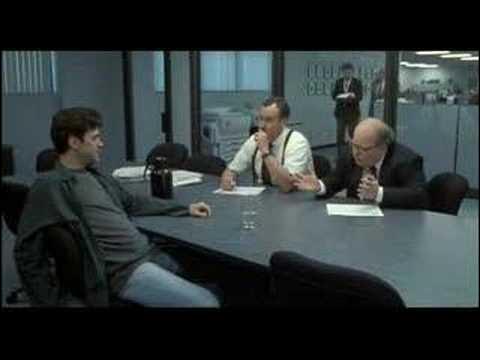
## Background Published on YouTube by ghostb13 on March 28, 2008, this video features a scene from the film Office Space. According to the description, the clip highlights Ron Livingston's character explaining his typical daily routine to the consulting team known as the Bobs.
## TL;DR During an efficiency review at Initech, management consultants Bob Slydell and Bob Porter invite Peter Gibbons to walk them through a typical workday. Peter candidly reveals that he arrives late, stares blankly at his desk for hours, and logs only about fifteen minutes of genuine work each week. He explains that his disengagement stems from a complete lack of financial incentive combined with the bureaucratic absurdity of reporting to eight separate bosses. Disarmed and fascinated by his radical honesty, the consultants ponder whether equity sharing would motivate him, while Peter casually departs after wishing them success with their upcoming layoffs.
## Atmosphere & style The scene carries a dry, deadpan comedic atmosphere driven by the stark contrast between sterile corporate evaluation and radical employee apathy. Peter speaks with a serene, unbothered nonchalance, treating his profound lack of effort and disdain for corporate hierarchy as simple, objective facts. The interaction feels quietly subversive and cathartic as the consultants shift from structured professional inquiry into stunned, spellbound admiration for his absolute transparency.
## Bulletin - [00:00](https://www.youtube.com/watch?v=_iiOEQOtBlQ&t=0s) Peter Gibbons candidly admits to management consultants that across an entire workweek, he only completes roughly 15 minutes of real, actual work. - [01:07](https://www.youtube.com/watch?v=_iiOEQOtBlQ&t=67s) Peter explains that his lack of productivity is not driven by laziness, but by a compensation model that offers zero financial incentive for shipping extra units. - [01:07](https://www.youtube.com/watch?v=_iiOEQOtBlQ&t=67s) Excessive bureaucracy at Initech subjects Peter to eight separate bosses, causing a single mistake to result in eight individual reprimands. - [01:07](https://www.youtube.com/watch?v=_iiOEQOtBlQ&t=67s) Fear-based management and threat of job loss only motivate employees to do just enough work to avoid getting fired.
## Key takeaways - [00:00](https://www.youtube.com/watch?v=_iiOEQOtBlQ&t=0s) Management consultants Bob Slydell and Bob Porter evaluate workplace efficiency by interviewing Peter Gibbons about his typical routine. - [00:00](https://www.youtube.com/watch?v=_iiOEQOtBlQ&t=0s) Peter routinely arrives at least 15 minutes late and enters via a side door to evade detection by Bill Lumbergh. - [00:00](https://www.youtube.com/watch?v=_iiOEQOtBlQ&t=0s) Peter creates the illusion of productivity by spacing out and staring at his desk for an hour before lunch and another hour after lunch. - [00:00](https://www.youtube.com/watch?v=_iiOEQOtBlQ&t=0s) Peter estimates that his total productive labor amounts to only approximately 15 minutes in a given week. - [01:07](https://www.youtube.com/watch?v=_iiOEQOtBlQ&t=67s) Peter clarifies that his low output is caused by a total lack of incentive rather than personal laziness, noting he simply does not care. - [01:07](https://www.youtube.com/watch?v=_iiOEQOtBlQ&t=67s) Initech's current compensation structure provides no financial reward or upside for employees who work harder to produce extra units. - [01:07](https://www.youtube.com/watch?v=_iiOEQOtBlQ&t=67s) Bloated oversight forces Peter to answer to eight different managers, leading to eight redundant reprimands whenever an error occurs. - [01:07](https://www.youtube.com/watch?v=_iiOEQOtBlQ&t=67s) Peter observes that workplace cultures driven by fear of harassment and termination elicit only the minimum effort required to stay employed. - [01:07](https://www.youtube.com/watch?v=_iiOEQOtBlQ&t=67s) Bob Slydell proposes the hypothetical introduction of a stock option equity-sharing program to restore employee motivation. - [01:07](https://www.youtube.com/watch?v=_iiOEQOtBlQ&t=67s) Peter indifferently exits the interview after wishing the consultants success with their planned layoffs and terminations.
## Detailed walkthrough ### [00:00](https://www.youtube.com/watch?v=_iiOEQOtBlQ&t=0s) A Typical Day at Initech
Management consultants Bob Slydell and Bob Porter welcome Peter Gibbons into the conference room to evaluate his routine as part of their workplace efficiency review. Slydell introduces himself and his associate Bob Porter, gesturing for Peter to take a seat for a minute or two while explaining that they are attempting to get a realistic feel for how employees spend their working hours. When Slydell asks Peter if he would walk them through a typical day, Peter responds with disarming, completely unfiltered candor rather than corporate platitudes.
```mermaid flowchart TD accTitle: Peter Gibbons' Daily Routine accDescr: Flowchart illustrating Peter's typical arrival and workday activities at Initech. subgraph Morning["Morning Routine"] A["Arrive 15 minutes late"] --> B["Use side door to avoid Lumbergh"] B --> C["Space out at desk for 1 hour"] end subgraph Afternoon["Afternoon Routine"] C --> D["Lunch break"] D --> E["Space out at desk for another hour"] E --> F["Total weekly output: ~15 minutes of real work"] end ```
Peter outlines his routine by explaining that he generally comes in at least fifteen minutes late, intentionally slipping through the side entrance so his supervisor, Bill Lumbergh, cannot spot him. Once at his workstation, he explains that he simply spaces out for about an hour by staring blankly at his desk in a way that creates the illusion of working. He admits to repeating the exact same behavior for another hour after lunch, calculating that over the course of a normal workweek, his actual output amounts to almost nothing. Peter puts his weekly labor into plain perspective: “I'd say in a given week I probably only do about 15 minutes of real actual work.” Stunned yet fascinated by this unapologetic honesty, the consultants ask Peter if he would indulge them and elaborate further, prompting Peter to offer his thoughts on TPS reports and the broader structure of his job.
- Peter regularly arrives at least 15 minutes late and enters via the side door to avoid being seen by Lumbergh. - He estimates spending roughly an hour before lunch and another hour after lunch staring at his desk while pretending to work. - His total actual labor across an entire week amounts to roughly fifteen minutes.
---
[01:07](https://www.youtube.com/watch?v=_iiOEQOtBlQ&t=67s) Motivation, Eight Bosses, and Equity Sharing
Peter cuts straight to the underlying psychology of his disengagement, clarifying that his lackluster output is not rooted in personal laziness but in a complete lack of incentive. He argues that under Initech's current compensation structure, working tirelessly to ship extra product units produces zero financial reward for him, leaving him with no incentive to strive for excellence. Peter encapsulates the core dilemma of his employment: “The thing is, Bob, it's not that I'm lazy, it's that I just don't care.”
```mermaid flowchart LR accTitle: The Eight Bosses Problem accDescr: Diagram showing how a single mistake by Peter triggers feedback from eight different supervisors. subgraph Worker["Employee"] P["Peter Gibbons"] end subgraph Management["Management Hierarchy"] B1["Boss 1"] B2["Boss 2"] B3["Boss 3"] B4["Boss 4"] B5["Boss 5"] B6["Boss 6"] B7["Boss 7"] B8["Boss 8"] end P -->|"Makes 1 mistake"| Management Management -->|"8 distinct reprimands"| P ```
Beyond the lack of upside, Peter highlights the company's bloated bureaucratic oversight, revealing that he currently answers to eight different managers. When the consultants express astonishment at that figure, Peter explains the daily consequence: whenever he makes a single error, eight different supervisors stop by his desk individually to reprimand him about it. Consequently, his only driving force on the job is avoiding harassment and keeping his paycheck, an environment that he notes produces only the bare minimum effort needed to avoid termination.
Intrigued by Peter's blunt diagnosis, the Bobs ask him to bear with them for a moment while they confer. Bob Slydell floats a strictly hypothetical scenario, asking whether a stock option equity sharing program would provide the necessary motivation. Peter gives an indifferent shrug, wraps up the conversation, and casually excuses himself from the meeting. As he departs, he cordially wishes them good luck with their scheduled terminations: “Good luck with your layoffs, all right? I hope your firings go really well.” The two consultants sit back in genuine admiration of his candor, uttering a stunned "Wow."
- Peter currently answers to eight different direct bosses, resulting in eight separate reprimands whenever an error occurs. - The threat of being hassled or fired only motivates an employee to work just hard enough to keep from getting terminated. - Bob Slydell floats the possibility of a stock option or equity-sharing program to fix Peter's motivational deficit.
## Notable quotes > [01:07](https://www.youtube.com/watch?v=_iiOEQOtBlQ&t=67s) The thing is, Bob, it's not that I'm lazy, it's that I just don't care. — Peter Gibbons
## Mentioned Peter Gibbons, Bob Slydell, Bob Porter, Bill Lumbergh, Initech, Ron Livingston, TPS reports
## Video description Ron Livingston explains his typical day to the Bob's consulting team
[Source](https://www.youtube.com/watch?v=_iiOEQOtBlQ)