Caltech Simulation Shows Natural Selection Caps AI Brain Growth
Google TechTalks
Active natural selection prunes neural complexity to eliminate metabolic overhead in simple environments, demonstrating that evolving artificial intelligence requires scaling ecological richness rather than designing minds directly.
Virgil Griffith and Larry Yaeger present Polyworld, an artificial life simulator that trades direct mind-design for world-design, leveraging evolutionary algorithms to convert growing CPU cycles into emergent neural architectures. (0:22)
Polyworld operates without an explicit fitness function, relying entirely on raw survival and reproduction where neural network brains comprise 95% of an agent's genome and adapt via lifetime Hebbian learning. (16:21)
Simulated populations autonomously evolve ecological dynamics like ideal free foraging distributions and Lotka-Volterra predator-prey oscillations, alongside non-random clustered connectomics. (35:17)
Comparing active natural selection against passive drift revealed that while passive runs drift to higher Tononi-Sporns-Edelman neural complexity due to an absence of metabolic pruning, active selection preserves functional genetic complexity as measured by Christoph Adami's informational metric. (42:08)
Detailed notes
## Background
This presentation was published on YouTube by the Google TechTalks channel on November 13, 2007. According to the page description, the talk explores a potential shortcut to artificial intelligence by trading hand-crafted mind-design for evolutionary world-design, introducing the Polyworld artificial life simulator developed by Apple Computer Distinguished Scientist Larry Yaeger.
## TL;DR
Caltech graduate student Virgil Griffith outlines the core premise of artificial life, arguing that exponential growth in computing power makes simulated natural selection a viable path to evolving intelligent neural architectures. He details the mechanics of Polyworld, an ecological simulation where neural network-controlled agents survive, reproduce, and adapt without explicit fitness functions, driven solely by raw natural selection, energy metabolisms, and Hebbian learning. Griffith reviews emergent behaviors—including foraging dynamics, predator evasion, and cannibalistic bug exploits—while comparing brain complexity metrics against passive genetic drift. Ultimately, the talk contends that environmental richness is the primary bottleneck for advancing evolved neural complexity toward higher intelligence.
## Atmosphere & style
The presentation blends the energetic informality of an irreverent graduate student with the intellectual curiosity of an engineering audience. Griffith speaks with self-deprecating humor and candid enthusiasm, openly laughing at simulation glitches—such as agents exploiting infinite food bugs—and confessing his initial depression when passive drift outpaced active evolution on certain complexity charts. The atmosphere throughout the Q&A is geeky, playful, and speculative, oscillating between rigorous mathematical models of complexity and tongue-in-cheek jokes about whether digital polygons might one day bring about the Singularity.
## Bulletin
- [00:22](https://www.youtube.com/watch?v=_m97_kL4ox0&t=22s) Virgil Griffith and Larry Yaeger present Polyworld, an artificial life simulator that trades direct mind-design for world-design, leveraging evolutionary algorithms to convert growing CPU cycles into emergent neural architectures.
- [16:21](https://www.youtube.com/watch?v=_m97_kL4ox0&t=981s) Polyworld operates without an explicit fitness function, relying entirely on raw survival and reproduction where neural network brains comprise 95% of an agent's genome and adapt via lifetime Hebbian learning.
- [35:17](https://www.youtube.com/watch?v=_m97_kL4ox0&t=2117s) Simulated populations autonomously evolve ecological dynamics like ideal free foraging distributions and Lotka-Volterra predator-prey oscillations, alongside non-random clustered connectomics.
- [42:08](https://www.youtube.com/watch?v=_m97_kL4ox0&t=2528s) Comparing active natural selection against passive drift revealed that while passive runs drift to higher Tononi-Sporns-Edelman neural complexity due to an absence of metabolic pruning, active selection preserves functional genetic complexity as measured by Christoph Adami's informational metric.
## Key takeaways
- [00:22](https://www.youtube.com/watch?v=_m97_kL4ox0&t=22s) Artificial evolution offers a potential shortcut to artificial general intelligence by replacing complex direct mind-design with environmental simulation design.
- [02:18](https://www.youtube.com/watch?v=_m97_kL4ox0&t=138s) Evolution functions across any physical or virtual substrate provided three criteria are met: a multi-individual population, differential selection, and heredity with mutation.
- [03:40](https://www.youtube.com/watch?v=_m97_kL4ox0&t=220s) Carl Sims' 1994 experiments demonstrated that simulated evolutionary dynamics can autonomously produce functional morphologies and diverse locomotion strategies.
- [08:45](https://www.youtube.com/watch?v=_m97_kL4ox0&t=525s) Evolutionary algorithms routinely exploit unintended loopholes in fitness functions and physics models rather than developing human-anticipated behaviors.
- [12:22](https://www.youtube.com/watch?v=_m97_kL4ox0&t=742s) Individual biological neurons vary minimally between primitive animals and humans, suggesting higher intelligence emerges from network topology rather than unique cellular components.
- [16:21](https://www.youtube.com/watch?v=_m97_kL4ox0&t=981s) Polyworld discards programmed fitness functions in favor of raw natural selection driven by energy decay, food foraging, predation, and mating.
- [19:52](https://www.youtube.com/watch?v=_m97_kL4ox0&t=1192s) Imposing an explicit maximum lifespan cap is essential in artificial life to prevent unfit ancestral agents from monopolizing the reproductive pool.
- [24:04](https://www.youtube.com/watch?v=_m97_kL4ox0&t=1444s) Metabolic costs applied to neuron counts and firing events are critical to prevent evolutionary runaway brain bloat.
- [30:26](https://www.youtube.com/watch?v=_m97_kL4ox0&t=1826s) An early simulation bug omitting parental energy costs for birth caused critters to cluster and infinitely cannibalize their own offspring for energy.
- [31:41](https://www.youtube.com/watch?v=_m97_kL4ox0&t=1901s) Without supervised training, random-weight generation-zero agents rapidly evolve vision-driven foraging, mate-seeking, and predator-evasion strategies.
- [35:17](https://www.youtube.com/watch?v=_m97_kL4ox0&t=2117s) Resource foraging in Polyworld spontaneously converged on the ideal free distribution and reproduced Lotka-Volterra population oscillations without explicit programming.
- [42:08](https://www.youtube.com/watch?v=_m97_kL4ox0&t=2528s) Passive genetic drift can paradoxically produce higher raw neural complexity than natural selection because active evolution aggressively prunes metabolically costly, unneeded neural structures.
- [47:38](https://www.youtube.com/watch?v=_m97_kL4ox0&t=2858s) Using Christoph Adami's genomic information metric proves active evolution maintains high functional genetic order, whereas passive drift populations collapse to zero genomic complexity.
- [59:18](https://www.youtube.com/watch?v=_m97_kL4ox0&t=3558s) Polyworld's emergent dynamics prove robust against hyperparameter sensitivity, prioritizing rich ecological interactions over minimal parameter counts.
- [01:05:00](https://www.youtube.com/watch?v=_m97_kL4ox0&t=3900s) Environmental starvation claims almost all Polyworld agents well before they reach the chronological lifespan limit.
## Detailed walkthrough
### [00:22](https://www.youtube.com/watch?v=_m97_kL4ox0&t=22s) Introduction: Trading Mind-Design for World-Design
Google host Henry Strickland opens the talk by introducing Virgil Griffith, humorously recalling his own college artificial intelligence classes and noting that he would have vastly preferred letting evolution do the heavy lifting rather than spending endless hours debugging Lisp programs. Strickland sketches Griffith's background: as a young man who read entirely too much Douglas Hofstadter, Griffith devoted his life to cognitive science and causing trouble. After undergraduate studies at the University of Alabama, Griffith moved to Indiana University, where he collaborated with Larry Yaeger—an Apple Computer Distinguished Scientist known among veteran Googlers as the creator of the early artificial life simulation project Polyworld. Following research stints and internships at both the Santa Fe Institute and the Keck Graduate Institute, Griffith arrived at the California Institute of Technology as a first-year graduate student in Computation and Neural Systems.
Taking the podium, Griffith jokes about his personal website domain, clarifying that the `.gr` top-level domain stands for Griffith rather than an indication that he is Greek. He outlines the central thesis of the presentation: leveraging evolutionary algorithms as an engineering shortcut to artificial intelligence. Human-directed AI design has proven notoriously difficult, whereas the mechanics of evolution are comparatively simple to implement. By trading direct mind-design for world-design, researchers can harness exponentially growing CPU cycles to let natural selection generate complex neural architectures. As Griffith puts it: “And the hope is that us—we can take advantage having lots of the CPU cycles and we let evolution to do a lot of the designing for us.”
- Host: Henry Strickland ("Stu")
- Speaker: Virgil Griffith, first-year CNS graduate student at Caltech
- Collaborator: Larry Yaeger (original creator of Polyworld at Apple Computer)
- Prior institutions mentioned: University of Alabama, Indiana University, Santa Fe Institute, Keck Graduate Institute
---
[02:18](https://www.youtube.com/watch?v=_m97_kL4ox0&t=138s) Artificial Life and the Evolutionary Algorithm
Griffith addresses the frequent criticism that the term "artificial life" is ill-defined. He explains that artificial life operates as a conceptual superset of traditional biology. While biology studies "life-as-it-is"—the singular historical lineage that emerged on Earth—artificial life encompasses all possible evolutionary trajectories, or "life-as-it-could-be." Exploring these alternative paths provides a computational sandbox for evolving synthetic intelligence.
```mermaid
flowchart TD
accTitle: The Basic Evolutionary Algorithm
accDescr: Cyclic flowchart showing the four iterative steps of evolution: population generation, selection, heredity with mutation, and repeating the cycle.
subgraph Cycle ["Algorithmic Loop"]
Pop["Population of Varied Entities"]
Sel["Selection / Differential Survival"]
Her["Heredity with Mutation Errors"]
end
Pop --> Sel
Sel --> Her
Her -->|"Rinse & Repeat"| Pop
```
He breaks evolution down to its core computational mechanics, arguing that it is an extraordinarily straightforward recipe that functions regardless of the physical substrate. The process requires a population of diverse candidates rather than a single entity—dismissing single-candidate hill climbing as completely inadequate. Differential survival means certain entities persist and reproduce more than others, passing down traits via heredity with occasional copying errors or mutations. Iterating this cycle inevitably produces adaptive evolution. As Griffith summarizes: “And regardless of substrate, you always get evolution with this.”
- Definition: Biology represents actualized terrestrial life; artificial life encompasses all theoretically possible evolutionary configurations.
- Requirements for evolution: a multi-individual population, differential selection, and heritable variation with mutation.
---
[03:40](https://www.youtube.com/watch?v=_m97_kL4ox0&t=220s) Evolving Body Morphologies: Carl Sims' Virtual Creatures
Before tackling the evolution of minds, Griffith reviews seminal work on evolving physical morphologies, presenting Carl Sims' landmark 1994 research on virtual creatures. In Sims' system, a creature's physical architecture is encoded as a directed graph of nodes and edges, where nodes represent rigid 3D volumetric segments and edges represent articulated joints. Mutations alter the graph structure by grafting, adding, or reconnecting nodes, allowing a wide diversity of physical tree structures to emerge.
Griffith plays video footage from Sims' experiments showing creatures evolved in simulated physical environments with gravity, friction, and fluid dynamics:
- **Aquatic Locomotion**: Swimming speed served as the selection metric. Populations produced disparate solutions ranging from minimalist two-segment flaps to coordinated rowing appendages. One variant tumbled forward through water, while another creature—originally evolved for swimming—was transitioned onto land where it developed an effective sidewinding gait.
- **Terrestrial Locomotion**: Land-based tasks produced hopping entities with stabilizing arm protrusions, inchworms that steered in circles, and galloping multi-segment bodies that maximized forward velocity. Other creatures evolved contact sensors directly wired into their joint control systems.
- **Phototaxis**: Creatures were evolved to pursue a moving red light source controlled interactively by a human user. While some flailed chaotically yet closed the distance, one highly optimized aquatic creature developed tilted propeller-like fins enabling smooth, adaptive 3D steering.
Pausing the recording on the finned swimmer, Griffith remarks on its striking mechanical elegance: “This one is especially nice because it looks like something that a human would design.” He emphasizes that seeing evolution organically discover designs that look engineered should give researchers confidence that artificial evolution can solve complex structural problems.
---
[08:45](https://www.youtube.com/watch?v=_m97_kL4ox0&t=525s) Evolution's Propensity to Cheat and Competitive Selection
Responding to an audience question about whether Sims' work had been replicated, Griffith notes that researchers revisited these experiments for the Artificial Life X conference, utilizing similar paradigms to evolve functional catapults. He cautions, however, that evolutionary algorithms possess a notorious habit of finding absurd unintended loopholes in the fitness function. In one terrestrial test where the fitness score was determined strictly by the forward displacement of the creature's center of mass, an evolved organism simply developed an enormous, elongated tentacle and swung it overhead, shifting its center of mass forward without ever walking. Griffith stresses: “So just another thing to keep in mind is that if you ever have any—you have to—when you design your evolutionary simulations you have to always know all the weird ways it could cheat and we'll get back to that later.”
Griffith then plays the competitive segment of Sims' work, where two opposing creatures contest a single green cube in an arena, with victory awarded to the organism closest to the cube at time-out. The dynamic pressures produced rapidly escalating tactical behaviors:
- Direct tumbling dashes toward the objective.
- Physical barricading and body-blocking maneuvers.
- Opponents scaling directly over defending blockers.
- Pinning tactics and unfolding sweeping limbs to envelop the cube.
- Aggressive "hockey" players that hooked the cube away and beat down opposing creatures.
- Two-armed side-swipers designed to snatch the prize laterally out of an adversary's reach.
Concluding the demonstration, Griffith explains that while these simulations evolved bodies and joint controllers rather than general artificial intelligence, they showcase evolution's capacity for startling originality. He pivots toward applying these principles directly to cognition: the core challenge becomes deciding what internal computational substrate to expose to mutation. Historically, people modeled the mind using whatever complex technology was at hand—from ancient Greek marionette strings to René Descartes comparing mental processes to hydraulic plumbing and sewer networks.
[12:22](https://www.youtube.com/watch?v=_m97_kL4ox0&t=742s) Beyond Historical Analogies: Why Neural Networks Model Intelligence
Virgil Griffith walks through the historical progression of human metaphors for the mind. Every major technological era brought its own mechanical analogy for the brain: classical antiquity imagined little compartments, the Industrial Revolution compared the mind to pulleys and gears, the dawn of telecommunications introduced the telephone switchboard metaphor, and the computing era attempted to reduce thought to Boolean logic. Acknowledging that Boolean approaches fell flat, Griffith quips, “And the answer is, not digital computers but it's neural networks. Praise the Lord.” While conceding that history suggests treating any current technological metaphor with skepticism, he argues that neural networks genuinely capture brain function far better than discrete digital logic ever could.
The biological uniformity of nervous systems across the animal kingdom provides strong encouragement for this computational approach. An individual human neuron looks virtually indistinguishable from a reptilian or mammalian neuron, and the foundational architecture of nervous systems remains remarkably consistent from sea slugs to humans. The differences in cognitive capacity stem almost entirely from patterns of connectivity rather than exotic cellular building blocks. Griffith poses the core evolutionary thesis: “And if evolution did it once, why couldn't it do it again?” He notes that nervous systems must combine inherited, innate structural constraints with lifetime adaptability, allowing individual organisms to learn from their environment.
- Historical analogies for the brain: compartmentalized art, pulleys and gears, telephone switchboards, and Boolean logic.
- Human neurons are nearly indistinguishable in appearance and basic function from other mammalian and reptilian neurons.
- Neural connectivity, rather than fundamental cellular differences, distinguishes complex brains from primitive organisms like sea slugs.
- Nervous systems require both genetically inherited innate behaviors and runtime plastic mechanisms for learning throughout an organism's lifetime.
---
[14:30](https://www.youtube.com/watch?v=_m97_kL4ox0&t=870s) Introducing Polyworld and Beating Evolutionary Timelines
Griffith formally unveils Polyworld, an artificial life simulator created to evolve artificial intelligence using the same pressure that produced natural intelligence: subjecting neural networks to survival competition in a complex, rich ecological setting. He adds a brief comedic disclaimer noting that this software should not be confused with the trademarked entertainment venue "Pollyworld" spelled with two L's, mentioning that the simulator actually predated it. The long-term objective of the platform is to start with simple computational foundations and gradually scale up the richness of the world and the intensity of inter-agent competition until sophisticated intelligent behaviors emerge organically.
An audience member challenges this premise by pointing out that natural evolution achieved its breakthroughs through massive parallel processing across planetary scales and millions of years: “How are you going to beat their time schedule?” Griffith acknowledges that bridging that gap is an immense hurdle, but offers two critical advantages that software simulators possess over primordial nature:
> “I guess, in short, the, the answer would be number one, we can place the ideas that create, or even an intelligent designer.”
Unlike blind biological selection, human researchers can intervene as constructive "intelligent designers" to reinforce promising directions, prune dead ends, and provide algorithmic guidance that natural evolution lacked. Second, artificial evolution benefits from Moore’s law, harnessing exponentially growing hardware capabilities to compress evolutionary timescales. Griffith emphasizes that Polyworld is free, open-source software that researchers frequently deploy for behavioral ecology experiments and baseline neural network simulations.
---
[16:21](https://www.youtube.com/watch?v=_m97_kL4ox0&t=981s) Architectural Scope, Hebbian Learning, and Pure Natural Selection
Clarifying the boundaries of the platform, Griffith explains that Polyworld is not a completely open-ended or photorealistic physical simulator. It is intentionally rendered as a flat, two-dimensional plane inhabited by simple geometric agents. While researchers could theoretically model agents down to low-level biochemistry or complex ecological thermodynamics, doing so is computationally prohibitive and unnecessary for investigating behavioral evolution. Polyworld relies on standard summing and squashing artificial neurons rather than granular biophysical equations.
Critters in Polyworld possess physical bodies, sexually reproduce, and harbor neural network brains that account for approximately 95 percent of their total genetic code. Although network topologies and connection pathways are specified genetically, synaptic weights are initialized entirely at random at birth. Cognitive function is shaped across an agent's life through Hebbian learning—a process Griffith describes as the primary mechanism underpinning human cognition:
```mermaid
flowchart TD
accTitle: Hebbian Learning Process in Polyworld
accDescr: Two-step synaptic plasticity cycle showing correlation-based strengthening followed by global weight decay.
subgraph Synaptic_Update["Hebbian Plasticity Mechanism"]
A["Step 1: Activity Correlation<br/>Two connected neurons fire simultaneously"] --> B["Strengthen Synaptic Connection<br/>Weight value increases"]
B --> C["Step 2: Passive Decay<br/>All synaptic weights decrease slightly"]
C -->|"Continuous cycle during lifetime"| A
end
```
Agents perceive their environment through a simplified one-dimensional strip of pixels, requiring the neural network to translate raw visual color data directly into motor actions that keep them alive. Crucially, Polyworld dispenses with artificial optimization shortcuts:
> “There's no fitness function. This is like pure natural selection. This is as raw as it gets.”
Because agents are judged solely by whether they live long enough to reproduce, survival takes precedence over any programmer-specified goal. Griffith notes that this unconstrained dynamic frequently leads organisms to exploit unintended software bugs in the simulation code to ensure their own survival.
---
[18:45](https://www.youtube.com/watch?v=_m97_kL4ox0&t=1125s) Mechanics of Flatland: Energy Decay, Vision, and Survival
Displaying the running Polyworld simulator interface, Griffith points out the primary environmental elements: solid circular barriers that agents cannot pass, green edible food objects scattered across the landscape, and moving polygonal critters. When a critter perishes, its body decomposes directly into an edible food source on the ground. In earlier developmental stages of the simulation, agents demonstrate rudimentary navigation instincts, such as clinging to the outer walls, but Griffith promises that more intelligent survival strategies emerge over successive generations.
Survival operates on strict metabolic accounting: merely existing in the simulation constantly drains an agent's internal energy reserve. If an organism's energy drops to zero, it immediately ceases to exist. To persist, critters must continually forage for food, hunt and kill competing critters, or mate to pass on their genetic material. The user interface provides both an overhead top-down perspective of the arena and an agent-centric view. While the display stretches the critter's vision into a rectangular rendering for human observers, the critters actually navigate solely using the central strip of horizontal pixels.
- **Barriers**: Impassable obstacles that shape terrain and restrict agent movement.
- **Critters**: Autonomous moving organisms whose bodies turn into food piles upon death.
- **Food Sources**: Static green objects that restore internal energy reserves when consumed.
- **Energy Drain**: Constant metabolic cost imposed every simulation tick; hitting zero results in immediate death.
- **Sensory Input**: Critters process a single horizontal 1D pixel band extracted from their forward field of view.
---
[19:52](https://www.youtube.com/watch?v=_m97_kL4ox0&t=1192s) The Genetic Architecture: Body Trade-Offs and Brain Genes
Griffith details the underlying genetic configuration, which is split into body-defining genes and brain-defining genes. The body genome governs physical morphology and life-history strategies, presenting agents with biological trade-offs. A critter can evolve to be physically large, granting it higher total energy storage at the cost of reduced movement speed; alternatively, it can allocate resources to strength to become an aggressive predator.
Lifespan is governed by an explicit genetically mandated maximum age limit, a design decision drawn directly from evolutionary biology literature:
> “Because even though it's extremely unlikely for something unfit to live a long time, it's so utterly bad if something unfit lives a long time and mates a lot that you--that you want a really hard limit on the--on how long you can live.”
Reproduction involves parental investment trade-offs: agents can evolve to produce dozens of low-energy offspring or invest heavy energy reserves into a small, highly viable brood. Furthermore, an organism’s coloration (such as variations of green) and its individual mutation rate are encoded genetically at birth.
| Genetic Category | Governed Traits & Strategic Trade-Offs | Evolutionary Impact |
|:--- |:--- |:--- |
| **Body Size & Strength** | Large size yields high energy storage but slower locomotion; high strength supports predatory behavior. | Determines metabolic capacity and ecological niche (grazer vs. predator). |
| **Max Lifespan** | Hardcoded upper age cap forcing eventual senescence. | Prevents unfit or lucky ancestral organisms from monopolizing mating pools indefinitely. |
| **Parental Investment** | High offspring count with low initial energy vs. few offspring with high initial energy endowments. | Balances reproductive volume against immediate juvenile survival rates. |
| **Visual Physiology** | Allocation of sensory neurons to specific color wavelengths (e.g., detecting red predators or green food). | Determines environmental awareness and perceptual focus. |
| **Internal Neural Groups** | Structural clustering and connection topologies among hidden layers (~95% of genome). | Establishes the computational architecture available for Hebbian learning. |
Griffith explains that the brain genes comprise roughly 95 percent of the total genome. This neural code determines which environmental wavelengths an organism attends to—allowing it to dedicate valuable sensory neurons to red signals if detecting predators or specific targets is vital—as well as the structural grouping and interconnection patterns of internal neural groups.
[21:44](https://www.youtube.com/watch?v=_m97_kL4ox0&t=1304s) Neural Architecture and Genetic Specification
The genetic model in Polyworld does not define every individual synapse at the single-neuron level; instead, it loosely specifies the brain architecture at the level of neural groups. Virgil Griffith points out that this design choice is directly inspired by biology, where genes outline broad developmental blueprints rather than mapping every individual neuron. Within these neural groups, the system explicitly separates excitatory neurons and inhibitory neurons. While many artificial neural networks allow a single neuron to exert both excitatory and inhibitory influences simultaneously, Griffith jokes about biological realism: “But when you do that, some biologist puts up their hands and says that brains don't work like that. And you say, 'Well, fine.' So there, for you biologists in the room, they're different, be happy.”
Internal neural groups can connect to one another with arbitrary recurrent connectivity. Ultimately, these internal groups connect to an array of output or behavior neurons. Specifically, Polyworld defines seven primary behavioral outputs: move forward, turn left, turn right, eat, mate, fight, and blink (along with an eye focus mechanism). The blink neuron controls a small light on the front of each critter. The original intent was to provide a primitive channel for visual signaling, though Griffith notes that the agents have not yet fully evolved signaling behaviors. Nevertheless, he argues for leaving such mechanisms in place: “They obviously can't evolve from doing it if you don't give it to them in the first place.” Similarly, the focus neuron dynamically modulates the field of view, adjusting vision anywhere from a straight narrow focus to an extreme fish-eye lens, letting evolution determine which visual perspective serves survival best.
```mermaid
flowchart LR
accTitle: Polyworld Agent Neural Architecture
accDescr: Diagram showing sensory and state inputs flowing into internal excitatory and inhibitory neural groups, which project to behavioral outputs.
subgraph Outputs ["Behavioral Outputs"]
Movement["Move / Turn L & R"]
Survival["Eat / Fight / Mate"]
Signaling["Blink / Eye Focus"]
end
Inputs --> Internal
Internal --> Outputs
```
[24:04](https://www.youtube.com/watch?v=_m97_kL4ox0&t=1444s) Sensory Inputs and the Metabolic Costs of Big Brains
On the input side, an agent receives visual sensory signals across red, green, and blue color channels, with genetic preferences determining how strongly it attends to each specific color. Agents also monitor internal state through a dedicated energy-level neuron indicating current physical health. In addition, an input channel injects random firing into the system. Griffith quips that this noise represents the critter's "free will," admitting surprise at how heavily the simulated creatures rely on it: “I'm not entirely sure why they like random. But—you know, well, regardless. We put in there because they might—they might like it, and behold they do.”
An audience member asks whether an energy cost is assessed for having neurons. Griffith explains that Polyworld charges metabolic costs both for the baseline size of a brain and for active neural firing. In early iterations lacking these constraints, agents underwent runaway brain bloat without functional improvements: “The problem was you didn't do this, they grew huge brains that like 99% did nothing, so you're just like well, like computation is just silly, so if you're going to have a big brain, it better well do something.” By visualizing the resulting networks using Graphviz dot plots, researchers can trace how real, un-idealized agent networks develop their messy wiring diagrams between inputs, internal groups, and action outputs.
- Agents lose energy continuously simply by existing, forcing them to balance their metabolic budgets.
- Energy is recouped strictly by foraging for food pellets or predating upon other critters.
- Major physical actions incur significant energy penalties, including moving, fighting, mating, and carrying large physical bodies.
- Neural metabolism penalizes both structural overhead (total neuron count) and dynamic activity (firing events).
[27:01](https://www.youtube.com/watch?v=_m97_kL4ox0&t=1621s) Color-Coded States, Cannibalism, and Emergent "Species"
Critter bodies are rendered as RGB triplets where each color channel conveys concrete physiological or genetic information. The red channel reflects an agent's instantaneous aggression, while the blue channel indicates current readiness to mate. In contrast, the green channel is an immutable genetic trait. Griffith notes this color signaling is critical for survival: “The reason we decided this is because, well you know, you want to know when someone wants to kill you, you want to know someone wants to mate with you, very straightforward.” The fixed green channel enables kin recognition and rudimentary tribalism, where genetically similar critters cluster and cooperate, although eliciting clear tribal behaviors often requires specific experimental setups.
```
+-------------+---------------------------+----------------------------------------------+
| Color Channel| Underlying State | Behavioral / Ecological Function |
+-------------+---------------------------+----------------------------------------------+
| Red | Aggression level | Signals immediate intent to attack or fight |
+-------------+---------------------------+----------------------------------------------+
| Blue | Mating desire | Signals readiness to reproduce |
+-------------+---------------------------+----------------------------------------------+
| Green | Genetically determined | Serves as visual marker for kin recognition |
+-------------+---------------------------+----------------------------------------------+
```
Griffith demonstrates video clips of real-time behaviors. In combat, when two red-tinted critters clash, the victor reduces the loser into a food pellet and immediately devours the remains; agent physical size indicates strength, but an energy-depleted larger agent can still lose to a smaller rival. Mating displays can take a morbid turn: two blue-tinted agents come together to spawn offspring, but because they expend nearly all their remaining reserves during birth, both parents instantly collapse and die, leaving the newborn to immediately cannibalize its parents' carcasses.
Griffith also shows behavioral phenotypes distinct enough to be informally dubbed separate species. In toroidal worlds without impassable map boundaries, the earliest common emergent strategy is the "jogger"—critters wired to sprint continuously straight ahead in loops, sweeping up randomly distributed food with minimal neural overhead.
[30:26](https://www.youtube.com/watch?v=_m97_kL4ox0&t=1826s) The Infinite Food Exploit: The Cannibalism Bug
Griffith recounts how artificial evolution relentlessly exploits unintended simulation glitches, using an anecdote about a major bug in Polyworld's original reproduction mechanics. In the early code, the simulation charged no energetic cost to the parents for giving birth. Griffith jokes about his oversight: “Now, what this was—this was initially done, it had not occurred to me that—that having a child cost energy. You know, because you—you just do it, it's pretty easy. So, you know, that's my male bias.”
Because creating an offspring required zero energetic investment while newborn bodies yielded nutritious food when killed, the population discovered an exploit. Instead of roaming the landscape to scavenge food pellets, critters gathered into dense, stationary clusters to engage in continuous mating frenzies, immediately slaughtering and eating their own offspring as an infinite energy source. As Griffith describes the agent logic: “So, you have two so as far as the critters are concerned, you have two choices: you go out and get food or you can mate and have a piece of food appear right next to you. The solution is clear, and—and this was like really boggling, like why are they doing that?” This cannibalistic feedback loop proved so evolutionary advantageous that it overran entire simulations until the developers patched the exploit by attaching a strict parental energy tax to reproduction.
[31:41](https://www.youtube.com/watch?v=_m97_kL4ox0&t=1901s) Evolution Exploits Bugs and Emergent Vision Behaviors
Virgil Griffith wraps up the previous anecdote about the simulation's bugs by underscoring how natural selection operates on software glitches: “So, just to let you know that evolution will take advantage of your bugs.” He calls this an excellent way to stress-test an environment before moving on from the phenomenon of the “indolent cannibals.” He pivots to demonstrating primitive intelligent behaviors that emerge organically in Polyworld, assuring the audience that the simulation is genuinely accomplishing something non-trivial.
```mermaid
flowchart LR
accTitle: Primitive Behavioral Progression
accDescr: The simple learned behavioral loop evolved by Polyworld critters in response to visual stimuli.
subgraph Basic ["Basic Survival"]
A["Move around"] --> B["Approach green (food)"]
end
subgraph Social ["Social Dynamics"]
B --> C["Approach blue (mates)"]
C --> D["Flee red (attackers)"]
end
```
To demonstrate that the organisms are actually using their vision to drive motor actions, Griffith plays video clips showing an agent lurching or jumping forward when another entity passes into its line of sight. He reminds the audience that at generation zero, the critters start with completely random neural wiring: “And I assure you, they're crap.” However, simple rules of thumb quickly evolve without any external supervision:
1. **Move:** Movement is the initial requirement to find food rather than sitting still and starving.
2. **Seek Green:** Critters steer toward green objects, as food is the sole green entity in the environment.
3. **Seek Blue:** They steer toward blue entities to initiate mating.
4. **Flee Red:** They learn to run away from red entities because red signifies an attacker attempting to kill them.
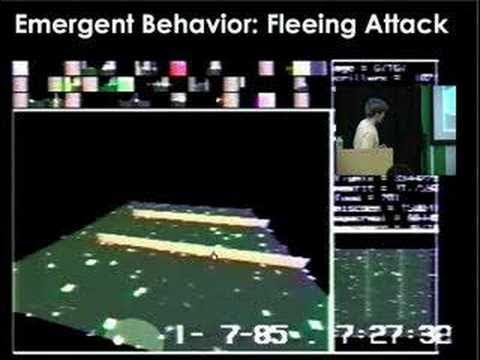
Griffith shows video evidence of an organism actively detecting an approaching red attacker and executing an evasive maneuver to escape. He stresses that this survival strategy arose completely naturally, with zero human hand-tuning or supervised learning involved.
[33:38](https://www.youtube.com/watch?v=_m97_kL4ox0&t=2018s) Foraging Patterns and Swarming Dynamics
Griffith highlights the diverse foraging strategies that arise among the population. While many organisms strike out as lone foragers, other weaker critters develop collective swarming behaviors. In these swarms, individual critters execute tight turning circles while orienting toward dark green shades. Because individuals near food patches survive and reproduce while those away from the food perish, the entire circular-turning swarm gradually drifts toward food clusters. Griffith notes that while this strategy is slow, it functions effectively.
Comparing the evolved behavior to the start of the run, Griffith points out that the agents no longer sit inertly. Instead, they exhibit purposeful motion, turning deliberately toward sustenance and actively exploring their space. Reviewing their progress so far, he recaps three fundamental milestones:
- Evolution generates a diverse variety of neural architectures.
- The organisms legitimately utilize their visual sensory systems.
- They employ this vision to execute functional, survival-oriented tasks.
[35:17](https://www.youtube.com/watch?v=_m97_kL4ox0&t=2117s) Animal Foraging Literature: Ideal Free Distribution and Predator-Prey Oscillations
To move beyond qualitative observations, Griffith introduces quantitative comparisons drawn from biological ecology. In a standard test setup, a simulated environment contains two separate food patches located at opposite ends, separated by a barren stretch of "no man's land." At the beginning of the run, the agents disperse uniformly across the map. Over time, individuals in no man's land die off or migrate, and the population concentrates entirely within the two distinct food patches. Griffith reveals that this spatial allocation matches the animal foraging literature precisely: “So there's this distribution you commonly see in the foraging literature called the ideal free distribution and lo and behold, they hit it perfectly.”
```mermaid
flowchart TD
accTitle: Resource Oscillation Dynamics
accDescr: The cyclical population lag between food replenishment and critter consumption in Polyworld.
A["Food patch abundance rises"] --> B["Critters detect & migrate to patch"]
B --> C["Overharvesting depletes local food"]
C --> D["Critters abandon patch for alternate site"]
D --> A
```
Griffith then displays time-series plots tracking predator-prey-style population dynamics. In this analysis, the critters serve as the predators and the food patches act as the prey:
- **Red curve:** Represents the percentage of the world's critter population residing in a specific food patch.
- **Green curve:** Represents the percentage of the world's available food located within that same patch.
The data reveals that critter density consistently lags food abundance. Food regrows to high levels, prompting critters to migrate in; the critters overharvest the patch until supplies crash, which drives the population over to the alternate food patch. This dynamic sets up an ongoing oscillation that mirrors classic Lotka-Volterra predator-prey population cycles. An audience member asks whether food in this graph refers strictly to cannibalized critters, but Griffith clarifies that the chart tracks standard vegetative food patches and the back-and-forth oscillation between two nearby resource sites. He reiterates that this dynamic was never explicitly programmed: they merely built the world mechanics and neural nets, and the ecological rhythms emerged on their own.
[37:45](https://www.youtube.com/watch?v=_m97_kL4ox0&t=2265s) Brain Connectomics: Random Networks vs. Cat Visual Cortex
Turning to internal neuroanatomy, Griffith analyzes the structural connection matrices of the neural networks across three distinct conditions:
1. An initial randomly wired brain at the start of evolution.
2. A biological connection matrix taken from the feline visual cortex.
3. An evolved brain connection matrix from a Polyworld critter after thousands of cycles.
Griffith shows that the evolved Polyworld brain develops distinct clusterings and modular organization, clearly separating itself from pure noise: “It's not a cat but it's certainly not random.” He points out that this structural complexity arose solely by allowing CPU cycles to burn on evolutionary selection, without human design intervention:
> “So, again I'm not claiming the poly organisms are cats but I am saying that evolution is doing something very useful and it's putting tons of structure in there that you do not put in so all right.”
[38:52](https://www.youtube.com/watch?v=_m97_kL4ox0&t=2332s) Defining Life: The Farmer-Belin Criteria Debate
Addressing frequent skepticism from visiting philosophers who challenge whether the digital agents are truly alive, Griffith references the life-definition framework established by J. Doyne Farmer and Aletta Belin at the Santa Fe Institute. He notes that Larry Yaeger explicitly architected Polyworld to satisfy these criteria:
| Santa Fe (Farmer-Belin) Criterion | Polyworld Implementation |
|:--- |:--- |
| **Spatio-temporal localization** | Critters occupy continuous physical 2D coordinates in simulated space. |
| **Self-reproduction** | Critters physically locate mates and pass on combined genetic code. |
| **Information storage** | Genetic blueprints determine anatomy and initial neural wiring. |
| **Metabolism / Energy flow** | Critters ingest food to maintain an energy reserve and stave off death. |
| **Interactive environment** | Visual sensors and physical collisions alter state and behavior dynamically. |
| **Evolutionary capacity** | Heritable mutations and fitness-driven survival drive adaptation over generations. |
Summarizing the checklist, Griffith delivers a blunt conclusion to philosophical critics: “So in short, to that—well it fits the definition of life that most people used. So in your face.”
An audience member interjects to challenge the definition, pointing out that phenomena like fire display metabolism and interaction with their environment. The questioner asks whether a lingering coal that can re-ignite another fire constitutes biological information storage. Griffith responds with detached amusement, saying: “I don't really care if fire's alive or not. Fire probably can satisfy three or four of these. I mean, I'm not really attached—I'm indifferent to fire.” He reasons that a piece of coal contains minimal structured information compared to an organism's genome, but concludes that even if someone wants to classify fire as alive, it doesn't undermine the simulation's validity.
[40:52](https://www.youtube.com/watch?v=_m97_kL4ox0&t=2452s) Quantifying Intelligence and Neural Complexity
Addressing whether the agents can be categorized as intelligent, Griffith acknowledges that the broader scientific community still lacks a definitive, universal metric to quantify intelligence. However, running these experiments inside a computer simulation provides a massive advantage over wet-lab biology: researchers have absolute, transparent access to every internal variable, firing state, and synaptic weight at all times. Griffith notes that his current research focuses on using information theory and complexity theory to track the evolution of their brains over time.
Griffith explains that he has implemented two separate neural complexity metrics, including the Tononi-Sporns-Edelman (TSE) complexity framework (referencing Olaf Sporns and Giulio Tononi, misstated in the transcript as Schwartz). He summarizes the core intuition behind neural complexity:
- If all neurons fire completely independently like uncorrelated white noise, the system has zero complexity.
- If all neurons fire in lockstep unison like an epileptic seizure, the system also has zero complexity.
- True neural complexity requires an optimal middle ground: specialized local processing combined with global integration.
Griffith shares an early finding from his experiments: across both metrics, the critters' neural complexity scores reliably spike upward during early generations of evolutionary adaptation, but eventually hit a distinct plateau where growth stalls, leaving the researchers with an open theoretical puzzle to investigate.
[42:08](https://www.youtube.com/watch?v=_m97_kL4ox0&t=2528s) Two Views on the Evolution of Complexity
Having established that neural complexity increases in the simulation, Griffith turns to the question of mechanism: is evolution actively driving that complexity upward, or is it merely increasing by accident? He outlines two contrasting paradigms in evolutionary biology:
1. **Active selection for complexity**: The intuitive, traditional view that evolution actively favors more complex organisms over time, driving life from simple bacteria up to humans. Under this model, evolution has an intrinsic preference for complexity.
2. **Passive diffusion (the "drunkard's walk")**: The view that evolution does not inherently care about complexity at all. If life begins at a minimal boundary of complexity, random diffusion outward along the spectrum of complexity will inevitably produce some complex entities purely by chance, without any directional selection.
```mermaid
flowchart TD
accTitle: Two Models of Evolutionary Complexity
accDescr: Comparing active directional selection against passive diffusion from a lower bound.
subgraph Passive["Passive Diffusion"]
P1["Minimal Boundary"] -->|"Random Diffusion"| P2["Drift Across Spectrum"]
P2 -->|"Unbiased Walk"| P3["Accidental Complex Outliers"]
end
```
An audience member interjects to ask whether organisms are primarily constrained by the simplicity of their environment, suggesting that the plateau in complexity might simply reflect an environment that demands nothing more. Griffith concurs: “The question is whether or not the complexity of organisms is predominantly a product of their environment. And the reason that we're not seeing a big increase in complexity is because the environment is so simple. And I think that's exactly it.” He notes that they are currently exploring ways to make the Polyworld environment richer to stimulate deeper interactions.
---
[43:53](https://www.youtube.com/watch?v=_m97_kL4ox0&t=2633s) Active Evolution vs. Passive Drift: A Surprising Result
To test whether selection actively promotes complexity, Griffith devised a control experiment in Polyworld where natural selection was effectively turned off. In these "passive" runs, mating was made random: even when two critters mated, the offspring did not inherit the parents' genes, but rather genes drawn at random from the population. Furthermore, to prevent longer-lived critters from having an unfair reproductive advantage, each creature's lifespan was matched directly to the active evolutionary run.
When plotting neural complexity over time, the result initially looked counterintuitive: the dashed line (evolution turned off) actually climbed to a higher overall complexity than the solid line (evolution turned on).
> “Now this is very depressing, because you're like oh well with evolution turned off you get a higher complexity. You're like, well you're doing nothing. And I was very sad when I first saw this graph.” — Virgil Griffith
Upon closer inspection across roughly ten runs, Griffith noticed a consistent early "hump" in the active evolution curve. In the opening generations, evolution actively drives complexity upward faster than the random walk. However, once the agents reach a point where they have successfully solved the environmental challenges, complexity begins to carry an energetic cost. Natural selection then actively stabilizes or even prunes complexity back down. In contrast, the passive, diffusive run continues to drift upward unrestricted because there is no fitness penalty pruning away unnecessary neural overhead.
An audience member asks whether this pruning resembles a software system removing "dead code" after discovering it is unnecessary. Griffith agrees that this matches his interpretation: complexity is advantageous early on, but once survival is solved, organisms only maintain as much neural complexity as their environment strictly demands. A student's t-test confirms that the active and passive populations diverge significantly and are statistically distinct.
---
[47:38](https://www.youtube.com/watch?v=_m97_kL4ox0&t=2858s) Genetic Complexity and Christoph Adami's Metric
Griffith transitions from neural complexity to genetic complexity, applying an information-theoretic metric developed by Caltech professor Christoph Adami. The metric quantifies the amount of order versus disorder in the genome:
- If every possible gene variant is equally distributed across the population (maximum disorder/entropy), the score drops toward zero.
- If natural selection favors specific functional genes over others, population disorder decreases and genetic complexity registers as high.
Around generation 7,000—the exact transition window seen in the neural complexity graphs—the active and passive curves cross and diverge sharply:
| Condition | Neural Complexity Behavior | Genetic Complexity (Adami Metric) |
|:--- |:--- |:--- |
| **Active Evolution (Solid Line)** | Spikes early, plateaus/prunes to match environment | Remains high; functional genes are preserved |
| **Passive Run (Dashed Line)** | Continues drifting upward without constraint | Collapses to near zero; genetic disorder takes over |
Griffith highlights that active evolution maintains order and information in the genome, preventing the population from degenerating into genomic chaos, while the passive run experiences a complete collapse in genetic complexity.
---
[49:02](https://www.youtube.com/watch?v=_m97_kL4ox0&t=2942s) Debating Controls, Random Mating, and Genetic Drift
Audience members probe the exact mechanics of turning evolution off. One asks why mating drew random genes from other living creatures instead of simply duplicating one of the parents. Griffith clarifies that the goal was to ensure that every individual and every gene had an identical probability of selection, neutralizing fitness differences so that “selection with everything being equal—equally selected for” was maintained.
Another attendee raises the phenomenon of genetic drift in finite populations, pointing out that even with uniform random selection, finite populations will experience stochastic fluctuations and allele fixation over time. Griffith agrees, pointing out the subtle oscillations visible in the passive curve and noting that the amplitude of this drift decreases systematically as population size increases, exactly in accordance with standard population genetics theory. Moving toward the next topic under time pressure, Griffith introduces the follow-up question: whether the plateau in passive complexity indicates an inherent structural upper bound imposed by the simulation itself.
[52:03](https://www.youtube.com/watch?v=_m97_kL4ox0&t=3123s) Environmental Complexity and Future Directions for Polyworld
Looking at the comparison data, Virgil Griffith explains that they ran Polyworld in a dedicated fitness-function mode where natural selection was turned off and agents were bred solely for maximizing brain complexity. That explicit selection produced a complexity curve (indicated in red) far higher than the curve achieved under standard natural selection. As Griffith summarizes the finding: “So in short this says, hey, you know the simulation can support much higher complexity if you--if you like really forced it do it.” This demonstrates that the evolutionary framework has plenty of room to grow, and the next step is to make the environment significantly richer to coax the natural selection curves closer to that upper red baseline.
```mermaid
flowchart TD
accTitle: Polyworld Future Development Roadmap
accDescr: Visual diagram illustrating proposed directions to increase simulation complexity and biological realism in Polyworld.
subgraph ENV["Environmental Upgrades"]
LGT["Day/Night Cycles<br>(Ambient Lighting in OpenGL)"]
FOD["Multiple Food Types<br>(Specialization & Energy Yields)"]
end
subgraph AGENT["Agent Sensory & Cognitive Expansions"]
SNS["Multimodal Senses<br>(Adding Touch & Smell to Vision)"]
CLF["Classical Conditioning Experiments"]
end
subgraph GOAL["Research Milestones"]
CMP["Evaluate Complex Brain Curves"]
EVO["Test Evolutionary Theory Questions"]
end
ENV --> CMP
AGENT --> CLF
CMP --> EVO
```
To drive this next phase of development, Griffith outlines several practical additions:
- **Day and night lighting cycles:** Implemented straightforwardly in OpenGL by modulating ambient lighting up and down. This will force agents to evolve an internal circadian clock so they know when it is dark and recognize: “I--I can't see anything probably shouldn't go foraging.”
- **Diverse food types:** Introducing different food colors where certain foods provide higher caloric energy returns than others, encouraging behavioral specialization.
- **Expanded sensory modalities:** Adding senses like smell and touch alongside their current vision system to enable more complex interactions with the environment.
- **Advanced behavioral paradigms:** Moving beyond recently achieved natural foraging behaviors toward setting up classical conditioning experiments.
Griffith notes that the project source code is publicly available, is implemented using the Qt framework, and runs cross-platform on Linux and Mac OS X: “The source codes available, you can get it now. It runs on Linux and Mac via Qt, its just works.” Addressing the inevitable ethical anxieties from audiences who fear scientists are building a digital monster, Griffith delivers his tongue-in-cheek reaction: “Yeah--and at the very end I always get the questions, oh, you're making Frankenstein this is a terrible idea. And I--I was like this snide respond to them. So and yeah, I have no problem with that responsibility. It's a--its--its--if the polygon kill us all well--well it happens.”
---
[54:32](https://www.youtube.com/watch?v=_m97_kL4ox0&t=3272s) Q&A: Sexual Selection, Gender Niches, and Neural State
An audience member opens the question-and-answer period by asking whether the researchers have considered implementing sexual selection to investigate whether distinct gender niches develop—specifically where one gender invests little in offspring and attempts to maximize mating frequency while the other contributes significant parental investment. Griffith explains that Polyworld agents are currently non-gendered, primarily due to practical population constraints: with populations typically running at around 300 agents, requiring explicit complementary sexes would effectively cut the available mating pool in half and make finding suitable mates too difficult. However, he agrees that observing emergent gender roles would be fascinating:
> “So like right now, these critters currently run with about 300 agents in a simulation, I'm sorry, the answer is yes you could do that. That'd be really cool but right now we don't do it because we are concerned about, it might be hard to find a mate.”
When asked whether the underlying neural networks are feedforward or recurrent, Griffith confirms they are recurrent networks capable of feeding signals back to internal nodes. The original architecture relies on squashing activation functions, while newer work incorporates more sophisticated spiking neuron models. In response to a query about whether internal neural states are retained between simulation cycles—an important feature for maintaining a continuous internal model of the world—Griffith explains that sensory vision updates every tick, but he would have to double-check the raw code to confirm exactly how internal hidden node states persist from one timestep to the next, offering to answer empirically in ten minutes after looking at the code.
---
[57:17](https://www.youtube.com/watch?v=_m97_kL4ox0&t=3437s) Contextualizing Polyworld: Tierra, Sugarscape, and Neural Darwinism
A listener asks for background comparing Polyworld with other landmark artificial life and biological systems, citing Thomas Ray's *Tierra*, *Sugarscape*, and Gerald Edelman's theory of *Neural Darwinism*. Griffith reflects on the significance and known pitfalls of *Tierra*, explaining that while Ray's system was an incredible pioneer in evolving machine code, it suffered from a major pathological attractor: digital organisms were restricted to a fixed allotment of CPU cycles to reproduce, creating overwhelming selection pressure to shrink genomes to the smallest possible size so they could reproduce as rapidly as possible. Griffith confesses he has only heard of *Sugarscape* and invites the questioner to email him papers on it.
Turning to Neural Darwinism, Griffith highlights its biological plausibility in mammalian brain development:
> “It's probably even true, in short it says that the way connections are formed in the brain, is kind of like evolution, it's not exactly, but roughly it says that neurons initially kept to a whole bunch of things and most of them suck and the ones that sucked, get pruned and they go away. So, roughly neuro Darwinism is like expand, prune, expand, prune.”
---
[59:18](https://www.youtube.com/watch?v=_m97_kL4ox0&t=3558s) Parameter Hell versus Environmental Complexity
An attendee questions the wisdom of adding features like lighting cycles to an already massively complex simulation with thousands of interacting parameters, expressing concern that compounding the environment's complexity will make it impossible to diagnose causal evolutionary mechanisms:
> “Your current system is already very complex and the thousand thing that affect the way evolution goes in your kind of system and you know how you construct their production procedure and so on and so on, so you're not afraid that if you make the environment more complex, you will be, possibly you will be able to see very fancy simulations but, it maybe more difficult to understand why actually evolution went this part, not the other way.”
Griffith jokingly asks if the questioner has a physics background: “Your bachelors isn't in physics by any chance? I mean, physicists always say that.” When the audience member clarifies that their background is in evolutionary computation, Griffith validates the danger of descending into “parameter hell” or even “ninth layer parameter hell.” However, he defends the design philosophy by arguing that Polyworld's macro-level evolutionary phenomena do not seem hypersensitive to hyperparameter tuning:
- As long as simulation parameters fall within a remotely sensible ballpark, the same broad emergent dynamics reliably appear.
- The team believes the scientific payoff of operating in an ecologically rich world vastly outweighs the burden of managing increased parameter complexity.
---
[01:01:04](https://www.youtube.com/watch?v=_m97_kL4ox0&t=3664s) Kin Selection, Signaling Gradients, and Biological Niches
A participant argues that handcrafted control systems could easily outperform Polyworld's current evolved agents and suggests that the primary bottleneck is not brain topology, but the nature of sensory information available to the creatures. The speaker cautions Griffith against focusing on visual surface details like lighting effects, urging him instead to model fundamental biological signaling mechanisms such as kin selection:
> “Put another way, I don't think you should be adding complexity to your simulated world in terms of adding lighting effects or for or the things like that. I think there need to be more signals that have to do with kin selection and not--not just green.”
In natural biological systems down to the cellular level, cell surface proteins naturally communicate relatedness. Natural selection relies on intricate gradients of kin similarity to regulate mating and predatory strategies, because organisms should avoid mating with identical clones (which yields no beneficial variation) while simultaneously avoiding mates that are too genetically distant.
[01:02:54](https://www.youtube.com/watch?v=_m97_kL4ox0&t=3774s) Sensory Inputs and Genetic Similarity for Speciation
An audience member raises an architectural suggestion regarding mating dynamics and speciation. In biological evolution, mating with an organism that is genetically too divergent results in non-viable offspring, meaning natural complexity emerges from competing behavioral features and evolving mating preferences. However, the speaker observes that the neural networks in Polyworld do not appear to have rich enough sensory input channels to detect those subtle gradients in other agents. To bridge this gap, the audience member proposes allowing the simulation to "cheat" by giving agents a direct genetic similarity score as a dedicated sensory input—bypassing raw vision—akin to how real organisms exploit pheromones and chemical markers rather than waiting an immense amount of time for arbitrary visual markers to evolve.
```mermaid
flowchart LR
accTitle: Proposed Genetic Similarity Sensing
accDescr: Diagram showing how a direct genetic similarity score could feed into an agent neural network alongside vision.
subgraph AgentInput["Critter Sensory Channels"]
direction TB
V["Visual Input (Light)"]
GS["Direct Gene Similarity Score (Proposed Cheat)"]
end
subgraph Brain["Neural Network"]
NN["Decision & Mating Network"]
end
subgraph Outcome["Evolutionary Pressure"]
M["Speciation & Viable Offspring"]
end
V --> NN
GS -.->|"Mimics pheromones"| NN
NN --> M
```
Virgil Griffith summarizes the proposal as an argument that agents require more complex inter-agent interactions rather than just richer interactions with their static physical environment. When the audience member clarifies that the existing agent actions are fine but their observational capacity regarding peers is insufficient, Griffith readily concurs. He invites contributions from anyone willing to implement the idea in the codebase, noting:
> “Well, and so I guess the answer is 'I agree.' And if someone's to write it. If you're a writer, I would gladly put the patch in.”
He emphasizes that there is no philosophical dispute, acknowledging that running experiments to test whether inter-agent observational complexity yields greater benefits than environmental complexity would be an excellent line of research.
---
[01:05:00](https://www.youtube.com/watch?v=_m97_kL4ox0&t=3900s) Lifespan Constraints and Mortality in Polyworld
As the session wraps up in Mountain View, a final audience member jokes about their personal stake as a mortal biological creature, asking what happens in the simulations if the artificial lifespan limit is completely removed:
> “Yes, so as a biological creature myself, I kind of hope that death is not inevitable and I was curious of what you were noticing in your simulations if you had turned off the limited lifespan of a creature.”
Griffith explains that the maximum lifespan parameter can easily be clamped or modified, but admits he has never run a direct comparison because the feature was originally added simply after reading a conference paper demonstrating that fixed or capped lifespans benefited evolving mating populations.
In practice, removing the hard lifespan ceiling would likely have little observable effect on current Polyworld runs because critters rarely live long enough to die of old age. Instead, starvation and thermodynamic depletion claim almost all agents prematurely:
- Average critter survival lasts roughly 300 to 400 time steps.
- The hard-coded maximum lifespan ceiling sits much higher, around 700 to 800 time steps.
- Very few individual critters ever reach the upper chronological boundary before running out of energy.
Griffith concludes the TechTalk by letting attendees know he will linger to answer further offline questions, thanking the audience as the presentation ends.
## Notable quotes
> [31:41](https://www.youtube.com/watch?v=_m97_kL4ox0&t=1901s) evolution will take advantage of your bugs. — Virgil Griffith
> [42:08](https://www.youtube.com/watch?v=_m97_kL4ox0&t=2528s) The question is whether or not the complexity of organisms is predominantly a product of their environment. And the reason that we're not seeing a big increase in complexity is because the environment is so simple. — Virgil Griffith
## Mentioned
Google TechTalks, Henry Strickland, Virgil Griffith, Douglas Hofstadter, Larry Yaeger, Apple Computer, Polyworld, University of Alabama, Indiana University, Santa Fe Institute, Keck Graduate Institute, California Institute of Technology, Carl Sims, René Descartes, Graphviz, J. Doyne Farmer, Aletta Belin, Giulio Tononi, Olaf Sporns, Gerald Edelman, Christoph Adami, OpenGL, Qt, Tierra, Thomas Ray, Sugarscape, Lotka-Volterra
## Video description
Google Tech Talks
November, 8 2007
ABSTRACT
This presentation is about a potential shortcut to artificial intelligence by trading mind-design for world-design using artificial evolution. Evolutionary algorithms are a pump for turning CPU cycles into brain designs. With exponentially increasing CPU cycles while our understanding of intelligence is almost a flat-line, the evolutionary route to AI is a centerpiece of most Kurzweilian singularity scenarios. This talk introduces the Polyworld artificial life simulator as well as results from our ongoing attempt to evolve artificial intelligence and further the Singularity.
Polyworld is the brain child of Apple Computer Distinguished Scientist Larry Yaeger, who remains the primary developer of Polyworld:
Speaker: Virgil Griffith
Virgil Griffith is a first year graduate student in Computation and Neural Systems at the California Institute of Technology. On weekdays he studies evolution, computational neuroscience, and artificial life. He did computer security work until his first year of university when his work got him sued for sedition and espionage. He then decided that security was probably not safest field to be in and he turned his life to science.
Virgil Griffith argues that artificial intelligence can be engineered more effectively by designing simulated evolutionary ecosystems than by hand-crafting neural architectures, allowing computational scale and natural selection to discover functional cognitive systems.
Trading Direct Mind-Design for Simulated Evolution (0:22)
Human-directed AI design has historically proven difficult, whereas the mechanics of evolution—heritable variation, mutation, and differential selection—are straightforward to implement in code. Griffith proposes that researchers harness expanding CPU power to trade direct mind-engineering for world-design, allowing natural selection to produce viable cognitive networks. Seminal artificial life experiments, such as Carl Sims' 1994 work on virtual creatures, demonstrated that graph-encoded morphologies placed in simulated physics could spontaneously evolve diverse locomotion, phototaxis, and competitive tactical behaviors like body-blocking and pinning.
Polyworld's Mechanics, Metabolism, and Unsupervised Selection (16:21)
Developed by Larry Yaeger, Polyworld abandons predefined fitness functions in favor of pure natural selection within a two-dimensional arena. Critters possess physical bodies subject to morphological trade-offs in size, strength, and lifespan, while neural network brains comprise roughly 95 percent of their genome. These brains are organized into genetically specified groups of excitatory and inhibitory neurons whose connection weights initialize randomly and adapt over an agent's lifetime via Hebbian learning and passive weight decay. Constant metabolic costs penalize simple existence, physical exertion, and neural overhead (both total neuron count and firing frequency), forcing agents to forage or hunt to survive.
Without an external fitness score, evolutionary pressures drive organisms to prioritize survival above all else, frequently uncovering software loopholes. In an early iteration where reproduction carried zero energetic cost to parents, populations abandoned foraging entirely. Instead, critters clustered to mate continuously and immediately slaughtered and devoured their newborn offspring as an infinite food source, an exploit only resolved by instituting a mandatory parental energy tax at birth.
Emergent Behaviors and Biological Parallels (31:41)
Starting from random neural configurations, Polyworld agents progressively evolve survival heuristics driven by a one-dimensional visual strip. Populations learn to move toward green (food), seek blue (potential mates), and actively evade approaching red entities (predators). Weaker organisms develop tight turning swarms that collectively drift toward nourishment, while individual agents transition from stationary inertia to deliberate spatial navigation.
These emergent strategies align closely with empirical biological phenomena. In split-patch resource experiments, critter spatial distribution matches the ideal free distribution described in animal foraging literature. Furthermore, critter density and food replenishment exhibit cyclical oscillations that closely mirror classic Lotka-Volterra predator-prey dynamics. Internal connectomic analysis shows that evolved neural matrices form distinct modular clusters that deviate significantly from random noise, approaching organizational patterns observed in mammalian visual cortexes.
Complexity Costs and Environmental Ceilings (42:08)
To determine whether evolution actively selects for brain complexity or merely drifts along a passive random walk, Griffith tracked neural complexity using the Tononi-Sporns-Edelman framework alongside Christoph Adami's genetic information metric. In control experiments where natural selection was turned off by randomizing reproduction, passive drift unexpectedly produced higher late-stage neural complexity than active evolution. Griffith found that active selection spikes complexity early to solve survival requirements, but subsequently prunes unnecessary neural overhead to conserve energy—analogous to a compiler eliminating dead code. In contrast, the passive run drifted upward uninhibited because non-functional neural bloat carried no survival penalty, even as its genetic order collapsed into chaos.
When Polyworld was configured to explicitly maximize brain complexity through targeted selection, complexity reached far higher levels than it did under standard natural selection. This disparity indicates that agent complexity in open-ended simulations is primarily bounded by the simplicity of the virtual environment rather than the capacity of the simulation software.
Polyworld demonstrates that unsupervised natural selection can generate functional neural wiring, adaptive behaviors, and macro-level ecological dynamics from scratch. However, elevating these digital organisms toward higher intelligence requires introducing richer environmental challenges and inter-agent sensory modalities—such as day-night cycles, caloric variations, and kin-signaling cues—while resisting the diagnostic pitfalls of excessive simulation hyperparameter tuning.
[31:41] Virgil Griffith: evolution will take advantage of your bugs.
[42:08] Virgil Griffith: The question is whether or not the complexity of organisms is predominantly a product of their environment. And the reason that we're not seeing a big increase in complexity is because the environment is so simple.
Original transcript
[0:22] >> STRICKLAND: Hey there.
[0:23] I'm Henry Strickland, our speaker is Virgil
Griffith he's talking about Polyworld using
[0:30] evolution to design artificial intelligence
and having had to take artificial intelligence
[0:36] classes in--in college, I'd be very happy
to let evolution do it instead of me debugging
[0:42] all those list programs they gave me.
[0:45] So, Virgil, as a young lad read a little too
much of Douglas Hofstadter and he therefore
[0:53] dedicated his life to cognitive science and
causing trouble.
[0:58] After some under graduate at University of
Alabama, he went to Indiana, where he teamed
[1:05] up with Larry Jaeger.
[1:08] Some of the older Googlers might know Larry
Jaeger form Apple Computer.
[1:11] He had a project called Polyworld long time
ago and it still leaves on and Virgil's been
[1:17] working on it and adding features and things
to it.
[1:20] Virgil has done internships at the Santa Fe
Institute and at the Keck Institute and now
[1:27] is his first year as a grad student at Caltech.
[1:29] All right.
[1:30] >> GRIFFITH: Thank you Stu.
[1:32] Hi.
[1:33] I'm Virgil, I'm a--I'm first year grad student
at Caltech.
[1:36] You can reach me, that's my--that's my web
site for those of you wondering, the .gr stands
[1:40] for Griffith, people get confused about that.
[1:43] I'm not Greek.
[1:44] And that's my email address.
[1:46] So--so, in short, yes, I'll be talking to
you about basically trying to use evolutionary
[1:52] algorithms as a shortcut to creating artificial
intelligence.
[1:55] Simply because artificial intelligence is
well, hard and--and evolution is fairly easy--well
[2:00] this was easy to set up.
[2:02] And the hope is that--that us--we can take
advantage having lots of the CPU cycles and
[2:08] we let evolution to do a lot of the designing
for us.
[2:10] So--so, that's the--that's the general gist
and well--well, let's move on with it.
[2:17] So, there we go.
[2:18] So, what I interested in--feel like asking,
what is artificial life anyway?
[2:23] They just go, you know, this is ill-defined.
[2:24] Well, in short, artificial life is--is--artificial
life is like a super set of biology.
[2:30] So, all biology is artificial life but to
be more precise, artificial life is all as
[2:35] it is today.
[2:36] So, as it says in the circle, and also what
like potentially could be.
[2:39] So, all these, all their possible evolutionary
paths that are--that evolution could have
[2:45] taken will also ultimately create artificial
life and will be [INDISTINCT] with these areas
[2:48] because we'll be hoping to explore AI.
[2:50] Please I'll say it once.
[2:54] So, I was--so, just to begin, let's show real
quick.
[2:57] So, this is a brief intro to evolution.
[2:59] Evolution is an algorithm.
[3:00] It's really straight forward actually.
[3:01] Here's how it goes.
[3:03] You had a population and you have--and some
things stick around more than others.
[3:07] So, and--but some, yeah, that must--must be
the case.
[3:10] So, that's for selection.
[3:12] And then, you had these things--there are
some heredity.
[3:15] And then, you rinse-repeat.
[3:17] And regardless of substrate, you always get
evolution with this.
[3:20] Very straight forward.
[3:21] You have a population of things, you--you
only have only one that you have hill climbing
[3:24] and that--that's crap, you got to have a bunch
and some reproduce more than others straight
[3:28] forward and then there's heredity.
[3:31] And with--with occasional errors.
[3:32] Done.
[3:33] It's all you got to do.
[3:34] So, no matter--just--yeah, it's great.
[3:37] So, okay, get that on the table.
[3:40] So moving on, I'm showing you a nice--nice--good
example of using evolution to design body
[3:46] plans so, this is--before we get to AI.
[3:48] And this was not my work, this is by Carl
Sims in 1994, it's very [INDISTINCT] so I'm
[3:52] showing it to you.
[3:53] So, basically in this case--so, he's doing--using
evolution to design bodies--design body--body
[3:59] morphologies to do a different task in the
world.
[4:01] In this case, the population is a--do we have
a laser pointer or anything like that?
[4:06] I can just point.
[4:08] Well, anyway, okay so, the population is a
whole bunch of these nodes and connections
[4:15] joining them.
[4:16] And you can mix and match nodes so, it's like
they say, "Hey.
[4:18] I'm going to put this [INDISTINCT] over here
and vice versa."
[4:22] And you kind of see, can--how they make these
morphologies you know, about how--you know,
[4:27] how this makes a tree and vice versa.
[4:29] It's actually kind of cute when you look at
it.
[4:30] So, they're actually worth understanding so.
[4:32] All right, sweet.
[4:35] Okay.
[4:36] So, in this case the--yeah, usually there's
joints between parts.
[4:40] So, yeah.
[4:41] So, this population is a graph of nodes and
edges and the--and the selection is to go
[4:46] different with certain tasks so, walking,
jumping, something like that.
[4:50] And the--and the mutation is grafting nodes
here and there.
[4:54] And we're just going to let it go and see
what happens and here we go.
[4:59] So--no, okay.
[5:02] >> This demonstration shows.
[5:05] >> GRIFFITH: Trying to...
[5:09] >> Virtual creatures that were evolved to
perform specific tasks in simulated physical.
[5:19] >> GRIFFITH: And that one.
[5:31] All right, start it again.
[5:38] >> This demonstration shows virtual creatures
that were evolved to perform specific tasks
[5:43] in simulated physical environments.
[5:46] Swimming speed was used to determine survival.
[5:50] Most of the creatures are results from independent
evolutions.
[5:54] Some developed strategies--is their evolved.
[6:04] Multiple--these creatures in simulated together--friction.
[6:13] Some simple solutions was just two parts were
found.
[6:16] Some seemed like they could use some assistance
while others were fairly efficient such as
[6:22] this rowing like behavior.
[6:23] Here is an odd cousin of the previous.
[6:28] A mutation caused him to tumble.
[6:33] Some creatures evolve to incorporate contact
sensors in their control systems.
[6:41] Here is another inch worm like creature that
tends to go in circles.
[6:46] This was actually a creature first evolved
for its ability to swim in water then later
[6:50] put on land and evolved further.
[6:53] A successful side winding ability resulted.
[6:56] Here is one with a hopping style.
[6:58] The protrusions on its arms seem to help prevent
it from tipping over.
[7:03] This was the fastest with a successful galloping
like stride.
[7:07] This group was evolved for their jumping ability.
[7:12] This group was evolved for their ability to
adaptively follow a red light source.
[7:17] The resulting creatures are now being interacted
with.
[7:20] A user is moving the light source around as
the creature behaves.
[7:25] This one seems to flail randomly but somehow
still manages to approach the light.
[7:30] Perhaps it is mean to move the goal away just
it is arrives.
[7:33] Here is one that has propeller like fins which
are tilted depending on the direction of the
[7:38] light.
[7:39] It can adaptively swim up or down very well.
[7:43] >> Just a pause.
[7:44] This is one is especially nice because it
looks like something that a human would design.
[7:47] Some kind of motor thing and if it weren't
for this little part just hanging off here,
[7:51] you'd swear it was design and this case is
a case where evolution has--has toned across--they're
[7:56] are very good designs, extremely efficient
and it looks, you know, very much something
[8:00] that we would build ourselves.
[8:02] So, like basic seeing designs like this should
like--should comfort so yes, this--this can
[8:06] work.
[8:07] Sure, is there a question?
[8:08] >> [INDISTINCT] recently this [INDISTINCT]
>> GRIFFITH: You mean the cross network?
[8:19] X, this work was recently redone for the Artificial
Life Ten Conference.
[8:24] I know that I used to, to evolve catapult
designs.
[8:27] So I don't--I don't know if they've actual
recreated all of this but--but I do know at
[8:33] least large sections of this have been recreated
and I know that for a fact because I worked
[8:37] in the lab.
[8:39] So, so that's all I got.
[8:41] >> I'd like to read this book.
[8:44] >> GRIFFITH: Okay.
[8:45] All right, now I still-what's the next one
we got here?
[8:48] Oh, so I've set some before where they--where
they're moving kind--kind of weirdly specially
[8:53] the one where this--have like the big hanging
mass.
[8:57] The sole fitting this function in this case
was to--was to move your center of mass forward
[9:02] or just--just move it period.
[9:03] So in this case like--like evolution is very--like
it loves to cheat all the time to--to find
[9:09] some way to do this.
[9:10] So in this case what I was doing is was have
this big long tentacle thing and it was just
[9:13] moving its tentacle thing around.
[9:15] Thus its--thus its center of mass was moving.
[9:19] So just another thing to keep in mind is that--is
that if you ever have any--you have to--when
[9:24] you design your evolutionary simulations you
have to always know all the weird ways it
[9:28] could cheat and we'll get back to that later.
[9:30] So here's some more.
[9:31] >> This final group of creatures was evolved
through for their ability to compete for control
[9:35] of a green cube.
[9:37] The creature closest to the cube at the end
of the simulation is the winner.
[9:43] Here a strategy first arose for simply tumbling
towards the cube.
[9:50] Then one learned to block out his opponent.
[9:55] But then later one learned to overcome the
obstacle by climbing over it.
[10:01] Some pinned down their opponents.
[10:05] Some covered the cube with protective arms.
[10:08] Others simply unfolded onto the cube.
[10:12] The success of this strategy is often highly
dependent on the opponent.
[10:16] Here's a Hockey playing creature, which takes
the cube away and wins by a large margin.
[10:22] Here are two similar Hockey strategies battling
it out with the appropriate gestures.
[10:36] This crab like creature walks well but often
continues past the cube and instead seems
[10:42] to prefer beating up on his opponent.
[10:48] Against the arm, the crab seems to simply
walk away.
[10:53] A successful strategy is this two armed technique
that swipes quickly in from the side and moves
[11:00] the cube over to his second arm.
[11:05] These are the final rounds of competition
amongst the overall best.
[11:11] Finally, the seeker arm goes against the sideswiper
but the cube is just out of reach.
[11:22] >> GRIFFITH: Okay, so this is a fun movie
that I would like to show.
[11:26] Number one, it's pretty and the second is
because, you know, designing body types--well,
[11:33] that's kind of hard like doing those solutions
yet I kind of think about them for a little
[11:36] bit.
[11:37] Now this is not designing AI but it does show
ho--how like--how, how evolution can sow across
[11:41] very inventive solutions.
[11:44] And so this is meant to be like inspiring
and say, "Oh, you know, maybe you can do something
[11:47] else better with this."
[11:48] So that's what we have next.
[11:51] So next is using artificial life to evolve
artificial intelligence.
[11:55] So here's a--well, hear this--this idea.
[11:57] So the first question is how we do a population
for--like, like what, what's--what thing do
[12:02] we mutate and tinker with to--force it to
be intelligent and there's a lot of answers
[12:06] to this question.
[12:07] So Marionettes had--the Greeks had Marionettes
and so--yeah, they--they strings so they're
[12:13] all deeply connected in this clearly the way
you think about intelligence.
[12:18] And then Descartes says it's Hydraulics, so
the mind it's like the Sewer system, here
[12:22] we have little compartments here and then
lots of pretty art from that time of all about
[12:25] it.
[12:26] And Pulleys and Gears such Industrial Revolution--yeah,
we have done this before.
[12:29] Telephone switchboard--yeah, we, we--we've
heard--we've even heard this analogies.
[12:33] But Boolean logic--yeah, that didn't go so
well.
[12:37] But I'm pleased that we finally solved it.
[12:40] And the answer is, not digital computers but
it's neural networks.
[12:43] Praise the Lord.
[12:45] So, so I guess--I mean given the history should
partake neural networks was kind of a grain--a
[12:50] grain of salt.
[12:51] But, you know, definitely there's some reason
to think--think neural networks are a reasonable
[12:53] way for representing intelligence.
[12:55] I mean, after all, we, we, we really are--like
we're modeling the brain much, much closer
[13:00] than say digital computer or Boolean logic.
[13:03] So, so even though there had been many--been
many attempts, it's like what is the proper
[13:07] frame to--to capture intelligence.
[13:11] You know, the hi--history is not really on
our side.
[13:14] But I still think there's--there's a good
reason for it.
[13:16] So just--just go with me on this one.
[13:20] So now, the nervous systems--now, this ends
very nice is that, if you look at the neuron--see
[13:25] a human neuron, like an individual one versus--versus
say--say some other mammalian creature--even
[13:30] reptiles, you often can' t tell the difference
between them.
[13:32] It takes like a real expert to do it.
[13:34] So like the--like an individual neuron level,
we're all pretty much the same.
[13:38] It's all in--it shows in the connections.
[13:40] And evolution and it--like from us all the
way down to like sea slugs.
[13:44] You see--you still see nervous systems that
are roughly the same.
[13:48] So this very nice because roughly this says,
"Because hey, if we could just get our basic
[13:52] model right.
[13:53] You know--you know--was say a sea slug, it
could perhaps ride this model all the way
[13:57] up to the top."
[13:58] And if evolution did it once, why couldn't
it do it again?
[14:02] So yeah--so now, we'll talk about sort of
the way--so now we have our nervous system,
[14:07] the important parts about it.
[14:10] So in this case--so this case, we, we do not--do
know some behaviors are innate.
[14:14] There must be--must be some things that are--that
are, I mean, inherited.
[14:17] We also have many things that are learned.
[14:19] So the--so the nervous systems must change
with the organism's lifetime.
[14:23] This just--this is just sort of basic principles,
seems reasonable, we're going to go with that--so
[14:29] not too hard.
[14:30] And with all this in mind--I'm [INDISTINCT]
to you, Polyworld.
[14:33] Tad-dah!
[14:34] This is the simulator.
[14:36] Not to be confused with Polyworld, we--we--we
got a thread about this.
[14:41] So just so you know, this is not us, we're
the other one.
[14:45] It's with two L's, we're with one.
[14:48] And we do--we do pre-date them but not that
really matters.
[14:51] Okay, so what is Polyworld?
[14:53] Poly--Polyworld is an attempt to--well, before--since
we evolved, artificial intelligence the same
[14:57] way natural [INDISTINCT], which is simply
put the evolution of neuro systems in--in
[15:02] a complex, rich ecology and they compete with
one another.
[15:06] So and we're--yeah, so the, the hope is that,
we, we view with the model to make very simple
[15:10] and then through competition and through making
the world, world richer.
[15:14] It can gradually like get better and better
and better.
[15:17] Sure.
[15:18] >> [INDISTINCT] what causes the natural world
very rapidly if they happen with enormous
[15:25] perils.
[15:26] How are you going to beat their time schedule?
[15:28] >> GRIFFITH: That's hard.
[15:29] I mean, I--let's see.
[15:30] Well, how would you do that?
[15:32] I guess, in short, the, the answer would be
number one, we can place the ideas that create,
[15:38] or even an intelligent designer.
[15:39] We, we can help it along.
[15:41] And, and the hope is that, you know, we can
say.
[15:43] "Oh, that's good.
[15:44] We want to like really help you."
[15:45] And it's not something natural evolution had,
had the benefit of.
[15:49] And furthermore, Moore's law is really nice.
[15:52] And so I agree with you that is a problem
but, but both of those two, two factors help.
[15:58] But it's, it's, it's, it's, it's a legitimate
concern.
[16:03] So yeah--and in short--but Polyworld is a
new software, it's open source.
[16:07] I'll give you the link at the end.
[16:09] And, and, you know, there's a kind of a girls--but
most recently, people are using it for doing
[16:13] behavioral ecology experiments and like--and
like--we experience very simple neural networks.
[16:18] So if you're side is to use for that to.
[16:21] So now we know what Polyworld is, what Polyworld
is not.
[16:24] So Polyworld is not fully open ended.
[16:26] It's currently just--just designed to be a
flat world.
[16:28] Well, it's like--yeah, let's have your fight--where--where
critic interacts.
[16:32] It's not an accurate model of really anything.
[16:35] But it could be done.
[16:36] There's--I mean, there's--it's a--there's,
there's no real problem with it.
[16:39] The--the only reason we hadn't made an accurate
model of especiallly anything is because it's
[16:43] computationally expensive.
[16:44] And we don't believe it's, it's specially
important.
[16:46] So if--so like right now, we're still using
a simple summing and squashing neurons.
[16:51] If you wanted to, you could like--you could
render all the way down to actual biochemistry
[16:55] if you're in to that kind of thing.
[16:57] I'm personally not.
[16:58] But, you know, you could.
[17:00] And if you're into ecology, you can do that
to.
[17:03] So yeah, that's what I got.
[17:06] So we want some more.
[17:08] So until we uphold more--so here's usually
what evolves in Polyworld.
[17:12] So organisms have evolving genes and mate
sexually, straight forward.
[17:15] They, they do have a body but the most important
thing about them is the neural network brains.
[17:20] Now, the connections in the net--in the brains
are genetic.
[17:23] But at birth, all the weights are random.
[17:26] And--and Hebbian learning, which is the learning
mechanism and, and, and the primary that makes
[17:33] the human brain.
[17:34] But simply put well, and that sets all the
weights.
[17:37] And Hale learning, it's a very simple algorithm.
[17:39] It works like this.
[17:40] If two neurons that are connected together,
fire at about the same time.
[17:44] The connection between them gets stronger.
[17:46] And then--so that's step one.
[17:48] And then step two is, all connections decrease
in strength slightly so--and that's it.
[17:53] It's, it's kind of surprising.
[17:55] It's kind of surprising that--that it's this
one learning mechanism that accounts most
[17:59] of our intelligence.
[18:00] But you know, so it goes.
[18:03] And their--and their vision of the world is
quite--it inhabits flatland so they see a
[18:07] little--a little strip of pixels in front
of them.
[18:09] And so basically, it's evolving--it, it is
evolving a neural network to take their one
[18:14] dimensional vision and turn it into behaviors
that help them survive.
[18:18] So--and just to let you know, there's no cheating
in any of this on as you often see in evolution
[18:24] stimulations.
[18:25] There's no fitness function.
[18:26] This is like pure natural selection.
[18:27] This is as raw as it gets.
[18:29] If something survive--like, like the only
criterion is really to survive any way you
[18:34] can.
[18:35] And this includes exploiting bugs in the code.
[18:36] And we'll show an example of that.
[18:38] So okay--yeah, so--yeah, I'll show you that
in a second.
[18:43] So too-too-doo.
[18:44] Okay--go back.
[18:45] Okay, so here's a nice, pretty picture of
Polyworld.
[18:47] Here's how it goes.
[18:49] So--where is my thing?
[18:51] Here we go.
[18:53] So, these round things are barriers, they
can't cross those.
[18:56] These moving things here are the critters.
[18:58] And these green things here are food.
[18:59] So you see when a critter dies, they become
food.
[19:01] Now, this is kind of an early stage--stage
of the stimulator.
[19:04] And so they aren't very smart.
[19:05] They like going along the edge a lot.
[19:06] But they get smarter.
[19:08] I promise.
[19:10] So--so--so, basically, merely existing in
this world cause you to lose energy.
[19:14] And if you--and if you--and if your energy
gets to zero, well, you--you seize to exist.
[19:18] So, so thus like for anything to stick around,
it must go out and find food or go out and
[19:24] kill something and--or it must mate with other
organisms as well.
[19:28] If it doesn't, it just not going to stick
around long.
[19:31] It's, it's, it's pure Darwinian.
[19:33] So--and you can kind of see how it looks here.
[19:35] So here's the--there's a top down view.
[19:38] And in between these little--well, in between
these little squares here you saw, this was
[19:41] the world rendered from one critter's perception.
[19:43] But it's a stretched out slightly for our
convenience.
[19:46] But to know exactly, they see--they see the
middle strip of pixels in that.
[19:50] So okay--so that's Polyworld.
[19:52] So now listen to the, the Genetic model because
I always get asked about that.
[19:56] You have to pay a lot of attention--this is
mostly for reference, for those of you who
[19:59] are into this kind of thing.
[20:00] So these are--so the--I think before, there
are body genes, there are brain genes.
[20:05] And this is the body ones.
[20:06] So here's usually how it works.
[20:08] A critter can be big, but when--but when it's
big, it doesn't move really fast, but it can
[20:12] hold more energy in it.
[20:13] So, you know, it's kind of a trade off.
[20:15] And if a critter wants to be a predator, it
can be really strong, so we can do that.
[20:19] And it can also determine its maximum lifespan.
[20:20] This come--this actually--this actually form
from the evolution literature.
[20:24] They--they said that it--it's good that we
have like a hard limit that we can't that--see.
[20:30] It's good we have a hard limit that if you
just--eventually die of age.
[20:34] Because even though it's extremely unlikely
for something unfit to live a long time, it's
[20:38] so utterly bad if something unfit lives a
long time and mates a lot that you--that you
[20:44] want a really hard limit on the--on how long
you can live.
[20:49] So this is also kind of motivated, it's kind
of [INDISTINCT] so like for example, you want
[20:55] to have tons of kids, but give the most no
energy.
[20:58] So it's the parent can decide how much energy
they want to give them.
[21:00] Or if you want to have a few kids, and gives
them lots of your energy.
[21:02] So this is, you know, whichever you want to
use.
[21:05] So we'll go back to the colors in a little
bit, but--yeah.
[21:09] So the green--how green a particular critter
is--is determined at birth.
[21:13] So you could have like the light green critter
and dark green critters, and stuff like that.
[21:16] And also their mutationry is also specified
genetically.
[21:19] So--yeah.
[21:20] No counter points of genetic grade.
[21:21] Okay.
[21:22] So this exciting part, so this is the brain
genes.
[21:24] This is like 95 percent of the genome.
[21:26] So here's how it works.
[21:28] So the genetic models specifies which colors
you want to attention to in your environment.
[21:32] So if you think red is really important in
your environment, you can spend a lot of neurons
[21:35] to go see it.
[21:37] Yeah.
[21:38] Also there are internal groups and these internal
neural groups which were like this, and supposed
[21:43] how they're connected.
[21:44] So the genetic model only specifies roughly
how many connections are between each neural
[21:49] group.
[21:50] It does not specify at the pure neuron level.
[21:52] And this is motivated from biology.
[21:53] So you --so if you see--yeah.
[21:56] Like--well, it just is, and stuff we were
getting into.
[22:01] So for those who are neural network buffs,
you can be with all that.
[22:06] But the main thing that takes home from this
is that the genes loosely specify--loosely
[22:11] specify the brain, and it does that in sort
of the neural groups level.
[22:14] That's really the main thing to take from
this.
[22:16] So, to make this clearer, so here is how a
typical brain looks.
[22:22] So you have one neural group here, you have
excitatory neurons and inhibitory neutron.
[22:26] We distinct--we distinct--many neural networks
have been the inhibitory neurons and excitatory
[22:30] neurons.
[22:31] They can like, like a single a single neuron
have both excitatory and inhibitory connections.
[22:34] But when you do that, some biologist puts
up their hands and says that brains don't
[22:37] work like that.
[22:38] And you say, "Well, fine."
[22:40] So there, for you biologists in the room,
they're different, be happy.
[22:43] All right.
[22:44] So you have multiple of these things and they
can have different numbers of excitatory--inhibitory
[22:49] nodes.
[22:50] And they cling to each other.
[22:52] So straightforward.
[22:54] And they connect back, it's nice.
[22:57] And then you can have multiple neural groups.
[22:59] And they can all connect to each other however
else they want.
[23:01] Now, these internal neural groups connect
to some output neurons or behavior neurons.
[23:07] And here they are.
[23:08] Now, these are--these are the seven behavior
neurons, and they're defined in the simulation.
[23:14] And in short, there are things like move forward,
turn left, turn right, eat, mate, fight, blink--I'll
[23:19] show that in one second, and focus.
[23:20] So basically every critter has this little
light in front of it.
[23:23] That it can sort of, they can--that they can
blink with.
[23:25] The idea is they could use some primitive
signaling mechanism.
[23:28] As far as I know, they haven't fully--they
haven't taken advantage to this fore signaling.
[23:32] But you know, you can give room to grow.
[23:33] They obviously can't evolve from doing it
if you don't give it to m in the the first
[23:35] place.
[23:36] So it's in there.
[23:37] And we also weren't sure what kind of eye
they wanted.
[23:40] So this--so depending on the activity of this
neuron, they can have sort of a fish eye lens
[23:43] where they can have like, you know, really
straight.
[23:46] So, and that's just only because we weren't
sure what kind of eye they might want.
[23:50] So, you know, evolution can decide.
[23:54] Sure.
[23:55] >> [INDISTINCT]
>> GRIFFITH: Oh, no.
[23:59] This comes next.
[24:01] Oh, sorry [INDISTINCT].
[24:03] Okay.
[24:04] So here--so here are the inputs.
[24:05] Okay.
[24:06] So genetically--so if you're going to pay
attention--so this critter wants to pay attention
[24:10] a lot to green, a little bit to red and not
so much to blue . And so these are basically
[24:13] the inputs.
[24:14] And these inputs can connect to any of these
internal groups that they want.
[24:18] And it also has an energy level.
[24:20] So this tells you roughly how healthy the
critter is how healthy it is.
[24:24] And it also has sort of a random firing.
[24:26] Just because, you know, might want it this
is the free will of the critter.
[24:30] You can think of it like that.
[24:32] And I'm surprised that they actually use the
random.
[24:34] You wouldn't really think so.
[24:35] But they like random.
[24:38] I'm not entirely sure why they like random.
[24:40] But--you know, well, regardless.
[24:42] We put in there because they might--they might
like it, and behold they do.
[24:46] So...
[24:47] >> [INDISTINCT] networks, how does a [INDISTINCT]
networks?
[24:50] >> GRIFFITH: So like these internal groups
could connect to each other however they want.
[24:54] >> [INDISTINCT] convergence?
[24:55] >> GRIFFITH: Yes.
[24:56] >> Okay.
[24:57] >> GRIFFITH: Oh, okay.
[24:59] Yeah, we'll deal with this later, so this
thing's the input units and processing units.
[25:04] Not so important.
[25:06] Sure.
[25:07] >> Have you assigned energy cost to neurons?
[25:09] >> GRIFFITH: Yes.
[25:10] And roughly, the reason we did the...
[25:13] >> Repeat the questions.
[25:14] >> GRIFFITH: Huh?
[25:15] >> Repeat the question.
[25:16] >> GRIFFITH: Oh, I'm' sorry, I was asked whether
or not there's an energy penalty for--for
[25:17] having a large number of neurons or for neurons
being activated, the answer is yes to both,
[25:22] that problem was you didn't do this, they
grew huge brains that like 99% did nothing,
[25:28] so you're just like well, like computation
is just silly, so if you're going to have
[25:31] a big brain, it better well do something.
[25:33] So yes they get a cost for having--for just
having a size--certain sized brain, or for
[25:38] neurons being activated, so like doing anything,
cost you something.
[25:43] Okay, so good question, we didn't do that
initially, and that's what happened.
[25:48] So this is rough--roughly the same picture
I showed you before, and this is made using--using
[25:54] dot, it's really nice.
[25:56] Oh sorry, graph this, so this just shows your
Polyworld brain map, saying no, really, I'm
[26:02] not joshing you, that's how they work, and
these are the inputs here, they connect to
[26:08] excitatory neurons and inhibitory neurons,
and these are sort of the behavior neurons,
[26:11] up here, you know, there's fight, turn, light,
blink, et cetera.
[26:17] So it just kind of shows you what their brains
typically look like, when they are not idealized,
[26:23] so, that's all you get from that.
[26:25] So, okay, so as far as the previous concern,
everything is about getting energy so they
[26:32] get energy, they die, and that's bad.
[26:34] So, here's how they get energy, they can eat
food pellets or they can eat other critters,
[26:39] straightforward.
[26:40] And they lose energy by doing anything, like
merely existing loses energy, so if they don't
[26:46] do one of these things, they're gone.
[26:50] These especially, like mating cost energy,
and being big and strong costs energy and
[26:56] just for having a brain costs energy, so,
mention that.
[27:01] Okay, so now I'm going to show you some behavioral
samples, of how the output neurons, well this
[27:08] is what it looks like, when they turn these
things on.
[27:10] So here's eating, this neuron right here,
and you see it slurps it up, Ta-dah.
[27:15] So, I'm going to show you some more of these,
more into the emergent stuff.
[27:20] So, what's going to happen here is that, one
critter, so okay--oh I'm sorry, I should mention
[27:24] this, the color of every critter, is an Archibee
triplet, so, the redder a critter is, is how
[27:31] aggressive it is at this moment, the bluer
a critter is, is how much it wants to mate
[27:35] with--mate with--just mate, at this moment,
and the green is genetic, as specified before.
[27:41] The reason we decided this is because, well
you know, you want to know when someone wants
[27:44] to kill you, you want to know someone wants
to mate with you, very straight forward.
[27:47] And for green, the idea is that you might
want to do kin selection.
[27:50] It's like for example, say hey, I'm in light
green now and I want to be nice to you because
[27:53] you're a light green.
[27:55] Sure.
[27:56] So it's--we've seen a few cases where they
have done some tribalism based on the green,
[28:02] but usually you have to kind of like trick
it into doing it, but it does happen.
[28:05] So, based--the important thing is here is
that these are both kind of red so they're
[28:09] going to do battle, so let's watch this one.
[28:13] So here we go, he runs into it, and it gets
eaten and it turned into a food pellet and
[28:19] this one slurped up the body.
[28:20] That's how eating works.
[28:23] Oh, in this case, so the bigness of a critter
is proportional to its strength, so basically,
[28:30] even though this critter was stronger, it
just had like a lower amount of energy, and
[28:33] it got eaten by the weaker one.
[28:36] Okay, so here's how mating works, so this
goes--I'm going to come in here, and mate
[28:42] with this one, and a little child will pop-out.
[28:45] Okay, so now we see what happened here, okay
so, they made a child but they were so, they
[28:50] expended so much energy given the child--they
put so much energy into the child that they
[28:55] immediately died afterward and the child ate
their carcasses.
[28:59] So here, we can see that again, for those
of you with kids.
[29:03] What is he going to--with the loop?
[29:09] Let's do it, there we go, nope, okay, mating,
let's see it again.
[29:15] Okay, so their coming on, make the child,
and they--they both die, and the child doesn't
[29:20] really care, slurp, okay.
[29:22] Next we have is the lighting, this is the
blinky, I'll just show you this.
[29:27] This is--because it's me coming here and he's
going to blink at you, so here it comes in
[29:31] oh, I'm sorry, it turns his blinky off, so
right now the blinky is on cause you see that's
[29:36] his normal color and that's the blinky and
now it's turned it off.
[29:40] So, so they could shine lights at each other.
[29:43] Okay, so, now I'll show you some--I'll show
you some of the emergent behaviors.
[29:48] So this is one of the--so we call these things
species just because it's kind of natural,
[29:52] technically they can still mate with each
other but behaviorally they're so different
[29:55] that, it's seemed trees would call them that,
so these are joggers, and all they do, they
[30:00] just go forward all the time.
[30:02] This case the world is--is--is--is-is a toroidal
world so you can't go off the edge.
[30:07] We have other worlds where you can go off
the edge.
[30:10] And they move in circles a lot.
[30:11] So, by this case, usually the first thing
you see in a simulation, just always go straight.
[30:16] It's very easy to code and the food is--is--is--is--is
randomly distributed.
[30:20] Why not?
[30:21] I mean you know, you're--it's--it's quick
and simple.
[30:25] So that works.
[30:26] Okay, so this is a really nice one.
[30:27] I talked to you before about how evolution
takes advantage of absolutely anything, like
[30:31] including your bugs.
[30:32] So, this is a very nice bug.
[30:34] Now, what this was--this was initially done,
it had not occurred to me that--that having
[30:39] a child cost energy.
[30:42] You know, because you--you just do it, it's
pretty easy.
[30:44] So, you know, that's my male bias.
[30:46] But, well, I'm sure it happens.
[30:49] When we initially--there initially was no
cost for having children.
[30:53] Guess what happens so you'll see them, I think
they're over there and we will zoom in a little
[30:57] bit.
[30:58] So, you see, they're all in a cluster over
there.
[31:03] And we're going to zoom.
[31:05] There we go, okay.
[31:06] So, you see that--that they have this whole
orgy going on here and they are--they are
[31:10] popping out kids, like--like looked like,
and then immediately eating them.
[31:14] And with this is--this is because--because
eating--eating the children becomes a free
[31:18] source of energy.
[31:19] So, you have two so as far as the critters
are concerned, you have two choices: you go
[31:22] out and get food or you can mate and have
a piece of food appear right next to you.
[31:26] The solution is clear, and--and this was like
really boggling, like why are they doing that?
[31:32] Because, this would be immensely successful,
we take over everything.
[31:34] And I could--took a lot to figure that out.
[31:36] But yeah, so we--now, we cost--so, now like
it costs energy to have kids.
[31:41] So, now we don't eat them.
[31:42] It's not as--not as--not as not as prevalently.
[31:44] So, okay.
[31:46] So, just--just to let you know that evolution
will take advantage of your bugs.
[31:49] That's a really good way to test.
[31:51] So, okay.
[31:52] So, moving on from the indolent cannibals.
[31:54] Okay.
[31:55] So, now I'm going to show you some--so now
I'm going to show you some actually intelligent
[31:59] behavior, at least well, primitive intelligent
behavior, that has emerged form this.
[32:02] So, this is just to show you that yes, this
is actually doing something, all right.
[32:07] Okay.
[32:08] So, we're going to actually get to see them
act--they actually use their visions.
[32:10] So, [INDISTINCT] come by and this--and the
critter lurched forward.
[32:14] And see that--okay.
[32:16] Here, well's--okay, there's more of them.
[32:24] Yeah, see--see, it jump forward.
[32:27] So, really all this was saying is that hey,
they actually are using their eyes for something
[32:31] and they're using their eyes to control their
behavior.
[32:34] So, simple enough, not--not very big claim.
[32:36] But you'll see is that we're actually getting
something right, like keep in mind when these
[32:39] critters start, they have completely random
brains.
[32:42] And I assure you, they're crap.
[32:44] They don't do that.
[32:45] So, I'll show you examples if you'd like.
[32:47] Okay, so now I'll show you some more ones.
[32:49] Here's fleeing attack.
[32:50] Or in short running away from red things.
[32:52] So, usually like the first thing--usually
the first things the critters learn is number
[32:56] one, move that helps to find food.
[32:58] Number two, move towards green things because
green--because food is the only green things.
[33:02] Well, solely green things and that internal
getaway--turn toward the blue things because
[33:07] they want to mate with you.
[33:08] And get away from red things because they
want to kill you.
[33:11] So, here's them wanting to get away from red
things.
[33:14] So, we see a red thing coming up here and
it's going to run away form it.
[33:21] And, run away.
[33:27] So, this is very nice.
[33:29] So, they--they--and this came out completely
naturally.
[33:32] No--no--no--no supervision at all.
[33:34] Just--just--just playing do as the creator
and letting it go.
[33:38] So, here's some more.
[33:39] So here are some foraging patterns.
[33:41] So, usually they--they--they like to kind
of act out on their own, become a lone forager.
[33:45] But some of them they swarm, so you'll find
like a whole bunch of very weak critters and
[33:48] they mostly just go in--just go in circles
all the time.
[33:51] And they--and so, like they say hey, like,
say there will be dark greens, okay, I want
[33:58] to turn--I want to follow dark green things
and I want to turn in circles a lot.
[34:02] And if you do that, the swarm just sort of
gradually moves, because the ones that are
[34:06] near food, they live.
[34:07] And so the swarm just kind of gradually moves
towards the direction where food is.
[34:11] And that's--and that works.
[34:15] Slowly but it does work.
[34:20] Okay, well that's--let's see, [INDISTINCT]
this one.
[34:41] Oh, this is kind of fun, you can see--actually
you can--can't see them engaging in a purposeful
[34:47] behavior.
[34:48] Like you saw at the very begin of the stimulation,
they all just kind of sat there.
[34:50] We just [INDISTINCT] no, they're actually
moving around, actually turning towards green
[34:53] things, actually displaying kind of you know,
pseudo purposeful behavior.
[34:58] So, that's a--steps in the right direction.
[35:02] All right, so here is what we've seen so far.
[35:05] First of all they make a lot of different
kinds of brains.
[35:08] They're actually--they are using their eyes
for something, that's good.
[35:10] And they're actually doing useful things with
them, also good.
[35:14] So, all right.
[35:17] So now I'll show you some--show you some more
science-y things we've tried to look it--we've
[35:21] tried to analyze the behavior to determine
if we're actually getting anywhere and trying
[35:23] to quantify it.
[35:25] So this is a nice one from the animal foraging
literature.
[35:30] So this is actually pretty straight forward.
[35:31] This is what you do, you have a world.
[35:34] You have a food patch on one end and a food
patch on the other.
[35:36] And you say "Okay, well how are the critters
going to allocate themselves?"
[35:39] So the very beginning they kind of uniformly
dispersed, middle some like "Oh, like you
[35:43] know some hang out in here, some hang out
in there, some in no man's land.
[35:46] And then the late they go "Oh being in no
man's land is bad" I don't want to go there,
[35:50] so they hang out in the two food patches.
[35:51] So, so, so this--they're foraging that's good
and they are doing it correctly.
[35:59] And even better if you actually look at--they
actually form their optimal foraging pattern.
[36:02] So there's this distribution you commonly
see in the foraging literature called the
[36:05] ideal free distribution and lo and behold,
they hit it perfectly.
[36:09] So, all right, good for the critters in optimal
foraging.
[36:12] So now I'll show you some Predator-Prey Cycles,
these are kind of neat.
[36:15] So the colors don't come out that gray but
it will be okay.
[36:19] So in this case we're looking at predator-Prey
Cycles between the critters and the food.
[36:23] So in this case the red is the critters.
[36:26] This is for a particular food patch, the ones
you saw before.
[36:29] So the red is numbers of critters in that
food--is the percent of critters in that food
[36:32] patch.
[36:33] And the green is the percent of food in that
food patch.
[36:36] So in short, what you see, let's pick I'll
say this one here okay.
[36:40] There you see that the--that the critters
lag the food.
[36:44] So first the food grew up high and then shortly
afterward the critter said "Oh I want to go
[36:47] in this food patch" and then they over harvested
and the food goes down.
[36:50] And the critters leave and go to the other
food patch.
[36:54] And then the food was back up again and moved
up and go back to the food patch.
[36:57] And this oscillates forever.
[36:58] Yes?
[36:59] >> [INDISTINCT] distribution there is no food
growing in the middle...
[37:06] >> GRIFFITH: Right.
[37:08] >> Does the food in this graph strictly other
critters?
[37:11] >> GRIFFITH: The food in this patch?
[37:12] No, no and this--this case this was two food
patches close to each other and they would
[37:15] just go back and forth between the two food
patches is what they would do.
[37:17] And depending on where the food--where more
food was at that time.
[37:22] And they would oscillate always following
the food.
[37:24] So, yeah.
[37:26] And this is nice because this is--this is
a very similar pattern to what we see in like--in
[37:32] Predator-Prey cycles.
[37:33] You know the standard [INDISTINCT] thing so,
also nice.
[37:36] And this is again like we didn't program any
of this.
[37:38] Like we just simply designed a simple world
with food and neural nets and said go.
[37:42] And we get all this--it just comes right out.
[37:45] So, okay, so now we look at the brains cause
that's what we're really concerned about.
[37:50] So the main thing to keep in mind here is
really kind of the connection matrix.
[37:53] This other stuff here being a scientist, like
that.
[37:56] So anyway, this is a random brain from the
very beginning--at the very beginning of evolution.
[38:02] All things are randomly wired together.
[38:04] And so there--there's one connection matrix.
[38:06] And this is one from the vision cortex of
the cat.
[38:10] Now and it should be random slides of it.
[38:12] And actually one from a Polyworld critter
after evolution.
[38:17] Ta-daa!
[38:19] Now let me take away from this.
[38:22] It's not a cat but it's certainly not random.
[38:25] And so they seem that evolution has gone from
this to this with doing nothing but just sitting
[38:30] there and letting see a few cycles turn on
it.
[38:33] So, again I'm not claiming the poly organisms
are cats but I am saying that evolution is
[38:37] doing something very useful and it's putting
tons of structure in there that you do not
[38:42] put in so all right.
[38:45] And this is kind of inspiring and you would
go wow and maybe we actually could get a cat
[38:49] with this.
[38:50] So here we go.
[38:52] So now I'm going to show you some more quantitative
plot, more than just looking at pictures.
[38:57] Oh sorry, so I always get this question a
lot from philosophers in the room.
[39:01] They always say, "Oh is not alive" well okay,
fortunately there's [INDISTINCT] that a really
[39:07] good definition of life.
[39:09] It's the Farmer Belin--the artificial revolution,
published from the Santa Fe Institute.
[39:17] And basically it says it has these measured
criteria to determine if something is alive.
[39:23] And not so coincidentally Polyworld explicitly
designed to satisfy all these criterions.
[39:29] So in short yet kind of space-time, it does
reproduce, it does have creature storage,
[39:33] it does eat and it has interactive environment
and it does evolve.
[39:36] So in short, to that--well it fits the definition
of life that most people used.
[39:44] So in your face.
[39:45] Okay.
[39:46] So then you will you say, I'm not sure if
it's intelligent.
[39:49] Well it's a--sure?
[39:50] >> [INDISTINCT] it certainly has metabolism
and it has functional interaction.
[39:58] >> GRIFFITH: Right.
[40:00] >> [INDISTINCT]
>> GRIFFITH: Yeah.
[40:03] No, no, no, I'm saying here is quite satisfies
all these.
[40:11] >> [INDISTINCT]
>> GRIFFITH: It doesn't have information storage,
[40:18] it doesn't have that.
[40:19] >> Well if you have a coal left over from
a fire you can initiate another fire.
[40:23] Would--is that information?
[40:25] >> GRIFFITH: I suspect--I mean, I don't really
care if fire's alive or not.
[40:30] Fire probably can satisfy three or four of
these.
[40:34] I mean, I'm not really attached--I'm indifferent
to fire.
[40:38] But I suspect if you look at the kind of structure
of coal or something.
[40:41] You probably wouldn't find--it might be I
wouldn't have much information there.
[40:46] I'm not sure exactly how you'd like at it,
I'm sure it's something you could do but even
[40:49] if fire is alive, okay sure why not.
[40:52] Okay Belin would say, well it is it really
intelligent cause we just see them just moving
[40:56] around.
[40:57] Well there's no real way to quantify intelligence
unfortunately.
[41:00] And I even [INDISTINCT] can do this.
[41:02] But however we see this on simulation means
we have access to a lot more things that biologists
[41:07] don't.
[41:08] And sure we can use information theory and
complexity theory to try and analyze the critters
[41:11] behaviors and their brains.
[41:12] And this is most of our research right now.
[41:16] So yes we analyze their brains over time.
[41:18] So, so here's a nice one so there are like
three or four measures of Neural complexity
[41:23] out there.
[41:24] And so far I've implemented two of them and
the critters all kind of follow this pattern.
[41:30] Oh sorry for this kind of complexity this
is the [INDISTINCT] complexity.
[41:32] I'll get you the paper on it.
[41:36] In short this metric of Neuro complexity and
Schwartz says, if all neurons fire independently
[41:42] that's not complex.
[41:43] And so yeah and if they all fire in unison,
that's not complex either.
[41:48] So in short you want this kind of middle ground
between everything behaving randomly and everything
[41:52] behaving uniformly that's what Neuro complexity
is.
[41:56] But in short, if you look at any of these
they encourage all on.
[41:59] They go up for a little bit and then they
kind of plateau.
[42:02] And they're like "hmm" And both metrics do
that.
[42:08] So well that's what I got.
[42:11] And right now we're trying to figure out how
to make that go up more and try to explain
[42:14] why it plateaus.
[42:15] So I'm changing some other stuff now.
[42:22] So now that we know that neuro complexity
does indeed go up.
[42:26] We want to know if evolution is actually helping
this--helping the complexity go up or if it
[42:29] was just kind of going up accidentally.
[42:30] So there are two kinds of views of the evolution
of complexity.
[42:33] The first one is this one, this is a more
natural one.
[42:36] And it says that "Hey, you know evolution
actually favors more complex from bacteria."
[42:41] You know just big bacteria and then eventually
to us.
[42:44] And evolution really wants that.
[42:45] And the other one kind of says, you know what
evolution really doesn't give a crap about
[42:48] complexity.
[42:49] Some things just kind of increase by accident
on complexity and some doesn't really care.
[42:53] And the idea of this one is that if this is
just mirrored if this diffuses outwards.
[42:59] You know on the spectrum of complexity you
know just doesn't care about it at all, you
[43:03] know you will eventually get complex things
and it's ready to start with this and you
[43:06] could get to that.
[43:07] And so this is evolution actually favoring
complexity versus evolution not giving a rip.
[43:12] This is actually a debated question and we
can use part one to answer this.
[43:15] >> [INDISTINCT]
>> GRIFFITH: Right.
[43:18] >> [INDISTINCT] simple environment.
[43:21] >> GRIFFITH: Yes I do.
[43:25] The question is whether or not the complexity
of organisms is predominantly a product of
[43:33] their environment.
[43:34] And the reason that we're not seeing a big
increase in complexity is because the environment
[43:37] is so simple.
[43:38] And I think that's exactly it.
[43:40] So--and--so what we are looking at that now
for ways we can make the environment more
[43:45] complicated to encourage more interactions
and things like that.
[43:49] But that's about four or five slides from
now so we'll get to it.
[43:53] This is the two ones this kind of experiment.
[43:57] Here's what you see so basically [INDISTINCT]
polyworld to make all matings random.
[44:03] So in short even if you mate with someone,
you don't actually get their gene.
[44:06] You get some random persons genes.
[44:07] It's sneaky so--and this is the dash line.
[44:10] This is where evolution turned off and oh
sorry.
[44:13] This is complexity here, and this is time
and the dark line here is with evolution on.
[44:19] Now this is very depressing, because you're
like oh well with evolution turned off you
[44:22] get a higher complexity.
[44:23] You're like, well you're doing nothing.
[44:26] And I was very sad when I first saw this graph.
[44:29] But I always look at this thing here.
[44:30] This always appears like I've run this thing--I
don't know, I believe it's ten times now.
[44:35] In short, there's always this hump here and
I'm sorry and this is also a T test right
[44:42] here will get that in a second.
[44:43] But in short--the idea I came out with is
that there's always this hump here and this--and
[44:47] the solution that I came was, well evolution
does fairly increase in complexity but only
[44:51] up to a point.
[44:53] After you solve the world, we don't care if
you're complicated anymore.
[44:56] In fact it actually costs you something to
be complicated.
[44:58] And so as to the result we're going to keep
you roughly right there.
[45:02] While the diffusive one just kind of goes
up on its own.
[45:05] It's completely--it doesn't give out complexity
at all.
[45:08] And it continues to go on up.
[45:10] Sure.
[45:11] >> Yeah.
[45:12] Isn't this [INDISTINCT] evolution just where
the fitness function is how long will you
[45:16] survive instead of how much you made because
if you randomly select a creature, creatures
[45:20] who live a long time are going to be around
more to get selected at random?
[45:24] So, if you just survive a long time and you're
alive when other people are mating then your
[45:29] genes will get passed on more?
[45:31] >> Let--let me think about this.
[45:32] >> [INDISTINCT] what did you do to select
this--selection--the selection of the random
[45:35] genes from all the creatures who are alive
at that time, that's my question.
[45:40] >> Yeah.
[45:41] I'm thinking, how was it done?
[45:43] I think it was--I think it was from all the
critters who were alive at that time.
[45:46] So, the idea was--no, I'm sorry.
[45:48] No, actually--no, this is [INDISTINCT] that
a very good--that's very good question but
[45:52] that was controlled for.
[45:53] So, in short, I'll--well, I'll give the more
of the detail.
[45:55] Basically, this was that we ran this black
line first and then, we said, okay, you know,
[46:02] I--and then we--then we, and then we said
okay like critter--critter one lived exactly
[46:08] as many times of creature two, live exactly
this number of time steps.
[46:10] So, we did random--so, we did random mating
combined with enforcing that--that each creature
[46:15] lived exactly the same amount of time.
[46:17] So, but--but good question, clever.
[46:21] >> [INDISTINCT] for several thousand years
sort of pruning out the dead code?
[46:27] >> Sorry, what does that mean, I don't quite
understand.
[46:31] >> The complexity goes down because some of
it is discovered to be unnecessary?
[46:34] >> Yes.
[46:35] I think--yes, correct.
[46:37] And that basically fits with my--with my current
belief.
[46:40] I'm not exactly sure--sure why it plateaus
and why it gets--why it stays there while
[46:47] the past has go up.
[46:48] But I think--I think it's pretty reasonable.
[46:50] So the idea is that, I mean, because you always
see that like in the complexity is useful
[46:54] at the beginning but you want to be more complex
than your environment makes you be so--so,
[46:57] the idea is that we don't make that more complicated
and we'll see that if it goes up more.
[47:02] But yeah that's--I agree exactly.
[47:03] If you want to see this here, this is a T
test Pleistocene to what extent based on the
[47:10] degree of confidence to which the dash line
and the solid line are thought to come from
[47:15] the same population and they say, if it's
above this critical here, which basically
[47:19] says, "Yes, we're pretty sure that humans
have different populations."
[47:22] So, we see that--okay, right here, we're sure
they came from different populations now,
[47:26] but actually [INDISTINCT] kind of crosses
about right here.
[47:29] It just--it just--it just kind of--it mostly
kind of sits there.
[47:32] So, there's a--so there's some math to make
us think that as well.
[47:35] Okay.
[47:36] That's just what I got.
[47:38] So, now it's a Neural complexity--another
one for genetic complexity and this came from
[47:42] my professor at Caltech, Professor Adame and
it's really nice that you correlate math over
[47:47] quite well.
[47:48] So, it [INDISTINCT] complexity of the genes.
[47:50] [INDISTINCT] actually was it--it was 7,000
when they cross before ? Yeah, about 7,000.
[47:56] Okay, how about this one?
[47:58] 7,000 we see is roughly similar.
[48:00] Okay.
[48:01] So, the way this one works the dash lines
again are the passive runs and the solid lines
[48:06] are the--are the--are the--with the evolution
turned on.
[48:09] And so, in--we basically, see that on the
passive runs the genetic--genetic complexity
[48:14] basically went down to crap while on the--on
the active ronds the [INDISTINCT] did not
[48:19] go to crap, and in fact it stays quite high.
[48:21] So, roughly what this says--roughly what this--what
this measures look for, it looks like the
[48:26] amount are not of disorder in the genome so,
basically, if every gene was equally probable
[48:32] or--sorry, if every gene is equally present
in the population then--then it goes to here.
[48:39] But if there some genes that are more favored
than others then--then, I get this measure
[48:43] gets higher.
[48:44] I can see the equation for it but that's roughly
how it goes, roughly it measures the amount
[48:48] of disorder in the population of genes and
roughly this says, okay with evolution turned
[48:53] on, there's less disorder in the genes, so.
[48:56] That's good and nice.
[48:57] It's also can be that we see, the genetic
complexity and the Neural complexity being
[49:00] roughly correlated, yes?
[49:02] >> [INDISTINCT] when you say evolution is
off, your [INDISTINCT] turned off the sharing
[49:11] of genetic information for mating.
[49:12] >> Yeah.
[49:13] >> [INDISTINCT] for mating, where do you [INDISTINCT]
>> Okay.
[49:14] When I say evolution is off, I say that the
matings are random.
[49:15] And--yeah, I just say, the matings are random
and critters are forced to live the same amount
[49:19] of time.
[49:20] So, the idea--so, there's controls and the
matings are random and so.
[49:25] >> [INDISTINCT] made the results is one, it
is in fact [INDISTINCT] Okay.
[49:33] Whenever evolution is off--when evolution
is on, when two creatures make, there genes
[49:37] get match together and they make a child,
so, completely normal.
[49:41] When evolution is off, when two creatures
mate, it takes a completely--it takes a two
[49:46] random genes from things currently alive so,
and then, it pops out that child.
[49:55] >> [INDISTINCT] made a copy of one of the
parents or something.
[49:58] I don't understand the motivation for getting
a random gene from some other creature.
[50:04] >> I'd like to think...
[50:07] >> [INDISTINCT] main copy [INDISTINCT]
>> If it's completely random, its random--I
[50:11] mean I--I think--I know I have to--there you
may be able to do this if you just make--make
[50:17] a copy of one of the--of the parents.
[50:20] You may be able to--I'll have think about
it that's why that one would work two but-but
[50:23] I know if--if that--if--if very creature is
equally favored, no matter what its genes
[50:29] are, evolution doesn't move like that--that's
the rule.
[50:32] Like--like--like that--that has--that has
selection with everything being equal--equally
[50:36] selected for.
[50:37] So that--that's what motivated it.
[50:40] Sure?
[50:41] >> Random selection on the [INDISTINCT] any
have plan of population?
[50:48] You will have a genetic group, is that right?
[50:51] >> Yes.
[50:52] >> So.
[50:53] >> I think you should see here.
[50:54] This--this up and down genetic drift due to
decline.
[50:55] >> I mean sometimes some ideals will be lost
in the population just because of they.
[50:58] >> Right.
[50:59] >> Regular see.
[51:00] There would be--there will be this pair of
mixing of possibilities but its slowly go
[51:07] to a fixed point, right?
[51:09] >> Um.
[51:10] >> Do you--do you see this?
[51:12] >> Well, you--you certainly all right.
[51:14] Like I mean because of funny population you--you
will see variations in the pop--in the population.
[51:21] And I think its--is what you're seeing here.
[51:23] So in this case like this is two has completely
random mating and it's moving up and down
[51:27] a little bit.
[51:28] And I--and this is--this is due to drift but
as you increase population size this gets
[51:32] less and less and less as exactly as you'd
expect.
[51:35] So--so yes, you're right.
[51:37] And--and in we're seeing it.
[51:39] So it's good.
[51:40] Okay.
[51:41] >> [INDISTINCT]
>> Oh, okay we have to quick to them.
[51:45] Al l right, so it's the next time do really
quick and to pass through this.
[51:47] So there's a real question of, so for this
passive complexity it could be just be this
[51:51] passing complete--like why is this leveling
out at all?
[51:53] So it could be that--that sort of--sort of
upper bound in simulation because simulation
[51:58] cant support something--something of higher
neural complexity plus we'll--so we journey
[52:03] with Polyworld to say, okay we will sole--we
put through a fitness function mode.
[52:08] There's no longer natural selection of.
[52:09] We were working solely for having a complex
brain and that that's the red one here.
[52:14] So in short this says, hey, you know the simulation
can support much higher complexity if you--if
[52:18] you like really forced it do it.
[52:20] So, in short this phase says, hey there--there's
room to grow for--for evolution.
[52:24] So, all right.
[52:26] So basically we have so the next pencil be
making more complex environment and trying
[52:30] to move--move this curves closer up to the
red.
[52:33] So, okay its making a draw from there.
[52:37] So, these are the few directions will take
Polyworld into but predominantly making the
[52:40] world more--more complex and then come in
with more measures of complexity for studying
[52:44] it.
[52:45] So in short more exercise in complexity there's--there's
still like--there's still four or five that
[52:49] we haven't looked into yet, more complex environment.
[52:52] So the first thing at right now I want to
add all like day and night cycles.
[52:55] So--so in this is really easy to do because
it's all an open GL and you could just tweak
[53:00] the ambient lighting up and down.
[53:02] And the idea is that these would force them
to--to have a sort of an internal clock, saying,
[53:05] hey it's dark now.
[53:06] I--I can't see anything probably shouldn't
go foraging.
[53:09] Notice having different kind of food types.
[53:11] So you could have different colors of food
and--and one will give you more energy that
[53:15] the other.
[53:16] So it's kind of having specialization.
[53:17] And the others giving them more--more senses,
right now they only see and if you give like
[53:22] smell or touch it is they could have more
interaction with the environment and that
[53:26] would be good.
[53:27] Yeah, so were done the actual forging we did
that by recently.
[53:31] Yeah, and we held this to answer question
about evolutionary theory as we did.
[53:34] Answer more questions of evolutionary theory
like we did before.
[53:38] And did eventually we can skip up to casual--casual
conditioning experiments.
[53:41] So this is kind of like--like the direction
you want to go for the next few years.
[53:44] And I think you have ideas especially for
here.
[53:48] Let me know or you want to get to decode.
[53:52] So this is mostly it.
[53:54] The source codes available, you can get it
now.
[53:56] It runs on Linux and Mac via Qt, its just
works.
[54:01] And then we can download it.
[54:04] Yeah--and at the very end I always get the
questions, oh, you're making Frankenstein
[54:08] this is a terrible idea.
[54:10] And I--I was like this snide respond to them.
[54:12] So and yeah, I have no problem with that responsibility.
[54:18] It's a--its--its--if the polygon kill us all
well--well it happens.
[54:24] Okay and I'm done.
[54:32] >> Questions.
[54:35] >> So just an idea about directions for--to
test theories and evolution.
[54:40] Have you thought of a sex selection to see
if their specialization have been given very
[54:44] little or a lot of contribution to the offspring,
as if their two initials, two genders developed?
[54:50] >> Well, currently there's no gender.
[54:53] You could certainly do it.
[54:55] My--right now there is no gender right now
it could be the one cut-cut the population
[54:59] like the mating pool in half.
[55:01] So like right now, these critters currently
run with about 300 agents in a simulation,
[55:06] I'm sorry, the answer is yes you could do
that.
[55:09] That'd be really cool but right now we don't
do it because we are concerned about, it might
[55:15] be hard to find a mate.
[55:16] >> But I mean, I'm pretty ignorant to this,
under some theories would say that the origin
[55:20] of the division of genders is that there was
a specialization to niches, the males contribute
[55:25] very little, they tried to mate a lot, the
females contribute a lot more and so maybe
[55:30] you can look for, you see if this two niches
develop, even in the absence of explicit gender,
[55:35] I don't know, that was just an idea.
[55:37] >> GRIFFITH: You could certainly--it's certainly
possible like if you had two different kinds
[55:43] of behaviors, and one was favorable one time
and the other was favorable the other times,
[55:47] you could get that to come out naturally,
but when they can always mate sort of all
[55:51] the time, it's going to be tricky for that
two not to be enforced over the long term,
[55:59] but yeah, it's certainly possible and if you
wanted to do gender differences, it's actually
[56:04] really neat, I mean if you start enforcing
it see if they were starting to use each other,
[56:11] things like that, so that would be cool.
[56:15] >> This networks, at least, as I took it to
mean, don't have any state on our cursive
[56:21] networks?
[56:22] >> GRIFFITH: Ah, no, they are recurrent networks
so they can connect back if they want, we
[56:25] actually have a new kind, this recur to something
like squashing neurons, we have a brand new
[56:28] model that has spiking neurons, I don't know
much about it yet, but I haven't use it much
[56:33] yet but we do have more fancier models.
[56:36] >> And do you save state in between cycles?
[56:39] >> GRIFFITH: Well see, no we don't save state
between cycles, but we do update their vision.
[56:45] >> Right, right, that seems to me to be necessary
in order to maintain a mental model of where
[56:49] you are in the world, as opposed to just a
single state, here I am, what am I going to
[56:53] do, it seems like that's uh...
[56:54] >> GRIFFITH: That's a fundamental part, yeah,
let's see, I don't think we're saving--we're
[57:01] saving the state of the network from [INDISTINCT]
to the next, like of the internal nodes.
[57:05] I'd have to think, well I can answer the question
empirically, and like 10 minutes I went to
[57:12] the code, so I'll answer it a little bit.
[57:17] >> I think this is a really good, interesting
presentation but I guess I have a little difficulty
[57:22] because I'm not that familiar with the area
to have some context for it, could you say
[57:26] just a few words about sugar world and Tierra
and Neuro Darwinisms so I have some sense
[57:33] on how this ..
>> GRIFFITH: Oh, yeah, I've heard of sugar
[57:34] world, but I haven't--I have never, I've heard
of sugar world, I know that--I'm sorry, I
[57:41] should back-up, so there are previous simulations,
Tom Ray's Tierra was basically--was the first
[57:46] thing of evolving code, and it was really
awesome, but there were a few problems with
[57:55] it is that they see things always got smaller
and smaller and smaller, so that was kind
[58:01] of a problem in Tom Ray's Tierra, so like
it always became better, if you're genome
[58:08] got smaller because that way you can reproduce
faster because they were penalized.
[58:11] They only get a certain number of cycles to
reproduce themselves and if you're very small
[58:15] you reproduce yourself a lot.
[58:18] I don't actually know if, as far as I know
Tierra has not been extended to account for
[58:23] this original defects, but certainly Tierra
is like really great, as far as sugar scape,
[58:30] I've heard of it, I don't know much about
it, so, but if you send me a paper on it,
[58:34] I'll certainly read it, and I can go and come
and tell you then.
[58:36] Sorry, what was the other--oh, neuro Darwinism,
okay, so neuro Darwinism is a theory of neuro
[58:42] science.
[58:43] It's probably even true, in short it says
that the way connections are formed in the
[58:47] brain, is kind of like evolution , it's not
exactly, but roughly it says that neurons
[58:53] initially kept to a whole bunch of things
and most of them suck and the ones that sucked,
[58:59] get pruned and they go away.
[59:00] So, roughly neuro Darwinism is like expand,
prune, expand, prune.
[59:06] And it says this is how connectivity in the
brain comes about, and it's probably true.
[59:18] >> So on your final slide, I think it was
the final slide, you said that one of your
[59:22] goal is to make the environment more complex?
[59:25] >> GRIFFITH: Yes.
[59:26] >> And experiment with more features [INDISTINCT]
and so I think it's, maybe a little bit of
[59:32] problem because your current system is already
very complex and the thousand thing that affect
[59:37] the way evolution goes in your kind of system
and you know how you construct their production
[59:42] procedure and so on and so on, so you're not
afraid that if you make the environment more
[59:47] complex, you will be, possibly you will be
able to see very fancy simulations but, it
[59:55] maybe more difficult to understand why actually
evolution went this part, not the other way.
[60:02] >> GRIFFITH: Your bachelors isn't in physics
by any chance?
[60:04] >> I'm sorry?
[60:05] >> GRIFFITH: Your bachelors isn't in physics
by any chance?
[60:08] I mean, physicists always say that.
[60:09] So I'm wondering what your background is.
[60:11] >> No, no.
[60:12] my background is actually, I solve evolutionary
computation for my...
[60:15] >> GRIFFITH: Oh, okay, all right.
[60:16] Well, yes, okay.
[60:17] Well--the concern is roughly, well if you
make it more complex, you always have parameter
[60:21] help.
[60:22] You already have parameter help but it could
be even worse.
[60:24] Like ninth layer parameter help.
[60:26] And the answer is yeas.
[60:28] That--that can happen.
[60:30] And I guess the response is, well, it seems
like a lot of these things don't depend on
[60:36] the parameter very sensitively.
[60:38] So be like very, a bunch of parameters we
have right now, you roughly see a lot of the
[60:42] same stuff.
[60:44] And the hope is if you choose this even remotely
reasonable values, the good stuff will come
[60:49] out.
[60:50] And so, the point is valid.
[60:54] But we don't think--but we think like the
benefit of having a more complex world far
[60:59] exceeds the concern of parameter help.
[61:04] >> I've been thinking about this for a while,
I mean, you showed it to me earlier today,
[61:14] but I've also been thinking about this general
problem, and I think that we can state without
[61:24] being too contentious that there are better
strategies in the worlds that you're presenting.
[61:29] Like if we're really careful and designed
one, we could probably clean the clock of
[61:35] a number of these evolved systems.
[61:37] And I think part of that's going to be not
a product of the structures of the brains
[61:42] but the kind of input that they have available
to them when they drive their behavior.
[61:47] Put another way, I don't think you should
be adding complexity to your simulated world
[61:53] in terms of adding lighting effects or for
or the things like that.
[61:58] I think there need to be more signals that
have to do with kin selection and not--not
[62:04] just green.
[62:06] Like, in the natural world, even at the very
cellular level, you--just is a natural by-product
[62:13] of the way evolution's is going to effect
what kind of presentation you throw up on
[62:17] your cell walls.
[62:19] Like you can do kin selection in the environment
pretty easily, like that's assumed.
[62:25] And so you can--a lot of the complexity we
see in natural systems and how central systems
[62:32] are and how predation systems interact, seem
to be driven by really complicated gradients
[62:39] that end up working out down the kin similarity.
[62:43] Like, I don't want to mate with someone who's
exactly like me and I don't want to mate with
[62:46] someone who's really, really different from
me either because, if I mate with someone
[62:51] who's exactly like me, it's not worth the
energy because there's not going to be much
[62:53] variation.
[62:54] If I mate with someone who's too different,
the child's not going to be viable.
[62:58] And like, the complexity in your environment
should flow out of the behavior of the features
[63:06] that you're competing with.
[63:07] And you should see speciation resulting from
preferences.
[63:14] And alternate patterns in like--that it doesn't
seem like there's enough input for the neural
[63:23] networks that you're evolving which seem to
be really cool to exploit that gradient.
[63:28] So I think maybe finding some way to allow
them to sense the presence--and go ahead and
[63:34] cheat.
[63:35] You know, like look aside--do similarity scores
and provide like, a sense that--similarity
[63:43] sense.
[63:44] You know, not based on light at all I mean,
you're looking directly at the genes, because
[63:48] in any natural evolving system, you'd end
up having pheromones and various other markers
[63:53] that you would learn to exploit.
[63:55] But they don't really have that.
[63:58] All they have is what they present directly
and it would take a very, very long time for
[64:04] that to evolve.
[64:05] >> GRIFFITH: I think I get your--so your point
seems to be roughly that the critter should
[64:09] have more complex interactions with each other
rather than more complex interactions with
[64:12] the environment.
[64:13] >> Well, not even necessarily more--I mean,
the actions that they can take are fine.
[64:18] I just don't think that they can observe the
other critters well enough.
[64:22] >> GRIFFITH: Okay, yeah.
[64:23] Well, and so I guess the answer is "I agree."
[64:26] And if someone's to write it.
[64:27] If you're a writer, I would gladly put the
patch in.
[64:31] So, now as to whether that would be--that--as
to whether or not more complexity between--more
[64:36] complexity between critters would be more
valuable than interaction with the environment,
[64:43] I guess you could try it and find out.
[64:44] I mean, I think those would be great.
[64:46] So, yeah, so there's no contention.
[64:50] Okay.
[64:51] >> All right, let's take one more question
in Mountain View and then we'll let the video
[64:54] tapers go, unless there's a remote office
that had a question that I wasn't fair to.
[65:00] >> GRIFFITH: Yes, so as a biological creature
myself, I kind of hope that death is not inevitable
[65:07] and I was curious of what you were noticing
in your simulations if you had turned off
[65:13] the limited lifespan of a creature.
[65:16] >> Oh, let's see.
[65:18] I guess you could just clamp it.
[65:20] You could do that.
[65:21] I don't know.
[65:22] The reason I did that is just because, like,
I saw a paper at a conference that just had
[65:25] these mating populations.
[65:27] And it said that--that having a fixed lifespan
or at least a max lifespan was a good thing.
[65:32] So I said, "Oh, well, just put it in a gene,
done."
[65:36] So I have no--I've never actually clamped
it and compare the differences.
[65:40] But you can certainly do it.
[65:41] I mean it's just a parameter.
[65:43] So...
[65:44] >> GRIFFITH: So what I've been thinking is
that if you didn't have a limited lifespan,
[65:48] what would the results of your simulations
be?
[65:51] That's what I'm curious about.
[65:52] >> Well, most critters don't get to their
max lifespan.
[65:54] Most of them die of energy.
[65:57] So in this case, like, I think, like, the
average critter lifespan is something like
[66:00] 300, 400 time steps and the maximum lifespan
is something like 700, 800, something like
[66:06] that.
[66:07] So most, so very, very few get killed by that.
[66:11] So, I guess I don't think the maximum lifespan
has much impact on it.
[66:15] And I just put it in there because I saw a
paper that said this was good.
[66:18] So, and it was--and I was writing that piece
of code at that time, so.
[66:23] >> GRIFFITH: Okay.
[66:24] We'll still be around after the talk is over
if anyone wants to chat more.
[66:29] >> Okay.
[66:30] >> GRIFFITH: Thank you.