Sony Betamax Fails to Beat VHS Quality in Side-by-Side Vintage Tests
Technology Connections
Sony's elimination of the high-quality Beta I speed to compete with VHS recording times reduced the format to visual parity, revealing its reputation for superior quality as a product of marketing rather than technical performance.
AI-assisted summary of Comparing Beta & VHS on Quality: Was Beta Really Better? — original source. Check the original for full context.
Source published:
Key ideas
- A side-by-side comparison between vintage Betamax and VHS hardware reveals that Betamax held no noticeable image quality advantage over standard VHS at consumer speeds. (3:48)
- Consumer Betamax lost its technical visual edge after Sony abandoned the 1-hour Beta I speed in 1979, making the lower-bandwidth Beta II format the consumer baseline to compete with VHS runtimes. (8:02)
- Betamax only visibly outperforms VHS at extended play speeds, where Beta III retains better sharpness and linear audio fidelity than the soft, smeary VHS SLP mode. (6:11)
- Claims that Betamax survived through broadcast television conflate consumer Beta with Betacam, a fundamentally incompatible professional format that recorded component video at much higher tape speeds. (8:25)
Detailed notes
## Background This video was published on YouTube by the channel Technology Connections on June 21, 2017. According to the description, it is a revised re-upload that utilizes an authentic 1979 RCA VDT-600 VCR for VHS playback to provide a fair, period-accurate comparison against Betamax, challenging the long-standing belief that Beta was inherently superior in picture quality.
## TL;DR The video stages a meticulous side-by-side test between vintage Betamax and VHS hardware to determine whether Sony's format genuinely delivered a better viewing experience. By routing identical modern test footage and calibration patterns through analog tape decks onto DVD-RAM discs, the host demonstrates that both formats share heavy color-under limitations, with Beta II and VHS SP looking nearly identical in resolution. While Betamax wins convincingly at slower tape speeds like Beta III compared to VHS SLP, Betamax suffered from visual artifacts like the 'fingerprint effect' and forfeited its true fidelity edge when Sony abandoned the short-duration Beta I speed to compete with VHS tape lengths. Ultimately, the comparison debunks the myth of Betamax's consumer superiority and refutes the common counterargument regarding professional Betacam.
## Atmosphere & style The video carries an earnest, nerdy, and quietly witty tone, feeling like a cozy workbench session with an enthusiastic vintage electronics archivist. The host delivers his technical breakdown with approachable skepticism, blending wry humor about comparing obsolete tape formats in 2017 with genuine reverence for analog hardware. It feels meticulously analytical yet unpretentious, methodically debunking consumer tech folklore through clean visual evidence and pragmatic engineering history.
## Bulletin - [03:48](https://www.youtube.com/watch?v=_oJs8-I9WtA&t=228s) A side-by-side comparison between vintage Betamax and VHS hardware reveals that Betamax held no noticeable image quality advantage over standard VHS at consumer speeds. - [08:02](https://www.youtube.com/watch?v=_oJs8-I9WtA&t=482s) Consumer Betamax lost its technical visual edge after Sony abandoned the 1-hour Beta I speed in 1979, making the lower-bandwidth Beta II format the consumer baseline to compete with VHS runtimes. - [06:11](https://www.youtube.com/watch?v=_oJs8-I9WtA&t=371s) Betamax only visibly outperforms VHS at extended play speeds, where Beta III retains better sharpness and linear audio fidelity than the soft, smeary VHS SLP mode. - [08:25](https://www.youtube.com/watch?v=_oJs8-I9WtA&t=505s) Claims that Betamax survived through broadcast television conflate consumer Beta with Betacam, a fundamentally incompatible professional format that recorded component video at much higher tape speeds.
## Key takeaways - [00:00](https://www.youtube.com/watch?v=_oJs8-I9WtA&t=0s) Capturing an accurate, period-correct comparison required swapping modern VHS hardware for a 1979 RCA VDT-600 deck to avoid unfair DSP and HQ sharpening advantages. - [01:09](https://www.youtube.com/watch?v=_oJs8-I9WtA&t=69s) Testing footage was routed digitally from a smartphone through a PlayStation 2 composite output onto tape, then ingested interlaced to avoid common capture card de-interlacing degradation. - [03:48](https://www.youtube.com/watch?v=_oJs8-I9WtA&t=228s) Both VHS and Betamax employ color-under chroma encoding, resulting in constrained color resolution and noticeable degradation along saturated boundaries like red-blue transitions. - [03:48](https://www.youtube.com/watch?v=_oJs8-I9WtA&t=228s) Indian Head resolution test patterns show almost identical horizontal resolving limits between consumer VHS SP and Beta II. - [06:11](https://www.youtube.com/watch?v=_oJs8-I9WtA&t=371s) Real-world footage displays nearly identical sharpness between VHS SP and Beta II, debunking the belief that Betamax was visibly superior in everyday home use. - [06:11](https://www.youtube.com/watch?v=_oJs8-I9WtA&t=371s) Betamax recordings commonly exhibit a distinct moiré-like 'fingerprint effect' in flat gradients, an artifact caused by dense track recording without guard bands. - [06:11](https://www.youtube.com/watch?v=_oJs8-I9WtA&t=371s) Beta III clearly outperforms VHS SLP in both video sharpness and linear audio fidelity, though VHS SLP provided much longer recording times of up to six to eight hours. - [08:02](https://www.youtube.com/watch?v=_oJs8-I9WtA&t=482s) Sony dropped the superior Beta I recording speed because an L-500 cassette could only fit one hour of footage, falling behind consumer demand for recording full broadcasts. - [08:02](https://www.youtube.com/watch?v=_oJs8-I9WtA&t=482s) Because Beta II became the default mode, its technical specifications roughly aligned with VHS LP rather than the higher-quality VHS SP mode. - [08:25](https://www.youtube.com/watch?v=_oJs8-I9WtA&t=505s) Broadcast Betacam used completely different component video recording tracks and incompatible tape transport speeds despite sharing a cassette shell size with consumer Beta.
## Detailed walkthrough ### [00:00](https://www.youtube.com/watch?v=_oJs8-I9WtA&t=0s) Leveling the Playing Field: Vintage Hardware and the Re-upload
Opening with an amused acknowledgment that viewers find themselves watching a side-by-side comparison of Betamax and VHS in 2017, the host clarifies that putting together a fair comparison between these legacy formats is surprisingly difficult. Finding a Betamax machine in pristine working order is an uphill battle, meaning the footage had to be captured from his best available unit: a vintage Toshiba front-loading deck that is well over thirty years old. This upload is actually a revision of an earlier video, revised specifically to eliminate an unintended advantage given to VHS. In the original comparison, viewers rightly pointed out that the newer Panasonic VHS deck utilized VHS HQ circuitry and modern digital signal processing, granting it an unfair visual edge over the aging Beta deck.
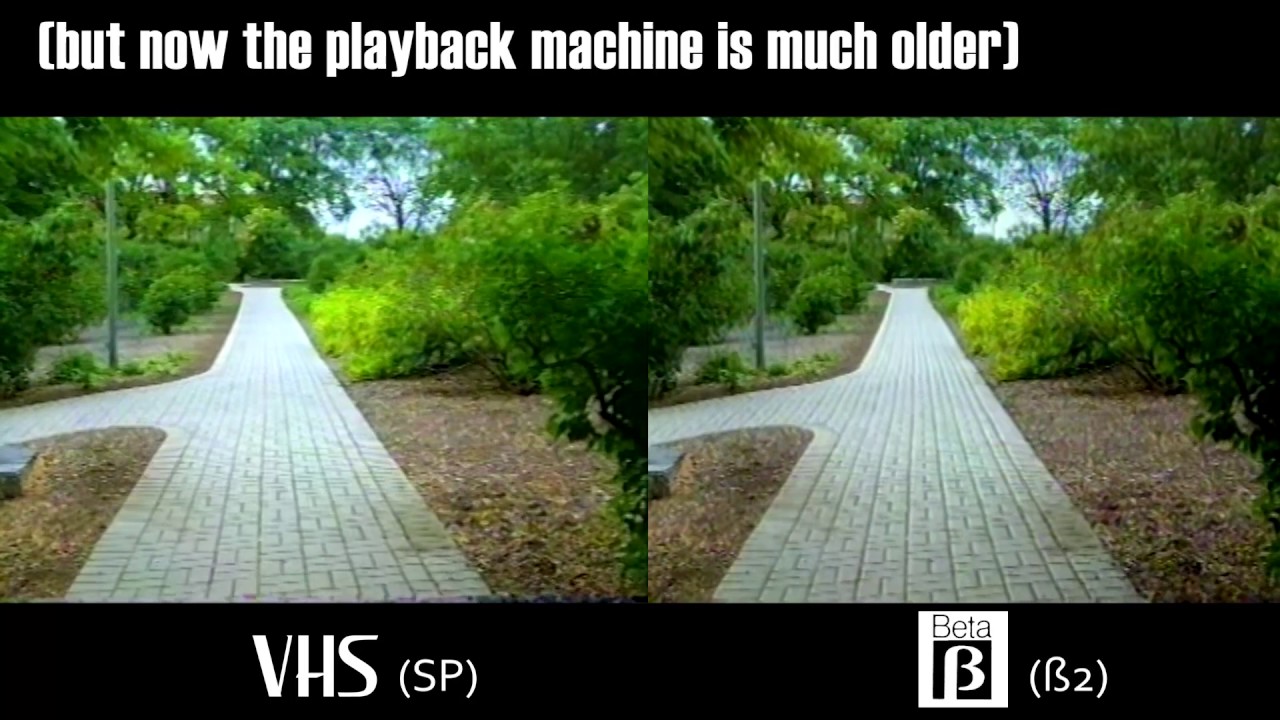
To establish a fairer contest between period-accurate machinery, the host pulled out a true vintage heavyweight: an RCA VDT-600 deck dating back to 1979. He substituted the original playback capture with output directly from this vintage machine. While the tape itself was originally recorded on the newer Panasonic deck—given that the 1979 RCA dinosaur does not record particularly cleanly—it was played back through the antique hardware. The host acknowledges that this might still leave the VHS footage with the slightest edge, but playing it back on a period-correct antique levels the contest considerably. The linear audio track from the original upload was retained for the VHS clips.
As the host remarks regarding the hardware adjustment: “This video has been re-uploaded to address an unfair advantage the VHS footage had in the previous version: the age of the VCR.”
[01:09](https://www.youtube.com/watch?v=_oJs8-I9WtA&t=69s) The Signal Chain: From Modern Smartphone to DVD-RAM
The source footage for the test consists of an outdoor stroll through Downtown Lombard and Lilacia Park, captured in full HD at 60 frames per second using a OnePlus 3 mounted on a gimbal for stabilization. To route this digital video into analog tape, the file was authored to a standard DVD and played back through a PlayStation 2 console via composite video out. That composite feed was simultaneously fed into the front-loading Toshiba Betamax deck and a Panasonic DMR-ES40V combo unit. The material was recorded across two speeds on each format: Standard Play (SP) and Super Long Play (SLP) on VHS, and Beta II and Beta III on Betamax. Beta I was deliberately omitted because it had been phased out on consumer hardware as early as 1979 due to its inefficient tape usage, leaving a 1-hour recording duration that Sony quickly deemed impractical. The VHS deck's Hi-Fi audio tracking was disabled to force playback through the standard linear mono audio track.
Capturing the analog playback back into a modern digital editing suite required a specialized workflow. Standard PC video capture dongles routinely botch analog signals by forcing crude de-interlacing that degrades motion into choppy 30p output. Instead, both VCRs were played through the Panasonic DMR-ES40V's composite inputs, using its built-in DVD recorder to generate genuine interlaced 29.97 fps NTSC video directly onto DVD-RAM discs. These discs output `.vro` files, a format that Sony Movie Studio handles natively while Adobe Premiere Pro fails to recognize. The host used an older laptop running Sony Movie Studio to export the files into high-bitrate NTSC standard MP4s, preserving the analog line structure before moving them to his main editing desktop. The final YouTube render was prepared at 60p to prevent interlacing artifacts and ensure modern displays render the full analog frame rate accurately.
The host pulls no punches when describing consumer digital capture hardware: “All video capture cards that I’ve used produce garbage output because they insist on de-interlacing, producing 30p footage that looks like crap.”
```mermaid flowchart TD accTitle: Analog Tape Testing Signal Chain accDescr: Pipeline showing the journey of video from mobile capture, through analog tape recording, to final PC editing. subgraph Source["Source Generation"] A["OnePlus 3 Phone<br>(1080p 60fps)"] --> B["Authored DVD"] B --> C["PlayStation 2<br>(Composite Output)"] end
subgraph Recording["Tape Recording & Playback"] C --> D["Toshiba Beta VCR<br>(Beta II & Beta III)"] C --> E["Panasonic DMR-ES40V<br>(VHS SP & SLP)"] E -. Tape transfer.-> F["1979 RCA VDT-600<br>(VHS Playback)"] end
subgraph Capture["Digital Ingest & Editing"] D --> G["Panasonic DVD-RAM Recorder<br>(Interlaced NTSC 29.97 fps)"] F --> G G --> H["DVD-RAM.vro Files<br>(Sony Movie Studio on Laptop)"] H --> I["High-Bitrate MP4<br>(Adobe Premiere Pro 60p Export)"] end ```
[03:48](https://www.youtube.com/watch?v=_oJs8-I9WtA&t=228s) Side-by-Side Visual Inspection: Color, Dropouts, and Test Patterns
Putting the two formats side by side reveals that their overall presentation is surprisingly matched, debunking the popular belief that Betamax offered a day-and-night visual leap over VHS. Both systems employ color-under (heterodyne) color processing, an analog technique where the chroma subcarrier is down-converted beneath the luminance band. Because chroma bandwidth is severely constrained in both formats, color resolution lags dramatically behind black-and-white luminance detail. When displaying colorful still photographs, both formats struggle noticeably with saturated red tones, though the Toshiba Beta deck displays a bit more smear and instability in saturated red patches, which could be an artifact of that individual deck's aging circuitry.
When evaluated with standard television calibration charts, the performance envelope between the two consumer formats remains neck and neck. An Indian Head test pattern reveals nearly identical resolution limits across the converging line rasters, demonstrating that consumer Betamax does not extract significantly more horizontal resolving lines than VHS at standard playback speeds. Furthermore, the SMPTE color bar chart produces rough, jagged color transitions on both formats, with severe color distortion and fringing cropping up along the magenta bars and across the tricky red-blue color boundaries.
Addressing the shared color limitations of consumer video tape, the host observes: “Both VHS and Beta use a color-under encoding technique, and the resolution of the color is quite poor compared to the image resolution.”
- Both formats exhibit signal compromises due to low-bandwidth color-under chroma encoding. - The 30-year-old Toshiba Betamax hardware suffers from intermittent video signal dropouts. - Indian Head pattern tests display virtually indistinguishable horizontal resolving power between standard VHS and Beta II. - SMPTE color bars demonstrate severe edge degradation on both formats, most prominently at red-blue color interfaces.
[06:11](https://www.youtube.com/watch?v=_oJs8-I9WtA&t=371s) The Sharpness Reality: The Fingerprint Effect and Slower Speeds
Scrutinizing full-motion video dispels the myth of Beta’s immediate visual dominance at primary recording speeds. In direct comparisons of real-world scenes, Beta II does not produce a sharper or visibly superior picture compared to VHS SP; the two formats look nearly identical in line detail and texture. Betamax, however, exhibits a distinct artifact visible in smooth gradients such as open daylight skies: the infamous "fingerprint effect." This persistent moiré-like pattern plagued virtually all Beta II recordings, lingering as an unavoidable byproduct of how the format packed high-density video onto tape without guard bands.
Where Betamax does claim a genuine, unmistakable victory over VHS is at their slowest recording modes. Beta III footage is visibly sharper and more coherent than VHS SLP (EP), which degrades into a soft, smeary picture. Linear audio is also noticeably better on Beta III, which follows from the fact that tape moves past the stationary audio head at a faster rate in Beta III than in VHS SLP. While the Toshiba Betamax unit exhibited audible wow and flutter in Beta III audio—likely due to deteriorated filter capacitors inside the capstan motor's power delivery circuit—the overall fidelity remained superior. However, the host points out that comparing Beta III directly to SLP is fundamentally misleading: Beta III offers roughly three to four hours of runtime, putting it in direct competition with VHS LP (Long Play), whereas VHS SLP sacrificed fidelity to achieve unmatched six- to eight-hour recording windows on a single cassette.
Assessing the overall visual comparison between the formats, the host concludes: “There’s nothing about the output from the Beta machine that says to me, this is superior to VHS.”
[08:02](https://www.youtube.com/watch?v=_oJs8-I9WtA&t=482s) Sony’s Tape Speed Conundrum and the Betacam Distinction
Evaluating the format war objectively reveals why Betamax surrendered its quality advantage early on. Beta I was technically sharper than VHS SP, but Sony was forced to abandon Beta I recording functionality by 1979 because a standard L-500 tape could only fit a single hour of footage at that speed. To match consumer demand for recording full football games and long movies without swapping cassettes, Sony elevated Beta II to the default standard. Because Beta II was the technical counterpart to VHS LP rather than VHS SP, the real-world fidelity of consumer Beta plummeted to roughly parity with VHS. Sacrificing Beta I eliminated the format's primary technical edge, but offering a two-hour baseline runtime was an absolute necessity for commercial survival.
The host addresses a common historical rationalization: the claim that Betamax never truly lost the format war because it went on to dominate broadcast television through Betacam. This argument conflates two radically different technologies. While a Betacam cassette shares the same shell geometry as a consumer Betamax tape, Betacam recorded analog component video (Y, R-Y, B-Y) across isolated tracks at blazing tape speeds, making tapes completely unplayable on consumer Betamax VCRs. Furthermore, professional Betacam later introduced the physically enlarged Betacam L cassette shell to overcome the physical capacity ceiling that doomed consumer Beta. Professional studios could easily afford massive, expensive equipment, whereas home consumers were bound by price and convenience. Because Betacam was strictly an enterprise broadcast tool that was never marketed to everyday living rooms, its studio success has no bearing on the consumer format war won by VHS.
Reflecting on the critical technical pivot Sony made in the late 1970s, the host points out: “As I said in the last videos, by disabling Beta 1, Sony got rid of much of the picture advantage Beta had over VHS.”
| Metric / Feature | Consumer Betamax (Beta II / Beta III) | Consumer VHS (SP / SLP) | Professional Betacam | |:--- |:--- |:--- |:--- | | **Color Method** | Color-under (Heterodyne) | Color-under (Heterodyne) | Isolated Component Video (Y, R-Y, B-Y) | | **Consumer Speed Parity** | Beta II roughly matches VHS LP | SP offers maximum baseline quality | High-speed tape transport | | **Extended Play Fidelity** | Beta III retains decent sharpness | SLP exhibits heavy softness and smear | Uses enlarged Betacam L shells | | **Consumer Tape Limits** | L-500 shell limited 1-hr Beta I run | T-120 offered 2 hrs SP / 6 hrs SLP | Irrelevant (priced for broadcast market) | | **Interchangeability** | Plays on Betamax consumer decks | Plays on VHS consumer decks | Completely incompatible with consumer Beta |
## Notable quotes > [06:11](https://www.youtube.com/watch?v=_oJs8-I9WtA&t=371s) There’s nothing about the output from the Beta machine that says to me, this is superior to VHS.
> [08:02](https://www.youtube.com/watch?v=_oJs8-I9WtA&t=482s) by disabling Beta 1, Sony got rid of much of the picture advantage Beta had over VHS.
> [03:48](https://www.youtube.com/watch?v=_oJs8-I9WtA&t=228s) Both VHS and Beta use a color-under encoding technique, and the resolution of the color is quite poor compared to the image resolution.
## Mentioned Adobe Premiere Pro, Betacam, Betacam L, Betamax, Downtown Lombard, Lilacia Park, OnePlus 3, Panasonic DMR-ES40V, Patreon, PlayStation 2, RCA VDT-600, SMPTE, Sony, Sony Movie Studio, Technology Connections, Toshiba, VHS, YouTube
## Video description You can support this channel on Patreon! Link below This video has been re-uploaded with the VHS footage captured from the RCA VDT-600, a VCR from 1979. This is a much fairer comparison than using the Panasonic unit as the VHS playback device. Many people believe that Beta was a vastly superior product to VHS, but I think this was mostly marketing prowess on Sony's part. People seemed to think that they were giving up something of quality if the went with VHS over Beta. But as this video will demonstrate, I don't think that was really the case.
You can support Technology Connection through Patreon! Find me here: https://www.patreon.com/technologyconnections
[Source](https://www.youtube.com/watch?v=_oJs8-I9WtA)