Boston Dynamics Atlas Robot Hits 80% Success Rate in Gymnastics
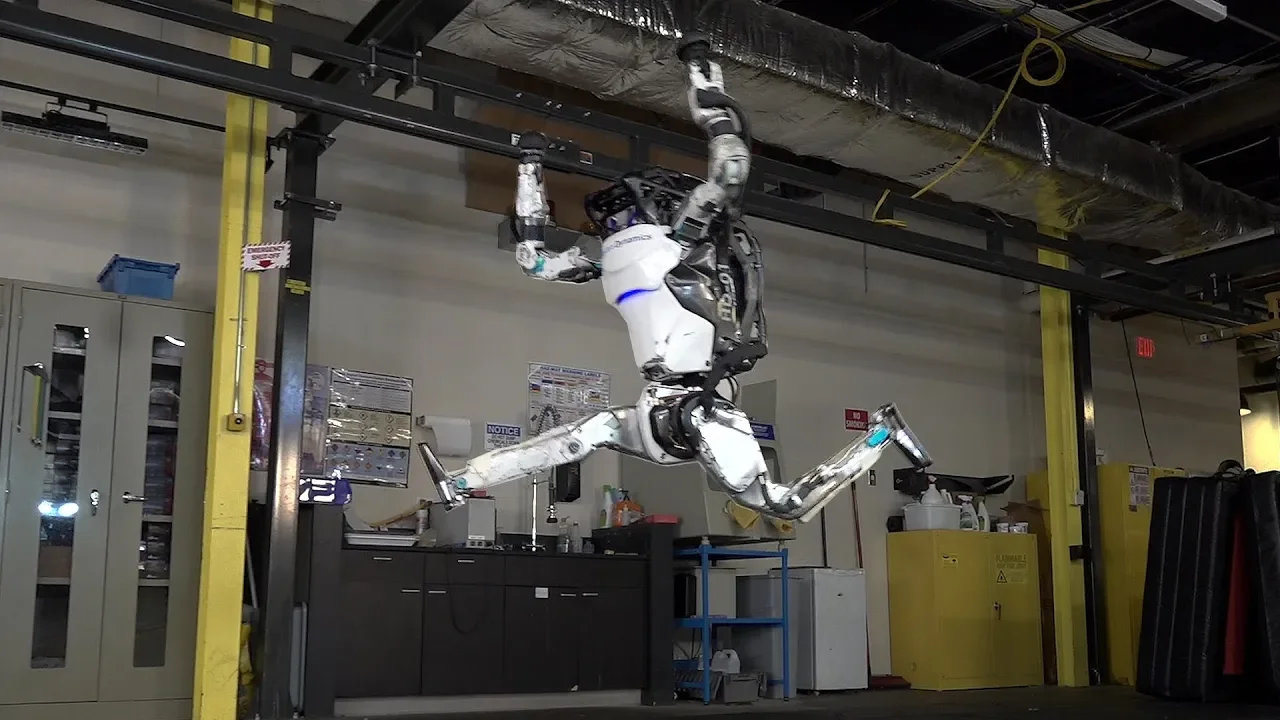
Boston Dynamics
Pairing trajectory optimization with model predictive control slashes routine development time while sustaining an 80% execution rate across whole-body maneuvers.
AI-assisted summary of More Parkour Atlas — original source. Check the original for full context.
Source published:
Key ideas
- Boston Dynamics demonstrated its humanoid robot Atlas performing a continuous gymnastic parkour routine utilizing full whole-body coordination. (0:00)
- The development workflow employs an optimization algorithm to convert high-level maneuver descriptions into dynamically feasible reference motions. (0:00)
- A real-time model predictive controller tracks reference trajectories while smoothly blending transitions between sequential maneuvers. (0:00)
- The new streamlined development pipeline produced dynamic routines significantly faster than prior methods, achieving an operational success rate of roughly 80%. (0:00)
Detailed notes
## Background Published on YouTube by Boston Dynamics on September 24, 2019, this demonstration features the humanoid robot Atlas performing an athletic gymnastic routine. The video description details a streamlined development process where an optimization algorithm and a model predictive controller allow Atlas to coordinate its whole body across dynamic maneuvers with an 80% success rate.
## TL;DR The video highlights the humanoid robot Atlas executing a continuous series of gymnastic and parkour maneuvers using coordinated movements of its arms, legs, and torso to sustain momentum. To achieve this, an optimization algorithm converts high-level maneuver descriptions into dynamically feasible reference trajectories. In execution, a real-time model predictive controller smoothly blends these trajectories from one maneuver directly into the next. This refined engineering approach significantly reduced routine development times while achieving an approximate 80% operational success rate.
## Atmosphere & style The presentation has a sleek, clinical, and astonishingly fluid feel, emphasizing pure robotic agility without distracting production elements. Watching Atlas carry out complex athletic choreography creates a striking sensation of mechanical life and physical grace. The brief showcase offers an intense, focused glimpse into advanced robotics that leaves a lasting impression of effortless kinetic power.
## Bulletin - [00:00](https://www.youtube.com/watch?v=_sBBaNYex3E&t=0s) Boston Dynamics demonstrated its humanoid robot Atlas performing a continuous gymnastic parkour routine utilizing full whole-body coordination. - [00:00](https://www.youtube.com/watch?v=_sBBaNYex3E&t=0s) The development workflow employs an optimization algorithm to convert high-level maneuver descriptions into dynamically feasible reference motions. - [00:00](https://www.youtube.com/watch?v=_sBBaNYex3E&t=0s) A real-time model predictive controller tracks reference trajectories while smoothly blending transitions between sequential maneuvers. - [00:00](https://www.youtube.com/watch?v=_sBBaNYex3E&t=0s) The new streamlined development pipeline produced dynamic routines significantly faster than prior methods, achieving an operational success rate of roughly 80%.
## Key takeaways - [00:00](https://www.youtube.com/watch?v=_sBBaNYex3E&t=0s) Atlas executes a continuous sequence of dynamic gymnastic maneuvers rather than isolated, discrete actions. - [00:00](https://www.youtube.com/watch?v=_sBBaNYex3E&t=0s) The robot relies on whole-body coordination—synchronizing its legs, arms, and torso—to preserve momentum and dynamic balance. - [00:00](https://www.youtube.com/watch?v=_sBBaNYex3E&t=0s) New development techniques were implemented to streamline the creation of complex robotic parkour routines. - [00:00](https://www.youtube.com/watch?v=_sBBaNYex3E&t=0s) High-level behavioral descriptions of movements are computationally converted into dynamically feasible reference trajectories using an optimization algorithm. - [00:00](https://www.youtube.com/watch?v=_sBBaNYex3E&t=0s) Real-time trajectory tracking on Atlas is managed by a model predictive controller. - [00:00](https://www.youtube.com/watch?v=_sBBaNYex3E&t=0s) The model predictive controller enables seamless blending from one gymnastic maneuver directly into the next. - [00:00](https://www.youtube.com/watch?v=_sBBaNYex3E&t=0s) The optimization and control pipeline drastically reduced routine development time compared to earlier Atlas development cycles. - [00:00](https://www.youtube.com/watch?v=_sBBaNYex3E&t=0s) The dynamic routine achieves a performance success rate of approximately 80% under this control framework.
## Detailed walkthrough ### [00:00](https://www.youtube.com/watch?v=_sBBaNYex3E&t=0s) Dynamic Gymnastic Maneuvers and Motion Control
During the brief clip, a prompt notes, “I'm going to go to the next video,” as the showcase captures Boston Dynamics' humanoid robot, Atlas, executing a continuous sequence of dynamic gymnastic maneuvers. Rather than relying solely on isolated leg movements, Atlas employs whole-body coordination—synchronizing its legs, arms, and torso—to maintain balance and momentum across complex parkour actions.
The development workflow behind these maneuvers relies on a streamlined two-stage process. First, an optimization algorithm converts high-level behavioral descriptions of each movement into dynamically feasible reference trajectories. Next, Atlas executes and tracks these paths in real time using a model predictive controller, which blends individual actions seamlessly into the next movement. This streamlined pipeline allowed the team to construct dynamic routines significantly faster than during earlier Atlas development cycles, yielding an operational success rate of approximately 80%.
```mermaid flowchart LR accTitle: Atlas Dynamic Motion Control Pipeline accDescr: Diagram illustrating the workflow from high-level maneuver descriptions to dynamic routine execution on Atlas. subgraph Planning["Trajectory Generation"] A["High-Level Maneuver Description"] --> B["Optimization Algorithm"] B --> C["Dynamically Feasible Reference Motions"] end subgraph Execution["Real-Time Control"] C --> D["Model Predictive Controller"] D --> E["Whole-Body Dynamic Routine"] end ```
- Atlas utilizes its entire physical structure—including torso, arms, and legs—to coordinate momentum and balance throughout the routine. - Dynamic reference trajectories are generated by an optimization algorithm from high-level movement inputs. - Real-time tracking is handled by a model predictive controller that smoothly blends transitions between distinct maneuvers. - The development approach achieved an approximate 80% success rate while drastically reducing iteration time compared to prior routines.
## Mentioned Atlas, Boston Dynamics
## Video description Atlas uses its whole body -- legs, arms, torso -- to perform a sequence of dynamic maneuvers that form a gymnastic routine. We created the maneuvers using new techniques that streamline the development process. First, an optimization algorithm transforms high-level descriptions of each maneuver into dynamically-feasible reference motions. Then Atlas tracks the motions using a model predictive controller that smoothly blends from one maneuver to the next. Using this approach, we developed the routine significantly faster than previous Atlas routines, with a performance success rate of about 80%. For more information visit us at https://www.BostonDynamics.com.
[Source](https://www.youtube.com/watch?v=_sBBaNYex3E)