Credit Reports: Last Week Tonight with John Oliver (HBO)
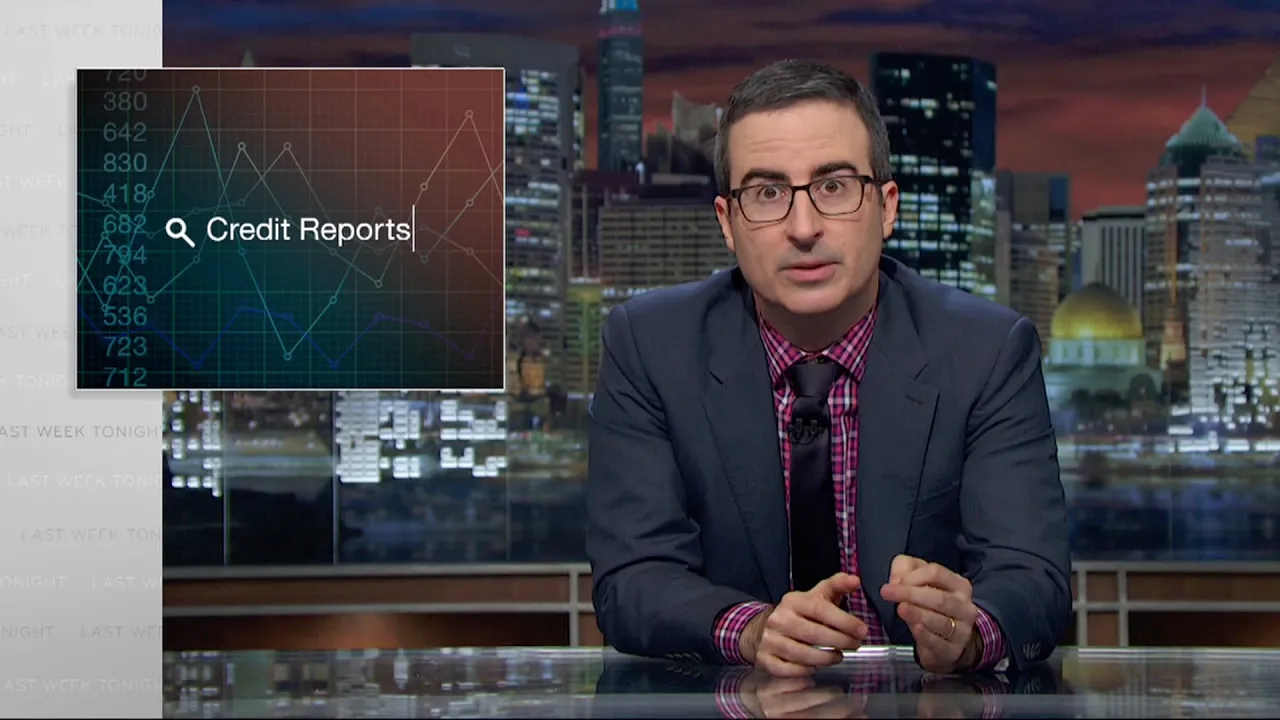
LastWeekTonight
AI-assisted summary of Credit Reports: Last Week Tonight with John Oliver (HBO) — original source. Check the original for full context.
Source published:
Key ideas
- Roughly 47% of employers conduct credit checks on job applicants, even though credit bureaus have admitted under legislative questioning that no statistical research links credit histories to job performance or workplace fraud. (0:04)
- Government research reveals that 25% of consumers have errors on at least one credit report, while 5% suffer from serious inaccuracies that raise borrowing costs—affecting approximately 10 million Americans across the Big Three bureaus. (4:26)
- Over 50% of debt on consumer credit reports originates from medical bills, skewing financial assessments based on involuntary medical emergencies rather than fiscal irresponsibility. (4:26)
- Federal oversight of background check screening remains critically weak, with the FTC acknowledging that it does not maintain a national registry and cannot determine how many background screening firms operate in the country. (14:05)
Detailed notes
## Background Published on YouTube by the official LastWeekTonight channel on April 11, 2016, this segment from HBO's *Last Week Tonight with John Oliver* examines the outsized role credit reports play in everyday American life. According to the video's description, while credit reports exert immense influence, they are shockingly prone to critical mistakes, prompting Oliver to demonstrate to the reporting agencies why this widespread inaccuracy is a catastrophic problem.
## TL;DR John Oliver investigates how the "Big Three" credit reporting agencies—Equifax, Experian, and TransUnion—dominate consumer lives by expanding credit checks into housing, insurance, and employment screening without empirical proof connecting credit scores to workplace reliability. He breaks down the alarming prevalence of reporting errors, noting that over half of delinquent debt is medical and that roughly 10 million Americans suffer from severe inaccuracies that derail their livelihoods. After exposing the nearly insurmountable nightmare of disputing errors and the lack of federal oversight over private background screening agencies, Oliver challenges the industry's dismissive stance on its 5% failure rate. In response, he launches three grotesque, phonetically similar parody businesses to subject the credit bureaus to the exact same sting of mistaken identity.
## Atmosphere & style The segment delivers an entertaining mix of investigative fury and relentless, irreverent humor, oscillating between alarming administrative realities and absurd, high-energy pop-culture analogies. Watching it feels like tumbling down a Kafkaesque rabbit hole of corporate apathy, as heartbreaking real-world stories of innocent citizens being classified as corpses or terrorists are underscored by Oliver's mounting exasperation. The narrative arc builds a sense of righteous frustration before releasing the tension through a gleefully petty act of corporate retaliation that feels both hilarious and cathartic.
## Bulletin - [00:04](https://www.youtube.com/watch?v=aRrDsbUdY_k&t=4s) Roughly 47% of employers conduct credit checks on job applicants, even though credit bureaus have admitted under legislative questioning that no statistical research links credit histories to job performance or workplace fraud. - [04:26](https://www.youtube.com/watch?v=aRrDsbUdY_k&t=266s) Government research reveals that 25% of consumers have errors on at least one credit report, while 5% suffer from serious inaccuracies that raise borrowing costs—affecting approximately 10 million Americans across the Big Three bureaus. - [04:26](https://www.youtube.com/watch?v=aRrDsbUdY_k&t=266s) Over 50% of debt on consumer credit reports originates from medical bills, skewing financial assessments based on involuntary medical emergencies rather than fiscal irresponsibility. - [14:05](https://www.youtube.com/watch?v=aRrDsbUdY_k&t=845s) Federal oversight of background check screening remains critically weak, with the FTC acknowledging that it does not maintain a national registry and cannot determine how many background screening firms operate in the country.
## Key takeaways - [00:04](https://www.youtube.com/watch?v=aRrDsbUdY_k&t=4s) Credit reports have expanded beyond lending into rental housing, insurance rate calculations, and employment screening across standard and entry-level positions. - [00:04](https://www.youtube.com/watch?v=aRrDsbUdY_k&t=4s) Nearly half of all employers run credit checks on applicants despite lacking empirical proof of their predictive value. - [02:09](https://www.youtube.com/watch?v=aRrDsbUdY_k&t=129s) TransUnion admitted before an Oregon legislative committee that it has no statistical research linking poor credit to inferior workplace performance or employee theft. - [04:26](https://www.youtube.com/watch?v=aRrDsbUdY_k&t=266s) More than half of consumer debt listed on credit reports stems from medical expenses rather than discretionary spending. - [04:26](https://www.youtube.com/watch?v=aRrDsbUdY_k&t=266s) A government study determined that 1 in 4 consumers has a credit report error, and 1 in 20 faces severe errors causing higher loan and mortgage costs. - [04:26](https://www.youtube.com/watch?v=aRrDsbUdY_k&t=266s) Bureau file-merging errors have resulted in innocent consumers being falsely classified as deceased or matched with government terrorist watchlists. - [07:44](https://www.youtube.com/watch?v=aRrDsbUdY_k&t=464s) Independent background screening companies bundle criminal, driving, and credit records, frequently creating life-altering errors such as false matches to registered sex offenders. - [07:44](https://www.youtube.com/watch?v=aRrDsbUdY_k&t=464s) The Fair Credit Reporting Act (FCRA) legally entitles consumers to one free disclosure of their credit files per year from each major bureau. - [10:50](https://www.youtube.com/watch?v=aRrDsbUdY_k&t=650s) Resolving errors can trap consumers in multi-year bureaucratic battles, leading the Big Three bureaus to generate the highest volume of consumer complaints to the CFPB. - [10:50](https://www.youtube.com/watch?v=aRrDsbUdY_k&t=650s) Despite recurring regulatory settlements and decades of media exposés, credit bureau error rates have remained stubbornly persistent since the 1990s. - [14:05](https://www.youtube.com/watch?v=aRrDsbUdY_k&t=845s) Because background check companies generate files on demand rather than maintaining static archives, consumers are largely unable to verify or correct information before losing job offers. - [14:05](https://www.youtube.com/watch?v=aRrDsbUdY_k&t=845s) The Federal Trade Commission lacks a registry of background screening agencies and does not track how many operate nationwide. - [16:28](https://www.youtube.com/watch?v=aRrDsbUdY_k&t=988s) The credit reporting trade lobby spun an FTC finding of a 5% serious error rate as a 95% accuracy success, discounting the 10 million Americans harmed by inaccurate files. - [16:28](https://www.youtube.com/watch?v=aRrDsbUdY_k&t=988s) Last Week Tonight incorporated three repugnant parody businesses resembling Equifax, Experian, and TransUnion to expose the harm of reputational damage caused by mistaken identity.
## Detailed walkthrough ### [00:04](https://www.youtube.com/watch?v=aRrDsbUdY_k&t=4s) The Pervasive Reach of Credit Reports
John Oliver introduces credit reports as the foundation of the single most important three-digit number in an American's life—other than 311, “the Beatles of rap-rock.” While credit scoring is critical to the modern economy by helping lenders determine whom to extend credit to, its standards have a long history. Oliver rolls a vintage educational film illustrating the traditional criteria for borrowing, where a narrator instructs: “Scoring high on these three C's is essential to earn a good credit rating.” In the clip, the required three C's are listed as character, capacity, and capital. Oliver dryly notes that back when the film was made, there was an unmentioned fourth C determining credit access: “namely, what color you were.”
```mermaid flowchart TD accTitle: Impact of Credit Reports Beyond Banking accDescr: Flowchart illustrating how credit reports affect lending, housing, insurance, and employment decisions.
subgraph CR["Credit Reporting Bureau Data"] R["Credit Report & Score"] end
subgraph USES["Everyday Uses"] B["Lending Decisions\n(Banks & Mortgages)"] L["Housing Access\n(Landlords)"] I["Rate Setting\n(Insurers)"] E["Hiring & Screening\n(47% of Employers)"] end
R --> B R --> L R --> I R --> E ```
The reach of credit reports has expanded far past traditional banking decisions. Today, landlords use them to screen potential tenants, insurance companies review them to calculate premiums, and employers increasingly use them during hiring. A news report highlights that 47% of employers run credit checks on prospective hires, which is completely legal provided the applicant gives consent. Oliver points out absurd Craigslist job postings requiring spotless credit, ranging from managing a Benihana restaurant in Cincinnati to operating a roadside seasonal fireworks tent. For a fireworks stand, Oliver argues, an employer does not need to scrutinize credit history; the only qualifying question should be finding someone who loves lighting fireworks, and the only relevant three digits are “the ones on that person's two hands.”
- Nearly half (47%) of employers conduct credit checks on job applicants with applicant consent. - Credit checks appear in entry-level and service job advertisements, such as running seasonal fireworks stands.
---
[02:09](https://www.youtube.com/watch?v=aRrDsbUdY_k&t=129s) Selling False Correlations to Employers
The credit reporting industry is dominated by three major agencies: Equifax, Experian, and TransUnion. These firms aggressively promote credit data for non-lending purposes, particularly employment screening. Experian pitches employers on the idea that credit responsibility mirrors workplace reliability, claiming: “If you manage your credit well, then it's very likely you're going to manage the company's money well.” Oliver ridicules this claim using himself as an example, remarking that while his personal credit is likely fine, he routinely squanders HBO’s budget on ridiculous costumes, pyrotechnics, and checkered dress shirts, demonstrating no inherent ability to manage corporate funds.
TransUnion similarly advertises on its website that credit histories enable employers to evaluate job candidates quickly and easily. However, this marketing collapses under scrutiny. During testimony before an Oregon legislative committee, an Oregon lawmaker asked a TransUnion representative point-blank for proof connecting credit histories to workplace theft or performance issues. The TransUnion representative conceded: “I guess in that case I would say that there at this point we don't have any research to show any statistical correlation between what's in somebody's credit report and their job performance or their likelihood to commit fraud.”
Despite having just admitted that no empirical evidence exists, the same representative suggested less than thirty seconds later that if an employer must choose between two otherwise identical applicants, having high debt might still be something worth considering. Oliver mocks the sheer absurdity of acknowledging a total lack of correlation while telling employers they are free to imagine one anyway, comparing it to believing that eating alphabet soup makes one's vocabulary expand: “I can imagine that eating alphabet soup will increase my vocabulary—that does not make it indubitable.”
- The "Big Three" credit bureaus are Equifax, Experian, and TransUnion. - TransUnion testified before an Oregon legislative body that it lacks any statistical research linking poor credit to inferior job performance or a propensity to commit workplace fraud.
---
[04:26](https://www.youtube.com/watch?v=aRrDsbUdY_k&t=266s) Medical Debt and Rampant Errors: From Terrorists to the Deceased
Relying on credit scores as a barometer of moral character is deeply flawed, not least because over half of all debt appearing on credit reports stems from medical expenses. As Oliver notes, illness is not a voluntary choice. Furthermore, the reports are plagued by an alarming rate of inaccuracies. A government study revealed that approximately 25% of consumers have an error on at least one of their credit reports, and 1 in 20 people suffer from errors severe enough to force them into paying higher rates on mortgages or auto loans. Oliver compares this failure rate to consumer fast food: if one out of every twenty Wendy's Frostys turned out to be a cup of warm goat semen, the public would demand immediate accountability.
These clerical blunders cause immense havoc. In one instance, a woman named Judy Thomas was repeatedly denied loans and discovered that her credit file was cluttered with medical collections, veterinary bills, and collection notices belonging to an entirely different person named Judith Kendall. In another egregious case of mistaken identity, a man named Amit Patel was denied his dream apartment because a credit agency conflated his name with a government sanctions watch list, slapping the label “terrorist” directly onto his credit file. Oliver points out the sheer incompetence of using rental apartment rejections as the frontline defense against global terrorism.
An even more extreme error befell Helen Mill, who attempted to purchase a travel trailer only to have the dealership's finance manager explain that she could not be processed because the three major credit bureaus had declared her dead. Describing the bureaucratic nightmare of trying to purchase a credit score while officially classified as a corpse, Mill stated: “You can't get anything when you're deceased—no credit score, there's nothing, you don't even exist.”
- Over 50% of debt reported on consumer credit reports originates from medical bills. - A government study found 25% of consumers have errors on credit reports, and 5% (1 in 20) have significant errors that alter borrowing costs. - Common reporting failures include blended files (confusing different people like Judy Thomas and Judith Kendall), false matches to national security sanction watchlists, and erroneously marking living consumers as deceased.
---
[07:44](https://www.youtube.com/watch?v=aRrDsbUdY_k&t=464s) The Broader Background Check Industry and General Information Services
The threat of inaccurate reporting extends well beyond the Big Three into hundreds of background screening agencies that package credit scores alongside criminal and driving records. While some agencies operate conscientiously, others show questionable professionalism. Oliver showcases an internal promotional video by General Information Services (GIS) that features Snow White consulting the company's "magic mirror" to run checks on the seven dwarfs. In the clip, an actor makes an awkward, homophobic pun regarding fairies, prompting Oliver to criticize both their judgment and the amateurish acting.
The consequences of slipshod criminal background checks can destroy lives. Oliver references Chicago resident Samuel Jackson, who was denied employment opportunities because a background screening firm conflated his record with those of three separate registered sex offenders. One of the underlying crimes had taken place when Jackson was only three years old. Jackson's attorney highlighted the absurdity of the match, stating: “The background check company was aware that Mr. Jackson is only 30 years old, so it clearly couldn't have been him, and obviously he couldn't be all three sex offenders at the same time.”
Because these reckless mistakes systematically cost innocent people employment and shelter, screening agencies have faced severe legal backlash. In the previous year, GIS and its affiliates paid $13 million in fines and damages to resolve allegations of inaccurate reporting. Oliver emphasizes that while consumers facing these injustices often feel compelled to inspect their records immediately, the Fair Credit Reporting Act does at least give individuals the legal right to access a free copy of their credit files from the major bureaus once every year.
- Hundreds of third-party background screening firms bundle credit reports with criminal histories and driving records. - General Information Services (GIS) and its affiliates settled litigation and regulatory actions for $13 million in fines and damages over screening errors. - The Fair Credit Reporting Act (FCRA) mandates that the major nationwide credit reporting agencies provide consumers with one free credit disclosure per year upon request.
[10:50](https://www.youtube.com/watch?v=aRrDsbUdY_k&t=650s) The Endless Dispute Nightmare and Industry Complacency
Even though consumers have an official website to request their reports, discovering an error is often just the beginning of a protracted ordeal. The story of Judy Thomas highlights how broken the dispute process can be: it turned into a grueling six-year battle involving boxes of correspondence to prove she was Judy Thomas and not "Judith Kendall." Despite hiring a local attorney and having official documentation certified—confirming her identity, her residence, that she had never used the surname Kendall, and that she had never even stepped foot in Utah, let alone owed money to a Utah cable company—the credit agencies did nothing. John Oliver jokes that at that point, she might as well have given up, changed her name to Judith Kendall, moved to Utah, adopted a sick pet, and bought a cable package just to make her life make sense.
```mermaid flowchart TD accTitle: The Credit Dispute Loophole and Failure accDescr: Flowchart illustrating the consumer struggle when attempting to correct credit report errors.
subgraph Error["Data Contamination"] A["Inaccurate Data Injected\n(Wrong identity / False debt)"] --> B["Credit Report Ruined"] end
subgraph Bureaucracy["The Dispute Black Hole"] B --> C["Consumer Files Dispute\n(Letters & Legal Affidavits)"] C --> D{"Bureaus Blame Creditors"} D -->|"Settlements & Promises"| E["No Substantive Change\n(6-Year Battles)"] end
subgraph Reality["CFPB & Media Findings"] E --> F["Top CFPB Complaints"] F --> G["Decades of Recurring News Exposés\n(1990s to Present)"] end ```
Unsurprisingly, the Big Three credit bureaus (Equifax, Experian, and TransUnion) received the highest number of consumer complaints submitted to the Consumer Financial Protection Bureau (CFPB) since the start of the previous year. While bureaus often deflect blame by arguing that inaccurate data originates from creditors, Oliver stresses that their dispute resolution mechanisms are woefully inadequate. Although the agencies signed a settlement agreement pledging to overhaul their dispute processes, Oliver notes that the industry has spent a quarter of a century claiming it is constantly improving accuracy. Yet local news broadcasts over the last 25 years have continuously sounded the exact same alarm about studies finding staggering error rates, ranging from 25% to nearly one-third of all credit reports containing serious inaccuracies. Oliver compares these repetitive news stories to routine media staples like reporting on the death of the world's oldest person or inventing panicked teen sex trends—riffing on the idea of teens graduating from "Netflix and chill" to something far more alarming like "Hulu and rim job."
The absurdity reached a peak during research for the segment: the show uncovered a news broadcast from 2002 describing an identical six-year legal battle against TransUnion by a completely different woman who was *also* named Judy Thomas. Oliver quips:
> “The lesson here is pretty simple: if you or someone you know is named Judy Thomas, give up; there is no hope in life for Judies like you.”
- The CFPB received more consumer complaints about the Big Three credit bureaus than about any other financial entities since the start of the previous year. - A cited U.S. Public Interest Research Group (PIRG) survey revealed that nearly one-third of examined credit reports contained serious errors. - A 2002 lawsuit proved that at least two separate women named Judy Thomas spent six years each trying to fix mistaken identities on their TransUnion reports.
---
[14:05](https://www.youtube.com/watch?v=aRrDsbUdY_k&t=845s) Background Check Blindspots and Federal Inaction
The situation is arguably worse within the background check industry. While federal law requires background check companies to provide consumers with copies of their files upon request, an enormous structural loophole exists: unlike the credit bureaus, most background check companies do not maintain pre-existing files on all consumers. Instead, they dynamically aggregate public and commercial data only after an employer or landlord pays them to conduct a search. Because many of these companies refuse to allow individuals to preemptively order their own background checks, an applicant cannot easily verify what errors might be lurking. A person could be erroneously matched with a convicted sex offender and only learn about the error after an apartment or employment offer has already vanished—likely lost, as Oliver jokes, to an overqualified and charismatic rival like Neil Patrick Harris landing a CPA job.
When *Last Week Tonight* tested whether companies would sell staffers their own background reports, only a subset agreed. Although most reports returned clean, five staffers discovered completely unfamiliar alias names tied to their files. Most alarmingly, staffer Charles Wilson found himself matched with an individual indicted for Medicaid fraud in Florida. While the website tagged the entry as "pending verification" and eventually scrubbed it, Oliver jokes that it came too late, as the entire writers' room had already staged a *Spartacus*-style show of solidarity by committing Medicaid fraud on Charles's behalf.
This Wild West atmosphere persists because regulators lack fundamental oversight. In a televised interview clip, an official from the Federal Trade Commission (FTC) admitted that the government does not even possess a national registry of background check companies, nor does it know how many are operating across the country. Oliver expresses disbelief that the government has lost track of companies that control people's livelihoods in the same careless way the public has lost track of the baffling proliferation of Oreo cookie flavors, such as root beer float.
---
[16:28](https://www.youtube.com/watch?v=aRrDsbUdY_k&t=988s) The Five-Percent Sweden Problem and Oliver’s Corporate Retaliation
The credit and background check industries operate with a troubling degree of complacency regarding these life-altering errors. Oliver revisits the FTC study mentioned earlier in the broadcast, which determined that one in twenty credit reports (5%) suffered from serious inaccuracies. Rather than taking accountability, an industry trade group issued a triumphant press release titled *"FTC Report Confirms Credit Reports Are Accurate,"* highlighting that 95% of consumers were completely unaffected. Oliver dismantles this spin by putting the raw math into perspective: with the Big Three maintaining records on over 200 million Americans, a "minor" 5% error margin wrecks the lives of roughly 10 million real people. As Oliver explains:
> “They’re basically saying, ‘Great news, everyone: we only fucked up a group equivalent to the entire population of Sweden! We’re the greatest!’”
```mermaid flowchart LR accTitle: Last Week Tonight Parody Bureau Mapping accDescr: Mapping the actual Big Three credit bureaus to the satirical parody companies launched by Last Week Tonight.
subgraph RealBureaus["The Big Three Credit Bureaus"] EQ["Equifax"] EX["Experian"] TU["TransUnion"] end
subgraph ParodySites["Satirical Counterparts Launched by Show"] PEQ["Equifa-x.com\n(Shelter Animals & Peanut Butter)"] PEX["Ex-perian.com\n(Mein Kampf Whispered to Babies)"] PTU["Trams-Union.com\n(Dead SeaWorld Orca Steaks)"] end
EQ -.->|"Targeted by"| PEQ EX -.->|"Targeted by"| PEX TU -.->|"Targeted by"| PTU ```
To give credit executives a firsthand taste of what it feels like to have one's identity confused with something horrific due to negligible quality standards, Oliver reveals that the show established three legally incorporated, reprehensible parody businesses deliberately named to mimic the bureaus:
* **Equifax** (`equifax.com` / phonetic spoof): A company that brings shelter animals into customers' residences so the animals can lick peanut butter off patrons' genitals before sending the animals straight back to the shelter. * **Experian** (`experian.com` / phonetic spoof): A venture that dispatches agents to whisper excerpts from Adolf Hitler's *Mein Kampf* directly into infants' ears, without consent from the babies or their parents. * **TransUnion** (`tramsunion.com` / phonetic spoof): A gourmet butcher shop selling steaks processed exclusively from the carcasses of deceased performing orcas from SeaWorld.
Oliver points out that having their corporate reputations dragged down by being mistaken for these repugnant businesses would be an absolute public relations nightmare for the credit agencies. He mockingly reassures them that they have nothing to worry about, concluding that the public will surely avoid confusing them at least 95% of the time—and by the bureaus' own published standards, that should be more than good enough.
## Notable quotes > [02:09](https://www.youtube.com/watch?v=aRrDsbUdY_k&t=129s) If you manage your credit well, then it's very likely you're going to manage the company's money well. — Experian
## Mentioned John Oliver, Equifax, Experian, TransUnion, Consumer Financial Protection Bureau, Federal Trade Commission, General Information Services, Fair Credit Reporting Act, U.S. Public Interest Research Group, Judy Thomas, Judith Kendall, Amit Patel, Helen Mill, Samuel Jackson, Charles Wilson, Benihana, Wendy's, SeaWorld, Netflix, Hulu, Neil Patrick Harris, Adolf Hitler
## Video description Credit reports play a surprisingly large role in our lives, but even more surprising is how often they contain critical mistakes. John Oliver helps credit agencies see why this is a problem.
Connect with Last Week Tonight online... Subscribe to the Last Week Tonight YouTube channel for more almost news as it almost happens: www.youtube.com/user/LastWeekTonight
Find Last Week Tonight on Facebook like your mom would: http://Facebook.com/LastWeekTonight
Follow us on Twitter for news about jokes and jokes about news: http://Twitter.com/LastWeekTonight
Visit our official site for all that other stuff at once: http://www.hbo.com/lastweektonight
[Source](https://www.youtube.com/watch?v=aRrDsbUdY_k)