Benn Jordan Halts Vinyl Releases Over Toxic PVC Degassing Risks
Benn Jordan
Vinyl records are sonically obsolete media that outgas hazardous concentrations of formaldehyde and volatile organic compounds into homes, warranting a consumer boycott until pressing plants replace toxic polyvinyl chloride with recyclable alternatives.
AI-assisted summary of VINYL: Maybe it's time we had an intervention. — original source. Check the original for full context.
Source published:
Key ideas
- Benn Jordan challenges the romanticized vinyl resurgence, arguing it is an economically driven push sparked by plummeting crude oil prices in the mid-2000s rather than an organic acoustic renaissance. (0:00)
- Objective testing and audio engineering realities demonstrate that digital audio formats offer superior fidelity, as vinyl mastering requires severely limiting dynamic range and bass frequencies to prevent mechanical tracking errors. (4:06)
- Indoor air quality experiments reveal that both vintage and newly unsealed records immediately off-gas hazardous levels of total volatile organic compounds (TVOC) and formaldehyde into domestic spaces without requiring needle friction. (11:14)
- Unlike residential construction materials, the record pressing industry remains largely unregulated, frequently incorporating toxic stabilizers like lead and cadmium into non-recyclable PVC. (13:21)
- Jordan urges artists and consumers to reject mass-produced PVC media in favor of sustainable, carbon-negative physical editions, estimating collective consumer pressure could force manufacturers to adopt safe alternatives within a year. (17:41)
Detailed notes
## Background Published on YouTube by musician and audio producer Benn Jordan on August 23, 2019, this video delivers a critical intervention examining the modern vinyl revival. Reflecting the channel description's prompt—that true vinyl lovers should demand the format be modernized—Jordan interrogates why the music world continues to embrace an obsolete, toxic physical medium.
## TL;DR Musician Benn Jordan deconstructs the romantic mythology of the modern vinyl resurgence, challenging claims of analog sonic superiority by highlighting the severe mechanical compromises and distortions inherent to turntable playback. Beyond audio fidelity, Jordan investigates the heavy environmental and health hazards of polyvinyl chloride (PVC), performing an air-quality experiment that reveals alarming spikes in airborne volatile organic compounds and formaldehyde from routine record handling. Citing his own refusal to press his music catalog onto standard vinyl, Jordan calls on collectors, musicians, and pressing plants to phase out toxic PVC in favor of sustainable, recyclable materials while preserving the mindful ritual of focused listening.
## Atmosphere & style The presentation carries a candid, pragmatic, and mildly irreverent tone that balances technical audio expertise with sharp skepticism toward industry marketing. Jordan addresses the viewer with calm, conversational intimacy, using dry humor and empirical curiosity to dismantle audiophile dogmas before shifting into genuine concern during his makeshift laboratory testing. The narrative arc moves from playful technological debunking to a sobering environmental caution, ultimately resolving into an earnest, reflective plea to cherish music listening as an intentional mental space rather than a physical consumer fetish.
## Bulletin - [00:00](https://www.youtube.com/watch?v=aZ2czFuIYmQ&t=0s) Benn Jordan challenges the romanticized vinyl resurgence, arguing it is an economically driven push sparked by plummeting crude oil prices in the mid-2000s rather than an organic acoustic renaissance. - [04:06](https://www.youtube.com/watch?v=aZ2czFuIYmQ&t=246s) Objective testing and audio engineering realities demonstrate that digital audio formats offer superior fidelity, as vinyl mastering requires severely limiting dynamic range and bass frequencies to prevent mechanical tracking errors. - [11:14](https://www.youtube.com/watch?v=aZ2czFuIYmQ&t=674s) Indoor air quality experiments reveal that both vintage and newly unsealed records immediately off-gas hazardous levels of total volatile organic compounds (TVOC) and formaldehyde into domestic spaces without requiring needle friction. - [13:21](https://www.youtube.com/watch?v=aZ2czFuIYmQ&t=801s) Unlike residential construction materials, the record pressing industry remains largely unregulated, frequently incorporating toxic stabilizers like lead and cadmium into non-recyclable PVC. - [17:41](https://www.youtube.com/watch?v=aZ2czFuIYmQ&t=1061s) Jordan urges artists and consumers to reject mass-produced PVC media in favor of sustainable, carbon-negative physical editions, estimating collective consumer pressure could force manufacturers to adopt safe alternatives within a year.
## Key takeaways - [00:00](https://www.youtube.com/watch?v=aZ2czFuIYmQ&t=0s) A standard 12-inch vinyl record stores around 11 songs with mechanical compromises, compared to modern memory cards holding thousands of lossless studio-quality master files. - [01:00](https://www.youtube.com/watch?v=aZ2czFuIYmQ&t=60s) The vinyl revival was economically driven by dropping crude oil prices that inflated manufacturing margins, coupled with initiatives like Record Store Day that primarily offloaded non-returnable stock for major record labels. - [04:06](https://www.youtube.com/watch?v=aZ2czFuIYmQ&t=246s) Physical limitations of the turntable stylus force mastering engineers to compromise bass response and stereo width, meaning praised analog 'warmth' stems from mechanical coloration rather than fidelity. - [05:15](https://www.youtube.com/watch?v=aZ2czFuIYmQ&t=315s) Double-blind scientific research, including a study with 40 music majors across diverse instruments, resulted in 96% of participants preferring digital recordings over analog. - [07:22](https://www.youtube.com/watch?v=aZ2czFuIYmQ&t=442s) Polyvinyl chloride (PVC) is an inherently unstable polymer linked to severe health conditions, including carcinomas, organ damage, and endocrine disruption. - [08:10](https://www.youtube.com/watch?v=aZ2czFuIYmQ&t=490s) Inhaled vinyl chloride metabolites are permanently retained in human liver and body tissue, and continuous molecular degradation causes records to shed microplastics and VOCs over their entire lifespan. - [08:44](https://www.youtube.com/watch?v=aZ2czFuIYmQ&t=524s) Microplastics generated by PVC readily bond with toxic persistent organic pollutants (POPs) such as dioxins. - [11:14](https://www.youtube.com/watch?v=aZ2czFuIYmQ&t=674s) Controlled indoor testing with an industrial air quality monitor demonstrated that merely placing an unsealed record on a platter caused formaldehyde levels to surge sixfold and triggered hazardous VOC alarms. - [12:00](https://www.youtube.com/watch?v=aZ2czFuIYmQ&t=720s) Degassing spikes occurred even on vintage albums spun hundreds of times prior to stylus contact, proving chemical outgassing happens independently of mechanical groove friction. - [13:21](https://www.youtube.com/watch?v=aZ2czFuIYmQ&t=801s) While household plumbing enforces strict certifications and chemical alterations like CPVC to ban lead stabilizers, consumer audio pressing faces zero regulatory restrictions on toxic additives. - [15:37](https://www.youtube.com/watch?v=aZ2czFuIYmQ&t=937s) Vinyl records cannot be processed by municipal recycling programs and slowly leach hazardous compounds into landfills, making ordinary disposal environmentally detrimental. - [16:20](https://www.youtube.com/watch?v=aZ2czFuIYmQ&t=980s) Jordan refuses lucrative distributor advances to press his back catalog until pressing facilities transition to verified non-toxic or recyclable polymers. - [17:41](https://www.youtube.com/watch?v=aZ2czFuIYmQ&t=1061s) As an alternative to toxic factory media, Jordan released a carbon-negative physical edition of his album 'Piety of Ashes' by repurposing landfill waste, which sold out in 24 hours. - [19:01](https://www.youtube.com/watch?v=aZ2czFuIYmQ&t=1141s) The revered ritual of vinyl listening originates from intentional, undistracted human attention, which does not require obsolete, toxic PVC to experience.
## Detailed walkthrough ### [00:00](https://www.youtube.com/watch?v=aZ2czFuIYmQ&t=0s) The Absurdity of the Vinyl Revival
Benn Jordan introduces the vinyl revival by contrasting modern digital storage with the physical reality of a 12-inch record. Holding up a tiny memory card, he points out that it can easily hold around 4,364 lossless-quality songs identical to their studio masters. In contrast, a typical vinyl LP holds roughly 11 songs imperfectly copied from those same masters, costs a substantial amount of money, is environmentally taxing to ship, picks up audible surface noise from the smallest speck of dust, warps under heat, releases toxic chemicals into the home, and cannot even be recycled once discarded. Despite these drawbacks, the medium is widely embraced as trendy and fashionable.
While popular narratives frame the mid-2000s resurgence of vinyl as an emotional rediscovery of musical purity—where fans crave an intimate physical connection and artists deliver bespoke artifacts—Jordan offers a far more cynical commercial explanation. Around that time, crude oil prices took a steep dive, which drastically lowered the raw material cost of pressing records and expanded profit margins. This occurred right as independent musicians were realizing they no longer needed to surrender publishing royalties to major labels to cover physical manufacturing plants. Jordan notes that events like Record Store Day, established in 2008, served corporate record labels far more than grassroots artists: independent stores are often forced to take on non-returnable stock of overpriced, repackaged back-catalog merchandise, while major labels reap effortless profits. Reflecting on his own career and the broader industry landscape, Jordan points out: “We are creatures of habit and we're nostalgic, but sometimes it's good to have a little insight and think about how the music industry used to be 10 or 20 or 30 years ago, and how hopeless it was for independent artists.”
Around two years prior, Jordan published a brief blog entry explaining why he would no longer manufacture or release vinyl for his musical project (The Flashbulb), primarily as a stock response to constant fan requests. The essay provoked widespread indignation. Jordan reveals that the owner of one of the world's largest record manufacturing plants tracked down his personal email solely to insult him. Yet, despite interviews and discussions across mainstream music outlets, record labels, and pressing plants, no one provided an empirical counter-argument; the backlash was purely defensive. The situation grew so absurd that journalists writing about the environmental and logistical issues of vinyl began citing other news articles that were ultimately referencing Jordan’s original post, creating a bizarre circular loop of citations. Jordan stresses that he speaks as someone who has collected, cut, mastered, and profited from vinyl for decades, bearing no personal grudge against collectors, but rather attempting to address the obvious issues everyone chooses to ignore.
```mermaid flowchart TD accTitle: The Vinyl Revival Cycle accDescr: Diagram illustrating the commercial and marketing loop driving the vinyl resurgence.
subgraph IndustryPressure["Economic Drivers"] A["Crude Oil Prices Drop"] --> B["Vinyl Production Margins Rise"] B --> C["Major Labels Push Reissues"] end
subgraph RetailChannel["Distribution"] C --> D["Record Store Day Campaigns"] D --> E["Shops Obligated to Buy Non-Returnable Reprints"] end
subgraph ConsumerBelief["Consumer Culture"] E --> F["Nostalgia & Perceived 'Pure' Audio"] F --> G["Listeners Purchase Expensive, Obsolete Discs"] end ```
---
[04:06](https://www.youtube.com/watch?v=aZ2czFuIYmQ&t=246s) The Myth of Sonically Superior Vinyl
The primary justification consumers give for spending significant money on large, clunky physical discs is the widespread belief that vinyl is sonically superior to digital files. Jordan challenges this claim directly: “Well, the thing is, digital audio is superior—yeah, I said it.” The romantic view of analog as a medium free from the digital realm's technical constraints ignores the severe physical and mechanical bottlenecks inherent to phonograph playback.
Low frequencies, such as sub-bass sweeps and heavy kick drums, demand wide, deep physical groove excursions that consume enormous surface area on the disc, starving the rest of the frequency spectrum. Conversely, high frequencies—like delicate synthesizers and hi-hats—require grooves so minuscule that standard phono needles struggle to physically track them. If an audio signal is cut too loudly, the needle oscillates violently across the groove wall, producing harsh mechanical distortion. Mastering an album for vinyl therefore requires aggressively compromising dynamic range and stereo width. While the resulting sound is often praised as "warm," that warmth is an artifact of frequency coloration and analog inaccuracy rather than fidelity to the master recording.
Jordan notes that an equalized digital file or even a high-resolution digital rip of a vinyl disc replicates the exact same sonic characteristics. Objective science consistently upholds this reality: in a rigorous double-blind study conducted in 2000 by researchers from the University of Texas and Florida State University, 40 music majors evaluated identical performances recorded in both digital and analog across diverse sound sources (from solo piano to full string orchestras). The results were decisive, with 96% of participants preferring the digital recording across every category, whether listened to on studio loudspeakers or headphones.
Jordan acknowledges the audiophile pushback that claims trained human ears can easily surpass peer-reviewed measurements:
> “I know that more than a few of the people watching this are currently disagreeing with everything that I just said, because, fuck these rigorous, peer-reviewed studies, you can tell the difference, you're super special, and you can listen to music better than anybody else.”
In reality, numerous blind tests show that listeners cannot consistently distinguish between a high-bitrate V0 MP3 file and an uncompressed lossless format. Jordan admits that even with decades of professional mastering experience on widely released records, he cannot reliably tell the difference either. For an artist who spends weeks or months fine-tuning micro-details in a mix, every mechanical error introduced by turntable playback takes the listener further away from the intended piece. While vinyl serves as an attractive nostalgic decoration or collectible, Jordan argues it has been technically obsolete for forty years.
---
[07:22](https://www.youtube.com/watch?v=aZ2czFuIYmQ&t=442s) Toxic Realities: PVC, Off-Gassing, and Health Risks
Beyond the sonic deficiencies and commercial nostalgia, Jordan highlights the most critical hazard of vinyl manufacturing: the severe health risks of polyvinyl chloride (PVC). Record pressing remains an almost completely unregulated industrial process, using a polymer linked to catastrophic long-term illnesses. PVC exposure is scientifically documented to cause liver cancer, lung cancer, brain cancer, breast cancer, severe nerve damage, autoimmune disruptions, male reproductive organ damage leading to impotence, and irregular menstruation in women. Furthermore, manufacturers historically blended heavy metals such as lead and cadmium into the plastic as chemical stabilizers.
The danger is not restricted to factory floors. PVC is unstable and continuously degrades over its lifespan, leading to a steady drop in molecular weight that forces the material to outgas microscopic particles and toxic volatile chemicals into indoor domestic environments.
Jordan details the biological pathway of exposure: when inhaled, airborne vinyl chloride particles bypass basic respiratory defenses, pass directly into the bloodstream through the lungs, and circulate throughout the body. The liver absorbs a significant portion of this compound, but lacking any evolutionary or biochemical mechanism to safely break it down, it transforms the chemical into rogue toxic metabolites. While trace amounts of unchanged vinyl chloride exit the body through urine within a day or two, the altered byproducts manufactured by the liver remain embedded in human tissue permanently. Because collectors store hundreds of records in confined, unventilated living spaces rather than industrial cleanrooms, this steady chemical outgassing poses an ongoing, under-acknowledged domestic health hazard.
- **Primary health conditions tied to PVC and vinyl chloride:** - Carcinomas: Liver cancer (angiosarcoma), brain cancer, lung cancer, and breast cancer. - Neurological & Reproductive: Peripheral nerve damage, male impotence, and female menstrual disruption. - Heavy metal toxicity: Stabilizer compounds containing lead and cadmium. - **Physical degradation process:** Polymer molecular weight decreases over time, generating continuous particulate outgassing in domestic listening environments.
[08:44](https://www.youtube.com/watch?v=aZ2czFuIYmQ&t=524s) POPs, Dioxins, and the Air Quality Experiment Setup
Microplastic particles that shed into home environments act like tiny sponges, absorbing persistent organic pollutants (POPs) from their surroundings. While POPs introduce countless toxic compounds into the human body, the compounds that polyvinyl chloride (PVC) bonds with most readily are dioxins—substances notorious for their inclusion in Agent Orange and the attempted assassination of former Ukrainian President Viktor Yushchenko, which left him permanently disfigured. Acknowledging that his home experiments are neither peer-reviewed nor backed by institutional funding, Benn Jordan explains that his goal is simply to satisfy his curiosity and perhaps encourage a well-funded scientific institution to run a rigorous study. To test the off-gassing and particulate shedding of records, he used channel earnings to purchase an unused turntable and an industrial-grade laser air quality monitor capable of detecting particulate matter smaller than 2.5 microns, total volatile organic compounds (TVOC), and formaldehyde (HCHO).
Jordan established strict controls to ensure the validity of his indoor test. He calibrated the monitor to manufacturer specifications and isolated it inside an empty, deeply cleaned room alongside the new turntable for 32 hours to allow any factory off-gassing from the equipment itself to stabilize before introducing records. He shut off his HVAC system—despite having two filters installed to manage dust—to eliminate air currents and external vent contaminants, wore a face mask to minimize his own respiratory impact, and intentionally left the turntable unplugged from any amplifier or audio system to avoid introducing electrical variables. The goal was to observe shifts in TVOC or particulate matter (PM2.5 and PM10), where concentrations exceeding 34 $\mu\text{g/m}^3$ for PM2.5 and 54 $\mu\text{g/m}^3$ for PM10 induce respiratory discomfort in sensitive individuals.
- **Sensor Capabilities**: Measures PM2.5, PM10, TVOC, and formaldehyde (HCHO). - **Control Period**: 32 hours of baseline stabilization in a sealed, unventilated room. - **Safety Baselines**: Respiratory irritation begins at concentrations above 34 $\mu\text{g/m}^3$ for PM2.5 and 54 $\mu\text{g/m}^3$ for PM10. - “As always, in full transparency, unless otherwise noted, my experiments on this channel are not peer-reviewed and are limited by my own budget and knowledge limitations at best.” — Benn Jordan
```mermaid flowchart TD accTitle: Experimental Air Quality Protocol accDescr: Diagram illustrating the environmental controls and testing process used to measure vinyl record emissions.
subgraph Preparation ["Controlled Environment"] A["Deep clean and air out room"] --> B["Seal HVAC vents and turn off AC"] B --> C["Place new turntable and calibrated monitor"] C --> D["32-hour stabilization baseline"] end
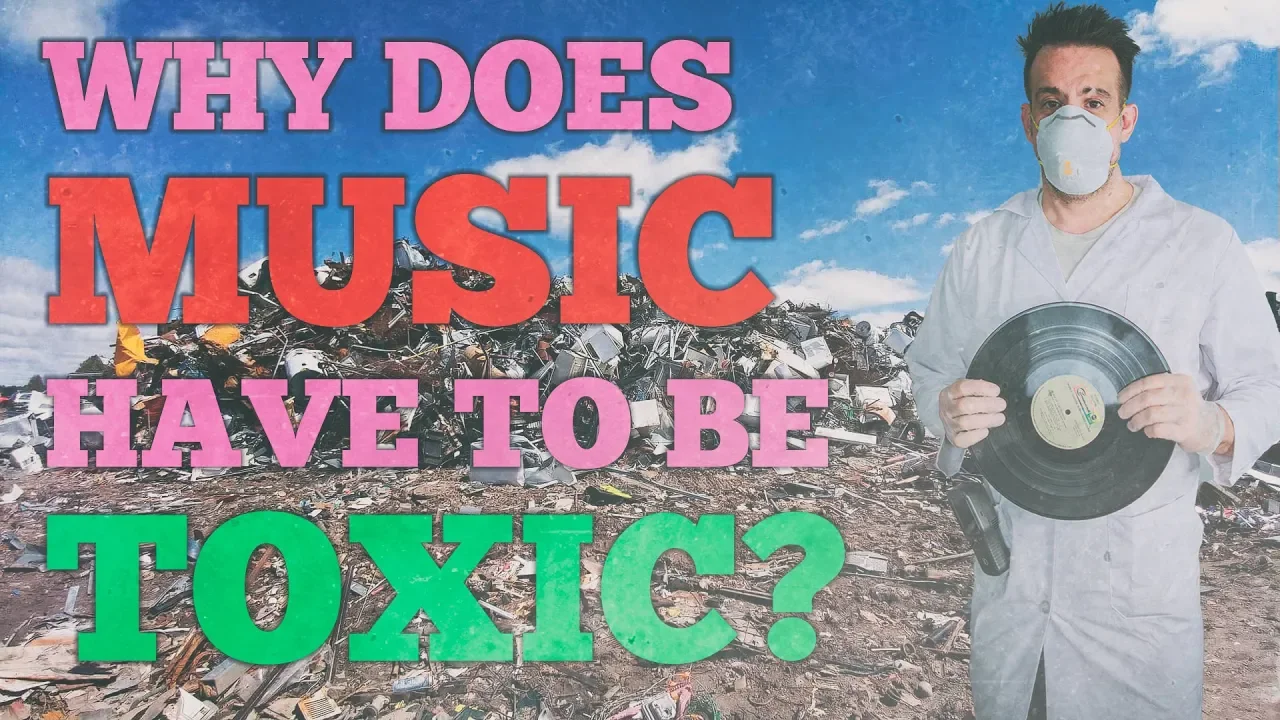
subgraph Execution ["Testing Variables"] D --> E["Tester enters with mask and lab coat"] E --> F["Introduce individual records to platter"] F --> G["Measure PM2.5, PM10, TVOC, and HCHO"] end ```
---
[11:14](https://www.youtube.com/watch?v=aZ2czFuIYmQ&t=674s) The Air Quality Test: Shocking Degassing Results
When testing began, Jordan brought out an unplayed copy of one of his own releases from 2005 under an alternate moniker. Within minutes of placing the vinyl on the platter, the air monitor recorded an unexpected spike in total volatile organic compounds, accompanied by a sixfold surge in formaldehyde levels. The readings climbed so rapidly that the instrument triggered an internal audible alarm to warn that the air quality had become hazardous. After removing the record and sealing it back in its packaging, the monitor gradually returned to safe baseline levels. A second test with a 2006 pressing produced an identical spike, triggering the alarm almost immediately.
Jordan initially wondered whether this toxicity was restricted to unplayed archival stock. To test that hypothesis, he placed a vintage album on the platter that he had spun roughly 200 times over a 20-year period. Before the stylus even made contact with the groove, the ambient TVOC levels soared and tripped the monitor alarm once more. Simulating the routine handling of an active DJ or collector flipping through a crate produced gas emissions intense enough to reach levels deemed dangerous for short-term human inhalation. The experiment contradicted Jordan's initial hypothesis: the primary hazard was not airborne micro-dust ground up by the mechanical action of the stylus, but immediate chemical degassing that occurs whenever PVC vinyl is exposed to ambient air.
- **Formaldehyde Surge**: Unsealed vinyl caused an immediate sixfold increase in airborne HCHO. - **Degassing vs. Friction**: Significant VOC spikes occurred prior to stylus contact, proving off-gassing occurs independently of mechanical groove wear. - **Simulated Browsing**: Flipping through a record crate released enough airborne TVOCs to register as hazardous for short-term exposure. - “I did not prepare myself for actual results like this that were so alarming to the point where this device would tell me that I'm not even supposed to be breathing the air next to a record.” — Benn Jordan
---
[13:21](https://www.youtube.com/watch?v=aZ2czFuIYmQ&t=801s) PVC in Plumbing, Regulations, and Phthalate Dangers
Addressing the inevitable counterargument that PVC is ubiquitous in household plumbing, Jordan details the strict structural and chemical distinctions governing industrial plastic pipes versus consumer audio discs. Modern building codes rarely permit standard PVC for interior residential supply lines; potable water systems rely on copper, PEX, polyethylene, or chlorinated polyvinyl chloride (CPVC). CPVC undergoes a free-radical chlorination reaction that substitutes hydrogen atoms with chlorine, substantially enhancing the material's tensile strength and thermal ceiling before it degrades and sheds phthalates. Even when PVC is utilized for drainage, plumbing standards strictly prohibit lead stabilizers, require extensive pre-flushing (denoted by NSF-PW or NSF 61 certifications), and account for the lethal hazard of PVC releasing airborne hydrochloric acid if a structure catches fire.
Jordan contrasts these municipal construction safeguards with the record pressing industry, which operates almost completely unregulated. Vinyl records routinely incorporate heavy metal stabilizers including lead, cadmium, and barium to facilitate pressing and maintain structural integrity. While major health organizations such as the CDC and WHO caution that even trace exposure to leaching phthalates causes irreversible liver damage, reproductive harm, thyroid dysfunction, heart disease, type 2 diabetes, and breast cancer, records face no chemical restrictions. Jordan highlights the regulatory precedent set in 2008 when President George W. Bush signed federal legislation outlawing phthalates in children's toys and products, underscoring how dangerous the petrochemical industry's additives are considered by policymakers when basic safety standards are enforced.
- **Plumbing Standards**: Potable water piping requires certifications such as NSF-PW or NSF 61 and strictly bans lead stabilizers. - **CPVC Chemistry**: Free-radical chlorination replaces hydrogen with chlorine to delay thermal breakdown and phthalate release. - **Fire Hazard**: Burning PVC releases concentrated hydrochloric acid gas. - **Pressing Additives**: Unregulated vinyl audio pressing employs toxic heavy metals like lead, barium, and cadmium. - “When a Bush is signing a law that cuts into oil industry profits, you should probably pay a little attention.” — Benn Jordan
---
[15:37](https://www.youtube.com/watch?v=aZ2czFuIYmQ&t=937s) Disposal Realities and Benn's Stance as an Artist
Given the toxic profile of PVC, Jordan warns listeners against discarding their vinyl collections into household trash or municipal recycling streams. Vinyl cannot be processed by standard residential recycling facilities, and tossing it into ordinary landfills ensures that heavy metals and persistent pollutants slowly leach into soil and groundwater. Because commercial waste services refuse to accept records, internet guides on vinyl disposal overwhelmingly advise either converting records into ornamental crafts or offloading them to other collectors.
The issue directly affects Jordan's musical career and commercial income. Every vinyl release under his musical moniker has sold out completely, and distributors continually offer lucrative upfront advances to press his back catalog onto vinyl. Despite valuing audiophiles for their attentive and dedicated listening habits, Jordan refuses these commercial offers until plants can manufacture records using verified recycled or non-toxic, recyclable polymers. Standing in a shipping warehouse filled with boxed records made him confront the environmental absurdity of using toxic, heavy physical plastics to store acoustic data that could be preserved with greater fidelity on modern digital media using negligible physical resources.
- **Disposal Restrictions**: Residential recycling services and many landfills outright reject PVC vinyl due to chemical toxicity. - **Benn's Commercial Condition**: Advances and represses are rejected unless distributors utilize recycled or fully recyclable polymers. - **Data Density**: Entire warehouse rooms of packaged physical vinyl represent acoustic data that can be stored cleanly in a microscopic digital footprint. - “I don't want the final legacy of my music to be hydrochloric acid or slow degassing of toxic chemicals, and I've lost a lot of money on that stance.” — Benn Jordan
[17:41](https://www.youtube.com/watch?v=aZ2czFuIYmQ&t=1061s) A Carbon-Negative Alternative and a Challenge to the Industry
Reflecting on his own principles as an independent artist, Benn Jordan explains how he approached the physical release of his full-length album, *Piety of Ashes*. Rather than pressing another run of toxic vinyl, he crafted a special edition filled with collectible, extraneous items that he deliberately made carbon-negative. While acknowledging that "carbon-negative" sounds like a trendy buzzword, Jordan points out that in practice, it meant he physically took waste destined for a landfill and repurposed it into art. Designing, sourcing, and hand-making these packages proved to be a genuinely enjoyable, creative process, resulting in an artifact far more intimate and unique than a mass-produced record stamped in a factory. The run completely sold out within the first 24 hours, and Jordan used the proceeds to offset the environmental damage caused by shipping the packages to fans. Even if he ultimately contributed more material goods to the world, he was able to feel good about the process.
This experience leads Jordan to question the standard practices of musicians, bands, and record labels. Artists pour vast amounts of time, energy, and money into writing songs, performing, recording, and marketing their work, yet their imagination abruptly halts when it comes to the physical medium itself. He finds it baffling that creators are content handing over the vital final step of their project to an industrial manufacturing plant. At the same time, Jordan challenges vinyl collectors who spend exorbitant amounts of money on their hobby to demand something far more personal, unique, and sustainable. Despite the grim facts surrounding the environmental toll of pressing records, Jordan insists the story of vinyl is not over. If music enthusiasts applied collective pressure, the industry would have to evolve rapidly. As Benn Jordan argues, “If vinyl collectors simply and loudly refused to buy more records until a safer, recyclable, and more environmentally friendly alternative was used for their production, how long do you actually think it would be before manufacturers stopped using PVC entirely? I'd give it a year.”
- Benn Jordan's self-designed, carbon-negative physical edition of *Piety of Ashes* completely sold out within its first 24 hours. - The project repurposed discarded materials from landfills and directly offset the carbon footprint incurred by customer shipping. - Jordan calls out labels and artists for outsourcing the critical tactile experience of their music to toxic, mass-scale PVC factories rather than innovating on packaging and physical media.
[19:01](https://www.youtube.com/watch?v=aZ2czFuIYmQ&t=1141s) Reclaiming the Ritual of Listening (Without PVC)
Jordan emphasizes that he is not blind to the romantic appeal of analog sound. He understands the tactile romance of pulling out a sleeve, wiping away the dust, setting an album on a turntable, gently dropping the needle into the groove, and listening straight through track by track as the artist intended. However, he argues that the sacred quality people attribute to vinyl does not actually reside in the polyvinyl chloride disc or the mechanical turntable. Rather, the magic comes from the listeners themselves—the rare decision to step away from the noise of a hectic day, close one's eyes, and truly focus on the music. That deliberate attention is what triggers chills, unlocks vivid memories, and carries the imagination somewhere new.
While that focused, contemplative listening state has become increasingly scarce in modern culture, Jordan reminds his audience that you do not need toxic chemicals or a specific legacy format to achieve it. Polyvinyl chloride is entirely unnecessary; all that is required are your ears, an open mind, and the self-discipline to carve out uninterrupted time for music. Wrapping up the video, Jordan expresses gratitude to viewers for hearing out an uncomfortable critique of a beloved hobby. He invites those interested in supporting his work to explore his music catalog on Bandcamp or check out his Instagram, noting that he avoids using Patreon or affiliate sponsorships.
As Benn Jordan observes regarding the romanticized mystique of records: “The sacred thing is not the disk or the turntable, it's us music lovers taking a break from our hectic days and just closing our eyes, relaxing, and actually listening to the music.”
## Notable quotes > [19:01](https://www.youtube.com/watch?v=aZ2czFuIYmQ&t=1141s) The sacred thing is not the disk or the turntable, it's us music lovers taking a break from our hectic days and just closing our eyes, relaxing, and actually listening to the music. — Benn Jordan
> [15:37](https://www.youtube.com/watch?v=aZ2czFuIYmQ&t=937s) I don't want the final legacy of my music to be hydrochloric acid or slow degassing of toxic chemicals, and I've lost a lot of money on that stance. — Benn Jordan
## Mentioned Benn Jordan, The Flashbulb, Record Store Day, University of Texas, Florida State University, Agent Orange, Viktor Yushchenko, CDC, WHO, George W. Bush, Piety of Ashes, Bandcamp, Instagram, Patreon
## Video description If you love vinyl, then you should demand for it to be modernized. Links: https://www.instagram.com/bennjordan/ My music ($upport me!): https://theflashbulb.bandcamp.com/
[Source](https://www.youtube.com/watch?v=aZ2czFuIYmQ)