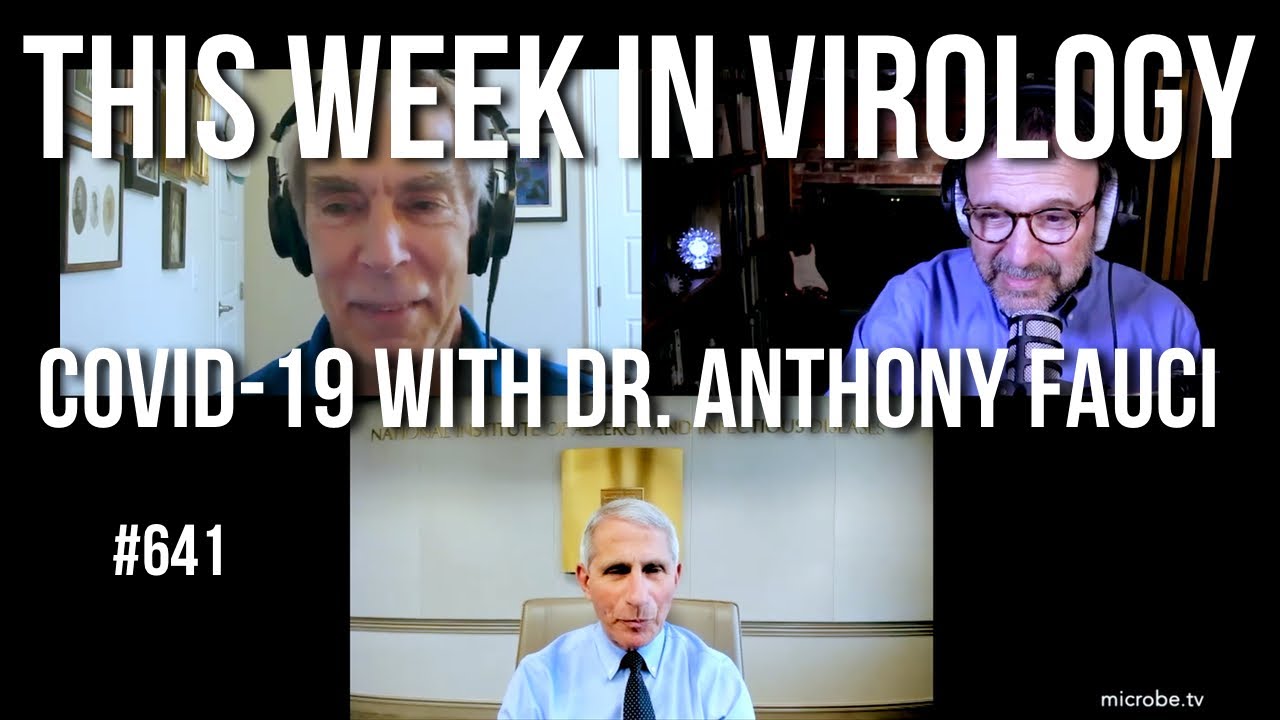
TWiV 641: COVID-19 with Dr. Anthony Fauci
MicrobeTV
AI-assisted summary of TWiV 641: COVID-19 with Dr. Anthony Fauci — original source. Check the original for full context.
Source published:
Key ideas
- Cycle threshold (Ct) values of 35 or higher on RT-PCR indicate that the probability of isolating replication-competent SARS-CoV-2 is minuscule, representing non-viable remnant viral genetic material rather than infectious virus. (3:50)
- Large-scale outbreaks in closed quarters, such as the USS Theodore Roosevelt where roughly 1,000 sailors contracted COVID-19, demonstrate that asymptomatic and pre-symptomatic spread is a major driver of transmission. (5:47)
- National seroprevalence in the US remained low at approximately 3% to 4% in mid-2020, making natural herd immunity without vaccination an unacceptable strategy due to high morbidity and mortality. (16:07)
- Operation Warp Speed's decision to manufacture vaccine doses 'at financial risk' during clinical trials aimed to compress delivery timelines, targeting tens to hundreds of millions of deployable doses by early 2021. (27:57)
Detailed notes
## Background Published on YouTube by MicrobeTV on July 17, 2020, this episode of This Week in Virology features Dr. Anthony Fauci returning to the podcast to discuss the ongoing COVID-19 crisis. According to the show description, the conversation covers SARS-CoV-2 transmission dynamics, diagnostic testing, immunity, pathogenesis, vaccine development, and long-term pandemic preparedness.
## TL;DR In this interview, Dr. Anthony Fauci joins virologists Vincent Racaniello and Rich Condit to analyze the mechanistic realities of SARS-CoV-2, emphasizing that while respiratory droplets remain the primary transmission driver, asymptomatic spread and potential aerosol dissemination play significant roles. He discusses using PCR cycle thresholds (Ct ≥ 35) to indicate non-infectious remnant RNA, argues for pragmatic rapid antigen testing, and warns against pursuing natural herd immunity given the virus's estimated 1% infection fatality rate. Dr. Fauci also explains the distinction between the ACTIV partnership and Operation Warp Speed, outlining how manufacturing vaccines 'at financial risk' enables rapid deployment without sacrificing clinical safety standards. The episode concludes with a call for sustained federal investment in basic virology and prototype pathogen research to prepare for future pandemics.
## Atmosphere & style The discussion carries a calm, collegial, and deeply academic tone, free from the soundbites and political friction typical of mainstream media appearances from that era. Dr. Fauci speaks as a peer among fellow virologists, openly acknowledging scientific uncertainties and data-free zones with refreshing humility while methodically unpacking clinical evidence. Listening to the conversation feels like sitting in on an urgent yet measured laboratory conference, characterized by mutual professional respect, scientific candor, and a shared passion for public health biology.
## Bulletin - [03:50](https://www.youtube.com/watch?v=a_Vy6fgaBPE&t=230s) Cycle threshold (Ct) values of 35 or higher on RT-PCR indicate that the probability of isolating replication-competent SARS-CoV-2 is minuscule, representing non-viable remnant viral genetic material rather than infectious virus. - [05:47](https://www.youtube.com/watch?v=a_Vy6fgaBPE&t=347s) Large-scale outbreaks in closed quarters, such as the USS Theodore Roosevelt where roughly 1,000 sailors contracted COVID-19, demonstrate that asymptomatic and pre-symptomatic spread is a major driver of transmission. - [16:07](https://www.youtube.com/watch?v=a_Vy6fgaBPE&t=967s) National seroprevalence in the US remained low at approximately 3% to 4% in mid-2020, making natural herd immunity without vaccination an unacceptable strategy due to high morbidity and mortality. - [27:57](https://www.youtube.com/watch?v=a_Vy6fgaBPE&t=1677s) Operation Warp Speed's decision to manufacture vaccine doses 'at financial risk' during clinical trials aimed to compress delivery timelines, targeting tens to hundreds of millions of deployable doses by early 2021.
## Key takeaways - [00:00](https://www.youtube.com/watch?v=a_Vy6fgaBPE&t=0s) SARS-CoV-2 transmission is primarily driven by large respiratory droplets, though aerosol transmission can contribute under specific environmental conditions. - [00:00](https://www.youtube.com/watch?v=a_Vy6fgaBPE&t=0s) While viral RNA persists on non-porous surfaces like plastic and steel for 48 to 72 hours, finding RNA via PCR does not necessarily equate to culturable, infectious virus. - [03:50](https://www.youtube.com/watch?v=a_Vy6fgaBPE&t=230s) An RT-PCR cycle threshold (Ct) of 35 or above suggests that viral particles are non-viable, which can help resolve patient discharge dilemmas without needing BSL-3 viral culture. - [05:47](https://www.youtube.com/watch?v=a_Vy6fgaBPE&t=347s) The massive spread aboard the USS Theodore Roosevelt underscores that asymptomatic and pre-symptomatic carriage is critical to transmission dynamics. - [07:06](https://www.youtube.com/watch?v=a_Vy6fgaBPE&t=426s) The NIH launched the HERO study across 6,000 children and 2,000 families to quantify pediatric infection susceptibility and secondary household transmission rates. - [07:06](https://www.youtube.com/watch?v=a_Vy6fgaBPE&t=426s) School reopening policies should default to resuming in-person education when feasible, but must be adapted flexibly to local community viral transmission rates. - [11:48](https://www.youtube.com/watch?v=a_Vy6fgaBPE&t=708s) Frequent rapid antigen testing provides significant public health value by identifying individuals with high viral loads immediately prior to gatherings, even if it lacks the analytical sensitivity of PCR. - [13:23](https://www.youtube.com/watch?v=a_Vy6fgaBPE&t=803s) Determining whether SARS-CoV-2 multi-organ pathology is due to direct systemic viral invasion or secondary downstream inflammation relies heavily on autopsy pathology. - [13:23](https://www.youtube.com/watch?v=a_Vy6fgaBPE&t=803s) The infection fatality rate of SARS-CoV-2 is estimated at approximately 1%, making it far deadlier than seasonal influenza despite being lower than SARS-CoV-1 or MERS-CoV. - [16:07](https://www.youtube.com/watch?v=a_Vy6fgaBPE&t=967s) Relying on wild virus circulation to achieve herd immunity is rejected due to low national seroprevalence (3–4%) and the extreme human cost of widespread infection. - [17:35](https://www.youtube.com/watch?v=a_Vy6fgaBPE&t=1055s) Coronaviruses historically show waning immunity over 6 to 12 months, suggesting booster vaccinations may be needed if vaccine-induced protection decays over time. - [22:01](https://www.youtube.com/watch?v=a_Vy6fgaBPE&t=1321s) Focusing candidate vaccines primarily on the surface spike protein is grounded in establishing neutralizing antibodies to block viral entry via human ACE2 receptors. - [23:03](https://www.youtube.com/watch?v=a_Vy6fgaBPE&t=1383s) Systemic viral dissemination generally confers longer-lasting immunological memory than localized upper respiratory mucosal infections. - [24:52](https://www.youtube.com/watch?v=a_Vy6fgaBPE&t=1492s) The ACTIV partnership directs therapeutic priorities—such as outpatient monoclonals and direct antivirals—while Operation Warp Speed harmonizes trial endpoints and operational logistics. - [27:57](https://www.youtube.com/watch?v=a_Vy6fgaBPE&t=1677s) Manufacturing vaccine doses 'at financial risk' enables rapid distribution upon clinical trial success without compromising scientific evaluation standards. - [31:26](https://www.youtube.com/watch?v=a_Vy6fgaBPE&t=1886s) Long-term pandemic preparedness requires sustained federal funding for prototype pathogens and platform technologies to anticipate emerging viral threats.
## Detailed walkthrough ### [00:00](https://www.youtube.com/watch?v=a_Vy6fgaBPE&t=0s) Introduction and Transmission Modes: Droplets, Aerosols, and Surfaces
Host Vincent Racaniello opens TWiV episode 641, recorded on July 16, 2020, alongside co-host Rich Condit in Austin, Texas. They welcome their guest, Dr. Anthony Fauci, Director of the National Institute of Allergy and Infectious Diseases (NIAID). Racaniello notes that Fauci last appeared on the podcast in 2013, observing how much has changed since then. Fauci agrees, and Racaniello immediately dives into the science of SARS-CoV-2 and COVID-19, framing the opening round of questions around transmission dynamics and diagnostics. Specifically, Racaniello asks for Fauci’s assessment of the relative contributions of the three primary transmission routes: large respiratory droplets, fine aerosols, and direct contact with contaminated surfaces (fomites).
Fauci acknowledges that firm empirical data remain scarce, though the prevailing assumption has long leaned toward droplet transmission. Acknowledging the rising debate regarding aerosols, he remarks that distinguishing between droplet and fine aerosol spread in real-world conditions is exceptionally difficult unless an outbreak presents unusual spatial patterns. He recalls the infamous 2003 SARS outbreak at a hotel in Hong Kong (the Metropole Hotel), where infections traveled vertically across floors and across open courtyards, demonstrating clear aerosol propagation. Nevertheless, for SARS-CoV-2, Fauci provides his working assessment: “I would think as an intelligent guess that it is almost a very large majority of it is the standard droplet, which is if you stay six feet or more away it's unlikely that the droplet will reach you, but I would not rule out the possibility that there is a degree of aerosol, the extent of which I don't know.”
Regarding fomite transmission, Fauci points out that laboratory experiments demonstrate the virus can persist on non-porous surfaces such as hard enameled steel and plastic significantly longer than on corrugated cardboard or cotton fabrics. He cites research conducted by Vincent Munster at NIAID's Rocky Mountain Laboratories showing detectable viral RNA up to 48 to 72 hours on certain surfaces. However, he cautions that finding RNA via PCR does not necessarily equate to replication-competent virus. Condit follows up by asking about the balance between direct droplet spread and fomite transmission. Fauci responds that although someone coughing into a hand and touching a doorknob could conceivably pass it to someone who touches the handle 15 minutes later, crowded gatherings heavily favor droplet spread as the predominant driver, which reinforces the critical role of wearing face masks.
- Host Vincent Racaniello (Columbia University) and co-host Rich Condit (Austin, Texas) interview Dr. Anthony Fauci, who last appeared on TWiV in 2013. - Historical precedent cited: 2003 SARS-CoV-1 transmission across courtyard and floors at the Metropole Hotel in Hong Kong as definitive evidence of aerosol capability. - Rocky Mountain Laboratories study (Dr. Vincent Munster): viral RNA detected for 48 to 72 hours on hard, non-porous surfaces (steel, plastic) versus porous substrates, though culturability remains uncertain.
```mermaid flowchart TD accTitle: Suspected Transmission Pathways of SARS-CoV-2 accDescr: Flowchart showing the relative likelihood and evidence base of droplet, aerosol, and fomite transmission routes.
subgraph Pathways["Potential Routes of Transmission"] D["Respiratory Droplets"] A["Fine Aerosols"] F["Fomites / Surfaces"] end
subgraph Assessment["Scientific Assessment"] D -->|"Predominant route; mitigated by 6-foot distancing & masks"| EvD["Primary Driver"] A -->|"Clear historical precedent (2003 SARS Hong Kong), extent uncertain"| EvA["Contributing Factor"] F -->|"RNA persists 48–72h on plastic/steel; infectivity unclear"| EvF["Secondary Driver"] end ```
[03:50](https://www.youtube.com/watch?v=a_Vy6fgaBPE&t=230s) PCR Cycle Thresholds and Infectious Virus
Racaniello shifts to the clinical conundrum of prolonged viral shedding, noting that many recovered COVID-19 patients continue to test positive for viral RNA via PCR for weeks, even though no infectious virus can be cultured from them. This creates substantial hurdles for hospital physicians deciding whether patients are safe to discharge to home or to congregate facilities like nursing homes. Racaniello asks whether diagnostic laboratories could implement a quantitative cutoff based on cycle threshold (Ct) values from RT-PCR to certify that a patient is no longer infectious.
Fauci confirms that an operational threshold is indeed emerging across clinical research. In his view, a high Ct value reflects remnant, fragmented viral genetic material rather than a viable pathogen capable of transmitting infection. He notes: “What is now sort of evolving into a bit of a standard that if you get a cycle threshold of 35 or more, that the chances of it being replication-competent are minuscule.” He shares how demoralizing it is for patients who repeatedly undergo testing and receive positive results at Ct values of 36, 37, or 38 when culture attempts in biosafety level 3 (BSL-3) facilities are virtually always negative. In those instances, Fauci argues clinicians should recognize that the assay is detecting “just dead nucleotides, period.” Condit asks if diagnostic laboratories routinely provide the Ct value along with the qualitative positive/negative result, and Fauci clarifies that while clinicians or patients typically receive only a binary result initially, testing platforms capture the raw Ct number, which can be retrieved upon explicit request.
- Cycle threshold (Ct) benchmark: Ct values $\ge 35$ indicate that the probability of isolating replication-competent virus is minuscule. - Laboratory limitation: Culturing SARS-CoV-2 requires high-containment BSL-3 facilities, making real-time culture testing impractical for routine patient discharge decisions. - Diagnostic workflow: Standard reports return a qualitative positive or negative result, but numeric Ct values remain recorded in laboratory systems and are retrievable by ordering physicians.
[05:47](https://www.youtube.com/watch?v=a_Vy6fgaBPE&t=347s) Asymptomatic Spread and the USS Theodore Roosevelt
Condit asks Fauci to weigh in on the proportion of viral transmission stemming from asymptomatic or pre-symptomatic individuals compared to visibly sick, symptomatic patients. Fauci jokes that he likes these questions precisely because nobody has definitive numbers yet, meaning anyone can venture an informed hypothesis so long as they do not take their estimates too seriously.
Fauci reasons that silent spread must account for a substantial share of total community transmission, pointing directly to the outbreak aboard the nuclear aircraft carrier USS *Theodore Roosevelt*. In that incident, only a small handful of sailors exhibited symptoms at first, yet over one thousand sailors ultimately contracted the infection within the ship's close quarters. Fauci underscores that simple logic rules out symptomatic cases alone causing that volume of secondary infections: “I can't imagine, Richard, that one symptomatic person coughed on a thousand people and infected them; it would almost have to be a substantial amount of asymptomatic carriage and transmission.”
- Case study: Outbreak aboard the USS *Theodore Roosevelt* aircraft carrier, where roughly 1,000 sailors tested positive following initial symptomatic index cases. - Transmission dynamics: The explosive spread within closed quarters serves as clinical proof that asymptomatic and pre-symptomatic carriers drive large-scale spread.
[07:06](https://www.youtube.com/watch?v=a_Vy6fgaBPE&t=426s) Children, Schools, and the HERO Study
Condit raises the contentious debate surrounding school reopenings in the fall of 2020, asking whether scientific data support claims that children acquire or transmit SARS-CoV-2 differently from adults. Fauci describes the issue as one of the current “data-free zones,” explaining that while the medical community knows children are far less prone to severe disease, high-quality data are still lacking on how easily they get infected and whether they efficiently transmit the virus to others. To bridge this gap, Fauci details the HERO study (Human Epidemiology and Response to SARS-CoV-2), launched by the NIH on May 1, 2020. The multi-site surveillance effort monitors 6,000 children across 2,000 families to quantify rates of infection, secondary household attack rates to parents, clinical illness, and neutralizing antibody responses.
Racaniello emphasizes that the TWiV inbox is overflowing with inquiries from anxious educators asking how schools can safely resume operations. In response, Fauci outlines a multi-tiered framework for evaluating school safety. He argues that reopening should serve as the default baseline objective because prolonged closures impose severe downstream ripple effects on child development, working parents, and societal function. However, Fauci rejects a uniform federal mandate, stressing that epidemiology varies wildly across American jurisdictions: “It's not one answer to a question; it depends on a number of different circumstances, but the one thing that's critical is that if you're that the first thing is paramount, you have to be attentive to and sensitive to the safety and the welfare of the children and the teachers.” In low-transmission rural counties, children could return to classrooms normally, whereas communities with higher transmission rates would need to enforce strict mitigation protocols—such as staggered attendance, morning and afternoon shifts, mandatory face coverings, and protections for high-risk staff—or delay in-person learning entirely until case numbers decline.
- HERO Study: Human Epidemiology and Response to SARS-CoV-2, an NIH study tracking 6,000 children across 2,000 families to measure pediatric infection rates, transmissibility to household adults, symptoms, and antibody responses. - Reopening framework: Defaulting to reopening schools when possible to avoid deleterious educational, socioeconomic, and psychological ripple effects on children and families. - Localized mitigation measures: Alternating school days, split shifts (morning/afternoon), universal masking, protecting medically vulnerable individuals, and monitoring local community viral transmission rates. - Teacher welfare: Prioritizing educators' health and concerns, addressing educator demonstrations (such as those occurring in Austin, Texas) regarding unsafe classroom conditions.
[11:48](https://www.youtube.com/watch?v=a_Vy6fgaBPE&t=708s) Rapid Antigen Testing vs. PCR Sensitivity
Rich Condit brings up Michael Mina from the Broad Institute, highlighting his advocacy for an inexpensive, one-dollar daily saliva-based antigen test produced at scale using domestic manufacturing capabilities. Dr. Fauci embraces the underlying strategy, even if not the exact specifics, emphasizing how transformative rapid, on-demand testing would be for returning safely to normal activities. Being able to screen an entire group instantaneously right before people gather inside a school classroom or a factory floor would slash anxiety and serve as a game-changing public health countermeasure by guaranteeing that everyone present is negative at that exact moment.
The conversation pivots to analytical sensitivity versus real-world public health utility. Rich notes that while antigen tests are broadly recognized as less sensitive than RT-PCR, PCR can sometimes be too sensitive, detecting non-transmissible remnants long after the window of peak contagiousness has passed. Even if an inexpensive test misses lower viral loads, catching individuals harboring high titers of virus is more than enough to drive down community spread substantially. Dr. Fauci agrees wholeheartedly with this pragmatic view, summarizing the regulatory and testing mindset: “Don't let the perfect be the enemy of the good really.”
[13:23](https://www.youtube.com/watch?v=a_Vy6fgaBPE&t=803s) Viral Dissemination, Autopsy Data, and the Infection Fatality Rate
Rich shifts the discussion to whether SARS-CoV-2 behaves strictly as a localized respiratory pathogen or causes true systemic infections. Emerging reports have suggested transient viremia, direct viral invasion of the vasculature, and viral presence in the kidneys, liver, or central nervous system, leaving open the question of whether multi-organ sequelae are primary infections or secondary, downstream consequences of respiratory failure and inflammation. Dr. Fauci leans toward direct viral escape: “You know my sense Richard is that the virus is getting out although we don't have you know overwhelming proof that that's the case that we may be seeing downstream distal effects of things that are essentially respiratory.” Definite resolution will not come from speculation, but from rigorous autopsy pathology; if intact virus is repeatedly found in vascular endothelium, renal parenchyma, liver, or brain tissue, the case is settled.
Addressing the infection fatality rate (IFR), Dr. Fauci looks back at his early perspective published in the *New England Journal of Medicine*, where he estimated the IFR at approximately 1%. Determining the exact number remains complicated because the true denominator is heavily obscured by asymptomatic cases: - The overall mortality of an epidemic is dictated by the interplay between cumulative infections and clinical lethality: a pathogen with a devastating death rate infecting few people causes fewer total deaths than a virus with a relatively modest fatality rate that infects millions. - Unlike SARS-CoV-1 (roughly 10% mortality) or MERS-CoV (around 37%), SARS-CoV-2 falls near ~1%, putting it significantly above seasonal influenza while spreading far more easily.
[16:07](https://www.youtube.com/watch?v=a_Vy6fgaBPE&t=967s) Seroprevalence and the Fallacy of Natural Herd Immunity
Examining national seroprevalence, Rich asks where Dr. Fauci believes the United States stands in mid-2020. Dr. Fauci points out that while hard-hit epicenters like New York City reached roughly 22% antibody positivity due to severe early surges, the broader US national average hovers at only 3% to 4%. Because the country remains exceptionally far from protective thresholds, attempting to reach herd immunity strictly through uncontrolled wild virus circulation would extract an unacceptable human toll in suffering and mortality:
> “I don't want to see herd immunity that we get because we had 70 percent of the people got infected and a whole bunch of people got really sick that's the reason why I'm putting my stock and you know getting that vaccine as quickly as we possibly can.”
[17:35](https://www.youtube.com/watch?v=a_Vy6fgaBPE&t=1055s) Waning Immunity, Re-infection Risks, and Vaccine Longevity
Rich poses a complex set of interrelated questions about the durability of humoral immunity, the speed of antibody decay, the frequency of re-infection, and whether secondary infections might lead to milder disease or antibody-dependent enhancement (ADE). Dr. Fauci draws parallels to the four endemic seasonal common cold coronaviruses, where historical studies show that protective immunity lasts only six months to a year, permitting recurring reinfections. He expects virtually 100% of infected individuals to mount an initial immune response, but notes that because SARS-CoV-2 emerged just six months prior, only multi-year longitudinal observation will reveal how long natural protection endures.
The co-hosts joke about the relentless pressure from the media and the public, where Dr. Fauci remarks that “everyone wants an answer yesterday” and that if a scientist dares to hazard an educated guess, critics instantly attack them if subsequent data shifts.
Regarding vaccine design, Dr. Fauci argues that concerns over waning titers do not undermine the mechanism of immunization; rather, they simply dictate whether subsequent boosters are required. He points to the newly published Phase 1 clinical trial results from Moderna's mRNA-1273 vaccine in the *New England Journal of Medicine* (evaluating 45 participants): - A moderate dose of 100 micrograms stimulated robust neutralizing antibody titers against wild-type virus that equaled or exceeded titers measured in convalescent patient serum. - Long-term durability remains to be tracked, but Dr. Fauci emphasizes prioritizing near-term protection over a single season first, noting booster strategies can easily be introduced later if immunity fades.
[22:01](https://www.youtube.com/watch?v=a_Vy6fgaBPE&t=1321s) Focusing Vaccines on the Spike Protein
Vincent Racaniello asks whether designing the vast majority of candidate vaccines exclusively around the surface spike protein—to the exclusion of nucleocapsid or other internal viral proteins—is a sound scientific bet. Dr. Fauci acknowledges the nuance: “It's a loaded question Vince.”
From a classical structural and mechanistic immunology standpoint, generating neutralizing antibodies that physically block the spike protein's receptor-binding domain from engaging the human ACE2 receptor remains the proven, primary correlate of protection against viral entry. While Dr. Fauci does not dismiss the auxiliary role of antibodies or cell-mediated responses directed against other structural proteins, neutralizing the binding interface is paramount. He reminisces that he and Vincent debated the very same conceptual dilemma years prior regarding influenza antigens—pitting neutralizing surface hemagglutinin against internal nucleoprotein or neuraminidase—a question that still sparks debate in viral vaccinology.
[23:03](https://www.youtube.com/watch?v=a_Vy6fgaBPE&t=1383s) Correlates of Protection and Immunity: Respiratory vs. Systemic Infection
The hosts discuss the immune targets for SARS-CoV-2, noting that anti-spike protein antibodies correlate well with protection in animal models, while some candidate vaccines include additional viral proteins. Vincent Racaniello asks whether waning immunity is driven by the virus actively manipulating the immune system—which might mean a vaccine could perform better—or if it is an inherent feature of respiratory infections. Dr. Fauci reflects on the role of viremia, hypothesizing that purely mucosal, upper-respiratory infections naturally induce weaker, shorter-lived immune memory compared to disseminated systemic infections.
To answer this conclusively, Dr. Fauci wants to see comparative long-term data tracking patients with mild illness versus severe disease. Dr. Fauci states: “I want to take somebody who gets infected, gets a respiratory infection, a little pulmonary, and then gets better versus somebody that's in the hospital in an ICU with multi-system disease and find out if the systemic dissemination of the virus really gives you immunity that is, you know, years worth as opposed to months worth.” Rich Condit agrees, pointing out that viruses conferring lifelong durable immunity—such as measles, polio, and smallpox—involve a systemic phase of infection.
[24:52](https://www.youtube.com/watch?v=a_Vy6fgaBPE&t=1492s) ACTIV vs. Operation Warp Speed and Therapeutic Prioritization
Rich Condit asks Dr. Fauci to clarify the distinction between ACTIV (Accelerating COVID-19 Therapeutic Interventions and Vaccines) and Operation Warp Speed (OWS), and how candidate vaccines and drugs are selected for upfront investment. Dr. Fauci explains that ACTIV functions as a public-private partnership and think tank composed of government agencies and outside academic investigators tasked with setting scientific priorities and allocating resources. Operation Warp Speed, by contrast, operates as the operational arm. While it does not run trials itself, OWS ensures trial design harmonization: establishing common databases, a single Data and Safety Monitoring Board (DSMB), unified primary and secondary endpoints, and standardized immunological parameters across vaccine developers.
```mermaid flowchart TD accTitle: ACTIV and Operation Warp Speed Organizational Workflow accDescr: Flowchart illustrating how ACTIV prioritizes targets and Operation Warp Speed harmonizes protocols and operations across therapeutics and vaccines.
subgraph Scientific["Scientific Strategy & Prioritization"] A["ACTIV Partnership<br/>(NIH, Agencies, Academia, Industry)"] B["Therapeutic Needs Analysis<br/>(Early Outpatient vs Late ICU)"] A --> B end
subgraph Operations["Operational Framework"] C["Operation Warp Speed (OWS)"] D["Harmonized Clinical Protocols"] E["Shared DSMB & Endpoints"] C --> D C --> E end
subgraph Pipelines["Clinical Pipelines"] F["Early Intervention<br/>(Monoclonals, Plasma, Direct Antivirals)"] G["Late Stage Intervention<br/>(Dexamethasone, Remdesivir)"] H["Vaccine Candidates<br/>(mRNA, Vectors, Subunits)"] end
B --> C D --> F D --> G D --> H ```
In therapeutics, clinical need dictates priority. Dr. Fauci points out that clinicians already have dexamethasone for ventilated patients needing oxygen (which is ineffective early) and remdesivir to accelerate recovery early on. The urgent gap is outpatient interventions to keep high-risk individuals out of the hospital entirely. Consequently, ACTIV and OWS have prioritized convalescent plasma, hyperimmune globulin, direct-acting antivirals, and monoclonal antibodies for immediate clinical evaluation.
- **Dexamethasone:** Proven to decrease mortality or improve discharge times in ventilated and oxygen-dependent patients, but unsuitable for early outpatient infection. - **Remdesivir:** Effective earlier in the course of severe disease as an antiviral to shorten time to recovery. - **Top therapeutic priority:** Outpatient agents (direct antivirals, monoclonal antibodies, hyperimmune globulin, convalescent plasma) to prevent progression to hospitalization. - **OWS core harmonization mandate:** Ensuring that disparate pharmaceutical companies evaluate their candidates against standard endpoints, shared DSMB reviews, and aligned immunological assays.
[27:57](https://www.youtube.com/watch?v=a_Vy6fgaBPE&t=1677s) Unprecedented Timelines and Manufacturing "At Financial Risk"
Asked whether the world has ever seen an antiviral or vaccine effort on this scale, Dr. Fauci agrees that it is entirely unprecedented. While expressing distaste for the branding, Dr. Fauci remarks: “I don't like the word Warp Speed, because it makes it look like you're carelessly rushing, but to to do things in the way we've done it right now is truly remarkable.” He recalls that for 40 years, vaccine development meant isolating wild virus, culturing it in the lab, and manually inactivating or attenuating it over many years. With SARS-CoV-2, the genomic sequence was posted online on January 10; the very next day, his team met with Moderna to engineer an mRNA vaccine. By day 62, the Phase 1 trial was underway, and a 30,000-subject Phase 3 trial was scheduled to begin at the end of July—barely five months later.
Addressing public doubts about manufacturing and distribution capacity, Dr. Fauci explains the strategy of producing doses "at risk." This risk is purely financial, not scientific or medical. The federal government invested hundreds of millions to upwards of a billion dollars per candidate to build production sites and manufacture millions of doses during Phase 3 testing before efficacy is known. If the candidate fails, the money is lost; if it succeeds, months of lead time are saved. Based on manufacturer forecasts, Dr. Fauci anticipates that tens to hundreds of millions of doses could be ready for deployment by the first quarter of 2021.
[31:26](https://www.youtube.com/watch?v=a_Vy6fgaBPE&t=1886s) Future Pandemic Preparedness and Post-Interview Reflections
With Dr. Fauci's staff signaling that he has time for only one last question before his next engagement, Vincent Racaniello asks about long-term research support. Recalling Dr. Fauci's 2013 TWiV appearance where he worried whether we would be ready for "the next big one," Racaniello asks if NIAID will expand extramural grant funding for basic research on non-circulating, emerging pathogens that academic labs normally cannot get funded to study. Dr. Fauci replies that NIAID had established a prototype pathogen and platform technology program prior to COVID-19, but believes the current crisis will finally convince Congress to sustain large-scale preparedness funding. Dr. Fauci says: “Now the Congress realizes that for the next one we've really got to be prepared, so I am seeing, I hope fingers crossed, an infusion of a lot of money into this type of preparedness.”
Racaniello thanks Dr. Fauci for his leadership on behalf of the virology community, affirming that virologists are "100, 200 behind you." After Dr. Fauci departs, Racaniello and Condit decompress, praising Dr. Fauci's candor, scientific integrity, and willingness to say "I don't know" when faced with a rapidly evolving pathogen. They note the privilege of having him on TWiV 641, recalling his earlier appearance on TWiV seven years prior in 2013.
[34:24](https://www.youtube.com/watch?v=a_Vy6fgaBPE&t=2064s) Looking Back at Previous Interviews with Dr. Fauci
Following their conversation with Dr. Anthony Fauci, the hosts reflect on their prior encounter with him, recalling a previous visit where they spent an entire hour sitting down in his office. Vincent Racaniello and Rich Condit strongly encourage listeners to seek out that earlier interview, noting that it traces Dr. Fauci's full career history—particularly his deep, foundational involvement in combating the early HIV/AIDS epidemic.
The discussion turns to the memorable final question asked during that previous meeting: what kept him awake at night. At the time, Dr. Fauci had answered without hesitation that his nightmare scenario was a brand-new, respiratory-borne viral outbreak capable of spreading globally—essentially describing the exact crisis humanity found itself in with COVID-19. As Vincent points out, that kind of focused, deep-dive scientific discussion is rare: “I think it's an interview you won't find anywhere else basically.”
- The previous in-person office interview detailed Dr. Fauci’s personal history and scientific work from the beginning of the AIDS epidemic to modern emerging threats. - When asked the signature closing question of what kept him up at night, Dr. Fauci presciently identified a respiratory pandemic—what the hosts describe as “the big one.”
[34:57](https://www.youtube.com/watch?v=a_Vy6fgaBPE&t=2097s) Episode Wrap-up, Acknowledgments, and Sign-off
Vincent Racaniello wraps up TWiV episode 641, reminding listeners that full show notes, accompanying resources, and links to the archived Fauci interview can be found at microbe.tv/twiv. He invites the audience to send their questions and feedback to twiv@microbe.tv and directs supporters to microbe.tv/contribute. He formally credits the day's special guest, Dr. Anthony Fauci from the National Institute of Allergy and Infectious Diseases (NIAID).
Vincent then turns to co-host Rich Condit, emeritus professor from the University of Florida Gainesville, currently living in Austin, Texas. Rich shares his heartfelt appreciation for participating in the show, remarking that staying deeply engaged with active scientific research has made his retirement remarkably rewarding. Rich describes his experience with enthusiasm: “I never thought I would do this much science in retirement and it's some of the best and most interesting science I've ever done from my chair with a headset on.” Vincent jokes that they will gladly keep him busy before acknowledging the American Society for Virology (ASV) and the American Society for Microbiology (ASM) for their ongoing support of the show. With musical credits given to Ronald Jenkees, Vincent signs off on another episode of This Week in Virology, concluding with the podcast's signature tagline: “Another TWiV is viral.”
- **Show notes and links:** microbe.tv/twiv - **Listener feedback:** twiv@microbe.tv - **Support and contributions:** microbe.tv/contribute - **Guest:** Dr. Anthony Fauci (Director, National Institute of Allergy and Infectious Diseases) - **Co-host:** Dr. Richard Condit (Emeritus Professor, University of Florida, Gainesville; based in Austin, Texas) - **Organizational support:** American Society for Virology (ASV) and American Society for Microbiology (ASM) - **Theme music:** Ronald Jenkees
## Notable quotes > [05:47](https://www.youtube.com/watch?v=a_Vy6fgaBPE&t=347s) I can't imagine, Richard, that one symptomatic person coughed on a thousand people and infected them; it would almost have to be a substantial amount of asymptomatic carriage and transmission. — Dr. Anthony Fauci
> [27:57](https://www.youtube.com/watch?v=a_Vy6fgaBPE&t=1677s) I don't like the word Warp Speed, because it makes it look like you're carelessly rushing, but to to do things in the way we've done it right now is truly remarkable. — Dr. Anthony Fauci
## Mentioned Dr. Anthony Fauci, Vincent Racaniello, Rich Condit, National Institute of Allergy and Infectious Diseases (NIAID), National Institutes of Health (NIH), Vincent Munster, Rocky Mountain Laboratories, Metropole Hotel, USS Theodore Roosevelt, HERO study, Michael Mina, Broad Institute, Moderna, ACTIV, Operation Warp Speed, American Society for Virology (ASV), American Society for Microbiology (ASM), Ronald Jenkees, New England Journal of Medicine, Columbia University, University of Florida
## Video description Dr. Anthony Fauci joins TWiV to discuss SARS-CoV-2 transmission, testing, immunity, pathogenesis, vaccines, and preparedness.
[Source](https://www.youtube.com/watch?v=a_Vy6fgaBPE)