SpaceX Starship SN8 Hits Altitude Target, Explodes on Landing Pad
SpaceX
Low pressure in the fuel header tank starved the Raptor engines and caused a high-velocity crash, though the flight successfully validated Starship's aerodynamic glide and landing flip maneuvers.
AI-assisted summary of Starship High Altitude Test - SN8 — original source. Check the original for full context.
Source published:
Key ideas
- SpaceX successfully launched Starship prototype Serial Number 8 (SN8) on its first high-altitude flight test to an apogee of approximately 12.5 km (41,000 feet) from Cameron County, Texas. (105:00)
- The vehicle completed its planned belly-flop aerodynamic descent, actively trimming its horizontal posture via independent control of two forward and two aft flaps. (110:00)
- SN8 executed the critical landing flip maneuver to swing vertical, but low pressure in the fuel header tank led to high touchdown velocity and an explosive hard landing. (110:00)
- Despite the destructive impact on the landing pad, major flight objectives were met, and SpaceX confirmed Starship SN9 was already prepared for the subsequent test campaign. (115:00)
Detailed notes
## Background Published on YouTube by SpaceX on December 9, 2020, this broadcast documents the high-altitude suborbital flight test of Starship serial number 8 (SN8) from their Cameron County launch pad in Boca Chica, Texas. According to the page description, the vehicle successfully ascended, transitioned propellant, and performed a landing flip maneuver before low fuel header tank pressure caused a high-velocity hard landing.
## TL;DR The broadcast chronicles the historic 12.5-kilometer test flight of Starship SN8, beginning with an abrupt countdown abort that requires an extended ground recycle. Once the countdown resumes, SN8 lifts off smoothly under the power of three Raptor engines, systematically shutting them down as it reaches apogee and transitions propellant to internal header tanks. The vehicle then executes an unprecedented unpowered belly-flop aerodynamic glide, expertly balancing attitude using four actuated body flaps. During the final relight and landing flip maneuver, depleted header tank pressure results in engine copper erosion and an explosive touchdown on the pad, successfully securing essential engineering data for future prototypes like SN9.
## Atmosphere & style The broadcast carries a tense, highly technical ambiance driven by crackling voice loops, venting cryogenic tanks, and procedural callouts against the vast backdrop of Boca Chica. What begins as a nerve-wracking, prolonged countdown hold shifts into awe-inspiring spectacle as the massive steel rocket ascends, hovers, and floats serenely through its horizontal aerodynamic descent. The shocking, fiery violence of the touchdown is quickly balanced by relief and quiet triumph, leaving viewers with the palpable thrill of witnessing frontier aerospace engineering in real time.
## Bulletin - [01:45:00](https://www.youtube.com/watch?v=ap-BkkrRg-o&t=6300s) SpaceX successfully launched Starship prototype Serial Number 8 (SN8) on its first high-altitude flight test to an apogee of approximately 12.5 km (41,000 feet) from Cameron County, Texas. - [01:50:00](https://www.youtube.com/watch?v=ap-BkkrRg-o&t=6600s) The vehicle completed its planned belly-flop aerodynamic descent, actively trimming its horizontal posture via independent control of two forward and two aft flaps. - [01:50:00](https://www.youtube.com/watch?v=ap-BkkrRg-o&t=6600s) SN8 executed the critical landing flip maneuver to swing vertical, but low pressure in the fuel header tank led to high touchdown velocity and an explosive hard landing. - [01:55:00](https://www.youtube.com/watch?v=ap-BkkrRg-o&t=6900s) Despite the destructive impact on the landing pad, major flight objectives were met, and SpaceX confirmed Starship SN9 was already prepared for the subsequent test campaign.
## Key takeaways - [00:00](https://www.youtube.com/watch?v=ap-BkkrRg-o&t=0s) The launch was initially aborted just moments before the terminal count due to an automated hold, forcing an extended recycle operation of over an hour. - [05:00](https://www.youtube.com/watch?v=ap-BkkrRg-o&t=300s) Launch controllers used the extended hold to safe the vehicle, reset ground support equipment, and stabilize cryogenic liquid oxygen and liquid methane levels. - [01:30:00](https://www.youtube.com/watch?v=ap-BkkrRg-o&t=5400s) The countdown officially resumed at T-15 minutes with Raptor engine terminal chilling and header tank pressurization verified by T-10 minutes. - [01:40:00](https://www.youtube.com/watch?v=ap-BkkrRg-o&t=6000s) Range safety confirmed full clearance of the Gulf of Mexico maritime exclusion zone at T-5 minutes prior to terminal count entry. - [01:45:00](https://www.youtube.com/watch?v=ap-BkkrRg-o&t=6300s) Starship SN8 lifted off successfully powered by three sea-level Raptor engines firing simultaneously. - [01:50:00](https://www.youtube.com/watch?v=ap-BkkrRg-o&t=6600s) During ascent, the vehicle sequentially shut down individual Raptor engines to regulate acceleration as propellant mass depleted. - [01:50:00](https://www.youtube.com/watch?v=ap-BkkrRg-o&t=6600s) At apogee (~12.5 km), SN8 successfully switched propellant feed from the main tanks to internal header tanks and shut down its final Raptor. - [01:50:00](https://www.youtube.com/watch?v=ap-BkkrRg-o&t=6600s) SN8 proved the viability of the unpowered belly-flop glide, using four actuated aerodynamic flaps to stabilize its horizontal descent. - [01:50:00](https://www.youtube.com/watch?v=ap-BkkrRg-o&t=6600s) The Raptor engines reignited and gimbaled aggressively to swing the massive steel vehicle from a horizontal orientation to vertical for touchdown. - [01:50:00](https://www.youtube.com/watch?v=ap-BkkrRg-o&t=6600s) Insufficient pressure in the fuel header tank starved the Raptors during the landing burn, resulting in engine copper erosion and excessive descent speed. - [01:50:00](https://www.youtube.com/watch?v=ap-BkkrRg-o&t=6600s) The vehicle struck the Cameron County landing pad at high velocity, resulting in an explosive hard landing but yielding critical flight telemetry. - [01:55:00](https://www.youtube.com/watch?v=ap-BkkrRg-o&t=6900s) Starship SN9 was confirmed as the immediate follow-on prototype waiting in the high bay to continue the suborbital test flight program.
## Detailed walkthrough ### [00:00](https://www.youtube.com/watch?v=ap-BkkrRg-o&t=0s) Initial Countdown and Abort Hold
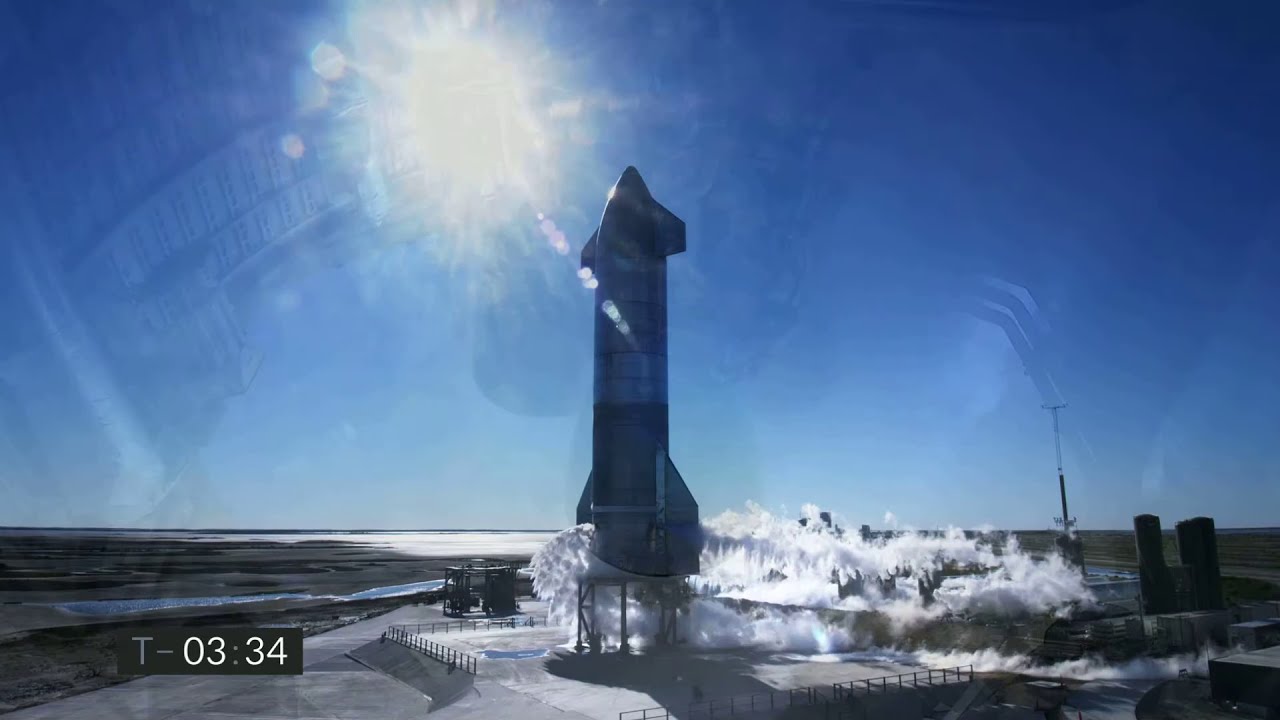
The live broadcast begins on the Cameron County launch pad in Boca Chica, Texas, where Starship Serial Number 8 (SN8) sits fueled on the mount for its historic high-altitude suborbital flight test. Background communications hum as controllers monitor propellant loading and system pressures. As the clock ticks down past the five-minute mark toward a planned liftoff, launch controllers verify tank press and engine chill status.
The launch sequence is abruptly halted just moments before the final terminal count. A launch controller calls out over the net, “Hold, hold, hold on countdown.” The hold pauses vehicle operations as controllers scramble to safe vehicle systems, review telemetry parameters, and assess whether a recycle is possible within the day's test window.
- Vehicle: Starship prototype serial number 8 (SN8) - Test objective: First high-altitude flight to an altitude of 12.5 km (41,000 feet) - Initial status: Abort called before final terminal count, placing the vehicle into a hold
---
[05:00](https://www.youtube.com/watch?v=ap-BkkrRg-o&t=300s) Launch Recycle and Extended Standby
Following the countdown abort, SpaceX teams enter an extended hold and recycle operation lasting over an hour. Technicians and flight controllers work methodically through procedural checklists to reset the ground support equipment (GSE), stabilize cryogenic propellant levels in the main liquid oxygen (LOX) and liquid methane tanks, and clear any transient engine sensor or valve anomalies.
During the prolonged pause, livestream ambient audio captures periodic net checks, operations controller voice loops, range monitoring, and venting sounds from the pad as Starship periodically relieves pressure. The operations controller checks in across subsystems with status updates to coordinate the next attempt once ground systems and the Cameron County safety perimeter are fully verified.
```mermaid flowchart TD accTitle: Starship SN8 Launch Operation Flow accDescr: Sequential flow diagram of the Starship SN8 high-altitude test flight stages.
subgraph Countdown["Countdown & Range"] A["Countdown Hold & Recycle"] --> B["Range & Maritime Zone Clear"] B --> C["Terminal Count: T-2 Mins to T-0"] end
subgraph Ascent["Ascent & High-Altitude Flight"] C --> D["Liftoff on 3 Raptor Engines"] D --> E["Sequential Raptor Engine Cutoffs"] E --> F["Apogee (~12.5 km) & Transition to Header Tanks"] end
subgraph Descent["Descent & Touchdown"] F --> G["Belly-Flop Aerodynamic Glide (Flap Control)"] G --> H["Raptor Relight & Landing Flip Maneuver"] H --> I["High-Velocity Impact / Hard Touchdown"] end ```
---
[01:30:00](https://www.youtube.com/watch?v=ap-BkkrRg-o&t=5400s) Resuming the Countdown: T-15 to T-10 Minutes
Activity across the operational nets ramps back up as SpaceX flight controllers resolve the hold conditions and establish a new T-0 target. A controller announces over the net, “T-minus 15 minutes.” Ground systems resume active terminal chilling of the Raptor engines and final topping of both the main methane and liquid oxygen tanks, along with pressurization of the dedicated nosecone and common-dome propellant header tanks designed for the landing burn.
At the ten-minute mark, the net crackles with the countdown callout: “T minus 10 minutes.” With the vehicle configured and automated sequences initiated, controllers begin final status checks on vehicle flight computers, thrust vector control actuators, and aerodynamic flap control systems.
- Timeline checkpoint: Countdown resumed at T-15 minutes - Flight milestones: Tank pressurization and Raptor chill sequences verified by T-10 minutes
---
[01:40:00](https://www.youtube.com/watch?v=ap-BkkrRg-o&t=6000s) Range Clearance and Final Pad Preparation
With five minutes remaining, focus shifts to safety perimeters, airspace restrictions, and the Gulf of Mexico maritime exclusion zone. A controller queries range safety on the perimeter clearance, receiving the report: “Maritime zone is clear at this time.” The launch director promptly acknowledges the status over the operational loop: “Yeah, copy maritime zone is clear at this time.”
Moments later, the timekeeper calls out, “T minus five minutes.” Starship SN8 transitions into its final autonomous setup, closing propellant ground feed valves, starting final engine purge sequences, and verifying that the hydraulic and battery power systems powering the four aerodynamic body flaps are fully primed for active flight control.
- Range confirmation: Gulf of Mexico maritime clearance confirmed clear of marine traffic - Milestone: Terminal count entry at T-5 minutes
---
[01:45:00](https://www.youtube.com/watch?v=ap-BkkrRg-o&t=6300s) Terminal Count and SN8 Liftoff
The terminal count proceeds with rapid, high-stakes milestones. The controller calls, “T minus 2 minutes,” followed closely by “T minus one minute.” At thirty seconds before launch, the controller confirms the vehicle status: “Stage is go for flight.” Starship’s flight computers assume autonomous control of the countdown.
At ten seconds, the final cadence begins: “T minus 10... 7, 6, 5, 4, 3, 2, 1, 0.” The ignition sequence commands all three Raptor engines to light in a plume of methane exhaust, and the announcer confirms, “We have liftoff.” Starship SN8 climbs majestically off the Cameron County launch pad into clear skies, with its three Raptor engines firing smoothly through maximum aerodynamic pressure.
- Launch time: T-0 achieved after countdown recycling - Engine configuration: 3 sea-level Raptor engines firing simultaneously at liftoff - Primary ascent: Clear launch pad clearance and stable vertical ascent trajectory
---
[01:50:00](https://www.youtube.com/watch?v=ap-BkkrRg-o&t=6600s) Ascent, Flap Aerodynamics, Landing Flip, and Touchdown
Starship SN8 powers through its high-altitude ascent, sequentially shutting down individual Raptor engines as vehicle mass decreases to maintain controlled acceleration. Upon reaching its targeted apogee of approximately 12.5 kilometers, the final Raptor shuts down, and propellant feeds transition from the main tanks to the internal header tanks. SN8 tilts horizontally, entering its pioneering unpowered belly-flop aerodynamic glide. The vehicle's onboard flight computers independently actuate the two forward and two aft body flaps, maintaining an exceptionally stable belly-down orientation through the descent.
As SN8 approaches the ground, the vehicle commands the Raptor relight sequence for the landing flip maneuver. The Raptors reignite and gimbal aggressively, swinging the massive steel ship from a horizontal belly-down orientation into a vertical landing posture. However, low pressure in the fuel header tank starves the engines during the final landing burn, causing the exhaust flame to turn bright green from engine copper erosion. SN8 reaches the landing pad with high touchdown velocity, resulting in an explosive hard landing. Despite the destructive touchdown, the primary test objectives—ascent, stage propellant transition, aerodynamic belly-flop stability, and the landing flip maneuver—were cleanly achieved.
| Phase | Observed Behavior | Primary Result | |:--- |:--- |:--- | | **Ascent** | 3 Raptor engines fired; sequential engine cutoffs | Reached target ~12.5 km apogee | | **Aerodynamic Descent** | Horizontal belly-flop descent | Precise attitude control using 4 body flaps | | **Propellant Transfer** | Switch from main tanks to header tanks | Transition completed; header pressure ran low | | **Flip Maneuver** | Raptor reignition and thrust-vector flip | Successful rotation from horizontal to vertical | | **Touchdown** | Low fuel header pressure led to high descent rate | Hard impact/touchdown on landing pad |
---
[01:55:00](https://www.youtube.com/watch?v=ap-BkkrRg-o&t=6900s) Post-Test Aftermath and Team Congratulations
In the wake of the explosive impact, cameras capture the dust and smoke clearing over the Boca Chica landing site, revealing the wreckage alongside valuable telemetry preserved across all vehicle channels. On the international transmission feed, commentators praise the historic engineering milestone achieved by the prototype, broadcasting in Spanish: “Increíble trabajo, equipo.” (“Incredible work, team.”)
The broadcast highlights the test's unprecedented aerodynamic data collection and confirms that Serial Number 9 (SN9) is already waiting in the high bay for the next flight test campaign. The broadcast concludes with warm gratitude to the Cameron County community and viewers worldwide: “Gracias por ver el video.” (“Thank you for watching the video.”)
- Result: Successful data capture across all major flight phases; rapid unscheduled disassembly on touchdown - Follow-up: Starship SN9 designated as the next test article in line for the high-altitude test program
## Mentioned SpaceX, Starship, Starship SN8, Starship SN9, Raptor engine, Cameron County, Boca Chica, Gulf of Mexico, Mars
## Video description On Wednesday, December 9, Starship serial number 8 (SN8) lifted off from our Cameron County launch pad and successfully ascended, transitioned propellant, and performed its landing flip maneuver with precise flap control to reach its landing point. Low pressure in the fuel header tank during the landing burn led to high touchdown velocity resulting in a hard (and exciting!) landing.
Thank you to all the locals supporting our efforts in Cameron County and beyond. Congratulations to the entire Starship and SpaceX teams on today’s test! Serial number 9 (SN9) is up next – Mars, here we come!
[Source](https://www.youtube.com/watch?v=ap-BkkrRg-o)