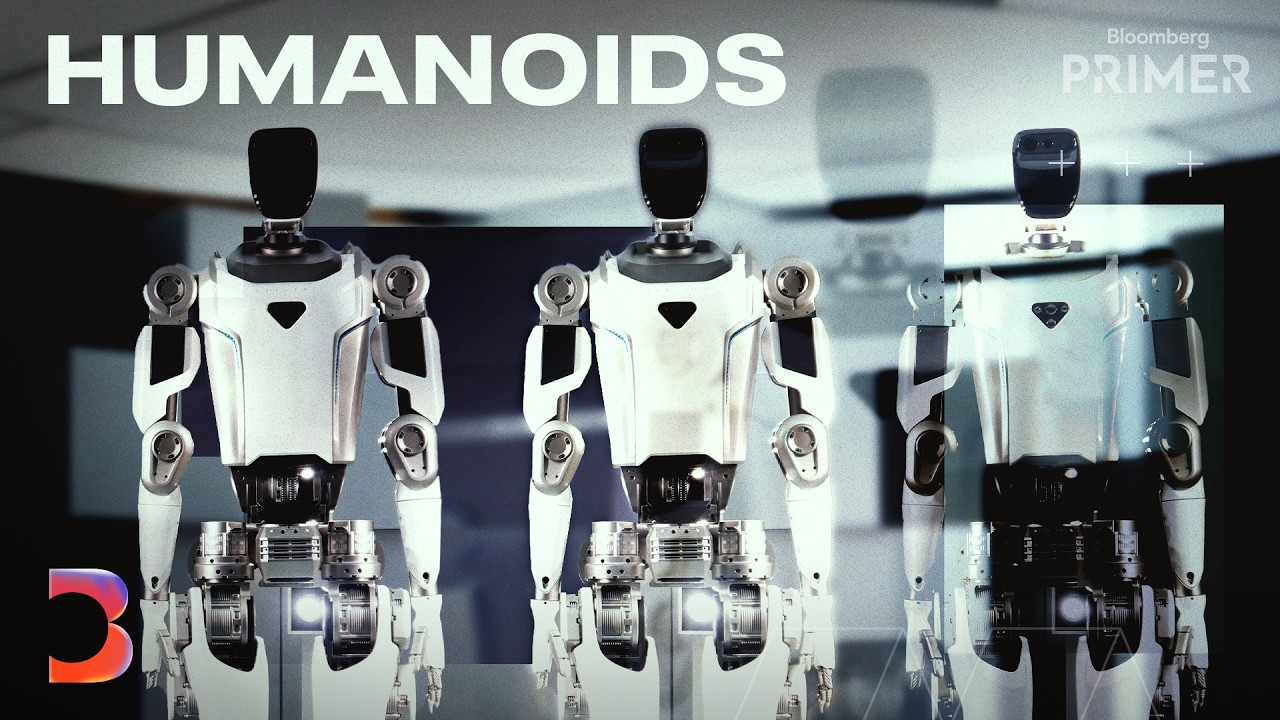
Tech Giants Pour Billions Into Humanoids as High Error Rates Delay ROI
Bloomberg Originals
Massive investments in physical AI face persistent engineering bottlenecks, leaving humanoid robots reliant on human oversight and years away from delivering real-world economic returns.
## Background
Published by Bloomberg Originals on YouTube on April 29, 2026, this video report investigates the gap between hype and reality in the humanoid robotics industry. The page description highlights how physical AI and billions of dollars in investments are driving humanoids from viral online videos into real-world factory trials, raising the fundamental question of whether these machines can deliver sufficient value to justify their massive costs.
## TL;DR
Driven by breakthroughs in physical AI and massive tech investments, humanoid robotics is attempting to transition from entertaining online stunts to real-world labor in warehouses, factories, and homes. However, major technical bottlenecks remain, including severe training data gaps, limited battery life, slow operation, and a lack of fine dexterity needed for complex tasks. While China leads in vertical manufacturing and state support, and startups like 1X are advancing world models, industry veterans caution that full commercial viability and proven return on investment remain years away.
## Atmosphere & style
The video maintains a balanced, investigative, and candid tone, blending futuristic enthusiasm with sharp economic skepticism. It balances glossy corporate demonstrations and viral robot stunts against the clumsy, tethered reality of behind-the-scenes testing where humanoids frequently drop items or require human intervention. Watching it feels like a grounded journey through the high-stakes AI gold rush, contrasting tech-billionaire optimism with pragmatic, expert-led reality checks.
## Key takeaways
- [00:00](https://www.youtube.com/watch?v=UQZooauU-FQ&t=0s) Humanoid robots are moving from viral internet stunts to commercial reality through advancements in physical AI, though their long-term economic value remains unproven.
- [02:02](https://www.youtube.com/watch?v=UQZooauU-FQ&t=122s) Physical AI integrates neural networks with sensors and actuators, allowing robots like 1X's Neo to learn and adapt to unpredictable physical environments rather than following fixed, repetitive code.
- [04:45](https://www.youtube.com/watch?v=UQZooauU-FQ&t=285s) Massive investments from major tech firms and leaders are driving high valuations and ambitious revenue claims, despite public demos frequently showing hardware limitations and reliance on human teleoperation.
- [07:08](https://www.youtube.com/watch?v=UQZooauU-FQ&t=428s) A major technical bottleneck is the 'robot data gap', as physical motion requires synchronized video and motor data rather than the text tokens used by traditional LLMs.
- [09:44](https://www.youtube.com/watch?v=UQZooauU-FQ&t=584s) Robotics developers are bridging the data gap using virtual simulations, 2D video harvesting, VR teleoperation, and 'world models' that visually predict actions before execution.
- [15:10](https://www.youtube.com/watch?v=UQZooauU-FQ&t=910s) China holds a competitive advantage in the global race due to massive state backing, an integrated electronics supply chain, and existing dominance in industrial automation.
- [17:25](https://www.youtube.com/watch?v=UQZooauU-FQ&t=1045s) Humanoid deployments are initially targeting labor gaps in manufacturing and warehousing, though successful integration requires keeping human workers involved in the loop.
- [20:27](https://www.youtube.com/watch?v=UQZooauU-FQ&t=1227s) Current warehouse trials highlight ongoing engineering bottlenecks, including high error rates, slow operation, limited battery life, and poor motor dexterity for complex tasks.
- [21:35](https://www.youtube.com/watch?v=UQZooauU-FQ&t=1295s) Controlled environments like factories are far easier to automate than unpredictable semi-structured environments like hospitals, where mistakes carry high stakes.
- [22:29](https://www.youtube.com/watch?v=UQZooauU-FQ&t=1349s) Industry experts urge realistic timelines, noting that while physical AI holds vast potential, fully autonomous humanoid commercialization remains years away.
## Detailed walkthrough
### Introduction to Robot Hype and Physical AI
The segment opens with an exploration of how humanoid robots have rapidly transitioned from laboratory curiosities into viral internet sensations. The host acknowledges the temptation to simply show funny robot videos for the entire duration, joking about "Rizzbot," but emphasizes that behind the silly hats, dancing routines, and viral stunts lies a serious, highly expensive, and largely unproven financial gamble. Industry experts note that while the interest in human robotics has existed for a long time, the current game-changer is the viability of commercializing them through solid business models powered by artificial intelligence.
* The core technical pursuit is cracking the code of "physical AI"—embedding specialized artificial intelligence into bodies equipped with sensors, batteries, and complex, expensive actuators.
* Market analysts project that this paradigm shift could transform humanoids into a multi-trillion-dollar market by the year 2050.
* Despite the grand projections, industry professionals caution against "humanoid hype," stressing that party tricks and dance routines will not build supply chains or revolutionize global labor markets. Real value must come from work performed in homes, hospitals, and especially factories.
---
### Meet Neo and the Mechanics of Physical AI
Moving inside robotics startup 1X, founder Bernt Børnic introduces the gamma version of "Neo," an in-home humanoid robot undergoing testing with employees. Børnic explains that Neo handles household tasks like laundry and represents the final engineering version before production units ship to customer homes. In a candid behind-the-scenes demonstration filmed in 2025, Neo's autonomous operation occasionally required assistance via teleoperation from a human operator named Turing—prompting playful banter about whether Danielle hit her head.
* Neo's behavior runs on a large neural network that ingests images, forces, tactile feedback, and environmental data, directly outputting motor commands down to the exact forces and torques needed for balance, walking, and object manipulation.
* Unlike traditional robots programmed for repetitive, fixed tasks, physical AI systems are designed to learn and adapt over time within unpredictable environments.
* Physical AI spans a broad category that includes humanoids, general intelligence robots, and driverless cars, all united by their reliance on motors, sensors, cameras, and AI models to interpret the physical world.
---
### The Billion-Dollar Investment Frenzy and Big Tech Backing
The recent explosion in robotics development is fueled directly by massive investments in artificial intelligence, attracting billions of dollars in funding in 2025 alone and driving tech startups to staggering valuations. High-profile tech leaders are driving the narrative, most notably Jensen Huang of Nvidia, who highlights physical AI as the necessary brain power for future humanoids. Nvidia anchors this ecosystem by supplying specialized AI chips for robots alongside a dominant market share in the AI GPUs utilized inside data centers to train large language and real-world models, paired with a newly announced deep collaboration with Boston Dynamics.
* Other tech giants, including OpenAI, Google, and Tesla, are heavily invested in bridging the gap between screen-based AI and real-world applications.
* Tesla CEO Elon Musk offers some of the most far-fetched market projections, claiming that Optimus—Tesla's proprietary humanoid robot—will eventually generate $30 trillion in annual revenue.
* Despite slick marketing campaigns, tech conferences, and promotional videos, public demonstrations often reveal the lingering limitations of current hardware, with robots frequently tethered to safety lines or requiring human teleoperation behind the scenes.
---
### The Robot Data Gap and Training Challenges
At UC Berkeley's "Auto Lab," Professor Ken Goldberg and his students study bimanual (two-armed) robotics while exploring what it will take to find robotics' equivalent to ChatGPT's breakthrough moment. However, a fundamental technological mismatch exists: while Large Language Models (LLMs) are book-smart, operating on strings of words predicting the next appropriate text token from trillions of internet sources, robots must generate physical motion.
* Robots require complex sequences of video frames paired with synchronized motor commands sent to robotic arms to successfully execute physical tasks like folding laundry or handling delicate fabrics without crushing them.
* The primary bottleneck is the "robot data gap"—the near-total absence of recorded physical training data linking camera inputs directly to robot motions.
* To overcome this gap, companies are racing to compile vast training libraries utilizing three main strategies: simulation in hyper-realistic virtual worlds, harvesting 2D YouTube videos (despite the difficulty of extracting 3D structure), and human teleoperation using VR gear to manually guide robots as training data is recorded. Professor Goldberg also highlights the "Flywheel" effect, where robots continuously collect operational data from their images and motions to refine and improve larger overarching AI models.
---
### Inside 1X and the Rise of World Models
At the 1X headquarters, engineering teams design and build inviting home-use prototypes featuring soft outer covers and fabric face coverings suitable for family environments. While the company initially relied on human teleoperation and direct input during visits in 2025, it has increasingly shifted toward utilizing a "world model" approach to train and execute humanoid behaviors.
* The world model operates similarly to AI video generation tools, pulling from a massive library of images and videos to visually predict a future action before the robot executes it.
* By comparing the model's generated prediction against the robot's actual real-world performance, the system learns from every single iteration to enhance future accuracy.
* The ultimate objective of these advanced training loops is moving robust, adaptable robots out of controlled laboratory environments and into real-world applications where they can autonomously refine their capabilities.
---
### The World Humanoid Robot Games and China’s Advantage
The international race to commercialize humanoids is vividly displayed at the inaugural World Humanoid Robot Games, held inside a converted Olympic ice skating rink in Beijing. Competitors from across the globe gather to pit humanoids against each other in physical events ranging from boxing and football matches to complex work tasks. Observers note that working alongside heavy, autonomous machinery can initially feel intimidating, but operators quickly develop a functional working connection with the hardware.
* China's aggressive push to dominate the humanoid and AI robotics industry is heavily backed by state strategy, echoing national directives from the "Made in China 2025" plan that paired robotics with electric vehicles (EVs) and semiconductors as core growth drivers.
* In 2025, the Chinese government pledged 1 yuan trillion (approximately $140 billion US dollars) to promote emerging technologies, heavily prioritizing robotics and helping foster over 140 domestic humanoid companies, though officials have cautioned about a potential market bubble.
* Companies like AgiBot, UBTech, and Unitree shipped the highest volume of humanoids globally in 2025, benefiting from China's deeply vertically integrated electronics supply chain, manufacturing scale, and preexisting dominance in industrial robotics deployed to counteract a shrinking workforce.
---
### Transitioning from Backflips to Real Industrial Jobs
For engineering breakthroughs and massive investments to yield true economic returns, humanoid robots must transition from performing party tricks and backflips to entering the workforce. Economists studying technological anxiety emphasize that worker involvement during robot deployment is critical to ensuring that automation enhances, rather than degrades, human job quality. While traditional industrial robots have spent decades successfully executing routine, single-purpose manufacturing tasks like welding, painting, and parts assembly, humanoids are engineered to be versatile multipurpose workers capable of sharing human workspaces.
* Industry estimates project that nearly 2 million manufacturing jobs in the United States alone could remain unfilled by 2033.
* To bridge this labor gap, major global corporations including BMW, Amazon, and Hyundai are currently conducting limited, highly controlled pilot tests of third-party humanoids in factories and warehouses.
* Patrick Kelleher outlines warehouse trials at logistics provider GXO—which has spent a decade working with automation and a year piloting third-party humanoids—noting success cases such as deploying robots inside industrial freezers to complete directed tasks for an entire battery life, thereby sparing human workers from harsh, cold environments.
By the way, to unlock the full functionality of all Apps, enable [Gemini Apps Activity](https://myactivity.google.com/product/gemini).
[20:27](https://www.youtube.com/watch?v=UQZooauU-FQ&t=1227s) The Limits of Warehouse Humanoids and Engineering Bottlenecks
While humanoid robots are actively being trialed in logistical facilities, they remain far from perfect in practice. Operators observe that these machines frequently damage products, drop items, or misplace inventory. Consequently, human workers must continuously work alongside them to perform audits and corrective actions, ensuring that the tasks assigned to the humanoids are completed with acceptable accuracy.
Beyond operational errors, humanoids face severe technical and physical engineering bottlenecks that prevent them from operating seamlessly in warehouse settings. They remain noticeably slow, operate with limited battery life, and struggle with basic object manipulation. Everyday human tasks like gripping a box or handling delicate objects require fine dexterity—an attribute that humanoids, reliant on mechanical motors and actuators, find extraordinarily difficult to replicate. Industry representatives caution that humanoids will not replace human teammates anytime soon because real-world tasks are too complex and quality-critical. Furthermore, the true return on investment (ROI) remains completely uncertain until the underlying technologies mature and pricing stabilizes.
- Humanoids currently require human oversight due to high error rates in product handling and placement.
- Motors and actuators struggle to replicate human-level dexterity for basic picking and sorting tasks.
- Industry experts do not expect humanoids to replace human workers in the near term due to complexity, quality control, and unproven ROI.
[21:35](https://www.youtube.com/watch?v=UQZooauU-FQ&t=1295s) Deployment Challenges: Controlled Factories vs. Complex Environments
The environment in which a robot operates dictates its likelihood of success. Manufacturing plants and industrial warehouses offer highly structured settings with fixed production processes where humanoids can perform safely behind physical barriers or segregated lanes. However, deploying humanoids into human-centered environments—such as homes, care facilities, or hospitals—presents a vastly greater challenge.
In semi-structured environments like hospitals, clear protocols exist for patient care, yet unpredictable variables constantly arise. Unlike a factory line where a dropped part is merely an inefficiency, medical environments involve high-stakes, "life and death type of situations" where the financial, operational, and physical costs of a robot making a mistake are extremely high.
- Industrial environments offer fixed, repeatable processes that can be isolated from humans to shield against safety risks.
- Semi-structured human environments (e.g., hospitals and homes) introduce immense uncertainty and unpredictable variables.
- The high stakes of medical care mean the tolerance for robot error in semi-structured environments is exceptionally low.
[22:29](https://www.youtube.com/watch?v=UQZooauU-FQ&t=1349s) Realism versus Hype in the Future of Humanoid Robotics
The ultimate question facing the industry is whether humanoid robots will eventually overcome their steep technical hurdles, justify their immense capital investments, and become ubiquitous companions that fold laundry, water plants, and build cars—or whether they will prove to be a fleeting novelty eclipsed by specialized, non-humanoid robot forms. Robotics veterans with decades of experience express enthusiasm for the field's recurring resurgence and the vast research opportunities ahead, yet emphasize the need for grounded expectations.
While researchers remain genuinely optimistic about the long-term potential of physical AI and humanoid form factors, they urge the public and investors to remain realistic about the extended timeframe required for true commercial readiness. The segment closes on a playful note, acknowledging the theatrical nature of current robotics PR—symbolized by a dramatic drone shot pulling away from a humanoid waving from a balcony—leaving the definitive verdict on humanoids open "for now."
- Experts with 40 years of experience in the field highlight that robotics undergoes repeated cycles of hype and resurgence.
- Realizing the vision of fully autonomous domestic and industrial humanoids will require many more years of research and realistic timelines.
Driven by advances in physical artificial intelligence, humanoid robotics has attracted billions of dollars in speculative investment and extreme commercial forecasts. However, bridging the gap between viral demonstrations and functional utility remains constrained by acute training data shortages, mechanical dexterity limits, and high operational error rates.
Capital Surge and Geopolitical Ambitions
The push toward commercial humanoid robotics is propelled by massive funding rounds, with market analysts projecting a multi-trillion-dollar industry by 2050. Technology giants like Nvidia supply specialized robotic chips and training GPUs, while companies such as Tesla, OpenAI, and Google seek to bring AI models into physical embodiments. Tesla CEO Elon Musk has offered outlier forecasts claiming Optimus will eventually generate $30 trillion in annual revenue.
Concurrently, national strategy in China treats robotics as a core growth pillar alongside electric vehicles and semiconductors. Backed by a 2025 government pledge of 1 trillion yuan (approximately $140 billion), Chinese firms including AgiBot, UBTech, and Unitree lead global humanoid shipment volumes, leveraging integrated electronics supply chains and factory automation scale despite domestic warnings of an emerging market bubble.
The Physical AI and Data Bottleneck
Unlike large language models that predict text tokens from abundant internet libraries, physical AI requires real-time translation of sensory inputs into precise motor forces, balance, and bimanual manipulation. UC Berkeley robotics professor Ken Goldberg identifies the "robot data gap"—the severe scarcity of recorded physical actions linked directly to camera inputs—as the central barrier preventing robotics from reaching a breakthrough equivalent to ChatGPT.
To compile training data, engineering teams utilize simulation, 2D web video harvesting, and human teleoperation via VR gear. Robotics startups such as 1X, developing the domestic prototype Neo, have shifted toward predictive "world models" that forecast visual frames before executing physical movements. Nevertheless, public demonstrations across the sector frequently rely on covert human teleoperation and physical safety tethers to avoid mechanical failure.
Industrial Pilots Confront Dexterity Limits (20:27)
Faced with projections of nearly two million unfilled U.S. manufacturing positions by 2033, industrial corporations including BMW, Amazon, Hyundai, and logistics provider GXO have initiated controlled pilot tests. While robots have shown utility in targeted, hostile environments—such as operating inside industrial freezers for the duration of a battery charge—their broader logistics performance reveals significant physical engineering bottlenecks.
Current humanoids remain slow, have limited battery life, and frequently drop items, misplace inventory, or damage products due to inadequate actuator dexterity. Consequently, human workers must continuously oversee machines and perform corrective audits, leaving the long-term return on investment completely unproven until hardware stabilizes and prices decline.
Structured Facilities Versus High-Stakes Environments (21:35)
The viability of deploying humanoid robots depends fundamentally on the predictability of the workspace. Structured manufacturing plants and warehouses allow robots to operate along fixed paths or behind physical barriers, mitigating safety risks to human personnel.
By contrast, semi-structured human environments such as homes, elder care facilities, and hospitals present chaotic variables. In healthcare settings, operational failures carry life-and-death consequences, resulting in an exceptionally low tolerance for robotic error. Because the operational and financial penalties for mistakes in dynamic environments are severe, deploying general-purpose humanoids into shared everyday spaces represents a far steeper hurdle than deploying them in closed industrial plants.
Industry veterans with four decades of experience note that robotics routinely experiences hype cycles, warning that developing fully autonomous domestic and industrial humanoids will require extended research timelines. Until physical dexterity, autonomy, and unit economics are proven, it remains uncertain whether multi-purpose humanoids will achieve widespread adoption or be outcompeted by specialized, non-humanoid automation.
[0:00] humanoid hype
[0:00] physical AI
[7:08] Ken Goldberg: Flywheel
[9:44] world model
[15:10] Made in China 2025
[21:35] life and death type of situations
[22:29] for now
Original transcript
[0:00] - This hand, this knee
[0:02] and this head are all small feats
[0:04] of engineering decades in the making
[0:06] and together they're about
to take a massive leap fo-
[0:10] ...forward.
[0:11] Oh dear.
[0:13] Humanoid robots have
exploded out of the lab
[0:16] and into the real world of late.
[0:19] Not always on the best footing,
[0:20] but I'm not just here to
show you funny robot videos
[0:23] for the next half hour,
[0:25] even though I could...
[0:26] easily.
[0:27] - What's up, Rizzbot?
[0:28] - Because behind silly hats
[0:30] and dancing is a very
serious, very expensive
[0:34] and very unproven bet
[0:36] that AI-powered robots could one day
[0:38] transform labor as we know it.
[0:41] - The interest in human
robotics has been there
[0:42] for a long, long time.
[0:43] What's changed, of
course, is now we see that
[0:46] it's viable to commercialize this
[0:47] and start really applying
some good business models.
[0:51] AI clearly plays a large part in this.
[0:54] - The hope is in cracking
the code of physical AI,
[0:57] taking specialized artificial intelligence
[1:00] and putting it in a body
with sensors, batteries,
[1:03] and actuators.
[1:05] Very expensive and
technologically complex actuators.
[1:09] It's a paradigm shift that
could set humanoids up
[1:12] to become a multi-trillion
dollar market by 2050.
[1:16] But for these massive
figures to be realized,
[1:19] it won't be about party
tricks or dance routines.
[1:22] It'll be about work in
homes, in hospitals,
[1:26] in factories, especially factories.
[1:29] - When you really work
with robots, you realise
[1:30] how challenging it is.
[1:32] There is a lot of
[1:33] what I sometimes call
"humanoid hype" out there.
[1:36] - Like a lot of hype coming from the
[1:39] most influential figures
in the tech industry.
[1:42] But hype doesn't build a supply chain
[1:44] or rewrite the global labor market.
[1:47] To do that, you need...
[1:49] well, let's get into it, shall we?
[2:14] This robot runs on AI.
[2:19] Well, sometimes.
[2:22] For this demonstration filmed in 2025,
[2:25] Neo needed some help from real humans
[2:27] and was operated remotely
by a man named Turing.
[2:31] No, not that Turing,
[2:34] but don't worry, we'll get to that later.
[2:36] - You're looking beautiful, Danielle.
[2:38] Did you hit your head?
[2:40] You okay?
[2:42] - This particular humanoid is made
[2:44] by a company called 1X,
a robotic startup founded
[2:47] by this actual human, Bernt Børnic.
[2:51] - So this is Neo. This
is the gamma version.
[2:53] So this is what we've been
doing the in-home tests
[2:56] among employees with.
[2:58] This is the one that's doing my laundry,
[3:00] and this is the last,
[3:02] let's call it like the
last engineering version.
[3:04] The version that we're working
on right now that's about
[3:06] to go into production is the unit
[3:08] that will go into the
first customer homes.
[3:14] Essentially, the entire behavior
of Neo is AI in the sense
[3:18] that it takes images, forces, tactile
[3:22] and in general all the information
[3:24] that it has about the world.
[3:26] And there's a big neural network
[3:28] and out comes the actual motor
commands all the way down
[3:30] to the forces and torques that
it's exerting to be able to
[3:33] do everything from balance and
walk to doing manipulation.
[3:38] - Unlike a traditional
robot that's programmed
[3:40] to do a specific task
the same way every time,
[3:44] a robot that uses AI
should, in theory anyways,
[3:48] learn to do things over time
in unpredictable environments.
[3:52] It's sometimes called physical AI.
[3:55] A category that besides humanoids includes
[3:58] other general intelligence
robots and driverless cars.
[4:01] Basically, it's anything that
uses motors, sensors, cameras,
[4:04] and AI models to make sense
of the world around it.
[4:08] - We are seeing a very clear
correlation between the amount
[4:10] of data and how many
different tasks we can do
[4:14] and how successful we are at these tasks.
[4:16] And that is really the beauty
of how AI has changed robotics
[4:20] because there is no longer
this limit where you need
[4:22] to write some specific
code for every task.
[4:26] Everything is just data.
[4:27] - Let me introduce you to our robot.
[4:29] - 1X is just one of many
humanoid robot companies
[4:32] that have burst onto the
tech scene in recent years.
[4:35] - You mind taking a sweat towel from me?
[4:37] - [Robot] Sure, I'll
get the laundry started.
[4:39] - The frenzy comes down to
two little letters,
[4:42] which come with big checks.
[4:45] A. I.
[4:47] - The past few years we've
seen explosive interest in
[4:50] development of and investment in AI,
[4:54] and a lot of people are
seizing on this moment as a way
[4:57] to work on all kinds of related
things, including robots.
[5:02] - It's a packed scene with billions
[5:04] of dollars in investments in 2025 alone.
[5:07] And companies globally
racking up huge valuations.
[5:11] - People are betting
big on humanoid robots
[5:14] because very high profile
people involved in the world
[5:17] of humanoid robotics are talking it up.
[5:19] - People are like this guy, Jensen Huang.
[5:22] - There's so many humanoid robots here,
[5:24] and the AIs that they
need are physical AIs.
[5:30] to power the brains of these humanoids.
[5:33] - It needs a brain and
Nvidia has a chip for that
[5:36] that can go into the robot itself.
[5:38] Then they have the software.
[5:40] Nvidia has largely a
monopoly for AI GPUs
[5:44] that go into data centers for training,
[5:47] large language and other AI models.
[5:50] So they have a stronghold there
[5:52] because just like generative AI tools,
[5:54] humanoid robotics
models, real world models
[5:57] are also trained using
the same technology.
[6:01] We just announced a new deep
[6:03] collaboration in the Boston Dynamics.
[6:05] They've got some very exciting...
[6:06] - Other AI and tech giants
like OpenAI, Google,
[6:09] and Tesla are also betting big
that there's a lot of money
[6:13] to be made by taking AI off a screen
[6:15] and bringing it into the real world.
[6:18] - And then you have Elon Musk
[6:20] who talks endlessly about humanoid robots.
[6:23] - I think everyone on earth is going
[6:24] to have one and gonna want one.
[6:26] - His projections are even
more, let's say far-fetched.
[6:31] Elon Musk has said that Optimus,
Tesla's own humanoid robot,
[6:35] will be a product that
can bring in $30 trillion
[6:39] of revenue annually.
[6:43] - And with numbers like
that, there's hype.
[6:46] - You increasingly see
them showing up in ads.
[6:49] You see them at tech conferences.
[6:51] There are lots and lots of videos of them.
[6:55] Sometimes you'll see
them operating in person,
[6:59] but they might be like
tethered to something.
[7:01] So I feel like you're both seeing progress
[7:04] and you're also seeing this sense
[7:07] of it's not quite there yet.
[7:19] - This is my students in our lab here.
[7:22] We call it the "Auto
Lab" for Automation Lab.
[7:24] And so students are
working on various projects
[7:27] and we have a number of robots in here.
[7:29] Two armed robot, we call it bimanual
[7:31] - Professor Ken Goldberg at UC Berkeley
[7:33] has been interested in
what makes robots work
[7:36] for a long time
[7:39] - In the last few years,
there's been a lot of excitement
[7:41] about the potential of
artificial intelligence,
[7:43] specifically with the
breakthrough of ChatGPT,
[7:46] which is a huge paradigm
shift in the field of AI.
[7:48] And so that's the speculation:
[7:50] what is the GPT moment for robotics?
[7:55] - But here's the thing: Large
Language Models, or LLMs,
[7:59] like the kind behind ChatGPT,
[8:01] are more book-smart than... robot-smart
[8:05] - In ChatGPT, you looking
in a string of words
[8:08] and then you're trying to generate
[8:09] what would be the next appropriate string
[8:11] of words that goes with that
[8:13] - ChatGPT and other large
language models run on, well...
[8:18] mostly language.
[8:19] Think of it like having
access to a massive library
[8:22] of trillions of words, photos
and videos from the internet.
[8:27] But a robot doesn't just generate words.
[8:29] It has to create motion.
[8:32] - In a robot,
[8:33] what we need to see is a
string of images, a video,
[8:37] and then we need to see a
string of motions of commands
[8:40] that go to the robot arms to
get it to do the right thing.
[8:45] - To do that, it needs data to learn from,
[8:47] a lot of data.
[8:49] - When it comes to humanoid
robots, data is so,
[8:52] so important.
[8:54] Without data, a system
[8:56] that relies on AI doesn't know anything.
[8:59] If you want a robot to do
something like folding laundry
[9:02] for instance, you're
gonna have to have a ton
[9:04] of information about
how laundry is folded.
[9:06] So it can learn, see
patterns in that data.
[9:09] How do you pick up a piece of fabric?
[9:13] Do you use articulated fingers,
[9:15] which are extremely difficult to build?
[9:18] And how do you also hold onto
things without squishing them?
[9:22] - Robots learn from experience.
[9:25] And here's the problem, almost none of
[9:27] that physical experience
has been recorded.
[9:30] - No one has captured the
motions of robots that go
[9:34] with the inputs that were
generated coming from a camera.
[9:39] So we have a gap, what I
call the "robot data gap."
[9:45] - That gap is a challenge
[9:46] and an opportunity, especially
[9:48] for the ones betting on physical AI.
[9:51] More data means better AI.
[9:54] The need for data for robots is so big.
[9:56] Companies are rushing to create
libraries made of both real
[9:59] and artificial synthetic data.
[10:03] - So people today are
trying to collect this data
[10:05] to be able to train robots.
[10:08] The first one is simulation, to be able
[10:11] to simulate environments
and robots moving in them.
[10:13] - Think of it like creating a
hyper-realistic environment.
[10:17] The robot can learn it.
Its superpower is scale.
[10:20] Thousands of robots in thousands
[10:22] of worlds all learning at the same time.
[10:25] The problem is virtual worlds
[10:28] and virtual robots can
lack real world detail.
[10:32] Another way to train humanoids
is harvesting existing
[10:35] video of the real world.
[10:37] - We do have a huge amount
of videos on YouTube
[10:39] and other places that have show
people manipulating things,
[10:44] but it's very difficult
[10:46] to get the full three
dimensional structure
[10:48] of a scene from a two dimensional video.
[10:51] - There is one option
[10:52] for delivering real human interactions in
[10:55] real-world conditions.
[10:57] Teleoperation, where VR glasses
in stylish outfits can turn
[11:01] these robots into a very expensive puppet.
[11:05] - So there's someone behind
the scenes behind the curtain
[11:08] who is controlling two
arms, moving them around.
[11:11] And as that happens, the video images
[11:13] and the motions of the robot are recorded
[11:15] and that provides data,
but that's very, very slow.
[11:19] But there are farms people out
there doing that as we speak.
[11:23] - Teleoperation has been criticized
[11:25] for its use in demonstrations
to drum up excitement
[11:28] and money, but it's also
a powerful training tool
[11:35] Beyond Teleoperation,
there's another option:
[11:37] to let the robots just learn on the job.
[11:40] Goldberg calls it the "Flywheel."
[11:43] - As it's working, it's
collecting data from its images
[11:46] and its motions, and then
use that data by filtering it
[11:49] to train a larger model.
[11:52] And eventually that new model becomes
[11:53] better than the original model.
[11:56] - Nailing an AI model
[11:57] and a training data set
that works is paramount
[12:00] for any robotics company hoping
[12:02] to make it in the humanoid biz.
[12:14] - Neo's a robot for the home.
[12:16] You want every part of Neo to be inviting
[12:19] and made of materials that
you would want to have
[12:21] around your family or in your living room.
[12:24] We're using soft cover and this
fabric for the face covering
[12:30] - At 1X headquarters
teams design, build,
[12:34] and train humanoid prototypes.
[12:38] Like many places, 1X uses a combination
[12:40] of training techniques,
[12:42] but when it comes to
AI, things changed fast.
[12:45] When we visited 1X in 2025,
they relied on a combination
[12:49] of tools to train their
humanoids, including teleoperation
[12:53] and human input.
[12:55] Hi, Turing.
[12:59] Since then, 1X says it
increasingly uses something called
[13:02] a "world model" to train
and run their humanoids,
[13:05] and it's pulling from many
[13:06] of those data gap filling tactics.
[13:10] The video here on the left
is generated by the model.
[13:13] It's almost like a future vision of
[13:15] what the robot should do.
[13:17] And on the right is the
robot completing the action.
[13:21] Similar to other AI video creation tools,
[13:23] the world model pulls from
a vast library of images
[13:26] and video to generate a
visualization of an action.
[13:30] Each time it generates the
prediction of an action,
[13:33] it can learn from the
resulting real world action
[13:36] and, in theory, help
improve those predictions
[13:39] with every generation.
[13:41] Kind of like a flywheel.
[13:42] Remember, of course, the actual goal
[13:47] of all these models and data
is to get robots outta the lab
[13:50] and into the real world where
they can continue to improve.
[13:54] And when it comes to doing
that, there's one place
[13:56] that's been faster than the rest.
[14:09] This is the first World Humanoid
Robot Games taking place in
[14:12] an old Olympic ice
skating rink in Beijing.
[14:16] Look at all these humanoids,
[14:18] running,
[14:20] jumping,
[14:21] dancing.
[14:24] Competitors here are gathered
from all over the world
[14:26] to put humanoids to the mechanical test.
[14:32] - I think the games
are really interesting.
[14:34] There's tons of really cool events
[14:36] that you don't really see normally.
[14:38] It's very different, very
unique, very special.
[14:41] When I first met our robot,
when I first interacted with it,
[14:44] it was a little scary
[14:46] 'cause, you know, you have
this like very heavy piece
[14:48] of machinery just running around
[14:49] and walking around next to you.
[14:50] Then you try to like keep your
[14:52] distance and stay away from it.
[14:53] But as I've gone to know it
[14:55] and worked with it, I've developed a sort
[14:57] of like connection with it.
[15:02] - These games which involve
everything from boxing
[15:04] to football matches,
to yes, work, are part
[15:08] of a large push in China
to dominate the humanoid
[15:11] and AI robotics industry.
[15:15] - China's unique interest
in robots has to deal
[15:19] with the government for the most part.
[15:21] The fact that DC as a strategic priority.
[15:25] Back in 2015, the media
[15:26] and China 2025 plan had
mentioned robots, along with EVs
[15:29] and semiconductors, as
future growth drivers.
[15:32] So a lot of money has
been poured into this area
[15:35] and it continues to be so.
[15:38] - In 2025, China pledged 1 trillion yuan,
[15:41] about 140 billion US dollars
to promote the advancement
[15:45] of emerging technologies.
[15:46] A big part of that being robotics.
[15:50] That kind of support has
helped produce 140 Chinese
[15:53] companies all making humanoids
a number that has continued
[15:57] to grow so much
[15:58] that officials have warned
of a potential bubble.
[16:01] Still, China is currently
dominating the humanoid robotics
[16:05] market much like they've done with EVs.
[16:08] Companies like AgiBot, UBTech,
[16:11] and Unitree, among others,
ship the most humanoids out
[16:14] of any country in 2025.
[16:18] That's down in part to some
serious chops when it comes
[16:21] to manufacturing cheaply and quickly,
[16:23] which is a good thing if you're trying
[16:24] to get robots out in the world fast.
[16:27] - So much of the electronics
industry has its supply chain
[16:32] from the the sort of circuit level
[16:37] throughout China, and they have scale.
[16:40] Scale means better economics,
[16:43] and it means ability to move quickly.
[16:46] - It's really vertically integrated.
[16:48] Just like with EVs, they
have a lot of companies
[16:51] that make components
for these human robots,
[16:54] whether they're sensors, AI
chips, batteries, the fact
[16:58] that they're able to sort
of supply of the components
[17:02] for these robots.
[17:04] - That advantage in
scale may come in handy.
[17:07] China already leads the
world in the deployment
[17:10] of industrial robots
[17:11] as it races against a
shrinking workforce.
[17:14] But for engineering, training,
[17:16] and investment to pay
off, they're going to have
[17:18] to do something more than backflips.
[17:21] They're going to need to get a job.
[17:24] Sorry, robots.
[17:29] - I am an economist,
[17:30] and I am studying the
wellbeing implications
[17:34] of technological change,
technological anxiety
[17:38] and fear that the technologies are going
[17:41] to take over our jobs is nothing new.
[17:45] What do we need to think about
[17:48] before deploying humanoid
robots at scale would be
[17:53] worker involvement in the process.
[17:56] So how these robots will be deployed would
[18:01] have huge implications for the quality of
[18:06] of work that that people will have.
[18:10] - Robots aren't new. They've
been in factories for decades.
[18:14] They're very good at
performing routine tasks
[18:17] and physical tasks.
[18:19] - Tasks like welding,
painting, and assembling parts.
[18:23] - But they're not multipurpose,
[18:25] and that's where the humanoids come in.
[18:29] - Basically, a humanoid robot
is designed to do the tasks
[18:32] that humans can do.
[18:34] It's estimated that almost 2
million manufacturing jobs in
[18:37] the US alone might go unfilled by 2033.
[18:41] But if humanoids are going to
be part of closing that gap,
[18:45] they need to actually, well, move
[18:47] and problem solve like a
human safely alongside people.
[18:52] And right now, that's only
happening in a limited number
[18:55] of very controlled pilot tests
[18:57] run by some very big companies.
[19:00] - For example, the BMW
[19:03] is currently running a pilot
and is reporting early data.
[19:08] - Other big names testing
[19:09] these robots include Amazon and Hyundai.
[19:14] These trials are crucial
when it comes to figuring out
[19:16] where humanoids work and where they don't.
[19:19] They also provide, yes, data
[19:22] to fuel development while
things like technology
[19:25] and regulation catch up.
[19:27] - We started with pilots in
humanoids about a year ago.
[19:31] - This is Patrick Kelleher.
[19:33] His company is one of many
testing out third party humanoid
[19:36] robots in their warehouses.
[19:38] - We have been working with
robots for the last 10 years,
[19:42] and we are at the forefront
[19:44] of piloting humanoids in
our warehouse operations.
[19:48] And it really is fascinating
[19:51] to see the new technology
take foot in production
[19:54] in the warehouse environment.
[19:56] - GXO has found some
cases that humanoids might
[20:00] be useful for, like say,
working in a freezer.
[20:03] - We're able to deploy the
humanoids in that environment
[20:06] where they can really work
for an entire battery life.
[20:09] Completing tasks being directed
by somebody who is outside
[20:13] of the freezer and getting work completed,
[20:15] without putting our teammates
in an uncomfortable situation,
[20:19] working in that cold
environment for a long time.
[20:24] - There's still a lot
they're not great at.
[20:27] - The humanoids so far are not perfect.
[20:30] They damage product, they drop product,
[20:33] they may put product back
in the wrong location.
[20:36] It is so important that our
teammates are working alongside
[20:39] of them to do that, there
is corrective action
[20:42] and audits done to make
sure that the activity done
[20:45] by the humanoid is accurately.
[20:49] - Humanoids still face a number
of engineering challenges
[20:52] that can create serious
bottlenecks in a warehouse.
[20:55] They're slow for one, they
have a limited battery life
[20:58] and picking up a box
or handling an object,
[21:01] things that we take for
granted, require dexterity.
[21:04] It's something humanoids,
which move using motors
[21:07] and actuators, have a
hard time replicating.
[21:11] - We do not see humanoids in
the next couple years taking
[21:14] away many of the tasks
that our teammates perform.
[21:17] The tasks are too complex
[21:20] and too important from
a quality perspective
[21:22] to go entirely to humanoids.
[21:25] And it's not really understood yet
[21:26] what the return on
investment is going to be
[21:29] based on the finalized
technologies that are coming out.
[21:35] - Places where humanoid robots
might be deployed first,
[21:38] like factories and
warehouses are already built
[21:41] for industrial robots.
[21:43] But putting them in environments
for people, like hospitals
[21:46] and homes, might prove
to be the bigger test.
[21:50] - In manufacturing, you have a very fixed
[21:54] production process.
[21:56] You can shield off human beings
[21:58] and you can let the
humanoid robot perform.
[22:04] While in a hospital setting.
[22:06] It's a semi-structured environment.
[22:08] There are protocols and how
processes should be done
[22:12] and how patients should be cared for,
[22:14] but still, there are so many
uncertainties that can arise.
[22:18] In fact, it's about, yeah, life
and death type of situations
[22:23] and the cost of making a
mistake are are very, very high.
[22:29] - So will humanoids one day
[22:32] overcome their technical
challenges, recoup investments,
[22:34] and become indispensable
companions, folding our laundry,
[22:38] watering our plants,
and building our cars?
[22:41] Or just be a novelty, giving way to robots
[22:44] of other shapes and sizes?
[22:47] - I've been in this field for 40 years
[22:49] and it is fascinating to me
[22:51] how much it has had a resurgence again
[22:55] and again over the years,
and I'm thrilled about that.
[22:58] I am excited
[22:59] because I feel that this
field has got many years
[23:02] of questions and research
that needs to be done.
[23:06] So in some sense, I don't
wanna sound discouraging.
[23:10] I'm very actually
optimistic about the future,
[23:13] but I think it's important, again
[23:15] to just be realistic about the timeframe.
[23:18] - In the meantime, I'll
leave you with this.
[23:21] A humanoid robot waving
to you from a balcony
[23:25] as a drone pulls slowly
and dramatically away.
[23:29] That feels like a decent
way to end...
[23:32] ...for now.