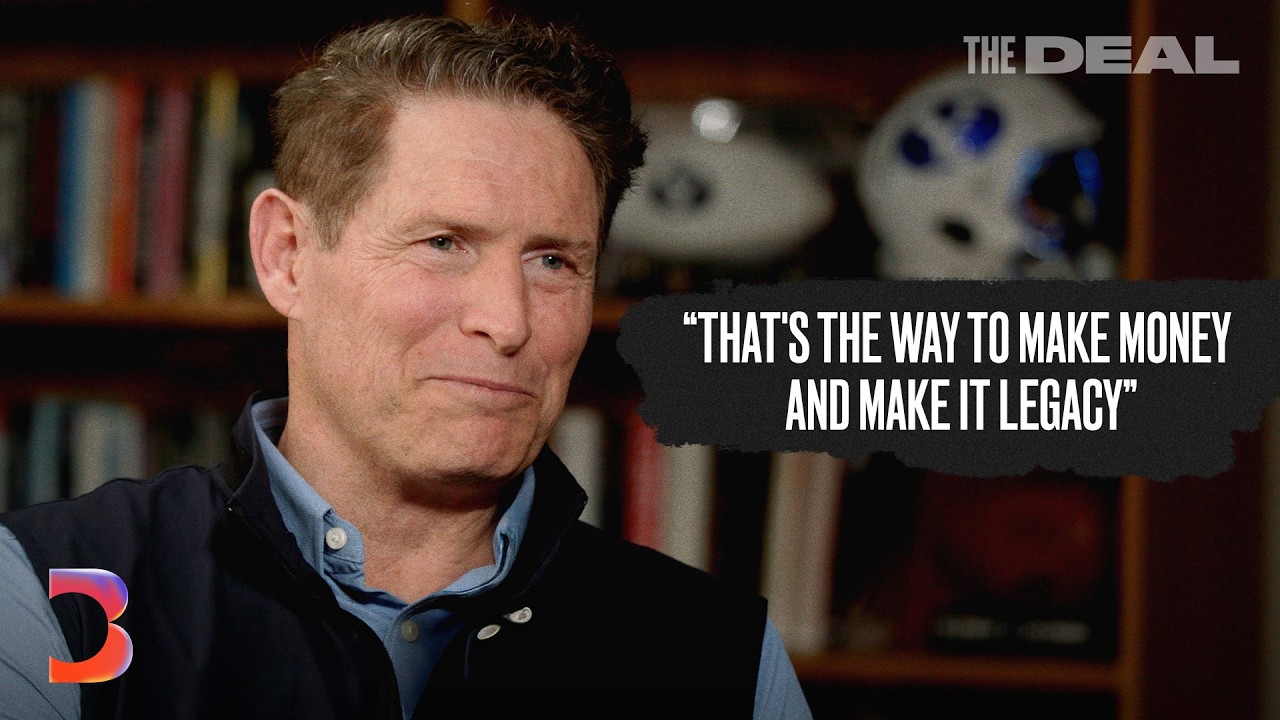
NFL Legend Steve Young Expands HGGC to $10 Billion via Walsh Philosophy
Bloomberg Originals
Former San Francisco 49ers quarterback Steve Young credits coach Bill Walsh's culture of empowerment and open knowledge sharing for driving the growth of his private equity firm, HGGC, to $10 billion in assets.
## Background
This video was published on YouTube by Bloomberg Originals on April 30, 2026. The page description outlines an episode of *The Deal*, hosted by Alex Rodriguez and Jason Kelly, featuring an interview with three-time Super Bowl champion Steve Young on his transition from the NFL to managing a $10 billion private equity fund.
## TL;DR
Steve Young details his journey from Hall of Fame NFL quarterback to co-founder of the $10 billion private equity firm HGGC. He reflects on managing imposter syndrome, utilizing an "abundance mindset" rather than transactional zero-sum private equity, and applying leadership lessons from 49ers icons Eddie DeBartolo Jr. and Bill Walsh. Rodriguez and Young also compare notes on athlete resilience, the ability to process failure, and the necessity of empowering younger talent to build a lasting business legacy.
## Atmosphere & style
The dynamic between Steve Young, Alex Rodriguez, and Jason Kelly feels warm, collegial, and mutually respectful, blending high-level executive financial discussion with the intimate candidness of world-class athletes. The tone is deeply reflective and introspective, shifting naturally between humorous anecdotes—such as playing catch after closing pitch meetings—and serious philosophical breakdowns on leadership, vulnerability, and overcoming fear. Listening to the conversation feels like sitting in on an exclusive, peer-to-peer masterclass on sports legacy, operational empathy, and personal growth.
## Key takeaways
- [00:01](https://www.youtube.com/watch?v=e4rTYZYRGao&t=1s) Steve Young believes private equity can move past zero-sum transactionalism by operating from an abundance mindset focused on culture, heart, and long-term legacy.
- [01:30](https://www.youtube.com/watch?v=e4rTYZYRGao&t=90s) Mentored by NFL icon Roger Staubach, Young learned to leave football behind quickly post-retirement to build a distinct career in business.
- [01:30](https://www.youtube.com/watch?v=e4rTYZYRGao&t=90s) To prevent past fame from becoming a detriment in corporate environments, athletes transitioning to business must maintain humility and start from the ground up.
- [04:00](https://www.youtube.com/watch?v=e4rTYZYRGao&t=240s) HGGC grew into a $10 billion private equity firm across 5 funds, originating from early startup board experiences and a Bain Capital-sponsored venture.
- [04:00](https://www.youtube.com/watch?v=e4rTYZYRGao&t=240s) Drawing on Bill Walsh's philosophy that 'the score takes care of itself,' Young countered standard private equity financial engineering by prioritizing human trust and partnership.
- [07:55](https://www.youtube.com/watch?v=e4rTYZYRGao&t=475s) Imposter syndrome and inner insecurities remain present even for accomplished figures, but can be channeled as high-stakes leadership drive in executive environments.
- [09:41](https://www.youtube.com/watch?v=e4rTYZYRGao&t=581s) Athletes develop a high tolerance for failure and rapid accountability, which translates into a strong ability to manage relationships and rebound in business.
- [12:25](https://www.youtube.com/watch?v=e4rTYZYRGao&t=745s) Effective team owners and leaders combat hubris by treating their position as if it were fireable, empowering employees rather than relying on authority.
- [12:25](https://www.youtube.com/watch?v=e4rTYZYRGao&t=745s) Radical empowerment and trust from leaders accelerate individual growth, a strategy Young uses to develop junior talent at HGGC.
- [16:00](https://www.youtube.com/watch?v=e4rTYZYRGao&t=960s) Former 49ers owner Eddie DeBartolo Jr. transformed owner-player relations by acting as a true partner and supplying full support alongside direct accountability.
- [16:00](https://www.youtube.com/watch?v=e4rTYZYRGao&t=960s) Bill Walsh pioneered holistic athlete wellness—including sleep, nutrition, and mental health—decades before it became standard practice in sports science.
- [18:25](https://www.youtube.com/watch?v=e4rTYZYRGao&t=1105s) Walsh exemplified abundance leadership by freely sharing his playbooks with departing assistant coaches, forcing himself to constantly innovate rather than rely on fading competitive advantages.
- [21:47](https://www.youtube.com/watch?v=e4rTYZYRGao&t=1307s) Driven by his father's advice that dreams require concrete plans, Young focuses his long-term legacy on family, paying it forward, and continuous business growth.
## Detailed walkthrough
### [00:01](https://www.youtube.com/watch?v=e4rTYZYRGao&t=1s) Private Equity with Heart and the Post-NFL Transition
Steve Young lays out his core philosophy: business and private equity do not have to be a cold, zero-sum transaction. While many assume private equity is purely transactional—a game where "you get what you get, I get what I get"—he believes the greatest and most enduring businesses operate from a place of "abundance," heart, and shared culture. That human element, he argues, is what elevates a company from simply making money to building a lasting legacy.
Hosts Alex Rodriguez and Jason Kelly meet Young at the offices of HGGC, the $10 billion private equity firm he co-founded nearly two decades ago. When asked how he introduces himself today, Young bypasses his storied sports resume—three Super Bowl titles, an MVP award, and a Hall of Fame induction—describing himself simply as an "aspirational dad" focused on launching his children into the world. He credits NFL mentor Roger Staubach for giving him crucial advice on transitioning away from the game: "run anywhere" and get away from football quickly, because while football never truly leaves a player, the player must actively leave it behind.
Alex notes that transitioning from sports to business is not a move from "penthouse to penthouse." Instead, athletes must have the humility to start from the ground up to avoid letting past fame work against them. Young admits that for the first 15 years of his private equity career, he actively avoided bringing up his football past, worrying constantly about how others perceived it. However, his perspective shifted during a major fundraising pitch. After closing a deal with a high-profile investor, the investor asked if they could step outside to play catch. Realizing that his sports background was a positive asset to others, Young stopped hiding it, embracing it whenever useful while remaining entirely focused on business when in the boardroom.
- **Firm scale:** HGGC manages **$10 billion** in assets across **5 funds**.
- **Key figure:** Former NFL quarterback Roger Staubach gave Young the core advice on retiring from professional sports.
---
[04:00](https://www.youtube.com/watch?v=e4rTYZYRGao&t=240s) Building HGGC and Overcoming Imposter Syndrome
Young traces his path into finance back to his playing days, when he attended law school during NFL offseasons to prepare for life after sports. While he originally expected to practice law, an invitation to join the board of PowerBar—then a startup producing energy bars for marathon runners in Berkeley—changed his trajectory. On the board, he sat alongside Silicon Valley giants like Warren Hellman (co-founder of Hellman & Friedman) and Larry Sonsini (of Wilson Sonsini). When Young brought them an early internet algorithm created by a friend to localize web traffic (a precursor to modern location-based search), they recognized his natural business instincts. This project led him to team up with Rich Lawson to launch found.com, catching the eye of Bob Gay at Bain Capital, who ultimately sponsored Young and Lawson to launch their own private equity firm.
Discussing the massive growth of middle-market private equity—which has expanded from a handful of dominant firms like KKR, Blackstone, and Carlyle to over 6,000 middle-market firms today—Alex asks Young how he dealt with imposter syndrome when pitching institutional investors as a former athlete without a traditional business degree. Young admits that around 2008, he and his partners realized traditional private equity was broken because it relied too heavily on financial engineering. Drawing on the principles of his legendary 49ers coach Bill Walsh—who famously authored *The Score Takes Care of Itself*—Young focused on human relationships, trust, and partnership rather than acting like a "spreadsheet jockey."
Despite his track record, Young confesses that imposter syndrome never fully disappears; he still occasionally feels awkward or out of place in corporate boardrooms. He believes the same deep-seated insecurities and inner drive that fueled his performance on the football field continue to drive his business career today. Alex counters that while Young may lack a Harvard MBA, leading a team in the pressure cooker of a Super Bowl with 150 million people watching serves as an equivalent masterclass in executive leadership and high-stakes decision-making.
- **Key influencers & mentors:** Warren Hellman (Hellman & Friedman), Larry Sonsini (Wilson Sonsini), Bob Gay (Bain Capital), and Bill Walsh (San Francisco 49ers).
- **Early venture:** found.com, a mid-1990s internet localization business.
- **Industry growth:** Middle-market private equity has expanded to over **6,000 firms**.
---
[09:41](https://www.youtube.com/watch?v=e4rTYZYRGao&t=581s) Failure, Vulnerability, and the Lessons of Sports
The conversation turns to how the emotional intensity of professional sports translates to the corporate world. Young explains that playing football in front of 80,000 live spectators under a ticking play clock creates total, unvarnished transparency—a domain where human behavior and flaws are exposed instantly. He attributes his ability to connect deeply with business partners to his own self-awareness and willingness to be vulnerable.
Alex agrees, noting that professional athletes develop a unique resilience to failure. In baseball, a hitter who fails 70% of the time still ends up in the Hall of Fame, giving elite athletes a "PhD in failing" and a "master's in getting back up." Unlike traditional executives who may have experienced an uninterrupted string of academic and professional wins, former athletes are uniquely comfortable accepting fault, taking accountability ("that's my fault"), and adapting quickly after a setback. Young emphasizes that this ability to process failure and remain self-aware is 100% portable into business, as both arenas fundamentally depend on managing human relationships.
> "In baseball, if you fail 70% of the time you go to the Hall of Fame. So you almost have a PhD in failing. The key is that you have a master's in getting back up." — **Alex Rodriguez**
---
[12:25](https://www.youtube.com/watch?v=e4rTYZYRGao&t=745s) Ownership Advice: Hubris, Risk, and Radical Empowerment
In a segment titled "Asking for a Friend," Jason asks Young for leadership advice directed at someone who recently acquired professional sports teams and is stepping into an ownership role for the first time—a subtle nod to Alex's own ownership stakes. Young's primary piece of advice is for owners to view their position as "highly fireable," even though technically it is not. He warns that owners easily fall into laziness and hubris because they feel safe from being fired, even if they draw public criticism. To build a winning organization, an owner must walk around without the arrogance of ownership so that employees feel inspired to fight alongside them rather than simply bow to authority.
Young illustrates the power of empowerment through a personal story about former 49ers offensive coordinator Mike Shanahan (father of 49ers head coach Kyle Shanahan). Shanahan once approached Young and admitted that his desire to protect his quarterback was causing him to call plays overly cautiously. Shanahan flipped the script: he told Young that he was going to call plays as fast and aggressively as possible, trusting Young to handle any problems on the field and asking Young to "take care of me."
This sudden shift in trust gave Young an overwhelming surge of motivation and acceleration. Young applies this exact mindset to managing young talent at HGGC: rather than keeping junior team members in safe, subordinate roles, he pushes them to take on hard tasks ahead of their time, allowing them to learn and iterate rapidly.
- **Leadership principle:** Lead without the hubris of ownership; treat the position as if it were fireable to keep an edge.
- **Key story:** Offensive coordinator Mike Shanahan empowered Young by switching to aggressive play-calling and trusting him to manage on-field breakdown, a strategy Young uses to develop young talent in private equity.
[16:00](https://www.youtube.com/watch?v=e4rTYZYRGao&t=960s) Lessons in Leadership: Eddie DeBartolo Jr. and Bill Walsh
Alex Rodriguez kicks off the section by asking Steve Young about two pivotal figures from his time with the San Francisco 49ers: former team owner Eddie DeBartolo Jr. and legendary head coach Bill Walsh. Reflecting on his own experience playing under both George and Hal Steinbrenner, Rodriguez notes how different leadership styles can profoundly shape an athlete's life and business career.
Young explains why DeBartolo stands out as a Hall of Fame owner. Rather than treating players like "chattel"—which was the standard dynamic Young had known in professional sports—DeBartolo was perhaps the first NFL owner to treat players as true partners. He owned the team on paper, but he kept that ownership document tucked away in a drawer, never pulling rank or lording authority over his athletes. Instead, DeBartolo approached them with a simple, empowering question: *"I want you to be champions. What do you need?"* Whatever the players listed, DeBartolo provided, but it came with strict mutual accountability. If the team failed to deliver after being given every resource, DeBartolo would hold firm, candid discussions. This created a profound sense of shared destiny and alignment that was virtually unheard of in sports at the time.
Turning to Bill Walsh, Young describes him as a visionary who was decades ahead of his time in every aspect of team building. Long before modern sports science made them standard talking points, Walsh was deeply invested in holistic player care back in 1987 and 1992—focusing on hydration, nutrition, sleep quality, and mental health. Beyond his revolutionary West Coast offense, Walsh created an environment of complete care, leaving Young to marvel at how many extraordinary athletes toil in relative obscurity simply because they never cross paths with an owner or coach capable of elevating them to that level.
* **Owner-Player Dynamic:** DeBartolo redefined sports ownership by viewing players as equal partners and backing them with total support, paired with uncompromising accountability.
* **Holistic Coaching:** Bill Walsh prioritized athlete wellness—nutrition, hydration, sleep, and mental health—long before these practices became mainstream athletic science.
---
[18:25](https://www.youtube.com/watch?v=e4rTYZYRGao&t=1105s) The Box of Proprietary Knowledge and the Power of Abundance
When asked what made Bill Walsh so extraordinary, Young shares a vivid story from his first team meeting with the 49ers. Young recalled sitting in the room as Walsh spoke about team connection and love, only to notice a person following Walsh around with a large video camera—capturing him in meetings, down hallway corridors, and out on the practice field. Young initially assumed the team was filming a documentary or building a museum archive, given Walsh's past Super Bowl victories.
However, Young eventually realized Walsh was building a massive physical repository—a box containing his complete tactical and psychological playbook, including installation tapes, offensive schemes, and motivational speeches. Rather than hoarding this proprietary knowledge to preserve his competitive edge, Walsh freely handed the box to his departing assistant coaches so they could succeed as head coaches elsewhere. He gave it to Mike Holmgren when he left for the Green Bay Packers and to Mike Shanahan when he departed for the Denver Broncos. As they walked away with his life's work, Walsh would tell them, *"I'll see you in the championship game."*
When those same former assistants later beat the 49ers in major games, Young questioned the wisdom of giving away their playbook. Walsh explained his philosophy: he knew his initial tactical advantage had a natural "glide slope" and would inevitably wane over time. By handing his secret weapon to his sharpest proteges, he forced them to refine it, which in turn forced him to continuously reinvent himself and keep his own saw sharp. Young cites this story as the ultimate example of an "abundance mindset" over a scarcity mindset.
* **Coaching Tree Legacy:** Bill Walsh's repository directly fueled the head coaching careers of NFL legends like Mike Holmgren and Mike Shanahan.
* **The Glide Slope Theory:** Walsh believed that sharing proprietary knowledge prevents stagnation, forcing leaders to constantly innovate rather than coast on past competitive advantages.
---
[20:15](https://www.youtube.com/watch?v=e4rTYZYRGao&t=1215s) Rethinking Private Equity: From Zero-Sum to Abundance
The conversation transitions to how these leadership philosophy lessons apply to modern business and finance. Young argues that traditional private equity is built on a transactional, zero-sum foundation—a rigid spreadsheet where one party wins what the other loses. However, Young believes that private equity can be transformed into a framework of long-term abundance and shared growth.
By moving beyond mere numbers on a page, dealmakers can create space to explore the full measure of what a partnership can achieve. Young notes that this aspirational mindset requires daily reinforcement, transparent communication, and genuine belief—especially when economic conditions get tough. While there are countless standard ways to make a quick profit, Young asserts that building a business centered on empathy, partnership, and heart is the only way to turn financial success into a lasting legacy.
> "Private equity can be a place of abundance. It makes no sense because it should be just transactions... But great business, the greatest businesses are the ones that have that heart, that feeling."
---
[21:47](https://www.youtube.com/watch?v=e4rTYZYRGao&t=1307s) Dreams, Plans, and the Road to 110
Jason Kelly brings the interview toward its conclusion by bringing up Steve Young's father, Grit Young, who had recently turned 90 years old. Kelly recalls a famous story where a young Steve told his father he dreamed of playing in the NFL. His father famously responded: *"That's a nice dream. That's a wonderful dream, son. Less than 1% chance, but everyone needs a dream... But what's the plan?"* Kelly asks Young what his current dream and plan are for his private equity firm and his life.
Young responds that his primary dream centers on paying it forward to his children and future generations. He jokes about recently asking his 90-year-old father what his own dream was, to which Grit replied, "110"—meaning he plans to live to be 110 years old. This leads to a brief, lighthearted misunderstanding where Rodriguez assumes Grit meant giving "110 percent" effort, prompting laughs across the table as Young clarifies that his dad literally meant reaching 110 years of age.
Young wraps up by expressing deep gratitude for the interview, sharing his mutual respect for Rodriguez and Kelly, and stating his desire to stay connected and continue "chewing on" these big leadership and business ideas together in the future.
* **Grit Young's Philosophy:** A dream without a concrete plan remains a statistical improbability.
* **Longevity Mindset:** Steve Young's father, Grit Young, set his personal life goal at reaching 110 years of age.
## Notable quotes
> [00:01](https://www.youtube.com/watch?v=e4rTYZYRGao&t=1s) run anywhere — Roger Staubach
> [09:41](https://www.youtube.com/watch?v=e4rTYZYRGao&t=581s) In baseball, if you fail 70% of the time you go to the Hall of Fame. So you almost have a PhD in failing. The key is that you have a master's in getting back up. — Alex Rodriguez
> [09:41](https://www.youtube.com/watch?v=e4rTYZYRGao&t=581s) that's my fault — Alex Rodriguez
> [12:25](https://www.youtube.com/watch?v=e4rTYZYRGao&t=745s) Asking for a Friend — Jason Kelly
> [12:25](https://www.youtube.com/watch?v=e4rTYZYRGao&t=745s) take care of me — Mike Shanahan
> [16:00](https://www.youtube.com/watch?v=e4rTYZYRGao&t=960s) I want you to be champions. What do you need? — Eddie DeBartolo Jr.
> [18:25](https://www.youtube.com/watch?v=e4rTYZYRGao&t=1105s) I'll see you in the championship game. — Bill Walsh
> [20:15](https://www.youtube.com/watch?v=e4rTYZYRGao&t=1215s) Private equity can be a place of abundance. It makes no sense because it should be just transactions... But great business, the greatest businesses are the ones that have that heart, that feeling. — Steve Young
> [21:47](https://www.youtube.com/watch?v=e4rTYZYRGao&t=1307s) That's a nice dream. That's a wonderful dream, son. Less than 1% chance, but everyone needs a dream... But what's the plan? — Grit Young
> [21:47](https://www.youtube.com/watch?v=e4rTYZYRGao&t=1307s) 110 — Grit Young
## Mentioned
Steve Young, Alex Rodriguez, Jason Kelly, HGGC, Roger Staubach, PowerBar, Warren Hellman, Hellman & Friedman, Larry Sonsini, Wilson Sonsini, found.com, Rich Lawson, Bob Gay, Bain Capital, KKR, Blackstone, Carlyle, Bill Walsh, San Francisco 49ers, The Score Takes Care of Itself, Harvard, Super Bowl, Mike Shanahan, Kyle Shanahan, Eddie DeBartolo Jr., George Steinbrenner, Hal Steinbrenner, Mike Holmgren, Green Bay Packers, Denver Broncos, Grit Young
Former NFL quarterback Steve Young argues that private equity can transcend transactional, zero-sum financial engineering by grounding firm leadership in partnership, psychological safety, and an "abundance mindset" derived from elite sports.
Transitioning from Athletics to Middle-Market Finance (0:01)
Young's entry into private equity began during his NFL career, when he completed law school during offseasons and subsequently joined the board of startup PowerBar alongside Silicon Valley figures Warren Hellman and Larry Sonsini. After developing an early web localization concept with Rich Lawson that led to found.com, the duo secured backing from Bain Capital's Bob Gay to launch their own firm. Today, their firm, HGGC, manages $10 billion in assets across five funds in a crowded middle-market private equity landscape that has expanded to over 6,000 firms.
Despite his athletic accolades, Young spent his first 15 years in private equity deliberately avoiding mention of his football past out of concern over how institutional investors would perceive him. He notes that imposter syndrome persists in corporate boardrooms, yet the same self-doubt and internal drive that pushed his athletic career now inform his business execution, supported by Roger Staubach's advice to leave football behind decisively upon retirement.
Translating Failure and Vulnerability into Leadership (9:41)
The high-visibility pressure of professional sports provides unique preparation for executive decision-making. Young explains that playing before tens of thousands of spectators under a play clock exposes flaws instantly, demanding extreme self-awareness and vulnerability. Co-host Alex Rodriguez observes that elite athletes hold a "PhD in failing" and a "master's in getting back up," citing baseball's baseline where failing 70% of the time can still lead to the Hall of Fame. Unlike executives conditioned only by continuous academic and corporate success, athletes are trained to accept fault and adapt rapidly.
Young argues this capacity to process mistakes translates directly into managing business partnerships. For those assuming team ownership or executive roles, Young warns against hubris and complacency, advising owners to behave as though their position is "highly fireable" to maintain organizational trust. He points to former offensive coordinator Mike Shanahan, who empowered Young by calling aggressive plays and trusting his quarterback to handle breakdown, as an operational template for accelerating the development of junior talent at HGGC.
San Francisco 49ers Mentors and the Abundance Principle (16:00)
Young attributes his core management philosophy to two former leaders of the San Francisco 49ers: owner Eddie DeBartolo Jr. and head coach Bill Walsh. DeBartolo altered the standard owner-player dynamic by treating athletes as equal partners, asking what resources they needed to win while maintaining strict mutual accountability when goals were missed. Walsh operated decades ahead of standard athletic practice by prioritizing holistic wellness—such as nutrition, sleep, and mental health—alongside tactical innovation.
Walsh also demonstrated what Young terms an "abundance mindset" by compiling his entire offensive system, tactical installations, and motivational methods into physical repositories and giving them freely to departing assistants, including Mike Holmgren and Mike Shanahan. Walsh reasoned that competitive tactical advantages have an inherent "glide slope" that inevitably declines over time. Distributing his proprietary materials forced his rivals to improve, which in turn pressured Walsh to continuously innovate rather than hoard stagnant intellectual property.
Reframing Private Equity Beyond Zero-Sum Metrics (20:15)
By around 2008, Young and his partners concluded that traditional private equity relied excessively on financial engineering, reducing corporate interactions to rigid zero-sum outcomes where one party's gain is another's loss. Drawing on Walsh's management philosophy, HGGC aimed to build firm operations around human connection, empathy, and transparent communication rather than treating businesses as mere spreadsheet exercises.
Young asserts that while purely transactional methods can generate standard financial returns, building an enduring institution requires treating alignment and shared culture as primary assets. He balances this philosophy with pragmatic execution, invoking his father Grit Young's maxim that while an aspirational dream is necessary, it remains statistically improbable without a rigorous, executable plan.
Young frames empathy and an abundance mindset as practical operational advantages rather than sentimental add-ons, though he emphasizes that translating these values into sustained business performance requires continuous, rigorous reinforcement, especially under adverse economic conditions.
[0:01] Roger Staubach: run anywhere
[9:41] Alex Rodriguez: In baseball, if you fail 70% of the time you go to the Hall of Fame. So you almost have a PhD in failing. The key is that you have a master's in getting back up.
[9:41] Alex Rodriguez: that's my fault
[12:25] Jason Kelly: Asking for a Friend
[12:25] Mike Shanahan: take care of me
[16:00] Eddie DeBartolo Jr.: I want you to be champions. What do you need?
[18:25] Bill Walsh: I'll see you in the championship game.
[20:15] Steve Young: Private equity can be a place of abundance. It makes no sense because it should be just transactions... But great business, the greatest businesses are the ones that have that heart, that feeling.
[21:47] Grit Young: That's a nice dream. That's a wonderful dream, son. Less than 1% chance, but everyone needs a dream... But what's the plan?
[21:47] Grit Young: 110
Original transcript
[0:01] - We started a firm basically
around what I learned in,
[0:04] in football and said,
private equity can be a place
[0:08] of abundance. And it makes no sense.
[0:09] Because it should be just transactions.
[0:10] It should be a zero sum
game. You get what you get.
[0:13] I get what I get. But great business,
[0:15] the greatest businesses are
the ones that have that,
[0:19] that heart, that feeling that, that
[0:22] there might be other ways to make some
[0:24] money, that's fine with you.
[0:25] But to me, that's the way to
make money and make it legacy.
[0:32] - There's no one quite like
Steve Young, the NFL Hall
[0:35] of Famer who won three Super Bowls
[0:37] as a scrambling lefty
quarterback is now making
[0:39] moves in private equity.
[0:42] Alex and I caught up with
him in his office at HGGC,
[0:45] that's the $10 billion firm he
created almost 20 years ago.
[0:49] We talked to him about ownership, risk
[0:51] and why he thinks the PE
business needs a new playbook.
[0:55] All right, so Steve Young,
we, we often start this show
[0:58] by asking people to introduce themselves.
[1:01] How do you introduce yourself these days?
[1:04] - Well, most of everything's at home.
[1:06] I still have one left in high school.
[1:08] My little daughter,
Laila, kids in college,
[1:10] kids outta college, trying
to get people launched.
[1:13] And so it's like,
I would introduce myself
[1:15] as an aspirational dad right now
[1:16] and see if I can, you
know, get people launched.
[1:19] - So not three time Super Bowl
winner, you know, MVP, Hall
[1:23] of Famer, co-founder of
a private equity firm.
[1:25] Just aspirational dad.
[1:26] - Well, I think if you have,
all politics are local, right?
[1:29] Yeah. What, how, if
things are good at home,
[1:31] then things are gonna
be good everywhere else.
[1:32] And so for me, you know,
it was my old mentor,
[1:35] Roger Staubach, who told
me when I transitioned,
[1:38] you know, he said, I said, what?
[1:39] How do you transition? He goes,
you run. And I go run where?
[1:41] He goes, run anywhere.
Just get away from football
[1:44] because football will never leave you,
[1:47] but you need to leave it.
[1:48] - Wow.
- And so I thought
[1:50] that was great advice
because it's really true.
[1:51] Football never left me,
[1:53] but you need to leave the
thing that's not, it's over.
[1:56] And I think that, I don't
wanna drag it around.
[1:59] Everyone has a dream and a lot
of dreams are, you know, my,
[2:01] my dream is to play football
and play professional football,
[2:03] and you get the dream comes
true, but it is gonna end.
[2:06] And the day it ends, the day
[2:07] before it ends, you one
of the best in the world.
[2:10] Great. The next day you
wake up, that's gone.
[2:14] What are you great at? And
the truth is nothing. Right?
[2:18] I'm not great at anything else.
[2:19] - I talk about it all the
time, Steve, is this whole idea
[2:21] of it's not from penthouse to penthouse.
[2:23] And what I mean by that
is you played for 15,
[2:26] 20 years and you're in the penthouse.
[2:28] That doesn't mean that you
come to the business world
[2:30] and you're gonna be in the penthouse.
[2:32] Now you don't start in the
third floor or the lobby.
[2:34] You actually have to start in the basement
[2:36] and humanize yourself
[2:38] and have the humility to
start from the ground up,
[2:40] just like you did in the minor leagues in
[2:41] baseball or football.
[2:43] And that's an interesting, I
do have a question for you,
[2:45] following up on what you just said.
[2:46] When you walk into an investor meeting
[2:50] or a company you're trying to buy, I find
[2:54] that sometimes being an
athlete, the greater you are
[2:57] and even the more famous you are,
that almost works against you
[3:00] How have you, have
you dealt with that at all?
[3:02] - So it's funny, for the first 15 years
[3:05] of this private equity journey,
[3:09] I tried to avoid it.
[3:12] And I almost, and if it came
up, I was fine, but I didn't.
[3:16] I wouldn't, you know,
if it didn't come up,
[3:18] I was fine with that too.
[3:20] And I realized over time that it was,
[3:22] I was the one that was
overwrought about it.
[3:23] I'm the one that's thinking
about it. Like, no one else.
[3:26] And and I think it was an investor,
[3:28] and I'm not gonna name the investor,
[3:29] but it was a big
investor in one of our funds
[3:32] and it was a big deal
for us to get them in.
[3:35] And we finish. He says,
we're done.
[3:37] He goes, do you mind, I,
[3:39] there's one last thing
I wanted to ask you.
[3:41] He is like, yeah. He goes,
please throw me a ball.
[3:43] Can we go out and have a catch?
[3:45] And I was like, I was
thinking like, I'm like,
[3:48] yeah, we go have a catch.
[3:50] And that's when I was like, stop.
[3:51] Let's just like- I played, it was great.
[3:54] If it's helpful, if it's
useful to you in some way,
[3:58] let's talk about it all day long.
[3:59] But if it doesn't come
up, let's talk business.
[4:01] Yeah. Because that's what's fun.
[4:03] - And so let's talk business,
[4:05] let's talk about private equity
[4:07] because as both of you
know, I love private equity.
[4:10] I, I'm fascinated by it,
[4:13] but private equity is not
for the faint of heart.
[4:16] I mean, I think you would agree,
Alex, that like, you know,
[4:18] you and I look at this
industry together a lot.
[4:21] There are a lot of easier
things you could have done.
[4:24] - Yeah.
- Why, why private equity?
[4:27] - I dunno. We, we, I'd go try
[4:28] to give the quick answer to that.
[4:31] I'd gone to law school
while I played, I went
[4:33] to three Super Bowls while
I was in law school in the
[4:35] wintertime, but it was really around
[4:38] getting ready for the transition.
[4:40] And so because of that, I
thought I'd be a lawyer.
[4:42] But then I was asked to be
on the board of PowerBar,
[4:47] which at the time was a meal replacement
[4:48] for marathoners out of
Berkeley, California.
[4:51] But for me as a young single guy is like,
[4:53] that's not meal
replacement, that's dinner.
[4:56] And so we got famously friends
[4:58] and he goes, look, join the board.
[4:59] On the board was the Warren Hellman
[5:01] and Larry Sonsini,
titans of Silicon Valley.
[5:05] - Hellman and founder
of Hellman and Friedman.
[5:07] - And, and Larry Sonsini of
Wilson Sonsini, famous law firm.
[5:10] And I had a buddy who
had started a business
[5:12] around an algorithm that
back in, in the mid nineties,
[5:15] you could go in and fiddle around
[5:16] with the URLs in the internet and you,
[5:18] and he said, I figured out an algorithm
[5:20] that could localize the internet.
[5:21] Before everyone's time here,
[5:23] you remember when it's like,
you could put in Palo Alto
[5:26] or New York hammer
[5:27] and you'd get a USSR sickle.
Like nothing made sense.
[5:31] And so I took it to 'em and
said, look, this is not-
[5:33] and they realized, Steve,
you're a businessman.
[5:35] You're not a lawyer.
And so that transition,
[5:37] we built a business and that's
where I met Rich Lawson,
[5:38] my longtime partner, was building a
[5:40] business called found.com.
[5:42] - Wow.
[5:43] - And we did it while
I was finishing playing,
[5:44] and that's what started it.
[5:46] And one of our investors
with Bain Capital and Bob Gay
[5:48] and Bob saw what we were doing
and then he sponsored us,
[5:52] but essentially sponsored
me and Rich together
[5:54] to start a private equity firm.
[5:55] And that's how it transitioned.
[5:57] And so I started what
is now HGGC, fifth fund,
[6:00] and you know, $10 billion later.
[6:04] - Here you are.
- Here we are.
[6:06] So Steve, I mean
if you think about 40 years
[6:07] ago when Henry Kravis
and Steve Schwarzman,
[6:10] and you start Blackstone and KKR
[6:12] and Carlisle with David Rubenstein.
[6:14] And, and so like the big top four,
[6:17] it was a very small industry,
[6:19] - Very small.
[6:20] - If you look 40 years now, you
have thousands-
[6:21] - 6,000 right?
[6:23] - Middle market private equity firms.
[6:24] - So the competition is fierce.
[6:25] So when you, when it comes
to imposter syndrome, Hall
[6:28] of Famer, three Super Bowls, law degree.
[6:31] But now you're asking investors
[6:32] and institutions to invest in you
[6:34] and Rich. First time fund,
former football player.
[6:37] Describe how you felt
when you were in those
[6:40] boardroom asking for money.
[6:41] - For early, early, early days.
[6:43] - The first days.
- You know, it was interesting,
[6:47] we all agreed in 2008
[6:50] that private equity was broken. You know,
[6:53] - Wow.
[6:54] - I'd seen enough of private
equity for eight years
[6:55] to say I have that opinion.
[6:57] And then others have
been back in the KKR days
[6:59] and the early Bain days and
late eighties, early nineties,
[7:02] that like the middle market
where the people are, Alex,
[7:05] it's like, across the
table is not some widget.
[7:07] It's you and me. Let's work it out.
[7:08] We got a business size that
is, is really around, it's,
[7:12] it's not a spreadsheet,
spreadsheet jockey kind of process.
[7:16] It's people. And, and we
said, we've lost that.
[7:19] And so in 2008 we started
a firm basically around
[7:22] what I learned in, in, in
football, which Bill Walsh used
[7:25] to say, he wrote a book, my
famous Hall of Fame coach,
[7:28] the score takes care of itself.
[7:30] In other words, yeah, we
have to return money to you,
[7:33] but that score will take care
[7:34] of itself if we have those
fundamental values of partnership
[7:38] and the, and the and and the,
[7:40] and the athleticism to be great partners
[7:44] and use our intellect and
our ability and our, and our,
[7:48] and our expertise.
[7:49] And so I, what I had to do,
Alex, you say, as me coming out
[7:52] of a, a professional career
[7:54] and the imposter syndrome, I
need to get really smart people
[7:56] around me fast because I know it's not,
[7:59] if it's about me, we're in trouble.
[8:01] But the imposter syndrome sticks around.
[8:03] - Yeah.
- I mean,
[8:04] I still think about
sometimes I feel awkward
[8:07] and a little out of place.
[8:09] And I, and I think that's
my own weird insecurities.
[8:12] And I think in a, in a weird
way, insecurities drove me
[8:16] as a football player.
[8:17] And in some ways I think some
[8:19] of the insecurities drive me here,
[8:21] just be completely authentic about it.
[8:22] - Yeah, of course.
- I mean, it's hard to say
[8:24] because I'd love to tell you I'm the king
[8:25] and get outta my way.
- Right.
[8:27] - But I think, to be honest about it,
[8:29] the imposter syndrome is
something that is around,
[8:32] and I don't know that
it's completely gone.
[8:35] - You, you may not have
an MBA from Harvard
[8:37] and neither do I, but the MBA
you got is three Super Bowls
[8:42] to be in the middle of that
huddle in a pressure situation
[8:45] in the Super Bowl with 150
million people watching.
[8:48] It's, you're doing the same
thing in a boardroom, right?
[8:50] Sending your message. Here's the play,
[8:52] here's our strategy.
- And it really is about people.
[8:55] And if you're, if
you're not good at that,
[8:59] it does devolve, it will, you know,
[9:02] football is one in relationship.
[9:04] I, I go back to Bill Walsh,
he used to stand in front
[9:06] of the team the first day of training camp
[9:08] and say, we will, I don't
care what play we call,
[9:10] I don't care what defense
we run, we will win
[9:12] because we have shared
common experiences together
[9:15] and an element of love for each other.
[9:19] - Wow.
- Powerful.
[9:21] - And I was like, we all,
like, what did he just say?
[9:24] - Yeah.
- That's insane.
[9:25] And so I go back to, you know,
the boardroom, the things
[9:28] that you, you had hit it
right on the head, the things
[9:32] that I had viscerally
experienced, the stuff that I went
[9:34] through it, it's a different,
[9:36] it's not a field, it's not a huddle.
[9:38] It's a, but it is the same drama,
[9:41] - Right.
[9:42] I, I mean, I've gotten to know
you pretty well over, like,
[9:44] you have an ability to go
pretty deep with people.
[9:47] Where does that come from?
[9:49] - Maybe it's my own vulnerability
[9:54] that I feel to myself.
[9:55] Like if someone says I suck,
I'm kinda like, huh, I wonder,
[10:00] let me, let me, let me,
let me look into that.
[10:03] You know what I mean? And I think that
[10:06] that vulnerability makes me interested in
[10:08] what's happening around me.
[10:10] And I think I watch closely when you play,
[10:12] and Alex, I don't know how
you'd think about baseball,
[10:14] but football with the
field, it's, you know,
[10:16] there's 80,000 witnesses.
[10:17] There's a clock, there's
a score, you know,
[10:21] there's a play clock that you
gotta, you gotta go, you know?
[10:24] And if you pay attention on
the field, the human behavior
[10:27] that that happens, and to you
[10:29] and everyone else is the
truth that you cannot lie.
[10:33] And so, to me, I, I think
whatever my, my vulnerability
[10:35] or my interest in it just got an expert
[10:40] jolt from playing all those years.
[10:42] Like I, I feel like every human
behavior I see in the world
[10:45] today, I can-
[10:46] - You saw.
- I see the flaw.
[10:48] - I mean, did you have
that-
[10:49] I mean, I'm fascinated by
this idea of translation.
[10:52] Football's a different
game from, from baseball.
[10:54] What, what are the things,
[10:55] what, what are the the
commonalities for you?
[10:59] - I mean, it is total transparency, right?
[11:01] Because every time you come to the plate,
[11:03] you're sitting in front of
Yankee stadium in front
[11:05] of 50,000 people
[11:06] and all, you gotta look
at that, that scoreboard.
[11:08] It's gonna tell you
what's your batting average,
[11:09] what are RBIs, home runs.
[11:11] Yeah. OPS, everything.
[11:13] So you're either gonna get cheered or
[11:14] booed and it's immediate.
[11:15] And I think one of the advantages Steve
[11:18] and I have being former
athletes is we have no
[11:21] problem saying, Hey, that's my fault.
[11:22] That's my fault. And we
get our butts kicked over
[11:25] and over, over again.
[11:27] In baseball, if you fail 70%
[11:29] of the time you go to the Hall of Fame.
[11:30] So you almost have a PhD in failing.
[11:32] The key is that you have a
master's in getting back up.
[11:35] And I think that's,
[11:36] we were talking a little
bit about that earlier.
[11:37] A lot of people in business
[11:39] that all they've done is win, win, win.
[11:42] We're actually perfectly made for business
[11:44] because business is a sport of failure.
[11:47] - What I, well, yeah, I love that.
[11:48] Because in a way, if I
could get all the guys
[11:51] that are out there going through that
[11:52] and learning- it's intuitive, right?
[11:54] It's what, it's, you
can't get into the pros
[11:56] and not have that happen to you.
[11:58] And if you could just be aware,
self-aware, as what's-
[12:03] it's intuitive, but it's not,
[12:04] you're not necessarily aware of it.
[12:06] And if you could become
aware of it and watch it
[12:08] and become as a, as a talent,
you could be easily hireable.
[12:12] Like if you really take it
in and you notice it.
[12:15] - Yeah.
[12:16] And you pay attention to it.
It, it's, again, it's portable.
[12:19] A hundred percent portable over
into the, you know, another
[12:23] practice, another, because it's people.
[12:25] - Alright, so, so I want to introduce
[12:28] an on-the-fly segment
that I'm gonna call asking
[12:30] for a friend, because I really
am asking for a friend.
[12:32] And this isn't so like asking
for me, I'm actually asking
[12:35] for a friend. Steve, asking for a friend.
[12:38] If you were to say,
[12:39] have just bought a couple
basketball teams in the last few
[12:42] years, you're taking
on the role as an owner
[12:46] for the first time. You've
been an owner of your firm.
[12:49] What's the best advice you could give him?
[12:52] - Fascinating. Treat
[12:58] your position as highly fireable,
[13:03] even though it's not, you get
inevitably a little lazy just
[13:07] 'cause I'm safe.
- You're in charge.
[13:09] Like I can make mistakes and,
you know, and just grow up.
[13:11] Well, I might get embarrassed.
[13:13] Someone might write a
bad article about me,
[13:14] but I'm not, I'm not in, I'm not at risk.
[13:17] Like I, I just feel like
I want to, I want to,
[13:23] I want to walk around without the hubris
[13:26] that I own the place.
[13:28] - Wow.
- Right.
[13:29] What I mean, it's like, because,
[13:30] and I think people will feel,
[13:34] 'cause you walk around with hubris,
[13:35] you own the place
everyone else like you do.
[13:37] So I'll, I'll bow,
[13:39] but it doesn't make me
feel like I wanna go fight.
[13:42] - Wow.
- And I think that's super powerful.
[13:44] The other thing is, there's
a, one of the best things
[13:48] that ever happened to me
when I was playing, I was,
[13:51] I wasn't flailing around,
I was playing pretty well,
[13:54] but Mike Shanahan was,
Kyle Shanahan, the coach
[13:56] of the 49ers, his
dad, he was a great coach
[13:58] of the Broncos.
[14:00] And he played, coach
of the 49ers for me.
[14:03] He turned to me one day
and he said, you know,
[14:04] I'm a really aggressive play caller.
[14:06] And I think I spend so much
time trying to make sure
[14:09] that I don't put you in a bad spot.
[14:12] But you know what, I start
[14:13] to feel like I'm holding you back.
[14:16] So I'm gonna flip the script
[14:18] and instead of holding you
back, I'm gonna empower you.
[14:21] You take care of me instead
of me coach, take care of you,
[14:25] you player, take care of me.
[14:27] I'm gonna call as hard and
fast as I possibly can.
[14:31] And if you, you know,
[14:32] if there's a problem, you deal with it.
- Wow.
[14:33] And I remember
feeling like this empowerment,
[14:37] this feeling like I, I, I mean,
[14:40] I can still feel in the
back of my neck right now.
[14:42] It's like, let's go do it, let's do that.
[14:44] And then what came out of
it was this acceleration.
[14:49] And so I guess my point is trust,
[14:54] like empower people to
run ahead, not by the side
[14:57] and not from behind, but to go,
and I've done this in business
[15:01] and especially in our firm, you're young,
[15:04] you haven't done it before,
well you're about to
[15:06] and you know what it might
cost us in the short run,
[15:10] but running out and forcing
you to kind of do hard things
[15:13] that are ahead of your
time, you're gonna find out
[15:16] and we're gonna find out really
fast and then we'll iterate.
[15:18] - Yeah.
- And it doesn't mean that you fail.
[15:20] It's just like, let's
iterate, let's get fast.
[15:21] And, and that's how you empower people.
[15:24] You have to empower that.
My coach empowered me.
[15:27] That's what it felt like. And
then I was like, unstoppable.
[15:30] And if you can get a team
full of empowered people,
[15:34] you, you can't stop 'em.
[15:35] - I love that, thank you for that advice
[15:36] and that, that, that
really means a lot to me.
[15:39] And I think it's, it's funny
how much alike we, we think
[15:42] - No, I, we had, we talked
for a few minutes before.
[15:44] I'm like, we just, I know we
[15:45] turn, we're gonna turn to butter soon.
[15:47] We keep going around the
circle.
[15:48] - Yeah. I try to take
you to dinner and like
[15:49] actually like keep going.
[15:50] Because I, you know, it was so good.
[15:52] - No, but what I've loved
what you, I watch on,
[15:55] on, on baseball.
[15:56] I watch you in, you know, a
lot of interviews and stuff.
[15:58] I know you're, this is
rattling around your,
[16:00] you're chewing on what I'm chewing
[16:01] on and that's what I appreciate
[16:03] - Trying to figure it out.
[16:04] Yeah. Every day. Que question
for you is, I played for
[16:09] several amazing owners.
[16:10] Two of 'em are George Steinbrenner
and Hal Steinbrenner.
[16:13] They were both great but very different
[16:15] and both had big impacts in
my life and my business life.
[16:19] - Talk a little bit about
DeBartolo and also Bill Walsh.
[16:24] What did they mean to you
and what made them so good?
[16:28] - Eddie DeBartolo is in
the Pro Football Hall
[16:30] of Fame as an owner.
[16:32] He's in there for a lot of reasons,
[16:33] but to me, the main reason is
he was the first equity owner
[16:37] of a professional football team for sure.
[16:41] That looked at the players as partners.
[16:43] - Mm.
- Everything else, all I'd ever known was,
[16:46] and I'm gonna, I'm gonna
conflate it, but it was chattel.
[16:49] And so I think he saw us
like, you're my partner
[16:53] and we're in this together.
[16:54] And I think that's the empowerment, right?
[16:55] It's like, I own the team
[16:57] and I could, it's in a drawer somewhere.
[16:59] I got a piece of paper
that says I own it.
[17:00] - Right.
[17:01] But I don't pull it. I put in the drawer
[17:02] and I don't really pull it out.
[17:04] And you know what, don't
make me pull it out
[17:06] because I want you to know that.
[17:08] And his question was always,
I want you to be champions.
[17:12] What do you need? And so whatever it was,
[17:16] we'd list it and then we know what he did.
[17:18] He held us accountable. Like,
[17:19] I gave you everything
you needed, where is it?
[17:23] And if we came up short, there's
[17:24] like, we didn't get it done.
[17:26] And so we'd have a little, you know,
[17:29] - There'd be a discussion,
- There'd be a discussion,
[17:30] but it was like, you talk about
empowerment, I always felt
[17:33] like we were in it together.
[17:35] And I think that's a super
powerful feeling from an owner.
[17:38] - Yeah.
- That's unusual.
[17:39] And then Bill only accentuated
that he was somebody
[17:42] that was worried in 1987, 1992.
[17:45] He was worried about
hydration and nutrition
[17:49] and sleep and mental health.
[17:51] And, and not only was the
West Coast offense ahead of,
[17:54] he was ahead of time in everything.
[17:55] - Wow.
- They're both one of one.
[17:57] - Yeah.
- And I, and I ran into both of 'em
[18:00] and it's a, it's a miracle.
[18:02] It's how many athletes that
I know, amazing athletes
[18:06] that never ran into someone like that.
[18:08] Either a coach or an owner.
[18:10] And really toiled in general anonymity
[18:13] because they never got to a
place that could be like that.
[18:17] - And, and just to chew on that,
[18:18] 'cause I'm obsessed with like great coach
[18:20] and a great leadership
Bill Walsh I've admired
[18:22] for a long time.
[18:24] Yeah. You know, should back
when you played-
[18:26] - He's all of that.
[18:26] - Was it that he was
just a great visionary,
[18:29] a great offensive mind,
[18:30] great connector, EQ, what,
what was his greatness?
[18:34] - Okay, all of that.
But I'm gonna give you,
[18:36] I joined the team first meeting.
[18:38] He's talking about love and everything.
[18:39] Someone's over in the corner
with a big camera filming it
[18:44] and walking around, following
him down the hall, out
[18:46] to the practice field.
[18:47] And I'm like, what is this?
[18:49] You know, are they doing a
[18:49] museum or what, you know, what is this?
[18:51] Because he was, he was
already won Super Bowls.
[18:52] He's like, maybe there's, I
don't know, a documentary.
[18:55] And no, he was, it took me
some time to figure it out.
[18:59] But he was developing
what was a repository,
[19:01] like a physical box of
everything that he was to EQ
[19:06] to EQ all those speeches,
all the installation,
[19:09] all the offense, all the,
you know, any, you know,
[19:13] anything that he'd ever done.
[19:14] I want it to be in a place
where I could hand it
[19:16] to my assistant coaches because
my assistant coaches aren't
[19:19] getting head coaching jobs
and I want him to thrive.
[19:21] And so he handed to Mike
Holmgren as he went to Green Bay.
[19:25] - Wow.
- He handed it to Mike Shanahan as he went
[19:27] to the Denver Broncos and
he handed it to many others.
[19:30] And he's basically saying
at the height of his career,
[19:32] here's everything that I am,
[19:34] here's all my proprietary knowledge.
[19:35] It's two, three
generations ahead of everybody.
[19:38] We had a tactical advantage
for 20 years. Right?
[19:42] And he's handing it out. And it,
[19:45] and both those guys
told me that as he left,
[19:48] as they were leaving with this
box of stuff, he said
[19:51] to them, I'll see you in the championship
[19:52] game. And we did.
[19:55] - Yeah. Wow.
- And then sometimes they beat us.
[19:57] Like, what, what are we doing?
[19:59] He goes, Steve, if we, I knew
I had a tactical advantage,
[20:03] but I knew it was gonna be like
a, it's like a glide slope.
[20:07] It's not gonna stay the same.
[20:09] It's going to, it's gonna wane.
[20:11] So as it as it settles, if
I don't reinvent myself off
[20:15] of the same off of me,
[20:17] and I knew if I handed
it to 'em, I'd be out,
[20:19] They'd sharpen my saw.
[20:20] - Right.
- I was like,
[20:23] - Mm,
- That's, that's abundance.
[20:26] - And so, you know,
[20:28] I know you think a lot
about this Steve and,
[20:30] and Alex does too.
[20:33] What, what's the version of that
[20:36] that you use in your current life?
[20:38] You know, what is the spirit of abundance?
[20:39] What is the, okay, it's easy
focusing on the transition.
[20:42] It's actually really easy.
What does it look like?
[20:44] - Think about transaction,
think about the roots
[20:46] of private equity are
we're gonna make a deal.
[20:49] Right? And if the, and if the deal sits
[20:51] as a spreadsheet in front of you,
[20:54] but there is a way to now take
that as a base of transaction
[20:58] and create a space where we start
[21:00] to look at the full measure
of what you'd like to do.
[21:03] And the full measure of what
we, the, the restrictions
[21:06] and the abundance of what we can do.
[21:07] And let's see if we
can find ways together.
[21:09] And you have, it has, it's aspirational.
[21:11] You have to do it every day. You have
[21:13] to talk about it every day.
[21:14] You have to believe it every day.
[21:15] You have to go into the
relationship that way.
[21:17] When things get tough, you gotta remind
[21:19] yourself that that's what it is.
[21:20] And so I've taken from my previous life
[21:24] and said, private equity can be a place
[21:28] of abundance. It makes no sense.
[21:29] because it should be just transactions.
[21:30] It should be a zero sum
game. You get what you get.
[21:33] I get what I get. But great business,
[21:35] the greatest businesses are
the ones that have that,
[21:39] that heart, that feeling that, that
[21:42] there might be other ways to make some
[21:43] money, that's fine with you.
[21:45] But to me that's the way to
make money and make it legacy.
[21:49] - As we wrap up, Steve,
I did wanna ask you, and,
[21:51] and this is very much of a piece of
[21:52] what we're talking about, your dad,
[21:55] who I think just recently turned
[21:56] - 90, 90.
- Grit.
[21:58] Grit Young.
[22:00] One line that you, that
you've talked about many times
[22:03] that I never forget is you told
[22:06] him you wanted to play in the NFL.
[22:07] And he said, that's the
[22:08] dream.
[22:09] - That's a nice dream. That's
a wonderful dream son.
[22:10] Less than 1% chance, but
everyone needs a dream.
[22:13] Hold on to it. But what's the plan?
[22:16] - What's the plan? So I'll,
I'll, I'll turn this on you now,
[22:19] as you think about this point
in your career, you know,
[22:24] you, you've got multiple
partners now in, in this firm.
[22:28] As you think about this
moment for you in this firm,
[22:31] in in in private equity,
[22:35] what's your dream and what's the plan?
[22:38] - My dream goes back
to my children.
[22:40] I think it's like, like I
really do wanna pay it forward.
[22:44] My dream is, and I think it, you know,
[22:46] I asked my dad the other day 'cause he is
[22:47] like, you bothered me all my life.
[22:48] What's your dream? He told me one 110.
[22:50] So I guess my dream is 110.
[22:53] - I'm sorry, what is 110?
[22:54] - 110 years old.
[22:56] - Oh. Oh, I believe I like
that. I like that. I love that.
[22:59] - Sorry about that.
You're not old enough to
[23:00] think about that.
[23:02] - Yeah, exactly.
- I love it. In about 10 years you'll
[23:03] be like, I know what 110 is.
[23:06] - Exactly. He's like 110%. I love
that. I'll always give 110%.
[23:09] No, no. 110 years old.
- Yeah. Yeah. All right.
[23:13] Steve Young, this has been a treat
[23:15] - I've been looking for to this, you guys.
[23:16] I can't wait. This is a, I mean, I,
[23:17] I feel like you guys came to talk to me.
[23:19] I can't, I want more conversation
[23:21] with you guys really.
- Anytime.
[23:23] - I wanna, I wanna stay
connected. You, Alex.
[23:24] - Please.
[23:24] - I think you and I are chewing
on a lot of the same stuff.
[23:27] - I love what you're doing.
I have a tremendous amount of
[23:29] respect and admiration for you.
- Yeah. Me too.