Bill Gross Finds Timing Beats Ideas and Funding in 200-Startup Study
TED
Market timing accounts for 42 percent of startup outcomes, surpassing execution and capital because ventures can secure funding and build business models later if customer demand already exists.
AI-assisted summary of The single biggest reason why start-ups succeed | Bill Gross | TED — original source. Check the original for full context.
Source published:
Key ideas
- A systematic analysis of 200 startups revealed that market timing accounts for 42 percent of the difference between success and failure, making it the single biggest determinant of startup outcomes. (2:42)
- Team execution and idea differentiation ranked second and third respectively, while business model clarity (24%) and initial funding (14%) proved to be the least decisive factors. (2:42)
- Macroeconomic timing during the Great Recession was pivotal for sharing economy platforms Airbnb and Uber, as individuals urgently sought supplemental income to make ends meet. (4:21)
- Premature market entry caused well-funded ventures like Idealab's Z.com to fail due to low broadband penetration, while YouTube succeeded just two years later when infrastructure crossed the 50 percent threshold. (4:21)
Detailed notes
## Background Published on YouTube by TED on June 1, 2015, this talk features entrepreneur and incubator founder Bill Gross exploring the root causes behind startup success and failure. According to the page description, Gross gathered and ranked data from hundreds of his own and outside companies across five key factors to identify one standout differentiator that surprised even him.
## TL;DR Drawing on decades of experience launching ventures and running the technology incubator Idealab, Bill Gross analyzed data across 200 companies to determine which variables truly drive startup outcomes. Evaluating five core factors—idea, team and execution, business model, funding, and timing—he discovered that timing accounted for 42 percent of the difference between success and failure, outranking execution and the idea itself. Contrasting macroeconomic tailwinds that enabled runaway hits like Airbnb and YouTube against well-capitalized premature failures like Z.com, Gross demonstrates that market readiness is paramount. Ultimately, he urges founders to set aside subjective biases and honestly assess whether customers are genuinely primed for their solutions.
## Atmosphere & style Gross delivers a reflective, data-driven talk that pairs personal humility with the clear-eyed perspective of a seasoned builder. The narrative moves crisply from nostalgic childhood enterprises to rigorous statistical revelations, accented by candid humor and punchy analogies like Mike Tyson's warning about getting punched in the face by reality. It feels like an authentic, behind-the-scenes debrief that strips away romantic entrepreneurial myths in favor of sober, actionable insight.
## Bulletin - [02:42](https://www.youtube.com/watch?v=bNpx7gpSqbY&t=162s) A systematic analysis of 200 startups revealed that market timing accounts for 42 percent of the difference between success and failure, making it the single biggest determinant of startup outcomes. - [02:42](https://www.youtube.com/watch?v=bNpx7gpSqbY&t=162s) Team execution and idea differentiation ranked second and third respectively, while business model clarity (24%) and initial funding (14%) proved to be the least decisive factors. - [04:21](https://www.youtube.com/watch?v=bNpx7gpSqbY&t=261s) Macroeconomic timing during the Great Recession was pivotal for sharing economy platforms Airbnb and Uber, as individuals urgently sought supplemental income to make ends meet. - [04:21](https://www.youtube.com/watch?v=bNpx7gpSqbY&t=261s) Premature market entry caused well-funded ventures like Idealab's Z.com to fail due to low broadband penetration, while YouTube succeeded just two years later when infrastructure crossed the 50 percent threshold.
## Key takeaways - [00:12](https://www.youtube.com/watch?v=bNpx7gpSqbY&t=12s) Aligning people under the right equity incentives within a startup format unlocks human potential more effectively than traditional corporate structures. - [00:12](https://www.youtube.com/watch?v=bNpx7gpSqbY&t=12s) Bill Gross evaluated five core dimensions across startups: the idea, team and execution, business model, funding, and timing. - [00:12](https://www.youtube.com/watch?v=bNpx7gpSqbY&t=12s) Team execution was initially considered the foremost factor because startups must adapt quickly when customers deliver the equivalent of Mike Tyson's 'punch in the face.' - [02:42](https://www.youtube.com/watch?v=bNpx7gpSqbY&t=162s) The quantitative study sampled 100 internal Idealab companies and 100 external companies, comparing landmark successes with heavily backed failures. - [02:42](https://www.youtube.com/watch?v=bNpx7gpSqbY&t=162s) Timing emerged as the primary differentiator, accounting for 42 percent of the variance between startup success and failure. - [02:42](https://www.youtube.com/watch?v=bNpx7gpSqbY&t=162s) Team and execution ranked second at 32 percent, confirming that operational adaptability remains vital once an idea meets the market. - [02:42](https://www.youtube.com/watch?v=bNpx7gpSqbY&t=162s) Idea novelty and differentiation ranked third at 28 percent, proving that an exceptional concept cannot salvage bad market timing. - [02:42](https://www.youtube.com/watch?v=bNpx7gpSqbY&t=162s) Having a fully realized business model ranked fourth at 24 percent, as monetization can be developed later if customer demand is strong. - [02:42](https://www.youtube.com/watch?v=bNpx7gpSqbY&t=162s) Funding ranked last at 14 percent, demonstrating that initial undercapitalization is readily overcome when genuine market traction is present. - [02:42](https://www.youtube.com/watch?v=bNpx7gpSqbY&t=162s) Many dot-com era failures, such as Webvan and Kozmo, collapsed despite possessing immense capital and clear business models. - [04:21](https://www.youtube.com/watch?v=bNpx7gpSqbY&t=261s) Airbnb overcame early investor skepticism because the Great Recession pushed homeowners to rent rooms out of necessity for extra income. - [04:21](https://www.youtube.com/watch?v=bNpx7gpSqbY&t=261s) Uber benefited from the same economic conditions, which provided a ready supply of drivers looking to earn supplemental revenue. - [04:21](https://www.youtube.com/watch?v=bNpx7gpSqbY&t=261s) Z.com failed in the early 2000s despite capital and celebrity backing because broadband penetration was too low and streaming required manual codec installation. - [04:21](https://www.youtube.com/watch?v=bNpx7gpSqbY&t=261s) YouTube launched with perfect timing in 2005 without a business model, immediately following Adobe Flash solving codec barriers and US broadband exceeding 50 percent. - [04:21](https://www.youtube.com/watch?v=bNpx7gpSqbY&t=261s) Founders must move beyond passion for their concept to honestly evaluate whether consumer readiness and market infrastructure truly support their launch.
## Detailed walkthrough ### [00:12](https://www.youtube.com/watch?v=bNpx7gpSqbY&t=12s) The Power of Startups and Five Potential Factors for Success
Bill Gross opens with his deep conviction in the startup model as an engine for human progress, explaining that when people are brought together under the right equity incentives, they achieve feats that were previously unimaginable. “If you take a group of people with the right equity incentives and organize them in a startup, you can unlock human potential in a way never before possible,” Gross asserts. Yet despite this immense potential, the vast majority of startups fail. Seeking to understand why—and wanting to move past subjective instincts and personal biases developed over decades in business—Gross set out to systematically evaluate what factors actually determine whether a company succeeds or fails.
Gross traces his entrepreneurial roots back to age twelve, when he sold candy at a junior high school bus stop. In high school, he built solar energy equipment, and during college, he manufactured loudspeakers. After graduating, he launched software ventures, and twenty years prior to this talk, he founded the technology incubator Idealab. Over those two decades, Idealab launched more than 100 companies, producing both dramatic successes and painful failures that offered valuable lessons. Reflecting on this body of experience, Gross isolated five core attributes to evaluate:
1. **The Idea:** Gross admitted he initially believed the idea was everything, noting that he named his incubator Idealab out of reverence for the initial "aha!" moment. 2. **Team and Execution:** Over time, Gross began leaning toward team adaptability as the critical factor. Drawing an unexpected comparison on the TED stage, Gross recalls boxing legend Mike Tyson: “Everybody has a plan, until they get punched in the face.” In business, the customer represents that punch in the face, and a startup's ultimate success hinges on how effectively the team adapts to customer reality. 3. **The Business Model:** Gross questioned whether having a clear, immediate pathway to generating revenue from customers was the primary differentiator. 4. **Funding:** He considered whether the sheer volume of capital raised could make or break an enterprise. 5. **Timing:** Gross examined whether an offering arrived too early (forcing the startup to expensively educate an unready market), too late (facing an overcrowded field of competitors), or just at the right moment.
[02:42](https://www.youtube.com/watch?v=bNpx7gpSqbY&t=162s) Analyzing 200 Companies: The Unexpected Primacy of Timing
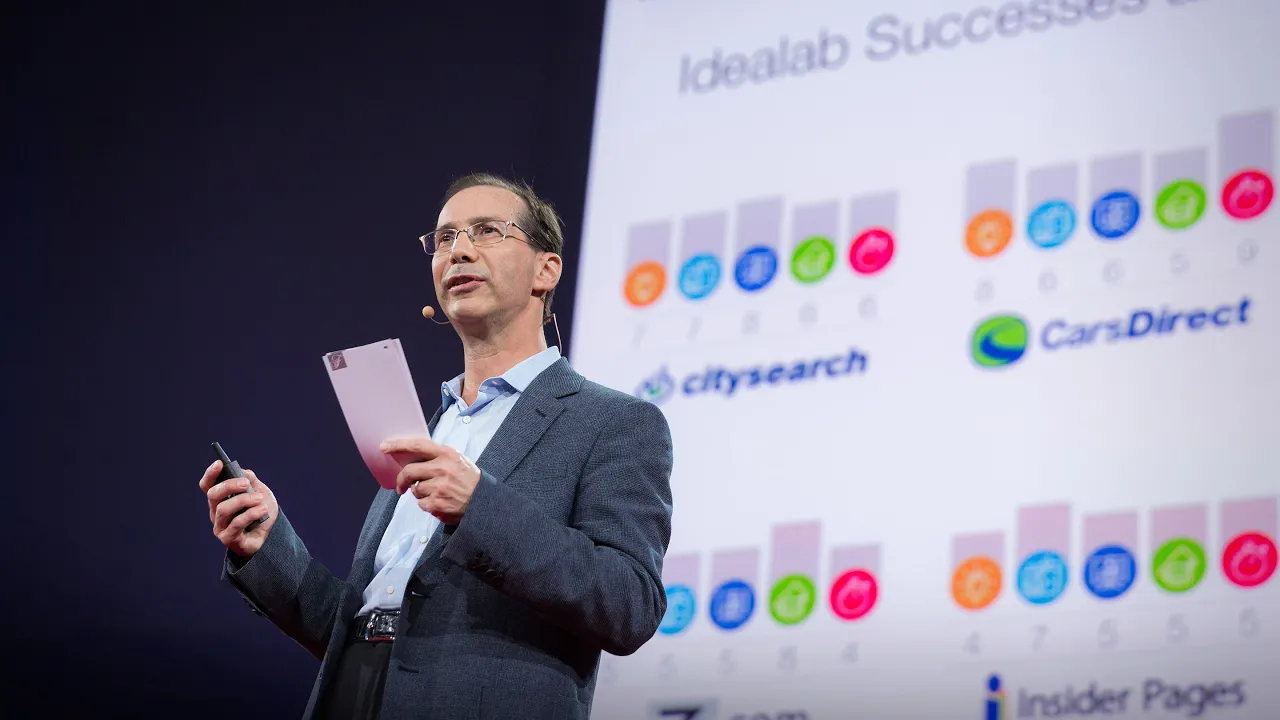
To move beyond anecdotal impressions, Gross gathered data across 200 companies—100 started within Idealab and 100 outside ventures—and scored each company across the five chosen criteria. Within Idealab, he examined five billion-dollar breakout successes (Citysearch, CarsDirect, GoTo.com, NetZero, and Tickets.com) alongside five high-hope ventures that failed (Z.com, Insider Pages, MyLife, Desktop Factory, and Peoplelink). For non-Idealab ventures, he analyzed iconic runaway successes like Airbnb, Instagram, Uber, YouTube, and LinkedIn, contrasting them with heavily backed dot-com era failures including Webvan, Kozmo, Pets.com, Flooz, and Friendster—many of which possessed ample funding and operational business models yet still collapsed.
```mermaid flowchart LR accTitle: Five Factors of Startup Success Ranked by Impact accDescr: A horizontal flow diagram showing the relative importance of five factors in startup success based on Bill Gross's analysis.
subgraph Primary ["Top Determinants"] F1["1. Timing<br/><b>42%</b>"] F2["2. Team & Execution<br/><b>32%</b>"] end
subgraph Secondary ["Foundational Factors"] F3["3. Idea Uniqueness<br/><b>28%</b>"] F4["4. Business Model<br/><b>24%</b>"] F5["5. Funding<br/><b>14%</b>"] end
Primary --> Secondary ```
The statistical outcome of the analysis ran counter to Gross's own long-held assumptions. “Timing accounted for 42 percent of the difference between success and failure,” Gross reveals. Team and execution ranked second, while idea uniqueness and differentiation landed in third place. While Gross clarified that this finding does not render ideas irrelevant, he was astonished that timing consistently superseded them. The lowest-ranking factors were the business model and funding, a hierarchy that Gross realized made practical sense: a company with genuine customer demand can invent or refine a monetization model later, and a startup showing real traction can readily raise intense capital in the modern market.
- **Rank 1 — Timing (42%):** The single largest differentiator between success and failure across the 200-company dataset. - **Rank 2 — Team and Execution:** The operational capacity to listen to market reality and adapt after launch. - **Rank 3 — Idea (Differentiation/Uniqueness):** Novelty and quality matter, but cannot rescue misaligned market timing. - **Rank 4 — Business Model:** Can be formulated down the road if customers urgently desire the core value proposition. - **Rank 5 — Funding:** Secondary because early underfunding is swiftly overcome once an offering demonstrates organic traction.
[04:21](https://www.youtube.com/watch?v=bNpx7gpSqbY&t=261s) Case Studies in Timing and Honest Market Assessment
To illustrate how market readiness dictates startup outcomes, Gross contextualizes several prominent examples. When Airbnb sought funding, prominent investors turned it down on the premise that no rational person would rent out a room in their home to a stranger. Yet Airbnb debuted during the depth of the Great Recession, a moment when ordinary homeowners desperately needed extra income to make ends meet, prompting them to overcome reservations about hosting strangers. Uber benefited from an identical macroeconomic dynamic: while the company possessed top-tier software and execution, its exponential supply growth was powered by thousands of drivers seeking supplemental income in a sluggish economy. Similarly, Gross's early search engine success, GoTo.com—which he introduced at TED in 1998—flourished because websites were urgently searching for cost-effective traffic solutions, just as Citysearch had surged when small businesses realized they required websites.
Conversely, mistiming proved fatal for Idealab's digital video company, Z.com. Founded in 1999–2000, Z.com had top-tier Hollywood talent signed, an established revenue model, and ample cash reserves. However, broadband penetration was too low, and users had to manually install custom codecs into web browsers just to stream video, leading the business to shutter in 2003. Merely two years later, Adobe Flash resolved the codec bottleneck and United States broadband penetration crossed 50 percent, allowing YouTube to emerge with impeccable timing. YouTube launched without a clear business model or guaranteed path to monetization, yet its timing was flawless for consumer demand.
Gross concludes that while passionate founders naturally want to push their beloved concepts into the world, they must subject their timing to rigorous scrutiny. “And the best way to really assess timing is to really look at whether consumers are really ready for what you have to offer them,” Gross urges, warning entrepreneurs never to live in denial about the market signals they encounter so that their innovations can have a true chance to change the world.
## Notable quotes > [00:12](https://www.youtube.com/watch?v=bNpx7gpSqbY&t=12s) If you take a group of people with the right equity incentives and organize them in a startup, you can unlock human potential in a way never before possible — Bill Gross
> [04:21](https://www.youtube.com/watch?v=bNpx7gpSqbY&t=261s) the best way to really assess timing is to really look at whether consumers are really ready for what you have to offer them — Bill Gross
## Mentioned Bill Gross, Idealab, Mike Tyson, Citysearch, CarsDirect, GoTo.com, NetZero, Tickets.com, Z.com, Insider Pages, MyLife, Desktop Factory, Peoplelink, Airbnb, Instagram, Uber, YouTube, LinkedIn, Webvan, Kozmo, Pets.com, Flooz, Friendster, Adobe Flash, TED
## Video description Bill Gross has founded a lot of start-ups, and incubated many others — and he got curious about why some succeeded and others failed. So he gathered data from hundreds of companies, his own and other people's, and ranked each company on five key factors. He found one factor that stands out from the others — and surprised even him.
TEDTalks is a daily video podcast of the best talks and performances from the TED Conference, where the world's leading thinkers and doers give the talk of their lives in 18 minutes (or less). Look for talks on Technology, Entertainment and Design -- plus science, business, global issues, the arts and much more. Find closed captions and translated subtitles in many languages at http://www.ted.com/talks/bill_gross_the_single_biggest_reason_why_startups_succeed
Follow TED news on Twitter: http://www.twitter.com/tednews Like TED on Facebook: https://www.facebook.com/TED
Subscribe to our channel: http://www.youtube.com/user/TEDtalksDirector
[Source](https://www.youtube.com/watch?v=bNpx7gpSqbY)