IIHS Petitions US Regulators as Truck Underride Guards Fail at 35 MPH
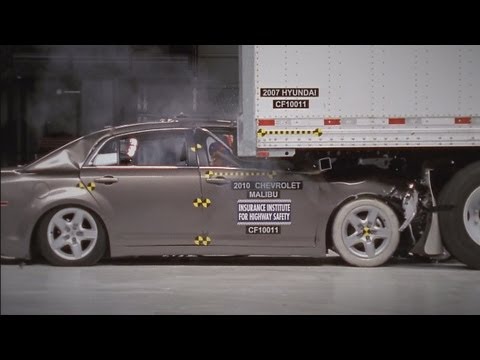
Weak federal standard allows deadly car-into-truck crashes — IIHS

IIHS

Current federal standards allow tractor-trailer underride guards to collapse in low-speed crashes, bypassing passenger car crumple zones and causing deadly cabin intrusion.

AI-assisted summary of Weak federal standard allows deadly car-into-truck crashes — original source. Check the original for full context.

Source published:

Key ideas

  • IIHS crash tests reveal that rear underride guards on semi-truck trailers routinely fail even at low speeds of 35 mph, prompting the Institute to petition the federal government for stronger standards. (0:00)
  • When an underride guard shears off or collapses, passenger car crumple zones are completely bypassed, allowing trailer beds to intrude directly into the cabin with fatal consequences. (1:13)
  • Guards built to stricter standards, such as the Canadian-compliant Wabash trailer, held firm in center collisions but failed catastrophically during outer-edge impacts. (1:45)

Detailed notes

## Background Published on YouTube by the Insurance Institute for Highway Safety (IIHS) on March 1, 2011, this video report accompanies an official IIHS news release. According to the page description, new crash tests demonstrate that semi-truck underride guards frequently fail even in relatively low-speed collisions with fatal consequences, prompting the Institute to petition the federal government for stronger mandates across more commercial trailers.

## TL;DR While modern passenger cars are engineered with crumple zones that absorb impact forces, these safety structures are rendered useless when colliding with semi-trailers whose underride guards collapse or detach. Crash tests using a Chevrolet Malibu at 35 mph show weak guards failing completely, allowing the trailer bed to bypass the engine bay and slice directly into the passenger compartment with risk of decapitation. Even stronger guards built to Canadian standards, such as those on Wabash trailers, only withstood center impacts while failing catastrophically when struck on their outer edges. Consequently, the IIHS argues that outdated federal safety standards leave motorists fatally exposed and must be overhauled.

## Atmosphere & style The presentation carries an urgent, clinical, and sobering tone characteristic of rigorous investigative safety research. The visual contrast between a vehicle's front end crumpling safely in a standard collision versus the violent shearing intrusion of a trailer bed creates a chilling impression of vulnerability. It feels measured yet deeply alarming, using stark crash-test physics and direct statements about decapitation to underscore the immediate human stakes.

## Bulletin - [00:00](https://www.youtube.com/watch?v=bT3G-kcKN70&t=0s) IIHS crash tests reveal that rear underride guards on semi-truck trailers routinely fail even at low speeds of 35 mph, prompting the Institute to petition the federal government for stronger standards. - [01:13](https://www.youtube.com/watch?v=bT3G-kcKN70&t=73s) When an underride guard shears off or collapses, passenger car crumple zones are completely bypassed, allowing trailer beds to intrude directly into the cabin with fatal consequences. - [01:45](https://www.youtube.com/watch?v=bT3G-kcKN70&t=105s) Guards built to stricter standards, such as the Canadian-compliant Wabash trailer, held firm in center collisions but failed catastrophically during outer-edge impacts.

## Key takeaways - [00:00](https://www.youtube.com/watch?v=bT3G-kcKN70&t=0s) In collisions between passenger vehicles and large trucks, passenger cars are inherently at a severe structural disadvantage. - [00:08](https://www.youtube.com/watch?v=bT3G-kcKN70&t=8s) Underride crashes occur when a passenger vehicle slides directly beneath the trailer of a semi-truck. - [00:16](https://www.youtube.com/watch?v=bT3G-kcKN70&t=16s) Many severe injuries and fatalities in truck collisions could be prevented by installing stronger underride guards. - [00:23](https://www.youtube.com/watch?v=bT3G-kcKN70&t=23s) Real-world crash analyses show existing underride bars routinely bend or tear away completely from trailer attachments. - [00:45](https://www.youtube.com/watch?v=bT3G-kcKN70&t=45s) Current federal safety regulations for underride guards fall significantly short of what is required to prevent underride. - [01:00](https://www.youtube.com/watch?v=bT3G-kcKN70&t=60s) IIHS has formally petitioned the federal government to mandate stronger guards and expand requirements to more trucks and trailers. - [01:13](https://www.youtube.com/watch?v=bT3G-kcKN70&t=73s) Modern passenger vehicles rely on front-end crumple zones to absorb kinetic energy and protect the occupant cabin. - [01:25](https://www.youtube.com/watch?v=bT3G-kcKN70&t=85s) In a 40 mph vehicle-to-vehicle test, the Chevrolet Malibu's crumple zone performed as designed and preserved survival space. - [01:33](https://www.youtube.com/watch?v=bT3G-kcKN70&t=93s) Striking a weak trailer guard at 35 mph bypassed the Malibu's crumple zone entirely, pushing the hood directly into the cabin. - [01:50](https://www.youtube.com/watch?v=bT3G-kcKN70&t=110s) The Wabash trailer built to Canadian standards successfully prevented underride during a direct center impact. - [02:05](https://www.youtube.com/watch?v=bT3G-kcKN70&t=125s) Outer-edge impacts on the Canadian-standard guard resulted in total structural failure and severe passenger compartment intrusion. - [02:20](https://www.youtube.com/watch?v=bT3G-kcKN70&t=140s) Federal standards for commercial trailer underride guards have failed to evolve alongside advancements in passenger car crashworthiness.

## Detailed walkthrough ### [00:00](https://www.youtube.com/watch?v=bT3G-kcKN70&t=0s) The Failure of Underride Guards and Federal Safety Standards

Whenever passenger cars and large trucks collide, the car is inherently at a severe disadvantage. Among the most catastrophic types of these collisions are underride crashes, where a passenger vehicle slides directly underneath the trailer of a semi-truck. New research from the Insurance Institute for Highway Safety (IIHS) reveals that a significant portion of the severe injuries and fatalities occurring in these collisions could be prevented simply by equipping big rigs with stronger underride guards. An examination of real-world crashes demonstrated that existing underride guards are suffering catastrophic failures on the road: the bars routinely bend or tear completely away from the trailer attachments, leaving nothing to stop the car from traveling under the rig.

Controlled crash tests conducted by the Institute show that many guards fail with alarming ease, even at relatively low impact speeds. While the federal government mandates rear underride guards on semi-truck trailers specifically to keep passenger vehicles from sliding underneath, the current regulations fall drastically short of what physics demands. As the IIHS investigator points out regarding the current regulatory benchmark: “Our crash tests show though, that the standard is not as strong as it could be and as strong as it should be to prevent this kind of underride.”

```mermaid flowchart TD accTitle: Car-into-Truck Underride Crash Dynamic accDescr: Diagram illustrating how underride guard failure bypasses a car's crumple zone and intrudes into the passenger compartment.

subgraph Impact ["Collision Dynamic"] A["Passenger Car (35 mph)"] --> B["Rear Underride Guard"] end

subgraph Failure ["Guard Performance"] B -->|"Fails / Bends / Tears Off"| C["Trailer Bed Enters Cabin"] B -->|"Holds in Place"| D["Crumple Zone Absorbs Energy"] end

subgraph Outcome ["Crash Result"] C --> E["Severe Cabin Intrusion & Potential Decapitation"] D --> F["Occupant Survival Space Preserved"] end ```

[01:13](https://www.youtube.com/watch?v=bT3G-kcKN70&t=73s) Crash Testing the Chevrolet Malibu: Center Impacts vs. Outer-Edge Vulnerability

Modern passenger cars are engineered with crumple zones and energy-absorbing front-end structures intended to deform progressively and cushion vehicle occupants during serious frontal impacts. However, when crashing into the rear of a tractor-trailer, that advanced structural protection is completely nullified if the truck’s rear underride guard shears off or collapses. To demonstrate this disparity, the Institute contrasted tests of the Chevrolet Malibu, an IIHS Top Safety Pick. After a 40 mile per hour head-on crash into another car, the Malibu's front structure crumpled as designed, dissipating the kinetic energy and maintaining ample survival space within the occupant compartment.

The results diverged horrifyingly when the Malibu struck the rear of a trailer equipped with a weak underride guard at just 35 miles per hour. Because the guard collapsed instantly, the car's crumple zone was never engaged to manage the crash energy. Instead, the high trailer bed sliced straight over the engine bay, peeled back the hood, and intruded directly into the cabin: “And real people could have been decapitated in a crash like this.”

Even trailers built to higher specifications exhibited critical flaws. The Wabash trailer tested featured the strongest underride guard in the evaluation series because it was built to comply with Canada’s more stringent safety standard. When the Malibu struck the Wabash guard dead-center, where the steel structure is most rigid, the guard held firm and successfully prevented underride. But when the Malibu was run into the guard's outer edge, the structure failed completely. The unsupported outer end lacked the strength to deflect the impact, allowing the car to submerge beneath the trailer bed, which once again smashed into the passenger cabin. Although passenger vehicles have become far more crashworthy, the federal standard governing commercial trailer guards has failed to evolve alongside them, leaving motorists vulnerable unless a stronger federal rule is mandated.

- **40 mph car-to-car baseline:** The Chevrolet Malibu preserved occupant survival space through crumple-zone energy absorption. - **35 mph weak guard rear-impact:** The trailer sheared off the guard, bypassed the engine bay, and forced the hood into the crash dummies' laps. - **Wabash trailer (Canadian standard):** Successfully stopped the Malibu during a center impact, but permitted complete underride when struck on its outer edge.

## Mentioned Insurance Institute for Highway Safety, IIHS, Chevrolet Malibu, Wabash

## Video description IIHS news release • March 1, 2011

Underride guards on big rigs often fail in crashes; Institute petitions government for new standard

ARLINGTON, VA — New crash tests and analysis by the Insurance Institute for Highway Safety demonstrate that underride guards on tractor-trailers can fail in relatively low-speed crashes — with deadly consequences. The Institute is petitioning the federal government to require stronger underride guards that will remain in place during a crash and to mandate guards for more large trucks and trailers.

More news at https://www.iihs.org/news

[Source](https://www.youtube.com/watch?v=bT3G-kcKN70)

中文简报

卡车防钻入护栏在35英里时速下失效 IIHS向美监管机构请愿 现行联邦标准允许半挂牵引车的防钻入护栏在低速碰撞中折瘪失效,使乘用车溃缩区无法发挥作用,并导致致命的座舱侵入。 尽管现代乘用车设计有吸收撞击力的碰撞溃缩区,但在与防钻入护栏坍塌或脱落的半挂车相撞时,这些安全结构将变得毫无用处。使用雪佛兰迈锐宝在35英里/小时速度下进行的碰撞测试显示,脆弱的护栏会彻底失效,导致挂车底板直接穿透发动机舱并切入乘员舱,存在致人断头的风险。即便按照更严格的加拿大标准制造的护栏(如Wabash挂车所使用的护栏),也仅能承受中心撞击,而在外边缘受撞时仍会发生灾难性失效。因此,IIHS认为过时的联邦安全标准使驾乘人员面临致命风险,必须进行彻底修订。 IIHS碰撞测试显示,半挂卡车的后部防钻入护栏在35英里/小时的低速下仍频繁失效,促使该机构向联邦政府请愿,要求出台更严格的标准。 (0:00) 当防钻入护栏发生剪切断裂或坍塌时,乘用车溃缩区将完全失效,导致挂车底板直接侵入座舱,带来致命后果。 (1:13) 按照更严格标准制造的护栏(如符合加拿大标准的Wabash挂车护栏)虽然在正中碰撞中表现稳固,但在外边缘受到撞击时却发生了灾难性失效。 (1:45)

Reading summary

Research and crash tests by the Insurance Institute for Highway Safety (IIHS) show that current U.S. federal standards for semi-truck rear underride guards are insufficient to prevent catastrophic passenger cabin intrusion during rear-end collisions. Structural Failures and Inadequate Federal Regulations (0:00) Passenger vehicles are at an inherent disadvantage in collisions with commercial semi-trucks, particularly in underride crashes where a car slides directly beneath a trailer. IIHS research shows that a substantial portion of catastrophic injuries and deaths in these collisions could be avoided if trailers were fitted with stronger underride guards. In real-world crashes, existing guards routinely bend or detach entirely from trailer mountings, providing no barrier to prevent the car from continuing under the rig. Controlled crash evaluations conducted by IIHS demonstrated that many guards fail easily even at relatively low speeds. Although federal regulations mandate rear guards to halt passenger vehicles, IIHS investigators argue that the existing regulatory benchmark falls far short of physical crash demands and fails to deliver the strength necessary to prevent underride. Nullifying Modern Crumple Zones in Impacts (1:13) Modern passenger cars utilize engineered crumple zones designed to absorb and dissipate energy progressively, maintaining survival space within the passenger compartment. However, when an underride guard collapses, these structural safety features are completely bypassed. To illustrate the difference, IIHS evaluated a Chevrolet Malibu—rated as an IIHS Top Safety Pick—in both car-to-car and car-to-trailer impacts. In a 40 mph head-on collision with another passenger car, the Malibu's frontal structure absorbed the energy as engineered and preserved the occupant cabin. Conversely, when impacting the rear of a trailer equipped with a weak underride guard at 35 mph, the guard collapsed immediately. Because the vehicle's crumple zone was never engaged, the trailer bed rode directly over the engine bay, peeled back the hood into the crash test dummies' laps, and intruded deeply into the cabin, creating conditions where occupants could be decapitated. Outer-Edge Vulnerabilities Under Stricter Standards (1:13) Trailers certified to tougher benchmarks still exhibited severe structural weaknesses during offset testing. IIHS tested a Wabash trailer fitted with the strongest guard in the study, built to comply with Canada's more stringent safety standard. When struck dead-center at 35 mph where the steel framing is most rigid, the Wabash guard successfully stopped the Malibu and prevented underride. However, when the Malibu struck the outer edge of the Wabash guard, the unsupported structure failed completely. The guard buckled under the impact, allowing the car to submerge under the trailer bed and causing the trailer to intrude into the passenger compartment. While passenger cars have become significantly more crashworthy through advanced front-end engineering, federal standards governing commercial trailer guards have failed to evolve alongside them, leaving motorists vulnerable unless regulations are strengthened.

精炼阅读摘要

美国公路安全保险协会(IIHS)的研究显示,现行联邦安全标准过低,导致半挂卡车的后部防钻撞护栏在碰撞中极易断裂失效;若能制定更严格的法规并配备更强固的护栏,将能大幅减少乘用车钻入卡车底盘所造成的致命伤亡。 现行联邦标准不足与护栏结构性失效 (0:00) 在乘用车与大型卡车的碰撞事故中,轿车直接钻入半挂车底盘下方的“防钻撞事故”(Underride crashes)是最具毁灭性的形态之一。IIHS对现实事故的调查显示,道路上现役的卡车后防钻撞护栏经常遭遇灾难性破坏,横梁结构在撞击下普遍发生严重弯曲,甚至完全从卡车连接部件上撕裂脱落,使后方车辆失去阻挡而直接滑入车底。受控碰撞测试进一步证实,即使在相对较低的撞击速度下,许多护栏也会轻而易举地损坏。尽管联邦政府强制要求半挂车安装后防钻撞护栏,但IIHS调查人员明确指出,现行联邦安全标准并未达到物理力学要求的坚固程度,既未能充分发挥技术潜力,也未能达到有效防止轿车钻入卡车底部的应有水平。 实车测试揭示吸能失效与护栏边缘缺陷 (1:13) 现代乘用车普遍设计的吸能溃缩区在护栏断裂时会彻底失去保护效能。IIHS对比测试了获得“顶级安全选择”评价的雪佛兰Malibu(Chevrolet Malibu):该车在以40英里/小时进行车对车正面碰撞时,前部吸能结构正常溃缩并保全了乘员生存空间;但当该车以仅35英里/小时撞击装有薄弱护栏的卡车后部时,护栏瞬间崩溃,车辆溃缩区完全无法介入吸收动能,导致拖车底板直接切入发动机舱并侵入乘员舱,调查员指出此类事故极易造成车内人员被斩首。此外,测试证明即便是符合更严苛加拿大安全标准的Wabash拖车,也仅能在正中心撞击时依靠坚固的钢结构阻挡车辆;一旦撞击位置偏向缺乏结构支撑的护栏外侧边缘,护栏便彻底失守,轿车依然会完全钻入卡车尾部并遭到挤压毁灭。 IIHS总结指出,尽管现代乘用车的耐撞性能已大幅提升,但商用拖车防钻撞护栏的联邦法规却长期滞后,若监管机构不强制推行更高强度的联邦标准以消除护栏边缘脆弱等安全漏洞,道路上的驾乘人员将持续面临致命风险。

Detailed notes — zh

## Background 该视频由美国公路安全保险协会(IIHS)于 2011 年 3 月 1 日发布在 YouTube 平台上。视频简介指出,IIHS 最新的碰撞测试与分析表明,半挂卡车上的防钻撞护栏在相对较低的车速下即可能失效并导致致命后果,为此该机构正式向联邦政府请愿,要求提高护栏强度标准并强制更多大型卡车及挂车安装。 ## TL;DR 视频通过对比碰撞测试展示了现行卡车后部防钻撞护栏的严重安全缺陷。获得“顶级安全之选”的雪佛兰迈锐宝在轿车对撞中能有效溃缩吸能,但在低速追尾配备脆弱护栏的挂车时,护栏瞬间崩塌,挂车底板直接切入乘员舱并带来致命的“斩首”风险。即使是符合更严苛标准的挂车,在遇到外侧末端偏置碰撞时依然发生结构断裂并导致钻底。IIHS 强调现代乘用车的耐撞性大幅提升,但防钻撞法规却严重滞后,呼吁联邦政府立即提高护栏强度门槛并扩大强制安装范围。 ## Atmosphere & style 整段视频洋溢着严谨、冷峻且极具警示意味的调查纪实风格。慢动作碰撞画面的视觉冲击力极强,从轿车安全吸能的平稳场景急转直下至车顶被挂车底板生生削切的骇人惨状,营造出强烈的危机感与紧迫感。解说语气客观专业却辞锋犀利,通过直言真实乘员面临的“斩首”危险,生动传递出对现行法规滞后于汽车安全技术发展的沉痛抨击与改革呼吁。 ## Bulletin - [00:00](https://www.youtube.com/watch?v=bT3G-kcKN70&t=0s) IIHS 碰撞测试证实,现行美国联邦标准的卡车后部防钻撞护栏在相对较低车速下极易失效断裂,导致追尾轿车直接钻入货车底盘。 - [01:06](https://www.youtube.com/watch?v=bT3G-kcKN70&t=66s) 获“顶级安全之选”评价的雪佛兰迈锐宝以仅 35 mph 撞击脆弱护栏时发生灾难性钻底,货厢底板切入乘员舱,假人受重创并面临斩首致死风险。 - [01:51](https://www.youtube.com/watch?v=bT3G-kcKN70&t=111s) 即便符合更严格加拿大标准的沃巴什(Wabash)护栏能抵御正中撞击,在边缘偏置碰撞时依然失效崩塌,显示边缘结构存在严重防护盲区。 - [01:51](https://www.youtube.com/watch?v=bT3G-kcKN70&t=111s) IIHS 已正式向美国联邦政府请愿,要求提升防钻撞护栏强制标准并扩大加装范围,以解决卡车法规严重落后于现代轿车被动安全技术的问题。 ## Key takeaways - [00:00](https://www.youtube.com/watch?v=bT3G-kcKN70&t=0s) 轿车在与重型卡车的碰撞中处于天然体量劣势,其中以追尾并钻入挂车底部的钻底事故致死致伤风险最高。 - [00:00](https://www.youtube.com/watch?v=bT3G-kcKN70&t=0s) 现实事故调查与受控碰撞测试均显示,许多符合现行联邦法规的护栏在受力后发生折弯或直接断裂脱落。 - [00:00](https://www.youtube.com/watch?v=bT3G-kcKN70&t=0s) 现行美国联邦卡车防钻撞护栏安全标准严重滞后且偏低,未能提供防止恶性钻底事故所需的结构强度。 - [01:06](https://www.youtube.com/watch?v=bT3G-kcKN70&t=66s) 现代轿车的前端溃缩吸能设计若要发挥保护作用,必须依托卡车防钻撞护栏在猛烈冲击下保持结构稳固。 - [01:06](https://www.youtube.com/watch?v=bT3G-kcKN70&t=66s) 雪佛兰迈锐宝在 40 mph 车对车碰撞中乘员舱完好,但在 35 mph 追尾弱护栏卡车时溃缩区完全无法起效。 - [01:06](https://www.youtube.com/watch?v=bT3G-kcKN70&t=66s) 防钻撞护栏失效会导致挂车底板直接切入驾驶室,造成引擎盖掀翻、挤压乘员下肢乃至瞬间斩首等致命创伤。 - [01:51](https://www.youtube.com/watch?v=bT3G-kcKN70&t=111s) 沃巴什(Wabash)挂车护栏符合加拿大更高标准,在正中碰撞下表现优异,能成功阻拦车辆并消除钻底。 - [01:51](https://www.youtube.com/watch?v=bT3G-kcKN70&t=111s) 偏置碰撞测试表明,即使是高规格护栏在其外侧边缘位置仍存在结构强度缺陷,撞击后同样导致乘员舱被严重侵入。 - [01:51](https://www.youtube.com/watch?v=bT3G-kcKN70&t=111s) 乘用车耐撞性在过去几十年已有大幅提升,但卡车防钻撞联邦法规停滞不前,二者技术水平产生严重脱节。 - [01:51](https://www.youtube.com/watch?v=bT3G-kcKN70&t=111s) IIHS 正式提请联邦政府出台更严格的护栏抗撞标准,并扩大强制安装防钻撞护栏的大型货车及挂车范围。 ## Detailed walkthrough ### [00:00](https://www.youtube.com/watch?v=bT3G-kcKN70&t=0s) 卡车追尾钻底事故与防钻撞护栏的严重缺陷 无论何时轿车与大型卡车发生碰撞,轿车由于体型与质量差异显然都处于绝对劣势。在所有相撞事故中,最具毁灭性的形式之一便是轿车直接滑入大型卡车挂车的底部(即钻底事故)。公路安全保险协会(IIHS)的最新研究揭示,在这类事故中造成的大量人员伤亡,本可以通过配备更坚固的后部防钻撞护栏(underride guards)来有效避免。IIHS 对现实世界中的多起撞击事故进行了深入调查,发现许多防钻撞护栏在撞击发生时表现极其脆弱,甚至出现了灾难性的结构失效——护栏在受力后发生严重弯曲,甚至直接从挂车底盘上断裂脱落,导致追尾车辆毫无阻拦地钻入挂车腹部。 ```mermaid flowchart TD accTitle: 卡车追尾防钻撞护栏失效与保护机制对比 accDescr: 对比展示防钻撞护栏完好与断裂失效对追尾轿车内部乘员造成的两种截然相反的后果 subgraph Failure["护栏结构强度不足(现行标准)"] A["轿车以相对较低车速追尾"] --> B["防钻撞护栏发生弯折或断裂脱落"] B --> C["轿车吸能溃缩区无法发挥作用"] C --> D["挂车底板直接切入乘员舱 (致死/斩首风险)"] end subgraph Protection["高强度护栏保持结构完整"] E["轿车撞击高强度护栏"] --> F["护栏稳固受力阻挡车体深入"] F --> G["车头溃缩区正常吸能变形"] G --> H["乘员舱结构完整,提供充足生存空间"] end ``` IIHS 进行的一系列受控碰撞测试直观地证实了这一危险:部分符合现行联邦法规的护栏在相对较低的行车速度下就会轻易失效。尽管美国联邦政府强制要求半挂卡车尾部必须安装防钻撞护栏,其初衷是在发生追尾事故时阻止小客车滑入底盘下方,但碰撞测试的严酷事实证明,现行联邦安全标准不仅未达到其应有的防护极限,甚至远不足以有效预防此类恶性钻底事故的发生。正如 IIHS 研究人员尖锐指出的那样:“Our crash tests show though, that the standard is not as strong as it could be and as strong as it should be to prevent this kind of underride.”(我们的碰撞测试表明,现行标准既没有达到它能够达到的强度,也没有达到防止这种钻底事故所应有的强度。) - 事故不对称性:轿车与卡车相撞处于天然物理劣势,其中以追尾并钻入挂车底部的危险性最高。 - 现实失效模式:实际调查表明许多护栏直接折弯或从车体撕裂,丧失阻拦功能。 - 速度门槛:部分护栏在相对较低的车速碰撞下即可发生结构性损毁。 - 标准滞后:现行联邦卡车防钻撞标准严重偏低,无法提供充分的安全冗余。 --- ### [01:06](https://www.youtube.com/watch?v=bT3G-kcKN70&t=66s) 雪佛兰迈锐宝碰撞对比:有效吸能与致命钻底 现代轿车的车头结构经过精密工程设计,能够在发生严重正面碰撞时通过特定的受控溃缩来吸收巨大的撞击能量,从而最大限度减少对车内乘员的冲击和伤害。然而,当轿车以相同方式撞击大型卡车尾部时,这套先进的安全防护设计能够奏效的唯一前提,就是卡车的防钻撞护栏必须在猛烈撞击下保持在原位不崩塌。为了直观证明这一点,测试团队选用了获得“顶级安全之选”(Top Safety Pick)评价的雪佛兰迈锐宝(Chevrolet Malibu)进行了对照试验。 在迈锐宝以每小时 40 英里(约 64 公里/小时)的速度与另一辆轿车发生碰撞后,其车头结构完美地吸收了碰撞产生的能量,驾驶舱与乘员舱保持了极其完整的生存空间。但随后展示的画面则令人触目惊心:同一款雪佛兰迈锐宝在仅仅以每小时 35 英里(约 56 公里/小时)的速度撞上一辆配备脆弱防钻撞护栏的挂车尾部时,整个车头防撞梁与吸能区甚至根本没有机会发挥作用。脆弱的护栏瞬间断裂失效,挂车底板如同利刃般向后猛烈推挤,直接将轿车引擎盖向上剥开,整个金属车体被生生切入并横扫至碰撞测试假人的膝盖上方。研究人员对此发出了极其严厉的警告:“And real people could have been decapitated in a crash like this.”(在这样的碰撞事故中,真正坐在车里的人可能会被直接斩首。) - 迈锐宝车对车碰撞(40 mph):车头溃缩吸能完全生效,乘员舱生存空间保持完好。 - 迈锐宝追尾弱护栏卡车(仅 35 mph):护栏瞬间崩塌,吸能结构未能起效,货厢底板直接削入驾驶室。 - 致命伤害风险:碰撞不仅将车盖挤压推移至假人腿部,更极易对真实车内乘员造成斩首等致命创伤。 --- ### [01:51](https://www.youtube.com/watch?v=bT3G-kcKN70&t=111s) 偏置碰撞失效与更严格联邦标准的呼吁 在此次测试的各类挂车中,沃巴什(Wabash)挂车配备了整个测试系列中最坚固的防钻撞护栏,该护栏符合更为严苛的加拿大安全标准。当雪佛兰迈锐宝正对挂车中央撞击时,由于护栏中部结构坚固,沃巴什挂车成功阻挡了车辆,完全防止了钻底现象的发生。然而,当测试调整为偏置碰撞、迈锐宝仅撞击护栏的外侧末端时,场景发生了急剧逆转。护栏边缘的外侧结构强度严重不足,无法承受局部的冲击力,最终迈锐宝再次直接滑入挂车底部,坚硬的挂车尾部再一次深入侵入到轿车乘员舱内。 这一系列测试揭示出一个严峻的行业脱节现状:尽管现代汽车在防撞耐撞性能上已经取得了长足的进步,远比过去更加坚固安全,但针对卡车防钻撞护栏的美国联邦法规标准却长期停滞不前,完全未能跟上乘用车安全技术的演进节奏。IIHS 郑重呼吁联邦政府尽快提高标准,要求加装更强固的护栏并扩大强制安装的货车与挂车范围。正如研究所明确强调的:“Cars are much more crashworthy than they used to be, but the federal standard for underride guards hasn't kept pace. Many crashes with big rigs would be much less severe with a stronger federal rule.”(现在的汽车耐撞性已经远超以往,但有关防钻撞护栏的联邦标准却没有与时俱进。只要出台更严格的联邦法规,许多涉及重型大卡车的严重车祸后果本可以大大减轻。) - 沃巴什(Wabash)护栏特性:符合更严格的加拿大标准,在正中碰撞时表现优秀,成功拦截车辆。 - 边缘结构缺陷:在仅击中护栏外侧末端的偏置测试中,护栏依然崩溃,轿车再次钻底侵入乘员舱。 - 政策与监管诉求:IIHS 正式向政府提出请愿,敦促制定更高强度的全覆盖护栏标准,减少卡车追尾事故中的致死悲剧。 ## Notable quotes > [01:51](https://www.youtube.com/watch?v=bT3G-kcKN70&t=111s) Cars are much more crashworthy than they used to be, but the federal standard for underride guards hasn't kept pace. Many crashes with big rigs would be much less severe with a stronger federal rule. — IIHS ## Mentioned IIHS(美国公路安全保险协会), 雪佛兰迈锐宝(Chevrolet Malibu), 沃巴什(Wabash), 美国联邦政府 ## Video description IIHS news release • March 1, 2011 Underride guards on big rigs often fail in crashes; Institute petitions government for new standard ARLINGTON, VA — New crash tests and analysis by the Insurance Institute for Highway Safety demonstrate that underride guards on tractor-trailers can fail in relatively low-speed crashes — with deadly consequences. The Institute is petitioning the federal government to require stronger underride guards that will remain in place during a crash and to mandate guards for more large trucks and trailers. More news at https://www.iihs.org/news [Source](https://www.youtube.com/watch?v=bT3G-kcKN70)

Source quotes

[1:51] IIHS: Cars are much more crashworthy than they used to be, but the federal standard for underride guards hasn't kept pace. Many crashes with big rigs would be much less severe with a stronger federal rule.

Original transcript

[0:00] Anytime cars and trucks collide, the car is obviously at a disadvantage. But one of the most devastating kinds of crashes is when a car slides under the trailer of a large truck. Our new research shows that many of the injuries and deaths that occur in these kinds of crashes could be prevented with stronger underwrite guards. We've studied how underwrite guards are performing in real-world crashes, and discovered that many are failing catastrophically. The guard bends or it may break away from the trailer, allowing a vehicle to slide under it. Our crash tests demonstrate how easily some guards fail at relatively low speeds. The federal government requires that the backs of semi-truck trailers have underride guards to prevent vehicles from sliding underneath them in the event of a crash. Our crash test show though, that the standard is not as strong as it could be and as strong as it should be to prevent this kind of underride. CARS' front-end structures are designed to crush in a way to minimize injuries to occupants in serious frontal crashes. But when you crash into the back of a large truck, That protection only works if the truck's underride guard stays in place. The Chevrolet Malibu is a top safety pick. And this is a Malibu after a 40 mile per hour crash with another car. The front end structure has absorbed the crash energy from that, and you can see there's lots of survival space. in the occupant compartment. Thank you. This is a Malibu. after it struck the rear end of a trailer, with a weak underwrite guard at only 35 miles an hour. This front structure never got a chance to do its work. Instead, the trailer just pushed back peel the hood back, put it into the laps of the dummies. And real people could have been decapitated in a crash like this. The Wabash trailer had the strongest underride guard in this series. Its guard meets a tougher Canadian standard. This Wabash trailer prevented underride when the Malibu struck it in the center, where the guard is stronger. But it was a very different story when the Malibu crashed into only the outer end of the guard. The guard isn't strong enough there and it allowed the Malibu to slide under the trailer and the trailer ends up back in the occupant compartment. Cars are much more crash worthy than they used to be, but the federal standard for underride guards hasn't kept pace. Many crashes with big rigs would be much less severe with a stronger federal rule.