ETH Zurich Algorithm Recovers Quadcopters After Midair Propeller Loss
Mark Mueller
Software that stabilizes damaged drones via a controlled spin eliminates the need for heavy multi-motor hardware redundancy.
AI-assisted summary of Quadrocopter failsafe algorithm: recovery after propeller loss — original source. Check the original for full context.
Source published:
Key ideas
- ETH Zurich researchers have demonstrated an autonomous failsafe algorithm that allows a quadrocopter to maintain controlled flight and safely recover after losing a propeller mid-flight. (0:00)
- Upon detecting propeller detachment, the quadrocopter automatically enters a rapid, controlled spin around its primary axis to compensate for asymmetric thrust and returns to hover at its original position. (0:00)
- The failsafe operates purely as a software upgrade on standard, off-the-shelf quadrocopter hardware, avoiding the weight and payload penalties of physical redundancy like hexacopters or octocopters. (0:00)
- The degraded vehicle remains fully controllable throughout the spin state and executes a soft, controlled landing upon operator command. (0:00)
Detailed notes
## Background Published on YouTube by Mark Mueller on December 2, 2013, this video presents robotics research conducted with Raffaello D'Andrea at the Institute for Dynamic Systems and Control (IDSC) at ETH Zurich. The video demonstrates an autonomous failsafe algorithm that allows a standard quadrocopter to survive the loss of a propeller mid-flight and perform a controlled landing without extra redundant hardware.
## TL;DR Inside ETH Zurich's Flying Machine Arena, a quadrocopter hovers with an unbolted propeller that intentionally vibrates loose and detaches mid-air. Rather than tumbling out of control, the drone's autonomous estimation and control system instantly identifies the failure and initiates a rapid, controlled spin around its primary axis to counter asymmetric thrust. The aircraft stabilizes itself, regains its initial hover coordinates, and maintains full maneuverability until executing a smooth, operator-commanded soft landing. This software-only solution allows standard quadcopters to achieve failsafe recovery in safety-critical applications without the payload and weight penalties of adding extra motors.
## Atmosphere & style The presentation is tense and dramatic, heightened by a suspenseful musical score that builds anticipation as the loose rotor blade begins to shake. What initially appears headed for an inevitable catastrophic crash transforms into a mesmerizing display of dynamic control as the vehicle seamlessly transitions into a high-speed stabilization spin. The demonstration feels remarkably focused and high-tech, evoking quiet awe as the violently spinning craft remains steady and gently touches down with complete precision.
## Bulletin - [00:00](https://www.youtube.com/watch?v=bsHryqnvyYA&t=0s) ETH Zurich researchers have demonstrated an autonomous failsafe algorithm that allows a quadrocopter to maintain controlled flight and safely recover after losing a propeller mid-flight. - [00:00](https://www.youtube.com/watch?v=bsHryqnvyYA&t=0s) Upon detecting propeller detachment, the quadrocopter automatically enters a rapid, controlled spin around its primary axis to compensate for asymmetric thrust and returns to hover at its original position. - [00:00](https://www.youtube.com/watch?v=bsHryqnvyYA&t=0s) The failsafe operates purely as a software upgrade on standard, off-the-shelf quadrocopter hardware, avoiding the weight and payload penalties of physical redundancy like hexacopters or octocopters. - [00:00](https://www.youtube.com/watch?v=bsHryqnvyYA&t=0s) The degraded vehicle remains fully controllable throughout the spin state and executes a soft, controlled landing upon operator command.
## Key takeaways - [00:00](https://www.youtube.com/watch?v=bsHryqnvyYA&t=0s) Catastrophic propeller loss in conventional quadrotors immediately breaks thrust and torque balance, typically resulting in an unrecoverable crash. - [00:00](https://www.youtube.com/watch?v=bsHryqnvyYA&t=0s) The experiment intentionally induced rotor separation mid-flight by mounting a propeller without a retaining nut, relying on operational vibration to shake it free. - [00:00](https://www.youtube.com/watch?v=bsHryqnvyYA&t=0s) Onboard estimation and control systems autonomously detect the mechanical failure in real time without human intervention. - [00:00](https://www.youtube.com/watch?v=bsHryqnvyYA&t=0s) To counter the lost thrust vector, the recovery algorithm initiates a controlled high-speed spin around the vehicle's primary axis. - [00:00](https://www.youtube.com/watch?v=bsHryqnvyYA&t=0s) While spinning, the vehicle actively stabilizes its altitude and successfully maneuvers back to its original coordinate setpoint. - [00:00](https://www.youtube.com/watch?v=bsHryqnvyYA&t=0s) The quadrocopter maintains stable degraded flight until receiving a user command, at which point it executes a gentle, controlled touchdown. - [00:00](https://www.youtube.com/watch?v=bsHryqnvyYA&t=0s) Historically, surviving a motor or propeller failure required hardware redundancy through six- or eight-rotor configurations. - [00:00](https://www.youtube.com/watch?v=bsHryqnvyYA&t=0s) Hardware redundancy adds substantial structural mass, reducing a multicopter's energy efficiency and usable payload capacity. - [00:00](https://www.youtube.com/watch?v=bsHryqnvyYA&t=0s) Because the failsafe relies exclusively on standard sensors and motors, it can be deployed as an algorithmic-only upgrade to existing quadrocopters. - [00:00](https://www.youtube.com/watch?v=bsHryqnvyYA&t=0s) This algorithmic fault tolerance allows quadrocopters to be considered for safety-critical missions where payload efficiency is paramount. - [00:00](https://www.youtube.com/watch?v=bsHryqnvyYA&t=0s) The underlying spinning control dynamics offer a conceptual blueprint for designing novel vehicle configurations with fewer active actuators. - [00:00](https://www.youtube.com/watch?v=bsHryqnvyYA&t=0s) The project was developed by Mark W. Mueller and Raffaello D'Andrea at the ETH Zurich Flying Machine Arena with support from the Swiss National Science Foundation.
## Detailed walkthrough ### [00:00](https://www.youtube.com/watch?v=bsHryqnvyYA&t=0s) Quadrocopter Propeller Loss and Autonomous Failsafe Recovery
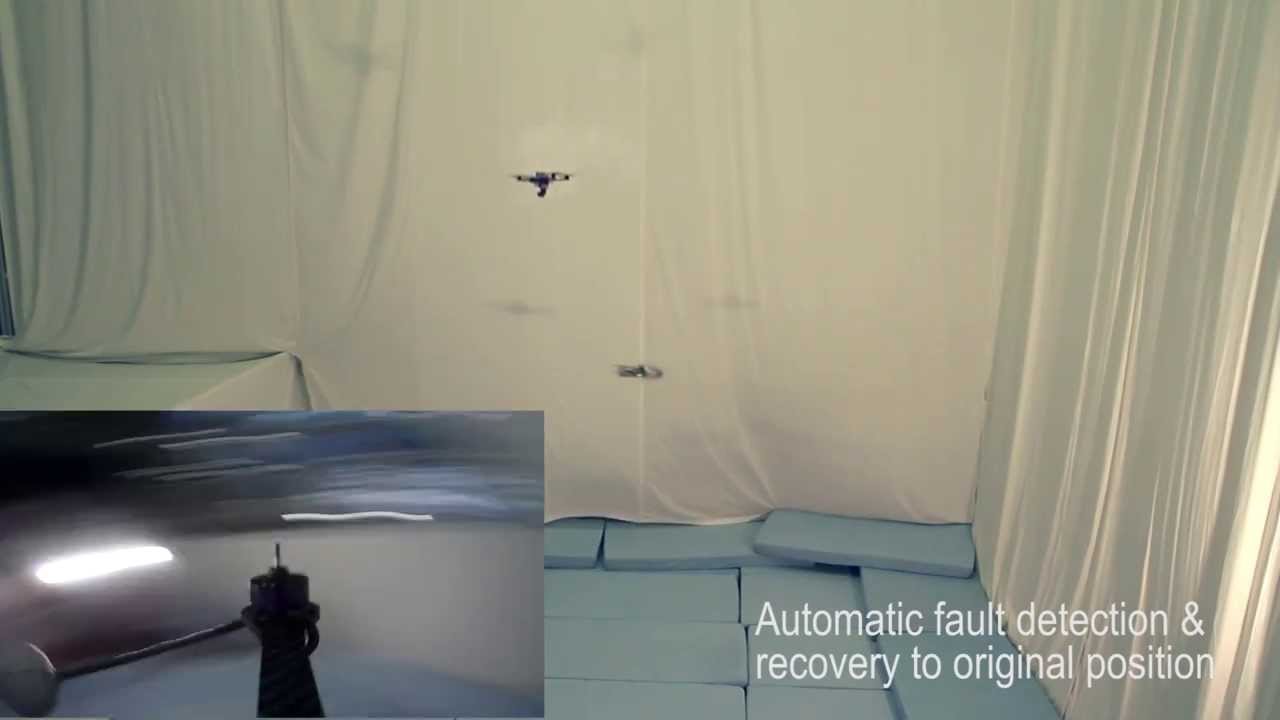
The demonstration from the Institute for Dynamic Systems and Control (IDSC) at ETH Zurich's Flying Machine Arena showcases an automated failsafe control algorithm designed to recover a quadrocopter after catastrophic propeller loss. Set against a dramatic, tense musical backdrop, the experiment illustrates a scenario where a quadrocopter rotor blade is deliberately installed without a retaining nut, allowing normal operational vibrations to shake the propeller loose mid-flight. When the blade flies off, conventional quadrotors would immediately lose attitude control and crash due to the sudden loss of torque balance and thrust symmetry.
Instead of crashing, the vehicle's onboard estimation and control system autonomously senses the failure in real time. Upon detecting the lost propeller, the failsafe algorithm takes over: the quadrocopter enters a rapid, controlled spin around its primary axis to compensate for the asymmetric thrust, stabilizes its altitude and orientation, and maneuvers back to its original hover coordinates. The vehicle remains fully controllable in this degraded state until receiving an operator command to execute a smooth, controlled soft landing.
Historically, multirotor aircraft required physical hardware redundancy—such as upgrading to hexacopter or octocopter configurations—to survive the loss of a motor or propeller. The researchers demonstrate that this capability can be achieved purely through control software on existing, off-the-shelf quadrocopter hardware, preserving payload capacity and structural efficiency without the penalty of extra motors and structural weight.
```mermaid flowchart TD accTitle: Quadrocopter Failsafe Recovery Architecture accDescr: Sequence diagram showing propeller detachment, automated detection, recovery spin, and soft landing. subgraph S1["Nominal Flight"] A["Normal Quadrocopter Hover"] --> B["Propeller Vibrates Loose"] end subgraph S2["Failsafe Algorithm"] B --> C["Automatic Failure Detection"] C --> D["Controlled High-Speed Spin"] D --> E["Position Recovery & Stable Hover"] end subgraph S3["Landing Phase"] E --> F["Operator Landing Command"] F --> G["Controlled Soft Touchdown"] end ```
- **Institution and Location**: Institute for Dynamic Systems and Control (IDSC), ETH Zurich, tested inside the Flying Machine Arena. - **Key Researchers**: Mark W. Mueller and Raffaello D'Andrea. - **Hardware Footprint**: Implemented as a pure software upgrade utilizing standard onboard sensors and motors without additional actuators or mechanical redundancy. - **Operational Payoff**: Enables four-rotor vehicles to be deployed in safety-critical operations while retaining optimal payload capacity compared to heavier hexacopters or octocopters. - **Project Support**: Backed by the Swiss National Science Foundation (SNSF) with patent-pending technology.
## Mentioned ETH Zurich, Flying Machine Arena, Institute for Dynamic Systems and Control (IDSC), Mark W. Mueller, Markus Waibel, Max Kriegleder, Raffaello D'Andrea, Swiss National Science Foundation (SNSF)
## Video description Quadrocopter failsafe algorithm -- Institute for Dynamic Systems and Control (IDSC), ETH Zurich, Switzerland - http://www.idsc.ethz.ch/
== UPDATE == Please see this video (http://youtu.be/ek0FrCaogcs) for a demonstration of the flight algorithm without the motion capture system.
The video shows an automatic failsafe algorithm that allows a quadrocopter to gracefully cope with the loss of a propeller. The propeller was mounted without a nut, and thus eventually vibrates itself loose.
The failure is detected automatically by the system, after which the vehicle recovers and returns to its original position. The vehicle finally executes a controlled, soft landing, on a user's command.
The failsafe controller uses only hardware that is readily available on a standard quadrocopter, and could thus be implemented as an algorithmic-only upgrade to existing systems. Until now, the only way a multicopter could survive the loss of a propeller (or motor), is by having redundancy (e.g. hexacopters, octocopters). However, this redundancy comes at the cost of additional structural weight, reducing the vehicle's useful payload. Using this technology, (more efficient) quadrocopters can be used in safety critical applications, because they still have the ability to gracefully recover from a motor/propeller failure.
This control approach can also be applied to design novel flying vehicles, the results of which will be posted soon.
This technology is patent pending.
For more information, please see www.FlyingMachineArena.org
Researchers: Mark W. Mueller and Raffaello D'Andrea
Video: Mark W. Mueller, Markus Waibel, Max Kriegleder, and Raffaello D'Andrea
Location: Flying Machine Arena at ETH Zurich
Acknowledgements This work is supported by and builds upon prior contributions by numerous collaborators in the Flying Machine Arena project. See http://www.flyingmachinearena.org/people . This work was supported by the SNSF (Swiss National Science Foundation).
[Source](https://www.youtube.com/watch?v=bsHryqnvyYA)