In spring 2017, T-Mobile turned off IPv4 on roughly 10 million iPhones, assigning exclusively IPv6 cellular interfaces without noticeable disruption to end users. (3:22)
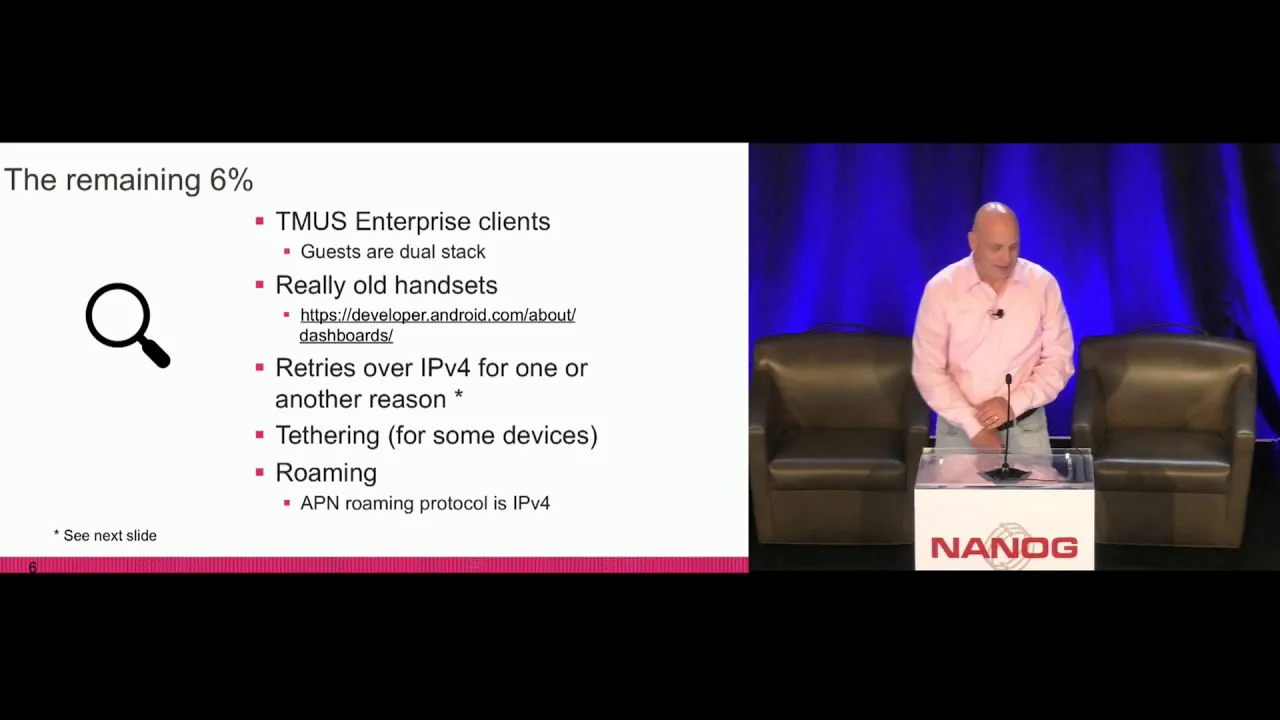
By mid-2018, approximately 94% of outbound traffic originating from T-Mobile's autonomous system preferred IPv6, with the remaining 6% tied up in enterprise Wi-Fi, legacy handsets, tethering, and roaming. (5:20)
T-Mobile uses DNS64 and NAT64 alongside 464XLAT (RFC 6877) and RFC 7050 prefix discovery to maintain reachability for legacy IPv4 destinations and applications using hardcoded IPv4 literals. (15:38)
Transport and protocol decision-making is actively shifting from network operators to higher-level application APIs, browsers, and central cloud resolvers via DNS over HTTPS (DoH). (20:55)
Detailed notes
## Background
Published on YouTube by NANOG on June 27, 2018, this presentation features Stephan Lagerholm detailing T-Mobile's multi-year strategy to eliminate IPv4 dependency. The session covers how T-Mobile transitioned over 10 million handsets to IPv6-only transport in 2017 using DNS64, NAT64, and 464XLAT, sharing operational experiences, Happy Eyeballs testing, and troubleshooting strategies for broken applications.
## TL;DR
Stephan Lagerholm outlines T-Mobile's journey to reaching over 94% IPv6 adoption across its mobile fleet by disabling IPv4 on cellular interfaces and leveraging technologies like DNS64, NAT64, and 464XLAT. He explains how client-side translation and Apple's App Store mandate enabled massive fleet migrations on Android and iOS while leaving a small long tail of legacy devices, tethering, and roaming traffic. Lagerholm also presents testbed findings on browser failover behaviors under Happy Eyeballs, warns against carrier-side DNS workarounds for broken third-party domains, and examines the architectural trend of protocol decisions moving up into the application layer.
## Atmosphere & style
The presentation carries a casual, self-effacing, and collegial vibe typical of a seasoned network engineering conference. Lagerholm balances technical depth with lighthearted humor, joking about sunny weather outside the conference hall, World Cup soccer matches, and waiting out older subscribers with ancient phones. It feels pragmatic and battle-tested—an insider's retrospective celebrating a massive operational milestone while offering candid reflections on browser quirks, lingering RFC 1918 shortages, and the shifting power dynamics between network operators and application developers.
## Bulletin
- [03:22](https://www.youtube.com/watch?v=d6oBCYHzrTA&t=202s) In spring 2017, T-Mobile turned off IPv4 on roughly 10 million iPhones, assigning exclusively IPv6 cellular interfaces without noticeable disruption to end users.
- [05:20](https://www.youtube.com/watch?v=d6oBCYHzrTA&t=320s) By mid-2018, approximately 94% of outbound traffic originating from T-Mobile's autonomous system preferred IPv6, with the remaining 6% tied up in enterprise Wi-Fi, legacy handsets, tethering, and roaming.
- [15:38](https://www.youtube.com/watch?v=d6oBCYHzrTA&t=938s) T-Mobile uses DNS64 and NAT64 alongside 464XLAT (RFC 6877) and RFC 7050 prefix discovery to maintain reachability for legacy IPv4 destinations and applications using hardcoded IPv4 literals.
- [20:55](https://www.youtube.com/watch?v=d6oBCYHzrTA&t=1255s) Transport and protocol decision-making is actively shifting from network operators to higher-level application APIs, browsers, and central cloud resolvers via DNS over HTTPS (DoH).
## Key takeaways
- [00:10](https://www.youtube.com/watch?v=d6oBCYHzrTA&t=10s) T-Mobile collaborated early with Secure64 to deploy the industry's first commercial DNS64 platform to accelerate the transition away from IPv4.
- [03:22](https://www.youtube.com/watch?v=d6oBCYHzrTA&t=202s) Android 4.3 introduced native IPv6 and 464XLAT support in 2013, creating the initial foundation for T-Mobile's mobile IPv6 rollout.
- [03:22](https://www.youtube.com/watch?v=d6oBCYHzrTA&t=202s) Apple accelerated carrier adoption by mandating that all App Store submissions support IPv6-only environments starting June 1, 2016.
- [03:22](https://www.youtube.com/watch?v=d6oBCYHzrTA&t=202s) T-Mobile turned off IPv4 across 10 million iPhones in spring 2017, leaving the cellular interface operating exclusively on IPv6.
- [05:20](https://www.youtube.com/watch?v=d6oBCYHzrTA&t=320s) The long tail of the remaining 6% IPv4 traffic consists of corporate campus networks, pre-Android 4.3 devices, tethering, roaming, and connection-retry quirks.
- [10:25](https://www.youtube.com/watch?v=d6oBCYHzrTA&t=625s) Handset tethering behaviors vary by operating system, with iPhones historically presenting IPv4-only interfaces to connected laptops while newer devices support dual stack.
- [10:25](https://www.youtube.com/watch?v=d6oBCYHzrTA&t=625s) Roaming defaults globally to IPv4 across international and regional partner networks, requiring operators to keep legacy APN configurations active.
- [12:44](https://www.youtube.com/watch?v=d6oBCYHzrTA&t=764s) Happy Eyeballs testing shows Chrome and Safari quickly recover back to IPv6 after network failures, whereas Edge and IE fail over to IPv4 and never switch back.
- [12:44](https://www.youtube.com/watch?v=d6oBCYHzrTA&t=764s) Firefox on Android evaluated Happy Eyeballs only once per session for a given domain, remaining stuck on the initial transport protocol even if connectivity changed.
- [15:38](https://www.youtube.com/watch?v=d6oBCYHzrTA&t=938s) DNS64 resolvers synthesize IPv6 addresses using the well-known prefix 64:ff9b::/96 when authoritative AAAA records are missing, forwarding traffic through NAT64 gateways.
- [17:36](https://www.youtube.com/watch?v=d6oBCYHzrTA&t=1056s) Android handsets resolve IPv4 literals using the local CLAT daemon, whereas Apple implements translation higher in the stack using APIs like NSURLSession.
- [17:36](https://www.youtube.com/watch?v=d6oBCYHzrTA&t=1056s) RFC 7050 enables devices to dynamically discover network NAT64 prefixes by querying ipv4only.arpa.
- [21:45](https://www.youtube.com/watch?v=d6oBCYHzrTA&t=1305s) Network operators should avoid deploying local DNS spoofing or workarounds for misconfigured external domains, using RFC compliance and platform mandates instead to compel external fixes.
- [25:51](https://www.youtube.com/watch?v=d6oBCYHzrTA&t=1551s) Because dominant content providers like Google, Facebook, and Oath serve traffic natively over IPv6, the overwhelming majority of T-Mobile carrier traffic completely bypasses IPv4 transport.
## Detailed walkthrough
### [00:10](https://www.youtube.com/watch?v=d6oBCYHzrTA&t=10s) Introduction and T-Mobile's Path to IPv6
Stephan Lagerholm introduces his presentation in Denver, joking about how great it is to be indoors discussing IPv6 on a sunny day. Reflecting on his background, he explains that he was born and raised in Sweden before relocating to the United States in 2007. His active involvement in IPv6 advocacy began around 2009 at an ARIN conference in San Antonio. While living in Dallas, he met Stan Barber, and during their discussions comparing IPv4 versus IPv6 adoption across Europe and the US, they realized the United States was falling behind. This realization prompted them to co-found the Texas IPv6 Task Force in 2009, drawing inspiration from Denver's own Rocky Mountain IPv6 Task Force.
Around that time, Lagerholm began working at Secure64, a DNS company based in Denver. One day, an internal sales representative came into his office saying, “Hey, you got to talk to this guy Cameron at T-Mobile. He's talking about DNS64, NAT64, IPv6. I have no idea what he's talking about.” Lagerholm contacted Cameron Byrne at T-Mobile, who convinced him that pairing DNS64 with NAT64 represented the ideal evolutionary path for mobile service providers transitioning away from IPv4. As a result, Secure64 partnered with T-Mobile to deliver the industry's first commercial DNS64 platform. Following a subsequent role running DNS architecture at Microsoft, Lagerholm joined T-Mobile in late 2016 to lead their architecture group. Upon his arrival, Byrne immediately told him: “By the way, we're turning off IPv4 on our iPhones here shortly. So, that might be something you want to look into and dig into.”
The outline for the session focuses on:
- T-Mobile's journey toward complete IPv4 independence
- Research into retries, return traffic, and the impact of Happy Eyeballs algorithms on the network
- Technical fundamentals of NAT64, DNS64, prefix discovery (RFC 7050), and 464XLAT (RFC 6877)
- Application-level fallback to IPv4
- Best practices and operational lessons learned from removing IPv4 completely from a production carrier network
---
[03:22](https://www.youtube.com/watch?v=d6oBCYHzrTA&t=202s) Client Landscape and Turning Off IPv4 on 10 Million iPhones
Lagerholm highlights that mobile carriers benefit from a significantly simpler client ecosystem than wireline service providers, which must contend with legacy consumer equipment like Nest thermostats and odd embedded hardware. The vast majority of T-Mobile’s subscribers use either Android or Apple hardware. Google integrated native IPv6 and 464XLAT support into Android starting with version 4.3 (Jelly Bean MR2), which served as T-Mobile's trigger to enable IPv6 across Android handsets. Apple provided a massive industry push at WWDC 2015 when they mandated that, effective June 1, 2016, all applications submitted to the App Store had to support IPv6-only network environments rather than just functioning under dual-stack configurations.
```mermaid
flowchart TD
accTitle: Mobile Platform Milestones Toward IPv6-Only Operation
accDescr: Timeline diagram illustrating Android 4.3 adding 464XLAT in 2013, Apple mandating IPv6-only app support in 2016, and T-Mobile disabling IPv4 on iPhones in 2017.
subgraph Android["Android Ecosystem"]
A["Android 4.3 Released (2013)"] --> B["Native IPv6 + 464XLAT Support"]
B --> C["T-Mobile enables IPv6 on Android"]
end
subgraph Apple["Apple Ecosystem"]
D["WWDC Announcement (2015)"] --> E["Mandate IPv6-only App Support (June 2016)"]
E --> F["T-Mobile disables IPv4 interface on iPhones (Spring 2017)"]
end
C --> G["Over 10 Million Handsets on IPv6-Only"]
F --> G
```
Asking the audience how many are T-Mobile subscribers with iPhones, Lagerholm points out that their cellular connections operate strictly on IPv6 without any local IPv4 address assigned to the cellular interface. In the spring of 2017, T-Mobile turned off IPv4 on roughly 10 million iPhones across the fleet. Lagerholm emphasizes the scale of this milestone: “We have been able to move clients to a new IP protocol without even them probably knowing that they moved to an IPv6 only experience and we turn off IPv4 on them.”
- Android handsets have natively supported IPv6 alongside 464XLAT (CLAT) since Android 4.3.
- Apple App Store policy required all apps submitted after June 1, 2016, to pass compatibility testing in an IPv6-only NAT64/DNS64 environment.
- When Wi-Fi is disabled on modern iPhones attached to T-Mobile's cellular core, the device exposes exclusively an IPv6 transport interface to the OS.
---
[05:20](https://www.youtube.com/watch?v=d6oBCYHzrTA&t=320s) Deployment Trajectory and the Long Tail of the Remaining 6%
T-Mobile's migration trajectory spans several years of public tracking, starting around the release of Android 4.3 in 2013. At APRICOT 37 in early 2014, T-Mobile presented metrics from the World IPv6 Launch organization showing that 16% of outbound traffic originating from their autonomous system preferred IPv6 over IPv4. Over successive industry presentations, that adoption curve showed steady, steep upward momentum before beginning to taper slightly as it approached the upper 90th percentile. By mid-2018, data published on `worldipv6launch.org` showed that approximately 94% of handsets originating traffic from T-Mobile's AS preferred IPv6. Looking across the industry, Lagerholm cites Verizon Wireless and India's greenfield operator Reliance Jio as the other major wireless service providers driving massive scale IPv6 adoption.
With 94% of traffic preferring IPv6, T-Mobile has reached the point of scraping the “bottom of the barrel” to identify why the remaining 6% continues to touch IPv4. Lagerholm breaks down the five primary categories accounting for this trailing traffic:
1. **Enterprise and Campus Clients**: Internal enterprise users have not yet been migrated to pure IPv6 or dual stack. While corporate guest Wi-Fi networks use the same production DNS64 and NAT64 infrastructure that powers mobile handsets, those guest networks maintain a fallback dual-stack configuration to provide emergency IPv4 reachability in the event that users access raw IPv4 literals.
2. **Legacy Handsets**: Devices running operating systems prior to Android 4.3 do not support the required client-side translation architecture. While Google's Play Store statistics show pre-4.3 devices representing roughly 4% of active devices globally, Lagerholm notes that cellular network subscribers and power users who generate high web traffic typically upgrade their primary phones much faster than that global baseline, likely placing the internal carrier figure at a few percent. He quips that with hardware as old as the Samsung Galaxy S II, “This is hard for us to do anything. We just have to wait them out and at some point they'll, you know, buy a new phone and that old grandma, she'll pass away and, you know, at some point we'll we'll get to to no old handsets.”
3. **Application Retries and Happy Eyeballs Behaviors**: Intermittent radio coverage scenarios can trick connection-fallback algorithms. For instance, an Uber driver navigating via Google Maps might enter a tunnel and experience packet loss or coverage disruption. If the device emerges and reconnects using dual-stack logic where Happy Eyeballs establishes an IPv4 socket first, applications may pin themselves to IPv4 instead of returning to IPv6.
[10:25](https://www.youtube.com/watch?v=d6oBCYHzrTA&t=625s) Tethering and Roaming Corner Cases
Stephan Lagerholm breaks down the lingering corner cases that keep a small fraction of mobile traffic tied to IPv4. Tethering is one notable scenario: when turning a handset into a mobile hotspot, different devices behave differently toward connected clients. An iPhone used as a hotspot exposes an IPv4-only interface to an attached laptop, whereas newer devices such as the LG V30 offer a full dual-stack tethering experience. Stephan estimates that tethering edge cases account for roughly 1% to 2% of the traffic not running purely over IPv6.
The other major factor holding back full IPv6 deployment is roaming, where T-Mobile's APN roaming protocol is globally configured as IPv4 only. Because this is a global network setting, T-Mobile cannot safely switch it to IPv6 until all roaming partners worldwide are capable of handling it:
> “So, since it's a global setting, we need to make sure that all the service providers in the world can handle before we turn it on.”
This constraint applies not only internationally across Canada, Mexico, and Europe, but also domestically. When driving north a few hours into Wyoming, a user may enter areas without native T-Mobile coverage where service relies on regional partner networks; in those locations, traffic is similarly tunneled back to T-Mobile over IPv4. Domestic roaming accounts for another 1% to 2% of traffic, though this will burn down as T-Mobile expands native infrastructure. International roaming, however, will eventually force a deliberate decision on whether to enable IPv6. Stephan jokes to the audience about preserving network metrics:
> “So, so don't go to Mexico or Canada or Europe for vacation this summer. If you can stay in the US where you have T-Mobile coverage, or maybe Puerto Rico is a good alternative for you then, you know, that would be good because then we keep the statistics high.”
He adds that while visiting his native Sweden would unfortunately mean falling back to IPv4 on international roaming, attendees could at least catch the Sweden vs. Mexico World Cup match early Wednesday morning.
[12:44](https://www.youtube.com/watch?v=d6oBCYHzrTA&t=764s) Happy Eyeballs Testing and Browser Failover Behaviors
Stephan examines Happy Eyeballs, the standardized mechanism designed to fall back gracefully to IPv4 whenever IPv6 connectivity degrades or fails. To observe how clients handle these transitions in practice, he evaluated the `he.test-ipv6.com` diagnostic test (which uses JavaScript polling every five seconds to report whether the connection is IPv4 or IPv6) and attempted to induce live failures while driving around. Because inducing failures consistently in the field proved difficult, he built a dedicated testbed using a web page that continuously refreshed an image every five seconds, applying `iptables` rules to drop IPv6 traffic and watch how different web browsers reacted.
Browsers exhibit starkly different fallback and recovery behaviors:
- **Google Chrome and Apple Safari:** Both handled the transition effectively. When `iptables` blocked IPv6, they shifted quickly to IPv4. Once the blocking rule was removed and IPv6 restored, both browsers rapidly detected the recovery and moved back to IPv6. Stephan notes that this "return" behavior after recovery is not deeply specified in early Happy Eyeballs RFCs, making their implementation particularly noteworthy.
- **Microsoft Edge and Internet Explorer:** Both browsers successfully failed over to IPv4 when an IPv6 failure was induced. However, neither browser ever migrated back to IPv6 once the IPv6 path became healthy again.
- **Mozilla Firefox on Android:** Failed to switch over under these conditions. When starting on an IPv6 connection that was subsequently severed, Firefox never fell back to IPv4. Stephan explains that Firefox appears to run its Happy Eyeballs check once at the start of a session for a given domain and assumes that result remains valid throughout, without re-evaluating. Similarly, if started while IPv6 was blocked, Firefox stayed stuck on IPv4 and never shifted to IPv6 when it became available.
Stephan highlights that resolving these edge cases across browser engines will be critical as operators attempt to push network statistics toward 100% IPv6.
[15:38](https://www.youtube.com/watch?v=d6oBCYHzrTA&t=938s) DNS64, NAT64, and CLAT Architecture
Stephan illustrates the architecture of DNS64 and NAT64 used to serve IPv6-only mobile handsets. Because the client handset possesses only an IPv6 interface, it has no reason to issue DNS `A` queries and instead transmits only `AAAA` queries directly to T-Mobile's DNS64 servers.
```mermaid
flowchart TD
accTitle: DNS64 and NAT64 Architecture Flow
accDescr: Flow diagram showing how an IPv6-only handset queries DNS64 and either routes directly to the IPv6 internet or synthesizes an address through NAT64.
subgraph Client["Mobile Device"]
HS["IPv6-Only Handset"]
end
subgraph DNS["Resolution"]
D64["DNS64 Resolver"]
end
subgraph NetworkPaths["Internet Routing"]
V6NET["IPv6 Internet"]
N64["NAT64 Gateway"]
V4NET["IPv4 Internet"]
end
When an authoritative `AAAA` record exists, the DNS64 server returns it directly, allowing the client to take an optimal path out to the IPv6 internet without stateful intermediate translation nodes. If only an IPv4 `A` record exists, the DNS64 server synthesizes an IPv6 address by prepending the standard Well-Known Prefix `64:ff9b::/96` to the IPv4 address (converting the dotted-decimal octets into hexadecimal notation) and returning the synthetic `AAAA` to the client:
> “Worst case scenario, there's no V6, but there is a V4 address. And in that case, we do a synthetic we append a prefix, the DNS64 prefix is 64FF9B in this case and we convert this from hex to from octal to hex and we send that back to the client to trick him into that there is actually an IPv6 address for this website that you're trying to to reach.”
The synthesized prefix is routed directly to pairs of redundant NAT64 gateways inside T-Mobile's network, which strip the prefix and forward the packets to the IPv4 internet. Stephan points out that NAT64 appliances are expensive to deploy and operate. While major content providers like Google and Facebook deliver nearly all traffic natively over IPv6, smaller CDNs and select cloud hosts still lag on IPv4, requiring continued gateway capacity.
[17:36](https://www.youtube.com/watch?v=d6oBCYHzrTA&t=1056s) 464XLAT and Application-Level Fallback
To support applications that rely on hardcoded IPv4 address literals rather than DNS hostnames, T-Mobile implements 464XLAT (RFC 6877, co-authored by Cameron Byrne). On Android devices, a client translator daemon called `clat` runs locally on the phone. When an application attempts to communicate with an IPv4 literal, the local `clat` process intercepts the packet, prepends the network's NAT64 prefix, and emits a standard IPv6 packet over the cellular link to the network's NAT64 gateway (`plat`), which translates it out to IPv4.
To discover the local NAT64 prefix dynamically without manual provisioning or hardcoding, clients implement RFC 7050. The device transmits a DNS `AAAA` query for the well-known name `ipv4only.arpa`. By inspecting the synthetic IPv6 address returned by the DNS64 resolver and stripping the known trailing 32 bits, the client automatically learns the exact prefix in use on that network.
Apple approaches this translation at the application layer rather than running a system-wide `clat` daemon. In Apple's developer guidelines, engineers are advised against writing directly to low-level BSD sockets and are directed toward higher-level networking frameworks:
> “Instead, they're recommending the stuff in the middle that's kind of in bluish here. So, they want you to use what they call NSURLSession, which is a higher-level API, and they will take care of all the translation on your behalf and falling back to IPv4 if possible.”
Using `NSURLSession`, the operating system manages RFC 7050 prefix discovery queries for `ipv4only.arpa` behind the scenes. If an application attempts to reach an IPv4 literal, the framework synthesizes an IPv6 address on the fly. Stephan notes that this shifts the architectural responsibility: the industry is increasingly migrating the IPv4 fallback mechanism higher up the software stack, turning what was once a carrier network-level dual-stack routing decision into client OS and application-level behavior.
[20:55](https://www.youtube.com/watch?v=d6oBCYHzrTA&t=1255s) Protocol Decision-Making Moves to the Application Layer
The historical architectural model for network decisions has undergone a dramatic shift. Network operators used to evaluate whether to run dual-stack on a client or server, leave it on IPv4, or move it to IPv6-only. That responsibility later shifted downward into the operating system layer via mechanisms like 464XLAT. Today, the decision has shifted even further up the stack directly into the application itself. Applications are now dynamically assessing service-level agreements (SLAs), deciding autonomously whether the performance on IPv6 is adequate or whether they need to force an immediate fallback to IPv4.
```mermaid
flowchart TD
accTitle: Protocol Decision Migration Over Time
accDescr: The historical evolution of where IPv4 vs IPv6 routing and transport decisions are made, moving from the network operator to the operating system and finally up into individual applications and cloud resolvers.
subgraph Hist["Past Architectures"]
direction TB
N["Network Operators<br/>(Dual-stack vs. IPv4 vs. IPv6)"]
O["Operating System Layer<br/>(464XLAT Client clat)"]
N --> O
end
subgraph Modern["Application-Driven Present"]
direction TB
A["Application / Browser Layer<br/>(Active SLA monitoring & Happy Eyeballs fallback)"]
C["Central Cloud & DoH Resolvers<br/>(Remote routing decisions & external DNS)"]
A --> C
end
O --> A
```
Stephan Lagerholm points out that this evolution is creating an uneasy dynamic for network operators. With industry discussions increasingly focusing on DNS over HTTPS (DoH), browsers and applications gain the power to bypass local network resolvers altogether, forwarding queries directly to proprietary centralized resolvers in the cloud to determine routing and reachability remotely. Looking at where this trend is heading, Lagerholm highlights the unsettling nature of that shift: “So, it's kind of a you know, an interesting but a little bit scary new path that we're seeing here and where's this going to end?”
[21:45](https://www.youtube.com/watch?v=d6oBCYHzrTA&t=1305s) Practical Learnings and Troubleshooting IPv6 Deployments
Reflecting on T-Mobile’s broader deployment, Lagerholm compares adopting IPv6 to funding a retirement account: “Obviously invest in IPv6 a little bit it's like your 401K retirement plan, right? You you need to kind of constantly invest and and and move, you know, we've done a big investment which was a very successful investment early on with with our handsets and that panned out really well for us.” While the mobile handset environment is now in strong shape, internal infrastructure remains an ongoing effort. T-Mobile's internal network management network ("NMnet") continues to run out of RFC 1918 private address space, requiring the team to systematically enable IPv6 during standard lifecycle hardware refreshes and end-of-life upgrade cycles.
Prior to completely deactivating IPv4 for Apple devices, the engineering team performed extensive scanning to identify mission-critical services and applications with broken DNS configurations. When DNS64 synthetic synthesis derailed on flawed external zones—such as with a major US credit card issuer and a university—T-Mobile reached out directly to their engineering teams, securing fixes before the commercial rollout. Lagerholm firmly advises against implementing localized DNS workarounds or internal spoofed records to resolve external defects:
- **Avoid local DNS overrides:** Faking DNS responses inside the carrier network to patch an external domain's breakage creates serious security and operational liability. If a financial institution changes its hosting or IP blocks and someone else takes over the previous address, the carrier risks functioning as an accidental man-in-the-middle.
- **Use RFC standards as leverage:** When contacting third parties with broken endpoints, quoting specific sections—such as RFC violations in DNS64 or NAT64 specifications—gives remote network administrators concrete technical justification to fix their zones.
- **Enforce Apple App Store guidelines:** Third-party app developers can be held accountable to Apple's strict policy mandating that every application submitted to the App Store support an IPv6-only environment.
- **Monitor social media channels:** For specialized core DNS teams inside massive service providers, tracking user complaints on platforms like Twitter and Reddit helps reproduce obscure application-level breakages on actual mobile handsets and coordinate fixes with external application providers.
- **Maintain perspective:** Not every broken site on the internet can stall an IPv6 migration. Broken sites and uncompliant DNS servers are constantly malfunctioning across the wider web regardless, so carriers should dive in and eliminate IPv4 without expecting every external edge case to be pristine.
[25:51](https://www.youtube.com/watch?v=d6oBCYHzrTA&t=1551s) Q&A: Traffic Volumes and Migration Strategy
During the concluding question-and-answer period, audience members raise questions regarding actual live traffic splits and how the migration was rolled out across the user base. When asked about overall traffic distribution, Lagerholm notes that IPv6 accounts for well over 94% of T-Mobile's cellular network traffic. Because the dominant content providers on the internet (such as Google, Facebook, and Oath/Yahoo) already serve all their traffic natively over IPv6, combined with the fact that roughly 96% of T-Mobile handsets operate in IPv6-only mode, the vast majority of all carrier traffic never touches IPv4 transport.
Edward from Spotify asks whether the shift to IPv6 happened as an incremental deployment or as an overnight change: “Was there any kind of gradual rollout of this change to IPv6 or was it a big switch in a day that you say, 'Yep, let's do it'?” Lagerholm explains that the initial support rolled out on Android handsets starting with version 4.3, representing a gradual initial adoption. However, when the configuration was finalized for specific handset populations and later extended to iOS, each operational flip functioned like a scheduled cutover date: “So, it was kind of a a a big it was like a flag day, right? We're turning this on and then any anybody with Android 4.3 is going to have it, right?” From that baseline flag day, native IPv6 volume grew naturally as subscribers upgraded their older smartphones to modern, IPv6-capable devices.
## Mentioned
Stephan Lagerholm, Cameron Byrne, Stan Barber, Edward, T-Mobile, Apple, Google, Microsoft, Mozilla, Secure64, Spotify, Verizon Wireless, Reliance Jio, Facebook, Oath/Yahoo, ARIN, Texas IPv6 Task Force, Rocky Mountain IPv6 Task Force, World IPv6 Launch, App Store, Google Play Store, Google Chrome, Apple Safari, Microsoft Edge, Internet Explorer, Mozilla Firefox, Android, iOS, iPhone, Samsung Galaxy S II, LG V30, DNS64, NAT64, 464XLAT, CLAT, PLAT, Happy Eyeballs, DNS over HTTPS, NSURLSession, RFC 6147, RFC 6877, RFC 7050, RFC 6555, RFC 8305
## Video description
Speaker
Stephan Lagerholm
Over the last 10 years, T-Mobile have had a strategy of removing our dependency of IPv4. In the spring of 2017 we finally flipped the switch and turned off IPv4 for over 10 million handsets. As of March 2018 we only have a single digit % of our users relying on IPv4. We have in other words reached the utopia of making our customer experience independent of IP transport protocol. To achieve this we are using DNS64 and related technologies. Stephan will share some of T-Mobile’s experience with DNS64 and give some advice on how to find and handle broken applications and websites. Talk outline: • Background T-Mobile’s journey towards IPv6 only • Background, RFC6147, RFC6877 and RFC7050 • Selection algorithm and happy eyeballs (RFC6555, RFC8305) • Common failure scenarios for IPv6 only hosts • RFC compliance and how popular DNS64 resolvers react to various common DNS misconfigurations • Conclusion and learnings
IPv6占比达94%,T-Mobile在千万台手机上停用IPv4
该运营商利用DNS64和464XLAT向纯IPv6传输过渡,同时将协议回退逻辑直接推向客户端应用。
Stephan Lagerholm概述了T-Mobile在其移动终端设备中实现超过94%的IPv6普及率的历程,具体做法是通过在蜂窝接口上禁用IPv4,并利用DNS64、NAT64和464XLAT等技术。他解释了客户端转换与苹果应用商店(App Store)的相关强制要求如何促成了Android和iOS设备的大规模迁移,同时仅留下了少量的老旧设备、网络共享和漫游流量这一长尾。Lagerholm还展示了Happy Eyeballs机制下浏览器故障转移行为的试验台测试结果,警告运营商不要为受损的第三方域名提供运营商端DNS变通方案,并探讨了协议决策向上层应用层转移的架构趋势。
2017年春季,T-Mobile在约1000万台iPhone上关闭了IPv4,仅分配IPv6蜂窝接口,且未对最终用户造成明显影响。 (3:22)
截至2018年年中,T-Mobile自治系统发出的出站流量中约有94%优先使用IPv6,其余6%则分布在企业Wi-Fi、老旧手机、网络共享和漫游中。 (5:20)
T-Mobile结合使用DNS64、NAT64、464XLAT(RFC 6877)以及RFC 7050前缀发现机制,以保持老旧IPv4目标地址和使用硬编码IPv4字面量应用的可达性。 (15:38)
传输和协议的决策权正积极从网络运营商向更高级别的应用程序API、浏览器以及通过DNS over HTTPS(DoH)的中央云解析器转移。 (20:55)
Reading summary
T-Mobile transitioned its cellular subscriber fleet to an IPv6-only transport by leveraging mobile operating system capabilities, DNS64/NAT64 network translation, and client-side translation frameworks. According to architecture lead Stephan Lagerholm, while over 94% of carrier traffic operates natively on IPv6, complete IPv4 elimination remains impeded by roaming constraints, tethering variations, legacy clients, and application-level fallback behaviors.
Mobile Fleet Migration and Flag-Day Deployments (3:22)
Mobile operators benefit from a relatively uniform client base compared to wireline networks. T-Mobile began enabling IPv6 after Google introduced native IPv6 and 464XLAT support in Android 4.3 in 2013. Apple provided crucial industry momentum by mandating that all App Store submissions support IPv6-only environments effective June 1, 2016. In spring 2017, T-Mobile deactivated IPv4 on cellular interfaces for approximately 10 million iPhones, moving them to an IPv6-only transport without user disruption.
Lagerholm explained that major rollout phases functioned as scheduled cutovers tied to supported operating system versions. Outbound IPv6 traffic recorded by World IPv6 Launch climbed from 16% in early 2014 to roughly 94% by mid-2018. Because leading content providers like Google, Facebook, and Oath/Yahoo deliver content natively over IPv6, and about 96% of T-Mobile handsets run IPv6-only cellular configurations, the vast majority of subscriber traffic bypasses IPv4 transport entirely.
Translation Mechanics: DNS64, NAT64, and 464XLAT (15:38)
To connect IPv6-only handsets to IPv4 endpoints, T-Mobile deployed paired DNS64 and NAT64 systems. When an IPv6 handset queries DNS64 for a domain lacking authoritative AAAA records, the resolver synthesizes an IPv6 address using the Well-Known Prefix 64:ff9b::/96. Traffic directed to this prefix routes through redundant NAT64 gateways, which strip the synthetic prefix and translate packets to the IPv4 internet.
For applications relying on hardcoded IPv4 address literals, devices employ 464XLAT (RFC 6877). Android executes a local client translator daemon (CLAT) that intercepts IPv4 literals, prepends the NAT64 prefix, and transmits standard IPv6 packets to the carrier gateway (PLAT). Devices dynamically discover the network's NAT64 prefix using RFC 7050 queries for ipv4only.arpa. On iOS, Apple handles translation at the application framework level via APIs like NSURLSession rather than running a system daemon, embedding translation logic into higher software layers.
The Residual Long Tail of IPv4 Traffic (5:20)
The remaining 6% of traffic touching IPv4 stems from specific architectural edge cases. Roaming is a primary hurdle: T-Mobile's global APN roaming configuration defaults to IPv4 because turning on IPv6 requires uniform readiness across global partner carriers. Domestic roaming in areas without native coverage also tunnels traffic over IPv4. Together, Lagerholm estimated roaming accounts for 1% to 2% of residual IPv4 traffic.
Hotspot tethering accounts for another estimated 1% to 2%, as tethered iPhones expose only IPv4 to connected clients, whereas devices like the LG V30 offer dual-stack tethering. Other factors include unmigrated corporate campus environments, guest Wi-Fi networks requiring dual-stack fallback for raw IPv4 reachability, and legacy devices running versions prior to Android 4.3 that cannot run CLAT.
Application Fallbacks and Operational Realities (12:44)
Protocol decision-making has migrated from network operators to the application layer. Active SLA monitoring and Happy Eyeballs algorithms enable applications to autonomously trigger IPv4 fallbacks. In controlled failure testing with iptables, Chrome and Safari quickly shifted to IPv4 and reverted to IPv6 once restored. Internet Explorer and Edge failed over to IPv4 but never returned to IPv6, while Firefox on Android failed to switch mid-session. Furthermore, technologies like DNS over HTTPS (DoH) allow applications to bypass carrier DNS infrastructure entirely.
Operationally, T-Mobile scanned mission-critical domains prior to disabling IPv4 on iPhones, finding defective DNS setups at major banks and universities. Lagerholm strongly warned against implementing local DNS overrides or spoofing records to mask external errors, citing security and man-in-the-middle liabilities. Instead, carriers should cite IETF RFC specifications and Apple App Store mandates to compel third-party providers to resolve domain breakages.
While T-Mobile demonstrated that an IPv6-only mobile core is commercially viable at scale, full protocol retirement remains unfinished: internal carrier management networks (NMnet) still battle RFC 1918 address exhaustion. Moreover, as applications and centralized cloud resolvers increasingly govern transport selection, network operators face reduced control over traffic paths and failover behaviors.
[0:10] Thanks everybody. Can you have everybody
[0:12] hear me okay? Yeah, it sounds good.
[0:14] Well, it's great to be here in Denver,
[0:15] sunny day and we're going to talk about
[0:17] IPv6 here indoors, so that feels great.
[0:20] Some background on me, I'm going to talk
[0:22] about how our path to going IPv6 only at
[0:26] T-Mobile.
[0:27] Uh I was born and raised in Sweden. I
[0:29] moved to the US in 2007.
[0:31] In 2009, I I remember attending an ARIN
[0:34] conference in San Antonio.
[0:36] Uh I lived in Dallas
[0:38] at that time and and I met with Stan
[0:40] Barber, who some of you guys might be
[0:41] familiar with and we were talking about
[0:43] the deployment of IPv4 versus IPv6 in
[0:46] the Europe and versus US and kind of
[0:49] came to the conclusion that, you know,
[0:50] it's it's we're we're a little behind
[0:52] here in the US and maybe we should do
[0:54] something. So, we founded the Texas IPv6
[0:56] Task Force uh back in 2009. We were
[0:59] inspired by the Rocky Mountain Task
[1:01] Force here in Denver, who by the way,
[1:03] they're a sponsor and there's some
[1:05] events going on tonight if anybody's up
[1:07] for a free beer. Uh anybody who's doing
[1:09] IPv6.
[1:11] Uh
[1:11] nevertheless, uh I started work for a
[1:13] company called Secure64, also based here
[1:15] in Denver, a DNS company and one day
[1:18] this sales guy comes, you know, comes
[1:20] into my office and says, "Hey, you got
[1:22] to talk to this guy Cameron at T-Mobile.
[1:24] He's talking about DNS64, NAT64, IPv6. I
[1:27] have no idea what he's talking about."
[1:30] So, I know you're into um IPv6, so why
[1:32] don't you give him a call? So, I did and
[1:34] um
[1:35] um Cameron, uh who's still with
[1:37] T-Mobile, who who's a good friend and
[1:39] and somebody I work very closely with,
[1:41] he convinced me that, you know, DNS64,
[1:44] NAT64 was the right path for a mobile
[1:47] service provider to take to transition
[1:49] to IPv6.
[1:50] And uh we actually Secure64 at that
[1:52] point became partners of T-Mobile and we
[1:55] had the first commercial DNS64 platform.
[1:58] Anyway, fast forward a couple of years,
[2:00] I worked for Microsoft doing DNS for
[2:02] them for a while and then about 2 years
[2:04] ago this opportunity showed up to lead
[2:06] the architectural group within T-Mobile.
[2:09] So, I jumped on that and, you know, end
[2:11] of 2016 when I started, one of the first
[2:14] thing Cameron said was
[2:15] "By the way, we're turning off IPv4 on
[2:18] our iPhones here
[2:19] shortly. So, that might be something you
[2:21] want to look into and dig into." So,
[2:23] it's kind of cool to have that full
[2:24] circle, first working
[2:26] as a vendor and now kind of have have
[2:28] the first-hand view of what we're trying
[2:30] to accomplish and and why we're moving
[2:32] to IPv6.
[2:33] If you want to reach me, you know,
[2:35] here's my T-Mobile email address and
[2:36] Twitter, LinkedIn and so forth.
[2:39] Or feel free to find me in the corridors
[2:41] here lately
[2:43] after after this talk.
[2:45] So, I'm going to talk about our journey
[2:47] to become IPv4 independent.
[2:49] Uh I'm going to have a little bit of an
[2:52] talking about retries, returns and happy
[2:55] eyeballs and how that is affecting our
[2:57] network. I've been doing a little bit of
[2:58] research there lately.
[3:00] And then give you guys a background for
[3:01] those who who doesn't know NAT64, DNS64
[3:04] and some of the technologies we are
[3:06] using like prefix discovery and 464XLAT.
[3:10] And then talk about application level
[3:12] fallback to IPv4 and what that is and
[3:14] then some best practices and some
[3:16] learnings that I've had from
[3:18] removing IPv4 from our network.
[3:22] So, our customer base is pretty easy to
[3:24] deal with compared to perhaps, you know,
[3:27] a wired service provider where there's
[3:29] nest thermostats and all kinds of stuff.
[3:32] Uh the bulk of our customer base is
[3:35] either Android handsets or Apple
[3:37] devices. And Android from starting from
[3:40] 4.3 and onwards have had support for
[3:43] IPv6 plus 464XLAT.
[3:46] And that's when we decided to turn on um
[3:49] IPv6 on these Android handsets.
[3:52] And for Apple in 2015 at their developer
[3:55] conference, they announced that uh
[3:58] starting June 1st, 2016, any application
[4:01] within the application store needs to be
[4:03] not only, you know,
[4:05] working on a V6 like a dual stack
[4:07] environment, but actually must support
[4:10] IPv6 only networking. So, it's been
[4:12] tremendously helpful for us to um
[4:16] to have those two giants behind us also
[4:19] helping us pushing the transition to
[4:21] IPv6.
[4:23] And just a quick survey, how many of you
[4:24] guys are T-Mobile customers in here?
[4:26] Raise a hand. And how many of you guys
[4:28] have a iPhone?
[4:30] So, I don't know if you guys are aware,
[4:31] but but you're actually having a V6 only
[4:34] experience today, right? So, we have
[4:36] about, you know, give or take 10 million
[4:38] iPhones in our network and there there's
[4:41] no IPv4 interface. If you look at the
[4:43] interface, you turn off Wi-Fi and you
[4:45] look at your interfaces,
[4:46] there is no IPv4 interface. It's there,
[4:48] only IPv6. So, that's a pretty cool
[4:51] accomplishment in my opinion and I mean,
[4:53] this is stuff that's ready. This is
[4:55] nothing we're going to turn on a year
[4:57] from now, 2 years from now. This is now,
[4:59] right now. We've had it on for a year
[5:00] and a half. It works, right? And we've
[5:03] really reached a utopia that I think we
[5:05] all talked about. We have been able to
[5:07] move clients to a a new
[5:09] IP protocol without even them probably
[5:12] knowing that they moved to an IPv6 only
[5:14] experience and we turn off IPv4
[5:18] on them.
[5:20] So, it's been a long journey starting
[5:21] with Android 4.3 somewhere around 2013.
[5:25] We've had talks similar to this talk
[5:27] several times uh starting um in 20
[5:30] beginning of 2014, Apricot 37, where we
[5:33] could announce based on the World IPv6
[5:36] Launch that we had 16%
[5:39] of uh our customer base were preferring
[5:42] IPv6 over IPv4 outbound from our AS.
[5:47] And then from from there, we've we've
[5:48] had uh several talks as you guys can see
[5:51] and we've made steady progress.
[5:53] It's tapering off a little bit here uh
[5:55] at the end.
[5:57] Uh as we're getting close to uh 100%,
[6:00] obviously, it's a little harder and
[6:01] there's more corner cases that we need
[6:03] to take into account, but as you can
[6:05] see, it's a good steady progress. And
[6:07] today, based on the World IP
[6:09] World IPv6 Launch at org website, uh
[6:13] today uh some 94% of our traffic is uh
[6:17] or 94% of our handsets, I should say, or
[6:21] you know, they're preferring IPv6 over
[6:23] IPv4 going out from our AS. So, that's a
[6:26] pretty remarkable accomplishment. And
[6:29] can you guys turn on the clock here so I
[6:30] know how much uh time I have left? That
[6:32] would be great.
[6:34] Uh so, that's a pretty remarkable
[6:35] accomplishment. At this point, you you
[6:37] might want to look into like what's that
[6:40] remaining 6%? You know, what kind of
[6:42] corner cases are we like how's the
[6:44] bottom of the barrel looking here in
[6:45] terms of getting to 100% and, you know,
[6:48] I think we're kind of the first
[6:50] uh service provider really pushing, you
[6:52] know, closer, you know, over 90% here
[6:54] that, you know, we can we can look at
[6:56] that and and and see what's going on.
[6:59] If you look at the World IPv6 Launch,
[7:01] there's, you know, a big bunch of
[7:02] companies in there. They're doing a lot
[7:04] of good stuff on IPv6. I think everybody
[7:06] is transitioning one way or another. I
[7:08] think on the wireless side of things is
[7:11] us. Um Verizon Wireless is doing a great
[7:13] job. They have a good adoption rate as
[7:15] well. And then Reliance in India, who's
[7:18] a new entrance to market and they could
[7:19] kind of um go directly into IPv6.
[7:24] So, looking at the remaining 6% and
[7:26] zooming in, um I think it's five
[7:29] categories
[7:30] that um you know, is is mostly
[7:32] contributing to to the remaining 6%. We
[7:36] do have our enterprise clients. We have
[7:38] not migrated our enterprise clients to
[7:40] IPv6 or dual stack yes yet.
[7:44] Uh the the guests are dual stack. So, if
[7:47] you ever visit if you're ever going to
[7:49] visit a T-Mobile campus, then if you
[7:52] connect to the guest, you're actually
[7:53] using NAT64 and DNS64 and those
[7:56] technologies that we're using for our
[7:58] handsets and you're using those for um
[8:01] for your your experience there. But we
[8:03] do we do have the guests are dual
[8:04] stacked. So, if there's an IPv4 literal
[8:07] or something like that coming up and you
[8:09] have that emergency IPv4 connectivity as
[8:12] well.
[8:12] Uh more on that later on how DNS64 and
[8:15] NAT64 works.
[8:17] There's also some really old handsets.
[8:19] So, Android handsets, for example,
[8:21] before 4.3, they are not capable or
[8:24] they're capable dual stack, but they're
[8:25] not turned on in our network.
[8:27] Um so, if you look at this link from
[8:30] developer.android.com,
[8:32] you can see it's about the world wide
[8:35] population of these types of handsets
[8:38] and tablets that are this old is about 4
[8:40] 4%. So, that's measured who is actually
[8:44] going to the
[8:45] uh to app app store to to download any
[8:48] new applications. So, so about 4%. I
[8:51] think that's since that's a worldwide
[8:52] number, I think the number in our
[8:53] network might be a little lower.
[8:55] Typically, your primary device is your
[8:57] phone and you might want to upgrade that
[8:59] a little bit more often. You might have
[9:01] an older tablet or something in your
[9:02] home that might not be upgraded as often
[9:05] and you're using a little longer. So, I
[9:07] think in our network, it might be less
[9:09] than 4%. Um and also, if you're a power
[9:12] user, you probably upgraded your phone
[9:15] at some point. So, most of the
[9:16] connections we're seeing outbound, you
[9:18] know, are coming from power users that
[9:20] are using browsing the internet lot. So,
[9:23] um they probably have a newer uh
[9:25] handset.
[9:27] So, maybe a a couple of percent or
[9:28] something could still constitute, you
[9:30] know, old phones that are not being
[9:32] upgraded. And this is hard for us to do
[9:34] anything. We just have to wait them out
[9:35] and at some point they'll, you know, buy
[9:37] a new phone and that old grandma, she'll
[9:39] pass away and, you know,
[9:42] at some point we'll we'll get to to no
[9:44] old handsets. Uh but but they're still,
[9:46] you know, I'm surprised because we're
[9:47] talking about like Samsung Galaxy S2 um
[9:50] as a good example of a phone that's, you
[9:52] know, not supporting Android 4.3. So,
[9:55] it's pretty old stuff.
[9:58] Another thing that could contribute a
[9:59] little bit to this is retries over IPv4
[10:02] for one or another reason. So, think
[10:04] about we're having LTE network, you're
[10:06] an Uber driver or something, you're
[10:08] using Google Maps or
[10:10] some other application, you're driving
[10:11] to a tunnel, you might get some
[10:13] connectivity issues. As you drive out of
[10:16] the tunnel, Happy Eyeballs kicks in and
[10:18] you get a V4
[10:19] connectivity. And then the question
[10:21] becomes, do you stay now on V4 or do you
[10:23] move back to IPv6?
[10:25] There could be a little bit of this, you
[10:26] know, I'm I'm just starting some
[10:28] research on this and I'll cover that in
[10:30] in the next slide, but it's not
[10:32] significant.
[10:33] Tethering is another case. So, if you
[10:37] have a phone, you turn it on as a mobile
[10:39] hotspot, some of our phones is going to
[10:42] expose just V4 to your laptop, like an
[10:45] iPhone, it'll be V4 only experience.
[10:49] Whereas others, like I have an LG V30, a
[10:51] fairly new phone, and that's actually
[10:52] dual stack. So, if I do tethering with
[10:55] that, I get a dual stack experience. So,
[10:57] there's some corner cases there.
[11:01] Maybe 1 to 2% I would estimate in that
[11:03] category as well.
[11:05] And then the last one is roaming. So,
[11:07] our APN roaming protocol is set to IPv4
[11:10] only. And this is a global setting that
[11:12] we set. So, that means that whenever
[11:14] you're roaming to another network, you
[11:16] will be IPv4 back to us and then out to
[11:19] the internet from there.
[11:21] So, since it's a global setting, we need
[11:23] to make sure that all the service
[11:25] providers in the world can handle before
[11:27] we turn it on. So, it's a little
[11:28] unfortunate that this is a global
[11:29] setting for us.
[11:31] And this is not only for international
[11:33] roaming, you know, Canada, Mexico,
[11:35] Europe and so forth, but we also have
[11:37] roaming partners in areas where we don't
[11:39] have
[11:40] a lot of connectivity. So, like if you
[11:42] drive up north there a couple of hours
[11:45] into Wyoming, you're probably going to
[11:46] find some spots where we don't have
[11:48] coverage, but we're partnering with some
[11:50] local
[11:51] provider and they have coverage. And in
[11:53] that case, you'll also be tunneled back
[11:55] to us via IPv4. So, this is probably a 1
[11:58] to 2% as well. And as we build out our
[12:01] coverage and we become less
[12:03] dependent on those national roaming
[12:06] partners,
[12:07] this will this will actually burn down
[12:09] this category. But the international
[12:11] roaming at some point we'll have to make
[12:12] a decision if we want to turn that on
[12:14] and go V6.
[12:16] So, so don't go to Mexico or Canada or
[12:19] Europe for vacation this summer. If you
[12:20] can stay in the US where you have
[12:22] T-Mobile coverage, or maybe Puerto Rico
[12:25] is a good alternative for you then, you
[12:26] know, that would be good because then we
[12:28] keep the statistics high.
[12:31] Sweden is, you know, unfortunately,
[12:33] that'll be international roaming, so
[12:34] you're screwed, but you know, you can
[12:36] watch the game on on Wednesday. We're
[12:38] playing Mexico 5:00 a.m. in the morning
[12:40] or 6:00 a.m. I guess here.
[12:43] Anyway,
[12:44] back to IPv6. So, there's um
[12:48] Happy Eyeballs has been out for a while.
[12:49] The whole idea is that if IPv6
[12:52] connectivity is bad for one or another
[12:53] reason,
[12:54] you should move over to IPv4.
[12:57] So, there's a great site
[12:59] that you can check your Happy Eyeballs,
[13:01] the he.test-ipv6.com,
[13:04] and it's like a JavaScript that every 5
[13:06] seconds
[13:07] retries and you can you can see whether
[13:09] you're V4 or V6.
[13:11] And I've been driving around a lot
[13:13] seeing, you know, how can I induce
[13:15] failures here? So, so
[13:18] so and see can I do I stay on IPv4 in
[13:21] that case or am I going to go back to
[13:23] IPv6 after after a while?
[13:26] It's been tricky to in in real life
[13:28] really induce these types of failures.
[13:31] So, I don't know how common they are. I
[13:32] need to look into this a little bit
[13:33] further.
[13:34] But I also set up a test bed that I just
[13:36] had a kind of a JavaScript just
[13:38] reloading an image every 5 seconds. And
[13:41] then with IP tables just shut down IPv6
[13:43] and see how different browsers reacted.
[13:46] And Safari as well as Google Chrome were
[13:49] doing a good job, you know, quickly jump
[13:51] over to IPv4 doing the Happy Eyeball
[13:54] thing. And then as I remove that failure
[13:56] and remove that IP tables rule with
[13:59] IPv6, they quickly determine that V6 is
[14:01] good enough again and they move back to
[14:03] IPv6. So, that's what I call the returns
[14:06] that probably not covered in too great
[14:08] length how you should react to IPv6
[14:11] becoming available again after you're on
[14:12] V4 in the in the RFCs and the Happy
[14:15] Eyeball RFCs and so forth, but
[14:17] interesting that you know, some of the
[14:20] major browsers are doing a good job
[14:21] there. Others though, like if you if
[14:24] you're working on an Edge or an Internet
[14:27] Explorer, if you induce that failure,
[14:29] it's going to fail over and do
[14:31] IPv4, but then even if IPv6 becomes
[14:35] available again, it's actually not going
[14:36] to fall back into IPv6. So, that's an
[14:39] interesting corner case that maybe
[14:40] there's some work here to be done by the
[14:42] browser vendors.
[14:44] Mozilla Firefox on my Android, I
[14:47] couldn't get to work even doing Happy
[14:49] Eyeball and fall over. So, once it
[14:50] started to reload this image, it was
[14:52] over V6. I shut it down and it never
[14:54] actually fall back to IPv4. And I think
[14:57] that is just because it's doing the
[14:58] Happy Eyeball in the beginning for that
[15:00] URL or that
[15:02] um
[15:03] domain name and it's not doing Happy
[15:05] Eyeballs again. It's just assuming that
[15:06] that's going to be good for the entire
[15:07] session.
[15:09] Right? Once I had
[15:11] and similarly, if I induced the failure,
[15:14] but I I started the
[15:17] the browser
[15:19] on IPv4, Firefox never failed back to
[15:22] IPv6 even if IPv6 was available at the
[15:24] later stage. So, I think there's some
[15:26] corner cases here that needs to be
[15:27] looked into as we're trying to trend
[15:29] down to 100%. There there's some corner
[15:31] cases here in the browsers that probably
[15:33] need some some work to to make this work
[15:35] a little bit better.
[15:38] So, a little bit of a background on how
[15:40] DNS64 NAT64 works. So, you have the
[15:44] handset and the handset is a V6 only
[15:46] handset. So, it'll send out a quad A
[15:48] query because there's no V4 interface,
[15:50] so there's no point in sending out any A
[15:52] queries.
[15:53] And that will reach our DNS64 box.
[15:56] If there's a quad A record available,
[15:58] we'll send that back to the client and
[16:00] the client will take the black path out
[16:02] to the V6 internet. So, that's the ideal
[16:05] way of going because there's no middle
[16:07] machines here that needs to do anything
[16:10] and it's it's very convenient for us.
[16:12] Worst case scenario, there's no V6, but
[16:15] there is a V4 address. And in that case,
[16:18] we do a synthetic we append a prefix,
[16:21] the DNS64 prefix is 64FF9B
[16:24] in this case and we convert this from
[16:26] hex to from octal to hex and we send
[16:30] that back to the client to trick him
[16:31] into that there is actually an IPv6
[16:33] address for this
[16:35] website that you're trying to to reach.
[16:37] And that entire prefix is routed to our
[16:41] NAT64 gateway. So, that packet will now
[16:44] end up in our NAT64 gateway. We can
[16:46] strip off the the prefix and we can send
[16:49] that out on the on the V4 internet.
[16:53] So, we have a ton of these NAT64
[16:55] gateways in our network, obviously.
[16:57] They're rather expensive. You want to
[16:58] deploy them in pairs so there's a
[17:00] failure. So, ideally, you know, if you
[17:02] guys can move all your content to IPv6,
[17:05] then we don't we can decommission them
[17:07] eventually, right? So, so we're getting
[17:08] closer and closer and you know, we'll
[17:11] see we'll see how this goes, but please
[17:13] move over to IPv6. And I got to say, you
[17:15] know, the the top content providers like
[17:18] the Google, Facebook of the world,
[17:21] they've been doing a tremendous good job
[17:23] of enabling IPv6. So, so it's some of
[17:26] the smaller CDNs and and some other
[17:30] cloud providers that we're seeing some
[17:31] traffic going into being V4 only still.
[17:36] So, we're also using 464XLAT.
[17:38] And 464XLAT is also an RFC 6877.
[17:43] Cameron actually Cameron Byrne, he's one
[17:45] of the authors of that. And what it is
[17:47] it's a kind of a small little
[17:49] piece of code on your Android handset
[17:52] that is exposing an an IPv4 address to
[17:54] your Android handset. And worst case
[17:57] scenario, if you encounter like an IPv4
[17:59] literal, like something embedded into a
[18:01] website, then if you only had V6, you
[18:04] couldn't you were you were dead in the
[18:06] water. But this gives you this
[18:08] opportunity to still communicate over V4
[18:11] by sending it there, the the clat
[18:15] demon that's running on your 464XLAT
[18:17] device is now going to do kind of like
[18:19] we're doing with the NAT64 DNS64. It
[18:22] knows the DNS64 prefix, it's going to
[18:24] append it, it's going to create an IPv6
[18:27] packet so it can go IPv6 only over our
[18:29] network to the NAT64 gateway. And from
[18:32] there, we strip that header and send it
[18:34] out. So, that's how it works on Android
[18:36] phones.
[18:39] There's a a similar RFC or a kind of
[18:41] another RFC that we're also using, RFC
[18:44] 7050,
[18:45] discovery of IPv6 prefixes. And this is
[18:48] instead of hardcoding these DNS64 NAT64
[18:52] prefixes in our network, instead we send
[18:55] a query for ipv4only.arpa,
[18:57] a quad A query. And from there,
[19:00] we can determine you can strip off the
[19:02] the last 64 bits and from there the
[19:04] handset can determine
[19:06] what the prefix is and you start using
[19:08] that. So, we don't have to hardcode and
[19:10] provision anything.
[19:11] So, this is great and that's how it's
[19:13] working in in Android. And Apple devices
[19:16] actually doing something similar when it
[19:18] comes to what I call application level
[19:20] fallback. So, if you go to this URL at
[19:23] at the bottom there to the developer
[19:25] manual for for Apple,
[19:27] they're actually not recommending you if
[19:29] you create some application to use the
[19:31] low-level sockets.
[19:33] Instead, they're recommending the stuff
[19:35] in the middle that's kind of in bluish
[19:37] here. So, they want you to use what they
[19:39] call NSURLSession, which is a
[19:41] higher-level API, and they will take
[19:44] care of all the translation on your
[19:46] behalf and falling back to IPv4 if
[19:48] possible.
[19:49] So, the blue stuff here is actually
[19:53] using RFC 7050 sending out these IPv6
[19:58] IPv4 only ARPA
[20:00] queries to figure out the prefix. And if
[20:02] you encounter an IPv4 literal, you can
[20:05] actually fall back to IPv4. So, here you
[20:07] have a V6 only device with a browser
[20:10] that understands that it's a V6 only
[20:12] device and it has this backdoor kind of
[20:15] into V4 as needed. So, it's kind of
[20:18] cool, you know, I talked about this
[20:19] example where you induce a failure just
[20:21] by adding an IP um
[20:24] IP tables.
[20:25] And it's pretty cool, you sit there with
[20:27] a V6 only Apple device and then you
[20:29] induce a failure on V6 and then you see
[20:32] all of a sudden V4 traffic coming in
[20:33] from that V6 only device because it's
[20:35] going via that NAT64 device.
[20:38] So, so pretty cool stuff.
[20:42] The one thing I want to mention here
[20:43] though is that uh
[20:45] you know, we're moving the IPv4 fallback
[20:47] mechanism further up in the stack here
[20:50] as a you know, as an industry. It used
[20:52] to be a decision that we made from a
[20:53] network perspective, do we want to dual
[20:55] stack this uh server or client or do we
[20:58] want to keep in V4 or want to do V6 only
[21:00] on him? And that's something that then
[21:02] kind of moved into the OS layer with the
[21:04] 464 xlat. And now the application is
[21:07] taking making that decision on our
[21:08] behalf like when when is the SLA on V6
[21:11] not good enough and when do I need to
[21:13] fall back into V4? So, it's kind of a
[21:16] you know, an interesting but a little
[21:18] bit scary new path that we're seeing
[21:20] here and where's this going to end? You
[21:21] know, there's a lot of discussion on DNS
[21:24] over HTTP. You know, who says that the
[21:26] applications the browser can't just
[21:28] forward all the DNS records up to their
[21:30] resolver and make decisions up there.
[21:32] And who says they can't just forward
[21:34] everything up to some central cloud and
[21:37] from there just route it out on the
[21:38] internet, right? So, something to kind
[21:40] of think about and keep track of.
[21:45] So,
[21:47] some of the learnings that I feel we
[21:51] we did well and and some things that I
[21:53] want to share is that you know,
[21:56] obviously invest in IPv6 a little bit
[21:58] it's like your 401K retirement plan,
[22:01] right? You you need to kind of
[22:03] constantly invest and and and move, you
[22:06] know, we've done a big investment which
[22:08] was a very successful investment early
[22:10] on with with our handsets and that
[22:13] panned out really well for us. We're in
[22:15] pretty good shape now and you know, but
[22:16] we still have ways to go with our
[22:18] internal clients with data centers. We
[22:20] we have what we call NM net which is a
[22:22] network management network which where
[22:24] we're running out of RFC 1918 space.
[22:26] So, we have still ways to go and but now
[22:29] we can kind of we're working on the
[22:31] traditional upgrade cycles when
[22:32] something goes end of life, we can work
[22:35] into and and enable IPv6 at that point.
[22:38] Determine what sites and applications
[22:40] are important. You know, we did a lot of
[22:41] scanning in advance before we turn on
[22:44] and turned off IPv4 on our
[22:47] uh Apple devices. And some sites are
[22:49] just broken, right? So, so we did a lot
[22:52] of outreach. There was a card a credit
[22:55] card issuer here in the US who had a DNS
[22:57] problem with their domain and we
[23:00] couldn't reach it. The DNS64 kind of
[23:02] derailed and we couldn't reach that
[23:04] site. And we managed to reach out to
[23:05] them and and they actually fixed it you
[23:07] know, before we launched. So, that was
[23:09] great. Uh same thing as a university I
[23:11] reached out to that fixed their sites
[23:13] and some other some other sites as well.
[23:16] Um so, you know, this has been live for
[23:18] a year and a half now. So, if if you're
[23:19] a you know, wireless service provider
[23:21] from US or elsewhere, you know, if it
[23:23] works for us chances are it's pretty
[23:25] well it's going to work for you too,
[23:26] right? So, I don't think we have to be
[23:27] too concerned about turning off IPv4
[23:30] anymore. It works very good at least in
[23:32] a wireless environment with Apple and
[23:34] Android handsets.
[23:36] Um
[23:37] don't try to fix things with local
[23:39] overrides. You know, one thing that you
[23:41] know, when we had that card issuer
[23:44] having problems, I was thinking maybe we
[23:46] pop something in our own DNS to just
[23:48] circumvent this problem from from
[23:50] happening.
[23:51] I think in general that's probably a bad
[23:52] idea because you know, especially when
[23:54] we talk about you know, credit cards and
[23:56] those kinds of things, what happens if
[23:57] they move and somebody else takes their
[23:59] IP address and you know, you don't want
[24:01] to be the man in the middle and be
[24:02] liable for that. It's better if the
[24:04] actually where the problem is, if they
[24:06] can fix the problem there. And it's you
[24:08] know, if you have the RFCs you know,
[24:10] DNS64 NAT64 RFCs and you can point to
[24:13] the exact you know, your violation on
[24:16] section 5.3 in this RFC, it's easy for
[24:19] easy that's good ammunition for them to
[24:21] you know, to fix on their side. And also
[24:23] pointing to the Apple policy that all
[24:26] the applications today needs to be
[24:29] capable of an IPv6 only experience in
[24:31] Apple store. So, that's a requirement
[24:33] and you know, they obviously they didn't
[24:36] you know, some of the applications
[24:37] didn't live up to that that requirement.
[24:39] So, they have to go fix it on their
[24:41] side.
[24:42] Uh scan social media. You know, some of
[24:44] this stuff when you're a large company
[24:45] like a T-Mobile, it might be hard to get
[24:47] through to the people that actually you
[24:49] know, are working on this. You know,
[24:50] we're small team that working deep in
[24:52] into this with DNS and so forth. Uh but
[24:55] social media is a great tool to just see
[24:57] if people are having problems, you know,
[24:58] let's try them on our phones and see if
[25:00] we can reproduce it. And we found some
[25:02] issues that way that we could fix and
[25:04] work together with application uh
[25:05] providers to fix.
[25:08] And then you know, don't try to change
[25:09] the world. Maybe keep things in
[25:11] perspective. There's a lot of broken
[25:12] stuff out there already. People are
[25:14] under attack and there's stuff that
[25:15] doesn't work. They're not RFC compliant
[25:18] and you know, don't let like you know, a
[25:20] few sites that doesn't work hinder your
[25:23] you know, deployment or and and getting
[25:26] off of IPv4. So, kind of dive into it
[25:29] would be my suggestion and you know,
[25:30] work it out. And it's been useful for
[25:32] us, you know, just diving into this and
[25:34] and and at the end of the day, you know,
[25:37] everything worked out fine. So,
[25:40] that's my last slide. We have about 4
[25:41] minutes for questions here. So, is
[25:43] anybody who wants to
[25:51] Go ahead.
[25:57] 1 2 3
[25:58] Why don't we wait with you? We go ahead
[26:00] to the right first and then we'll come
[26:01] back to you.
[26:13] IPv4 IPv6 nothing is working. IPv5
[26:18] Yeah, speak loud.
[26:36] So, the the traffic volume ratio is
[26:37] actually um
[26:39] is an interesting question. You know, we
[26:41] have a lot of V it's it's actually
[26:44] you know, more more I would say more
[26:46] than 94% of our traffic is V6 at this
[26:49] point, right? Because
[26:50] the most of the main content if you
[26:52] think about you know, Oath or you know,
[26:55] Yahoo and Facebook and Google and the
[26:57] big content provider, they're all
[26:59] already there and 96% of our handsets
[27:02] are already there. So, you get this kind
[27:04] of matrix where the traffic is is is
[27:07] really really large in terms of IPv6
[27:10] most of the cases.
[27:12] Hello. Okay. Um great talk. Thank you.
[27:15] question. Uh
[27:17] was there any kind of gradual rollout of
[27:20] this change to IPv6 or was it a big
[27:22] switch in a day that you say, yep, let's
[27:24] do it. Yeah. And you are just Edward
[27:27] from Spotify. Okay. Um
[27:30] you know, it's it's it's started with
[27:31] Android really, right? So, 4.3 it was
[27:34] kind of slow start there and and then
[27:37] Apple
[27:38] provided support at the later stage.
[27:41] So, it was kind of a a
[27:43] a big it was like a flag day, right?
[27:45] We're turning this on and then any
[27:46] anybody with Android 4.3 is going to
[27:48] have it, right? So, so so it wasn't
[27:50] gradually but then we've grown gradually
[27:52] because people are changing handsets,
[27:54] they're getting new handsets and and
[27:56] those kinds of things.
[27:57] So,
[27:59] all righty, cool. Any other questions?
[28:02] If not, I want to thanks everybody for
[28:04] listening. It's been great and let me
[28:06] know if you have any more questions. I'm
[28:07] here uh throughout the day and tomorrow.
[28:10] So, thank you very much.