AI Vulnerability and Redemptions Force Private Credit to Cap Cash Outflows
Bloomberg Originals
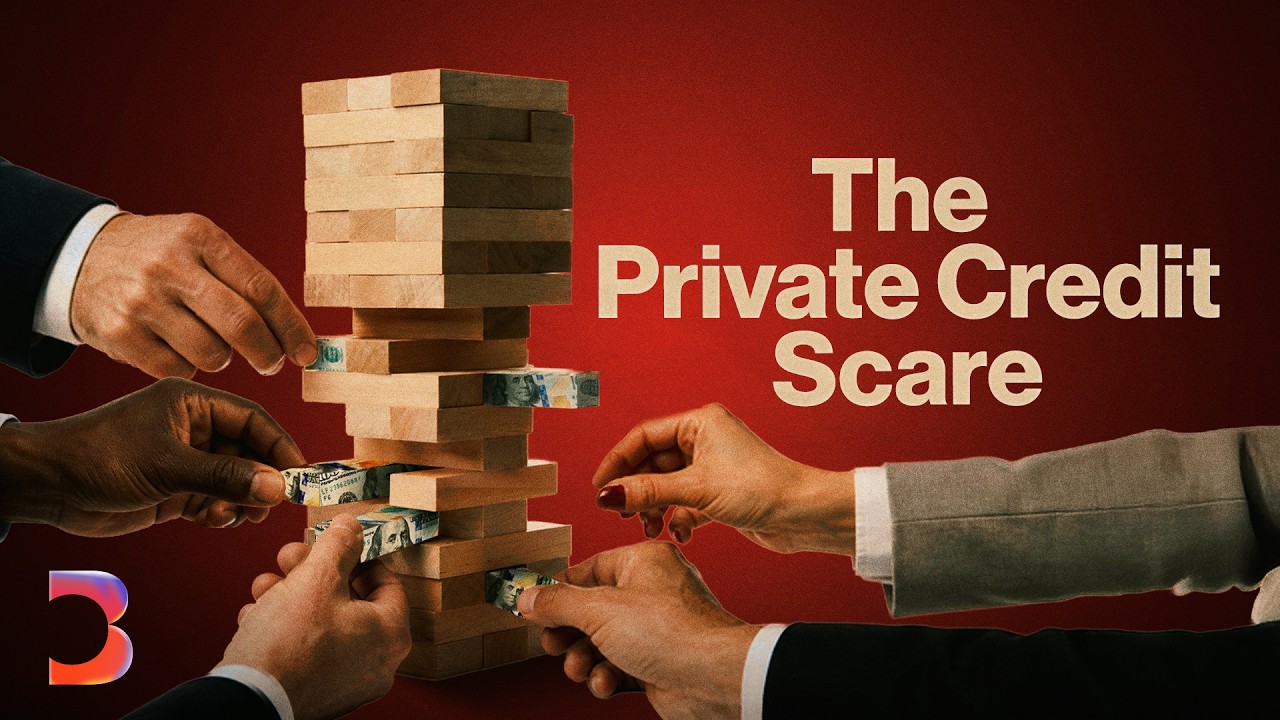
Private credit faces an unprecedented liquidity test as artificial intelligence threatens software borrowers, driving retail redemptions and triggering loan markdowns.
AI-assisted summary of How AI Is Disrupting a $1.8 Trillion Market — original source. Check the original for full context.
Source published:
Detailed notes
## Background Published by Bloomberg Originals on YouTube on May 8, 2026, this video examines how the $1.8 trillion private credit market is facing unprecedented pressure. According to the page description, the sector's historical boom is being tested by borrower stress, retail investor redemptions, and existential risks introduced by artificial intelligence.
## TL;DR The private credit market expanded rapidly from $500 billion in 2015 to $1.8 trillion today, largely driven by direct lending to software companies backed by private equity. However, the rise of generative AI has disrupted traditional software business models, creating significant loan default risks and triggering panicky redemption requests from retail investors. To prevent fire sales, major asset managers like Blue Owl, Blackstone, and Apollo have instituted liquidity caps, locking billions of dollars in funds. Amid sudden loan markdowns to zero and warnings from industry leaders like Jamie Dimon about hidden credit risks, the easy growth phase for non-bank lending appears to have come to an end.
## Atmosphere & style The video presents an analytical, cautious, and investigative tone that mirrors a high-stakes financial thriller. Combining cinematic, data-led reporting with sober industry commentary, it captures a palpable shift from historical post-2008 optimism to acute market anxiety. Listening to the breakdown of sudden fund lockups and dramatic loan write-downs creates a sense of mounting tension and impending reckoning for non-bank finance.
## Key takeaways - [00:00](https://www.youtube.com/watch?v=iBBOLjt8haY&t=0s) The $1.8 trillion private credit market faces a crisis of confidence due to rising borrower stress and its heavy exposure to software companies threatened by AI disruption. - [02:00](https://www.youtube.com/watch?v=iBBOLjt8haY&t=120s) Private credit bypasses traditional banking intermediaries by creating direct lending arrangements between institutional investors and borrowing firms. - [02:26](https://www.youtube.com/watch?v=iBBOLjt8haY&t=146s) While currently estimated at $1.8 trillion, asset managers like Apollo view the total addressable market opportunity for private credit at up to $40 trillion. - [04:18](https://www.youtube.com/watch?v=iBBOLjt8haY&t=258s) Post-2008 banking regulations and the Federal Reserve's 2022 interest rate hikes served as primary catalysts driving the rapid expansion of direct private lending. - [05:43](https://www.youtube.com/watch?v=iBBOLjt8haY&t=343s) Generative AI's rapid growth has raised existential concerns regarding whether software loans were underwritten on sound fundamentals or outdated growth projections. - [07:28](https://www.youtube.com/watch?v=iBBOLjt8haY&t=448s) A wave of investor redemption requests forced private credit funds to enforce strict liquidity caps during Q1, blocking billions in retail withdrawal requests. - [08:31](https://www.youtube.com/watch?v=iBBOLjt8haY&t=511s) Lack of public secondary market trading and real-time price discovery has created severe valuation opacity, leading to abrupt write-downs of private loans from 100 to zero. - [09:14](https://www.youtube.com/watch?v=iBBOLjt8haY&t=554s) Recent loan defaults sparked warnings from bank executives like Jamie Dimon that hidden leverage and non-performing loans represent broader systemic credit risks.
## Detailed walkthrough ### [00:00](https://www.youtube.com/watch?v=iBBOLjt8haY&t=0s) Industry Pressures and Existential AI Risk
The $1.8 trillion private credit market is navigating what observers describe as the biggest crisis of confidence in its history. Private credit firms—which lend capital directly to companies outside traditional, bank-led channels—have historically gathered funds from institutional investors and, more recently, wealthy retail investors. A massive chunk of this capital was channeled toward software businesses, particularly those backed by private equity firms, which long appeared to be safe bets. However, the rapid emergence of artificial intelligence has introduced an existential risk that threatens to upend those software models, placing private lenders at the epicenter of a major industry shift.
This market pressure triggered significant investor anxiety late last year, prompting retail investors to seek exits. To handle these redemption demands, Blue Owl allowed investors to pull 15% of their shares out of one of its private credit funds and sold off assets to raise capital and pay down debt. Other firms took even more unusual measures: at Blackstone, employees contributed their own money to help satisfy redemption requests. Despite these moves, Blue Owl’s share price dropped significantly, underscoring widespread industry distress. While some commentators compare the situation to the precursor of the 2008 financial crisis—pointing to structural similarities with subprime mortgage repackaging—others argue the panic is overblown because private credit does not rely on traditional bank deposits. Nonetheless, because these private loans lack public disclosure, assessing their true quality remains difficult.
- **Market Size:** $\$1.8\text{ trillion}$ private credit market facing unprecedented strain. - **Blue Owl Liquidity Measures:** Permitted a 15% share withdrawal from a private fund and liquidated assets to clear debt. - **Blackstone Capital Injection:** Employees chipped in personal funds to assist with meeting investor redemptions. - **2008 Parallels:** Observers debate whether current opacity mirrors subprime mortgage repackaging or if non-bank funding models isolate broader financial contagion.
---
[02:00](https://www.youtube.com/watch?v=iBBOLjt8haY&t=120s) Defining Private Credit and Its Scope
At its core, private credit refers to non-bank lending arrangements. While it encompasses various financial structures, the dominant segment currently grabbing headlines is direct lending, where non-bank institutions lend funds straight to corporate borrowers. Standard corporate borrowing often involves going to a bank or accessing debt capital markets—where banks arrange bonds or syndicated loans and distribute them to multiple investors for a fee. Direct private credit bypasses these middle steps entirely, establishing a direct link between the borrowing company and the final buyer of the debt.
While the current market is commonly estimated at $\$1.8\text{ trillion}$, some asset managers view this as merely the tip of the iceberg, estimating the broader addressable market opportunity at up to $\$40\text{ trillion}$. Private credit extends beyond standard corporate loans into supply chain finance, consumer auto loans, mortgages, railcar financing, trade finance, music royalties, and projects traditionally funded by municipal bonds. Asset managers like Apollo see vast room for expansion across these asset classes. Geographically, North America represents roughly two-thirds of the private debt market, followed by Europe, with the Asia-Pacific region and the rest of the world holding the remainder.
- **Market Evolution:** Grew from approximately $\$500\text{ billion}$ in 2015 to around $\$1.8\text{ trillion}$ today. - **Total Potential Market:** Estimated by some managers to be as large as $\$40\text{ trillion}$. - **Geographic Breakdown:** ~66% in North America, followed by Europe, then Asia-Pacific and other regions. - **Key Industry Players:** Blackstone, BlackRock, Blue Owl, and Apollo.
---
[04:18](https://www.youtube.com/watch?v=iBBOLjt8haY&t=258s) Historical Drivers and the Rise of Direct Lending
While private credit roots trace back to the 1980s, the modern landscape was shaped primarily by the aftermath of the 2008 global financial crisis. Strict regulatory reforms following the crash restricted traditional banks from engaging in higher-risk lending with their own capital. This regulatory shift created a vacuum that private credit managers quickly filled. The market experienced another major growth spurt in 2022 when the Federal Reserve began aggressively raising interest rates. The resulting volatility in high-yield bond and leveraged loan markets made traditional borrowing difficult, allowing private lenders to step in and capture market share.
Direct lenders heavily targeted software companies, which often boast rapid revenue growth but lack current profitability—a risk profile traditional commercial banks frequently avoid. Borrowers willingly accept higher interest rates from private credit funds in exchange for speed, execution certainty, and long-term lender relationships. Driven by this expansion, alternative asset managers saw strong public stock performance between 2022 and 2026. For example, Blue Owl’s assets under management (AUM) expanded dramatically over this period, rising from roughly $\$100\text{ billion}$ to over $\$300\text{ billion}$.
- **Regulatory Catalyst:** Post-2008 regulations forced banks to reduce high-risk loans, transferring market share to non-bank lenders. - **2022 Fed Rate Hikes:** Disrupted high-yield bond and leveraged loan markets, accelerating the move toward direct lending. - **Blue Owl Growth:** Assets under management surged from $\sim\$100\text{ billion}$ to more than $\$300\text{ billion}$ over a four-year span.
---
[05:43](https://www.youtube.com/watch?v=iBBOLjt8haY&t=343s) AI Disruption and Investor Redemptions
The rapid rise of generative AI—highlighted by companies like OpenAI reaching an $\$852\text{ billion}$ valuation and Anthropic continually dominating tech headlines—has fundamentally disrupted assumptions about software company longevity. Because private credit firms invested heavily in software debt, investors are now questioning whether these loans were underwritten on sound fundamentals or predicated on overly optimistic growth projections that AI tools could render obsolete. This uncertainty caused public shares of firms like KKR and Blue Owl to tumble by as much as 10%, with retail investors leading the charge in withdrawing funds.
In late 2025, Blue Owl co-CEO Marc Lipschultz expressed confidence in the firm's underwriting, stating: "Credit quality is excellent in our book, and that doesn't mean no defaults. Everyone's gonna have defaults now and then, you just can't have many and you have to get good recoveries, and that's exactly what we do at Blue Owl." However, by November, Blue Owl canceled a planned merger between two of its funds following scrutiny over potential investor losses. A wave of unprecedented withdrawal requests hit major players across the sector, including Blackstone, Blue Owl, and Apollo.
To protect fund valuations and prevent forced asset fire sales, managers enforced liquidity caps during the first quarter, blocking billions of dollars in redemption requests. Wealthy retail investors—who had invested through specialized products—found themselves locked in, with unmet withdrawal requests exceeding allowable payout thresholds by double-digit percentages.
- **Market Reaction:** Shares of KKR and Blue Owl dropped by up to 10% amid fears over software debt exposure. - **Marc Lipschultz's Stance:** Maintained that credit quality remained strong and that manageable default rates with high recoveries are standard practice. - **Fund Capital Lockups:** Private credit funds instituted redemption caps in Q1, denying billions in retail liquidity requests.
---
[08:31](https://www.youtube.com/watch?v=iBBOLjt8haY&t=511s) Valuations, Transparency Issues, and the "Cockroach" Warning
A primary structural concern in private credit is its inherent lack of transparency. Unlike publicly traded bonds or syndicated loans, private loans are bespoke agreements between institutional parties. Because these private assets do not trade on public secondary markets, there is no real-time price discovery mechanism. Skepticism around private loan valuations intensified after several high-profile investments had their values written down from 100 to zero with little advance warning. Industry anxieties were further amplified by the high-profile collapses of subprime auto lender Tricolor and auto parts supplier First Brands, which raised broader doubts about underwriting standards and hidden leverage across credit markets.
JPMorgan Chase CEO Jamie Dimon, who faced losses connected to the Tricolor fallout, offered a blunt warning regarding hidden systemic risks: "My antenna goes up when things like that happen. And I probably shouldn't say this, but when you see one cockroach, there's probably more." His comment highlighted concerns that more non-performing loans and hidden leverage could emerge across the sector as economic conditions tighten.
Despite these warnings, defenders of private credit note a key difference from 2008: post-crisis reforms purposefully shifted risky debt away from taxpayer-backed banks and onto institutional investors who are better positioned to absorb losses without triggering a systemic banking crisis. While widespread systemic failure has not materialized, analysts generally agree that the easy growth phase for private credit has ended, setting up a far more challenging operating environment ahead.
- **Valuation Shock:** Multiple private loans experienced abrupt markdowns from 100% to zero. - **Market Failures:** Fallouts at Tricolor and First Brands sparked broader scrutiny of loan underwriting and hidden leverage. - **Jamie Dimon's Analogy:** Warned that isolated loan defaults are often "cockroaches" signaling broader hidden credit problems.
## Notable quotes > [05:43](https://www.youtube.com/watch?v=iBBOLjt8haY&t=343s) Credit quality is excellent in our book, and that doesn't mean no defaults. Everyone's gonna have defaults now and then, you just can't have many and you have to get good recoveries, and that's exactly what we do at Blue Owl. — Marc Lipschultz
> [09:14](https://www.youtube.com/watch?v=iBBOLjt8haY&t=554s) My antenna goes up when things like that happen. And I probably shouldn't say this, but when you see one cockroach, there's probably more. — Jamie Dimon
## Mentioned Blue Owl, Blackstone, Apollo, BlackRock, KKR, JPMorgan Chase, Jamie Dimon, Marc Lipschultz, OpenAI, Anthropic, Tricolor, First Brands, Federal Reserve
[Source](https://www.youtube.com/watch?v=iBBOLjt8haY)