Hydrogen vs. Battery Electric Cars
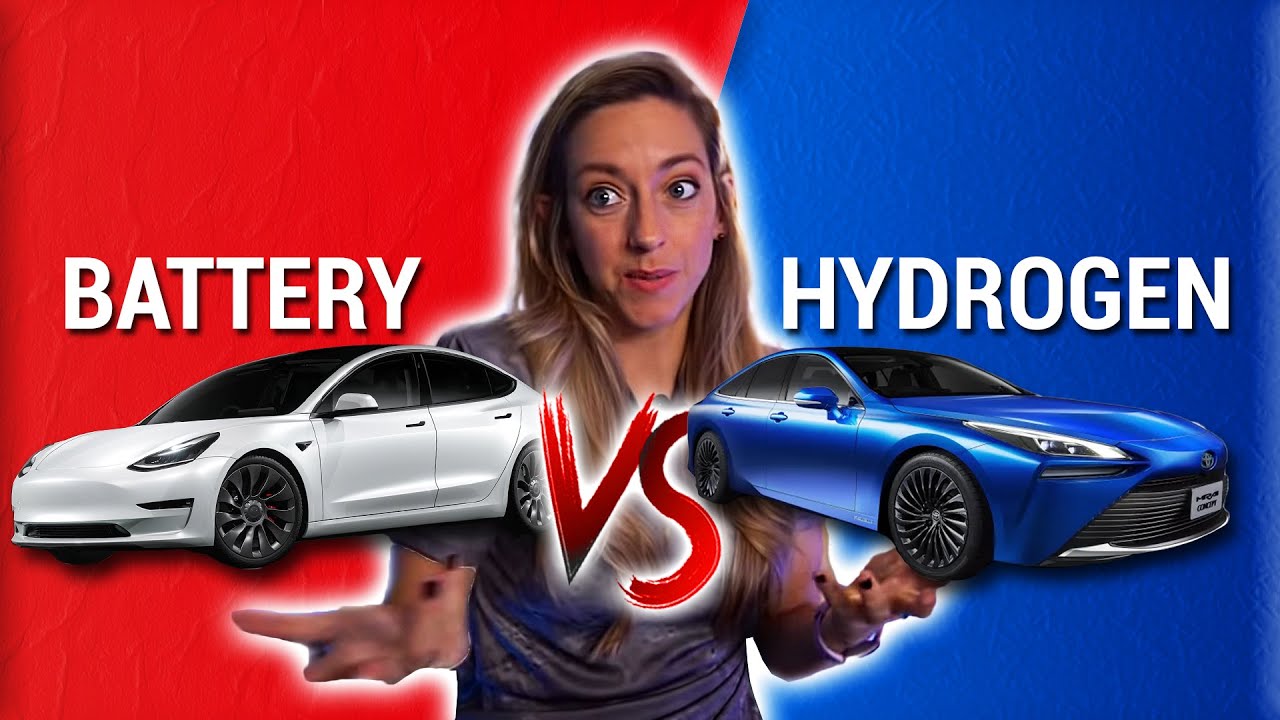
Physics Girl
AI-assisted summary of Hydrogen vs. Battery Electric Cars — original source. Check the original for full context.
Source published:
Key ideas
- While battery-electric vehicles achieve 70% to 90% well-to-wheel efficiency, hydrogen fuel cells reach only 25% to 35% due to energy-intensive electrolysis, compression, chilling, and distribution. (4:34)
- Fuel cells scale significantly better for long-range and heavy transport, as achieving a 400-mile range with lithium batteries adds roughly 1,500 kg of pack weight compared to expanding lightweight hydrogen tanks. (6:14)
- Retail infrastructure remains a primary bottleneck for hydrogen adoption; as of May 2021, California had only 45 public hydrogen stations compared to around 5,000 DC fast-charging plazas. (1:24)
- Industry experts and researchers emphasize that decarbonization requires both technologies simultaneously to prevent electrical grid overloads and meet distinct operational duty cycles across passenger and freight transit. (12:03)
Detailed notes
## Background Published by Dianna Cowern on the YouTube channel Physics Girl on August 18, 2021, this video is part of a series sponsored by Toyota. The page description explains that Dianna drove 1,800 miles across California in a 2021 Toyota Mirai to explore and compare electric vehicle technologies.
## TL;DR The video breaks down the technical and practical differences between battery-electric vehicles (BEVs) and hydrogen fuel cell electric vehicles (FCEVs). While battery electrics lead in round-trip well-to-wheel efficiency (70–90% versus 25–35%) and currently enjoy a much larger charging infrastructure, hydrogen holds massive advantages in gravimetric energy density, five-minute refueling speeds, and payload scaling for heavy transport, commercial trucking, and marine vessels. Relying exclusively on battery charging could overload the electrical grid, especially in freight hubs like the Twin Ports with thousands of commercial trucks. Ultimately, experts and host Dianna conclude that clean transportation is not a zero-sum contest, and both technologies are crucial to achieving complete zero-emission mobility.
## Atmosphere & style The presentation blends energetic road-trip curiosity with accessible, physics-driven analysis as Dianna travels across California interviewing engineers, researchers, and truck operators. The tone is inquisitive, enthusiastic, and grounded, with moments of relatable exasperation over early-adopter quirks like frozen fuel nozzles. Rather than fueling tribal automotive rivalries, the narrative builds a collaborative, hopeful case for energy diversification driven by urgent public health and environmental needs.
## Bulletin - [04:34](https://www.youtube.com/watch?v=dWAO3vUn7nw&t=274s) While battery-electric vehicles achieve 70% to 90% well-to-wheel efficiency, hydrogen fuel cells reach only 25% to 35% due to energy-intensive electrolysis, compression, chilling, and distribution. - [06:14](https://www.youtube.com/watch?v=dWAO3vUn7nw&t=374s) Fuel cells scale significantly better for long-range and heavy transport, as achieving a 400-mile range with lithium batteries adds roughly 1,500 kg of pack weight compared to expanding lightweight hydrogen tanks. - [01:24](https://www.youtube.com/watch?v=dWAO3vUn7nw&t=84s) Retail infrastructure remains a primary bottleneck for hydrogen adoption; as of May 2021, California had only 45 public hydrogen stations compared to around 5,000 DC fast-charging plazas. - [12:03](https://www.youtube.com/watch?v=dWAO3vUn7nw&t=723s) Industry experts and researchers emphasize that decarbonization requires both technologies simultaneously to prevent electrical grid overloads and meet distinct operational duty cycles across passenger and freight transit.
## Key takeaways - [00:00](https://www.youtube.com/watch?v=dWAO3vUn7nw&t=0s) Both battery-electric vehicles (BEVs) and fuel cell electric vehicles (FCEVs) share electric drivetrains, making them complementary platforms under the broader EV umbrella. - [01:24](https://www.youtube.com/watch?v=dWAO3vUn7nw&t=84s) Hydrogen vehicles achieve baseline ranges around 300 to 400 miles and refuel in approximately 5 minutes, significantly faster than 30-minute to multi-hour battery charging. - [01:24](https://www.youtube.com/watch?v=dWAO3vUn7nw&t=84s) California's retail hydrogen network remains in early incubation with around 45 stations and 8,000 cars in 2021, while battery vehicles had already passed the adoption curve crook with roughly 250,000 cars. - [01:24](https://www.youtube.com/watch?v=dWAO3vUn7nw&t=84s) For the approximately 50% of Californians living in multi-family housing without dedicated home charging, public hydrogen stations provide a practical zero-emission pathway. - [04:34](https://www.youtube.com/watch?v=dWAO3vUn7nw&t=274s) Pure hydrogen possesses a far higher gravimetric energy density (~35,000 Wh/kg) than lithium-ion cells (200–300 Wh/kg), but round-trip thermodynamic efficiency strongly favors batteries. - [04:34](https://www.youtube.com/watch?v=dWAO3vUn7nw&t=274s) Producing green hydrogen via water electrolysis immediately loses about 30% of input electrical energy, with further thermodynamic losses incurred during 700-bar compression and transport. - [04:34](https://www.youtube.com/watch?v=dWAO3vUn7nw&t=274s) Fuel cell storage systems do not suffer from the progressive permanent capacity degradation over repeated cycles seen in chemical battery packs. - [06:14](https://www.youtube.com/watch?v=dWAO3vUn7nw&t=374s) Adding range to battery vehicles incurs severe non-linear weight penalties, making hydrogen far more viable for heavy-duty commercial trucking, rail, and maritime shipping. - [06:14](https://www.youtube.com/watch?v=dWAO3vUn7nw&t=374s) Major commercial manufacturers including Daimler, Volvo, Freightliner, Mack, Hyzon, and Nikola are actively piloting hydrogen Class 8 big rigs to decarbonize freight logistics. - [08:49](https://www.youtube.com/watch?v=dWAO3vUn7nw&t=529s) Hydrogen dispenser reliability faced growing pains when consumer misuse, such as pouring water on frozen high-pressure nozzles, exacerbated icing issues at retail stations. - [10:06](https://www.youtube.com/watch?v=dWAO3vUn7nw&t=606s) Charging all 15 million California vehicles or thousands of heavy drayage trucks overnight would overload the electric grid without massive distribution upgrades, highlighting the need for dual clean fuel pathways. - [10:06](https://www.youtube.com/watch?v=dWAO3vUn7nw&t=606s) A diversified transportation network provides system resilience: hydrogen functions during electric grid blackouts, while battery fleets remain operational during hydrogen supply bottlenecks. - [12:03](https://www.youtube.com/watch?v=dWAO3vUn7nw&t=723s) Treating clean transportation as a zero-sum competition is counterproductive; deploying both platforms is essential to address localized smog in transit corridors and achieve global decarbonization goals.
## Detailed walkthrough ### [00:00](https://www.youtube.com/watch?v=dWAO3vUn7nw&t=0s) The EV Showdown: Battery vs. Fuel Cell Basics
Dianna Cowern introduces an in-depth exploration of clean transportation alternatives by documenting an 1,800-mile California road trip powered exclusively by hydrogen in a 2021 Toyota Mirai. The central conflict in sustainable mobility is often framed as a zero-sum battle between battery-electric vehicles (BEVs) and fuel cell electric vehicles (FCEVs). Dianna clarifies an important technical distinction right away: both technologies are driven by electric drivetrains, which means the umbrella term “EV” technically encompasses both platforms. Despite hydrogen industry insiders lamenting how frequently the two are pitted against one another, the comparison is natural because battery-electric cars have already achieved significant commercial momentum.
The fundamental driving question behind Dianna’s journey is straightforward: given how widely battery vehicles have caught on, why do we still need hydrogen? Fuel cell passenger cars are already actively deployed on public roads across California and several international markets, yet their existence remains largely unfamiliar to the broader public. To evaluate whether hydrogen holds a viable place in the zero-emission transition, the series compares the practical realities, operational nuances, and engineering trade-offs of both systems within California’s early-adopter automotive ecosystem.
[01:24](https://www.youtube.com/watch?v=dWAO3vUn7nw&t=84s) Range, Refueling Speed, and Infrastructure Disparities
The head-to-head comparison begins with driving range, where fuel cells demonstrate an early competitive edge over standard electrics. Most standard battery-electric cars achieve between 100 and 200 miles on a charge, with premium models reaching roughly 387 miles. Hydrogen cars average around 300 miles of driving range as a baseline, and the 2021 Toyota Mirai XLE achieves an EPA-estimated range of 402 miles. However, the operational divide widens drastically when examining replenishment times. Recharging a battery vehicle spans anywhere from 30 minutes at a high-power DC fast charger to several hours on standard Level 2 systems, whereas a complete hydrogen tank refill requires only about five minutes.
```mermaid flowchart TD accTitle: Fueling Infrastructure and Vehicle Fleet in California accDescr: Comparison of charging stations versus hydrogen stations alongside car fleet sizes in California. subgraph Stations["California Fueling Stations (May 2021)"] S1["DC Fast Charging Stations: ~5,000"] S2["Hydrogen Fuel Stations: ~45"] end subgraph Fleet["California Vehicle Fleet"] V1["Gasoline Vehicles: ~15,000,000"] V2["Battery Electric: ~250,000"] V3["Hydrogen Fuel Cell: ~8,000"] end S1 -.-> V2 S2 -.-> V3 ```
The major obstacle facing hydrogen is physical station availability. Visiting the first operational hydrogen station in the United States—established in January 2003 at the University of California, Irvine—Dianna interviews Professor Scott Samuelsen, director of the Advanced Power and Energy Program (APEP). While California hosts approximately 5,000 high-speed charging plazas for batteries, the state maintained only 45 retail hydrogen stations as of May 2021. If a single hydrogen station is offline, drivers face severe route disruptions. Professor Samuelsen explains that vehicle adoption typically follows an S-curve or hockey-stick trajectory: “In energy, we talk about that as being a curled development time, and then you get to a point, we call the activation energy, when the market self-propagates, it just grows.” Battery electrics passed the crook of that adoption curve around 2012, whereas hydrogen passenger cars—numbering only around 8,000 compared to 250,000 battery cars out of 15 million total registered vehicles in California—remain in early market incubation.
Urban infrastructure also creates stark socio-economic divides regarding refueling feasibility. About 50% of Californians reside in multi-family housing units without personal garages, dedicated parking stalls, or workplace charging perks. Dianna points out that as a renter living with roommates, she cannot install a home wall charger, making hydrogen a potentially viable zero-emission alternative—provided a public retail station is located nearby. Research indicates that statewide coverage equivalent to California's 8,000 gasoline outlets could be achieved with roughly 1,000 strategically distributed hydrogen stations co-located at existing gas stations.
- **Fast refuel speed:** Hydrogen tanks fill in ~5 minutes; battery fast-charging requires roughly 30 minutes to an hour. - **Station density comparison:** California hosted ~5,000 fast-charging sites versus only 45 open hydrogen dispensers in mid-2021. - **Fleet scale:** California roads carried roughly 15 million passenger cars, of which ~250,000 were battery electric and ~8,000 were fuel cell vehicles. - **Target network:** Analysts project that approximately 1,000 co-located hydrogen dispensers could match the network convenience of the state's 8,000 petroleum stations.
[04:34](https://www.youtube.com/watch?v=dWAO3vUn7nw&t=274s) Efficiency and Energy Losses: Well-to-Wheel Realities
When evaluating the physical energy density of the storage medium, pure hydrogen dramatically outperforms electrochemical cells. Hydrogen boasts a specific energy of approximately 35,000 watt-hours per kilogram, whereas commercial lithium-ion cells max out between 200 and 300 watt-hours per kilogram. Despite hydrogen's staggering gravimetric advantage, the overall round-trip ("well-to-wheel") thermodynamic efficiency tells the opposite story. Battery-electric vehicles deliver between 70% and 90% end-to-end efficiency, while hydrogen fuel cell systems convert only 25% to 35% of the original electricity into mechanical motion at the wheels.
```mermaid flowchart LR accTitle: Well-to-Wheel Efficiency Comparison accDescr: Shows the energy path and efficiency losses for battery electric versus hydrogen fuel cell vehicles. subgraph BEV["Battery Electric (70% - 90% Efficiency)"] direction TB E1["Grid Generation"] --> T1["Transmission Lines"] T1 --> C1["AC/DC Charger & Battery"] C1 --> M1["Motor to Wheels"] end subgraph FCEV["Hydrogen Fuel Cell (25% - 35% Efficiency)"] direction TB E2["Electricity Generation"] --> EL["Electrolysis (-30%)"] EL --> CP["Compression & Cooling"] CP --> TR["Transport to Station"] TR --> FC["Fuel Cell Stack to Wheels"] end ```
The dramatic discrepancy stems from the thermodynamic steps required across each supply chain. Battery vehicles draw power directly from generating plants through standard transmission grids, incurring modest transmission, charging, AC-to-DC conversion, and motor losses. In contrast, producing green hydrogen via water electrolysis immediately forfeits roughly 30% of the input electrical energy. Additional energy is drained while compressing the gas to operating pressures of up to 700 bar (10,000 psi), chilling it for safe dispensing, transporting it via tanker trucks, and finally passing it through the onboard fuel cell membrane to generate electricity for the motor. As Dianna summarizes: “And it's mostly things that you can't get around, which means you have to use about twice as much energy to produce hydrogen and then to use hydrogen for your cars as you do to produce electricity for your battery cars.” However, hydrogen systems hold an operational lifecycle advantage: unlike lithium-ion packs, fuel cell stacks do not experience substantial storage capacity degradation over repeated cycles.
- **Specific energy:** Pure hydrogen holds ~35,000 Wh/kg compared to 200–300 Wh/kg for modern lithium-ion batteries. - **Well-to-wheel efficiency:** Battery electric achieves 70% to 90%; hydrogen fuel cells yield 25% to 35%. - **Electrolysis penalty:** Splitting water molecules dissipates approximately 30% of primary electrical energy before storage or distribution occurs. - **Degradation profile:** Chemical batteries progressively lose permanent charge capacity over years of cycling, a degradation mode that fuel cell fuel systems largely avoid.
[06:14](https://www.youtube.com/watch?v=dWAO3vUn7nw&t=374s) Heavy Transport: The Weight Penalty and Commercial Fleet Scaling
While batteries excel in lightweight commuter platforms, vehicle physics diverge when scaling up to high payloads, extensive daily utilization, and extended range requirements. Both architectures are modular—fuel cells can be scaled from compact smartphone chargers up to passenger aircraft powertrains, while batteries scale from hand-held devices to converted pickup trucks like Simone Giertz's "Truckla." However, as target range expands, the relationship between vehicle curb weight and range scales far worse than linearly for lithium-ion designs. Plotting vehicle test weight against driving distance reveals that achieving a 400-mile passenger car range requires adding roughly 1,500 kilograms of battery pack mass, forcing the vehicle to expend considerable energy simply hauling its own power source.
```mermaid flowchart TD accTitle: Scaling Trade-offs for Heavy Transport accDescr: Flowchart illustrating the divergent scaling impacts of increasing vehicle range between battery and hydrogen platforms. R["Demand for Increased Range (400+ Miles)"] --> B["Battery Electric Approach"] R --> H["Hydrogen Fuel Cell Approach"]
B --> B1["Add Battery Pack Modules"] B1 --> B2["Mass Scales Non-Linearly (+1,500 kg)"] B2 --> B3["Diminishing Range Returns & Cargo Capacity Loss"]
H --> H1["Expand Compressed Tank Volume"] H1 --> H2["Negligible Gravimetric Mass Added"] H2 --> H3["Maintains Full Payload Capacity"] ```
Representatives from the non-profit Energy Independence Now note that broad consumer adoption demands vehicles that do not compromise lifestyle utility, referencing drivers in Colorado hauling four passengers, dogs, and roof racks loaded with skis through severe terrain: “Really have to give consumers what they want if we expect to be successful.” Because hydrogen features an exceptionally high gravimetric energy density, engineers can double or triple an onboard fuel supply by expanding tank capacity with negligible structural weight penalties. This fundamental physical distinction makes fuel cells particularly compelling for heavy-duty commercial transit, maritime shipping, and rail networks.
At the Port of Long Beach, industrial transport firms and legacy truck manufacturers are actively field-testing Class 8 heavy-duty hydrogen semi-trucks. Drivers operating these prototypes praise the cabin environment, noting that fuel cell power eliminates the loud clatter of diesel combustion: “If you have a passenger, you literally can converse with them.” Nearly every major commercial truck builder—including Daimler, Volvo, Freightliner, Mack, and emerging ventures like Hyzon and Nikola—is heavily investing in heavy-duty hydrogen fuel cell programs. Simultaneously, battery electric Class 8 rigs developed by companies like Tesla remain in development, highlighting an impending industry-wide contest to decarbonize freight logistics.
- **Weight-to-range penalty:** Reaching a 400-mile range with lithium batteries adds roughly 1,500 kg (over 3,300 lbs) of weight compared to equivalent fuel cell systems. - **Multi-modal decarbonization:** Fuel cell propulsion research is expanding beyond highways into marine cargo ships and heavy freight rail locomotives. - **Port of Long Beach tests:** Major transport fleets are currently evaluating hydrogen big rigs in continuous drayage operations to replace polluting diesel haulers. - **Industrial manufacturers:** Commercial vehicle heavyweights Daimler, Volvo, Freightliner, Mack, Hyzon, and Nikola are actively deploying fuel cell tractor units alongside Tesla's battery-electric Semi development.
[08:49](https://www.youtube.com/watch?v=dWAO3vUn7nw&t=529s) Heavy Transport, Marine Applications, and Infrastructure Realities
The conversation shifts toward heavy-duty and non-standard transportation applications, where fuel cells present distinct advantages over heavy battery packs. An engineer highlights the environmental motivation behind hydrogen trucks, noting, “What we're trying to do for the environment with these trucks is to take the smoke out of the air.” Dianna gets the opportunity to see and drive a hydrogen-powered vessel, observing with excitement, “I realized, this boat is completely silent.” Based on conversations with industry specialists, fuel cells show the most immediate promise for transportation segments requiring higher weight capacities, extended range, and higher operating speeds.
However, refueling infrastructure remains a massive obstacle, lagging far behind the electrical vehicle charging network. There simply are not enough hydrogen fueling stations operating today, and consumer-facing stations have experienced growing pains. An engineer explains that hardware developed for isolated, industrial environments handled by trained technicians suddenly had to deal with general consumers: “Everyday consumers were trying to use it while they're talking on their phone and bouncing a baby, or, you know.” A frustrating issue arose with nozzles freezing up during high-pressure dispensing. Uninformed drivers began pouring water over the frozen couplings in an attempt to thaw them out, which backfired by adding moisture that froze the mechanism even tighter—prompting an exasperated groan from Dianna. To improve station uptime and customer experience, newer designs incorporate more robust equipment and feature multiple dispensers per location.
- Fuel cells are especially attractive for heavy transport where vehicles demand higher weight limits, continuous uptime, and long ranges. - Hydrogen marine vessels provide whisper-quiet operation alongside zero direct emissions. - Nozzle freezing issues at retail pumps worsened when consumers poured tap water over cold dispensers, introducing moisture that exacerbated ice buildup. - Station equipment is evolving toward multi-dispenser layouts to eliminate single points of failure.
[10:06](https://www.youtube.com/watch?v=dWAO3vUn7nw&t=606s) Grid Vulnerability, Fleet Scale, and Fuel Diversification
The discussion expands to the broader electrical grid and the real-world logistics of high-volume transportation hubs. A full-scale overnight transition to plug-in battery vehicles poses profound infrastructure challenges. If all 15 million registered passenger cars in California were battery-electric and plugged in at the exact same moment at night, the existing electrical grid would fail under the load. A representative at the Twin Ports (the ports of Los Angeles and Long Beach) outlines the sheer scale of the drayage freight challenge: “Well hey, we have 17,000 trucks at the Twin Ports here. What do you think it would take to take a quarter of those, you know, 4,000 trucks offline and charge them overnight?” Sidelining thousands of commercial vehicles for 4 to 12 hours at a time carries crippling economic and logistical consequences.
```mermaid flowchart TD accTitle: Energy Diversification Flow accDescr: Illustrates how electricity and hydrogen pathways balance transportation demand and grid resilience.
subgraph Supply["Energy Supply"] Renewables["Renewables: Solar & Wind"] end
subgraph Pathways["Dual Clean Pathways"] Grid["Electric Grid & Batteries"] H2["Hydrogen Fuel Stations"] end
subgraph Applications["Target Vehicle Types"] BEV["Battery Electric Vehicles: Daily Commuting & Peak Shaving"] FCEV["Fuel Cell Vehicles: Heavy-Duty, Long-Haul & Port Freight"] end
Renewables --> Grid Renewables --> H2 Grid --> BEV H2 --> FCEV BEV -.->|"Backup during H2 shortages"| Grid FCEV -.->|"Backup during grid outages"| H2 ```
Instead of relying solely on one pathway, planners envision a mixed system where grid upgrades take place where practical, while dense hydrogen hubs handle vehicles requiring rapid turnaround. A fueling specialist describes their revelatory "aha moment" while commissioning a station in Japan, watching passenger cars roll in and out every five minutes: “Five minutes, five minutes, five minutes, and there goes another zero-emission vehicle. It made so much sense.” Researchers model hydrogen station placements by analyzing early adopters of hybrid and battery-electric cars, as these drivers share the demographic profile most willing to embrace fuel cells. Furthermore, energy diversification serves as crucial resilience against system shock: if an electrical blackout strikes, hydrogen vehicles can still refuel; if a localized hydrogen delivery disruption occurs, battery vehicles keep moving. Batteries can absorb midday surplus solar and wind power, discharging it back into buildings and homes at night when generation dips.
- California has roughly 15 million cars; charging them all simultaneously overnight would overwhelm the electrical grid without vast distribution upgrades. - The Twin Ports handle roughly 17,000 active drayage trucks, making multi-hour charging down-times economically impractical for large-scale logistics. - Rapid hydrogen refills take around five minutes per vehicle, providing retail throughput comparable to conventional gas pumps. - Vehicle adoption modeling treats current hybrid-electric and battery-electric owners as direct proxies for prospective fuel cell drivers.
[12:03](https://www.youtube.com/watch?v=dWAO3vUn7nw&t=723s) Moving Beyond the Winner-Take-All Mindset
The pervasive debate over whether battery-electric vehicles or fuel cell electric vehicles will "win" misses the urgent environmental reality. Industry experts consistently emphasize that clean mobility is not a zero-sum competition. As one interviewee states: “The majority of questions that we are asked is, 'What about the battery-electric vehicle, the BEV? Is that gonna win, or is this fuel cell electric vehicle gonna win?' But it turns out, they're both gonna be winners because they're both going to be needed.” Dianna heartily agrees, expressing frustration with the cultural urge to treat decarbonization like a spectator sport: “This like, competitive nature that we all have as Americans, of like wanting to pick this winner, and I just wanna like scream from the hilltops like, 'Hey, we need both of these!'”
Personal motivations drive much of this technical work. One researcher recounts growing up in China surrounded by severe smog, an experience that instilled a lifelong mission to eliminate urban air pollution. Deploying both battery-electric and fuel cell vehicles simultaneously tackles greenhouse gases on a macro level while directly wiping out toxic particulate emissions in frontline port communities and transit corridors, creating immediate public health improvements. Dianna wraps up the journey by thanking series sponsor Toyota for providing the 2021 Mirai, reminding viewers to subscribe for the upcoming episodes on grid energy storage and concentrated solar power, and signing off with her trademark “happy physicsing.”
- Experts agree neither technology is a replacement for the other; both are indispensable across distinct duty cycles and geographic needs. - Displacing diesel combustion in shipping corridors directly targets localized toxic smog and air quality hazards alongside global emissions targets. - Upcoming installments in the series focus on grid-scale energy storage solutions and concentrated solar technologies.
## Notable quotes > [04:34](https://www.youtube.com/watch?v=dWAO3vUn7nw&t=274s) you have to use about twice as much energy to produce hydrogen and then to use hydrogen for your cars as you do to produce electricity for your battery cars. — Dianna Cowern
## Mentioned Dianna Cowern, Physics Girl, Toyota, Toyota Mirai, University of California, Irvine, Scott Samuelsen, Advanced Power and Energy Program, Energy Independence Now, Simone Giertz, Truckla, Port of Long Beach, Port of Los Angeles, Twin Ports, Daimler, Volvo, Freightliner, Mack, Hyzon, Nikola, Tesla
## Video description I drove 1800 miles in a Hydrogen car to learn about electric vehicles. Thanks to Toyota for sponsoring this video series and lending us the 2021 Mirai!
Video 1: The truth about driving a hydrogen car https://www.youtube.com/watch?v=hghIckc7nrY
Upcoming videos in this series: Grid Energy Storage Concentrated Solar
Creator/Host: Dianna Cowern Editor: Levi Butner Producer: Hope Butner Production Assistant: Patrick Muhlberger Research: Sophia Chen and Erika Carlson
Support Physics Girl https://www.patreon.com/physicsgirl http://physicsgirl.org/ http://twitter.com/thephysicsgirl http://facebook.com/thephysicsgirl http://instagram.com/thephysicsgirl
Special thank you to our X-Ray tier patrons: Carlos Patricio, David Cichowski, Eddie Sabbah, Fabrice Eap, Gil Chesterton, Isabel Herstek, Margaux Lopez, Matt Kaminski, Michael Schneider, Patrick Olson, Vikram Bhat, Vincent Argiro, wc993219
[Source](https://www.youtube.com/watch?v=dWAO3vUn7nw)