Google Autonomous Car Decodes Cyclist Hand Signals in City Tests
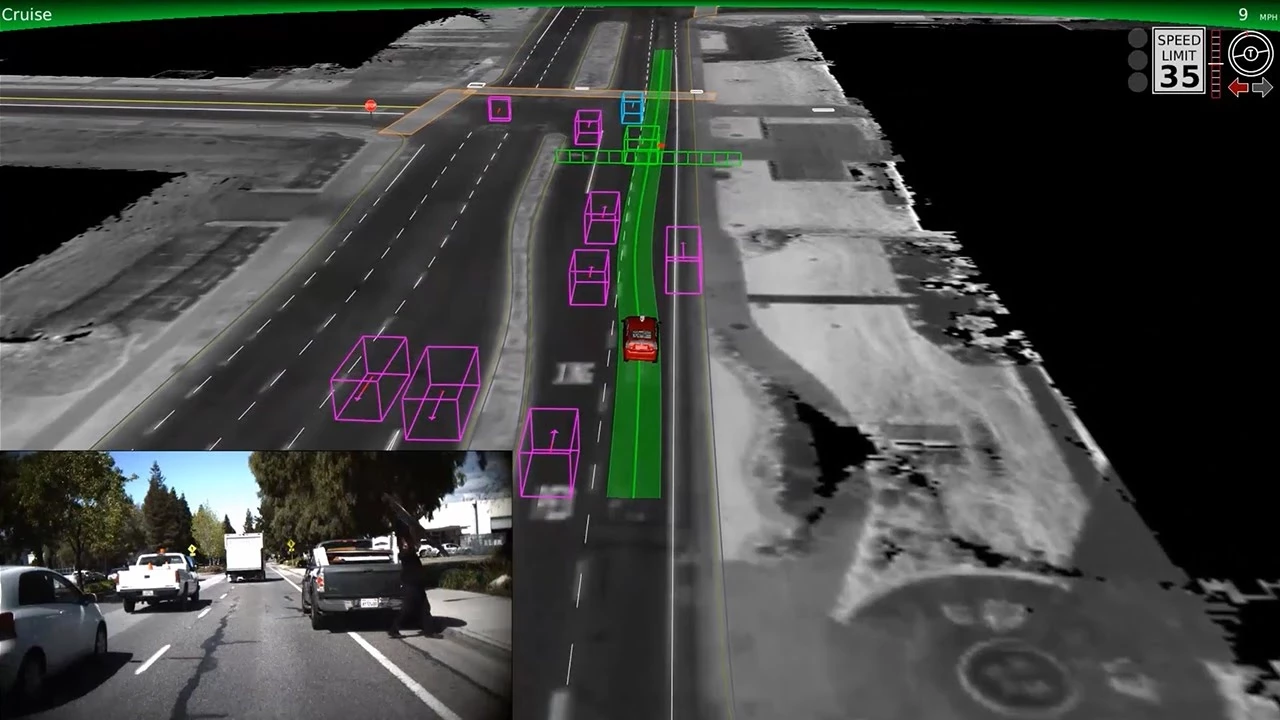
Deploying human test drivers to document real-world edge cases allows Google's software engineers to program autonomous vehicles to anticipate unpredictable pedestrian and cyclist maneuvers.
AI-assisted summary of Google Self-Driving Car on City Streets — original source. Check the original for full context.
Source published:
Key ideas
- Google test drivers in Mountain View identify complex edge cases in real-world city driving to help software engineers continuously refine autonomous navigation behaviors. (0:03)
- The self-driving system recognizes construction signage and traffic cones well in advance, executing proactive lane changes and maintaining defensive buffers around parked trucks. (0:03)
- Cyclists are treated as a distinct object class, with perception software capable of recognizing physical hand signals to anticipate lane merges. (1:03)
- A real-time 3D bounding-box visualization tracks multi-modal road users and projects virtual boundary fences to prevent turning into pedestrians or overtaking cyclists. (1:03)
Detailed notes
## Background Published by Google on YouTube on April 28, 2014, this video showcases the Google self-driving car navigating common urban traffic scenarios near the Googleplex in Mountain View, California.
## TL;DR Test driver Priscilla explains the role of human drivers in gathering real-world edge cases to help software engineers train Google's autonomous driving system. The vehicle demonstrates its ability to detect construction cones well in advance, maintain wide buffer zones around parked trucks, and hold back cautiously at railroad crossings. Furthermore, the car utilizes specialized perception algorithms to recognize cyclist hand signals and dynamic movements, employing color-coded 3D bounding boxes and virtual fences to safely negotiate crowded intersections.
## Atmosphere & style The presentation carries a calm, confident, and gently optimistic tone that demystifies autonomous driving technology for everyday viewers. Priscilla's measured narration pairs seamlessly with colorful computer-vision visualizations, creating an informative and reassuring behind-the-scenes look at how the car 'sees' the world. The overall feeling is one of measured, steady progress, transforming potentially chaotic road interactions into structured, predictable engineering triumphs.
## Bulletin - [00:03](https://www.youtube.com/watch?v=dk3oc1Hr62g&t=3s) Google test drivers in Mountain View identify complex edge cases in real-world city driving to help software engineers continuously refine autonomous navigation behaviors. - [00:03](https://www.youtube.com/watch?v=dk3oc1Hr62g&t=3s) The self-driving system recognizes construction signage and traffic cones well in advance, executing proactive lane changes and maintaining defensive buffers around parked trucks. - [01:03](https://www.youtube.com/watch?v=dk3oc1Hr62g&t=63s) Cyclists are treated as a distinct object class, with perception software capable of recognizing physical hand signals to anticipate lane merges. - [01:03](https://www.youtube.com/watch?v=dk3oc1Hr62g&t=63s) A real-time 3D bounding-box visualization tracks multi-modal road users and projects virtual boundary fences to prevent turning into pedestrians or overtaking cyclists.
## Key takeaways - [00:03](https://www.youtube.com/watch?v=dk3oc1Hr62g&t=3s) Test drivers play a dual role by maintaining operational safety and documenting edge cases to train automated driving algorithms. - [00:03](https://www.youtube.com/watch?v=dk3oc1Hr62g&t=3s) Real-world urban testing focuses on navigating city street conditions surrounding the Googleplex in Mountain View, California. - [00:03](https://www.youtube.com/watch?v=dk3oc1Hr62g&t=3s) Sensor arrays detect construction zones through orange signs and traffic cones early enough to perform smooth, proactive lane shifts. - [00:03](https://www.youtube.com/watch?v=dk3oc1Hr62g&t=3s) The vehicle software automatically steers to maintain an expanded defensive buffer when passing large parked vehicles. - [00:03](https://www.youtube.com/watch?v=dk3oc1Hr62g&t=3s) Railroad crossings activate heightened caution logic, preventing the vehicle from entering until the tracks ahead are fully cleared. - [01:03](https://www.youtube.com/watch?v=dk3oc1Hr62g&t=63s) Cyclists are classified as a special category of moving object governed by dedicated predictive behavior models. - [01:03](https://www.youtube.com/watch?v=dk3oc1Hr62g&t=63s) Perception algorithms detect physical hand signals from cyclists to anticipate merges into the vehicle's travel lane. - [01:03](https://www.youtube.com/watch?v=dk3oc1Hr62g&t=63s) The driving system consistently yields right-of-way even if a cyclist exhibits erratic or repeated path changes. - [01:03](https://www.youtube.com/watch?v=dk3oc1Hr62g&t=63s) The onboard visualization system classifies surrounding road users into color-coded 3D bounding boxes, separating cars from cyclists and pedestrians. - [01:03](https://www.youtube.com/watch?v=dk3oc1Hr62g&t=63s) Rear and blind-spot sensors detect cyclists overtaking from behind to avoid right-hook collisions during turns. - [01:03](https://www.youtube.com/watch?v=dk3oc1Hr62g&t=63s) Virtual red and green boundary fences dynamically manage stop thresholds and clear path confirmations at crowded intersections.
## Detailed walkthrough ### [00:03](https://www.youtube.com/watch?v=dk3oc1Hr62g&t=3s) Teaching Google's Self-Driving Car to Navigate Mountain View
Priscilla introduces herself as one of the test drivers working on the Google self-driving car project. Her team bears the responsibility of maintaining safety for both the autonomous test vehicles and the general public sharing the roads, while feeding back vital performance evaluations from real-world driving environments. Explaining the daily mission of the test driving crew, Priscilla notes, “A big part of our job is to go out into the world and uncover all the potential scenarios a car might encounter.” Once these edge cases and road conditions are documented in the field, the test drivers collaborate directly with software engineers to teach the automated driving system how to navigate each challenge smoothly.
Demonstrating typical driving situations encountered along the streets of Mountain View, California, Priscilla highlights the vehicle’s ability to recognize and maneuver through active construction zones. The onboard sensors detect orange signs and traffic cones well ahead of time, alerting the driving system to blocked lanes in advance so that it can execute safe lane changes. In parallel, the software maintains a wide defensive berth around hazards, actively steering the vehicle to preserve a safe buffer distance from large obstacles such as trucks parked along the curb.
When approaching complex infrastructure like railroad crossings, the system exercises heightened caution. In the computer's internal visual display, a virtual red fence and a railroad warning sign appear near the intersection, signaling that the autonomous vehicle must pause and confirm the tracks are fully cleared of other traffic before attempting to cross.
- Test drivers serve a dual role: ensuring real-time road safety and providing feedback to engineers to train driving behaviors. - Real-world street testing is conducted near the Googleplex in Mountain View, California. - Construction zones are identified early through sensor detection of orange warning signs and traffic cones. - The system automatically creates extra buffer space around large stationary vehicles parked on street shoulders. - Railroad crossings trigger specialized logic represented visually by red barrier fences, preventing the car from entering until cross-tracks are completely clear.
[01:03](https://www.youtube.com/watch?v=dk3oc1Hr62g&t=63s) Interacting with Cyclists and Busy Intersections
The software distinguishes between general road obstacles and vulnerable road users, treating non-motorized traffic with specialized awareness algorithms. As Priscilla explains, “Our cars treat cyclists as a special category of moving object.” When a cyclist on the road raises an arm, the system's perception software recognizes the physical hand signal, calculates the cyclist's intended trajectory, and anticipates their merge directly into the vehicle's lane. The car reliably holds back and yields the right-of-way—even when the cyclist unpredictably alters course multiple times while riding.
```mermaid flowchart TD accTitle: Cyclist Detection and Lane Maneuver Flow accDescr: Flowchart showing how Google's self-driving car detects cyclist signals and manages safe turns. subgraph Perception ["Perception & Tracking"] A["Detect Cyclist (Red/Yellow Bounding Box)"] --> B["Recognize Arm Hand Signal"] C["Detect Cyclist Approaching from Behind"] --> D["Track Dynamic Path Changes"] end subgraph Decision ["Behavior Planning"] B --> E["Predict Lane Entry & Maintain Yield"] D --> E E --> F{"Is Path Fully Clear?"} end subgraph Action ["Vehicle Execution"] F -->|"No (Red Fence Active)"| G["Hold Stop Position"] F -->|"Yes (Green Clearance)"| H["Execute Safe Turn"] end ```
At complex, heavily trafficked intersections, the vehicle constructs a live 3D bounding-box map of its surroundings. Other passenger vehicles are rendered as pink bounding boxes, while cyclists and pedestrians appear as red and yellow boxes. Virtual red and green fences demarcate stop and yield boundaries on the display, showing where the car must remain stationary while pedestrians and cyclists complete their crossing turns. The sensor array also monitors blind spots, successfully identifying approaching cyclists overtaking from behind the vehicle and holding position until they have passed before determining that it is safe to proceed with a turn. Priscilla concludes on an encouraging note, stating, “We still have more work to do, but it's fun to see how many situations we can now handle smoothly and naturally.”
- Cyclists are classified as a distinct category with specific predictive behavior models. - Perception algorithms can detect manual hand signals from cyclists to anticipate sudden lane merges. - The car maintains yielding behavior even if a cyclist wavers or changes directions repeatedly. - On-screen visualization mapping classifies objects by color: pink boxes for cars, and red or yellow boxes for pedestrians and cyclists. - Rear-facing sensing tracks cyclists overtaking from behind, preventing right-hook collisions during turns. - Stop thresholds and path safety are indicated visually in the computer interface using green and red virtual boundary fences.
## Notable quotes > [01:03](https://www.youtube.com/watch?v=dk3oc1Hr62g&t=63s) Our cars treat cyclists as a special category of moving object. — Priscilla
> [00:03](https://www.youtube.com/watch?v=dk3oc1Hr62g&t=3s) A big part of our job is to go out into the world and uncover all the potential scenarios a car might encounter. — Priscilla
## Mentioned Google, Google self-driving car, Googleplex, Mountain View, California, Priscilla
## Video description The Google self-driving car navigates some common scenarios on city streets near the Googleplex. Learn more: http://goo.gl/LKlBZQ
[Source](https://www.youtube.com/watch?v=dk3oc1Hr62g)