Double Pendulums Reveal Stable Periodic Orbits Across Chaotic Zones
2swap
Mapping double pendulums across angle and momentum coordinates reveals discrete islands of stability that resist divergence, demonstrating that chaotic behavior is not an inevitable consequence of starting position or elevated energy.
AI-assisted summary of Double Pendulums are Chaoticn't — original source. Check the original for full context.
Source published:
Key ideas
- While double pendulums are universally cited as textbook chaotic systems, specific configurations—such as the 'Pretzel Pendulum'—completely resist divergence and maintain stable, repeating trajectories despite minute differences in starting positions. (0:00)
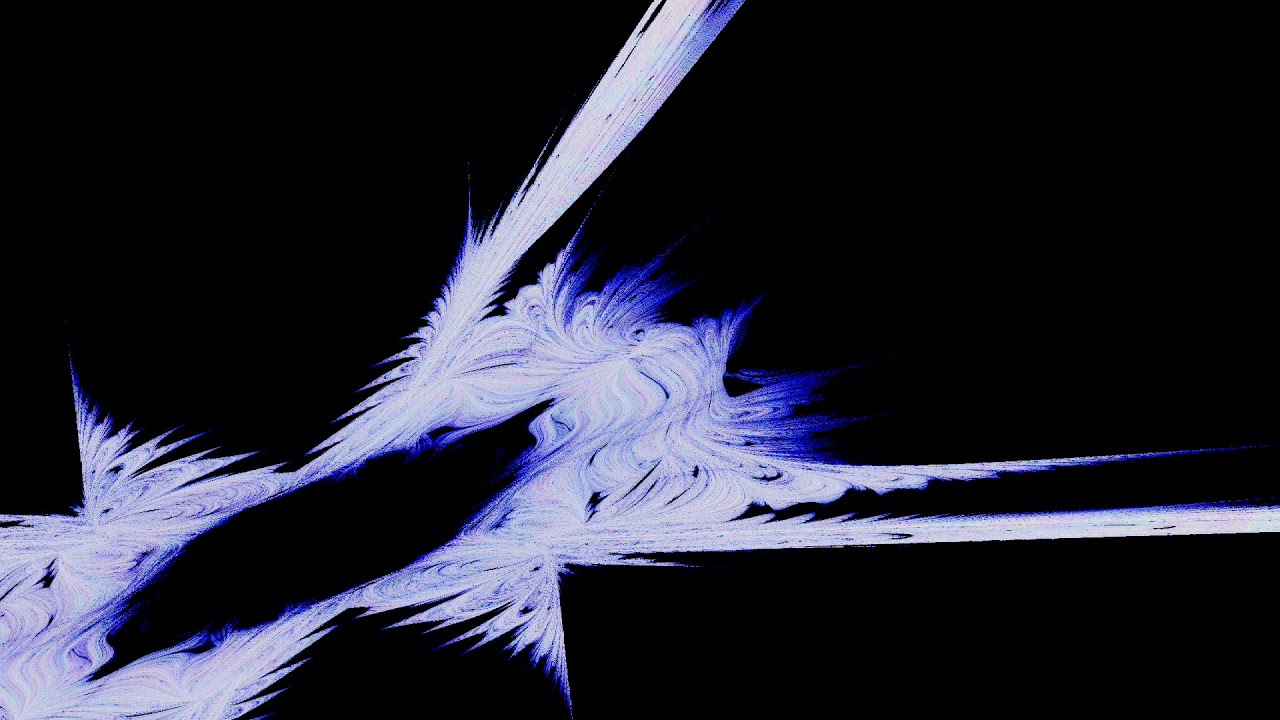
- Mapping double pendulum divergence rates across initial angle coordinates produces an infinite, periodic fractal landscape partitioned into a coherent black regime and a chaotic white sea. (2:13)
- Isolated 'islands of stability' exist within the chaotic regime, yielding structured periodic angle-space trajectories dubbed the Pretzel, the Shoelace, and the Heart. (4:27)
- Fixing starting angles at rest and varying initial angular momentum demonstrates that chaos is not strictly governed by high mechanical energy, as stable pockets and spirograph-like patterns reemerge at non-zero velocities. (5:35)
Detailed notes
## Background Published by 2swap on YouTube on July 11, 2025, this video explores the dynamics of double pendulums beyond their textbook reputation for chaos. The video description credits inspirations from Drew's Campfire, Cruz Godar's generative art color schemes, and scientific literature on double pendulum energy, while noting an erratum regarding analytical closed-form solutions for non-trivial starting positions.
## TL;DR While double pendulums are universally cited as quintessential examples of chaotic unpredictability, mapping their phase space reveals surprising pockets of absolute order. By tracking angle-space trajectories, sonifying motion data into stereo audio, and plotting divergence rates across high-density grids, the video visualizes intricate fractal boundaries between chaos and coherence. Within the sea of chaos lie isolated "islands of stability"—yielding closed, repeating loops nicknamed the Pretzel, Shoelace, and Heart. Finally, testing momentum-space demonstrates that this order is not merely an artifact of low mechanical energy, revealing a landscape where order and chaos interweave.
## Atmosphere & style The presentation is intellectually playful, meditative, and visually mesmerizing, blending rigorous computational physics with aesthetic appreciation. It moves smoothly from a disarming debunking of pop-science dogma into hypnotic visualizations and sonic experiments, creating an almost synesthetic experience when mapping angle data directly to stereo sound. The narration carries an understated, curious wonder, guiding the viewer through vast fractal landscapes to uncover delicate geometric gems hidden within apparent noise.
## Bulletin - [00:00](https://www.youtube.com/watch?v=dtjb2OhEQcU&t=0s) While double pendulums are universally cited as textbook chaotic systems, specific configurations—such as the 'Pretzel Pendulum'—completely resist divergence and maintain stable, repeating trajectories despite minute differences in starting positions. - [02:13](https://www.youtube.com/watch?v=dtjb2OhEQcU&t=133s) Mapping double pendulum divergence rates across initial angle coordinates produces an infinite, periodic fractal landscape partitioned into a coherent black regime and a chaotic white sea. - [04:27](https://www.youtube.com/watch?v=dtjb2OhEQcU&t=267s) Isolated 'islands of stability' exist within the chaotic regime, yielding structured periodic angle-space trajectories dubbed the Pretzel, the Shoelace, and the Heart. - [05:35](https://www.youtube.com/watch?v=dtjb2OhEQcU&t=335s) Fixing starting angles at rest and varying initial angular momentum demonstrates that chaos is not strictly governed by high mechanical energy, as stable pockets and spirograph-like patterns reemerge at non-zero velocities.
## Key takeaways - [00:00](https://www.youtube.com/watch?v=dtjb2OhEQcU&t=0s) Popular science typically frames the double pendulum as chaotic due to extreme sensitivity to initial conditions, where micro-deviations amplify exponentially. - [00:00](https://www.youtube.com/watch?v=dtjb2OhEQcU&t=0s) The 'Pretzel Pendulum' disproves the universal chaos claim by maintaining identical, repeating trajectories despite slightly varied initial conditions under standard deterministic physics. - [01:02](https://www.youtube.com/watch?v=dtjb2OhEQcU&t=62s) Plotting state trajectories in angle-space (top arm angle vs. bottom arm angle) separates space-filling chaotic motion from closed, periodic Lissajous curves. - [01:02](https://www.youtube.com/watch?v=dtjb2OhEQcU&t=62s) Sonifying pendulum angles into stereo audio channels translates chaotic motion into an erratic rumble and stable motion into structured periodic acoustic pitches. - [02:13](https://www.youtube.com/watch?v=dtjb2OhEQcU&t=133s) Simulating one double pendulum per pixel across an angle grid generates an infinite periodic fractal that tiles every 2π radians. - [02:13](https://www.youtube.com/watch?v=dtjb2OhEQcU&t=133s) Evaluating local divergence rates across the fractal grid reveals a dark coherent central regime surrounded by a high-divergence white chaotic regime. - [02:13](https://www.youtube.com/watch?v=dtjb2OhEQcU&t=133s) Continuous coordinate movement inside the coherent region smoothly morphs Lissajous curves until crossing the white threshold, where chaotic dynamics trigger instantly. - [04:27](https://www.youtube.com/watch?v=dtjb2OhEQcU&t=267s) Deep inside the chaotic white region, isolated 'islands of stability' harbor non-divergent trajectories, including the Pretzel, Shoelace, and Heart patterns. - [04:27](https://www.youtube.com/watch?v=dtjb2OhEQcU&t=267s) The central coherent region overlaps closely with a low mechanical potential energy basin, prompting the hypothesis that low energy guarantees order. - [05:35](https://www.youtube.com/watch?v=dtjb2OhEQcU&t=335s) Switching the analysis to momentum-space by varying initial angular velocities proves that stability is not solely a low-energy phenomenon. - [05:35](https://www.youtube.com/watch?v=dtjb2OhEQcU&t=335s) Extreme starting momenta generate complex rotations and spirograph-like trajectories that weave between ordered modes and chaotic behavior. - [05:35](https://www.youtube.com/watch?v=dtjb2OhEQcU&t=335s) Double pendulum differential equations lack closed-form analytic solutions for non-trivial positions, yet the underlying phase space supports profound pockets of order.
## Detailed walkthrough ### [00:00](https://www.youtube.com/watch?v=dtjb2OhEQcU&t=0s) The Pretzel Pendulum and Challenging Chaos
The standard narrative around the double pendulum is that it is the textbook example of chaos. Popular science videos frequently demonstrate this by setting up two seemingly identical double pendulums with microscopic initial differences; over time, those imperceptible deviations amplify exponentially until the two pendulums desynchronize entirely into an unpredictable mess. Because of this hyper-sensitivity to initial conditions, double pendulums are broadly declared to be chaotic.
```mermaid flowchart TD accTitle: Double Pendulum Sensitivity to Initial Conditions accDescr: Diagram showing how identical physics with tiny initial differences leads to either chaos or stable repeating patterns. subgraph Initial["Initial Conditions"] A["Top & Bottom Arm Angles"] B["Minute Starting Difference"] end subgraph Dynamics["Governing Physics"] C["Coupled Equations of Motion"] end subgraph Outcomes["Observed Behaviors"] D["Chaotic Desynchronization<br>(Complete Mess)"] E["Islands of Stability<br>(Pretzel Pendulum Pattern)"] end A --> C B --> C C --> D C --> E ```
However, this reputation ignores a striking counterexample. 2swap introduces a pair of double pendulums with slightly different starting positions that completely refuse to diverge: “These pendulums also have slightly different starting positions, but they will *not* diverge.” Instead of devolving into randomness, they trace out an identical, clean, repeating trajectory dubbed the "Pretzel Pendulum." Both the mess-making pendulums and the Pretzel Pendulums follow the exact same deterministic laws of physics—the only variable changed is the exact initial position where they were released. By systematically mapping how behavior changes as a function of starting position, one can construct intricate fractals where every coordinate indicates the chaoticity of that specific configuration.
[01:02](https://www.youtube.com/watch?v=dtjb2OhEQcU&t=62s) Angle-Space Plots and Sonifying Pendulums
To unpack the mathematics, 2swap inspects individual specimens by tracking two core variables: the angle of the top bar relative to the vertical ($x$-axis) and the angle of the bottom bar relative to the vertical ($y$-axis). Plotting this state trajectory generates a phase-plane visualization in angle-space: - **The Chaotic Specimen**: The trajectory wanders continuously, filling space without ever settling into a regular loop or predictable geometric path. - **The Non-Chaotic Specimen**: The path cleanly traces a regular, closed geometric figure known as a Lissajous curve. - **The Pretzel Pendulum**: Traces a distinct, highly repetitive closed loop in angle-space.
```mermaid flowchart LR accTitle: Angle Data Sonification Pipeline accDescr: Flowchart illustrating how top and bottom angle signals are mapped to audio channels. subgraph Angles["Angle Signals"] X["Top Angle (X)"] Y["Bottom Angle (Y)"] end subgraph Audio["Stereo Audio Mapping"] L["Left Speaker"] R["Right Speaker"] end subgraph Soundscapes["Acoustic Output"] C["Clean / Periodic Pitch"] N["Harsh / Chaotic Noise"] end X --> L Y --> R L & R --> C L & R --> N ```
To make these patterns visceral, 2swap isolates the time-series signals of the top and bottom angles and routes them directly to audio, assigning the top angle to the left speaker and the bottom angle to the right speaker. When sonified, the regular Lissajous curve produces a harsh but clearly structured acoustic oscillation. The chaotic pendulum, by comparison, produces an erratic, noisy rumble. The Pretzel Pendulum, with its clean, tight periodic cycle, produces the purest and most consistent sound. While this audio mapping proves that one can listen to pendulums to diagnose chaos, doing so one by one is far too slow to explore the broader landscape.
[02:13](https://www.youtube.com/watch?v=dtjb2OhEQcU&t=133s) Fractal Landscapes and Divergence Rates
To scale up the analysis, 2swap constructs a 2D grid array of pendulums where the horizontal position corresponds to the top angle and the vertical position corresponds to the bottom angle, with colors assigned to specific angle positions. Pushing the simulation to a density of one pendulum per pixel reveals an expansive fractal pattern.
Because rotating either pendulum arm by a full circle ($2\pi$ radians) returns it to the exact same physical orientation, the resulting fractal perfectly tiles the plane periodically. Within this infinite landscape, two starkly separated regimes emerge: 1. **The Coherent Regime (Black)**: Centered around the origin $(0,0)$, where the pendulums are largely undisturbed and exhibit predictable, non-chaotic dynamics. 2. **The Chaotic Regime (White)**: Outer regions where initial configurations yield wild, unpredictable motion.
To quantify and visualize this boundary, each pixel is assigned two pendulums separated by an infinitesimal initial displacement. The color value of that pixel tracks how rapidly those two pendulums diverge over time. Selecting a coordinate inside the central black zone yields a stable, smooth Lissajous curve; sliding that coordinate continuously within the black region morphs the curve smoothly and gracefully. But the moment the coordinate crosses the threshold into the white zone: “All hell breaks loose.”
[04:27](https://www.youtube.com/watch?v=dtjb2OhEQcU&t=267s) Islands of Stability and the Energy Hypothesis
Deep within the white sea of chaos lie isolated black enclaves: the "islands of stability." These pockets host special starting positions that resist divergence and settle into stable, repeatable orbits: - **The Pretzel**: Found inside the largest island of stability, maintaining its tight, woven trajectory. - **The Shoelace**: A more intricate closed pattern found in another stable enclave. - **The Heart**: A tiny island of stability whose angle-space trajectory traces out a literal heart shape.
| Pattern Name | Island Size | Angle-Space Trajectory Characteristics | |:--- |:--- |:--- | | **Lissajous** | Massive (Main Region) | Smooth, classic harmonic curves centered around origin $(0,0)$ | | **Pretzel** | Large Island | Distinct symmetric woven loops resisting chaotic divergence | | **Shoelace** | Medium Island | High-complexity interlocking periodic loops | | **Heart** | Very Small Island | Delicate closed trajectory resembling a heart shape |
Noticing that the well-behaved Lissajous pendulums all cluster near the coordinate $(0,0)$—where the arms hang down at rest—points toward a physical hypothesis: mechanical energy. Pendulums near $(0,0)$ possess very little potential energy. 2swap tests this by calculating the mechanical energy of a borderline-chaotic pendulum and highlighting in red every configuration on the map with equal or lesser mechanical energy. The highlighted energy basin overlaps almost perfectly with the central black Lissajous region, raising the question of whether chaos is simply a byproduct of high mechanical energy while low energy guarantees coherence.
[05:35](https://www.youtube.com/watch?v=dtjb2OhEQcU&t=335s) Shifting to Momentum-Space and Order in the Rough
To test whether high energy strictly dictates chaos, 2swap shifts paradigms. Rather than releasing motionless pendulums from various angled configurations, the setup fixes the starting angles at $(0,0)$ (pointing straight down) and varies their initial starting momentum (angular velocities).
Mapping this momentum-space reveals that stability is not merely a low-energy phenomenon: - Islands of stability reappear across non-zero starting momenta. - While low-energy pendulums in momentum-space remain stable and slightly higher-energy ones become chaotic, ultra-high-energy configurations resist simple categorization. - At extreme energies, the arms whip through complex rotations, generating intricate spirograph-like trajectories that weave between order and chaos.
Reflecting on the nature of the system, 2swap notes that "chaos" itself is an elusive concept whose working definition shifts between aperiodicity, unpredictability, and trajectory divergence depending on the lens applied. Even though the governing differential equations lack an analytic closed-form solution for non-trivial starting points, the phase space remains profoundly rich: “...the differential equations describing double pendulums have no analytic solution for *any* nontrivial starting position, but even so, this system is sufficiently fertile to support little gems of order in the rough.”
## Notable quotes > [05:35](https://www.youtube.com/watch?v=dtjb2OhEQcU&t=335s) the differential equations describing double pendulums have no analytic solution for any nontrivial starting position, but even so, this system is sufficiently fertile to support little gems of order in the rough. — 2swap
## Mentioned 2swap, Brilliant, 6884, SwapTube, Drew's Campfire, Cruz Godar, Ricky Reuser
## Video description http://brilliant.org/2swap/ - Click here for a 30 day Brilliant free trial and 20% discount on an annual premium subscription!
ERRATUM: At the end of the video, I said: "there is no closed-form solution for non-trivial starting positions." The trivial cases I was referring to are those in which the two arms are collinear, and those in which both arms are vertical but pointing in opposite directions. However, my general claim may not be precisely correct. It is indeed the case that there exists no closed-form function which maps a pendulum's starting angles and a time duration onto the pendulum propagated out for that duration of time. However it is not yet proven that no _specific_ starting condition has a function that maps duration runtime to future position. That said, no such configuration has been found either, and very well may not exist.
If you liked this, please support me on Patreon! https://www.patreon.com/2swap You can support the musician, 6884, on Kofi: https://ko-fi.com/iam6884 Check out his music here! https://6884.bandcamp.com/
SOURCES AND CREDITS Video animated with SwapTube: https://github.com/2swap/swaptube This was largely inspired by this video from Drew's Campfire: https://www.youtube.com/watch?v=OIHyN7TzY6A Pretzel drawing by https://www.instagram.com/litaapollo/ Discussion of energy was inspired by this paper: https://www.famaf.unc.edu.ar/~vmarconi/fiscomp/Double.pdf. Notice that they find slightly different results, since they plot whether or not a pendulum arm peforms a flip as opposed to divergent behavior, which I focused on. The color scheme I used in this video was generously provided by Cruz Godar, who has a website packed full of cool generative art here, double pendulums included! https://cruzgodar.com/gallery
After rendering this video, I investigated the internal structure of the islands of stability, such as their oscillatory modes. Maybe I'll make another video showing my findings...
Here's an interactive online version by Ricky Reuser: https://observablehq.com/@rreusser/the-double-pendulum-fractal
Join our discord server about math, computer science, and other miscellaneous nerd stuff! https://discord.gg/XDb7x2BZAE
[Source](https://www.youtube.com/watch?v=dtjb2OhEQcU)