SpaceX Lands Grasshopper Rocket From 325 Meters in Closed-Loop Test
SpaceX
Integrating high-accuracy ground sensors into Falcon 9 flight algorithms enables the precision control required to return orbital rocket boosters intact.
AI-assisted summary of Grasshopper 325m Test | Single Camera (Hexacopter) — original source. Check the original for full context.
Source published:
Key ideas
- SpaceX's Grasshopper experimental VTVL rig completed a 325-meter (1,066-foot) test flight on June 14, 2013, surpassing the height of Manhattan's Chrysler Building before returning to the pad. (0:00)
- The flight marked the first operational test integrating Grasshopper's full navigation sensor suite directly with Falcon 9 Reusable (F9-R) closed-loop flight algorithms. (0:00)
- An additional high-accuracy altitude and ground-displacement sensor was incorporated into the active control loop to enable dynamic engine throttling for pinpoint landing. (0:00)
- The 10-story test vehicle validated core physical recovery hardware, including a Falcon 9 first-stage tank, a Merlin 1D engine, and hydraulically damped landing legs. (0:00)
Detailed notes
## Background Published on YouTube by SpaceX on July 6, 2013, this video documents the June 14, 2013 test flight of the Grasshopper vertical takeoff vertical landing (VTVL) vehicle ascending to an altitude of 325 meters. According to the description, this milestone marked the first time Grasshopper utilized its complete navigation sensor suite integrated with F9-R closed-loop control algorithms to execute a precision touchdown.
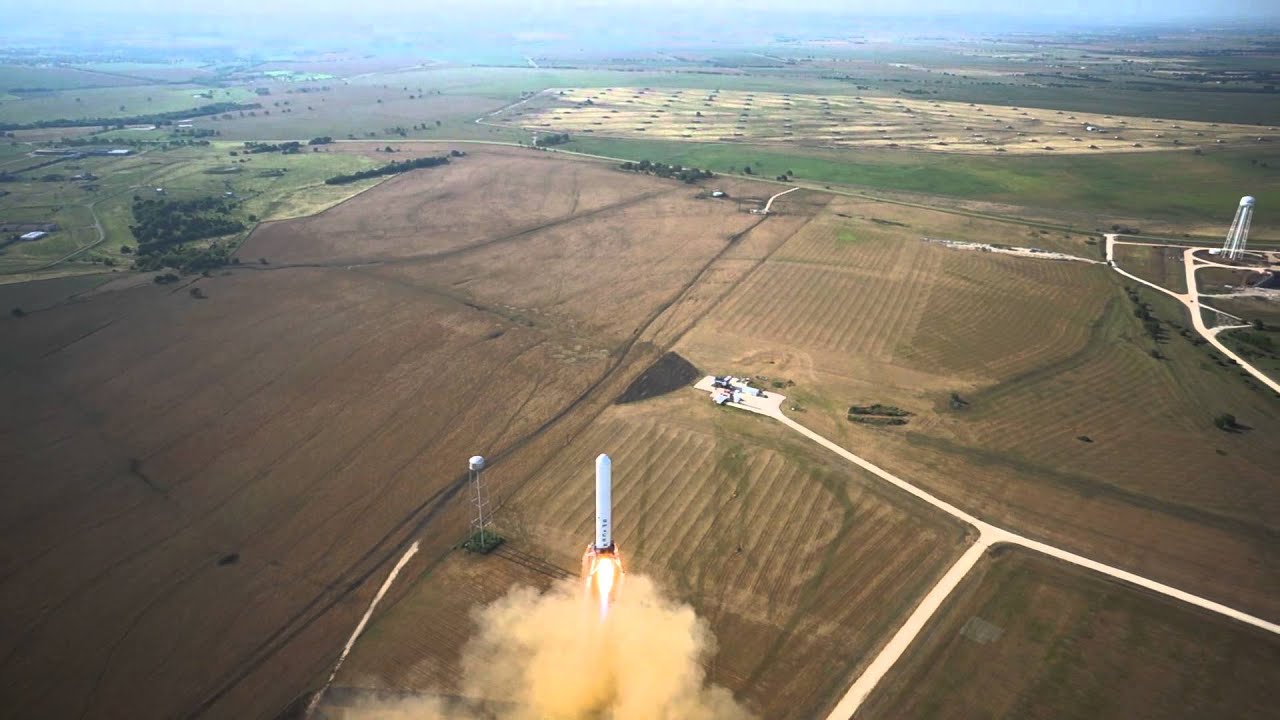
## TL;DR Captured from an aerial hexacopter drone at SpaceX's McGregor, Texas facility, the footage tracks the 10-story Grasshopper test vehicle launching, ascending 325 meters—surpassing the height of the Chrysler Building—and executing a controlled vertical landing back on the pad. The test evaluated core technologies for booster recovery, utilizing a single Merlin 1D engine and shock-absorbing landing legs. By feeding data from a newly added high-precision ground-distance sensor directly into the primary flight loop, the rocket dynamically adjusted its descent and throttling for a pinpoint landing.
## Atmosphere & style The video possesses an unvarnished, observational quality, pairing raw ambient mechanical audio with the steady, hovering vantage point of a drone camera over the Texas proving grounds. Watching a massive 10-story structure float upward, pause in mid-air, and set itself down with surgical precision feels both surreal and calmly methodical. The clip concludes on an understated, whimsical note with the simple on-screen caption: “Thank you. Thank you. The End.”
## Bulletin - [00:00](https://www.youtube.com/watch?v=eGimzB5QM1M&t=0s) SpaceX's Grasshopper experimental VTVL rig completed a 325-meter (1,066-foot) test flight on June 14, 2013, surpassing the height of Manhattan's Chrysler Building before returning to the pad. - [00:00](https://www.youtube.com/watch?v=eGimzB5QM1M&t=0s) The flight marked the first operational test integrating Grasshopper's full navigation sensor suite directly with Falcon 9 Reusable (F9-R) closed-loop flight algorithms. - [00:00](https://www.youtube.com/watch?v=eGimzB5QM1M&t=0s) An additional high-accuracy altitude and ground-displacement sensor was incorporated into the active control loop to enable dynamic engine throttling for pinpoint landing. - [00:00](https://www.youtube.com/watch?v=eGimzB5QM1M&t=0s) The 10-story test vehicle validated core physical recovery hardware, including a Falcon 9 first-stage tank, a Merlin 1D engine, and hydraulically damped landing legs.
## Key takeaways - [00:00](https://www.youtube.com/watch?v=eGimzB5QM1M&t=0s) Grasshopper reached a target apogee of 325 meters (1,066 feet) at SpaceX's development facility in McGregor, Texas. - [00:00](https://www.youtube.com/watch?v=eGimzB5QM1M&t=0s) The test demonstrated a complete vertical takeoff, controlled ascent, descent, and soft upright landing back onto the launch pad. - [00:00](https://www.youtube.com/watch?v=eGimzB5QM1M&t=0s) Standard rocket navigation sensors are sufficient for orbital insertion telemetry but lack the resolution needed for precision vertical touchdowns. - [00:00](https://www.youtube.com/watch?v=eGimzB5QM1M&t=0s) To achieve high landing accuracy, SpaceX introduced a new, higher-precision proximity sensor directly into the primary flight control loop. - [00:00](https://www.youtube.com/watch?v=eGimzB5QM1M&t=0s) The test validated F9-R closed-loop guidance algorithms that dynamically adjust engine thrust based on real-time ground distance measurements. - [00:00](https://www.youtube.com/watch?v=eGimzB5QM1M&t=0s) Grasshopper is constructed around a 10-story Falcon 9 first-stage propellant tank supported by a fixed steel framework. - [00:00](https://www.youtube.com/watch?v=eGimzB5QM1M&t=0s) Propulsion and vector control are provided by a single gimbaling Merlin 1D engine. - [00:00](https://www.youtube.com/watch?v=eGimzB5QM1M&t=0s) Touchdown forces are mitigated by four wide-stance landing legs fabricated from steel and aluminum and fitted with hydraulic shock dampers. - [00:00](https://www.youtube.com/watch?v=eGimzB5QM1M&t=0s) The Grasshopper testing campaign laid the foundational hardware and algorithmic architecture for recovering orbital-class boosters intact rather than discarding them. - [00:00](https://www.youtube.com/watch?v=eGimzB5QM1M&t=0s) The entire flight profile was captured in a single continuous aerial shot via an unmanned hexacopter drone camera.
## Detailed walkthrough ### [00:00](https://www.youtube.com/watch?v=eGimzB5QM1M&t=0s) Grasshopper 325-Meter Test Flight and Precision Landing
Captured from an aerial hexacopter drone camera, this test records SpaceX’s Grasshopper experimental vehicle conducting a 325-meter (1,066-foot) vertical takeoff and vertical landing (VTVL) flight on June 14, 2013. Rising higher than Manhattan’s Chrysler Building, the 10-story test rig ascends steadily over the McGregor, Texas proving grounds, hovers, and controls its descent back to the launch pad for a soft, upright touchdown. The brief audio track features ambient test sound and concludes with the parting caption: “Thank you. Thank you. The End.”
This milestone flight marked the first operational deployment of Grasshopper's full navigation sensor suite integrated directly with Falcon 9 Reusable (F9-R) closed-loop control flight algorithms. While standard orbital launch vehicles carry telemetry and position-tracking instrumentation sufficient for upper-atmosphere trajectory insertion, those standard sensors lack the resolution and low-latency precision required to guide a rocket back to a pinpoint ground target. For this profile, SpaceX incorporated an additional high-accuracy altitude and displacement sensor into the primary flight loop, enabling the flight computer to dynamically calculate the vehicle's true distance from the ground in real time and throttle the Merlin 1D engine for a controlled touchdown.
The Grasshopper platform was engineered to validate the core physical and algorithmic architecture necessary to recover orbital-class rocket boosters intact rather than discarding them to burn up in Earth's atmosphere. Built from a modified Falcon 9 first-stage propellant tank and powered by a single gimbaling Merlin 1D engine, the vehicle utilizes a fixed steel support structure and four wide-stance landing legs manufactured from steel and aluminum with integrated hydraulic shock dampers to absorb landing impacts.
```mermaid flowchart TD accTitle: Grasshopper Closed-Loop Flight Architecture accDescr: Visual flow of sensor data driving the F9-R flight algorithms for Grasshopper's vertical takeoff and precision landing.
subgraph Sensors["Sensor Suite"] S1["Standard Rocket Telemetry Sensors"] S2["High-Accuracy Ground Distance Sensor"] end
subgraph Avionics["Guidance & Navigation"] F9R["F9-R Closed-Loop Control Algorithms"] end
subgraph Actuation["Propulsion & Airframe"] M1D["Gimbaled Merlin 1D Engine Throttling"] PAD["Precision Pad Touchdown on Dampened Legs"] end
S1 --> F9R S2 -->|"Real-time altitude / ranging data"| F9R F9R --> M1D M1D --> PAD ```
- **Flight Altitude:** Reached an apogee of 325 meters (1,066 feet), exceeding the structural height of the Chrysler Building. - **Flight Date:** June 14, 2013, at SpaceX's rocket development and test facility in McGregor, Texas. - **Structural Profile:** 10-story airframe consisting of a Falcon 9 first-stage fuel tank, a central Merlin 1D engine, and an external steel support framework. - **Landing Gear System:** Four wide-base legs composed of welded steel and aluminum equipped with hydraulic dampers. - **Control Advances:** Introduction of closed-loop F9-R navigation algorithms utilizing an extra high-precision ground-proximity sensor.
## Mentioned SpaceX, Grasshopper, Falcon 9, F9-R, Merlin 1D, Chrysler Building, McGregor, Texas
## Video description On June 14, SpaceX's Grasshopper flew 325 m (1066 feet)--higher than Manhattan's Chrysler Building--before smoothly landing back on the pad. For the first time in this test, Grasshopper made use of its full navigation sensor suite with the F9-R closed loop control flight algorithms to accomplish a precision landing. Most rockets are equipped with sensors to determine position, but these sensors are generally not accurate enough to accomplish the type of precision landing necessary with Grasshopper.
Previous Grasshopper tests relied on the other rocket sensors but for this test, an additional, higher accuracy sensor was in the control loop. In other words, SpaceX was directly controlling the vehicle based on new sensor readings, adding a new level of accuracy in sensing the distance between Grasshopper and the ground, enabling a more precise landing.
Grasshopper is a 10-story Vertical Takeoff Vertical Landing (VTVL) vehicle designed to test the technologies needed to return a rocket back to Earth intact. While most rockets are designed to burn up on atmosphere reentry, SpaceX rockets are being designed not only to withstand reentry, but also to return to the launch pad for a vertical landing. The Grasshopper VTVL vehicle represents a critical step towards this goal.
Grasshopper consists of a Falcon 9 rocket first stage tank, Merlin 1D engine, four steel and aluminum landing legs with hydraulic dampers, and a steel support structure.
[Source](https://www.youtube.com/watch?v=eGimzB5QM1M)