Bush Botches Folk Adage, Declares 'Can't Get Fooled Again'
godsroundtable
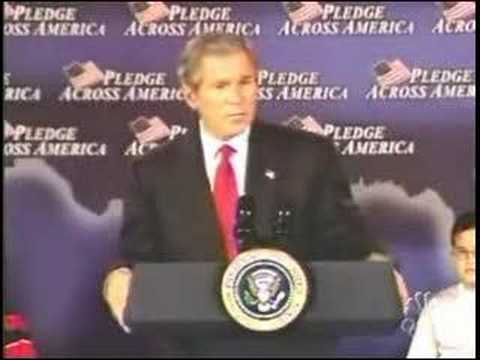
President Bush falters on the traditional proverb to avoid admitting vulnerability with 'shame on me,' abruptly reconfiguring the line into an assertive vow that the public cannot be fooled.
AI-assisted summary of Bush "Fool Me Once..." — original source. Check the original for full context.
Source published:
Key ideas
- President George W. Bush attempts to establish common ground with his audience using a folksy proverb about deception. (0:00)
- Bush deliberates publicly over whether the saying originates in Tennessee or Texas before delivering the first half of the line. (0:00)
- He stumbles when approaching the traditional conclusion ('shame on me'), hesitating after saying 'shame on, shame on you.' (0:00)
- Bush reconfigures the aphorism mid-delivery into an assertive declaration: 'If you fool me, we can't get fooled again.' (0:00)
Detailed notes
## Background Published on YouTube by the channel godsroundtable on June 25, 2006, this short clip features an excerpt of an address by President George W. Bush. The video's show notes simply describe it as a "Speech From Bush."
## TL;DR President George W. Bush attempts to engage his audience by reciting a well-known folksy proverb, musing over whether it originates in Texas or Tennessee. He begins the adage with "fool me once, shame on, shame on you," but falters before uttering the customary "shame on me" conclusion. To avoid expressing personal vulnerability, he abruptly pivots and emphatically rephrases the line into "If you fool me, we can't get fooled again."
## Atmosphere & style The brief clip has an awkward, hesitant tone that transitions rapidly into unintended humor and bluster. Bush's deliberate pauses expose the gears turning as he realizes he has lost the thread of the common saying, creating a moment of palpable rhetorical suspense. The delivery concludes with a sudden shift in energy, exchanging a folksy cadence for a loud, assertive recovery that feels abrupt and disjointed.
## Bulletin - [00:00](https://www.youtube.com/watch?v=eKgPY1adc0A&t=0s) President George W. Bush attempts to establish common ground with his audience using a folksy proverb about deception. - [00:00](https://www.youtube.com/watch?v=eKgPY1adc0A&t=0s) Bush deliberates publicly over whether the saying originates in Tennessee or Texas before delivering the first half of the line. - [00:00](https://www.youtube.com/watch?v=eKgPY1adc0A&t=0s) He stumbles when approaching the traditional conclusion ('shame on me'), hesitating after saying 'shame on, shame on you.' - [00:00](https://www.youtube.com/watch?v=eKgPY1adc0A&t=0s) Bush reconfigures the aphorism mid-delivery into an assertive declaration: 'If you fool me, we can't get fooled again.'
## Key takeaways - [00:00](https://www.youtube.com/watch?v=eKgPY1adc0A&t=0s) Bush opens his remark with an attempt to share a familiar folksy adage with the audience. - [00:00](https://www.youtube.com/watch?v=eKgPY1adc0A&t=0s) He hesitates over the exact origin of the proverb, debating between Tennessee and Texas. - [00:00](https://www.youtube.com/watch?v=eKgPY1adc0A&t=0s) Bush delivers the premise: 'There's an old saying in Tennessee, I know it's in Texas, probably in Tennessee...' - [00:00](https://www.youtube.com/watch?v=eKgPY1adc0A&t=0s) He introduces the first half of the traditional proverb: 'fool me once, shame on, shame on you.' - [00:00](https://www.youtube.com/watch?v=eKgPY1adc0A&t=0s) He falters upon reaching the conventional completion of the adage, which traditionally concludes with 'shame on me.' - [00:00](https://www.youtube.com/watch?v=eKgPY1adc0A&t=0s) Bush abruptly alters and reconstructs the aphorism in mid-speech rather than finishing the standard phrase. - [00:00](https://www.youtube.com/watch?v=eKgPY1adc0A&t=0s) The mid-speech reconfiguration avoids admitting the vulnerability inherent in the phrase 'shame on me.' - [00:00](https://www.youtube.com/watch?v=eKgPY1adc0A&t=0s) Bush opts for a firm, assertive conclusion instead of the proverb's self-deprecating traditional ending. - [00:00](https://www.youtube.com/watch?v=eKgPY1adc0A&t=0s) He emphatically delivers his revised phrasing: 'If you fool me, we can't get fooled again.'
## Detailed walkthrough ### [00:00](https://www.youtube.com/watch?v=eKgPY1adc0A&t=0s) The Stumble on an Old Saying
President George W. Bush begins to invoke a familiar adage, pausing to deliberate over its origins before delivering the line to the audience. He starts out attempting to establish common ground with a folksy reference: “There's an old saying in Tennessee, I know it's in Texas, probably in Tennessee, that says, fool me once, shame on, shame on you.”
As he reaches the traditional conclusion of the proverb—typically finished as "shame on me"—he falters and abruptly reconfigures the aphorism in mid-speech. Seeking a firm and assertive wrap-up instead of admitting vulnerability, he emphatically declares, “If you fool me, we can't get fooled again.”
## Mentioned George W. Bush, Tennessee, Texas
## Video description Speech From Bush
[Source](https://www.youtube.com/watch?v=eKgPY1adc0A)