Radiant Electric Stoves Beat Gas Burners in Cooktop Speed Tests
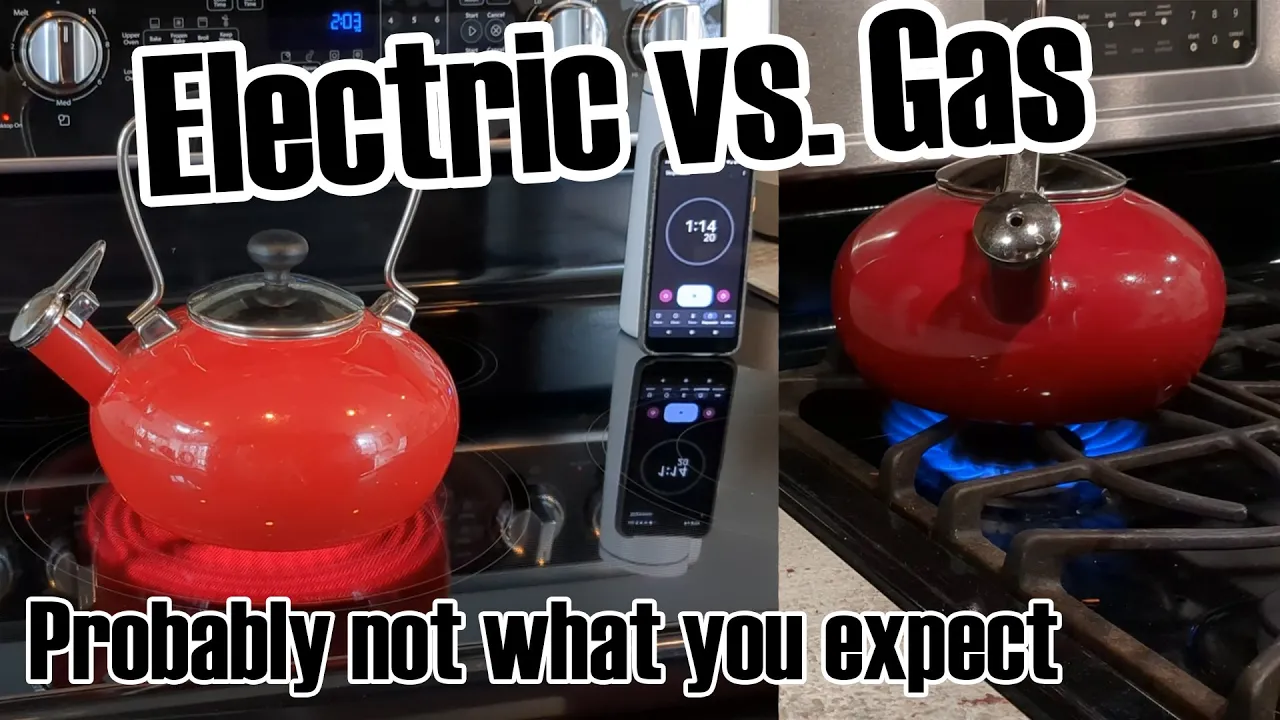
Gas stoves aren't really that fast - even standard electric is faster! — Technology Connextras

Technology Connextras

Standard electric stoves deliver heat to cookware faster than gas ranges because open flames waste substantial thermal energy around the pot while polluting indoor air.

AI-assisted summary of Gas stoves aren't really that fast - even standard electric is faster! — original source. Check the original for full context.

Source published:

Key ideas

  • Empirical testing shows standard radiant electric cooktops generally match or outperform gas burners in boiling speed, with a 1,200-watt electric element boiling 8 cups of water in 16 minutes and 45 seconds compared to 19 minutes on a standard gas burner. (34:25)
  • Indoor air quality monitoring during gas cooking revealed severe combustion spikes, with ambient CO2 climbing from an 818 ppm baseline to 1,560 ppm during an ordinary dinner preparation in a sealed home. (29:44)
  • Gas ranges vent significant convective heat around cookware, causing pot handles to become scalding hot, raising kitchen ambient temperatures in summer, and preventing escaping water vapor from condensing into visible steam until a rolling boil is reached. (10:52)
  • Choosing a standard radiant double-oven range over an induction model saved roughly $1,600, while avoiding cookware incompatibilities and acoustic buzzing from bonded base plates. (62:27)

Detailed notes

## Background Published on YouTube by Technology Connextras on January 30, 2023, the video features the succinct description "Really!" followed by a detailed timeline of chapter timestamps. It documents the creator's side-by-side empirical testing comparing boiling speed, indoor air quality impacts, and daily usability between his former gas stove and a replacement radiant electric range.

## TL;DR Challenging the widespread belief that gas cooking is inherently faster and better, the host conducts head-to-head boiling and preheating tests between his gas stove and a newly installed radiant electric double-oven range. The results show that electric resistance cooking transfers heat into cookware more efficiently than open flames, outperforming standard gas burners across almost all vessel sizes while narrowly trailing only an oversized high-output gas burner. In addition to boiling speeds, the host tracks indoor air quality, showing that gas combustion rapidly spiked indoor CO2 levels past 1,500 ppm, whereas electric operation produced zero emissions. While addressing radiant electric's thermal lag, he demonstrates that simple technique adjustments, cooler cookware handles, lower ambient kitchen heat, and an easy-to-clean glass surface make electric a practical and compelling choice.

## Atmosphere & style The presentation is casual, unpretentious, and methodically nerdy, driven by a self-deprecating Midwestern charm that keeps deep dives into electrical duty cycles and thermal physics engaging. Watching the host pace across his apartment while checking CO2 monitors and timing whistling kettles feels like sitting in on a candid, evidence-based mythbusting experiment with a practical friend. The narrative maintains a thoughtful, open-minded arc that avoids ideological lecturing, focusing instead on relatable kitchen realities and the quiet satisfaction of debunking persistent conventional wisdom.

## Bulletin - [34:25](https://www.youtube.com/watch?v=eUywI8YGy0Y&t=2065s) Empirical testing shows standard radiant electric cooktops generally match or outperform gas burners in boiling speed, with a 1,200-watt electric element boiling 8 cups of water in 16 minutes and 45 seconds compared to 19 minutes on a standard gas burner. - [29:44](https://www.youtube.com/watch?v=eUywI8YGy0Y&t=1784s) Indoor air quality monitoring during gas cooking revealed severe combustion spikes, with ambient CO2 climbing from an 818 ppm baseline to 1,560 ppm during an ordinary dinner preparation in a sealed home. - [10:52](https://www.youtube.com/watch?v=eUywI8YGy0Y&t=652s) Gas ranges vent significant convective heat around cookware, causing pot handles to become scalding hot, raising kitchen ambient temperatures in summer, and preventing escaping water vapor from condensing into visible steam until a rolling boil is reached. - [01:02:27](https://www.youtube.com/watch?v=eUywI8YGy0Y&t=3747s) Choosing a standard radiant double-oven range over an induction model saved roughly $1,600, while avoiding cookware incompatibilities and acoustic buzzing from bonded base plates.

## Key takeaways - [39:57](https://www.youtube.com/watch?v=eUywI8YGy0Y&t=2397s) The persistent perception that electric cooktops are slower than gas stems largely from sensory psychology: gas provides immediate acoustic roar and visible flame, whereas radiant electric heats silently. - [34:25](https://www.youtube.com/watch?v=eUywI8YGy0Y&t=2065s) Across multiple water boiling trials, gas held an advantage only when using a specialized high-output quick-boil burner on a large 4-quart pot (16:47 vs. 18:00); on regular-sized burners, radiant electric was consistently faster. - [34:25](https://www.youtube.com/watch?v=eUywI8YGy0Y&t=2065s) Electric ovens with dual-element rapid preheat reach 400°F faster than standard gas ovens, challenging the assumption that gas preheating is superior. - [08:41](https://www.youtube.com/watch?v=eUywI8YGy0Y&t=521s) Combustion byproducts from gas stoves elevate indoor CO2 well above normal baselines, and standard over-the-range microwave exhaust hoods often fail to adequately vent emissions from front burners. - [45:12](https://www.youtube.com/watch?v=eUywI8YGy0Y&t=2712s) The primary operational drawback of radiant electric cooktops is thermal inertia, which prevents instant temperature drops when dialing down heat. - [45:12](https://www.youtube.com/watch?v=eUywI8YGy0Y&t=2712s) Thermal inertia on electric cooktops is easily managed by lifting cookware off the glass surface to immediately halt conductive heat transfer, or by lowering settings early before reaching a boil. - [45:12](https://www.youtube.com/watch?v=eUywI8YGy0Y&t=2712s) Thermal mass in ceramic glass and heating elements enables effective duty-cycle pulsing, smoothing out power fluctuations to maintain a stable, gentle simmer. - [53:45](https://www.youtube.com/watch?v=eUywI8YGy0Y&t=3225s) A standard 9,000 BTU gas burner produces roughly the equivalent of 3,000 watts of thermal energy, matching the top electric element, but wastes most of it into the kitchen air through combustion blow-by. - [56:10](https://www.youtube.com/watch?v=eUywI8YGy0Y&t=3370s) Electric cooktops prevent pot handles from overheating and eliminate hot flue gas blasts to the cook's face and hands, making close stirring and sensory monitoring far more comfortable. - [50:53](https://www.youtube.com/watch?v=eUywI8YGy0Y&t=3053s) Traditional flat-bottom electric and induction cooktops do not support authentic round-bottomed wok cooking without specialized, costly equipment. - [50:53](https://www.youtube.com/watch?v=eUywI8YGy0Y&t=3053s) Relying on gas stoves for blackout resilience is increasingly complicated by modern electronic safety valves and ignition lockouts, whereas portable camping burners or vehicle-to-load EV power offer cleaner backup alternatives. - [01:00:06](https://www.youtube.com/watch?v=eUywI8YGy0Y&t=3606s) Smooth glass-ceramic surfaces provide flat, functional kitchen prep space when cool and are substantially easier to clean than heavy, stained gas grates, provided spills are not repeatedly baked into the glass. - [01:04:45](https://www.youtube.com/watch?v=eUywI8YGy0Y&t=3885s) Pairing an affordable radiant electric range with a $60 to $70 portable induction burner provides instant temperature control and emergency flexibility without the steep price tag of a full induction appliance.

## Detailed walkthrough ### [00:00](https://www.youtube.com/watch?v=eUywI8YGy0Y&t=0s) Rethinking the Gas vs. Electric Debate

Opening the video with a self-deprecating joke about entering the cultural discourse, the host clarifies that his aim is neither to force everyone to throw out their gas stoves nor to pretend gas appliances lack advantages for specific cooking styles. Rather, his objective is to challenge a widely held cooking assumption by demonstrating that standard radiant electric stoves are actually faster at transferring heat into cookware than gas burners. This realization first occurred to him during his previous kettle video, when taking a red whistling kettle to his parents' radiant cooktop revealed it boiled water significantly faster than his own gas range at home.

While acknowledging that electric elements suffer from slower responsiveness when adjusting heat downward, he notes that induction technology already resolves that issue. However, he deliberately chose a conventional radiant model over induction for practical and financial reasons. He prepares to present head-to-head empirical boiling tests to prove that the raw speed advantage of electric cooktops is genuine, regardless of common cooking lore.

“I totally get that this is going to sound like make believe, but I'm here with some tests to show you that this is indeed the case.”

[01:32](https://www.youtube.com/watch?v=eUywI8YGy0Y&t=92s) Indoor Air Quality and the Push to Switch

The decision to swap out appliances originated from persistent concerns regarding combustion byproducts trapped indoors. The building is tightly sealed, meaning that merely existing inside alongside his cat causes ambient baseline carbon dioxide ($\text{CO}_2$) to hover around 750 to 800 parts per million (PPM), roughly doubling background outdoor levels due to minimal fresh air exchange. Although studies outlining the health risks of indoor gas combustion date back to the 1980s, the host previously relied on workarounds like cracking windows and retrofitting bathroom exhaust fans with one-hour countdown timers whenever he cooked.

The final push came while visiting his parents over Christmas. Preparing Cream of Wheat porridge (Farina) and batches of white rice on their radiant electric cooktop, he discovered that his cooking instincts were completely intact; dialing back the heat early prevented boil-overs entirely. Furthermore, boiling both items took noticeably less time than on his gas range. Because his home features a 200-amp electrical panel positioned directly below the kitchen, running a dedicated 240-volt circuit took him only about three hours. He recognizes this setup was unusually favorable, capped the household gas supply pipe, and plugged in his replacement unit.

“I'm not out here to tell you you should get rid of your gas stove right now because that's difficult and expensive... but I do want to hopefully convince you that even a standard electric stove is fine.”

[05:35](https://www.youtube.com/watch?v=eUywI8YGy0Y&t=335s) Selecting a Double-Oven Range and Passing on Induction

In North American households, cooking setups rarely feature separated wall ovens and cooktops; the standard configuration is an integrated freestanding range. The host prioritized a specific layout: a double-oven range where the typical lower pan storage drawer is replaced by a full-sized roasting oven, positioning a compact, slender oven cavity directly beneath the cooking surface at waist height. This upper cavity warms faster, conserves energy, and accommodates the vast majority of everyday single-person baking tasks.

Securing that specific double-oven configuration alongside an induction cooktop would have effectively doubled the total purchase price of the appliance. Despite induction technology having matured decades ago without inherently prohibitive component costs, market segmenting pushes North American induction double-oven units into an extreme luxury tier. Consequently, he opted for a radiant glass top paired with the dual oven layout.

“Mainly I just want that skinny oven at the top because it's a more convenient height to use, and I don't need a full oven almost ever.”

```mermaid flowchart TD accTitle: Stove Selection Decision accDescr: Decision flow showing why the host picked a radiant double-oven range instead of an induction model.

subgraph Priorities["Appliance Priorities"] A["Double-Oven Range Configuration"] B["Compact upper cavity at convenient height"] A --> B end

subgraph Options["Market Assessment"] C["Induction Cooktop Double Oven"] D["Radiant Electric Double Oven"] end

B --> C B --> D

C -->|"Double the purchase price"| E["Rejected: Excessive premium"] D -->|"Affordable & meets cooking needs"| F["Selected for installation"] ```

[07:15](https://www.youtube.com/watch?v=eUywI8YGy0Y&t=435s) Establishing the Boiling Speed Test

To benchmark heating performance before removing the gas unit, the host set up water-boiling trials across several household pots and kettles. Although water temperature was not gauged with a dedicated probe, he flushed the household plumbing until the tap water ran at a cold, stable underground temperature to maintain consistent starting baselines across trials.

While boiling water does not cover every culinary technique, it isolates the fundamental physical objective of a cooktop: delivering thermal energy into cookware and liquid as rapidly as possible. Filming these tests side-by-side with timing logs allows for a direct comparison of energy transfer between fuel types.

“The whole point of a stove is to get heat energy into cookware and thus into food, so I think it's about the most fair test that you can do.”

[08:41](https://www.youtube.com/watch?v=eUywI8YGy0Y&t=521s) Tracking Carbon Dioxide as an Emission Proxy

For the on-camera test, the host places four quarts (one gallon) of tap water into a large IKEA stockpot on the highest-output burner of the gas stove. Simultaneously, an indoor air quality monitor tracks ambient $\text{CO}_2$ levels throughout the run. While sustained levels exceeding 1,000 PPM impair cognitive function, ambient $\text{CO}_2$ serves here primarily as a visible proxy for dangerous, unmonitored combustion byproducts such as nitrogen dioxide ($\text{NO}_2$) and ultrafine combustion particulate matter.

Before igniting the burner, the over-the-range microwave exhaust fan is set to high. However, poor duct routing severely compromises its airflow to the outdoors. The baseline readings and initial conditions at ignition are:

- Starting water volume: 4 quarts (in an IKEA stockpot) - Initial ambient indoor $\text{CO}_2$ reading: 818 PPM - Exhaust status: Over-the-range microwave vent active on high - Anticipated time to reach a rolling boil on gas: ~16 minutes

“When $\text{CO}_2$ goes up quite a lot because of using the stove, then we know that those worst things are also in the air, and it just gives a good idea of how hard it is to get all that stuff out of the living space.”

[10:52](https://www.youtube.com/watch?v=eUywI8YGy0Y&t=652s) Testing the Ikea Pot on Gas and Observing the Disappearing Steam

Alec continues timing the four quarts of water in the Ikea pot on his old gas stove's large "quick boil" front burner. In a previous run using a different pot with a wider base on that same burner, it took 16 minutes and 30 seconds to reach a boil. By contrast, running the Ikea pot on the back left burner—which was also marketed as a quick boil burner—was vastly slower, taking over half an hour just to bring four cups of water to a boil. Alec reflects on how this challenges popular assumptions:

> “Yeah, this idea that gas stoves are really fast is increasingly sounding like BS to me.”

He is performing these baselines to compare against his incoming replacement: a standard radiant glass-ceramic cooktop, rather than an induction range.

Alec monitors indoor air quality throughout the run. To keep conditions controlled, he disables the building HVAC system so no forced air circulates, leaving only the range extractor hood running. The $\text{CO}_2$ meter sits roughly 30 feet (about 9 meters) away, around the corner in the living room. As the test passes the 10-minute mark, the reading rises from an initial baseline of 818 ppm up to 845 ppm, and then rapidly spikes to 960 ppm. While walking back and forth carries a slight draft of kitchen air into the living room, he stresses that the monitor is far away; directly in the kitchen, levels would likely register around 1,500 to 1,600 ppm.

Around 14 minutes in, active bubbling appears. Defining boiling as the point where the surface is intensely disturbed, Alec stops the clock at roughly 16 minutes and 47 seconds—just 17 seconds longer than the wide-base pot, illustrating that water and energy behave predictably regardless of vessel shape.

Turning off the gas burner reveals a striking physical phenomenon: steam only becomes visible *after* the flame is extinguished. When Alec reignites the burner, the billowing plume vanished instantly.

> “The exhaust gases from the burner are so hot that they are able to keep the water vapor that's escaping from condensing into mist so it's visible as steam.”

This demonstrates the sheer volume of wasted convective energy rushing up past the sides of cookware on a gas range. After completing the run, the remote $\text{CO}_2$ monitor continues climbing, registering 1,160 ppm, then 1,205 ppm, and eventually surpassing 1,245 ppm as the combustion byproducts disperse through the apartment.

```mermaid flowchart TD accTitle: Gas Stove Convective Heat Waste and Steam Suppression accDescr: Diagram showing how hot gas exhaust bypasses the pot and prevents water vapor from condensing into visible steam.

subgraph Combustion["Gas Burner Operation"] Burner["High-Output Gas Flame"] --> FlameHeat["Direct Conductive Heat to Pan Base"] Burner --> HotExhaust["Massive Hot Exhaust Gas Flow"] end

subgraph PotInteraction["Pot & Water Vapor"] FlameHeat --> BoilingWater["Boiling Water Releases Vapor"] HotExhaust --> BypassSides["Exhaust Rushes Up Around Pot Sides"] BoilingWater --> Evaporation["Escaping Vapor Stream"] end

subgraph VisualEffect["Visual Result"] BypassSides --> Overheating["Superheats Ambient Air Above Pot"] Evaporation --> Overheating Overheating -->|"Prevents condensation"| InvisibleSteam["Steam Stays Invisible / Disappears"] Burner -.->|"Turn Flame OFF"| DropsTemp["Ambient Air Rapidly Cools"] DropsTemp -->|"Condenses into mist"| VisibleSteam["Dense Plume of Steam Appears"] end ```

[17:10](https://www.youtube.com/watch?v=eUywI8YGy0Y&t=1030s) The New Radiant Electric Stove: Setup and Burner Limiting

Alec reveals his new cooking appliance: a standard radiant glass-ceramic cooktop (electric resistance under glass), not induction. To evaluate its capabilities, he stages a simultaneous two-pot boil test: - **Right front burner:** Four quarts (nearly four liters) of water in the large Ikea pot. - **Left front burner:** Eight cups (two quarts) of water in the smaller pot.

Because this test solely boils clean water and produces no combustion byproducts, smoke, or aerosolized grease, Alec leaves the range extractor hood off completely. Prior tests had already confirmed that running the electric range leaves indoor $\text{CO}_2$ levels untouched.

The right element has the highest power rating on the cooktop, though the smaller pot on the left sits on an element running at approximately two kilowatts. Alec notes that while the glowing heating coils appear bright magenta-pink on camera due to digital sensors capturing intense infrared emissions, they look deep red to the naked eye.

The benchmark targets from the gas stove are: - **16 minutes, 47 seconds** for the 4-quart pot on the maximum-output gas burner. - **19 minutes flat** for the 8-cup pot on the gas stove's normal-output burner.

Early into the boil, the right electric element cycles off. Alec explains that this is a built-in safety feature typical of modern glass-ceramic ranges, which use internal temperature limiters to prevent the cooktop from overheating when running continuously at maximum output.

- Cooktop type: Standard electric radiant glass-ceramic (non-induction). - Gas benchmark for large pot (4 quarts): 16:47 (high-output quick-boil burner). - Gas benchmark for small pot (8 cups): 19:00 (normal-output burner). - Left radiant burner output: Approximately 2 kW. - $\text{CO}_2$ production during electric boiling: 0 ppm increase.

[20:47](https://www.youtube.com/watch?v=eUywI8YGy0Y&t=1247s) Side-by-Side Boiling: Usability and Final Timings

As the timers pass seven minutes, wisps of vapor emerge over the electric elements. Alec notes an underappreciated ergonomic advantage of electric cooking over gas: the lack of convective exhaust. On high-powered gas stoves, an intense plume of superheated combustion air constantly blasts upward around cookware, making it uncomfortable to stir food with short utensils, evaluate aromas, or visually monitor simmering. On the radiant cooktop, Alec demonstrates that he can comfortably hold his hand right above and next to the pots, even though the elements are slightly wider than the cookware bases.

During the test, heat radiating from the cooktop forces Alec to reposition his filming smartphones to keep them from overheating.

At the 14-minute mark, the smaller pot approaches a vigorous boil. Alec calls it at 14 minutes and 45 seconds (rounding up to 15:00): - **Small pot result:** 14:45 on electric versus 19:00 on the gas stove's standard burner—over four minutes faster.

Meanwhile, the 4-quart pot on the cycling high-power element continues building toward a boil. On gas, the flames had engulfed the sides of the pan to reach a rolling boil at 16:47. On the electric range, the water reaches full boil at approximately 18 minutes and 30 seconds. Despite suffering thermal throttling cycles and being slightly undersized for the element, the electric burner finished less than two minutes behind the gas stove's most aggressive burner. Alec concludes:

> “Electric stoves are not slow, folks.”

[25:51](https://www.youtube.com/watch?v=eUywI8YGy0Y&t=1551s) Kettle Test on the Moderate Gas Burner

Testing the tea kettle on the gas stove turns into an experiment on power versus ventilation. Rather than using the massive high-output front burner, the kettle is placed on the more moderate back-left burner—what the host considers the only "normal" burner on that range, though it still has decent power. To keep things standardized, exactly one liter of water (measured using a pre-filled bottle) is poured in. Boiling is defined by a crisp, objective audio cue: the moment the kettle starts to whistle, it is officially done. The kettle's whistle is oriented away from the phone camera, and the extractor fan built into the over-the-range microwave is set to its highest speed.

Because the back-left burner sits more directly underneath the microwave hood than the front burners do, it should theoretically benefit from better exhaust capture. Still, the host remains skeptical about the fan's real-world capability. Once the kettle whistles, he shuts off the extractor fan entirely to observe what the lingering combustion gases do to the kitchen's air quality. While admitting that turning off ventilation over an open flame is normally a bad idea, he paces back and forth across the kitchen to stir up the air and overcome any sensor latency. The CO2 readings steadily climb from a baseline of around 818 ppm up to 1,220 ppm before stabilizing.

- Test volume: ~1 liter of water. - Metric for completion: The first audible whistle from the kettle. - Starting indoor CO2 baseline: ~818 ppm. - Stabilized CO2 reading after test: 1,220 ppm. - Takeaway on hood geometry: The rear burner exhaust is largely captured by the overhead microwave hood, but front burners completely miss the intake canopy.

---

[29:44](https://www.youtube.com/watch?v=eUywI8YGy0Y&t=1784s) Real-World CO2 Spikes from Everyday Cooking

Reflecting on the ambient measurements during post-production editing, the host admits that real cooking produces far more alarming spikes than a single isolated boiling test. After completing the stove tests that evening, he cooked an ordinary dinner using the gas oven and at least one stovetop burner. That single cooking session drove indoor CO2 levels all the way to 1,560 ppm—nearly double his home's typical baseline.

Even aggressive remediation did little to solve the problem quickly. Running the kitchen extractor fan and two separate bathroom exhaust fans continuously for a full hour only brought the CO2 down to 1,110 ppm. The host emphasizes that the only true way to flush combustion byproducts like CO2 out of a sealed home is to open windows and dump the conditioned indoor air, which subsequently requires reheating or recooling the house from scratch.

> “Whatever I did ended up peaking indoor CO2 at 1560. That is like just holy yikes, that's pretty much double the typical baseline level.”

---

[30:57](https://www.youtube.com/watch?v=eUywI8YGy0Y&t=1857s) Kettle Test on the Smooth-Top Electric Range

The scene shifts to the new radiant electric range to run the identical one-liter kettle test. Before switching anything on, the host touches the bare glass cooktop with his hand to prove the surface and internal elements are stone-cold, noting that the hot surface warning light is off. However, touching the surface introduces finger grease, prompting an immediate cleaning interlude. Maintaining a smooth ceramic-glass cooktop requires diligence; burning baked-on grease into the glass causes lasting cosmetic damage. While specialized products like Cerama Bryte exist, ordinary glass cleaner handles day-to-day wipe-downs.

```mermaid flowchart TD accTitle: Electric Kettle Test Configuration accDescr: Diagram illustrating how the multi-zone electric burner interacts with the kettle base. subgraph Burner["Triple-Zone Radiant Burner"] Inner["Inner 6-inch Zone"] Mid["Middle Zone Active"] Outer["Outer Ring Inactive"] end Inner --> Mid Mid -->|"Matches kettle diameter (~8-9 in)"| Base["Kettle Base"] Base -->|"Direct contact + radiant heat"| Water["1 Liter of Water"] Water -->|"Reaches boil in 7:15"| Whistle["Audible Whistle"] ```

The kettle is centered on the front multi-zone burner set to its middle diameter. The 6-inch inner section alone would be slightly too narrow for the kettle's footprint, whereas the middle zone matches the kettle's base diameter almost perfectly. Even though some stray radiant energy escapes around the perimeter, the vast majority is transferred cleanly upward into the steel vessel. The whistling kettle clocks in at exactly 7 minutes and 15 seconds.

- Cooktop maintenance rule: Keep the surface free of grease before heating to avoid baking in residue. - Burner setting: Middle ring of the multi-zone element. - Test result: Whistle sounded at 7 minutes, 15 seconds.

---

[34:25](https://www.youtube.com/watch?v=eUywI8YGy0Y&t=2065s) Off-Camera Data: Preheating Ovens and Boiling Water

Moving beyond the filmed trials, the host breaks down the comprehensive data gathered across multiple days of testing ovens and cooktops. First, in terms of oven preheating to 400°F, the old gas range required 8 minutes and 59 seconds. The new electric range beat it handily: both of its cavity ovens hit 400°F in under 8 minutes. The electric range achieves this through a "rapid preheat" function that activates both the top broil element and the bottom bake element simultaneously, destroying the long-held myth that gas ovens preheat faster than electric ones.

On the cooktop side, the large 4-quart (1-gallon) Ikea pot was the only scenario where the gas range held an edge—and only on its specialized high-output burner, which clocked 16 minutes and 47 seconds versus the electric range’s best time of 18 minutes. When that same 4-quart pot was placed on the gas stove's back-left burner, it languished for 35 minutes before boiling. In every other test, radiant electric proved strictly faster. For an 8-cup pot of water, the normal front-left gas burner took 19 minutes. On the electric stove, even the weakest, smallest 1,200-watt rear element boiled that same volume in 16 minutes and 45 seconds—beating the standard gas burner by 2 minutes and 15 seconds.

| Test Scenario | Gas Stove Time | Radiant Electric Stove Time | Notes / Details | |:--- |:--- |:--- |:--- | | **Oven Preheat to 400°F** | 8 min 59 sec | < 8 min (both cavities) | Electric uses dual elements (Rapid Preheat) | | **4 Quarts Water (Large Burner)** | 16 min 47 sec | 18 min 00 sec | Sole victory for gas (Quick Boil burner only) | | **4 Quarts Water (Back-Left Burner)** | 35 min 00 sec | — | Gas burner heavily throttled by smaller size | | **8 Cups Water (Standard Burner)** | ~19–20 min | 14 min 20 sec (medium zone) | Best electric run was 14:20; secondary run 15:00 | | **8 Cups Water (Smallest Burner)** | — | 16 min 45 sec | Electric 1,200 W element beats standard gas burner |

> “The slowest burner on this electric stove is faster than what I would call a normal burner on a gas stove.”

---

[38:02](https://www.youtube.com/watch?v=eUywI8YGy0Y&t=2282s) Element Wattage and Duty-Cycle Power Throttling

A peculiar quirk emerged during head-to-head testing between the two rear electric burners. On paper, the back-left burner is rated 100 watts higher (1,300 W) than the back-right burner (1,200 W). However, when identical Ikea pots were raced simultaneously, the 1,200 W back-right burner boiled in 13 minutes, while the 1,300 W back-left burner took 15 minutes.

The discrepancy comes down to internal duty cycling. The stove aggressively cycles certain burners on and off even when turned to maximum. The host deduces that this thermal throttling serves as an engineering safeguard against overloading a home's electrical panel. Summing the stove's maximum surface wattages reveals an immense electrical draw:

- Front burners: 3,000 W + 3,000 W - Rear burners: 1,300 W + 1,200 W - Total cooktop capacity alone: 8,500 Watts

Supplied on a typical 50-amp, 240-volt circuit, the absolute ceiling before tripping the breaker is 12 kilowatts (12,000 watts). If an operator turns on all four cooktop burners simultaneously alongside both oven elements, the total demand would easily exceed 50 amps. Staggering element duty cycles keeps the range from pulling peak current for more than a few minutes at a time, protecting household breakers from tripping during intensive cooking sessions.

[39:57](https://www.youtube.com/watch?v=eUywI8YGy0Y&t=2397s) Why Electric Stoves Feel Slower Than Gas

Even with the cooktop’s internal power limitations throttling the largest 3,000-watt burner down to an effective 2,000 watts, empirical testing shows that the bog-standard radiant electric stove remains almost as fast as the giant gas burner and noticeably faster in virtually every other comparative scenario. Yet despite the hard data, electric stoves suffer from a persistent reputation of being agonizingly sluggish. Even the host admits that whenever he turns on an electric cooktop, his instinctive reaction is still to dread that boiling or heating will take forever.

He attributes this perception primarily to sensory psychology. When firing up a gas burner, the user experiences immediate acoustic and visual feedback: the rapid *tick-tick-tick* of the spark igniter gives way to a roaring, visible blue flame. On an electric stove—whether conventional radiant or induction—the user twists the dial and hears nothing more than a faint hum. On radiant glass-ceramic units, a dull red glow emerges after a few seconds, but there is no sound and no leaping flame to signal high energy output. Because human brains equate sensory drama with power, an electric stove feels inert even when it is actively dumping more net heat into a pot than an equivalent gas flame.

> “So just by numbers the electric stove, the bog standard electric stove, is faster than the gas stove.”

[41:47](https://www.youtube.com/watch?v=eUywI8YGy0Y&t=2507s) Re-evaluating the Stovetop Kettle Data

Turning to the stovetop kettle tests, performance varies across burners due to geometry and heating element sizing. On the electric range's lower-wattage rear burners, bringing the kettle to a boil took 10 minutes and 54 seconds on the back-left burner, and 10 minutes and 7 seconds on the back-right. By comparison, the old gas stove boiled the same kettle in approximately 8 minutes on its back-left burner. Some seasonal ambient variation factored into this difference, as the gas test had been performed during warmer weather when tap water was not as cold as winter supply water.

However, when moving to the electric stove’s front-left dual-ring burner on its medium setting, the electric cooktop surged ahead, boiling the kettle in 7 minutes and 15 seconds. The host deliberately skipped testing the kettle on the stove's largest front-right "mega" burner because heat overflow had proved hazardous in the past; running a modest kettle over that massive gas or electric ring allowed excess heat to bleed up around the sides, leaving the handle scorching and unsafe to grip. Ultimately, stovetop kettle arguments are largely moot because standalone plug-in electric kettles outperform both gas and electric ranges.

> “There's no reason to boil water in a kettle on a stove; electric kettle remains faster than this stove no matter what, just because there's losses involved with transferring heat from the burner to the kettle to the water.”

- **Electric Back-Left Burner:** 10:54 to boil - **Electric Back-Right Burner:** 10:07 to boil - **Gas Back-Left Burner:** ~8:00 to boil (warmer seasonal baseline) - **Electric Front-Left (Medium setting):** 7:15 to boil

[43:23](https://www.youtube.com/watch?v=eUywI8YGy0Y&t=2603s) Context: Cooking Habits and U.S. Appliance Demographics

Before evaluating the broader trade-offs between fuel sources, two contextual qualifiers set the baseline. First, culinary complexity dictates how much a cooktop's nuances actually matter. For someone who rarely cooks elaborate multi-course meals from scratch—relying instead on stir-fried vegetables and pre-prepared groceries from Trader Joe's—the exacting requirements of high-end culinary arts do not reflect daily reality.

Second, popular discourse often treats gas cooking as universal, yet federal energy data reveals that only 38 percent of American homes actually possess a gas stove. With induction adoption still hovering in the low single digits, approximately 58 percent of households across the United States rely on traditional electric resistance coil or radiant glass-ceramic ranges every day. For the vast majority of people, cooking on an electric range is already standard practice.

> “For those that are worried about how awful it would be to live with one, most of us are already doing it and we are fine.”

- **U.S. Gas Stove Adoption:** ~38% of homes - **U.S. Traditional Electric Adoption:** ~58% of homes (majority market share) - **U.S. Induction Adoption:** Minimal market penetration

[45:12](https://www.youtube.com/watch?v=eUywI8YGy0Y&t=2712s) Thermal Inertia: The Big Disadvantage and How to Overcome It

The single biggest operational disadvantage of a conventional electric stove is thermal inertia. Gas stoves provide instantaneous, square-wave thermal modulation: a flame transitions from maximum heat to zero heat the split second the valve is closed, even if the knob itself exhibits stepped or non-linear control. In contrast, radiant electric and coil cooktops must heat up the physical mass of the resistance element and the ceramic glass sheet above it. When switched to low, the element continues to radiate accumulated heat, producing a parabolic curve where temperatures keep climbing before slowly plateauing and declining.

```mermaid flowchart TD accTitle: Thermal Response Comparison accDescr: Flowchart contrasting the immediate response of gas stoves with the lagging curve of electric cooktops caused by thermal mass.

subgraph GasResponse["Gas Stove Response"] G1["Knob Adjusted"] --> G2["Instant Flame Adjustment"] G2 --> G3["Immediate Heat Change"] end

subgraph ElectricResponse["Radiant Electric Response"] E1["Knob Adjusted"] --> E2["Thermal Mass Lag"] E2 --> E3["Element & Glass Slow to Cool/Heat"] E3 --> E4["Gradual Temperature Curve"] end ```

Managing this lag requires anticipating heat transfer. When bringing liquids like Cream of Wheat to a boil with the intention of simmering, the cook must dial the heat down to medium or low at the first sight of perimeter bubbling rather than waiting for a rolling boil. If a pot is on the verge of boiling over, the fix requires no technical mastery: simply lift the cookware a couple of inches off the glass surface. The moment physical contact is broken, conducted thermal transfer ceases instantly, allowing the liquid to settle while the cook places it on an adjacent cool ring or trivet.

Furthermore, thermal inertia is the very property that makes conventional electric duty-cycling functional. Radiant cooktops regulate intermediate temperatures by cycling the heating element on and off via pulse-width modulation (such as 30 seconds energized followed by 3 seconds off). Without the dampening effect of the heavy glass and element thermal mass, that pulsing power would wildly fluctuate the pan temperature. The stored thermal mass smooths out those electrical pulses, maintaining a steady, consistent simmer across the bottom of the pan.

> “If you have something on an electric stove that is about to boil over or is getting too hot and you need to get heat away from it, pick it up; that's all you have to do.”

[50:53](https://www.youtube.com/watch?v=eUywI8YGy0Y&t=3053s) The Wok Problem and Using Gas During Power Outages

Before moving fully into the merits of electric cooking, Alec addresses a limitation brought up frequently in online discussions: cookware compatibility, specifically cooking with a traditional round-bottomed wok. While specialized induction wok units do exist nowadays, they remain quite expensive, and conventional flat electric ranges simply do not accommodate or heat a wok properly. Alec admits that he has never really used a wok himself or learned proper wok technique, but he refuses to dismiss the concern out of hand, acknowledging that for many people, especially for cultural reasons, it is an essential cooking method that flat-out will not work on standard electric.

Beyond cookware geometry, Alec circles back to a classic gas stove feature that would cause viewers to complain if left unmentioned: operational capability during a power outage. Growing up, his family relied on that trick several times, simply striking a match to light the burners when the electricity failed. However, he questions how reliable modern gas stoves are in this scenario. He recounts that his brother owned a newer gas stove with an electronic safety feature: after even a momentary power interruption, the display demanded the user verify all burners were turned off before pressing start. Because it was equipped with an electric safety solenoid valve that shuts off the gas supply, it may well fail to deliver gas during a true blackout.

Assuming a standard stove without electric shutoff interlocks, being able to cook through a blackout is undeniably useful. Yet Alec argues against letting that single edge case dictate your daily appliance choices. For true emergency resilience, far more practical alternatives exist, ranging from inexpensive propane camping stoves with small gas bottles to portable plug-in induction burners paired with modern backup power. Alec highlights his own setup: thanks to his electric vehicle and its vehicle-to-load (V2L) adapter, he has no need for a noisy fossil-fuel generator. As long as his car carries a usable charge, he can run a portable electric burner, microwave, or refrigerator directly from the car's battery.

- “I almost forgot this advantage of a gas stove and people would be really mad if I didn't bring it up and that is they work during power outages and uh in my past in my childhood that is a thing that we did a few times just light them with a match and it works however I'm not sure how many new stoves will work without power.” - “I'm not going to ever have a generator because so long as my car has some useful charge I can just plug a little burner into it plug the microwave into it uh the fridge freezer whatever I need to and use my car for that purpose...” - Modern gas ranges with electronic safety lockouts may cut fuel completely until an electronic reset sequence is completed, rendering match-lighting ineffective without grid power.

---

[53:45](https://www.youtube.com/watch?v=eUywI8YGy0Y&t=3225s) Waste Heat and Summer Kitchen Misery

Switching over to the affirmative case for switching to electric, Alec notes the immediate environmental payoff of ditching combustion in his studio space: after exhaustive cooking trials, indoor CO2 levels remained completely flat. Because his gas furnace vents properly outdoors and nothing else inside produces carbon dioxide except his own breathing, removing the unvented gas cooktop eliminated the indoor air pollution source entirely. Beyond air quality, the biggest day-to-day improvement comes in thermal comfort during hot weather.

Cooking in a kitchen during the summer using a gas stove—or worse, a gas oven—is miserable. Reviewing thermal camera footage recorded during his tea kettle experiments, Alec demonstrates that vast plumes of heat simply spill around the cookware rather than soaking into it. The small 9,000 BTU burner he tested churns out roughly the thermal equivalent of 3,000 watts, which happens to match the absolute highest-output element on his electric stove. In other words, the electric stove’s maximum setting only puts out as much total heat as a relatively modest gas burner, yet it delivers comparable or superior cooking speeds because the gas flame is notoriously inefficient at transferring fuel energy into the pan.

This problem is severely magnified in gas ovens. Because gas ovens burn fuel inside the cavity, they require an open exhaust vent—typically positioned directly underneath the rear control console—to continuously spew scorching combustion gases straight into the kitchen. An electric oven cavity, by contrast, requires no exhaust flue for fuel byproducts, allowing manufacturers to insulate the entire enclosure tightly. Preheating an electric oven dumps far less heat into the home than a gas unit, making warm-weather baking and cooking dramatically more tolerable.

```mermaid flowchart TD accTitle: Heat path comparison between gas and electric cooking accDescr: Diagram illustrating how gas cooking loses substantial heat to the kitchen air while electric transfers energy directly.

subgraph Gas["Gas Combustion Range"] GB["Gas Burner / Oven"] -->|"Open flame / exhaust"| CW1["Cookware / Cavity"] GB -->|"Combustion blow-by"| WasteAir["Surrounding Kitchen Air (Excess Heat & Exhaust)"] end

subgraph Electric["Electric Radiant / Induction"] EB["Electric Element"] -->|"Direct contact / magnetic field"| CW2["Cookware / Insulated Cavity"] EB -.->|"Minimal ambient leakage"| Ambient["Slight Room Warmth"] end ```

- “Indoor CO2 levels did they stayed flat because there's nothing emitting CO2 in the building other than me.” - “Gas stoves are just so bad at getting the heat energy from the fuel they combust into the cookware that a lot of it goes around the cookware ends up in your home and in the summer that sucks.” - A standard 9,000 BTU/hr gas burner releases roughly 2.6 to 3.0 kW of raw thermal power into the room, matching the maximum draw of a large electric cooktop element, but most of that gas energy bypasses the vessel completely.

---

[56:10](https://www.youtube.com/watch?v=eUywI8YGy0Y&t=3370s) Hot Handles, Searing Hands, and the Cooking Experience

The spillover of superheated exhaust gas around cookware creates immediate ergonomic hazards. Alec demonstrates this using an inexpensive saucepan from Walmart that features a hollow metal handle design. On a gas stove, the rising combustion plume catches in the handle cavity and channels directly along its length, turning the handle scalding hot within minutes even on a low simmer burner. Cooking something as basic as a pot of baked beans requires an oven mitt just to touch the handle, whereas on an electric cooktop, the same saucepan handle remains cool to the bare hand.

This blow-by heat also ruins delicate tasks like making Cream of Wheat, which requires continuous stirring at a simmer. On a gas stove, stirring with an ordinary dining spoon forces the cook's hand to sit directly in the rushing slipstream of hot combustion exhaust, causing painful burning that Alec had long assumed was an unavoidable part of cooking. On an electric range, little to no ambient heat curls around the pan perimeter, allowing comfortable bare-handed stirring.

Furthermore, leaning over a gas pan blasts the cook’s face with hot flue gases. This air curtain disperses food aromas, making it harder to smell subtle culinary changes, while also singeing facial hair and presenting an open-flame fire risk. The rushing exhaust even alters basic visual feedback: on gas, dry hot gases prevent moisture rising off a simmering pot from condensing into visible steam until the boil is violent. On electric, because the surrounding air is cooler and undisturbed, water vapor condenses into visible steam well before a rolling boil, giving a clearer visual indicator of temperature progression.

- “When you use these pots on a gas range this gets too hot to touch virtually any anything you're doing uh even just using that little simmer burner to heat up like some baked beans you cannot touch this with bare hands you need a uh something like an oven mitt to use it to actually hold it.” - “With the gas stove you cannot see water vapor coming up from water as it gets close to a boil all those exhaust gases going around the pot prevent the water vapor from condensing and turning into visible steam whereas on an electric stove because you don't have that huge amount of gas going around the pot you can see that...” - “I have been completely disillusioned from gas stoves as being so much better...”

---

[01:00:06](https://www.youtube.com/watch?v=eUywI8YGy0Y&t=3606s) Burner Noise, Usable Counter Space, and Maintenance

Alec wraps up his operational comparisons by addressing acoustics and ergonomics. On an electric stove, the kitchen remains peaceful; the only sounds produced are the actual food sizzling, bubbling, or coming to a boil. Gas burners produce a continuous hiss and roar from the rushing flame. While Alec concedes that flame roar can serve as a handy auditory cue for throttle level—making burner noise a functional draw—the overall sensory calm of electric is an unheralded perk.

The physical layout of radiant and smooth glass cooktops delivers another major kitchen upgrade: functional counter space. When a radiant electric or induction glass surface is cool and not actively cooking, it forms a continuous, flat glass expanse that can double as extra prep space or a staging surface for groceries and utensils. In contrast, gas stoves are capped with heavy, uneven cast-iron or stamped-metal grates and burner caps that collect grease, suffer persistent discoloration, and cannot support small items or double as prep surfaces. Cleaning those intricate metal grates is famously tedious, whereas wiping down a smooth ceramic-glass radiant cooktop requires nothing more than a quick pass with a sponge.

- “This is a small thing but like on an electric stove the noise is the food cooking so if you start to hear some boiling sounds or the searing those sizzling that's all you hear whereas with the gas stove you also have to deal with the noise of the flame.” - “You know what's really cool about a conventional radiant cooktop it's a big flat surface and when you're not using it to cook you can use it as a work surface for something else.” - Gas range grates inevitably suffer from baked-on grease, discoloration, and uneven profiles, making them difficult to sanitize compared to the continuous, wipe-clean slab of a glass electric cooktop.

[01:01:25](https://www.youtube.com/watch?v=eUywI8YGy0Y&t=3685s) Ceramic Cooktop Maintenance and Cleaning Realities

Addressing common complaints about radiant glass-ceramic cooktops, the host acknowledges that the cooking surface gets intensely hot, which can cause spilled oils to burn into the glass and discolor if neglected. However, keeping the surface in pristine condition simply requires regular care. To illustrate, he points to his parents' radiant stove, which still looks immaculate despite being fifteen years old because they routinely clean it with Cerama Bryte, marred only by a single scratch that appeared a year or two ago.

The biggest pitfall people encounter is letting splattered oil sit on the cooktop and then trapping it beneath a hot pot during the next cooking session, which bakes the residue into the glass. Even when that happens, the resulting marks can usually be buffed out without significant trouble. As the host explains: “I think people just like the biggest thing is if you cook something that is splattering oil you need to clean the cooktop before you use it again because if you trap that oil underneath the pot and then turn it on it will leave a mark so that's the big thing but you can get that out just by buffing I don't think it's that big of a deal.”

- Glass-ceramic radiant surfaces suffer discoloration when cooking oils are allowed to burn onto the surface repeatedly. - Regular maintenance using dedicated cleaners like Cerama Bryte prevents permanent stains and keeps decade-old appliances looking near-new.

---

[01:02:27](https://www.youtube.com/watch?v=eUywI8YGy0Y&t=3747s) Why I Didn't Go Induction: Cost, Cookware, and Noise

Addressing why he chose a conventional radiant glass-top range rather than full induction, the host jokingly admits his background plays a significant part: “mainly I'm a tortured midwesterner who doesn't need the best of the best and is allergic to spending a lot of money on something like a basic kitchen appliance.” Specifically, he wanted a double-oven configuration. Getting a double oven with an induction cooktop would have cost roughly $3,000, whereas the radiant cooktop equivalent was about $1,400. The only induction model available quickly was a Samsung unit featuring an unconventional door design, so paying double the price did not make financial or practical sense.

Beyond the initial purchase price, two other major hurdles factored into the decision: cookware incompatibility and acoustic annoyance. Because induction adoption in the United States remains relatively nascent, much of the host's existing kitchenware—including several skillets, saucepans, and a vegetable steamer—lacks magnetic bases and cannot function on an induction hob. Furthermore, the induction-compatible cookware he already owned (primarily an IKEA set) produced an irritating, resonant buzz on induction burners. While his tea kettle runs practically silent, the bonded magnetic base plates on the pots vibrate loudly against the alternating magnetic field, creating a grating experience he did not want to endure daily.

```mermaid flowchart TD accTitle: Reasons for Choosing Radiant Electric Over Induction Range accDescr: Flowchart illustrating the financial, cookware, acoustic, and reliability factors leading to the selection of a radiant electric range over induction.

subgraph Costs ["Appliance Cost (Double Oven)"] A["Radiant Electric Range: ~$1,400"] B["Induction Range: ~$3,000"] end

subgraph Cookware ["Cookware Issues"] C["Existing Non-Magnetic Pots/Pans"] D["Bonded Bases Buzz and Resonate"] end

subgraph Hardware ["Appliance Flexibility"] E["$60-$70 Portable Induction Cooktop"] F["Frees flat glass range surface for multipurpose use"] end

B -.->|"More than double the price"| A C --> A D --> A E --> F F --> A ```

- A double-oven induction range costs roughly $3,000, compared to $1,400 for a radiant model. - Cookware compatibility remains a hurdle in the US market; only a fraction of the host's collection (an IKEA set and a kettle) worked on induction. - Many induction-ready pots with bonded disc bottoms generate loud, unpleasant acoustic buzzing when vibrating under high-frequency electromagnetic fields.

---

[01:04:45](https://www.youtube.com/watch?v=eUywI8YGy0Y&t=3885s) The Portable Induction Workaround and Reliability Concerns

The host highlights an accessible compromise that eliminates the need for an expensive induction range: standalone plug-in induction burners. Because a glass-ceramic radiant cooktop provides a completely flat, durable work surface, a user can place a portable unit directly on top of an unheated burner beneath the existing range vent hood. Costing only $60 to $70, these portable units make spending an extra $1,500 on an all-in-one induction range feel unjustified. The host notes: “I'm a midwesterner I can't justify that that's awful.”

Reliability and reparability also raise valid concerns. With combined range-and-oven appliances standard in American kitchens, an electronic fault or blown burner module in an induction cooktop risks turning into an expensive, complicated repair or an early appliance replacement. In terms of sheer performance, the host tested a portable burner against a large 4-quart pot of water and brought it to a boil in approximately 19 minutes—nearly matching the speed of the radiant stove’s most powerful burner. For cooks who occasionally need instant temperature throttling or advanced temperature-control techniques, an inexpensive plug-in unit delivers those benefits without replacing an entire suite of pots and pans.

- Standalone portable induction cooktops retail for approximately $60 to $70 and store easily when not in use. - Placing a portable unit directly on top of a cold glass range allows cooking under the existing exhaust hood. - In boil-time tests with a 4-quart pot, a standard plug-in induction burner completed the task in roughly 19 minutes, matching the top radiant burner. - Repairing complex electronic driver boards inside an induction range can be substantially more difficult and costly than maintaining radiant heating elements.

---

[01:06:48](https://www.youtube.com/watch?v=eUywI8YGy0Y&t=4008s) Conclusion: Time to Break Up with Gas Stoves

Reflecting on the extended testing session and his coffee-fueled presentation, the host emphasizes that his goal is not to shame people who currently own and enjoy gas stoves. Instead, he urges home cooks to critically evaluate the drawbacks they have long treated as unavoidable facts of kitchen life. Escaping excessive ambient kitchen heat, handling pot handles without burning one's hands, and enjoying a cooktop that wipes clean in seconds are massive quality-of-life benefits that standard radiant electric stoves already provide.

While losing the instant visual flame control of gas requires a slight adjustment, the everyday convenience of electric surfaces often outweighs that trade-off, especially when supplemented by a portable induction plate when precise heat modulation is required. Delivering his final verdict on domestic cooking tech, the host summarizes: “I do think it's time we consider breaking up with our gas stoves folks because we have the technology.”

- Radiant electric cooktops keep kitchen ambient temperatures significantly lower than uncontained gas flames. - Cookware handles remain cooler on electric cooktops because heat is not allowed to spill around the exterior base of the vessel. - A flat glass-ceramic cooktop is substantially faster and less cumbersome to wipe down than heavy iron gas grates and burner wells.

## Notable quotes > [01:06:48](https://www.youtube.com/watch?v=eUywI8YGy0Y&t=4008s) I do think it's time we consider breaking up with our gas stoves folks because we have the technology. — Alec

> [45:12](https://www.youtube.com/watch?v=eUywI8YGy0Y&t=2712s) If you have something on an electric stove that is about to boil over or is getting too hot and you need to get heat away from it, pick it up; that's all you have to do. — Alec

> [53:45](https://www.youtube.com/watch?v=eUywI8YGy0Y&t=3225s) Gas stoves are just so bad at getting the heat energy from the fuel they combust into the cookware that a lot of it goes around the cookware ends up in your home and in the summer that sucks. — Alec

## Mentioned Technology Connextras, Cerama Bryte, IKEA, Samsung, Trader Joe's, Walmart, Cream of Wheat

## Video description Really!

00:00 Intro 01:32 Backstory 07:15 Testing Procedure 08:41 A note on CO2 and why I'm measuring it 10:02 Ikea pot, 4 quarts - large gas burner 17:10 Same pot, new stove 25:50 Kettle, gas stove 29:44 Real-world CO2 spikes from cooking 30:57 Kettle, Electric stove 34:25 Going over data from off-camera tests 40:36 Why does electric feel slower? 41:47 Right, the kettle! 43:23 Advantages/Disadvantages of gas vs. electric 45:12 Electric stove's big disadvantage (and how to overcome it) 51:25 Power outages 53:45 The many advantages of electric you may not have considered 1:02:27 Why I didn't go induction

[Source](https://www.youtube.com/watch?v=eUywI8YGy0Y)

中文简报

辐射式电炉在灶台速度测试中击败燃气灶 标准电炉向炊具传热的速度快于燃气灶,因为明火会在锅具周围浪费大量热能,同时还会污染室内空气。 针对燃气烹饪必然更快、更好的普遍看法,主持人将自己的燃气灶与一台新安装的辐射式双烤箱电炉进行了烧水和预热的面对面测试。结果表明,电阻加热向炊具传热的效率高于明火,在几乎所有锅具尺寸下的表现都优于标准燃气灶头,仅略微落后于一个超大功率的大火燃气灶头。除了烧水速度,主持人还监测了室内空气质量,结果显示燃气燃烧使室内二氧化碳浓度迅速飙升至1500 ppm以上,而电炉运行则实现零排放。在探讨辐射电炉的热滞后问题时,他展示了通过简单的烹饪技巧调整、更不烫手的锅柄、更低的厨房环境温度以及易于清洁的玻璃表面,使电炉成为一个实用且极具吸引力的选择。 实际测试表明,标准辐射式电炉灶在烧水速度上通常持平或优于燃气灶头,其中一个1200瓦的电炉发热元件将8杯水烧开用时16分45秒,而标准燃气灶头则用时19分钟。 (34:25) 燃气烹饪期间的室内空气质量监测显示出现了严重的燃烧排放峰值,在密封房屋内准备一顿普通晚餐期间,环境二氧化碳浓度从818 ppm的基线攀升至1560 ppm。 (29:44) 燃气灶会在锅具周围散发大量的对流热量,导致锅柄变得滚烫,并在夏季升高厨房环境温度,同时还会阻碍散逸的水蒸气凝结成肉眼可见的蒸汽,直到水完全沸腾。 (10:52) 选择标准辐射式双烤箱炉灶而非电磁炉款式节省了大约1600美元,同时还避免了炊具不兼容问题以及复合底板产生的蜂鸣噪音。 (62:27)

Source quotes

[66:48] Alec: I do think it's time we consider breaking up with our gas stoves folks because we have the technology. [45:12] Alec: If you have something on an electric stove that is about to boil over or is getting too hot and you need to get heat away from it, pick it up; that's all you have to do. [53:45] Alec: Gas stoves are just so bad at getting the heat energy from the fuel they combust into the cookware that a lot of it goes around the cookware ends up in your home and in the summer that sucks.

Original transcript

[0:00] who wants to join the culture War hi so [0:04] this is connectras oh my phone's not on [0:07] me oh see this is how prepared I am [0:09] hello again uh so this is uh I've [0:11] actually made an outline because I tried [0:13] to do this without it and it did not [0:15] work so I have a pretty simple goal with [0:17] this video I'm not out here to tell you [0:20] you should get rid of your gas stove [0:21] right now because that's difficult and [0:24] expensive I'm also not going to tell you [0:26] that gas stoves don't have any [0:28] advantages because they certainly do for [0:31] certain types of cooking [0:33] but I do want to hopefully convince you [0:35] that even a Standard Electric Stove is [0:38] fine and how do I intend to do that [0:42] simple they are actually faster than a [0:45] gas stove now this surprised me you may [0:49] remember from my uh Kettle video if you [0:51] saw that that I brought this red Kettle [0:54] over to my parents stove and it was [0:55] significantly faster at bringing it to a [0:57] boil than my gas stove that was [1:00] surprising to me [1:02] um so I totally get that this is going [1:04] to sound like make believe but I'm here [1:06] with some tests to show you that this is [1:08] indeed the case now caveat they are [1:12] slower in that particular way that I [1:15] know the people who have used both [1:16] electric and gas and strongly prefer gas [1:19] are going to say [1:20] and I will give you that but [1:23] Counterpoint induction stoves are a [1:25] thing and if you haven't used one you [1:27] should give it a try but I didn't get an [1:29] induction stove I will go into reasons [1:31] why later so before we get into the [1:33] tests I do want to give a little bit of [1:35] backstory feel free to skip to this time [1:37] marker if you don't care [1:39] um basically I've had the little nugget [1:42] in my head that gas stoves are probably [1:44] not the best thing to have in your home [1:46] because of air pollution concerns I've [1:48] had it in my head for a while [1:50] um this latest culture War nonsense I [1:53] don't know why exactly it flared up [1:55] right this minute but um we've had like [1:59] I said my Kettle video I made that seven [2:01] months ago and in that script I said [2:03] there's increasing evidence that gas [2:04] stoves are not great for indoor air [2:06] quality and actually there's been [2:08] information out since the 80s about this [2:11] um this is not new information it's just [2:13] coming to light now so I've been toying [2:15] with the idea of replacing the stove [2:17] here because this uh this building is [2:20] stupidly sealed up just me and the cat [2:24] being here brings Baseline CO2 levels to [2:28] about 750 to 800 parts per million and [2:32] um that's just me I mean the cats sell [2:34] of it but it's basically just my body me [2:36] existing there's so little air exchange [2:39] between sign on outside that CO2 [2:41] concentration basically doubles when I'm [2:44] here [2:45] so that has been a little bit concerning [2:48] to me but I haven't made the jump [2:50] because I too thought well gas stoves [2:54] are better than electric stoves and [2:57] I'll just open the windows or run [2:58] bathroom fans I actually installed [3:01] um bathroom fans timer switches so I can [3:04] run them for an hour and I was getting [3:06] in the habit of turning them on every [3:08] time I use the stove but what finally [3:11] pushed me to just get rid of it was over [3:13] Christmas I was staying at my parents [3:14] home and again they have a radiant [3:16] cooktop [3:18] and I've used it several times but it [3:20] hasn't it's it's not been years since I [3:22] really lived with it for any length of [3:24] time and um lately I have been getting [3:27] in the habit of having Cream of Wheat [3:29] for breakfast [3:30] I'm a very old soul if you can't tell [3:34] um and cream of wheat is it's a type of [3:37] porridge you might know it as Farina [3:40] f-a-r-i-n-a and um you boil water or [3:43] milk and then add the stuff and simmer [3:45] it for a while and with an electric [3:47] stove [3:49] um a conventional stove you have to be [3:50] careful when you're boiling things [3:52] because you can overshoot that Target [3:54] but I've remembered how to use an [3:57] electric stove so I successfully without [3:59] boiling it over made Cream of Wheat and [4:03] earlier I had made rice on the stove [4:05] because they don't have a rice cooker [4:06] and uh actually that's a lie they don't [4:08] have a small one I was just making it [4:10] for myself and same thing didn't have an [4:13] issue boiling over because I remembered [4:14] just turn the heat down before it gets [4:18] to a boil so the knowledge of how to use [4:20] an electric stove has not left my brain [4:22] and [4:23] it the both of those processes went [4:26] surprisingly quickly it seems to me like [4:29] it got to a boil earlier than I was [4:31] expecting in both cases [4:32] and so [4:35] I finally thought why don't I just bite [4:37] the bullet here uh I'm out in the middle [4:40] of nowhere you can kind of just do [4:42] whatever you want and I have 200 amp [4:44] electrical service and room for another [4:45] breaker and the stove happens to be [4:48] right above the area that the breaker [4:49] box is in so adding a new circuit for it [4:52] was very straightforward it took me [4:54] about three hours [4:56] and again to acknowledge that is special [4:59] it's uh special for me that I'm [5:01] comfortable doing that that I'm able to [5:03] do that and that I have the electrical [5:05] supply to do it so I'm not trying to say [5:07] anybody can do this easily I'm lucky in [5:10] that regard [5:11] but I had the means to run a new circuit [5:14] easily just buy a stove have it [5:17] delivered and then plug it in because an [5:20] electric stove you basically just plug [5:21] it in so [5:22] I took all or I unhooked the gas stove [5:26] capped off the gas line [5:28] and have a new stove now uh [5:32] so [5:33] that's where we are [5:35] so the particular stove that I chose is [5:37] a fairly high-end stove it is one of the [5:40] ones that has a double oven so rather [5:43] than have a storage drawer below the [5:45] oven right should clarify for any [5:48] European viewers who may be watching it [5:50] is [5:51] pretty uncommon in the US to have a [5:54] separate oven and cooktop it is usually [5:56] one device which we call a range [5:58] although [6:00] range is more of a technical term I [6:01] never call it that I just call it the [6:03] stove so here normally unless it's [6:07] generally pretty high-end kitchen [6:08] layouts that have a separate stovetop [6:10] and oven so it's just a regular range [6:13] and the feature that I really wanted [6:15] because I've grown to really like this [6:17] is these double oven ranges so rather [6:20] than have a storage drawer below the [6:23] oven which is quite typical the old one [6:25] had it they use that space for a second [6:27] oven but and this is why I really wanted [6:30] it they flip it so there's an oven at [6:32] the top which is very narrow and skinny [6:34] and then a big oven down below for doing [6:36] your turkey or whatever mainly I just [6:39] want that skinny oven at the top because [6:41] it's a more convenient height to use and [6:43] uh I don't need a full oven almost ever [6:46] so that's a feature that was priority [6:48] for me and to get that with an induction [6:51] cooktop was ridiculous it pretty much [6:54] doubled the cost of the stove which [6:55] again is ridiculous because induction [6:57] cooking technology is not new it's not [7:00] that expensive but Market situations [7:02] make it what it is so that is the main [7:06] reason why I do not have an induction [7:08] stove I have some other reasons which [7:10] I'll explain later but with all this [7:12] pontificating let's just get to the [7:14] tests so before I got rid of the gas [7:17] range I decided to boil different [7:19] quantities of water in various pieces of [7:21] cookware that I have and time how long [7:23] it takes to get to a boil now I did not [7:26] do this the most scientific way I never [7:28] again I don't know why I keep not doing [7:30] this but I didn't measure the beginning [7:32] water temperature however I did run the [7:35] tap long enough so that way it was [7:38] coming from the pipes underground so it [7:40] was really cold so it should be a very [7:42] similar starting temp [7:44] but uh I just wanted to see how long it [7:47] takes to get from cold to a roaring boil [7:49] now I know that that's not the most [7:52] perfect test there's more things that [7:54] you do with a stove but what that is [7:55] going to show is how quickly the stove [7:58] can get energy into cookware which is [8:01] the entire reason it exists [8:03] the whole point of a stove is to get [8:05] heat energy into cookware and thus into [8:07] food so I think it's about the most Fair [8:09] test that you can do [8:12] so again before I got rid of the stove I [8:14] took various pieces of cookware and [8:16] tested how long they took to boil [8:19] okay we're back at this nonsense again I [8:21] want to see how quickly this gas stove [8:24] can bring four quarts of water to a boil [8:27] and I'm going to actually film this I've [8:30] done some other tests but I know people [8:32] will probably want to see one actually [8:33] occur so I will do that and I'm also [8:37] going to let you know what indoor CO2 [8:38] levels do throughout this test ah CO2 [8:42] levels let me just explain that the CO2 [8:45] is not my biggest concern [8:47] arguably you shouldn't be in a space [8:49] that's above a thousand parts per [8:51] million for any length of time and I [8:54] intend at some point to get some better [8:55] ventilation going on here but I'm using [8:58] the CO2 as a proxy for the other [9:01] emissions coming from the stove so the [9:03] biggest things of concern are NO2 and uh [9:07] there might be other nitrous oxides but [9:08] I keep hearing people just say NO2 and [9:11] particulate matter the fine particulate [9:13] matter from the combustion and I do know [9:16] cooking in general produces particulate [9:18] matter but why not get rid of the kind [9:22] from the stove so anyway CO2 is just [9:25] being used as a proxy for that I know [9:28] it's not really that harmful on it by [9:30] itself but when CO2 goes up quite a lot [9:33] because of using the stove then we know [9:35] that those worst things are also in the [9:38] air and it just gives a good idea of how [9:40] hard it is to get that to get all that [9:43] stuff out of the living space and if I [9:46] didn't mention it in the testing because [9:47] it's been too long since I did it I do [9:50] have an over the range vent Hood [9:52] microwave which does vent outside but [9:55] the Run of piping is awful so it [9:58] basically doesn't do much uh so yes [10:01] anyway moving on right now CO2 as a [10:04] about 800 PPM the last time I looked at [10:06] the meter I'm going to start the test [10:08] and I will turn on the extractor it's an [10:10] over the range microwave it is vented [10:13] outside but it doesn't work that well as [10:15] you'll see [10:17] um but yeah without further Ado let me [10:18] turn on the vent [10:21] that's on high [10:23] and we'll start the [10:26] test [10:30] [Music] [10:31] okay let me actually look at the meter [10:34] and tell you what it says right now [10:37] it is reading 8 18 818 parts per million [10:42] [Music] [10:47] I expect this is going to take somewhere [10:49] around 16 minutes to come to a boil that [10:52] is what it took on this burner with a [10:55] differently shaped pot it had a wider [10:57] base uh than this one but I want to do [10:59] this pot on the same burner as well so [11:01] what was it let me see [11:04] it took 16 minutes and 30 seconds on the [11:07] same burner with a different pot [11:11] now when I ran that test I used this pot [11:14] on the back left burner the one that the [11:16] kettle is on top of right now that is [11:19] also listed as a quick boil burner but [11:22] it is nowhere near as fast as this one [11:23] that actually took over a half hour to [11:26] bring four cups of water to a boil and [11:28] this is the stove this is the pot that [11:31] was on that burner [11:32] so [11:34] yeah uh this idea that gas stoves are [11:37] really fast is increasingly sounding [11:40] like BS to me [11:42] uh but that's that's uh that's part of [11:45] what I'm doing I want to compare this [11:46] old stove to the new one that I'm [11:47] getting which is not induction it's just [11:49] a standard glass ceramic cooktop [11:54] the CO2 monitor has not registered a [11:57] change yet and I should have noted I [11:59] have disabled the building HVAC so [12:02] nothing should run nothing should move [12:04] air around throughout this test except [12:07] for the extractor and again the CO2 [12:10] meter is from where I am right now [12:13] about 30 feet going around the corner [12:15] away from the stove so about nine meters [12:18] or so [12:21] oh you can see my feet how good [12:31] I just checked the CO2 meter and it is [12:33] reading 8.45 and it is rising when I [12:37] first walked over there it was 8 43 so [12:39] we are already up 30 some parts per [12:42] million [12:43] I'm not quite 30. I good at math [12:54] as we approach the 10 minute Mark I'll [12:57] go ahead and take another look at the [12:58] meter [13:00] all right it is registered a significant [13:03] jump it is now reading 960 parts per [13:06] million now some of that is because [13:09] every time I walk over to it I'm [13:10] carrying some air from the kitchen over [13:13] into the living room but uh that's a lot [13:17] for how far away the meter is from the [13:19] kitchen if I brought it in here I would [13:21] imagine it would register probably 15 [13:23] 1600 parts per minute but I don't want [13:26] to do that because I I want to [13:27] illustrate that even with the extractor [13:29] running [13:31] and I know this isn't a very good one [13:32] but indoor CO2 levels are going very [13:36] much out they're becoming a lot [13:38] words words indoor CO2 levels are very [13:42] elevated from using just this one burner [13:44] for 10 minutes [13:52] we'll boil yet [14:03] okay so from the first test we should be [14:06] getting near proper boiling and you can [14:09] probably see some bubbling happening my [14:12] uh [14:13] when exactly you reach boiling is of [14:15] course going to be a little subjective [14:17] my what I'm looking out for is the [14:19] surface of the water to be very [14:21] disturbed so right now [14:25] definitely not boiling but I will stop [14:28] the timer once I see it boiling in fact [14:30] I'll reposition myself get closer to it [14:41] it's right on the edge of where I would [14:43] call it boiling [14:44] [Music] [14:54] [Music] [14:58] yeah I'll stop it here [15:01] so this pot took 17 seconds longer than [15:04] the other one uh proving once again that [15:07] energy is energy and water is water now [15:10] this is actually I want to point this [15:12] out because you may have noticed that [15:13] there wasn't any visible steam until I [15:15] turned off the burner me tilt the camera [15:17] up a little bit [15:20] when I turned the burner back on [15:24] see how the steam disappears [15:26] that's because there's so much exhaust [15:29] going around the pot the exhaust gases [15:32] from the burner are so hot that they are [15:36] able to keep this the water vapor that's [15:39] escaping from condensing into mist so [15:41] it's visible as Steam [15:44] the amount of energy that gets wasted [15:46] from a gas stove by the exhaust is going [15:48] around the pot is tremendous and you'll [15:51] see us again as soon as I turn the [15:53] burner off [15:54] now there's visible Steam [15:59] [Music] [16:01] these aren't the best things in the [16:03] world I don't think so anyway [16:06] oh let me check the CO2 meter it read [16:09] 1160. come with me there we go man you [16:12] can hardly read that can I make the [16:13] light go on it's got a light [16:21] I guess that doesn't do what I thought I [16:23] was gonna do [16:28] now it's going to keep Rising for a [16:31] while even though I've got the event [16:32] going on some of it I'm near to it if [16:34] I'm talking at the camera it will pick [16:36] up my uh exhalation but yeah I know I [16:40] didn't show it to you when I started but [16:42] 8 18 is what we started at and just [16:45] using that one burner for 17 minutes or [16:47] so elevated it this much [16:50] I'll let the camera roll for a little [16:51] bit and walk away from here [16:54] you can still read that right okay 1205. [16:58] as you can see it is still Rising [17:01] 12 35 yeah so it's not just me being [17:04] here [17:05] 45. [17:07] as the air mixes around it is uh it's [17:10] it's getting more concentrated oh hey [17:11] look it's a new stove this is a standard [17:15] glass ceramic cooktop this is not [17:17] induction this is your old school it [17:20] just gets really hot stove [17:23] why don't we do another comparison I'm [17:26] actually going to do two at the same [17:27] time here so we have the eight quarts in [17:30] this big pot and uh sorry four quarts in [17:33] this big pot which is close to four [17:36] liters and then eight cups in this [17:38] smaller pot pretty straightforward we're [17:40] just gonna do this again [17:43] not going to be able to start them at [17:44] exactly the [17:46] I'll start them then hit the stopwatch [17:47] how about that and I also got to make [17:49] sure I do the right size burners because [17:52] we got different options here [18:01] okay that's close enough [18:07] I have a higher angle so you can see [18:10] more betterly [18:13] um this is a higher power burner than [18:15] the one on the left [18:16] um if the whole burner were in use they [18:19] would be equally powered but the one on [18:21] the left is probably running at about [18:22] two kilowatts and it is not ideal for [18:24] this pot uh hopefully the pot would be [18:27] better if it were a little bit bigger [18:28] but we're just going to leave it as it [18:30] is [18:31] and for this test I'm not even going to [18:33] bother turning on the extractor fan [18:34] because you know what we're just boiling [18:37] water that's all we're doing and we're [18:39] not going to be generating any smoke or [18:40] particulates or anything like that and [18:43] as a matter of fact I've done a bunch of [18:44] testing already and it is delightful how [18:46] indoor CO2 has not gone up at all [18:53] so the time we have to beat is 16 [18:56] minutes and 47 seconds for this which [19:00] I've already done a test we are not [19:01] going to beat that we might but we're [19:03] going to get close what's going to [19:04] happen is fairly soon this burner is [19:07] going to shut off because of a high [19:10] temperature limit [19:12] um it's uh drawback of this particular [19:14] stove my understanding is it's fairly [19:16] common these days that they can only run [19:19] at full power for some set period of [19:21] time and then a limit kicks in that [19:24] burner though will probably not do that [19:25] because it's running at a lower power [19:27] setting and it's more spread out [19:29] also just interesting note these look [19:32] more pink on camera [19:35] there that one went [19:36] um because of the huge amounts of [19:38] infrared that they are putting out to [19:40] the naked eye they look a very dark red [19:44] oh and then the time to beat for that [19:46] one is [19:50] actually 19 minutes it took 19 minutes [19:53] for the old stoves normal burner to [19:57] bring it to a boil [19:59] so if this gets us there before 19 [20:01] minutes then it did it faster [20:05] now while we are waiting spoiler alert [20:08] even the small burners in the back the [20:11] one that my phone is on right now is a [20:13] warming burner so it's not a true burner [20:15] even the small burners at the back are [20:18] faster at Boiling quantities of water [20:21] like this than the normal burner on my [20:24] gas stove [20:28] this is exciting isn't it [20:47] as we approach the seven minute Mark [20:49] we're probably going to start seeing [20:51] steam appear over at least one of these [20:54] two this is actually something about gas [20:57] stoves that I had never really [20:58] appreciated is [21:01] problematic I guess you could say the [21:04] volume of those exhaust gases going [21:06] around the pot in addition to masking [21:08] the steam like I showed earlier they [21:10] make just stirring things or smelling [21:15] things it's much more difficult to [21:17] interact with the items on the stove [21:19] because you have this blast of hot air [21:22] coming up from the stove no matter what [21:25] whereas these because we do have a lot [21:28] of infrared light especially since these [21:30] pots are a little bit smaller than the [21:31] elements so you do feel some warmth [21:33] coming off of these but I can put my [21:34] hand here [21:36] comfortably even here over the over the [21:38] burner [21:40] you can't really do that with the gas [21:42] stove that's lit high but you need a [21:44] longer spoon like a wooden spoon or [21:45] something to stir comfortably at least [21:47] in my experience [21:51] and yes I can see [21:53] yeah you can see the Wisps of steam [21:54] starting to come up from there you would [21:56] not see that at all on the gas stove [21:59] because of all those exhaust gases [22:05] is it helpful for boiling water probably [22:08] not but I would argue that for cooking [22:10] some other things having a visual [22:12] indicator of steam is helpful [22:17] huh [22:20] I didn't think that was gonna be a [22:22] problem let me move it farther away [22:24] let's move that bottle out of the way [22:42] oh no [22:46] foreign [22:48] well [22:57] hey hey we didn't lose it [22:59] I'll just keep the phone away from here [23:04] so we are very nearly approaching [23:06] boiling on this one at the 14 minute [23:09] mark [23:27] okay folks I'm gonna call that boiling [23:30] we're at 14 minutes 45 seconds [23:33] and I'm gonna shut it off because uh [23:37] the phones are not happy [23:41] so 14 minutes 40 I should have hit lap [23:43] shouldn't I [23:44] we'll just do that [23:46] so 1445 is where we were we'll say 15 [23:49] minutes we just rounded to that that is [23:51] still four minutes faster than the [23:54] normal burner on my gas stove [24:04] now in order for this to tie the gas [24:06] stove it needs to get to a roaring boil [24:08] within the next minute which [24:10] I wouldn't say as likely [24:25] at this point the gas stove had it [24:28] boiling but as you can see we are really [24:30] close and remember that burner was the [24:33] really high-powered one where the Flames [24:35] look up the sides that's the only burner [24:38] on that stove that could do this [24:44] I'm just about getting those big [24:46] disturbances that I count as boiling I [24:49] bet the next time the element pops on [24:51] we'll be there [25:29] yeah I'm calling it maybe we should have [25:30] called that earlier but less than a two [25:33] minute penalty [25:36] on this stove to bring quite a lot of [25:39] water to boil [25:41] on a burner which isn't even sized [25:43] ideally for that pot and which is power [25:45] limiting itself [25:48] electric stoves are not slow folks okay [25:51] and now for funsies I'm going to test [25:53] the tea kettle again but this time on [25:56] the more moderate burner my original [25:58] testing I I'd have to go look at the [26:01] video to see exactly what it did but I [26:02] know that this burner right here [26:05] it's what I it's the only what I call [26:07] normal burner but this one is actually [26:09] only a little bit more powerful than [26:11] this one uh but anyway so I'm going to [26:14] give it that Advantage this time around [26:16] and let's bring the CO2 meter into the [26:18] kitchen so we can see exactly what's [26:19] happening in this room [26:21] so [26:23] I'm going to pour in one of these [26:25] bottles worth of water [26:30] this is extremely close to one liter [26:33] probably a tad more than I'll do the [26:36] same amount [26:37] later when this stove is out of here [26:46] uh where's the lid there it is [26:51] in this case we can have a more [26:52] objective when it starts whistling it's [26:55] boiling [26:59] turn the whistle so it's not pointing [27:01] right at my phone [27:04] trying to Center that reasonably well [27:08] okay and I will turn on the extractor [27:10] fan again giving us all the advantages [27:12] we can get for the CO2 [27:16] it is on its high speed by the way and [27:20] let's go [27:26] I'm actually very curious to see what [27:28] the CO2 meter does because I have not [27:30] done this before [27:35] oh and also this burner is more directly [27:39] underneath the microwave so it should do [27:40] a better job at extracting [27:43] but I I don't have a lot of faith that [27:46] it will [28:08] [Music] [28:15] okay I first heard the whistle [28:18] so now obviously I want to see what [28:20] happens [28:23] when I turn off the extractor [28:27] yeah I know you shouldn't do that [28:29] it's a bad idea to leave an open flame [28:31] without some sort of ventilation [28:35] well we know our while I write down the [28:37] times for these tests you keep watching [28:39] that meter actually I'm going to walk [28:42] let's go walk back and forth a couple [28:44] times to move here a little bit [28:50] okay now it's rising this may just have [28:54] more of a delay than I was expecting [28:58] [Music] [29:00] okay some minutes later and it's leveled [29:02] out at 12 20 and the temperature is more [29:04] in line with what it actually is in here [29:05] so [29:07] I really don't know [29:09] um but definitely it was at about eight [29:12] was eight 18 when I started this test [29:14] sitting over here so [29:16] um I guess that back left burner the uh [29:19] extractor fan is actually getting the [29:21] majority of the exhaust out but [29:24] certainly the front right which it makes [29:26] sense is not even underneath the [29:27] microwave the front burners aren't uh [29:30] that really adds to indoor CO2 levels so [29:33] um [29:34] anyway this video is I'm certain all [29:37] over the place unless I really added it [29:39] down but this is just for connectors so [29:40] you know it's allowed to be all over the [29:42] place I make the rules how about we get [29:44] even more all over the place so editing [29:47] me realized that talking had me forgot [29:50] to tell you that after I did these tests [29:52] I did them before I made dinner that [29:54] evening and after making dinner which [29:56] required using the oven and I believe [29:58] one of the burners on the stove though I [30:00] don't remember for sure whatever I did [30:03] ended up peeking indoor CO2 at 1560. [30:07] that is like just holy yikes that's [30:11] pretty much double the typical Baseline [30:13] level now granted that was after the [30:15] test that I did but still that just goes [30:17] to show you how high it can go and I can [30:20] tell you from experience [30:21] um previously just making a typical meal [30:23] I would easily get above 13 1400 [30:26] especially whenever I use the oven and [30:29] after a solid hour of leaving the [30:31] extractor fan on and the two bathroom [30:34] fans we got down to 11 10 parts per [30:37] million which honestly is a better [30:39] showing than I was expecting but still [30:41] that is still pretty elevated even after [30:43] an hour of all those fans running so [30:46] really if I wanted to get Co2 levels [30:48] down I would have to just open a window [30:50] for a while and then heat the air back [30:53] up so [30:54] yeah it's uh it's pretty bad okay one [30:58] final test of the kettle uh on this [31:00] three Zone burner we'll do the medium [31:02] setting and one thing that I should [31:04] stress I have been starting all these [31:06] tests with the burners cold this time I [31:08] will prove it to you by touching the [31:10] stove [31:12] it's Stone Cold [31:14] uh the hot surface indicator light is [31:16] not on [31:17] anyway let's get to it [31:21] actually since I just touched that with [31:24] my oily hands before we start [31:26] I gotta clean that off [31:30] foreign number one rule with this type [31:33] of stove top is keep it clean [31:36] if you let oily residue get on the [31:38] burners and then turn them on you will [31:40] regret that so normally I'm just using [31:44] glass cleaner day to day [31:46] really I use glass cleaner for [31:47] practically everything but there are [31:49] specific cleaners like ceramic bright [31:52] for [31:53] a cooktop like this [31:58] our one liter test volume [32:01] or close to it anyway the same bottle [32:14] [Music] [32:18] and remember I'm considering it done in [32:20] the kettle the moment I hear peek from [32:22] the whistle [32:32] maybe add like one second at a time [32:43] so I've opted to use the middle burner [32:45] because the six inch intersection is a [32:48] little bit smaller than the kettle's [32:49] bottom and so most of the middle section [32:52] is just going [32:54] around the kettle although the sides [32:56] yeah [32:58] it is actually about the same diameter [33:00] as the kettle itself but of course most [33:02] of that heat energy is just [33:04] being reflected into the kettle so sums [33:06] may hit it in but most is just going up [33:08] top [33:09] and I can feel the heat from the burner [33:13] although honestly less than I would have [33:14] imagined so [33:17] anyway [33:18] now we wait [34:21] 7 15. [34:24] all right okay so now that you've seen [34:26] the tests that I actually recorded for [34:28] the camera I did several other tests off [34:32] screen and I want to run over the [34:34] results with you now [34:36] um unrelated to the stove top this is [34:39] just interesting to note the gas range [34:41] took 8 minutes and 59 seconds so nine [34:44] minutes to preheat to 400 degrees this [34:48] new range and I'm surprised it took this [34:50] long to think of this strategy my uh the [34:54] one thing about electric ranges or Ovens [34:57] that I thought was a disadvantage to gas [34:59] is they tend to be slower to preheat at [35:02] least that's been my experience my mom [35:04] and dad have a wall oven because they [35:06] have a separate cooktop to cook top and [35:08] that thing is it takes a while to [35:09] preheat I've never timed it but it feels [35:12] quite slow [35:13] so the old range was about nine minutes [35:15] to get to 400. this new thing both of [35:18] the ovens heat to 400 in under eight [35:21] minutes because what they're doing is [35:23] they're using both the broil heating [35:25] element and the main heating element to [35:28] preheat it's called rapid preheat on [35:30] this particular model which seems so [35:32] obvious I don't know why [35:34] I mean maybe that's been standard for a [35:36] while but now that what I thought was an [35:39] advantage of a gas oven also gone [35:41] electric ovens are faster to preheat at [35:44] least these days [35:46] maybe it's a tie for some models but [35:48] certainly that's not a disadvantage [35:50] anymore [35:51] so moving away from the oven let's go [35:53] back to the cooktop so remember the big [35:55] Ikea pot with four quarts one gallon [35:58] close to four liters of water in it was [36:00] the only thing that the new stove did [36:03] not beat the old stove on Old stove did [36:06] 16 minutes 47 seconds the best time on [36:09] the new stove was [36:13] 18 minutes so really it's a small [36:16] disadvantage but it was there everything [36:19] else the electric stove is doing more [36:22] quickly than the gas stove and also [36:25] important to remember is that only that [36:27] one quick boil burner that produces [36:29] massive Flames managed to beat the time [36:32] I also put that pot with four quarts of [36:35] water in it over the back left burner [36:39] and on that particular stove it took 35 [36:42] minutes to boil so huge loss there [36:47] uh these smaller pots with eight cups of [36:50] water in there on the front left normal [36:52] burner it took 19 minutes so just about [36:55] 20 minutes to get eight cups of water to [36:57] boil [36:58] on the new stove even in the back [37:02] burners the smallest ones eight cups of [37:05] water took uh 16 minutes and 45 seconds [37:09] the smallest burner on this gas or [37:12] electric stove the smallest burner which [37:14] is only 1200 watts of output beat by two [37:18] minutes and 15 seconds the normal gas [37:22] burner on the gas stove thinking back to [37:25] the stove that I grew up with that thing [37:27] just had four identical burners and I [37:29] don't know what the output was but given [37:31] judging by the size of the Flames very [37:34] similar to that stove so [37:36] I that blew my mind more than anything [37:38] the slowest burner on this electric [37:41] stove is faster than what I would call a [37:45] normal burner on a gas stove [37:48] that same pot moved to the front left [37:51] burner set to the medium setting it [37:53] reduced down to 14 minutes and 20 [37:55] seconds uh the best was the best time I [37:58] also had a 15 minute run for that same [38:00] thing [38:02] uh and then unrelated to comparing to [38:05] the gas stove but I do just want to [38:06] point out that weird power limiting [38:08] thing that I mentioned the stove is [38:09] doing the back left burner by numbers is [38:13] actually 100 Watts more powerful than [38:15] the back right however it restricts [38:18] itself more severely so doing a race [38:20] with two very similar pots from Ikea 15 [38:24] minutes on the back left and 13 minutes [38:26] on the back right so [38:28] and affect the back right burner is a [38:31] bit faster just because that power [38:33] limiting thing doesn't kick in quite so [38:35] early [38:37] um and I should note I suspect the [38:40] reason why it's doing that is it's a [38:41] crude way to prevent the stove from [38:44] tripping a circuit breaker I don't think [38:47] it's actually necessary for the function [38:49] of the cooktop uh my mom and dad's [38:52] cooktop I'm pretty certain does not do [38:54] that the burners only ever cycle on and [38:57] off when you have them set to something [38:59] other than high [39:01] but if you add up the wattage of the [39:04] burners on this stove it's three [39:06] thousand three thousand thirteen hundred [39:09] and twelve hundred so that's [39:12] 6 and 2500 so that is 8 500 watts just [39:17] from the burners up top [39:19] and on a 50 amp breaker the most you can [39:22] pull is [39:24] 12 kilowatts so if you had all four [39:27] burners running and both ovens on [39:30] I think this stove would actually pull [39:32] more than 50 amps so I suspect the main [39:36] reason it has this feature is to [39:39] basically keep you from over loading the [39:42] circuit for more than a few minutes at a [39:44] time [39:45] but that might not be the case it may [39:47] just be that a built-in oven the cooktop [39:49] can't get so hot I don't really know [39:52] this is the first [39:54] Stout range with oven and stove that [39:57] I've lived with I've used them before in [39:59] like hotels extended stay hotels but [40:01] I've never actually lived with one until [40:03] now [40:04] so I don't know exactly why it's doing [40:05] that but in the end it doesn't matter [40:07] because even with that power limitation [40:09] which cuts the 3000 watt output of the [40:12] biggest burner down to effectively 2000 [40:14] Watts it's still almost as fast as the [40:18] giant burner on the gas stove and faster [40:21] than any other situation that I can test [40:23] with the gas stove [40:25] so just by numbers the electric stove [40:29] the bog Standard Electric Stove is [40:33] faster [40:34] than the gas stove so then now for some [40:37] speculation why does it feel slower than [40:41] the gas stove because I will be honest [40:43] even to me when you turn on the electric [40:45] stove it feels like oh this is going to [40:48] take forever [40:50] I now think this was largely [40:52] psychological because when you turn on a [40:54] gas stove you know it's the tick tick [40:57] tick and you get a flame and you can see [40:59] and hear that flame [41:02] whereas an electric stove a conventional [41:04] stove and induction as well but more [41:06] electric you turn it on you hear a faint [41:09] humming [41:10] and then nothing appears to happen the [41:13] newer radiant stoves you know you get [41:14] the glow within a few seconds and then [41:17] it's pumping out as much heat as it ever [41:18] will but there's no noise there's no [41:22] visible flame it just seems like [41:25] nothing's happening [41:27] so I think this is largely a [41:30] psychological thing that still affects [41:31] me whereas you you turn on that stove [41:34] and you feel like [41:35] nothing's happening but in actuality [41:38] once you let that thing get warm it's [41:40] gonna heat faster than any gas well most [41:43] gas stoves [41:44] uh in most situations [41:47] right the kettle forgot about the kettle [41:49] uh so this kettle on the back burners is [41:53] slower than on the gas stove the back [41:56] burners the times were 10 54 on back [41:59] left and 10 minutes and seven seconds on [42:01] back right uh the old stove managed to [42:04] get it in eight minutes on the back left [42:06] it would have taken a little bit longer [42:10] I think on the front left burner [42:12] uh I could go back to my Kettle script [42:15] because I timed it then I think it was [42:17] around I think it was less than eight [42:19] minutes so it's probably a little bit [42:21] longer because the water was colder [42:22] because it's winter time now rather than [42:25] uh was that summer or still spring [42:27] whatever doesn't matter [42:29] um however the new stove with the uh [42:33] front left burner on the medium setting [42:35] it got the kettle to a boil in seven [42:38] minutes and 15 seconds so it is still [42:41] faster than the Gap than the gas stove [42:42] at least on that one burner [42:44] however the mega burner I didn't test it [42:47] however I do know [42:49] all over the place in the past if I had [42:52] used that burner with the kettle I never [42:54] timed it but I have done in the past the [42:56] handle would be too hot to touch from [42:59] all the Heat going around the kettle [43:00] making it to the top [43:02] so I never used that burner and then of [43:05] course I got an electric kettle because [43:06] there's no reason to boil water in a [43:10] kettle on a stove electric kettle [43:12] remains faster than this stove no matter [43:15] what just because [43:16] there's losses involved with [43:17] transferring heat from the burner to the [43:19] kettle to the water we've been over that [43:22] okay so now that we've gone through all [43:24] that testing I want to talk about some [43:26] of the other advantages of an electric [43:28] stove as well as the big disadvantage [43:31] that I'm sure lots of you have been [43:33] yelling at your screen for a long time [43:36] I want to preface this with two things [43:39] however first I am not that culinarily [43:42] adventurous I will just put that out on [43:44] the line the most complicated thing I do [43:46] with my stove or cooktop is Stir Fry [43:50] things like vegetables or making some [43:53] sort of a stir-fry dish [43:54] for the most part I rarely go out to eat [43:57] but I buy a lot of stuff from Trader [43:59] Joe's which is basically [44:01] mostly pre-prepared I don't do a lot of [44:04] cooking from scratch so take what I'm [44:06] about to say with a massive grain of [44:08] salt if you are someone who really [44:09] enjoys cooking from scratch that sort of [44:12] thing it's not my bag but more power to [44:15] you if you like that [44:16] but the other thing that I want to say [44:17] before we get into this is [44:19] only 38 percent of homes in the US have [44:23] a gas stove the majority of American [44:25] homes have electric stoves and because [44:28] induction cooktops have barely [44:30] penetrated this Market [44:31] probably 58 percent of homes have a [44:35] traditional electric stove so for the [44:38] majority of us here we are living with [44:41] this type of stove day to day [44:44] most people know how to use them for [44:47] most culinary purposes there are some [44:50] that definitely they have huge [44:52] disadvantages for but it is a majority [44:54] of Americans that are using conventional [44:57] electric cooktops so [44:59] for those that are [45:02] worried about how awful it would be to [45:04] live with one most of us are already [45:07] doing it and we are fine [45:10] but with that out of the way here's the [45:12] big disadvantage which I'm sure most [45:15] people are aware of and that is thermal [45:16] inertia [45:18] this is probably the big reason why it [45:20] feels like electric stoves are slower [45:22] than gas stoves and it is the reason why [45:24] they are slower to react that is the [45:27] thing [45:28] you have to plan for what the stove is [45:31] going to do when you are cooking because [45:33] a gas stove can go from zero to a [45:37] hundred percent to zero instantly its [45:39] heat output is completely modulatable [45:43] is that a word modulatable [45:45] sure and you have find control over the [45:49] whole range and it reacts instantly [45:50] I will however say I have never used a [45:53] gas stove where the knob has a linear uh [45:57] rate of change to the flame size it's [45:59] usually quite stepped so I usually have [46:01] to watch the flame to see what it's [46:03] doing to judge how I've actually changed [46:06] the heat output but anyway [46:08] an electric stove because you have the [46:10] thermal mass of either the heating [46:12] element or the glass ceramic cooktop [46:15] and I actually think a regular coil top [46:18] stove might be a little bit better in [46:20] this regard but it's been too long since [46:22] I've used one and the little cheap ones [46:25] you can buy that plug into the wall they [46:27] don't have proper [46:28] um duty cycle controls at least from [46:30] what I have experienced so [46:33] I can't say that for certain but in any [46:35] case there's a there's the thermal mass [46:37] of the heating element itself which has [46:39] to be overcome when you are increasing [46:41] temperature and then hangs out there [46:44] when you're decreasing temperature so [46:46] rather than that very Square graph you [46:49] can have of heat output with a gas stove [46:51] a conventional electric you turn it to [46:54] high and it's going to slowly start [46:57] climbing in temperature and then the [46:59] thing that people find really difficult [47:01] to deal with is when you switch it to [47:03] low it's going to still keep Rising for [47:06] a while and then level out and start [47:08] falling it's probably parabolic like [47:10] most things seem to be in nature [47:14] for certain culinary uh techniques and [47:18] or certain brains this is very difficult [47:21] for me [47:23] it's not this is just something that I [47:24] know is going to happen and uh I think I [47:28] already said it but I've been taking so [47:29] many takes of this I may have forgotten [47:31] I just know that when I'm bringing [47:34] something to a boil that I then need to [47:35] simmer you need to turn the heat down [47:37] before it gets to a boil you need to [47:39] look for the early signs of boiling then [47:42] turn it down [47:43] and you'll be fine but I understand that [47:46] other people have brains that are built [47:47] differently and that is really hard to [47:49] manage so I don't want to be dismissive [47:50] of those folks but I do strongly believe [47:53] that that thermal inertia is something [47:55] you can learn to deal with and the other [47:58] thing which I feel like is obvious but [48:00] I'm gonna say it anyway if you have [48:02] something on an electric stove that is [48:04] about to boil over or is it getting too [48:07] hot and you need to get heat away from [48:09] it [48:10] pick it up that's all you have to do [48:13] just pick it up once it's not in contact [48:15] with the stove surface heat will stop [48:17] going into it instantly but if you ever [48:20] need to remove the heat from something [48:24] just pick it up it doesn't even need to [48:27] come up more than a couple inches [48:29] it's going to stop boiling [48:36] so again I've turned it off it's still [48:39] hot enough to make this boil but [48:44] pick it up [48:46] you always have that option [48:48] and you can just put it [48:50] right next to where you need it or put a [48:53] hot pad on the counter I realize that's [48:55] not perfect I'm not trying to sell you [48:57] one oh amazing just you can always do [49:00] that if something's about to boil over [49:02] pick it up [49:03] is that as elegant as just turning it [49:05] down no but [49:07] you can just pick it up and it's going [49:09] to solve that problem for you yes you're [49:11] going to need place to put it or just [49:13] hold it in the air I guess so it's not [49:15] perfect but that option is there you can [49:17] take it I have used it [49:19] you will be fine however some people [49:22] find that thermal Mass helpful [49:24] I can't say that I do but as a matter of [49:28] fact it is helpful to how the stoves [49:30] modulate their power because their duty [49:33] cycle based so when you set it to full [49:35] power it just stays on if you have it to [49:37] 90 it'll be on for maybe 30 seconds and [49:42] off for three seconds and then turn back [49:44] on so you [49:45] if the control is is uh good enough you [49:50] can have a very linear reaction on the [49:53] dial but it is going to be slow because [49:54] you have to deal with thermal Mass but [49:55] anyway [49:56] you know if it were that instant [49:58] reaction like gas that would be awful if [50:01] you just turn the burner on high for 30 [50:03] seconds then turn it off for 15 seconds [50:05] you basically don't have any heat [50:08] control but because you got that big [50:09] thermal mass of an electric stove yeah [50:12] it's probably doing a little bit of [50:13] Rippling as you go but you can like I've [50:16] heard people say they can't get a simmer [50:18] on an electric stove [50:20] I can I don't know if we have very [50:23] different definitions of simmer but um [50:27] I can [50:28] that's like I said you turn it like for [50:31] making Cream of Wheat turn it to high [50:33] start to see oh I'm getting bubbles [50:34] around the edges go down to like three [50:36] and then what do you know it comes to a [50:38] boil and then starts simmering so [50:41] I don't really understand that [50:42] particular complaint but I'm to [50:45] reiterate it is a thing it's a thing you [50:47] have to learn how to deal with some [50:49] people may not be able to learn how to [50:50] deal with it and certain cooking Styles [50:53] flat out will not work with it uh which [50:55] I don't want to dismiss is not important [50:58] especially if it's a cultural thing uh [51:00] the one thing that keeps coming up when [51:01] I have discussions online is cooking [51:03] with a wok [51:04] uh there are now induction walks which [51:07] exist but they're very expensive and [51:10] most conventional electric ranges just [51:12] do not work well with the walk [51:14] um I've never really used a walk I don't [51:16] know how to use one properly so that is [51:18] not a thing that I'm aware of but I'm [51:19] not going to [51:20] [Music] [51:21] I mean I trust that that is a thing all [51:23] right I almost forgot this advantage of [51:25] a gas stove and people would be really [51:26] mad if I didn't bring it up and that is [51:28] they work during power outages and uh in [51:32] my past in my childhood that is a thing [51:35] that we did a few times just light them [51:37] with imagine it works however [51:40] I'm not sure how many new stoves will [51:42] work without power [51:44] I have experienced a couple my brother [51:46] had one that if they had a power a brief [51:49] power Interruption it would then say [51:52] verify all uh [51:55] burners are off and then press start it [51:58] had a safety valve which would kill gas [52:00] to the burners and I don't know if that [52:03] would [52:04] like I don't know if that valve is [52:06] normally open and it closes when it has [52:08] power or what it might not work without [52:09] power [52:10] I don't know I'd have to see if I can [52:13] arrange to try that [52:14] but [52:16] assuming a regular stove you can use it [52:18] during a power outage which I will grant [52:20] you is a cool advantage and it might be [52:22] important depending on where you live [52:24] however two things uh if that's [52:27] something you absolutely want to have [52:30] you can get a camping stove for [52:32] emergencies I would probably recommend [52:34] like a little propane powered one with [52:36] the little bottles [52:38] or if you have some sort of backup power [52:40] solution you can get a portable plug-in [52:43] burner induction or otherwise so for me [52:47] at this point I am beyond that being [52:50] important because I have other ways to [52:52] cook should I need that and actually [52:56] to plug the really cool thing that [52:59] electricity lets us do because of my new [53:01] car and the vehicle to load adapter like [53:06] I'm not going to ever have a generator [53:08] because so long as my car has some [53:10] useful charge I can just plug a little [53:12] burner into it plug the microwave into [53:14] it uh the fridge freezer whatever I need [53:17] to and use my car for that purpose but [53:19] anyway I did just want to not forget [53:21] that's a cool thing if you are prone to [53:24] power outages and you still want to be [53:25] able to cook on your stove a gas stove [53:27] lets you do that but personally I [53:30] wouldn't cling to that because you can [53:32] get a camping stove if you really want [53:33] to or some sort of a battery backup [53:37] solution or a generator there's lots of [53:38] other options besides just that so I [53:41] wouldn't put too much weight on it but I [53:43] will admit it's cool and useful but now [53:45] let's talk about the advantages because [53:47] this is the other reason why I decided [53:50] yeah let's just get rid of the gas stove [53:52] so after all the testing that I've done [53:54] guess what indoor CO2 levels did they [53:58] stayed flat because there's nothing [54:00] emitting CO2 in the building other than [54:02] me [54:03] the furnace is properly vented outside [54:05] so even when it runs for two hours [54:07] indoor CO2 does not change now not [54:11] worried about that at all that source of [54:13] air pollution is gone [54:14] but other than that let's talk about [54:16] more quality of life things [54:18] hate in the kitchen in the summertime [54:20] cooking with a gas stove or especially [54:22] using a gas oven [54:24] sucks [54:25] it just sucks I have never changed my [54:30] opinion on that because it produces [54:32] quite a lot of heat I'm going to show [54:34] you this clip from the kettle video this [54:35] is the tea kettle on top of the gas [54:38] stove in the thermal camera [54:41] you can see that so much energy is just [54:43] going around the pot that little 9000 [54:46] BTU burner is something like three [54:49] kilowatts of heat that is the most [54:52] powerful burner on the electric stove so [54:55] the most powerful burner on the electric [54:57] stove can only produce [55:00] as much heat as a fairly weak burner on [55:03] the gas stove gas stoves are just so bad [55:06] at getting the heat energy from the fuel [55:08] they combust into the cookware that a [55:10] lot of it goes around the cookware ends [55:12] up in your home and in the summer that [55:15] sucks the oven is particularly egregious [55:18] in my experience because gas ovens have [55:21] to vent their exhaust out so usually [55:24] it's underneath the control panel if you [55:26] feel back there [55:28] um there's a lot of hot air or hot gases [55:31] coming out of that spot whenever the [55:33] oven burner is on because it has it's [55:35] combusting fuel it has to get that [55:37] exhaust out of there that adds heat to [55:39] your kitchen in addition to the actual [55:42] heat of the oven cavity whereas electric [55:44] ovens they can actually be insulated [55:46] because the electric heating element [55:48] doesn't need to be vented so you preheat [55:51] an electric oven it doesn't heat up the [55:53] kitchen nearly as much as a gas oven and [55:57] I actually think it might even do less [55:59] than a toaster oven but I haven't done [56:01] much comparison on that so cooking in [56:04] the summer with any electric range [56:05] induction or not [56:07] is so much nicer next thing related to [56:10] that go back to the clip on the Heat [56:12] going around the tea kettle [56:15] I have this pot here because these cheap [56:17] uh sauce pans I use quite a lot [56:20] um [56:21] and they they're from Walmart they're [56:23] not the greatest quality however if you [56:25] look at this handle [56:26] it has this lovely design Quirk where it [56:29] will collect exhaust gases from the [56:31] stove [56:32] and then they'll travel up the handle so [56:34] when you use these pots on a gas range [56:38] this gets too hot to touch virtually any [56:41] anything you're doing uh even just using [56:44] that little simmer burner to heat up [56:45] like some baked beans you cannot touch [56:48] this with bare hands you need a uh [56:51] something like an oven mitt to use it to [56:53] actually hold it [56:55] that never happens with an electric [56:56] stove and it's not just this pot I have [56:59] plenty of cookware that on the gas stove [57:01] including a nice it's not quite a walk [57:04] but a rounded frying pan type thing that [57:07] I cannot use [57:09] with bare hands also related to that and [57:12] again this is one of those brain nuggets [57:14] that once it gets in your brain you're [57:15] like [57:16] wow why do I want this [57:18] uh let's go back to the cooking Cream of [57:20] Wheat example you have to stir that [57:23] constantly while it's simmering [57:26] on a gas stove [57:28] if you I just Stir It with the spoon I'm [57:30] going to eat it with because why make [57:32] two things dirty when you are stirring [57:34] with something like a spoon it hurts [57:37] because all those gases going around the [57:39] pot are searing your hand a little bit [57:42] that's just the thing that I've been [57:44] used to and figured well that's a [57:46] consequence of cooking [57:47] it doesn't happen with an electric stove [57:49] even if the pot is a small one you just [57:52] use the small burners you might feel a [57:54] little bit of heat coming around the pot [57:56] but mostly it's nowhere near as hot as [57:59] stirring anything with a gas stove [58:02] also more complicated things cooking on [58:05] the gas stove say you you have your face [58:08] near the the frying pan something like [58:10] that [58:11] tons of exhaust gases are shooting up [58:14] around the pan and going into your face [58:16] which makes it hard and I've mentioned [58:19] this online and people thought I was [58:20] nuts but to me that makes it hard to [58:23] smell what's cooking because you have [58:25] this volume of hot air coming at you and [58:28] it's uh dispersing the actual odors from [58:32] the food [58:33] sense whatever [58:35] and it just in addition to making more [58:38] uncomfortable it's harder to see how the [58:40] food or harder to experience how the [58:42] food is cooking [58:43] also this is from if I didn't already [58:46] show you I'm going to hammer this point [58:48] in or I'll go back to it now [58:50] with the gas stove you cannot see water [58:53] vapor coming up from water as it gets [58:56] close to a boil all those exhaust gases [58:59] going around the pot prevent the water [59:01] vapor from condensing and turning into [59:03] visible steam whereas on an electric [59:05] stove because you don't have that huge [59:08] amount of gas going around the pot you [59:10] can see that so you also have better [59:12] visual indicator of how well your food [59:15] is cooking [59:16] the whole Heat going around the pot [59:18] thing is a huge disadvantage that I had [59:21] never really considered until I bothered [59:24] cooking on my parents stove again and [59:25] realized this is actually quite nice [59:29] so those are my main advantages as far [59:32] as cooking from on the electric stove [59:34] perspective handles don't get hot you [59:36] don't have a bunch of gas coming to you [59:38] you can see things when they're about to [59:40] boil it's easier to smell things you can [59:43] get your face up nice and close into [59:44] whatever you're cooking without [59:46] singing your hair also there's no open [59:48] Flames that's plus two you don't have to [59:50] worry about your hair catching on fire [59:52] so there are a lot of advantages that I [59:56] for me outweigh the disadvantage of the [59:58] thermal inertia thing I have been [60:00] completely disillusioned from gas stoves [60:03] as being so much better and then another [60:06] thing I didn't even mention was the [60:08] noise the noise from the burners [60:12] this is a small thing but like on an [60:14] electric stove the noise is the food [60:17] cooking so if you start to hear some [60:19] boiling sounds or the Searing those [60:22] sizzling [60:23] that's all you hear whereas with the gas [60:25] stove you also have to deal with the [60:27] noise of the flame the reason why I [60:29] don't think this is a big deal is [60:30] because that noise is also a good [60:31] indicator of the heat output so [60:35] I'll call it a wash [60:37] but aside from cooking there are some [60:40] other advantages as well you know what's [60:42] really cool about a conventional radiant [60:44] cooktop it's a big flat surface and when [60:48] you're not using it to cook you can use [60:49] it as a work surface for something else [60:52] same goes for induction stoves I've [60:55] never had a gas stove which isn't either [60:58] the old-fashioned kind that has the [60:59] little individual burner things or just [61:01] a big grate on top they get discolored [61:05] over time they're hard to clean it's [61:07] just a pain to live with and you can't [61:09] set things on them that you can with an [61:13] electric stove because it's just a big [61:14] slab of glass or whatever the material [61:17] is on induction stoves [61:19] another big advantage and I not to [61:21] mention easy to clean a radiant cooktop [61:25] a lot of people complain about them [61:26] because you know they do get extremely [61:28] hot and if you do not clean them [61:30] regularly you can get oils that kind of [61:34] smear onto the surface they get [61:36] discolored but if you clean them [61:38] regularly it's not a big problem [61:40] thinking back to my mom and dad's stove [61:41] they use ceramic bright on it regularly [61:43] it looks perfect even though it's 15 [61:46] years old at this point the only [61:48] literally the only cosmetic defect is it [61:50] has a big scratch on it now that showed [61:52] up like a year or two ago according to [61:54] them so [61:56] I don't know to me that doesn't seem [61:58] like a big deal I think people just like [62:00] the biggest thing is if you cook [62:01] something that is splattering oil you [62:04] need to clean the cooktop before you use [62:06] it again because if you trap that oil [62:08] underneath the pot and then turn it on [62:10] it will leave a mark so that's the big [62:12] thing but you can get that out just by [62:14] buffing I don't think it's that big of a [62:16] deal [62:17] uh so yeah [62:20] food for thought right now final [62:23] discussion [62:25] after all this family nonsense [62:28] so I kind of talked about it before why [62:31] didn't I get an induction range why did [62:33] I just get a conventional rating at [62:34] cooktop [62:37] uh mainly I'm a tortured midwesterner [62:40] who doesn't need the best of the best [62:41] and is allergic to spending a lot of [62:43] money on something like a basic kitchen [62:45] appliance [62:46] however I did want that double oven [62:48] thing so to get that with an induction [62:51] cooktop was something like three [62:54] thousand dollars [62:55] whereas getting without with a radiant [62:58] cooktop was about 1400. [63:00] I something about spending double the [63:03] money just to get an induction cooktop [63:05] didn't sit right with me and the only [63:08] option that I could get quickly uh was a [63:11] Samsung model that they have a weird [63:13] door situation for their double oven [63:15] model so [63:17] just was not a priority to me [63:19] but there's two other there's three [63:21] other reasons [63:23] um for one thing again I don't find [63:24] cooking with a regular electric stove to [63:26] be all that difficult so the advantage [63:28] of induction is not something that I [63:30] that I truly feel like I need but [63:32] secondly I have quite a lot of cookware [63:34] that doesn't work with induction [63:36] um I do have an individual induction [63:39] cooktop I've tested it and basically I [63:41] have a set of Ikea cookware one other [63:44] thing and this tea kettle and that's it [63:47] these sauce pans don't work I have a [63:49] couple of Skillets I use that don't work [63:51] I have a vegetable steamer that doesn't [63:53] work [63:55] um [63:56] it's one of the downsides of the fact [63:57] that in the U.S induction is just barely [64:01] moving here there's a lot of cookware [64:03] for sale that does not work with it and [64:05] then the other thing is the cookware [64:07] that I do have is very loud and it makes [64:11] an unpleasant noise on induction [64:13] cooktops and I now know it's not just [64:16] the one that I played with it is better [64:18] with a different cooktop but it's still [64:20] pretty loud so [64:22] it's a very unpleasant noise for me I [64:24] didn't want to deal with that I'm sure [64:26] there's better cookware that doesn't [64:27] make that noise the tea kettle is [64:29] practically silent but all of the [64:32] cookware that I have has the sides are [64:35] not magnetic but the bottom is and [64:37] probably the way the bottom is bonded to [64:39] the pot it's resonating in some way [64:42] it's loud but [64:45] here's the biggest reason why I didn't [64:46] bother getting induction [64:49] these exist so if for some reason I want [64:54] the benefits of induction [64:55] I could just use this thing and going [64:59] back to the flat work surface of the [65:00] electric stove so long as the stove [65:02] isn't hot I can just plop this on top of [65:06] one of the burners and still use the [65:07] vent hood that I currently have [65:09] so and again this is part of the going [65:12] back to these things are like 60 or 70 [65:14] dollars so the fact that [65:16] it cost fifteen hundred dollars more to [65:20] get basically the same oven but with an [65:22] induction cooktop [65:25] I'm a midwesterner I can't justify that [65:27] that's awful [65:28] plus I will be honest I have some [65:31] reservations about how reliable [65:33] induction cooktops might be I know [65:35] they've been around for a long time [65:36] they're probably pretty reliable but I [65:39] am concerned that if I lose a burner or [65:41] there's some sort of [65:43] electronic fault in the stove that it's [65:46] going to turn into a nightmare to fix [65:49] and the disadvantage of us all having [65:51] stoves combined with ovens is if you [65:54] have that problem [65:56] you might not need to spend more money [65:57] than you would otherwise so we basically [65:59] don't have any cheap induction options [66:01] here except plug-in burners and since [66:04] these exist and they are about as [66:06] powerful as most induction ranges well I [66:10] shouldn't say that a lot of induction [66:12] regions do have crazy high power burners [66:15] but this thing I timed that big pot of [66:18] water to boil [66:19] it was about 19 minutes on an induction [66:21] plug-in cooktop so it's about as fast as [66:24] the fastest burner on a radiant stove [66:27] uh so yeah if I want that greater [66:29] control that instant on and off I can [66:32] have that in addition to the radiant [66:35] cooktop so [66:37] that's why it wasn't a priority for me [66:39] these exist they're plentiful uh if I [66:43] want to start playing around with more [66:45] fancy cooking techniques I can just get [66:46] one of these [66:48] um but certainly if you are in the [66:49] position to replace your stove and you [66:51] want to go induction you might consider [66:53] it [66:54] for me it's just [66:56] not worth it yet with all the cookware I [66:59] have that doesn't work with it the fact [67:01] that conventional electric really [67:02] doesn't bother me the fact that some [67:04] cookware I've used is really loud and [67:06] unpleasant to use and the fact that [67:08] these things exist if I really want to [67:10] go with it [67:12] I just couldn't justify the purchase [67:14] anywho [67:16] I think that's all this is a very long [67:19] video and I can tell I had my coffee and [67:22] I've been rambling really fast so [67:25] we'll see how y'all like this one but uh [67:28] to reiterate I'm not telling you you [67:30] should hate your gas stove but I am [67:32] saying [67:33] maybe it's worth being a little more [67:34] critical of some of the disadvantages [67:36] that right now you just accept as a fact [67:40] of cooking life which don't have to be [67:43] less heat in the kitchen easier to touch [67:46] cookware without needing an oven mitt [67:49] and easier to clean there's a lot of [67:52] advantages to even a conventional cheap [67:54] radiant cooktop that might be worth [67:57] losing the fine control of gas and even [68:01] if you want that these are there for you [68:04] so [68:06] I do think it's time we consider [68:07] breaking up with our gas stoves folks [68:09] because [68:12] we have the technology